
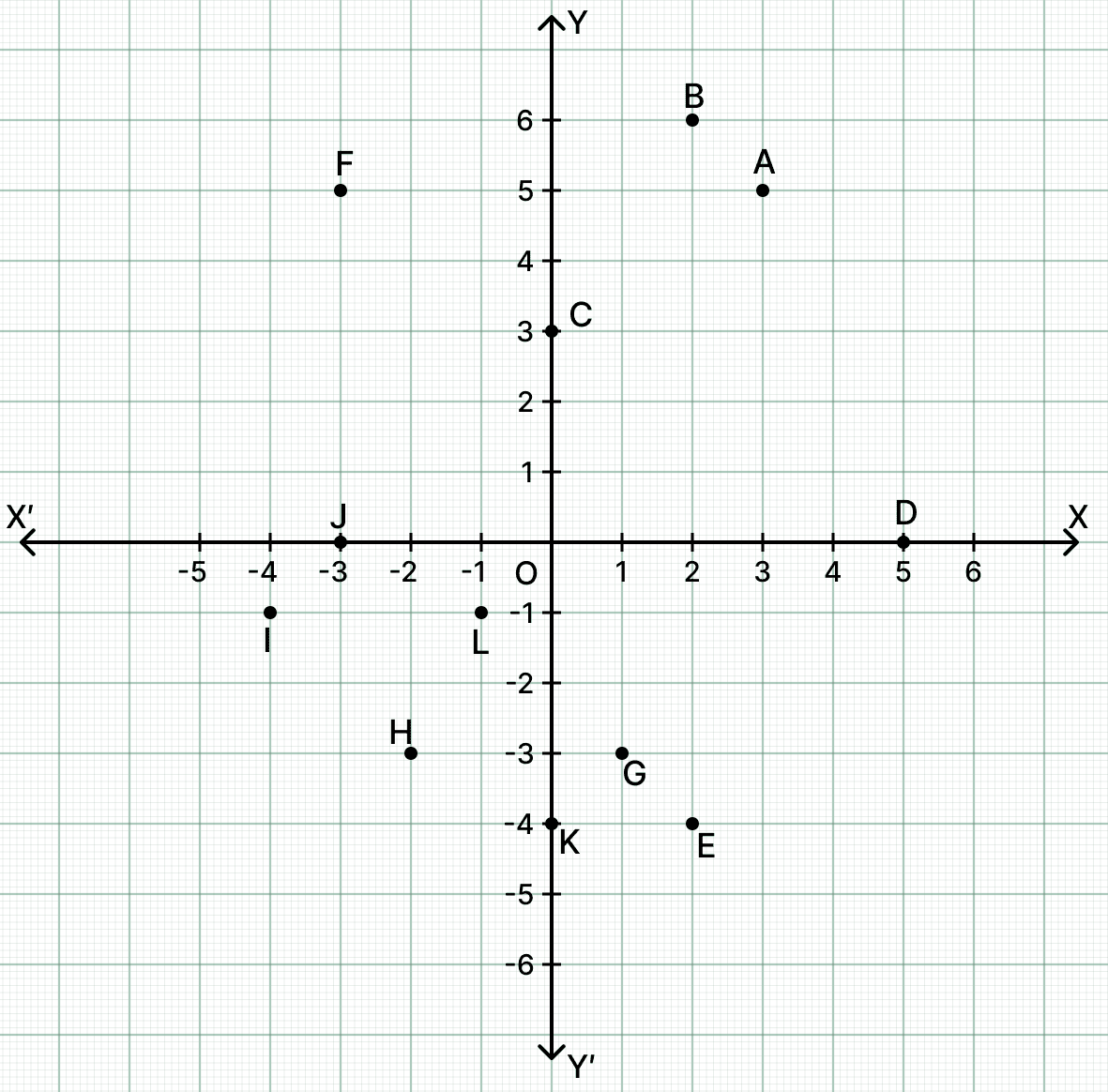
Plot the following points on a graph paper:
(i) A(3, 5)
(ii) B(2, 6)
(iii) C(0, 3)
(iv) D(5, 0)
(v) E(2, -4)
(vi) F(-3, 5)
(vii) G(1, -3)
(viii) H(-2, -3)
(ix) I(-4, -1)
(x) J(-3, 0)
(xi) K(0, -4)
(xii) L(-1, -1)
Answer
Draw the coordinate axes X'OX and Y'OY on a graph paper and choose the units such that 1 cm represents 1 unit on both the axes.
Steps:
To plot A(3, 5), start from the origin O, move 3 units to the right along the x-axis and then move 5 units upwards parallel to the y-axis. Mark a dot at this place.
To plot B(2, 6), start from the origin O, move 2 units to the right along the x-axis and then move 6 units upwards parallel to the y-axis. Mark a dot at this place.
To plot C(0, 3), start from the origin O and move 3 units upwards along the y-axis, as its abscissa is zero. Mark a dot at this place.
To plot D(5, 0), start from the origin O and move 5 units to the right along the x-axis, as its ordinate is zero. Mark a dot at this place.
To plot E(2, -4), start from the origin O, move 2 units to the right along the x-axis and then move 4 units downwards parallel to the y-axis. Mark a dot at this place.
To plot F(-3, 5), start from the origin O, move 3 units to the left along the x-axis and then move 5 units upwards parallel to the y-axis. Mark a dot at this place.
To plot G(1, -3), start from the origin O, move 1 unit to the right along the x-axis and then move 3 units downwards parallel to the y-axis. Mark a dot at this place.
To plot H(-2, -3), start from the origin O, move 2 units to the left along the x-axis and then move 3 units downwards parallel to the y-axis. Mark a dot at this place.
To plot I(-4, -1), start from the origin O, move 4 units to the left along the x-axis and then move 1 unit downwards parallel to the y-axis. Mark a dot at this place.
To plot J(-3, 0), start from the origin O and move 3 units to the left along the x-axis, as its ordinate is zero. Mark a dot at this place.
To plot K(0, -4), start from the origin O and move 4 units downwards along the y-axis, as its abscissa is zero. Mark a dot at this place.
To plot L(-1, -1), start from the origin O, move 1 unit to the left along the x-axis and then move 1 unit downwards parallel to the y-axis. Mark a dot at this place.
The required points are plotted on the graph paper as shown below:
Write down the coordinates of each of the following points P, Q, R, S and T shown on the graph paper.
Answer
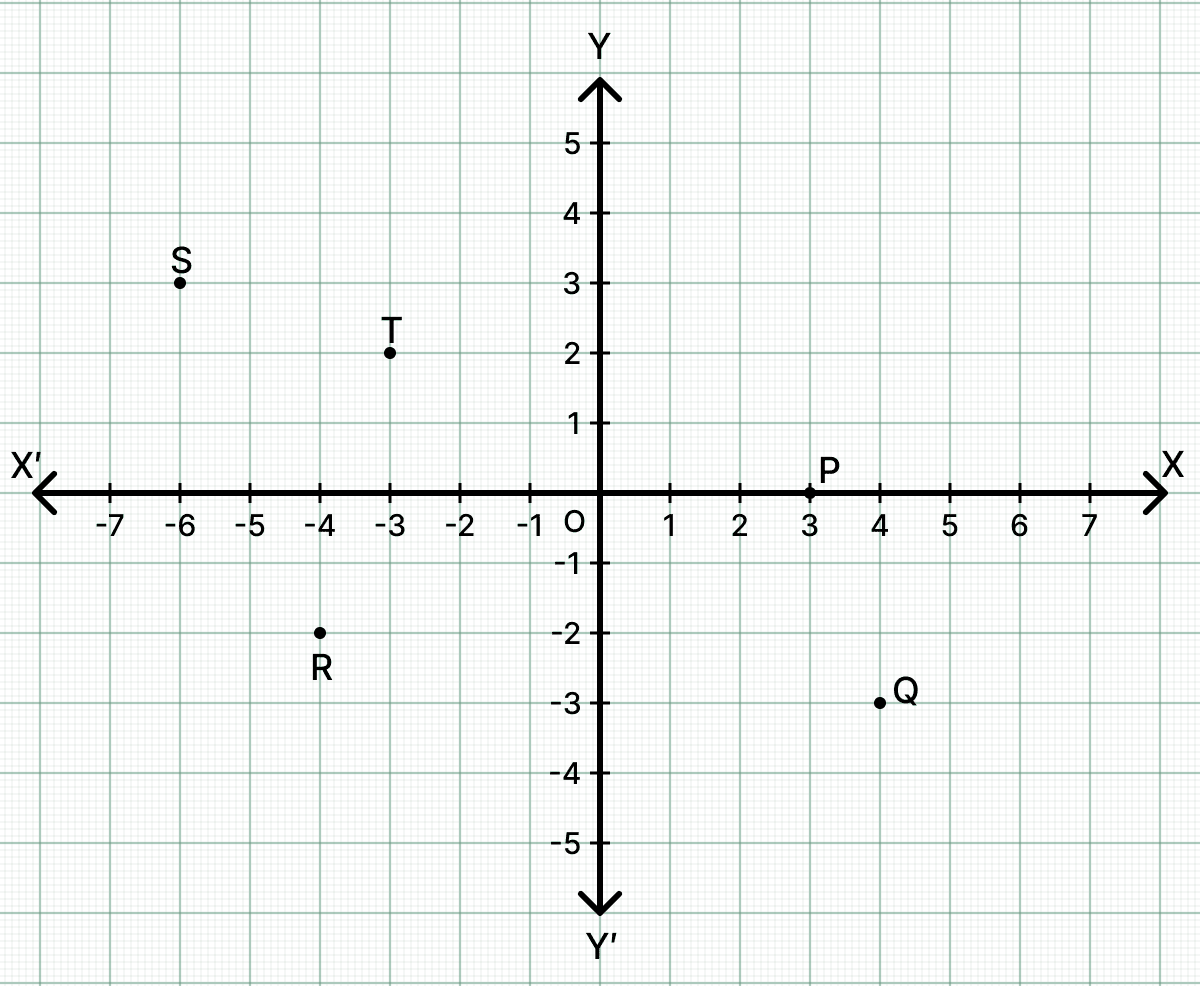
The point P lies on the x-axis at a distance of 3 units to the right of the origin.
So, the abscissa of P is 3 and its ordinate is 0.
∴ P = (3, 0)
The point Q is 4 units to the right of the origin and 3 units below it.
So, the abscissa of Q is 4 and its ordinate is -3.
∴ Q = (4, -3)
The point R is 4 units to the left of the origin and 2 units below it.
So, the abscissa of R is -4 and its ordinate is -2.
∴ R = (-4, -2)
The point S is 6 units to the left of the origin and 3 units above it.
So, the abscissa of S is -6 and its ordinate is 3.
∴ S = (-6, 3)
The point T is 3 units to the left of the origin and 2 units above it.
So, the abscissa of T is -3 and its ordinate is 2.
∴ T = (-3, 2)
Hence, the coordinates are P(3, 0), Q(4, -3), R(-4, -2), S(-6, 3) and T(-3, 2).
In which quadrant does the given point lie?
(i) (3, -7)
(ii) (-5, 1)
(iii) (-4, -6)
Answer
The signs of the coordinates of a point in the four quadrants are shown in the table given below:
| Quadrants ↓ | x (abscissa) | y (ordinate) |
|---|---|---|
| 1st XOY | +ve | +ve |
| 2nd YOX' | -ve | +ve |
| 3rd X'OY' | -ve | -ve |
| 4th Y'OX | +ve | -ve |
(i) In the point (3, -7), the abscissa is 3, which is positive, and the ordinate is -7, which is negative.
The abscissa is positive and the ordinate is negative in the fourth quadrant.
Hence, the point (3, -7) lies in the IV quadrant.
(ii) In the point (-5, 1), the abscissa is -5, which is negative, and the ordinate is 1, which is positive.
The abscissa is negative and the ordinate is positive in the second quadrant.
Hence, the point (-5, 1) lies in the II quadrant.
(iii) In the point (-4, -6), the abscissa is -4 and the ordinate is -6, and both of them are negative.
Both the abscissa and the ordinate are negative in the third quadrant.
Hence, the point (-4, -6) lies in the III quadrant.
On which axis does the given point lie?
(i) (0, -2)
(ii) (7, 0)
(iii) (0, 6)
Answer
(i) In the point (0, -2), the abscissa is zero.
We know that the abscissa of every point lying on the y-axis is zero.
So, the point (0, -2) lies on the y-axis at a distance of 2 units below the origin.
Hence, the point (0, -2) lies on the y-axis.
(ii) In the point (7, 0), the ordinate is zero.
We know that the ordinate of every point lying on the x-axis is zero.
So, the point (7, 0) lies on the x-axis at a distance of 7 units to the right of the origin.
Hence, the point (7, 0) lies on the x-axis.
(iii) In the point (0, 6), the abscissa is zero.
We know that the abscissa of every point lying on the y-axis is zero.
So, the point (0, 6) lies on the y-axis at a distance of 6 units above the origin.
Hence, the point (0, 6) lies on the y-axis.
Plot the points A(4, 1), B(-2, 1), C(-3, -2) and D(3, -2). Name the figure ABCD.
Answer
Draw the coordinate axes X'OX and Y'OY on a graph paper and plot the points A(4, 1), B(-2, 1), C(-3, -2) and D(3, -2) on it.
Join AB, BC, CD and DA.
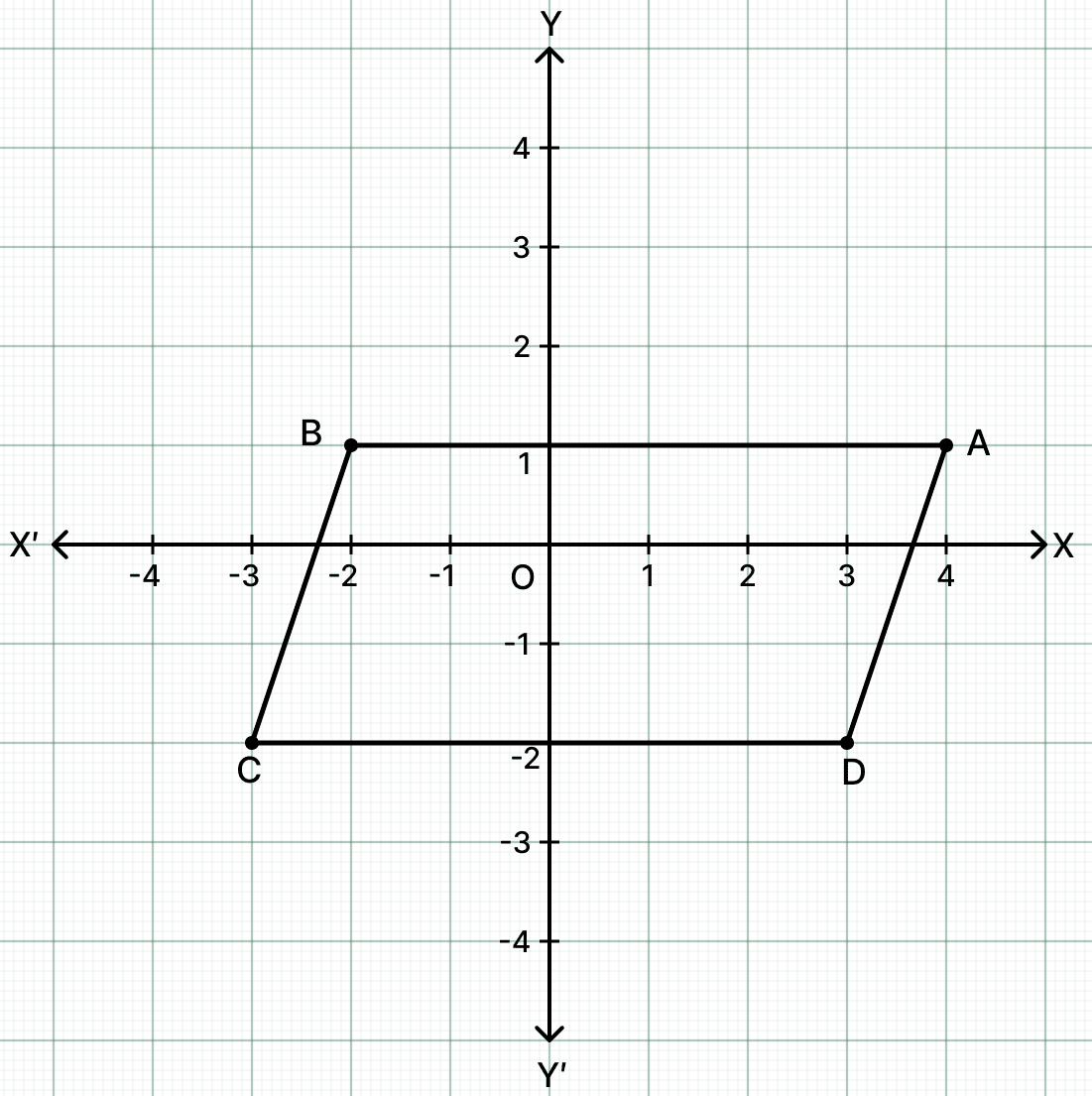
The points A(4, 1) and B(-2, 1) have the same ordinate 1, so AB is parallel to the x-axis and AB = 6 units.
The points D(3, -2) and C(-3, -2) have the same ordinate -2, so DC is parallel to the x-axis and DC = 6 units.
So, AB and DC are equal and parallel to each other.
From the graph, we also find that AD and BC are equal and parallel to each other.
So, ABCD is a quadrilateral in which both the pairs of opposite sides are equal and parallel, but no angle is a right angle.
Hence, the figure ABCD is a parallelogram.
Plot the points A(5, 1), B(-2, 2) and C(4, 2). Name the figure ABC.
Answer
Draw the coordinate axes X'OX and Y'OY on a graph paper and plot the points A(5, 1), B(-2, 2) and C(4, 2) on it.
Join AB, BC and CA.
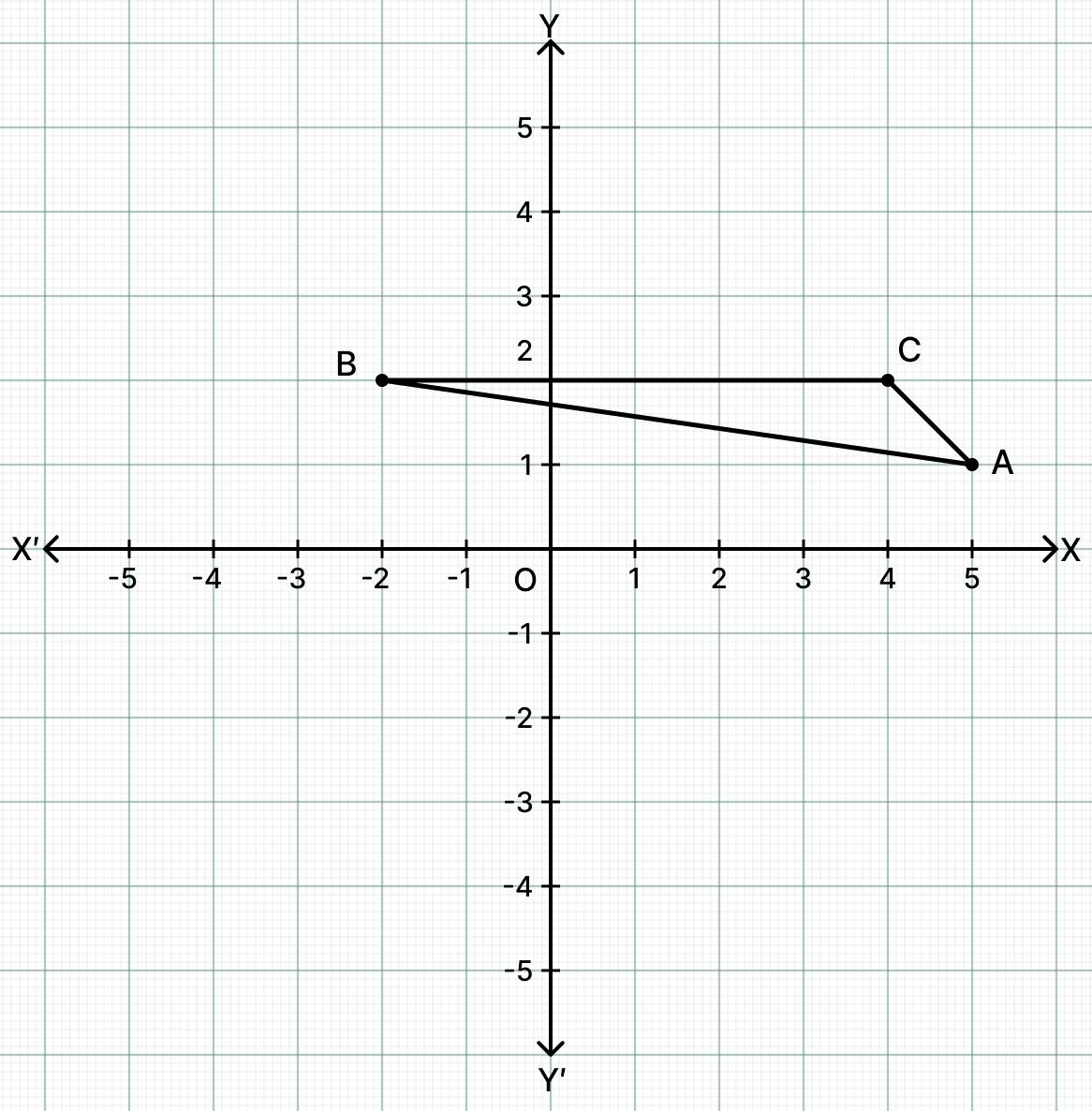
The three given points are not collinear, so on joining them we get a closed figure bounded by three line segments.
The points B(-2, 2) and C(4, 2) have the same ordinate 2, so BC is parallel to the x-axis and BC = 6 units.
From the graph, we find that the sides AB, BC and CA are of different lengths.
Hence, the figure ABC is a triangle.
In the following figure, find the coordinates of the points that represent:
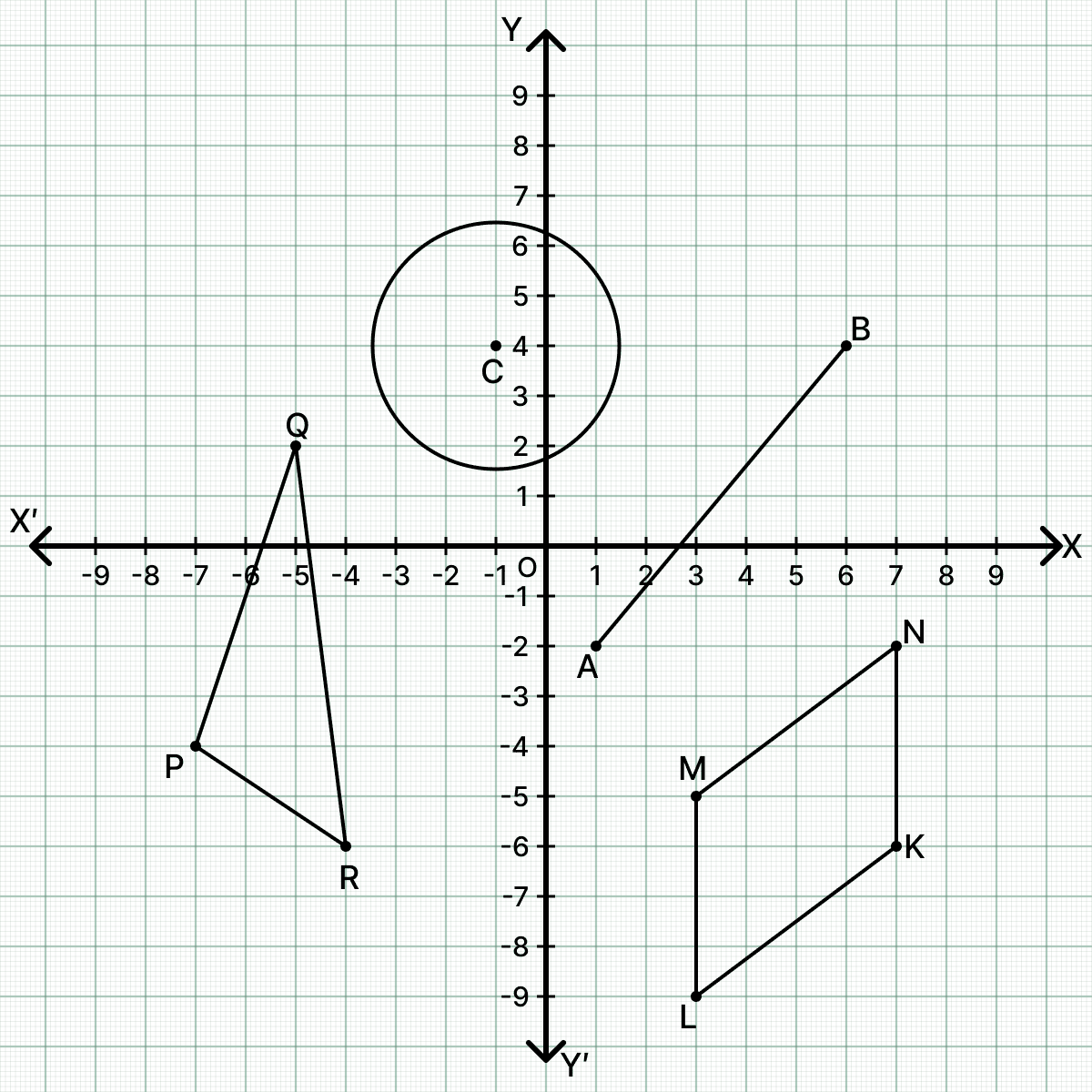
(i) the vertices of the end points of the line segment AB.
(ii) the centre C of the circle.
(iii) the vertices of the triangle PQR
(iv) the vertices of the parallelogram KLMN.
Answer
(i) The point A is 1 unit to the right of the origin and 2 units below it.
So, the abscissa of A is 1 and its ordinate is -2.
The point B is 6 units to the right of the origin and 4 units above it.
So, the abscissa of B is 6 and its ordinate is 4.
Hence, the end points of the line segment AB are A(1, -2) and B(6, 4).
(ii) The centre C of the circle is 1 unit to the left of the origin and 4 units above it.
So, the abscissa of C is -1 and its ordinate is 4.
Hence, the coordinates of the centre of the circle are C(-1, 4).
(iii) The point P is 7 units to the left of the origin and 4 units below it, so its coordinates are (-7, -4).
The point Q is 5 units to the left of the origin and 2 units above it, so its coordinates are (-5, 2).
The point R is 4 units to the left of the origin and 6 units below it, so its coordinates are (-4, -6).
Hence, the vertices of the triangle PQR are P(-7, -4), Q(-5, 2) and R(-4, -6).
(iv) The point K is 7 units to the right of the origin and 6 units below it, so its coordinates are (7, -6).
The point L is 3 units to the right of the origin and 9 units below it, so its coordinates are (3, -9).
The point M is 3 units to the right of the origin and 5 units below it, so its coordinates are (3, -5).
The point N is 7 units to the right of the origin and 2 units below it, so its coordinates are (7, -2).
Hence, the vertices of the parallelogram KLMN are K(7, -6), L(3, -9), M(3, -5) and N(7, -2).
In the following figure, determine:
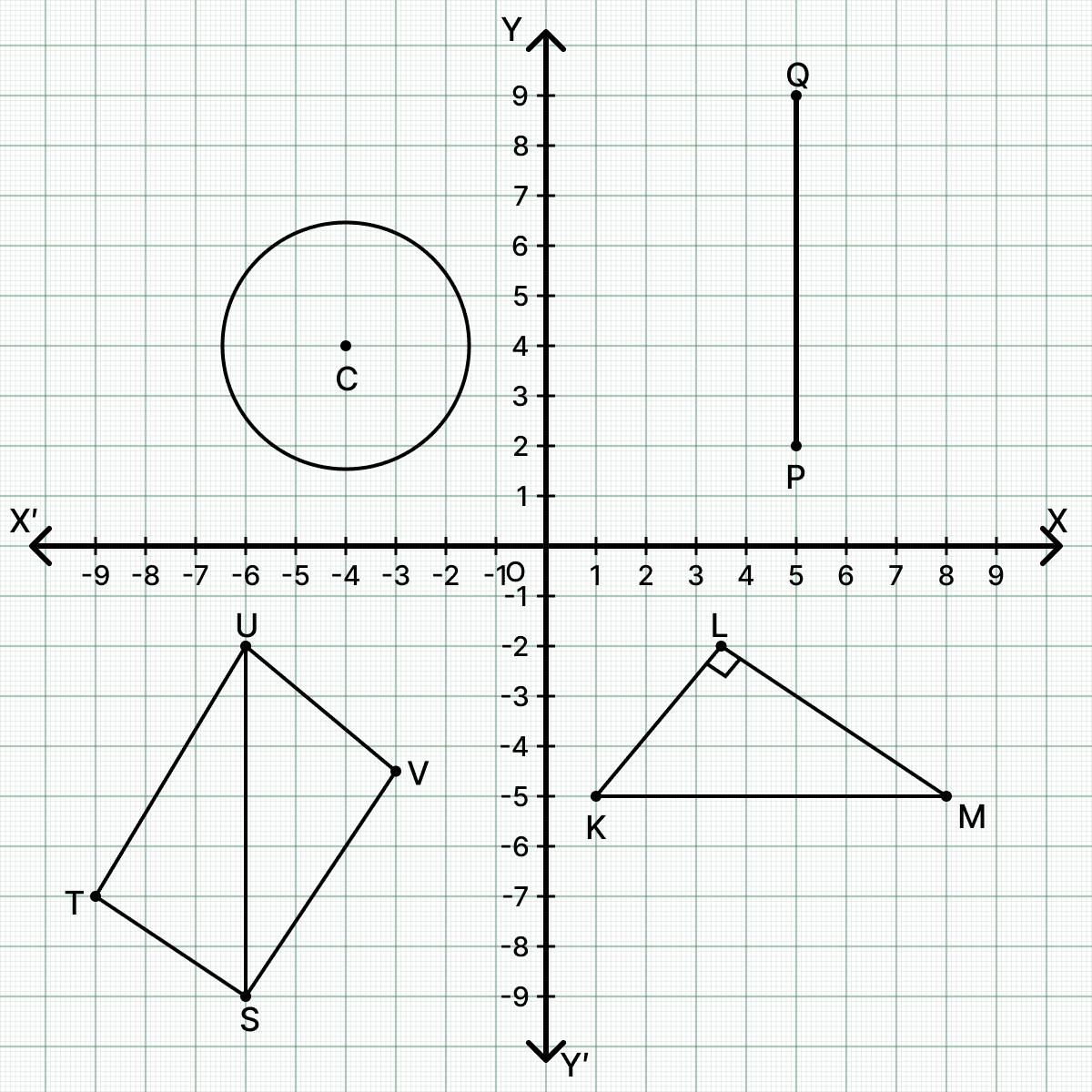
(i) the length of the line segment PQ.
(ii) the length of the hypotenuse of the right ΔKLM.
(iii) the radius of the circle with centre C.
(iv) the length of a diagonal of the rectangle STUV.
Answer
(i) From the figure, the coordinates of the end points of the line segment PQ are P(5, 2) and Q(5, 9).
Since P and Q have the same abscissa 5, the line segment PQ is parallel to the y-axis.
So, its length is the difference of the ordinates of Q and P.
PQ = 9 units - 2 units = 7 units
Hence, the length of the line segment PQ is 7 units.
(ii) In the right triangle KLM, the right angle is at L, so KM is the hypotenuse.
From the figure, the coordinates of K and M are K(1, -5) and M(8, -5).
Since K and M have the same ordinate -5, the line segment KM is parallel to the x-axis.
So, its length is the difference of the abscissae of M and K.
KM = 8 units - 1 unit = 7 units
Hence, the length of the hypotenuse of the right ΔKLM is 7 units.
(iii) From the figure, the coordinates of the centre of the circle are C(-4, 4).
Draw CD ∥ X'OX, meeting the circle at the point D.
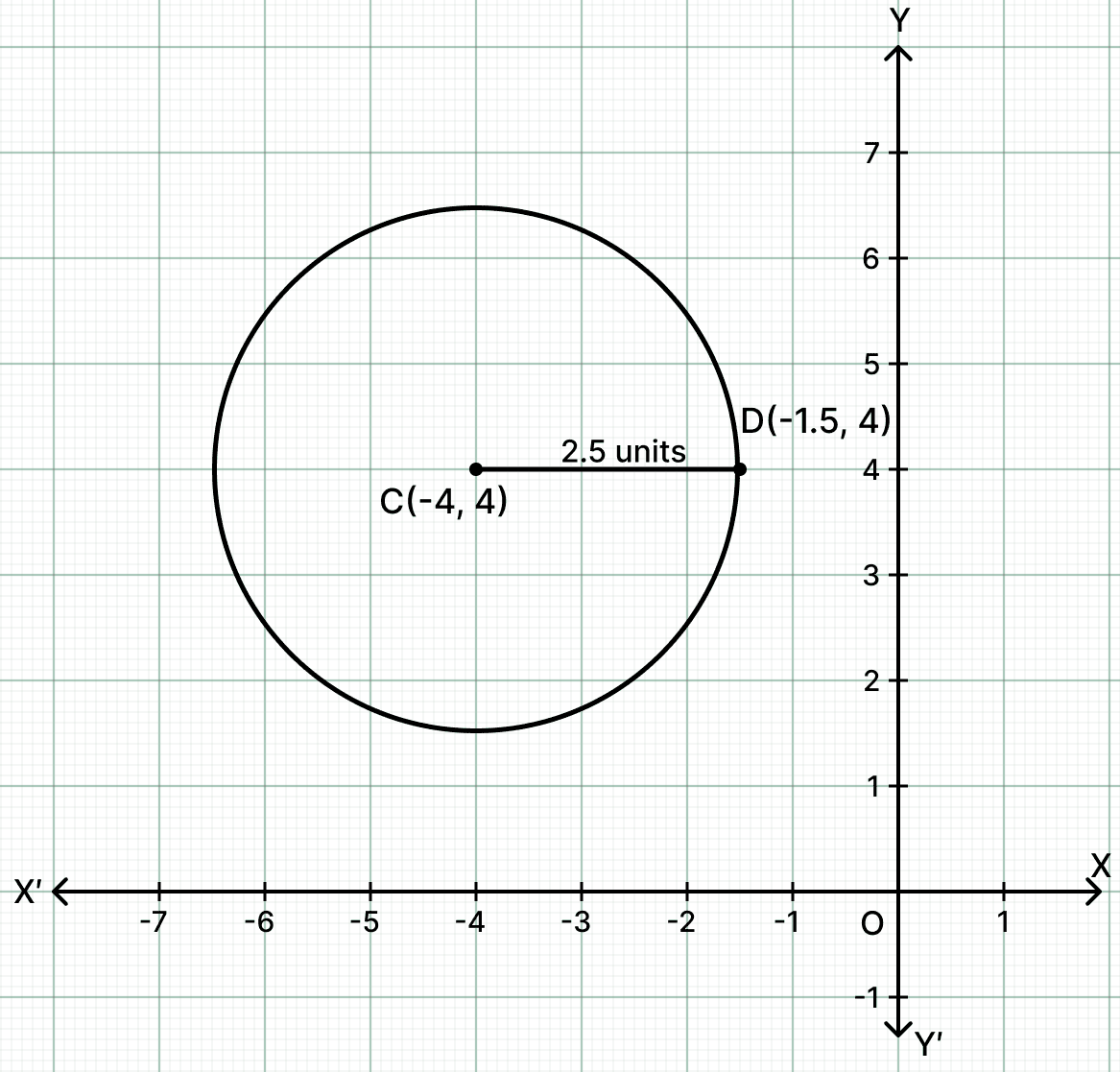
Since D lies on the circle and has the same ordinate as C, from the figure the coordinates of D are (-1.5, 4).
Radius (CD) = -1.5 units - (-4 units) = 2.5 units
Hence, the radius of the circle with centre C is 2.5 units.
(iv) From the figure, the coordinates of the end points of the diagonal SU of the rectangle STUV are S(-6, -9) and U(-6, -2).
Since S and U have the same abscissa -6, the diagonal SU is parallel to the y-axis.
So, its length is the difference of the ordinates of U and S.
SU = -2 units - (-9 units) = 7 units
Hence, the length of a diagonal of the rectangle STUV is 7 units.
The coordinates of three of the vertices of a rectangle are (2, -5), (7, -5) and (7, -2). Plot these points on a graph paper. Complete the rectangle and find the coordinates of the fourth vertex.
Answer
Draw the coordinate axes X'OX and Y'OY on a graph paper and plot the points A(2, -5), B(7, -5) and C(7, -2) on it.
Join AB and BC.
The points A(2, -5) and B(7, -5) have the same ordinate -5, so AB is parallel to the x-axis and AB = 5 units.
The points B(7, -5) and C(7, -2) have the same abscissa 7, so BC is parallel to the y-axis and BC = 3 units.
To complete the rectangle ABCD, draw a line through C parallel to BA and a line through A parallel to BC.
These two lines meet at the point D, as shown below:
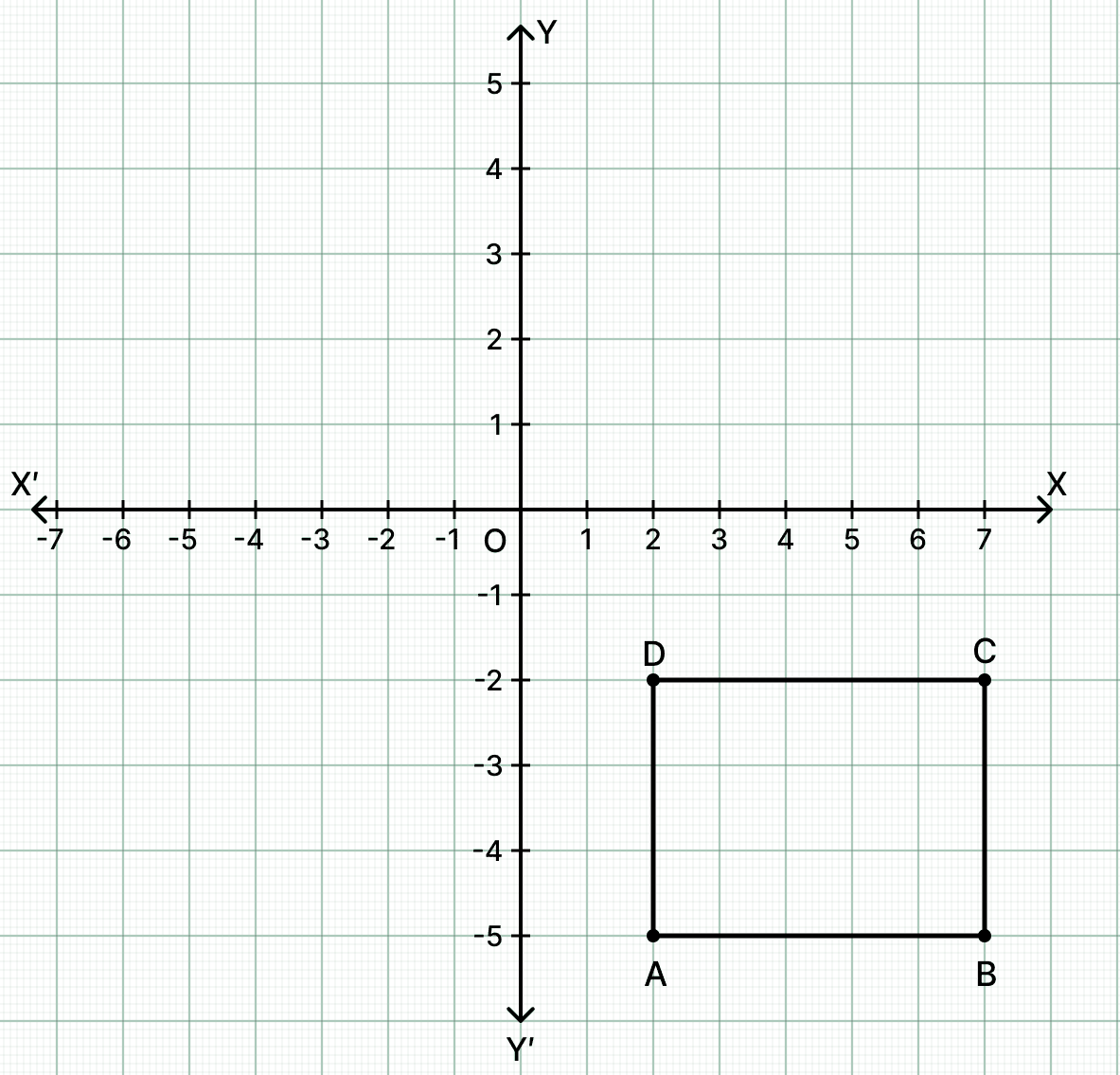
The point D is 2 units to the right of the origin and 2 units below it.
So, the abscissa of D is 2, which is the same as that of A, and its ordinate is -2, which is the same as that of C.
Hence, the coordinates of the fourth vertex are D(2, -2).
Three of the vertices of a parallelogram have coordinates (5, -2), (6, 2) and (0, 2). Plot these points on a graph paper and find the coordinates of the fourth vertex.
Answer
Draw the coordinate axes X'OX and Y'OY on a graph paper and plot the points A(5, -2), B(6, 2) and C(0, 2) on it.
Join AB and BC.
The points B(6, 2) and C(0, 2) have the same ordinate 2, so BC is parallel to the x-axis and BC = 6 units.
In the parallelogram ABCD, the side AD is opposite to the side BC.
So, AD must be parallel to BC and AD = BC = 6 units.
Starting from the point A(5, -2), move 6 units to the left parallel to the x-axis and mark the point D, as shown below:
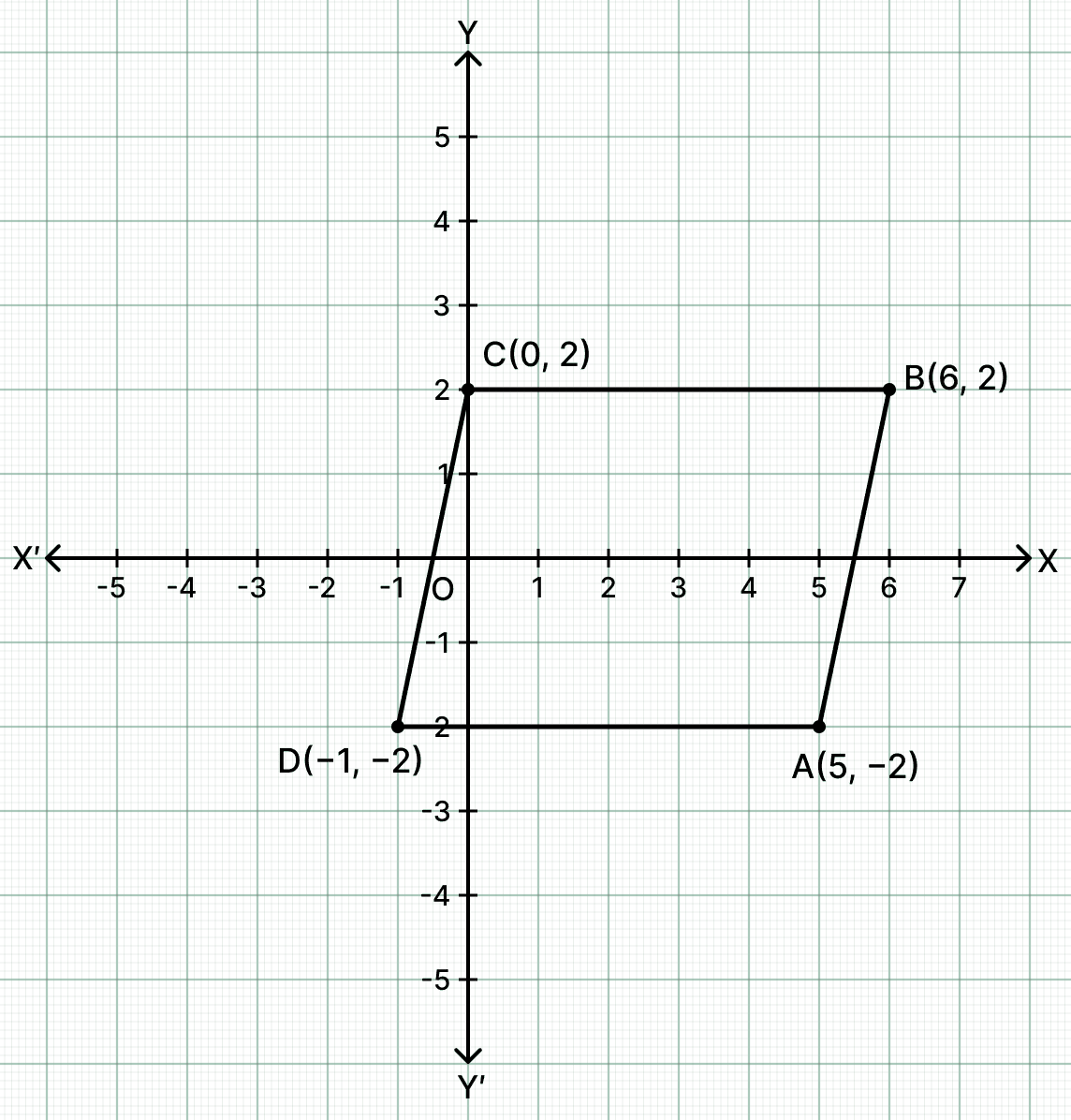
The point D is 1 unit to the left of the origin and 2 units below it.
So, the abscissa of D is -1 and its ordinate is -2.
Hence, the coordinates of the fourth vertex are D(-1, -2).