
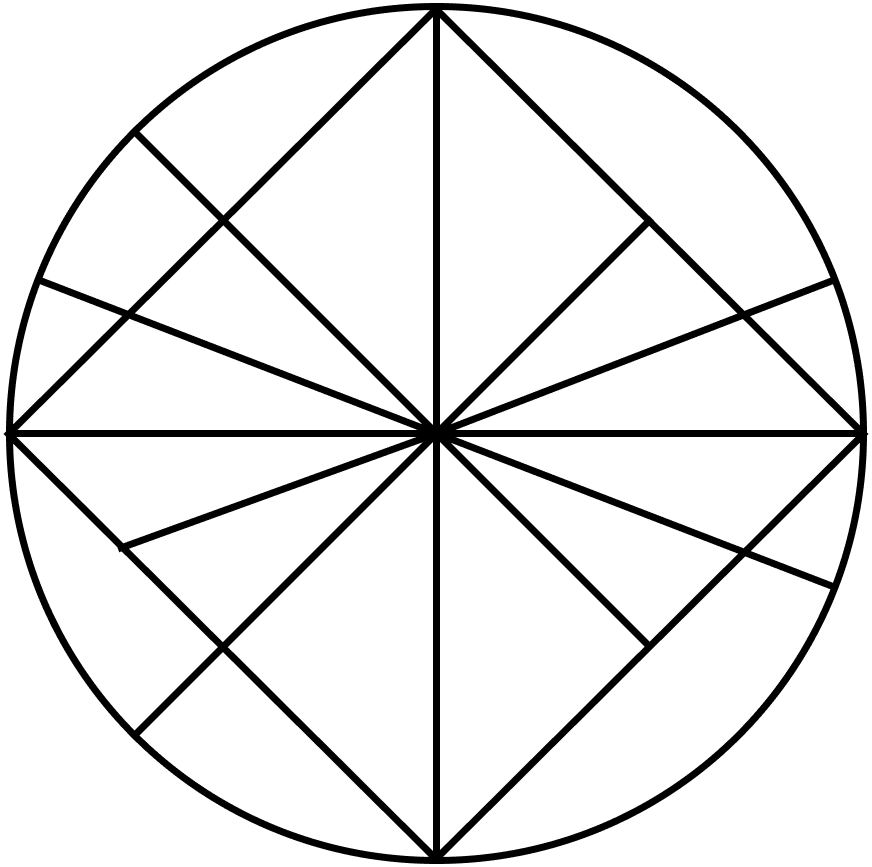
How many different chords are shown in the adjoining figure?
4
6
7
10
Answer
We know that,
A chord of a circle is a line segment whose end points lie on the circle.
In the given figure, six line segments are drawn through the centre of the circle, each having both its end points on the circle. So, each of them is a chord of the circle.
Besides these, four more line segments having both their end points on the circle are drawn, which do not pass through the centre. So, each of them is also a chord of the circle.
∴ Total number of chords = 6 + 4 = 10
Hence, option 4 is the correct option.
How many different radii are shown in the figure above?
9
10
11
12
Answer
We know that,
A radius of a circle is a line segment joining any point on the circle to its centre.
In the given figure, six chords pass through the centre of the circle and each of them is divided by the centre into two line segments, each joining the centre to a point on the circle.
∴ Total number of radii = 6 × 2 = 12
Hence, option 4 is the correct option.
How many different diameters are shown in the figure above?
6
3
4
5
Answer
We know that,
A chord of a circle passing through its centre is called a diameter of the circle.
In the given figure, six of the chords pass through the centre of the circle.
∴ Total number of diameters = 6
Hence, option 1 is the correct option.
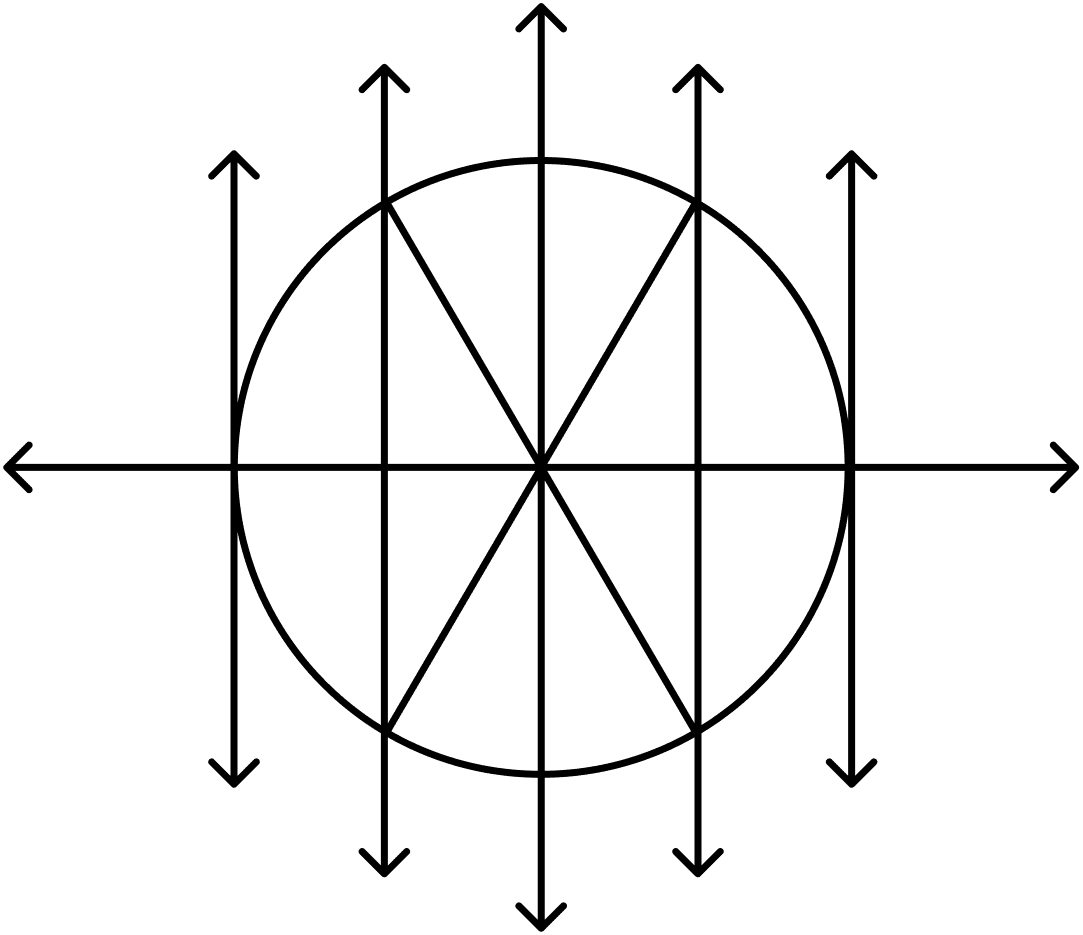
How many tangents and secants are shown in the adjoining figure?
2 tangents, 4 secants
4 tangents, 4 secants
4 tangents, 2 secants
2 tangents, 6 secants
Answer
We know that,
A line which touches a circle at one point only is called a tangent to the circle and a line which intersects a circle at two distinct points is called a secant of the circle.
In the given figure, six lines are drawn.
Out of these, the two extreme vertical lines touch the circle at one point each, so each of them is a tangent to the circle.
The remaining three vertical lines and the horizontal line intersect the circle at two distinct points each, so each of them is a secant of the circle.
∴ The figure has 2 tangents and 4 secants.
Hence, option 1 is the correct option.
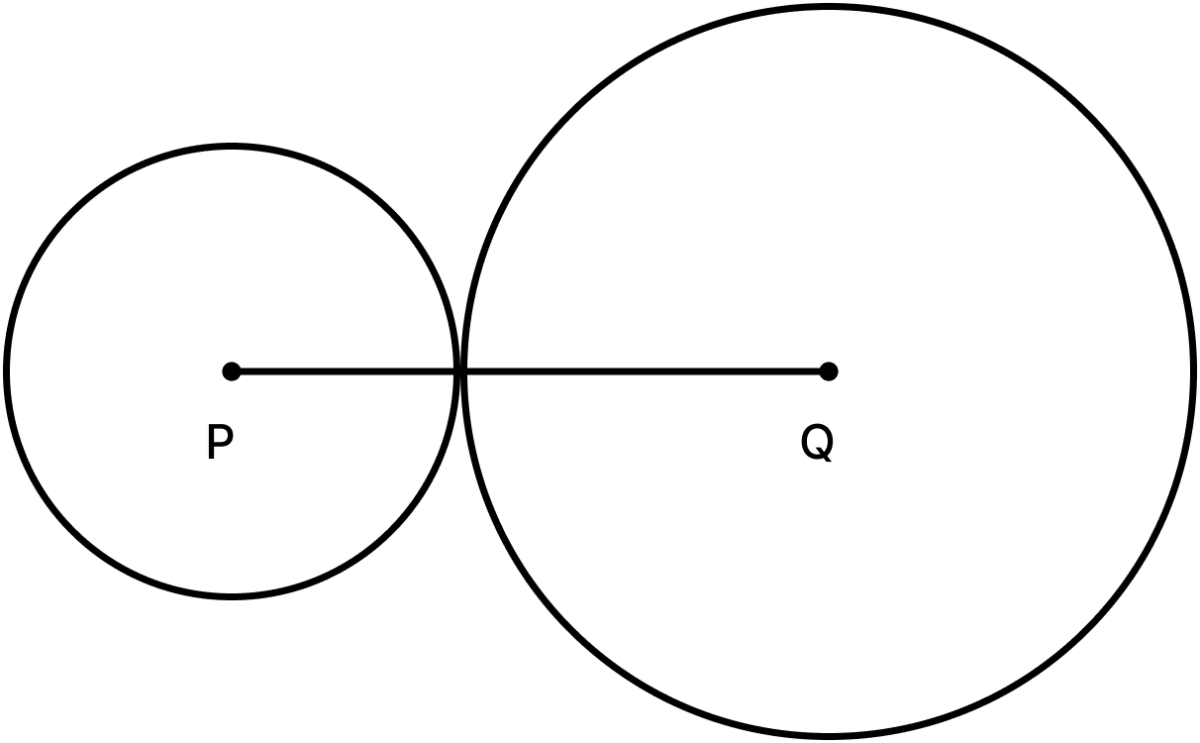
P and Q are the centres of two circles. If they are 15 cm apart and the radius of the bigger circle is the same as the diameter of the smaller circle, then the radius of the bigger circle is:
6 cm
8 cm
10 cm
12 cm
Answer
Let the radius of the smaller circle with centre P be cm.
Given, the radius of the bigger circle with centre Q is the same as the diameter of the smaller circle.
⇒ Radius of the bigger circle = cm
From figure, the two circles touch each other and PQ is made up of the radius of the smaller circle and the radius of the bigger circle.
Hence, option 3 is the correct option.
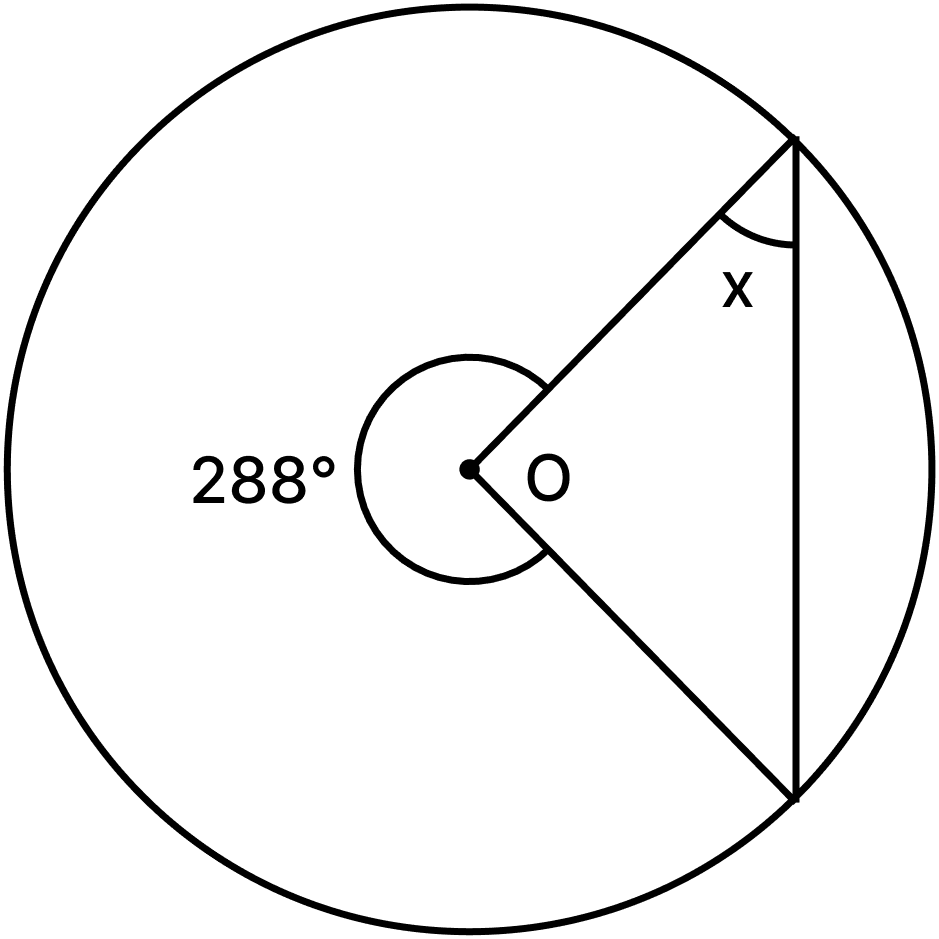
In the adjoining figure, O is the centre of the circle. The measure of the angle marked is:
40°
46°
51°
54°
Answer
From figure,
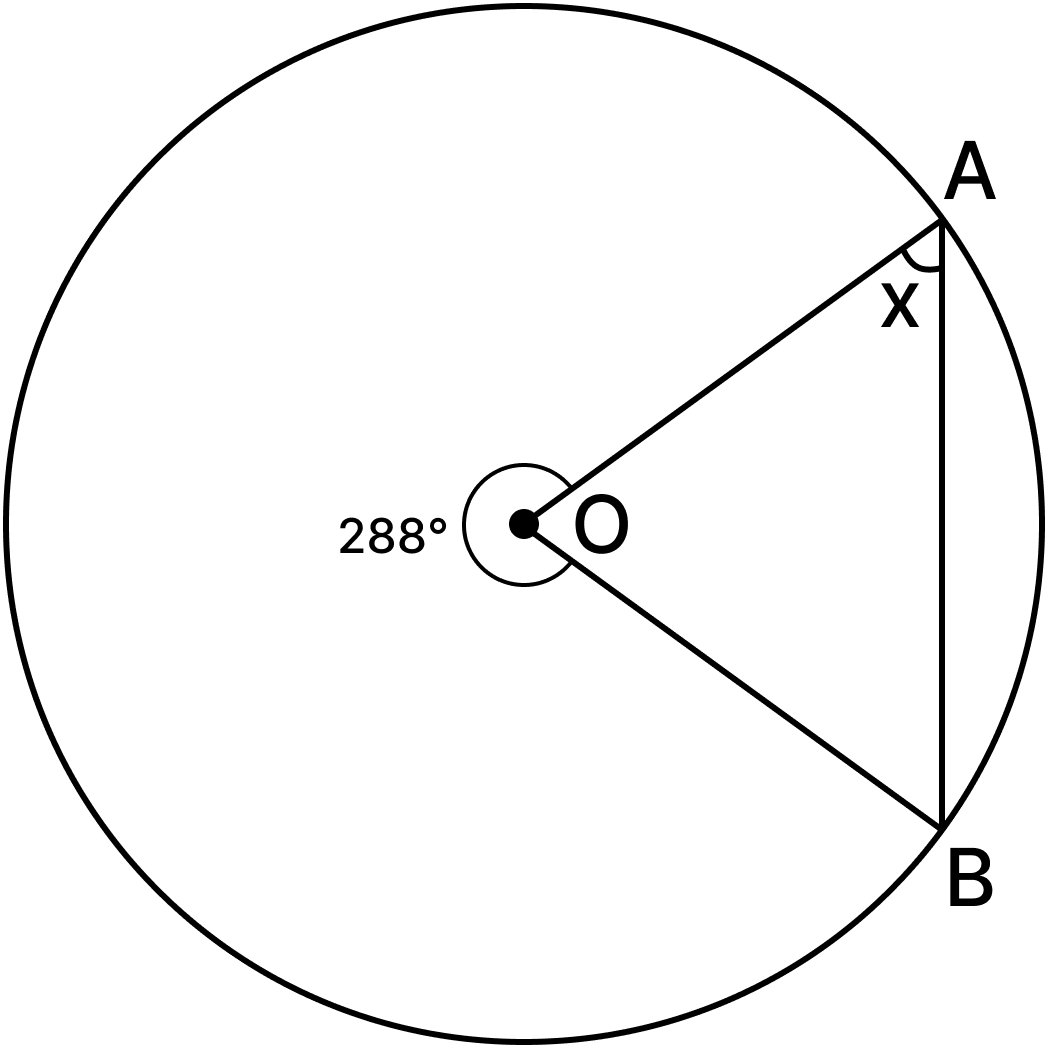
OA and OB are the radii of the circle, AB is a chord of the circle, reflex ∠AOB = 288° and = ∠OAB.
Since the angles at the point O make a complete angle,
⇒ ∠AOB + reflex ∠AOB = 360°
⇒ ∠AOB + 288° = 360°
⇒ ∠AOB = 360° - 288°
⇒ ∠AOB = 72°
In ∆OAB,
⇒ OA = OB (Radii of the circle)
⇒ ∠OAB = ∠OBA = [Angles opposite to equal sides of a triangle are always equal]
Using angle sum property,
⇒ ∠OAB + ∠OBA + ∠AOB = 180°
Hence, option 4 is the correct option.
How many circles can be drawn with a given point as the centre?
1
2
3
Infinite
Answer
Taking the given point as the centre, a circle can be drawn with any length as its radius, and the radius can be taken in an infinite number of ways.
So, an infinite number of circles can be drawn with a given point as the centre. Such circles are called concentric circles.
Hence, option 4 is the correct option.
How many circles can be drawn to pass through two given points?
0
1
2
Infinite
Answer
Let A and B be the two given points.
Every point lying on the perpendicular bisector of AB is at the same distance from A and from B, so a circle passing through A and B can be drawn with any such point as the centre.
Since the perpendicular bisector of AB has an infinite number of points, an infinite number of circles can be drawn to pass through two given points.
Hence, option 4 is the correct option.
How many circles can be drawn to pass through 3 non-collinear points?
0
1
2
Infinite
Answer
Through three non-collinear points, one and only one circle can be drawn, as the perpendicular bisectors of the line segments joining these points meet at exactly one point, which is the centre of that circle.
Hence, option 2 is the correct option.
To define an arc we need at least how many points?
1
2
3
4
Answer
Two points lying on a circle divide it into two arcs, so these two points alone do not tell us which of the two arcs is being talked about.
A third point lying on the required arc is needed to name it, as the arc ACB.
So, at least 3 points are needed to define an arc.
Hence, option 3 is the correct option.
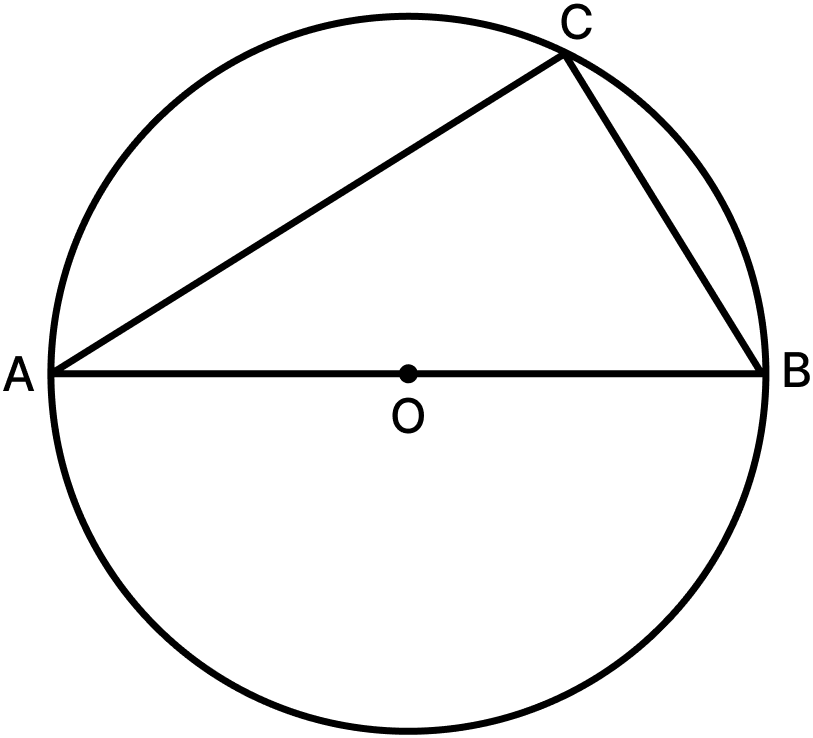
In the adjoining figure, O is the centre of the circle. If AC = 15 cm, BC = 8 cm then AB is equal to:
12 cm
16 cm
17 cm
18 cm
Answer
From figure,
AB is the diameter of the circle, AC = 15 cm and BC = 8 cm.
We know that,
Angle in a semi-circle is a right angle.
⇒ ∠ACB = 90°
So, ∆ACB is a right angled triangle with AB as the hypotenuse.
Using Pythagoras theorem,
⇒ AB2 = AC2 + BC2
⇒ AB2 = 152 + 82
⇒ AB2 = 225 + 64
⇒ AB2 = 289
⇒ AB =
⇒ AB = 17 cm
Hence, option 3 is the correct option.
Assertion (A): In the figure, the line AB is a secant as well as a chord of the circle.
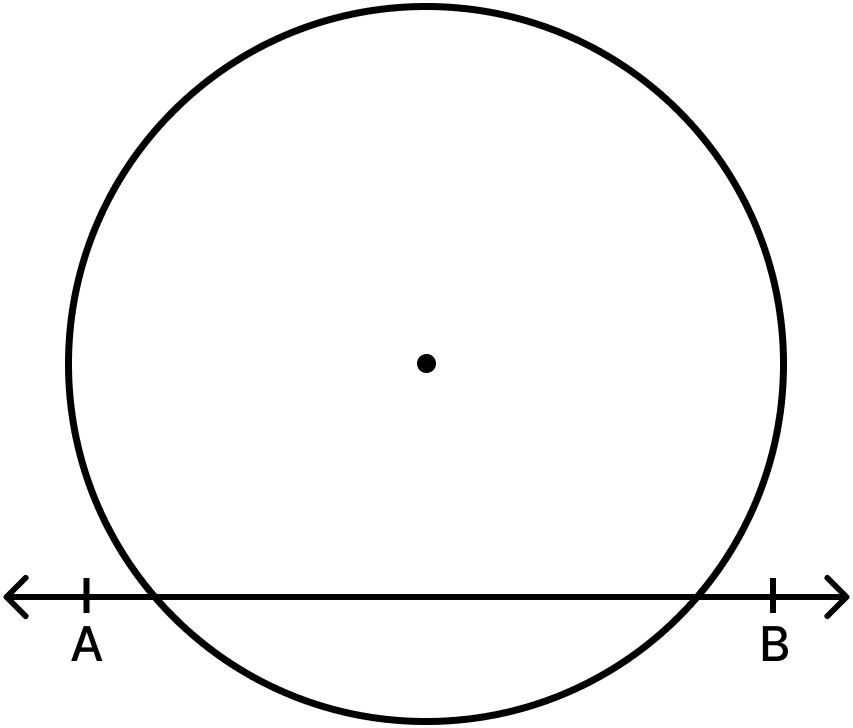
Reason (R): A line segment whose end points lie on a circle is called a chord.
Both Assertion (A) and Reason (R) are true and Reason (R) is the correct explanation of Assertion (A).
Both Assertion (A) and Reason (R) are true and Reason (R) is not the correct explanation of Assertion (A).
Assertion (A) is true but Reason (R) is false.
Assertion (A) is false but Reason (R) is true.
Answer
From figure, the line AB intersects the circle at two distinct points, so it is a secant of the circle.
But the points A and B do not lie on the circle, they lie outside it, and a chord must be a line segment having both its end points on the circle. So, AB is not a chord of the circle.
So, Assertion (A) is false.
A chord of a circle is a line segment whose end points lie on the circle.
So, Reason (R) is true.
∴ Assertion (A) is false but Reason (R) is true.
Hence, option 4 is the correct option.
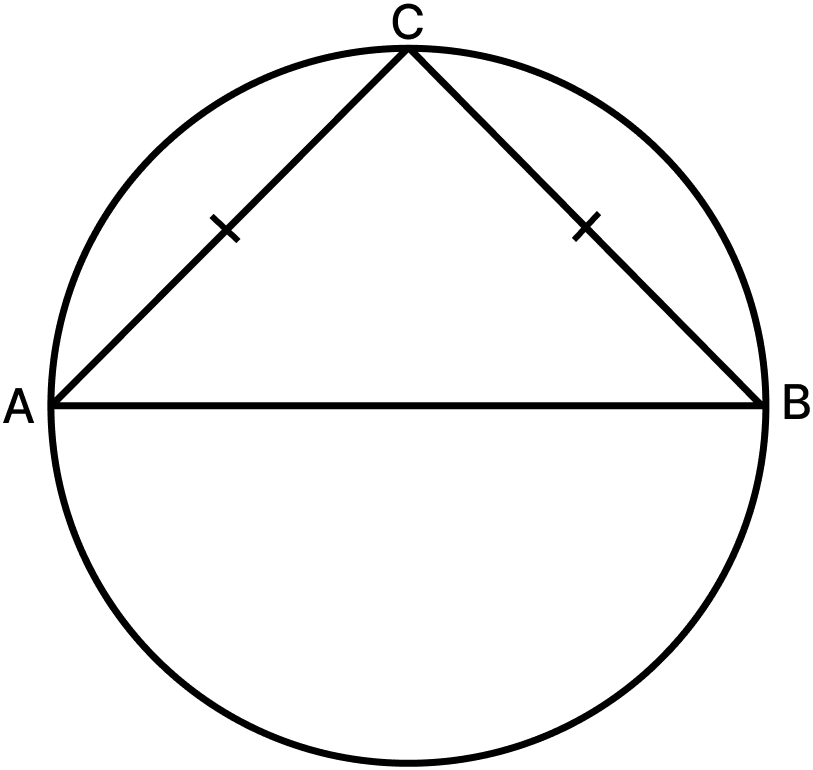
Assertion (A): In the figure, if AC = BC, then ∠BAC = 45°.
Reason (R): The angle in a semi-circle is a right angle.
Both Assertion (A) and Reason (R) are true and Reason (R) is the correct explanation of Assertion (A).
Both Assertion (A) and Reason (R) are true and Reason (R) is not the correct explanation of Assertion (A).
Assertion (A) is true but Reason (R) is false.
Assertion (A) is false but Reason (R) is true.
Answer
From figure, AB is the diameter of the circle and AC = BC.
We know that,
Angle in a semi-circle is a right angle.
⇒ ∠ACB = 90°
So, Reason (R) is true.
In ∆ACB,
⇒ AC = BC
⇒ ∠BAC = ∠ABC [Angles opposite to equal sides of a triangle are always equal]
Using angle sum property,
⇒ ∠BAC + ∠ABC + ∠ACB = 180°
⇒ ∠BAC + ∠BAC + 90° = 180°
⇒ 2∠BAC = 180° - 90°
⇒ 2∠BAC = 90°
⇒ ∠BAC =
⇒ ∠BAC = 45°
So, Assertion (A) is true and Reason (R) is the correct explanation of Assertion (A), as the value of ∠BAC is obtained by using the fact that the angle in a semi-circle is a right angle.
∴ Both Assertion (A) and Reason (R) are true and Reason (R) is the correct explanation of Assertion (A).
Hence, option 1 is the correct option.