
Take a point O on your notebook and draw circles of radii 3.6 cm, 4.5 cm and 5.3 cm, each having the same centre O.
Answer
Steps of construction:
Mark a point O on the notebook.
With O as centre and radius 3.6 cm, draw a circle.
With the same point O as centre and radius 4.5 cm, draw another circle.
With the same point O as centre and radius 5.3 cm, draw one more circle.
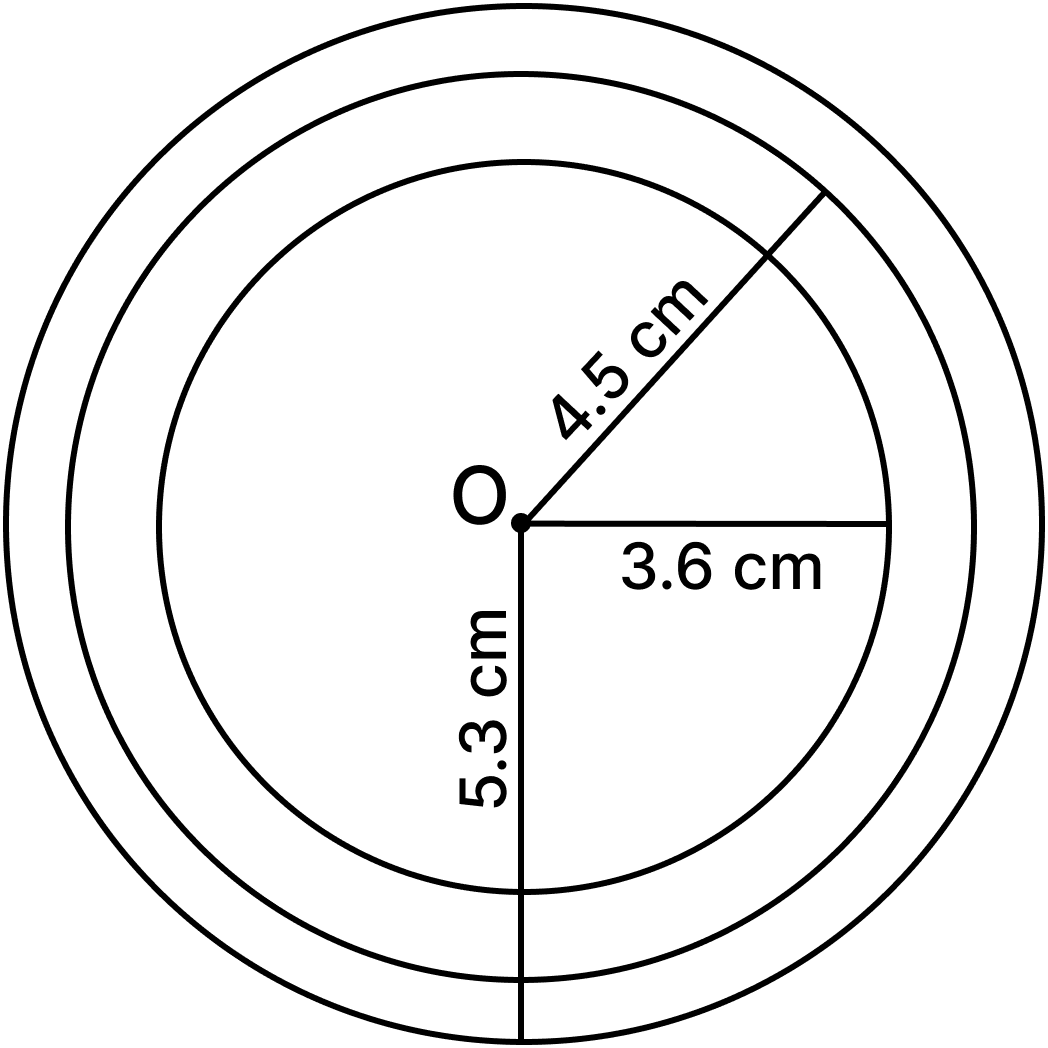
The three circles drawn have the same centre O but different radii.
Hence, the three circles drawn are concentric circles with centre O.
Draw a circle with centre C and radius 4.2 cm. Mark points, P, Q, R such that P lies in the interior of the circle, Q lies on the circle and R lies in the exterior of the circle.
Answer
We know that,
A point lies in the interior of a circle, on the circle or in the exterior of the circle according as its distance from the centre is less than, equal to or greater than the radius of the circle.
Steps of construction:
Mark a point C and with C as centre and radius 4.2 cm, draw a circle.
Mark a point P inside the circle such that CP < 4.2 cm.
Mark a point Q on the circle, so that CQ = 4.2 cm.
Mark a point R outside the circle such that CR > 4.2 cm.
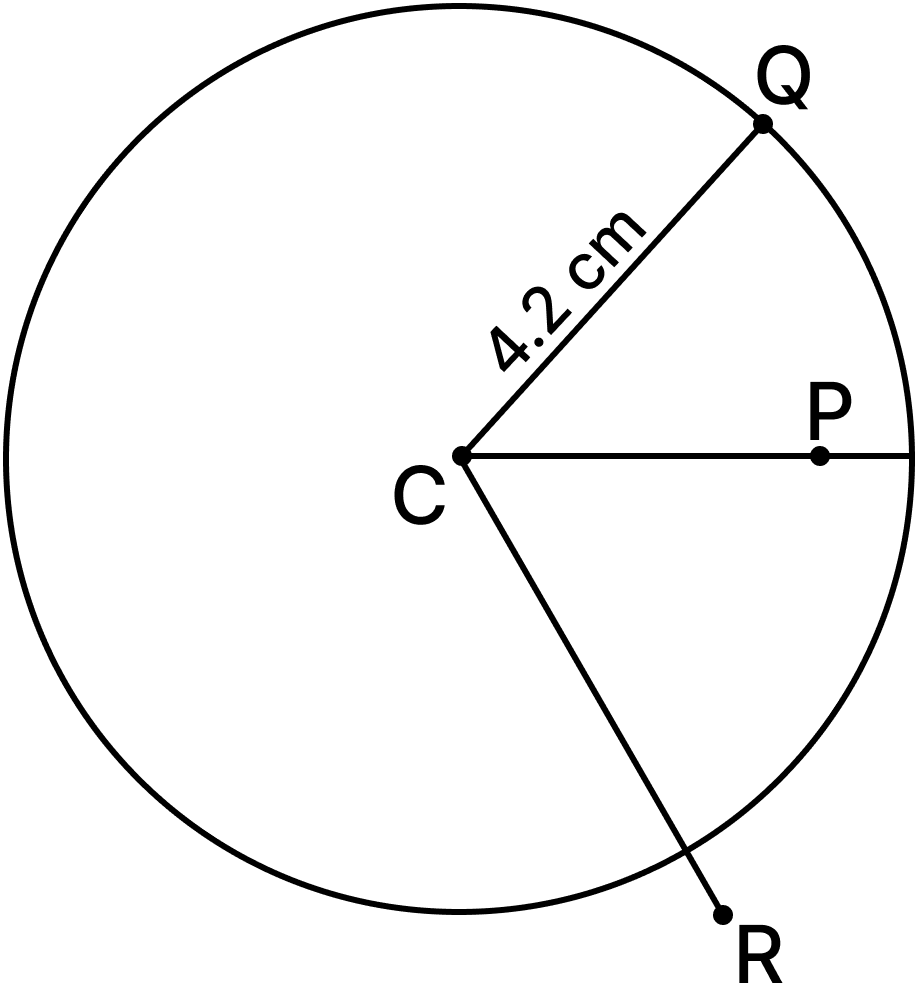
Hence, P lies in the interior of the circle, Q lies on the circle and R lies in the exterior of the circle.
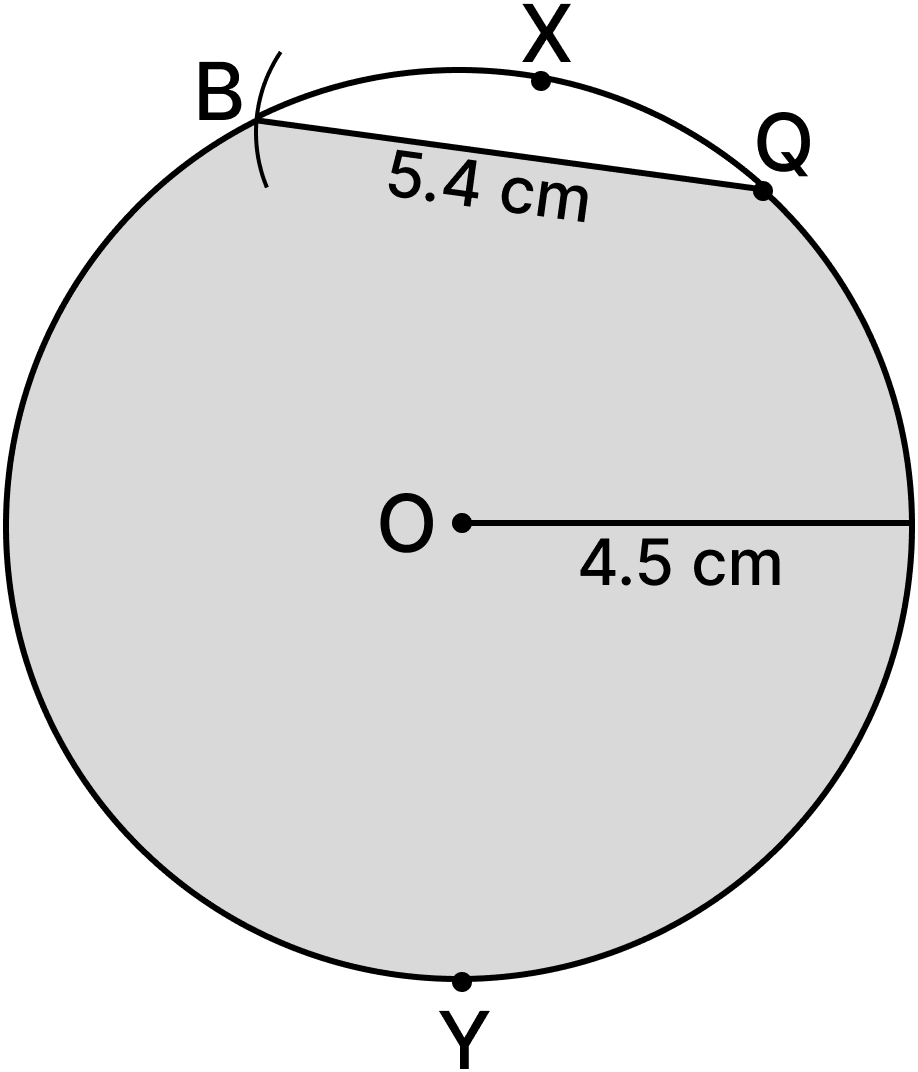
Draw a circle with centre O and radius 4.5 cm. Draw a chord AB of length 5.4 cm. Indicate by marking points X and Y, the minor arc AXB and the major arc AYB of the circle. Shade the major segment of the circle.
Answer
Steps of construction:
Mark a point O and with O as centre and radius 4.5 cm, draw a circle.
Take any point A on the circle.
With A as centre and radius 5.4 cm, draw an arc to meet the circle at B.
Join A and B. AB is the required chord.
Mark a point X on the smaller arc cut off by the chord AB, so that AXB is the minor arc, and mark a point Y on the bigger arc, so that AYB is the major arc.
Shade the part of the circular region bounded by the chord AB and the major arc AYB. It is the major segment of the circle and it contains the centre O.
Draw a circle with centre O and radius 3.6 cm. Draw a sector OAXB having the angle 75°. Measure the length of chord AB.
Answer
Steps of construction:
Mark a point O and with O as centre and radius 3.6 cm, draw a circle.
Take any point A on the circle and join OA.
Draw another radius OB such that ∠AOB = 75°.
Mark a point X on the arc AB lying inside ∠AOB. The region bounded by the radii OA, OB and the arc AXB is the required sector OAXB.
Join A and B.
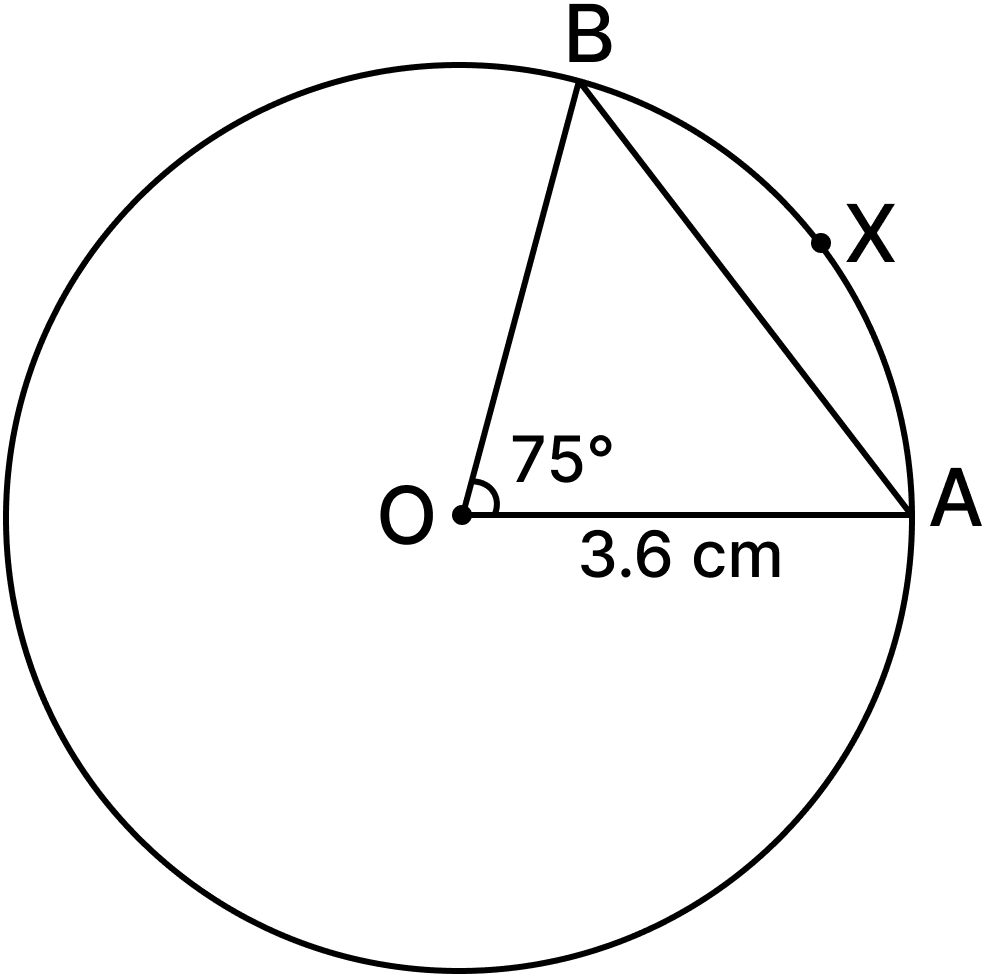
On measuring the chord AB, we get AB = 4.4 cm (approximately).
Hence, the length of the chord AB = 4.4 cm (approximately).
State which of the following statements are true and which are false:
(i) Every circle has a unique centre.
(ii) Each radius of a circle is also a chord of the circle.
(iii) Every circle has a unique diameter.
(iv) A line can meet a circle at the most at two points.
(v) A circle consists of an infinite number of points.
(vi) A secant of a circle is a segment having its end points on the circle.
(vii) One and only one tangent can be drawn to pass through a point on the circle.
(viii) One and only one tangent can be drawn to a circle from a point outside it.
(ix) An infinite number of chords can be drawn inside a circle.
(x) A minor arc is bigger than a semi-circle.
Answer
(i) A circle has one and only one centre, which is the fixed point lying in its interior and all the points of the circle are at the same distance from it.
Hence, the given statement is true.
(ii) A chord of a circle is a line segment having both its end points on the circle, whereas a radius has one end point at the centre and the other end point on the circle.
Hence, the given statement is false.
(iii) Every chord passing through the centre of a circle is a diameter, and an infinite number of such chords can be drawn. So, a circle has an infinite number of diameters.
Hence, the given statement is false.
(iv) A line either does not meet a circle at all, or touches it at one point, or intersects it at two distinct points. So, a line can meet a circle at the most at two points.
Hence, the given statement is true.
(v) A circle is the set of all those points of the plane which are at a constant distance from its centre and there are an infinite number of such points.
Hence, the given statement is true.
(vi) A secant of a circle is a line which intersects the circle at two distinct points. The segment having its end points on the circle is called a chord and not a secant.
Hence, the given statement is false.
(vii) At a given point on a circle, one and only one tangent can be drawn to the circle.
Hence, the given statement is true.
(viii) From a point lying in the exterior of a circle, exactly two tangents can be drawn to the circle and these two tangents are equal in length.
Hence, the given statement is false.
(ix) A chord can be drawn by joining any two points of the circle, and a circle has an infinite number of points. So, an infinite number of chords can be drawn inside a circle.
Hence, the given statement is true.
(x) An arc is called a minor arc if its length is less than the length of the arc of the semi-circle. So, a minor arc is smaller than a semi-circle.
Hence, the given statement is false.
Fill in the blanks:
(i) ............... is the longest chord of a circle.
(ii) Every point on a circle is ............... from its centre.
(iii) The perimeter of a circle is called its ...............
(iv) A part of a circle bounded by an ............... and a ............... is called a segment.
(v) A part of a circle bounded by an ............... and the two ............... at its ends is called a sector.
(vi) A ............... of a circle divides the circular region into two parts each called a segment.
Answer
(i) Diameter is the longest chord of a circle.
(ii) Every point on a circle is equidistant from its centre.
(iii) The perimeter of a circle is called its circumference.
(iv) A part of a circle bounded by an arc and a chord is called a segment.
(v) A part of a circle bounded by an arc and the two radii at its ends is called a sector.
(vi) A chord of a circle divides the circular region into two parts each called a segment.
In the adjoining figure, name:
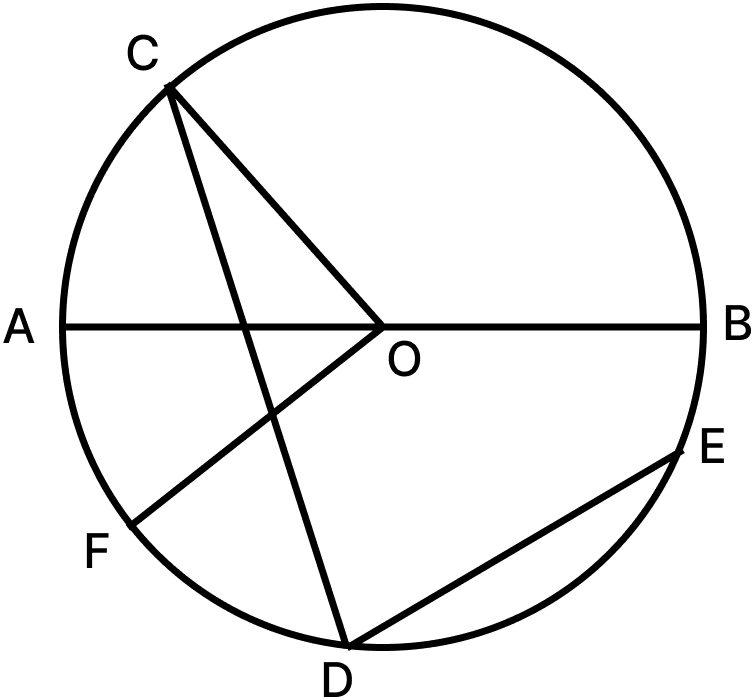
(i) all the radii
(ii) all the diameters
(iii) all the chords
(iv) a minor arc
(v) a major arc
(vi) a minor segment
(vii) a major segment
(viii) a minor sector
(ix) a major sector
Answer
(i) A radius of a circle is a line segment joining any point on the circle to its centre.
In the given figure, the line segments joining the centre O to the points A, B, C and F of the circle are drawn.
Hence, the radii are OA, OB, OC and OF.
(ii) A chord of a circle passing through its centre is called a diameter of the circle.
In the given figure, only the chord AB passes through the centre O.
Hence, the diameter is AB.
(iii) A chord of a circle is a line segment whose end points lie on the circle.
In the given figure, the line segments AB, CD and DE have both their end points on the circle.
Hence, the chords are AB, CD and DE.
(iv) An arc is called a minor arc if its length is less than the length of the arc of the semi-circle.
Hence, is a minor arc.
(v) An arc is called a major arc if its length is greater than the length of the arc of the semi-circle.
Hence, is a major arc.
(vi) The part of the circular region bounded by an arc and a chord is called a segment, and the segment containing the minor arc is called the minor segment.
The chord CD divides the circular region into two parts, out of which the part bounded by the chord CD and the minor arc CAD does not contain the centre O.
Hence, CADC is a minor segment.
(vii) The segment containing the major arc is called the major segment and it contains the centre of the circle.
Hence, CBDC is a major segment.
(viii) The part of the circular region bounded by an arc and the two radii at the ends of the arc is called a sector, and the sector containing the minor arc is called the minor sector.
The radii OC and OF together with the minor arc CAF bound the smaller part of the circular region.
Hence, OCAFO is a minor sector.
(ix) The sector containing the major arc is called the major sector.
The radii OC and OF together with the major arc CBF bound the bigger part of the circular region.
Hence, OCBFO is a major sector.
Find the length of the tangent drawn to a circle of radius 12 cm from a point distant 23 cm from the centre.
Answer
Let O be the centre of the circle of radius 12 cm and PT be the tangent drawn to the circle from the point P, touching the circle at T.
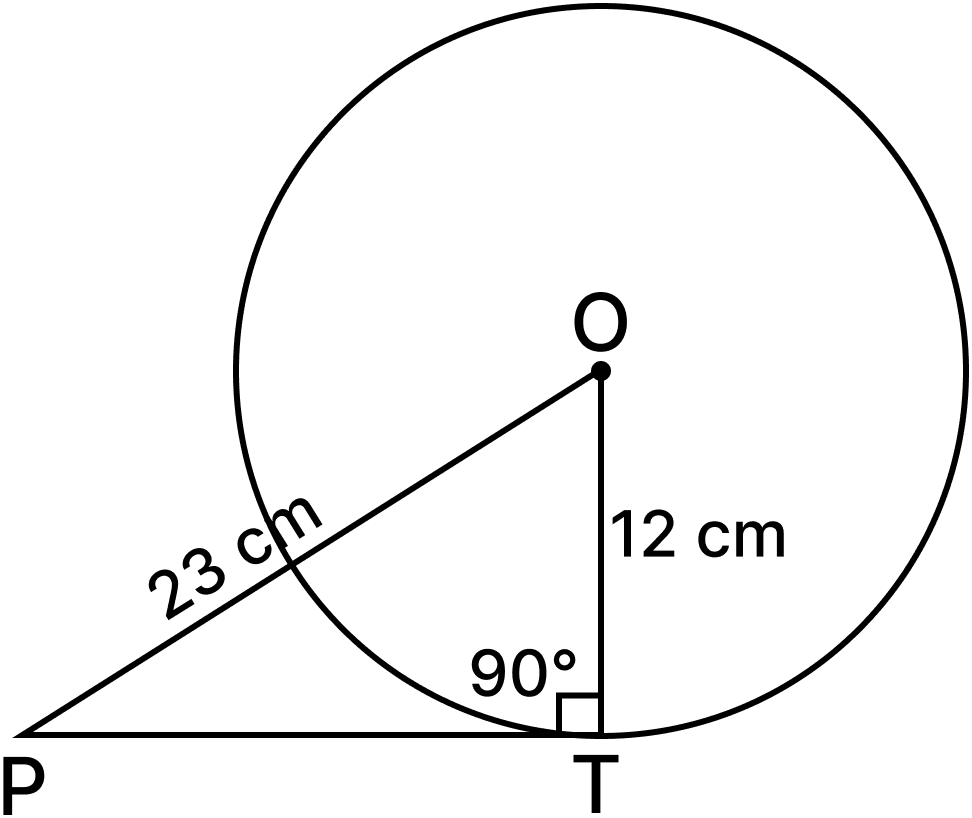
Thus,
OT = 12 cm and OP = 23 cm.
We know that,
The tangent at any point of a circle and the radius through that point are perpendicular to each other.
⇒ ∠OTP = 90°
So, ∆OTP is a right angled triangle with OP as the hypotenuse.
Using Pythagoras theorem,
⇒ OT2 + PT2 = OP2
⇒ 122 + PT2 = 232
⇒ 144 + PT2 = 529
⇒ PT2 = 529 - 144
⇒ PT2 = 385
⇒ PT =
⇒ PT = 19.6 cm (approximately)
Hence, the length of the tangent = cm = 19.6 cm (approximately).
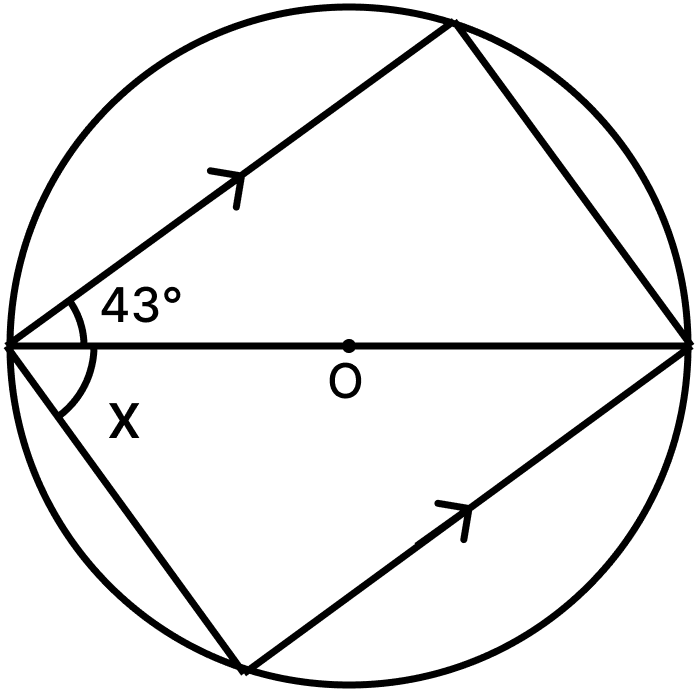
In the following figure, O is the centre of the circle. Find the measure of the angle marked .
Answer
From figure,
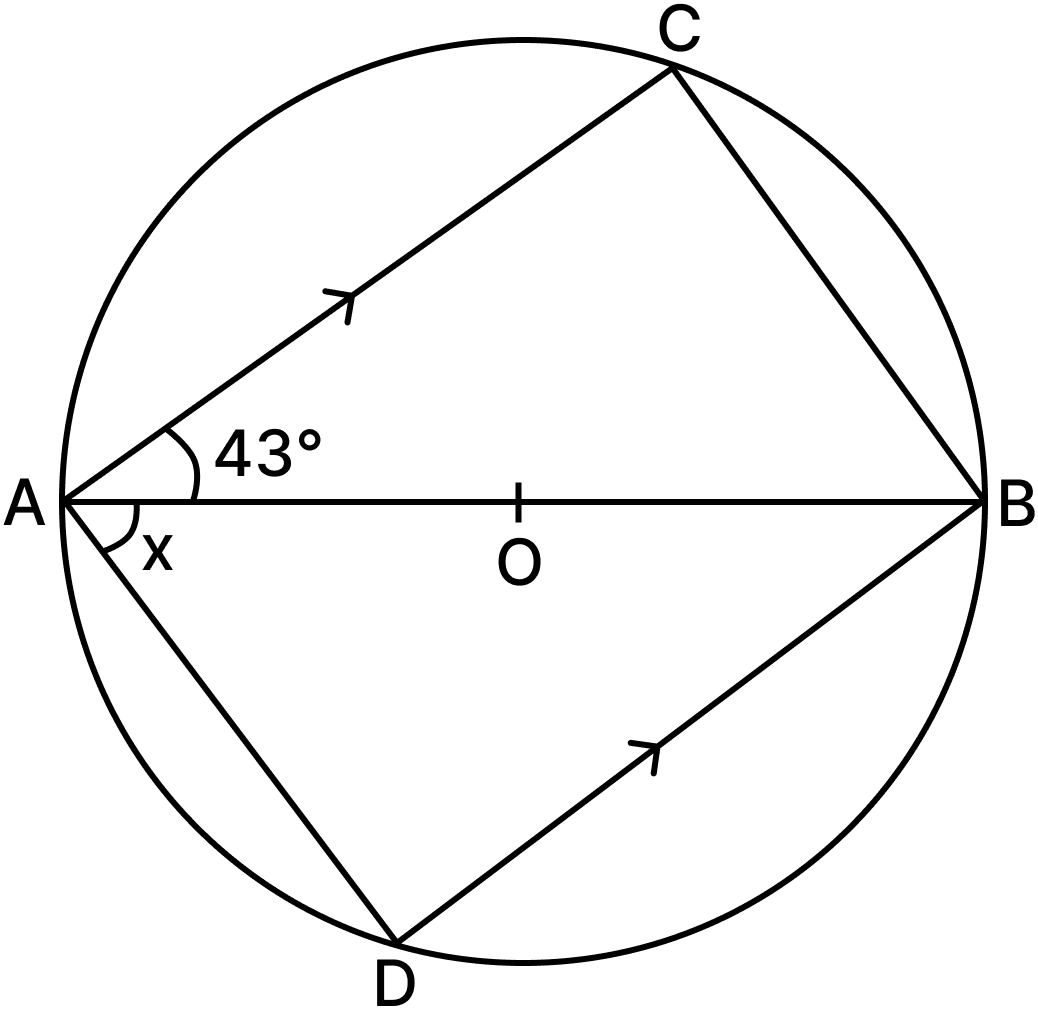
AB is the diameter of the circle, ∠CAB = 43°, AC ∥ DB and = ∠DAB.
Since, AC ∥ DB and AB is the transversal,
⇒ ∠DBA = ∠CAB (Alternate angles are equal)
⇒ ∠DBA = 43°
We know that,
Angle in a semi-circle is a right angle.
⇒ ∠ADB = 90°
In ∆ADB, using angle sum property,
⇒ ∠DAB + ∠DBA + ∠ADB = 180°
Hence, .
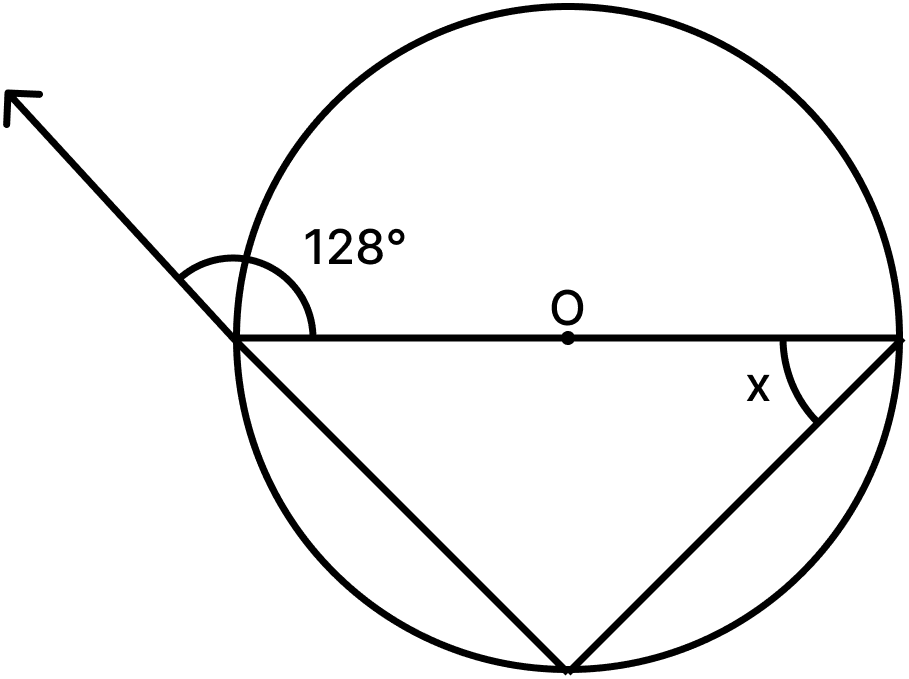
In the following figure, O is the centre of the circle. Find the measure of the angle marked .
Answer
From figure,
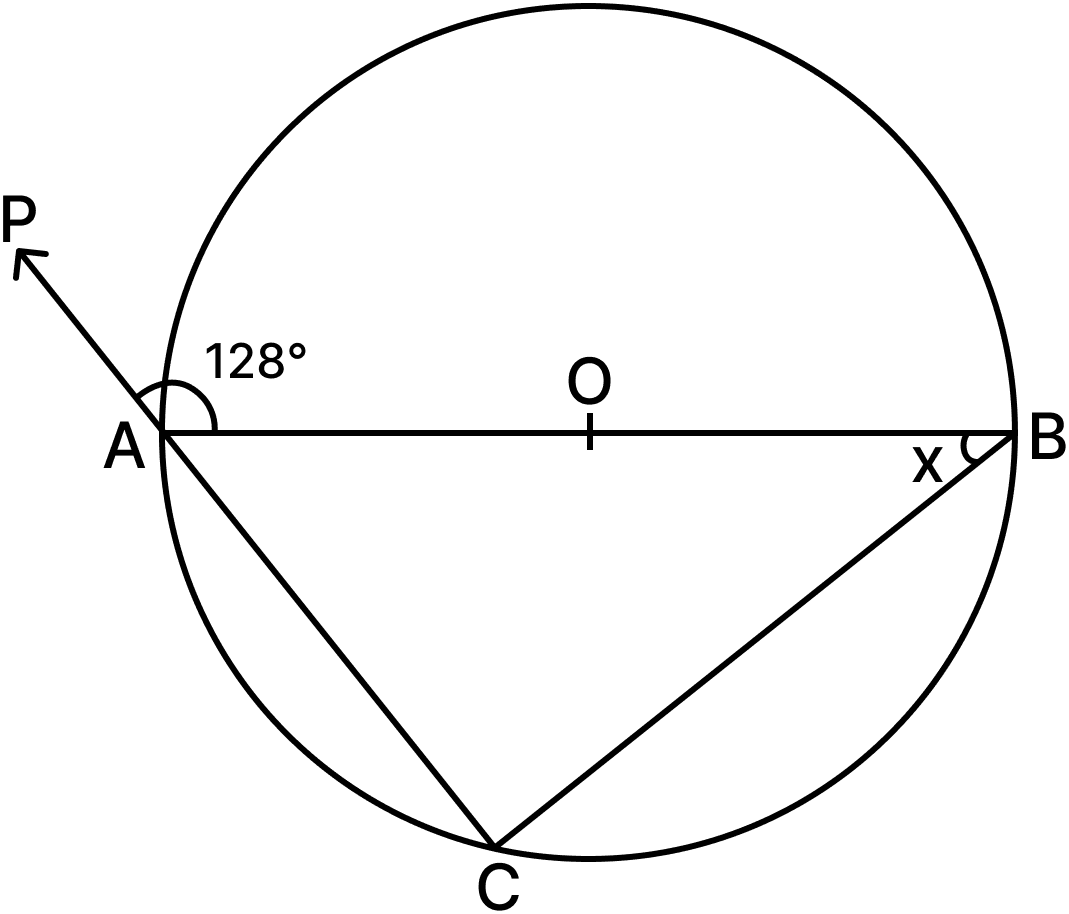
AB is the diameter of the circle, CA is produced to P such that ∠PAB = 128° and = ∠ABC.
Since, PAC is a straight line,
⇒ ∠CAB + ∠PAB = 180° (Linear pair)
⇒ ∠CAB + 128° = 180°
⇒ ∠CAB = 180° - 128°
⇒ ∠CAB = 52°
We know that,
Angle in a semi-circle is a right angle.
⇒ ∠ACB = 90°
In ∆ACB, using angle sum property,
⇒ ∠CAB + ∠ABC + ∠ACB = 180°
Hence, .
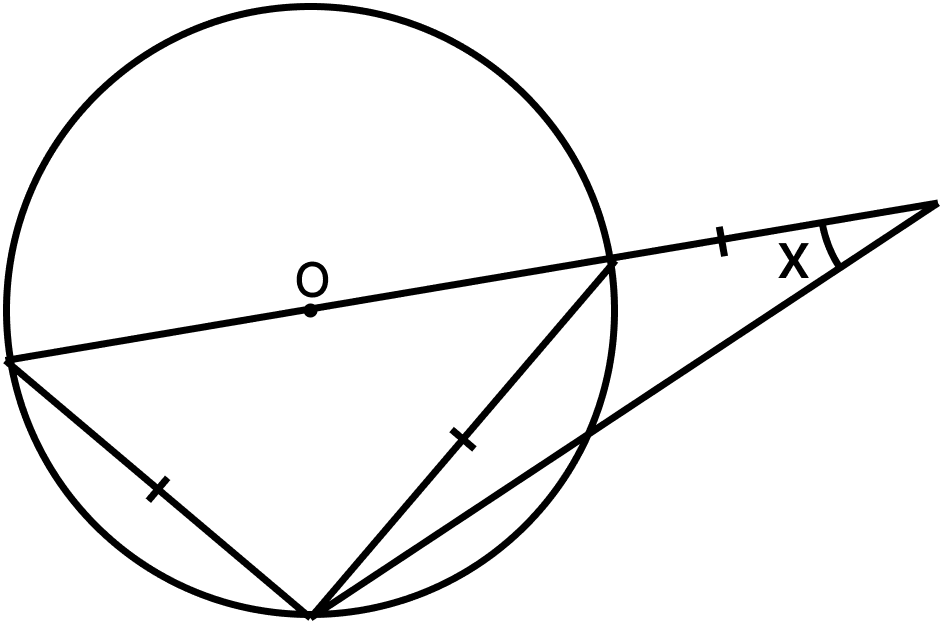
In the following figure, O is the centre of the circle. Find the measure of the angle marked .
Answer
From figure,
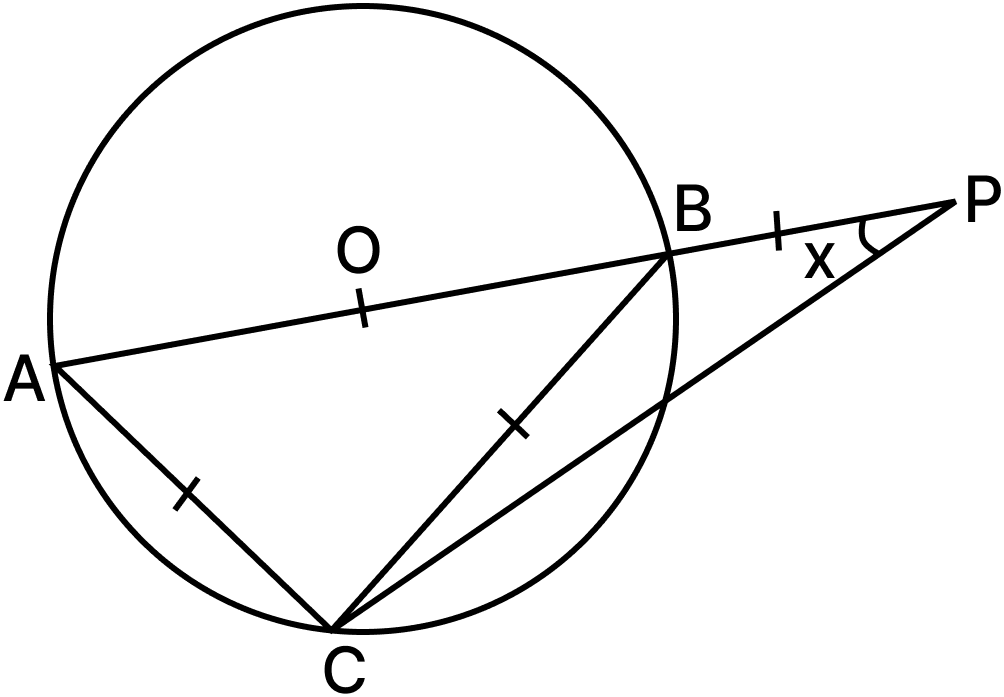
AB is the diameter of the circle, AB is produced to P, CA = CB = BP and = ∠BPC.
In ∆ACB,
⇒ CA = CB
⇒ ∠CAB = ∠CBA [Angles opposite to equal sides of a triangle are always equal]
We know that,
Angle in a semi-circle is a right angle.
⇒ ∠ACB = 90°
Using angle sum property,
⇒ ∠CAB + ∠CBA + ∠ACB = 180°
⇒ ∠CBA + ∠CBA + 90° = 180°
⇒ 2∠CBA = 180° - 90°
⇒ 2∠CBA = 90°
⇒ ∠CBA =
⇒ ∠CBA = 45°
In ∆BCP,
⇒ BC = BP
⇒ ∠BCP = ∠BPC = [Angles opposite to equal sides of a triangle are always equal]
According to exterior angle theorem,
Exterior angle of a triangle is equal to the sum of the two opposite interior angles.
⇒ ∠CBA = ∠BCP + ∠BPC
Hence, .
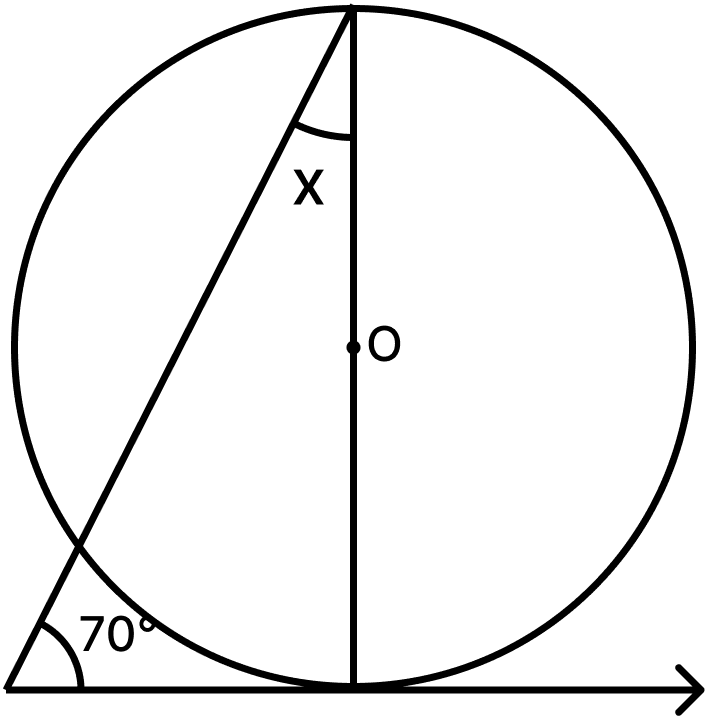
In the following figure, O is the centre of the circle. Find the measure of the angle marked .
Answer
From figure,
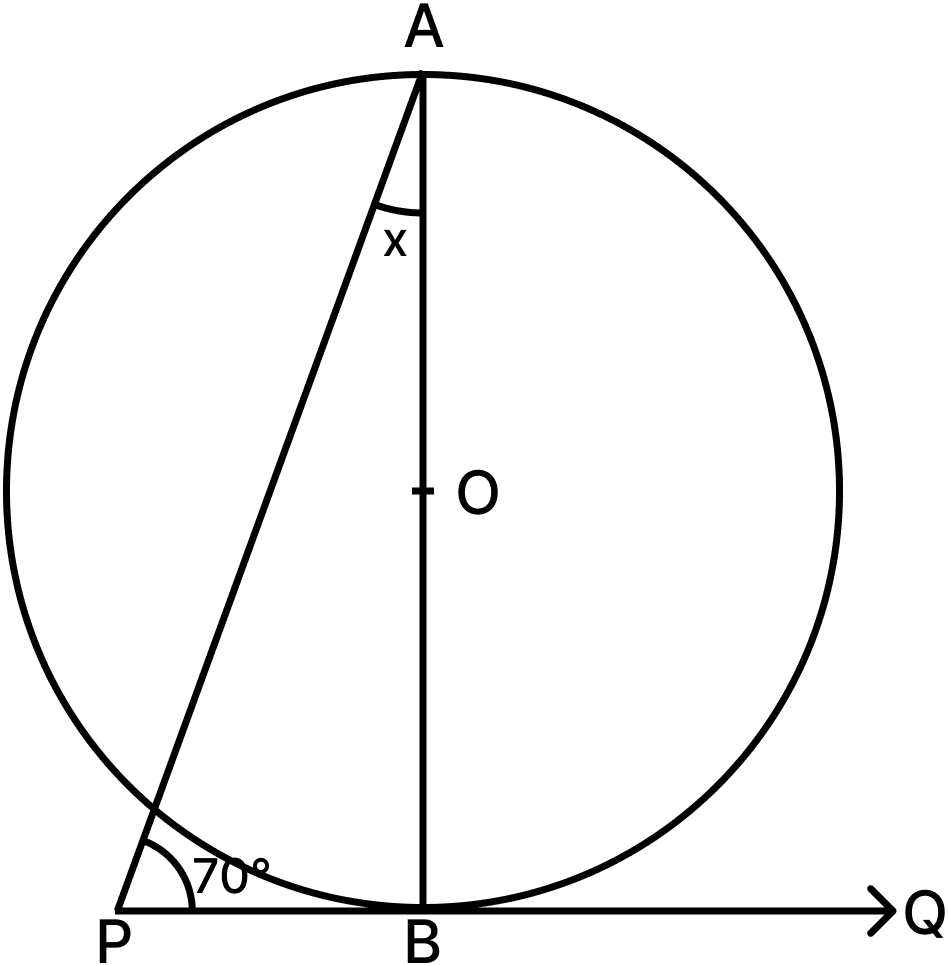
AB is the diameter of the circle, PQ is the tangent to the circle at B, ∠APB = 70° and = ∠BAP.
We know that,
The tangent at any point of a circle and the radius through that point are perpendicular to each other.
⇒ AB ⊥ PQ
⇒ ∠ABP = 90°
In ∆ABP, using angle sum property,
⇒ ∠BAP + ∠APB + ∠ABP = 180°
Hence, .
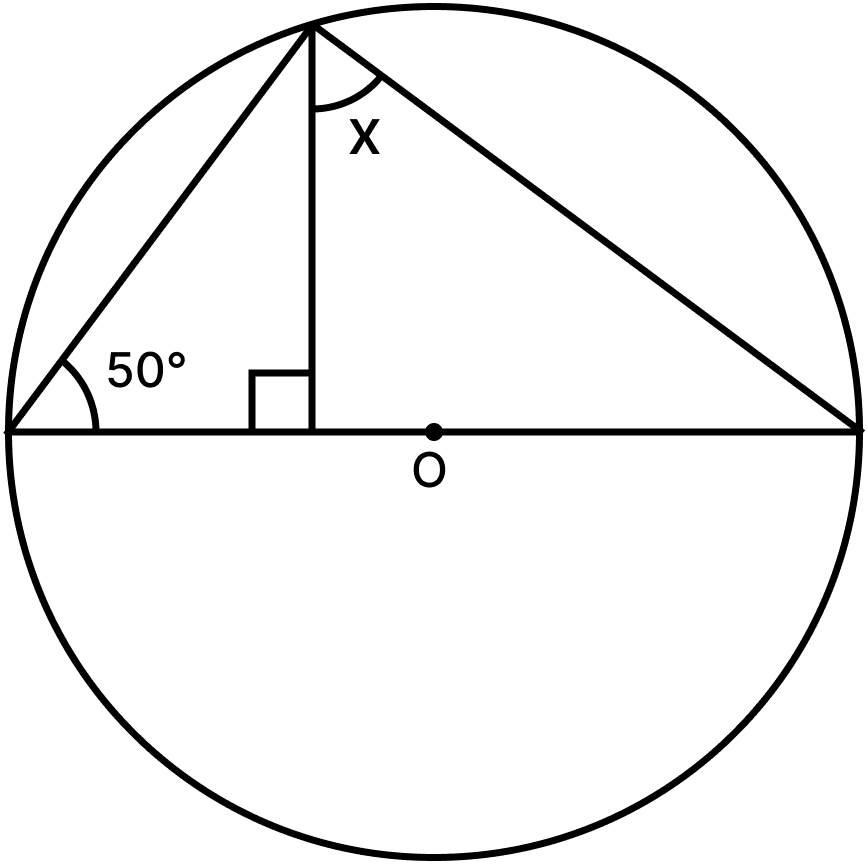
In the following figure, O is the centre of the circle. Find the measure of the angle marked .
Answer
From figure,
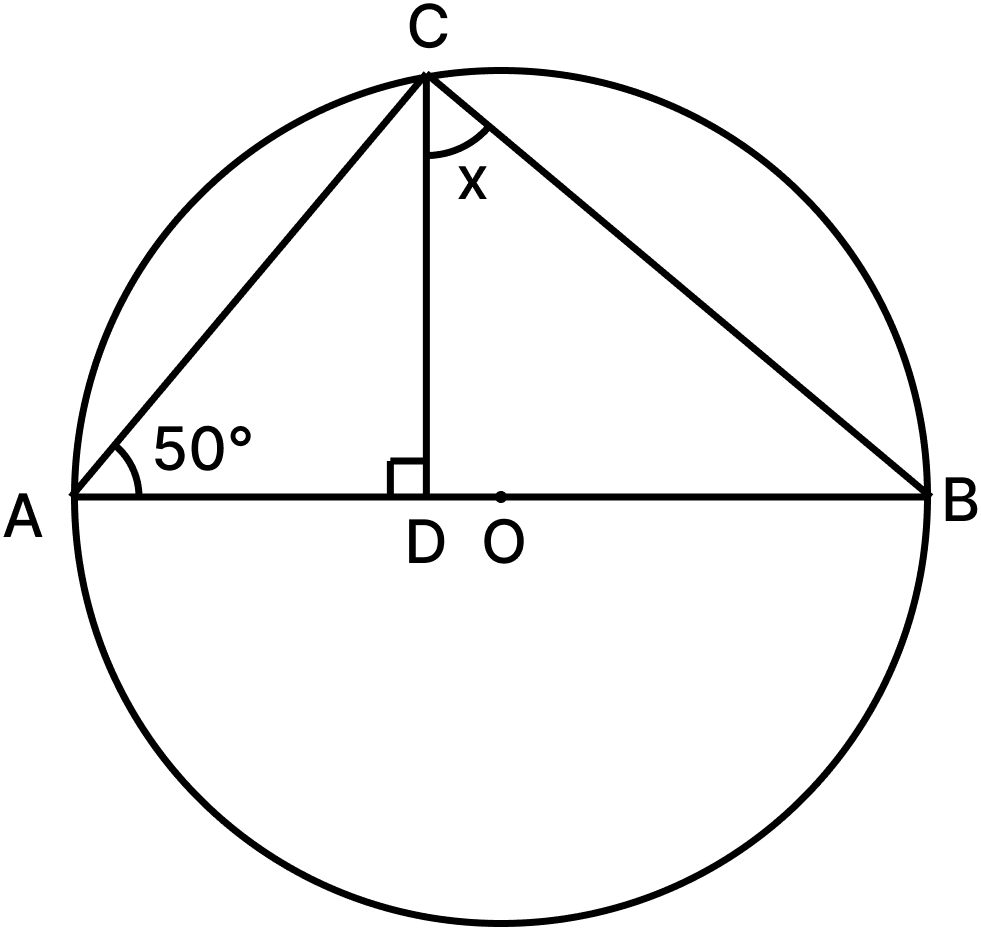
AB is the diameter of the circle, CD ⊥ AB, ∠CAB = 50° and = ∠DCB.
In ∆ACD,
⇒ ∠ADC = 90° (Since CD ⊥ AB)
Using angle sum property,
⇒ ∠CAD + ∠ACD + ∠ADC = 180°
⇒ 50° + ∠ACD + 90° = 180°
⇒ ∠ACD + 140° = 180°
⇒ ∠ACD = 180° - 140°
⇒ ∠ACD = 40°
We know that,
Angle in a semi-circle is a right angle.
⇒ ∠ACB = 90°
From figure,
⇒ ∠ACD + ∠DCB = ∠ACB
Hence, .