Divide:
45x7 by −9x4
Answer
Quotient of two monomials = (Quotient of their numerical coefficients) × (Quotient of their variable parts)
⇒45x7÷(−9x4)⇒−9x445x7⇒−945×x4x7⇒−5x(7−4)⇒−5x3
Hence, the required quotient = −5x3.
Divide:
−60x3y2 by −15xy
Answer
Quotient of two monomials = (Quotient of their numerical coefficients) × (Quotient of their variable parts)
⇒−60x3y2÷(−15xy)⇒−15xy−60x3y2⇒1560×xyx3y2⇒4x(3−1)y(2−1)⇒4x2y
Hence, the required quotient = 4x2y.
Divide:
−43x2yz3 by −32x2yz
Answer
Quotient of two monomials = (Quotient of their numerical coefficients) × (Quotient of their variable parts)
⇒−43x2yz3÷(−32x2yz)⇒−32x2yz−43x2yz3⇒(43×23)×x2yzx2yz3⇒89×(x(2−2)×y(1−1)×z(3−1))⇒89z2
Hence, the required quotient = 89z2.
Divide:
63a4b3c6 by −14a2b5c4
Answer
Quotient of two monomials = (Quotient of their numerical coefficients) × (Quotient of their variable parts)
⇒63a4b3c6÷(−14a2b5c4)⇒−14a2b5c463a4b3c6⇒−1463×a2b5c4a4b3c6⇒−29×b(5−3)a(4−2)c(6−4)⇒−2b29a2c2
Hence, the required quotient = −2b29a2c2.
Divide:
6ax−3cx+15x by −3x
Answer
For dividing a polynomial by a monomial, we divide each term of the polynomial by the monomial.
⇒−3x6ax−3cx+15x⇒−3x6ax−−3x3cx+−3x15x⇒−2a+c−5
Hence, the required quotient = −2a+c−5.
Divide:
10mn2−15m2n2+5m3n by −5mn
Answer
For dividing a polynomial by a monomial, we divide each term of the polynomial by the monomial.
⇒−5mn10mn2−15m2n2+5m3n⇒−5mn10mn2−−5mn15m2n2+−5mn5m3n⇒−2n(2−1)+3m(2−1)n(2−1)−m(3−1)⇒−2n+3mn−m2
Hence, the required quotient = −2n+3mn−m2.
Divide:
14x3y4−7x4y3−28x3y6 by −7x3y2
Answer
For dividing a polynomial by a monomial, we divide each term of the polynomial by the monomial.
⇒−7x3y214x3y4−7x4y3−28x3y6⇒−7x3y214x3y4−−7x3y27x4y3−−7x3y228x3y6⇒−2y(4−2)+x(4−3)y(3−2)+4y(6−2)⇒−2y2+xy+4y4
Hence, the required quotient = −2y2+xy+4y4.
Divide:
18a6b3−30a4b5+6a4b4 by 6a2b2
Answer
For dividing a polynomial by a monomial, we divide each term of the polynomial by the monomial.
⇒6a2b218a6b3−30a4b5+6a4b4⇒6a2b218a6b3−6a2b230a4b5+6a2b26a4b4⇒3a(6−2)b(3−2)−5a(4−2)b(5−2)+a(4−2)b(4−2)⇒3a4b−5a2b3+a2b2
Hence, the required quotient = 3a4b−5a2b3+a2b2.
Divide:
8a3b−16a2b2−6a4b3 by −2a2b
Answer
For dividing a polynomial by a monomial, we divide each term of the polynomial by the monomial.
⇒−2a2b8a3b−16a2b2−6a4b3⇒−2a2b8a3b−−2a2b16a2b2−−2a2b6a4b3⇒−4a(3−2)+8b(2−1)+3a(4−2)b(3−1)⇒−4a+8b+3a2b2
Hence, the required quotient = −4a+8b+3a2b2.
Divide:
21p2q3−85p3q2+41p3q3 by −41p2q2
Answer
For dividing a polynomial by a monomial, we divide each term of the polynomial by the monomial.
⇒(21p2q3−85p3q2+41p3q3)÷(−41p2q2)⇒−41p2q221p2q3−−41p2q285p3q2+−41p2q241p3q3⇒−2q(3−2)+25p(3−2)−p(3−2)q(3−2)⇒−2q+25p−pq
Hence, the required quotient = −2q+25p−pq.
Divide:
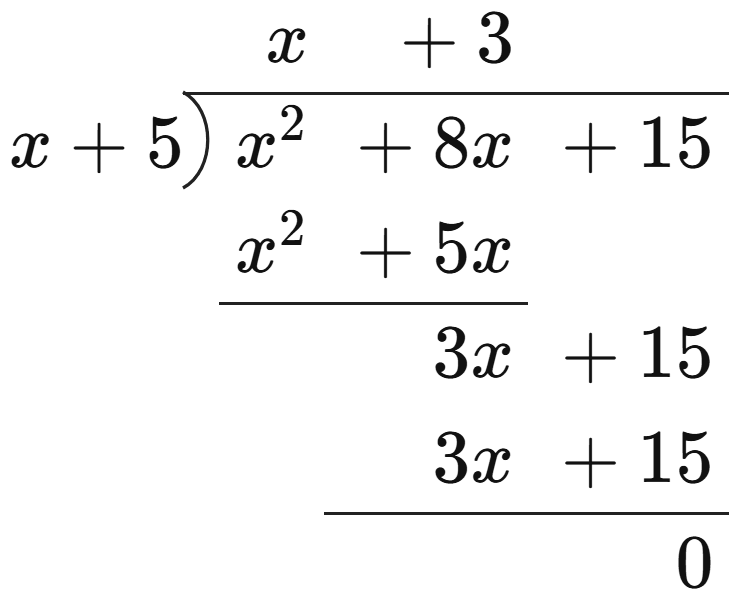
(x2+8x+15) by (x+5)
Answer
Dividing x2+8x+15 by x+5
Hence, quotient = x+3 and remainder = 0.
Divide:
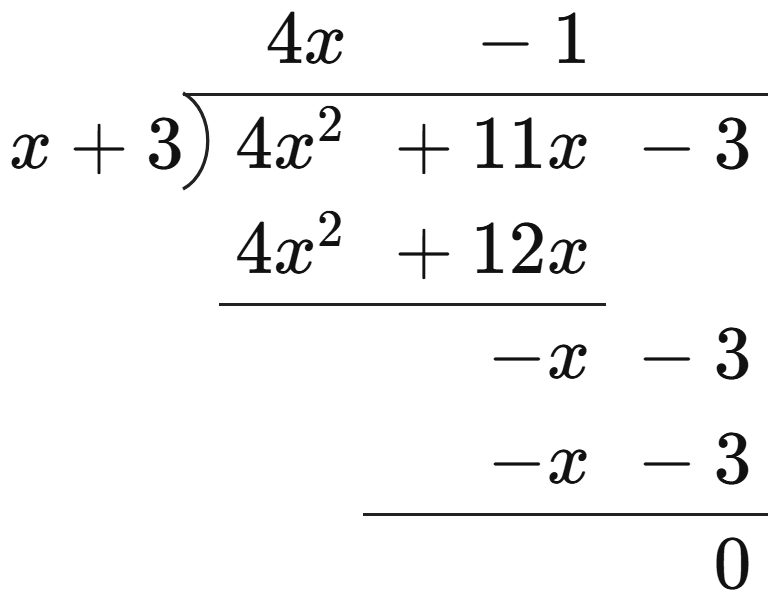
(4x2+11x−3) by (x+3)
Answer
Dividing 4x2+11x−3 by x+3
Hence, quotient = 4x−1 and remainder = 0.
Divide:
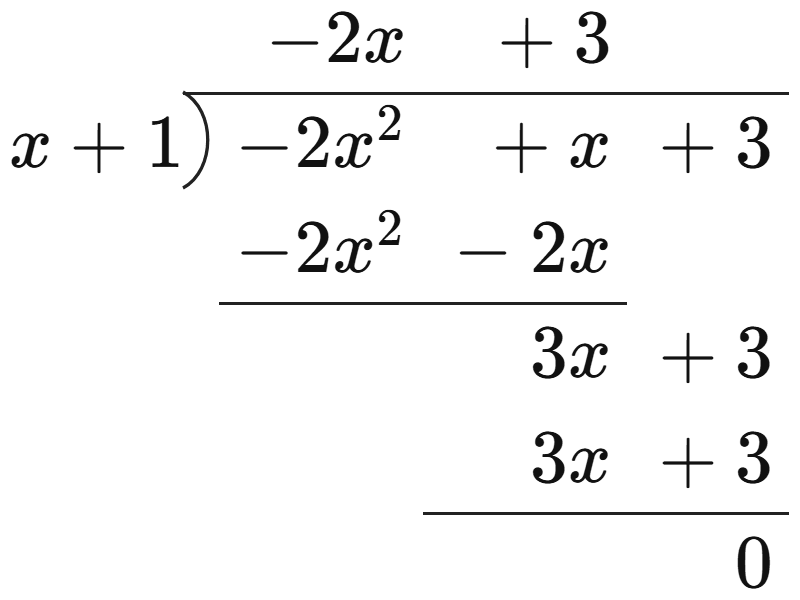
(3+x−2x2) by (x+1)
Answer
Arranging the terms of the dividend in descending powers of x, we divide −2x2+x+3 by x+1
Hence, quotient = −2x+3 and remainder = 0.
Divide:
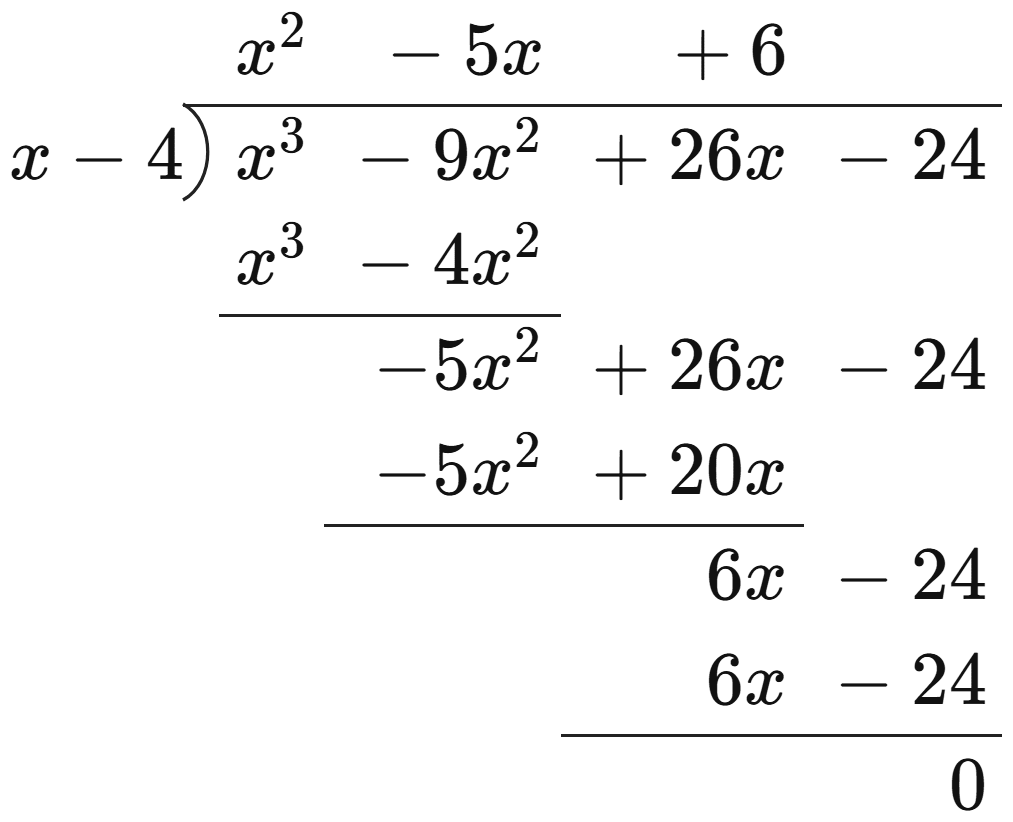
(x3−9x2+26x−24) by (x−4)
Answer
Dividing x3−9x2+26x−24 by x−4
Hence, quotient = x2−5x+6 and remainder = 0.
Divide:
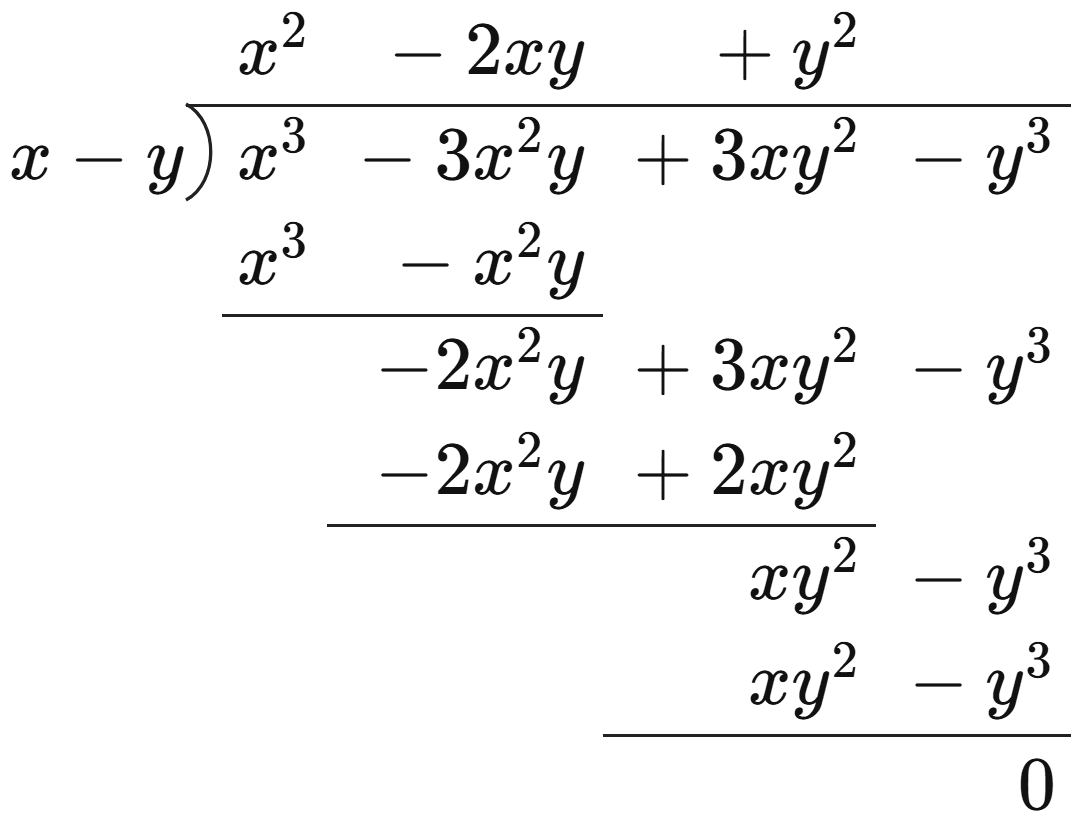
(x3−3x2y+3xy2−y3) by (x−y)
Answer
Dividing x3−3x2y+3xy2−y3 by x−y
Hence, quotient = x2−2xy+y2 and remainder = 0.
Divide:
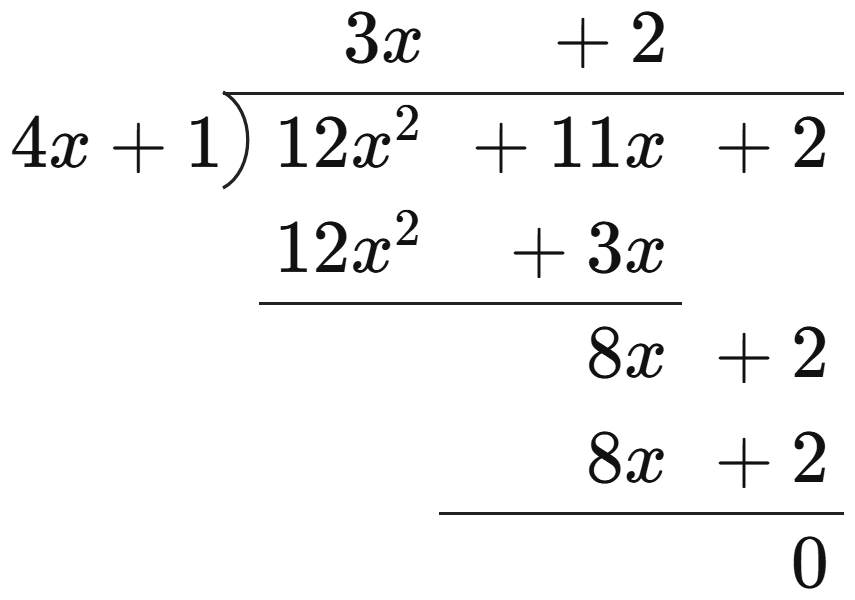
(12x2+11x+2) by (4x+1)
Answer
Dividing 12x2+11x+2 by 4x+1
Hence, quotient = 3x+2 and remainder = 0.
Divide:
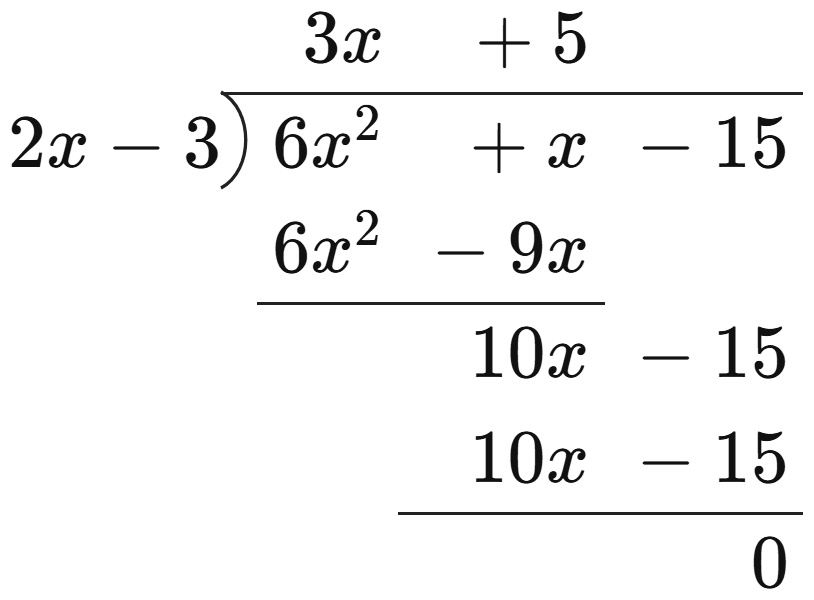
(6x2+x−15) by (2x−3)
Answer
Dividing 6x2+x−15 by 2x−3
Hence, quotient = 3x+5 and remainder = 0.
Divide:
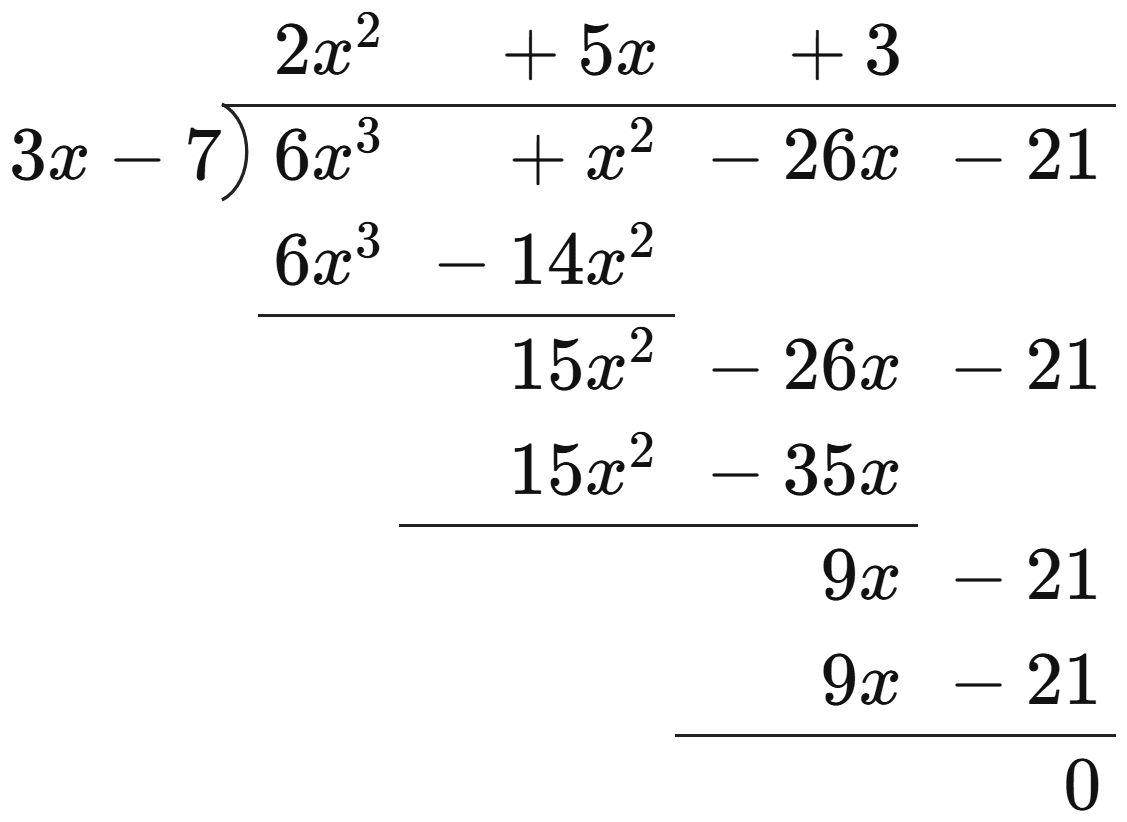
(6x3+x2−26x−21) by (3x−7)
Answer
Dividing 6x3+x2−26x−21 by 3x−7
Hence, quotient = 2x2+5x+3 and remainder = 0.
Divide:
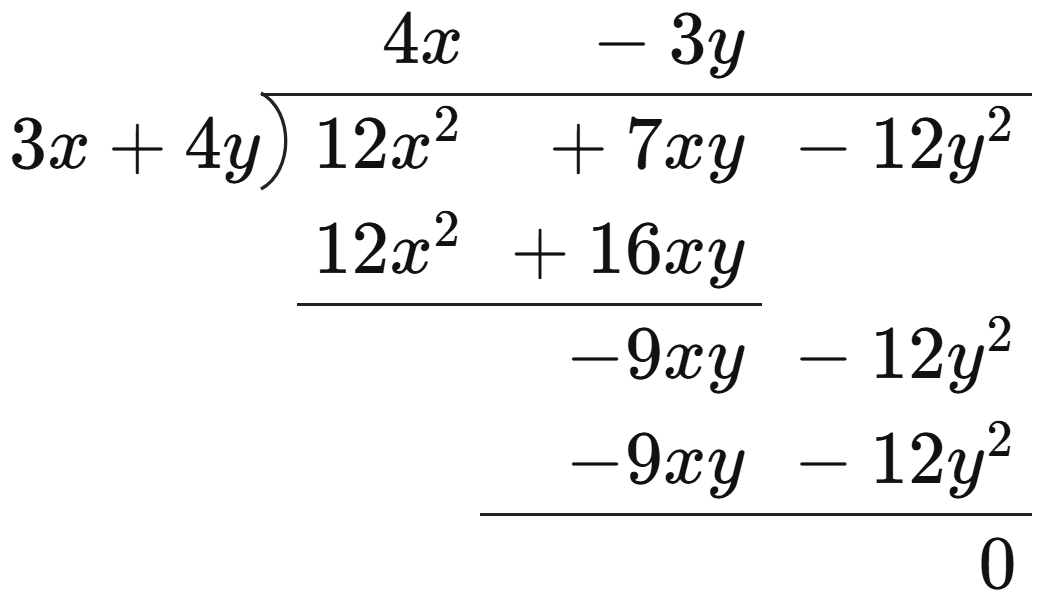
(12x2+7xy−12y2) by (3x+4y)
Answer
Dividing 12x2+7xy−12y2 by 3x+4y
Hence, quotient = 4x−3y and remainder = 0.
Divide:
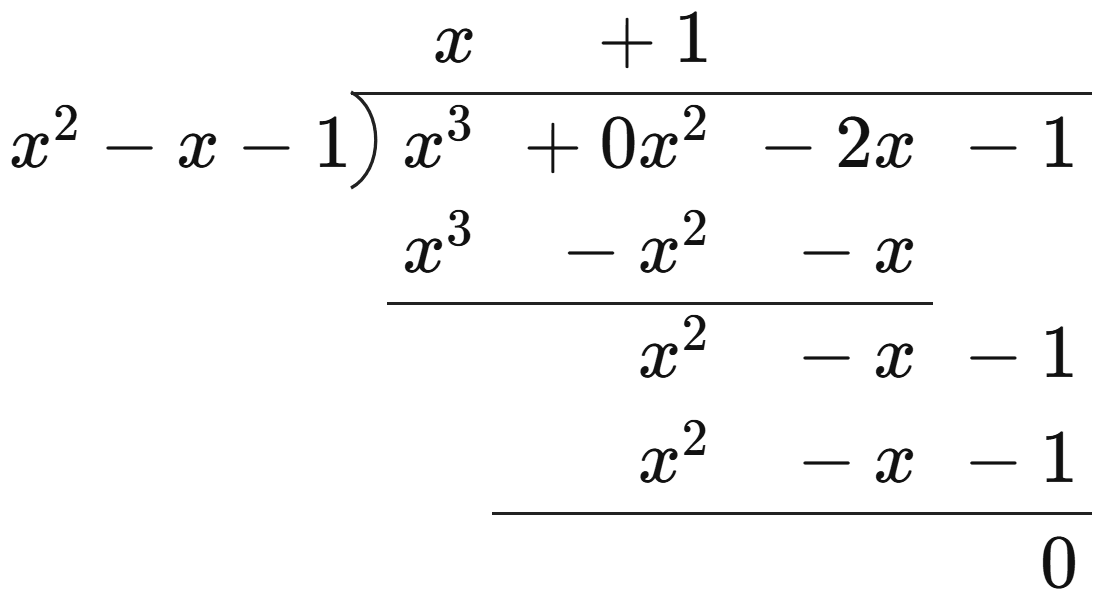
(x3−2x−1) by (x2−x−1)
Answer
Writing the missing power of x in the dividend with coefficient 0, we divide x3+0x2−2x−1 by x2−x−1
Hence, quotient = x+1 and remainder = 0.
Divide:
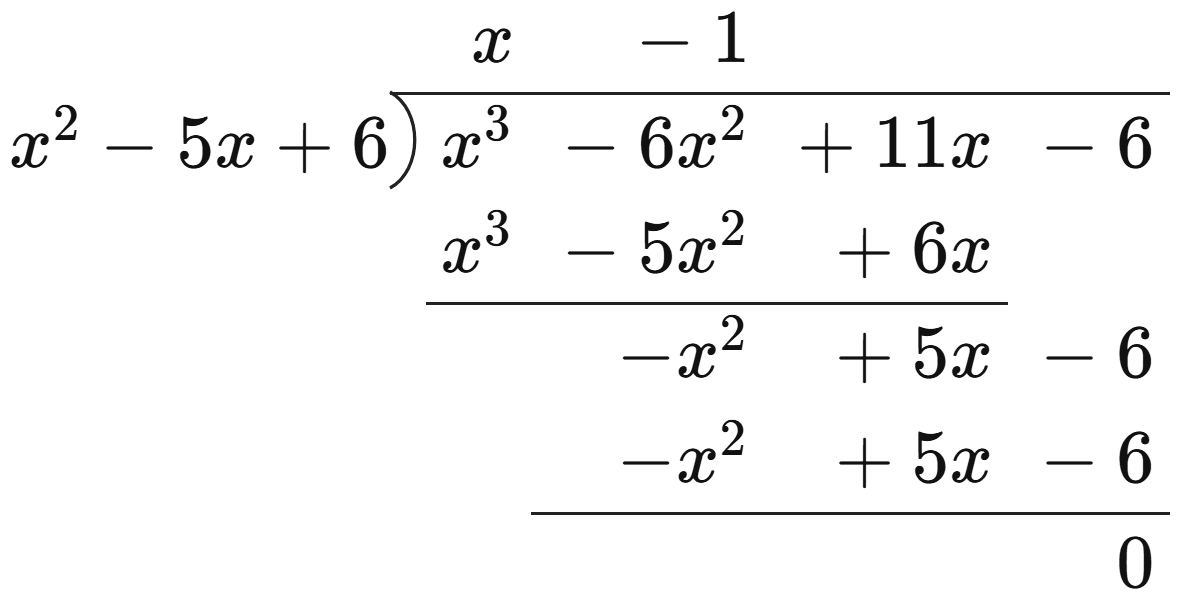
(x3−6x2+11x−6) by (x2−5x+6)
Answer
Dividing x3−6x2+11x−6 by x2−5x+6
Hence, quotient = x−1 and remainder = 0.
Divide:
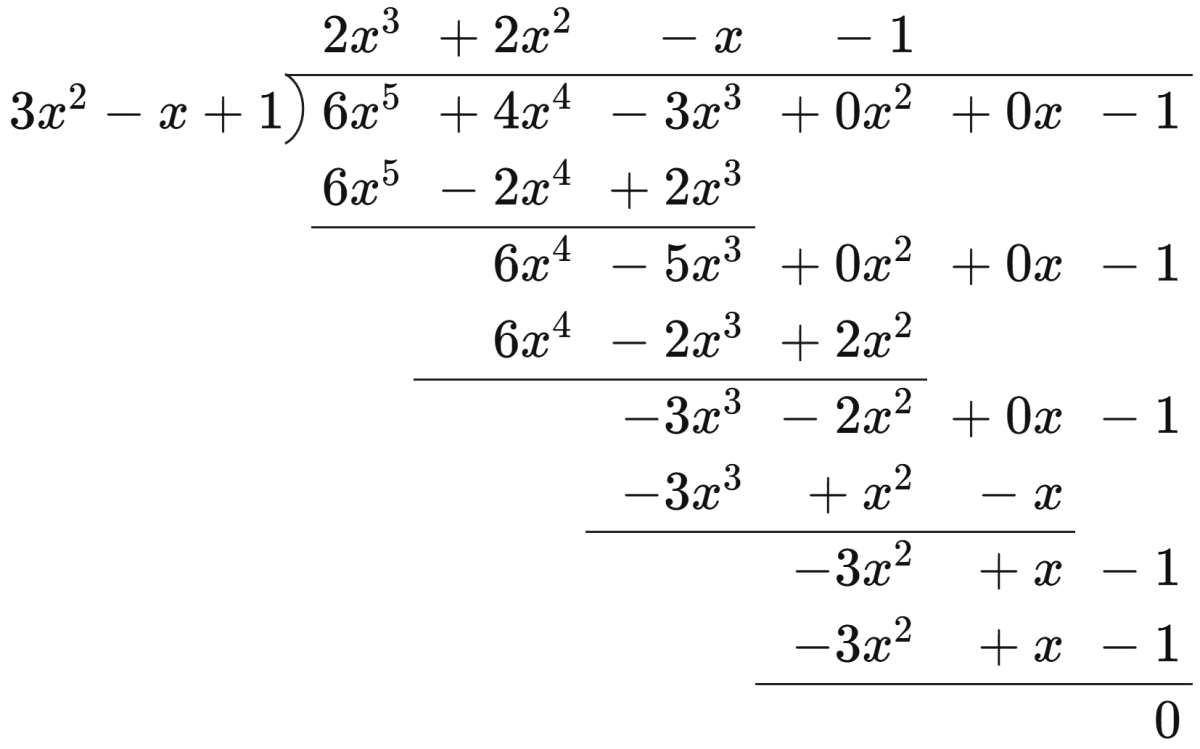
(6x5+4x4−3x3−1) by (3x2−x+1)
Answer
Writing the missing powers of x in the dividend with coefficient 0, we divide 6x5+4x4−3x3+0x2+0x−1 by 3x2−x+1
Hence, quotient = 2x3+2x2−x−1 and remainder = 0.
Divide:
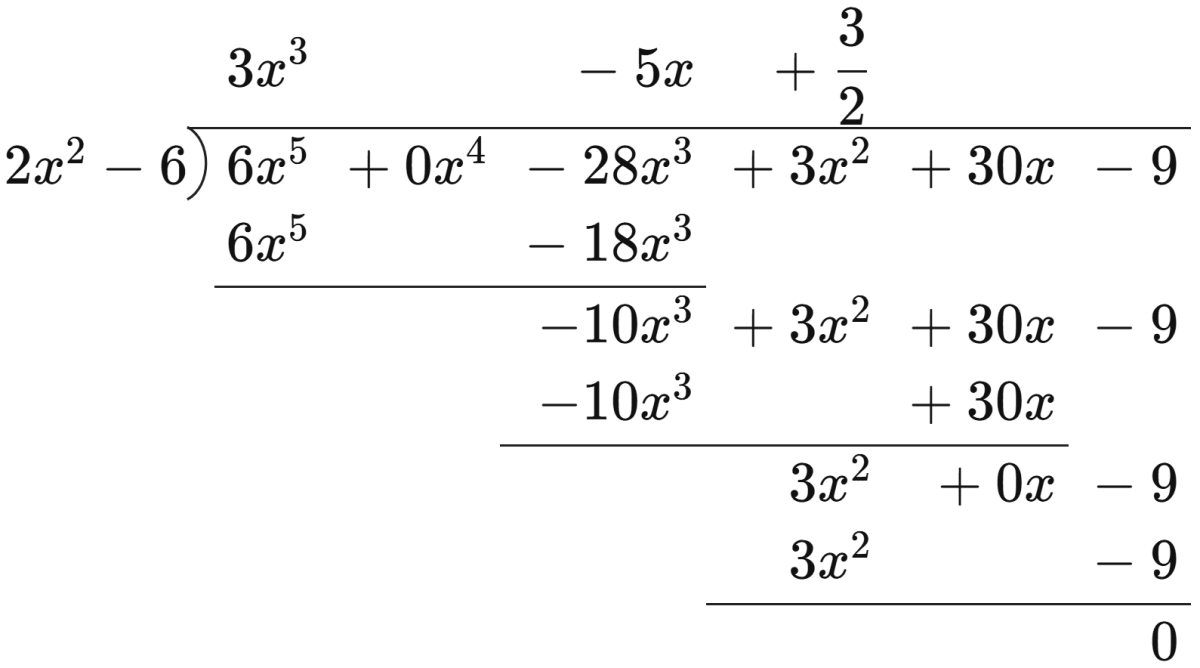
(6x5−28x3+3x2+30x−9) by (2x2−6)
Answer
Writing the missing power of x in the dividend with coefficient 0, we divide 6x5+0x4−28x3+3x2+30x−9 by 2x2−6
Hence, quotient = 3x3−5x+23 and remainder = 0.
Divide:
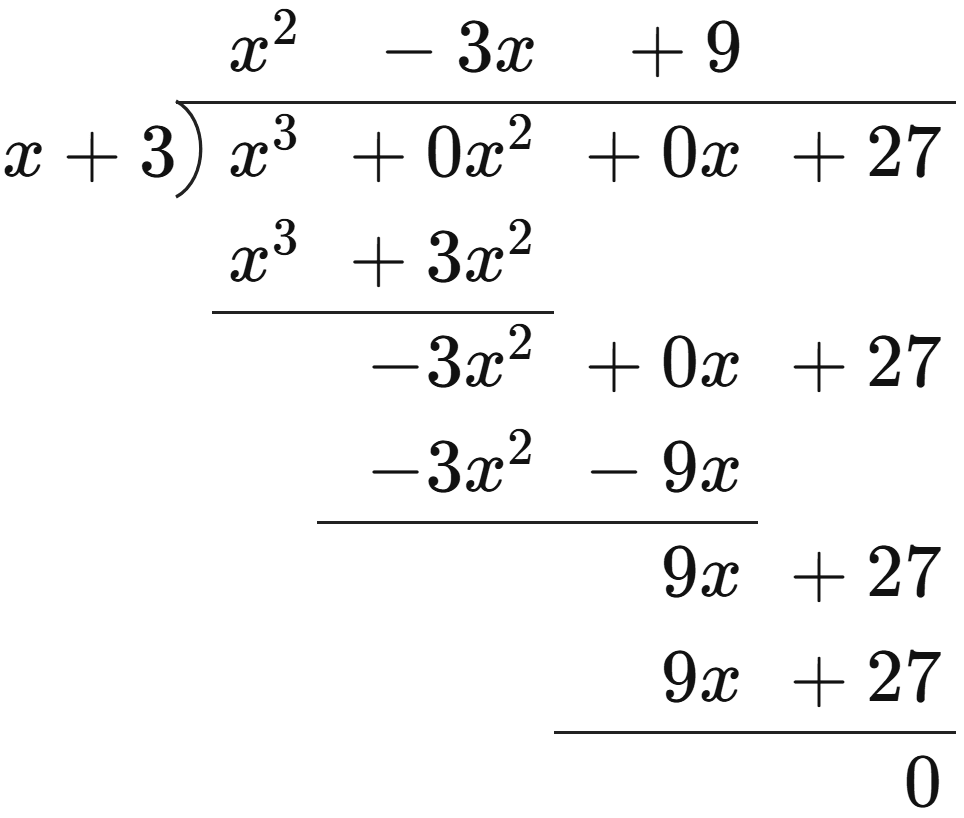
(x3+27) by (x+3)
Answer
Writing the missing powers of x in the dividend with coefficient 0, we divide x3+0x2+0x+27 by x+3
Hence, quotient = x2−3x+9 and remainder = 0.
Divide:
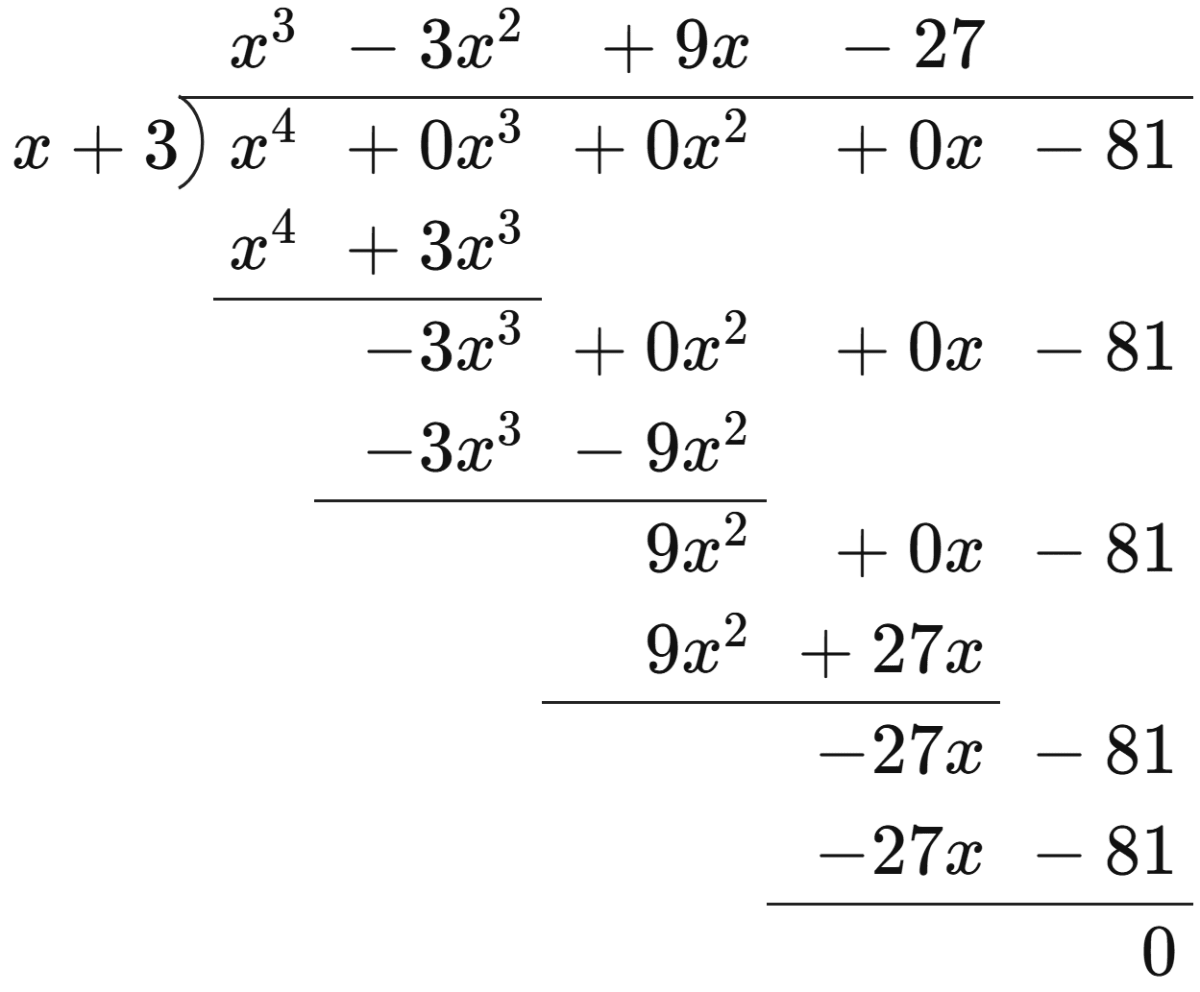
(x4−81) by (x+3)
Answer
Writing the missing powers of x in the dividend with coefficient 0, we divide x4+0x3+0x2+0x−81 by x+3
Hence, quotient = x3−3x2+9x−27 and remainder = 0.
Divide:
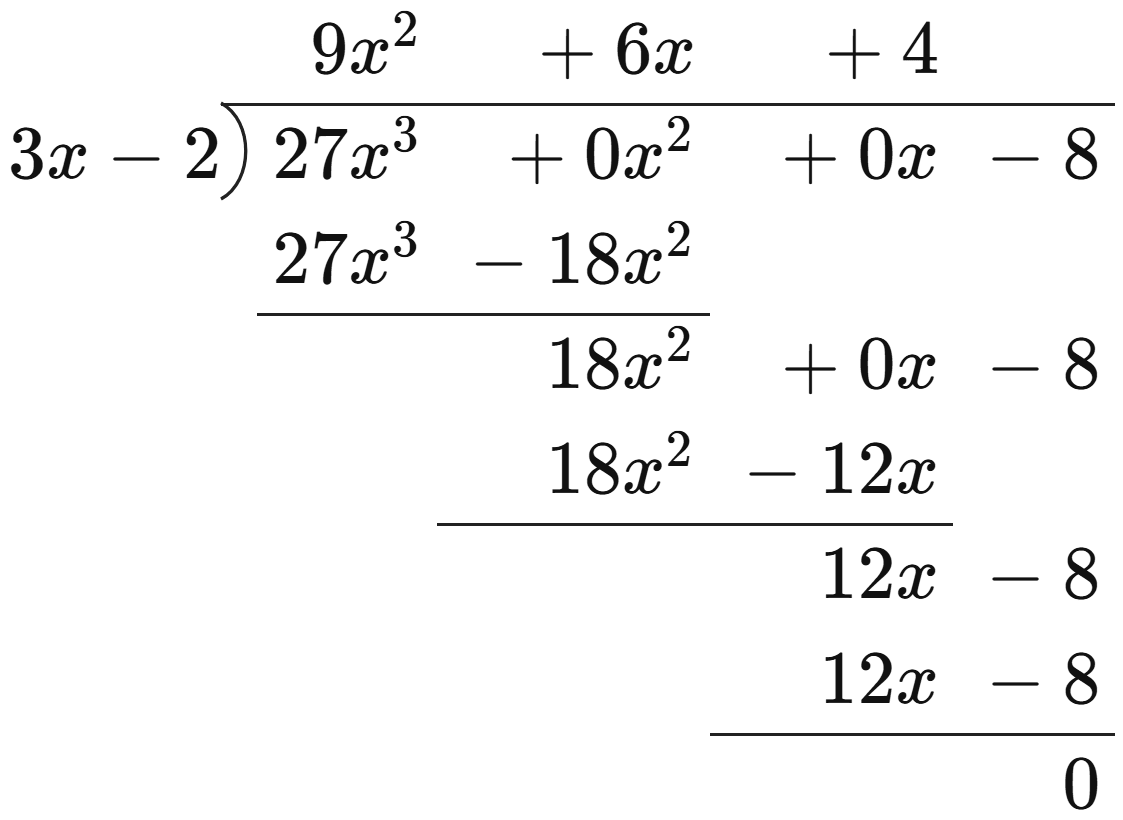
(27x3−8) by (3x−2)
Answer
Writing the missing powers of x in the dividend with coefficient 0, we divide 27x3+0x2+0x−8 by 3x−2
Hence, quotient = 9x2+6x+4 and remainder = 0.
Divide:
(x6−8) by (x2−2)
Answer
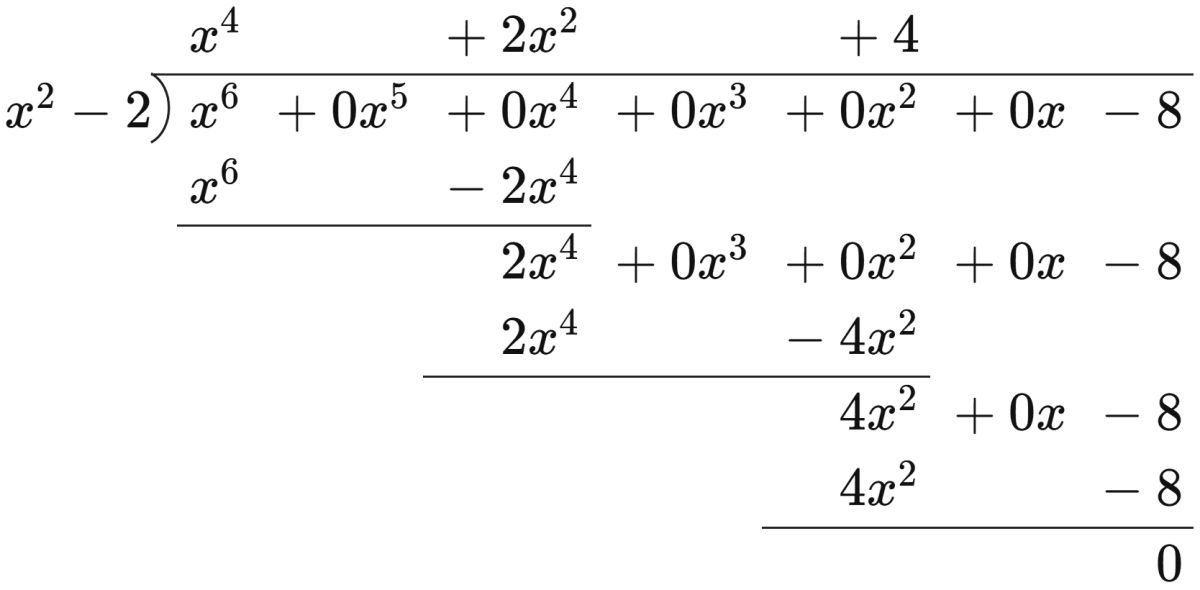
Writing the missing powers of x in the dividend with coefficient 0, we divide x6+0x5+0x4+0x3+0x2+0x−8 by x2−2
Hence, quotient = x4+2x2+4 and remainder = 0.
Divide:
(x6−y6) by (x−y)
Answer
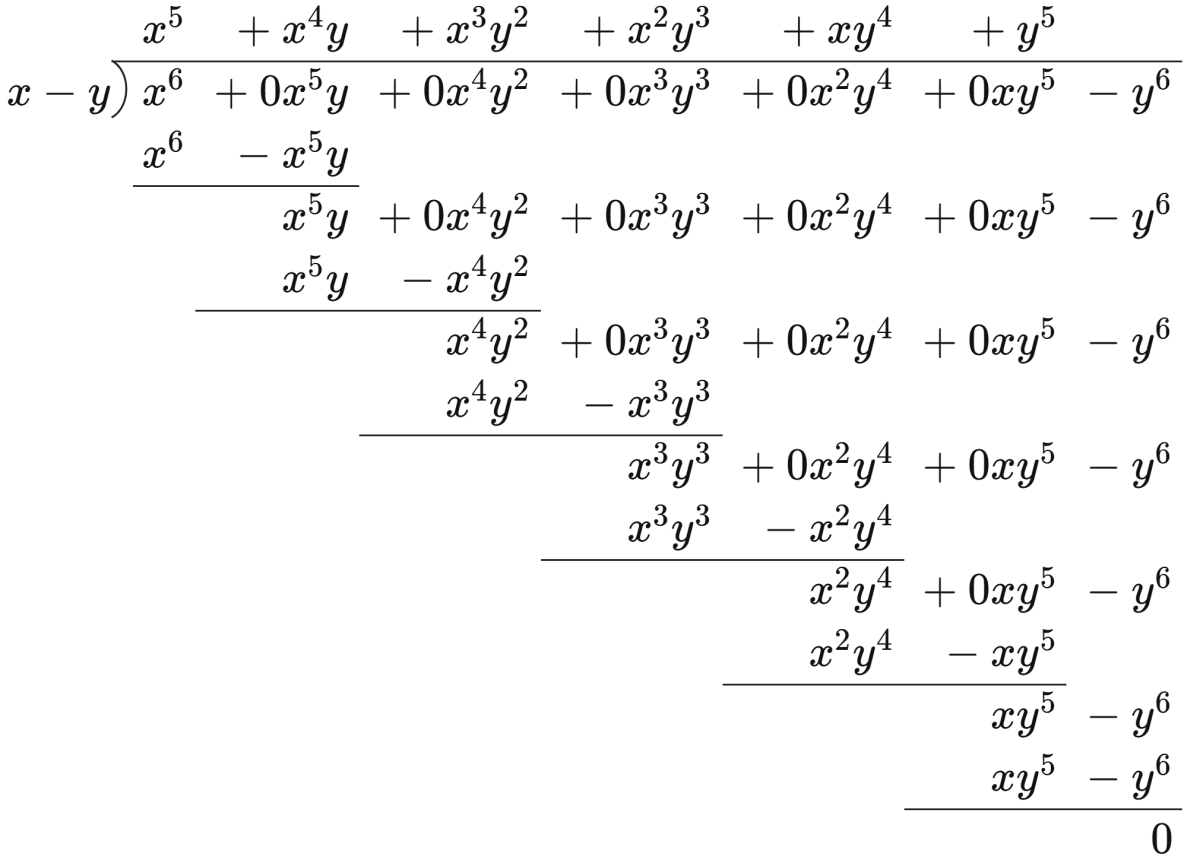
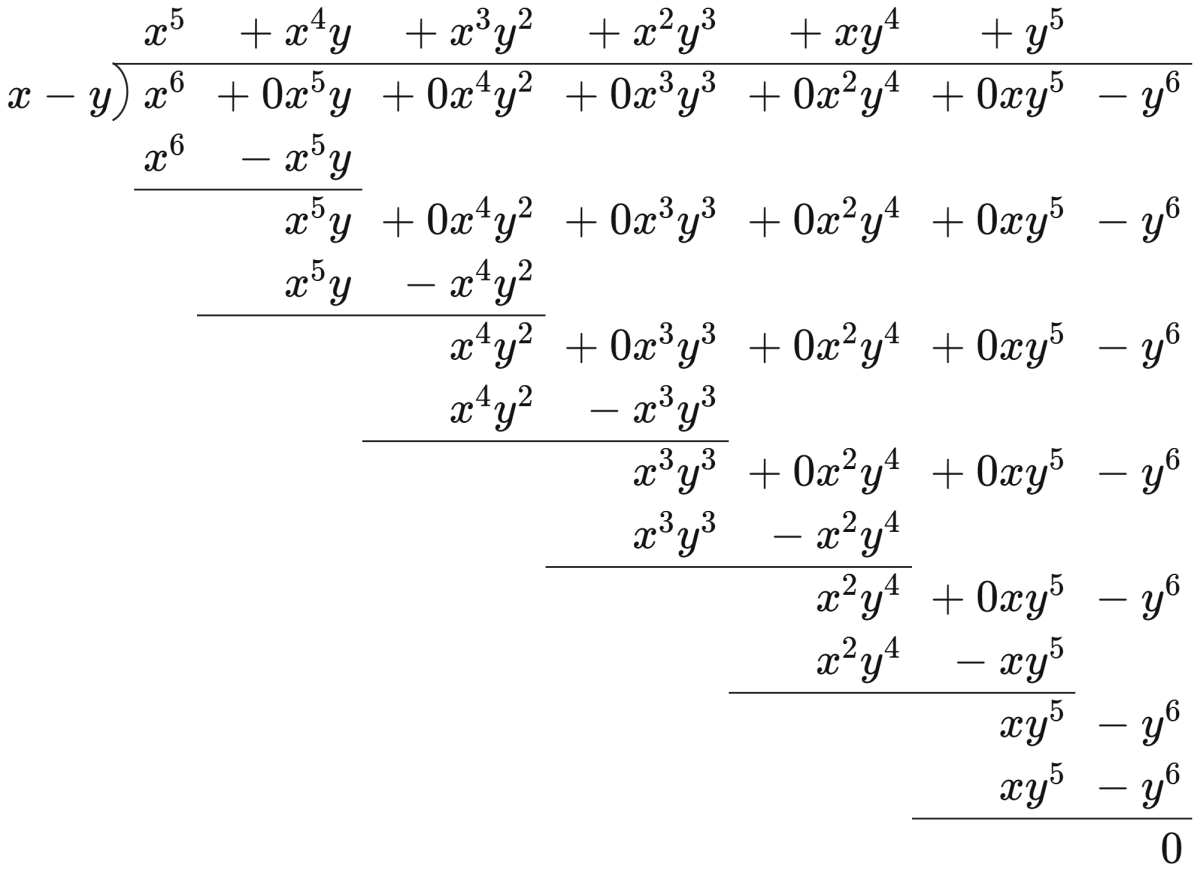
Writing the missing terms of the dividend with coefficient 0, we divide x6+0x5y+0x4y2+0x3y3+0x2y4+0xy5−y6 by x−y
Hence, quotient = x5+x4y+x3y2+x2y3+xy4+y5 and remainder = 0.
Divide:
(16x4−81y4) by (2x−3y)
Answer
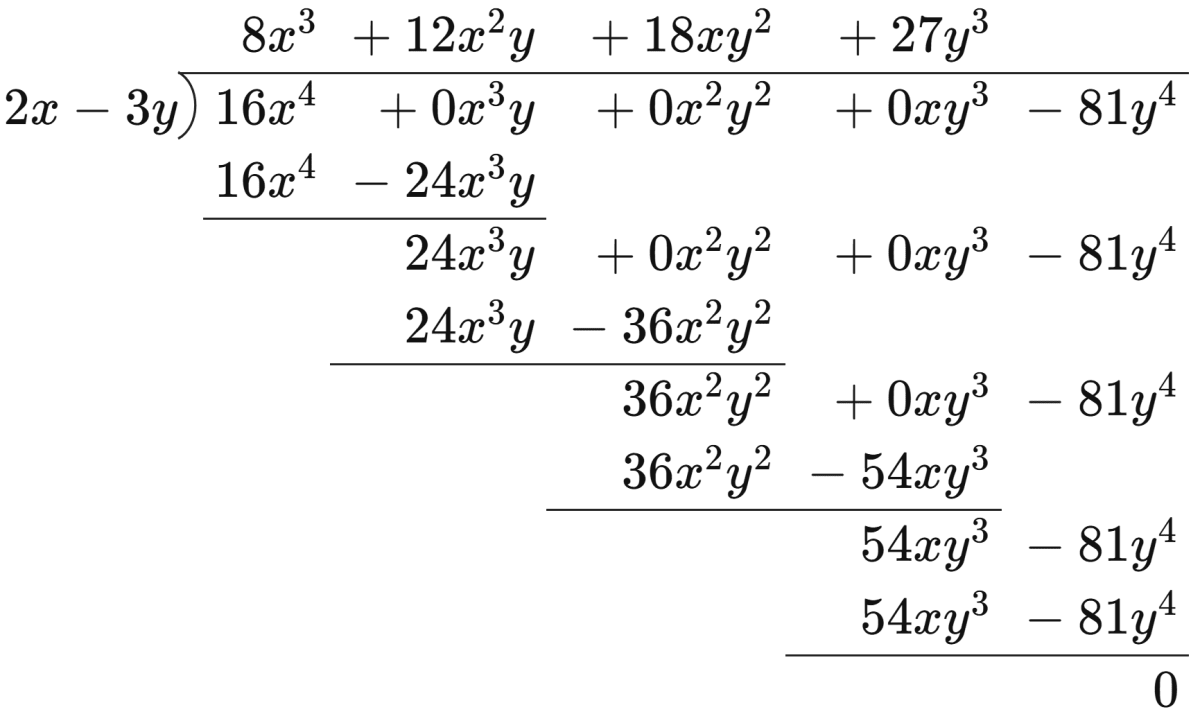
Writing the missing terms of the dividend with coefficient 0, we divide 16x4+0x3y+0x2y2+0xy3−81y4 by 2x−3y
Hence, quotient = 8x3+12x2y+18xy2+27y3 and remainder = 0.
Find the quotient and remainder when:
(6a2−31a+47) is divided by (2a−5)
Answer
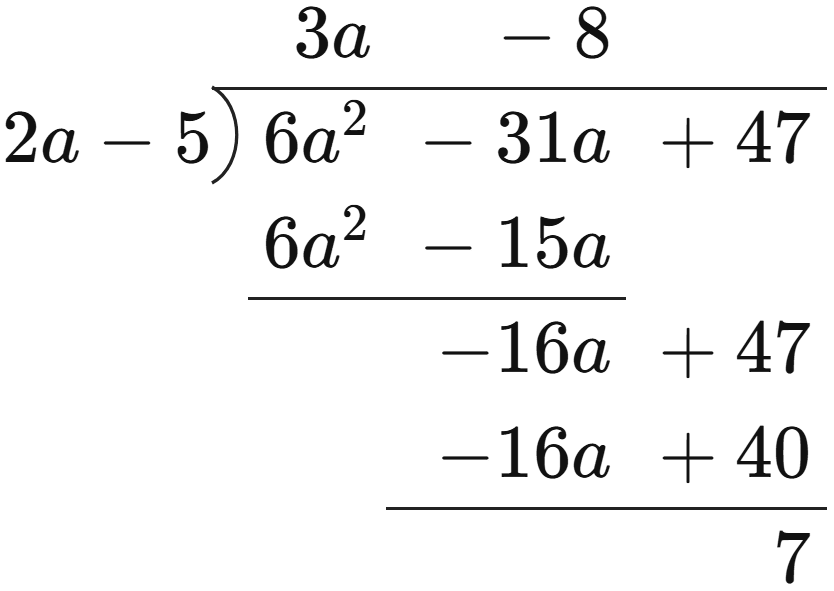
Dividing 6a2−31a+47 by 2a−5
Hence, quotient = 3a−8 and remainder = 7.
Find the quotient and remainder when:
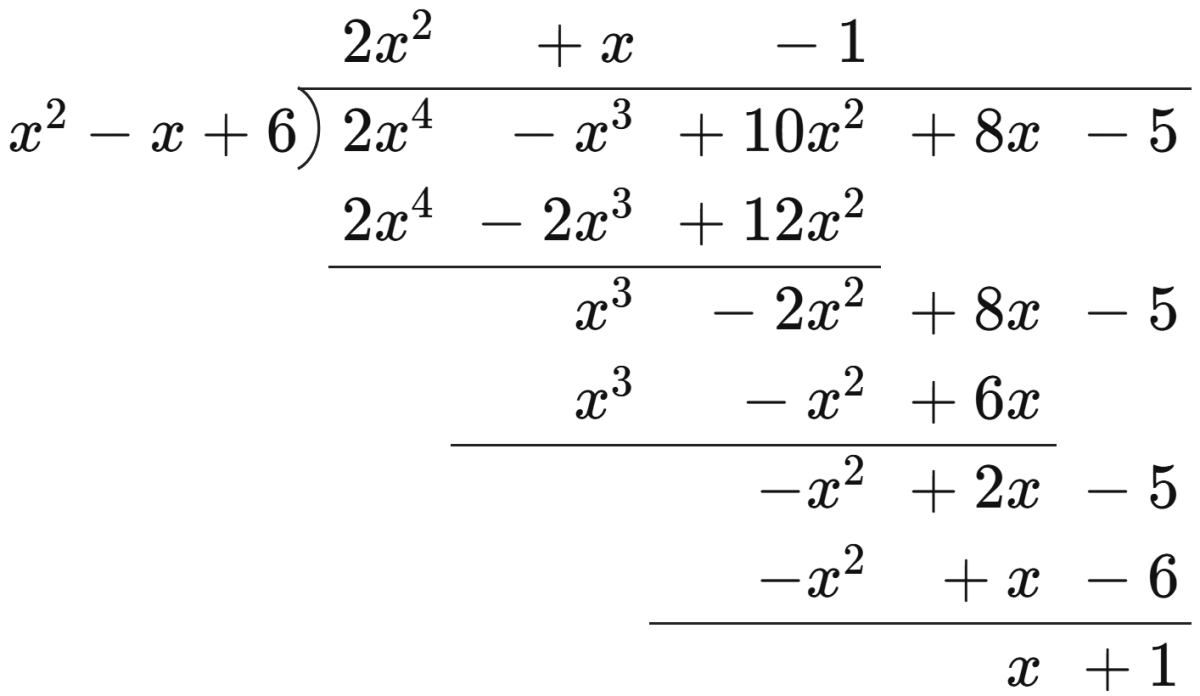
(2x4−x3+10x2+8x−5) is divided by (x2−x+6)
Answer
Dividing 2x4−x3+10x2+8x−5 by x2−x+6
Hence, quotient = 2x2+x−1 and remainder = x+1.
Find the quotient and remainder when:
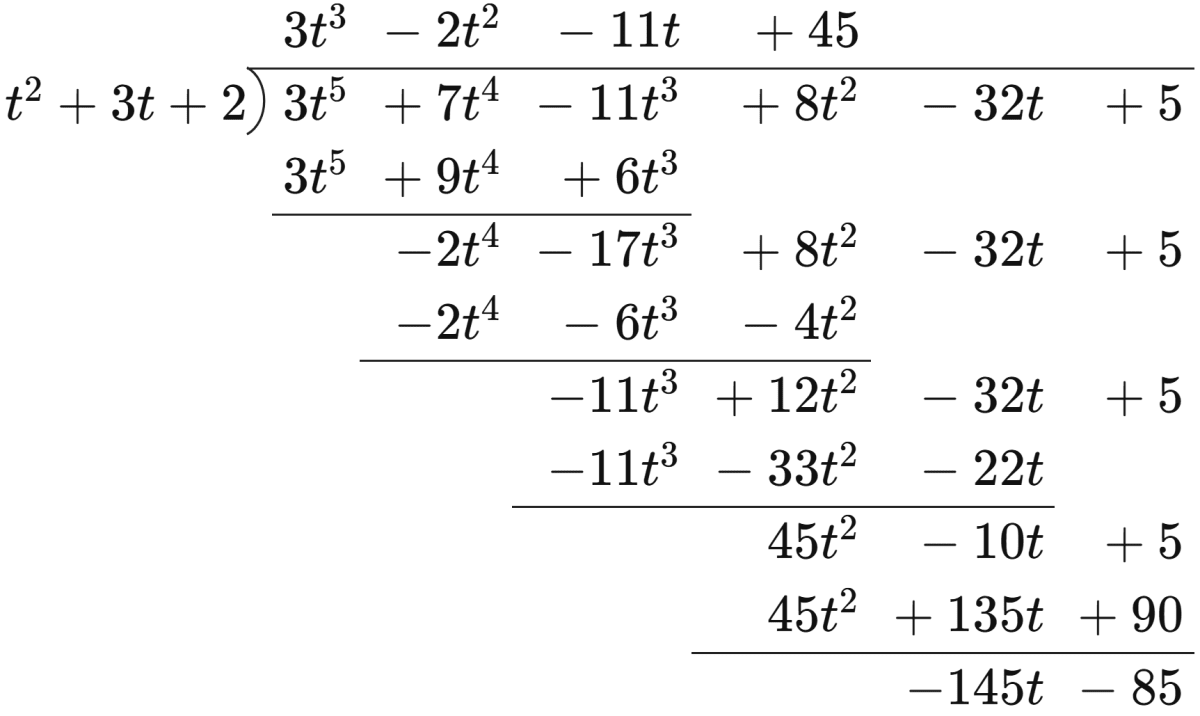
(3t5+7t4−11t3+8t2−32t+5) is divided by (2+3t+t2)
Answer
Arranging the terms of the divisor in descending powers of t, we divide 3t5+7t4−11t3+8t2−32t+5 by t2+3t+2
Hence, quotient = 3t3−2t2−11t+45 and remainder = −145t−85.
Find the quotient and remainder when:
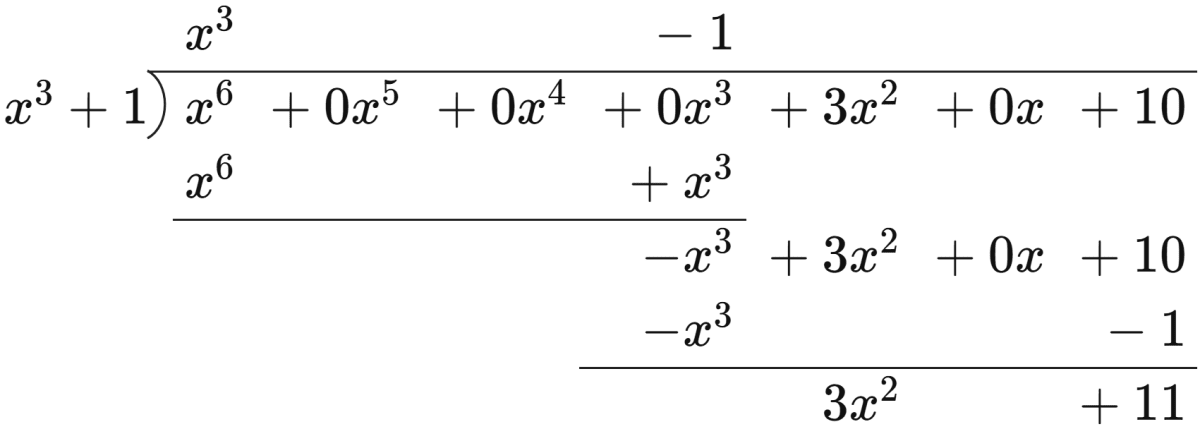
(x6+3x2+10) is divided by (x3+1)
Answer
Writing the missing powers of x in the dividend with coefficient 0, we divide x6+0x5+0x4+0x3+3x2+0x+10 by x3+1
Hence, quotient = x3−1 and remainder = 3x2+11.
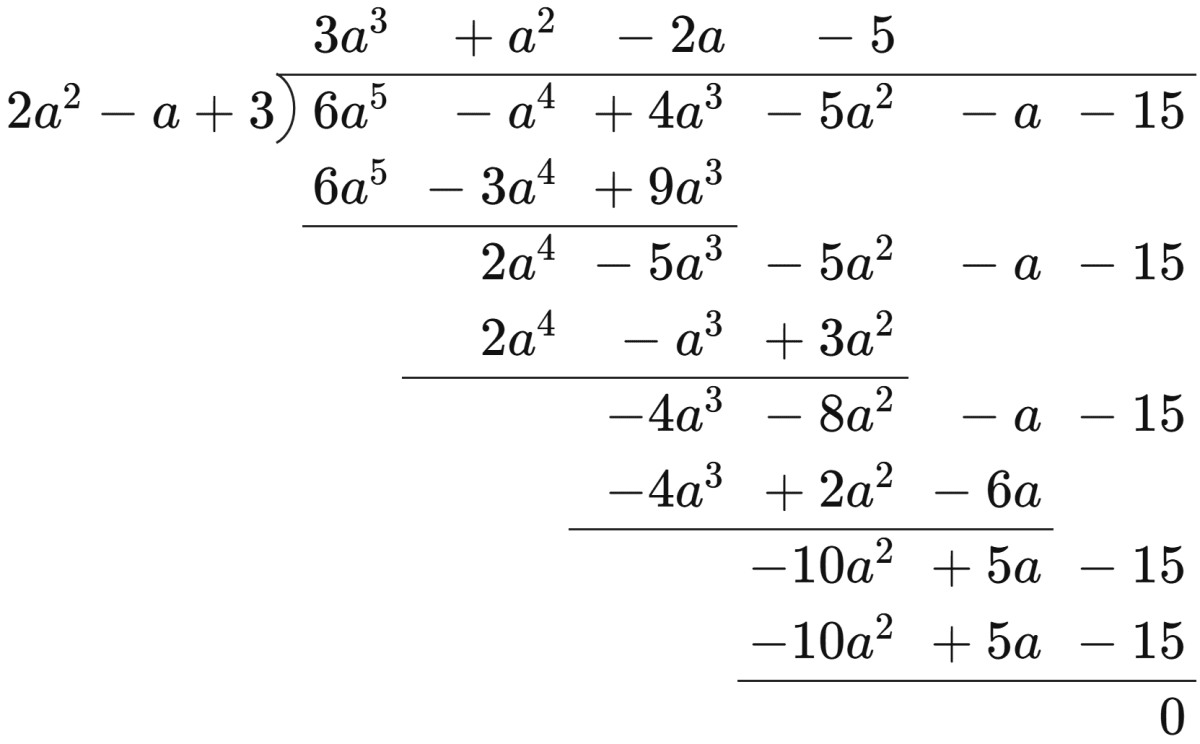
Show by division method that (2a2−a+3) is a factor of (6a5−a4+4a3−5a2−a−15).
Answer
A polynomial is a factor of another polynomial if it divides that polynomial exactly, that is, if the remainder is 0.
Dividing 6a5−a4+4a3−5a2−a−15 by 2a2−a+3
Here, the remainder is 0.
Hence, (2a2−a+3) is a factor of (6a5−a4+4a3−5a2−a−15).
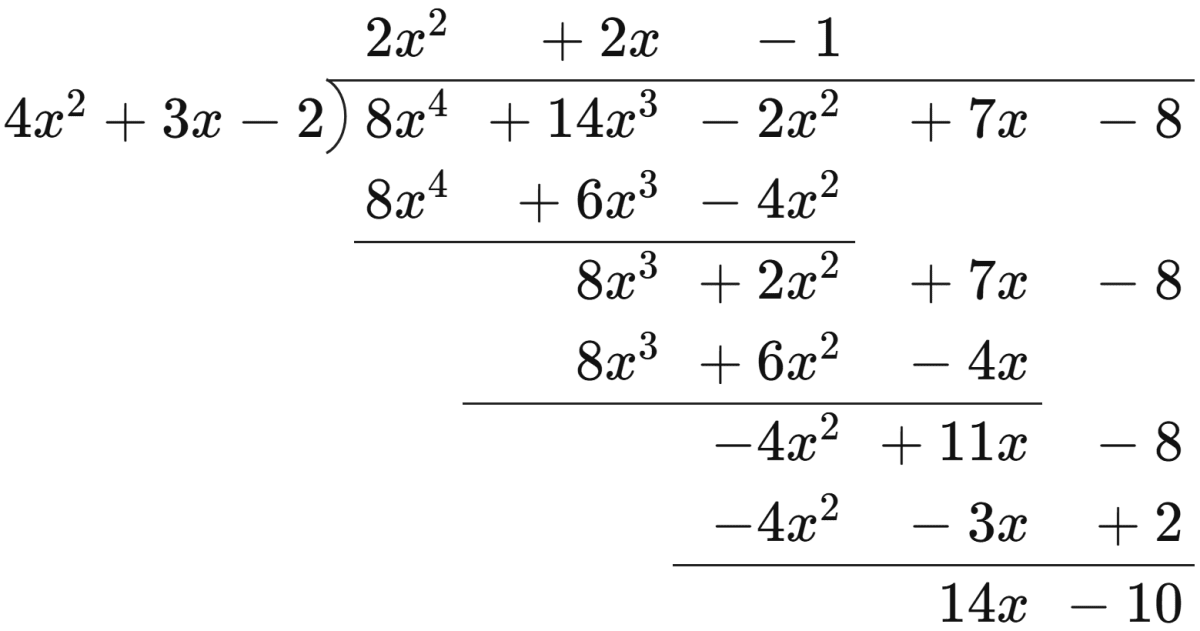
What must be subtracted from 8x4+14x3−2x2+7x−8 so that the resulting polynomial is exactly divisible by (4x2+3x−2)?
Answer
If a polynomial is divided by another polynomial, then on subtracting the remainder from the dividend, the resulting polynomial becomes exactly divisible by the divisor.
So, we first find the remainder on dividing 8x4+14x3−2x2+7x−8 by 4x2+3x−2.
Here, quotient = 2x2+2x−1 and remainder = 14x−10
Hence, 14x−10 must be subtracted from the given polynomial.
The length and breadth of a rectangle are (a+5b) units and (7a−b) units respectively. The perimeter of this rectangle is equal to the perimeter of a square. Find how much is the area of the rectangle less than that of the square?
Answer
Length of the rectangle = (a+5b) units
Breadth of the rectangle = (7a−b) units
Perimeter of the rectangle = 2 × (length + breadth)
=2×[(a+5b)+(7a−b)]=2×(8a+4b)=(16a+8b) units
As the perimeter of the square is equal to the perimeter of the rectangle,
Side of the square = 4Perimeter of the square
=416a+8b=(4a+2b) units
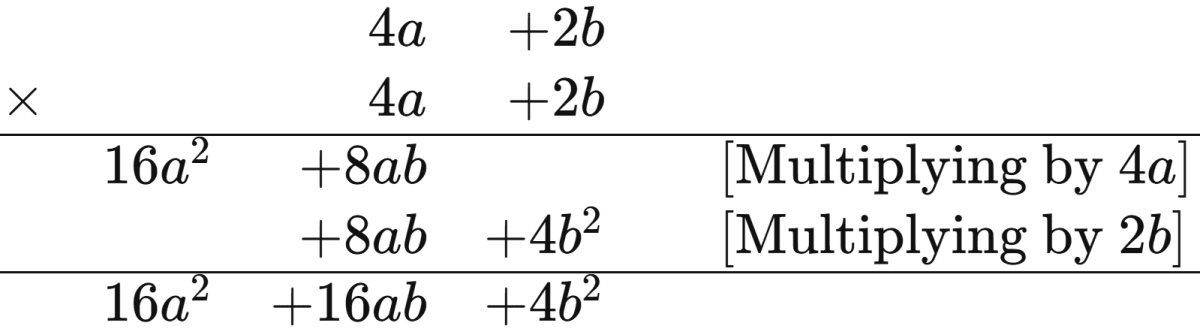
Now we find the area of the square.
So, area of the square = (16a2+16ab+4b2) square units.
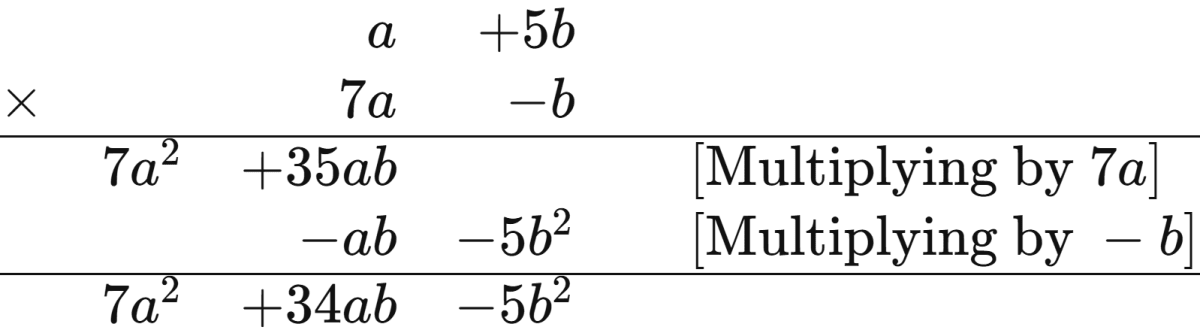
Next we find the area of the rectangle.
So, area of the rectangle = (7a2+34ab−5b2) square units.
Now we subtract the area of the rectangle from the area of the square.
Hence, the area of the rectangle is (9a2−18ab+9b2) square units less than the area of the square.
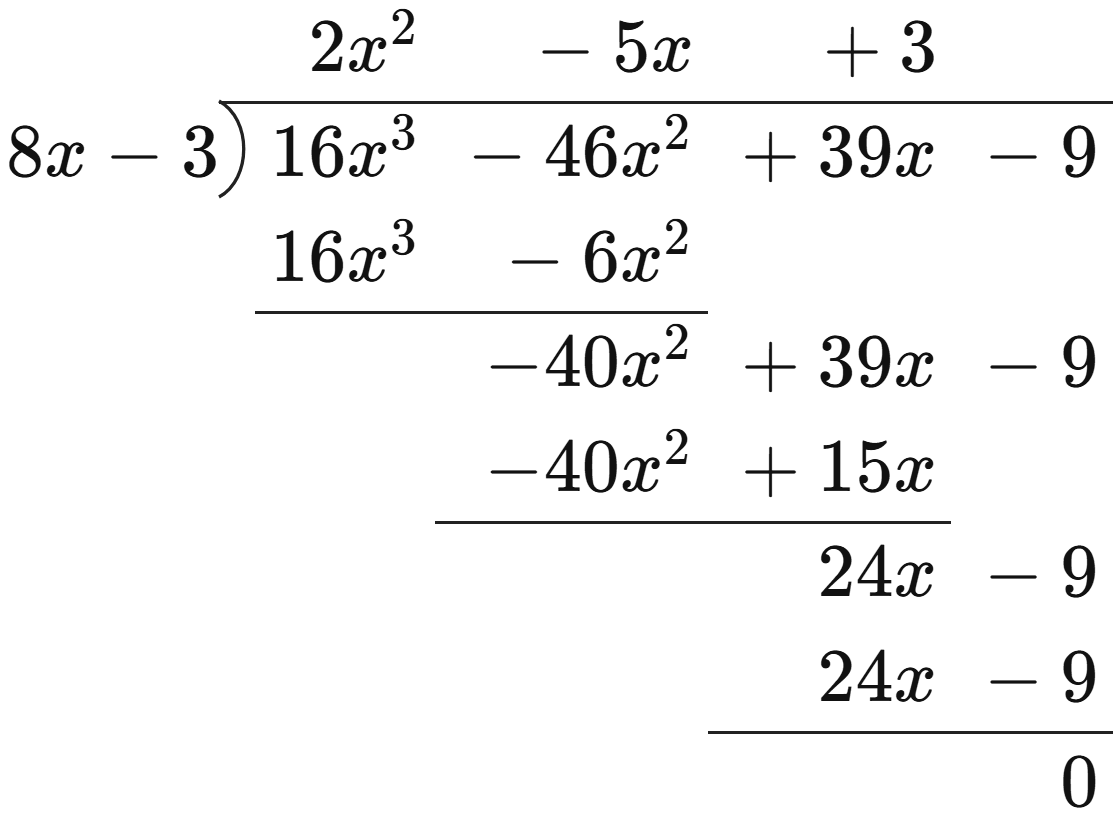
If a sum of ₹ (16x3−46x2+39x−9) is to be divided equally among (8x−3) persons, find the amount received by each person.
Answer
Total sum = ₹ (16x3−46x2+39x−9)
Number of persons = (8x−3)
∴ Amount received by each person = Total sum ÷ Number of persons
Dividing 16x3−46x2+39x−9 by 8x−3
Hence, the amount received by each person = ₹ (2x2−5x+3).
The product of two numbers is (x6−y6). If one of the numbers is (x−y), then find the other.
Answer
Product of the two numbers = (x6−y6)
One number = (x−y)
∴ Other number = Product ÷ One number
Writing the missing terms of the dividend with coefficient 0, we divide x6+0x5y+0x4y2+0x3y3+0x2y4+0xy5−y6 by x−y
Hence, the other number = x5+x4y+x3y2+x2y3+xy4+y5.
Divide 6x4−13x3+2x2+22x−24 by the product of 2x−3 and x2−2x+2.
Answer
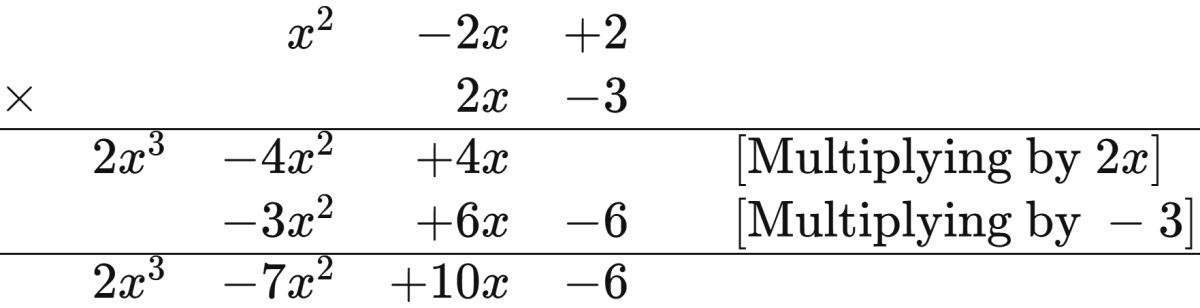
First we find the product of 2x−3 and x2−2x+2.
So, the divisor is 2x3−7x2+10x−6.
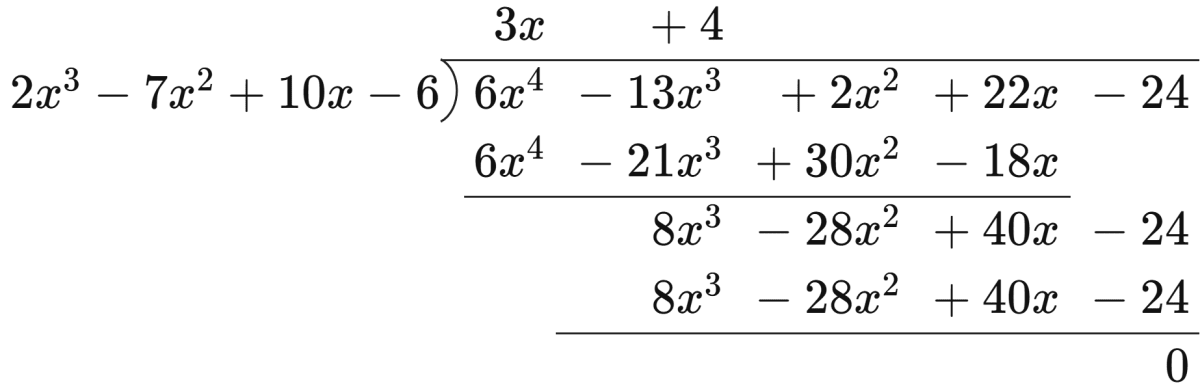
Now we divide 6x4−13x3+2x2+22x−24 by 2x3−7x2+10x−6
Hence, quotient = 3x+4 and remainder = 0.