Multiply:
8x2 by −5x
Answer
Product of monomials = (Product of their numerical coefficients) × (Product of their variable parts)
⇒8x2×(−5x)⇒[8×(−5)]×(x2×x)⇒−40x3
Hence, the required product = −40x3.
Multiply:
32ab by −6a2b
Answer
Product of monomials = (Product of their numerical coefficients) × (Product of their variable parts)
⇒32ab×(−6a2b)⇒[32×(−6)]×(ab×a2b)⇒−4a3b2
Hence, the required product = −4a3b2.
Multiply:
7x2y3 by −4x3y
Answer
Product of monomials = (Product of their numerical coefficients) × (Product of their variable parts)
⇒7x2y3×(−4x3y)⇒[7×(−4)]×(x2y3×x3y)⇒−28x5y4
Hence, the required product = −28x5y4.
Multiply:
(−95ax2) by (−53bxa2)
Answer
Product of monomials = (Product of their numerical coefficients) × (Product of their variable parts)
⇒(−95ax2)×(−53bxa2)⇒[(−95)×(−53)]×(ax2×bxa2)⇒31a3bx3
Hence, the required product = 31a3bx3.
Multiply:
(−32a6b5) by (−49a2b3)
Answer
Product of monomials = (Product of their numerical coefficients) × (Product of their variable parts)
⇒(−32a6b5)×(−49a2b3)⇒[(−32)×(−49)]×(a6b5×a2b3)⇒23a8b8
Hence, the required product = 23a8b8.
Multiply:
(−85p2q) by (2516pq2)
Answer
Product of monomials = (Product of their numerical coefficients) × (Product of their variable parts)
⇒(−85p2q)×2516pq2⇒[(−85)×2516]×(p2q×pq2)⇒−52p3q3
Hence, the required product = −52p3q3.
Multiply:
(2x2−5x+6) by −3x
Answer
In this case, we apply distributive laws and thus, multiply each term of the polynomial by the monomial.
⇒(2x2−5x+6)×(−3x)⇒[2x2×(−3x)]−[5x×(−3x)]+[6×(−3x)]⇒−6x3+15x2−18x
Hence, the required product = −6x3+15x2−18x.
Multiply:
(3−2y−y2) by −4xy
Answer
In this case, we apply distributive laws and thus, multiply each term of the polynomial by the monomial.
⇒(3−2y−y2)×(−4xy)⇒[3×(−4xy)]−[2y×(−4xy)]−[y2×(−4xy)]⇒−12xy+8xy2+4xy3
Hence, the required product = −12xy+8xy2+4xy3.
Multiply:
(3x2y−2xy2+5xy−6) by 4xy
Answer
In this case, we apply distributive laws and thus, multiply each term of the polynomial by the monomial.
⇒(3x2y−2xy2+5xy−6)×4xy⇒(3x2y×4xy)−(2xy2×4xy)+(5xy×4xy)−(6×4xy)⇒12x3y2−8x2y3+20x2y2−24xy
Hence, the required product = 12x3y2−8x2y3+20x2y2−24xy.
Multiply:
(7a3−5ab2−2b3+3ab+2a−5) by −3ab2
Answer
In this case, we apply distributive laws and thus, multiply each term of the polynomial by the monomial.
⇒(7a3−5ab2−2b3+3ab+2a−5)×(−3ab2)⇒[7a3×(−3ab2)]−[5ab2×(−3ab2)]−[2b3×(−3ab2)]+:[3ab×(−3ab2)]+[2a×(−3ab2)]−[5×(−3ab2)]⇒−21a4b2+15a2b4+6ab5−9a2b3−6a2b2+15ab2
Hence, the required product = −21a4b2+15a2b4+6ab5−9a2b3−6a2b2+15ab2.
Multiply:
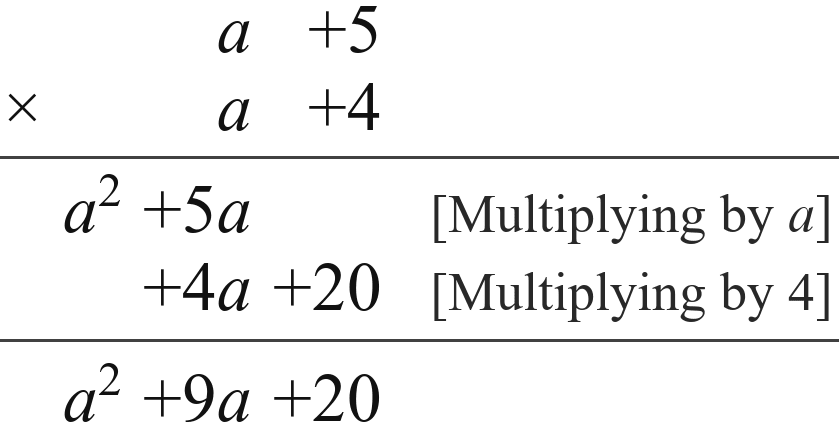
(a+5) by (a+4)
Answer
Multiply each term of the multiplicand by each term of the multiplier and take the algebraic sum of these products.
Arranging the multiplicand in descending order of powers and then multiplying, we get :
Hence, the required product = a2+9a+20.
Multiply:
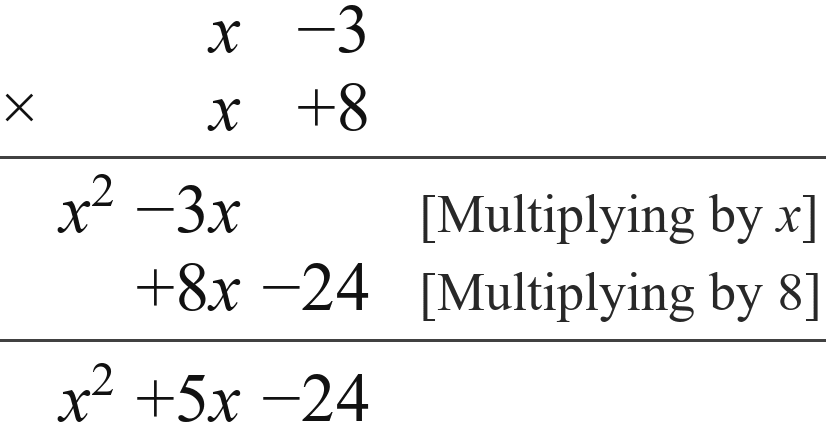
(x−3) by (x+8)
Answer
Multiply each term of the multiplicand by each term of the multiplier and take the algebraic sum of these products.
Arranging the multiplicand in descending order of powers and then multiplying, we get :
Hence, the required product = x2+5x−24.
Multiply:
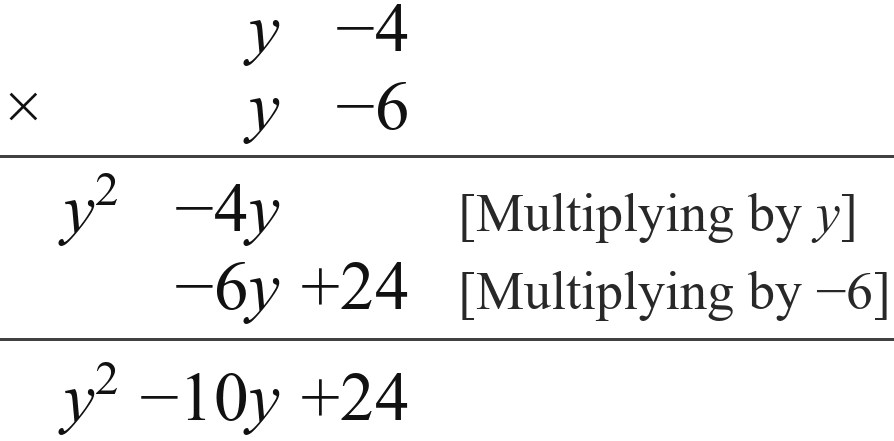
(y−4) by (y−6)
Answer
Multiply each term of the multiplicand by each term of the multiplier and take the algebraic sum of these products.
Arranging the multiplicand in descending order of powers and then multiplying, we get :
Hence, the required product = y2−10y+24.
Multiply:
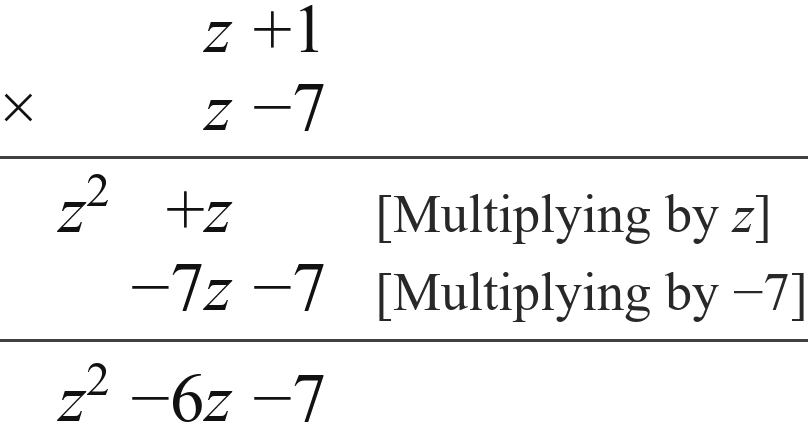
(z+1) by (z−7)
Answer
Multiply each term of the multiplicand by each term of the multiplier and take the algebraic sum of these products.
Arranging the multiplicand in descending order of powers and then multiplying, we get :
Hence, the required product = z2−6z−7.
Multiply:
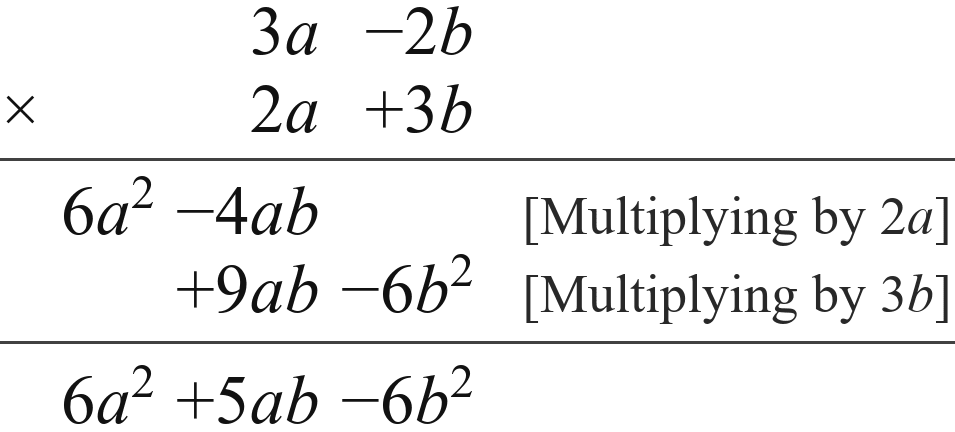
(3a−2b) by (2a+3b)
Answer
Multiply each term of the multiplicand by each term of the multiplier and take the algebraic sum of these products.
Arranging the multiplicand in descending order of powers and then multiplying, we get :
Hence, the required product = 6a2+5ab−6b2.
Multiply:
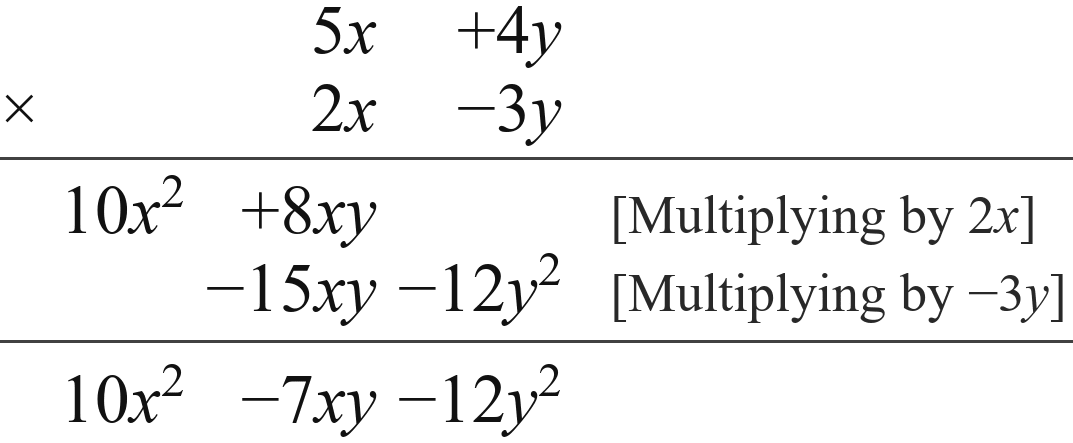
(5x+4y) by (2x−3y)
Answer
Multiply each term of the multiplicand by each term of the multiplier and take the algebraic sum of these products.
Arranging the multiplicand in descending order of powers and then multiplying, we get :
Hence, the required product = 10x2−7xy−12y2.
Multiply:
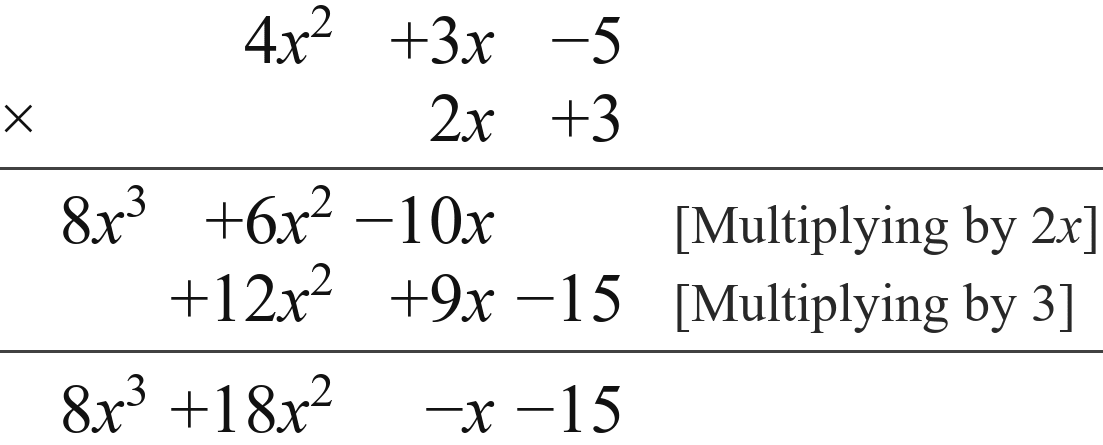
(4x2+3x−5) by (2x+3)
Answer
Multiply each term of the multiplicand by each term of the multiplier and take the algebraic sum of these products.
Arranging the multiplicand in descending order of powers and then multiplying, we get :
Hence, the required product = 8x3+18x2−x−15.
Multiply:
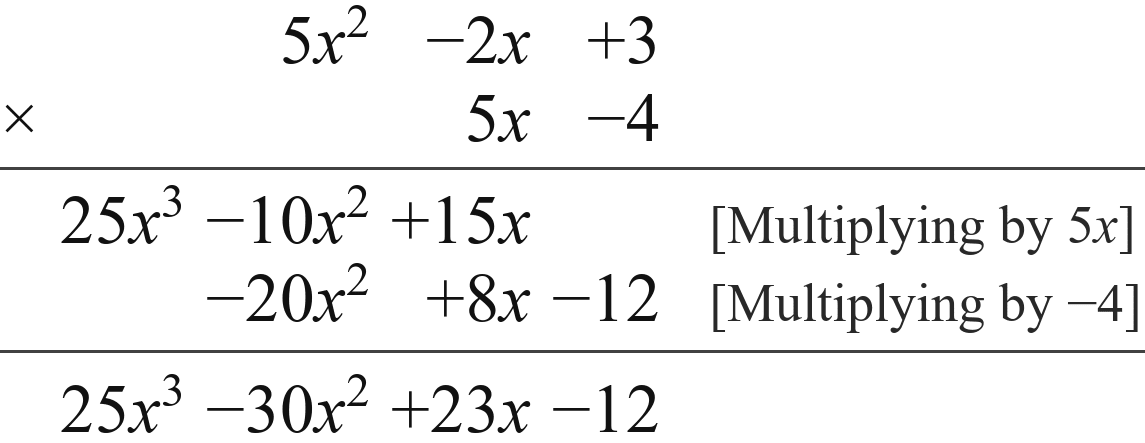
(3−2x+5x2) by (5x−4)
Answer
Multiply each term of the multiplicand by each term of the multiplier and take the algebraic sum of these products.
Arranging the multiplicand in descending order of powers and then multiplying, we get :
Arranging the multiplicand in descending powers of x, we get 5x2−2x+3.
Hence, the required product = 25x3−30x2+23x−12.
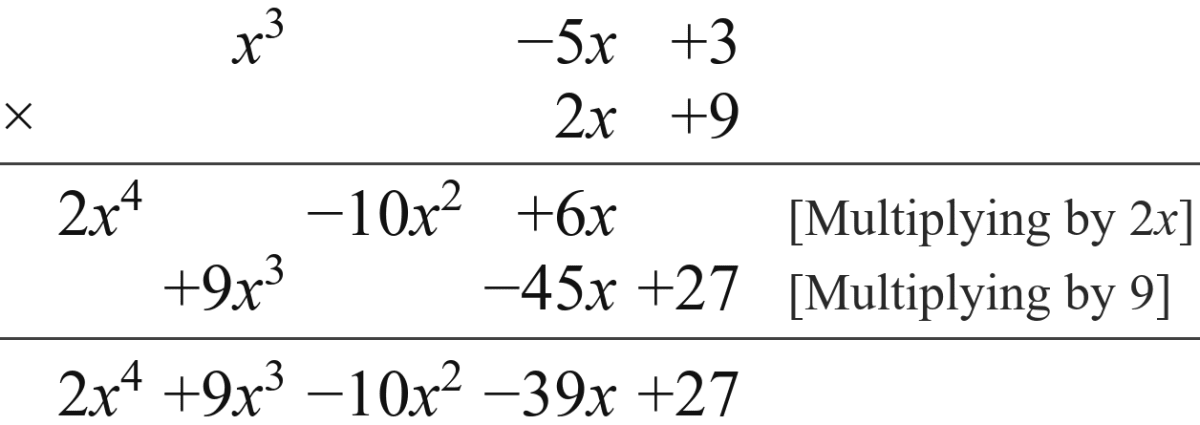
Multiply:
(x3−5x+3) by (2x+9)
Answer
Multiply each term of the multiplicand by each term of the multiplier and take the algebraic sum of these products.
Arranging the multiplicand in descending order of powers and then multiplying, we get :
Hence, the required product = 2x4+9x3−10x2−39x+27.
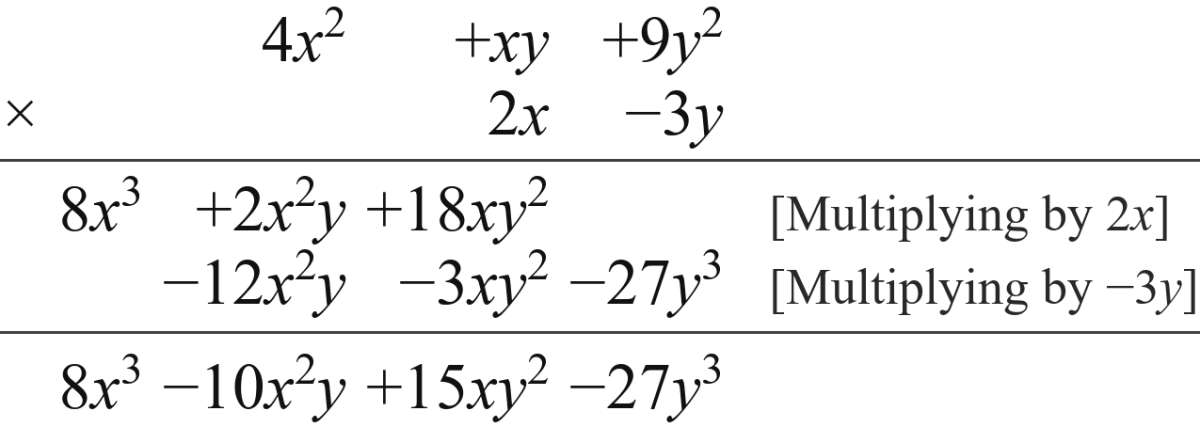
Multiply:
(4x2+xy+9y2) by (2x−3y)
Answer
Multiply each term of the multiplicand by each term of the multiplier and take the algebraic sum of these products.
Arranging the multiplicand in descending order of powers and then multiplying, we get :
Hence, the required product = 8x3−10x2y+15xy2−27y3.
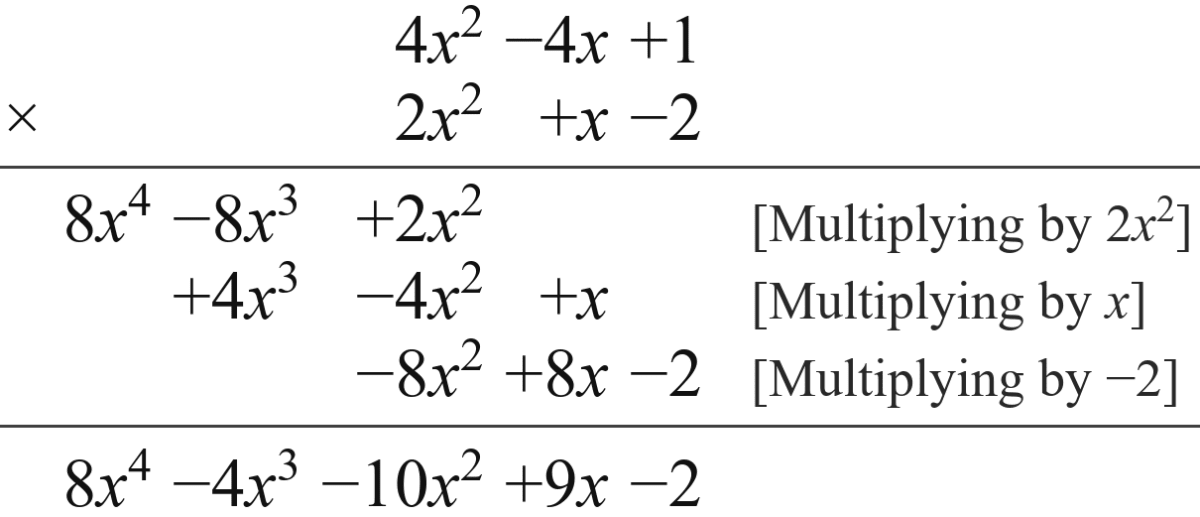
Multiply:
(4x2−4x+1) by (2x2+x−2)
Answer
Multiply each term of the multiplicand by each term of the multiplier and take the algebraic sum of these products.
Arranging the multiplicand in descending order of powers and then multiplying, we get :
Hence, the required product = 8x4−4x3−10x2+9x−2.
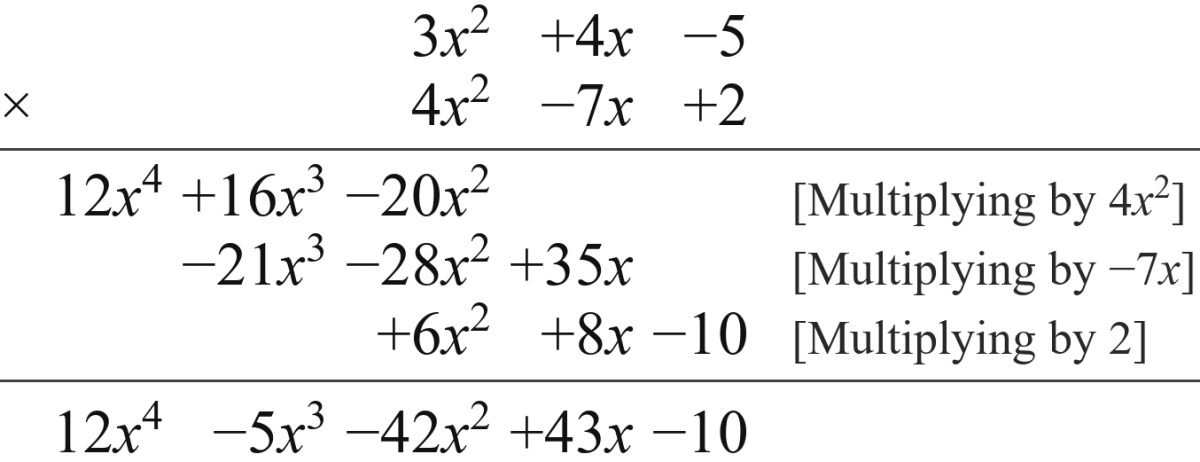
Multiply:
(3x2+4x−5) by (4x2−7x+2)
Answer
Multiply each term of the multiplicand by each term of the multiplier and take the algebraic sum of these products.
Arranging the multiplicand in descending order of powers and then multiplying, we get :
Hence, the required product = 12x4−5x3−42x2+43x−10.
Multiply:
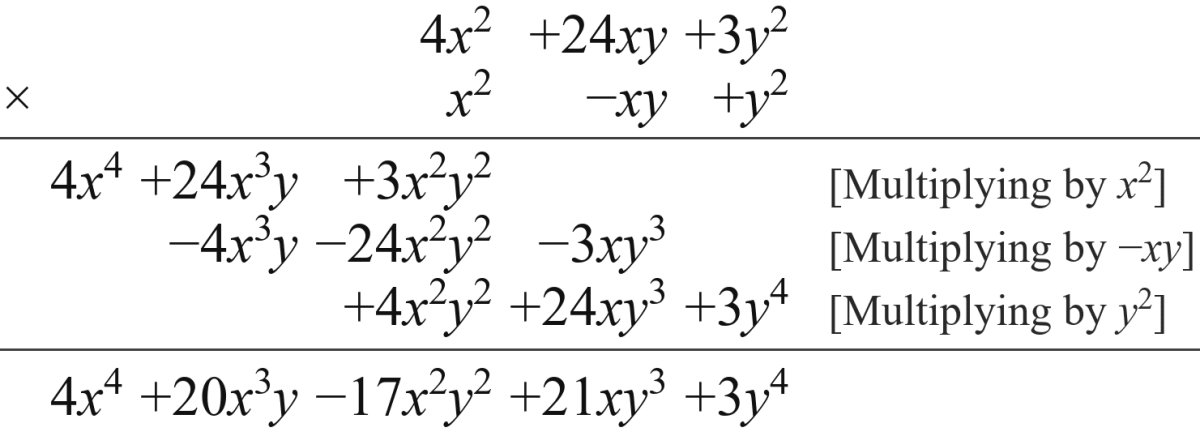
(4x2+24xy+3y2) by (x2−xy+y2)
Answer
Multiply each term of the multiplicand by each term of the multiplier and take the algebraic sum of these products.
Arranging the multiplicand in descending order of powers and then multiplying, we get :
Hence, the required product = 4x4+20x3y−17x2y2+21xy3+3y4.
Multiply:
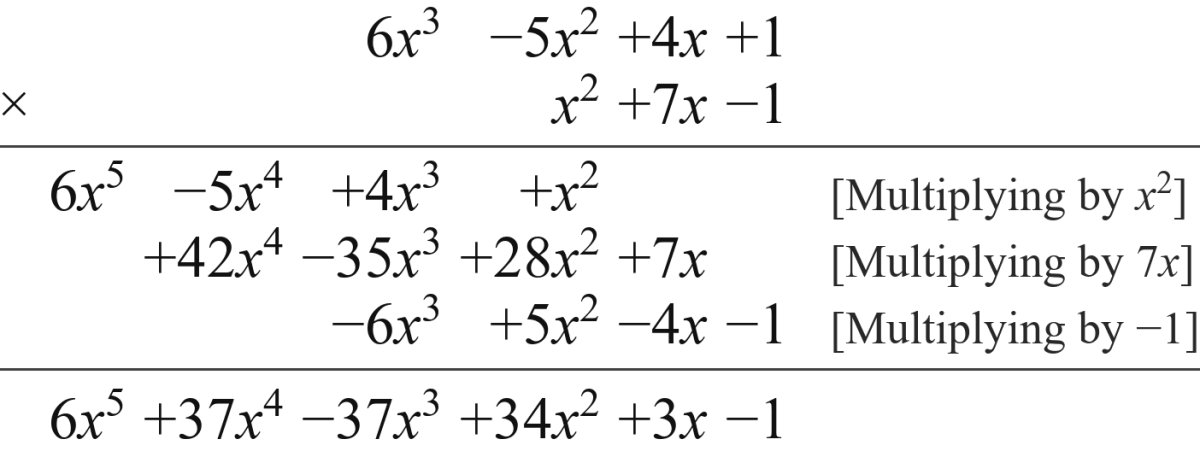
(6x3−5x2+4x+1) by (x2+7x−1)
Answer
Multiply each term of the multiplicand by each term of the multiplier and take the algebraic sum of these products.
Arranging the multiplicand in descending order of powers and then multiplying, we get :
Hence, the required product = 6x5+37x4−37x3+34x2+3x−1.
Multiply:
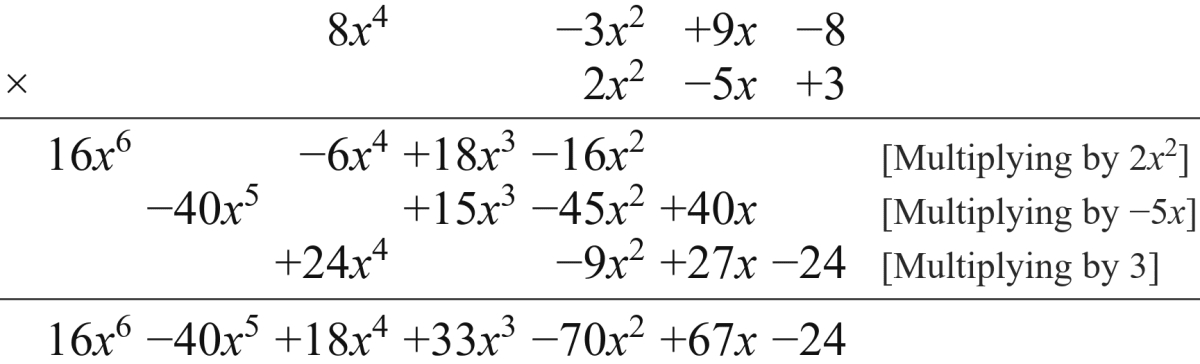
(8x4−3x2+9x−8) by (2x2−5x+3)
Answer
Multiply each term of the multiplicand by each term of the multiplier and take the algebraic sum of these products.
Arranging the multiplicand in descending order of powers and then multiplying, we get :
Hence, the required product = 16x6−40x5+18x4+33x3−70x2+67x−24.
Multiply:
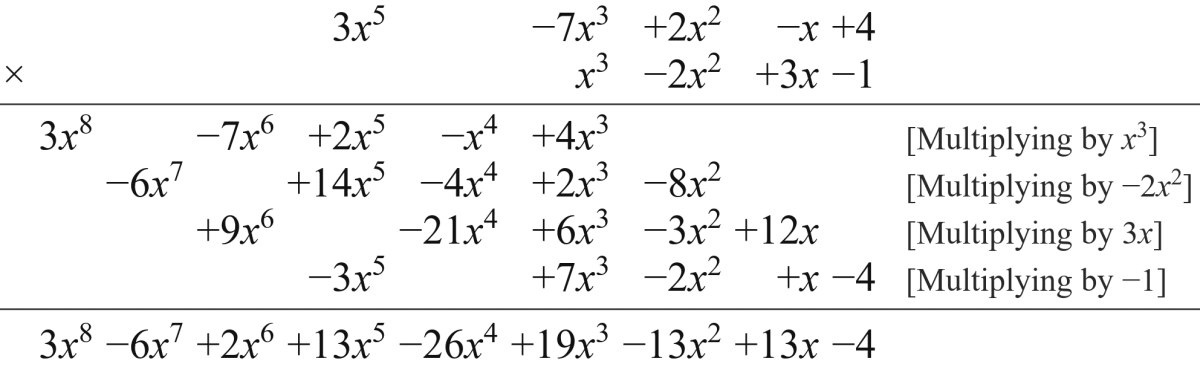
(3x5−7x3+2x2−x+4) by (x3−2x2+3x−1)
Answer
Multiply each term of the multiplicand by each term of the multiplier and take the algebraic sum of these products.
Arranging the multiplicand in descending order of powers and then multiplying, we get :
Hence, the required product = 3x8−6x7+2x6+13x5−26x4+19x3−13x2+13x−4.
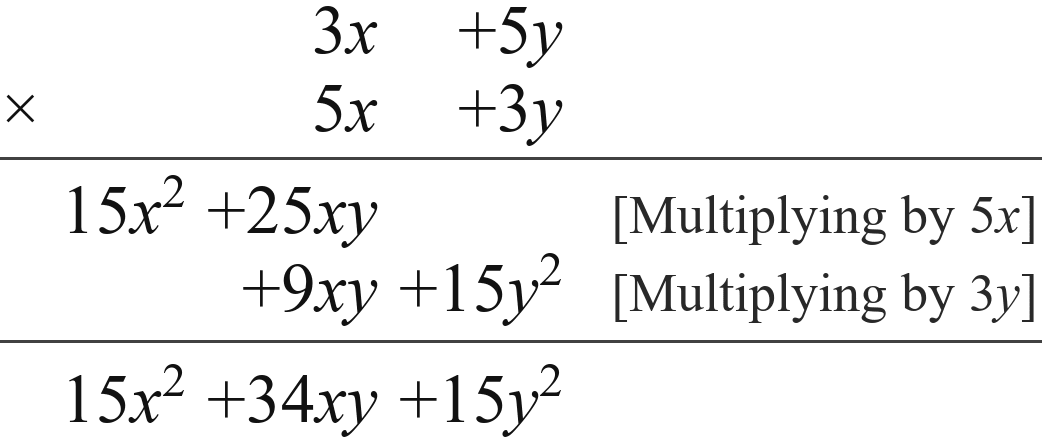
There are (3x+5y) shelves in a library and in each shelve there are (5x+3y) books. How many books are there in the library?
Answer
Number of shelves = (3x+5y)
Number of books on each shelf = (5x+3y)
Total number of books = Number of shelves × Number of books on each shelf
Hence, the number of books in the library = 15x2+34xy+15y2.