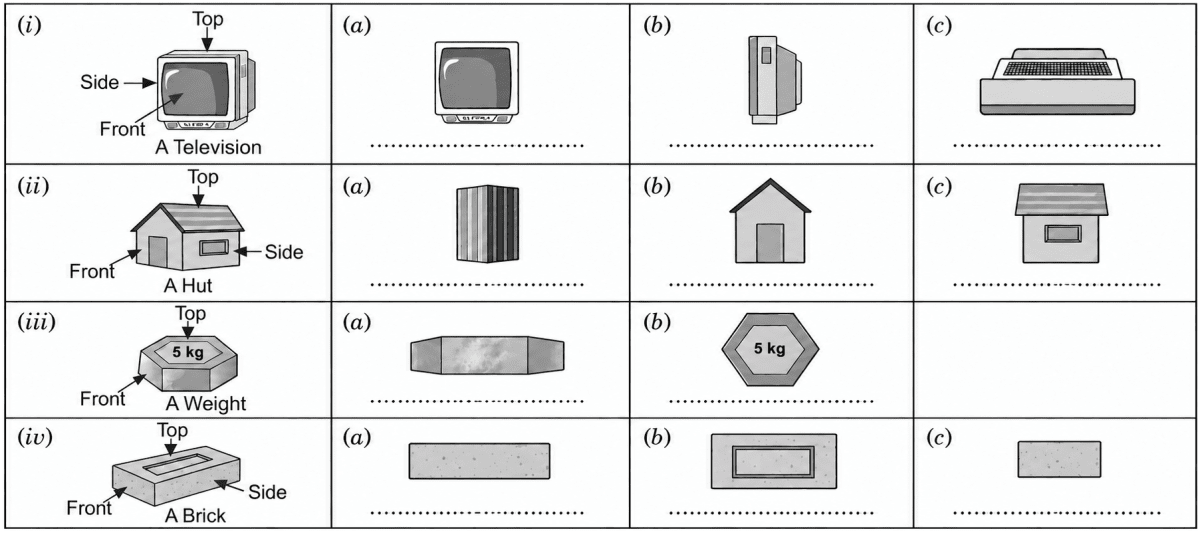
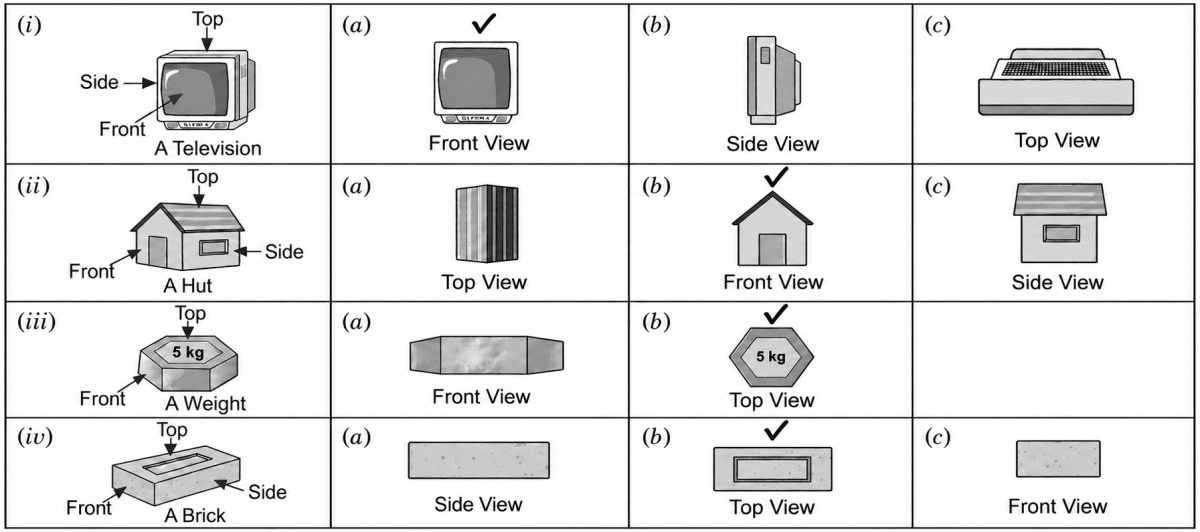
Below are given some 3D-solids and their three different views. Label the views shown as front view, side view and top view and tick the one which is the best 2D-representation of the object shown:
Answer
Complete the following table by filling the number of faces, the number of edges and the number of vertices for the given solid:
| Solid | Number of Faces | Number of Edges | Number of Vertices |
|---|---|---|---|
| (i) Cuboid | ...... | ...... | ...... |
| (ii) Tetrahedron | ...... | ...... | ...... |
| (iii) Rectangular Pyramid | ...... | ...... | ...... |
| (iv) Pentagonal Pyramid | ...... | ...... | ...... |
| (v) Hexagonal Pyramid | ...... | ...... | ...... |
| (vi) Triangular Prism | ...... | ...... | ...... |
| (vii) Hexagonal Prism | ...... | ...... | ...... |
Answer
(i) A cuboid is bounded by 6 rectangular faces. So, it has 6 faces, 12 edges and 8 vertices.
(ii) A tetrahedron is a triangular pyramid. It has 1 triangular base and 3 triangular lateral faces. So, it has 4 faces, 6 edges and 4 vertices.
(iii) A rectangular pyramid has 1 rectangular base and 4 triangular lateral faces. So, it has 5 faces, 8 edges and 5 vertices.
(iv) A pentagonal pyramid has 1 pentagonal base and 5 triangular lateral faces. So, it has 6 faces, 10 edges and 6 vertices.
(v) A hexagonal pyramid has 1 hexagonal base and 6 triangular lateral faces. So, it has 7 faces, 12 edges and 7 vertices.
(vi) A triangular prism has 2 triangular faces and 3 rectangular lateral faces. So, it has 5 faces, 9 edges and 6 vertices.
(vii) A hexagonal prism has 2 hexagonal faces and 6 rectangular lateral faces. So, it has 8 faces, 18 edges and 12 vertices.
The completed table is shown below:
| Solid | Number of Faces | Number of Edges | Number of Vertices |
|---|---|---|---|
| (i) Cuboid | 6 | 12 | 8 |
| (ii) Tetrahedron | 4 | 6 | 4 |
| (iii) Rectangular Pyramid | 5 | 8 | 5 |
| (iv) Pentagonal Pyramid | 6 | 10 | 6 |
| (v) Hexagonal Pyramid | 7 | 12 | 7 |
| (vi) Triangular Prism | 5 | 9 | 6 |
| (vii) Hexagonal Prism | 8 | 18 | 12 |
Fill in the blanks:
(i) A square prism may also be called a ......................
(ii) A tetrahedron has ...................... triangular faces.
(iii) A pentagonal pyramid has ...................... triangular faces.
(iv) The five lateral faces of a pentagonal prism are ...................... .
(v) Two adjacent faces of a solid meet in a/an ......................
(vi) Two adjacent edges of a solid meet in a/an ......................
(vii) The side view of any pyramid depicts a ......................
(viii) If a prism has a -sided polygon as its base, then it has ............ faces ............ edges and ............ vertices.
(ix) If a pyramid has a -sided polygon as its base, then it has ............ faces, ............ edges and ............ vertices.
Answer
(i) A square prism may also be called a cuboid.
(ii) A tetrahedron has 4 triangular faces.
(iii) A pentagonal pyramid has 5 triangular faces.
(iv) The five lateral faces of a pentagonal prism are rectangles.
(v) Two adjacent faces of a solid meet in a/an edge.
(vi) Two adjacent edges of a solid meet in a/an vertex.
(vii) The side view of any pyramid depicts a triangle.
(viii) If a prism has a -sided polygon as its base, then it has faces edges and vertices.
(ix) If a pyramid has a -sided polygon as its base, then it has faces, edges and vertices.
Write the number of faces, edges and vertices in:
(i) an octagonal pyramid
(ii) a decagonal prism
Answer
(i) In an octagonal pyramid, the number of sides of the polygonal base is 8.
Number of faces in a pyramid is 1 more than the number of sides of the polygonal base.
Number of faces = 8 + 1 = 9
Number of edges in a pyramid is twice the number of sides of the polygonal base.
Number of edges = 8 × 2 = 16
Number of vertices in a pyramid is 1 more than the number of sides of the polygonal base.
Number of vertices = 8 + 1 = 9
Hence, in an octagonal pyramid, F = 9, E = 16 and V = 9.
(ii) In a decagonal prism, the number of sides of the polygonal base is 10.
Number of faces in a prism is 2 more than the number of sides of the polygonal base.
Number of faces = 10 + 2 = 12
Number of edges in a prism is thrice the number of sides of the polygonal base.
Number of edges = 10 × 3 = 30
Number of vertices in a prism is twice the number of sides of the polygonal base.
Number of vertices = 10 × 2 = 20
Hence, in a decagonal prism, F = 12, E = 30 and V = 20.
Which of the following solids has the highest number of vertices?
(i) Cuboid
(ii) Triangular Prism
(iii) Triangular Pyramid
(iv) Square Pyramid
Answer
Number of vertices in a cuboid = 8
Number of vertices in a triangular prism = 6
Number of vertices in a triangular pyramid = 4
Number of vertices in a square pyramid = 5
Of these, 8 is the greatest.
Hence, cuboid has the highest number of vertices.
In which of the following solids, all the lateral faces are not triangular?
(i) Triangular Prism
(ii) Triangular Pyramid
(iii) Square Pyramid
(iv) Pentagonal Pyramid
Answer
A triangular pyramid, a square pyramid and a pentagonal pyramid are all pyramids, and all the lateral faces of a pyramid are triangles.
A triangular prism is a prism, and its 3 lateral faces are rectangles.
Hence, in a triangular prism all the lateral faces are not triangular.
In which of the following solids, none of the faces is triangular?
(i) Triangular Prism
(ii) Square Pyramid
(iii) Pentagonal Pyramid
(iv) Hexagonal Prism
Answer
A triangular prism has 2 triangular faces and 3 rectangular faces.
A square pyramid has 1 square face and 4 triangular faces.
A pentagonal pyramid has 1 pentagonal face and 5 triangular faces.
A hexagonal prism has 2 hexagonal faces and 6 rectangular faces.
Hence, in a hexagonal prism, none of the faces is triangular.
Look at the following picture:
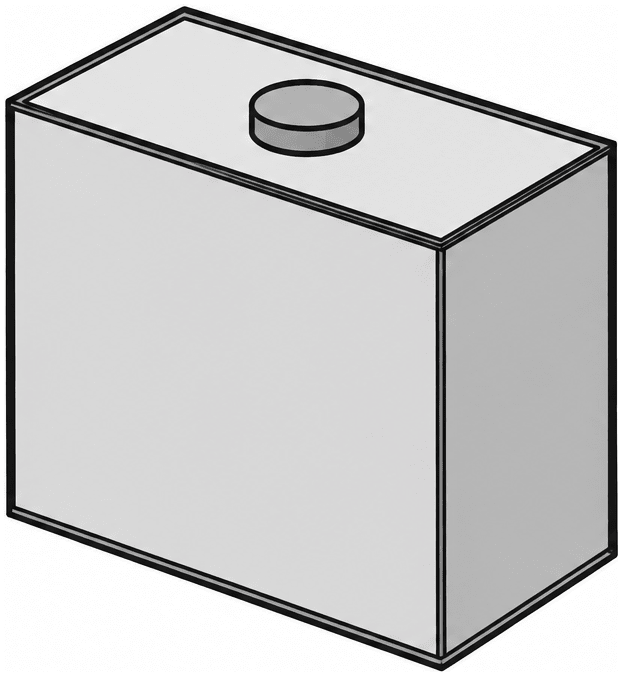
Which of the options given below correctly represent the view of the above object as seen from the top?
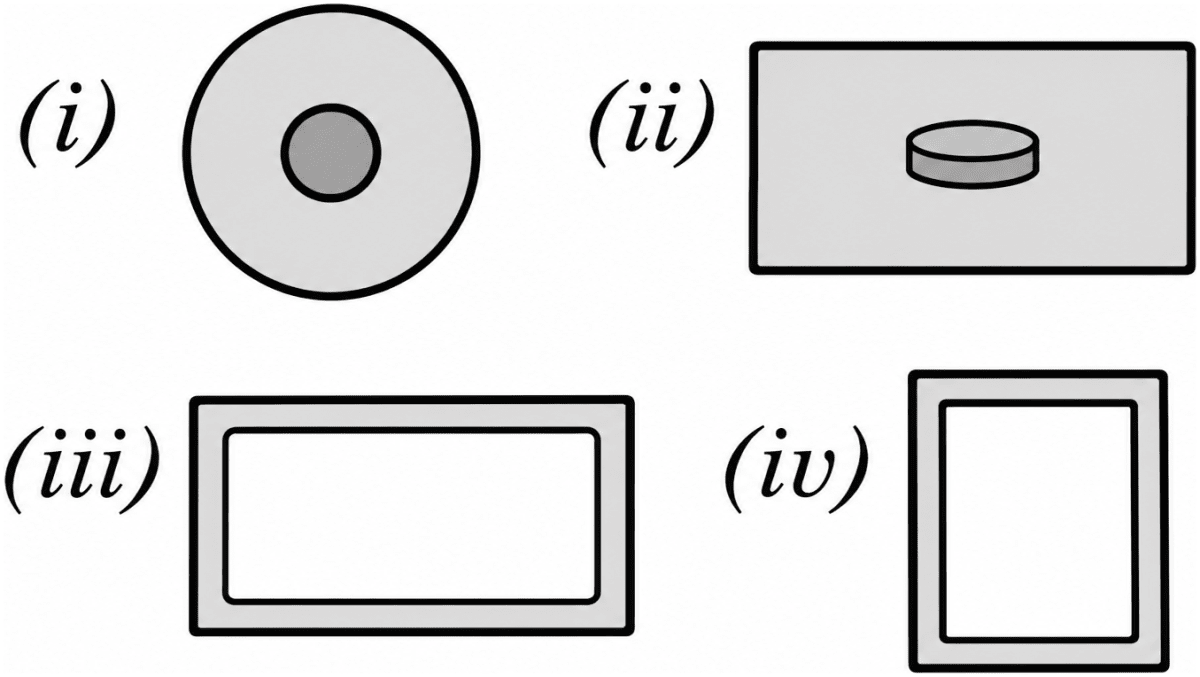
Answer
The given object is a container in the shape of a cuboid, having an oval cap fitted on its upper face.
Looking at the object from the top, the rectangular upper face of the container is seen along with the oval cap lying on it.
So, the top view of the given object is a rectangle having an oval inside it, which is the figure given in option (ii).
Hence, option (ii) is the correct option.
Choose the correct top view of the following jointed figure from the options given below it:
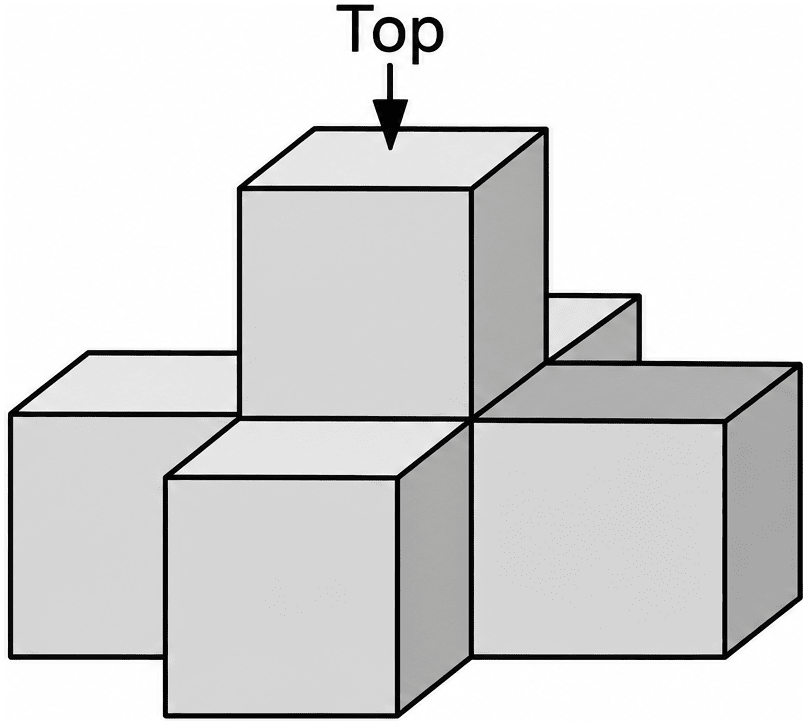
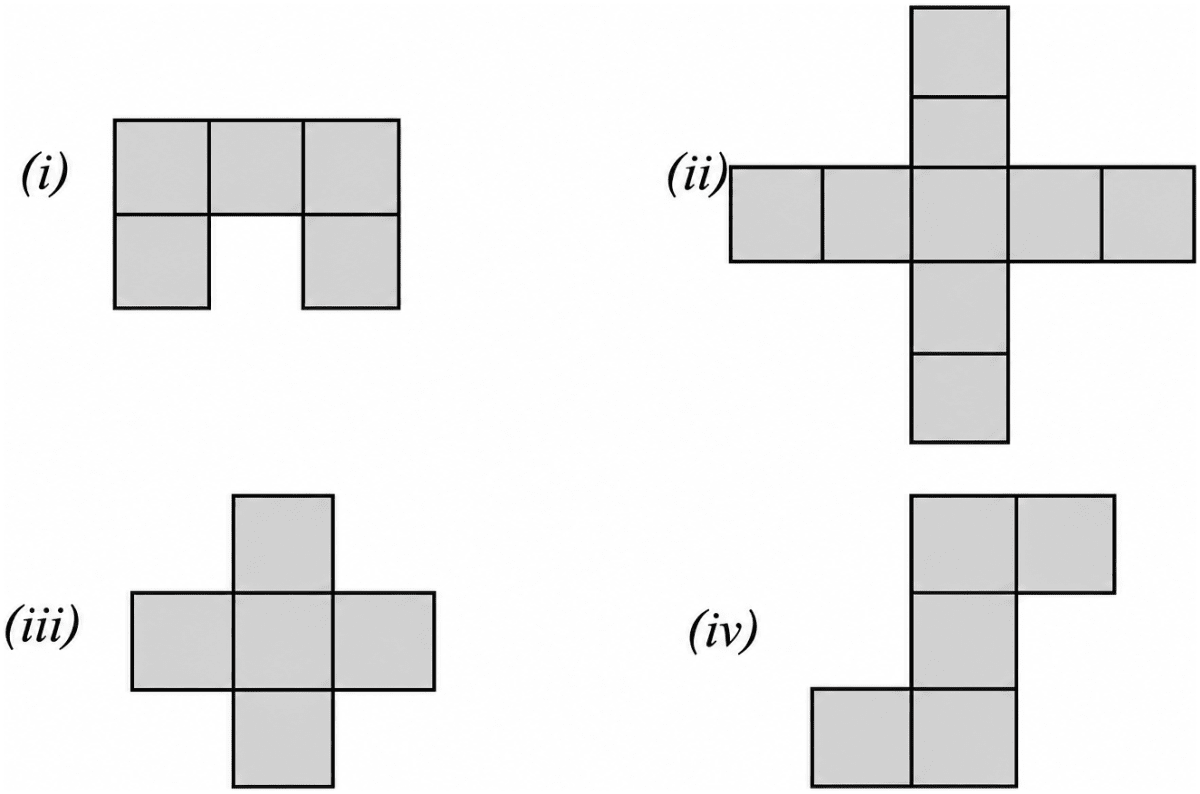
Answer
The given jointed figure is made of 6 identical cubes. One cube is at the centre, four cubes are joined to the four side faces of this central cube and one cube is placed on the top of the central cube.
Looking at the figure from the top, the central cube and the four cubes joined to its side faces are seen as 5 squares forming the shape of a plus sign. The cube placed on the top of the central cube exactly covers the central square, so it does not change the shape seen.
So, the top view of the given jointed figure is the figure given in option (iii).
Hence, option (iii) is the correct option.
Below are given three views of a 3D-jointed figure:
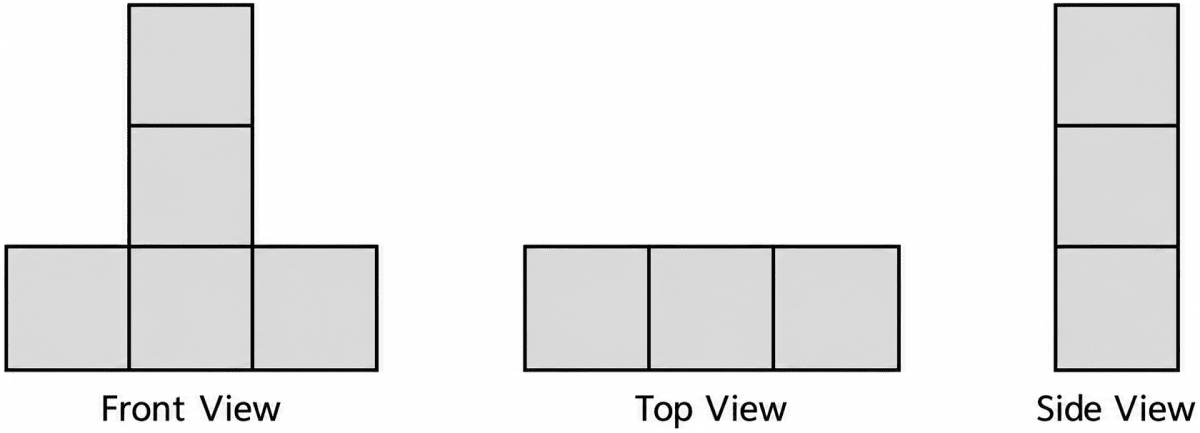
Choose the correct corresponding figure:
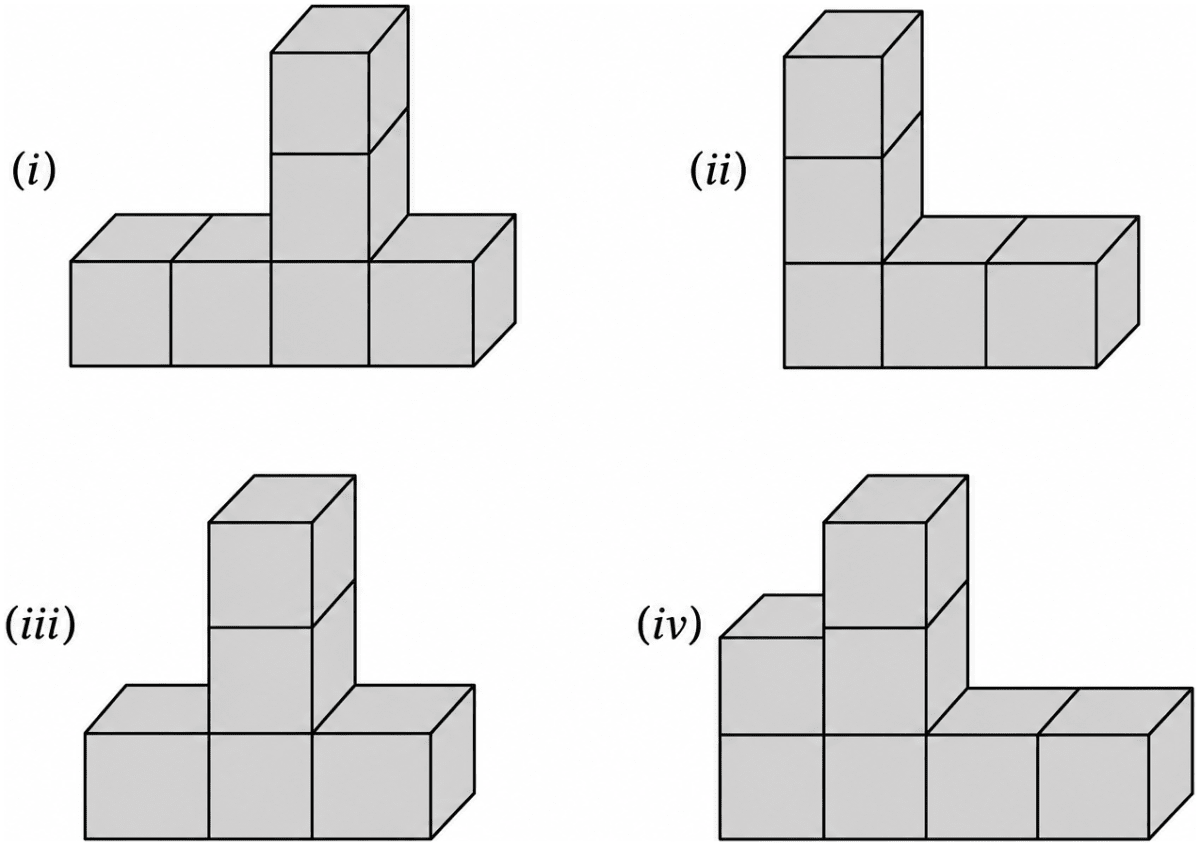
Answer
In the front view, there are 3 squares in a row with 2 more squares placed one above the other on the middle square. So, the required figure is 3 cubes long and 3 cubes high, and the column of cubes stands on the middle cube.
In the top view, there are 3 squares in a row. So, the required figure is 3 cubes long and 1 cube wide.
In the side view, there are 3 squares placed one above the other. So, the required figure is 1 cube wide and 3 cubes high.
The figure given in option (iii) is made of 3 cubes placed in a row with 2 cubes placed one above the other on the middle cube, so it has all the three given views.
Hence, option (iii) is the correct option.
Draw the correct 2D-front view of the jointed figure shown below:
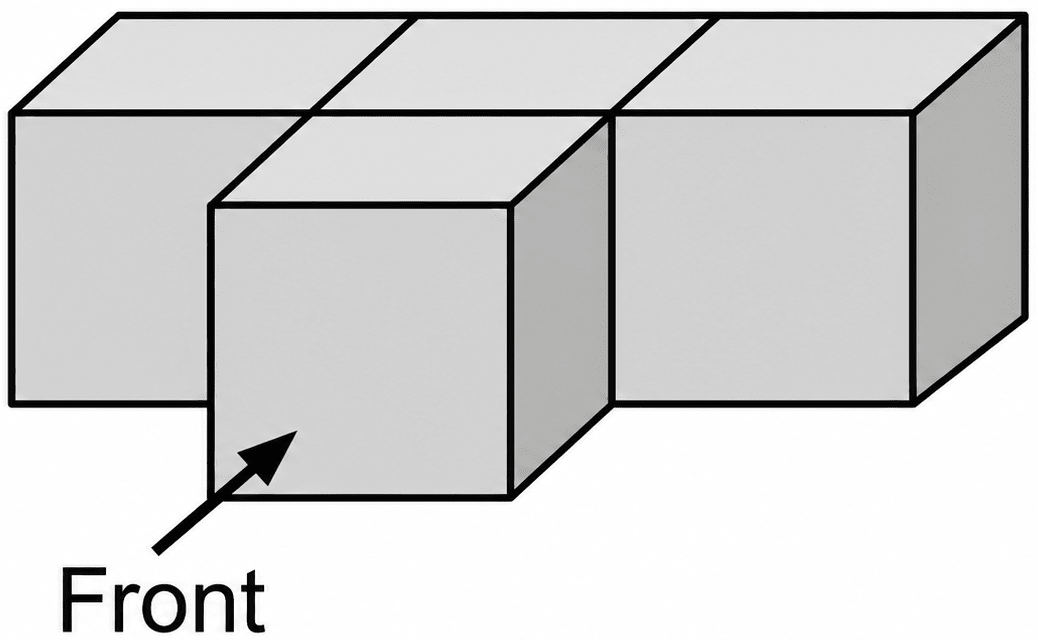
Answer
The given jointed figure is made of 4 identical cubes. Three cubes are placed in a row at the back and one cube is joined in front of the middle cube of this row.
Looking at the figure from the front, the cube lying in front exactly covers the middle cube of the row behind it.
So, only 3 squares placed in a row are seen.
The required 2D-front view of the given jointed figure is shown below: