
Which of the following is the density of water?
- 1 gcm-3
- 1000 gcm-3
- 0.1 gcm-3
- 10 gcm-3
Answer
1 gcm-3
Reason — Density is the mass per unit volume of a substance. The density of water is 1 gcm-3 (which is the same as 1000 kgm-3). Because of this, relative densities of other substances are compared with water.
What is the energy possessed by a body due to its position called?
- Kinetic energy
- Potential energy
- Thermal energy
- Electrical energy
Answer
Potential energy
Reason — The energy possessed by a body by virtue of its position or configuration is called potential energy. Kinetic energy, on the other hand, is the energy a body has due to its motion.
Which of the following is the mirror used as a rear-view mirror in vehicles?
- Plane mirror
- Concave mirror
- Convex mirror
- Cylindrical mirror
Answer
Convex mirror
Reason — A convex mirror always forms an erect and diminished image and gives a wider field of view of the traffic behind. This lets the driver see a large area in a small mirror, so it is used as a rear-view mirror.
In household electricity, what is the commercial unit of energy?
- Joule
- Watt
- Kilowatt-hour
- Volt
Answer
Kilowatt-hour
Reason — The commercial unit of electrical energy is the kilowatt-hour (kWh). It is the energy used by an appliance of power 1 kilowatt in 1 hour (1 kWh = 3.6 × 10⁶ J). The joule is too small a unit for measuring household consumption.
What can heat cause?
- Change of state
- Change in dimensions
- Rise in temperature
- All of these
Answer
All of these
Reason — When heat is supplied to a substance, its molecules gain energy. This can raise the temperature of the body, cause a change in its dimensions (expansion) and also bring about a change in its state of matter. So heat can cause all of these effects.
What device is used to test whether a material is a conductor or an insulator?
- Electroscope
- Ammeter
- Thermometer
- Hydrometer
Answer
Electroscope
Reason — An electroscope detects charge on a body. If a charged material is touched to a charged electroscope and the leaves collapse (the charge leaks away), the material is a conductor; if the leaves stay diverged, it is an insulator. An ammeter measures current, a thermometer measures temperature and a hydrometer measures density of liquids.
The upward force experienced by an object immersed in a fluid is which of the following?
- Gravitational force
- Buoyant force
- Magnetic force
- Frictional force
Answer
Buoyant force
Reason — When a body is immersed in a fluid, the fluid exerts an upward force on it called the buoyant force (or upthrust). It is equal to the weight of the fluid displaced by the immersed part of the body.
The turning effect of force depends on which of the following?
- Force applied and mass of the body
- Force applied and distance from pivot
- Pressure applied and area of contact
- Mass and acceleration
Answer
Force applied and distance from pivot
Reason — The turning effect of a force (moment of force) is the product of the force and the perpendicular distance of the force from the pivot (M = F × d). So it depends on the force applied and the distance from the pivot.
Gases can be compressed easily because of which of the following reasons?
- They have strong intermolecular forces.
- They have weak intermolecular forces.
- They have no intermolecular space.
- Their particles do not move.
Answer
They have weak intermolecular forces.
Reason — In gases the intermolecular distance is large and the intermolecular forces of attraction are very weak (almost negligible). Because of these large spaces between the molecules, the molecules can be pushed closer together, so gases can be compressed easily.
The unit 'horsepower' is used to measure ............... .
- Energy
- Work
- Power
- Force
Answer
Power
Reason — Horsepower (hp) is a unit of power. It was introduced by James Watt to compare the rate of doing work of engines and horses (1 hp = 746 watts). Power is the rate of doing work.
Assertion (A): Relative density has no unit.
Reason (R): It is a ratio of two densities.
- Both A and R are true, and R is the correct explanation of A.
- Both A and R are true, and R is not the correct explanation of A.
- A is true, but R is false.
- A is false, but R is true.
Answer
Both A and R are true, and R is the correct explanation of A.
Explanation —
Assertion (A) is correct: Relative density has no unit.
Reason (R) is also correct: Relative density is the ratio of the density of a substance to the density of water (at 4°C). Since both densities have the same unit, the units cancel each other.
Hence Reason (R) correctly explains Assertion (A).
Assertion (A): Lightning is a large-scale example of static electricity discharge.
Reason (R): Opposite charges accumulate in clouds and the ground.
- Both A and R are true, and R is the correct explanation of A.
- Both A and R are true, and R is not the correct explanation of A.
- A is true, but R is false.
- A is false, but R is true.
Answer
Both A and R are true, and R is the correct explanation of A.
Explanation —
Assertion (A) is correct: Lightning is a large-scale discharge of static electricity that occurs when accumulated electric charges are suddenly released.
Reason (R) is also correct: During a thunderstorm, opposite charges build up in the clouds and on the ground. When this charge becomes very large, the insulating air breaks down and a sudden electric discharge takes place as lightning. So lightning is indeed a large-scale discharge of static electricity, and the accumulation of opposite charges is the reason for it.
Hence Reason (R) correctly explains Assertion (A).
Assertion (A): Thermal expansion causes gaps in bridges.
Reason (R): Materials expand uniformly with rise in temperature.
- Both A and R are true, and R is the correct explanation of A.
- Both A and R are true, and R is not the correct explanation of A.
- A is true, but R is false.
- A is false, but R is true.
Answer
A is true, but R is false.
Explanation —
Assertion (A) is correct: Thermal expansion causes bridges to expand when the temperature increases. Gaps or expansion joints are provided in bridges to allow this expansion and prevent damage.
Reason (R) is incorrect: The amount of expansion depends on the nature of the material and the rise in temperature. Different materials have different coefficients of expansion, so they do not all expand by the same amount for the same rise in temperature.
Hence Assertion (A) is true, but Reason (R) is false.
Assertion (A): A convex mirror always forms diminished images.
Reason (R): It diverges the light rays falling on it.
- Both A and R are true, and R is the correct explanation of A.
- Both A and R are true, and R is not the correct explanation of A.
- A is true, but R is false.
- A is false, but R is true.
Answer
Both A and R are true, and R is the correct explanation of A.
Explanation —
Assertion (A) is correct: A convex mirror always forms a diminished, virtual, and erect image of an object, irrespective of the position of the object.
Reason (R) is also correct: A convex mirror is a diverging mirror, as it spreads out the light rays that fall on it. Because of this divergence, it always forms an erect and diminished (smaller) virtual image. So both A and R are true, and the diverging nature of the mirror is exactly why the image is diminished.
Hence Reason (R) correctly explains Assertion (A).
Assertion (A): Work done is zero when force acts perpendicular to displacement.
Reason (R): No component of force acts along the direction of displacement.
- Both A and R are true, and R is the correct explanation of A.
- Both A and R are true, and R is not the correct explanation of A.
- A is true, but R is false.
- A is false, but R is true.
Answer
Both A and R are true, and R is the correct explanation of A.
Explanation —
Assertion (A) is correct: Work is done only when there is displacement in the direction of the force.
Reason (R) is also correct: When the force acts perpendicular to the displacement, it has no component along the displacement, so the work done is zero.
Therefore, Reason (R) correctly explains Assertion (A).
Name the following.
(a) The SI unit of energy
(b) Instrument used to measure density of liquids
(c) Splitting of white light into seven colours
(d) Device that prevents electric shocks by grounding
(e) Upward force experienced by a body immersed in fluid
Answer
(a) Joule (J)
(b) Hydrometer
(c) Dispersion (of light)
(d) Earthing (earth wire)
(e) Buoyant force (upthrust)
Given alongside is the picture of a manometer. Read the information and fill in the blanks.
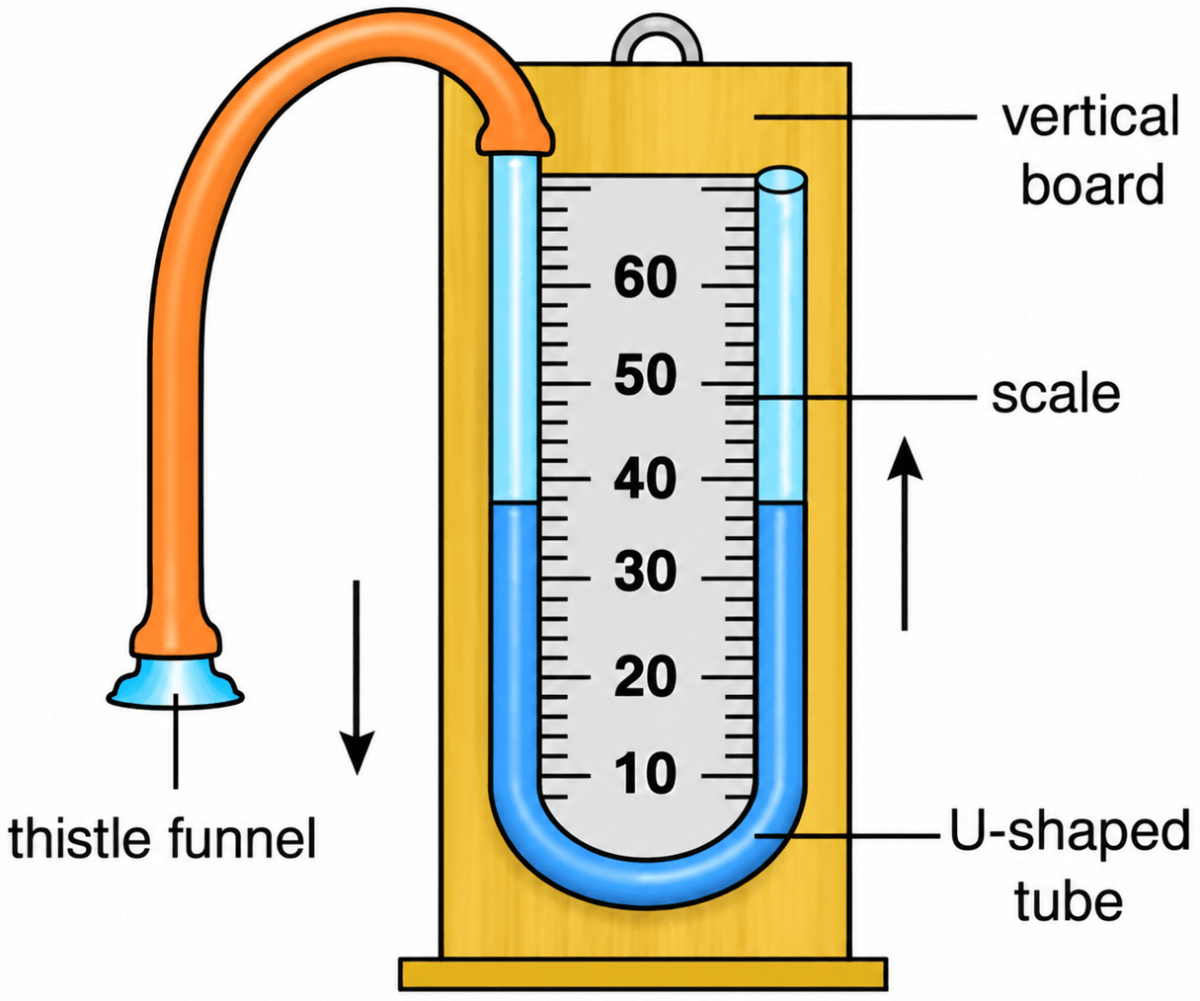
A simple device used to measure the pressure exerted by a liquid is called manometer. A manometer consists of a U-shaped tube filled with some liquid (water or mercury). One end of the tube is open to air and the other end is connected to a thistle funnel which has a rubber membrane stretched across its mouth. The level of liquid in the two arms of the manometer changes on placing the funnel in the beaker containing the liquid whose pressure is to be measured. Then in both the arms of the tube (they should be at the same level), check the mean position of the liquid and note it down. In the two arms, the difference in the levels of liquid is a measure of the pressure exerted by the liquid on the rubber membrane. The more the difference, the greater is the pressure exerted.
A manometer is a simple device used to measure the ............... exerted by a liquid. It has a ............... tube partly filled with ............... or mercury. One end of the tube is ..............., while the other is connected to a ............... covered with a ............... . When the funnel is placed in a ............... containing liquid, the levels in both arms ............... . The difference in levels shows the ............... of the liquid — the greater the difference, the greater the ............... .
Answer
A manometer is a simple device used to measure the pressure exerted by a liquid. It has a U-shaped tube partly filled with water or mercury. One end of the tube is open (to air), while the other is connected to a thistle funnel covered with a rubber membrane. When the funnel is placed in a beaker containing liquid, the levels in both arms change. The difference in levels shows the pressure of the liquid — the greater the difference, the greater the pressure.
Shuffle the following steps in correct order to show that air exerts pressure.
(a) Quickly invert the glass while holding the cardboard.
(b) Observe that the cardboard does not fall.
(c) Fill a glass with water up to the brim.
(d) Release the cardboard gently.
(e) Place a stiff cardboard on top of the glass.
Answer
The correct order of the given steps is:
- (c) Fill a glass with water up to the brim.
- (e) Place a stiff cardboard on top of the glass.
- (a) Quickly invert the glass while holding the cardboard.
- (d) Release the cardboard gently.
- (b) Observe that the cardboard does not fall.
So the correct order is c → e → a → d → b.
Read the explanations given below and name the terms.
(a) The forces that hold the molecules of matter together
(b) Energy possessed by a body due to its motion
(c) A device that minimizes loss of heat by conduction, convection, and radiation
(d) A device used to detect the presence of charge
(e) The principle which states that a floating body displaces its own weight of liquid
Answer
(a) Intermolecular force (force of attraction between molecules)
(b) Kinetic energy
(c) Thermos flask (vacuum flask)
(d) Electroscope
(e) Law of flotation
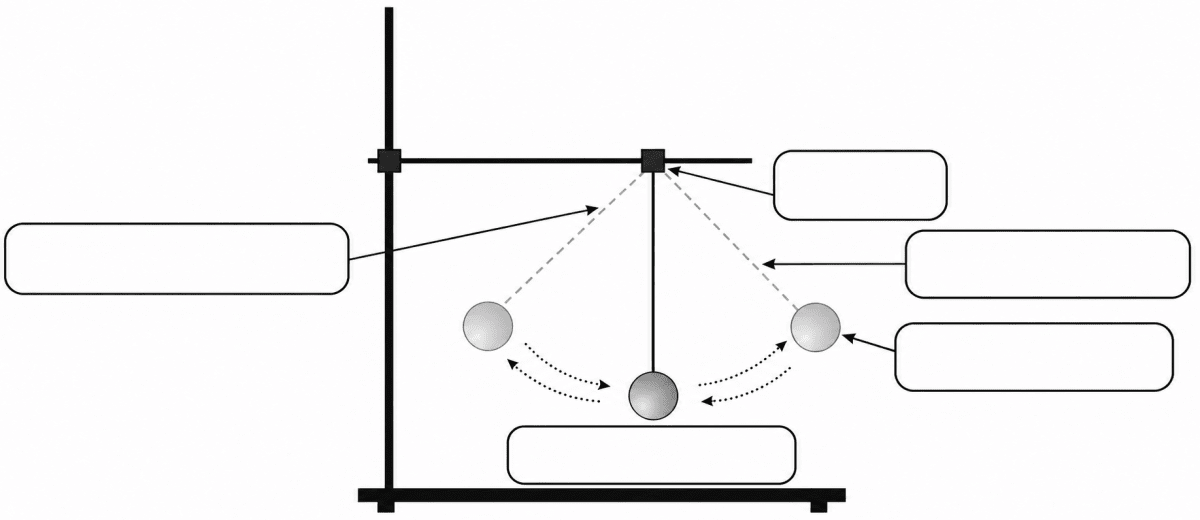
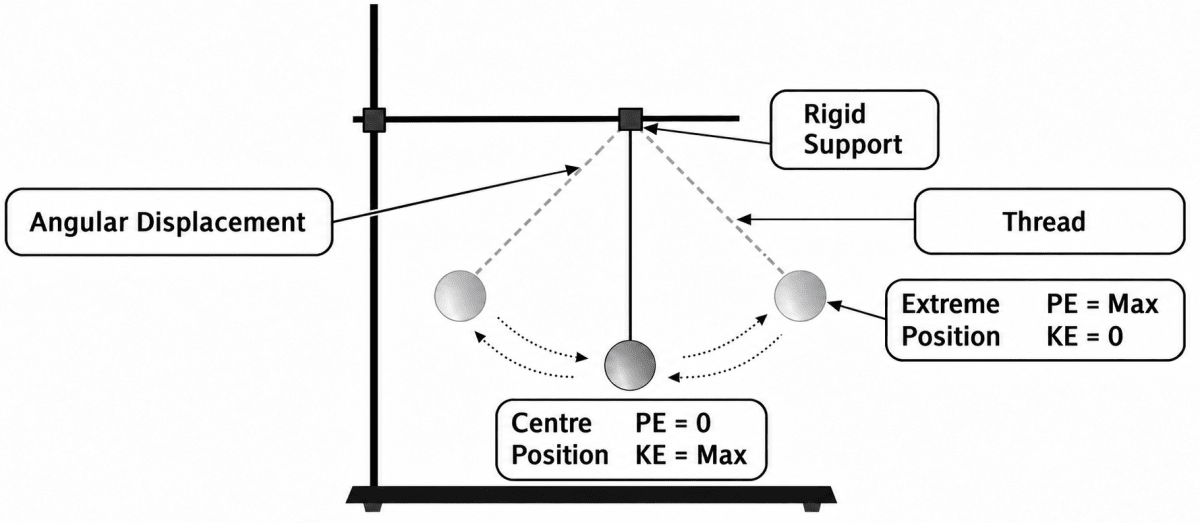
Write the correct words in the blank boxes given in the picture.
Answer
Define the following terms.
(a) Buoyancy
(b) Moment of force
(c) Timbre
(d) Atmospheric pressure
Answer
(a) Buoyancy — The upward force experienced by a body when it is immersed in a fluid is called buoyancy (or upthrust). It is equal to the weight of the fluid displaced by the body.
(b) Moment of force — The product of the magnitude of the force and the perpendicular distance of the force from the pivot. It measures the turning effect of a force about a fixed point.
(c) Timbre — The characteristic of a sound that helps us to distinguish between two sounds of the same loudness and pitch produced by different sources.
(d) Atmospheric pressure — The force exerted by the atmosphere (air) on a unit area of the surface of the earth is called atmospheric pressure.
State two differences between solids and liquids.
Answer
| Solids | Liquids |
|---|---|
| Solids have a fixed shape and a fixed volume. | Liquids have a fixed volume but take the shape of the container in which they are kept. |
| The intermolecular spaces are very small and the intermolecular forces are strong, so the molecules are tightly packed and cannot move about. | The intermolecular spaces are larger and the intermolecular forces are weaker, so the molecules are loosely packed and can move within the liquid. |
Define thrust. How is it related to pressure?
Answer
Thrust — The total force acting perpendicular to a surface is called thrust. Its SI unit is the newton (N).
Thrust is related to pressure as follows: pressure is the thrust acting per unit area of the surface.
For the same thrust, the smaller the area of contact, the greater the pressure; and the larger the area of contact, the smaller the pressure.
Define earthing. Why is it important?
Answer
Earthing — Earthing means connecting the metallic body of an electrical appliance to the earth through a thick copper wire, the other end of which is buried deep in the ground.
It is important because if a live wire accidentally touches the metal body of an appliance, the current flows safely into the earth through the earth wire instead of through the person. This protects the user from receiving a severe electric shock.
Define power. Write its SI unit.
Answer
Power — Power is defined as the amount of work done (or energy spent) by a body in unit time. It is the rate of doing work.
The SI unit of power is the watt (W).
Explain the construction and working of a gold-leaf electroscope with a neat diagram. Mention its uses.
Answer
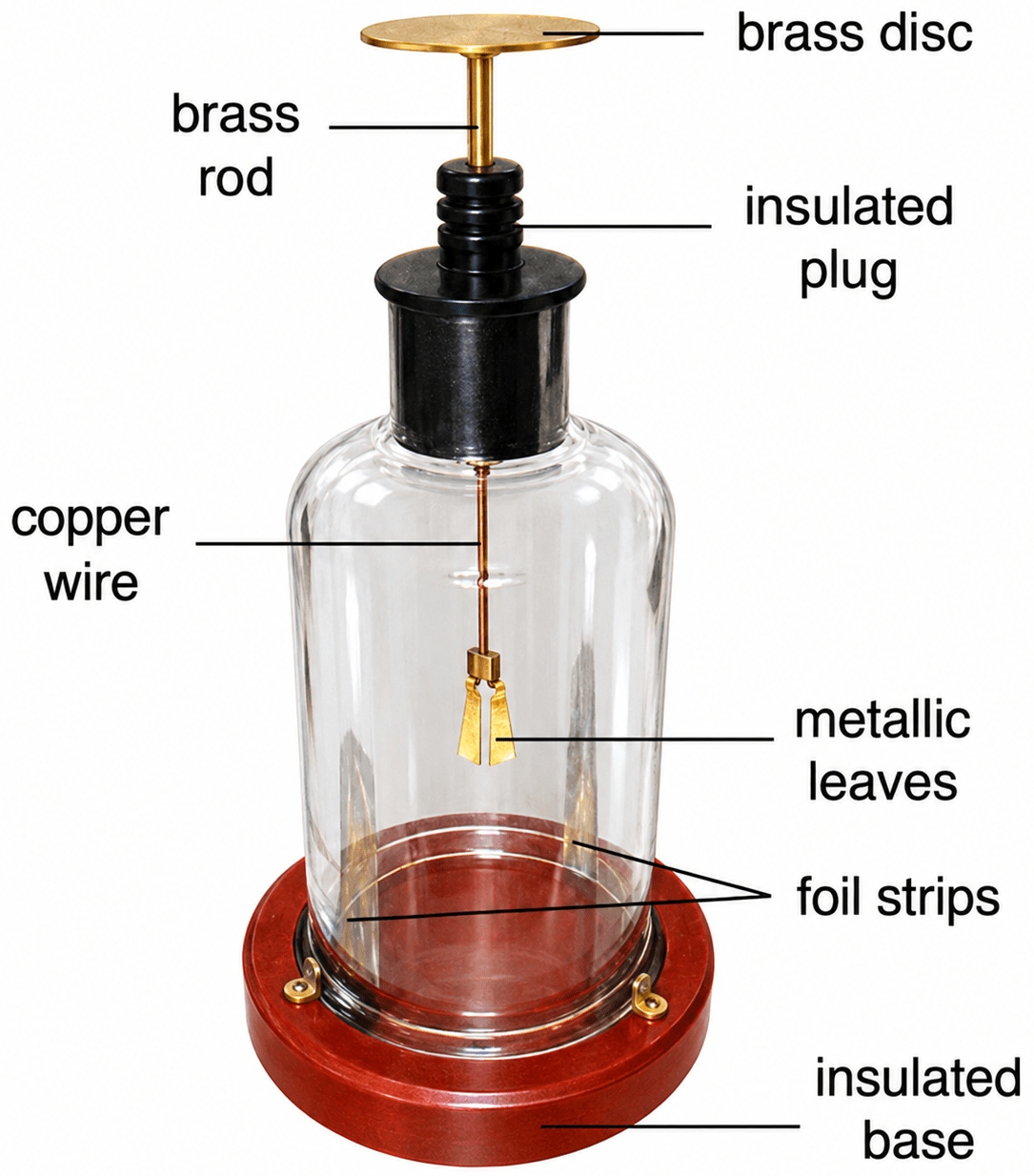
Construction: A gold-leaf electroscope consists of a glass jar fitted with an insulated plug (cork) at its mouth. A metallic rod, usually of brass, passes through the plug into the jar. The upper end of the rod, outside the jar, carries a metal disc or cap on which the charge to be tested is placed. The lower end of the rod, inside the jar, carries two thin metallic leaves (originally of gold) hanging parallel to each other.
Working:
- When a charged body is brought in contact with (or near) the brass disc, the charge spreads down the rod to the two leaves.
- Both leaves get the same kind of charge, and since like charges repel, the leaves diverge (spread apart).
- The greater the charge given to the disc, the more the leaves diverge.
- If the body is uncharged, the leaves do not diverge.
Uses:
- To detect whether a body is charged or not.
- To find the nature (positive or negative) of the charge on a body.
- To test whether a material is a conductor or an insulator.
Explain the refraction of light through a glass slab with the help of a diagram. Why is the emergent ray parallel to the incident ray?
Answer
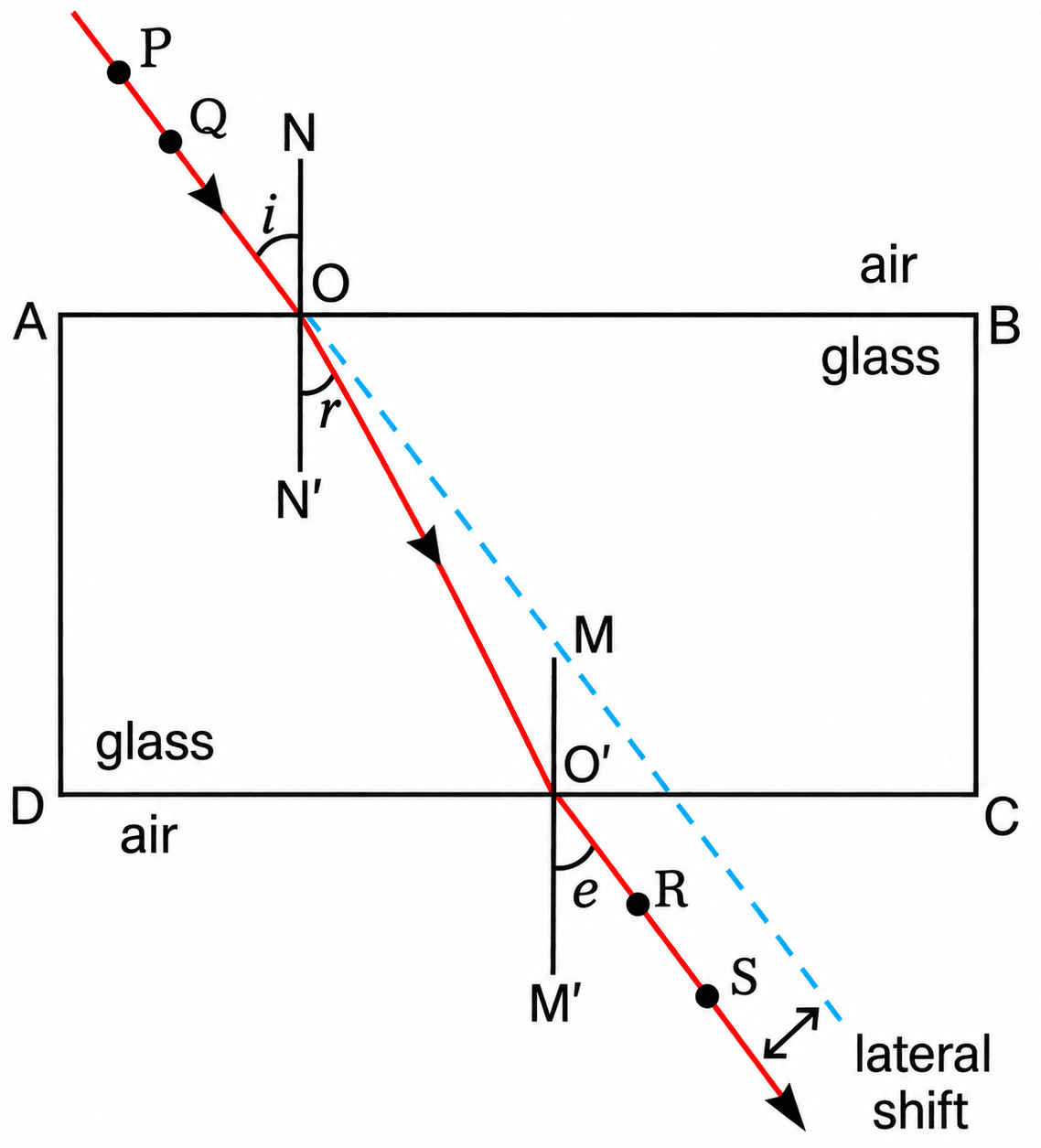
When a ray of light passes through a rectangular (parallel-sided) glass slab, it bends twice:
- The incident ray PO travels from air and strikes the surface AB of the slab. On entering the denser medium (glass), the ray bends towards the normal. Here the angle of refraction is smaller than the angle of incidence.
- The refracted ray travels through the glass in a straight line and reaches the opposite surface DC.
- On coming out of the glass into the air (a rarer medium), the ray bends away from the normal and emerges as the emergent ray O'S.
Why the emergent ray is parallel to the incident ray: Since the two refracting surfaces of the slab are parallel, the bending of the ray at the first surface (towards the normal) is exactly cancelled by the bending at the second surface (away from the normal). The angle of emergence becomes equal to the angle of incidence. Therefore the emergent ray comes out parallel to the incident ray, only shifted sideways by a small distance called the lateral displacement.
State the law of flotation. Explain how ships made of iron float on water while a small iron nail sinks.
Answer
Law of flotation: A body floats in a liquid when the weight of the body is equal to the weight of the liquid displaced by its immersed part. In other words, a floating body displaces a weight of liquid equal to its own weight.
Why a ship floats but an iron nail sinks:
- A small iron nail is solid and denser than water. Even when completely immersed, it cannot displace a weight of water equal to its own weight, so the buoyant force is less than its weight and the nail sinks.
- A ship, although made of iron, is hollow and has a large volume. Its overall average density is less than that of water. Because of its shape, it displaces a large amount of water until the weight of the displaced water equals the weight of the ship. The buoyant force then balances the weight of the ship, so it floats.
Thus, by making the iron into a hollow shape, the ship displaces enough water for the buoyant force to support its weight.
Explain the different changes of state of matter with suitable examples.
Answer
Matter can change from one state to another when heat is supplied to it or taken away from it. The main changes of state are:
Melting (fusion) — The change of a solid into a liquid on heating, at a constant temperature called the melting point. Example: ice melting into water at 0°C.
Boiling (vaporisation) — The change of a liquid into a gas (vapour) on heating, at a constant temperature called the boiling point. Example: water boiling into steam at 100°C.
Condensation — The change of a gas (vapour) into a liquid on cooling. Example: water vapour in the air turning into water droplets on a cold glass.
Freezing (solidification) — The change of a liquid into a solid on cooling, at a constant temperature is called freezing. Example: water freezing into ice at 0°C.
Sublimation — The direct change of a solid into a gas (and back) without passing through the liquid state. Example: camphor or dry ice turning directly into vapour.
Deposition — The direct change of a gas into a solid without passing through the liquid state. Example: water vapour changing directly into ice on very cold winter days.
Describe the bell-jar experiment to prove that sound requires a medium to travel.
Answer
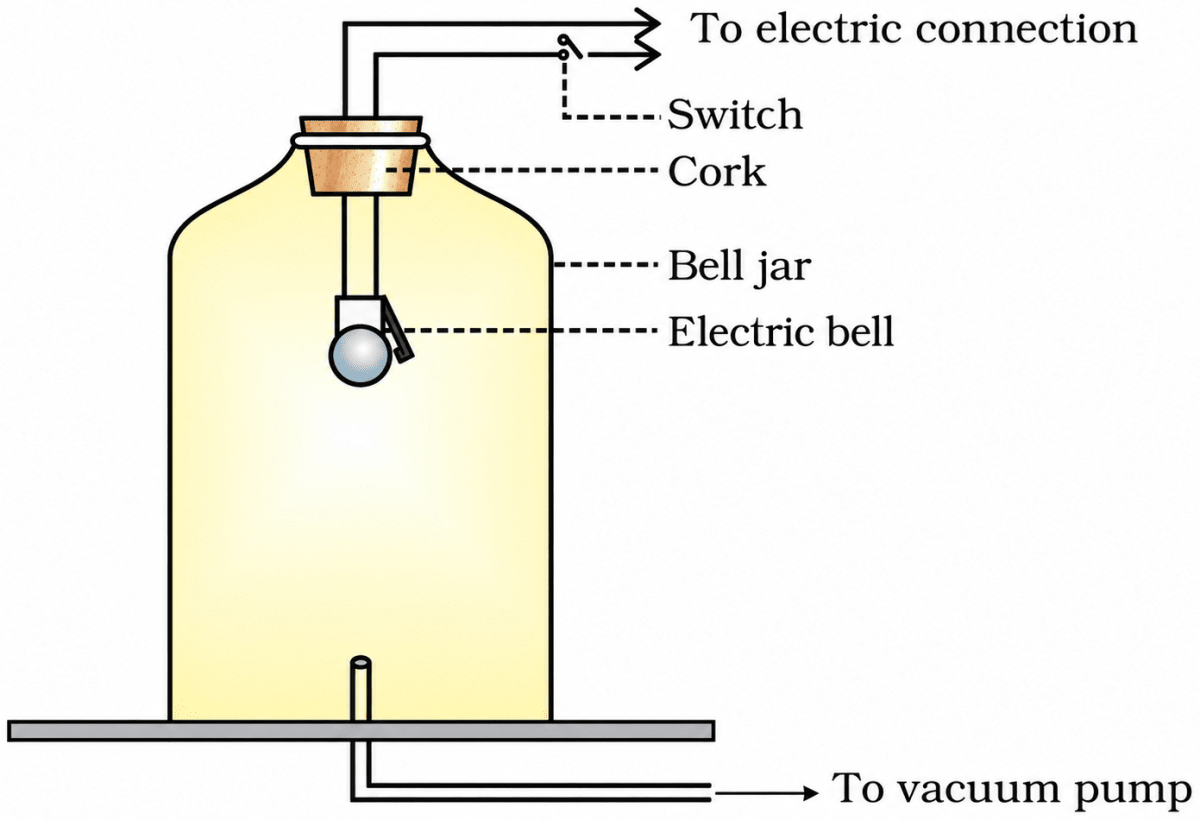
- Take an electric bell and hang it inside a closed glass bell jar. The jar is connected to a vacuum pump (air pump).
- Switch on the bell. The hammer is seen striking the gong, and a clear, loud sound is heard.
- Now slowly pump the air out of the jar using the vacuum pump.
- As more and more air is removed, the sound becomes fainter and fainter, even though the hammer is still seen striking the gong.
- When almost all the air has been removed, the sound can hardly be heard, although the bell is still vibrating.
- When air is allowed back into the jar, the sound becomes loud again.
This shows that sound needs a material medium (such as air) to travel. Since there is no medium in a vacuum, sound cannot travel through it.
A deodorant spray is released in one corner of a room. Soon the fragrance spreads everywhere.
(a) Which property of matter does this illustrate?
(b) Why does the fragrance spread faster in gases than in liquids?
(c) Name the process responsible for this.
Answer
(a) It illustrates that matter is made of tiny particles that are in continuous random (zigzag) motion and that have spaces between them.
(b) The fragrance spreads faster in gases because, in gases, the intermolecular spaces are very large and the particles move much faster and more freely than in liquids. So the fragrance particles mix and spread quickly through the air.
(c) The process responsible for this is diffusion.
A geyser, refrigerator and washing machine are connected in the same household circuit. One day, the main fuse blows off.
(a) Why did the fuse blow?
(b) How does a fuse protect household appliances?
(c) Name one modern device that serves the same purpose as a fuse.
Answer
(a) The fuse blew because too many high-power appliances were used at the same time on the same circuit. This caused an overload — a current larger than the safe limit flowed through the circuit, which melted the fuse wire.
(b) A fuse is a thin wire of low melting point that is the weakest part of the circuit. When the current becomes too large (due to overloading or a short circuit), the fuse wire heats up and melts, breaking the circuit. This stops the current and protects the appliances and wiring from damage.
(c) A miniature circuit breaker (MCB) serves the same purpose as a fuse.
A plastic ball floats on water but sinks in kerosene.
(a) What can you say about the relative density of the ball compared to water and kerosene?
(b) Which principle explains this observation?
(c) State one real-life application of this principle.
Answer
(a) Since the ball floats on water, its density is less than that of water (relative density less than 1). Since it sinks in kerosene, its density is greater than that of kerosene. So the relative density of the ball lies between that of kerosene and water.
(b) This observation is explained by buoyancy and the law of flotation. A body floats when the buoyant force can balance its weight; whether it floats or sinks depends on its density relative to that of the liquid.
(c) This principle is used in the design of ships and submarines, and in instruments like the hydrometer used to measure the density of liquids.
Geeta shouts loudly in a valley and hears her voice back after a short time.
(a) What phenomenon is this?
(b) State the condition required for this phenomenon to occur.
(c) Mention one practical use of this phenomenon.
Answer
(a) This phenomenon is an echo — the repetition of sound caused by the reflection of sound waves from a distant surface (here, the hills of the valley).
(b) To hear a clear echo, the reflecting surface must be far enough away (about 17 m or more) so that the reflected sound reaches the ear at least 0.1 second after the original sound.
(c) The phenomenon of reflection of sound (echo) is used in SONAR to measure the depth of the sea and to locate objects under water.
Snow boots are designed with wide soles.
(a) Why is this design necessary?
(b) Explain in terms of force and pressure.
(c) Mention another example where pressure reduction is useful.
Answer
(a) Wide soles are necessary so that the person does not sink into the soft snow while walking.
(b) Pressure is the thrust (force) acting per unit area. The weight of the person is the same, but the wide soles spread this weight over a larger area of contact. As the area increases, the pressure exerted on the snow decreases, so the feet do not sink into the snow.
(c) The same idea is used in giving wide foundations to buildings and dams, and in fitting army tanks and bulldozers with broad caterpillar tracks, so that their large weight is spread over a bigger area and the pressure on the ground is reduced.
Stars appear to twinkle but planets do not.
(a) Name the phenomenon responsible for the twinkling of stars.
(b) Why do planets not twinkle?
(c) State another natural phenomenon caused by the same effect.
Answer
(a) The twinkling of stars is caused by the atmospheric refraction of starlight. As starlight passes through different layers of the atmosphere, it is refracted by varying amounts, so the brightness of the star keeps changing and it appears to twinkle.
(b) Planets are much closer to us and appear as larger sources of light (a collection of many points). The variations in the light from these many points average out, so the planets do not appear to twinkle.
(c) Another natural phenomenon caused by atmospheric refraction is the early appearance of the sun at sunrise and its delayed disappearance at sunset.