
When dry ice is exposed to air, it changes directly into gas. Which of the following is this process?
- Condensation
- Sublimation
- Evaporation
- Deposition
Answer
Sublimation
Reason — Sublimation is the process in which a substance changes directly from the solid state to the gaseous state without first becoming a liquid. Dry ice (solid carbon dioxide) has very weak intermolecular forces, so on absorbing heat its molecules become free and it changes straight into a gas.
Pressure is defined as which of the following?
- Force × Area
- Force ÷ Area
- Area ÷ Force
- Force × Distance
Answer
Force ÷ Area
Reason — Pressure is the force (thrust) acting normally on unit area of a surface, so pressure = force ÷ area. For the same force, a smaller area of contact gives a greater pressure.
Which of the following mirrors always forms a virtual, erect and diminished image?
- Plane mirror
- Concave mirror
- Convex mirror
- None of these
Answer
Convex mirror
Reason — For an object placed at any position in front of a convex mirror, the reflected rays always appear to meet behind the mirror. So a convex mirror always forms an image that is virtual, erect and diminished. A plane mirror forms an image of the same size.
Hydrometer is used to measure which of the following?
- Mass of a liquid
- Density of a liquid
- Volume of a liquid
- Pressure of a liquid
Answer
Density of a liquid
Reason — A hydrometer is an instrument that floats in a liquid and is used to measure the relative density (density) of the liquid directly from the scale on its stem. The point where the liquid surface touches the stem gives the reading.
The atmospheric pressure at sea level is which of the following?
- 76 cm of mercury
- 1 Pascal
- 100 Pascal
- 1 mm of mercury
Answer
76 cm of mercury
Reason — At sea level the atmosphere exerts a pressure equal to about 101325 Nm-2 (1 atmosphere), which is the same as a 76 cm high column of mercury. This is taken as the standard atmospheric pressure.
Which colour of light bends the most on passing through a prism?
- Red
- Violet
- Blue
- Green
Answer
Violet
Reason — The refractive index of glass is highest for violet light and lowest for red light. Since a colour bends more when the refractive index is greater, violet light suffers the maximum bending on passing through a prism.
Which of the following can produce ultrasonic waves?
- Tuning fork
- Whistle
- Bats
- Humans
Answer
Bats
Reason — Ultrasonic waves are sounds of frequency higher than 20,000 Hz, which lie beyond the range of human hearing. Bats can produce and hear these high-frequency (ultrasonic) sounds, which they use to find their way and locate food.
Household electricity is supplied as which of the following?
- Direct current
- Alternating current
- Static charge
- Magnetic current
Answer
Alternating current
Reason — The electricity supplied to our homes through the mains (at about 220 V) is alternating current (AC), in which the direction of the current keeps reversing at regular intervals. A cell or battery, on the other hand, gives direct current.
Which of the following about intermolecular forces is true?
- Strongest in gases
- Strongest in solids
- Equal in solids and liquids
- Absent in liquids
Answer
Strongest in solids
Reason — In solids the molecules are very closely packed, so the intermolecular distance is small and the intermolecular force of attraction is the strongest. The force is weaker in liquids and almost negligible in gases, where the molecules are far apart.
A ball of mass 2 kg is raised to a height of 5 m. What will be its potential energy? (g = 9.8 ms-2)
- 10 J
- 49 J
- 98 J
- None of these
Answer
98 J
Reason — The gravitational potential energy of a body is given by:
PE = m × g × h.
PE = 2 × 9.8 × 5
PE = 98 J.
Assertion (A): The refractive index of a medium is always greater than 1.
Reason (R): Light travels slower in any medium compared to a vacuum.
- Both A and R are true, and R is the correct explanation of A.
- Both A and R are true, and R is not the correct explanation of A.
- A is true, but R is false.
- A is false, but R is true.
Answer
Both A and R are true, and R is the correct explanation of A.
Explanation —
Assertion (A) is correct: The refractive index of a medium is generally greater than 1 because the speed of light in a medium is less than its speed in vacuum.
Reason (R) is also correct: Light travels slower in any transparent medium compared to a vacuum due to its interaction with the particles of the medium.
The refractive index is given by:
n =
where,
c = speed of light in vacuum
v = speed of light in the medium
Since v < c, the value of n is greater than 1.
Hence Reason (R) correctly explains Assertion (A).
Assertion (A): Sound waves are longitudinal waves.
Reason (R): In longitudinal waves, particles move perpendicular to wave direction.
- Both A and R are true, and R is the correct explanation of A.
- Both A and R are true, and R is not the correct explanation of A.
- A is true, but R is false.
- A is false, but R is true.
Answer
A is true, but R is false.
Explanation —
Assertion (A) is correct: Sound waves are longitudinal waves because the particles of the medium vibrate back and forth in the same direction as the direction of propagation of the wave.
Reason (R) is incorrect: In longitudinal waves, particles do not move perpendicular to the wave direction. They move parallel to the direction of wave propagation. Particle motion perpendicular to the wave direction occurs in transverse waves.
Hence Assertion (A) is true, but Reason (R) is false.
Assertion (A): A convex lens can produce both real and virtual images.
Reason (R): The nature of the image formed depends on the position of the object relative to the lens.
- Both A and R are true, and R is the correct explanation of A.
- Both A and R are true, and R is not the correct explanation of A.
- A is true, but R is false.
- A is false, but R is true.
Answer
Both A and R are true, and R is the correct explanation of A.
Explanation —
Assertion (A) is correct: A convex lens can form both real and virtual images.
Reason (R) is also correct: When the object is placed beyond the focal point, a real image is formed, while when the object is placed between the optical centre and the focus, a virtual image is formed.
Hence Reason (R) correctly explains Assertion (A).
Assertion (A): Static electricity can cause objects to stick together.
Reason (R): Opposite charges attract each other.
- Both A and R are true, and R is the correct explanation of A.
- Both A and R are true, and R is not the correct explanation of A.
- A is true, but R is false.
- A is false, but R is true.
Answer
Both A and R are true, and R is the correct explanation of A.
Explanation —
Assertion (A) is correct: Static electricity can make objects stick together. For example, a charged comb can attract tiny pieces of paper.
Reason (R) is also correct: Opposite charges attract each other. A charged object can induce an opposite charge on a nearby object, causing an attractive force between them.
Hence Reason (R) correctly explains Assertion (A).
Assertion (A): It is easier to cut vegetables with a sharp knife than with a blunt one.
Reason (R): A sharp knife has less area of contact, producing greater pressure for the same force.
- Both A and R are true, and R is the correct explanation of A.
- Both A and R are true, and R is not the correct explanation of A.
- A is true, but R is false.
- A is false, but R is true.
Answer
Both A and R are true, and R is the correct explanation of A.
Explanation —
Assertion (A) is correct: A sharp knife cuts vegetables more easily because it can exert a greater pressure on the vegetable with the same applied force.
Reason (R) is also correct: A sharp knife has a smaller contact area at its edge. Since pressure is given by: P =
A smaller area produces greater pressure for the same force.
Hence Reason (R) correctly explains Assertion (A).
Name the following.
(a) The pressure exerted by air in all directions around us
(b) The ratio of the density of a substance to the density of water at 4°C
(c) The energy possessed by a stretched bow
(d) The phenomenon responsible for the apparent bending of a pencil in water
(e) The maximum displacement of a vibrating particle from its mean position
Answer
(a) Atmospheric pressure
(b) Relative density (specific gravity)
(c) Elastic potential energy
(d) Refraction of light
(e) Amplitude
Given alongside is the picture of a pith-ball electroscope. Read the information and fill in the blanks.
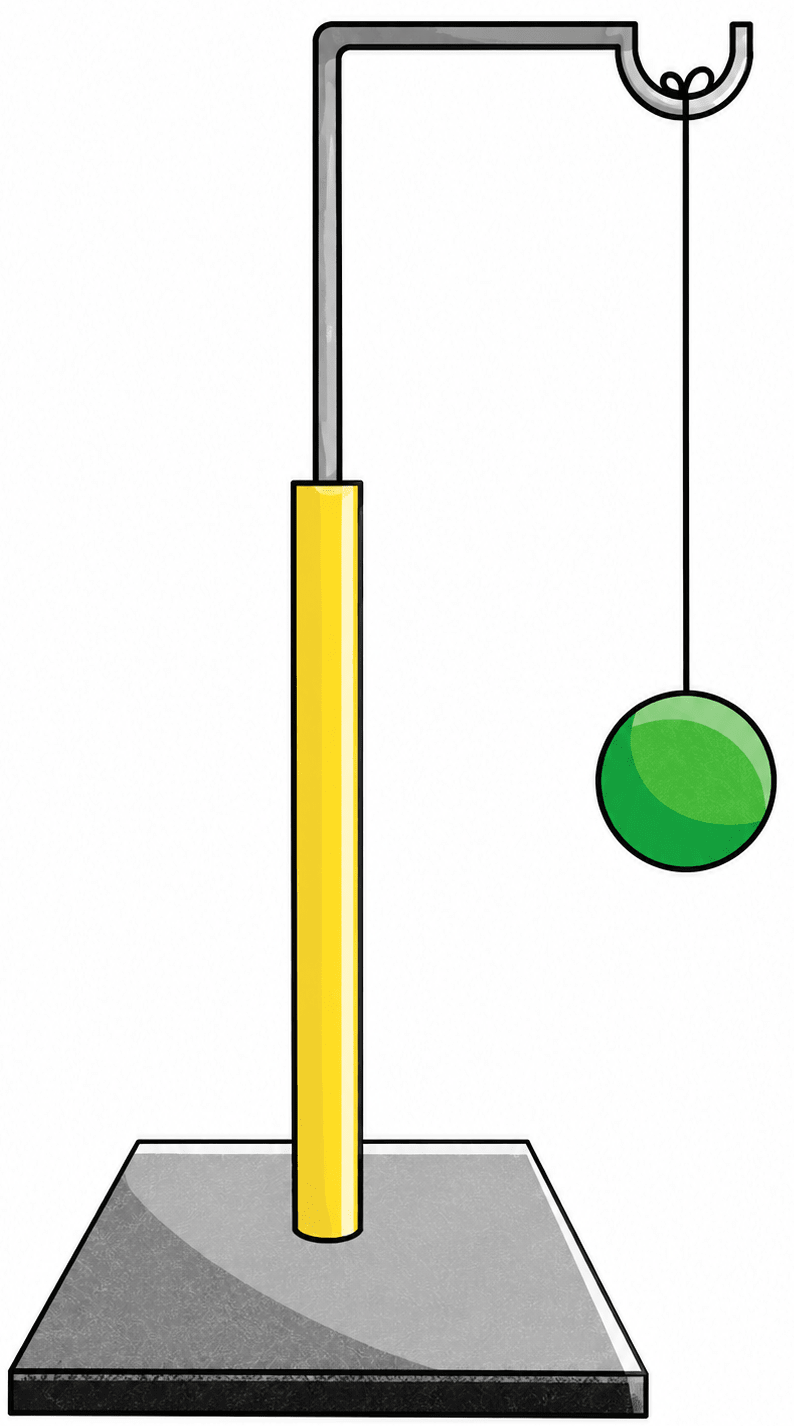
A pith-ball electroscope consists of a pith-ball suspended with a silk thread from an insulating stand. We bring the body close to the pith-ball without touching the ball to find whether a body is charged or uncharged. The body is charged if the pith-ball shows any movement whereas the body is uncharged if the ball remains stationary.
We charge the pith-ball either positive or negative by the method of conduction to find whether a body is positively charged or negatively charged. Now bring the body whose charge is to be identified near the pith-ball. If the pith-ball moves away from the body, they have same charges whereas if the pith-ball moves towards the body, they have opposite charges (If the pith-ball is positively charged then the body is negatively charged and vice versa).
A pith-ball electroscope consists of a pith-ball suspended with a ............... thread from an insulating stand. It is used to find whether a body is ............... or ............... The ball shows ............... if the body is charged and remains ............... if it is uncharged. The pith-ball is charged by the method of ............... If the pith-ball moves ............... from the body, they have the same charge, whereas if it moves ............... the body, they have opposite charges.
Answer
A pith-ball electroscope consists of a pith-ball suspended with a silk thread from an insulating stand. It is used to find whether a body is charged or uncharged. The ball shows movement if the body is charged and remains stationary if it is uncharged. The pith-ball is charged by the method of conduction. If the pith-ball moves away from the body, they have the same charge, whereas if it moves towards the body, they have opposite charges.
Shuffle the following steps in correct order to show refraction of light through a glass slab.
(a) Place the glass slab on a sheet of paper
(b) Mark the refracted and emergent rays
(c) Draw a line normal to the surface of the slab
(d) Remove the slab and join the rays
(e) Draw an incident ray on the paper towards the slab
Answer
The correct order of the given steps is:
- (a) Place the glass slab on a sheet of paper.
- (c) Draw a line normal to the surface of the slab.
- (e) Draw an incident ray on the paper towards the slab.
- (d) Remove the slab and join the rays.
- (b) Mark the refracted and emergent rays.
So the correct order is a → c → e → d → b.
Read the explanations given below and name the terms.
(a) The theory that explains the constant motion of particles in matter
(b) The instrument used to measure the pressure of gases
(c) The process of connecting the metal parts of an appliance to the ground for safety
(d) The time taken to complete one vibration
(e) The property of sound which enables us to distinguish between a flute and a violin playing the same note
Answer
(a) Kinetic theory of matter
(b) Manometer
(c) Earthing (grounding)
(d) Time period
(e) Quality (timbre) of sound
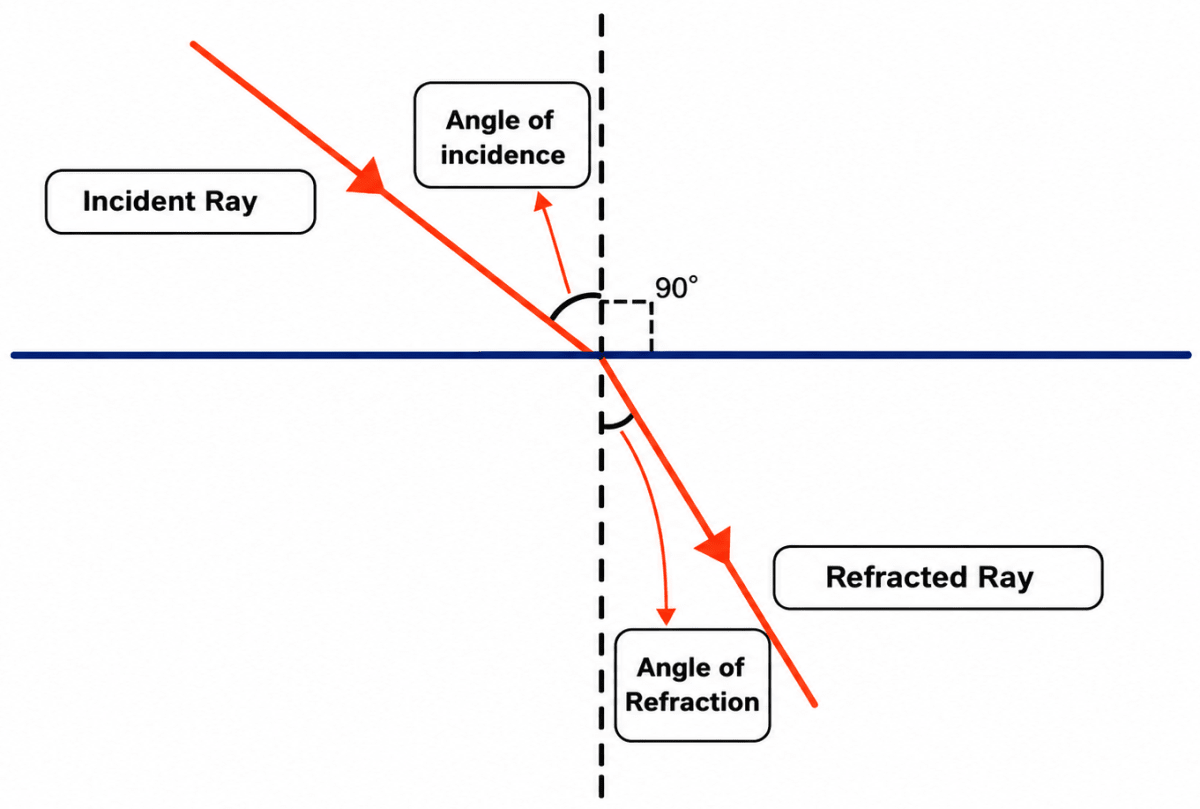
Write the correct words in the blank boxes given in the picture.
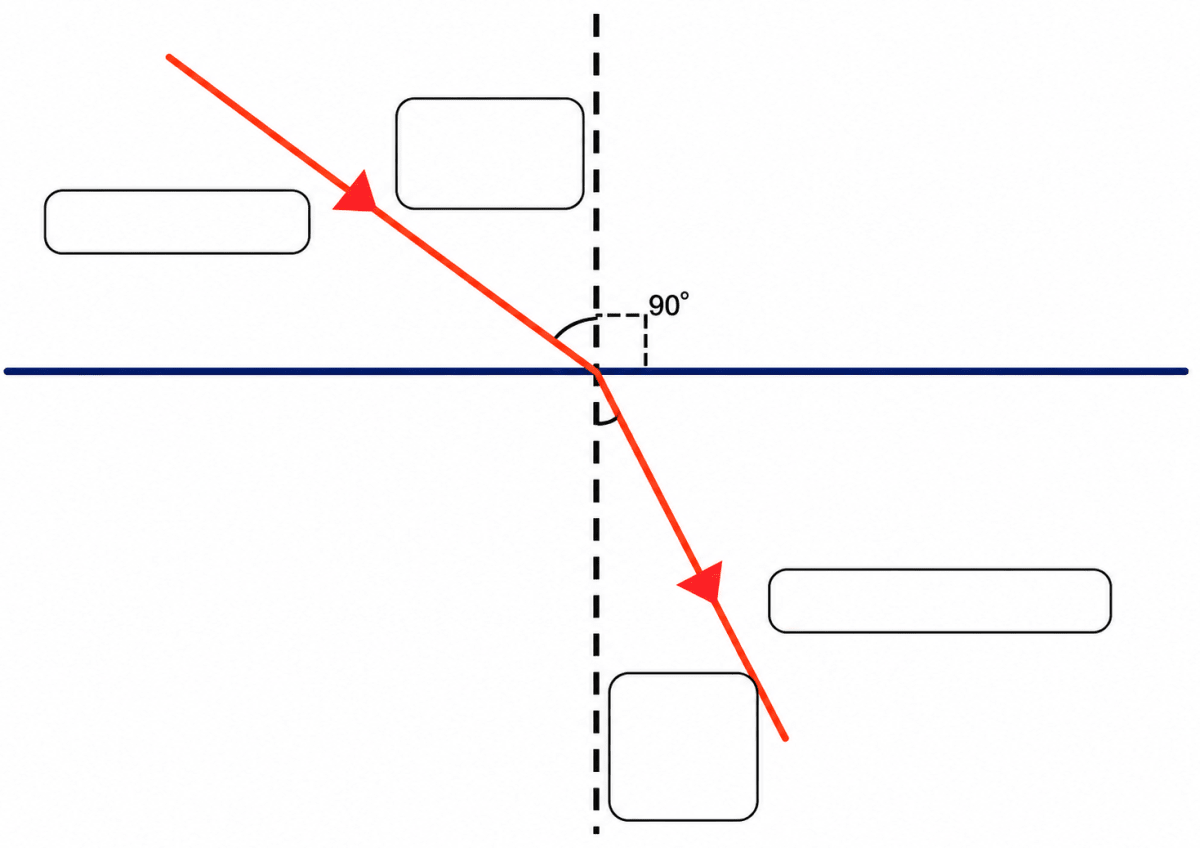
Answer
Define the following terms.
(a) Overloading
(b) Monotone
(c) Condensation
(d) Manometer
Answer
(a) Overloading — When too many appliances are connected to a single socket, the circuit draws a very large current from the mains, causing excessive heating of the wires. This condition is called overloading.
(b) Monotone — A sound wave of a single frequency is called a monotone. For example, a tuning fork produces a monotone, which is why its frequency is marked on its stem.
(c) Condensation — The process in which a substance in the vapour (gaseous) state changes into its liquid state is called condensation.
(d) Manometer — A manometer is a simple device, consisting of a U-shaped tube filled with a liquid, used to measure the pressure exerted by a liquid or gas.
Differentiate between work and power.
Answer
| Work | Power |
|---|---|
| Work is said to be done when a force displaces a body in its own direction. | Power is the amount of work done by a body in unit time (the rate of doing work). |
| The work done by a body does not depend on time. | The power spent by a body depends on the time taken to do the work. |
| The SI unit of work is the joule (J). | The SI unit of power is the watt (W). |
Which property of sound changes in the following situations?
(a) When loudness changes.
(b) When pitch changes.
Answer
(a) When the loudness of a sound changes, the amplitude of the sound wave changes. The greater the amplitude, the louder the sound.
(b) When the pitch of a sound changes, the frequency of the sound wave changes. The higher the frequency, the higher the pitch.
Distinguish between conductors and insulators with one example of each.
Answer
| Conductors | Insulators |
|---|---|
| Materials that allow electrons (electric charge) to flow through them are called conductors. | Materials that do not allow electrons to flow through them are called insulators. |
| They have a large number of free electrons. | They have very few free electrons. |
| Example: metals such as copper. | Example: rubber, plastic or wood. |
State the difference between commercial unit of energy and SI unit of energy.
Answer
| Commercial unit of energy (kWh) | SI unit of energy (joule, J) |
|---|---|
| One kilowatt-hour (kWh) is the energy consumed by a 1 kW appliance in 1 hour. | One joule is the work done when a force of 1 N displaces a body by 1 m in the direction of the force. |
| It is a larger unit used for measuring electrical energy consumed commercially. | It is the SI unit of energy. |
| 1 kWh = 3.6 × 10⁶ J. | 1 J = kWh. |
Draw ray diagrams to show image formation by a concave mirror when the object is
(a) at the centre of curvature and
(b) between the focus and the pole.
Answer
(a) Object at the centre of curvature (C):
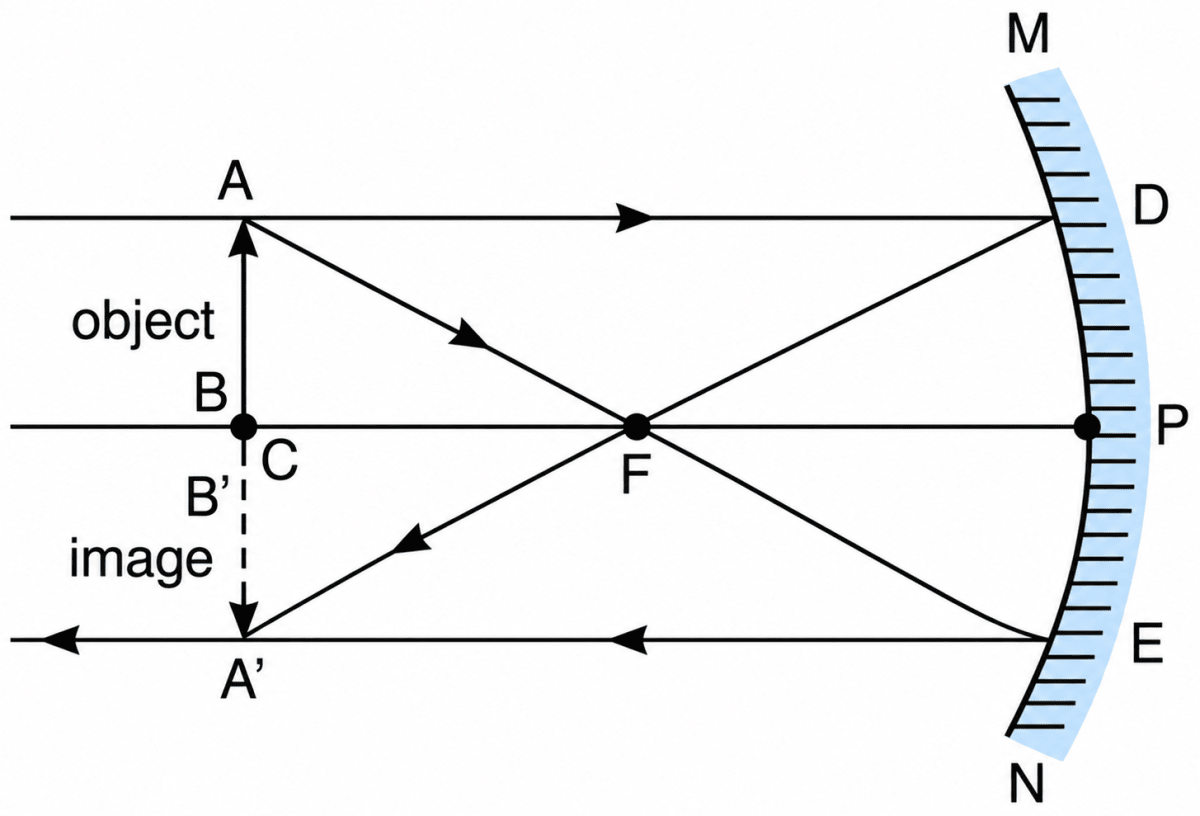
When the object is placed at the centre of curvature, the image is formed at the centre of curvature itself. The image is real, inverted and of the same size as the object.
(b) Object between the focus (F) and the pole (P):
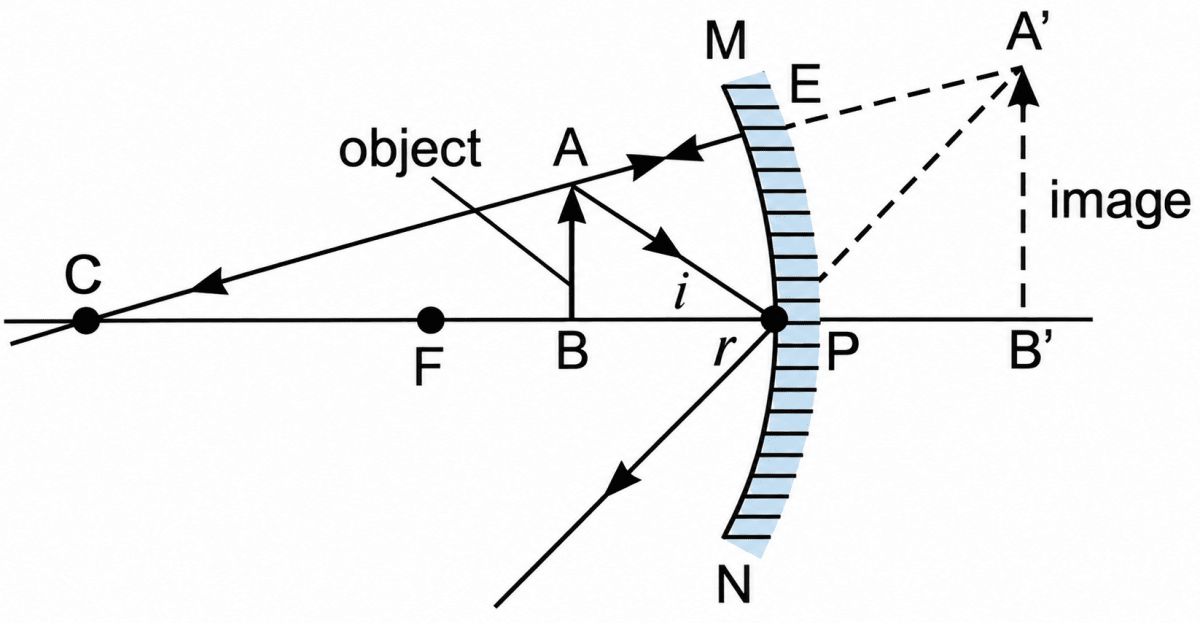
When the object is placed between the focus and the pole, the reflected rays diverge and appear to meet behind the mirror. The image is formed behind the mirror and is virtual, erect and magnified (enlarged).
Explain with diagrams the methods of charging a body by following methods.
(a) Friction
(b) Conduction
(c) Induction
Answer
(a) Charging by friction:

When a neutral object is rubbed with another body, free electrons are transferred from one body to the other. The body that gains electrons becomes negatively charged and the body that loses electrons becomes positively charged. For example, when a balloon is rubbed with hair, the balloon gains electrons and becomes negatively charged, while the hair becomes positively charged.
(b) Charging by conduction:
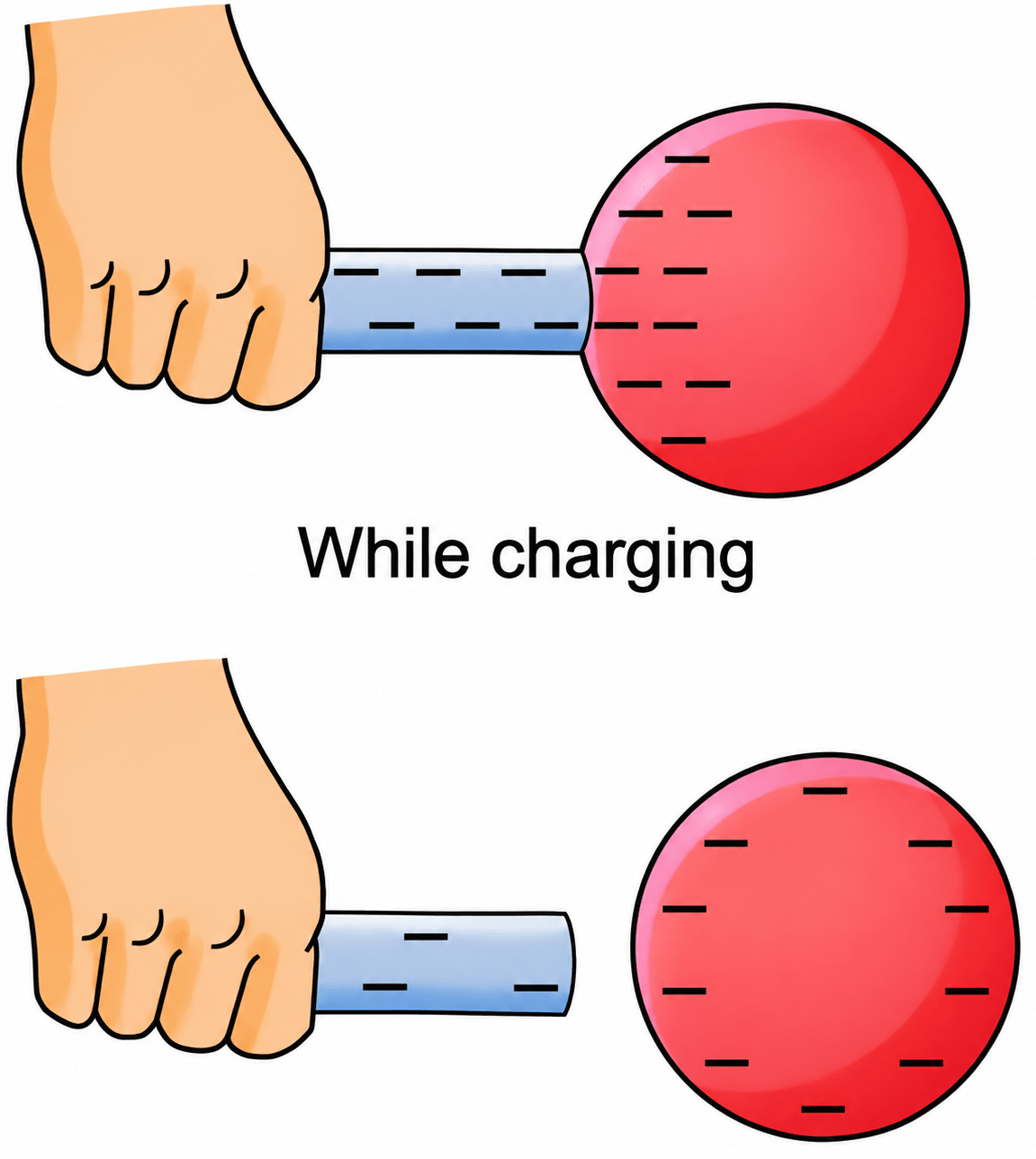
A neutral object is charged by touching it with a charged object. When a charged rod is brought in contact with a neutral conductor, some charge flows from the rod to the conductor. The neutral body then acquires the same kind of charge as the charging body. This method requires a conductor.
(c) Charging by induction:

A charged body is brought close to a neutral conductor without touching it. The end of the conductor near the charging body acquires an opposite (induced) charge, and the far end acquires the same kind of charge. The conductor is then earthed while the charged body is kept in position. The earth connection is removed first, and only then is the charged body taken away. The conductor is left with a charge opposite to that of the charging body. Here the charged body never touches the body being charged.
What is dispersion of light? Explain the formation of a rainbow with the help of a diagram.
Answer
Dispersion of light is the phenomenon of splitting of white light into its seven component colours (violet, indigo, blue, green, yellow, orange and red) when it passes through a prism. This band of seven colours is called the spectrum. It happens because the refractive index of glass is different for different colours, so each colour bends by a different amount.
Formation of a rainbow:

A rainbow is a circular arc of seven colours seen in the sky after rain. The tiny water droplets present in the atmosphere act like small prisms. When sunlight enters a water droplet, it is refracted and dispersed into its seven colours, since each colour travels at a different speed inside the droplet. These colours are then reflected inside the droplet and refracted again as they come out. In this way the water droplets split white sunlight into the seven colours and form a rainbow.
Define lateral pressure? Mention the factors affecting liquid pressure.
Answer
Lateral pressure is the pressure exerted by a liquid on the walls (sides) of its container. Unlike a solid, which exerts pressure only in the downward direction, a liquid exerts pressure in all directions, including on the side walls.
The pressure at a point inside a liquid depends on the following factors:
- Height of the liquid column — The pressure increases as the height (depth) of the liquid column above the point increases.
- Density of the liquid — The pressure is directly proportional to the density of the liquid. The greater the density, the more the pressure exerted.
State and explain the law of conservation of energy. Verify it with the example of a simple pendulum.
Answer
Law of conservation of energy: Energy can neither be created nor destroyed; it can only be changed from one form into another. The total energy of a system always remains constant.
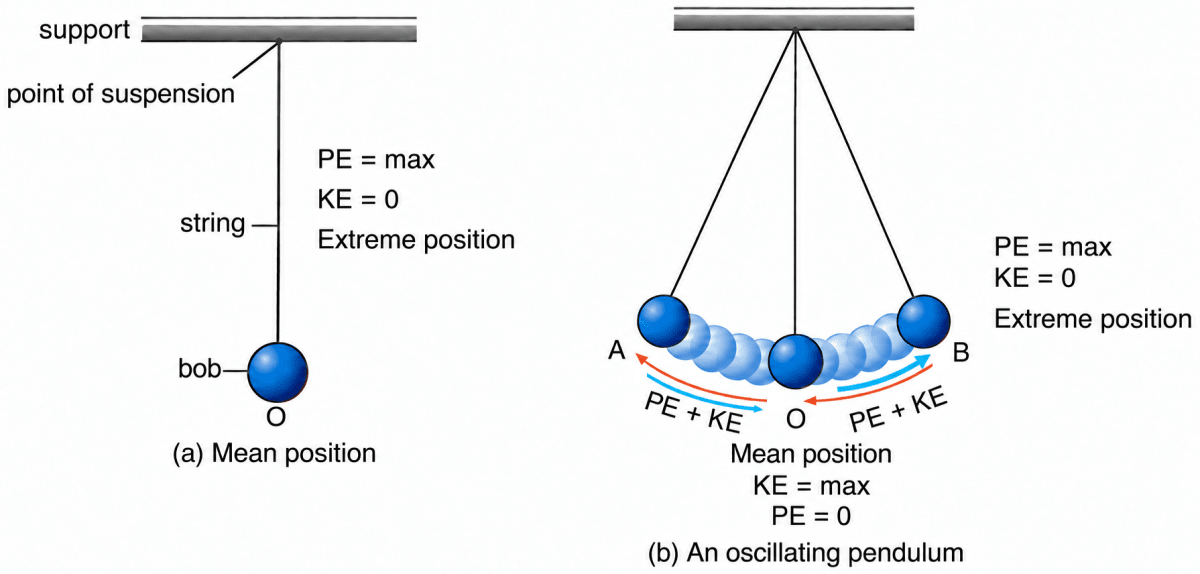
Verification with a simple pendulum: At the extreme positions, the bob of the pendulum is at its highest point and is momentarily at rest. Here it has maximum potential energy and zero kinetic energy. As the bob swings down towards the mean position, its height decreases, so the potential energy is converted into kinetic energy, and the kinetic energy becomes maximum at the mean position. As the bob rises towards the other extreme, the kinetic energy is again converted back into potential energy. Thus the energy keeps changing form, but at every instant the total mechanical energy (potential energy + kinetic energy) of the pendulum remains constant. This verifies the law of conservation of energy.
A balloon filled with air bursts when kept near a flame.
(a) Which property of gases is responsible for this?
(b) Why does the pressure inside the balloon increase on heating?
(c) State one more daily-life example of this property.
Answer
(a) The property responsible is that gases expand on heating. When their expansion is restricted, their pressure increases.
(b) On heating, the gas molecules inside the balloon gain energy and move faster. They strike the walls of the balloon more often and with greater force, so the pressure inside the balloon increases until the balloon bursts.
(c) A tightly sealed plastic bottle looks puffed up on a hot summer day, because the air inside it expands and exerts more pressure. (A tyre or football also feels harder when the air inside it is heated.)
A submarine can float on water or sink into it by adjusting tanks filled with water or air.
(a) Which principle is applied here?
(b) How does changing the density of the submarine affect its floating/sinking?
(c) Name one more application of this principle.
Answer
(a) The principle of floatation, based on the relative density of the submarine and water, is applied here.
(b) When the tanks are filled with water, the average density of the submarine becomes greater than that of water, so it sinks. When the tanks are filled with air, the average density becomes less than that of water, so the submarine floats. Thus, by changing its density, the submarine can float or sink.
(c) The same principle is used in a hydrometer (or a ship, which floats because its average density is less than that of water).
A hammer strikes a nail into a wooden plank.
(a) Which form of energy is used in this process?
(b) How does this energy get transformed?
(c) Name another tool that works on the same principle of energy transformation.
Answer
(a) The form of energy used when the hammer strikes the nail is kinetic energy.
(b) When the hammer is raised, it gains gravitational potential energy. As it is brought down, this potential energy is converted into kinetic energy. On striking the nail, this kinetic energy does work and drives the nail into the wooden plank.
(c) An axe works on the same principle of energy transformation.
A child rubs a plastic comb on dry hair and then brings it near small bits of paper. The bits of paper jump towards the comb.
(a) Which type of electricity is shown here?
(b) Why do the bits of paper get attracted?
(c) State another daily-life example of this type of electricity.
Answer
(a) This shows static electricity, as the charges produced on the comb are at rest.
(b) When the comb is rubbed on dry hair, it gets charged by friction. This charged comb induces an opposite charge on the nearby bits of paper, and because opposite charges attract, the bits of paper jump towards the comb.
(c) A balloon rubbed against hair sticks to a wall, or one gets a small shock on touching a metal doorknob after walking on a carpet — these are everyday examples of static electricity.
A heavy truck produces a low rumbling sound, while a whistle produces a high shrill sound.
(a) Which property of sound differs in these two cases?
(b) How is this property related to frequency?
(c) Which of the two has a higher frequency?
Answer
(a) The property of sound that differs is the pitch of the sound.
(b) The pitch of a sound is directly related to its frequency. The higher the frequency, the higher the pitch; the lower the frequency, the lower the pitch.
(c) The whistle has a higher frequency, because it produces a high-pitched (shrill) sound, while the truck produces a low-pitched (rumbling) sound.
In a household circuit, when too many appliances are switched on, the MCB trips.
(a) Why does the MCB trip in this case?
(b) How is it better than a fuse?
(c) Name the condition when current suddenly increases due to direct contact of wires.
Answer
(a) When too many appliances are switched on, the circuit draws a very large current (overloading). The MCB (miniature circuit breaker) detects that the current has crossed the safe limit and switches off on its own, breaking the circuit to prevent damage.
(b) An MCB is better than a fuse because it does not need to be replaced after it acts; it is simply a switch that can be turned on again to restore the circuit, whereas a melted fuse wire has to be replaced each time.
(c) This condition is called a short circuit, which occurs when the live wire directly touches the neutral wire and a very large current flows.