Refraction of light is the bending of light as it passes from one medium to another. This was first explained by Willebrord Snellius in 1621 through Snell's Law, which relates the angles of incidence and refraction. Rene Descartes also supported this using geometry. Key terms like incident ray, refracted ray and normal were introduced to describe this bending. The refractive index was later developed to measure how much a material bends light. These discoveries help explain the effects like a straw appearing bent in a glass of water.
Answer
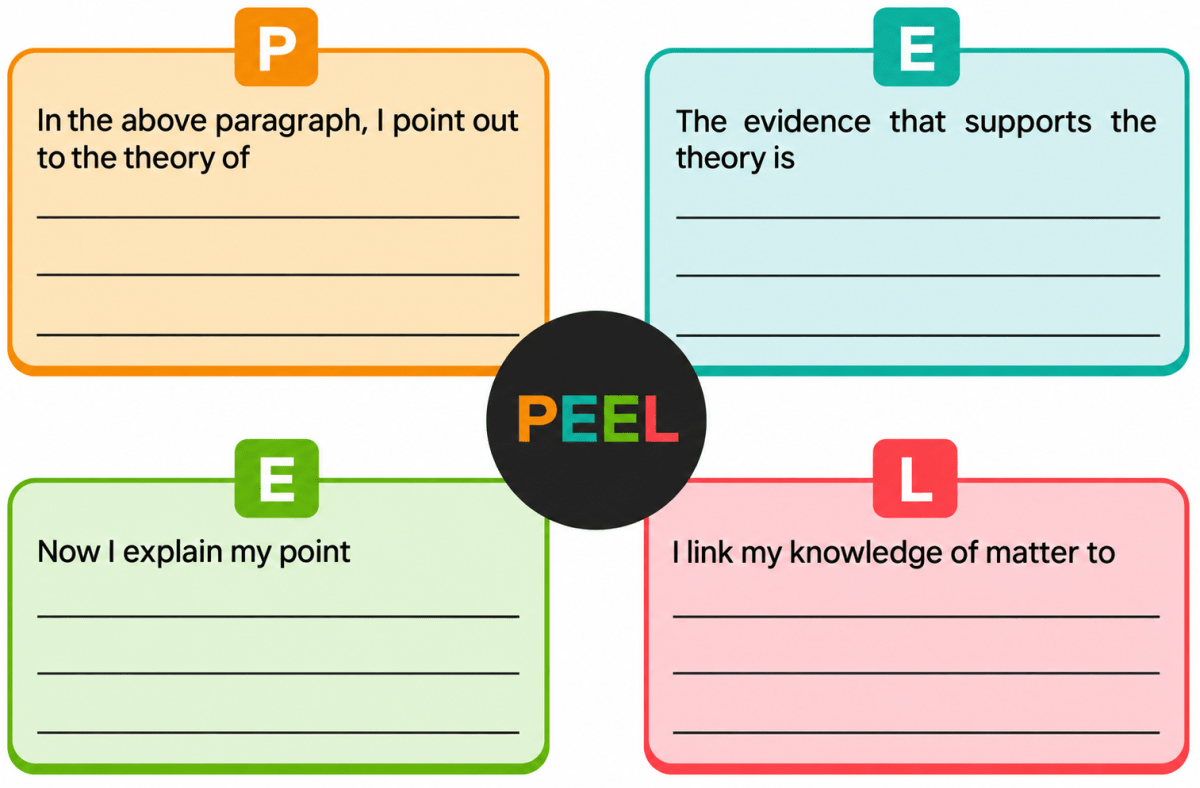
P - Point → In the above paragraph, I point out to the theory of the refraction of light (and Snell's Law).
E - Evidence → The evidence that supports the theory is Willebrord Snellius formulated Snell's Law in 1621, relating the angles of incidence and refraction. Rene Descartes also supported this using geometry.
E - Explanation → Now I explain my point: Refraction occurs because light changes speed and bends when passing from one medium to another. This behavior is analyzed using an incident ray, a refracted ray, and a normal line, and we use the refractive index to measure how much a material bends light.
L - Link → I link my knowledge of light to everyday physical phenomena, such as the visual illusion of a straw appearing bent when placed inside a glass of water.
Read the given paragraph and answer the questions that follow.
One rainy afternoon, Saniya sat near the window watching raindrops slide down the glass. Her younger brother Aarav was playing with his toy cars on the floor.
"Saniya, look! My pencil looks broken in the glass of water!" Aarav shouted.
Saniya smiled and said, "That's because of refraction, Aarav. Light bends when it travels from water to air, making the pencil look bent."
Just then, their father walked in with a small science kit. "Let's try something interesting," he said, pulling out a glass slab and a prism. He directed a beam of light through the glass slab using a torch. "See! The light bends twice — once when it enters the glass and once when it comes out. But it still comes out in the same direction, just shifted a bit."
Next, he passed the light through the prism. Aarav's eyes widened as he saw a rainbow on the white wall. "Wow! Where did all these colours come from?"
"That's dispersion of light, Aarav," said Saniya. "The prism bends different colours of light by different amounts, so they spread out."
Later that day, while going to the market, Aarav noticed the rear-view mirror on their scooter. "Papa, why does this mirror show smaller cars behind us?"
"That's a convex mirror, Aarav. It always shows virtual, smaller, and upright images so we can see a larger area behind us."
When they reached the optical shop, Aarav also saw a large curved mirror. "What's this one?"
"That's a concave mirror," Saniya replied. "It can make an image look big if you're close or upside down if you're far."

- Why did Aarav's pencil appear broken in the glass of water? Explain what caused this effect.
- What did Saniya's father demonstrate using the glass slab, and what happened to the light passing through it?
- How did the prism create a rainbow on the wall, and what is this phenomenon called?
- What type of mirror is used as a rear-view mirror on vehicles, and why is it suitable for that purpose?
- How do concave mirrors form different images depending on the distance of the object? Give examples from the story.
Answer
- The pencil appeared broken because of refraction of light. The part of the pencil inside the water is seen by light that travels from water (a denser medium) into air (a rarer medium). At the water surface this light bends, so the submerged part of the pencil appears raised and shifted, making the pencil look broken or bent.
- Saniya's father demonstrated refraction of light through a glass slab. The light bent twice — once while entering the glass and once while leaving it — but the emergent ray came out parallel to the incident ray, only shifted sideways. This sideways shift is called lateral displacement.
- The prism created a rainbow because white light is made up of seven colours, and each colour bends by a different amount as it passes through the prism. So the white light split into a band of seven colours on the wall. This phenomenon is called dispersion of light.
- A convex mirror is used as a rear-view mirror. It always forms a virtual, erect and diminished (smaller) image and gives a wider field of view, so the driver can see a larger area of the traffic behind the vehicle.
- A concave mirror forms a magnified, erect and virtual image when the object is close to the mirror, between the focus (F) and the pole (P). When the object is placed beyond the focus, the image becomes real and inverted. Thus, the nature, size and position of the image depend on the object's distance from the mirror.
Circle the word that does not belong to other words given alongside it.
- Refraction, Dispersion, Reflection, Digestion
- Glass slab, Prism, Concave mirror, Convex mirror
- Rainbow, Spectrum, Prism, Battery
- Convex mirror, Concave mirror, Plane mirror, Microscope
- Real image, Virtual image, Bent light, Incident ray
Answer
- Digestion
Reason — Refraction, dispersion and reflection are all phenomena related to light, whereas digestion is a biological process. - Prism
Reason — A prism is the only one of these that splits white light into its seven component colours (dispersion). The glass slab, concave mirror and convex mirror do not disperse white light. - Battery
Reason — Rainbow, spectrum and prism are all related to light and its colours, whereas a battery is a source of electricity. - Microscope
Reason — Convex mirror, concave mirror and plane mirror are all types of mirrors, whereas a microscope is an optical instrument (made using lenses). - Bent light
Reason — Real image, virtual image and incident ray are all standard terms used in optics, whereas "bent light" is only an informal way of describing refraction.
Match the columns.
| Column A | Column B |
|---|---|
| 1. Refraction of light | (a) Splitting of white light into seven colours |
| 2. Prism | (b) Shows smaller, virtual image with wider view |
| 3. Dispersion | (c) Bending of light when it passes from one medium to another |
| 4. Convex mirror | (d) Used in headlights and shaving mirrors |
| 5. Concave mirror | (e) Has slanted surfaces and causes light to bend and spread out |
Answer
| Column A | Column B |
|---|---|
| 1. Refraction of light | (c) Bending of light when it passes from one medium to another |
| 2. Prism | (e) Has slanted surfaces and causes light to bend and spread out |
| 3. Dispersion | (a) Splitting of white light into seven colours |
| 4. Convex mirror | (b) Shows smaller, virtual image with wider view |
| 5. Concave mirror | (d) Used in headlights and shaving mirrors |
Answer in one or a few word(s).
- What is refraction of light?
- Give one example of refraction.
- What is dispersion?
- Write one use of convex mirror.
- Which mirror should be used as a shaving or makeup mirror?
Answer
- The bending of light when it travels from one medium to another medium.
- A pencil appears bent when dipped in a glass of water.
- The splitting of white light into its seven component colours is called dispersion of light.
- Used as a rear-view mirror in vehicles.
- Concave mirror
Write the correct word(s) in the given blanks.
- A/An ............... is an optically transparent device made up of glass having triangular bases and rectangular sides.
- The phenomenon of splitting of white light into its component colours is called ............... .
- A ............... mirror is a smooth and highly polished curved glass surface.
- A spherical mirror whose inner hollow surface is polished and made opaque so that the outer surface becomes reflecting is called the ............... mirror.
- ............... image is formed by both convex mirror and concave mirror (for a specific case).
Answer
- A prism is an optically transparent device made up of glass having triangular bases and rectangular sides.
- The phenomenon of splitting of white light into its component colours is called dispersion.
- A spherical mirror is a smooth and highly polished curved glass surface.
- A spherical mirror whose inner hollow surface is polished and made opaque so that the outer surface becomes reflecting is called the convex mirror.
- Virtual image is formed by both convex mirror and concave mirror (for a specific case).
Write True or False for the following statements.
- Convex mirrors are used by dentists to see an enlarged image of a tooth. Doctors also use them to examine nose, ear and eye.
- A real image cannot be obtained on a screen.
- A glass slab causes light to disperse into different colours.
- Concave mirrors can produce magnified virtual images when the object is close.
- The light ray emerges from a glass slab in a direction opposite to the incident ray.
Answer
- False
Corrected Statement — Concave mirrors are used by dentists to see an enlarged image of a tooth. Doctors also use them to examine nose, ear and eye. - False
Corrected Statement — A real image can be obtained on a screen (it is a virtual image that cannot be obtained on a screen). - False
Corrected Statement — A prism causes light to disperse into different colours; a glass slab does not disperse light. - True
- False
Corrected Statement — The light ray emerges from a glass slab in a direction parallel to the incident ray, only shifted sideways.
Find errors in the given sentences and correct them.
- The second law of refraction states that the incident ray, the normal at the point of incidence and the refracted ray all lie in the same plane.
- Light reflects when it passes from air into water.
- A glass slab spreads white light into seven colours.
- Dispersion of light happens when it reflects from a plane mirror.
- A concave mirror always forms an upright and virtual image.
Answer
- The first law of refraction states that the incident ray, the normal at the point of incidence and the refracted ray all lie in the same plane.
- Light refracts when it passes from air into water.
- A prism spreads white light into seven colours.
- Dispersion of light occurs when white light passes through a prism and splits into its component colours.
- A concave mirror does not always form an upright and virtual image. It can form real, inverted images or a virtual, erect image depending on the position of the object.
Give reason — The prism separates the component colours of white light.
Answer
A prism separates the component colours of white light because different colours of light travel at different speeds inside the glass prism, causing them to bend (refract) by different angles.
Give reason — Convex mirrors are used as rear-view mirrors of vehicles.
Answer
Convex mirrors are used as rear-view mirrors because they always form virtual, erect, and diminished images. This provides a wider field of view, allowing drivers to see a larger area of traffic behind them in a small space.
Give reason — A pencil appears bent when dipped in a glass of water.
Answer
A pencil appears bent due to refraction of light. The light coming from the part of the pencil inside the water travels from water (a denser medium) into air (a rarer medium) and bends at the surface. Because of this bending, the submerged part of the pencil appears raised and shifted, so the pencil looks bent at the surface of the water.
Give reason — The light ray emerging from a glass slab is parallel to the incident ray.
Answer
A glass slab has two refracting surfaces that are parallel to each other. When light enters the slab (air to glass), it bends towards the normal, and when it leaves the slab (glass to air), it bends away from the normal by an equal amount. As the two bendings are equal and opposite, the emergent ray comes out parallel to the incident ray, only shifted sideways by a lateral displacement.
Give reason — We see a rainbow in the sky after rain.
Answer
After rain, a large number of tiny water droplets remain suspended in the air. These droplets act like tiny prisms. When sunlight passes through them, it undergoes refraction and dispersion, and the white light splits into its seven component colours. This band of seven colours forms a rainbow in the sky.
Write all the properties of refraction.
Answer
The properties of refraction are:
- A ray of light bends towards the normal when it enters a denser medium (for example, from air to glass). So the angle of refraction is less than the angle of incidence (∠i > ∠r).
- A ray of light bends away from the normal when it travels from a denser medium to a rarer medium. So the angle of refraction is more than the angle of incidence (∠i < ∠r).
- A ray of light travelling along the normal does not suffer any refraction. In this case, both the angle of incidence and the angle of refraction are equal to zero (∠i = ∠r = 0°).
Briefly explain prism.
Answer
A prism is an optically transparent device made of glass having triangular bases and rectangular sides. Its rectangular surfaces are called refracting surfaces, and the angle between any two refracting surfaces is called the angle of prism. When light passes through a prism, it is deviated towards the base; white light also splits into its seven constituent colours due to dispersion.
How is concave mirror different from convex mirror?
Answer
| Concave Mirror | Convex Mirror |
|---|---|
| It is polished on the outside so that the inner hollow surface reflects light. | Its inner hollow surface is polished and made opaque so that the outer surface reflects light. |
| Its reflecting surface curves inwards. | Its reflecting surface bulges outwards. |
| It converges a parallel beam of light to the focus. | It diverges a parallel beam of light. |
| It can form real or virtual images of different sizes, depending on the object's position. | It always forms a virtual, erect and diminished image. |
Mention the rules for drawing ray diagrams.
Answer
The rules for drawing ray diagrams are:
- Take at least two rays which originate from the same point on the object and whose path can be traced after reflection.
- Keep the object always on the left side, in front of the reflecting surface.
- Place the object always vertically upright, so that it is perpendicular to the principal axis.
What is refractive index?
Answer
The refractive index of a medium is the ratio of the speed of light in vacuum (air) to the speed of light in that medium. Since it is a ratio, it has no units. It is represented by the symbol μ.
List down the uses of concave mirror.
Answer
Some uses of concave mirror are:
- Concave mirrors are used as shaving mirrors. When we keep our face close to the mirror, a virtual, erect and magnified image is formed.
- Concave mirrors are used by dentists to see an enlarged image of a tooth. Doctors also use them to examine the nose, ear and eye.
- Concave mirrors are used in reflecting type telescopes.
- Concave mirrors are used in reflecting type solar cookers.
- Concave mirrors are used as reflectors in searchlights, projectors and headlights of automobiles. A parallel beam of light is obtained when the light source is placed at the focus of the concave mirror.
Differentiate between real image and virtual image.
Answer
| Real Image | Virtual Image |
|---|---|
| It is formed when the light rays after reflection actually meet at a point. | It is formed when the light rays after reflection do not actually meet but only appear to meet at a point. |
| It is always inverted (upside down). | It is always erect. |
| It can be obtained on a screen. | It cannot be obtained on a screen. |
| Examples: image on a cinema screen, image formed by a concave mirror. | Examples: image formed by a plane mirror, image formed by a convex mirror. |
What is focal point? Explain with the help of a diagram.
Answer
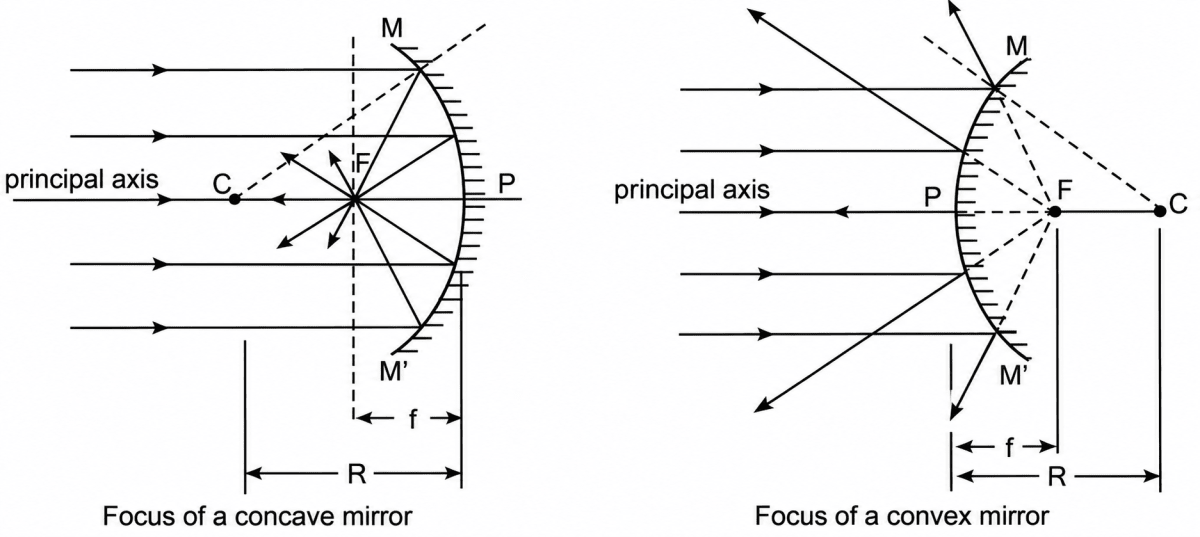
The focus (F) is the point on the principal axis where rays parallel to the principal axis meet after reflection in a concave mirror or appear to meet after reflection in a convex mirror. In a concave mirror, the focus is real, while in a convex mirror, it is virtual. The focal length is half the radius of curvature, i.e. .
Explain refraction of light through a prism.
Answer
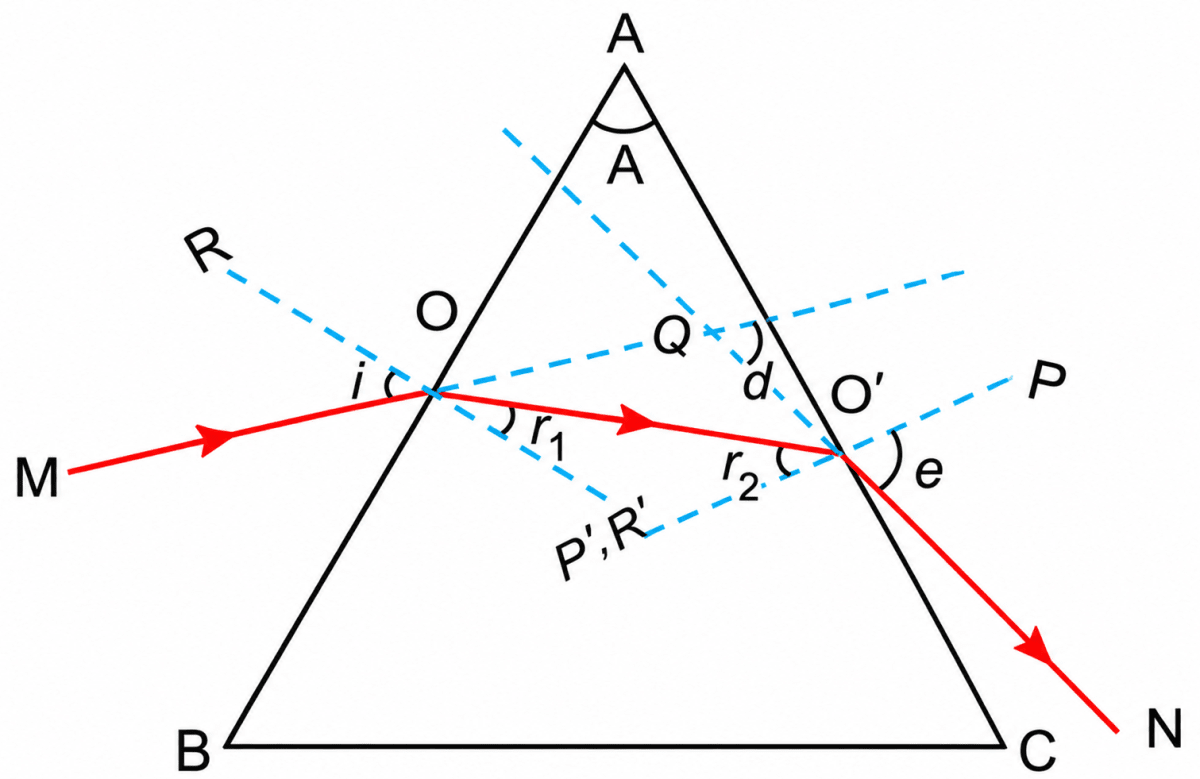
When a ray of light (MO) falls on the first refracting surface of a prism, it travels from air (a rarer medium) into glass (a denser medium) and bends towards the normal. This refracted ray (OO') then strikes the second refracting surface, where it travels from glass into air and bends away from the normal, emerging as the emergent ray (O'N).
In a prism, the refracted ray always bends towards the base of the prism. The angle through which the incident ray is deviated when it passes through the prism is called the angle of deviation (∠d). For a prism, the relation is:
∠i + ∠e = ∠A + ∠d
where ∠A is the angle of the prism, ∠i is the angle of incidence and ∠e is the angle of emergence.
What are the laws of refraction?
Answer
There are two laws of refraction:
- According to the first law, the incident ray, the normal at the point of incidence and the refracted ray all lie in the same plane.
- According to the second law, for a given pair of media, the ratio of the sine of the angle of incidence to the sine of the angle of refraction is always constant. This constant is the refractive index.
This second law is popularly known as Snell's law.
Read the given case study and answer the questions that follow.
At the school science fair, four students — Chetna, Kabir, Farhaan and Kavita — created a project titled "Light: The Bending Truth." They demonstrated different light phenomena using everyday objects.

- Chetna used a pencil in a glass of water to show how light bends, explaining refraction.
- Kabir used a glass slab and a laser pointer to show how light bends twice but comes out parallel to the original path.
- Farhaan passed light through a prism, which produced a rainbow on white paper. He explained it was dispersion of light.
- Kavita brought two mirrors — a concave mirror that made her face look large when close and a convex mirror that showed her classmates' tiny reflections even when they were far behind.
The judges were impressed by their practical knowledge and teamwork.
- What scientific concept did Chetna demonstrate using the pencil in water, and what causes the pencil to appear bent?
- How did Kabir's setup with a glass slab show that the light beam emerges parallel to the incident beam? What makes this happen?
- What did Farhaan's prism activity show about white light? What is this spreading of colours called?
- Which type of mirror did Kavita use to make her face appear larger, and under what condition does this happen?
- Why is the convex mirror used to see more area behind, and what kind of image does it always form?
Answer
- Chetna demonstrated refraction of light. The pencil appears bent because the light coming from its submerged part bends as it travels from water (a denser medium) into air (a rarer medium), making the part inside the water look raised and shifted.
- A glass slab has two refracting surfaces that are parallel to each other. The light bends towards the normal as it enters the slab and bends away from the normal by an equal amount as it leaves. As these two bendings are equal and opposite, the emergent ray comes out parallel to the incident ray, only shifted sideways (lateral displacement).
- Farhaan's prism activity showed that white light is made up of seven colours. When white light passes through a prism, each colour travels at a different speed in the glass and bends by a different amount. As a result, the white light splits into a band of seven colours. This spreading of colours is called dispersion of light.
- Kavita used a concave mirror to make her face appear larger. This happens when the object (her face) is placed close to the mirror, between its focus and pole, so that the mirror forms a virtual, erect and magnified image.
- A convex mirror gives a wider field of view, so a larger area behind can be seen in it. It always forms a virtual, erect and diminished (smaller) image.
Read the given information carefully and answer the questions that follow.
Reflection is when incident light (incoming light) hits an object and bounces off. Very smooth surfaces such as mirrors reflect almost all incident light.
The colour of an object is actually the wavelengths of the light reflected while all other wavelengths are absorbed. Colour, in this case, refers to the different wavelengths of light in the visible light spectrum perceived by our eyes. The physical and chemical composition of matter determines which wavelength (or colour) is reflected.
This reflective behaviour of light is used by lasers onboard NASA's Lunar Reconnaissance Orbiter to map the surface of the moon. The instrument measures the time it takes a laser pulse to hit the surface and return. The longer the response time, the farther away the surface and lower the elevation. A shorter response time means the surface is closer or higher in elevation. In this image of the moon's southern hemisphere, low elevations are shown as purple and blue, and high elevations are shown in red and brown.
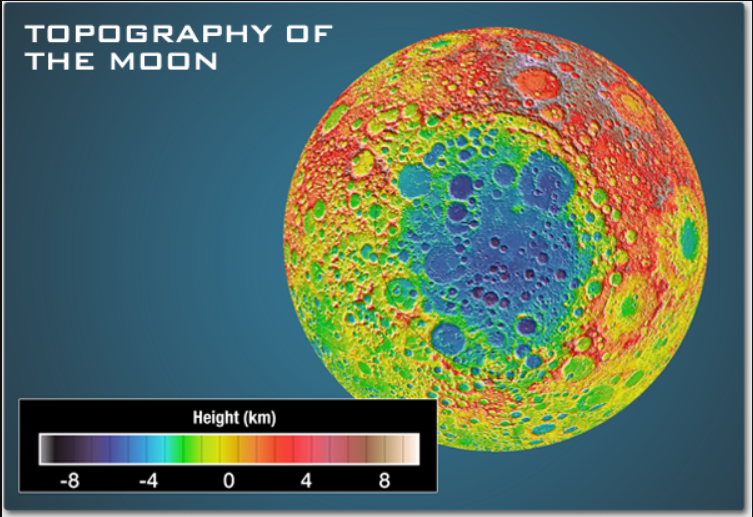
Source: https://science.nasa.gov/ems/03_behaviors/
- What is reflection?
- What does NASA's Lunar Reconnaissance Orbiter do?
- What are laws of reflection?
Answer
- Reflection is the bouncing back of incident (incoming) light when it hits an object or surface.
- NASA's Lunar Reconnaissance Orbiter uses lasers to map the surface of the moon. It measures the time taken for a laser pulse to hit the moon's surface and return. A longer response time means the surface is farther away and lower in elevation, while a shorter response time means the surface is closer or higher in elevation.
- The two laws of reflection are:
- The angle of incidence is equal to the angle of reflection (∠i = ∠r).
- The incident ray, the reflected ray and the normal at the point of incidence all lie in the same plane.
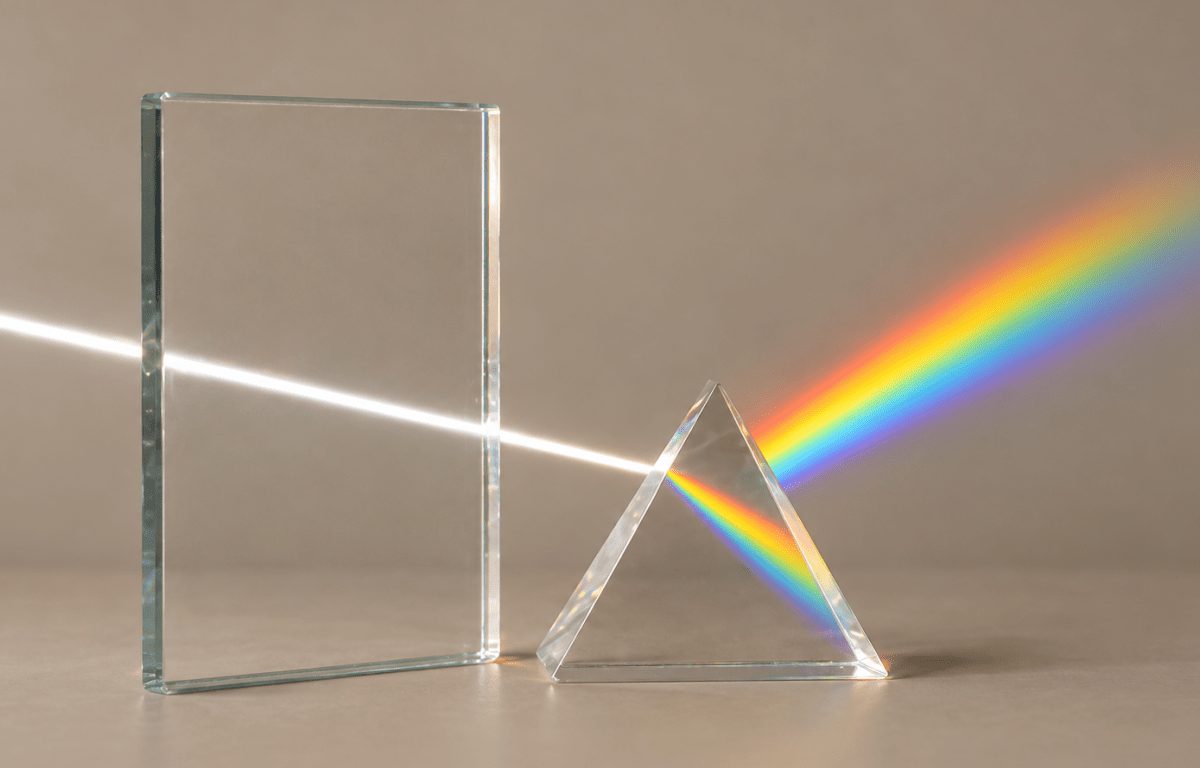
Why does light refract differently in a glass slab compared to a prism, even though both are transparent objects?
Answer
The difference lies in the shape and arrangement of their refracting surfaces.
In a glass slab, the two refracting surfaces are parallel to each other. So the bending of light at the second surface cancels the bending at the first surface, and the emergent ray comes out parallel to the incident ray (only shifted sideways). No splitting of colours takes place.
In a prism, the two refracting surfaces are inclined to each other (not parallel). So the bending of light at the two surfaces adds up, and the light is deviated towards the base of the prism. White light also splits into its seven colours (dispersion). Hence, even though both are transparent, light refracts differently in a glass slab and a prism.
Compare and contrast the images formed by concave and convex mirrors. How does the object's distance influence image type in each case?
Answer
| Concave Mirror | Convex Mirror |
|---|---|
| It can form both real and virtual images. | It always forms a virtual image. |
| The image may be diminished, of the same size or magnified, depending on the object's position. | The image is always diminished (smaller than the object). |
| The image is inverted for most positions but erect when the object is very close. | The image is always erect. |
In a concave mirror, the object's distance strongly influences the image. When the object is far (beyond the focus), the image is real and inverted; when it is close (between the focus and the pole), the image is virtual, erect and magnified.
In a convex mirror, the object's distance does not change the type of image. The image always remains virtual, erect and diminished, though its size increases a little as the object comes closer (but it always stays smaller than the object).
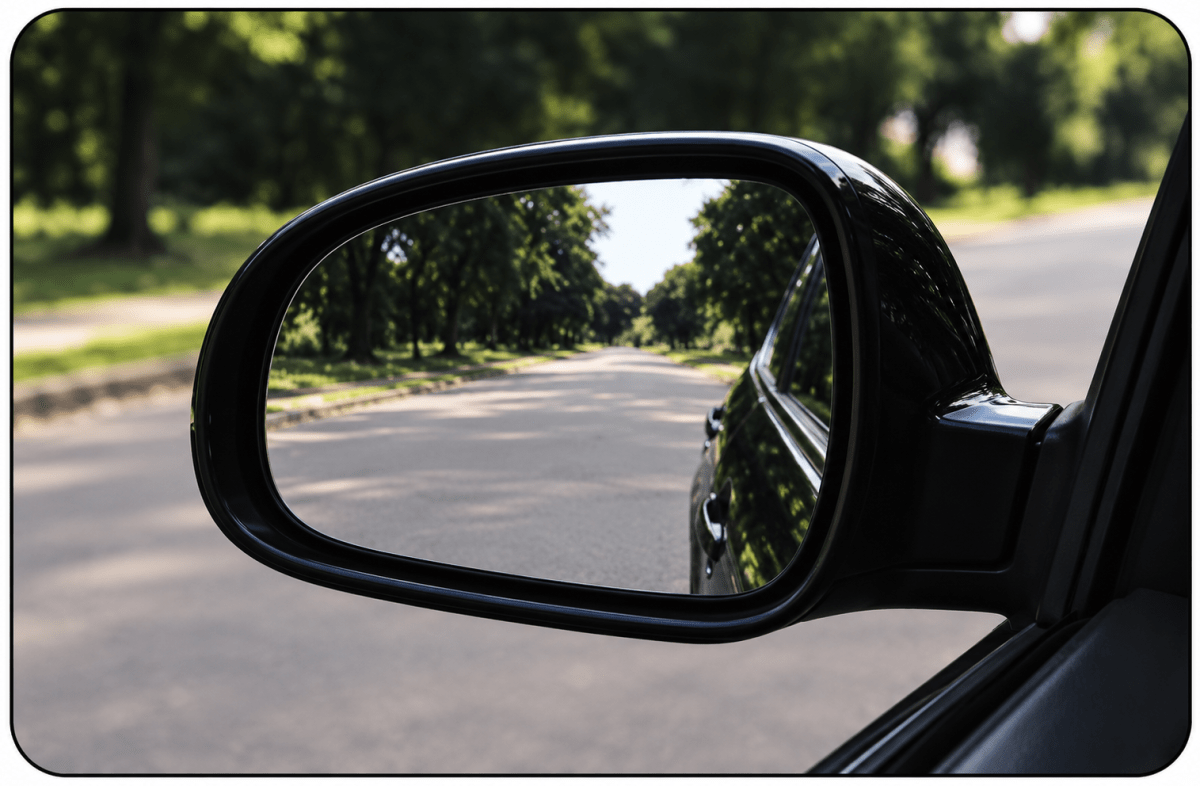
A driver wants to see a wider area behind the vehicle while reversing. Which mirror should be used and why?
Answer
A convex mirror should be used. A convex mirror always forms a virtual, erect and diminished image and gives a wider field of view. Because of this, a large area of the road behind the vehicle can be seen in a small mirror, which helps the driver while reversing.
You are asked to design a makeup mirror. Which spherical mirror will you choose to provide an enlarged image, and how should it be positioned relative to the face?
Answer
I will choose a concave mirror because it forms a magnified, erect, virtual image when the face is placed between the pole and the focus. This enlarged, upright image makes it easier to apply makeup.
Design a simple experiment using a torch and a prism to demonstrate dispersion of light at home or in class. What materials will you need and what steps will you follow?
Answer
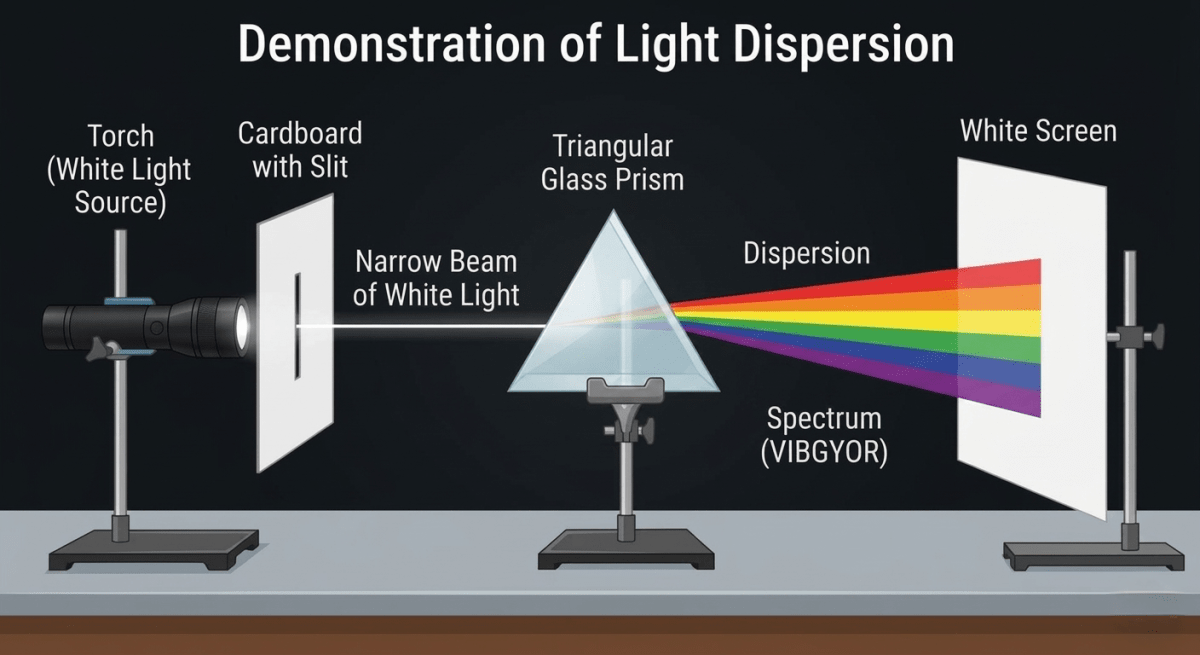
Aim: To demonstrate the dispersion of light using a torch and a prism.
Materials required: A triangular glass prism, a torch (or sunlight), a sheet of cardboard with a thin slit, a white screen or white sheet of paper, and a stand.
Procedure:
- Make a thin slit in the cardboard and place it in front of the torch so that only a narrow beam of white light passes through.
- Place the triangular glass prism on a stand in the path of this narrow beam of light.
- Hold the white screen on the other side of the prism, vertically, so that it can catch the light coming out of the prism.
- Adjust the prism slightly until a band of colours appears on the screen.
Observation: The white light passing through the prism splits into a band of seven colours — violet, indigo, blue, green, yellow, orange and red (VIBGYOR).
Conclusion: This shows that white light is made up of seven colours, and the splitting of white light into its component colours by a prism is called dispersion of light.
Imagine you're designing a science museum exhibit to teach children about refraction. What hands-on activity would you create to make the concept fun and clear?
Answer
Activity: "The Magic Disappearing Coin"
Aim: To show how refraction of light makes a hidden object appear.
Materials required: An opaque cup or bowl, a coin, and a jug of water.
Procedure:
- Place a coin at the bottom of the opaque cup.
- Ask a child to slowly move back until the coin just disappears from view behind the rim of the cup.
- Now, without moving the cup or the child, slowly pour water into the cup.
- The child will be amazed to see the hidden coin come into view again.
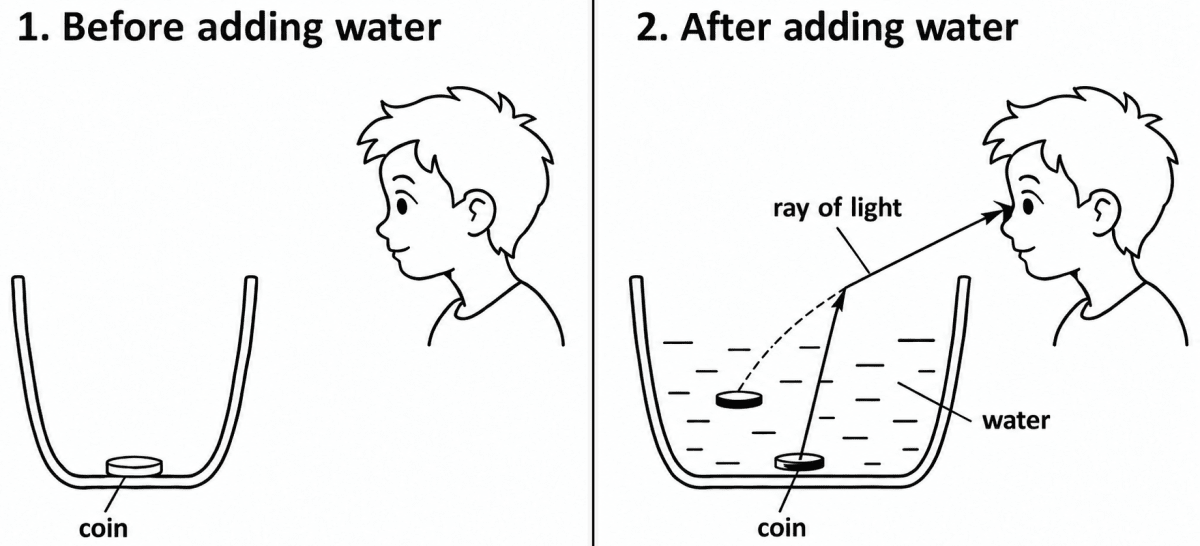
Explanation: As water is poured in, the light coming from the coin bends (refracts) when it travels from water to air. Because of this bending, the coin appears raised and becomes visible. This hands-on activity makes the idea of refraction fun and easy to understand. A pencil dipped in a glass of water can be kept alongside to show how it looks bent at the water surface.
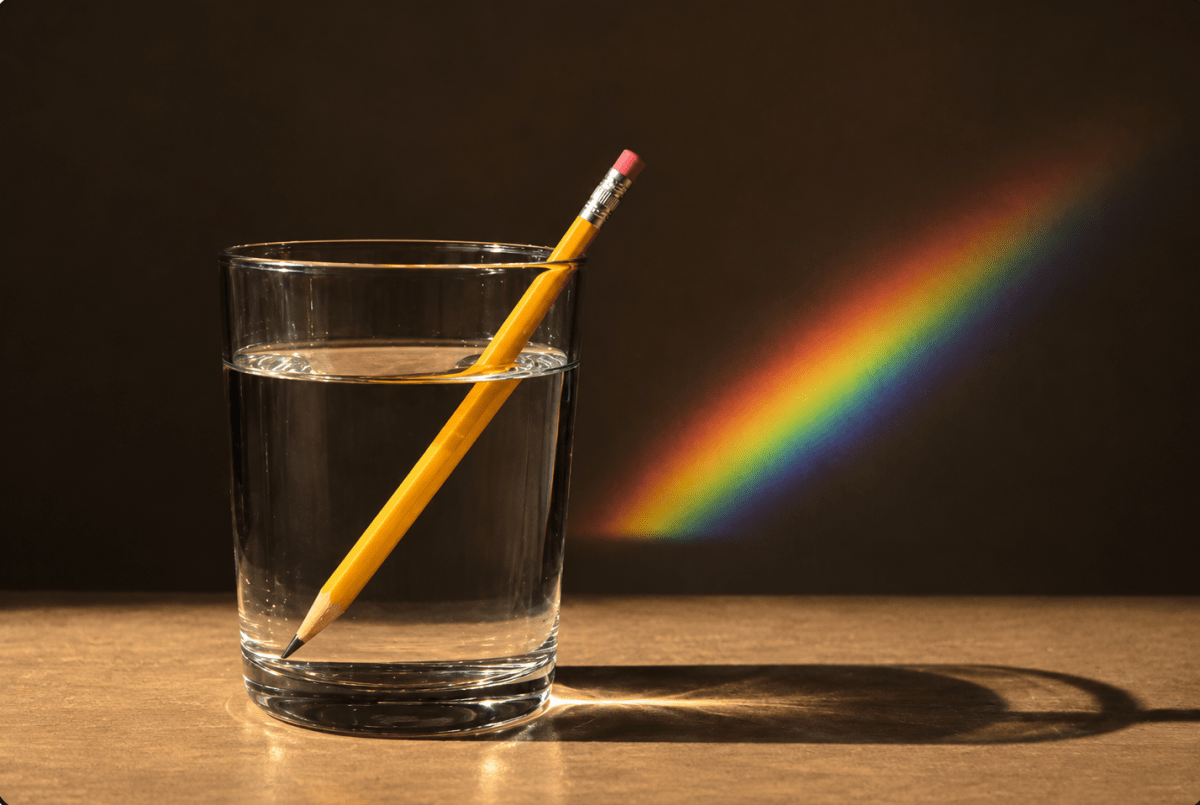
Sunny dipped a pencil into a glass of water and noticed that it looked bent at the surface. When he asked his teacher, she said that light changes direction when it passes from one medium to another. Later, he also observed a rainbow and wondered if the two phenomena were connected.
- What do we call the bending of light when it moves from one medium to another?
- Why does the pencil appear bent in water?
- Does the speed of light remain the same in all media?
- What happens to the direction of light when it goes from air to glass?
- What is the phenomenon called when white light splits into seven colours?
Answer
- The bending of light when it moves from one medium to another is called refraction of light.
- The pencil appears bent because the light coming from its submerged part bends (refracts) as it travels from water (a denser medium) into air (a rarer medium), making the part inside the water look raised and shifted.
- No, the speed of light is not the same in all media. It is maximum in vacuum (and air) and slows down in denser media such as water and glass.
- When light goes from air to glass, it travels from a rarer medium to a denser medium, so it bends towards the normal.
- The phenomenon in which white light splits into seven colours is called dispersion of light.
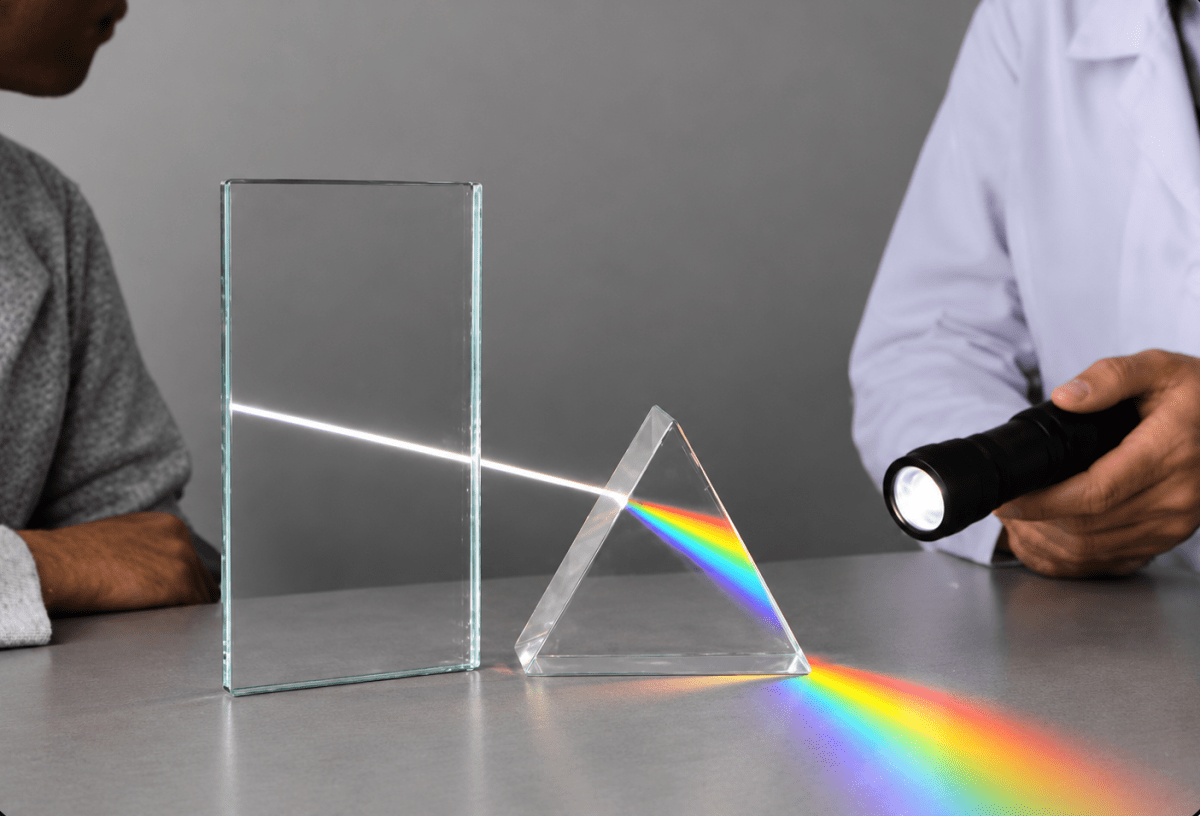
In the lab, students directed a ray of light through a glass slab and saw that it emerged parallel to the incident ray but slightly shifted. When the same light ray passed through a prism, it bent and split into different colours.
- What is observed when light passes through a parallel-sided glass slab?
- Is the direction of the emergent ray the same or different from the incident ray in a glass slab?
- What is the difference in the bending of light through a slab and a prism?
- What do you observe when white light passes through a prism?
- Why does a prism split light into a spectrum of colours?
Answer
- When light passes through a parallel-sided glass slab, it bends (refracts) at both surfaces, but the emergent ray comes out parallel to the incident ray, only shifted sideways by a lateral displacement.
- The direction of the emergent ray is the same as that of the incident ray. The emergent ray is parallel to the incident ray, only displaced sideways.
- In a glass slab the emergent ray is parallel to the incident ray and there is no dispersion. In a prism the light is deviated towards the base, and white light splits into its component colours (dispersion).
- When white light passes through a prism, it splits into a band of seven colours — violet, indigo, blue, green, yellow, orange and red (VIBGYOR), called the spectrum.
- A prism splits light into a spectrum because the refractive index of glass is different for different colours. So each colour bends by a different amount, with violet bending the most and red the least, and the colours spread out.
Sarita used a concave mirror to focus sunlight onto a piece of paper. She also used a convex mirror to see a wider view of the road behind her bicycle. She noticed how the shape of mirrors affected the images formed.

- What kind of mirror converges light to a point?
- Which mirror always forms virtual, erect and diminished images?
- How does the distance of the object from a concave mirror affect image formation?
- Which mirror is used to produce a real and inverted image?
- How is the image formed by a convex mirror different from that of a concave mirror?
Answer
- A concave mirror converges a parallel beam of light to a point (its focus).
- A convex mirror always forms virtual, erect and diminished images.
- The image formed by a concave mirror depends on the object's distance. Beyond the focus, it forms a real, inverted image, while between the focus and the pole, it forms a virtual, erect, magnified image.
- A concave mirror is used to produce a real and inverted image (when the object is placed beyond the focus).
- A convex mirror always forms a virtual, erect and diminished image for every position of the object, whereas a concave mirror can form real, inverted images of different sizes, or a virtual, erect and magnified image, depending on the object's position.
Jhanvi saw a dentist using a mirror to look at the back of her teeth. She noticed security mirrors in stores and the use of reflectors in flashlights. Curious, she asked her teacher about why different mirrors were used in different places.

- Which type of mirror is used by dentists and why?
- Why are convex mirrors used as rear-view mirrors in vehicles?
- How are concave mirrors useful in solar cookers or headlights?
- What property of convex mirrors makes them suitable for surveillance?
- Can one type of mirror serve all purposes? Why or why not?
Answer
- Dentists use a concave mirror, because it forms an enlarged, erect and virtual image of a tooth when held close to it, so the dentist can clearly see a magnified view of the tooth.
- Convex mirrors are used as rear-view mirrors because they always form a virtual, erect and diminished image and give a wider field of view, so the driver can see a larger area of the traffic behind the vehicle.
- In a solar cooker, a concave mirror converges the sunlight falling on it to a point (its focus), producing a high temperature to cook food. In headlights, a bulb placed at the focus of a concave mirror gives a strong parallel beam of light.
- A convex mirror gives a wide field of view and covers a large area, which makes it suitable for surveillance (vigilance) in shops, parking lots and metro stations.
- No, one type of mirror cannot serve all purposes, because each mirror forms different kinds of images suited to different needs. For example, a convex mirror gives a wide view but only a small image, while a concave mirror gives a magnified image or can focus light. So different mirrors are chosen for different uses.
Fill in the blanks.
- The bending of light when it passes from one medium to another is called ............... .
- The refractive index of a medium is the ratio of the speed of light in ............... to that in the medium.
- The mirror which always forms a virtual, erect and diminished image is a ............... mirror.
- Dispersion of light produces a band of ............... colours.
- The focal length of a concave mirror is equal to half its ............... .
Answer
- The bending of light when it passes from one medium to another is called refraction.
- The refractive index of a medium is the ratio of the speed of light in vacuum (air) to that in the medium.
- The mirror which always forms a virtual, erect and diminished image is a convex mirror.
- Dispersion of light produces a band of seven colours.
- The focal length of a concave mirror is equal to half its radius of curvature.
Write True or False.
- In refraction through a glass slab, the emergent ray is parallel to the incident ray.
- The angle of incidence is always equal to the angle of reflection.
- A real image can be obtained on a screen, whereas a virtual image cannot.
- The speed of light is greater in water than in air.
- Concave mirrors are used as rear-view mirrors in vehicles.
Answer
- True
- True
- True
- False
Corrected Statement — The speed of light is greater in air than in water, because light slows down when it enters a denser medium like water. - False
Corrected Statement — Convex mirrors are used as rear-view mirrors in vehicles.
Match the columns.
| Column A | Column B |
|---|---|
| 1. Concave mirror | (a) Diverging lens |
| 2. Convex mirror | (b) Used as a dentist's mirror |
| 3. Convex lens | (c) Splitting of white light into colours |
| 4. Concave lens | (d) Used as a rear-view mirror |
| 5. Dispersion | (e) Converging lens |
Answer
| Column A | Column B |
|---|---|
| 1. Concave mirror | (b) Used as a dentist's mirror |
| 2. Convex mirror | (d) Used as a rear-view mirror |
| 3. Convex lens | (e) Converging lens |
| 4. Concave lens | (a) Diverging lens |
| 5. Dispersion | (c) Splitting of white light into colours |
State the two laws of refraction of light.
Answer
The two laws of refraction of light are:
- The incident ray, the normal at the point of incidence and the refracted ray all lie in the same plane.
- For a given pair of media, the ratio of the sine of the angle of incidence to the sine of the angle of refraction is constant. This constant is the refractive index . This is known as Snell's law.
Define refractive index. How is it related to the speed of light?
Answer
The refractive index of a medium is the ratio of the speed of light in vacuum (air) to the speed of light in that medium. It is represented by μ and has no units.
Refractive index is inversely proportional to the speed of light in the medium, meaning that a higher refractive index indicates that light travels more slowly in that medium, while a lower refractive index means light travels faster.
Why do stars appear to twinkle but planets do not?
Answer
The light coming from a star passes through several layers of the atmosphere, which have different densities. Due to refraction in these many layers, the apparent position and brightness of the star keep changing slightly. This causes the star to appear to twinkle.
Planets are much closer to us than stars and appear as larger discs (made of many points of light), rather than as a single point. The slight changes in the light from the many points cancel out, so planets do not appear to twinkle.
What kind of image is formed by a convex mirror?
Answer
A convex mirror always forms a virtual, erect and diminished (smaller than the object) image, for every position of the object. The image is formed behind the mirror, between the pole and the focus.
Briefly explain prism.
Answer
A prism is an optically transparent device made up of glass having triangular bases and rectangular sides. The rectangular surfaces are called the refracting surfaces, and the angle between any two refracting surfaces is called the angle of prism. The base of the prism is non-refracting. When a ray of light passes through a prism, it bends towards the base, and white light passing through it splits into its seven component colours (dispersion).
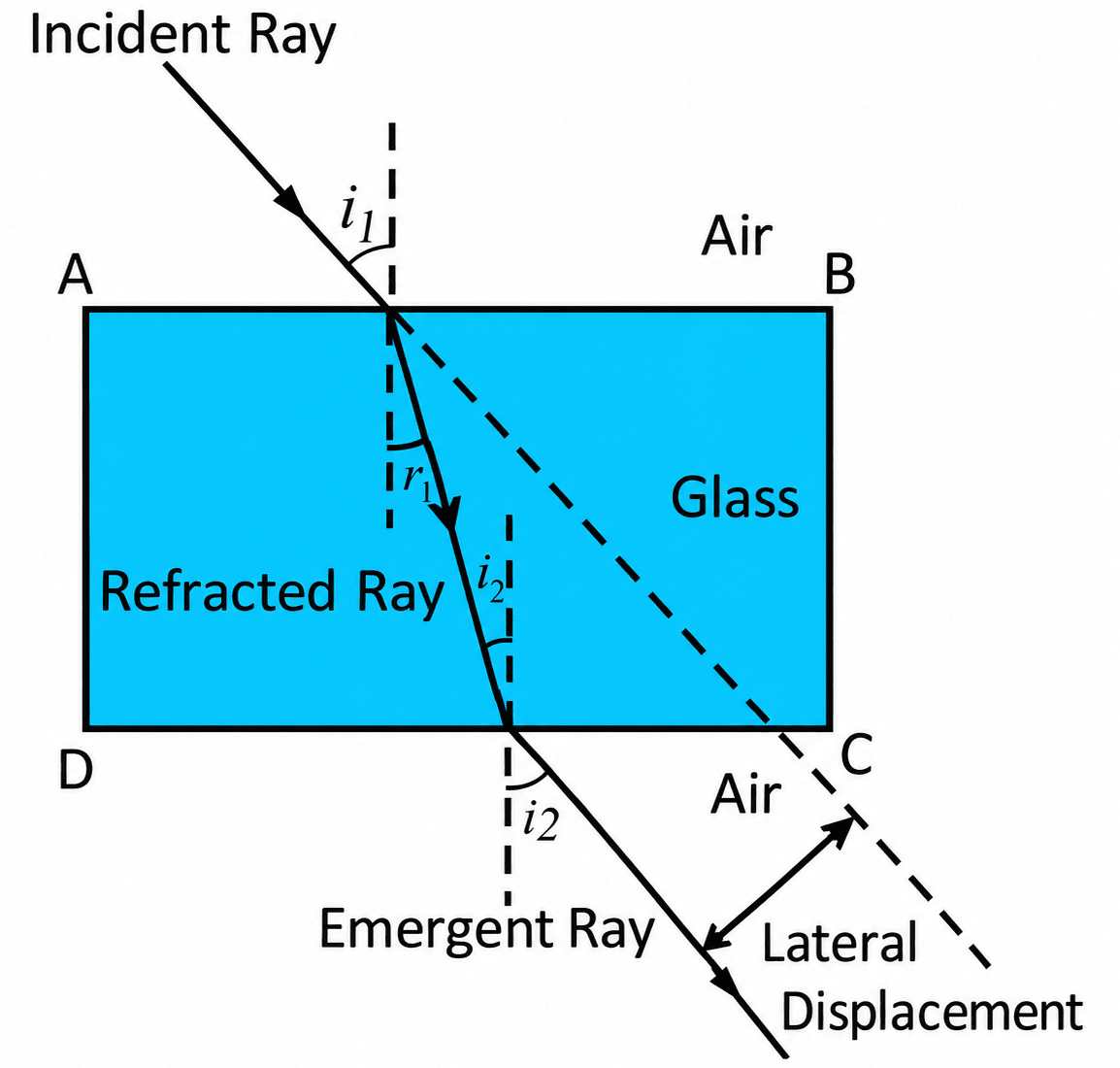
Explain with a neat diagram the refraction of light through a glass slab. Why does the emergent ray become parallel to the incident ray?
Answer
When a ray of light falls on a parallel-sided glass slab, it gets refracted at both surfaces of the slab.
At the first surface, the light travels from air (a rarer medium) into glass (a denser medium), so it bends towards the normal. This refracted ray travels through the slab and reaches the second surface. At the second surface, the light travels from glass into air (denser to rarer), so it bends away from the normal and comes out as the emergent ray.
The emergent ray becomes parallel to the incident ray because the two refracting surfaces of the slab are parallel to each other. The light bends towards the normal at the first surface and bends away from the normal by an equal amount at the second surface. As these two equal and opposite bendings cancel out, the emergent ray comes out parallel to the incident ray, only shifted sideways. This sideways shift is called lateral displacement.
Explain the difference between real and virtual images with examples.
Answer
| Real Image | Virtual Image |
|---|---|
| It is formed when the light rays after reflection actually meet at a point. | It is formed when the light rays after reflection do not actually meet but only appear to meet at a point. |
| It is always inverted (upside down). | It is always erect. |
| It can be obtained on a screen. | It cannot be obtained on a screen. |
Examples of real image: the image seen on a cinema screen and the image formed by a concave mirror (when the object is beyond the focus).
Examples of virtual image: the image formed by a plane mirror and the image formed by a convex mirror.
State the differences between a concave and a convex mirror with one use of each.
Answer
| Concave Mirror | Convex Mirror |
|---|---|
| It is polished on the outside so that its inner hollow surface reflects light. | Its inner hollow surface is polished and made opaque so that its outer surface reflects light. |
| It converges a parallel beam of light. | It diverges a parallel beam of light. |
| It can form real or virtual images of different sizes. | It always forms a virtual, erect and diminished image. |
One use of concave mirror: It is used as a shaving mirror (or by dentists to see an enlarged image of a tooth).
One use of convex mirror: It is used as a rear-view mirror in vehicles.
Explain dispersion of light with the help of a prism experiment. Why is violet light deviated the most?
Answer
Dispersion of light is the phenomenon of splitting of white light into its seven component colours.
Prism experiment: A narrow beam of white light is made to fall on a glass prism using a slit in a cardboard. A white screen is placed on the other side of the prism. When white light passes through the prism, it splits into seven colours—violet, indigo, blue, green, yellow, orange and red (VIBGYOR). This band of colours is called the spectrum.
Violet light is deviated the most and red light the least because the refractive index of glass is different for different colours. The refractive index is maximum for violet and minimum for red. Since a higher refractive index causes more bending, violet bends more and red bends less.
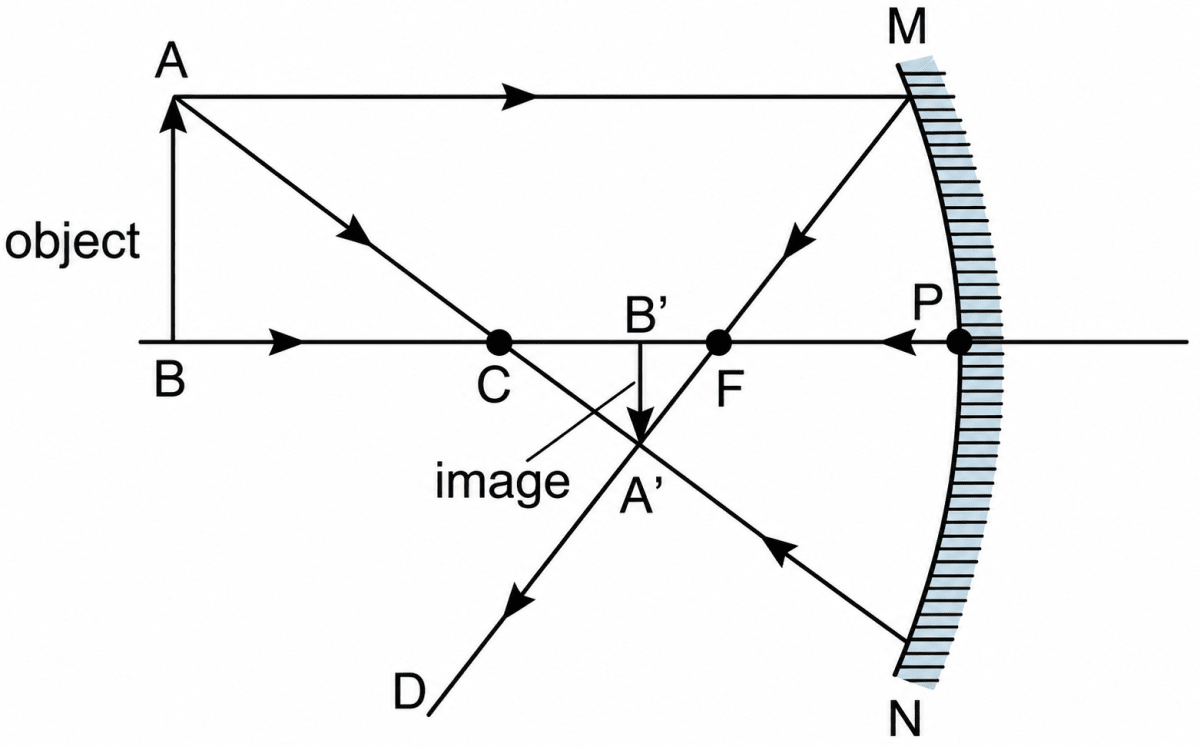
Draw a neat ray diagram to show the formation of a real image by a concave mirror.
Answer
When an object is placed beyond the centre of curvature (C) of a concave mirror, a real image is formed.
To draw the ray diagram, two rays are taken from the top of the object:
- A ray parallel to the principal axis, which after reflection passes through the focus (F).
- A ray passing through the centre of curvature (C), which falls on the mirror normally and retraces its path after reflection.
These two reflected rays meet at a point in front of the mirror, forming a real, inverted and diminished image between the centre of curvature (C) and the focus (F).