
Long ago, scientists and thinkers tried to understand how things move and why. Isaac Newton explained the idea of force and how it moves objects. The turning effect of force was first studied by Archimedes, showing how a force can rotate things. Blaise Pascal explained pressure as force on an area and showed that liquids pass on pressure equally. Thrust is a force that pushes things forwards like in rockets. Liquid pressure increases with depth and Torricelli showed that gases like air also exert pressure, helping invent the barometer. These ideas help us understand how things move and work around us.
Answer
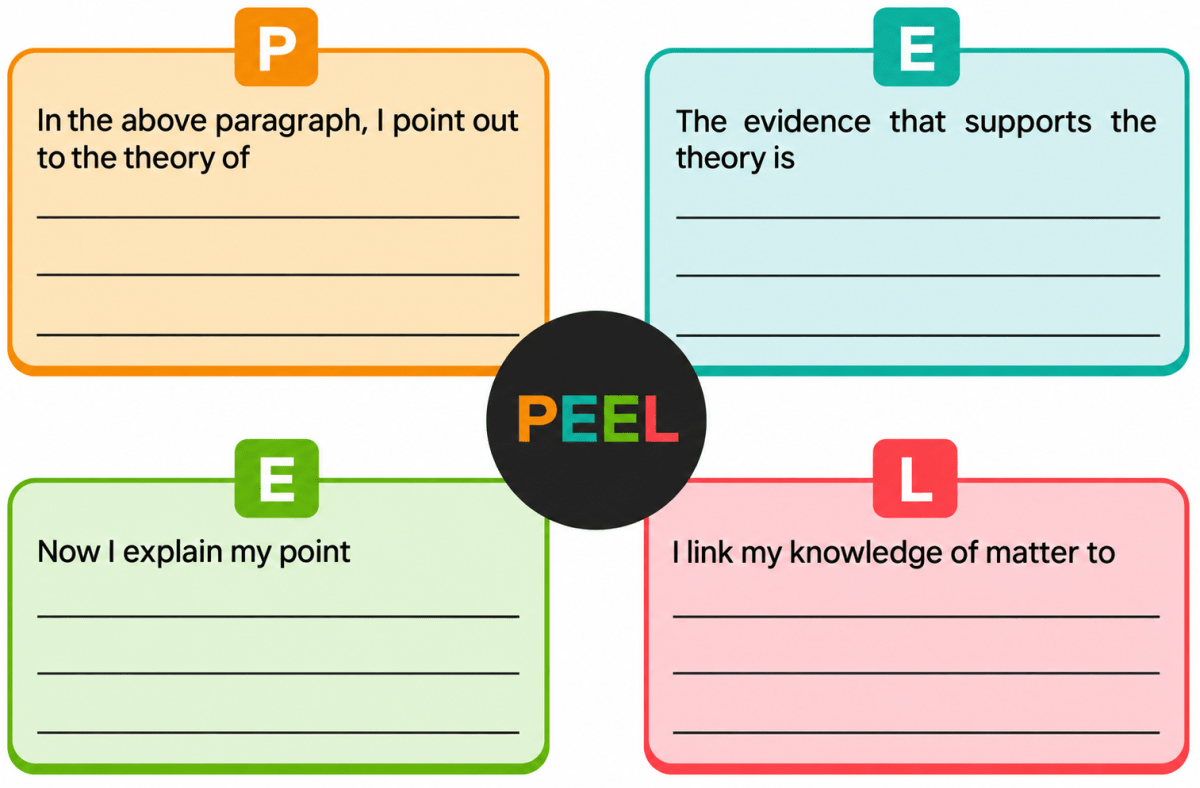
P - Point → In the above paragraph, I point out to the theory of: How force and pressure govern the movement and behavior of objects in our world.
E - Evidence → The evidence that supports the theory is:
- Isaac Newton explained how force moves objects.
- Archimedes showed how force rotates things.
- Blaise Pascal demonstrated that liquids transmit pressure equally.
- Torricelli proved that gases like air exert pressure.
E - Explanation → Now I explain my point: Different scientists discovered specific rules about how nature works. Together, these ideas explain how force causes motion and how pressure behaves in liquids and gases.
L - Link → I link my knowledge force and pressure to: A complete understanding of how things move and work around us daily.
Read the given paragraph and answer the questions that follow.
One windy evening, Sarthak and his sister Gunjan were helping their father fix a loose bolt on the gate. Their father handed Sarthak a spanner, but he couldn't open the bolt easily. Gunjan suggested using a longer spanner. When they used it, the bolt turned quickly. Their father smiled and said, "That's the turning effect of force. A longer spanner increases the turning moment."
Later, Gunjan accidentally stepped on a nail while walking barefoot on the lawn. "Ouch!" she cried. Their mother explained, "Since your body weight is acting on a small area, the pressure is high. That's why the nail hurt."
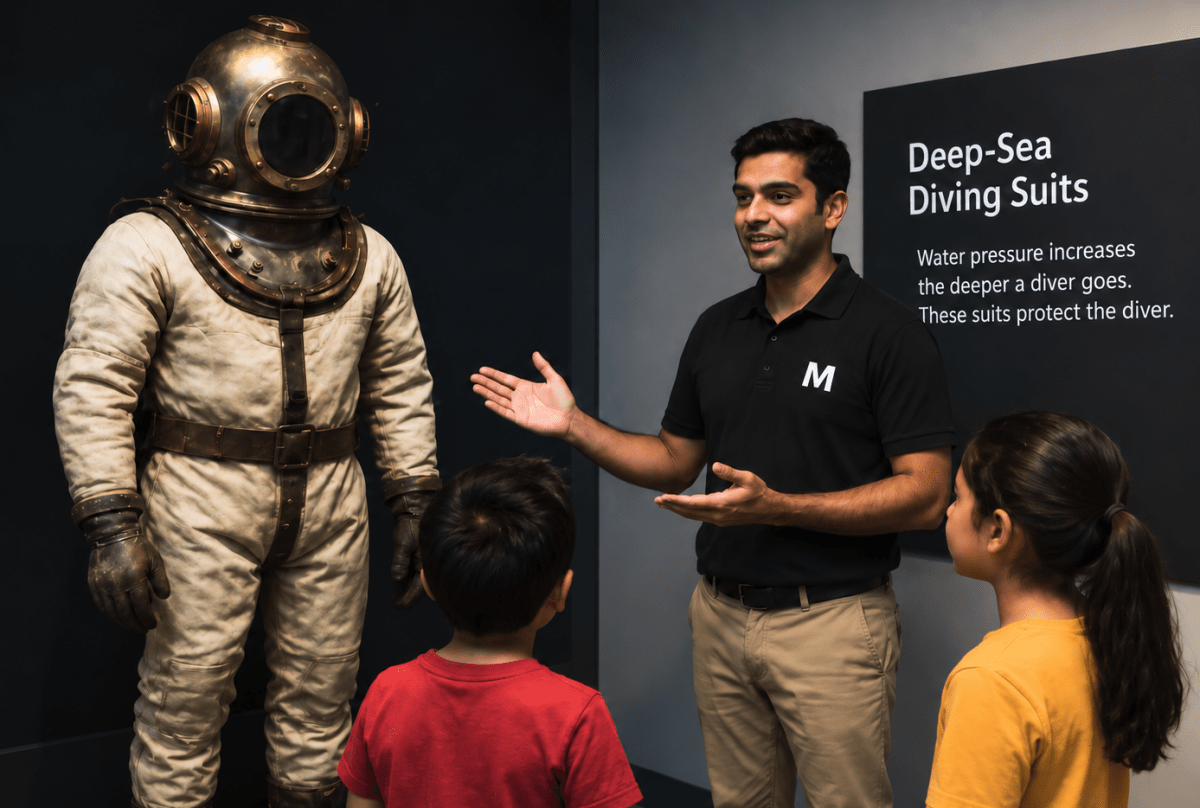
A few days later, they visited a science museum. They saw an exhibit showing how deep-sea divers wear special suits. A guide explained, "As we go deeper into the sea, the water pressure increases. That's why divers need strong suits to protect their bodies." Another exhibit showed an inflated balloon expanding near a heater. "This happens because gases exert pressure and heat increases it," the guide added.
- Why was it easier to turn the bolt with a longer spanner?
- What is the turning effect of force called?
- Why did stepping on a nail hurt Gunjan's foot?
- Why do deep-sea divers need special suits?
- What caused the balloon to expand near the heater?
Answer
A longer spanner increases the perpendicular distance from the bolt (pivot). Since the moment of force, M = F × d, increases with distance, the same force produces a greater turning effect and turns the bolt more easily.
The turning effect of force is called the moment of force (torque).
The tip of the nail has a very small area of contact. Gunjan's body weight acting on this small area produced a very high pressure (as pressure is inversely proportional to area), which is why the nail hurt her foot.
The pressure exerted by water increases with depth. Deep in the sea, water exerts a very large pressure on a diver's body. So divers need special suits to protect themselves from this large liquid pressure.
Gases exert pressure, and heating increases this pressure. The heat from the heater increased the pressure of the gas inside the balloon, so the balloon expanded.
Circle the word that does not belong to other words given alongside it.
- Force, Mass, Thrust, Friction, Pressure
- Gas, Air, Liquid, Water, Glass
- Surface area, Pressure, Depth, Thrust, Light
- Thrust, Push, Pull, Spin, Force
- Depth, Area, Gravity, Friction, Density
Answer
- Mass
Reason — Force, thrust, friction and pressure are all forces or are related to force, whereas mass is the amount of matter in a body and is not a force. - Glass
Reason — Gas, air, liquid and water are fluids (they can flow), while glass is a solid. - Light
Reason — Surface area, pressure, depth and thrust are all related to pressure, whereas light has no connection with pressure. - Spin
Reason — Thrust, push, pull and force are all forces or the way a force acts, while spin is a turning (rotational) motion, not a force. - Friction
Reason — Depth, area, gravity and density are all linked to pressure (pressure depends on area; liquid pressure depends on depth and density; pressure arises due to gravity), whereas friction does not affect pressure.
Note: In part 5, the grouping is based on factors connected with pressure. Since both gravity and friction are forces, the question is slightly open to interpretation; "friction" has been chosen as it has no role in determining pressure in this chapter.
Answer in one or a few word(s).
- Define force.
- Give an example of application of a force on a body.
- What is 1 newton?
- Write the SI unit of moment of force.
- Define liquid pressure.
Answer
A force is a push or pull that can change the state of rest or motion, direction of motion, shape or size of a body.
Squeezing a toothpaste tube (or pulling a rubber band, pushing a wheelbarrow).
One newton is the force which, when applied on a body of mass 1 kilogram, increases its speed by 1 metre per second in every second (1 N = 1 kg m/s2).
Newton-metre (Nm).
The pressure exerted by a liquid on the base and walls of the container in which it is kept is called liquid pressure.
Match the columns.
| Column A | Column B |
|---|---|
| 1. Turning effect of force | (a) Increases with depth |
| 2. Thrust | (b) Exerts pressure in all directions |
| 3. Pressure in liquids | (c) Force acting perpendicular to a surface |
| 4. Gas in a balloon | (d) Depends on area and force |
| 5. Pressure | (e) Force x perpendicular distance |
Answer
| Column A | Column B |
|---|---|
| 1. Turning effect of force | (e) Force x perpendicular distance |
| 2. Thrust | (c) Force acting perpendicular to a surface |
| 3. Pressure in liquids | (a) Increases with depth |
| 4. Gas in a balloon | (b) Exerts pressure in all directions |
| 5. Pressure | (d) Depends on area and force |
Write the correct word(s) in the given blanks.
- The SI unit of moment of force is ............... .
- The pressure due to a liquid at a point inside it ............... with the height of the liquid column above it.
- The pressure exerted by liquids on the walls of the container is called ............... pressure.
- ............... pressure is defined as the force exerted by atmosphere on a unit area of the surface of the earth.
- ............... consists of a U-shaped tube filled with some liquid (water or mercury).
Answer
- The SI unit of moment of force is newton-metre (Nm).
- The pressure due to a liquid at a point inside it increases with the height of the liquid column above it.
- The pressure exerted by liquids on the walls of the container is called lateral pressure.
- Atmospheric pressure is defined as the force exerted by atmosphere on a unit area of the surface of the earth.
- Manometer consists of a U-shaped tube filled with some liquid (water or mercury).
Write True or False for the following statements.
- Force can change the shape and size of a body.
- The moment of force is directly proportional to the applied force.
- It is easier to open the lid of a container with a coin rather than a spoon.
- The SI unit of thrust is pascal (Pa).
- The pressure due to a liquid at a point inside it decreases with the height of the liquid column above it.
Answer
True
True
False
Corrected Statement — It is easier to open the lid of a container with a spoon than with a coin, because a spoon has a longer arm (greater distance from the pivot), which gives a greater turning effect.False
Corrected Statement — The SI unit of thrust is the newton (N). Pascal (Pa) is the SI unit of pressure.False
Corrected Statement — The pressure due to a liquid at a point inside it increases (not decreases) with the height of the liquid column above it.
Find errors in the given sentences and correct them.
- The walls of the dams are made thinner at the bottom to withstand the greater lateral pressure of water.
- Pressure is directly proportional to area.
- Pressure in gases is less in a closed container than in an open container.
- A narrower tip of a needle reduces pressure on the skin.
- The turning effect of force is maximum when the force is applied closer to the pivot.
Answer
The walls of the dams are made thicker at the bottom to withstand the greater lateral pressure of water.
Pressure is inversely proportional to area.
Pressure in gases is more in a closed container than in an open container.
A narrower tip of a needle increases pressure on the skin.
The turning effect of force is maximum when the force is applied farthest from the pivot.
Give reason — It is easier to unscrew a nut tightly fitted to a bolt with a wrench having a long arm.
Answer
A wrench with a long arm increases the perpendicular distance (d) of the point of application of force from the pivot. Since the moment of force, M = F × d, a larger distance means a smaller force (F) is needed to produce the required turning effect. So unscrewing the nut becomes easier.
Give reason — A sharp knife cuts better than a blunt one.
Answer
A sharp knife has a very thin edge, so it makes a small area of contact with the object. As pressure is inversely proportional to the area of contact, the same force produces a very high pressure at the edge, and the object is cut easily. A blunt knife has a larger area of contact and so exerts less pressure.
Give reason — Snowshoes are much more effective as compared to ordinary shoes for walking on snow.
Answer
Snowshoes have a larger surface area than ordinary shoes. A larger area of contact reduces the pressure exerted on the snow. Due to this lower pressure, the feet do not sink into the snow, making walking easier.
Give reason — It is easy to push a sharpened pencil into the soil.
Answer
A sharpened pencil has a very small area at its tip. The same force acting over this small area produces a high pressure (as pressure is inversely proportional to area). This high pressure makes it easy to push the pencil into the soil.
Give reason — A balloon bursts when over-inflated.
Answer
On over-inflating, more and more air is filled inside the balloon. The gas exerts pressure in all directions on the walls of the balloon, and this pressure keeps increasing. When the pressure becomes greater than the balloon walls can withstand, the balloon bursts.
Write the various effects produced by a force.
Answer
A force can produce the following effects.
- It can stop a moving body.
- It can produce motion in a stationary body.
- It can change the shape and size of a body.
- It can change the direction of motion of a body.
- It can change the speed of a moving body.
Briefly explain turning effect of force with the help of examples.
Answer
When a force is applied on a body that is pivoted (fixed) at a point, the body turns about that point instead of moving in a line. This is called the turning effect of force.
For example, a door is fixed at one end with hinges. When we push it, it turns about the hinges and opens. Similarly, when force is applied on the handle of a wrench, the bolt turns and gets tightened.
Define moment of force. Write the factors on which moment of force depends.
Answer
Moment of force is the product of the magnitude of force and the perpendicular distance between the point of application of force and the pivoted point. It gives the turning effect of force about a fixed point, and the formula is written as M = F × d.
It depends on two factors.
- Magnitude of the applied force — the moment of force is directly proportional to the applied force.
- The perpendicular distance between the point of application of the force and the pivot — the turning effect increases with this distance.
What are the factors on which pressure depends.
Answer
Pressure depends on two factors.
- Magnitude of force — pressure is directly proportional to the force. The greater the force, the greater the pressure.
- Area of contact — pressure is inversely proportional to the area of contact. Pressure increases when the force acts on a smaller area and decreases when it acts on a larger area.
Differentiate between thrust and pressure.
Answer
| Thrust | Pressure |
|---|---|
| It is the total force acting perpendicular to the surface. | It is the thrust (perpendicular force) acting per unit area. |
| It does not depend on the area of contact. | It depends on the area of contact, as it is inversely proportional to it. |
| The SI unit of thrust is newton (N). | The SI unit of pressure is pascal (Pa). |
Write some applications of turning effect of force.
Answer
Some applications of the turning effect of force are as follows.
- A handle is provided at the free edge of a door. By applying force at this maximum distance from the hinges, it is easiest to open or close the door.
- Unscrewing a nut tightly fitted to a bolt is easier with a wrench having a long arm, as less force is needed to produce the required turning effect.
- A potter's wheel is pivoted at the centre and is turned with a stick applied at the outer rim. Similarly, a hand flour grinder (chakki) is moved by applying force at its handle.
- A driver turns the steering wheel of a car by applying force at its rim.
- It is easier to open the lid of a container with a spoon rather than a coin.
Give some physical examples of pressure.
Answer
Some physical examples of pressure are as follows.
- When a person dives deep into a pool, the ears start hurting, because the pressure of water increases towards the bottom.
- A sharp knife cuts fruits easily, as its thin edge makes a small area of contact and produces a very high pressure.
- Shopping bags and carry bags have wide straps to increase the area of contact and reduce the pressure exerted on the hands and shoulders.
- Nails, awl pins and thumb pins have pointed tips. Their small area produces a very high pressure that enables them to pierce a surface.
- Porters and construction workers place a round piece of cloth (turban) on their heads while carrying heavy loads, to increase the area of contact and reduce the pressure on the head.
Describe manometer.
Answer
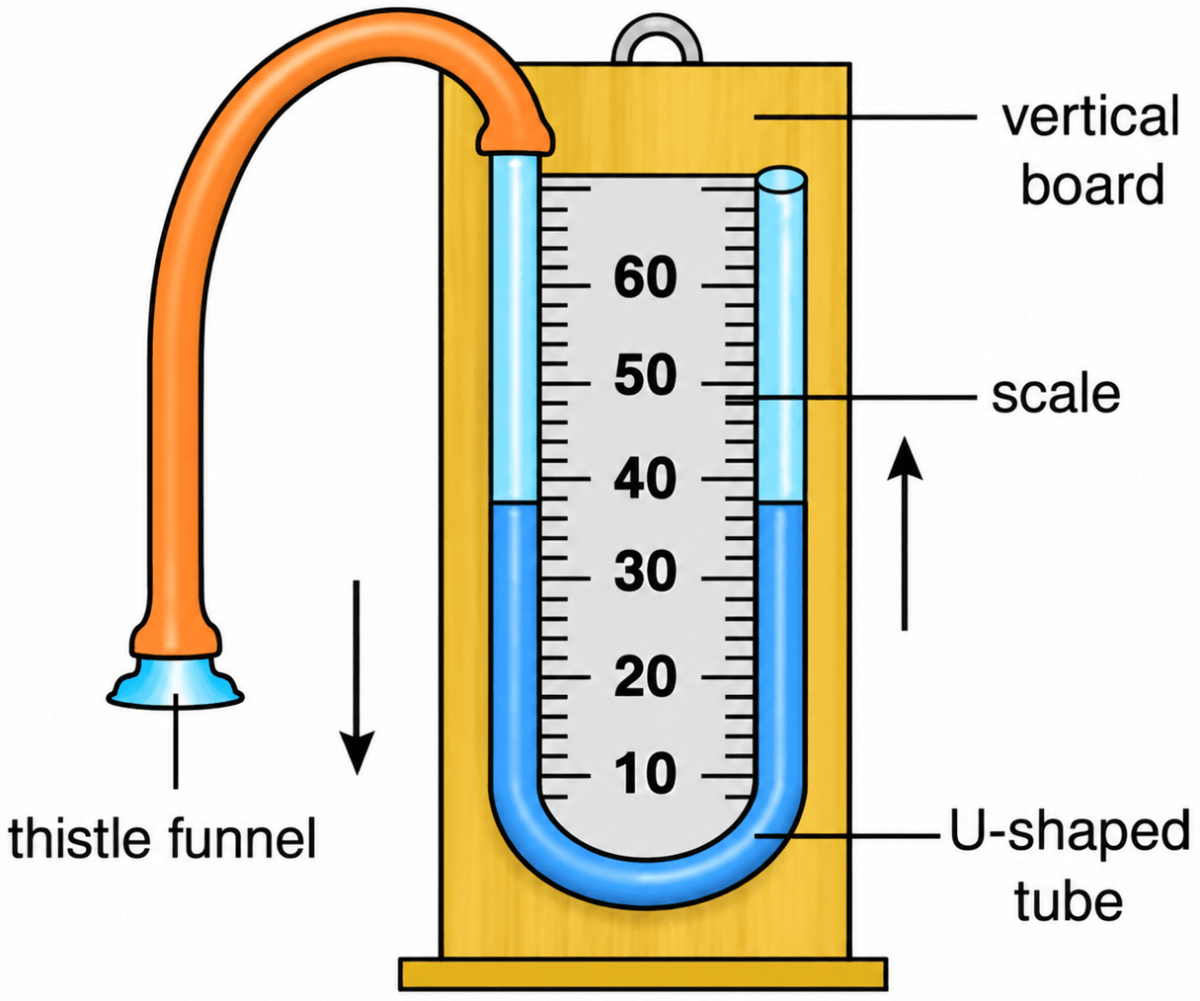
A manometer is a simple device used to measure the pressure exerted by a liquid. It consists of a U-shaped tube filled with some liquid (water or mercury). One end of the tube is open to air, and the other end is connected to a thistle funnel which has a rubber membrane stretched across its mouth.
When the funnel is placed in the liquid whose pressure is to be measured, the levels of liquid in the two arms of the tube change. The difference in the levels of liquid in the two arms is a measure of the pressure exerted by the liquid on the rubber membrane. The greater this difference, the greater is the pressure exerted.
What is lateral pressure? Mention the factors affecting liquid pressure.
Answer
The pressure exerted by liquids on the walls of the container is called lateral pressure.
The factors affecting liquid pressure are as follows.
- Height of the liquid column — the pressure at a point inside a liquid increases with the height of the liquid column above it.
- Density of the liquid — the pressure is directly proportional to the density of the liquid. The greater the density, the more the pressure exerted.
What are the applications of atmospheric pressure.
Answer
Some applications of atmospheric pressure are as follows.
- Ink rises in the tube of a fountain pen due to the pressure of the atmosphere.
- We can drink liquids through a straw. Sucking lowers the pressure inside the straw, and the atmospheric pressure outside pushes the liquid up.
- Rubber suction pads stick to a wall. When the pad is pressed, the air between the wall and the pad is expelled, lowering the pressure there, and the atmospheric pressure presses the pad firmly against the wall.
- At high altitudes, the atmospheric pressure is low while the blood pressure inside the body remains the same, so blood may ooze out of the nose (nose bleeding).
- When the piston of a syringe is pulled out, the pressure inside it decreases, and the atmospheric pressure forces the liquid to enter the syringe.
Read the given case study and answer the questions that follow.
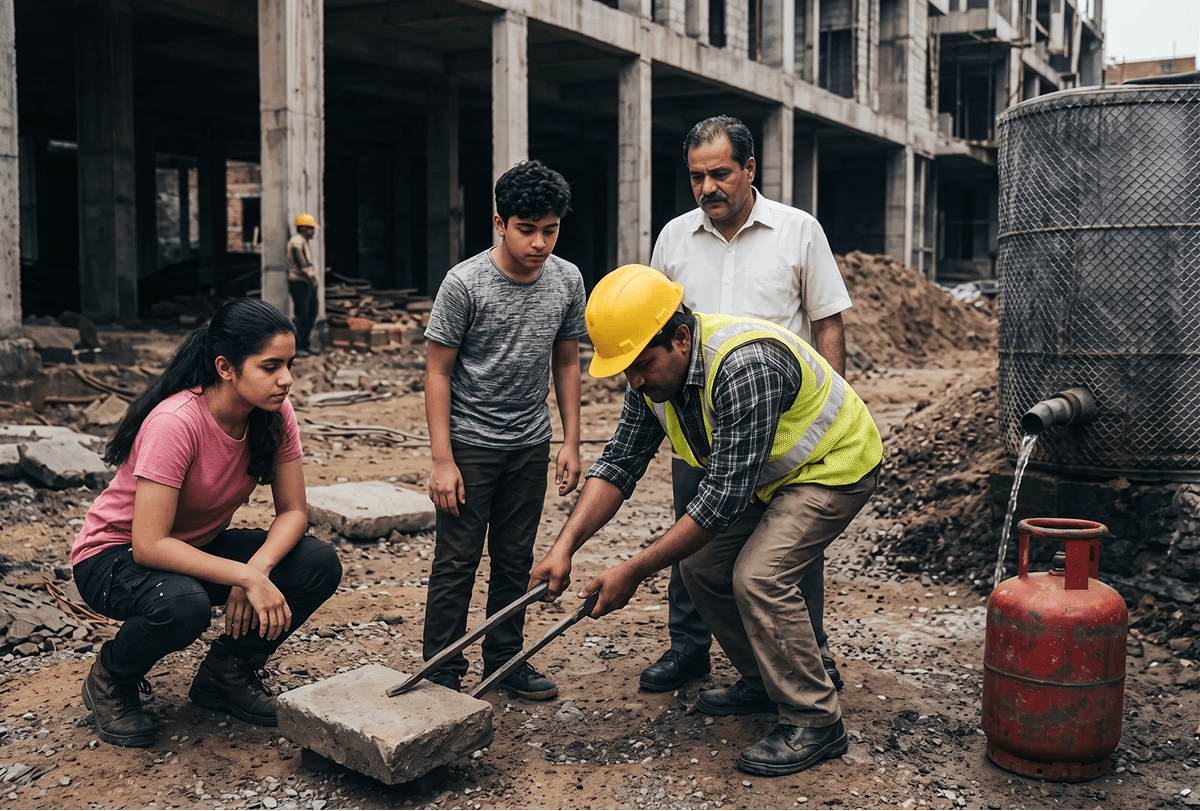
Vandana and her cousin Sahil were helping their uncle at a construction site. They noticed that the workers used long iron rods to move heavy stone slabs. Sahil asked, "Why don't they just lift the stones directly?" Their uncle replied, "We use the rod as a lever — the longer it is, the easier it becomes to move heavy objects due to the turning effect of force."
Later, Vandana saw a worker wearing broad shoes while working on muddy ground. "These shoes help reduce pressure on the soft surface," her uncle explained. "Since pressure is force per unit area, a larger area reduces pressure."
In another corner, a tank was being filled with water. Vandana observed that the water pipe at the bottom of the tank had stronger flow than the one at the top. Sahil guessed correctly, "That's because pressure in a liquid increases with depth!"
Just then, a gas cylinder leaked slightly and the smell spread quickly. Their uncle warned them, "Gas spreads fast in all directions and exerts pressure around — that's why leaks are dangerous."
- Why did the workers use a long iron rod to move the stone slabs instead of lifting them directly?
- How do broad shoes help while working on muddy ground?
- Why does water flow more strongly from the bottom pipe of the tank than from the top?
- What property of gases makes a gas leak dangerous?
- Which physical concept explains why the workers use the iron rod as a lever?
Answer
The iron rod is used as a lever. A longer rod gives a greater perpendicular distance from the pivot, which increases the moment of force (turning effect). So heavy stone slabs can be moved with less effort.
Broad shoes have a larger area of contact. Since pressure is inversely proportional to area, a larger area reduces the pressure on the soft muddy ground. So the feet do not sink into it.
Pressure in a liquid increases with depth. The bottom pipe is at a greater depth, so the water there is under greater pressure and flows out more strongly than from the top pipe.
Gases exert pressure in all directions and spread quickly in all directions. So a leaked gas spreads fast everywhere, which makes the leak dangerous.
The turning effect of force (moment of force) explains why the workers use the iron rod as a lever.
Read the given information carefully and answer the questions that follow.
The most familiar force is gravity. It is responsible for keeping our feet on the ground and holding Earth in its orbit around the sun. According to the general theory of relativity, gravity can be understood as bends and curves in the fabric of space-time that affect the motions of galaxies, stars, planets, and even light. Anything with mass makes a dent in space-time, causing objects to be attracted to each other. Gravity is an attractive force that draws two objects together. Its strength approximately increases with the masses of the two objects but decreases with the square of the distance between them. That means that if the moon were twice its current distance from Earth, the gravitational tug between the two would be just one fourth of what it is now. Despite being the weakest force, gravity works across infinite distances, making it responsible for the formation of the universe's structure.
Source: https://science.nasa.gov/universe/overview/forces/
- What is force?
- What is its unit?
- Define gravity.
Answer
A push or pull acting on a body which tends to change its state of rest or motion, or its direction of motion, or its shape or size, is called force.
The SI unit of force is the newton (N).
Gravity is an attractive force that draws two objects together. Its strength increases with the masses of the two objects and decreases with the square of the distance between them.
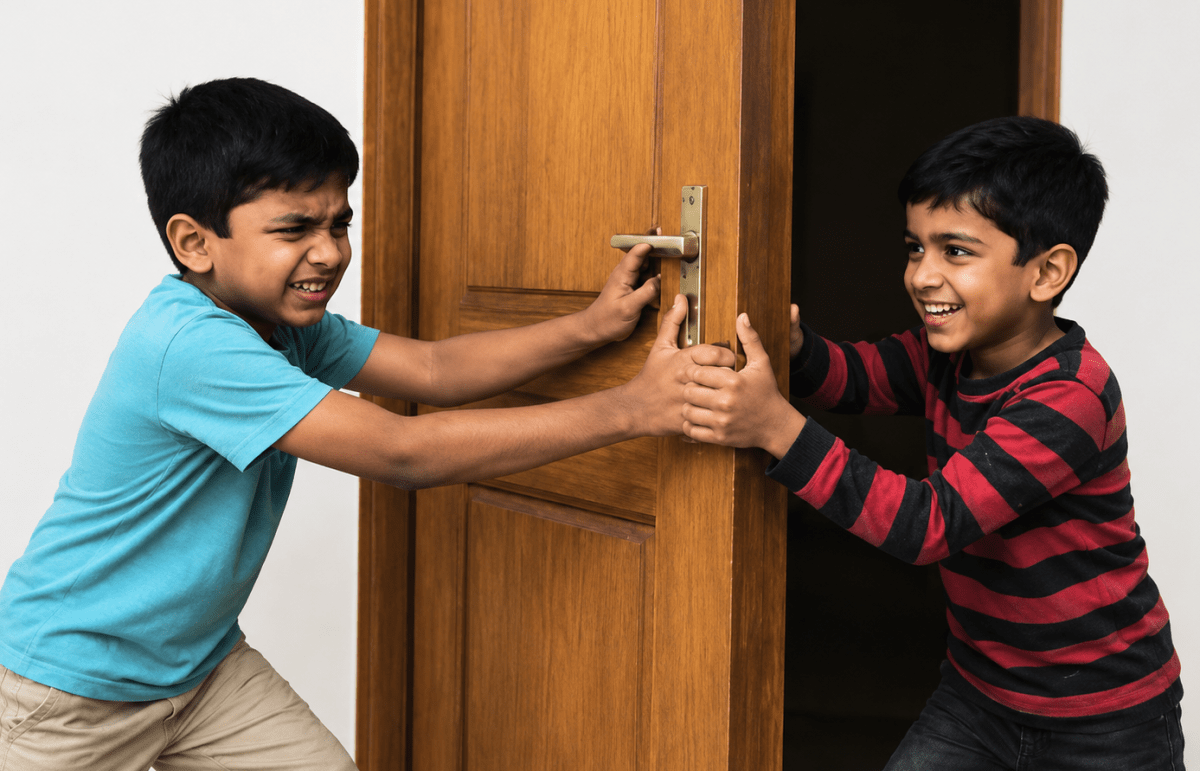
A boy pushes a door near its hinge but struggles to open it, while another pushes it from the edge and opens it easily. What concept is being applied here, and why does the second boy succeed?
Answer
The second boy opens the door easily because he applies force at the edge of the door, far from the hinges (pivot), producing a greater turning effect. Since moment of force, M = F × d, a larger distance (d) gives a greater moment of force. The first boy applies force near the hinges, where d is very small, so the turning effect is small and the door hardly moves.
Two balloons are filled with air. One is kept in sunlight and the other in a cool room. After some time, the one in sunlight bursts. Analyse the reason behind this event.
Answer
Heating increases the kinetic energy of the air molecules inside the balloon. As a result, they collide more frequently and forcefully with the balloon walls, increasing the gas pressure. When the pressure exceeds the elastic limit of the balloon, it bursts. The balloon kept in the cool room remains at lower pressure, so it does not burst.
Calculate the pressure exerted by a force of 200 N acting on an area of 0.5 m2.
Answer
Given,
Force(F) = 200 N
Area (A) = 0.5 m2
⇒ P = 400 Pa
So, the pressure exerted is 400 Pa.
A force of 50 N is applied at a distance of 0.3 m from the pivot. What is the moment of force?
Answer
Given,
Force(F) = 50 N
Distance (d) = 0.3 m
Moment of force (M) = Force × Distance
= 50 × 0.3
= 15 Nm
So, the moment of force is 15 Nm.
Design a simple activity using a stick and a brick to explain the turning effect of force to your classmates. Write the steps and what they will observe.
Answer
Steps
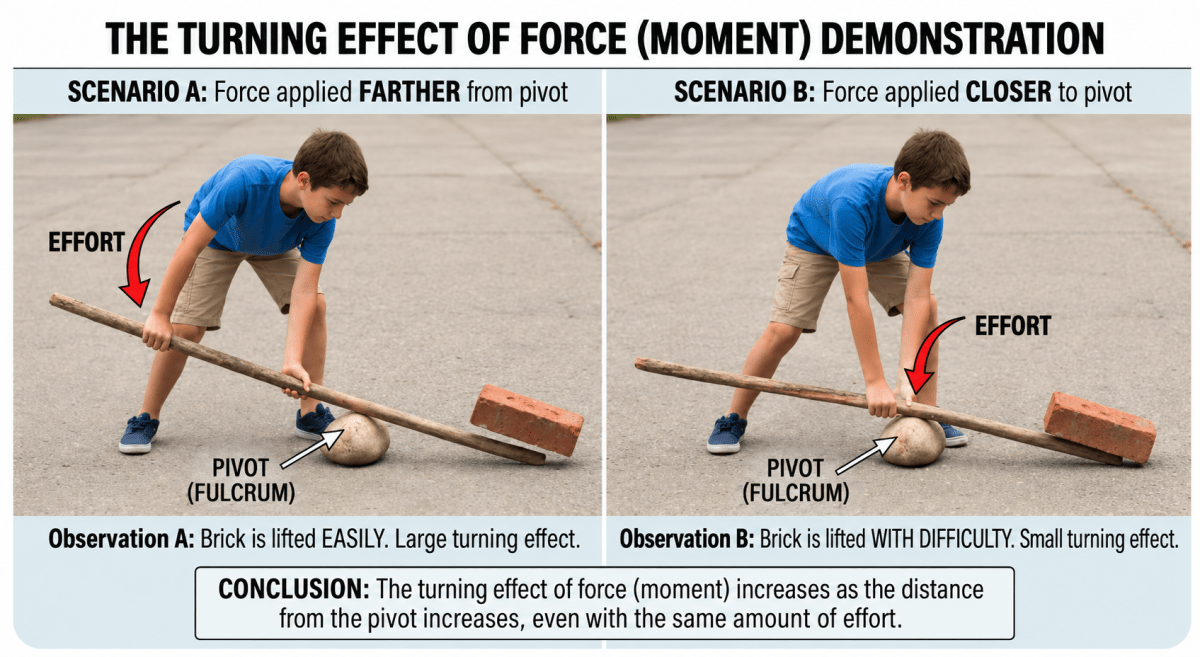
- Place a brick on the ground that is to be lifted.
- Take a strong stick and rest it over a small support (such as a stone), which acts as the pivot, with one end of the stick under the edge of the brick.
- First, press down on the free end of the stick at the point farthest from the pivot, and lift the brick.
- Now press the stick at a point closer to the pivot using the same effort.
Observation The brick is lifted much more easily when force is applied at the far end of the stick (greater distance from the pivot) than when force is applied closer to the pivot. This shows that the turning effect of force increases as the distance from the pivot increases.
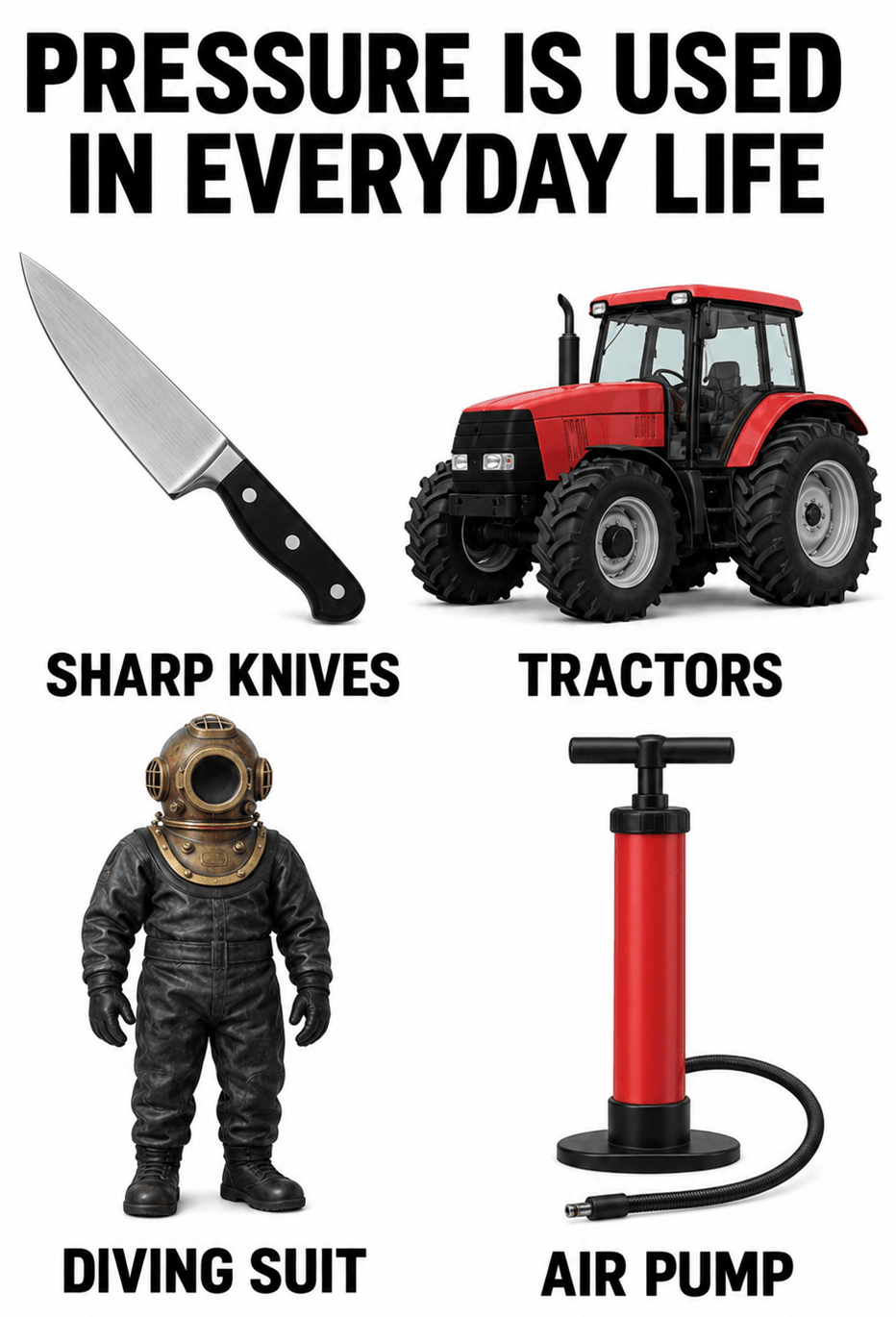
Create a poster that shows how pressure is used in everyday life (for example, sharp knives, tractors, diving suits). Include three examples and short explanations.
Answer
Poster title: Pressure in Everyday Life
- Sharp knives — A sharp knife has a thin edge with a small area of contact, so the same force produces a very high pressure that cuts easily.
- Tractors — Tractors have broad tyres which increase the area of contact and reduce the pressure on the ground, so they do not sink into soft soil.
- Diving suits — Deep-sea divers wear special suits to protect themselves from the large water pressure, which increases with depth.
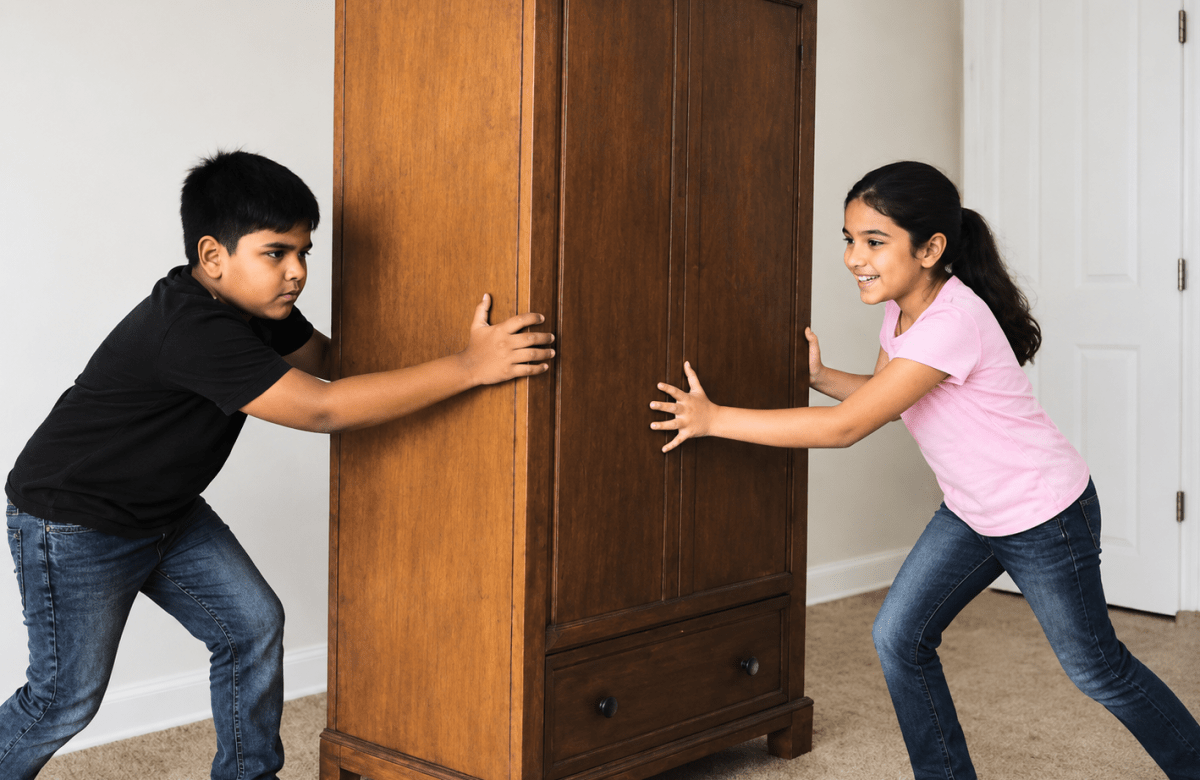
Sahil tried to push a heavy cupboard across the floor but couldn't move it. Then his sister helped him and together they managed to push it. Later, he saw a door swing open when pushed at the edge but hardly moved when pushed at the centre.
- What do we call a push or a pull acting on an object?
- Why was Sahil unable to move the cupboard alone?
- What happens to the effect of force when two people apply force in the same direction?
- What do you observe when a door is pushed at its edge versus at its centre?
- What is the turning effect of force called?
Answer
A push or a pull acting on an object is called force.
The force applied by Sahil alone was less than the force needed to move the heavy cupboard. So he could not move it on his own.
When two people apply force in the same direction, the forces add up. So the net (total) force increases, and the object can be moved more easily.
When the door is pushed at its edge (farthest from the hinges), it swings open easily because of a greater turning effect. When it is pushed at its centre (nearer the hinges), the turning effect is smaller, so it hardly moves.
The turning effect of force is called the moment of force.
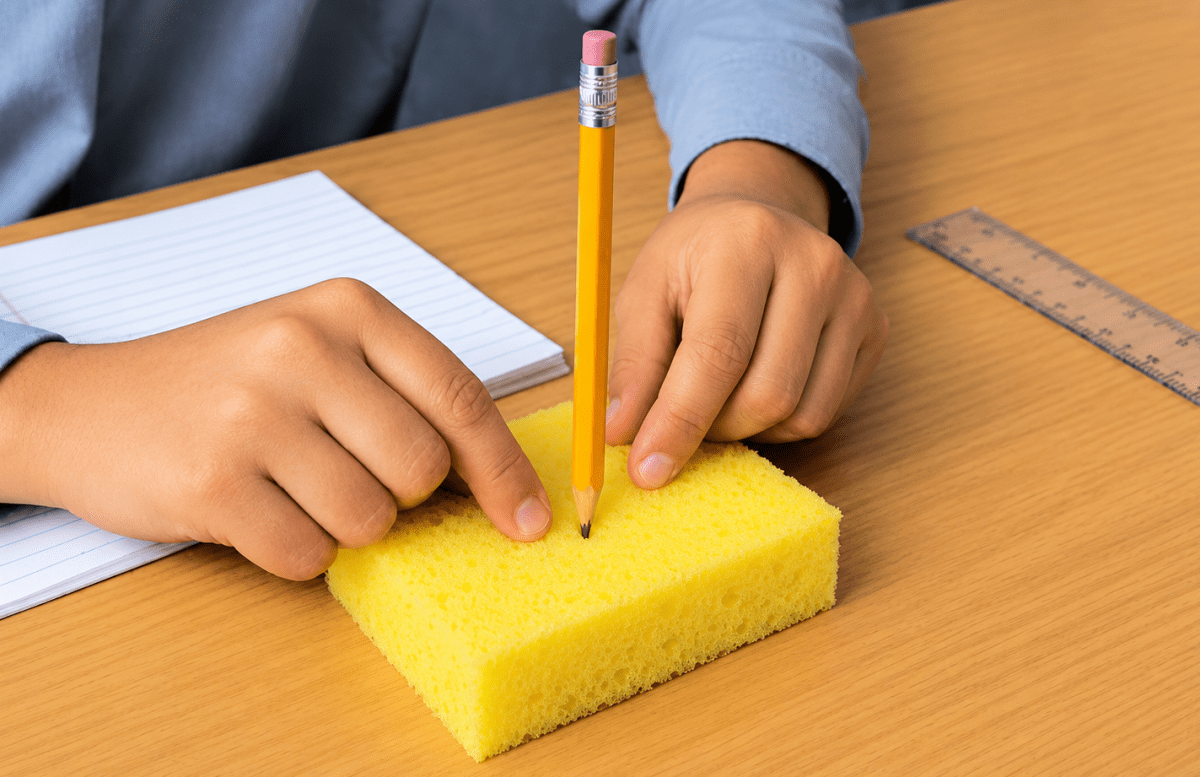
In school, Neha placed the sharp tip of her pencil on a sponge and gently pressed it. Then she pressed the eraser end of the same pencil with the same force. She noticed that the pencil tip went deeper into the sponge. Her teacher explained that this happened because the area where the force was applied was different.
- What is the relation between pressure and area when force remains constant?
- Which end of the pencil applies more pressure—tip or eraser? Why?
- What do we call the force acting per unit area?
- How does decreasing the contact area affect pressure?
- Why do sharp knives cut better than blunt ones?
Answer
When the force remains constant, pressure is inversely proportional to the area of contact. As the area decreases, the pressure increases, and as the area increases, the pressure decreases.
The tip of the pencil applies more pressure. This is because the tip has a much smaller area of contact, and the same force acting over a smaller area produces a greater pressure.
The force acting per unit area is called pressure.
Decreasing the contact area increases the pressure (for the same force).
A sharp knife has a thin edge with a small area of contact, so the same force produces a very high pressure and the object is cut easily. A blunt knife has a larger area of contact and so exerts less pressure.
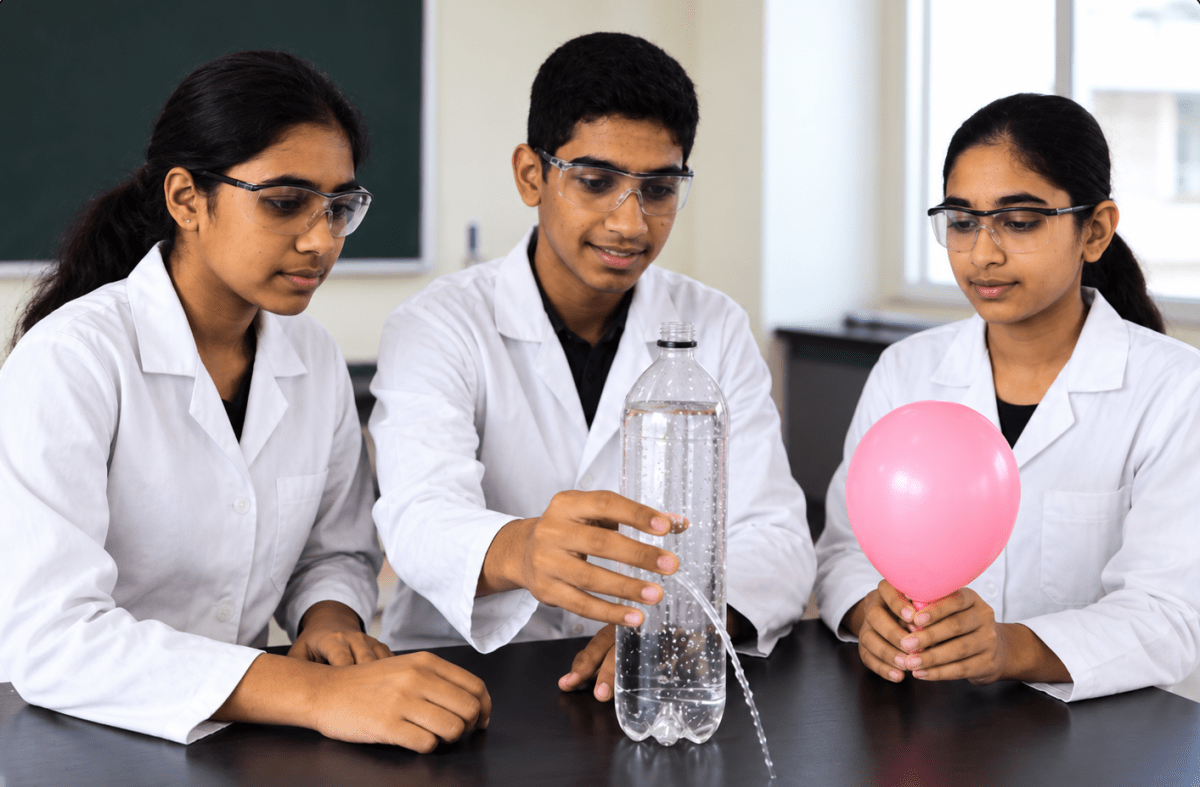
In a science lab, students filled a bottle with water and made three holes at different heights. They observed that water from the lowest hole came out with more force. Later, they inflated a balloon and noticed it expanded in all directions equally.
- Which hole in the bottle had the greatest water pressure? Why?
- What conclusion can you draw about pressure in liquids from this activity?
- What do you observe when a balloon is inflated?
- What does the balloon experiment show about pressure in gases?
- Which instrument is used to measure pressure in liquids?
Answer
- The lowest hole had the greatest water pressure. This is because pressure in a liquid increases with depth.
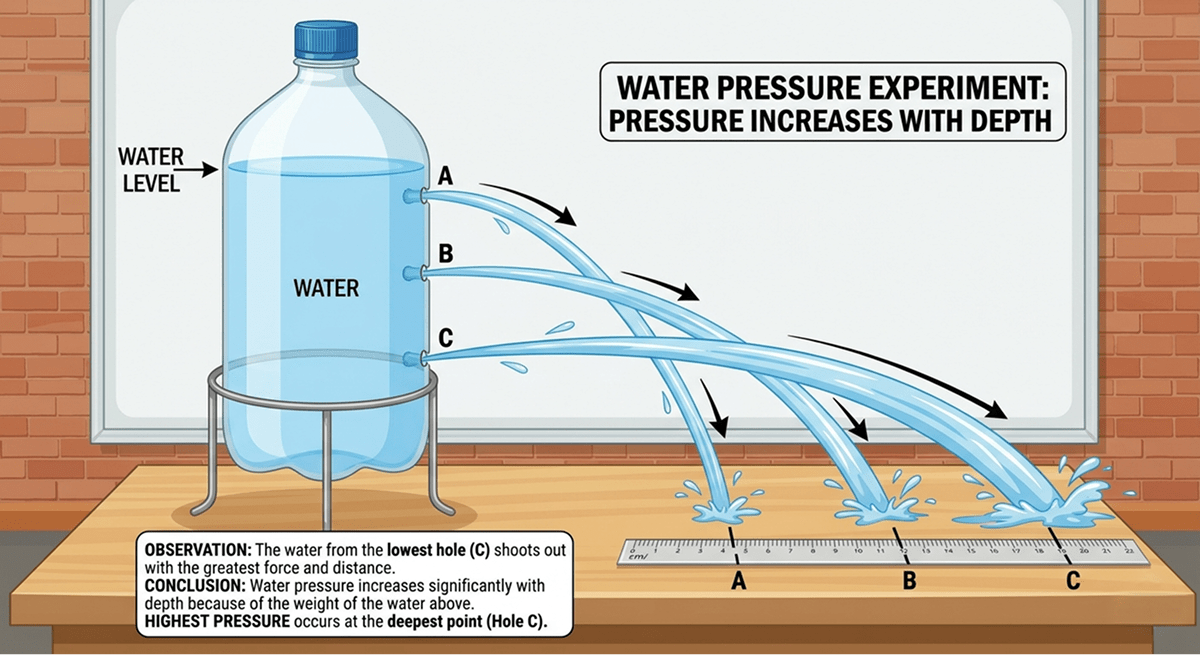
From this activity, we can conclude that the pressure exerted by a liquid increases with depth.
When a balloon is inflated, it expands (grows in size) equally in all directions.
The balloon experiment shows that gases also exert pressure, and they exert it equally in all directions.
A manometer is used to measure the pressure in liquids.
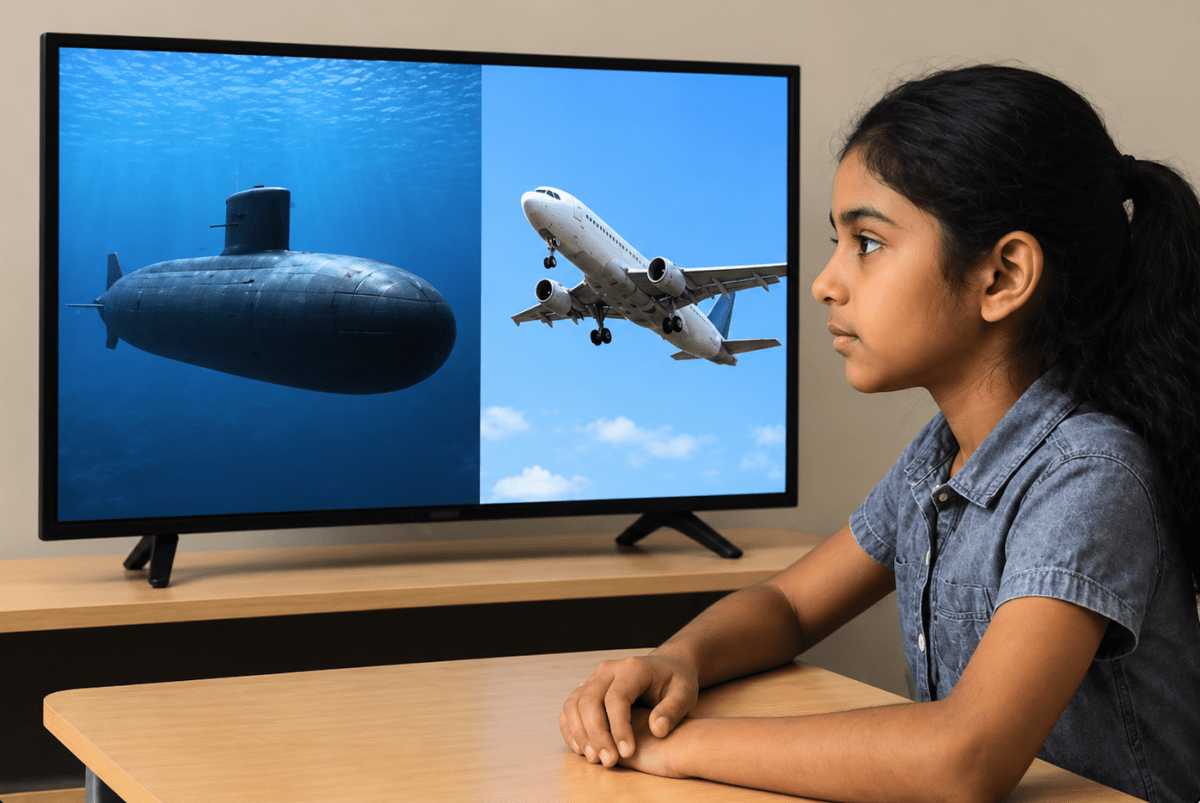
Radha watched a documentary about a submarine going deep underwater and an airplane flying high in the sky. She learnt that water pressure increases with depth and air pressure decreases with altitude. She wondered how engineers design vehicles to withstand such changes in pressure.
- What happens to pressure in liquids as depth increases?
- Why do deep-sea divers wear special suits?
- What happens to air pressure as we go higher above the ground?
- How do engineers use knowledge of pressure while designing submarines?
- How is the concept of thrust different from force?
Answer
As depth increases, the pressure in a liquid increases.
Deep-sea divers wear special suits to protect themselves from the large water (liquid) pressure, which increases with depth in the deep ocean.
As we go higher above the ground, the atmospheric (air) pressure decreases with altitude.
Knowing that water pressure increases with depth, engineers design submarines with strong and thick walls (hull) that can withstand the large pressure deep underwater.
Thrust is the force that acts perpendicular (normal) to a surface, whereas force is any push or pull that may act in any direction.
Fill in the blanks.
- The product of force and the perpendicular distance from the pivot point is called ............... .
- The turning effect of a force about a fixed point is called ............... .
- The SI unit of pressure is ............... .
- The force acting perpendicular to the surface of a body can be defined as ............... .
- Atmospheric pressure at sea level is approximately ............... pascal.
Answer
- The product of force and the perpendicular distance from the pivot point is called moment of force.
- The turning effect of a force about a fixed point is called moment of force.
- The SI unit of pressure is pascal (Pa).
- The force acting perpendicular to the surface of a body can be defined as thrust.
- Atmospheric pressure at sea level is approximately 101325 pascal.
Write True or False.
- A push or pull on an object is called force.
- Moment of force depends only on the magnitude of force applied.
- Liquids exert pressure equally in all directions.
- Thrust is a vector quantity, while pressure is a scalar quantity.
- Pressure decreases with depth in a liquid.
Answer
True
False
Corrected Statement — Moment of force depends on both the magnitude of force applied and the perpendicular distance from the pivot.True
True
False
Corrected Statement — Pressure increases (not decreases) with depth in a liquid.
Match the columns.
| Column A | Column B |
|---|---|
| 1. Manometer | (a) Pressure in liquids |
| 2. Pascal | (b) Unit of pressure |
| 3. Buoyancy | (c) force acting perpendicular to the surface |
| 4. Thrust | (d) Application of atmospheric pressure |
| 5. Nose bleeding | (e) Upward force exerted by a fluid |
Answer
| Column A | Column B |
|---|---|
| 1. Manometer | (a) Pressure in liquids |
| 2. Pascal | (b) Unit of pressure |
| 3. Buoyancy | (e) Upward force exerted by a fluid |
| 4. Thrust | (c) force acting perpendicular to the surface |
| 5. Nose bleeding | (d) Application of atmospheric pressure |
Define force and give two of its effects.
Answer
A push or pull acting on a body which tends to change its state of rest or motion, or its direction of motion, or its shape or size, is called force.
Two of its effects are:
- It can produce motion in a stationary body or change the speed of a moving body.
- It can change the shape and size of a body.
What is meant by atmospheric pressure?
Answer
The force exerted by the atmosphere on a unit area of the surface of the earth is called atmospheric pressure.
State two daily-life applications of pressure.
Answer
- Sharp knives, needles and pins have small areas of contact, so they exert a high pressure that helps in cutting or piercing.
- Heavy vehicles like tractors and trucks have broad tyres, which increase the area of contact and reduce the pressure on the ground.
Why are wide tires used in tractors?
Answer
Wide tyres have a large area of contact with the ground. A larger area reduces the pressure exerted by the tractor on the ground. Due to this lower pressure, the tractor does not sink into the soft ground.
Differentiate between thrust and pressure.
Answer
| Thrust | Pressure |
|---|---|
| It is the total force acting perpendicular to the surface. | It is the thrust (perpendicular force) acting per unit area. |
| It does not depend on the area of contact. | It depends on the area of contact, as it is inversely proportional to it. |
| The SI unit of thrust is newton (N). | The SI unit of pressure is pascal (Pa). |
Explain the turning effect of force with an example.
Answer
When a force is applied on a body that is pivoted (fixed) at a point, the body turns about that point instead of moving in a line. This is called the turning effect of force, and it is measured by the moment of force, M = F × d.
For example, a door is fixed at one end with hinges. When we push it at its edge (away from the hinges), it turns about the hinges and opens easily, because the large distance from the pivot gives a greater turning effect.
Derive the relation between thrust and pressure.
Answer
Thrust is the force acting perpendicular (normal) to a surface, and pressure is the thrust acting per unit area.
If a thrust F acts perpendicular to a surface of area A, then
That is, Pressure =
Thrust = Pressure × Area.
This shows that for a given thrust, pressure is more on a smaller area and less on a larger area.
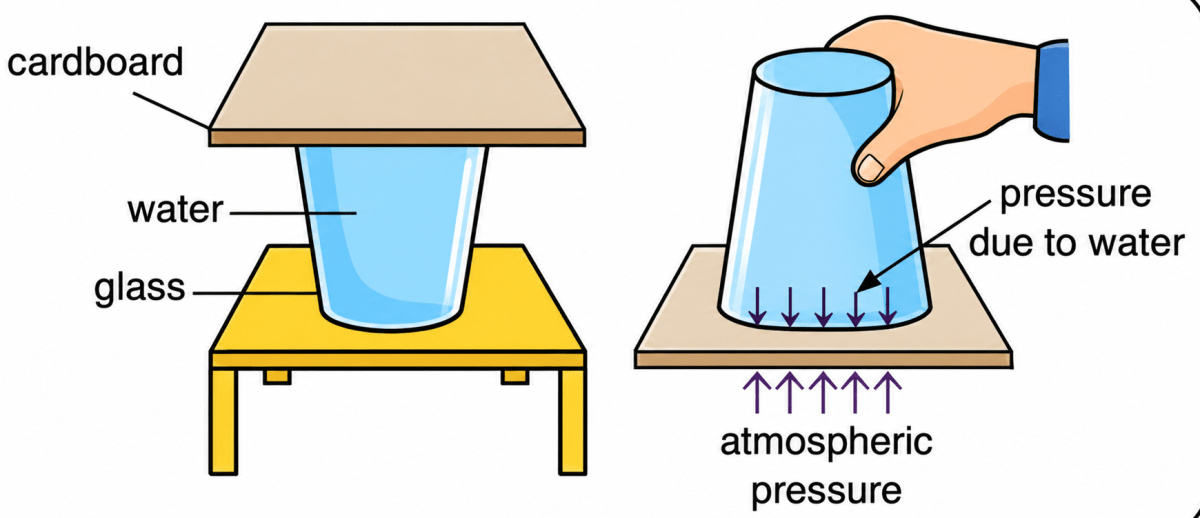
Describe an experiment to demonstrate the existence of atmospheric pressure.
Answer
Aim: To confirm the presence of atmospheric pressure.
Materials required: A cardboard, a glass and water.
Procedure
- Fill the glass with water up to the brim, so that there is no air gap between the water level and the brim of the glass.
- Cover the glass with the cardboard piece and press one palm tightly against the cardboard.
- Invert the glass quickly and then gently remove the hand below the cardboard.
Observation: The cardboard remains in its place and does not fall down, and the water does not spill.
Conclusion: Some force acts on the cardboard from below, strong enough to hold the weight of the water above it. This upward force is produced by atmospheric pressure. Hence, atmospheric pressure exists around us.
What is a manometer? How is it used?
Answer
A manometer is a simple device used to measure the pressure exerted by a liquid. It consists of a U-shaped tube filled with some liquid (water or mercury). One end of the tube is open to air, and the other end is connected to a thistle funnel having a rubber membrane stretched across its mouth.
To use it, the funnel is placed in the liquid whose pressure is to be measured. The levels of liquid in the two arms of the tube change, and the difference in these levels gives a measure of the pressure exerted by the liquid on the rubber membrane. The greater the difference in the levels, the greater is the pressure.
A force of 200 N is applied on an area of 0.5 m2. Calculate the pressure exerted.
Answer
Given,
Force (F)= 200 N
Area (A) = 0.5 m2
⇒ P = 400 Pa
So, the pressure exerted is 400 Pa.