
The concept of density - the relationship between mass and volume has roots in ancient Greece, with Archimedes (287 - 212 BCE) famously discovering the principle while testing the purity of a crown. Over time, particularly during the Scientific Revolution, this idea evolved into the scientific formula, density = mass/volume. To measure volume, early civilisations used marked containers, but with the introduction of the metric system in the 18th century, standard units like litres and millilitres were adopted. The development of precise instruments in the 19th century greatly improved accuracy. For solids with irregular shapes, Archimedes' water displacement method is still used to determine volume.

Answer
P - Point → In the above paragraph, I point out to the theory of: The concept of density as the relationship between mass and volume, and to Archimedes' principle of water displacement.
E - Evidence → That supports the theory is: Archimedes discovered the principle while testing the purity of a crown. The water displacement method continues to be used to determine the volume of irregularly shaped objects.
E - Explanation → Now I explain my point: Density evolved into a precise scientific concept expressed by the formula density = mass/volume, while measurement methods improved from simple marked containers to standardised metric units such as litres and millilitres.
L - Link → I link my knowledge of physical quantities and measurement to: How fundamental quantities like mass and volume combine to define a core property of matter.
Read the given paragraph and answer the questions that follow.
Lalita was curious when she saw that a small metal nail sank in water, but a large wooden log floated. Her teacher explained that this is due to density, which is the mass of a substance per unit volume. To understand it better, Lalita used a measuring cylinder to find the volume of irregular solids and liquids. She measured their mass using a balance, then calculated density using the formula: Density = Mass/Volume.
She then learned about relative density, which compares the density of a substance to that of water. If an object has relative density less than 1, it floats in water; if more than 1, it sinks. Lalita also discovered that gases usually have lower densities than liquids or solids.
In another experiment, she placed different objects in water and noticed that they floated only if the weight of water displaced was equal to their own weight. Her teacher called this the law of flotation, which explains how ships float even though they are made of metal.

- What is the formula to calculate the density of a substance?
- Why does a wooden log float in water but a metal nail sinks?
- What tool is used to measure the volume of irregular solids?
- What does it mean if an object's relative density is less than 1?
- State the law of flotation in simple words.
Answer
Density of a substance =
A wooden log floats in water because the density of wood is less than that of water, while a metal nail sinks because the density of the metal (iron) is more than that of water.
A measuring cylinder is used to measure the volume of irregular solids, by the water displacement method.
If an object's relative density is less than 1, it means the object is lighter than water and will float on water.
The law of flotation states that an object floats only when the weight of the water it pushes aside (displaces) becomes equal to its own weight.
Circle the word that does not belong to other words given alongside it.
- Gram, Kilogram, Cubic centimeter, Tonne
- Displacement, Volume, Density, Temperature
- Wood, Cork, Iron, Ice
- Speed, Mass, Volume, Density
- Current, Relative density, Float, Sink
Answer
Cubic centimeter
Reason — Gram, Kilogram and Tonne are units of mass, whereas cubic centimetre is a unit of volume.Temperature
Reason — Displacement, volume and density are directly involved in determining the density of a substance in this chapter, whereas temperature is not one of the quantities measured in this process.Iron
Reason — Wood, Cork and Ice have a relative density less than 1 and float on water, whereas iron has a relative density more than 1 and sinks in water.Speed
Reason — Mass, Volume and Density are related to one another (density = mass/volume), whereas speed is a quantity related to the motion of a body.Current
Reason — Relative density, Float and Sink are related to the floating and sinking of bodies, whereas current is not related to this concept.
Answer in one or a few word(s).
- Define density.
- Give the SI unit of mass and volume.
- What is specific gravity?
- Name an instrument used for measuring the relative density of liquids.
- When does a body sink in the liquid?
Answer
Density is the mass per unit volume of a substance.
SI unit of mass — kilogram (kg); SI unit of volume — cubic metre (m3).
Specific gravity is another name for relative density — the ratio of the density of a substance to the density of water at 4°C.
Hydrometer.
A body sinks in a liquid when its density is greater than the density of the liquid.
Match the columns.
| Column A | Column B |
|---|---|
| 1. Density | (a) Displaces water equal to its own weight |
| 2. Relative Density | (b) Mass ÷ Volume |
| 3. Measuring cylinder | (c) Density of object ÷ Density of water |
| 4. Ice floats on water | (d) Used to measure volume of a liquid |
| 5. Law of flotation | (e) Ice is less dense than water. |
Answer
| Column A | Column B |
|---|---|
| 1. Density | (b) Mass ÷ Volume |
| 2. Relative Density | (c) Density of object ÷ Density of water |
| 3. Measuring cylinder | (d) Used to measure volume of a liquid |
| 4. Ice floats on water | (e) Ice is less dense than water. |
| 5. Law of flotation | (a) Displaces water equal to its own weight |
Write the correct word(s) in the given blanks.
- A body or an object having definite volume has a defined ............... .
- ............... is a cylindrical glass or plastic beaker which has a side opening present near its mouth.
- To determine the density of a liquid, we need to measure its mass and ............... .
- ............... is a small glass bottle with a glass stopper.
- ............... force is equal to the weight of the liquid displaced by the immersed part of the body.
Answer
A body or an object having definite volume has a defined mass.
Eureka can is a cylindrical glass or plastic beaker which has a side opening present near its mouth.
To determine the density of a liquid, we need to measure its mass and volume.
A relative density (RD) bottle (pycnometer) is a small glass bottle with a glass stopper.
Buoyant force is equal to the weight of the liquid displaced by the immersed part of the body.
Write True or False for the following statements.
- The massive ice pieces that float on the water surface are called icebergs.
- Whales have a special organ in their body which is known as the air bladder.
- A balloon filled with helium gas rises up in air because the density of helium is more as compared to that of air.
- If the relative density of a substance is greater than 1, it is lighter than water and hence, it will float on water.
- A solid always has a higher density than a liquid.
Answer
True.
True.
False.
Corrected Statement — A balloon filled with helium gas rises up in air because the density of helium is less as compared to that of air.False.
Corrected Statement — If the relative density of a substance is greater than 1, it is heavier than water and hence, it will sink in water.False.
Corrected Statement — A solid usually has a higher density than a liquid, but not always — for example, ice (a solid) is less dense than water (a liquid), so ice floats on water.
Find errors in the given sentences and correct them.
- An iron nail floats in the seawater as the density of iron is less than that of water but a ship made of iron sinks.
- The formula for relative density is Volume ÷ Mass.
- The seawater has lower density because of the salts present in it whereas river water has higher amount of salts and hence, less density than the seawater.
- Measuring cylinders are used to measure mass.
- Relative density has a unit of kg/m3.
Answer
An iron nail sinks in the seawater as the density of iron is more than that of water but a ship made of iron floats.
The formula for relative density is Density of substance ÷ Density of water at 4°C.
The seawater has higher density because of the salts present in it whereas river water has lower amount of salts and hence, less density than the seawater.
Measuring cylinders are used to measure volume.
Relative density has no unit (it is the ratio of two similar quantities).
Give reason — Density is a measure of how much mass is contained in a given volume.
Answer
Density is defined as the mass per unit volume of a substance (ρ = ), so it tells us how much mass is packed into a given volume. If the molecules of a substance are tightly packed, a given volume contains more mass and the density is high; if the molecules are loosely packed, the same volume contains less mass and the density is low. Hence, density is a measure of how much mass is contained in a given volume.
Give reason — Relative density compares the density of a substance to the density of water, indicating whether the substance will float or sink.
Answer
Relative density compares the density of a substance to the density of water. It tells us if an object will float or sink because:
If Relative Density is less than 1: The substance is lighter (less dense) than water, so it floats.
If Relative Density is more than 1: The substance is heavier (more dense) than water, so it sinks.
Give reason — The law of flotation states that a floating object displaces a weight of liquid equal to its own weight.
Answer
When a body floats in a liquid, it sinks just enough to push aside (displace) a part of the liquid. The body keeps floating only when the upward buoyant force balances its downward weight, and this happens when the weight of the displaced liquid becomes equal to the weight of the body. Hence, a floating object displaces a weight of liquid equal to its own weight.
Give reason — Volume of irregular solids is measured by the displacement of water in a measuring cylinder.
Answer
An irregular solid has no definite shape, so its volume cannot be calculated by formula. When it is fully immersed in water, it displaces water equal to its own volume. The increase in water level (V2 − V1) in a measuring cylinder gives the volume of the solid by water displacement method.
Give reason — Ice floats on water with one tenth of its part outside the water and nine-tenth of its part inside the water.
Answer
Ice has many empty spaces between its particles, which makes its density less than that of water. Therefore, ice floats on water. It sinks only up to the point where the weight of the water displaced by the immersed part becomes equal to the weight of the ice. Hence, about one-tenth of ice remains above water and nine-tenths stays inside water.
How can we determine the density of a liquid?
Answer
To determine the density of a liquid, we measure its mass and its volume. First, take an empty, dry beaker and find its mass (m1) using a beam balance. Then pour a known volume (V) of the liquid, measured with a measuring cylinder, into the beaker and find the new mass (m2). The mass of the liquid is (m2 − m1).
The density of the liquid is then calculated as:
Density =
What does law of flotation state?
Answer
The law of flotation states that when a body floats in a liquid, the total weight of the body is equal to the weight of the liquid displaced by its immersed part. In other words, the apparent weight of a floating body is zero.
When a body is immersed in a liquid, what kind of forces act on it?
Answer
When a body is immersed in a liquid, two forces act on it:
- The weight of the body (W), which acts vertically downwards due to gravity.
- The buoyant force or upthrust (FB), which acts vertically upwards.
"Submarines are made to sink or rise to the surface of water at their will." Briefly explain this statement.
Answer
A submarine has special ballast tanks that control its average density. When the tanks are filled with water, its density becomes greater than that of seawater, so it sinks. When the water is pumped out, its density becomes less than that of seawater, causing it to rise to the surface.
Briefly describe pycnometer.
Answer
A pycnometer (specific gravity bottle) is used to determine the relative density of a liquid. It is a glass bottle of fixed volume with a stopper having a fine capillary tube. When completely filled, excess liquid flows out through the capillary, ensuring the bottle always contains the same volume of liquid.
Write about the different vessels used for measuring volume.
Answer
The different vessels used for measuring the volume of liquids are:
Measuring Cylinder: A graduated glass or plastic container used to measure the volume of liquids in millilitres (mL).
Measuring Beaker: A container made of glass or plastic used to hold and measure the approximate volume of liquids.
Eureka Can (Overflow Can): A container used to determine the volume of irregular solid objects by collecting the water displaced when the object is completely immersed.
How can we determine the density of a solid?
Answer
To determine the density of a solid, we need to measure its mass and its volume.
- Measure the mass of the solid using a beam balance.
- Determine its volume:
- For a regular-shaped solid, calculate the volume using the appropriate geometric formula.
- For an irregular-shaped solid, find the volume by the water displacement method using a measuring cylinder.
- Calculate density using the formula ρ = .
What procedure do we need to follow to determine relative density of a liquid?
Answer
The relative density of a liquid is determined using a relative density (RD) bottle (pycnometer). The procedure is:
- Take an empty, clean and dry RD bottle and find its mass (m1) using a physical or beam balance.
- Fill the bottle completely with distilled water and insert the stopper so that the excess water drains out. Dry it from outside and find its mass (m2).
- Empty and dry the bottle, then fill it completely with the liquid whose relative density is to be found. Insert the stopper, dry it and find its mass (m3).
- Now calculate the mass of water = (m2 − m1) and the mass of liquid = (m3 − m1).
Relative density =
What type of situations arise when a body is immersed in liquid?
Answer
When a body is immersed in a liquid, two forces act on it: its weight (W) downward and buoyant force (FB) upward. Based on their magnitude, three cases arise:
Case I (FB < W): The body sinks because weight is greater than upthrust. (Density of body > density of liquid)
Case II (FB = W): The body floats just below the surface as forces are balanced. (Density of body = density of liquid)
Case III (FB > W initially): The body rises upward. As it emerges partly from the liquid, the displaced volume decreases until the buoyant force becomes equal to its weight. It then floats partially above the surface. (Density of body < density of liquid)
Write five applications of flotation.
Answer
Five applications of flotation are:
- Balloons: A balloon filled with helium rises in air because helium is less dense than air, so the buoyant force on the balloon is greater than its weight.
- Flotation of ice on water: Ice floats on water with about one-tenth of its part outside the water, as the density of ice is less than that of water.
- Flotation of an iron ship: A ship made of iron floats because its hollow design contains air, which makes its average density less than that of water.
- Submarines: A submarine sinks or rises by filling its tanks with water to increase its density, or by forcing the water out to decrease its density.
- Flotation of man: It is easier for a man to swim in seawater than in river water, because seawater has a higher density due to the salts present in it.
Read the given case study and answer the questions that follow.
Nakul was playing near a pond when he accidentally dropped two bottles into the water – one plastic bottle filled with sand and the other filled with air. To his surprise, the air-filled bottle floated, but the sand-filled one sank. Curious, he discussed it with his elder sister, who explained that it was due to density and relative density.
They conducted a simple activity at home. Using a measuring cylinder, they found the volume of a small stone and then weighed it using a balance. They calculated its density and compared it to the density of water. Since the stone's density was more than that of water, it sank.
Later, they learnt that objects float when they displace water equal to their own weight—a principle known as the law of flotation. That's how huge ships, though made of heavy metal, still float because their shape allows them to displace a large volume of water.

Now answer the following questions.
- Why did the air-filled bottle float while the sand-filled bottle sank?
- How can Nakul calculate the density of the stone using a measuring cylinder and a balance?
- What does it mean if the relative density of an object is more than 1?
- According to the law of flotation, what condition must be met for an object to float?
- Why do ships made of metal float on water despite their high mass?
Answer
- Air-filled bottle floats because air makes its average density less than water. Sand-filled bottle sinks because sand increases its average density above water.
- If density of body < water → it floats
- If density of body > water → it sinks
Nakul can first find: The mass (m) of the stone using the beam balance. Then he can pour water in the measuring cylinder, note the initial level (V1), immerse the stone fully and note the new level (V2). The volume of the stone is (V2 − V1). The density is then calculated as ρ = m/(V2 − V1).
If the relative density of an object is more than 1, it means the object is heavier (denser) than water, and so it will sink in water.
According to the law of flotation, an object floats when the weight of the water displaced by its immersed part is equal to its own weight.
Ships are not solid metal; they have a hollow design with large empty spaces filled with air. This makes the average density of the ship less than that of water, so the ship displaces water equal to its own weight and floats, even though it is made of heavy metal.
Read the given information carefully and answer the questions that follow.
If something is heavy for its size, it has a high density. If an object is light for its size it has a low density. A pebble is heavy for its size, compared to a piece of popcorn which is light for its size. Imagine a big bowl of popcorn, compared to a big bowl of pebbles, which would feel heavier? It is easy to estimate relative densities if you keep either the volume or the mass of two objects the same. If you filled one bag with a kg of feathers and another with a kg of lead you would see that the feathers take up much more room, even though both bags have the same mass. This because feathers are less dense, they have less mass per volume. If you made a copper cube and an aluminium cube of the same volume and placed one in each hand, you would be able to feel that the copper cube would be heavier. Copper has more mass per unit volume than aluminium.
Source: https://www.scienceworld.ca/resource/floaters-and-sinkers/
- How can you guess which substance has high or low density?
- You have a bag of cotton and an iron rod of same weight. Which one will feel heavier? Why?
- How does mass per volume affect density of a substance?
Answer
We can guess the density by seeing how heavy a substance is for its size. If something is heavy for its size, it has a high density; if it is light for its size, it has a low density.
Both have the same weight, so they feel equally heavy when lifted. But cotton occupies more space because it is less dense, while iron occupies less space because it is more dense.
Density is the mass per unit volume of a substance. So the more mass a substance has in a given volume, the higher its density; and the less mass it has in the same volume, the lower its density.
A coin and a plastic cap have the same size but behave differently in water. Examine and explain the reason behind their floating and sinking behaviour.
Answer
Although the coin and plastic cap have the same size, they have different densities. The coin is denser than water, so it sinks, while the plastic cap is less dense than water, so it floats. Thus, floating or sinking depends on density, not size.
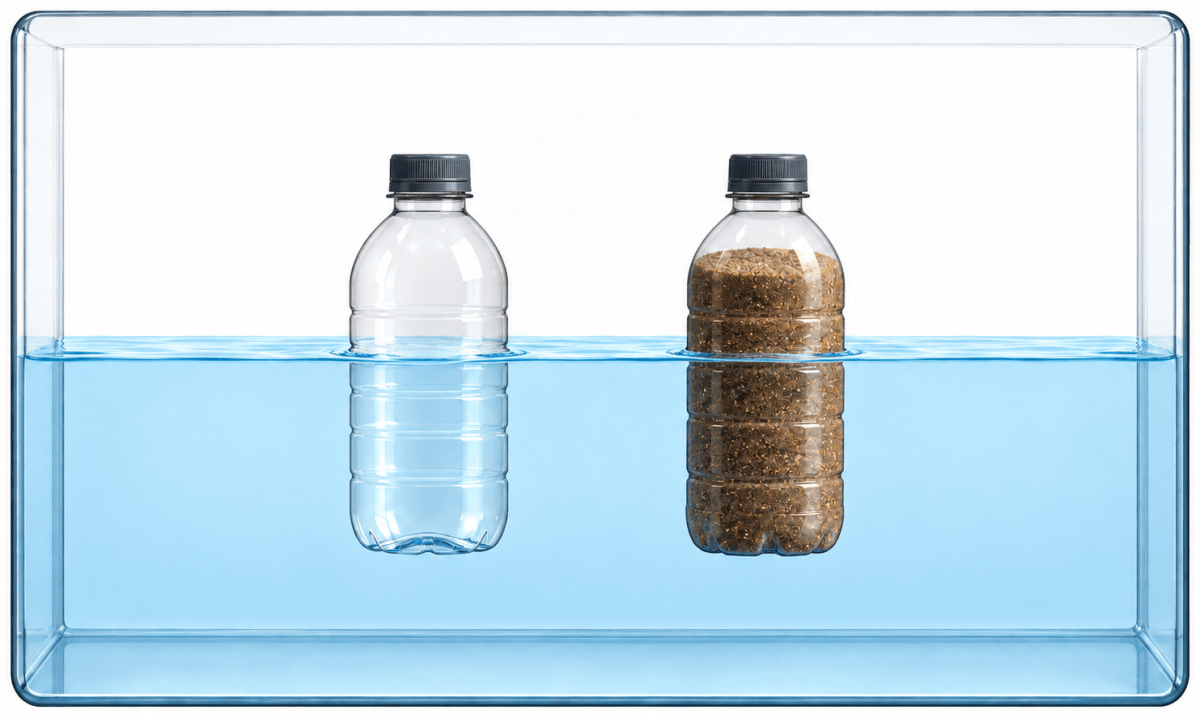
A sealed empty bottle floats in water, but the same bottle filled with sand sinks. Analyse the role of density in this change.
Answer
When the bottle is empty and sealed, it contains air, so its average density is less than water and it floats. When filled with sand, its mass increases while volume remains the same, so its average density becomes greater than water and it sinks. Thus, floating or sinking depends on average density.
An object has a mass of 300 g and a volume of 150 cm3. Calculate its density. Will it float or sink in water?
Answer
Mass of the object = 300 g
Volume = 150 cm3
Since the density of the object (2 g cm−3) is greater than the density of water (1 g cm−3), the object will sink in water.
A solid displaces 200 mL of water and weighs 2 kg. Find whether the object will float or sink in water using the concept of relative density.
Answer
Mass of the solid = 2 kg = 2000 g
Volume of the solid = 200 mL = 200 cm3 (1 mL = 1 cm3)
Since the relative density (10) is greater than 1, the object will sink in water.
Design an experiment using simple objects like pebbles, rubber balls and a bowl of water to test which materials float and which sink.
Answer
To test which materials float and which sink:
- Take a large bowl and fill it with water.
- Gently place each object — the pebbles and the rubber balls — one by one on the surface of the water.
- Observe which objects float on the surface and which sink to the bottom.
- Record the result for each object. An object floats if its average density is less than that of water and sinks if its average density is greater than that of water.
This shows that objects with density less than water float, while those with density more than water sink.
Create a model or a drawing to explain how a ship made of heavy metal floats on water despite the high density of the material used.
Answer
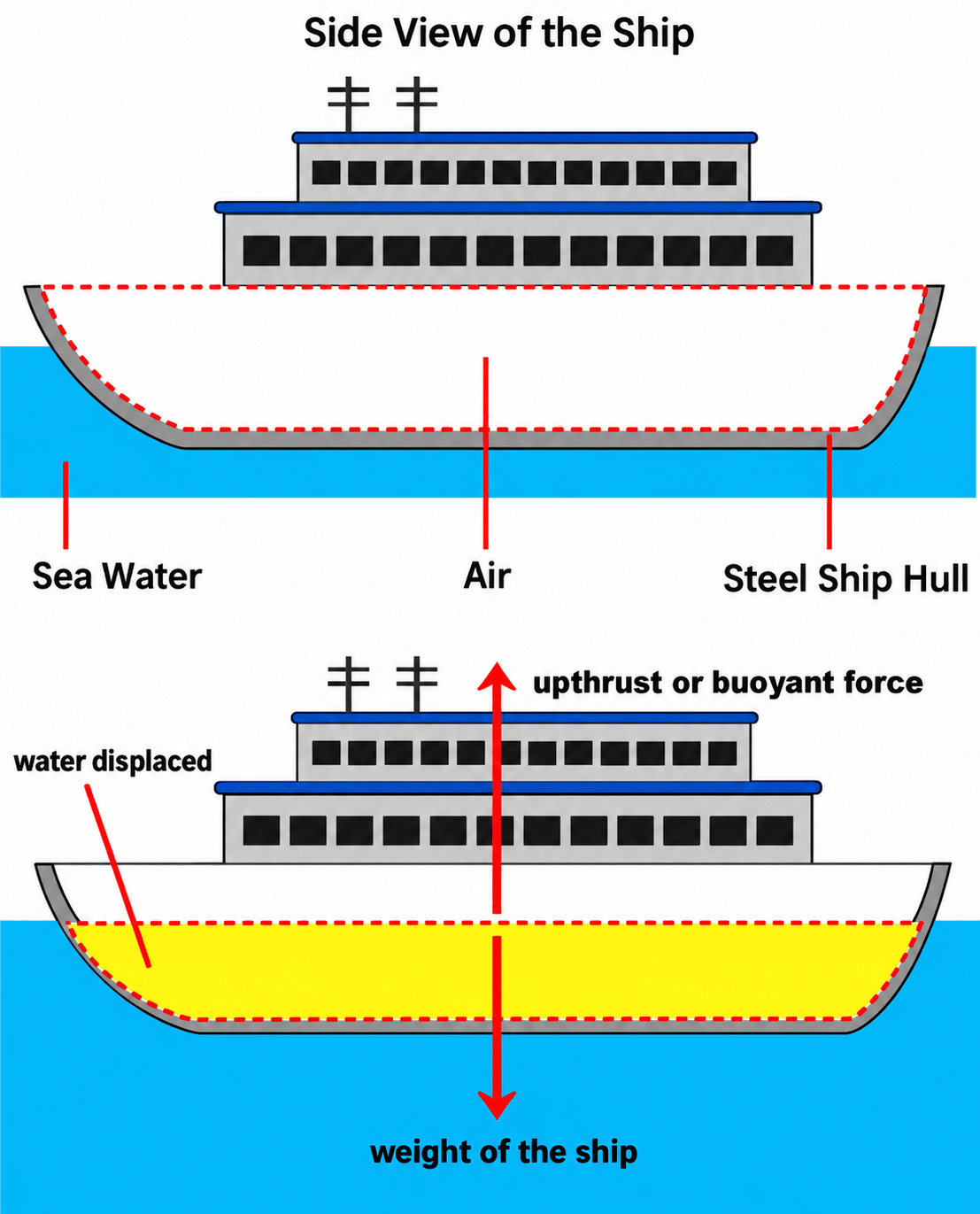
A ship is made of metal, which is dense, but it is hollow inside and filled with air. This increases its volume without adding much mass, so its average density becomes less than water.
When the ship is placed in water: It displaces a large amount of water. The buoyant force (upthrust) becomes equal to the ship’s weight.
Even though metal is heavy, a ship floats because its overall (average) density is less than water due to its hollow structure, and it displaces enough water to balance its weight.
Rekha was helping her mother in the kitchen. She noticed that cooking oil and water were stored in equal-sized bottles, but the water bottle felt heavier. Later, she saw a small wooden piece floating in water, while a metal key quickly sank. She wondered: Why do things with the same size have different weights? Why do some things float while others sink?

- Why did the bottle filled with water feel heavier than the one filled with oil?
- What is the name of the property that relates mass and volume?
- What determines whether an object will float or sink in water?
- Which material – wood or metal – has more density?
- Why is density called a characteristic property of matter?
Answer
The bottle with water felt heavier because water has greater density than oil. Since both bottles had the same volume, the water-filled bottle had more mass, so it felt heavier.
The property that relates mass and volume is called density (density = mass/volume).
Whether an object floats or sinks depends on its density compared to water. If its density is less than water, it floats, and if it is more than water, it sinks.
Metal has more density than wood. That is why a metal key sinks in water, while a piece of wood floats.
Density is called a characteristic property of matter because it is fixed for a given substance at fixed temperature and does not depend on the amount of substance.
In the science lab, students compared the densities of solid blocks (wood, iron and aluminum), water and air. They used measuring cylinders and overflow cans to measure volume and spring balances for mass. They noticed air's mass was nearly unmeasurable compared to solids and liquids.

- Which state of matter – solid, liquid or gas – generally has the highest density? Why?
- How can we measure the volume of an irregular solid like a stone?
- Which tool is more accurate for measuring liquid volume: a beaker or a measuring cylinder? Why?
- Why is the mass of air difficult to measure?
- What are the reasons behind the differences in density among solids, liquids and gases?
Answer
Solids generally have the highest density. This is because the particles (molecules) in a solid are very tightly packed with the smallest spaces between them, so a given volume contains the most mass.
The volume of an irregular solid like a stone is measured by the water displacement method. The stone is fully immersed in water in a measuring cylinder, and the rise in the water level (V2 − V1) gives the volume of the stone.
A measuring cylinder is more accurate than a beaker. This is because a measuring cylinder is narrow and has fine, closely spaced graduation marks in millilitres, which allow the volume of the liquid to be read more precisely.
The mass of air is very difficult to measure because air has a very low density (about 0.00127 g cm−3). So a given volume of air contains very little mass, which is almost negligible compared with that of solids and liquids.
The differences in density arise from how tightly the particles are packed. In solids, the particles are very tightly packed with the smallest spaces, so solids are the most dense. In liquids, the particles are a little farther apart, so liquids are less dense than solids. In gases, the particles are very far apart with the largest spaces, so gases are the least dense.
A group of students performed an experiment. They took an iron block and found its mass using a spring balance. Then, they placed it in a measuring jar filled with water and noted the volume it displaced. Using these values, they calculated its density. They repeated a similar activity with oil and water to observe how liquids of different densities behave.

- What two measurements are required to calculate the density of an object?
- How do you find the volume of an irregular object using water?
- If an object has a mass of 300 g and displaces 100 cm3 of water, what is its density?
- What do you observe when oil is poured into water?
- Why does oil form a layer above water?
Answer
The two measurements required are the mass of the object and its volume, because density = mass/volume.
When an object is fully immersed in water in a measuring cylinder, the water level rises. The increase in water level gives the volume of the object because it displaces an equal volume of water.
When oil is poured into water, the oil does not mix with the water but forms a separate layer above the water.
Oil forms a layer above water because oil is less dense than water. A liquid with lower density floats over a liquid with higher density, so the oil stays on top of the water.
Vijay designed a cardboard boat and tested whether it would float in water. He learnt about the law of flotation—that objects float when the weight of the water they displace equals their own weight. He experimented with coins, sponges, and plastic toys to see what floats and what sinks. He concluded that the shape and density both matter.

- Explain the law of flotation in your own words.
- Why does a large ship made of steel float even though steel is denser than water?
- What is the relative density of an object that just floats on water?
- How can changing the shape of an object affect its ability to float?
- How does knowledge of relative density help in designing boats and life jackets?
Answer
The law of flotation states that a body floats in a liquid when the weight of the displaced liquid equals the weight of the body.
A steel ship is hollow and contains large empty spaces filled with air. Because of this hollow shape, its average density becomes less than that of water, and it displaces a large volume of water whose weight equals the weight of the ship. So the ship floats, even though steel is denser than water.
An object that just floats on water has a relative density equal to 1, that is, its density is equal to the density of water.
Changing the shape of an object changes the volume of water it can displace. If an object is given a hollow, wide shape (like a boat), it displaces more water and its average density becomes less than that of water, so it can float even if the same material would sink as a solid lump.
Knowledge of relative density helps in designing floating objects. Boats are made hollow so their average density is less than water, and life jackets use light materials or air to reduce the wearer’s average density so they float easily.
Fill in the blanks.
- The mass per unit volume of a substance can be defined as ............... .
- ............... is a special bottle used for determining the relative density of a liquid.
- The instrument used to measure the volume of an irregular solid is called a ............... .
- The relative density of a substance is equal to the ratio of its density to the density of ............... .
- A body will float in a liquid if its ............... is less than that of the liquid.
Answer
The mass per unit volume of a substance can be defined as density.
A relative density (RD) bottle (pycnometer) is a special bottle used for determining the relative density of a liquid.
The instrument used to measure the volume of an irregular solid is called a measuring cylinder.
The relative density of a substance is equal to the ratio of its density to the density of water.
A body will float in a liquid if its density is less than that of the liquid.
Write True or False.
- The unit of relative density is kg/m3.
- A hydrometer is used to measure the density of liquids.
- The density of iron is greater than the density of water.
- A wooden block sinks in water because its relative density is more than 1.
- In the law of flotation, the weight of the floating body equals the weight of the liquid displaced.
Answer
False.
Corrected Statement — Relative density has no unit, as it is the ratio of two similar quantities.False.
Corrected Statement — A hydrometer is used to measure the relative density (specific gravity) of liquids.True.
False.
Corrected Statement — A wooden block floats in water because its relative density is less than 1.True.
Match the columns.
| Column A | Column B |
|---|---|
| 1. Measuring cylinder | (a) No unit |
| 2. Relative density | (b) Principle of flotation |
| 3. Eureka can | (c) Measures volume by displacement |
| 4. Density of water | (d) 1000 kg m−3 |
| 5. Ship floating on water | (e) Measures volume of liquids/solids |
Answer
| Column A | Column B |
|---|---|
| 1. Measuring cylinder | (e) Measures volume of liquids/solids |
| 2. Relative density | (a) No unit |
| 3. Eureka can | (c) Measures volume by displacement |
| 4. Density of water | (d) 1000 kg m−3 |
| 5. Ship floating on water | (b) Principle of flotation |
Define density and state its SI unit.
Answer
Density is the mass per unit volume of a substance (Density = Mass/Volume). Its SI unit is kilogram per cubic metre (kg m−3).
State the law of flotation in words.
Answer
The law of flotation states that when a body floats in a liquid, the total weight of the body is equal to the weight of the liquid displaced by its immersed part.
Why does a piece of iron sink in water but a ship made of iron floats?
Answer
A piece of iron sinks because the density of iron is greater than that of water. A ship made of iron floats because it is hollow and contains air, which makes its average density less than that of water. Due to this, the ship displaces enough water to balance its weight, so it floats.
Write two applications of relative density in daily life.
Answer
- The relative density of a substance tells us whether it will float or sink in water, which is useful in designing ships, boats and life jackets.
- A hydrometer is used to measure the relative density (specific gravity) of liquids, which can also help compare the concentration or purity of suitable liquids.
How can we determine the density of a liquid?
Answer
To determine the density of a liquid, we measure its mass and its volume. Take an empty, dry beaker and find its mass (m1). Then pour a known volume (V) of the liquid, measured with a measuring cylinder, into the beaker and find the new mass (m2). The mass of the liquid is (m2 − m1), so the density of the liquid = (m2 − m1)/V.
Derive the formula for density.
Answer
Density is defined as the mass per unit volume of a substance. So, for a given volume, the density is greater if the mass is greater, and it is smaller if the same volume contains less mass.
If a substance has a mass m and occupies a volume V, then:
For example, if a body of mass 100 g occupies a volume of 50 cm3, its density = = 2 g cm−3.
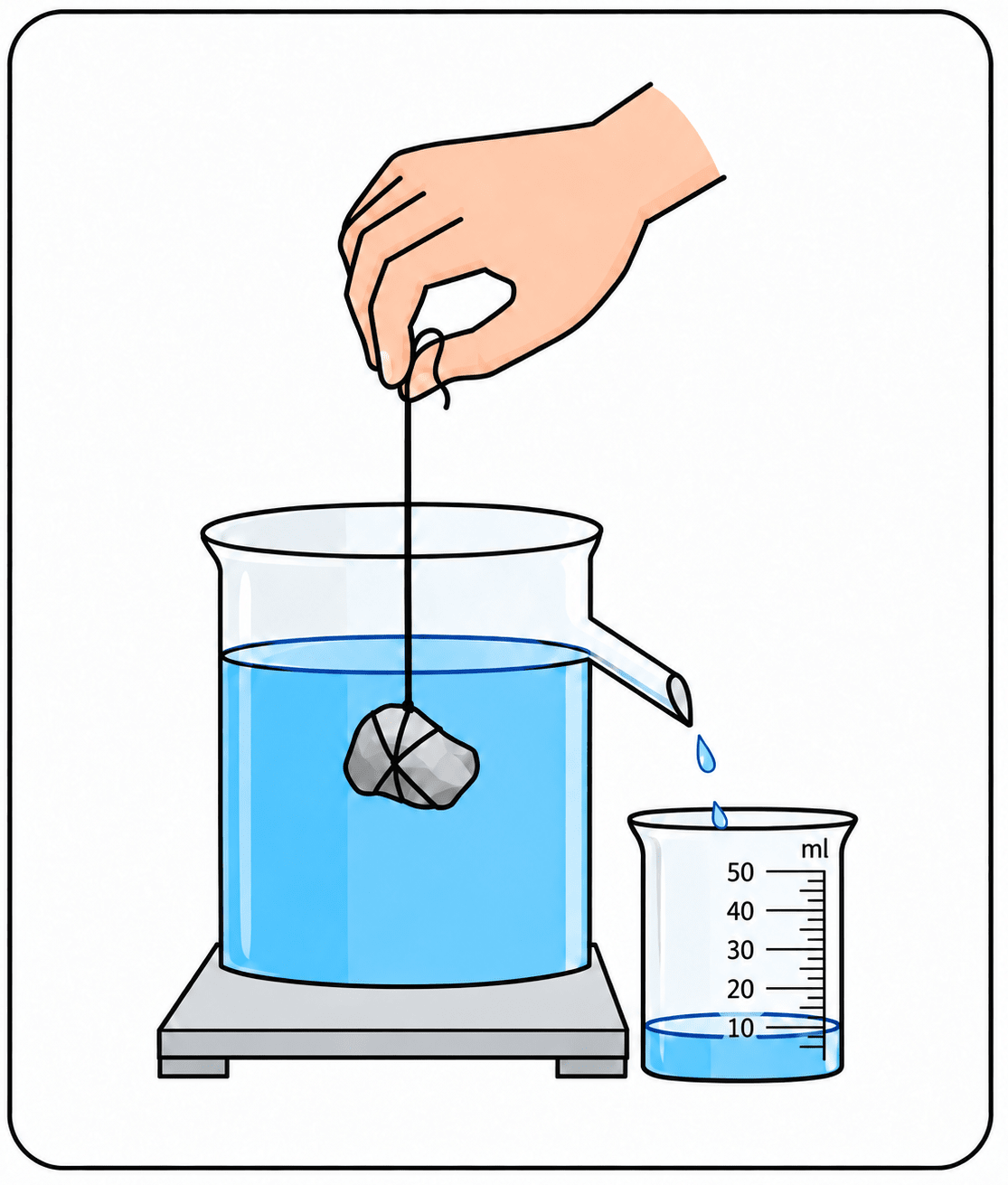
Explain with a diagram how the density of an irregular solid is determined using a Eureka can.
Answer
To find the density of an irregular solid (such as a stone) using a Eureka can:
- First, find the mass (m) of the solid using a beam balance.
- Fill the Eureka can with water up to its spout, and place an empty measuring beaker just below the spout.
- Tie the solid with a thread and lower it gently into the Eureka can until it is fully immersed, taking care that it does not touch the base of the can.
- The water displaced by the solid overflows through the spout and is collected in the measuring beaker. This volume of water gives the volume (V) of the solid.
- The density of the solid is then calculated using the formula ρ = .
Distinguish between density and relative density. State one application of each.
Answer
| Density | Relative Density |
|---|---|
| It is the mass per unit volume of a substance. | It is the ratio of the density of a substance to the density of water at 4°C. |
| It has units (kg m−3 in SI and g cm−3 in CGS). | It has no units, as it is the ratio of two similar quantities. |
| Density = | Relative density = |
Application of density: It helps us compare how heavy different substances are for the same volume (for example, iron is denser than wood).
Application of relative density: Relative density can be used to check the purity or concentration of suitable substances.
Describe the principle of flotation with two real-life examples.
Answer
The principle of flotation is based on two forces acting on a body in a liquid: weight (W) downward and buoyant force (FB) upward. A body floats in equilibrium when the buoyant force is equal to its weight; therefore, the weight of the displaced liquid equals the weight of the body. If the buoyant force is initially greater than the weight, the body rises until this equilibrium condition is reached. This occurs when the average density of the body is less than or equal to the density of the liquid.
Two real-life examples:
- Iron ship: A ship made of iron floats because its hollow shape makes its average density less than that of water, so the buoyant force balances its weight.
- Flotation of ice on water: Ice floats on water because the density of ice is less than that of water, so it displaces water equal to its own weight while floating.
A solid weighs 120 g in air and 90 g when fully immersed in water. Calculate its density and relative density.
Answer
Weight of the solid in air = 120 g
Mass of solid = 120 g
Weight of the solid in water = 90 g
Loss in weight in water = (120 − 90) g = 30 g
This loss in weight is equal to the weight of the water displaced, so the weight of water displaced = 30 g.
Mass of water displaced = 30 g
Since the density of water = 1 g cm-3, the mass of water displaced = 30 g
Then the volume of water displaced
= 30 cm3. This is also the volume of the solid, so V = 30 cm3.
Hence, the density of the solid is 4 g cm−3 and its relative density is 4.