
Two astronauts are repairing the arm of a space station together during a spacewalk. Can they talk to each other and hear the sounds of metal clanking as they do on the Earth?
Answer
No, the two astronauts cannot directly talk to each other or hear the sounds of metal clanking as they do on the Earth. Sound needs a material medium to propagate. In outer space there is a near vacuum, i.e., there is almost no medium (matter) present. Since sound cannot propagate through vacuum, the astronauts cannot hear each other speak or hear the metal objects clanking. Instead, they communicate through special devices (such as radio transmitters) fitted into their spacesuits.
How do most bats use sound to locate their prey in the dark at night?
Answer
Most bats locate their prey in the dark using a technique called echolocation. A bat emits short bursts of ultrasonic waves (sound waves of frequency above 20 kHz) as it flies. These waves get reflected from nearby objects and prey. By sensing the echoes of the reflected waves, the bat can determine the position, distance and direction of the obstacles and the prey, allowing it to fly and hunt without colliding into objects.
Explore various ways of producing sound.
Answer
Sound is produced by vibrating objects. Various ways of producing sound are:
- Plucking a stretched string — Plucking a stretched rubber band or the strings of a guitar, sitar or veena makes them vibrate and produce sound.
- Striking an object — Striking a metal object like a bell, a taal or a tuning fork against a pad sets it into vibration, producing sound.
- Blowing air through a pipe — Blowing through a bansuri (flute) makes the air column inside the hollow pipe vibrate and produce sound.
- Vibrating a membrane — Striking the stretched membrane of a drum or tabla makes it vibrate and produce sound.
- Vibration of vocal cords — In humans and some animals, sound is produced by the vibration of the vocal cords in the voice box (larynx).
- Rubbing body parts — Some animals like grasshoppers and crickets rub their wings or legs together to produce sound.
Make a list of different types of musical instruments and identify their vibrating parts which produce sound.
Answer
Different types of musical instruments and their vibrating parts which produce sound are:
| Musical Instrument | Vibrating Part |
|---|---|
| Guitar, Sitar, Veena, Tanpura, Sarangi, Violin | Stretched strings |
| Bansuri (Flute), Shehnai | Air column inside the pipe |
| Tabla, Mridangam, Drum, Dholak | Stretched membrane |
| Harmonium | Metal reeds |
| Taal, Manjira, Bell, Ghungroo | Metal body |
Assertion (A): We cannot hear the sound of a bell ringing in a closed jar after most of the air is pumped out.
Reason (R): Sound requires a medium to travel.
Choose the correct statement:
- Both A and R are true, but R is not the correct explanation of A.
- Both A and R are true, and R is the correct explanation of A.
- A is true, but R is false.
- A is false, but R is true.
Answer
Both A and R are true, and R is the correct explanation of A.
Explanation
Assertion (A) is true — In the vacuum bell jar experiment, as the air is pumped out of the jar, the sound of the bell becomes fainter. Once a near vacuum is reached, almost no sound can be heard even though the bell can be seen ringing.
Reason (R) is true — Sound is a mechanical wave and requires a material medium (solid, liquid or gas) to propagate. It cannot travel through vacuum.
Since the absence of a medium (air being pumped out) is exactly the reason why the sound of the bell cannot be heard, R is the correct explanation of A.
Assertion (A): Compressions and rarefactions move through the medium.
Reason (R): Individual particles of the medium continuously move forward with the wave.
Choose the correct statement:
- Both A and R are true, but R is not the correct explanation of A.
- Both A and R are true, and R is the correct explanation of A.
- A is true, but R is false.
- A is false, but R is true.
Answer
A is true, but R is false.
Explanation
Assertion (A) is true — In a sound wave, a series of alternating compressions and rarefactions travel forward through the medium in the direction of propagation of the wave.
Reason (R) is false — The individual particles of the medium do not move forward with the wave. They only vibrate (oscillate) back and forth about their mean positions. It is the disturbance (energy), not the particles of the medium, that is transferred from one place to another.
When sound travels from a tuning fork to your ear, which of the following actually reaches your ear?
- Air particles near the tuning fork
- Energy carried by sound waves
- The tuning fork material
- A continuous stream of compressed air
Answer
Energy carried by sound waves
Reason — In the propagation of a sound wave, it is the energy that is transferred and not the particles of the medium. The air particles only vibrate about their mean positions and pass on the disturbance to the neighbouring particles. Thus, what actually reaches the ear is the energy carried by the sound wave, not the air particles or the material of the tuning fork.
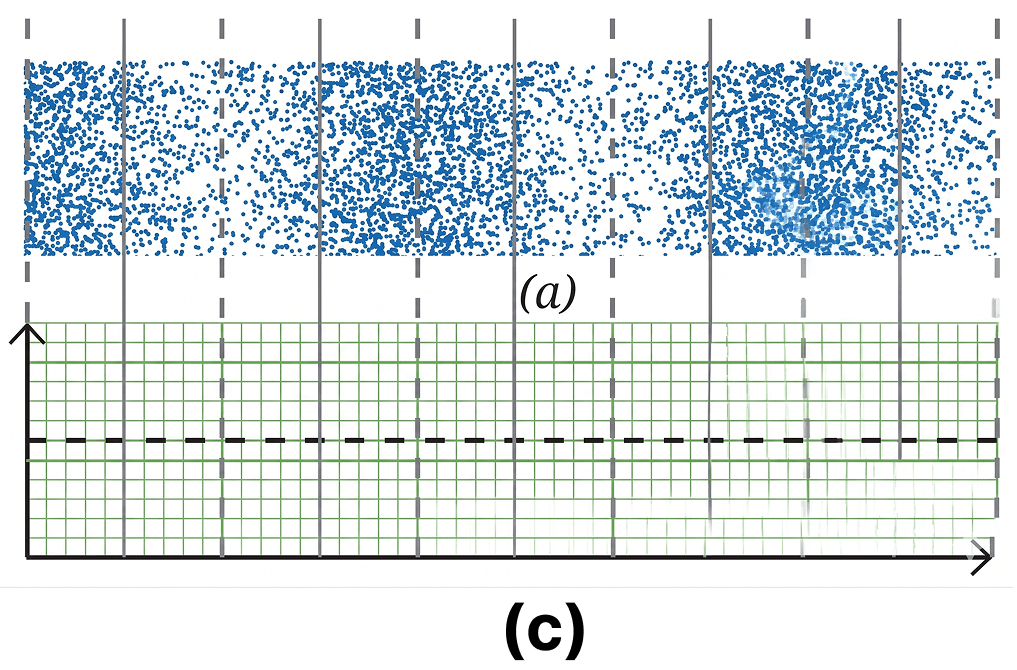
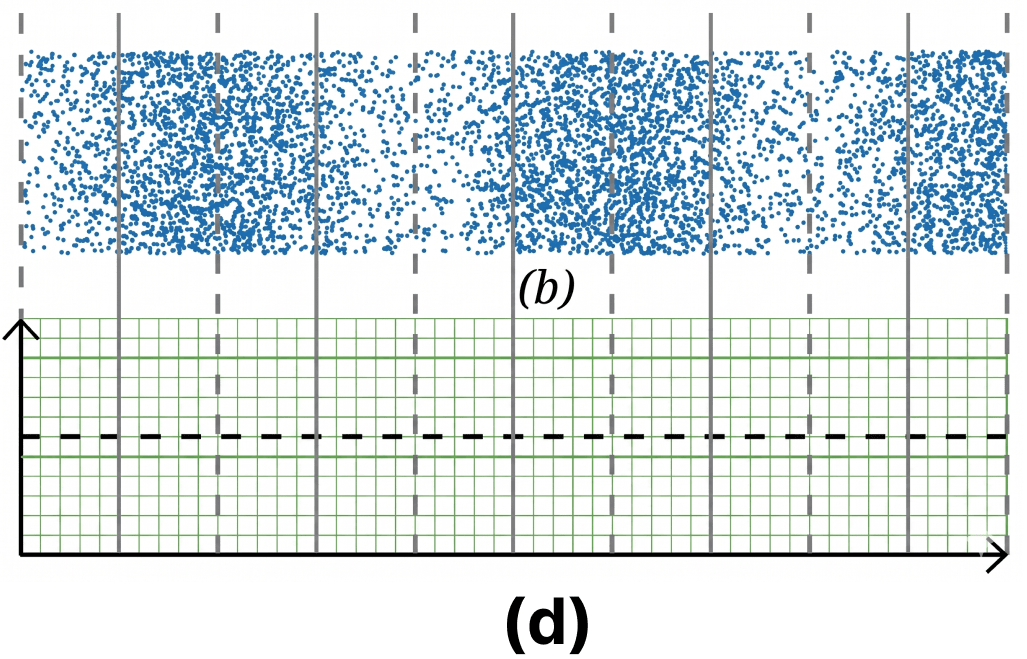
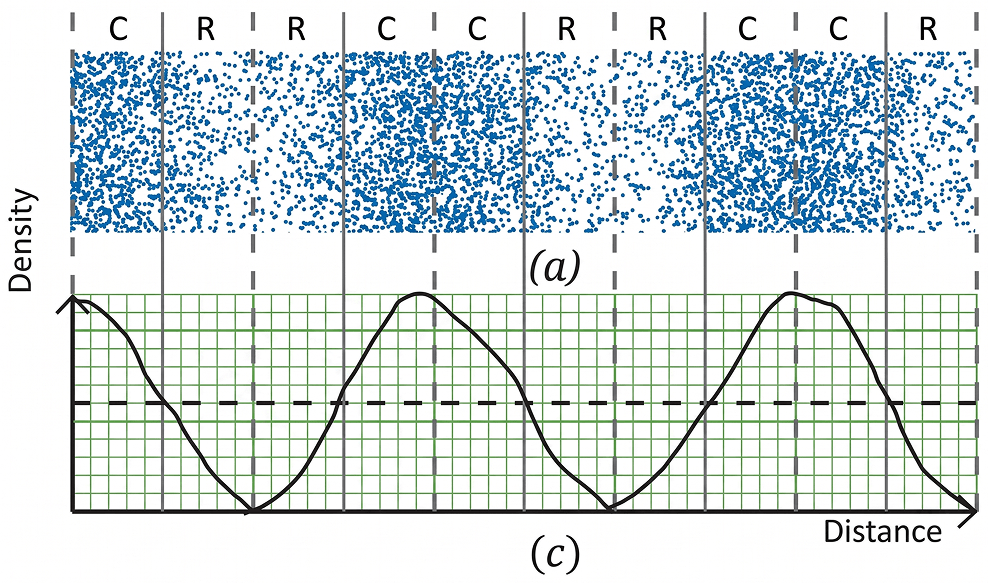
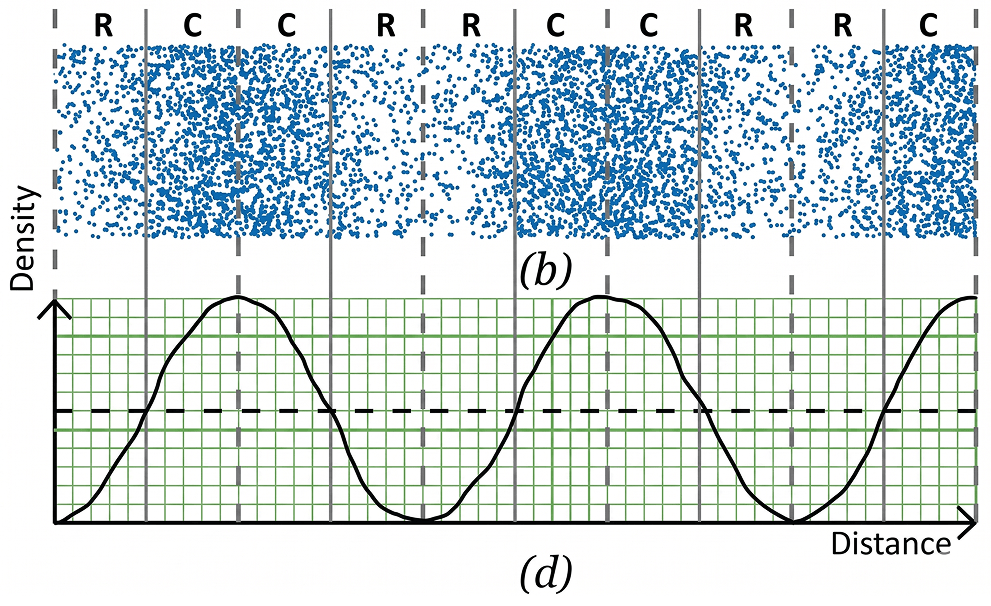
The variation of density of the medium for two sound waves is shown in Fig. 10.17 (a) and (b). Label compression and rarefaction by C and R on it. In the graph given in Fig. 10.17 (c) and (d), label the axes and draw the curves corresponding to Fig. 10.17 (a) and (b).
Answer
The graph is shown below:
Conduct Activity 10.1 once again with a thick rubber band and then with a thin rubber band. Does the thin rubber band vibrate faster than the thick rubber band? If yes, how do the frequency and time period of the sound produced by the thin rubber band differ from that of the thick rubber band?
Answer
Yes, the thin rubber band vibrates faster than the thick rubber band.
Since the thin rubber band vibrates faster, it completes more oscillations per second. Therefore:
- The frequency of the sound produced by the thin rubber band is higher than that of the thick rubber band (because frequency is the number of oscillations per unit time).
- The time period of the sound produced by the thin rubber band is shorter than that of the thick rubber band (because the time period is the time taken for one complete oscillation, and frequency and time period are inversely related, ).
If the frequency of a sound wave produced by an oscillating piston of a long tube filled with air is 20 Hz, then how many oscillations does the piston complete per minute?
Answer
Given,
Frequency (ν) = 20 Hz
Time (t) = 1 minute = 60 s
We know,
Frequency (ν) =
or
Number of oscillations = ν × t
Substituting we get,
Number of oscillations = 20 × 60 = 1200
Hence, the piston completes 1200 oscillations per minute.
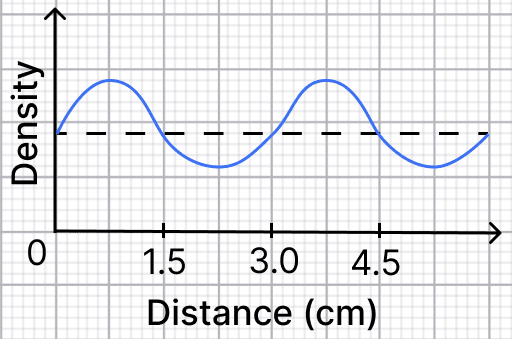
For the sound wave represented by the graph shown in Fig. 10.19, what is half of its wavelength?
Answer
The wavelength is the distance between two consecutive crests (or two consecutive troughs).
From the graph (Fig. 10.19), one complete wave (one crest and one trough) spans a distance of 3.0 cm on the distance axis.
Therefore, the wavelength of the sound wave (λ) = 3.0 cm
Half of its wavelength = = = 1.5 cm
Hence, half of the wavelength of the sound wave = 1.5 cm.
Table 10.1 shows the speed of sound in a few media at atmospheric pressure.
Table 10.1: Speed of sound in different media at 15 °C
| State | Substance/Medium | Approximate speed |
|---|---|---|
| Solid | Steel | 5000 m s–1 |
| Liquid | Water | 1500 m s–1 |
| Gas | Air | 340 m s–1 |
Compare the speeds in different media by finding the ratio of
(i) the speed of sound in water with respect to the speed in the air.
(ii) the speed of sound in steel with respect to the speed in the water.
Answer
From Table 10.1,
Speed of sound in steel = 5000 m s–1
Speed of sound in water = 1500 m s–1
Speed of sound in air = 340 m s–1
(i) Ratio of speed of sound in water with respect to air
= = 4.41
Hence, the speed of sound in water is about 4.41 times the speed of sound in air.
(ii) Ratio of speed of sound in steel with respect to water
= = 3.33
Hence, the speed of sound in steel is about 3.33 times the speed of sound in water.
Two friends are standing along a steel fence at a distance of 340 m from each other (Fig. 10.23). Gunjan places her ear over the fence and her friend knocks the fence with a metal object. Using the values of the speed of sound in steel and air given in Table 10.1, calculate the time difference between the sound that reached Gunjan through the air and the steel. Would it have been possible for her to distinguish between the two sounds? (The time interval between two sounds must be at least 0.1 s to be heard separately.)

Answer
Given,
Distance between the two friends (d) = 340 m
Speed of sound in air (vair) = 340 m s–1
Speed of sound in steel (vsteel) = 5000 m s–1
We know,
Time (t) =
Time taken by sound to travel through air,
tair = = 1 s
Time taken by sound to travel through steel,
tsteel = = 0.068 s
Time difference between the two sounds,
Δt = tair − tsteel = 1 − 0.068 = 0.932 s
Hence, the time difference between the two sounds = 0.932 s.
Since this time difference (0.932 s) is much greater than 0.1 s, yes, it would have been possible for Gunjan to distinguish between the two sounds.
An experiment is being set up that requires echoes to arrive at least 0.2 s after the emission of sound. What minimum distance should a reflecting surface be placed at? Assume the speed of sound to be 343 m s–1.
Answer
Given,
Speed of sound (v) = 343 m s–1
Time taken for the echo to arrive (t) = 0.2 s
In this time, sound travels to the reflecting surface and comes back, i.e., it covers twice the distance between the source and the reflecting surface.
Distance travelled by sound = v × t = 343 × 0.2 = 68.6 m
Minimum distance of the reflecting surface =
= = 34.3 m
Hence, the reflecting surface should be placed at a minimum distance of 34.3 m.
Sound travels much farther in water than light, and thus, is used for various underwater applications. A sonar signal sent to find the depth of ocean takes 4 s to return. What is the depth of the ocean at that location if the speed of sound in seawater is 1500 m s–1?
Answer
Given,
Speed of sound in seawater (v) = 1500 m s–1
Time taken by the signal to return (t) = 4 s
In this time, the sound travels to the bottom of the ocean and comes back, i.e., it covers twice the depth of the ocean.
Total distance travelled by sound = v × t = 1500 × 4 = 6000 m
Depth of the ocean =
= = 3000 m
Hence, the depth of the ocean at that location = 3000 m.
Which observation best supports the idea that sound is a mechanical wave?
- Sound shows reflection
- Sound needs a medium to propagate
- Sound has frequency
- Sound carries energy
Answer
Sound needs a medium to propagate
Reason — A mechanical wave is one that requires a material medium (solid, liquid or gas) for its propagation. Sound cannot travel through vacuum, as shown by the vacuum bell jar experiment. The fact that sound needs a medium to propagate is the observation that best identifies it as a mechanical wave. Reflection, frequency and carrying energy are properties shown by many other types of waves (including non-mechanical waves like light) as well.
For a sound wave propagating in a medium, increasing its frequency will increase its
- wavelength
- speed
- number of compressions per second
- time period
Answer
number of compressions per second
Reason — Frequency is the number of density oscillations (compressions or rarefactions) passing a fixed point per unit time. Hence, increasing the frequency directly increases the number of compressions per second. The speed of sound depends only on the medium and not on the frequency, so it remains constant. Since v = λν, increasing the frequency decreases the wavelength. The time period is inversely related to frequency (T = ), so it decreases.
If 20 compressions pass a point in 4 seconds, the frequency is
- 80 Hz
- 5 Hz
- 10 Hz
- 0.2 Hz
Answer
5 Hz
Reason — Frequency is the number of oscillations (compressions) passing a fixed point per unit time.
Frequency (ν) = = = 5 Hz
In a room, the reflected sound reaches the ear 0.05 s after its production. Will it produce an echo or reverberation? Justify your answer.
Answer
It will produce a reverberation, not an echo.
Justification: To hear a distinct echo, the time interval between the original sound and the reflected sound must be at least 0.1 s. Here, the reflected sound reaches the ear after only 0.05 s, which is less than 0.1 s. As a result, the brain cannot separate the reflected sound from the original sound; instead, the sound persists. This persistence of sound due to repeated reflections is called reverberation.
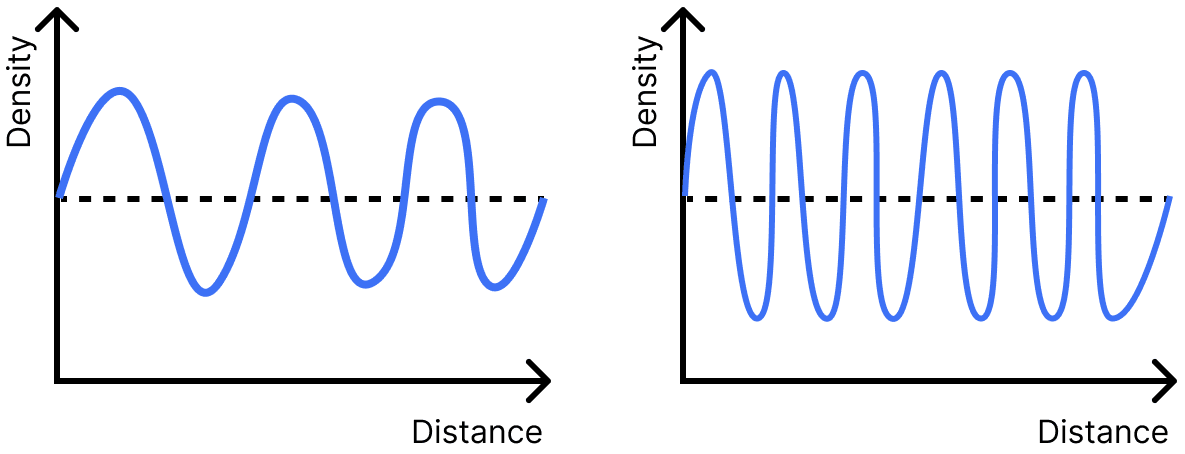
Graphs representing two sound waves are given in Fig. 10.30. If the scales on the X and Y axes of the two graphs are the same, which of the two sound waves has (i) greater wavelength, and (ii) smaller amplitude?
Answer
On comparing the two graphs (drawn to the same scale):
- Wave (a) has fewer crests and troughs over the same distance, so its crests (and troughs) are spread farther apart. Wave (b) has more crests and troughs over the same distance, so they are closer together.
- The crests and troughs of wave (a) reach a smaller height (and depth) from the average density line than those of wave (b).
Therefore,
(i) Sound wave (a) has the greater wavelength (its compressions and rarefactions are spread farther apart).
(ii) Sound wave (a) has the smaller amplitude (its density variations from the average are smaller).
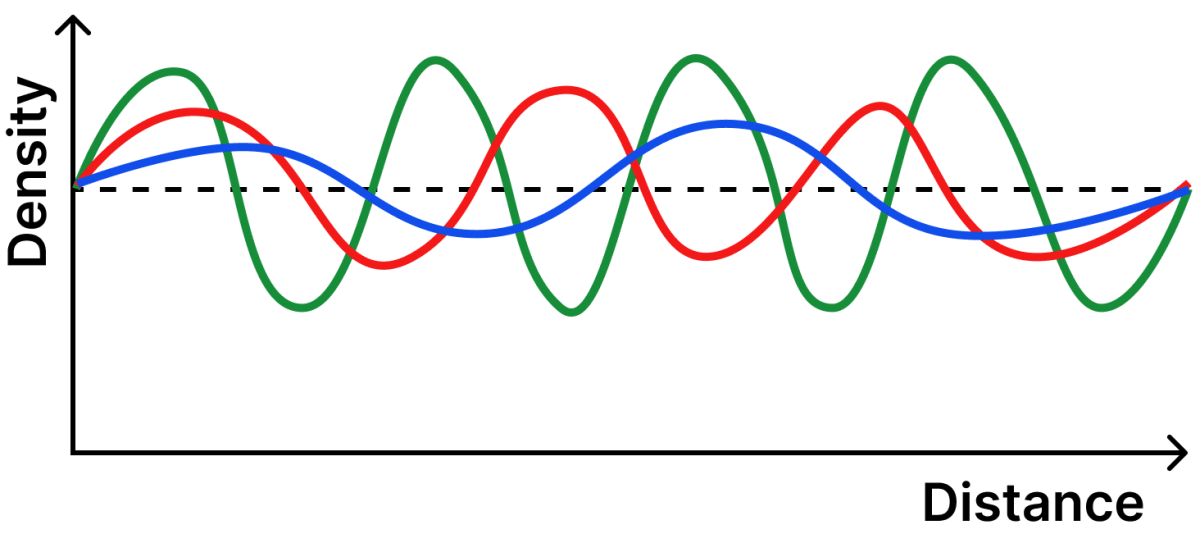
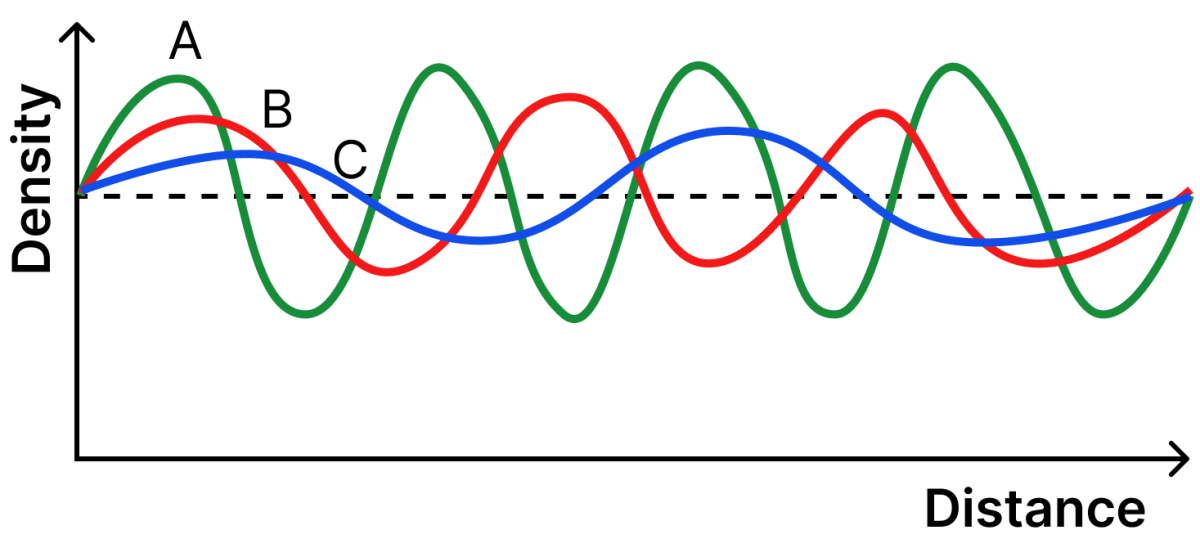
The sound waves emitted by three sources A, B and C are represented in Fig. 10.31. If the frequency of A is maximum and C is minimum, identify the corresponding curves, and mark A, B and C on them.
Answer
The frequency of a wave is related to its wavelength — a higher frequency corresponds to a shorter wavelength (more crests and troughs packed into the same distance), and a lower frequency corresponds to a longer wavelength (fewer crests and troughs in the same distance).
- A (maximum frequency): the curve with the shortest wavelength, i.e., the one having the largest number of crests and troughs over the given distance.
- C (minimum frequency): the curve with the longest wavelength, i.e., the one having the smallest number of crests and troughs over the given distance.
- B (intermediate frequency): the remaining curve, whose wavelength lies between those of A and C.
The curves are marked A, B and C accordingly, with A being the most closely spaced wave and C being the most widely spaced wave as shown below.
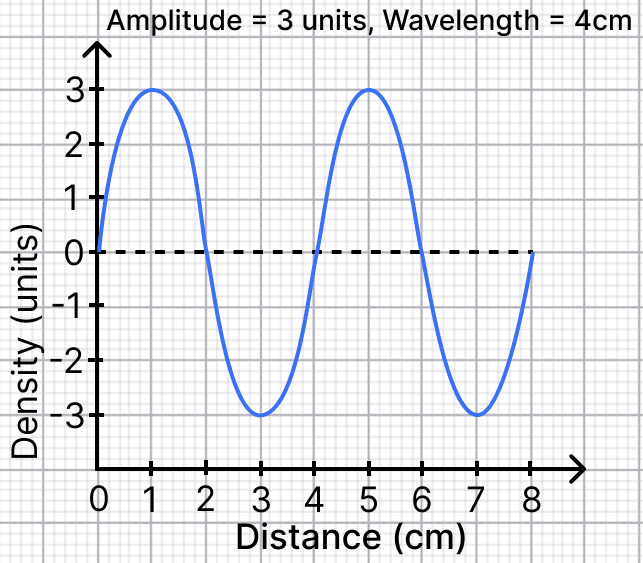
Draw a graph to represent a sound wave for which the density amplitude is 3 units and wavelength is 4 cm.
Answer
To draw the graph, take the distance along the x-axis (in cm) and the density along the y-axis (in units), with the average density marked as a horizontal dashed line.
- The amplitude is 3 units, so the curve rises to a maximum of +3 units above the average density at each crest and falls to a minimum of −3 units below the average density at each trough.
- The wavelength is 4 cm, so the distance between two consecutive crests (or two consecutive troughs) is 4 cm. Thus, a crest occurs at 1 cm, the next trough at 3 cm, the next crest at 5 cm, and so on.
The resulting curve is a smooth wave (sine-shaped) with amplitude 3 units and wavelength 4 cm, as shown below:
In a movie, while showing the explosion of a spacecraft in space, a flash of light is shown along with sound at the same time. What are the errors in this depiction?
Answer
There are two errors in this depiction:
- Sound cannot travel in space — Space is a near vacuum and has almost no medium (matter). Since sound is a mechanical wave that requires a material medium to propagate, the sound of the explosion cannot be heard in space.
- The sound and flash should not be shown as reaching together — If a material medium were present, light would travel much faster than sound. Therefore, the flash would be seen first and the sound would be heard later.
A source produces a sound wave of wavelength 3.44 m. If the wave travels with a speed of 344 m s–1 find its time period.
Answer
Given,
Wavelength (λ) = 3.44 m
Speed of sound (v) = 344 m s–1
We know,
Speed (v) = Wavelength (λ) × Frequency (ν)
or
Frequency (ν) =
Substituting we get,
ν = = 100 Hz
Now, time period (T) =
T = = 0.01 s
Hence, the time period of the sound wave = 0.01 s.
A ship searching for a sunken ship sent a sonar signal and detected an echo after 5 s. If ultrasonic wave travels at 1525 m s–1 in seawater, approximately how far down in the ocean is the wreckage of the sunken ship located?
Answer
Given,
Speed of ultrasonic wave in seawater (v) = 1525 m s–1
Time taken to detect the echo (t) = 5 s
In this time, the wave travels down to the wreckage and back, i.e., it covers twice the depth.
Total distance travelled by the wave = v × t = 1525 × 5 = 7625 m
Depth of the wreckage =
= = 3812.5 m
Hence, the wreckage of the sunken ship is located approximately 3812.5 m down in the ocean.
A vehicle is fitted with an ultrasonic distance sensor as part of parking assistance system which provides echolocation, while the driver is reversing the vehicle. It emits ultrasonic wave (about 40 kHz) which is reflected by the obstacle. When the warning beep starts sounding at a distance of 1.2 m from the obstacle, how much time is taken by ultrasonic wave to travel to the obstacle and come back? Assume the speed of ultrasonic wave in air to be 345 m s–1.
Answer
Given,
Distance of the obstacle (d) = 1.2 m
Speed of ultrasonic wave in air (v) = 345 m s–1
The wave travels to the obstacle and comes back, so the total distance covered = 2 × 1.2 = 2.4 m
We know,
Time (t) =
Substituting we get,
t = = 0.007 s (approximately)
Hence, the time taken by the ultrasonic wave to travel to the obstacle and come back ≈ 0.007 s.
The speed of sound in air is about 331 m s–1 at 0 °C and nearly 344 m s–1 at 22 °C. Roughly how much extra time will the sound of thunder take to travel a distance of 1720 m, if the air temperature changes from 22 °C to 0 °C? Assume that all other conditions remain unchanged.
Answer
Given,
Distance to be travelled (d) = 1720 m
Speed of sound at 22 °C (v22) = 344 m s–1
Speed of sound at 0 °C (v0) = 331 m s–1
We know,
Time (t) =
Time taken at 22 °C,
t22 = = 5 s
Time taken at 0 °C,
t0 = = 5.196 s
Extra time taken = t0 − t22 = 5.196 − 5 = 0.196 s
Hence, the sound of thunder will take roughly 0.196 s (about 0.2 s) extra time when the temperature changes from 22 °C to 0 °C.
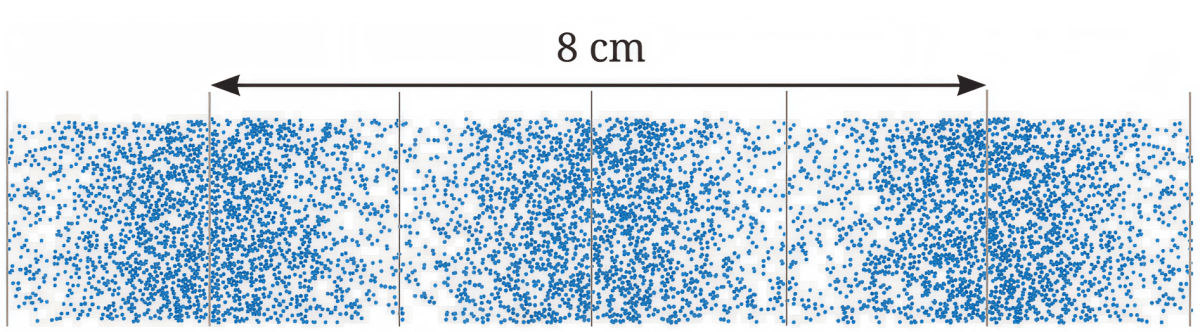
The variation of density of medium for a sound wave propagating with a speed of 340 m s–1 is shown in Fig. 10.32. Calculate the wavelength and frequency of the sound wave.
Answer
Given,
Speed of sound (v) = 340 m s–1
From the figure (Fig. 10.32), the distance of 8 cm covers two complete waves (two compressions and two rarefactions).
So,
2λ = 8 cm
λ = = 4 cm
Converting cm to m,
λ = = 0.04 m
Now,
Speed (v) = Wavelength (λ) × Frequency (ν)
or
Frequency (ν) =
Substituting we get,
ν = = 8500 Hz
Hence, the wavelength of the sound wave = 4 cm (0.04 m) and its frequency = 8500 Hz.
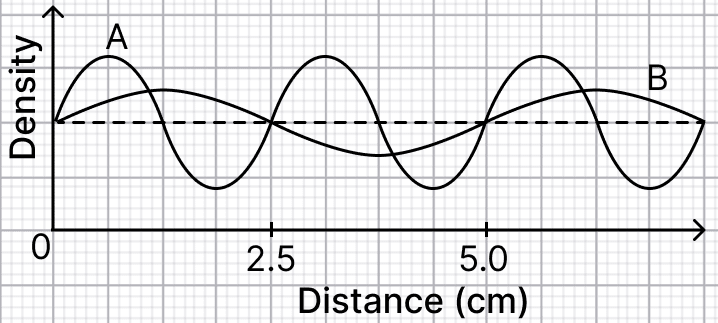
The graphical representation of two sound waves A and B propagating at the same speed of 345 m s–1 is shown in Fig. 10.33. What is the wavelength of each of them? Also, calculate their frequencies.
Answer
Given,
Speed of both sound waves (v) = 345 m s–1
For wave A:
From the graph, wave A completes one full wave (one crest and one trough) in a distance of 2.5 cm.
Wavelength of A (λA) = 2.5 cm = = 0.025 m
Frequency of A (νA) = = = 13800 Hz
For wave B:
From the graph, wave B completes one full wave (one crest and one trough) in a distance of 5.0 cm.
Wavelength of B (λB) = 5.0 cm = = 0.05 m
Frequency of B (νB) = = = 6900 Hz
Hence, the wavelength of wave A = 2.5 cm with frequency 13800 Hz, and the wavelength of wave B = 5.0 cm with frequency 6900 Hz.
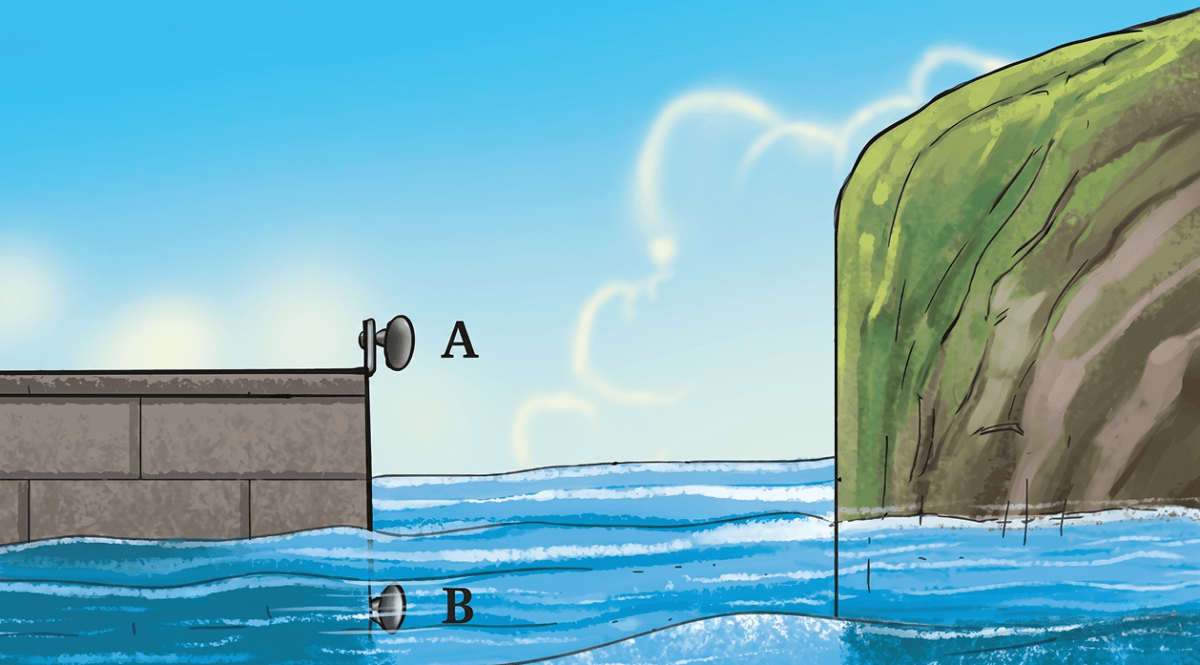
Two identical sound sources are placed at A and B — one in air and one submerged in water (Fig. 10.34). Both produce sounds at the same time, which travel horizontally to the vertical side of the cliff and come back. If the time taken by the sound to return to A is 4.5 times than that of B, what is the ratio between the speeds of sound in air and water?
Answer
Let the horizontal distance from each source to the cliff be d. Since the sound travels to the cliff and comes back, both sounds cover the same total distance 2d.
Let the time taken by sound to return to B (in water) be tB.
Then, time taken by sound to return to A (in air), tA = 4.5 tB
We know,
Speed =
Speed of sound in air (vair) =
Speed of sound in water (vwater) =
Taking the ratio,
= =
Substituting tA = 4.5 tB,
= = =
Hence, the ratio between the speeds of sound in air and water = 2 : 9 (i.e., 1 : 4.5). This shows that sound travels faster in water than in air.