
When does a farmer prefer asexual or sexual methods of reproduction for crops production?
Answer
A farmer prefers asexual methods of reproduction, such as vegetative propagation by cutting, grafting, layering and tissue culture, when:
- A large number of genetically identical plants are needed quickly.
- The desirable characters of a parent plant are to be preserved exactly.
- Uniform produce is required, or the plant does not produce viable seeds easily.
A farmer prefers sexual methods of reproduction, that is, raising crops from seeds, when:
- Variation and genetic diversity are needed in the crop.
- New and improved varieties, such as high-yielding or disease-resistant varieties, are to be developed through selective breeding or hybridisation.
- Crops with better adaptability to changing environmental conditions are required.
Why do you think most complex animals and flowering plants use sexual reproduction, while many simple organisms, like yeast and hydra mainly reproduce asexually?
Answer
Most complex animals and flowering plants use sexual reproduction because it involves two parents and meiosis, during which the random mixing of chromosomes creates new combinations of characters. This produces variation among offspring, which helps complex organisms adapt to changing environments, increases the chances of survival of the species and contributes to evolution.
Simple organisms like yeast and hydra mainly reproduce asexually because their simple body organisation allows quick and easy reproduction through mitosis (e.g., budding). Asexual reproduction is fast, requires only one parent and helps these organisms increase their population rapidly, especially when environmental conditions are favourable.
In a china-rose (hibiscus or gudhal) plant, a pollen tube grows and continues through the style after pollen lands on the stigma. Which process is about to happen next?
Answer
The process about to happen next is fertilisation. The pollen tube grows down through the style into the ovary and carries the male gamete to the ovule, where it fuses with the egg cell. This fusion of the male and female gametes is called fertilisation, and it results in the formation of a zygote.
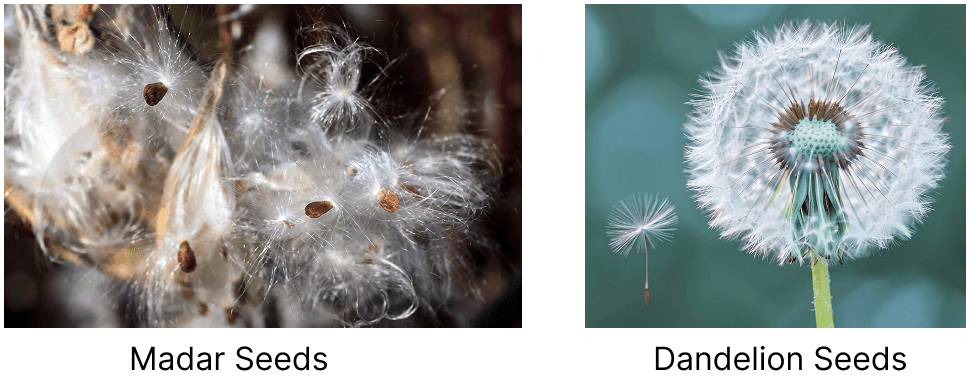
Look at the pictures of calotropis (madar) seeds and dandelion seeds given below. Can you guess what kind of seed dispersal these seeds are adapted for?
Answer
These seeds are adapted for dispersal by wind. Both calotropis (madar) and dandelion seeds are light in weight and bear fine, hair-like (feathery) tufts. These tufts act like parachutes that catch air currents, allowing the seeds to float and be carried far away from the parent plant by the wind.
A farmer plants two varieties of maize side by side, but notices that seeds form only when pollen from one variety reaches the stigma of the other. What type of pollination is this?
Answer
This is cross-pollination. Here, pollen is transferred from the anther of a flower of one plant to the stigma of a flower of another plant of the same type, but of a different variety.
Why do animals with external fertilisation generally produce more eggs than animals with internal fertilisation?
Answer
In external fertilisation, eggs and sperm are released outside the body, usually in water. Many eggs and young ones may be destroyed by water currents or eaten by other animals, and the chance of a sperm meeting an egg is comparatively low. Therefore, animals with external fertilisation produce a large number of eggs so that at least some young ones survive.
In internal fertilisation, fertilisation takes place inside the female body, where the gametes and the fertilised egg or embryo are better protected. Hence, fewer eggs are generally produced.
In animals, which fertilisation method the gametes are more protected?
Answer
The gametes are more protected in internal fertilisation. Since fertilisation takes place inside the female body, the gametes and the developing fertilised egg or embryo are protected from water currents, predators and unfavourable conditions.
Ravi suddenly notices that he is growing taller rapidly, his shoulders are broadening, and his voice cracks. What stage of life is he entering?
Answer
Ravi is entering puberty (adolescence). Rapid increase in height, broadening of shoulders and cracking (deepening) of the voice are physical changes that occur in boys at puberty, when the reproductive organs mature and the body becomes capable of reproduction.
Rina's period occurs every 28 days. Her last period was on the 5th of March. On which day is she most likely to get her next period?
Answer
Since Rina's cycle is 28 days, her next period will start 28 days after the 5th of March.
Counting 28 days from 5th March (March has 31 days): 5th March + 26 days = 31st March, and 2 more days = 2nd April.
So she is most likely to get her next period on the 2nd of April.
A human zygote has just formed. How many chromosomes does it have?
Answer
A human zygote has 46 chromosomes. It is formed by the fusion of a sperm and an egg, each of which is a gamete carrying 23 chromosomes. On fertilisation, the 23 chromosomes from the sperm and the 23 from the egg combine to give a total of 46 chromosomes in the zygote.
What protective devices can be used during sexual activity to reduce the spread of STIs?
Answer
Condoms can be used during sexual activity to reduce the spread of Sexually Transmitted Infections (STIs), as they act as a barrier and reduce direct contact between body fluids.
If a couple uses oral contraceptive pills but not condoms, which risks remain and why?
Answer
If a couple uses oral contraceptive pills but not condoms, the risk of Sexually Transmitted Infections (STIs) remains. Oral pills help prevent pregnancy by altering hormones and affecting the release of eggs, but they do not act as a physical barrier against disease-causing organisms. Condoms are needed to reduce the spread of STIs.
In many animals, the young ones can walk or find food soon after birth but human babies are completely dependent for a long time. What might be some advantages and disadvantages of this for humans as a species?
Answer
Advantages —
- The long period of dependence and parental care gives time for the large human brain to grow and develop.
- Children get time to learn complex skills, language, behaviour and social and cultural values from their parents and elders.
- It strengthens family and social bonds, which improves the survival and adaptability of humans.
Disadvantages —
- It demands a large investment of time, energy and resources from the parents over many years.
- The helpless young ones remain vulnerable for a long period if parental care is interrupted.
- Because so much care is needed for each child, humans generally raise fewer offspring at a time and reproduce slowly.
A flower's anthers are removed before it matures. Later, pollen from another plant of the same species is dusted onto its stigma and seeds are produced. Which process has been ensured here?
- Self-pollination
- Cross-pollination
- Fertilisation
- Tissue culture
Answer
Cross-pollination
Reason — Removing the anthers before the flower matures prevents the flower from being pollinated by its own pollen, ruling out self-pollination. Since the pollen is then brought from a flower of another plant of the same species, the transfer of pollen takes place between two different plants. This transfer of pollen from the anther of one plant to the stigma of another plant of the same type is cross-pollination.
Arrange the following stages of sexual reproduction in plants in the correct order:
- Pollen germination on stigma
- Fertilisation
- Pollination
- Formation of zygote
Answer
The correct order is:
Pollination → Pollen germination on stigma → Fertilisation → Formation of zygote
i.e., 3 → 1 → 2 → 4
Reason — First, pollen is transferred from the anther to the stigma (pollination). The pollen then germinates on the stigma and produces a pollen tube that grows through the style into the ovary (pollen germination on stigma). The male gamete carried by the pollen tube reaches the ovule and fuses with the egg cell (fertilisation). This fusion of gametes results in the formation of the zygote (formation of zygote).
Assertion (A): The zygote formed after fertilisation immediately attaches to the uterus wall.
Reason (R): The uterus wall is always prepared to receive the zygote.
- Both A and R are true, and R is the correct explanation of A.
- Both A and R are true, but R is not the correct explanation of A.
- A is true, but R is false.
- A is false, but R is true.
Answer
Both are false.
Explanation — The zygote does not immediately attach to the uterus wall. Fertilisation takes place in the oviduct (fallopian tube), after which the zygote travels towards the uterus, and only then implants into the inner lining of the uterus. So, Assertion A is false.
The uterus wall is also not always prepared to receive the zygote — its inner lining becomes thick and rich in blood vessels cyclically (around ovulation), and if fertilisation does not occur, this lining is shed during menstruation. So, Reason R is false.
Therefore, Both are false.
Why does asexual reproduction produce offsprings that are genetically identical to the parent?
Answer
Asexual reproduction involves only one parent and takes place through mitosis, a type of cell division that produces daughter cells each having the same number of chromosomes identical to the parent cell. As there is no fusion of gametes and no mixing of genetic material from two different parents, the DNA of the offspring is an exact copy of the parent's DNA. Therefore, the offspring are genetically identical to the parent and are called clones.
Explain why the menstrual cycle stops during pregnancy.
Answer
The menstrual cycle involves the monthly preparation of the thick uterine lining to receive a fertilised egg, and its shedding (menstruation) when no fertilisation takes place. During pregnancy, fertilisation has already occurred and the zygote (which develops into the embryo) implants into the thick inner lining of the uterus. This lining is now needed to nourish and support the developing embryo, so it is not shed. As a result, ovulation and menstruation do not take place, and the menstrual cycle stops during pregnancy.
Why are flowers that bloom at night white or light in colour as compared to flowers that bloom during the day?
Answer
Flowers depend on pollinators to attract them for pollination. Night-blooming flowers are visited by night-active pollinators (such as moths), and at night bright colours cannot be seen. White or light-coloured flowers reflect the faint light available at night (such as moonlight), so they stand out and remain visible in the dark, helping pollinators locate them easily. (Such flowers often also give off a strong fragrance.) In contrast, day-blooming flowers can be brightly coloured because their pollinators, such as bees and butterflies, can clearly see colours in daylight.
Why do vegetatively propagated plants tend to be more vulnerable to diseases than sexually reproduced plants?
Answer
Vegetatively propagated plants are produced asexually from a single parent through mitosis, so they are genetically identical (clones) to one another and to the parent. Because there is no genetic variation among them, if a particular disease or pathogen can affect one plant, it can affect all the others in exactly the same way, so the entire crop can be wiped out.
Sexually reproduced plants, on the other hand, show variation due to the mixing of genetic material from two parents. Some individuals may carry resistance to a disease and survive, so the population as a whole is less vulnerable.
If all flowers in a type of plant were only capable of self-pollination, how would it affect the genetic diversity over several generations? Explain.
Answer
In self-pollination, pollen is transferred to the stigma of the same flower or another flower of the same plant, so the offspring receive genetic material from essentially one parent. There is little or no mixing of genes from different individuals.
If this continued over several generations, the genetic diversity of the plant population would steadily decrease, producing offspring that are very similar to the parents. Low genetic diversity makes the population less able to adapt to changing environmental conditions and more vulnerable to diseases and environmental stress, reducing its chances of long-term survival and evolution.
A farmer wants to produce a large number of genetically identical plants quickly. Suggest suitable reproduction methods and explain why they are effective.
Answer
The farmer should use asexual methods of vegetative propagation, such as cutting, grafting, layering and especially tissue culture.
These methods are effective because:
- They involve a single parent and take place through mitosis, so all the plants produced are genetically identical (clones) to the parent and retain its desirable characters, giving uniformity in produce.
- Tissue culture can mass-produce a large number of healthy plantlets quickly from a small piece of tissue, such as the shoot tip (apical meristem), and can also provide virus-free plants (as done in banana farming).
- This method is fast and helps organisms increase their population quickly, especially when environmental conditions are favourable.
Thus, these methods allow the farmer to obtain large numbers of identical, desirable plants in a short time.
Suresh prepares slides with pollen grains in different sugar concentrations (0%, 2.5%, 5%, 7.5%, 10%) to study the germination of pollen.
(i) What are the different hypotheses which can be tested using this set-up?
(ii) What parameters should be kept the same in this set-up?
Answer
(i) Hypotheses that can be tested —
- Pollen germination depends on the sugar concentration of the medium.
- There is an optimum sugar concentration at which pollen germination or pollen tube growth is maximum.
- Pollen germination may increase with sugar concentration up to an optimum level and then decrease.
- Sugar concentration may have no effect on pollen germination. This is the null hypothesis.
(ii) Parameters that should be kept the same —
- The same type/species of pollen, of the same age and freshness.
- The same number of pollen grains placed on each slide.
- The same temperature, light, humidity and other surrounding conditions.
- The same time duration of observation for all slides.
- The same volume of solution and the same medium for all slides, with only the sugar concentration being varied.
Keeping these parameters the same ensures that any difference in germination is due to the change in sugar concentration.
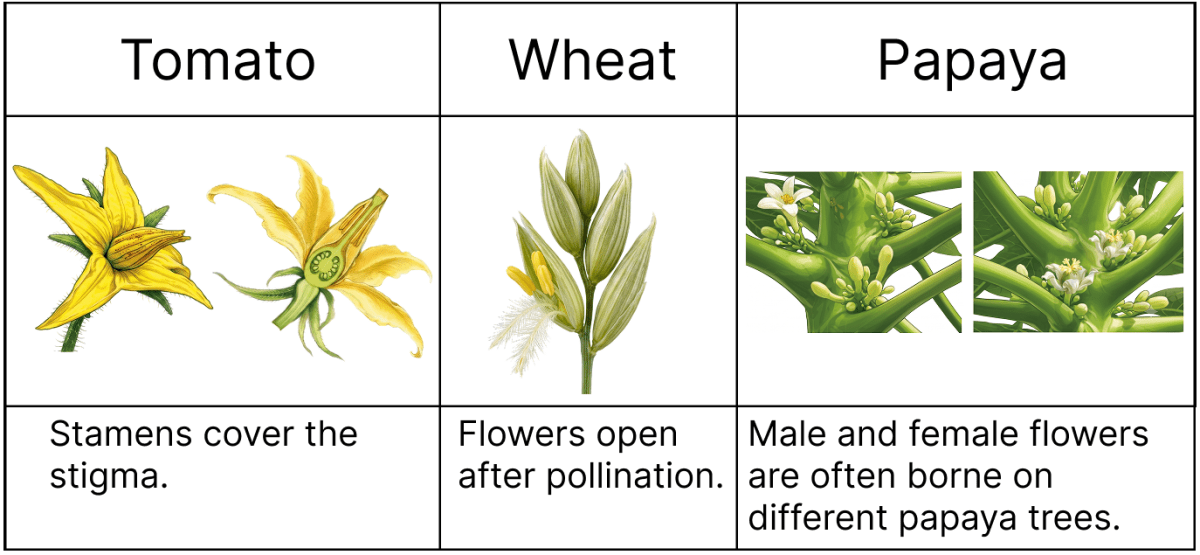
Look at the picture given below and think in line with the given prompts and find out which type(s) of pollination might have been followed in these flowers —
Answer
Tomato — Self-pollination: Since the stamens cover the stigma, the flower's own pollen can easily reach its own stigma. This favours the transfer of pollen within the same flower, i.e., self-pollination.
Wheat — Self-pollination: As the flowers open only after pollination has already taken place, the pollen of a flower reaches its own stigma while the flower is still closed. This ensures that pollination occurs with the flower's own pollen, i.e., self-pollination.
Papaya — Cross-pollination: Since the male and female flowers are often borne on different papaya trees, pollen from a male flower of one tree must be transferred to the stigma of a female flower on another tree. This makes cross-pollination necessary.
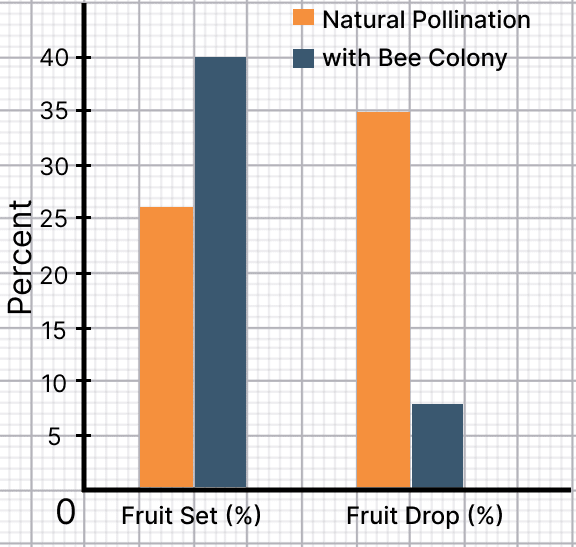
In the lower Himalayan region of northern India, apples are an important cash crop that contribute significantly to farmer's livelihoods. The fruit yield in apple cultivation is declining continuously, associated with climate change and a significant decline in the population of natural pollinators. A researcher-farmer group set up two experimental apple orchards at two distinct locations: Places A and B. In apple orchards at Place A, they allowed natural pollinators to pollinate the flowers of the apple. In apple orchards at Place B, they applied mixed farming techniques of beekeeping. Along with honey, the farmer yielded apples. The yield of apples is depicted in the figure below, in terms of fruit setting (number of fruits/the total number of corresponding fruit-bearing branches) and fruit drop (premature falling of developing fruits) in the two types of experimental places of apple orchards.
(i) What are the hypotheses the researcher-farmers group has thought of for this investigation?
(ii) What are the different parameters in the experiment?
(iii) Compare and analyse the data of two experimental orchards Places A and B, in terms of high yields of apple fruits.
(iv) Based on your analysis, what do you infer from the data?
Answer
(i) Hypotheses —
- Introducing bee colonies (managed pollinators through beekeeping) increases the yield of apple fruits.
- A higher pollinator population improves fruit setting and reduces premature fruit drop.
- The decline in natural pollinators is responsible for the falling apple yield, and this can be improved by supplementing with bees.
(ii) Parameters in the experiment —
- Independent variable (changed): the method of pollination — natural pollinators at Place A versus an added bee colony at Place B.
- Dependent variables (measured): fruit setting (%) and fruit drop (%).
- Parameters kept similar: apple variety, climatic region, soil and orchard management practices at both places.
(iii) Comparison and analysis (values read from the figure) —
- Fruit set: Place B (with bee colony) ≈ 40% is higher than Place A (natural pollination) ≈ 26%.
- Fruit drop: Place B (with bee colony) ≈ 8% is much lower than Place A (natural pollination) ≈ 35%.
So Place B shows higher fruit setting and lower fruit drop than Place A, which together mean a higher yield of apples at Place B.
(iv) Inference — Adding bee colonies improves pollination, which leads to greater fruit set and fewer fruits dropping prematurely, and hence a higher apple yield. Therefore, beekeeping (a mixed farming technique) is an effective way to overcome the decline in natural pollinators and boost apple production, with the added benefit of obtaining honey.
A student claims, "In humans, ovulation always happens on day 14 of the menstrual cycle". Critically examine this claim and state whether the claim is correct or not. Give at least two reasons for your answer.
Answer
The claim is not correct. It is an over-generalisation.
Reasons —
- Ovulation around day 14 is usually discussed with reference to a typical 28-day menstrual cycle. However, the menstrual cycle normally varies from about 21 to 35 days, so ovulation does not always occur on day 14.
- Even in the same person, the length of the menstrual cycle and the timing of ovulation may vary from month to month due to factors such as stress, health and hormonal changes.
Hence, ovulation may occur around day 14 in a typical 28-day cycle, but it does not always happen exactly on day 14.