
How much distance should we maintain from the truck ahead to avoid a collision if it suddenly applies the brakes?
Answer
We should maintain a safe distance from the truck ahead so that our vehicle can stop before reaching it if the truck suddenly applies the brakes.
This safe distance should be at least equal to the stopping distance of our vehicle. The stopping distance includes:
(i) the distance travelled during the driver's reaction time, and
(ii) the distance travelled after the brakes are applied before the vehicle stops.
The exact distance cannot be fixed for all situations. It depends on factors such as the speed of the vehicle, condition of the road, condition of tyres and brakes, and the driver's reaction time.
Does this distance depend upon the speed with which we are moving?
Answer
Yes, the safe distance depends upon the speed with which we are moving.
At a higher speed, the vehicle covers more distance during the driver's reaction time and also needs a longer distance to stop after the brakes are applied. Therefore, the stopping distance increases with speed.
So, if our vehicle is moving faster, we must maintain a larger distance from the truck ahead to avoid a collision.
In the example of an athlete running back and forth on a straight track (Fig. 4.4), when will the displacement of the athlete be zero? What will be the total distance travelled in that case?
Answer
The displacement of the athlete will be zero when she returns to her starting point O, since displacement is the net change in position between the two instants of time.
In Fig. 4.4, the athlete runs from O to A (a distance of 100 m). If she then runs back along the same path from A to O (another 100 m), she ends up at her starting position.
So, in that case:
Displacement = 0 m
Total distance travelled = OA + AO = 100 m + 100 m = 200 m
Fuel used up in a vehicle depends on which of the following? Justify your answer.
(i) Total distance travelled
(ii) Displacement
Answer
Fuel used up in a vehicle depends on the (i) total distance travelled.
Reason — The engine has to do work to move the vehicle along every metre of the actual path it covers, irrespective of the direction of motion. Hence the fuel consumed depends on the total distance travelled along the path.
Displacement is only the net change in position between the starting and stopping points. A vehicle can return to its starting point (displacement = 0) and yet consume a large amount of fuel, because it has actually travelled a long distance. So fuel consumption does not depend on displacement.
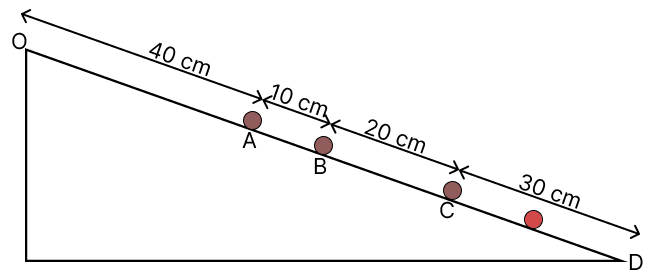
A ball rolls down an inclined track as shown in Fig. 4.6. Is its motion, a straight line motion? Assuming the starting point of the ball (O) to be the origin, can its motion from O to D be depicted using a horizontal line as shown in Fig. 4.3? Are the values of total distance travelled and magnitude of displacement from O equal or different at positions A, B, C and D?
Answer
Yes, the motion of the ball is a straight line motion, as the ball moves along a straight inclined track without turning back.
Yes, its motion from O to D can be depicted using a horizontal line as shown in Fig. 4.3. This is because the motion takes place along a single straight line in one direction only. So, taking O as the origin, the successive positions A, B, C and D can be marked on a horizontal straight line by their distances from O, even though the actual track is inclined.
The values of total distance travelled and magnitude of displacement from O are equal at positions A, B, C and D.
Reason — Since the ball moves in one direction only (without turning back), the length of the path covered from O up to any position is the same as the straight-line distance of that position from O. Hence, at each of the positions A, B, C and D, the total distance travelled from O equals the magnitude of displacement from O.
During a family road trip, you drive 200 km north in three hours. Afterwards, you drive 200 km south in two hours. Find the average speed and average velocity for your entire trip.
Answer
Given,
Distance travelled towards north = 200 km in 3 hours
Distance travelled towards south = 200 km in 2 hours
Total distance travelled = 200 km + 200 km = 400 km
Total time taken = 3 h + 2 h = 5 h
Average speed =
= = 80 km h–1
For displacement, the trip ends at the starting point because 200 km north and 200 km south cancel each other.
∴ Displacement = 200 km (north) – 200 km (south) = 0 km
Average velocity =
= = 0 km h–1
Hence, the average speed is 80 km h–1 and the average velocity is 0 km h–1.
Under what condition(s) is the
(i) magnitude of average velocity of an object equal to its average speed?
(ii) magnitude of average velocity of an object zero while its average speed is not zero?
Answer
(i) The magnitude of average velocity is equal to the average speed when the magnitude of displacement is equal to the total distance travelled. This happens when the object moves along a straight line in one direction (without turning back).
(ii) The magnitude of average velocity is zero while the average speed is not zero when the object returns to its starting position, so that its displacement is zero but the total distance travelled is not zero (for example, when an object completes one full round of a circular path).
My father went to a shop from home which is located at a distance of 250 m on a straight road. On reaching there, he discovered that he forgot to carry a cloth bag. He came home to take it, went to the shop again, bought provisions and came back home. How much was the total distance travelled by him? What was his displacement from home?
Answer
Given,
Distance between home and shop = 250 m
The father's journey consists of the following trips:
Home → Shop = 250 m
Shop → Home = 250 m
Home → Shop = 250 m
Shop → Home = 250 m
∴ Total distance travelled = 250 + 250 + 250 + 250 = 1000 m
Since the father finally returns to his home (the starting point), his net change in position is zero.
∴ Displacement from home = 0 m
Hence, the total distance travelled is 1000 m and the displacement from home is 0 m.
A student runs from the ground floor to the fourth floor of a school building to collect a book and then comes down to their classroom on the second floor. If the height of each floor is 3 m, find:
(i) the total vertical distance travelled, and
(ii) their displacement from the starting point.
Answer
Given,
Height of each floor = 3 m
(i) Going up from the ground floor to the fourth floor = 4 floors
Vertical distance going up = 4 × 3 = 12 m
Coming down from the fourth floor to the second floor = 2 floors
Vertical distance coming down = 2 × 3 = 6 m
∴ Total vertical distance travelled = 12 + 6 = 18 m
(ii) The student finally stops at the second floor.
Displacement = height of the second floor above the ground floor = 2 × 3 = 6 m (in the upward direction)
Hence, the total vertical distance travelled is 18 m and the displacement from the starting point is 6 m upwards.
A girl is riding her scooter and finds that its speedometer reading is constant. Is it possible for her scooter to be accelerating and if so, how?
Answer
Yes, it is possible for her scooter to be accelerating even when the speedometer reading is constant.
The speedometer shows only the magnitude of velocity (i.e., the speed) and not its direction. Acceleration occurs whenever the velocity changes — either in magnitude or in direction, or both.
So, if the girl rides her scooter along a curved path or takes a turn, the direction of her velocity keeps changing even though its magnitude (speed) stays constant. Since the velocity is changing (in direction), the scooter is accelerating. This is the case in uniform circular motion, where the speed is constant but the motion is still accelerated.
A car starts from rest and its velocity reaches 24 m s–1 in 6 s. Find the average acceleration and the distance travelled in these 6 s.
Answer
Given,
Initial velocity (u) = 0 (starts from rest)
Final velocity (v) = 24 m s–1
Time (t) = 6 s
According to the first kinematic equation,
v = u + at
or
a =
Substituting we get,
a = = 4 m s–2
Hence, average acceleration = 4 m s–2
For the distance travelled, using the second kinematic equation,
s = ut + at2
Substituting we get,
s = (0 × 6) + × 4 × (6)2
= × 4 × 36
= 72 m
Hence, the distance travelled in 6 s is 72 m.
A motorbike moving with initial velocity 28 m s–1 and constant acceleration stops after travelling 98 m. Find the acceleration of the motorbike and the time taken to come to a stop.
Answer
Given,
Initial velocity (u) = 28 m s–1
Final velocity (v) = 0 (comes to a stop)
Distance travelled (s) = 98 m
According to the third kinematic equation,
v2 = u2 + 2as
Substituting we get,
(0)2 = (28)2 + 2 × a × 98
0 = 784 + 196a
⇒ a = = -4 m s–2
Hence, the acceleration of the motorbike is -4 m s–2.
The negative sign indicates that the acceleration is opposite to the direction of motion (i.e., the motorbike is slowing down).
For the time taken, using the first kinematic equation,
v = u + at
or
t =
Substituting we get,
t = = 7 s
Hence, the time taken to come to a stop is 7 s.
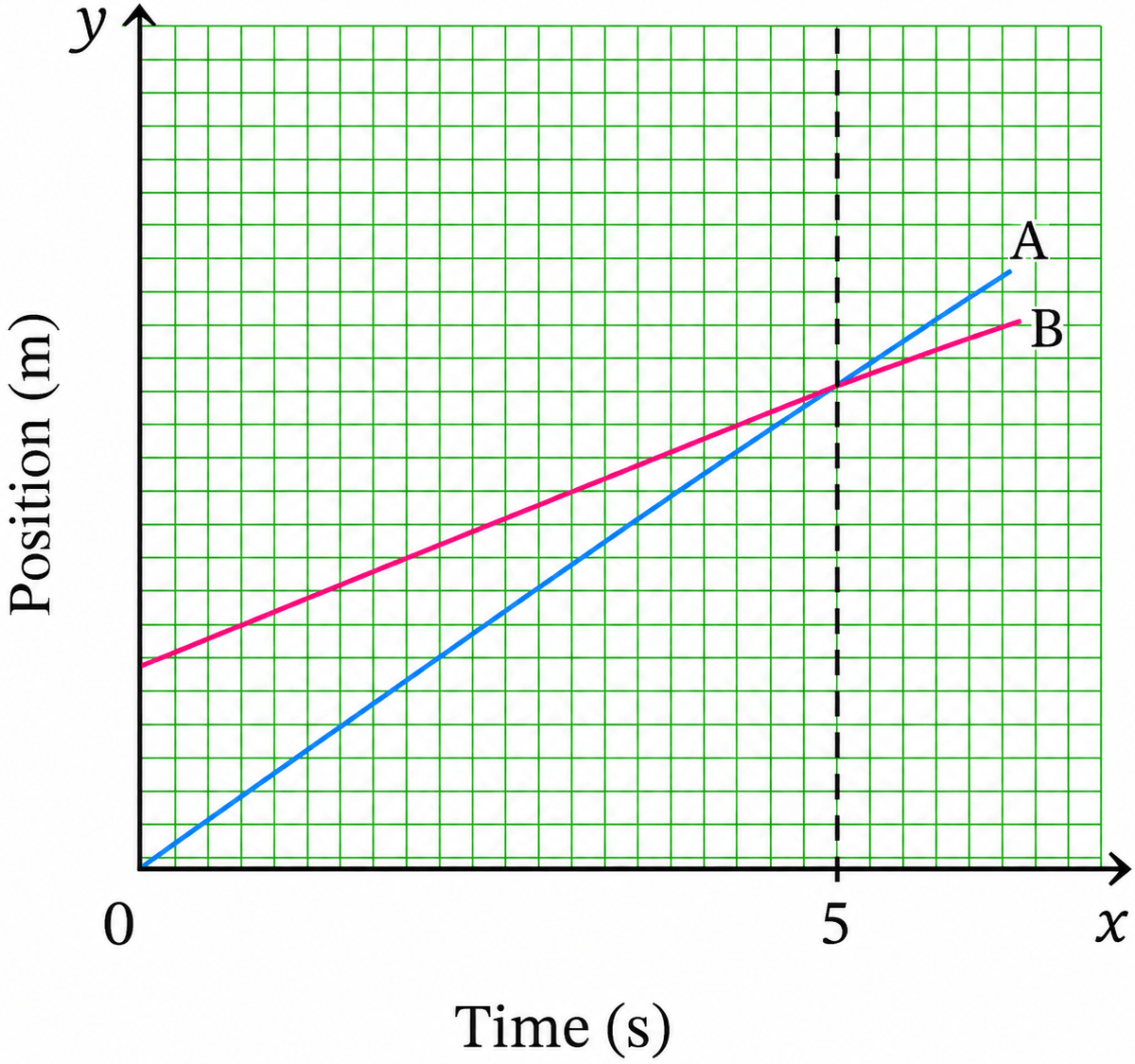
Fig. 4.27 shows a position-time graph of two objects A and B that are moving along the parallel tracks in the same direction. Do objects A and B ever have equal velocity? Justify your answer.
Answer
No, objects A and B never have equal velocity.
Justification — In a position-time graph, the velocity of an object is given by the slope of its graph. Both A and B are represented by straight lines, which means each of them moves with a constant velocity.
However, the two straight lines have different slopes. The line for A is steeper than the line for B. Hence, the velocity of A is greater than the velocity of B. Thus, the velocities of A and B are different at all times.
The point where the two lines meet only shows the instant when A and B are at the same position; it does not mean they have the same velocity. Hence, A and B never have equal velocity.
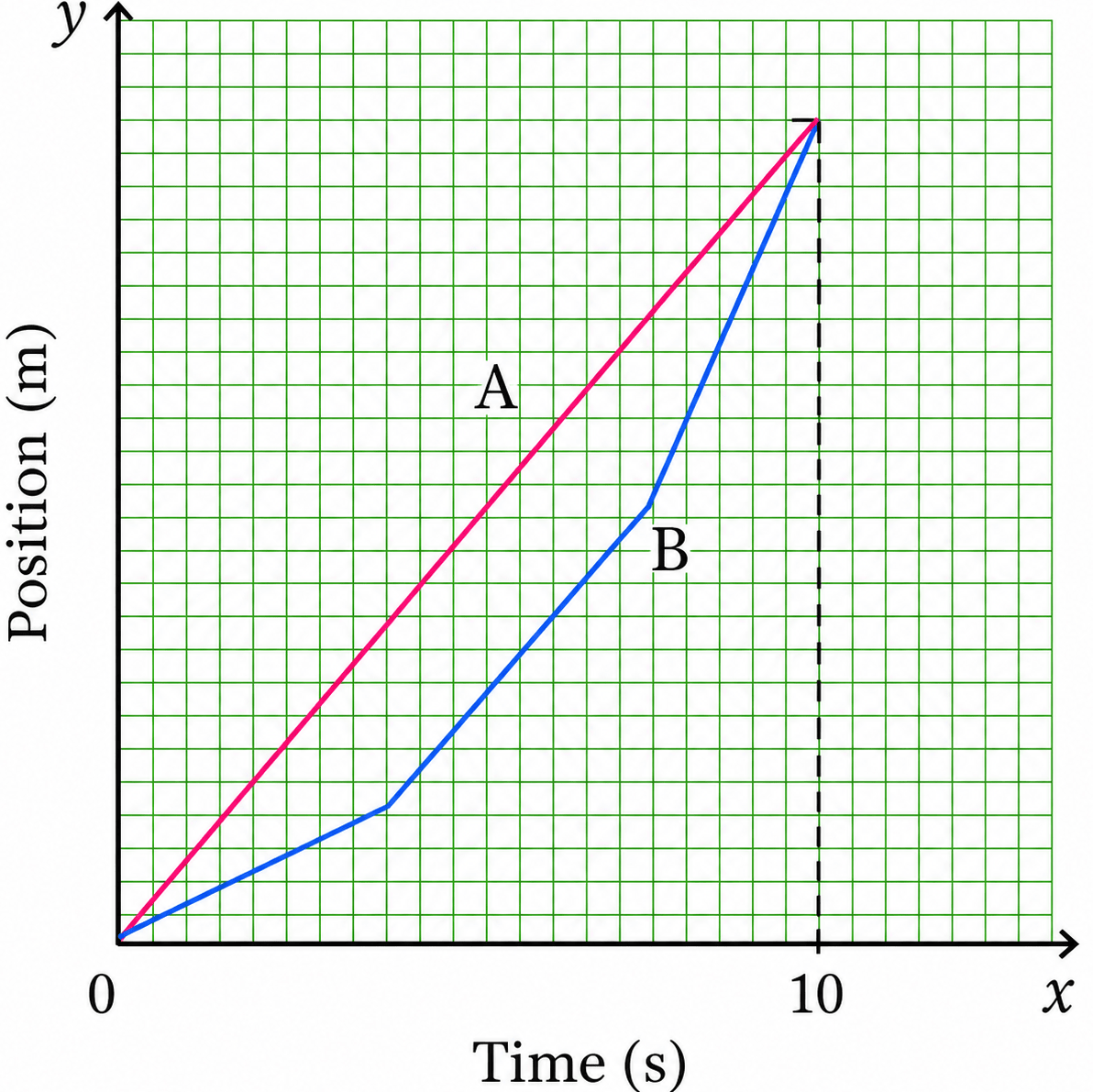
A graph in Fig. 4.28 shows the change in position with time for two objects A and B moving in a straight line from 0 to 10 seconds. Choose the correct option(s).
(i) The average velocity of both over the 10 s time interval is equal since they have the same initial and final positions.
(ii) The average speeds of both over the 10 s time interval are equal since both cover equal distance in equal time.
(iii) The average speed of A over the 10 s time interval is lower than that of B since it covers a shorter distance than B in 10 seconds.
(iv) The average speed of A over the 10 s time interval is greater than that of B since B's speed is lower than A's in some segments.
Answer
The correct options are (i) and (ii).
Reason — From the graph, both objects A and B start at the same initial position and reach the same final position at the end of 10 s.
(i) Average velocity = . Since both have the same initial and final positions, their displacements are equal, and the time interval is also the same (10 s). Hence their average velocities are equal.
(ii) Since both objects move in a straight line in the same direction, the total distance travelled by each equals the magnitude of its displacement. As both displacements are equal and the time is the same, the total distances are equal and so their average speeds are equal.
(iii) and (iv) are incorrect because both objects cover equal distances in equal time, so neither has a greater or lower average speed than the other.
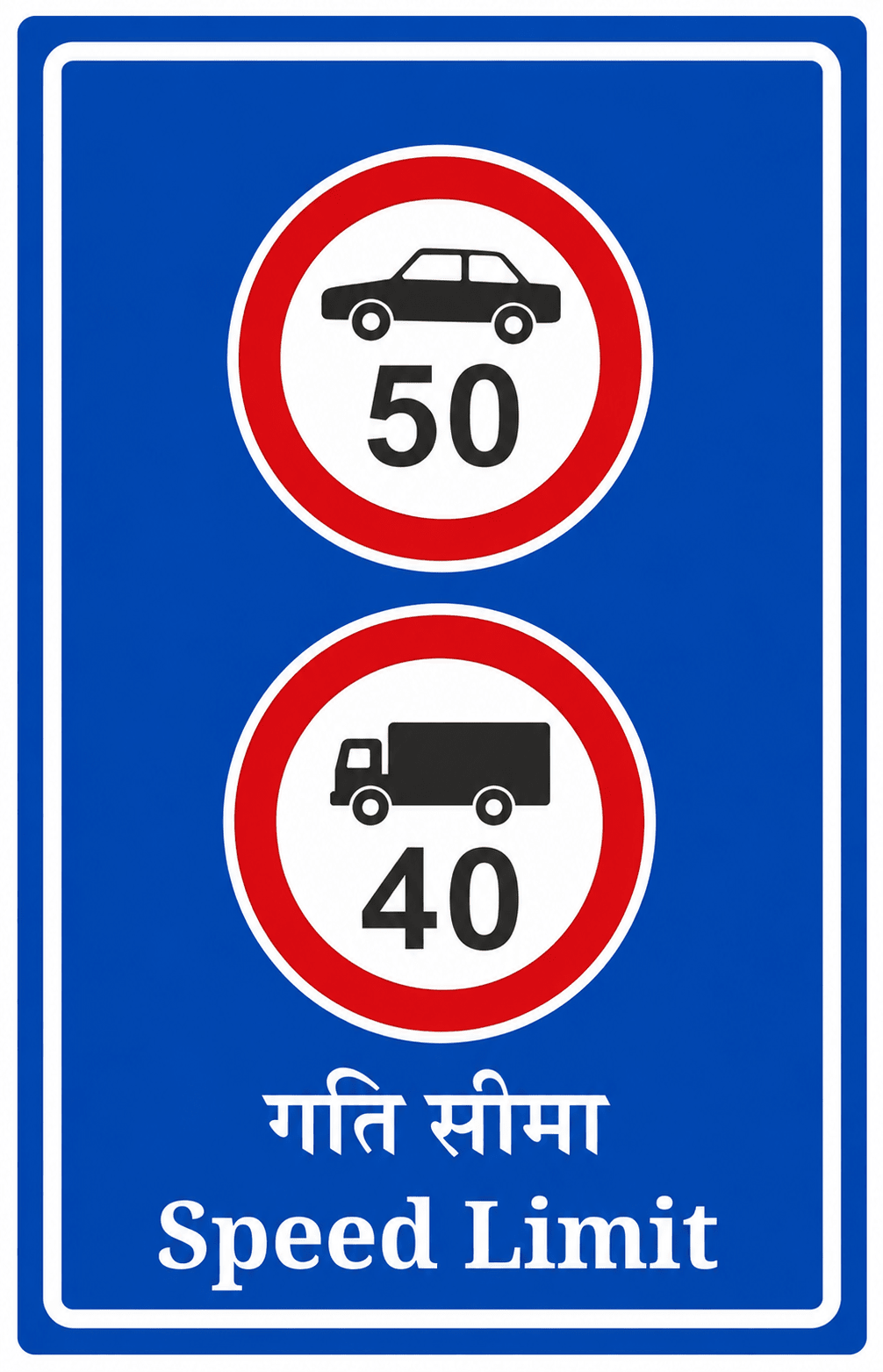
A truck driver driving at the speed of 54 km h–1 notices a road sign with a speed limit of 40 km h–1 (Fig. 4.29) for trucks. He slows down to 36 km h–1 in 36 s. What was the distance travelled by him during this time? Assume the acceleration to be constant while slowing down.
Answer
Given,
Initial velocity (u) = 54 km h–1
Convert km h–1 to m s–1: multiply by
u = 54 × = 15 m s–1
Final velocity (v) = 36 km h–1
v = 36 × = 10 m s–1
Time (t) = 36 s
First, find the acceleration using the first kinematic equation,
v = u + at
or
a =
Substituting we get,
a = = m s–2
Now, using the second kinematic equation,
s = ut + at2
Substituting we get,
s = (15 × 36) + × × (36)2
= 540 + × × 1296
= 540 – 90
= 450 m
Hence, the distance travelled by the truck during this time is 450 m.
A car starts from rest and accelerates uniformly to 20 m s–1 in 5 seconds. It then travels at 20 m s–1 for 10 seconds and finally applies the brake (with uniform acceleration) to stop in 6 seconds. Find the total distance travelled.
Answer
The motion of the car takes place in three phases.
Phase 1 (Speeding up):
u = 0, v = 20 m s–1, t = 5 s
Distance, s1 = (u + v)t = × (0 + 20) × 5 = 50 m
Phase 2 (Constant velocity):
Velocity = 20 m s–1, t = 10 s
Distance, s2 = velocity × time = 20 × 10 = 200 m
Phase 3 (Braking to stop):
u = 20 m s–1, v = 0, t = 6 s
Distance, s3 = (u + v)t = × (20 + 0) × 6 = 60 m
∴ Total distance travelled = s1 + s2 + s3
= 50 + 200 + 60
= 310 m
Hence, the total distance travelled by the car is 310 m.
A bus is travelling at 36 km h–1 when the driver sees an obstacle 30 m ahead. The driver takes 0.5 seconds to react before pressing the brake. Once the brake is applied, the velocity of the bus reduces with constant acceleration of 2.5 m s–2. Will the bus be able to stop before reaching the obstacle?
Answer
Given,
Initial velocity (u) = 36 km h–1
Convert km h–1 to m s–1: multiply by
u = 36 × = 10 m s–1
Distance travelled during the reaction time (before brakes are applied):
During the reaction time of 0.5 s, the bus moves at a constant velocity of 10 m s–1.
Reaction distance = velocity × time = 10 × 0.5 = 5 m
Distance travelled after the brakes are applied:
u = 10 m s–1, v = 0, a = -2.5 m s–2
Using the third kinematic equation,
v2 = u2 + 2as
(0)2 = (10)2 + 2 × (-2.5) × s
0 = 100 – 5s
⇒ s = = 20 m
∴ Total distance travelled before stopping = reaction distance + braking distance
= 5 + 20
= 25 m
Since the total stopping distance (25 m) is less than the distance of the obstacle (30 m),
Yes, the bus will be able to stop before reaching the obstacle (it stops 5 m short of it).
A student said, "The Earth moves around the Sun". In this context, discuss whether an object kept on the Earth can be considered to be at rest.
Answer
Whether an object is at rest or in motion depends on the reference point (frame of reference) chosen to describe its position.
With respect to the Earth's surface (or another object on the Earth), the object kept on the Earth does not change its position with time, so it is at rest relative to the Earth.
However, with respect to the Sun, the object moves along with the Earth as the Earth revolves around the Sun. Its position with respect to the Sun keeps changing with time, so it is in motion relative to the Sun.
Therefore, the same object can be considered at rest with respect to one reference point and in motion with respect to another. Rest and motion are relative; an object cannot be said to be at rest or in motion in an absolute sense.
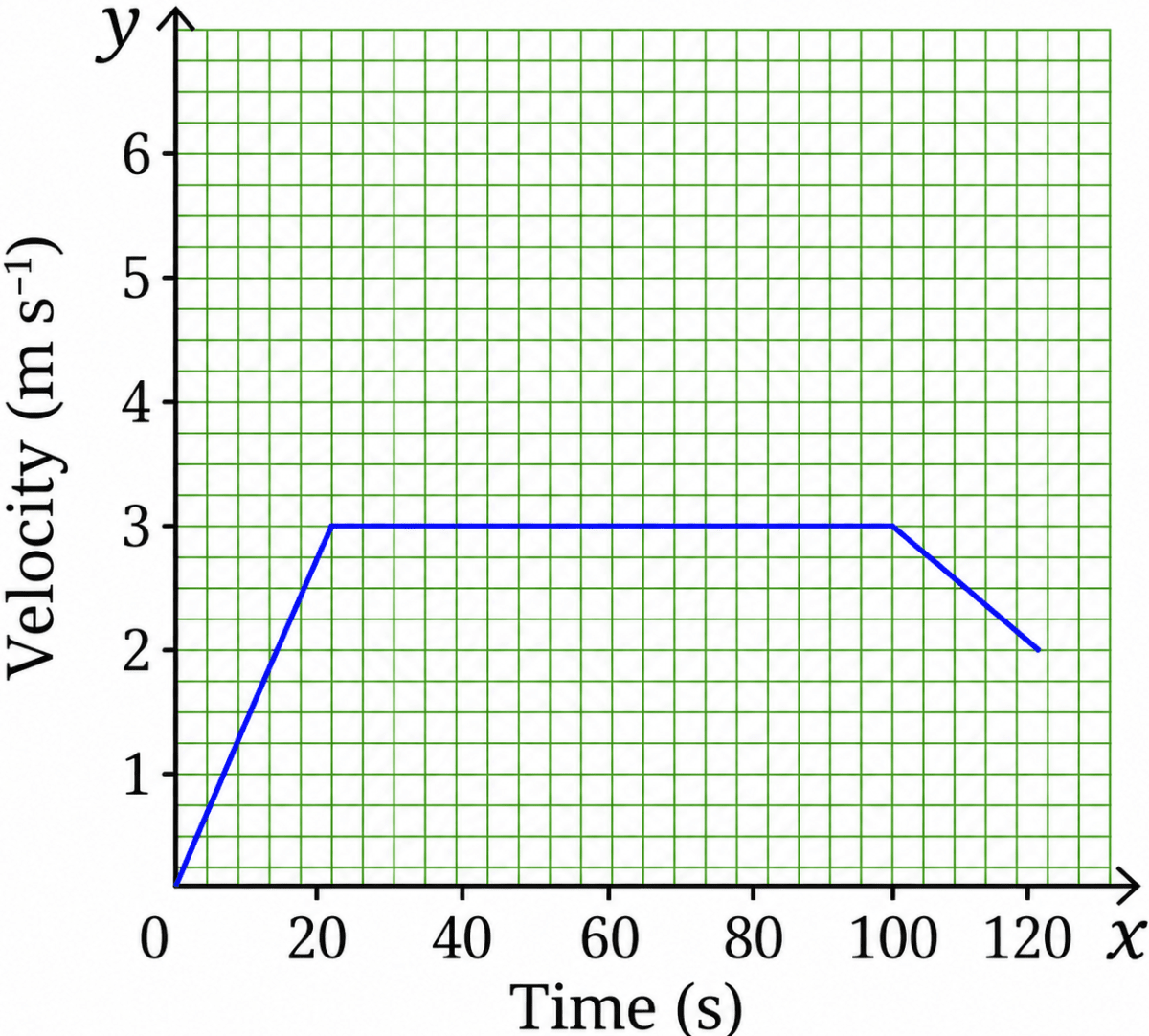
The velocity-time graph from 0 s to 120 s for a cyclist is shown in Fig. 4.30. Shade the areas (in different colours) representing the displacement of the cyclist
(i) while cyclist is moving with constant velocity.
(ii) when the velocity of cyclist is decreasing.
Also, calculate the displacement and average acceleration in the 120 s time interval.
Answer
From the velocity-time graph, the motion of the cyclist has three parts:
From 0 s to 20 s — velocity increases from 0 to 3 m s–1
From 20 s to 100 s — velocity is constant at 3 m s–1 [shade this region for part (i)]
From 100 s to 120 s — velocity is decreasing from 3 m s–1 to 2 m s–1 [shade this region for part (ii)]
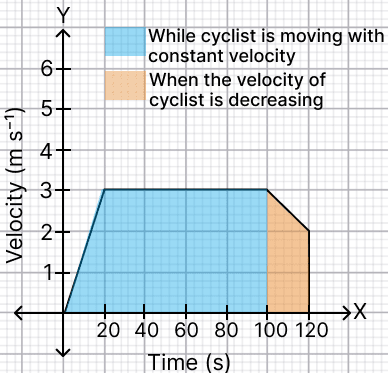
Displacement = area enclosed between the graph and the time axis.
Area from 0 s to 20 s (triangle) = × 20 × 3 = 30 m
Area from 20 s to 100 s (rectangle) = 80 × 3 = 240 m
Area from 100 s to 120 s (trapezium) = × (3 + 2) × 20 = × 5 × 20 = 50 m
∴ Total displacement = 30 + 240 + 50 = 320 m
Average acceleration in the 120 s interval =
=
=
= m s–2 (approximately)
Hence, the displacement is 320 m and the average acceleration is about m s–2.
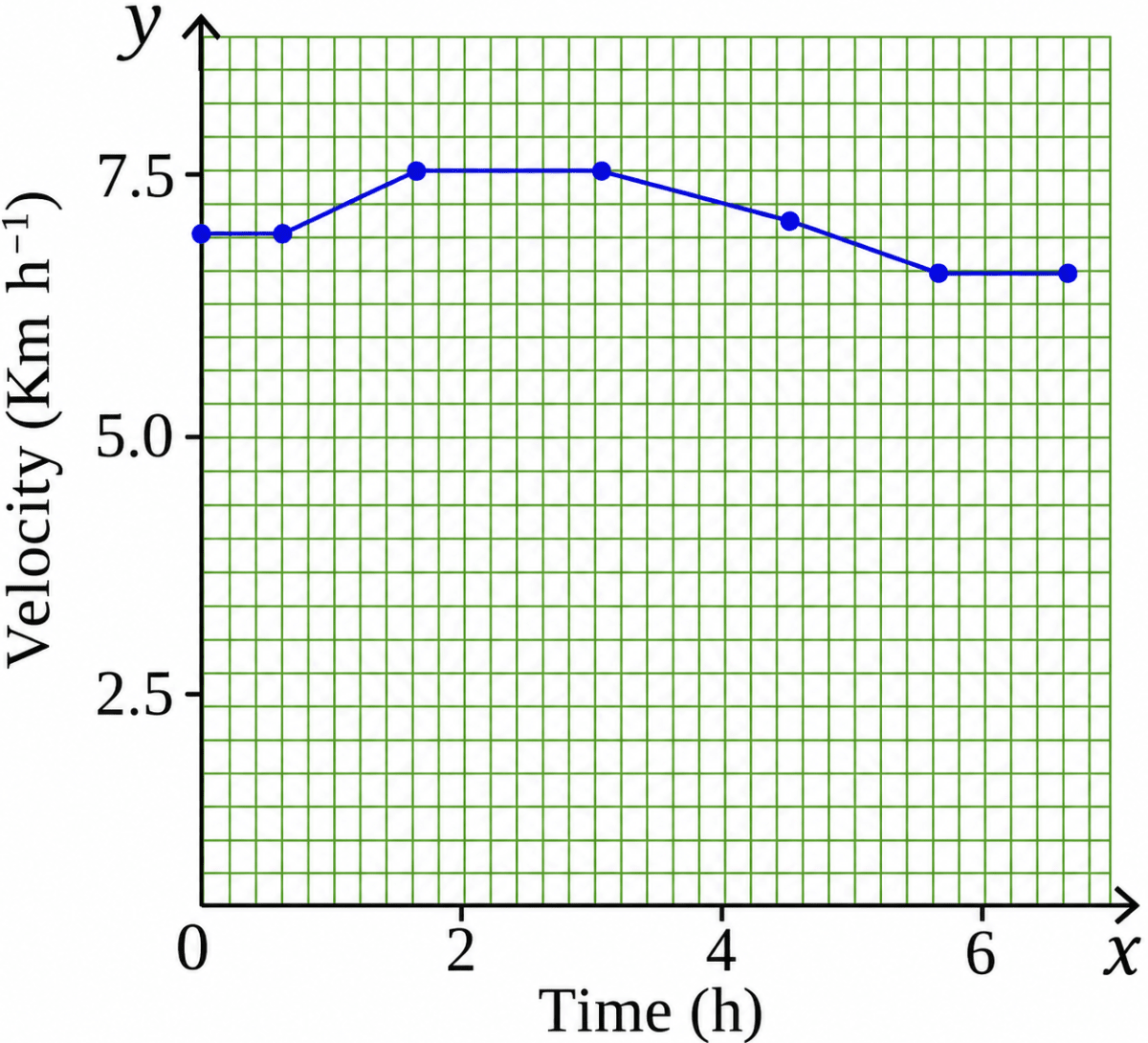
A girl is preparing for her first marathon by running on a straight road. She uses a smartwatch to calculate her running speed at different intervals. The graph (Fig. 4.31) depicts her velocity versus time. Estimate the running distance based on the graph.
Answer
The running distance is equal to the area enclosed between the velocity-time graph and the time axis.
Reading key points from the graph and calculating the area of each segment:
| Segment | Time (h) | Velocity (Km h-1) |
|---|---|---|
| Start | 0 ⟶ 0.6 | 7.0 |
| Rising | 0.6 ⟶ 1.6 | 7.0 ⟶ 7.5 |
| Steady | 1.6 ⟶ 3.0 | 7.5 |
| Falling | 3.0 ⟶ 4.6 | 7.5 ⟶ 7.0 |
| Slowing | 4.6 ⟶ 5.6 | 7.0 ⟶ 6.5 |
| End | 5.6 ⟶ 6.6 | 6.5 |
Here, the velocity is in km h–1 and the time is in hours, so the area gives the distance in kilometres.
Running distance ≈ sum of the areas under the velocity-time graph in different time intervals
= Area of rectangle (0 h ⟶ 0.6 h) + Area of trapezium (0.6 h ⟶ 1.6 h) + Area of rectangle (1.6 h ⟶ 3.0 h) + Area of trapezium (3.0 h ⟶ 4.6 h) + Area of trapezium (4.6 h ⟶ 5.6 h) + Area of rectangle (5.6 h ⟶ 6.6 h)
= (0.6 - 0) × 7.0 + × (7.0 + 7.5) × (1.6 - 0.6) + (3.0 - 1.6) × 7.5 + × (7.5 + 7.0) × (4.6 - 3.0) + × (7.0 + 6.5) × (5.6 - 4.6) + (6.6 - 5.6) × 6.5
= 0.6 × 7.0 + 0.5 × 14.5 × 1.0 + 1.4 × 7.5 + 0.5 × 14.5 × 1.6 + 0.5 × 13.5 × 1.0 + 1.0 × 6.5
= 4.2 + 7.25 + 10.5 + 11.6 + 6.75 + 6.5
= 46.8 km
Hence, the estimated running distance is approximately 46.8 km.
On entering a state highway, a car continues to move with a constant velocity of 6 m s–1 for 2 minutes and then accelerates with a constant acceleration 1 m s–2 for 6 seconds. Find the displacement of the car on the state highway in the 2 min 6 s time interval by drawing a velocity-time graph for its motion.
Answer
Given,
Initial velocity, u = 6 m s–1
Time for which the car moves with constant velocity = 2 min = 120 s
Acceleration, a = 1 m s–2
Time for which the car accelerates = 6 s
Final velocity after acceleration,
v = u + at
= 6 + 1 × 6
= 12 m s–1
The velocity-time graph is shown below:
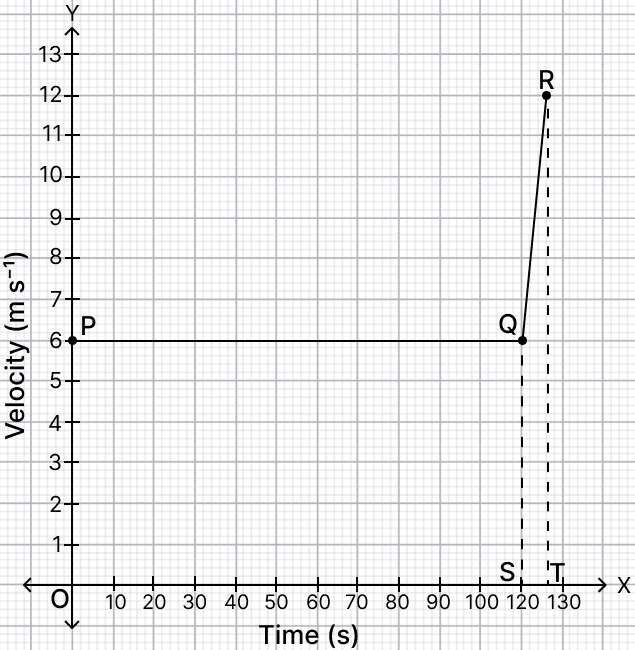
Displacement = area under the velocity-time graph
The area under the graph has two parts:
Area A (rectangle OPQS):
S1 = length × breadth = 120 × 6 = 720 m
Area B (trapezium QRTS):
S2 = × sum of parallel sides × height = × (6 + 12) × 6 = × 18 × 6 = 54 m
Total displacement,
S = S1 + S2 = 720 + 54 = 774 m
Hence, the displacement of the car in 2 min 6 s is 774 m.
Two cars A and B start moving with a constant acceleration from rest in a straight line. Car A attains a velocity of 5 m s–1 in 5 s. Car B attains a velocity of 3 m s–1 in 10 s. Plot the velocity-time graphs for both the cars in the same graph. Using the graph, calculate the displacement mentioned in the two time intervals (Hint: Calculate the acceleration in both cases. Then calculate their velocities at five instants of time to plot the graph).
Answer
Acceleration of Car A:
u = 0, v = 5 m s–1, t = 5 s
aA = = = 1 m s–2
Acceleration of Car B:
u = 0, v = 3 m s–1, t = 10 s
aB = = = 0.3 m s–2
Velocities at different instants of time (using v = u + at):
| Car A | Car B |
|---|---|
| At 0 s: 0 m s–1 | At 0 s: 0 m s–1 |
| At 1 s: 1 m s–1 | At 2 s: 0.6 m s–1 |
| At 2 s: 2 m s–1 | At 4 s: 1.2 m s–1 |
| At 3 s: 3 m s–1 | At 6 s: 1.8 m s–1 |
| At 4 s: 4 m s–1 | At 8 s: 2.4 m s–1 |
| At 5 s: 5 m s–1 | At 10 s: 3 m s–1 |
Plotting these points gives two straight lines starting from the origin, with the line for A being steeper than the line for B.
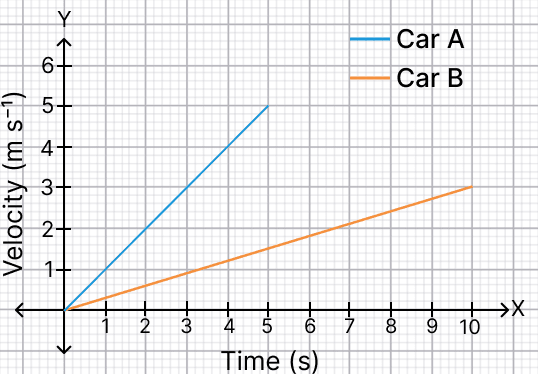
Displacement = area under the velocity-time graph.
Displacement of Car A (in 5 s) = area of triangle = × base × height
= × 5 × 5
= 12.5 m
Displacement of Car B (in 10 s) = area of triangle = × base × height
= × 10 × 3
= 15 m
Hence, Car A travels 12.5 m in 5 s and Car B travels 15 m in 10 s.
Rohan studies science from 6 PM to 7:30 PM at home. Consider the tip of the minute's hand of the wall clock. During the given time interval, what is its:
(i) distance travelled,
(ii) displacement,
(iii) speed, and
(iv) velocity.
The length of the minute's hand is 7 cm (Fig. 4.32).

Answer
Given,
Length of the minute's hand (radius), r = 7 cm
Time interval = 6:00 PM to 7:30 PM = 1 hour 30 minutes = 90 minutes
In 60 minutes the minute's hand completes 1 revolution.
∴ In 90 minutes, number of revolutions = = 1.5 revolutions
(i) Distance travelled
Distance covered in one revolution = circumference = 2πr
= 2 × × 7
= 44 cm
∴ Distance in 1.5 revolutions = 44 × 1.5 = 66 cm
(ii) Displacement
At 6:00 PM the tip is at the 12 mark. After 1.5 revolutions, the tip reaches the 6 mark, which is diametrically opposite to the starting position.
∴ Displacement = diameter of the circle = 2r = 2 × 7 = 14 cm (directed from the initial position towards the opposite point, i.e., vertically downward)
(iii) Speed
Time = 90 minutes = 90 × 60 = 5400 s
Speed = = = 0.0122 cm s–1 (approximately)
(iv) Velocity
Velocity = = = 0.0026 cm s-1 (approximately), directed from the initial position (12) towards the final position (6).