
How is the study of cells and tissues significant for understanding the life processes and human welfare?
Answer
The study of cells and tissues is significant because the cell is the basic unit of life and tissues are groups of similar cells that work together to perform specific functions. By studying cells and tissues, we can understand how life processes such as growth, movement, protection, transport, control and coordination take place in plants and animals.
This knowledge is also useful for human welfare. It helps scientists and doctors understand diseases, injuries and growth disorders. It is used in plant tissue culture to produce new plants, in agriculture to improve crops, and in medicine to study stem cells, tissue repair and treatment of diseases.
How are tissues in plants and animals different, and why?
Answer
Plant and animal tissues are different because plants and animals have different structures, modes of nutrition and patterns of growth. Plants are generally fixed in one place and need strong supporting tissues to remain upright. Their cells have cell walls, so many plant tissues provide rigidity and strength. Plants also have tissues such as xylem and phloem for transporting water, minerals and food.
Animals usually show movement and do not have rigid cell walls. Their tissues are more flexible and specialised for functions such as movement, protection, transport, control and coordination. For example, muscular tissue helps in movement, nervous tissue carries messages, epithelial tissue protects and lines organs, and connective tissue supports and connects different body parts.
Thus, plant tissues are suited for support, growth and transport in a fixed body, whereas animal tissues are suited for movement, coordination and complex body functions.
How is the division of labour at various levels of organisation in multicellular organisms correlated with their structure and function?
Answer
In multicellular organisms, division of labour means that different cells, tissues, organs and organ systems perform different specialised functions. This division of labour is closely related to their structure.
Cells with similar structure and function form a tissue. For example, muscle cells are long and contractile, so they form muscular tissue for movement. Neurons have long fibres, so they form nervous tissue for carrying messages. In plants, xylem cells are tubular and thick-walled, so they help in transport of water and provide strength.
Different tissues combine to form organs, and different organs form organ systems. Each level has a structure suited to its function. This organisation increases efficiency and allows multicellular organisms to carry out complex life processes.
You may have noticed that fibres of coconut husk are hard and brittle, whereas the leaf stalks of coriander are soft and flexible. Find out the reason.
Answer
The fibres of coconut husk are made of sclerenchyma. Sclerenchyma cells have thick walls due to the deposition of lignin and most of these cells are dead. This makes them hard, strong and brittle.
The leaf stalks of coriander are made of collenchyma. Collenchyma cells are living and have unevenly thickened corners due to the deposition of pectin, which gives them flexibility like rubber. This is why they remain soft and can bend without breaking.
Why do you think that a thick cuticle on the outer wall of epidermis is advantageous for a plant living in the desert but disadvantageous for a plant living underwater?
Answer
In a desert, water is scarce. The cuticle is a waxy, water-resistant layer secreted by epidermal cells. A thick cuticle reduces the loss of water through transpiration and also protects the plant from the intense heat and mechanical injury. Hence, it is advantageous for a desert plant.
A plant living underwater needs to exchange gases and absorb water and dissolved minerals directly through its surface. A thick, waterproof cuticle would block this exchange and absorption. Therefore, a thick cuticle would be disadvantageous for an underwater plant.
Once water is absorbed by plant roots, it has to travel against gravity through xylem. How do the 'dead' cells of the xylem work together with the living cells of leaves at the top to keep the water moving?
Answer
The xylem is made of tracheids and vessels, which are dead, tubular and thick-walled cells joined end to end. They form continuous, hollow pipe-like channels that run from the roots to the leaves, offering a low-resistance pathway for the upward movement of water.
The living cells of the leaves lose water in the form of water vapour through the stomata during transpiration. This loss of water creates a suction force called transpiration pull. The transpiration pull draws water upward through the column of water in the xylem. Thus, the dead xylem cells provide the pathway, while the living leaf cells generate the pull, and together they keep the water moving against gravity.
What do you think will happen if there were no stomata in the epidermis of the stem or leaves?
Answer
If there were no stomata in the epidermis of the stem or leaves:
- Exchange of gases would stop. Carbon dioxide could not enter for photosynthesis and oxygen could not be exchanged, so photosynthesis and respiration would be affected.
- Transpiration would not take place. This would stop the transpiration pull, and the upward transport of water and minerals through the xylem would be hampered.
- Elimination of excess water and wastes through transpiration would also be affected.
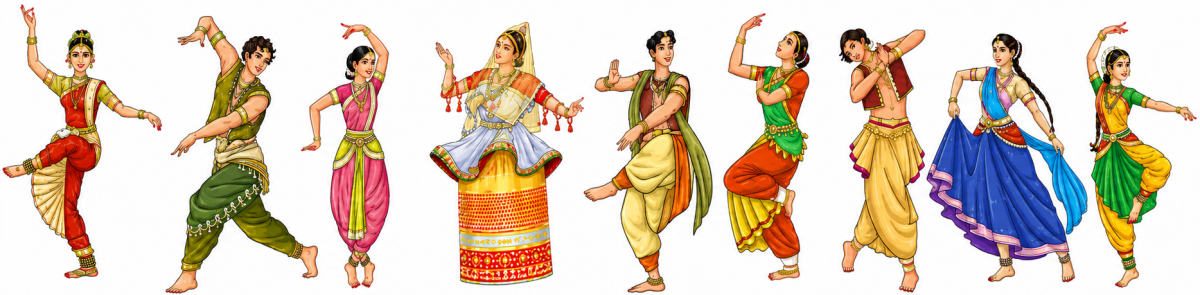
Look at the picture given below. Carefully observe the various poses of classical and folk dances of India. Can you identify which joints are involved? Also, what type of movement each joint allows?
Answer
The various dance poses involve different types of joints:
- Ball and socket joint (shoulder and hip) — allows free movement in all directions, i.e., forward, backward, sideways and circular movements. It is seen when the arms or legs are swung or raised in different directions.
- Hinge joint (elbow, knee and ankle) — allows movement in only one direction, like a door hinge (bending and straightening). It is seen when the arms or legs are bent.
- Pivot joint (between the skull and the backbone, at the neck) — allows the head to move side to side and turn. It is seen when the dancer turns or nods the head.
In his experiment on phloem cells of carrot, F. C. Steward used different combinations of nutrients and other factors, and obtained the following results.
Table 3.6: Effect of light, air and nutrient medium on growth of the cultured plant cells
| Light | Air | Composition of nutrient medium | Increase in fresh weight (mg) of the cells from initial weight |
|---|---|---|---|
| ✓ | ✗ | Solid medium + nutrients | reduced |
| ✓ | ✓ | Liquid medium + nutrients | 20% increased |
| ✗ | ✓ | Liquid medium + nutrients | reduced |
Based upon Table 3.6, think about these questions:
(a) What do you conclude about the characteristics of phloem cells of carrot?
(b) In which of the three combinations would you obtain the highest and lowest biomass? What could be the possible reason(s) for this observation?
(c) Will you get the same results if you culture animal cells instead of carrot cells?
(d) Think and mention any two commercial applications of the study above.
Answer
(a) The phloem cells of carrot are living and totipotent. They have the ability to dedifferentiate (regain the ability to divide), divide repeatedly and then redifferentiate to form roots, shoots and eventually a complete plant. Thus, even mature, specialised plant cells can give rise to a whole new plant under suitable conditions.
(b) The highest biomass is obtained in the second combination (Light present, Air present, liquid medium with nutrients), which shows a 20% increase in fresh weight. The lowest biomass is obtained in the first combination (Light present but Air absent, solid medium). The cells grow best when light, air and a liquid nutrient medium are all available, because air supplies oxygen for respiration and a liquid medium allows free movement of cells and easy availability of nutrients and gases. Growth is reduced when air (oxygen) is absent, as the cells cannot respire and divide properly.
(c) No, we will not get the same results with animal cells. Most mature animal cells are highly specialised and are generally not totipotent, so they usually cannot dedifferentiate and regenerate into a complete organism the way carrot phloem cells can.
(d) Two commercial applications:
- Plant tissue culture (micropropagation) — large numbers of identical, disease-free plants can be produced quickly from a few cells.
- Crop improvement and genetic engineering — desirable genes can be introduced and improved or disease-resistant varieties and valuable phytochemicals can be produced.
Meristematic tissues divide repeatedly. What property of their cells allows them to do this?
- They have thick walls for protection.
- They contain large vacuoles that store nutrients.
- They have thin walls, dense cytoplasm and large prominent nucleus.
- They are functionally differentiated cells.
Answer
They have thin walls, dense cytoplasm and large prominent nucleus.
Reason —
The thin walls allow the cells to expand and divide easily, the dense cytoplasm with many organelles supports active metabolism, and the large prominent nucleus controls the continuous cell division. Vacuoles are generally absent so that the cells stay small and divide rapidly. The other options are incorrect because thick walls would prevent division, large vacuoles are not present in meristematic cells, and functionally differentiated cells have already lost the ability to divide.
If a plant is unable to transport food from leaves to roots which tissue is malfunctioning?
- Xylem
- Phloem
- Epidermis
- Sclerenchyma
Answer
Phloem
Reason —
Phloem is the tissue that transports food prepared in the leaves to other parts of the plant, including the roots, through its sieve tubes. If food cannot move from the leaves to the roots, the phloem is malfunctioning. Xylem only transports water and minerals upward, the epidermis is a protective tissue, and sclerenchyma provides mechanical support, so none of these is responsible for food transport.
Why are the epithelial tissues that line an animal's internal organs usually only one or a few cells thick?
- To store food efficiently.
- To provide maximum strength.
- To allow quick exchange of materials across them.
- To reduce friction.
Answer
To allow quick exchange of materials across them.
Reason —
The epithelial tissues lining internal organs are only one or a few cells thick so that substances such as gases, nutrients and wastes can diffuse rapidly across them. A thin layer provides a short diffusion path, making the exchange of materials quick and efficient.
You can perform these two jumps (Fig. 3.21):
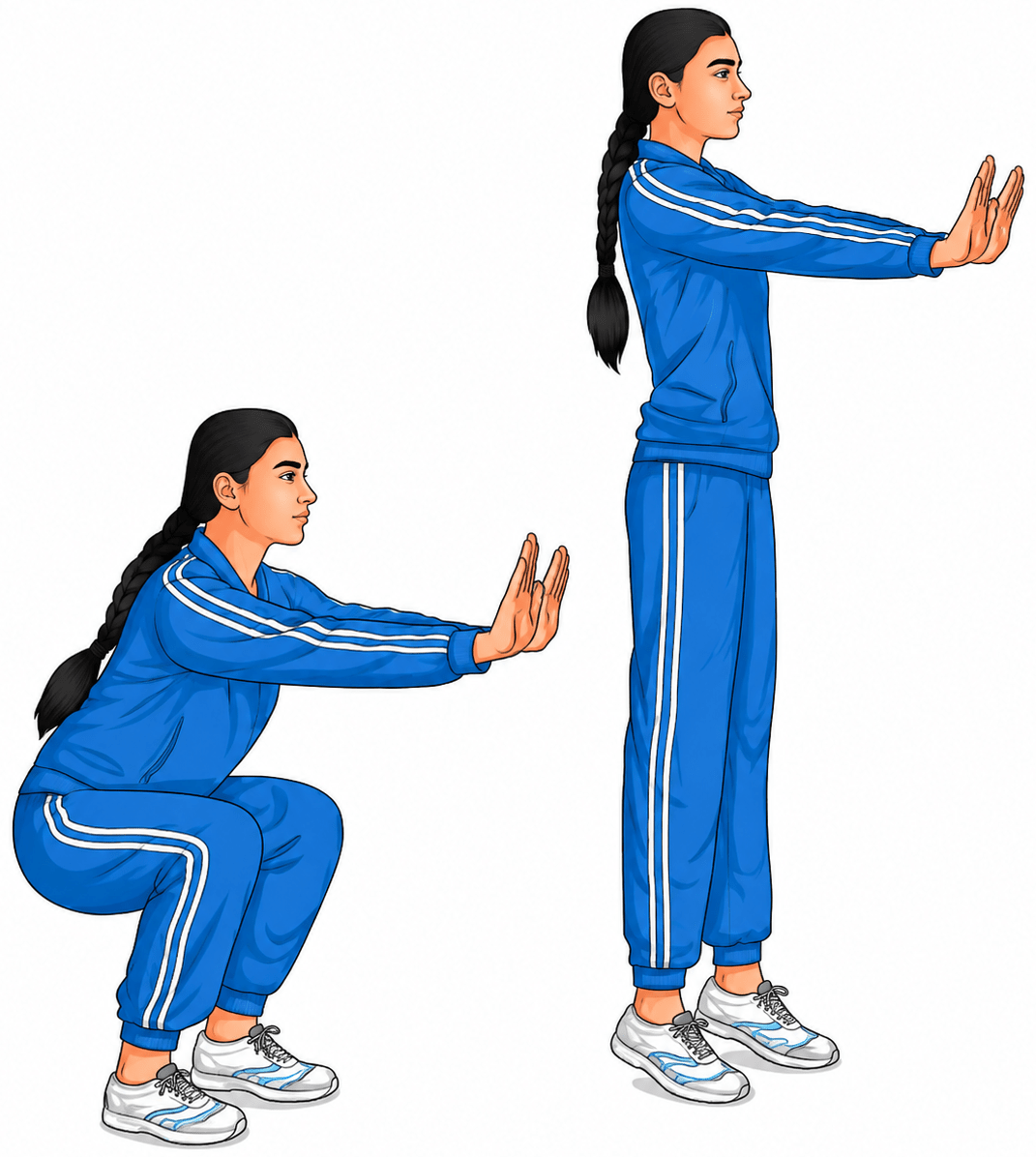
Straight-leg jump — keep knees and ankles stiff.
Normal jump — bend knees and ankles naturally.
How did your ankle, knee and hip positions differ between the two jumps?
Answer
In the straight-leg jump, the knees and ankles are kept stiff and do not bend. The hip also remains almost straight. As the joints do not flex, the body cannot absorb the shock of landing, so the landing is hard and jerky.
In the normal jump, the ankle, knee and hip joints bend (flex) naturally. The bending of these joints lets the muscles absorb the force of landing gradually, so the landing is smooth and cushioned, and there is less risk of injury.
Which type of joint is involved when you bend your knees and ankles?
- Ball and socket
- Hinge
- Pivot
Answer
Hinge
Reason —
The knee and the ankle bend and straighten in only one direction, like the hinge of a door. This back-and-forth movement in a single plane is characteristic of a hinge joint. A ball and socket joint allows movement in all directions, while a pivot joint allows rotation, so neither of these is involved in bending the knees and ankles.
Assertion: Epithelium is well-suited for gas exchange in the lungs.
Reason: It consists of multiple layers of tall cells that slow down diffusion.
- Both (A) and (R) are true, and (R) is the correct explanation of (A).
- Both (A) and (R) are true, but (R) is not the correct explanation of (A).
- (A) is true, but (R) is false.
- (A) is false, but (R) is true.
Answer
(A) is true, but (R) is false.
Explanation
The assertion is true because the epithelium lining the lungs is well-suited for gas exchange, as it is a single layer of thin, flat cells that allows rapid diffusion of gases.
The reason is false because this epithelium is not made of multiple layers of tall cells; if it were, the thickness would slow down diffusion rather than help it.
Therefore, (A) is true, but (R) is false is the correct option.
Assertion: Cardiac muscle can contract continuously without fatigue.
Reason: Cardiac muscle cells have a high number of mitochondria and an abundant blood supply.
- Both (A) and (R) are true, and (R) is the correct explanation of (A).
- Both (A) and (R) are true, but (R) is not the correct explanation of (A).
- (A) is true, but (R) is false.
- (A) is false, but (R) is true.
Answer
Both (A) and (R) are true, and (R) is the correct explanation of (A).
Explanation
The assertion is true because cardiac muscles work tirelessly and rhythmically throughout life without fatigue, enabling the heart to keep beating.
The reason is true and is the correct explanation because cardiac muscle cells have a large number of mitochondria, which produce a continuous supply of energy, and an abundant blood supply, which provides oxygen and nutrients constantly. Together these allow the muscle to contract without fatigue.
Therefore, Both (A) and (R) are true, and (R) is the correct explanation of (A) is the correct option.
Assertion: Tendons connect bone to bone and allow joint movement.
Reason: Tendons are made of tough connective tissue that transmits force from muscle to bone.
- Both (A) and (R) are true, and (R) is the correct explanation of (A).
- Both (A) and (R) are true, but (R) is not the correct explanation of (A).
- (A) is true, but (R) is false.
- (A) is false, but (R) is true.
Answer
(A) is false, but (R) is true.
Explanation
The assertion is false because tendons connect muscle to bone, not bone to bone; it is the ligaments that connect bone to bone.
The reason is true because tendons are indeed tough connective tissue that transmits the force of a contracting muscle to the bone to bring about movement.
Therefore, (A) is false, but (R) is true is the correct option.
Assertion: In a hinge joint, movement occurs primarily in one plane.
Reason: The bone ends are shaped to allow sliding in all directions.
- Both (A) and (R) are true, and (R) is the correct explanation of (A).
- Both (A) and (R) are true, but (R) is not the correct explanation of (A).
- (A) is true, but (R) is false.
- (A) is false, but (R) is true.
Answer
(A) is true, but (R) is false.
Explanation
The assertion is true because a hinge joint, such as the elbow or knee, allows movement in only one direction (one plane), like the hinge of a door.
The reason is false because in a hinge joint the bone ends do not allow sliding in all directions; movement in all directions is allowed by a ball and socket joint, not a hinge joint.
Therefore, (A) is true, but (R) is false is the correct option.
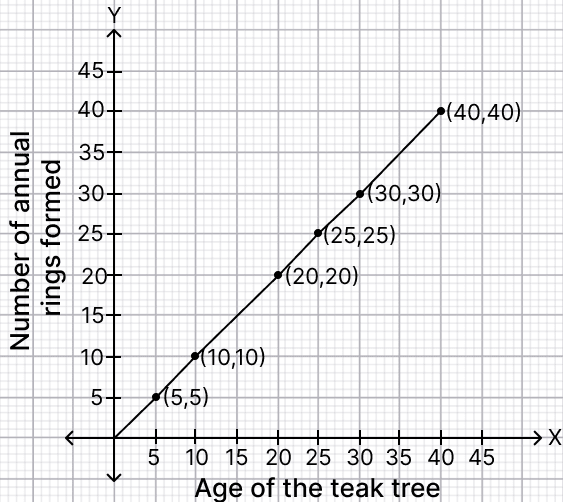
Plot a graph between the age of a tree (in years) on the x-axis and the diameter of the tree (in cm) along with the number of annual rings formed over time on the y-axis, using the data given in the Table 3.7.
Table 3.7: Data related to the age of a teak tree, and corresponding increase in the diameter of stem and number of annual rings
| S. No. | Age of the teak tree (Years) | DBH (Diameter at Breast Height) of tree (cm) | Number of annual rings formed |
|---|---|---|---|
| 1. | 5 | 4 | 5 |
| 2. | 10 | 8 | 10 |
| 3. | 20 | 24 | 20 |
| 4. | 25 | 28 | 25 |
| 5. | 30 | 32 | 30 |
| 6. | 40 | 40 | 40 |
(i) Analyse the graph in terms of the diameter of the stem over time and share the interpretation.
(ii) What is the relation between the diameter of the teak tree to the annual rings formed?
(iii) Which specialised tissue is responsible for the girth of the stem and where is it located?
Answer
The plotted graphs are shown below:
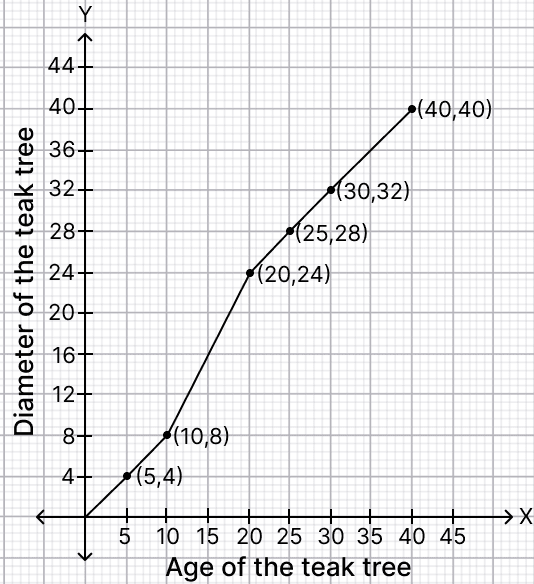
(i) The graph shows that the diameter (DBH) of the tree increases as the age of the tree increases. The curve rises steadily upwards, which means the stem becomes thicker (girth increases) with time. This continuous increase in diameter is due to the activity of the meristematic tissue that keeps adding new cells year after year.
(ii) The diameter of the teak tree and the number of annual rings are directly related. One annual ring is formed each year, so the number of annual rings is equal to the age of the tree. As the number of annual rings increases, the diameter of the tree also increases. Therefore, the diameter increases in proportion to the number of annual rings.
(iii) The lateral meristem (also called the lateral or vascular cambium) is responsible for the increase in girth of the stem. It is located along the circumference of the stem, arranged as a ring, where it divides to produce new cells towards the inside and the outside, increasing the diameter.
In a forest, it was observed that one of the trees was severely debarked by an elephant to meet its food requirements, as the bark is a rich source of nutrients (Fig. 3.22). Based on your learning, answer the following:
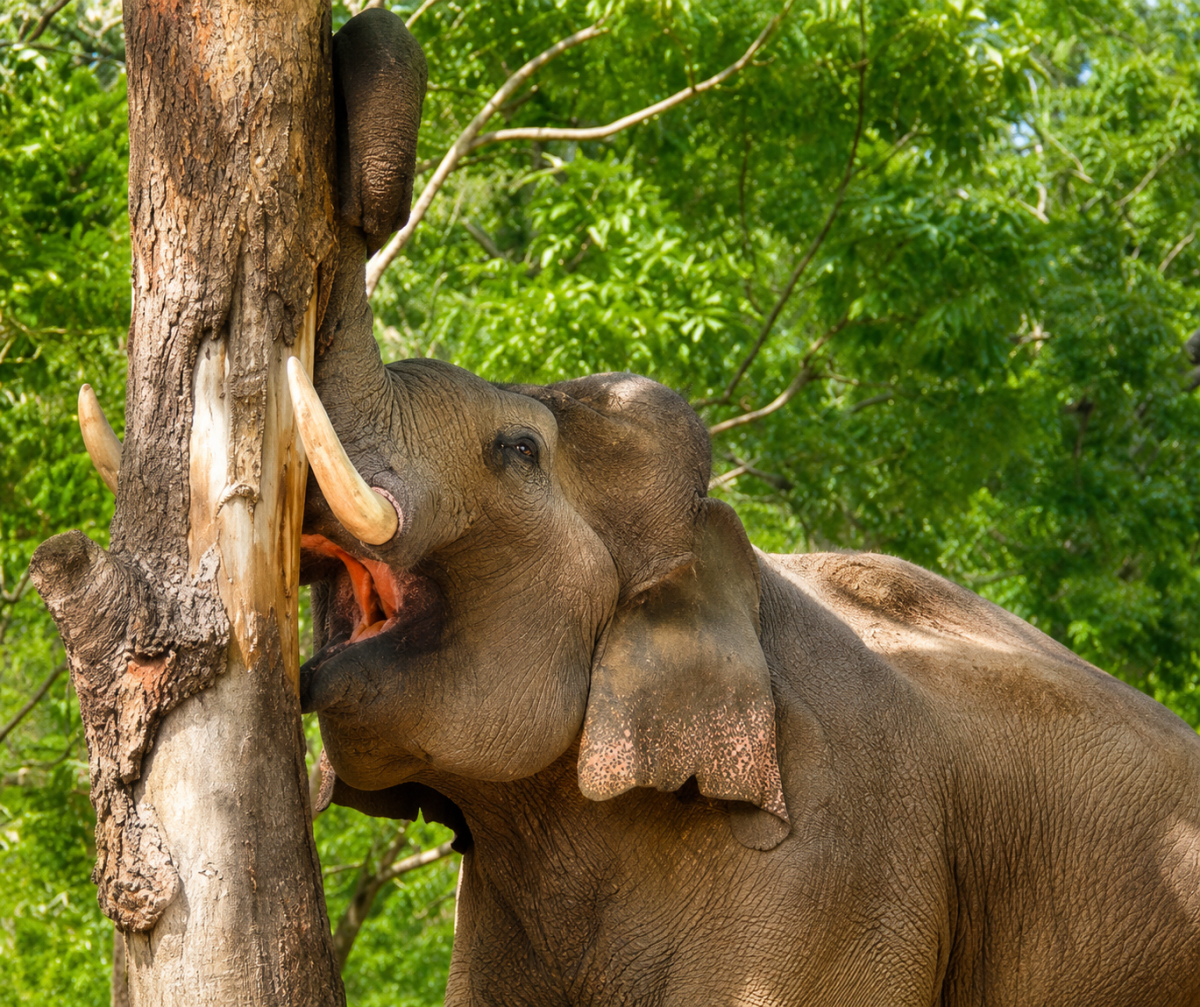
(i) Which function(s) of the tree is/are hampered by debarking?
(ii) Which plant tissue would be affected by further damage to the tree trunk even after debarking?
(iii) Which function of the tree would be hampered if the tissues beneath the bark were severely damaged?
(iv) What assumptions are you making to answer the questions above? How would the answer change if your assumptions are also changed?
Answer
(i) Debarking removes or damages the protective bark. Therefore, protection of the inner tissues from water loss, mechanical injury and infection is hampered. If the phloem present in the bark is also damaged, the transport of food prepared in the leaves to the roots and other parts of the tree is affected.
(ii) If the trunk is damaged further, beyond the bark and phloem, the xylem (the conducting tissue lying beneath the phloem) would be affected.
(iii) If the tissues beneath the bark (the xylem) were severely damaged, the transport of water and minerals from the roots to the leaves would be hampered. The xylem also gives strength to the stem, so the support and upright standing of the tree would also be affected.
(iv) The assumptions are that the tree is a woody (dicot) tree in which the bark is made of cork and phloem, and that the xylem lies just beneath the bark. If these assumptions change — for example, if only the outer dead cork was removed and the phloem remained intact — then food transport would not be greatly affected and the tree would be able to heal and survive.
Aamrapali observed that a young mango sapling's stem bends flexibly during monsoon winds and does not break. Which tissue is responsible for this flexibility? Predict and provide your explanation of the impact if the existing tissue was replaced by sclerenchyma.
Answer
The tissue responsible for this flexibility is collenchyma. Collenchyma consists of living cells with unevenly thickened corners due to pectin deposition, which provides both support and flexibility, allowing the stem to bend without breaking.
If collenchyma were replaced by sclerenchyma, the stem would become hard, rigid and brittle, because sclerenchyma cells have thick lignified walls and are mostly dead. The stem would lose its flexibility. As a result, instead of bending in the monsoon wind, the stiff stem would be more likely to snap or break.
Sohan designed an experiment for the regeneration of sugarcane, where he used cuttings to grow sugarcane. He used two types of cuttings, type 'A' and type 'B' (Fig. 3.23). After a few weeks, type 'B' cuttings sprouted and developed into sugarcane plants, whereas the type 'A' cuttings did not sprout.
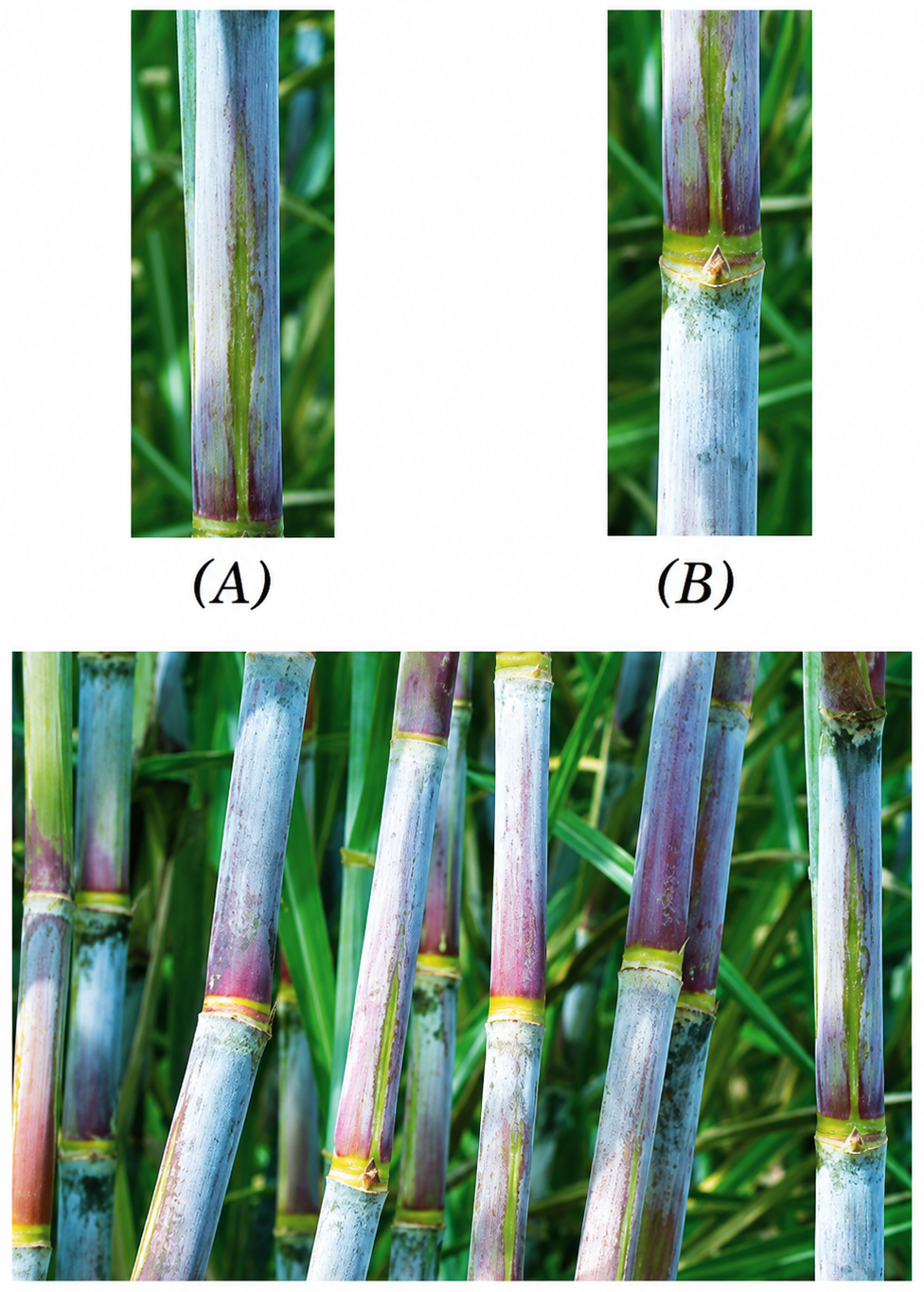
(i) Why were the type 'B' cuttings able to grow as sugarcane but type 'A' could not?
(ii) What difference was present in type 'B' compared to type 'A'?
(iii) What observation or measurement was made to determine whether this change had an effect?
(iv) What parameters should be kept the same for both types of cuttings to ensure a fair comparison?
Answer
(i) The type 'B' cuttings contained a node, which has meristematic tissue (intercalary meristem and buds) capable of dividing and giving rise to new shoots and roots. The type 'A' cuttings lacked a node, so they had no actively dividing cells to produce new growth and could not sprout.
(ii) Type 'B' had a node (with a bud), while type 'A' was taken from the internode and did not have a node.
(iii) The observation made was whether the cuttings sprouted and developed into sugarcane plants — that is, the appearance of new shoots/growth from the cuttings after a few weeks.
(iv) For a fair comparison, the following parameters should be kept the same for both types of cuttings: the type and variety of sugarcane, length and thickness of the cuttings, the soil, the amount of water, sunlight, temperature and the time period of observation. Only the presence or absence of a node should differ.
During the discussion in class, Rohan gives a statement that, "A tissue is a group of similar cells performing similar functions". But Rajiv counter argues that, "this is true in case of simple tissues but little different in case of complex tissues". Provide your explanation in view of the discussion in class.
Answer
Rohan's statement is correct for simple tissues. Simple permanent tissues, such as parenchyma, collenchyma and sclerenchyma, are made up of only one type of cell, and all the cells are similar in structure and perform the same function.
Rajiv is also right about complex tissues. Complex permanent tissues, such as xylem and phloem, are made up of more than one type of cell. For example, xylem contains tracheids, vessels, xylem parenchyma and xylem fibres, while phloem contains sieve tubes, companion cells, phloem parenchyma and phloem fibres. These different types of cells are not all alike, but they work together as a single unit to perform a common function (transport of water in xylem and food in phloem). So, in complex tissues, the cells are different in structure but coordinate to carry out one function.
Coconut husk fibres are used for mats which are tough and fibrous. Which tissue has structural features suitable for providing this strength? Explain why living parenchyma couldn't serve the same purpose.
Answer
The tissue that provides this strength is sclerenchyma. Sclerenchyma cells have thick walls due to the deposition of lignin and most of these cells are dead. This makes them hard, tough and strong, which is exactly why coconut husk fibres are suitable for making tough, fibrous mats.
Living parenchyma could not serve the same purpose because parenchyma cells have thin walls, are living, lack lignin and are loosely packed with intercellular spaces. They are soft and mainly meant for storage and photosynthesis, so they cannot provide the mechanical strength and toughness needed for mats.
Vibha claims to her friend Neha that, "Meristematic cells are located only at the root and shoot apices". What do you think about this statement? What question can Neha ask Vibha to help her understand further if the statement is incorrect?
Answer
Vibha's statement is incorrect. Meristematic cells (apical meristem) are present at the root and shoot apices, but they are not located only there. Plants also have lateral meristem, located along the circumference of the stem, which increases the girth, and intercalary meristem, located at the base of internodes or just above the nodes (as in grasses), which helps in regrowth after cutting or grazing.
Neha can ask Vibha questions such as:
- "If meristem is only at the tips, then how does the stem of a tree increase in thickness (girth)?"
- "How does grass grow back after it is mowed or grazed, if there are no dividing cells at its nodes?"
These questions would help Vibha realise that meristematic tissue is also present in lateral and intercalary positions, not just at the apices.
A plant cell and an animal cell are of the same size.
(i) Which cell will have a larger vacuole? Give reasons.
(ii) What assumptions are you making to answer the question above?
Answer
(i) The plant cell will have a larger vacuole. A mature plant cell usually has a single large central vacuole that may occupy most of the cell volume, and it helps to store cell sap and maintain the turgidity and shape of the cell. An animal cell, in contrast, has either no vacuole or only small, temporary vacuoles.
(ii) The assumptions are that the plant cell is a typical mature plant cell (and not a meristematic cell, since meristematic cells generally lack vacuoles) and that the animal cell is a typical, ordinary animal cell. We also assume both are normal, living cells of comparable, equal size.
A textbook states, "Each plant tissue performs only one specific function". What questions would you ask to critically examine the correctness of this statement? What examples of tissues would you take to find out the answers to these questions?
Answer
The statement is not fully correct, because many plant tissues perform more than one function. To critically examine it, the following questions could be asked:
- Does a single tissue ever carry out more than one function?
- Can the same tissue have different functions in different parts or conditions of the plant?
Examples of tissues to find out the answers:
- Parenchyma — it stores food, but it also performs photosynthesis in the green parts of the plant and forms air spaces that help aquatic plants to float. So one tissue has several functions.
- Epidermis — it protects the plant, but it also bears stomata for gaseous exchange and transpiration, and root hairs for the absorption of water and minerals.
- Xylem — it transports water and minerals, and it also provides mechanical strength to the plant.
These examples show that a single plant tissue can perform more than one function, so the textbook statement is not entirely correct.