
Where does a cell come from?
Answer
A cell comes from a pre-existing cell through the process of cell division. This is one of the main points of the Cell Theory. During cell division, a parent cell divides to form new daughter cells. In multicellular organisms, growth and repair occur when body cells divide by mitosis. In reproductive organs, cells divide by meiosis to form gametes.
How have technological interventions facilitated the creation of new knowledge in understanding the world beyond the naked eye?
Answer
Technological interventions such as microscopes have helped scientists study structures that cannot be seen with the unaided eye. Robert Hooke first observed cells in a thin slice of cork using a self-designed microscope. Light microscopes later helped students and scientists observe cells and their basic parts with better magnification and resolution. Powerful electron microscopes further revealed the fine details of cell structure, including many cell organelles, at the nanometre scale. Thus, improvements in magnification, resolution and contrast have created new knowledge about cells and the microscopic world.
How is the cell structural and functional unit of life?
Answer
The cell is the structural unit of life because all living organisms are made up of one or more cells. In multicellular organisms, similar cells form tissues, tissues form organs, and organs work together to form organ systems.
The cell is the functional unit of life because all basic life processes occur inside cells. The cell membrane controls the movement of substances in and out of the cell, the cytoplasm contains organelles, the nucleus controls cellular activities, mitochondria release energy, and other organelles perform specific functions. Therefore, the cell is the basic unit of both structure and function in living organisms.
How does a cell multiply?
Answer
A cell multiplies by cell division. In this process, new cells are formed from pre-existing cells. In mitosis, one parent cell divides to form two genetically identical daughter cells with the same number of chromosomes. Mitosis helps in growth, repair and replacement of old or damaged cells. In meiosis, cells in reproductive organs divide to form gametes with half the number of chromosomes. Thus, cell division allows organisms to grow, repair damaged tissues and reproduce.
What argument would you give for the necessity of a cell wall in plants usually fixed in one place versus in animals usually moving from one place to the other?
Answer
Plants generally cannot move from one place to another, so they need a rigid structure to withstand environmental stresses like wind and rain and to stay upright. The cell wall provides this rigidity and structural support, and also helps leaves and flowers remain firm and maintain their shape.
Animals, on the other hand, usually move from one place to another, so they require flexibility rather than rigidity. Animal cells do not have a cell wall, which allows them to change shape easily. This cellular flexibility supports the overall movement and functioning of animal tissues. A rigid cell wall would restrict this flexibility and hinder movement. Therefore, a cell wall is necessary in plants for support and rigidity, while its absence in animals allows flexibility and movement.
What consequences would you predict for a plant cell if its cell wall were to become as flexible as a cell membrane?
Answer
If the cell wall of a plant cell became as flexible as a cell membrane, the following consequences would be expected:
- The plant cell would lose its rigidity and definite shape.
- The plant would not be able to stay upright or withstand environmental stresses like wind and rain.
- When placed in a concentrated solution, the cell would shrink considerably (like an animal cell) instead of maintaining its shape, because the rigid wall would no longer hold the cell firm.
- The plant would lose its firmness and would wilt or collapse easily, as the wall would no longer provide structural support.
Why is it important to cut the two potato pieces in roughly equal size and measure their initial weight before placing them in different liquids?
Answer
Cutting the two potato pieces to roughly equal size ensures a fair comparison, as both pieces start with a similar surface area and volume. This way, any difference observed in the result is due to the different liquids (the variable being tested) and not due to differences in the pieces themselves.
Measuring the initial weight provides a baseline reference. By comparing the initial and final weights, the change in weight (increase or decrease) can be calculated accurately, which shows whether water has moved into or out of the cells by osmosis. This makes the experiment controlled and the results reliable.
Do white flowers contain any pigment? Give reasons.
Answer
White flowers do not contain coloured pigments. The bright colours of flowers and fruits come from plastids called chromoplasts, which contain pigments that may be yellow, orange or red. White flowers appear white because they lack these coloured pigments. They may contain colourless plastids called leucoplasts, which store food materials such as starch, oils or proteins but do not contain any pigment. Therefore, the white appearance is due to the absence of coloured pigments rather than the presence of a white pigment.
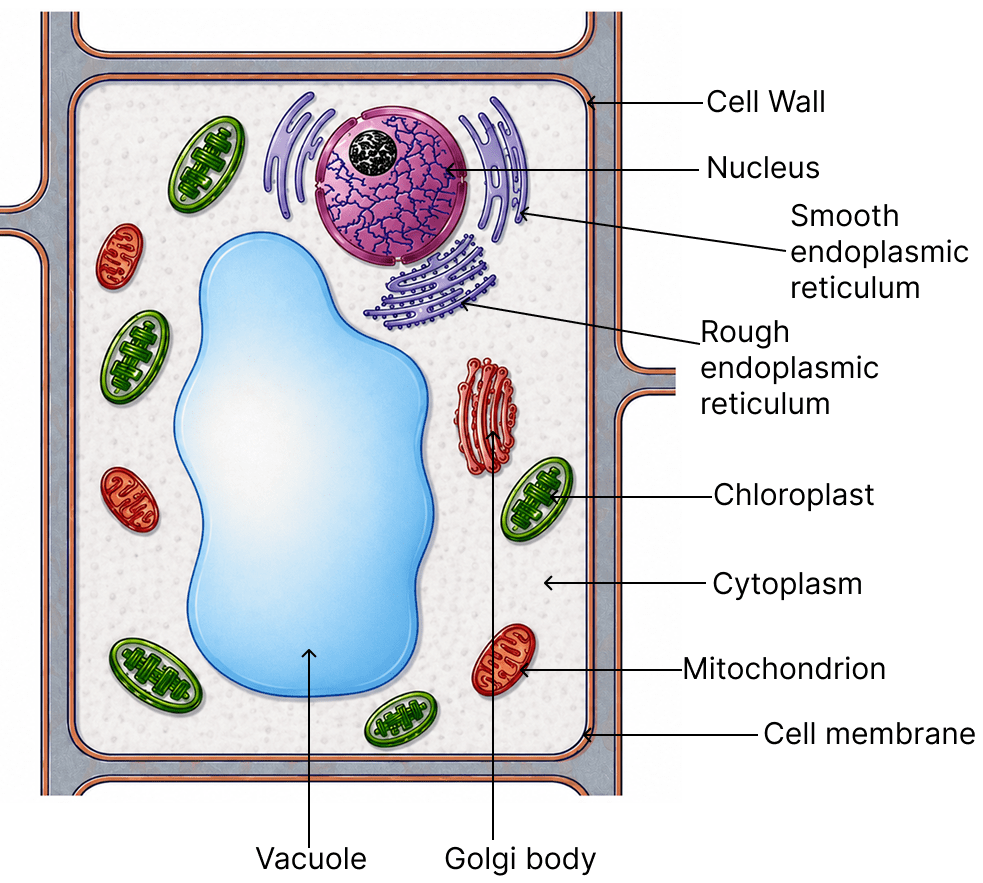
Draw a well-labelled schematic diagram of a plant or an animal cell using these clues —
(i) Nucleus appears as a dark and round body inside the cell.
(ii) ER spreads like a network of extended nuclear envelope.
(iii) Mitochondria and chloroplasts are rod shaped.
You may refer to Fig. 2.10.
Answer
A well-labelled schematic diagram of a plant cell drawn using the given clues:
- The nucleus is shown as a dark, round body inside the cell.
- The endoplasmic reticulum (ER) is drawn as a network spreading out from the nuclear envelope.
- The mitochondria and chloroplasts are shown as rod-shaped structures.
- The cell is bounded by a cell membrane, which is surrounded by a rigid cell wall, and contains a large central vacuole, Golgi body and ribosomes.
Instead of many small ones, why does a cell not have a single giant mitochondrion? How does this relate to the concept of surface area?
Answer
A cell has many small mitochondria instead of a single giant one because many small mitochondria together provide a much larger total surface area than a single large mitochondrion of the same volume.
This relates to the concept of surface area as follows: as an object becomes larger, its volume increases faster than its surface area, so the surface-area-to-volume ratio decreases. Mitochondria carry out cellular respiration on their inner membrane, which is folded into cristae to increase the surface area for chemical reactions and energy production. Many small mitochondria maximise the surface area available for these reactions, allowing more efficient release of energy (ATP). Additionally, several small mitochondria can be distributed throughout the cell to supply energy wherever it is needed.
If the skin cells start dividing by meiosis instead of mitosis, what do you think will happen to a cut on the skin?
Answer
Repair of a cut on the skin requires mitosis, which produces two genetically identical daughter cells with the same number of chromosomes as the parent cell. If skin cells started dividing by meiosis instead of mitosis, the new cells would have only half the number of chromosomes and would not be identical to the original skin cells.
As a result, the cut would not heal properly. The new cells produced would not be able to function normally as skin cells, so the wound would fail to close and the damaged tissue would not be replaced correctly. Meiosis is meant only for the formation of gametes and not for the growth and repair of body tissues.
Differentiate between the following pairs of terms based on the clues given in parentheses:
(i) Cell membrane and cell wall (permeability)
(ii) RER and SER (structure)
(iii) Chloroplasts and chromoplasts (pigments)
Answer
(i) Cell membrane and cell wall (permeability) — The cell membrane is selectively permeable, which means it allows some substances to pass through while blocking others. The cell wall is permeable, allowing water and some dissolved minerals to pass through it.
(ii) RER and SER (structure) — The Rough Endoplasmic Reticulum (RER) has ribosomes attached to its surface, which gives it a rough appearance under an electron microscope. The Smooth Endoplasmic Reticulum (SER) does not have ribosomes on its surface and therefore appears smooth.
(iii) Chloroplasts and chromoplasts (pigments) — Chloroplasts contain the green pigment chlorophyll. Chromoplasts contain other pigments that may be yellow, orange or red.
Two similar animal cells are placed in two different solutions:
- Cell X is placed in pure water.
- Cell Y is placed in a concentrated salt solution.
Cells are observed after some time. Cell X swells, and Cell Y shrinks. Which statement provides the correct explanation for the above observations?
(i) Salt molecules moved into Cell Y, causing it to shrink.
(ii) Water moved into Cell X and more water moved out of Cell Y than the salt solution entered in it.
(iii) Water moved into Cell X and moved out of Cell Y through the cell membrane.
(iv) Solute movement caused osmosis in both cells.
Answer
The correct statement is (iii) Water moved into Cell X and moved out of Cell Y through the cell membrane.
Cell X is placed in pure water, which is a dilute (hypotonic) solution. Water moves into the cell by osmosis from a region of higher water concentration (outside) to a region of lower water concentration (inside), so the cell swells. Cell Y is placed in a concentrated salt solution, which is a hypertonic solution. Here, water moves out of the cell by osmosis, so the cell shrinks. The cell membrane is selectively permeable and allows only water, not the salt, to pass through. This is why options involving the movement of salt molecules (i, ii) or solute movement (iv) are incorrect.
Look at the diagram of a cell in Fig. 2.20. Identify the parts labelled from (a) to (g) and correctly match them with their functions given below:
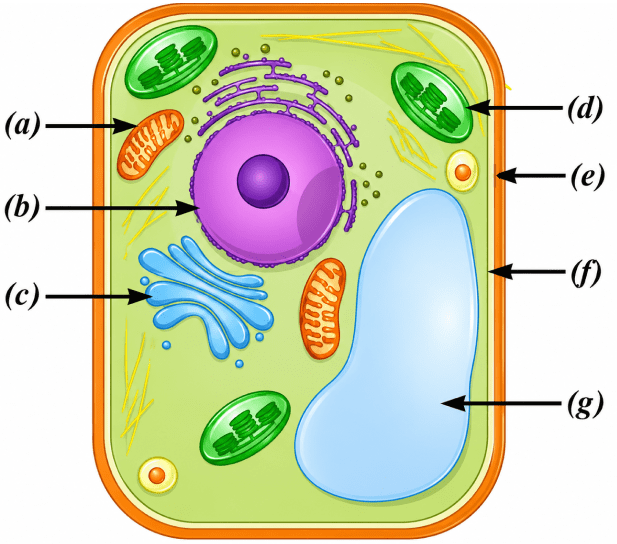
(i) Controlling all the activities of a cell.
(ii) Site of cellular respiration.
(iii) Storage organelle that also provides rigidity to the cell.
(iv) Separates the cell contents from surroundings.
(v) Provides structural rigidity to the cell.
(vi) Packs and stores materials received from ER.
(vii) Helps in manufacturing food.
Answer
The labelled parts of the plant cell and their matching functions are:
| Label | Part identified | Function |
|---|---|---|
| (a) | Mitochondria | (ii) Site of cellular respiration |
| (b) | Nucleus | (i) Controlling all the activities of a cell |
| (c) | Golgi apparatus | (vi) Packs and stores materials received from ER |
| (d) | Chloroplast | (vii) Helps in manufacturing food |
| (e) | Cell wall | (v) Provides structural rigidity to the cell |
| (f) | Cell membrane | (iv) Separates the cell contents from surroundings |
| (g) | Vacuole | (iii) Storage organelle that also provides rigidity to the cell |
Which of the following option(s) of the pairs of cell organelles are correctly placed under the given categories?
| Option | Present in the plant cells | Absent in the animal cells |
|---|---|---|
| (i) | Leucoplast | Cell wall |
| (ii) | Mitochondria | Ribosome |
| (iii) | Cell wall | Golgi apparatus |
| (iv) | Lysosome | Endoplasmic reticulum |
Answer
The correct option is (i) Leucoplast | Cell wall.
Leucoplast is a type of plastid that is present in plant cells (and absent in animal cells), so it is correctly placed under "Present in the plant cells." The cell wall is absent in animal cells, so it is correctly placed under "Absent in the animal cells."
The other options are incorrect because:
- (ii) Ribosomes are present in animal cells, so they are not "absent in the animal cells."
- (iii) The Golgi apparatus is present in animal cells, so it is not "absent in the animal cells."
- (iv) The endoplasmic reticulum is present in animal cells, so it is not "absent in the animal cells."
Two students, Renu and Rohit, were having a discussion on the plastids. Renu emphasised that all parts of the plants, even roots, contain plastids. However, Rohit did not agree with the statement and told her that plastids are absent in plant roots since the roots are underground and do not need to perform photosynthesis. Who is correct? Justify your answer.
Answer
Renu is correct. Plastids are present in all parts of a plant, including the roots. Rohit's mistake is assuming that all plastids are meant for photosynthesis. In fact, there are different types of plastids:
- Chloroplasts contain chlorophyll and carry out photosynthesis; these are mainly found in the green parts of the plant that are exposed to sunlight.
- Leucoplasts are colourless plastids that store food materials such as starch, oils and proteins. These are found in non-green parts of the plant, including roots.
Since roots are underground and do not perform photosynthesis, they do not contain chloroplasts but they do contain leucoplasts for storage. Therefore, plastids are indeed present in roots, and Renu is correct.
Mitochondria and chloroplasts are two important organelles in a plant cell. Discuss how these two organelles are structurally and functionally similar to each other, and different from each other.
Answer
Similarities:
- Both are double-membrane-bound organelles.
- Both have their own DNA and ribosomes, so they can make some of their own proteins.
- Both share an evolutionary history with certain single-celled organisms (bacteria).
- Both are involved in energy-related processes of the cell.
Differences:
| Mitochondria | Chloroplasts |
|---|---|
| Site of cellular respiration, where glucose is broken down to release energy (ATP). | Site of photosynthesis, where food (sugars) is synthesised using sunlight. |
| Present in both plant and animal cells. | Present only in plant cells (green parts). |
| Do not contain chlorophyll. | Contain the green pigment chlorophyll. |
| The inner membrane is folded into finger-like cristae. | Contain a semi-fluid stroma with disc-shaped membrane structures that contain chlorophyll. |
Which of the following pairs of cell organelles contains DNA?
(i) Chloroplasts, Ribosomes
(ii) Mitochondria, Nucleus
(iii) Golgi bodies, Ribosomes
(iv) Nucleus, Lysosomes
Answer
The correct pair is (ii) Mitochondria, Nucleus.
The nucleus contains chromosomes made of DNA, and mitochondria also have their own DNA. Ribosomes, Golgi bodies and lysosomes do not contain DNA, which is why the other options are incorrect. (Although chloroplasts also contain DNA, ribosomes in option (i) do not, so that pair is not fully correct.)
A researcher carried out an experiment in which she took two carrots of similar size. She placed one carrot in plain water and the other carrot in concentrated salt solution (Fig. 2.21). After 24 hours she recorded her observations.
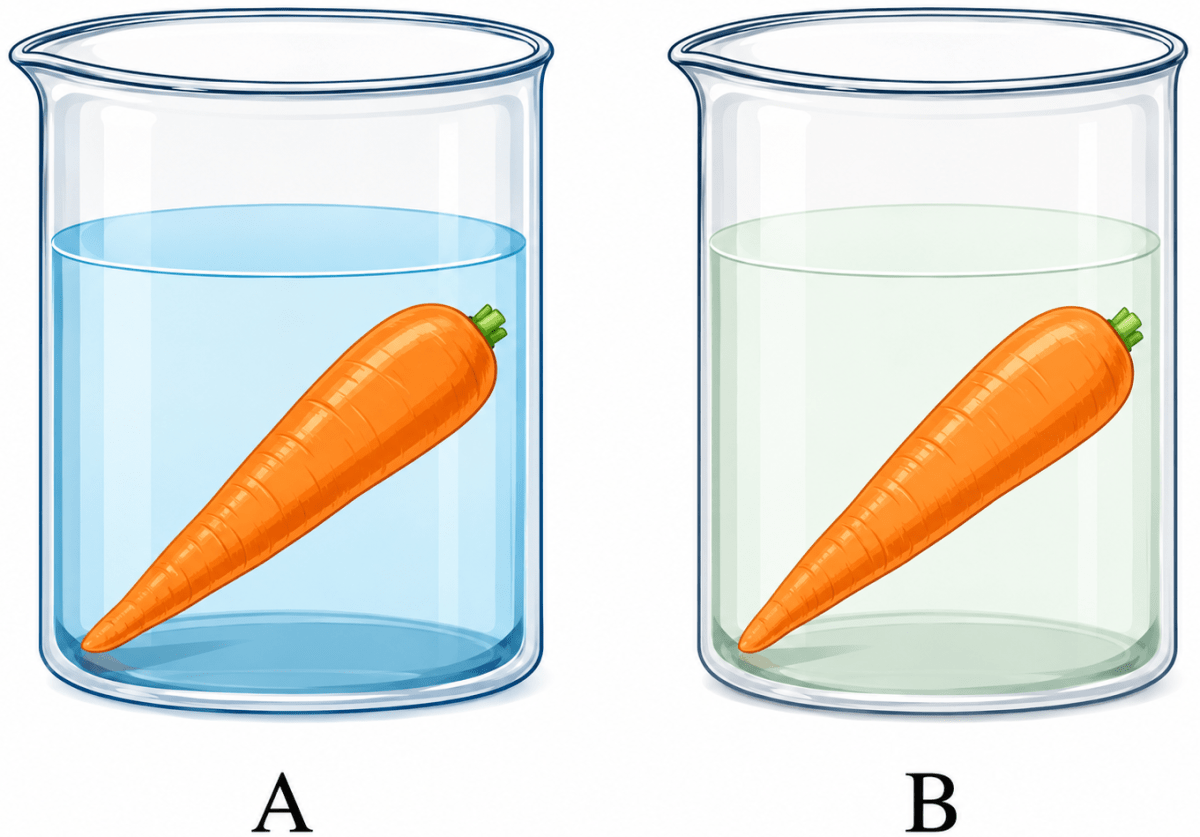
(i) What hypothesis does she want to test through this experiment?
(ii) What would you suggest for the improvement of this experiment?
(iii) Why does the carrot in plain water stay stiff and crunchy, but the carrot in concentrated salt solution become rubbery and limp?
Answer
(i) The hypothesis she wants to test is that water moves into or out of plant cells by osmosis depending on the concentration of the surrounding solution — that is, the firmness of the carrot depends on whether the surrounding solution is dilute or concentrated.
(ii) Improvements that can be suggested:
- Measure and record the initial and final weights of both carrots to obtain quantitative data.
- Use carrots of exactly equal size and weight.
- Keep the volume of solution, temperature and time the same for both carrots.
- Repeat the experiment a few times to make the results more reliable.
(iii) The carrot in plain water stays stiff and crunchy because plain water is a dilute (hypotonic) solution. Water moves into the carrot cells by osmosis, making the cells turgid and firm. The carrot in the concentrated salt solution becomes rubbery and limp because the salt solution is hypertonic. Water moves out of the carrot cells by osmosis, causing the cells to lose water and become flaccid, so the carrot turns limp and rubbery.
Indicate the presence or absence of following structures in bacterial and animal cells:
| Structures in a cell | Bacterial cell | Animal cell |
|---|---|---|
| Chromosome | ||
| Nucleus | ||
| Mitochondria | ||
| Golgi complex | ||
| Chromoplasts |
Answer
| Structures in a cell | Bacterial cell | Animal cell |
|---|---|---|
| Chromosome | Present (single, circular DNA) | Present |
| Nucleus | Absent (has a nucleoid instead) | Present |
| Mitochondria | Absent | Present |
| Golgi complex | Absent | Present |
| Chromoplasts | Absent | Absent |
Bacterial cells are prokaryotic, so they lack a well-defined nucleus and membrane-bound organelles such as mitochondria and the Golgi complex. Their genetic material is present as a single circular DNA molecule in a region called the nucleoid. Chromoplasts are plastids found only in plant cells, so they are absent in both bacterial and animal cells.
Carry out the following experiment:
Take four peeled potato halves and scoop each one out to make potato cups. One of these potato cups should be made from a boiled potato. Place each of the potato cups in a beaker containing water (Fig. 2.22). Now, set up the experiment as follows:
(a) Keep Cup A empty.
(b) Add one teaspoon sugar in Cup B.
(c) Add one teaspoon salt in Cup C.
(d) Add one teaspoon sugar in the boiled potato in Cup D.
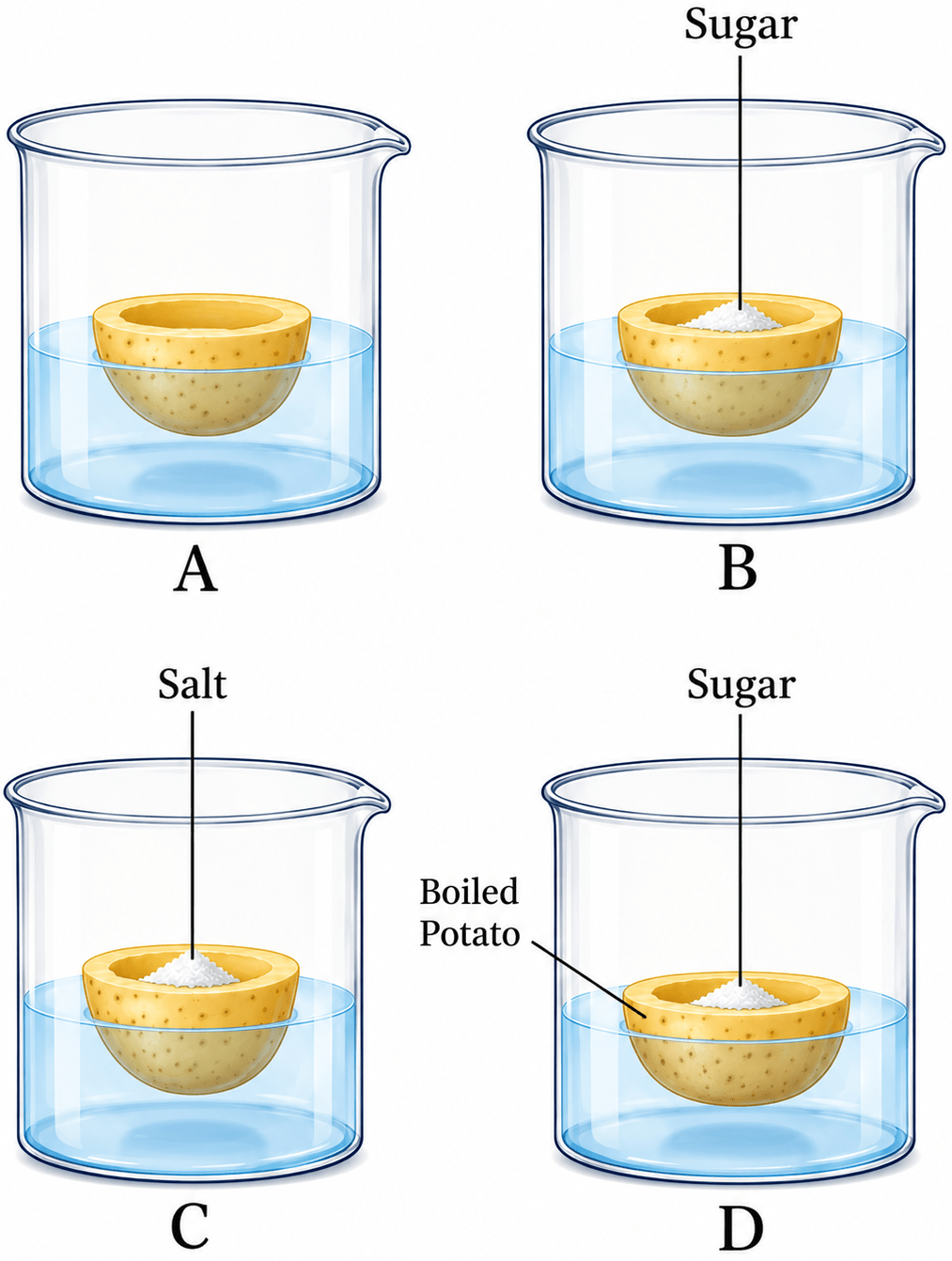
Observe the four potato cups for at least two hours and answer the following questions:
(i) Explain why water gathers in the hollowed portion of Cup B and Cup C.
(ii) Why is Cup A necessary for this experiment?
(iii) Explain why water does not gather in the hollowed portions of Cups A and D.
Answer
(i) Cups B and C contain sugar and salt respectively, which form a concentrated (hypertonic) solution inside the potato cups. The water in the beaker is a dilute (hypotonic) solution. Water therefore moves through the living potato cells from the beaker (higher water concentration) into the cup (lower water concentration, higher solute concentration) by the process of osmosis. As a result, water gathers in the hollowed portions of Cups B and C.
(ii) Cup A serves as the control for the experiment. It has no sugar or salt, so it shows what happens when there is no concentration difference. This provides a baseline against which the changes in Cups B, C and D can be compared.
(iii) In Cup A, no water gathers because there is no solute (sugar or salt) inside the cup, so the water inside and outside the potato are nearly equal in concentration (isotonic) and there is no net movement of water by osmosis. In Cup D, the potato is boiled, which kills its cells. The cell membranes are destroyed and can no longer act as selectively permeable membranes, so osmosis cannot take place and water does not gather in the cup.
Identify the pair that incorrectly matches the cell organelle with its function.
(i) Ribosome — Protein synthesis
(ii) SER — Lipid and cellulose synthesis
(iii) Lysosome — Digestion of foreign agents
Answer
The incorrectly matched pair is (ii) SER — Lipid and cellulose synthesis.
The Smooth Endoplasmic Reticulum (SER) is involved in the synthesis and storage of fats (lipids) and hormones. It is not involved in cellulose synthesis, so this pair is incorrectly matched. The other two pairs are correct: ribosomes are the sites of protein synthesis, and lysosomes contain enzymes that break down (digest) unwanted materials, worn-out parts and foreign agents.
What outcome do you expect, if all the mitochondria are removed from a eukaryotic cell?
Answer
Mitochondria are known as the powerhouse of the cell because they carry out cellular respiration, in which glucose and other molecules are broken down to release energy that is stored as ATP. If all the mitochondria are removed from a eukaryotic cell, the cell would not be able to produce energy through cellular respiration. Without ATP, the cell could not carry out its energy-requiring activities such as the synthesis of materials, transport, and movement. As a result, the cellular activities would stop and the cell would eventually die.
Which phenomenon inhibits the formation of tumors in the human body? Can plants also develop tumors? Explain.
Answer
The phenomenon that inhibits the formation of tumours in the human body is contact inhibition. In many animal cells, cell division usually stops when the cells come in contact with neighbouring cells. This controls cell division and prevents the cells from growing uncontrollably. Cancer cells lose this control and keep dividing, leading to the formation of tumours.
Plant cells do not show contact inhibition because of their rigid cell walls and follow a different pattern of growth. Plants may develop localised tumour-like growths, but these do not spread through the plant body like malignant tumours in animals.
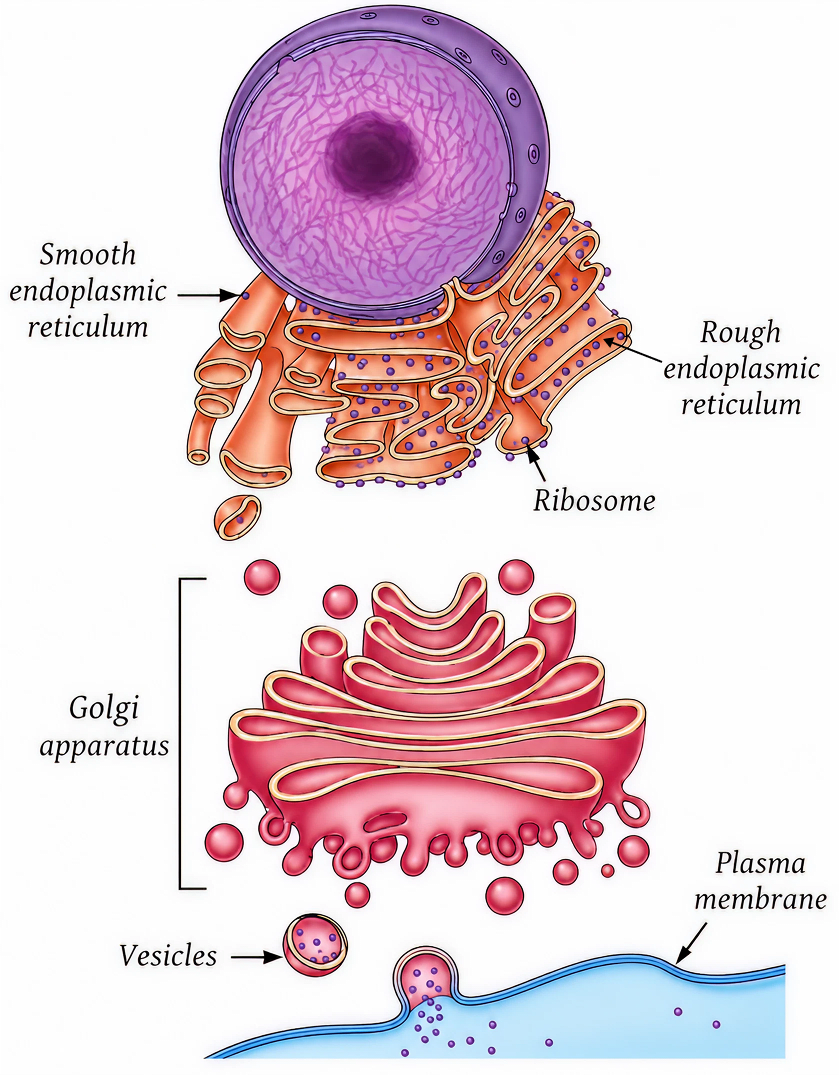
The cell membrane of a cell is made up of proteins and lipids. Which cell organelles help in the synthesis of cell membrane? Write the path of these compounds from their site of synthesis to the cell membrane and show this through a labelled diagram.
Answer
The cell membrane is made up of proteins and lipids, and the following organelles help in their synthesis:
- Proteins are synthesised by ribosomes attached to the Rough Endoplasmic Reticulum (RER).
- Lipids are synthesised by the Smooth Endoplasmic Reticulum (SER).
Path of these compounds to the cell membrane:
- Proteins are synthesised by ribosomes on the RER, and lipids are synthesised by the SER.
- From the ER, these proteins and lipids are transported to the Golgi apparatus.
- The Golgi apparatus modifies, sorts and packages them into vesicles.
- These vesicles move towards the cell membrane and fuse with it, thereby contributing the proteins and lipids to the cell membrane.
So the path is: RER (proteins) and SER (lipids) → Golgi apparatus → vesicles → plasma membrane (cell membrane).
What would happen if gametes are formed by mitotic divisions?
Answer
Gametes are normally formed by meiosis, in which the number of chromosomes is reduced to half (the gametes become haploid). During fertilisation, two gametes combine and the original chromosome number is restored.
If gametes were formed by mitotic divisions instead of meiosis, each gamete would have the full number of chromosomes (the same as the parent cell), not half. When two such gametes fused during fertilisation, the offspring would have double the normal number of chromosomes. With every generation, the chromosome number would keep doubling. This would disrupt the genetic stability of the species and lead to abnormalities. Therefore, meiosis is essential for keeping the chromosome number constant from one generation to the next.
A farmer, Deepa, was very happy with the harvest of amla (Indian Gooseberry) and lemons on her farm. However, she could sell only one-fourth of the produce in the local market. Recognising that a significant amount of produce may be lost post-harvest, she employed a traditional yet scientifically sound method to extend the shelf life of amla and lemons. She turned perishable produce into profitable products, such as pickles and sharbat. She used the excess produce to prepare pickles, murabbas, and sharbat by adding appropriate amounts of salt, sugar, or jaggery to small pieces of fruit and their juices. These were then stored in small glass bottles for sale, helping her prevent the wastage of post-harvest produce. This shift from farming to agro-processing would strengthen food security and boost the local economy, creating a sustainable model that cuts waste while increasing her income. Based on the above passage answer the following questions:
(i) Which scientific concept has the farmer applied in the preservation of the farm produce?
(ii) How does the addition of high concentrations of salt and sugar create an environment that prevents the growth of spoilage-causing bacteria and fungi?
(iii) Suggest a healthy recipe of this kind for food preservation.
(iv) What are the scientific values addressed in this case?
Answer
(i) The farmer has applied the scientific concept of osmosis in the preservation of her farm produce. By adding high concentrations of salt and sugar, she creates a concentrated (hypertonic) environment that preserves the food.
(ii) When high concentrations of salt and sugar are added, the surroundings of the spoilage-causing bacteria and fungi become hypertonic (more concentrated than the inside of the microbial cells). By osmosis, water moves out of the microbial cells, from their higher water concentration inside to the lower water concentration outside. This loss of water dehydrates the microbes and prevents them from growing and multiplying, thereby stopping spoilage of the food.
(iii) A healthy recipe of this kind: Amla murabba prepared with jaggery. Clean and prick fresh amla pieces, boil them briefly to soften, and then cook them in a concentrated jaggery syrup. The concentrated syrup draws water out of spoilage-causing microbes by osmosis and helps preserve the amla. The murabba can be stored in clean glass jars. Other examples include lemon pickle with salt or sun-dried salted vegetables.
(iv) The scientific values addressed in this case include:
- Application of scientific knowledge (osmosis) to solve a real-life problem.
- Reduction of food wastage and promotion of sustainability.
- Strengthening of food security.
- Resourcefulness, innovation and entrepreneurship.
- Respect for and use of traditional knowledge in a scientifically sound way.
- Contribution to the local economy and self-reliance.