
(i) Here is a way of understanding why the formula V = lwh is true: think of a cuboid as a large number of thin rectangular pieces (length l, width w) stacked on top of each other, like a pack of playing cards.
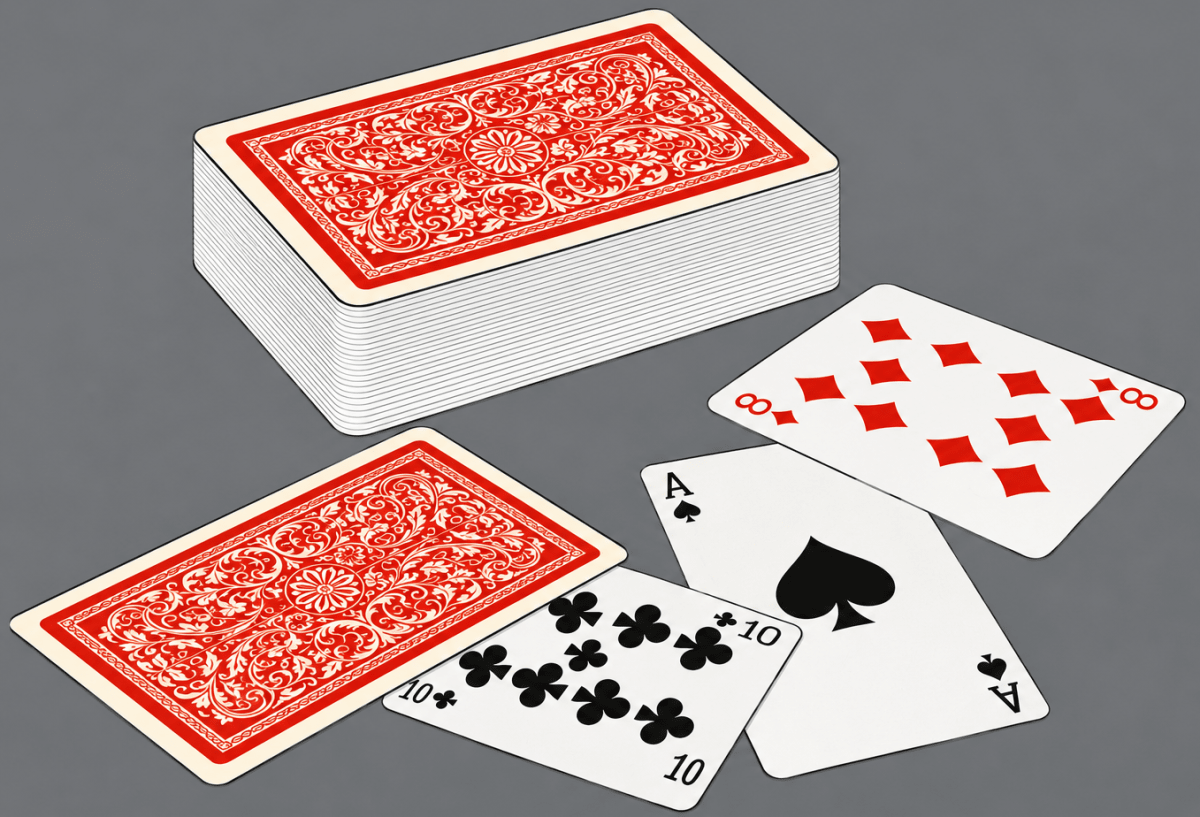
Try to work out for yourself why this model explains the formula for the volume of a cuboid, i.e.,
volume = area of base × height.
(ii) Write the formula for the surface area and the volume of a cube.
Answer
(i)
Every thin piece in the stack has the same length l and the same width w as the base of the cuboid. So the face of each piece is a copy of the base.
Area of the face of each piece = l × w = area of base
The volume of a cuboid is the number of unit cubes that fit into it. Group the thin pieces into layers, each 1 unit thick.
Number of unit cubes in one layer = l × w = area of base
The layers are stacked up to the height h of the cuboid, so there are h such layers.
Number of unit cubes in the cuboid = (number of unit cubes in one layer) × (number of layers)
= area of base × h
= l × w × h
So, however thin the pieces are, piling them up adds the same base area again and again until the height h is reached.
Hence, the stacking model shows that volume of a cuboid = area of base × height, i.e., V = lwh.
(ii)
A cube is a cuboid whose length, width and height are all equal to its side a.
Putting l = w = h = a in the formulas for a cuboid:
Total Surface Area = 2(wl + hl + hw)
= 2(a × a + a × a + a × a)
= 2(a2 + a2 + a2)
= 2 × 3a2
= 6a2
Volume = l × w × h
= a × a × a
= a3
Hence, for a cube of side a, Total Surface Area = 6a2 square units and Volume = a3 cubic units.
The volume of a cube is 64 cm3. What is its total surface area?
Answer
Given:
Volume of the cube = 64 cm3
Let the side of the cube = a cm.
We know the formula,
Volume of a cube = a3
a3 = 64
⇒ a =
⇒ a = 4 cm [∵ 4 × 4 × 4 = 64]
Total surface area of a cube = 6a2
= 6 × 42 cm2
= 6 × 16 cm2
= 96 cm2
Hence, the total surface area of the cube is 96 cm2.
How many small cubes with side 20 cm can be packed tight in a cubical box with side 2 m?
Answer
Given:
Side of each small cube = a = 20 cm
Side of the cubical box = b = 2 m
Converting into centimetres:
1 m = 100 cm
2 m = x
x = 2 × 100 cm = 200 cm
Side of the box = b = 200 cm
Volume of the box = b3
= 200 × 200 × 200 cm3
= 80,00,000 cm3
Volume of a small cube = a3
= 20 × 20 × 20 cm3
= 8000 cm3
No. of small cubes =
=
= 1000
Hence, 1000 small cubes can be packed in the box.
The dimensions of a godown are 40 m × 25 m × 10 m. If it is filled with cuboidal boxes, each of dimensions 2 m × 1.25 m × 1 m, then find the number of boxes.
Answer
Given:
Godown: length = 40 m, width = 25 m, height = 10 m
Each box: length = 2 m, width = 1.25 m, height = 1 m
We know the formula,
Volume of a cuboid = l × w × h
Volume of the godown = 40 × 25 × 10 m3
= 1000 × 10 m3
= 10000 m3
Volume of one box = 2 × 1.25 × 1 m3
= 2.5 m3
No. of boxes =
Hence, 4000 boxes can be placed in the godown.
Two cubes each of volume 125 cm3 are joined end to end. Find the surface area of the resulting cuboid.
Answer
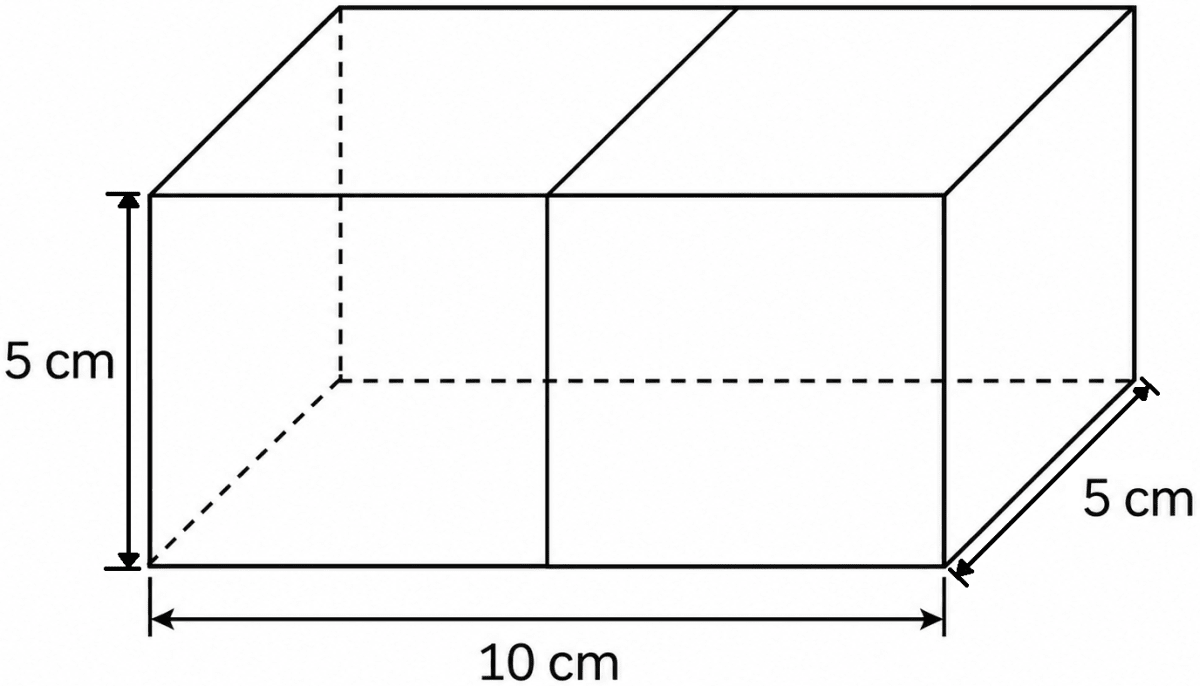
Given:
Volume of each cube = 125 cm3
Let the side of each cube = a cm.
Volume of a cube = a3
a3 = 125
⇒ a =
⇒ a = 5 cm [∵ 5 × 5 × 5 = 125]
When the two cubes are joined end to end, the resulting cuboid has:
Length (l) = 5 cm + 5 cm = 10 cm
Width (w) = 5 cm
Height (h) = 5 cm
We know the formula,
Total surface area of a cuboid = 2(lw + wh + hl)
= 2(10 × 5 + 5 × 5 + 5 × 10) cm2
= 2(50 + 25 + 50) cm2
= 2 × 125 cm2
= 250 cm2
Check: The two cubes have 12 faces of 5 × 5 = 25 cm2 each; joining hides 2 faces, leaving 10 × 25 = 250 cm2.
Hence, the surface area of the resulting cuboid is 250 cm2.
A cube of side 4 cm is cut into cubes of side 1 cm. What is the ratio of the surface areas of the original cube and all the cut-out cubes? (Note that there is no change in volume but a big change in the surface area. This property has major consequences in the biological world.)
Answer
Given:
Side of the original cube = 4 cm
Side of each cut-out cube = 1 cm
Surface area of the original cube = 6a2
= 6 × 42 cm2
= 6 × 16 cm2
= 96 cm2
Volume of the original cube = a3 = 43 = 64
Volume of one cut-out cube = a3 = 13 = 1
No. of cut-out cubes =
surface area of one cut-out cube = 6a2 = 6 × 12 cm2 = 6 cm2
TSA of all the cut-out cubes = Surface area of one cut-out cube × No. of cut-out cubes
= 6 × 64 cm2
= 384 cm2
Required ratio =
Hence, the ratio of the surface areas is 1 : 4.
The surface areas of the three faces of a cuboid that meet at one of the corners of the cuboid are 6 cm2, 15 cm2, and 10 cm2 respectively. What is the volume of the cuboid?
Answer
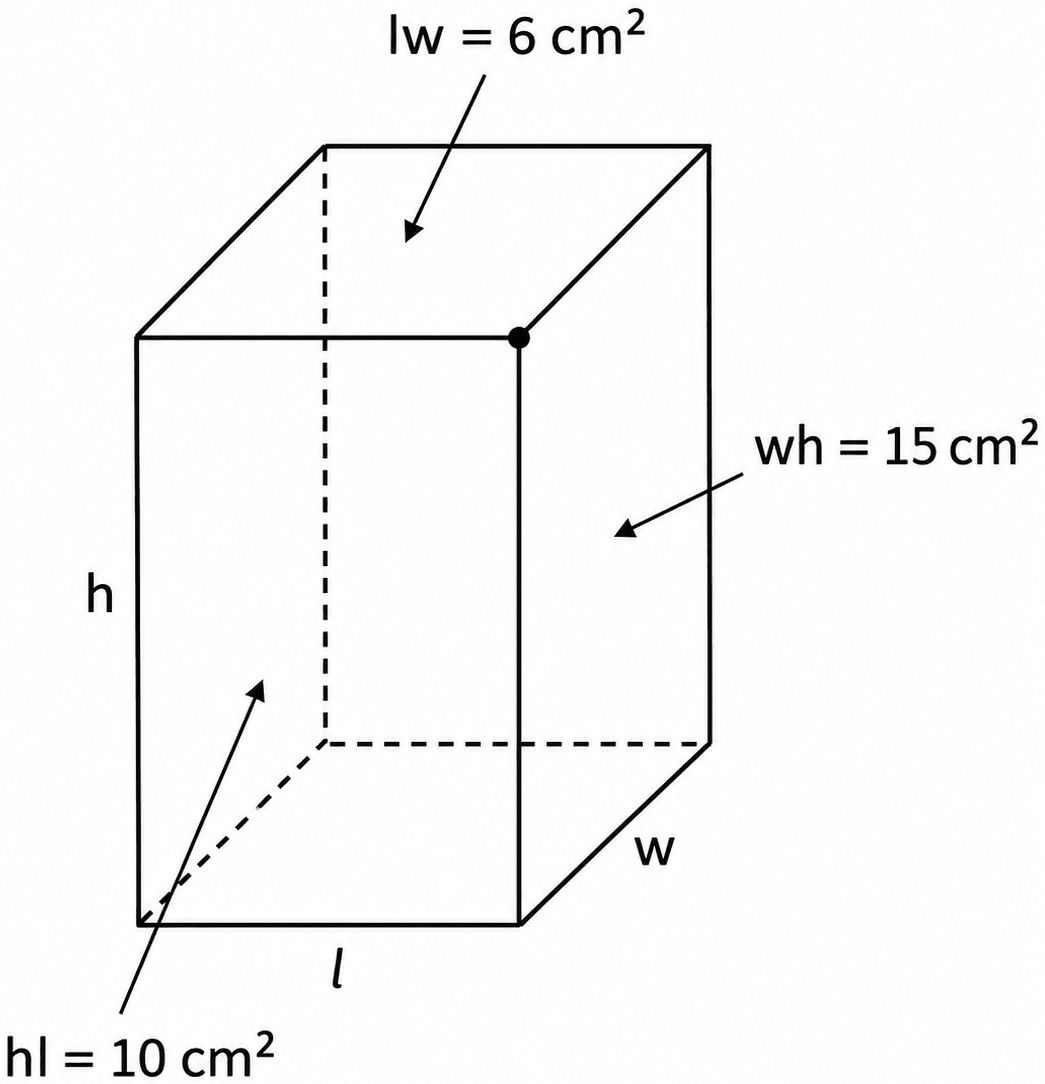
Let the length, width and height of the cuboid be l, w and h (in cm).
The three faces meeting at a corner have areas lw, wh and hl.
lw = 6 cm2 ...(1)
wh = 15 cm2 ...(2)
hl = 10 cm2 ...(3)
Multiplying (1), (2) and (3),
(lw) × (wh) × (hl) = 6 × 15 × 10
⇒ l2w2h2 = 900
⇒ (lwh)2 = 900
⇒ lwh =
⇒ lwh = 30
Volume of the cuboid = lwh = 30 cm3
Check: h = = 5 cm, l = = 2 cm, w = = 3 cm; and 2 × 3 = 6, 3 × 5 = 15, 5 × 2 = 10.
Hence, the volume of the cuboid is 30 cm3.
A cube of side 5 cm is painted on all its faces. If it is sliced into 1 cm3 cubes, how many of these 1 cm3 cubes have
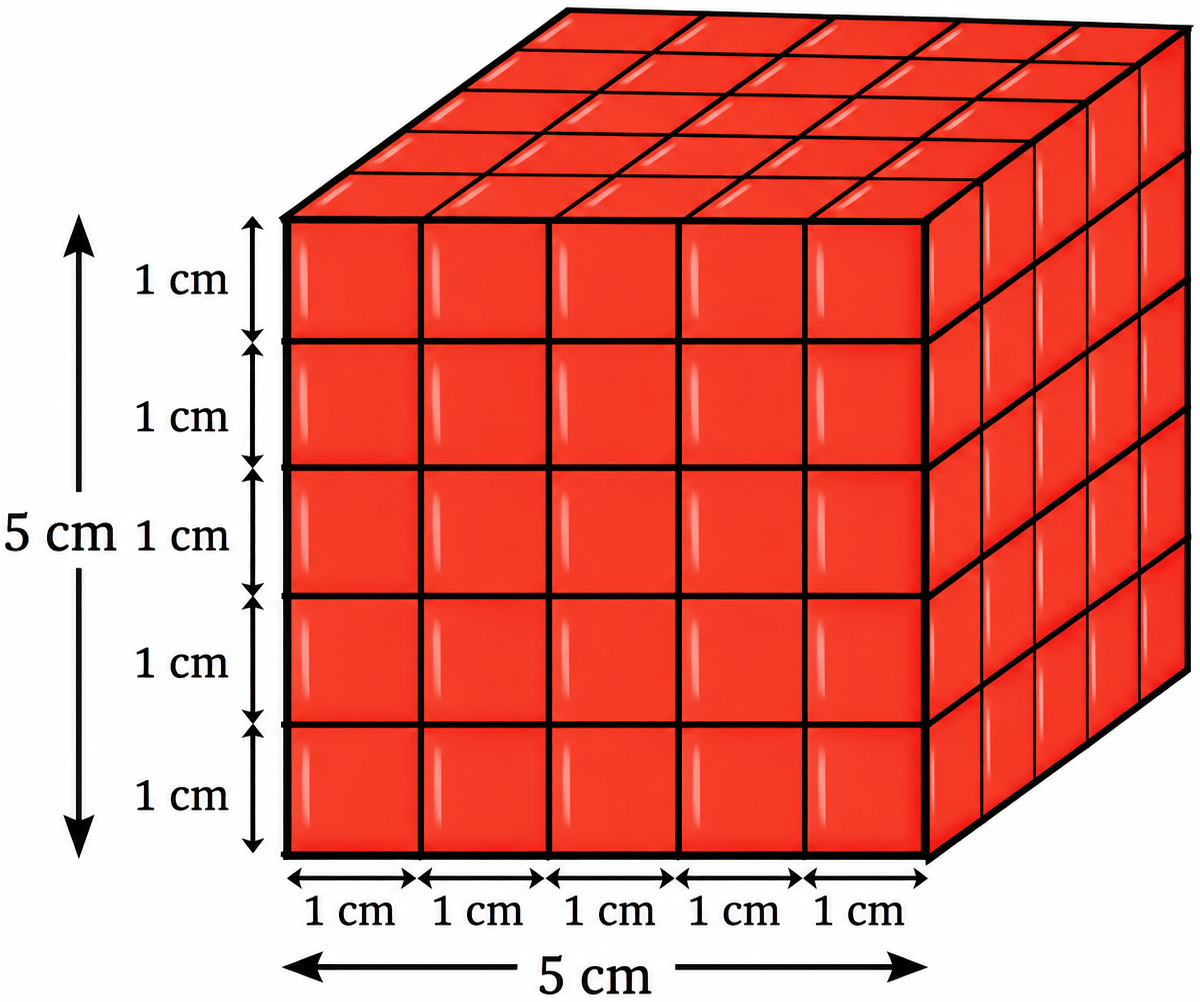
(i) exactly three faces painted?
(ii) exactly two faces painted?
(iii) exactly one face painted?
(iv) no face painted?
Answer
Each edge of the cube is 5 cm, so it is cut into 5 small cubes along each edge.
Total number of 1 cm3 cubes = 5 × 5 × 5 = 125
(i) A small cube has three painted faces only if it is at a corner of the big cube.
A cube has 8 corners.
Number of cubes with exactly three faces painted = 8
Hence, 8 cubes have exactly three faces painted.
(ii) A small cube has exactly two painted faces if it lies on an edge of the big cube but not at a corner.
Cubes on one edge, leaving out the 2 corner cubes = 5 - 2 = 3
A cube has 12 edges.
Number of cubes with exactly two faces painted = 12 × 3
= 36
Hence, 36 cubes have exactly two faces painted.
(iii) A small cube has exactly one painted face if it lies on a face of the big cube but not on any edge.
Such cubes on one face form a square of (5 - 2) × (5 - 2) = 3 × 3 = 9 cubes.
A cube has 6 faces.
Number of cubes with exactly one face painted = 6 × 9
= 54
Hence, 54 cubes have exactly one face painted.
(iv) The unpainted cubes form the inner cube left after removing one layer from every face.
Side of the inner cube = 5 - 2 = 3 cm
Number of cubes with no face painted = 3 × 3 × 3
= 27
Check: 8 + 36 + 54 + 27 = 125, the total number of small cubes.
Hence, 27 cubes have no face painted.
Find a cuboid with edges whose lengths are integers (in cm), given that it has a total surface area of exactly 100 cm2.
(i) Is there more than one such cuboid?
(ii) Can you find them all?
(iii) Show that you have found them all.
Answer
Let the edges be a cm, b cm and c cm, where a, b, c are positive integers. The order of the edges does not change the cuboid, so take a ≤ b ≤ c.
Total surface area = 2(ab + bc + ca)
2(ab + bc + ca) = 100
⇒ ab + bc + ca = 50 ...(1)
One such cuboid: take a = 1 and b = 2 in (1).
1 × 2 + 2c + c = 50
⇒ 2 + 3c = 50
⇒ 3c = 48
⇒ c = 16
Check:
2(1 × 2 + 2 × 16 + 16 × 1) cm2
= 2(2 + 32 + 16) cm2
= 2 × 50 cm2
= 100 cm2
So a cuboid of 1 cm × 2 cm × 16 cm has total surface area 100 cm2.
(i) Take a = 2 and b = 4 in (1).
2 × 4 + 4c + 2c = 50
⇒ 8 + 6c = 50
⇒ 6c = 42
⇒ c = 7
Check:
2(2 × 4 + 4 × 7 + 7 × 2) cm2
= 2(8 + 28 + 14) cm2
= 2 × 50 cm2
= 100 cm2
Hence, yes, there is more than one such cuboid; for example, 1 cm × 2 cm × 16 cm and 2 cm × 4 cm × 7 cm.
(ii) From (1), c(a + b) = 50 - ab, so
c = ...(2)
Limit on a: since a ≤ b ≤ c, each of ab, bc and ca is at least a2.
3a2 ≤ ab + bc + ca
⇒ 3a2 ≤ 50
⇒ a2 ≤ ≈ 16.67
⇒ a ≤ 4
Limit on b: since c ≥ b, from (2),
≥ b
⇒ 50 - ab ≥ b(a + b)
⇒ 50 - ab ≥ ab + b2
⇒ 50 ≥ ab + ab + b2
⇒ b2 + 2ab ≤ 50 ...(3)
Now check every a from 1 to 4 and every b ≥ a allowed by (3), using (2) for c:
| a | Values of b allowed by (3) | c = | Integer c ≥ b? |
|---|---|---|---|
| 1 | 1, 2, 3, 4, 5, 6 | , = 16, , , , | only b = 2, c = 16 |
| 2 | 2, 3, 4, 5 | , , = 7, | only b = 4, c = 7 |
| 3 | 3, 4 | , | none |
| 4 | 4 | none |
(For a = 1, b = 7 gives 49 + 14 = 63 > 50; for a = 2, b = 6 gives 36 + 24 = 60 > 50; for a = 3, b = 5 gives 25 + 30 = 55 > 50; for a = 4, b = 5 gives 25 + 40 = 65 > 50. So no larger b is allowed.)
Hence, there are exactly two such cuboids: 1 cm × 2 cm × 16 cm and 2 cm × 4 cm × 7 cm.
(iii) The search above is complete:
a cannot be more than 4, because 3a2 ≤ 50;
For each a, b cannot be larger than the values listed, because b2 + 2ab ≤ 50;
For each pair a, b, the value of c is fixed by (2).
Every possible pair (a, b) was checked, and only two of them give an integer c with c ≥ b.
Hence, 1 cm × 2 cm × 16 cm and 2 cm × 4 cm × 7 cm are the only integer cuboids with Total Surface Area 100 cm2.
Suppose a swimming pool is being built in your school. Two choices are available for the dimensions of the pool: (A) 8 ft (depth) × 50 ft × 20 ft and (B) 6 ft (depth) × 100 ft × 15 ft. Which option would be suitable/appropriate for your school? Why? What parameters/aspects did you consider to make the choice? [1 cubic foot ≈ 28.3 litres]
Answer
Option (B) is more suitable for a school, because it is shallower and safer, longer for swimming laps, and can hold more students at a time. Option (A) is cheaper to fill and build.
Comparing the two options:
Volume of pool (A) = 8 × 50 × 20 ft3 = 8000 ft3
Water needed for (A) ≈ 8000 × 28.3 litres = 2,26,400 litres
Volume of pool (B) = 6 × 100 × 15 ft3 = 9000 ft3
Water needed for (B) ≈ 9000 × 28.3 litres = 2,54,700 litres
Water surface area of (A) = 50 × 20 ft2 = 1000 ft2
Water surface area of (B) = 100 × 15 ft2 = 1500 ft2
Area to be tiled (floor + four walls) of (A) = 1000 + 2(8 × 50 + 8 × 20) ft2
= 1000 + 2(400 + 160) ft2
= 1000 + (800 + 320) ft2
= 1000 + 1120 ft2
= 2120 ft2
Area to be tiled of (B) = 1500 + 2(6 × 100 + 6 × 15) ft2
= 1500 + 2(600 + 90) ft2
= 1500 + (1200 + 180) ft2
= 1500 + 1380 ft2
= 2880 ft2
Parameters considered:
Safety (depth): 8 ft ≈ 2.4 m is much taller than most school students; 6 ft ≈ 1.8 m is safer for learners.
Use: a 100 ft long pool is better for lap swimming and races, and its larger water surface (1500 ft2) lets more students swim at once.
Cost and resources: (B) needs about 28,300 litres more water, 760 ft2 more tiling and more land than (A).
If land or water is scarce, a school could reasonably choose (A); otherwise (B) serves students better.
Hence, option (B) is more suitable for a school, considering depth (safety), length and water surface (use), and volume of water and area of tiling (cost).
Two cylinders, A and B, are given. The radius of cylinder B is twice that of cylinder A, and the height of cylinder B is half that of cylinder A. Find the ratio of the curved surface area of A to the curved surface area of B. Also find the ratio of the volume of A to the volume of B.
Answer
Let the radius of cylinder A be r and its height be h.
Then, radius of cylinder B = 2r and height of cylinder B = .
We know the formula,
Curved surface area of a cylinder = 2πrh
Curved surface area of A = 2πrh
Curved surface area of B = 2π × 2r ×
= 2πrh
Hence, the ratio of the curved surface area of A to that of B is 1 : 1.
Volume of a cylinder = πr2h
Volume of A = πr2h
Volume of B = π × (2r)2 ×
= π × 4r2 ×
= 2πr2h
Hence, the ratio of the volume of A to the volume of B is 1 : 2.
The radii of two cylinders are in the ratio 2:3, and their heights are in the ratio 3:2. Find (a) the ratio of their volumes, and (b) the ratio of their curved surface areas.
Answer
Given:
r1 : r2 = 2 : 3 and h1 : h2 = 3 : 2
Let r1 = 2k, r2 = 3k, h1 = 3m and h2 = 2m.
(a) Volume of a cylinder = πr2h
Hence, the ratio of their volumes is 2 : 3.
(b) Curved surface area of a cylinder = 2πrh
Hence, the ratio of their curved surface areas is 1 : 1.
The edge of a cube measures r cm. The largest possible right circular cylinder is cut out of the cube. What do you think is the volume of the cylinder (in cm3)?
Answer
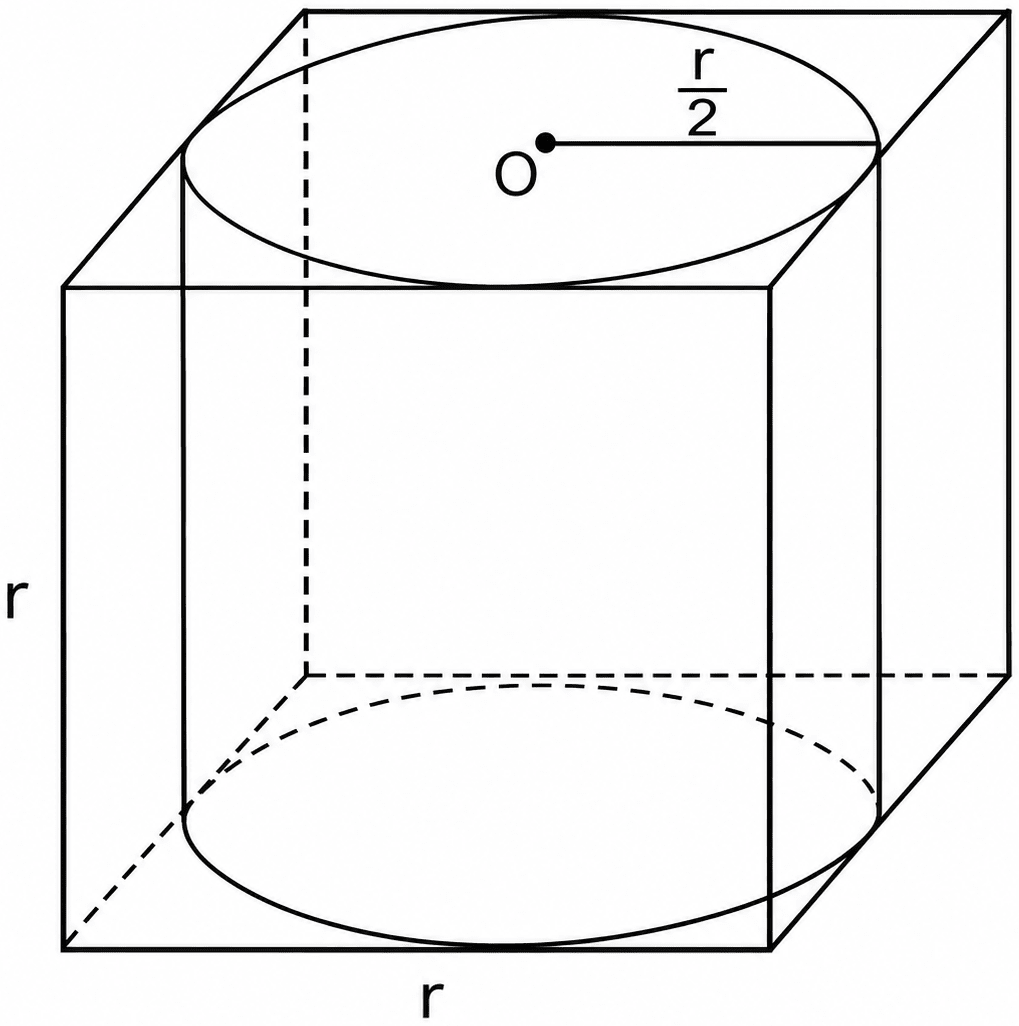
Given:
Edge of the cube = r cm
The largest cylinder stands on one face of the cube. Its circular base is the largest circle that fits in a square of side r, so the diameter of the base equals r.
Radius of the cylinder = cm
The cylinder reaches from the bottom face to the top face of the cube.
Height of the cylinder = r cm
Let O be the centre of the top of the cylinder.
We know the formula,
Volume of a cylinder = π × (radius)2 × height
Hence, the volume of the cylinder is cm3.
The radius of the base of a cylinder is increased by 10%. At the same time, the height of the cylinder is decreased by x%. Given that the volume of the cylinder remains unchanged, find the value of x.
Answer
Let the original radius be r and the original height be h.
Original volume = πr2h
New radius = r + × r = r
New height = h - × h = h
New volume = π × (new radius)2 × new height
According to the question, the volume remains unchanged:
Hence, x = ≈ 17.36, i.e., the height must be decreased by about 17.36%.
A solid metallic cube of side 12 cm is melted and recast into solid cylindrical rods, each having radius 2 cm and height 12 cm. Find:
(i) the volume of the cube,
(ii) the volume of one cylindrical rod,
(iii) the approximate number of complete cylindrical rods that can be formed.
Answer
Given:
Side of the cube (a) = 12 cm
Radius of each rod (r) = 2 cm, height of each rod (h) = 12 cm
π =
(i) Volume of the cube = a3
= 12 × 12 × 12 cm3
= 1728 cm3
Hence, the volume of the cube is 1728 cm3.
(ii) Volume of one rod = πr2h
Hence, the volume of one cylindrical rod is cm3 ≈ 150.86 cm3.
(iii) The volume of metal does not change on melting and recasting.
No. of rods =
Only complete rods are counted, so the fractional part is left over as unused metal.
Hence, 11 complete cylindrical rods can be formed.
For π, use one of the following approximations: π ≈ or π ≈ 3.14
Find the total surface area of a cone, if its slant height is 21 m and diameter of its base is 24 m.
Answer
Given:
Slant height (l) = 21 m
Diameter of the base = 24 m
Radius (r) = m = 12 m
π = 3.14
We know the formula,
Total surface area of a cone = πrl + πr2 = πr(l + r)
Hence, the total surface area of the cone is 1243.44 m2.
For π, use one of the following approximations: π ≈ or π ≈ 3.14
Find the curved surface area of a right circular cone whose slant height is 10 cm and base radius is 7 cm.
Answer
Given:
Slant height (l) = 10 cm
Radius (r) = 7 cm
π =
We know the formula,
Curved surface area of a cone = πrl
Hence, the curved surface area of the cone is 220 cm2.
For π, use one of the following approximations: π ≈ or π ≈ 3.14
The height of a cone is 16 cm, and its base radius is 12 cm. Find the curved surface area and the total surface area of the cone.
Answer
Given:
Height (h) = 16 cm
Radius (r) = 12 cm
π = 3.14
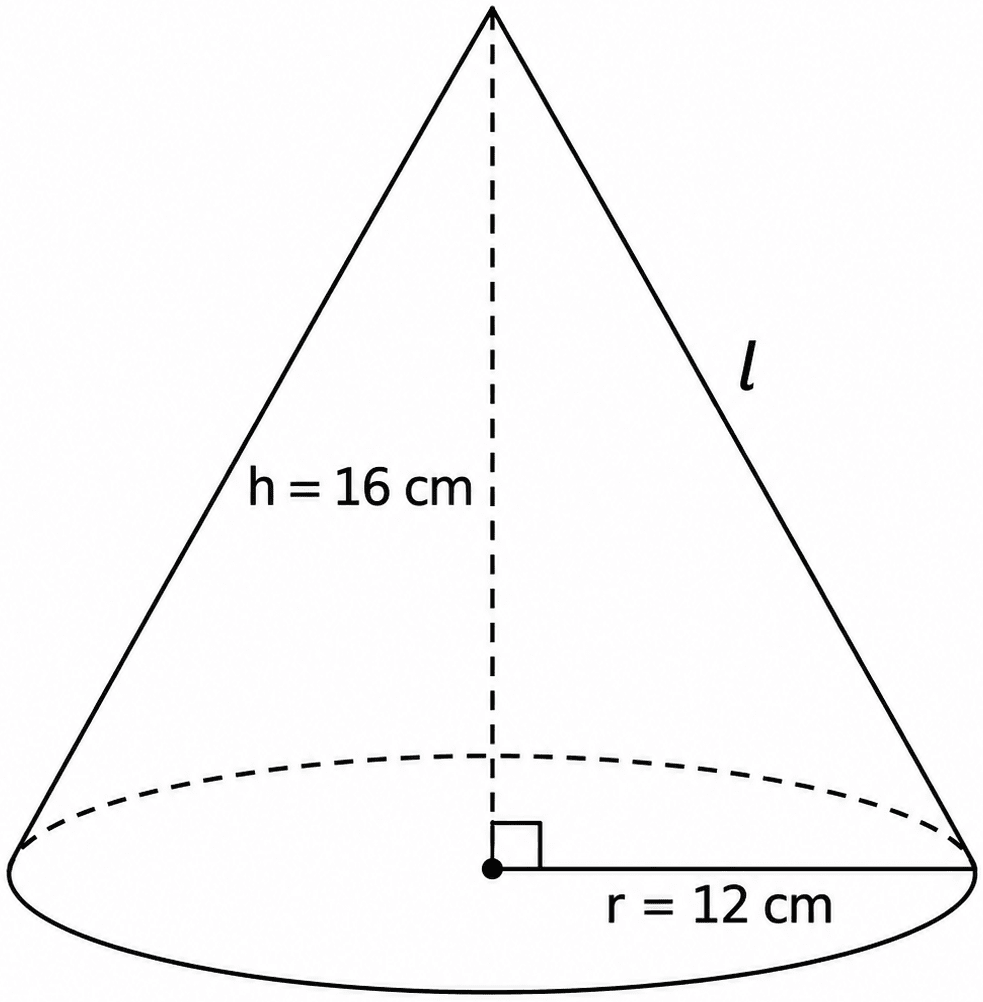
Using l2 = h2 + r2 (the Baudhāyana–Pythagoras theorem):
l2 = 162 + 122
= 256 + 144
= 400
⇒ l = cm = 20 cm
Curved surface area of the cone = πrl
= 3.14 × 12 × 20 cm2
= 3.14 × 240 cm2
= 753.6 cm2
Total surface area of the cone = πr(l + r)
= 3.14 × 12 × (20 + 12) cm2
= 3.14 × 12 × 32 cm2
= 3.14 × 384 cm2
= 1205.76 cm2
Hence, the curved surface area is 753.6 cm2 and the total surface area is 1205.76 cm2.
For π, use one of the following approximations: π ≈ or π ≈ 3.14
A cone has a height of 15 cm. If its volume is 1570 cm3, find the radius of the base.
Answer
Given:
Height (h) = 15 cm
Volume (V) = 1570 cm3
π = 3.14
Let the radius of the base be r cm.
We know the formula,
Volume of a cone = πr2h
Hence, the radius of the base is 10 cm.
For π, use one of the following approximations: π ≈ or π ≈ 3.14
The curved surface area of a cone is 308 cm2 and its slant height is 14 cm. Find (i) the radius of the base, (ii) the total surface area of the cone.
Answer
Given:
Curved surface area = 308 cm2
Slant height (l) = 14 cm
π =
(i) Let the radius of the base be r cm.
Curved surface area of a cone = πrl
Hence, the radius of the base is 7 cm.
(ii) Total surface area of a cone = πr(l + r)
Hence, the total surface area of the cone is 462 cm2.
For π, use one of the following approximations: π ≈ or π ≈ 3.14
A joker’s cap is in the form of a right circular cone of base radius 7 cm and height 24 cm. Find the area of the sheet required to make 10 such caps.
Answer
Given:
Radius (r) = 7 cm
Height (h) = 24 cm
π =
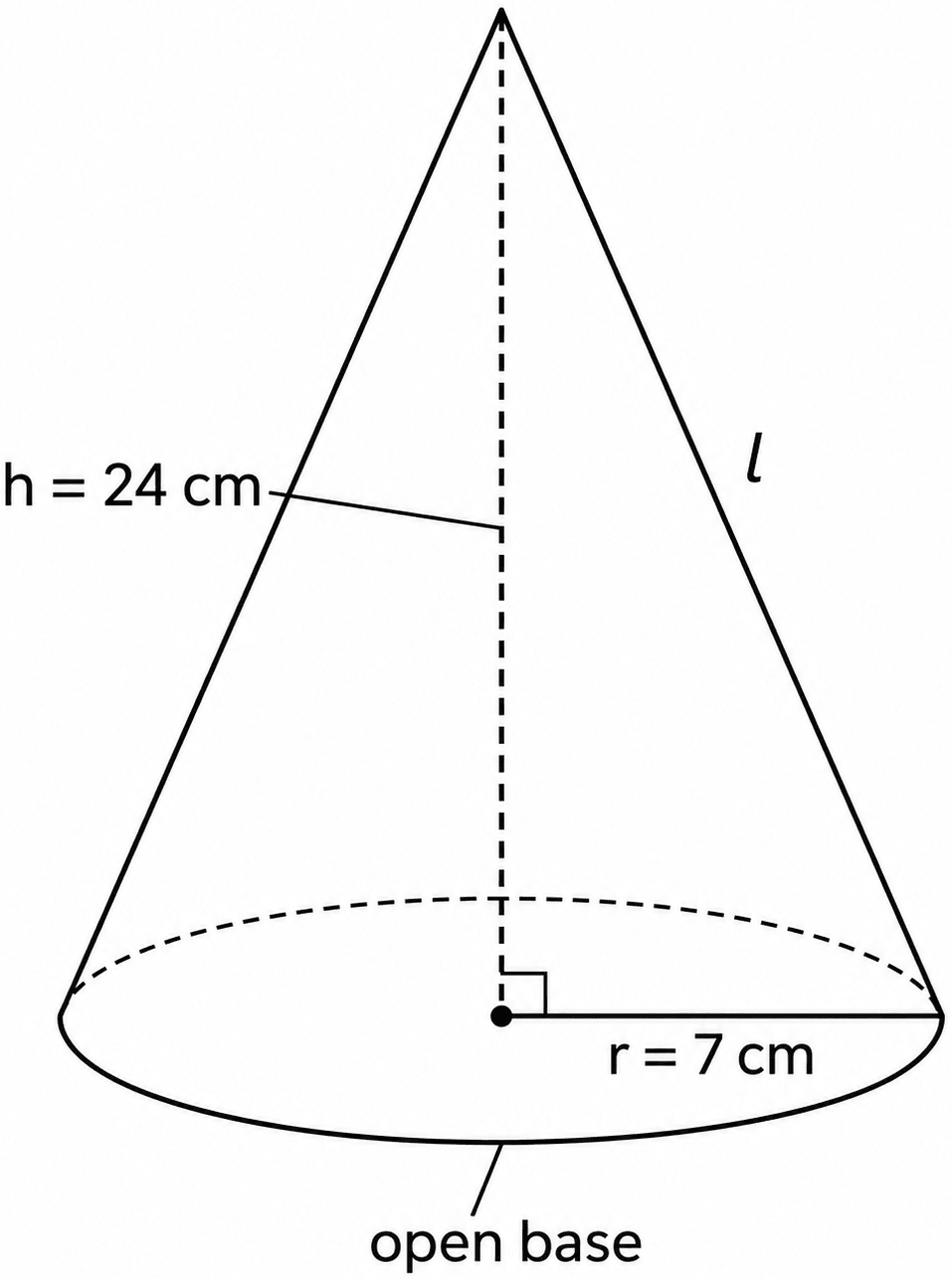
Using l2 = h2 + r2 (the Baudhāyana–Pythagoras theorem):
l2 = 242 + 72
= 576 + 49
= 625
⇒ l = cm = 25 cm
A cap is open at the base, so the sheet needed for one cap is its curved surface area.
Curved surface area of one cap = πrl
Area of sheet for 10 caps = 10 × 550 cm2
= 5500 cm2
Hence, 5500 cm2 of sheet is required to make 10 caps.
For π, use one of the following approximations: π ≈ or π ≈ 3.14
What length of tarpaulin 3 m wide is required to make a conical tent of height 8 m and base radius 6 m? Assume that the extra length of material that is required for stitching margins and wastage in cutting is 20 cm.
Answer
Given:
Height of the tent (h) = 8 m
Radius of the base (r) = 6 m
Width of the tarpaulin = 3 m
Extra length for stitching and wastage = 20 cm
π = 3.14
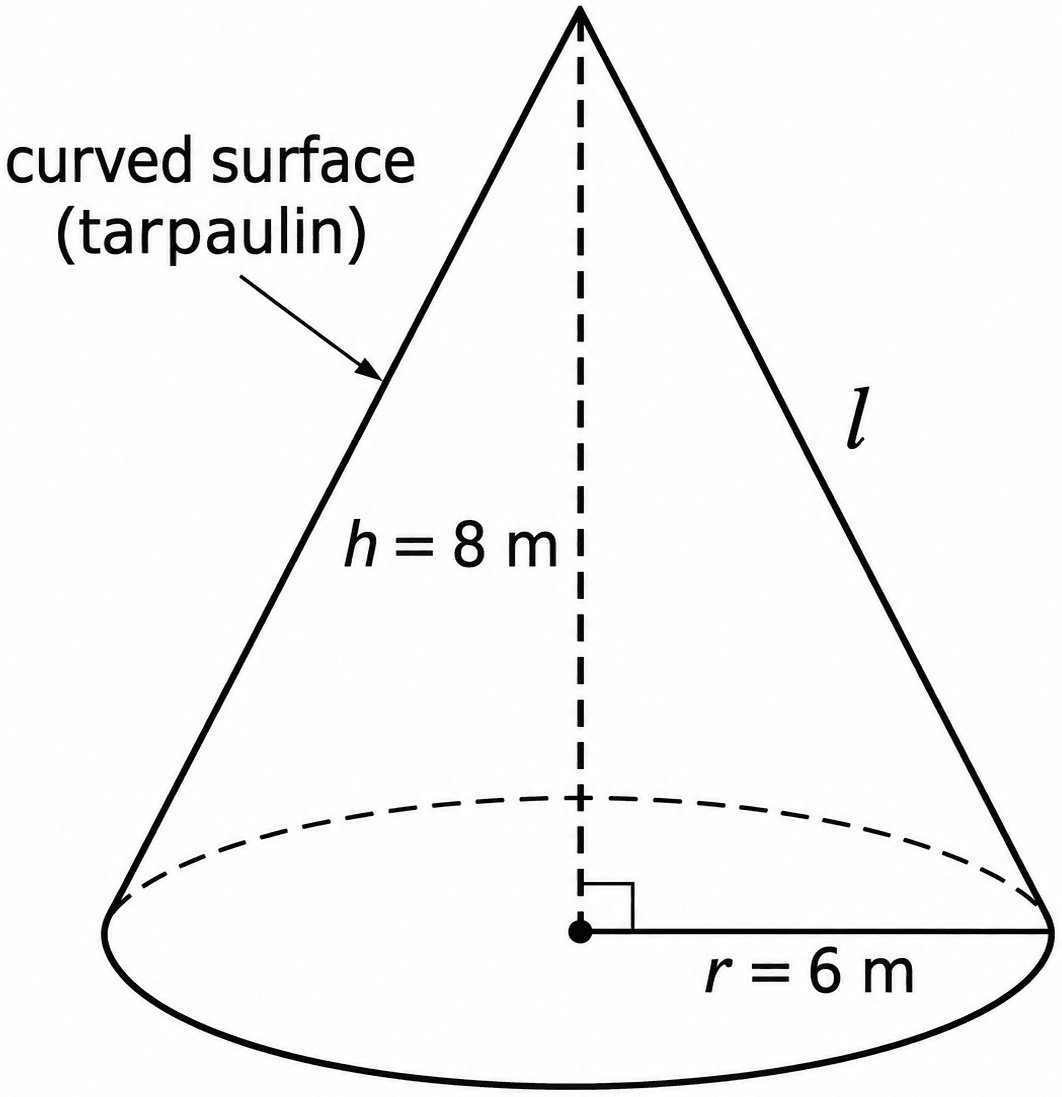
Using l2 = h2 + r2 (the Baudhāyana–Pythagoras theorem):
l2 = 82 + 62
= 64 + 36
= 100
⇒ l = m = 10 m
A tent has no base, so the area of tarpaulin needed is the curved surface area.
Curved surface area of the tent = πrl
= 3.14 × 6 × 10 m2
= 3.14 × 60 m2
= 188.4 m2
Length of tarpaulin for the tent =
Extra length = 20 cm = m = 0.2 m
Total length of tarpaulin = 62.8 m + 0.2 m
= 63 m
Hence, 63 m of tarpaulin is required.
For π, use one of the following approximations: π ≈ or π ≈ 3.14
A right triangle with sides 6 cm, 8 cm and 10 cm is rotated through 360° about the side of 8 cm. Find the volume and the curved surface area of the solid so formed.
Answer
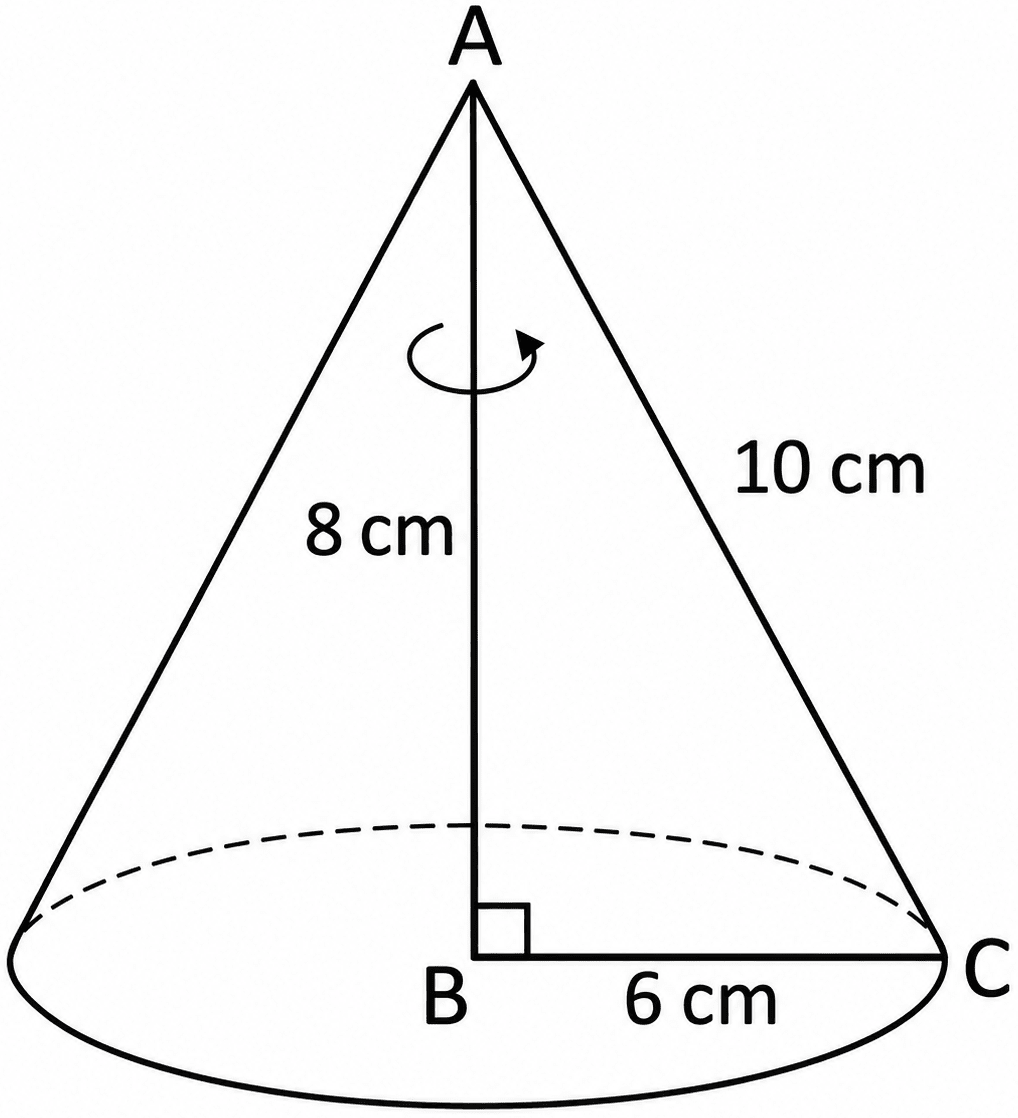
Let the triangle be ABC with AB = 8 cm, BC = 6 cm and CA = 10 cm.
Since 62 + 82 = 36 + 64 = 100 = 102, the triangle is right-angled at B, with perpendicular sides 6 cm and 8 cm and hypotenuse 10 cm.
When a right triangle is rotated about one of its perpendicular sides, it forms a right circular cone. Here it is rotated about AB = 8 cm.
Height of the cone (h) = AB = 8 cm
Radius of the base (r) = BC = 6 cm
Slant height (l) = CA = 10 cm
π = 3.14
Volume of the cone = πr2h
Curved surface area of the cone = πrl
= 3.14 × 6 × 10 cm2
= 3.14 × 60 cm2
= 188.4 cm2
Hence, the volume of the cone is 301.44 cm3 and its curved surface area is 188.4 cm2.
For π, use one of the following approximations: π ≈ or π ≈ 3.14
Suppose you have a cup in the shape of a right circular cone. Fill it with water to half the depth of the cone.
What fraction of the volume of the cup is occupied by the water?

Answer
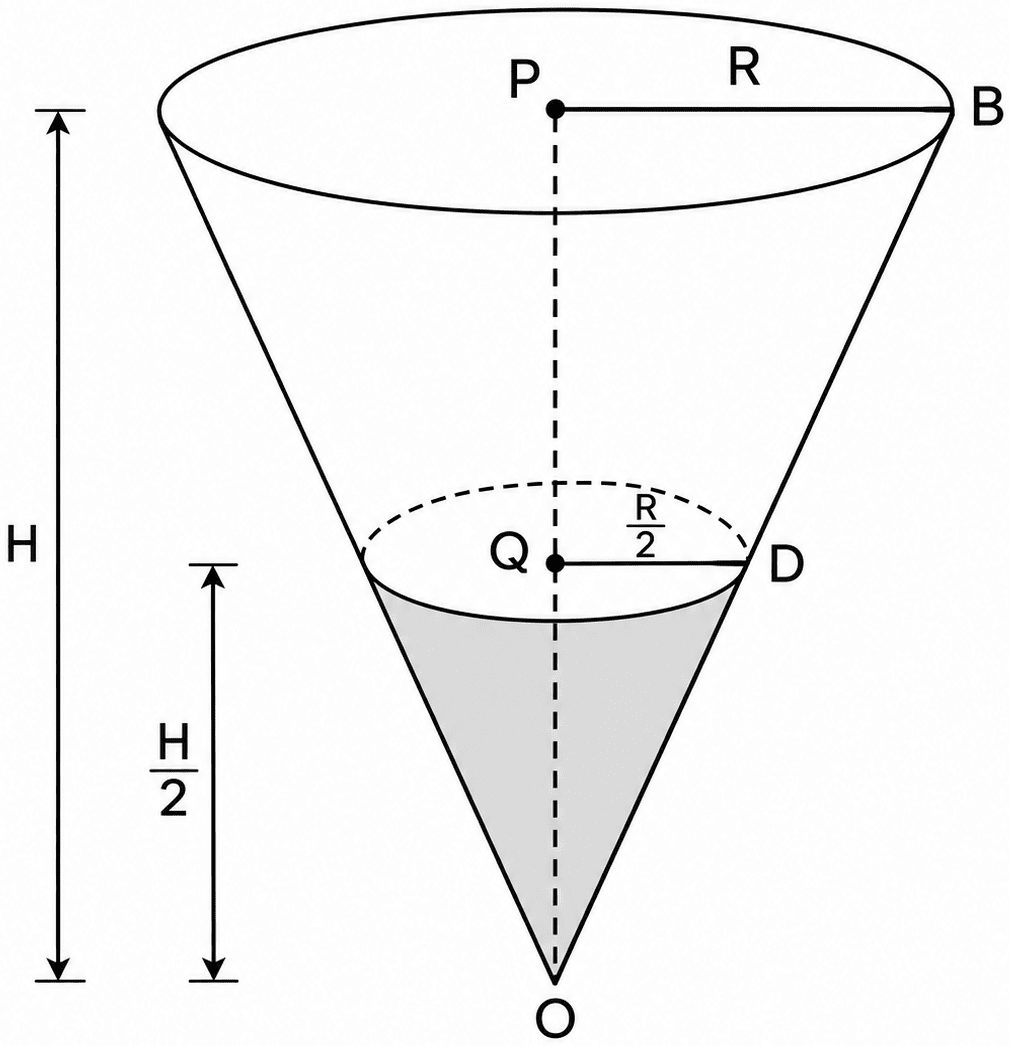
Let the cup have radius R and depth (height) H. The apex O is at the bottom; P is the centre of the rim and B a point on the rim, so OP = H and PB = R.
Volume of the cup = πR2H
The water forms a smaller cone with the same apex O. Let Q be the centre of the water surface and D the point where the water surface meets the slant side OB. Then OQ = .
The slant side OB is a straight line, so the radius of the cone grows in the same proportion as the depth: halfway up OP, the radius is half of PB.
Radius of the water surface, QD = × PB =
Volume of the water = × π × (QD)2 × OQ
Hence, the water occupies of the volume of the cup.
A ball bearing has a radius of 0.7 cm. Find its surface area.
Answer
Given:
Radius (r) = 0.7 cm
π =
We know the formula,
Surface area of a sphere = 4πr2
Hence, the surface area of the ball bearing is 6.16 cm2.
Two solid spheres made of the same metal have weights 5920 g and 740 g. Determine the radius of the larger sphere, if the diameter of the smaller one is 5 cm.
Answer
Given:
Weight of the larger sphere = 5920 g
Weight of the smaller sphere = 740 g
Diameter of the smaller sphere = 5 cm
Radius of the smaller sphere (r) = cm = 2.5 cm
Both spheres are made of the same metal, so each cm3 of metal weighs the same. Hence the weights are in the same ratio as the volumes.
= 8
Let the radius of the larger sphere be R cm.
Volume of a sphere = πr3
Hence, the radius of the larger sphere is 5 cm.
The diameter of the moon is approximately one fourth the diameter of the earth. Given that the moon and earth are both roughly spherical, find the ratio of their surface areas.
Answer
Let the diameter of the earth be d.
Radius of the earth =
Diameter of the moon =
∴ radius of the moon =
Surface area of a sphere = 4πr2
Hence, the ratio of the surface area of the moon to that of the earth is 1 : 16.
Find (i) the curved surface area and (ii) the total surface area of a hemisphere of radius 21 cm.
Answer
Given:
Radius (r) = 21 cm
π =
(i) Curved surface area of a hemisphere = 2πr2
Hence, the curved surface area of the hemisphere is 2772 cm2.
(ii) Total surface area of a hemisphere = 3πr2
Hence, the total surface area of the hemisphere is 4158 cm2.
Metal spheres, each of radius 2 cm, are packed into a rectangular box of internal dimensions 16 cm × 8 cm × 8 cm. When 16 spheres are packed, the box is filled with preservative liquid. Find the volume of this liquid. Round your answer to the nearest integer.
Answer
Given:
Radius of each sphere (r) = 2 cm
∴ diameter of sphere = 4 cm
Internal dimensions of the box = 16 cm × 8 cm × 8 cm
Number of spheres = 16
π = 3.14
The 16 spheres fit exactly: = 4 along the length, = 2 along the width and = 2 along the height; 4 × 2 × 2 = 16.
Volume of the box = 16 × 8 × 8 cm3
= 1024 cm3
Volume of one sphere = πr3
Volume of 16 spheres
Volume of the liquid = Volume of the box - Volume of 16 spheres
Hence, the volume of the preservative liquid is about 488 cm3.
The radius of a sphere is increased by 10%. Show that the volume increases by approximately 33.1%.
Answer
Let the original radius be r.
Original volume (V) = πr3
New radius = r + × r = r
New volume = π × (new radius)3
Increase in volume = New volume - V
% increase = %
= %
= 33.1 %
Hence proved: The volume increases by approximately 33.1%.
The radius of a sphere is increased by x%. The volume of the sphere increases by 72.8%. Find the value of x.
Answer
Let the original radius be r and the original volume be V.
V = πr3
New radius = r + × r = r
New volume =
=
=
The volume increases by 72.8%, so
New volume = V + × V = 1.728V
According to the question,
Hence, x = 20, i.e., the radius is increased by 20%.
The hemispherical dome of a building needs to be painted (see Fig. 14.16). If the circumference of the base of the dome is 35.2 m, find the cost of painting it, given the cost of painting is ₹ 10 per 100 cm2.
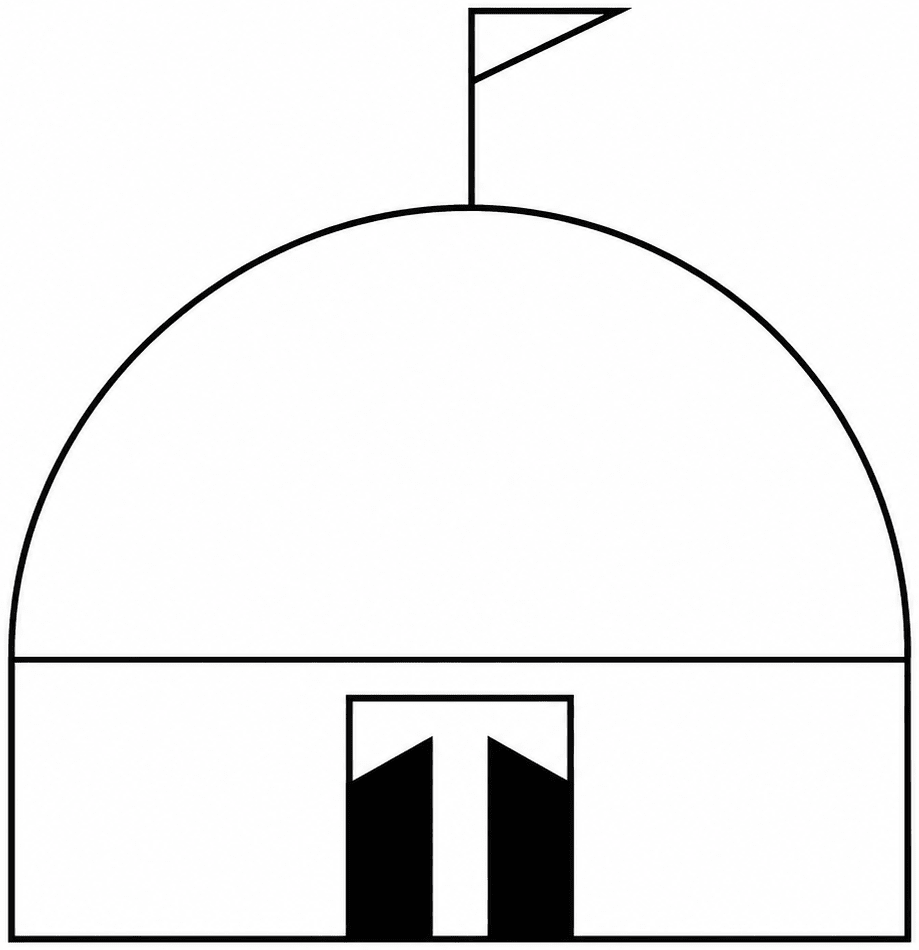
Answer
Given:
Circumference of the base of the dome = 35.2 m
Cost of painting = ₹10 per 100 cm2
π =
Let the radius of the dome be r m.
Circumference of a circle = 2πr
Only the curved surface of the dome is painted.
Curved surface area of a hemisphere = 2πr2
Converting into cm2:
1 m2 = 100 cm × 100 cm = 10000 cm2
197.12 m2 = ?
197.12 m2 = 197.12 × 10000 = 1971200 cm2
Area to be painted = 19,71,200 cm2
No. of 100 cm2 units =
=
= 19,712
Cost of painting = 19,712 × ₹10
= ₹1,97,120
Hence, the cost of painting the dome is ₹1,97,120.
For guesstimate problems, make a guess first before solving.
Estimate how many scoops of ice cream can be obtained from a cuboidal container of dimensions 10 cm × 15 cm × 20 cm.
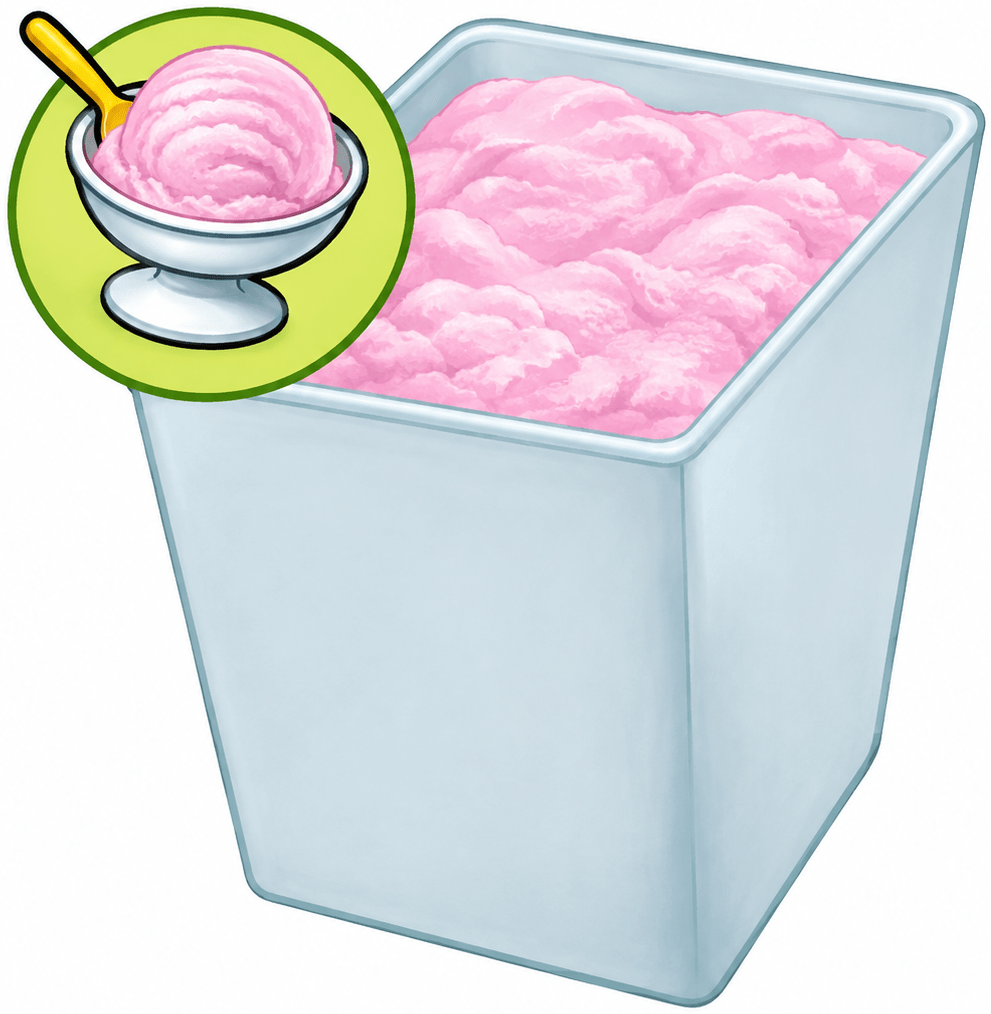
Answer
Guess: about 30 scoops.
Assumption: a scoop of ice cream is a solid ball of radius 3 cm (diameter 6 cm), and the container is full.
π = 3.14
Volume of the container = 10 × 15 × 20 cm3
= 3000 cm3
Volume of one scoop = πr3
No. of scoops =
Only full scoops are counted.
Hence, about 26 scoops of ice cream can be obtained from the container.
A cube of integer side length a is made of unit cubes. Write an expression giving the number of unit cubes to be added to make a cube of side length a + 1.
Answer
Number of unit cubes in a cube of side a = a3
Number of unit cubes in a cube of side a + 1 = (a + 1)3
Number of unit cubes to be added = (a + 1)3 - a3
Using the identity (x + y)3 = x3 + 3x2y + 3xy2 + y3 with x = a and y = 1:
(a + 1)3 = a3 + 3a2 + 3a + 1
Number of unit cubes to be added = a3 + 3a2 + 3a + 1 - a3
= 3a2 + 3a + 1
This matches the shape of the added cubes: three square slabs of a × a × 1 (3a2 cubes) on three faces, three rods of a × 1 × 1 (3a cubes) along the edges between them, and 1 cube at the corner.
Check for a = 2:
(2 + 1)3 - 23 = 27 - 8 = 19
3 × 22 + 3 × 2 + 1 = 12 + 6 + 1 = 19
Hence, the number of unit cubes to be added is 3a2 + 3a + 1.
For guesstimate problems, make a guess first before solving.
Solve the following:
Could a person drink enough water in a lifetime to fill an entire room the size of your classroom?
Answer
Assumption for both parts: the classroom is 9 m long, 6 m wide and 3 m high.
(i) Guess: no.
Assumptions: a person drinks about 2 litres of water a day and lives for about 70 years.
Volume of the classroom = 9 × 6 × 3 m3
= 162 m3
1 m3 = 100 cm × 100 cm × 100 cm
= 10,00,000 cm3
= litres [∵ 1000 cm3 = 1 litre]
= 1000 litres
Capacity of the classroom = 162 × 1000 litres
= 1,62,000 litres
Number of days in 70 years = 70 × 365
= 25550
Water drunk in a lifetime = 2 × 25550 litres
= 51,100 litres
Fraction of room filled =
=
≈ 0.32
Hence, no; a person drinks only about 51,100 litres in a lifetime, which fills only about one-third of the classroom.
For guesstimate problems, make a guess first before solving.
Solve the following:
Estimate the number of bricks used to build the walls of your classroom.
Answer
Guess: about 10,000 bricks.
Assumptions:
a brick with its mortar takes up 20 cm × 10 cm × 10 cm;
the walls are 20 cm thick (one brick length);
the classroom has one door 2 m × 1 m and two windows, each 1.5 m × 1.2 m.
Let the length of the floor be 9 m and breadth be 6 m
Let the height of the wall = 3 m
Total area of the four walls = perimeter of the floor × height
= 2(l + b) × height
= 2(9 + 6) × 3 m2
= 2 × 15 × 3 m2
= 90 m2
Area of the door = 2 × 1 m2 = 2 m2
Area of the two windows = 2 × 1.5 × 1.2 m2 = 3.6 m2
Area of the openings = 2 + 3.6 m2 = 5.6 m2
Area of brick wall = 90 - 5.6 m2
= 84.4 m2
Volume of the walls = area × thickness
= 84.4 × 0.2 m3
= 16.88 m3
Volume of one brick with mortar = 0.2 × 0.1 × 0.1 m3
= 0.002 m3
No. of bricks =
Hence, about 8400 bricks are used to build the walls of the classroom.
You are given two options: (A) one chocolate cube of side 50 mm, (B) hundred chocolate cubes of side 10 mm. Which option gives you more chocolate?
Answer
The amount of chocolate is measured by its volume.
Option (A):
side of chocolate cube = 50 mm
Volume of one cube = (50 mm)3 = 50 × 50 × 50 mm3
= 1,25,000 mm3
Option (B):
side of chocolate cube = 10 mm
Volume of one cube of side = (10 mm)3 = 10 × 10 × 10 mm3
= 1000 mm3
Volume of 100 such cubes = 100 × 1000 mm3
= 1,00,000 mm3
Since 1,25,000 mm3 > 1,00,000 mm3, option (A) has 25,000 mm3 more chocolate.
Hence, option (A), one cube of side 50 mm, gives more chocolate.
For guesstimate problems, make a guess first before solving.
If all the people in the world are crowded together in one location, how much area would it cover?

Answer
Guess: about the size of a large city.
Assumptions: the world population is about 8 billion = 8,00,00,00,000, and people standing close together need about 0.5 m × 0.5 m each.
Area for one person = 0.5 × 0.5 m2
= 0.25 m2
Total area = 8,00,00,00,000 × 0.25 m2
= 2,00,00,00,000 m2
Converting into km2:
10,00,000 m2 = 1 km2
2,00,00,00,000 m2 = x
x = km2
= 2000 km2
This is a square of side about km ≈ 44.7 km, a little larger than the area of Delhi (about 1,500 km2).
Hence, all the people in the world crowded together would cover about 2000 km2.
A school provides milk to its students in cylindrical glasses, each with a diameter of 7 cm. If each glass is filled with milk to a height of 12 cm, how many litres of milk are needed to serve 1600 students? Use 1000 cm3 = 1 litre.
Answer
Given:
Diameter of a glass = 7 cm
Radius (r) = cm = 3.5 cm
Height of milk (h) = 12 cm
Number of students = 1600
π =
Volume of milk in one glass = πr2h
Volume of milk for 1600 students = 1600 × 462 cm3
= 7,39,200 cm3
Converting into litres:
1000 cm3 = 1 litre
7,39,200 cm3 = x
x = litres
= 739.2 litres
Hence, 739.2 litres of milk are needed to serve 1600 students.
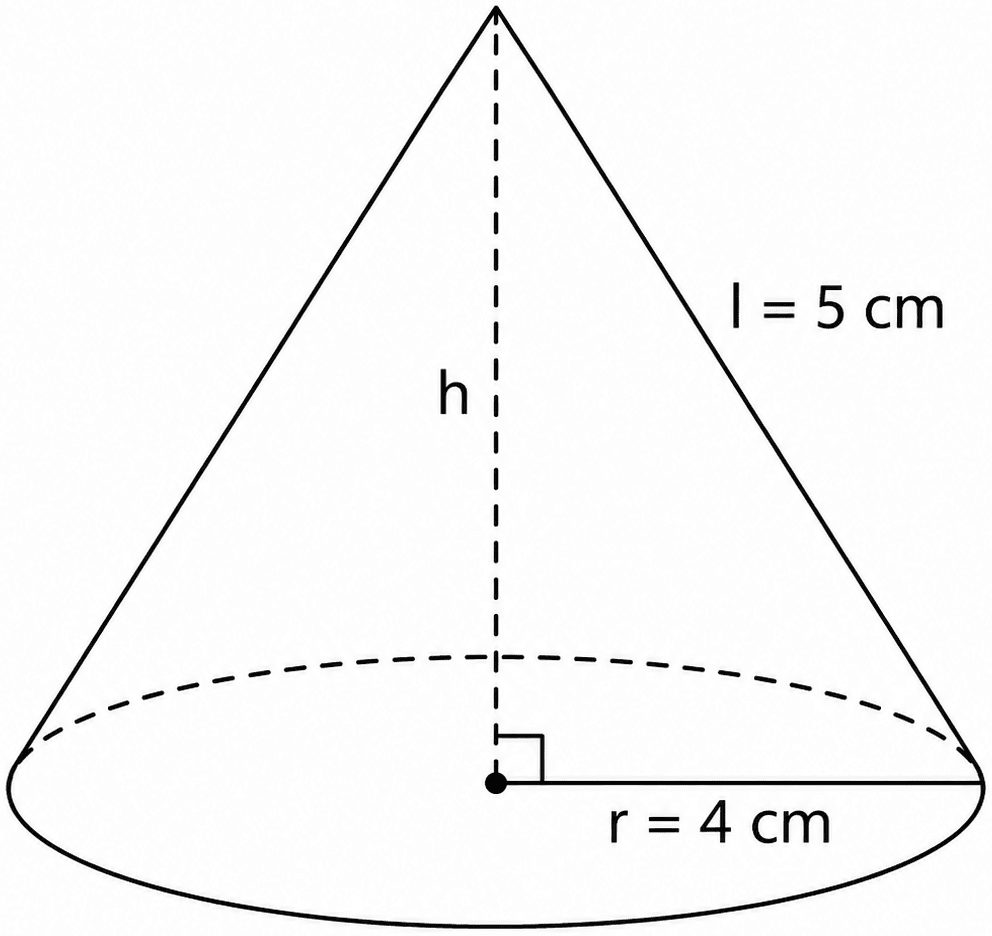
The surface area of a sphere of radius 5 cm is five times the area of the curved surface of a cone of radius 4 cm. Find the height and the volume of the cone.
Answer
Given:
Radius of the sphere (R) = 5 cm
Radius of the cone (r) = 4 cm
Surface area of the sphere = 4πR2
= 4 × π × 52 cm2
= 4 × π × 25 cm2
= 100π cm2
According to the question,
Surface area of the sphere = 5 × CSA of the cone
100π cm2 = 5 × CSA of the cone
⇒ CSA of the cone = cm2 = 20π cm2
Let the slant height of the cone be l cm.
CSA of the cone = πrl
Let the height of the cone be h cm.
Using l2 = h2 + r2 (the Baudhāyana–Pythagoras theorem):
Taking π = 3.14,
Volume of the cone = πr2h
Hence, the height of the cone is 3 cm and its volume is 16π cm3 ≈ 50.24 cm3.
Take Earth to be a perfect sphere with radius 6370 km. Take Jupiter to be a perfect sphere with radius 69,900 km. Take the Sun to be a perfect sphere with radius 6,95,700 km. Compute approximately:
(i) the ratio of the volume of Jupiter to the volume of the Earth;
(ii) the ratio of the volume of the Sun to the volume of the Earth.
(Calculator can be used.)
Answer
Given:
Radius of the Earth (RE) = 6370 km
Radius of Jupiter (RJ) = 69,900 km
Radius of the Sun (RS) = 6,95,700 km
Volume of a sphere = πr3
(i)
Hence, the volume of Jupiter is about 1321 times the volume of the Earth; the ratio is about 1321 : 1.
(ii)
Hence, the volume of the Sun is about 13,02,710 (about 13 lakh) times the volume of the Earth; the ratio is about 13,02,710 : 1.
Show that the volume of a sphere is equal to of the volume of the smallest cylinder which encloses it.
Answer
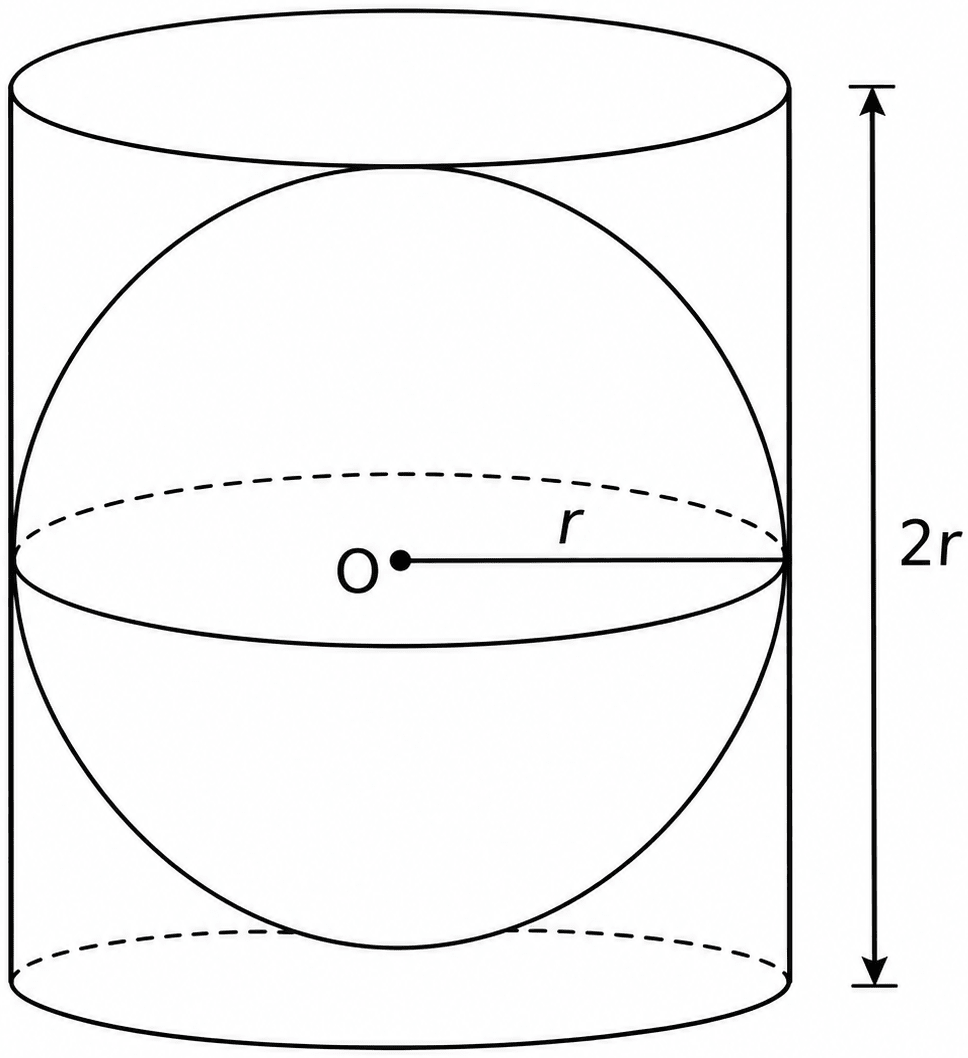
Given: A sphere with centre O and radius r.
To prove: Volume of the sphere = × volume of the smallest cylinder enclosing it.
Proof:
A cylinder that encloses the sphere must have radius at least r (to hold the widest circle of the sphere) and height at least 2r (to hold a diameter along its axis). The smallest such cylinder fits tightly around the sphere, touching it at the top, at the bottom and all round its widest circle:
Radius of the cylinder = r, height of the cylinder = 2r
Volume of the cylinder = π × r2 × h
= π × r2 × 2r
= 2πr3
Volume of the sphere = πr3
∴ Volume of the sphere = × volume of the cylinder
Hence proved.
Suppose the Earth is perfectly spherical. A string is wrapped tightly around the equator of the Earth. Another string, 1 metre longer, is placed around the Earth so that it forms a larger circle, staying the same distance above the ground everywhere.

How high above the ground is the second string?
Repeat this for: (i) the Moon (ii) Jupiter (iii) a volleyball. Are you surprised by the three answers? Why or why not?
Answer
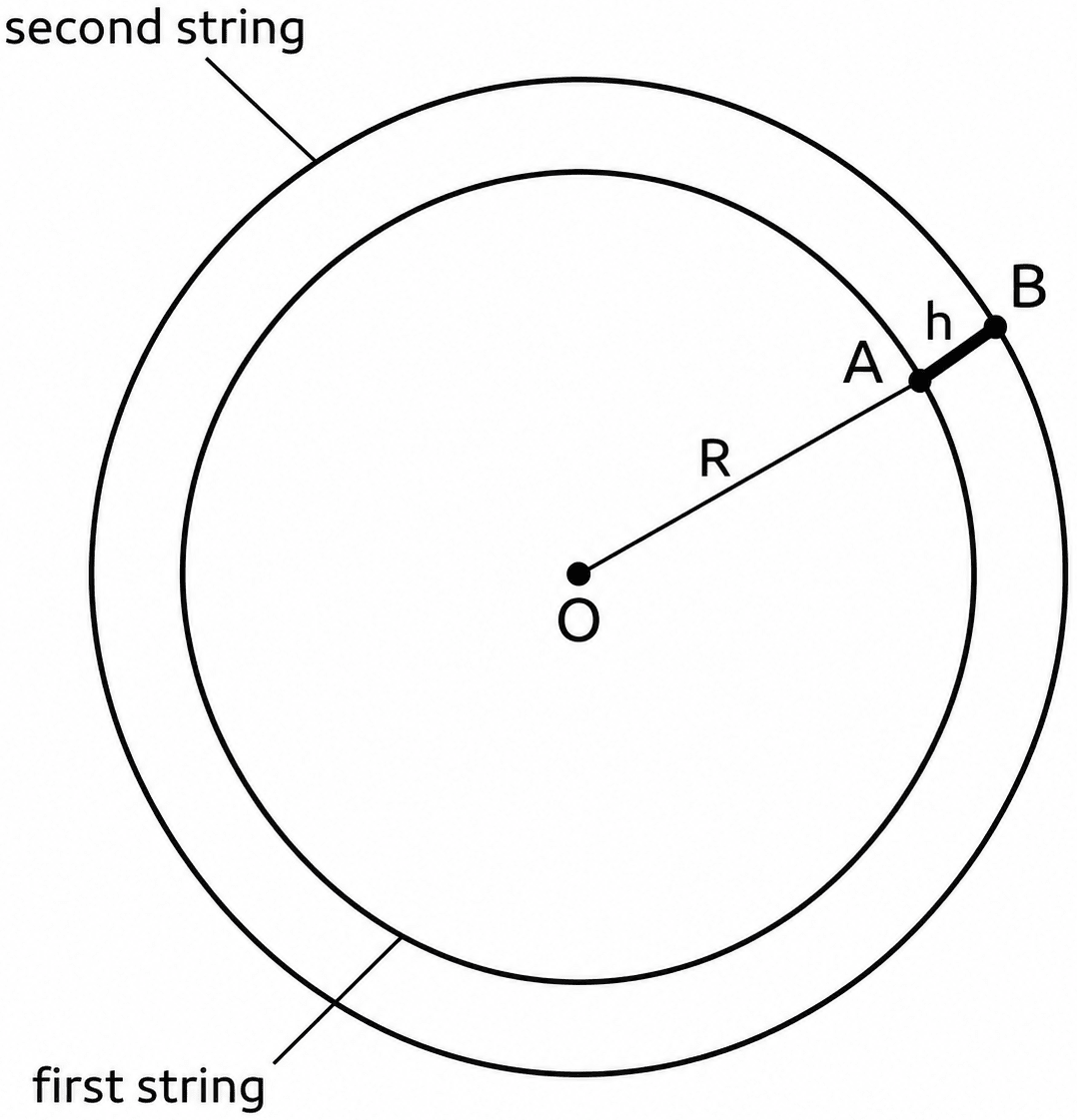
Let O be the centre of the Earth, R its radius (in metres) and h the height of the second string above the ground (in metres). A is on the first string and B on the second, along the same radius, so OA = R and AB = h.
Length of the first string = circumference of the equator = 2πR
Length of the second string = 2π(R + h)
According to the question,
Taking π = 3.14,
Hence, the second string is about 15.9 cm above the ground.
The radius R cancelled out, so h does not depend on the size of the sphere.
(i) Let the radius of the Moon be RM. The second string is 1 m longer than 2πRM:
Hence, for the Moon the string is about 15.9 cm above the ground.
(ii) Let the radius of Jupiter be RJ. The second string is 1 m longer than 2πRJ:
Hence, for Jupiter the string is about 15.9 cm above the ground.
(iii) Let the radius of a volleyball be RV. The second string is 1 m longer than 2πRV:
Hence, for a volleyball the string is also about 15.9 cm above its surface.
Most people are surprised. The extra 1 m seems tiny compared with the Earth's equator (about 40,000 km), so we expect the gap to be almost nothing for the Earth and Jupiter, and large for a volleyball. But the circumference is always 2π × radius, so adding 1 m to the circumference always adds m to the radius, whatever the size of the sphere.
Hence, all three answers are the same, about 15.9 cm, because the gap depends only on the extra length of string, not on the radius.
We have a cylinder with a base radius of r cm and height h cm. A square pyramid is fitted inside it. The square base of the pyramid lies on the base of the cylinder, its corners on the boundary of the cylinder. The apex of the pyramid lies on the top of the cylinder. Find the ratio of the volume of this pyramid to the volume of the cylinder.
Answer
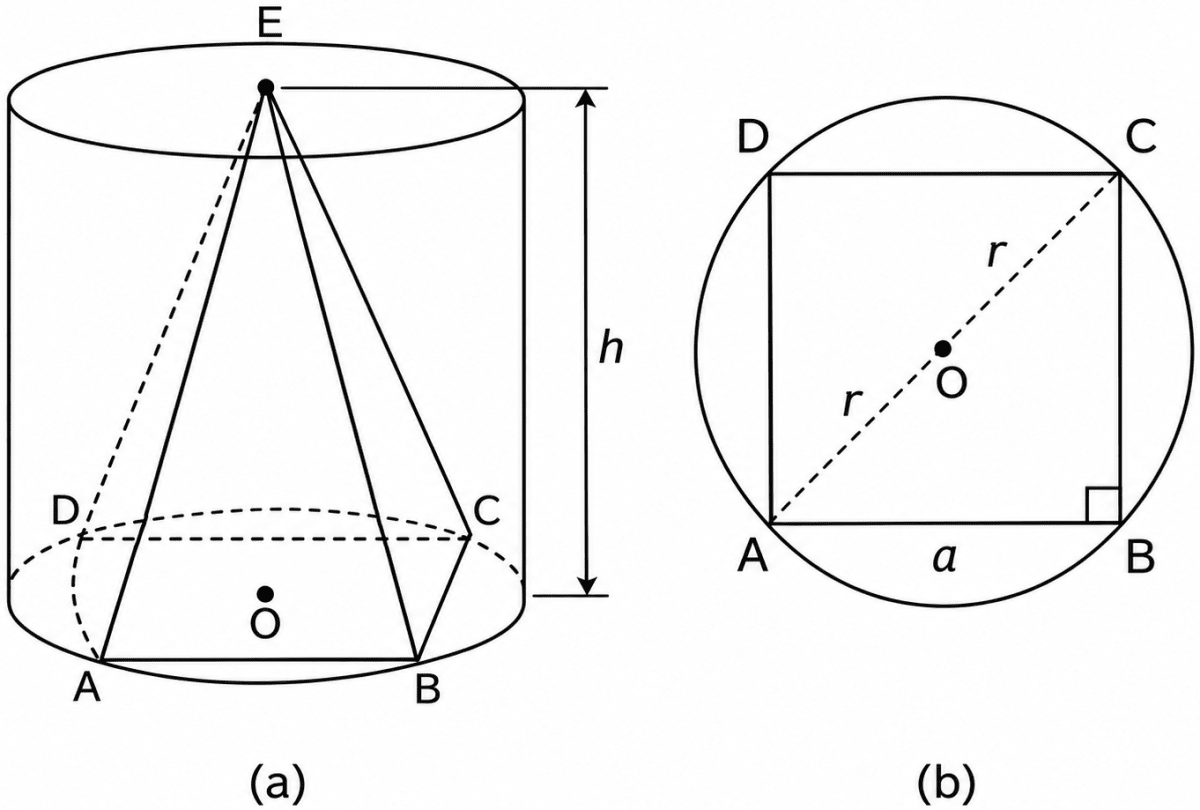
Let ABCD be the square base of the pyramid, O the centre of the base of the cylinder, E the apex, and a cm the side of the square.
The corners A, B, C, D lie on the circle of radius r, so the diagonal AC passes through O and is a diameter.
AC = 2r
In △ABC, ∠ABC = 90° (angle of a square).
Using the Baudhāyana–Pythagoras theorem,
Area of the base of the pyramid = a2 = 2r2 cm2
The apex lies on the top of the cylinder, so the height of the pyramid = h cm.
Volume of the pyramid = × area of base × height
Volume of the cylinder = πr2h cm3
=
=
Taking π = ,
Hence, the ratio of the volume of the pyramid to the volume of the cylinder is 2 : 3π (about 7 : 33).
What is the change in volume when:
the length of a cuboid with dimensions l, w, h is increased by 1 unit?
1 cubic unit
(lwh + 1) cubic unit
wh cubic units
lw cubic units
lh cubic units
Answer
Original volume = lwh
New length = l + 1
New volume = (l + 1) × w × h
= lwh + wh
Change in volume = New volume - Original volume
= lwh + wh - lwh
= wh
The volume increases by wh cubic units
Hence, option 3 is the correct option.
What is the change in volume when:
the radius of a cylinder with dimensions r, h is increased by 1 unit?
1 cubic unit
πr2h cubic units
πr2 cubic units
2πrh + 2πh cubic units
2πrh + πh cubic units
Answer
Original volume = πr2h
New radius = r + 1
New volume = π(r + 1)2h
= π(r2 + 2r + 1)h
= πr2h + 2πrh + πh
Change in volume = New volume - Original volume
= πr2h + 2πrh + πh - πr2h
= 2πrh + πh
The volume increases by (2πrh + πh) cubic units
Hence, option 5 is the correct option.
What is the change in volume when:
the radius of a sphere is decreased by 1 unit?
Answer
Original volume = πr3
New radius = r - 1 (here r > 1)
New volume = π(r - 1)3
Using the identity (x - y)3 = x3 - 3x2y + 3xy2 - y3 with x = r and y = 1:
(r - 1)3 = r3 - 3r2 + 3r - 1
Decrease in volume = Original volume - New volume
Hence, the volume decreases by , i.e., cubic units.
Given a cube with volume V, express its total surface area S in terms of V.
Answer
Let the side of the cube be a.
Volume, V = a3
⇒ a =
Total surface area, S = 6a2
Check: for a cube of side 2, V = 8 and S = 24; and = 6 × 4 = 24.
Hence, S = (that is, ).
Given a cube with total surface area S, express its volume V in terms of S.
Answer
Let the side of the cube be a.
Total surface area, S = 6a2
⇒ a2 =
⇒ a =
Volume, V = a3
Check: for a cube of side 2, S = 24 and V = 8; and = 4 × 2 = 8.
Hence, V = , i.e., .
A cylindrical glass of height 25 cm and radius 4 cm has water up to a height of 16 cm. A crow wants to drink water from this glass. The water must be at a height of 20 cm for the crow to reach it. There are some marbles lying around. How many marbles of radius 1 cm should the crow drop into the glass to make the water reach the required height?
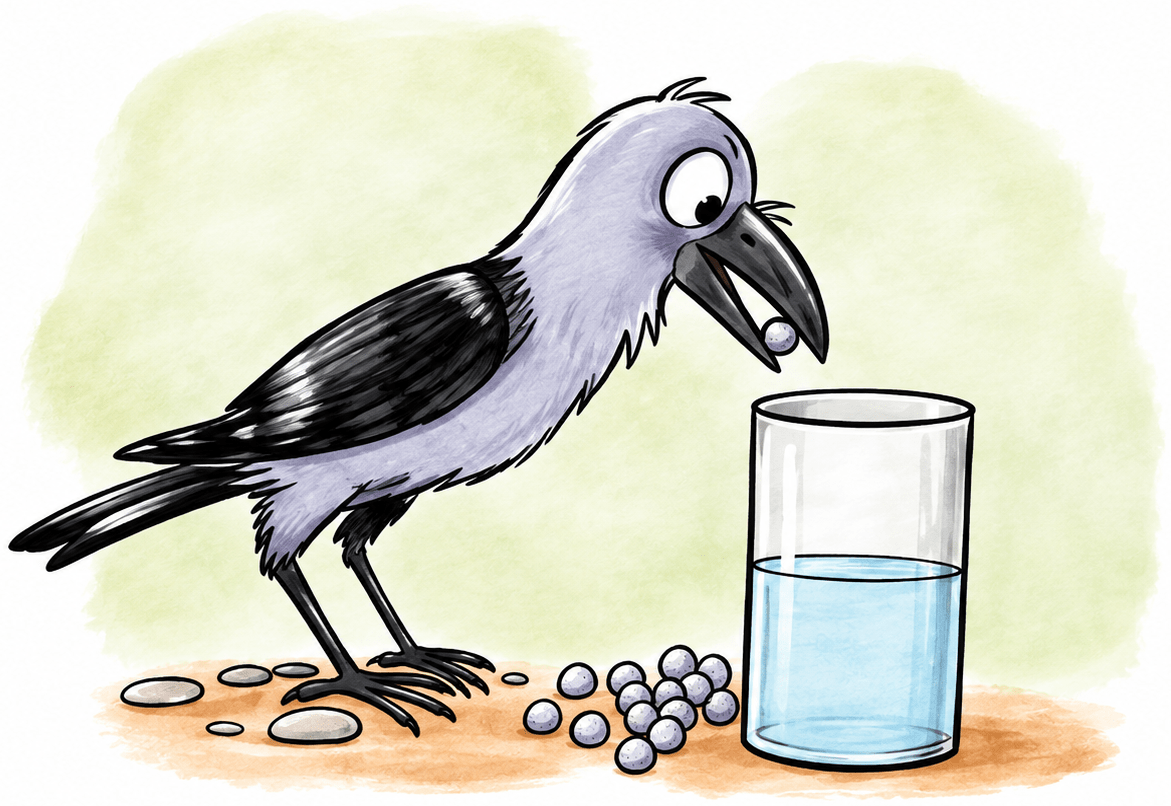
Answer
Given:
Radius of the glass (r) = 4 cm
Present height of water = 16 cm, required height = 20 cm
Radius of each marble (R) = 1 cm
Rise needed in the water level = 20 - 16 cm = 4 cm (less than the 25 cm height of the glass, so no water spills).
The marbles sink and stay under water, so the water rises by the total volume of the marbles.
Volume of a cylinder = area of circular base × height
= πr2h
Volume to be added = volume of a cylinder of radius 4 cm and height 4 cm
= π × 42 × 4 cm3
= π × 16 × 4 cm3
= 64π cm3
Volume of one marble = πR3
= π × 13 cm3
= cm3
No. of marbles =
Hence, the crow should drop 48 marbles into the glass.
For guesstimate problems, make a guess first before solving.
Find the volume of ink in a new ball point pen. Take the necessary measurements and make approximations, as needed.
Answer
Guess: less than 1 cm3.
Approximations: The ink in the refill fills a thin cylindrical tube; the metal tip and the empty part of the tube are ignored.
Sample measurements:
Inner diameter of the refill tube = 2 mm
radius (r) = 1 mm = 0.1 cm
Length of the ink column (h) = 10 cm
π = 3.14
Volume of ink = πr2h
Since 1000 cm3 = 1000 mL, 1 cm3 = 1 mL.
Volume of ink ≈ 0.31 mL
Hence, a new ball point pen holds about 0.31 mL of ink.
For guesstimate problems, make a guess first before solving.
Solve:
A ball of chapati dough of radius 6 cm is prepared. Estimate how many chapatis can be made from it?
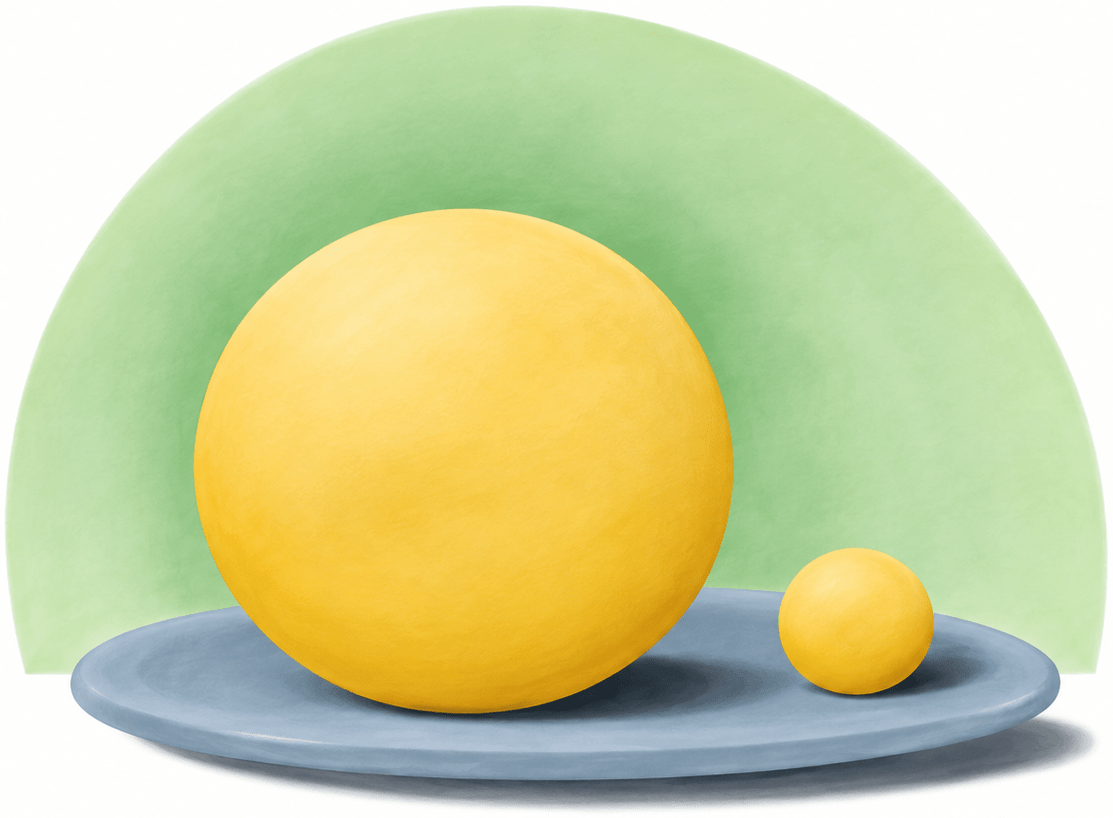
Answer
Guess: About 20 chapatis.
Assumption: Each chapati is a thin circular disc (a short cylinder) of radius 8 cm (diameter 16 cm) and thickness 2 mm = 0.2 cm.
Volume of the dough ball = πr3
Volume of one chapati = area of circular face × thickness
= π × (radius)2 × thickness
= π × 82 × 0.2 cm3
= π × 64 × 0.2 cm3
= 12.8π cm3
No. of chapatis =
Only whole chapatis are counted.
Hence, about 22 chapatis can be made from the dough ball.
For guesstimate problems, make a guess first before solving.
Solve:
Cut a coconut/muskmelon in half and find out the approximate volume of edible coconut flesh/fruit by taking the necessary measurements.
Answer
A sample set of results for a coconut is used below to show the method.
Guess: About 400 cm3.
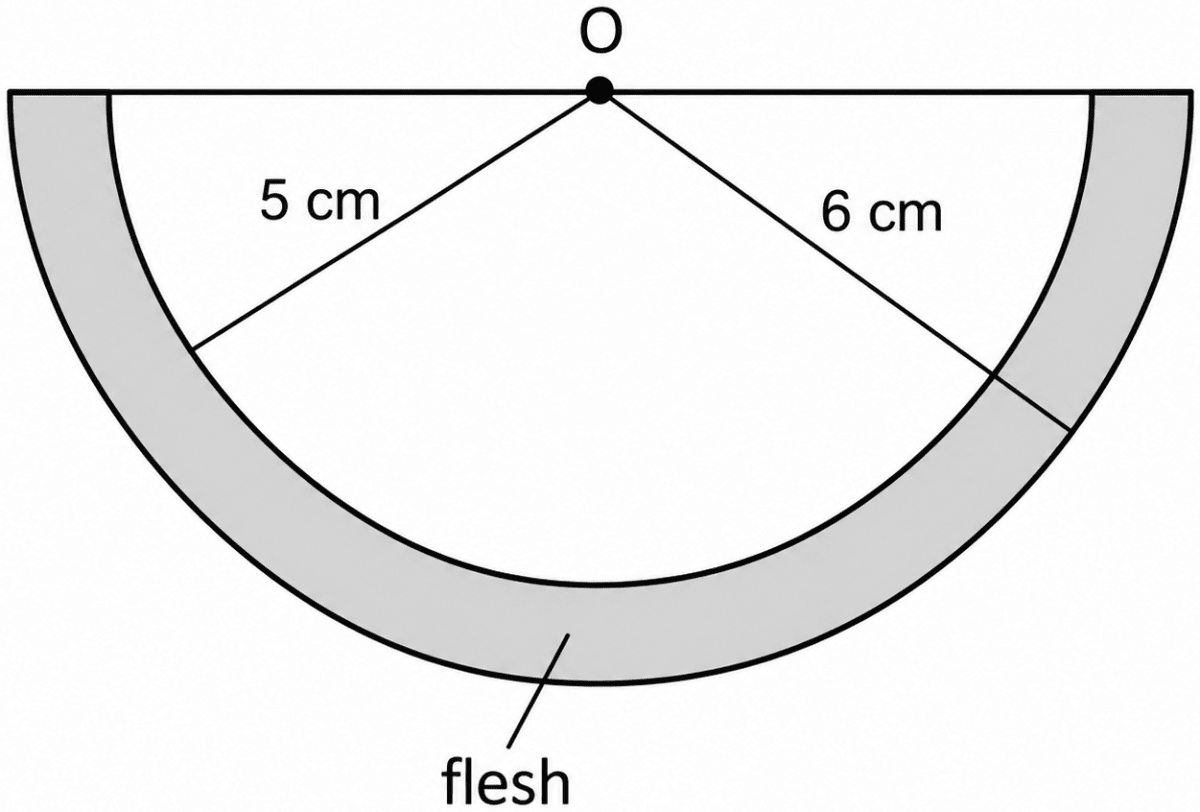
Each half of the coconut is close to a hemisphere. The flesh is a layer between two hemispheres with the same centre O.
Sample measurements:
Inner radius of the shell (outer surface of the flesh), R = 6 cm
Thickness of the flesh = 1 cm
∴ inner radius of the flesh, r = 6 - 1 cm = 5 cm
π = 3.14
Volume of flesh in one half = volume of hemisphere of radius R - volume of hemisphere of radius r
Volume of flesh in the whole coconut = 2 × volume in one half
Hence, the coconut has about 381 cm3 of edible flesh.
For guesstimate problems, make a guess first before solving.
Looking at the Ganita Manjari, Grade 9, Part 2 textbook, Sheela wonders:
(i) If all the pages of this textbook were laid out side-by-side on the floor would they cover the entire classroom floor?
(ii) What is the maximum number of textbooks that can fit in an empty storeroom of dimensions 15 ft × 20 ft × 30 ft?
Answer
Measurements and assumptions:
one page of the textbook measures about 17.4 cm × 24.3 cm;
the textbook has about 200 pages and is about 1 cm thick;
the classroom floor is 9 m × 6 m.
(i) Guess: no.
Area of one page = 17.4 × 24.3 cm2
= 422.82 cm2
Even if every one of the 200 pages is laid out separately,
Total area of the pages = 200 × 422.82 cm2
= 84,564 cm2
Converting into m2:
1 m2 = 10000 cm2
84,564 cm2 = x
x = m2
≈ 8.46 m2
Area of the classroom floor = 9 × 6 m2
= 54 m2
Fraction of the floor covered = ≈ 0.16
Hence, no; the pages would cover only about 8.46 m2, which is about one-sixth of the classroom floor.
(ii)
Given:
Dimensions of empty storeroom = 15 ft × 20 ft × 30 ft
Guess: A few lakh textbooks.
Converting the dimensions of the storeroom into cm (1 ft = 30.48 cm):
15 ft = 15 × 30.48 cm = 457.2 cm
20 ft = 20 × 30.48 cm = 609.6 cm
30 ft = 30 × 30.48 cm = 914.4 cm
Lay the books flat, in layers 1 cm thick, each layer covering the 457.2 cm × 609.6 cm floor.
Number of layers along the 30 ft side = = 914.4, so 914 layers
Fill each layer by dividing the 457.2 cm side of the floor into strips of two widths:
Width of 22 strips, each 17.4 cm wide = 22 × 17.4 cm = 382.8 cm
Width of 3 strips, each 24.3 cm wide = 3 × 24.3 cm = 72.9 cm
Total width used = 382.8 + 72.9 cm = 455.7 cm, which is less than 457.2 cm
In a 17.4 cm wide strip, the books lie with their 24.3 cm side along the 609.6 cm side.
Books in one such strip = ≈ 25.09, so 25 books
In a 24.3 cm wide strip, the books are turned, with their 17.4 cm side along the 609.6 cm side.
Books in one such strip = ≈ 35.03, so 35 books
Books in the 22 narrow strips = 22 × 25 = 550
Books in the 3 wide strips = 3 × 35 = 105
Books in one layer = 550 + 105 = 655
Number of books = books in one layer × number of layers
= 655 × 914
= 5,98,670
Check with volumes:
Volume of the storeroom = 457.2 × 609.6 × 914.4 cm3 ≈ 25,48,51,619 cm3
Volume of one textbook = 17.4 × 24.3 × 1 cm3 = 422.82 cm3
Upper limit =
=
≈ 6,02,742.58
Only whole books count, so no arrangement can hold more than 6,02,742 books. The exact maximum cannot be determined from the arrangement and volume calculation given here.
So the maximum lies between 5,98,670 and 6,02,742.
Hence, the storeroom can hold at least 5,98,670 textbooks, and no more than 6,02,742 textbooks.
For guesstimate problems, make a guess first before solving.
If the entire human population decided to climb into one giant cube, how long would the side have to be?
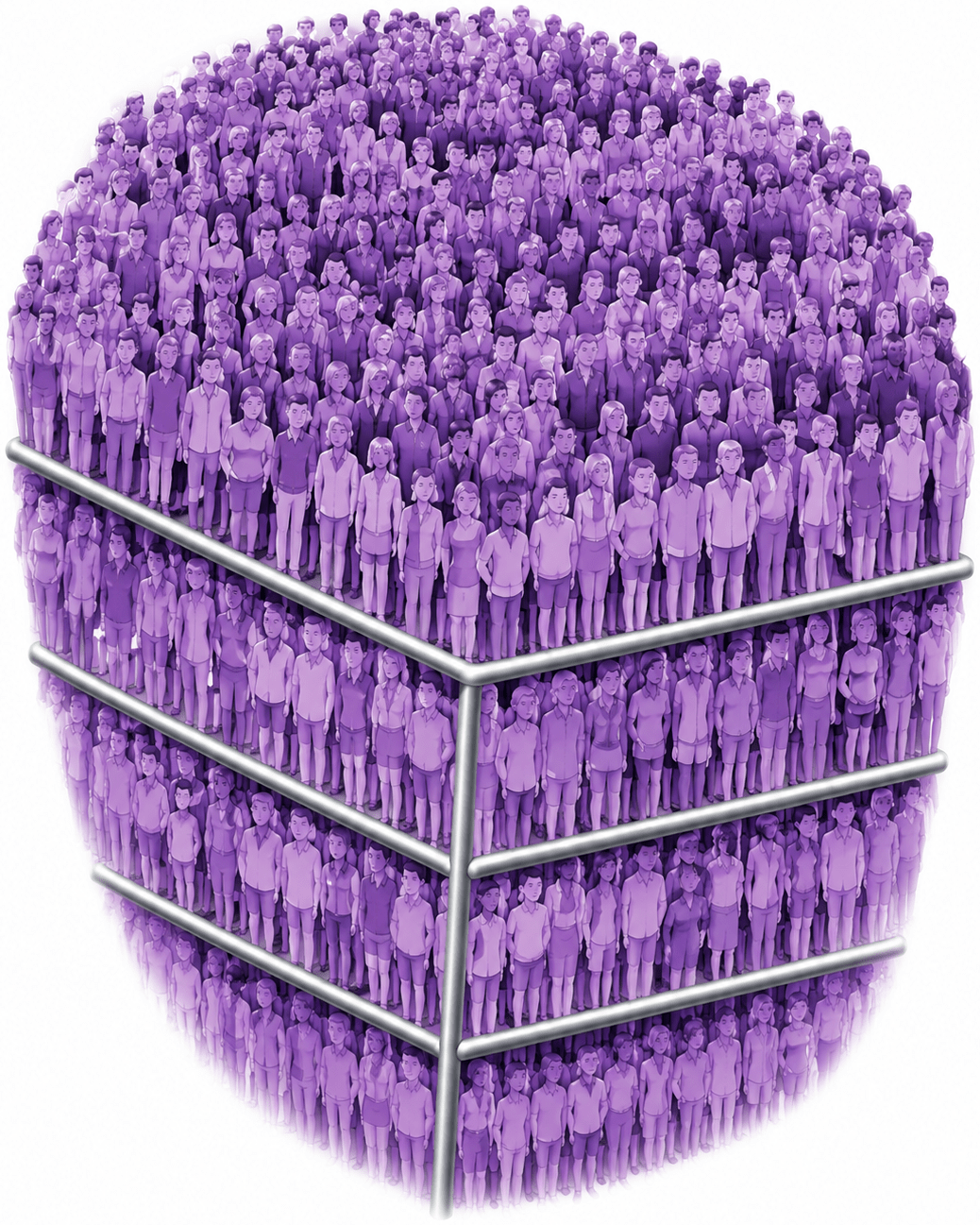
Answer
Guess: A few kilometres.
Assumptions:
The world population is about 8 billion = 8,00,00,00,000;
An average person has a mass of about 70 kg;
A human body is about as dense as water, 1000 kg per m3.
Volume of a person = mass ÷ density
= m3
= 0.07 m3
Allowing for small gaps between people, take 0.1 m3 of space per person.
Volume of the cube = 8,00,00,00,000 × 0.1 m3
= 80,00,00,000 m3
Let the side of the cube be a m.
Hence, the side of the cube would be only about 930 m, less than 1 km.
For guesstimate problems, make a guess first before solving.
The Earth’s surface has an estimated volume of 1.38 billion km3 of water. Suppose the Earth is a perfect sphere and all this water forms a uniform layer completely covering the Earth’s surface, like a thin water bubble. Estimate the thickness of this water layer. The Earth’s radius is ~6371 km.
(i) Write an expression that gives the thickness of this water layer.
(ii) Simplify the expression in (i) using a calculator.
Answer
Guess: A few kilometres.
Given:
Volume of water, V = 1.38 billion km3 = 1.38 × 10⁹ km3
Radius of the Earth, R = 6371 km
Let the thickness of the water layer be t km.
(i) The water layer is the space between a sphere of radius R + t and the Earth (radius R).
Since the layer is very thin compared with the radius of the Earth, its volume is almost the surface area of the Earth × thickness:
V ≈ 4πR2 × t
⇒ t ≈
Hence, the thickness is t = , which is approximately .
(ii) Taking π = 3.14,
R2 = 6371 × 6371 km2
= 4,05,89,641 km2
Surface area of the Earth = 4πR2
= 4 × 3.14 × 40589641 km2
≈ 50,98,05,891 km2
t ≈ km
≈ 2.71 km
Hence, the water layer would be about 2.71 km thick.
Give the dimension of a cuboid whose volume is halved when its surface area is doubled.
Answer
The cuboid has to be reshaped: We find a cuboid, and a reshaped cuboid whose surface area is double and whose volume is half.
To get a larger surface with a smaller volume, the new cuboid must be much flatter. Try an original cuboid a × b × b and a flat cuboid 1 × 2b × 2b (all in cm).
Volume of the original cuboid = ab2
Volume of the flat cuboid = 1 × 2b × 2b = 4b2
The volume is halved:
Surface area of the original cuboid = 2(ab + bc + ca)
= 2(8b + b × b + b × 8)
= 2(8b + b2 + 8b)
= 2(b2 + 16b)
= 2b2 + 32b
Surface area of the flat cuboid = 2(1 × 2b + 2b × 2b + 2b × 1)
= 2(2b + 4b2 + 2b)
= 2(4b2 + 4b)
= 8b2 + 8b
The surface area is doubled:
8b2 + 8b = 2(2b2 + 32b)
⇒ 8b2 + 8b = 4b2 + 64b
⇒ 8b2 - 4b2 = 64b - 8b
⇒ 4b2 = 56b
⇒ b = 14 [∵ b ≠ 0]
So the original cuboid is 8 cm × 14 cm × 14 cm and the new cuboid is 1 cm × 28 cm × 28 cm.
Hence, a cuboid of 8 cm × 14 cm × 14 cm, reshaped into a cuboid of 1 cm × 28 cm × 28 cm, has its volume halved while its surface area is doubled.
For guesstimate problems, make a guess first before solving.
Project: Find the volume of your house making necessary approximations. Present how you solved it.
Answer
A sample set of measurements is used below to show the method.
Guess: About 150 m3.
Steps followed:
Measure the length and width of each room with a measuring tape, and the height from floor to ceiling.
Treat each room as a cuboid; ignore the thickness of walls, cupboards and small projections.
Find the volume of each room using V = l × w × h.
Add the volumes of all the rooms.
Sample measurements (height of every room = 3 m):
| Room | Length (m) | Width (m) | Height (m) | Volume (m3) |
|---|---|---|---|---|
| Living room | 5 | 4 | 3 | 5 × 4 × 3 = 60 |
| Bedroom 1 | 4 | 3.5 | 3 | 4 × 3.5 × 3 = 42 |
| Bedroom 2 | 3.5 | 3 | 3 | 3.5 × 3 × 3 = 31.5 |
| Kitchen | 3 | 2.5 | 3 | 3 × 2.5 × 3 = 22.5 |
| Bathroom | 2.5 | 1.5 | 3 | 2.5 × 1.5 × 3 = 11.25 |
Volume of the house = 60 + 42 + 31.5 + 22.5 + 11.25 m3
= 167.25 m3
Hence, the volume of the sample house is about 167 m3.