
Write a linear equation in two variables in which a = 3, b = 0 and c = – .
Answer
The standard form of a linear equation in two variables is ax + by + c = 0.
Given:
a = 3
b = 0
c =
Substituting these values in ax + by + c = 0:
⇒ 3x + 0 × y + = 0
⇒ 3x + 0 × y - = 0
⇒ 3x - = 0
Hence, the required linear equation is 3x + 0 × y - = 0, that is, 3x - = 0.
Complete the following table after expressing the given linear equations in standard form.
| Linear equation in two variables | Standard Form | Coefficient of x | Coefficient of y | Constant term |
|---|---|---|---|---|
| y – 15 = | ||||
| 3y – 2x = 0 | ||||
| 5x = 3y | ||||
| x = 8 | ||||
| 3y = 1 |
Answer
The standard form of a linear equation in two variables is ax + by + c = 0, where a is the coefficient of x, b is the coefficient of y and c is the constant term. We bring all the terms to the left-hand side in each case.
(i) y - 15 =
⇒ 0 = - y + 15 [Subtracting y and adding 15 on both sides]
⇒ - y + 15 = 0
Here, a = , b = -1 and c = 15.
(ii) 3y - 2x = 0
⇒ -2x + 3y + 0 = 0
Here, a = -2, b = 3 and c = 0.
(iii) 5x = 3y
⇒ 5x - 3y = 0 [Subtracting 3y from both sides]
⇒ 5x - 3y + 0 = 0
Here, a = 5, b = -3 and c = 0.
(iv) x = 8
⇒ x - 8 = 0 [Subtracting 8 from both sides]
⇒ x + 0 × y - 8 = 0
Here, a = 1, b = 0 and c = -8.
(v) 3y = 1
⇒ 3y - 1 = 0 [Subtracting 1 from both sides]
⇒ 0 × x + 3y - 1 = 0
Here, a = 0, b = 3 and c = -1.
The completed table is:
| Linear equation in two variables | Standard Form | Coefficient of x | Coefficient of y | Constant term |
|---|---|---|---|---|
| y - 15 = | - y + 15 = 0 | -1 | 15 | |
| 3y - 2x = 0 | -2x + 3y + 0 = 0 | -2 | 3 | 0 |
| 5x = 3y | 5x - 3y + 0 = 0 | 5 | -3 | 0 |
| x = 8 | x + 0 × y - 8 = 0 | 1 | 0 | -8 |
| 3y = 1 | 0 × x + 3y - 1 = 0 | 0 | 3 | -1 |
The cost of a notebook is twice the cost of a pen. Consider the cost of a notebook to be ₹t and that of a pen to be ₹p. Charlie wrote t = 2p, whereas Meera wrote p = 2t. Which of these two representations is correct?
Answer
Given:
Cost of a notebook = ₹t
Cost of a pen = ₹p
According to the question,
Cost of a notebook = 2 × Cost of a pen
⇒ t = 2 × p
⇒ t = 2p
Meera's equation p = 2t says that the cost of a pen is twice the cost of a notebook, which is the opposite of what is given.
Check: If a pen costs ₹10, a notebook costs 2 × 10 = ₹20.
Charlie: t = 2p ⇒ 20 = 2 × 10 ⇒ 20 = 20, which is true.
Meera: p = 2t ⇒ 10 = 2 × 20 ⇒ 10 = 40, which is false.
Hence, Charlie's representation t = 2p is correct.
In a one-day International Cricket match between India and Sri Lanka played in Nagpur, two Indian batsmen together scored 176 runs. Manisha expressed this situation as x + y = 176, where the number of runs scored by one batsman is x, and the number of runs scored by the other is y. Is this a correct representation?
Answer
Given:
Runs scored by the first batsman = x
Runs scored by the second batsman = y
Total runs scored by the two batsmen = 176
According to the question,
Runs of the first batsman + Runs of the second batsman = Total runs
⇒ x + y = 176
This is a linear equation in two variables. In standard form it is x + y - 176 = 0, with a = 1, b = 1 and c = -176. Here, x and y can only be whole numbers, since runs cannot be negative or fractional.
Hence, yes, x + y = 176 is a correct representation of the situation.
Are , (0, 6), (4, 1) and solutions of the equation 3x + 2y = 12?
Can you find any other solution? How many solutions can you find?
Answer
A pair (x, y) is a solution of 3x + 2y = 12 if substituting it makes the LHS equal to 12.
(i)
Substituting x = 1 and y = in 3x + 2y = 12, we get:
LHS = 3 × 1 + 2 ×
= 3 + 9
= 12 = RHS
So, is a solution.
(ii) (0, 6)
Substituting x = 0 and y = 6 in 3x + 2y = 12, we get:
LHS = 3 × 0 + 2 × 6
= 0 + 12
= 12 = RHS
So, (0, 6) is a solution.
(iii) (4, 1)
Substituting x = 4 and y = 1 in 3x + 2y = 12, we get:
LHS = 3 × 4 + 2 × 1
= 12 + 2
= 14 ≠ 12
So, (4, 1) is not a solution.
(iv)
Substituting x = and y = in 3x + 2y = 12, we get:
LHS = 3 × + 2 ×
= +
=
= 12 = RHS
So, is a solution.
Hence, , (0, 6) and are solutions of 3x + 2y = 12, but (4, 1) is not.
Other solutions: We give x any value and solve the resulting equation for y.
When x = 2:
⇒ 3 × 2 + 2y = 12
⇒ 6 + 2y = 12
⇒ 2y = 12 - 6
⇒ 2y = 6
⇒ y = 3
So, (2, 3) is a solution.
When x = -2:
⇒ 3 × (-2) + 2y = 12
⇒ -6 + 2y = 12
⇒ 2y = 12 + 6
⇒ 2y = 18
⇒ y = 9
So, (-2, 9) is a solution.
When x = 6:
⇒ 3 × 6 + 2y = 12
⇒ 18 + 2y = 12
⇒ 2y = 12 - 18
⇒ 2y = -6
⇒ y = -3
So, (6, -3) is a solution.
For every value we give to x, we get one value of y. Since x can take infinitely many values, we can find as many solutions as we like.
Hence, (2, 3), (-2, 9) and (6, -3) are some other solutions, and the equation 3x + 2y = 12 has infinitely many solutions.
Four friends — Ranju, Meena, Farhan, and Toshi — are solving problems.
Ranju: I noticed something! If c = 0 in the standard form of a line ax + by + c = 0, then the line must pass through the origin. Look, if I substitute x = 0 and y = 0, in equation ax + by = 0, the equation is satisfied. So, the origin lies on the line! We can also say that the line passes through the origin.
Farhan: Let us try for the equation 2x + 3y = 0. Here a = 2, b = 3 but c = 0. If we substitute x = 0, then we get 3y = 0 or y = 0. This means (0, 0) lies on the line. So yes, this line passes through the origin.
Toshi: Suppose our equation has b = c = 0, say, 5x = 0. This becomes x = 0 which is the equation of the y-axis. And the y-axis passes through the origin.
Meena: And if we take a = c = 0, say, 7y = 0, that means y = 0, which is the equation of the x-axis that also passes through the origin.
So, they conclude: Whenever c = 0, the line ax + by + c = 0 will always pass through the origin, irrespective of the values of a or b. Do you agree with them?
Answer
Yes, we agree with them.
When c = 0, the equation ax + by + c = 0 becomes ax + by = 0.
Substituting x = 0 and y = 0:
LHS = a × 0 + b × 0
= 0 + 0
= 0 = RHS
This is true whatever the values of a and b are. So, (0, 0) is always a solution of ax + by = 0, that is, the origin always lies on this line.
The only condition is that a and b are not both zero. This is already part of the definition of a linear equation in two variables; if a = b = 0 as well, the "equation" becomes 0 = 0, which is not a line at all.
The friends' examples cover all the cases: Farhan's 2x + 3y = 0 (a ≠ 0, b ≠ 0), Toshi's 5x = 0, i.e. the y-axis (b = 0), and Meena's 7y = 0, i.e. the x-axis (a = 0).
The converse is also true: If the line ax + by + c = 0 passes through the origin, then a × 0 + b × 0 + c = 0, which gives c = 0.
Hence, a line ax + by + c = 0 passes through the origin whenever c = 0, irrespective of the values of a and b (not both zero).
Verify if the ordered pair (4, 3) is a solution of 5x – 6y = 2. Explain your reasoning.
Answer
An ordered pair is a solution of an equation if substituting its values makes both sides equal.
Given equation: 5x - 6y = 2
Substituting x = 4 and y = 3:
LHS = 5 × 4 - 6 × 3
= 20 - 18
= 2 = RHS
Hence, (4, 3) is a solution of 5x - 6y = 2, because x = 4 and y = 3 satisfy the equation.
Find any two solutions for the following equation:
7x – 3y = 21
Answer
Given equation: 7x - 3y = 21
Substituting x = 0:
⇒ 7 × 0 - 3y = 21
⇒ -3y = 21
⇒ y =
⇒ y = -7
So, (0, -7) is a solution.
Substituting y = 0:
⇒ 7x - 3 × 0 = 21
⇒ 7x = 21
⇒ x = 3
So, (3, 0) is a solution.
Hence, two solutions of 7x - 3y = 21 are (0, -7) and (3, 0).
Find any two solutions for the following equation:
2x + 3y = 5
Answer
Given equation: 2x + 3y = 5
Substituting x = 1:
⇒ 2 × 1 + 3y = 5
⇒ 2 + 3y = 5
⇒ 3y = 3
⇒ y = 1
So, (1, 1) is a solution.
Substituting x = 4:
⇒ 2 × 4 + 3y = 5
⇒ 8 + 3y = 5
⇒ 3y = -3
⇒ y = -1
So, (4, -1) is a solution.
Hence, two solutions of 2x + 3y = 5 are (1, 1) and (4, -1).
In the equations given below, m and n are unknown constants: 2mx + 3y = 7; 4x + ny = –10. If (2, –1) is the solution of both equations, find the values of m and n.
Answer
Given equations:
2mx + 3y = 7 ...(1)
4x + ny = -10 ...(2)
(2, -1) is the solution of both equations, so x = 2 and y = -1 satisfy both.
Substituting x = 2 and y = -1 in equation (1):
⇒ 2m(2) + 3(-1) = 7
⇒ 4m - 3 = 7
⇒ 4m = 7 + 3
⇒ 4m = 10
⇒ m =
⇒ m =
Substituting x = 2 and y = -1 in equation (2):
⇒ 4(2) + n(-1) = -10
⇒ 8 - n = -10
⇒ -n = -10 - 8
⇒ -n = -18
⇒ n = 18
Hence, m = and n = 18.
Find two solutions which lie in different quadrants for the following linear equation. Identify the quadrants in which the points lie.
5x + 3y = 7
Verify your solution by representing the linear equation on a graph paper.
Answer
We give a negative value and a positive value to x, so that the two points come out in different quadrants.
When x = -1:
⇒ 5 × (-1) + 3y = 7
⇒ -5 + 3y = 7
⇒ 3y = 7 + 5
⇒ 3y = 12
⇒ y = 4
So, P (-1, 4) is a solution.
When x = 2:
⇒ 5 × 2 + 3y = 7
⇒ 10 + 3y = 7
⇒ 3y = 7 - 10
⇒ 3y = -3
⇒ y = -1
So, Q (2, -1) is a solution.
Points in Quadrant I have x > 0, y > 0; in Quadrant II, x < 0, y > 0; in Quadrant III, x < 0, y < 0; and in Quadrant IV, x > 0, y < 0.
So, P (-1, 4) lies in Quadrant II and Q (2, -1) lies in Quadrant IV.
Verification on graph paper: Plot P (-1, 4) and Q (2, -1) and draw the straight line through them.
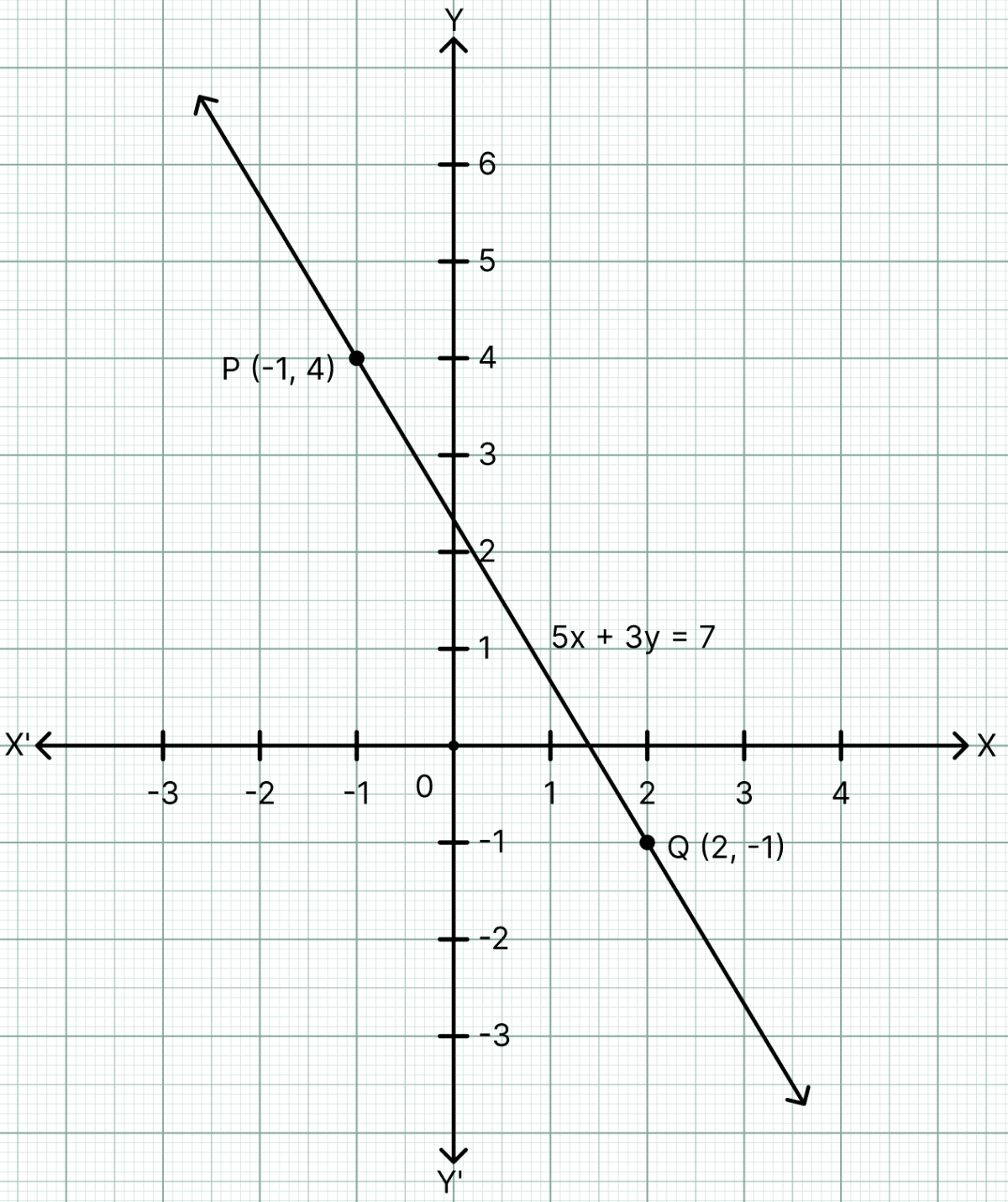
Both points lie on the straight line which is the graph of 5x + 3y = 7. Since every point on this line is a solution of the equation, the solutions are verified.
Hence, two solutions of 5x + 3y = 7 are P (-1, 4) in Quadrant II and Q (2, -1) in Quadrant IV.
Find two solutions which lie in different quadrants for the following linear equation. Identify the quadrants in which the points lie.
5x – 3y = 7
Verify your solution by representing the linear equation on a graph paper.
Answer
We give a negative value and a positive value to x, so that the two points come out in different quadrants.
When x = -1:
⇒ 5 × (-1) - 3y = 7
⇒ -5 - 3y = 7
⇒ -3y = 7 + 5
⇒ -3y = 12
⇒ y = -4
So, P (-1, -4) is a solution.
When x = 2:
⇒ 5 × 2 - 3y = 7
⇒ 10 - 3y = 7
⇒ -3y = 7 - 10
⇒ -3y = -3
⇒ y = 1
So, Q (2, 1) is a solution.
Points in Quadrant I have x > 0, y > 0; in Quadrant II, x < 0, y > 0; in Quadrant III, x < 0, y < 0; and in Quadrant IV, x > 0, y < 0.
So, P (-1, -4) lies in Quadrant III and Q (2, 1) lies in Quadrant I.
Verification on graph paper: Plot P (-1, -4) and Q (2, 1) and draw the straight line through them.
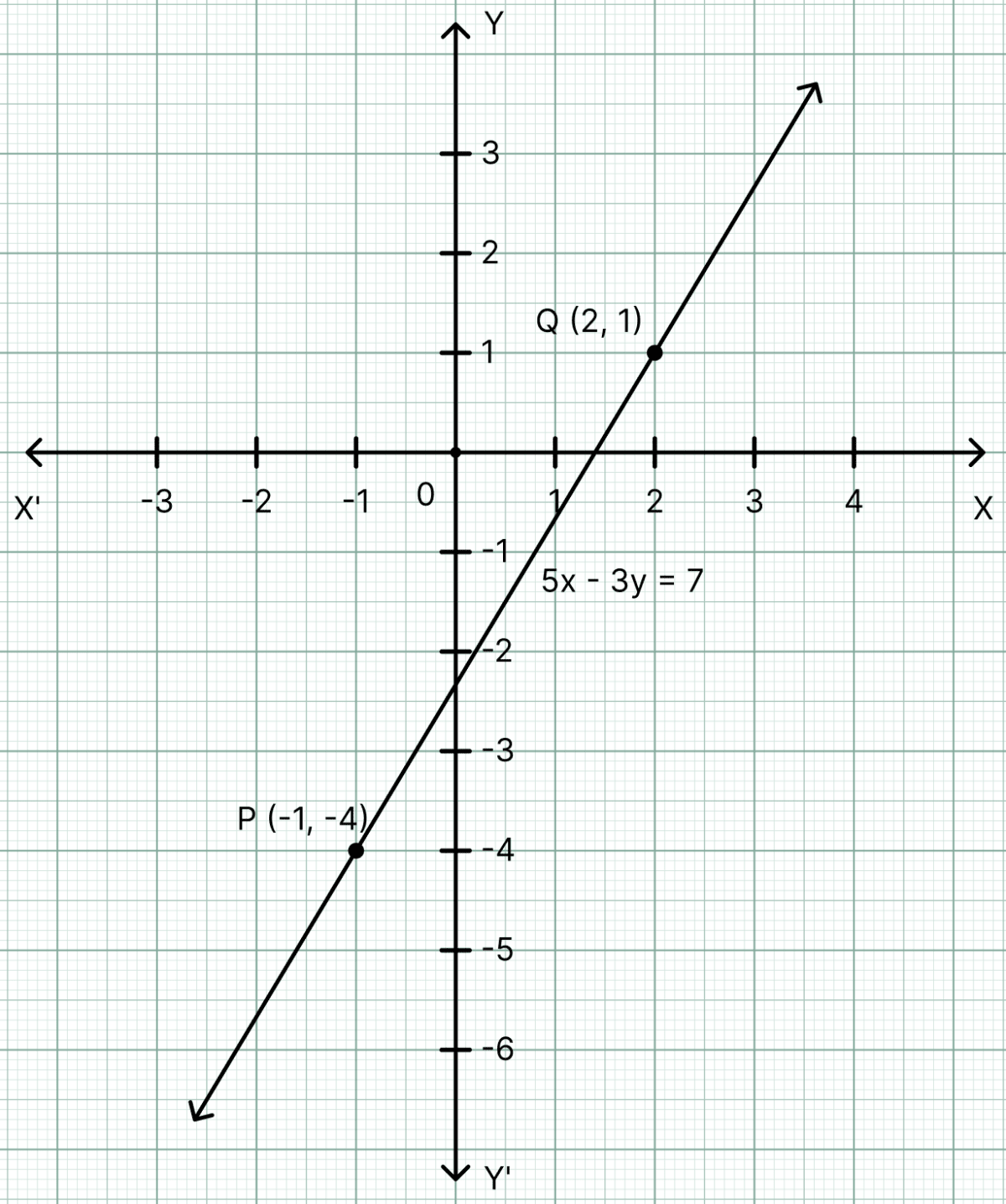
Both points lie on the straight line which is the graph of 5x - 3y = 7. Since every point on this line is a solution of the equation, the solutions are verified.
Hence, two solutions of 5x - 3y = 7 are P (-1, -4) in Quadrant III and Q (2, 1) in Quadrant I.
Find two solutions which lie in different quadrants for the following linear equation. Identify the quadrants in which the points lie.
–5x + 3y = 7
Verify your solution by representing the linear equation on a graph paper.
Answer
We give a negative value and a positive value to x, so that the two points come out in different quadrants.
When x = -2:
⇒ -5 × (-2) + 3y = 7
⇒ 10 + 3y = 7
⇒ 3y = 7 - 10
⇒ 3y = -3
⇒ y = -1
So, P (-2, -1) is a solution.
When x = 1:
⇒ -5 × 1 + 3y = 7
⇒ -5 + 3y = 7
⇒ 3y = 7 + 5
⇒ 3y = 12
⇒ y = 4
So, Q (1, 4) is a solution.
Points in Quadrant I have x > 0, y > 0; in Quadrant II, x < 0, y > 0; in Quadrant III, x < 0, y < 0; and in Quadrant IV, x > 0, y < 0.
So, P (-2, -1) lies in Quadrant III and Q (1, 4) lies in Quadrant I.
Verification on graph paper: Plot P (-2, -1) and Q (1, 4) and draw the straight line through them.
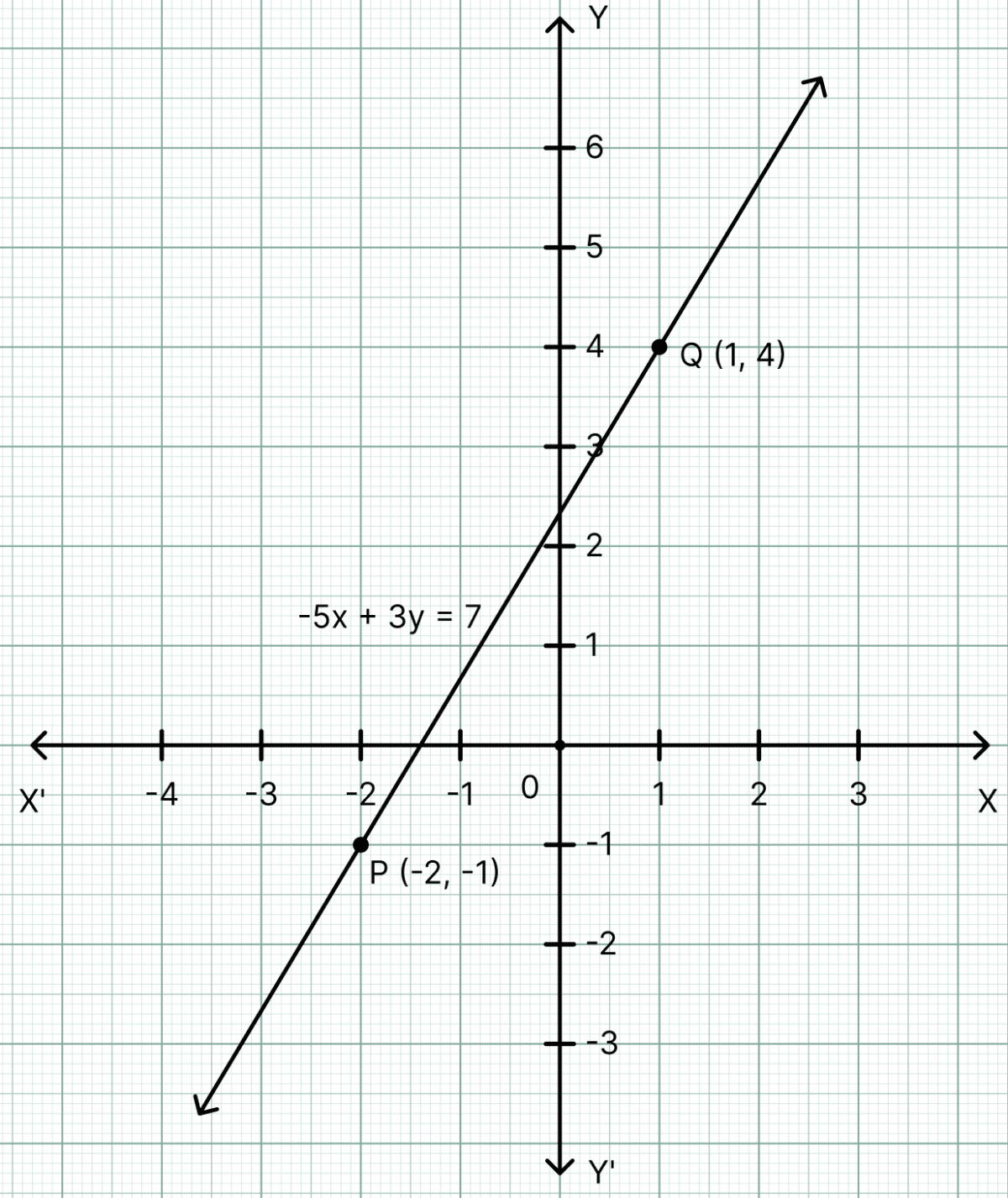
Both points lie on the straight line which is the graph of -5x + 3y = 7. Since every point on this line is a solution of the equation, the solutions are verified.
Hence, two solutions of -5x + 3y = 7 are P (-2, -1) in Quadrant III and Q (1, 4) in Quadrant I.
Find two solutions which lie in different quadrants for the following linear equation. Identify the quadrants in which the points lie.
–5x – 3y = 7
Verify your solution by representing the linear equation on a graph paper.
Answer
We give a negative value and a positive value to x, so that the two points come out in different quadrants.
When x = -2:
⇒ -5 × (-2) - 3y = 7
⇒ 10 - 3y = 7
⇒ -3y = 7 - 10
⇒ -3y = -3
⇒ y = 1
So, P (-2, 1) is a solution.
When x = 1:
⇒ -5 × 1 - 3y = 7
⇒ -5 - 3y = 7
⇒ -3y = 7 + 5
⇒ -3y = 12
⇒ y = -4
So, Q (1, -4) is a solution.
Points in Quadrant I have x > 0, y > 0; in Quadrant II, x < 0, y > 0; in Quadrant III, x < 0, y < 0; and in Quadrant IV, x > 0, y < 0.
So, P (-2, 1) lies in Quadrant II and Q (1, -4) lies in Quadrant IV.
Verification on graph paper: Plot P (-2, 1) and Q (1, -4) and draw the straight line through them.
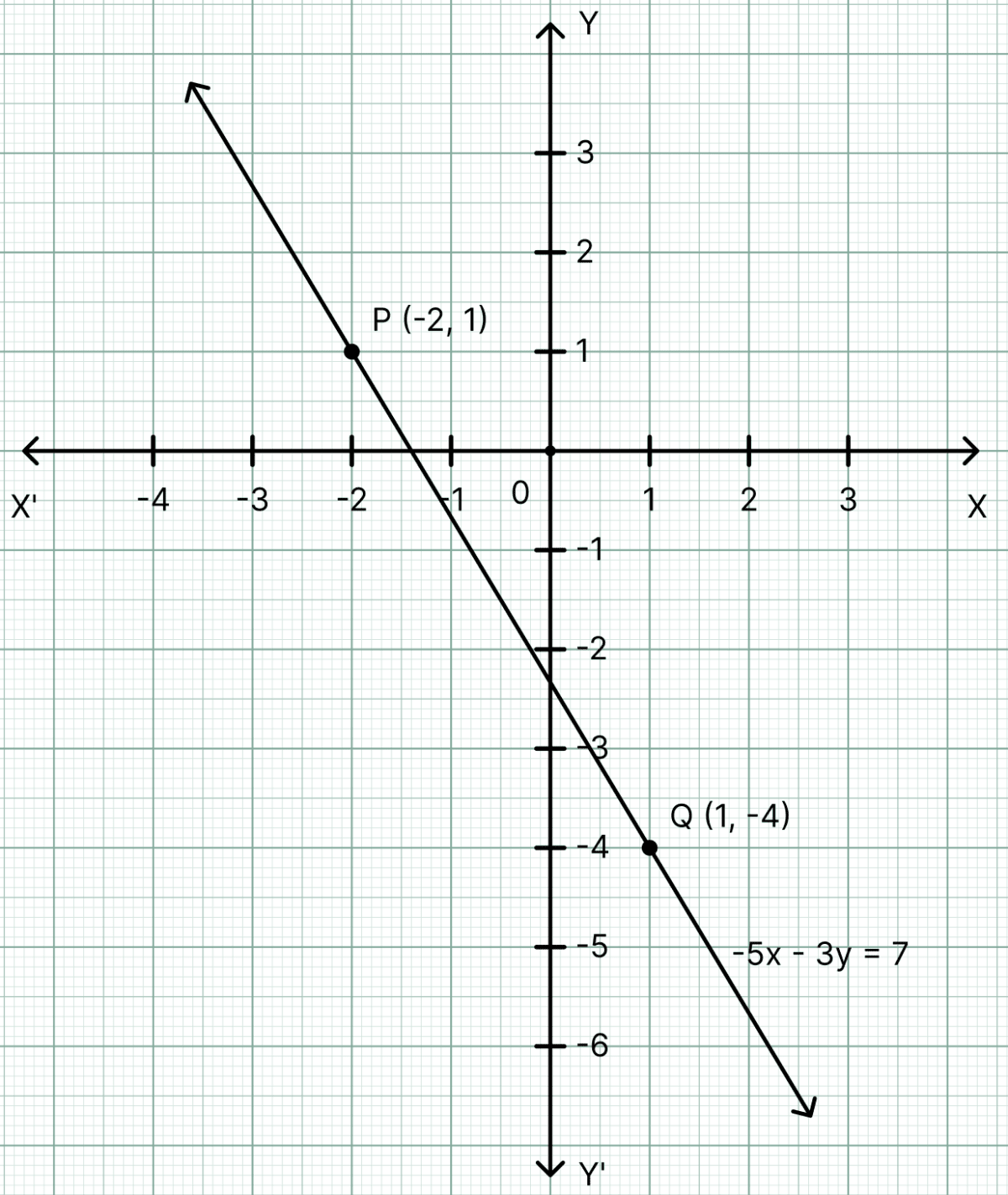
Both points lie on the straight line which is the graph of -5x - 3y = 7. Since every point on this line is a solution of the equation, the solutions are verified.
Hence, two solutions of -5x - 3y = 7 are P (-2, 1) in Quadrant II and Q (1, -4) in Quadrant IV.
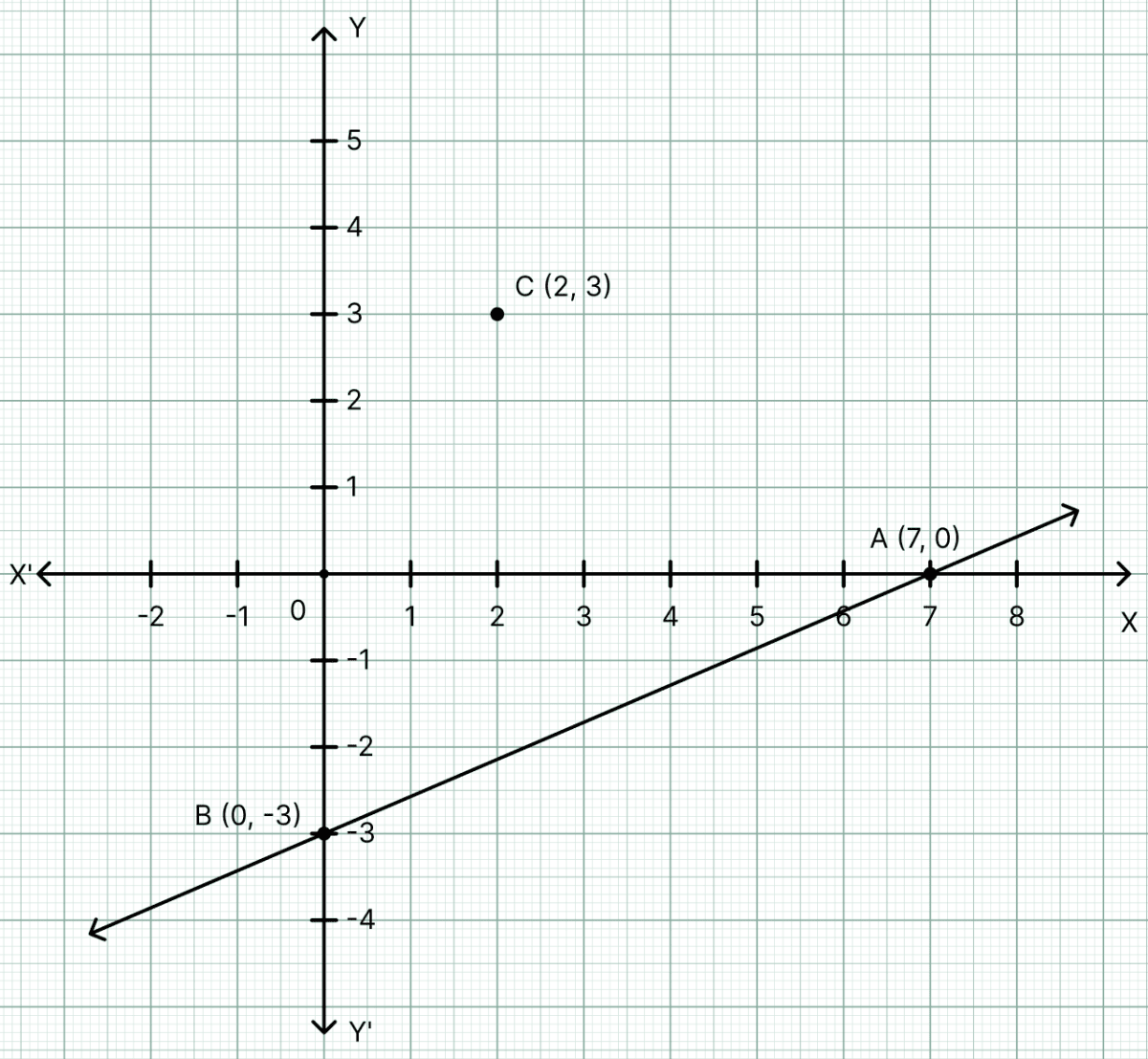
Consider the graph of the equation 3x – 7y = 21 shown below. Does the point C (2, 3) lie on the line? Does it satisfy the equation? Can points that do not lie on the line satisfy the equation?
Answer
Does C (2, 3) lie on the line?
The line passes through B (0, -3) and A (7, 0). Between x = 0 and x = 7 it lies below the x-axis, so at x = 2 the line is below the x-axis. The point C (2, 3) is above the x-axis.
So, C (2, 3) does not lie on the line.
Does C (2, 3) satisfy the equation?
Substituting x = 2 and y = 3 in 3x - 7y = 21:
LHS = 3 × 2 - 7 × 3
= 6 - 21
= -15 ≠ 21
So, C (2, 3) does not satisfy the equation.
Can points that do not lie on the line satisfy the equation?
No. Every solution (x, y) of a linear equation in two variables is a point on its graph, and every point on the graph is a solution. So a point satisfies 3x - 7y = 21 exactly when it lies on this line.
Hence, C (2, 3) neither lies on the line nor satisfies the equation, and no point that is off the line can satisfy the equation.
State whether the following sentences are True or False. Justify your answer.
A linear equation in two variables has only one solution.
Answer
False
Reason — For any value given to x, we can find a value of y that satisfies the equation. For example, x + y = 5 has the solutions (0, 5), (1, 4), (2, 3), (5, 0), and so on.
Hence, the statement is False.
State whether the following sentences are True or False. Justify your answer.
The graph of a linear equation in two variables always passes through the origin.
Answer
False
Reason — Consider x + y = 5.
Substituting x = 0 and y = 0:
LHS = 0 + 0
= 0 ≠ 5
So, (0, 0) is not a solution, and the graph of x + y = 5 does not pass through the origin. The graph ax + by + c = 0 passes through the origin only when c = 0.
Hence, the statement is False.
State whether the following sentences are True or False. Justify your answer.
A linear equation in two variables can never have rational solutions.
Answer
False
Reason — Consider 2x + 3y = 7.
Substituting x = 2 and y = 1:
LHS = 2 × 2 + 3 × 1
= 4 + 3
= 7 = RHS
So, (2, 1) is a solution, and both 2 and 1 are rational numbers. Similarly, is also a solution, since 2 × + 3 × 2 = 1 + 6 = 7.
Hence, the statement is False.
State whether the following sentences are True or False. Justify your answer.
x = 3 is a valid linear equation in two variables.
Answer
True
Reason — x = 3 can be written as
⇒ x - 3 = 0
⇒ x + 0 × y - 3 = 0
This is of the form ax + by + c = 0 with a = 1, b = 0 and c = -3. Here a and b are not both zero. Its graph is the line parallel to the y-axis through (3, 0).
Hence, the statement is True.
State whether the following sentences are True or False. Justify your answer.
The equation 2x + 3y = 7 has infinitely many solutions.
Answer
True
Reason — For every value of x, we get a value of y from 3y = 7 - 2x, that is, y = .
For example:
x = 2 gives y = = 1, so (2, 1) is a solution.
x = 5 gives y = = -1, so (5, -1) is a solution.
x = -1 gives y = = 3, so (-1, 3) is a solution.
Since x can take infinitely many values, there are infinitely many solutions.
Hence, the statement is True.
State whether the following sentences are True or False. Justify your answer.
The point (1, 2) is a solution of the equation 2x + 3y = 7.
Answer
False
Reason —
Substituting x = 1 and y = 2 in 2x + 3y = 7:
LHS = 2 × 1 + 3 × 2
= 2 + 6
= 8 ≠ 7
Hence, the statement is False.
(i) Compare the solutions of the equations 3x + 4y = 7 and 6x + 8y = 14. Argue that they have the same set of solutions, that is, every solution of one is also a solution of the other.
(ii) Show that the equations ax + by = c and kax + kby = kc, with k ≠ 0, have the same set of solutions.
Answer
(i) Given equations:
3x + 4y = 7 ...(1)
6x + 8y = 14 ...(2)
Let (p, q) be any solution of (1). Then
⇒ 3p + 4q = 7
⇒ 2 × (3p + 4q) = 2 × 7 [Multiplying both sides by 2]
⇒ 6p + 8q = 14
So, (p, q) is also a solution of (2).
Now let (r, s) be any solution of (2). Then
⇒ 6r + 8s = 14
⇒ = [Dividing both sides by 2]
⇒ 3r + 4s = 7
So, (r, s) is also a solution of (1).
For example, (1, 1) satisfies both: 3 × 1 + 4 × 1 = 7 and 6 × 1 + 8 × 1 = 14. Also (-3, 4) satisfies both: 3 × (-3) + 4 × 4 = -9 + 16 = 7 and 6 × (-3) + 8 × 4 = -18 + 32 = 14.
Hence, every solution of 3x + 4y = 7 is a solution of 6x + 8y = 14 and vice versa, so they have the same set of solutions.
(ii) Given equations, with k ≠ 0:
ax + by = c ...(3)
kax + kby = kc ...(4)
Let (p, q) be any solution of (3). Then
⇒ ap + bq = c
⇒ k(ap + bq) = kc [Multiplying both sides by k]
⇒ kap + kbq = kc
So, (p, q) is also a solution of (4).
Now let (r, s) be any solution of (4). Then
⇒ kar + kbs = kc
⇒ k(ar + bs) = kc
⇒ ar + bs = c [Dividing both sides by k, which is allowed since k ≠ 0]
So, (r, s) is also a solution of (3).
The condition k ≠ 0 is needed: if k = 0, equation (4) becomes 0 = 0, which every pair (x, y) satisfies, and we cannot divide by k to get back equation (3).
Hence proved.
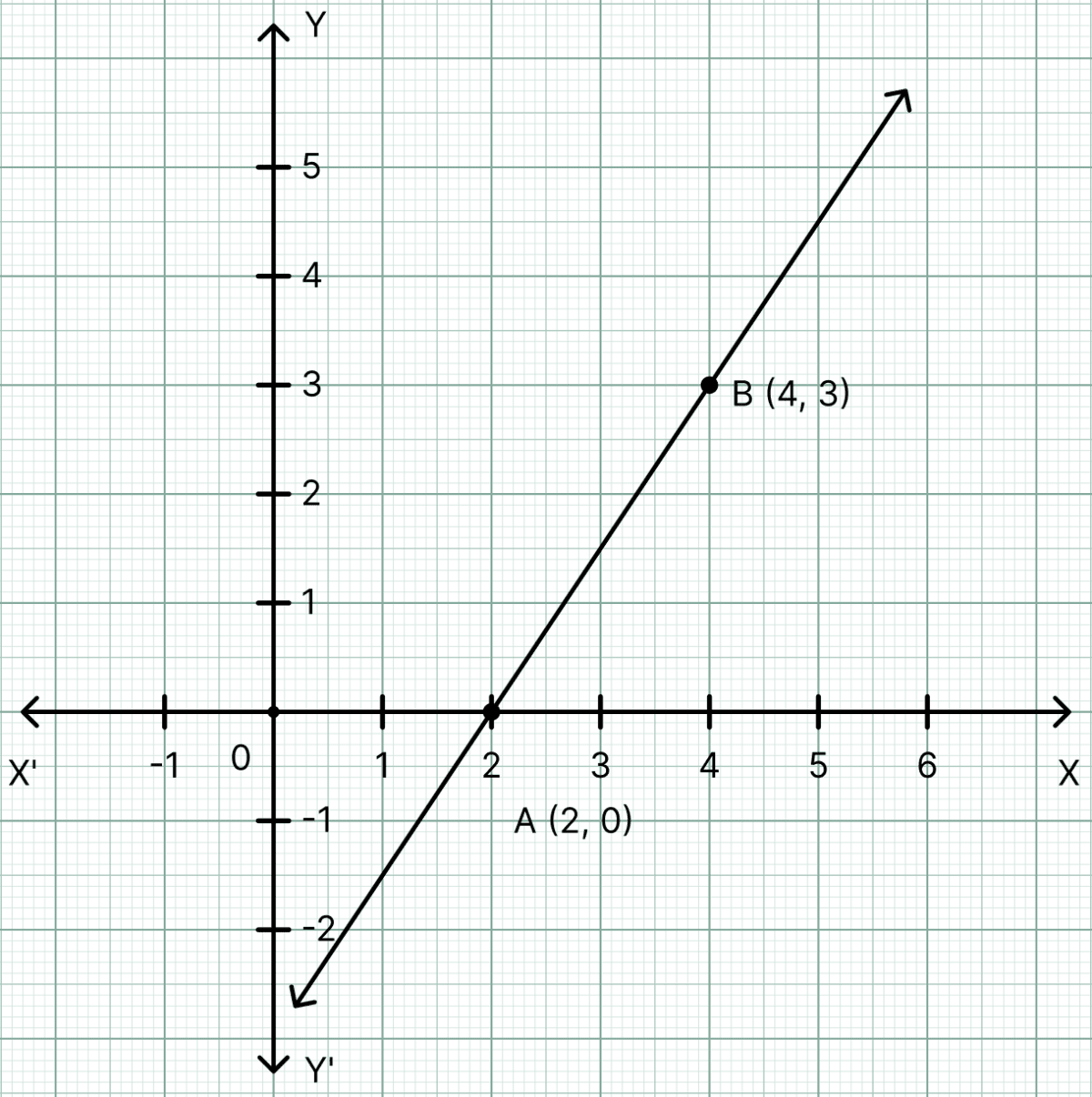
Consider the graph of the equation shown in Fig. 13.7 which passes through the points A (2, 0) and B (4, 3).
Now consider the same line AB further extended beyond B as shown in Fig. 13.8.
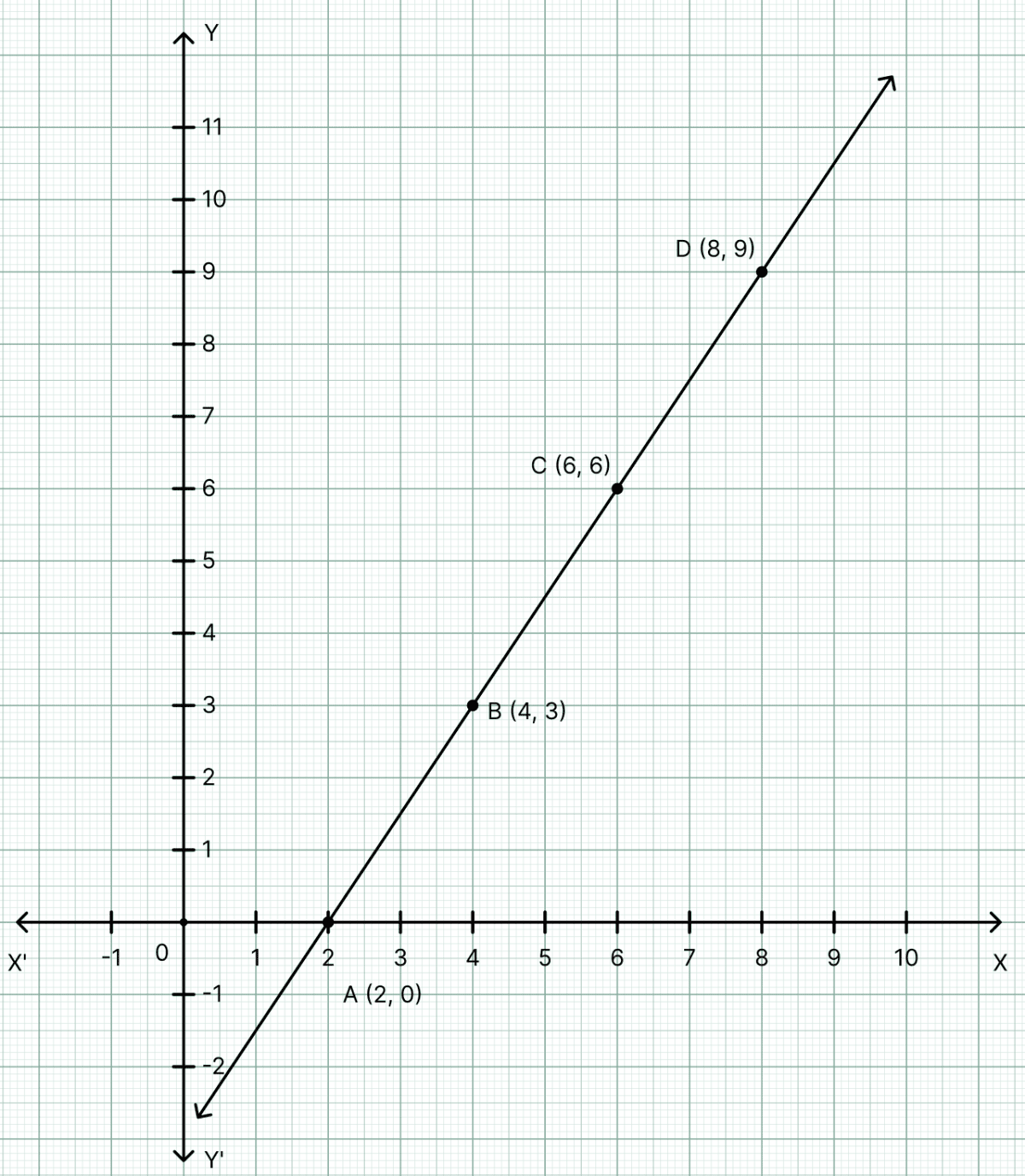
Consider the point on the line AB whose x-coordinate is 8. What is the y-coordinate of this point? Express this as an ordered pair.
Answer
Given:
A (2, 0) and B (4, 3) lie on the line.
We know that
Slope of a line = =
Slope of AB = =
Let the required point be P (8, y). The slope of the line is the same wherever we measure it, so the slope of AP is also .
This is the point D in Fig. 13.8.
Hence, the y-coordinate is 9 and the point is (8, 9).
Consider the graph of the equation shown in Fig. 13.7 which passes through the points A (2, 0) and B (4, 3).
Now consider the same line AB further extended beyond B as shown in Fig. 13.8.
What is the x-coordinate of the point on the line AB whose y-coordinate is 6? Express this as an ordered pair.
Answer
Given:
A (2, 0) and B (4, 3) lie on the line.
Slope of AB = = =
Let the required point be Q (x, 6). The slope of AQ must also be .
This is the point C in Fig. 13.8.
Hence, the x-coordinate is 6 and the point is (6, 6).
Consider the line 5x + y = 3. Rewrite it as y = –5x + 3.
Let us make a table of values to draw its graph.
| x | 0 | 1 | –1 |
|---|---|---|---|
| y | 3 | –2 | 8 |
Plotting the ordered pairs A (0, 3), B (1, –2), C (–1, 8) and drawing the line through them we get the graph of y = –5x + 3.
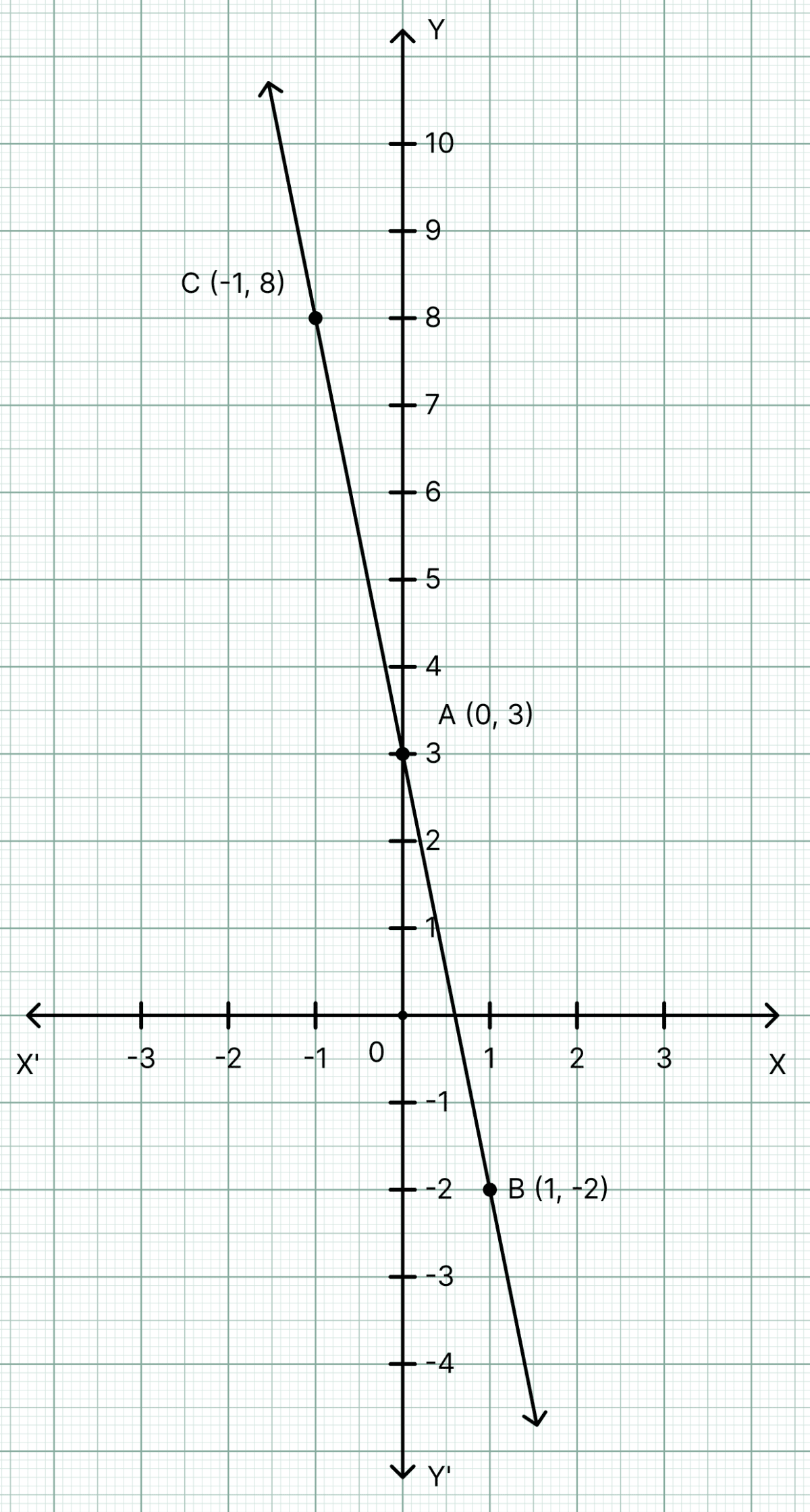
Can you use the points A, B and C to verify that the slope of this line is indeed –5?
Answer
Yes. We find the slope using each pair of points.
We know that
Slope =
Using A (0, 3) and B (1, -2):
Using B (1, -2) and C (-1, 8):
Using A (0, 3) and C (-1, 8):
Every pair of points gives the same slope, -5, which is the value of m in y = -5x + 3.
Hence, the slope of the line y = -5x + 3 is verified to be -5.
The following diagrams represent ski hills. Rank the hills in order of their steepness, from least to greatest.
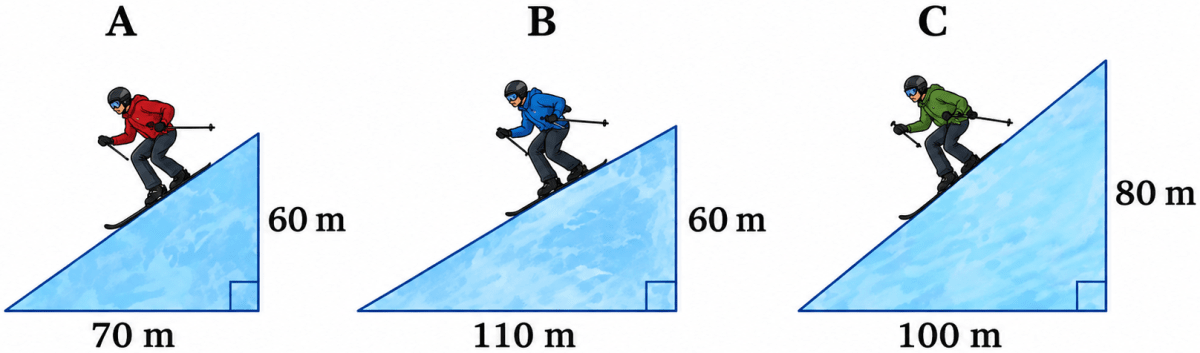
Answer
The steepness of a hill is its slope.
Slope =
Hill A:
Rise = 60 m, Run = 70 m
Slope of A = = ≈ 0.86
Hill B:
Rise = 60 m, Run = 110 m
Slope of B = = ≈ 0.55
Hill C:
Rise = 80 m, Run = 100 m
Slope of C = = = 0.8
To compare the three fractions exactly, we write them with the common denominator 385 [LCM of 7, 11 and 5]:
Since 210 < 308 < 330,
< <
Hence, in order of steepness from least to greatest, the hills are B, C, A.
The ramp at a loading dock rises 2.5 metres over a run of 4 metres. Find the slope of the ramp.
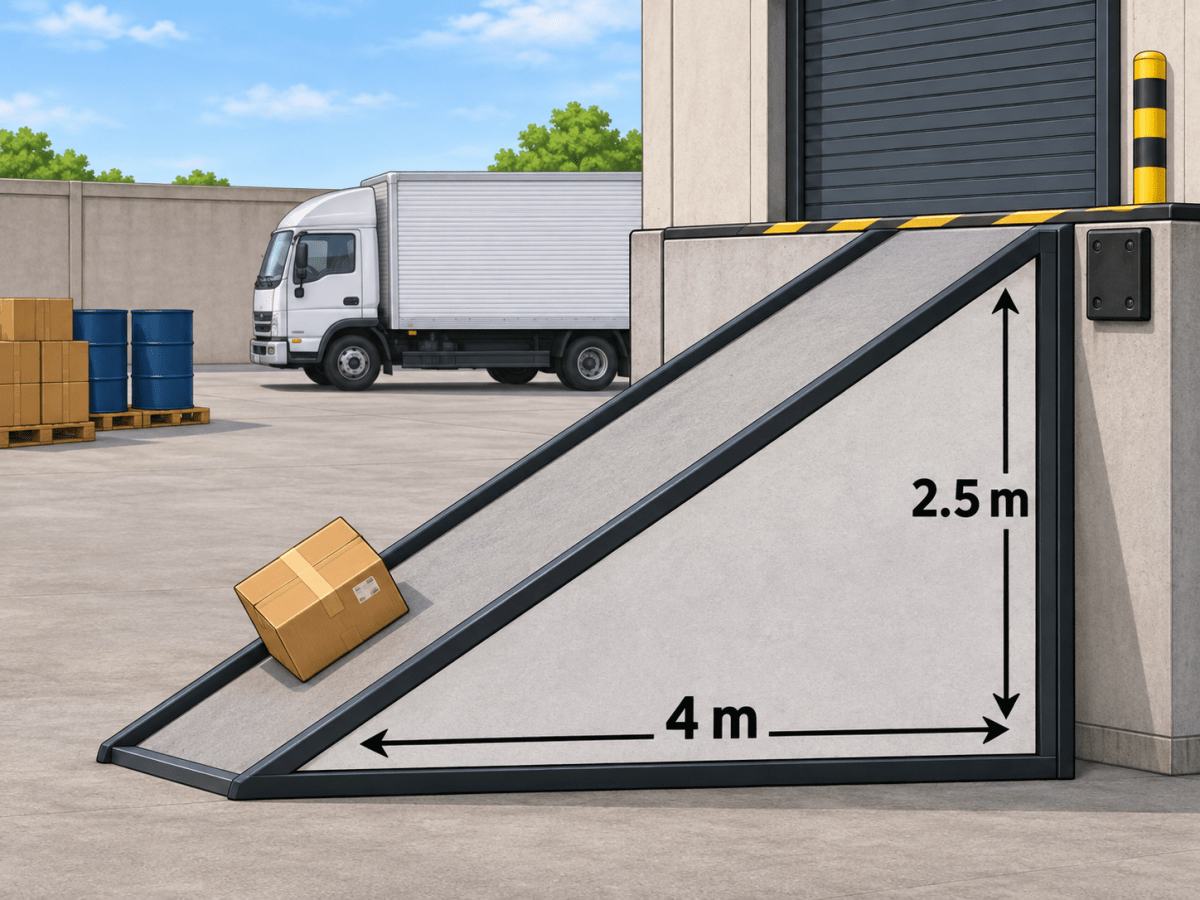
Answer
Given:
Rise = 2.5 m
Run = 4 m
We know that
Slope =
Hence, the slope of the ramp is 0.625.
Find the slope of the line l in the following diagram.
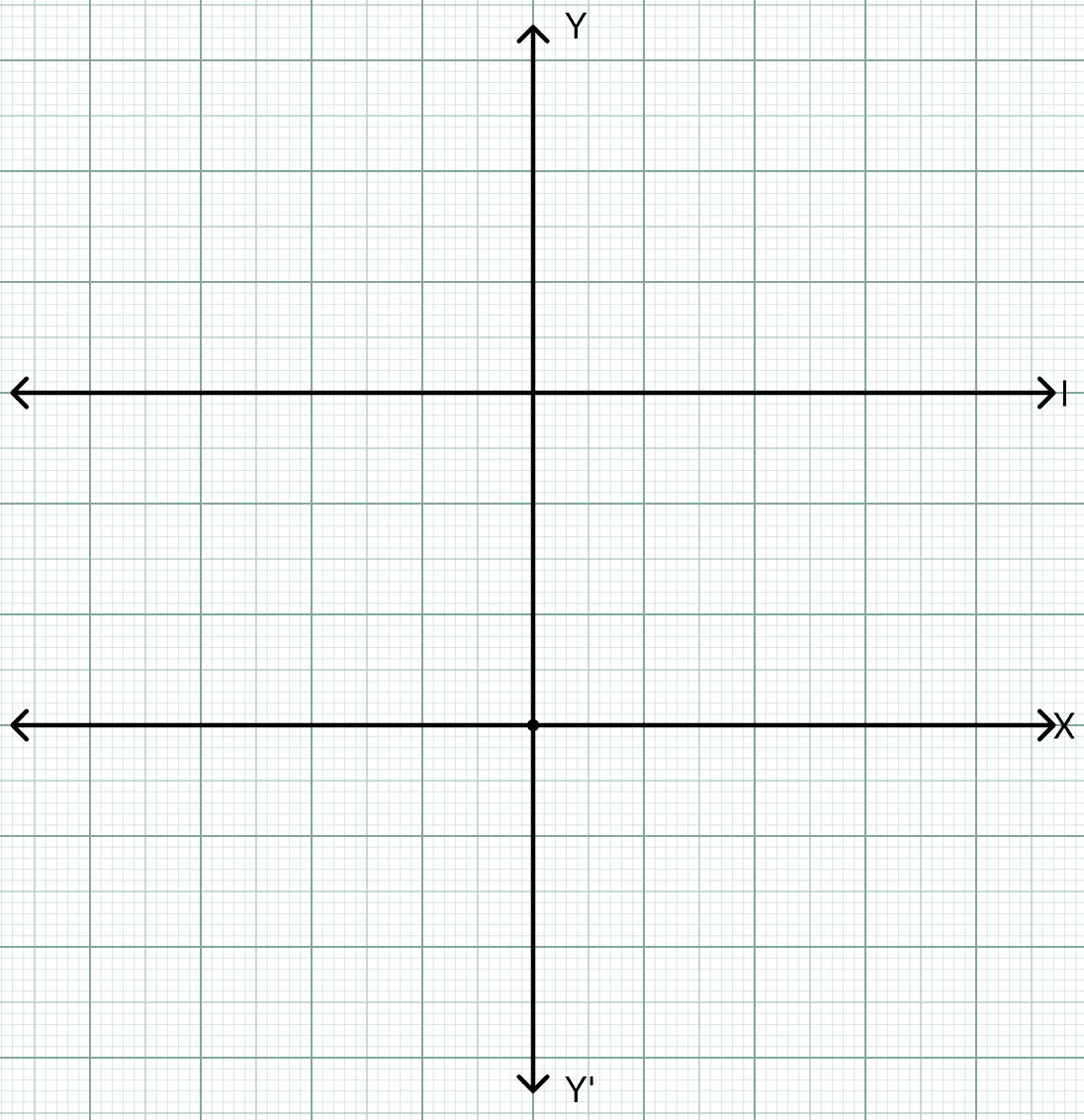
Answer
The line l is parallel to the x-axis, so every point on it has the same y-coordinate, say k.
Take any two points (x1, k) and (x2, k) on l.
Rise = k - k = 0
Run = x2 - x1 (not zero)
Slope = = = 0
Hence, the slope of the line l is 0.
Find the slope of the line l in the following diagram.
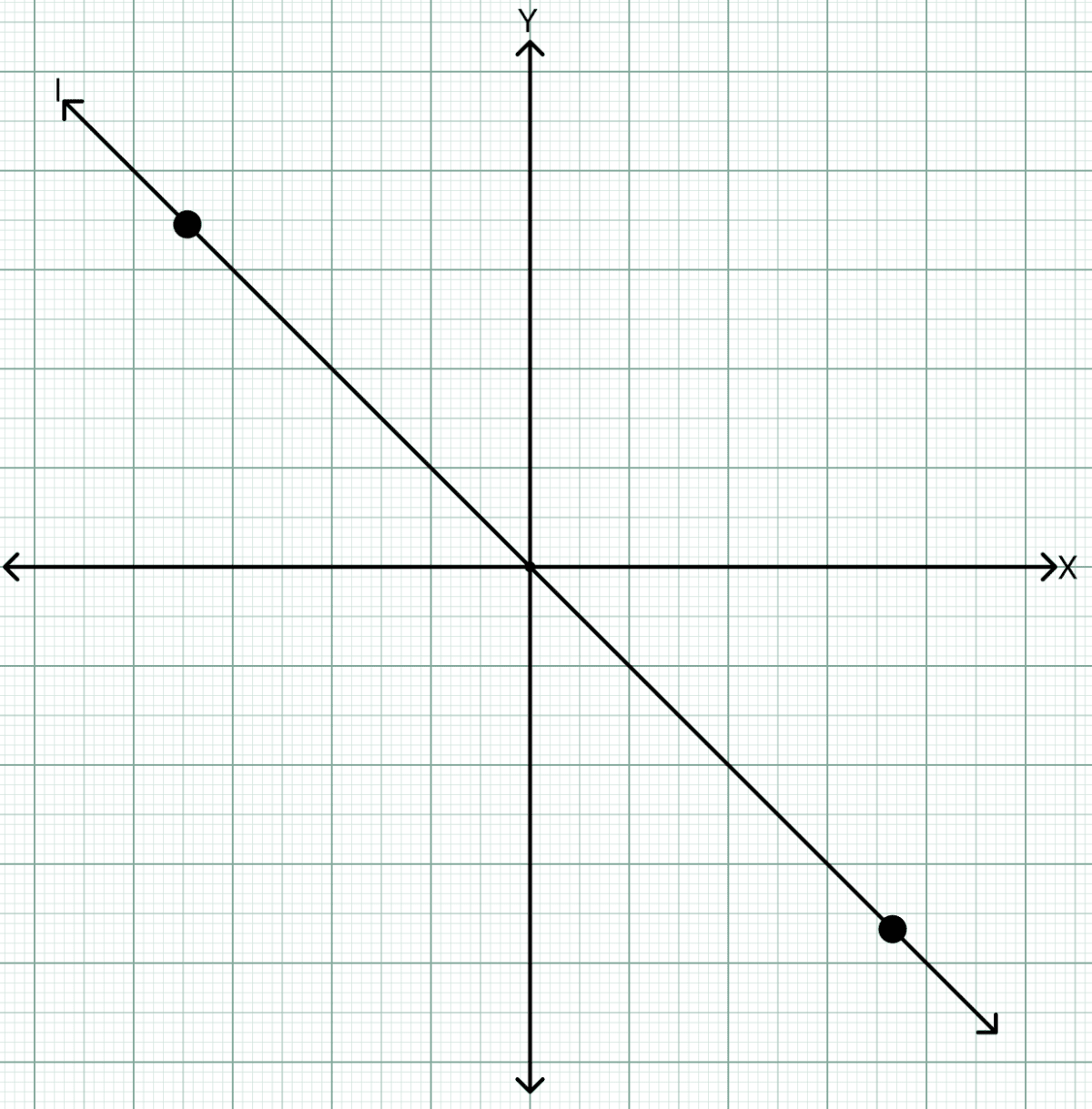
Answer
Let us take the side of one big square of the grid as 1 unit. The two marked points on l are then
P (-2, 2) and Q (2, -2).
We know that
Slope =
The slope is negative, which agrees with the line going downward from left to right.
Hence, the slope of the line l is -1.
Find the slope of the line l in the following diagram.
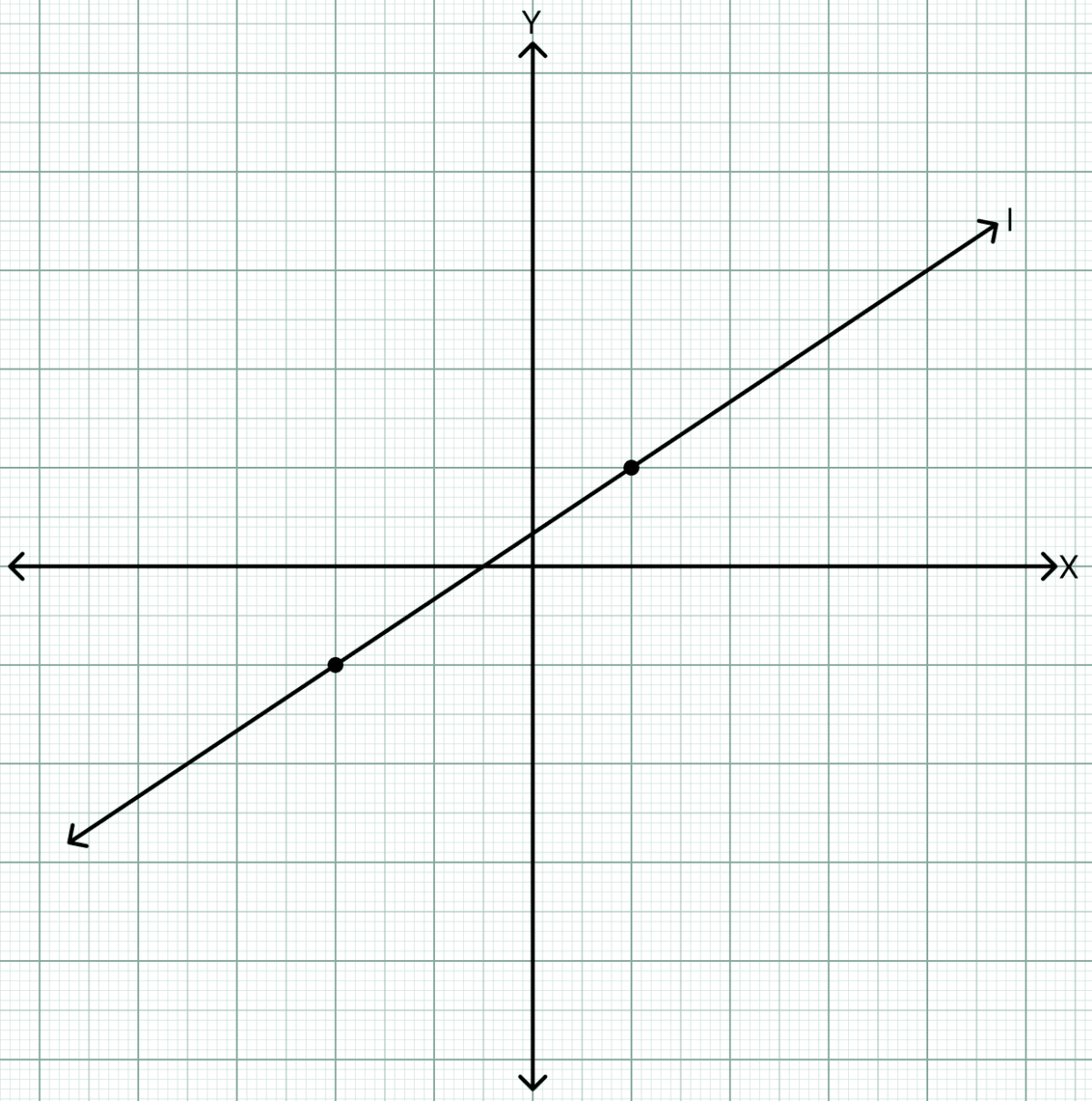
Answer
Let us take the side of one big square of the grid as 1 unit. The two marked points on l are then
P (-2, -1) and Q (1, 1).
We know that
Slope =
The slope is positive, which agrees with the line going upward from left to right.
Hence, the slope of the line l is .
Find the slope of the line l in the following diagram.
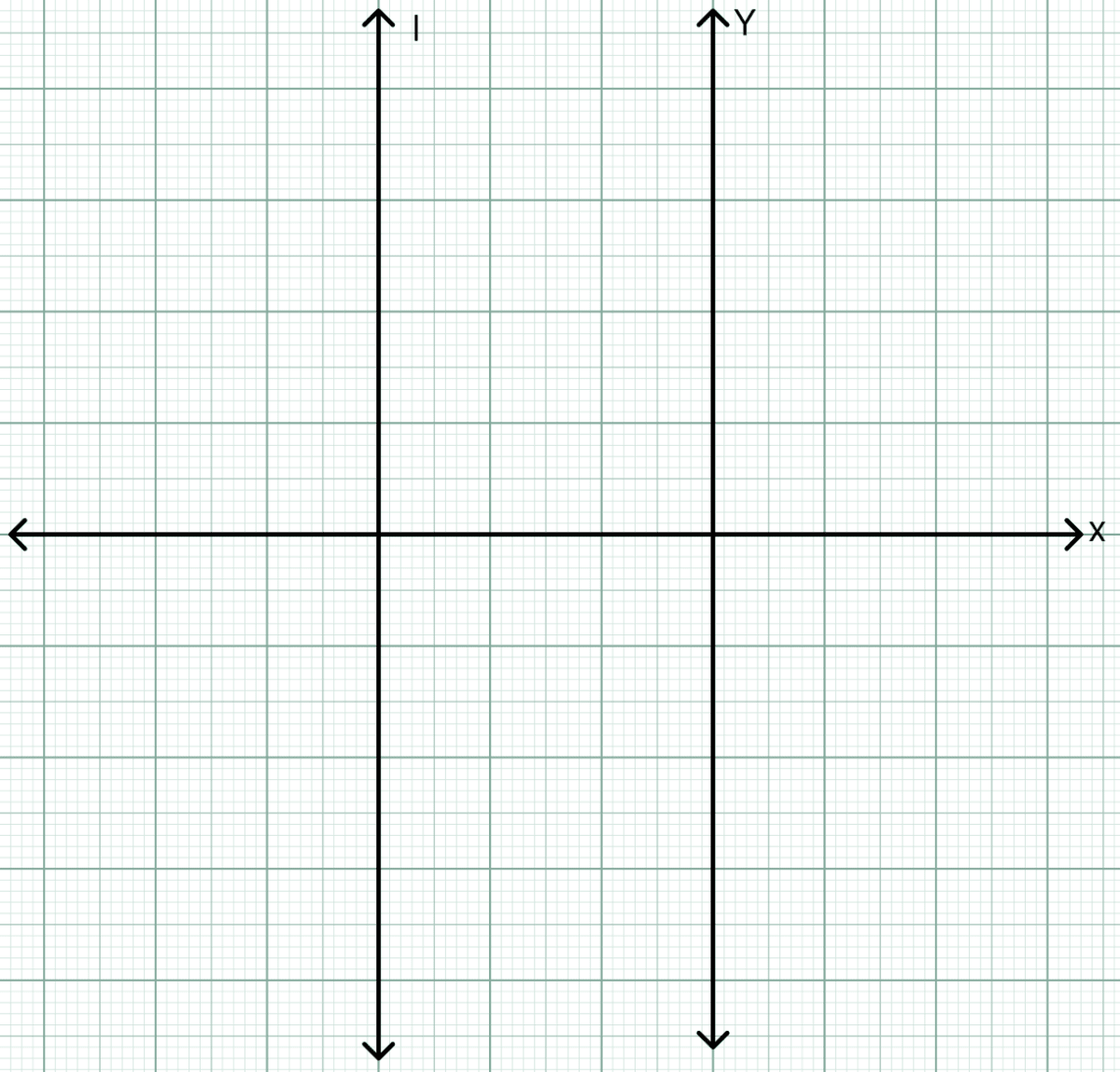
Answer
The line l is parallel to the y-axis, so every point on it has the same x-coordinate, say h.
Take any two points (h, y1) and (h, y2) on l.
Rise = y2 - y1
Run = h - h = 0
Slope = =
Division by 0 is undefined.
Hence, the slope of the line l is undefined.
An accessibility ramp for wheelchairs is to be made alongside the staircase. The guidelines given for the slope of the ramp is 1 cm vertical rise to 12 cm horizontal length. What should be the horizontal length of the ramp if the total height of the stairs is 18 cm?
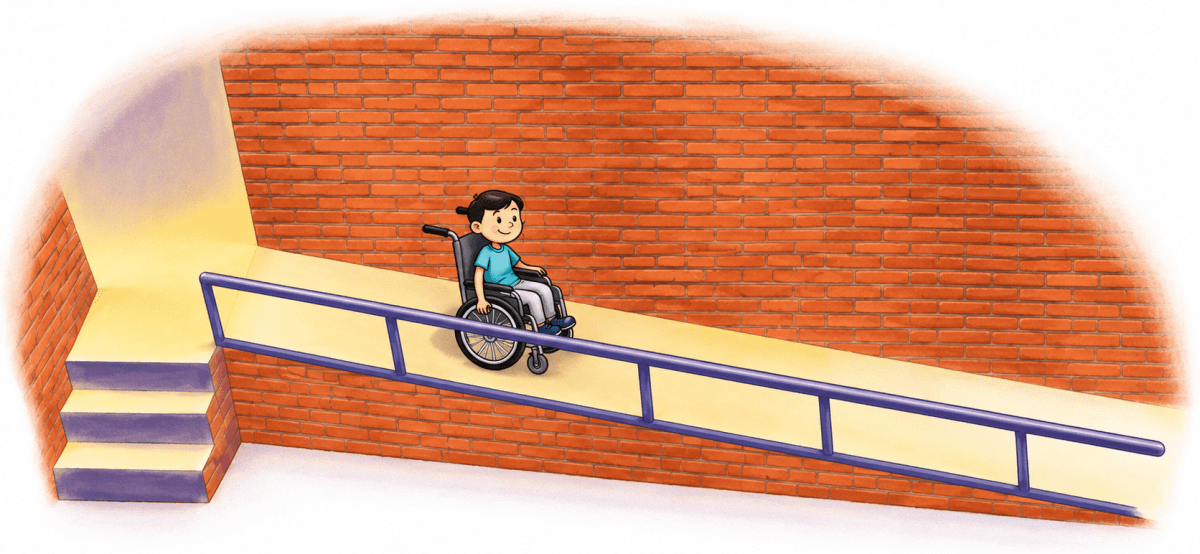
Answer
Given:
Required slope = [1 cm rise for every 12 cm of horizontal length]
Total rise (height of the stairs) = 18 cm
Let the horizontal length of the ramp be L cm.
Slope of the ramp =
Hence, the horizontal length of the ramp should be 216 cm.
The cost of one paratha and 2 bowls of dahi is ₹90. Also, the cost of 2 parathas and 7 bowls of dahi is ₹260. Can you figure out the cost of one paratha and one bowl of dahi and explain your reasoning?

Answer
Let the cost of one paratha be ₹x and the cost of one bowl of dahi be ₹y.
According to the question,
x + 2y = 90 ...(1)
2x + 7y = 260 ...(2)
If one paratha and 2 bowls cost ₹90, then double that order, 2 parathas and 4 bowls, costs twice as much.
∴ Cost of 2 parathas and 4 bowls of dahi = 2 × 90 = ₹180
⇒ 2x + 4y = 180 ...(3)
The order in (2) has the same 2 parathas but 3 more bowls of dahi. So the extra cost is the cost of 3 bowls.
Subtracting (3) from (2):
⇒ (2x + 7y) - (2x + 4y) = 260 - 180
⇒ 3y = 80
⇒ y = ≈ 26.67
Substituting y = in (1):
Check in (2): 2 × + 7 × = + = = 260 ✓
Hence, one paratha costs ₹ ≈ ₹36.67 and one bowl of dahi costs ₹ ≈ ₹26.67.
Given below is an everyday situation. Construct a pair of linear equations in two variables for the situation:
On two different days a family buys movie tickets and snack boxes. Let the cost of one movie ticket be ₹x and the cost of one snack box be ₹y. Frame a pair of linear equations in x and y to represent the following situations:
(i) On the first day, the family buys 2 movie tickets and 3 snack boxes for ₹850.
(ii) On the second day, the family buys 4 movie tickets and 1 snack box for ₹1100.
Answer
Given:
Cost of one movie ticket = ₹x
Cost of one snack box = ₹y
(i) First day:
Cost of 2 movie tickets = ₹2x
Cost of 3 snack boxes = ₹3y
Total cost = ₹850
⇒ 2x + 3y = 850 ...(1)
(ii) Second day:
Cost of 4 movie tickets = ₹4x
Cost of 1 snack box = ₹y
Total cost = ₹1100
⇒ 4x + y = 1100 ...(2)
Hence, the required pair of linear equations is 2x + 3y = 850 and 4x + y = 1100.
Given below is an everyday situation. Construct a pair of linear equations in two variables for the situation:
Two friends, Sahil and Meena, travelled by taxi. Let the fixed charge for one taxi trip be ₹x and the additional charge per kilometre be ₹y. Frame a pair of linear equations in x and y to represent the following situation:
(i) Sahil travelled 6 km and paid a total fare of ₹122.
(ii) Meena travelled 8 km and paid a total fare of ₹160.
Answer
Given:
Fixed charge for one trip = ₹x
Charge per kilometre = ₹y
Total fare = Fixed charge + (Charge per km × Distance in km)
(i) Sahil:
Charge for 6 km = ₹6y
⇒ x + 6y = 122 ...(1)
(ii) Meena:
Charge for 8 km = ₹8y
⇒ x + 8y = 160 ...(2)
Hence, the required pair of linear equations is x + 6y = 122 and x + 8y = 160.
Given below is an everyday situation. Construct a pair of linear equations in two variables for the situation:
In a sports meet, tickets for adults cost ₹150 each and tickets for children cost ₹100 each. A total of 200 people attended the meet, and the total amount collected from ticket sales was ₹25,000. (Let the number of adult tickets sold be x and the number of children’s tickets sold be y.) Frame a pair of linear equations in x and y to represent this situation.
Answer
Given:
Number of adult tickets sold = x
Number of children's tickets sold = y
Number of people:
Number of adults + Number of children = Total number of people
⇒ x + y = 200 ...(1)
Amount collected:
Amount from adult tickets = ₹150x
Amount from children's tickets = ₹100y
Amount from adult tickets + Amount from children's tickets = Total amount
⇒ 150x + 100y = 25000 ...(2)
Dividing both sides of (2) by 50, it can also be written as 3x + 2y = 500.
Hence, the required pair of linear equations is x + y = 200 and 3x + 2y = 500.
Solve the puzzle and discuss your strategy with your friends. Can you determine the value represented by each shape?
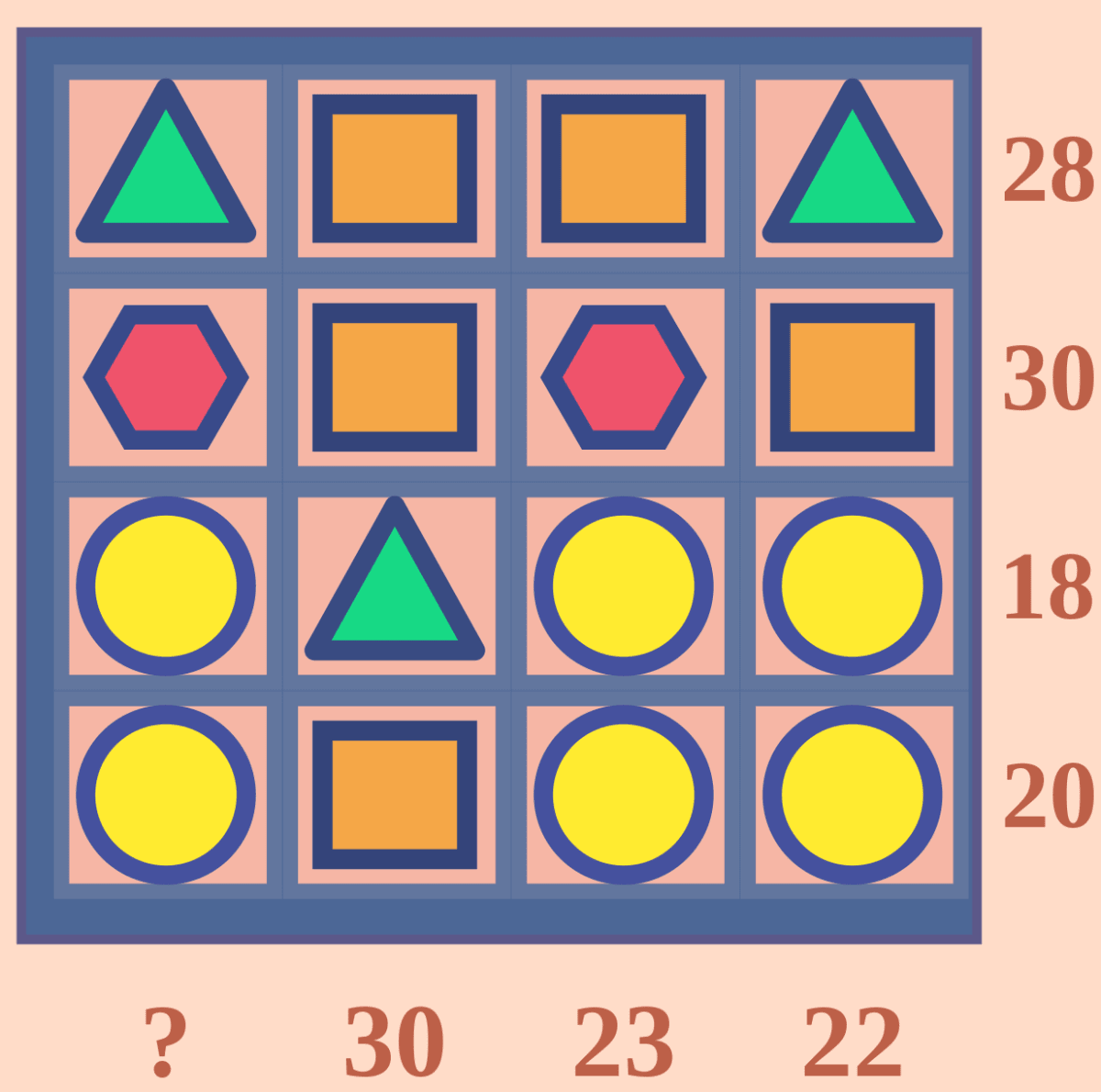
Answer
Let T, R, H and C be the values of a triangle, a rectangle, a hexagon and a circle, respectively.
Reading the grid:
Row 1: T + R + R + T = 28
Row 2: H + R + H + R = 30
Row 3: C + T + C + C = 18
Row 4: C + R + C + C = 20
Column 2: R + R + T + R = 30
Column 3: R + H + C + C = 23
Column 4: T + R + C + C = 22
Column 1: T + H + C + C = ?
Start with a line that has only two kinds of shapes, then substitute what we know into the other lines.
From Row 1:
⇒ 2T + 2R = 28
⇒ T + R = 14 ...(1)
From Column 4:
⇒ T + R + 2C = 22 ...(2)
⇒ 14 + 2C = 22 [Substituting (1) in (2)]
⇒ 2C = 8
⇒ C = 4
From Row 3:
⇒ 3C + T = 18
⇒ 3 × 4 + T = 18
⇒ 12 + T = 18
⇒ T = 18 - 12
⇒ T = 6
From (1):
⇒ R = 14 - 6
⇒ R = 8
From Row 2:
⇒ 2H + 2R = 30
⇒ 2H + 2(8) = 30
⇒ 2H + 16 = 30
⇒ 2H = 30 - 16
⇒ 2H = 14
⇒ H = 7
Check:
Row 4: 3C + R = 12 + 8 = 20 ✓
Column 2: 3R + T = 24 + 6 = 30 ✓
Column 3: R + H + 2C = 8 + 7 + 8 = 23 ✓
Column 1 (the missing total): T + H + 2C = 6 + 7 + 8 = 21
Hence, Triangle = 6, Rectangle = 8, Hexagon = 7 and Circle = 4, and the missing total of Column 1 is 21.
Solve the following pair of equations by substitution method:
7x – 15y = 2 (1)
x + 2y = 3 (2)
Let us consider Equation (2), that is, x + 2y = 3 and write it as x = 3 – 2y.
Therefore, the solution of the Equations (1) and (2) is x = , y = .
What if we had expressed y in terms of x, i.e., take Equation (2) and write y = (3 – x). Would we still get the same solution?
Answer
Yes, we get the same solution.
From (2):
y = (3 - x) ...(3)
Substituting (3) in (1):
Substituting x = in (3):
This is the same solution. The solution of a pair of equations is the ordered pair that satisfies both equations, and there is only one such pair here. So it does not depend on which variable we express first. Expressing x in terms of y was a little easier, because the coefficient of x in (2) is 1 and no fraction appears in the first step.
Hence, we still get x = , y = .
The ratio of incomes of two persons is 9 : 7 and the ratio of their expenditures is 4 : 3. If each of them manages to save ₹2000 per month, find their monthly incomes.
Then the equations formed by subtracting the expenditure from the income leading to a saving of ₹ 2000 are as follows:
9x – 4y = 2000 ...(1)
7x – 3y = 2000 ...(2)
The method used in solving this problem is called the Elimination Method because we eliminate one of the variables to obtain a linear equation in the other variable. In the example above, we eliminated y. Try the same problem by eliminating x instead of y. Also try to solve the two equations using the Substitution Method. Assess the pros and cons of each method.
Answer
Given:
9x - 4y = 2000 ...(1)
7x - 3y = 2000 ...(2)
Method 1: Elimination of x
Step 1: Multiply (1) by 7 and (2) by 9, so that the coefficients of x become equal.
63x - 28y = 14000 ...(3)
63x - 27y = 18000 ...(4)
Step 2: Subtract (3) from (4).
⇒ (63x - 63x) + (-27y + 28y) = 18000 - 14000
⇒ y = 4000
Step 3: Substitute y = 4000 in (1).
⇒ 9x - 4 × 4000 = 2000
⇒ 9x - 16000 = 2000
⇒ 9x = 18000
⇒ x = 2000
Method 2: Substitution
Step 1: From (2), express y in terms of x.
⇒ 3y = 7x - 2000
⇒ y = ...(5)
Step 2: Substitute (5) in (1).
Step 3: Substitute x = 2000 in (5).
Both methods give x = 2000 and y = 4000. So the monthly incomes are 9 × 2000 = ₹18000 and 7 × 2000 = ₹14000.
Pros and cons:
Elimination keeps whole numbers throughout and works well when no coefficient is 1, as here. But it needs multipliers, and these can make the numbers large: eliminating x needed the multipliers 7 and 9 (numbers up to 18000), while eliminating y needed only 3 and 4.
Substitution is quick when one variable has coefficient 1 or -1 (as x in x + 2y = 3 in Example 7). Here no coefficient is 1, so a fraction appears and the working is longer.
Both methods always give the same solution, so we choose the one that keeps the working simplest.
Hence, eliminating x and using substitution both give x = 2000, y = 4000, that is, monthly incomes of ₹18000 and ₹14000.
Does a pair of linear equations always have a unique solution? Can you analyse this using the Elimination Method? While subtracting the equations to eliminate a particular variable, if the other variable remains, then clearly there is a unique solution. But what if the second variable gets eliminated too while eliminating the first variable? Can you think of a situation where this happens?
Answer
No, a pair of linear equations does not always have a unique solution.
The second variable also gets eliminated when the coefficients of x and y in one equation are the same multiple of those in the other equation. Then we are left with no variable at all, and one of two things happens.
Situation 1:
x + y = 4 ...(1)
2x + 2y = 8 ...(2)
Multiplying (1) by 2:
2x + 2y = 8 ...(3)
Subtracting (3) from (2):
⇒ 0 = 0
This is always true. The two equations are really the same, so every solution of x + y = 4, such as (0, 4), (1, 3), (2, 2), satisfies both. There are infinitely many solutions.
Situation 2:
x + y = 4 ...(4)
2x + 2y = 9 ...(5)
Multiplying (4) by 2:
2x + 2y = 8 ...(6)
Subtracting (6) from (5):
⇒ 0 = 1
This is false. No pair (x, y) can make 2x + 2y equal to both 8 and 9, so there is no solution.
Hence, when both variables get eliminated together, the pair has either infinitely many solutions (we get 0 = 0) or no solution (we get 0 = a non-zero number); this happens when .
How many solutions are there to the equations
10x – 5y = 20 and 4x – 2y = 8?
Give 3 more examples of pairs of equations that lead to 0 = 0 after subtraction, and therefore have infinitely many solutions. Can you find a simple rule to check when this happens?
Answer
Given:
10x - 5y = 20 ...(1)
4x - 2y = 8 ...(2)
To eliminate x, multiply (1) by 2 and (2) by 5:
20x - 10y = 40 ...(3)
20x - 10y = 40 ...(4)
Subtracting (3) from (4):
⇒ 0 = 0
Both equations are multiples of 2x - y = 4: (1) is 5 times it and (2) is 2 times it. So every solution of 2x - y = 4, such as (2, 0), (0, -4), (3, 2), satisfies both.
Hence, the equations 10x - 5y = 20 and 4x - 2y = 8 have infinitely many solutions.
Three more examples (in each, the second equation is k times the first):
x + 2y = 3 and 2x + 4y = 6 [k = 2]
3x - y = 5 and 9x - 3y = 15 [k = 3]
2x + 5y = 1 and -4x - 10y = -2 [k = -2]
For example, in 1, multiplying x + 2y = 3 by 2 gives 2x + 4y = 6, and subtracting this from the second equation gives 0 = 0. The other two work in the same way with k = 3 and k = -2.
Rule: Write both equations in standard form a1x + b1y + c1 = 0 and a2x + b2y + c2 = 0. This happens when one equation is a constant multiple of the other, that is, when
For the given pair, 10x - 5y - 20 = 0 and 4x - 2y - 8 = 0:
= = , = = , = =
Hence, a pair has infinitely many solutions when .
Consider a general pair of equations
a1x + b1y + c1 = 0
a2x + b2y + c2 = 0
with a2, b2 and c2 each not equal to 0.
Thus, when = k, the pair of equations has infinitely many solutions.
What if one of a2, b2, c2 is zero?
Answer
Then the ratio with that zero in the denominator cannot be formed, since division by 0 is not defined. So the ratio test cannot be used as written.
Instead, we use the condition it came from: one equation is a constant multiple of the other, that is,
a1 = ka2, b1 = kb2, c1 = kc2, where k ≠ 0.
This makes sense even when some of a2, b2, c2 are zero. If, say, a2 = 0, it forces a1 = k × 0 = 0 as well; then we compare only the remaining coefficients.
Examples:
c2 = 0: x + 2y = 0 and 3x + 6y = 0. Here a1 = a2, b1 = b2 and c1 = 0 = × 0. The equations are the same line through the origin, so there are infinitely many solutions.
c2 = 0 but c1 ≠ 0: x + 2y - 3 = 0 and 3x + 6y = 0. The coefficients of x and y are in the ratio , but c1 = -3 ≠ × 0. Subtracting 3 times the first equation from the second gives 9 = 0, which is false. There is no solution.
a2 = 0 but a1 ≠ 0: x + y - 2 = 0 and 0 × x + y - 1 = 0. No k can give 1 = k × 0, so the lines are neither coincident nor parallel. From the second equation y = 1, and then x = 1. There is a unique solution (1, 1).
a1 = a2 = 0: 2y - 4 = 0 and 3y - 6 = 0. Here b1 = b2 and c1 = c2. Both equations are the line y = 2, so there are infinitely many solutions.
Hence, when one of a2, b2, c2 is zero, we check the conditions a1 = ka2, b1 = kb2, c1 = kc2 instead of the ratios: the matching coefficient of the first equation must then also be zero for the pair to have infinitely many solutions.
Does a pair of linear equations always have either a unique solution or infinitely many solutions?
Answer
No. A pair of linear equations can also have no solution at all.
Consider
x + y = 2 ...(1) and
x + y = 5 ...(2)
Subtracting (1) from (2):
⇒ (x + y) - (x + y) = 5 - 2
⇒ 0 = 3
This is false. No two numbers can have a sum equal to 2 and also equal to 5, so this pair has no solution. Graphically, the two lines have the same slope -1 but cut the y-axis at different points (0, 2) and (0, 5), so they are parallel and never meet.
Hence, a pair of linear equations has exactly one of three possibilities: a unique solution, infinitely many solutions, or no solution.
Give 3 more examples of pairs of equations that have no solution. Can you find a simple rule to check when this will happen?
Answer
Three examples:
3x + y = 4 and 6x + 2y = 3
2x - 3y = 4 and 4x - 6y = 9
x + 3y = 1 and 3x + 9y = 5
Check for example 1: multiplying 3x + y = 4 by 2 gives 6x + 2y = 8. Subtracting this from 6x + 2y = 3:
⇒ 0 = -5, which is false.
Check for example 2: multiplying 2x - 3y = 4 by 2 gives 4x - 6y = 8. Subtracting this from 4x - 6y = 9:
⇒ 0 = 1, which is false.
Check for example 3: multiplying x + 3y = 1 by 3 gives 3x + 9y = 3. Subtracting this from 3x + 9y = 5:
⇒ 0 = 2, which is false.
So none of the three pairs has a solution.
Rule: Write the equations in standard form a1x + b1y + c1 = 0 and a2x + b2y + c2 = 0. The left-hand sides can be made equal by multiplying by a constant, but the constants cannot. This happens when
(where a2, b2, c2 ≠ 0)
For example 2, 2x - 3y - 4 = 0 and 4x - 6y - 9 = 0:
= = , = = , = = ≠
Hence, a pair has no solution when .
We have the following cases:
when ≠ , the pair has a unique solution,
when , the pair has an infinite number of solutions, and
when ≠ , the pair has no solution.
Are the converses of the above statements true?
Answer
Yes, all three converses are true (for a2, b2, c2 not zero, as in the statements).
Two facts are used:
(a) For any pair, exactly one of the three ratio conditions holds: either ≠ ; or and is equal to them; or and is not equal to them.
(b) A pair cannot have two of the outcomes "a unique solution", "infinitely many solutions" and "no solution" at the same time.
Converse of 1: If the pair has a unique solution, then ≠ . — True.
Suppose instead . Then by statements 2 and 3, the pair has either infinitely many solutions or no solution, not a unique solution. This contradicts what is given. So ≠ .
Converse of 2: If the pair has infinitely many solutions, then . — True.
If ≠ , statement 1 gives a unique solution. If ≠ , statement 3 gives no solution. Neither is possible, so the only remaining case must hold.
Converse of 3: If the pair has no solution, then ≠ . — True.
If ≠ , statement 1 gives a unique solution. If , statement 2 gives infinitely many solutions. Neither is possible, so ≠ .
Hence, the converses of all three statements are true, so each ratio condition holds exactly when the matching kind of solution occurs.
Can there be methods other than elimination and substitution to reduce a pair of linear equations in two variables to a linear equation in one variable? If so, describe them.
Answer
Yes. One such method is the method of comparison (equating the same variable).
Steps:
From each equation, express the same variable (say y) in terms of the other variable.
Both expressions are equal to y, so equate them. This gives a linear equation in x alone.
Solve it for x, and substitute the value in either expression to get y.
Example: Rakesh's puzzle — the sum of two numbers is 25 and their difference is 11.
x + y = 25 ⇒ y = 25 - x ...(1)
x - y = 11 ⇒ y = x - 11 ...(2)
Equating (1) and (2):
⇒ 25 - x = x - 11
⇒ 25 + 11 = x + x
⇒ 36 = 2x
⇒ x = 18
From (1): y = 25 - 18 = 7
So the numbers are 18 and 7.
Other ideas:
Adding and subtracting the equations when they are suitable: here, adding gives 2x = 36 and subtracting gives 2y = 14 directly. This is useful when the coefficients of x and y are interchanged in the two equations.
In higher classes, a formula called the cross-multiplication method is used, which writes x and y directly in terms of the coefficients a1, b1, c1, a2, b2, c2.
The graphical method also gives the solution, but it reads the solution from the point where the lines meet instead of reducing the pair to one equation.
Hence, yes — for example, the method of comparison reduces a pair to a single linear equation by equating the two expressions for the same variable.
Consider the following pairs of linear equations in two variables.
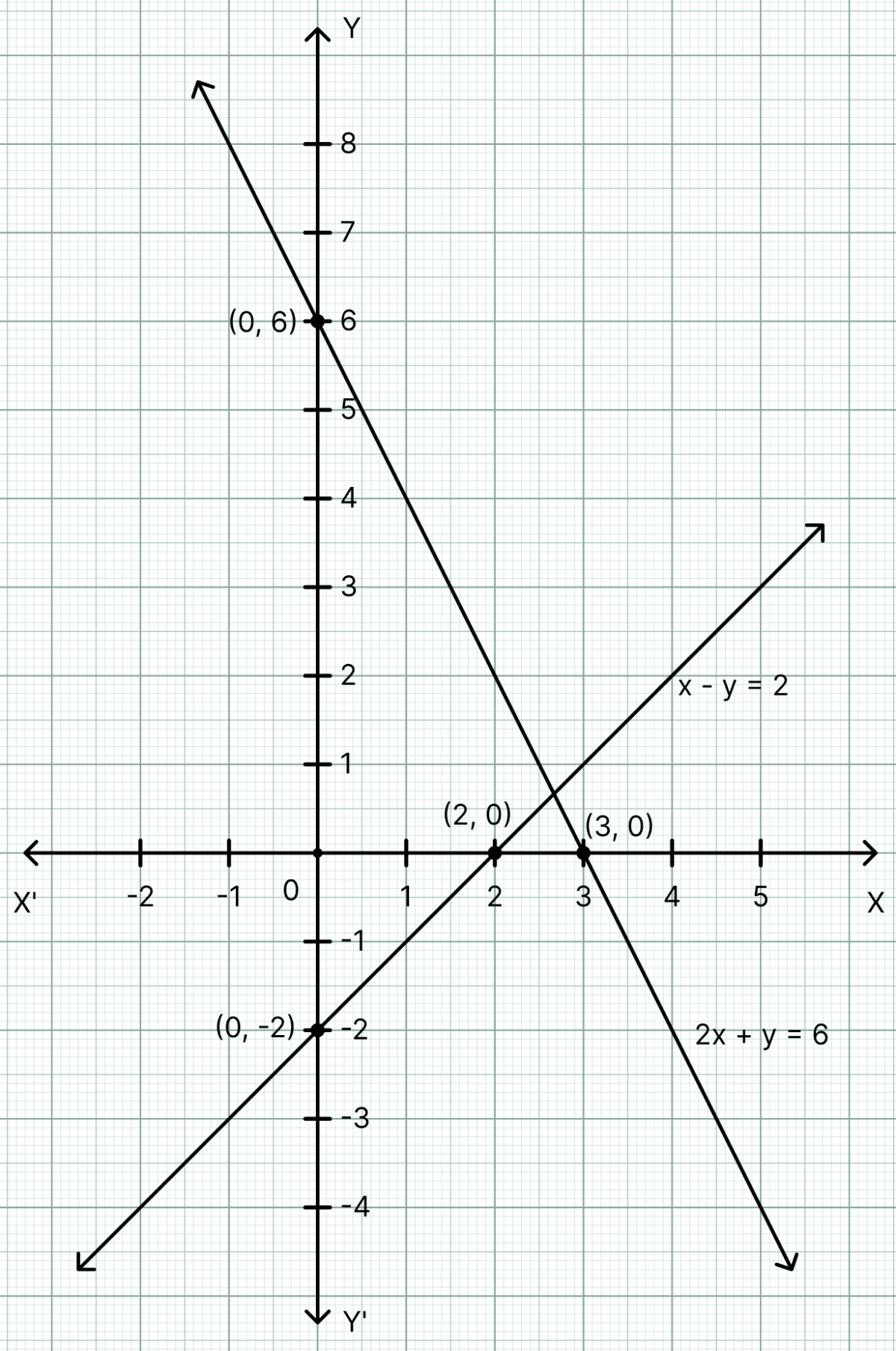
Pair 1: 2x + y = 6 and x – y = 2
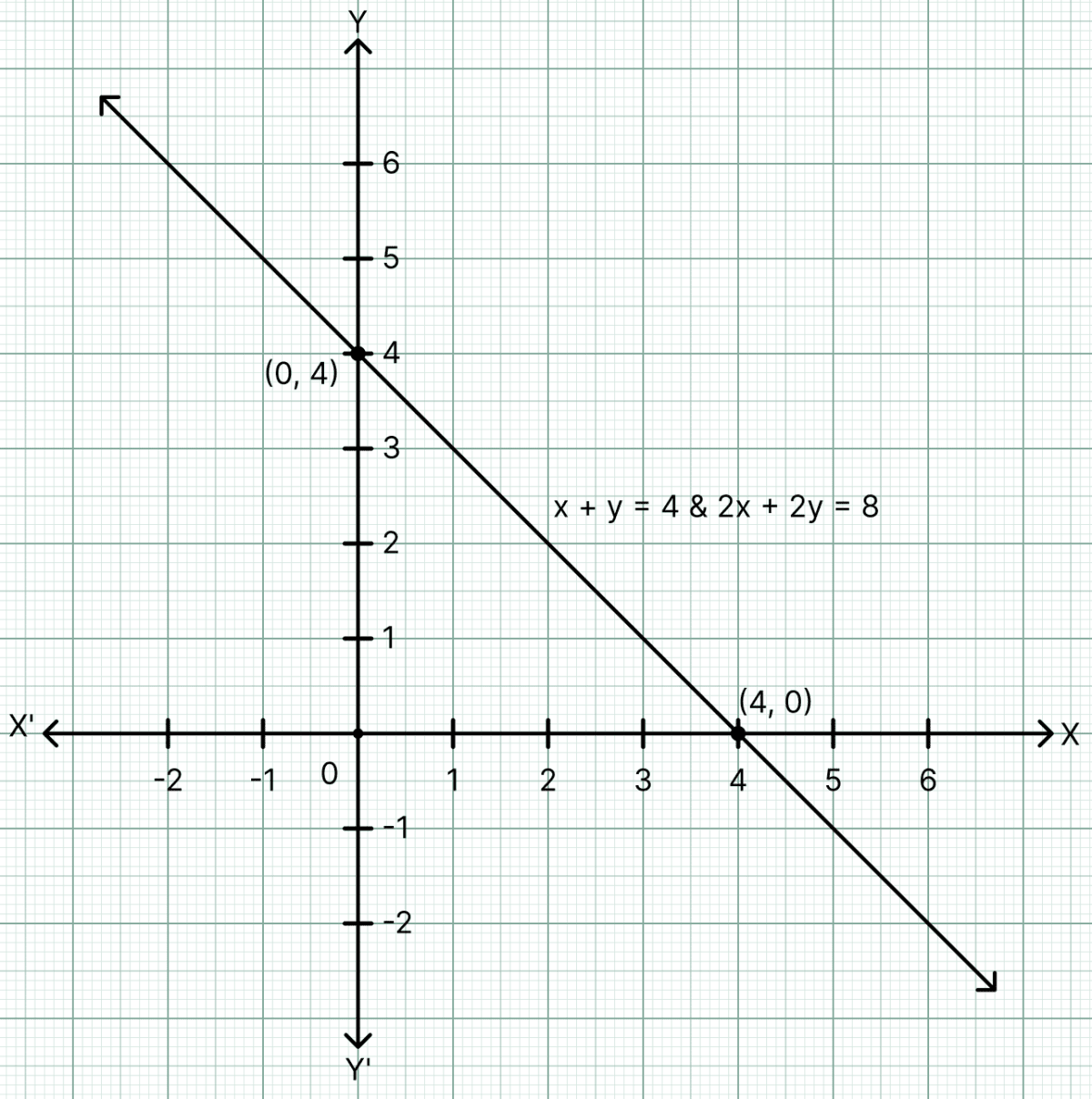
Pair 2: x + y = 4 and 2x + 2y = 8
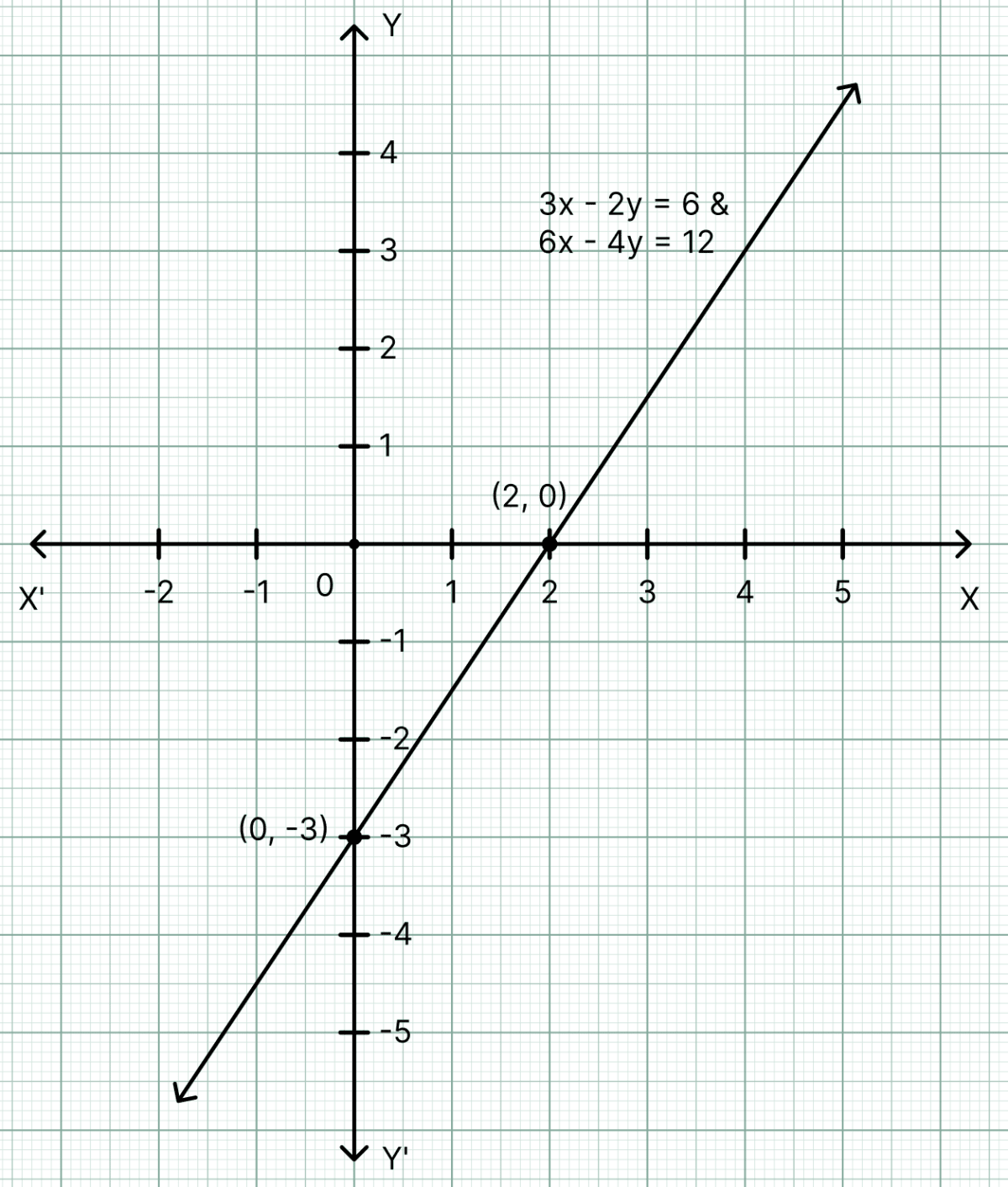
Pair 3: 3x – 2y = 6 and 6x – 4y = 12
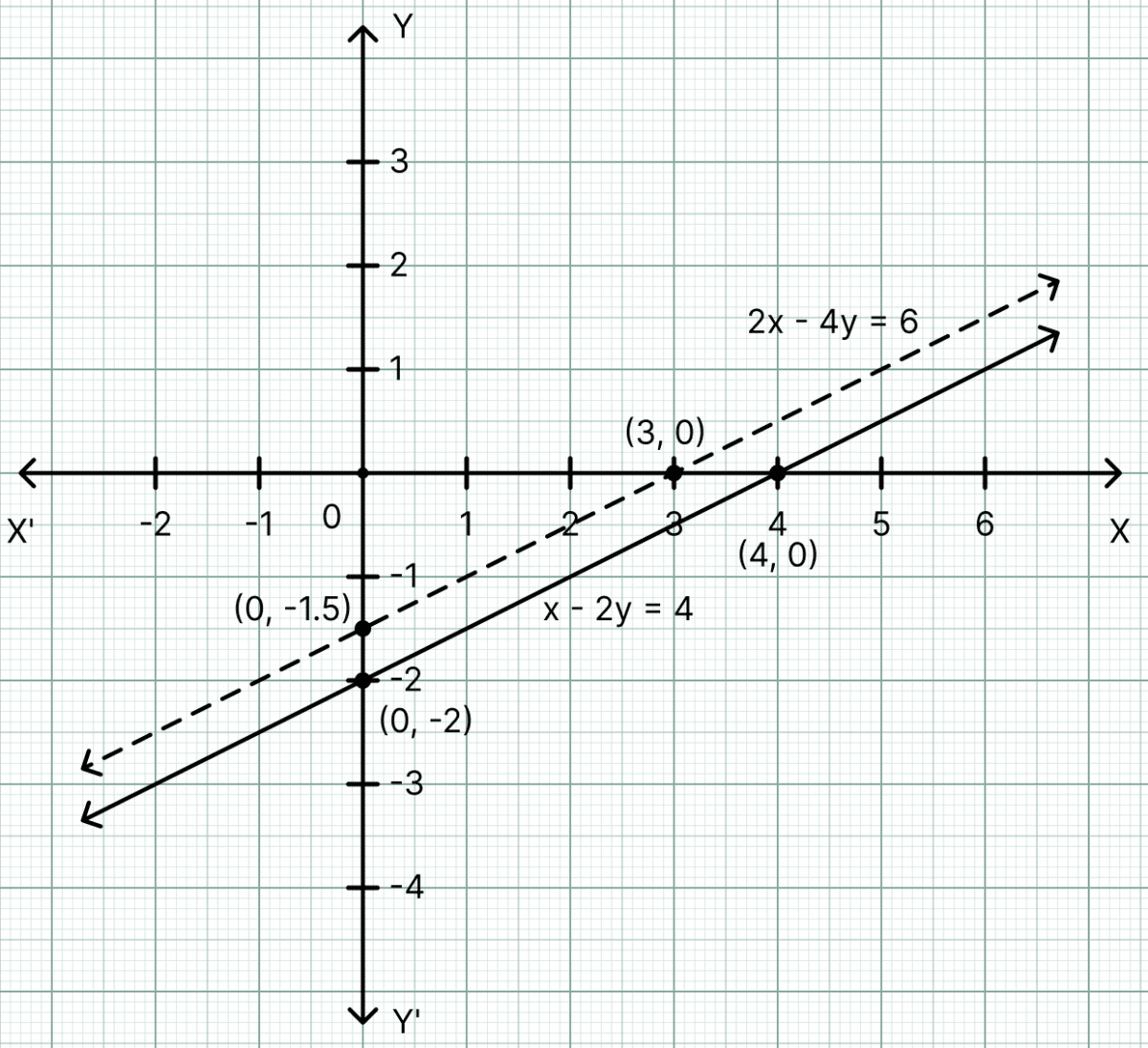
Pair 4: x – 2y = 4 and 2x – 4y = 6
For each pair, prepare a table of values (with at least two ordered pairs). Plot the points on the Cartesian plane. Draw the straight lines.
How do we find solutions from the graph? What can we say about the number of solutions when the two lines (i) intersect at a point, (ii) are parallel, (iii) are coincident?
Answer
A solution of a pair of equations must satisfy both equations, so its point must lie on both lines. So, from the graph, we read the coordinates of the point (or points) common to the two lines.
Two points on each line, found by putting x = 0 and y = 0:
| Pair | Equation | Points on the line |
|---|---|---|
| 1 | 2x + y = 6 | (0, 6), (3, 0) |
| 1 | x - y = 2 | (0, -2), (2, 0) |
| 2 | x + y = 4 | (0, 4), (4, 0) |
| 2 | 2x + 2y = 8 | (0, 4), (4, 0) |
| 3 | 3x - 2y = 6 | (0, -3), (2, 0) |
| 3 | 6x - 4y = 12 | (0, -3), (2, 0) |
| 4 | x - 2y = 4 | (0, -2), (4, 0) |
| 4 | 2x - 4y = 6 | (0, -1.5), (3, 0) |
We plot the two points of each line from the table and draw the straight lines, one graph for each pair.
Graph of Pair 1:
Graph of Pair 2:
Graph of Pair 3:
Graph of Pair 4:
(i) Lines intersect at a point (Pair 1): the lines have exactly one common point, so the pair has a unique solution. For Pair 1 the lines meet at . [Adding the equations gives 3x = 8.]
(ii) Lines are parallel (Pair 4): the lines have no common point, so the pair has no solution. Both lines of Pair 4 have slope but cut the y-axis at different points (0, -2) and (0, -1.5).
(iii) Lines are coincident (Pairs 2 and 3): the two equations give the same line, so every point of it is common to both. The pair has infinitely many solutions.
Hence, intersecting lines give a unique solution, parallel lines give no solution, and coincident lines give infinitely many solutions.
Can you prove that two lines of equal slope are parallel?
(Hint: Consider the equations of the two lines to be y = mx + d1 and y = mx + d2)
Answer
Yes.
Given: Two different lines with the same slope m:
y = mx + d1 ...(1)
y = mx + d2 ...(2)
where d1 ≠ d2 (if d1 = d2, the two equations are the same line).
To prove: The two lines are parallel, that is, they have no common point.
Proof: Suppose the lines have a common point (p, q). Then (p, q) satisfies both equations.
From (1): q = mp + d1 ...(3)
From (2): q = mp + d2 ...(4)
Subtracting (4) from (3):
⇒ 0 = d1 - d2
⇒ d1 = d2
This contradicts d1 ≠ d2. So the two lines have no common point, that is, they are parallel.
Hence proved.
Form a pair of linear equations for the following problem and find its solution.
The sum of two integers is +5 and their difference is –21. Find the two numbers.
Answer
Let the first integer be x and the second integer be y.
According to the question,
x + y = 5 ...(1)
x - y = -21 ...(2)
Adding (1) and (2):
⇒ (x + y) + (x - y) = 5 + (-21)
⇒ 2x = -16
⇒ x =
⇒ x = -8
Substituting x = -8 in (1):
⇒ -8 + y = 5
⇒ y = 5 + 8
⇒ y = 13
Check: -8 + 13 = 5 and -8 - 13 = -21 ✓
Hence, the two numbers are -8 and 13.
Form a pair of linear equations for the following problem and find its solution.
The difference between two numbers is 26 and one number is three times the other. Find the numbers.
Answer
Let the larger number be x and the smaller number be y.
According to the question,
x - y = 26 ...(1)
x = 3y ...(2)
Substituting x = 3y from (2) in (1):
⇒ 3y - y = 26
⇒ 2y = 26
⇒ y =
⇒ y = 13
Substituting y = 13 in (2):
⇒ x = 3 × 13
⇒ x = 39
Check: 39 - 13 = 26 and 39 = 3 × 13 ✓
Hence, the numbers are 39 and 13.
Form a pair of linear equations for the following problem and find its solution.
The coach of a cricket team buys 7 bats and 6 balls for ₹8880. Later, she buys 3 bats and 5 balls for ₹4000. Find the cost of each bat and each ball.
Answer
Let the cost of one bat be ₹x and the cost of one ball be ₹y.
According to the question,
7x + 6y = 8880 ...(1)
3x + 5y = 4000 ...(2)
Step 1: To eliminate y, multiply (1) by 5 and (2) by 6.
35x + 30y = 44400 ...(3)
18x + 30y = 24000 ...(4)
Step 2: Subtract (4) from (3).
⇒ (35x - 18x) + (30y - 30y) = 44400 - 24000
⇒ 17x = 20400
⇒ x =
⇒ x = 1200
Step 3: Substitute x = 1200 in (2).
⇒ 3 × 1200 + 5y = 4000
⇒ 3600 + 5y = 4000
⇒ 5y = 400
⇒ y = 80
Check: 7 × 1200 + 6 × 80 = 8400 + 480 = 8880 ✓
Hence, the cost of each bat is ₹1200 and the cost of each ball is ₹80.
Form a pair of linear equations for the following problem and find its solution.
The taxi charges in a city consist of a fixed charge together with the charge for the distance covered for every km. For a distance of 10 km, the total amount paid is ₹155 and for a journey of 15 km, the total amount paid is ₹220. What is the fixed charge and the charge per km? How much does a person have to pay for travelling a distance of 25 km?
Answer
Let the fixed charge be ₹x and the charge per km be ₹y.
Total amount = Fixed charge + (Charge per km × Distance in km)
According to the question,
x + 10y = 155 ...(1)
x + 15y = 220 ...(2)
Subtracting (1) from (2):
⇒ (x - x) + (15y - 10y) = 220 - 155
⇒ 5y = 65
⇒ y = 13
Substituting y = 13 in (1):
⇒ x + 10 × 13 = 155
⇒ x + 130 = 155
⇒ x = 25
Amount for 25 km:
Fixed charge = ₹25
Charge for 25 km = 25 × 13 = ₹325
Total amount = 25 + 325 = ₹350
Hence, the fixed charge is ₹25, the charge per km is ₹13, and a person has to pay ₹350 for travelling 25 km.
Form a pair of linear equations for the following problem and find its solution.
A fraction becomes equal to if 2 is added to both the numerator and the denominator. If 3 is added to both the numerator and the denominator, it becomes equal to . Find the fraction.
Answer
Let the fraction be .
According to the question,
and
To eliminate y, multiply (1) by 5 and (2) by 9:
55x - 45y = -20 ...(3)
54x - 45y = -27 ...(4)
Subtracting (4) from (3):
⇒ (55x - 54x) + (-45y + 45y) = -20 - (-27)
⇒ x = 7
Substituting x = 7 in (2):
⇒ 6 × 7 - 5y = -3
⇒ 42 - 5y = -3
⇒ -5y = -3 - 42
⇒ -5y = -45
⇒ y = 9
Check: = ✓ and = = ✓
Hence, the fraction is .
Form a pair of linear equations for the following problem and find its solution.
If we add 1 to the numerator and subtract 1 from the denominator, a fraction reduces to 1. It becomes equal to if we add 1 only to the denominator. What is the fraction?
Answer
Let the fraction be .
According to the question,
and
Subtracting (1) from (2):
⇒ (2x - x) + (-y + y) = 1 - (-2)
⇒ x = 3
Substituting x = 3 in (1):
⇒ 3 - y = -2
⇒ 3 + 2 = y
⇒ y = 5
Check: = = 1 ✓ and = = ✓
Hence, the fraction is .
Form a pair of linear equations for the following problem and find its solution.
Five years ago, Nuri was thrice as old as Sonu. Ten years later, Nuri will be twice as old as Sonu. How old are Nuri and Sonu?
Answer
Let Nuri's present age be x years and Sonu's present age be y years.
Five years ago:
Nuri's age = (x - 5) years, Sonu's age = (y - 5) years
⇒ x - 5 = 3(y - 5)
⇒ x - 5 = 3y - 15
⇒ x - 3y = -15 + 5
⇒ x - 3y = -10 ...(1)
Ten years later:
Nuri's age = (x + 10) years, Sonu's age = (y + 10) years
⇒ x + 10 = 2(y + 10)
⇒ x + 10 = 2y + 20
⇒ x - 2y = 20 - 10
⇒ x - 2y = 10 ...(2)
Subtracting (1) from (2):
⇒ (x - x) + (-2y + 3y) = 10 - (-10)
⇒ y = 20
Substituting y = 20 in (2):
⇒ x - 2 × 20 = 10
⇒ x - 40 = 10
⇒ x = 10 + 40
⇒ x = 50
Check: five years ago, 45 = 3 × 15 ✓; ten years later, 60 = 2 × 30 ✓
Hence, Nuri is 50 years old and Sonu is 20 years old.
Form a pair of linear equations for the following problem and find its solution.
The sum of the digits of a two-digit number is 9. Also, nine times this number is twice the number obtained by reversing the order of the digits. Find the number.
Answer
Let the ten's digit be x and the unit's digit be y.
The number = 10x + y
The number obtained by reversing the digits = 10y + x
According to the question,
x + y = 9 ...(1)
9(10x + y) = 2(10y + x)
⇒ 90x + 9y = 20y + 2x
⇒ 88x - 11y = 0
⇒ 8x - y = 0 ...(2) [Dividing both sides by 11]
Adding (1) and (2):
⇒ (x + 8x) + (y - y) = 9 + 0
⇒ 9x = 9
⇒ x = 1
Substituting x = 1 in (1):
⇒ 1 + y = 9
⇒ y = 9 - 1
⇒ y = 8
The number = 10 × 1 + 8 = 18
Check: 1 + 8 = 9 ✓; 9 × 18 = 162 and 2 × 81 = 162 ✓
Hence, the number is 18.
Form a pair of linear equations for the following problem and find its solution.
Meena went to a bank to withdraw ₹2000. She asked the cashier to give her ₹50 and ₹100 notes only. Meena got 25 notes in all. Find how many notes of ₹50 and ₹100 did she receive?
Answer
Let the number of ₹50 notes be x and the number of ₹100 notes be y.
According to the question,
x + y = 25 ...(1)
50x + 100y = 2000
⇒ x + 2y = 40 ...(2) [Dividing both sides by 50]
Subtracting (1) from (2):
⇒ (x - x) + (2y - y) = 40 - 25
⇒ y = 15
Substituting y = 15 in (1):
⇒ x + 15 = 25
⇒ x = 10
Check: 10 + 15 = 25 notes ✓; 50 × 10 + 100 × 15 = 500 + 1500 = ₹2000 ✓
Hence, Meena received 10 notes of ₹50 and 15 notes of ₹100.
Form a pair of linear equations for the following problem and find its solution.
A lending library has a fixed charge for the first three days and an additional charge for each day thereafter. Saritha paid ₹27 for a book kept for seven days, while Susy paid ₹21 for the book she kept for five days. Find the fixed charge and the charge for each extra day.
Answer
Let the fixed charge (for the first three days) be ₹x and the charge for each extra day be ₹y.
Saritha kept the book for 7 days, that is, 7 - 3 = 4 extra days.
⇒ x + 4y = 27 ...(1)
Susy kept the book for 5 days, that is, 5 - 3 = 2 extra days.
⇒ x + 2y = 21 ...(2)
Subtracting (2) from (1):
⇒ (x - x) + (4y - 2y) = 27 - 21
⇒ 2y = 6
⇒ y = 3
Substituting y = 3 in (2):
⇒ x + 2 × 3 = 21
⇒ x + 6 = 21
⇒ x = 21 - 6
⇒ x = 15
Check: 15 + 4 × 3 = 27 ✓ and 15 + 2 × 3 = 21 ✓
Hence, the fixed charge is ₹15 and the charge for each extra day is ₹3.
Form a pair of linear equations and find their common solutions graphically.
10 students of Grade 9 took part in a Mathematics quiz. If the number of girls is 4 more than the number of boys, find the number of boys and girls who took part in the quiz.
Answer
Let the number of boys be x and the number of girls be y.
According to the question,
x + y = 10 ...(1)
y = x + 4, that is, x - y = -4 ...(2)
Table of values for x + y = 10 (y = 10 - x):
| x | 0 | 4 | 10 |
|---|---|---|---|
| y | 10 | 6 | 0 |
Table of values for x - y = -4 (y = x + 4):
| x | 0 | -4 | 2 |
|---|---|---|---|
| y | 4 | 0 | 6 |
Plot A (0, 10), B (4, 6), C (10, 0) and join them to get the line x + y = 10. Plot P (0, 4), Q (-4, 0), R (2, 6) and join them to get the line x - y = -4.
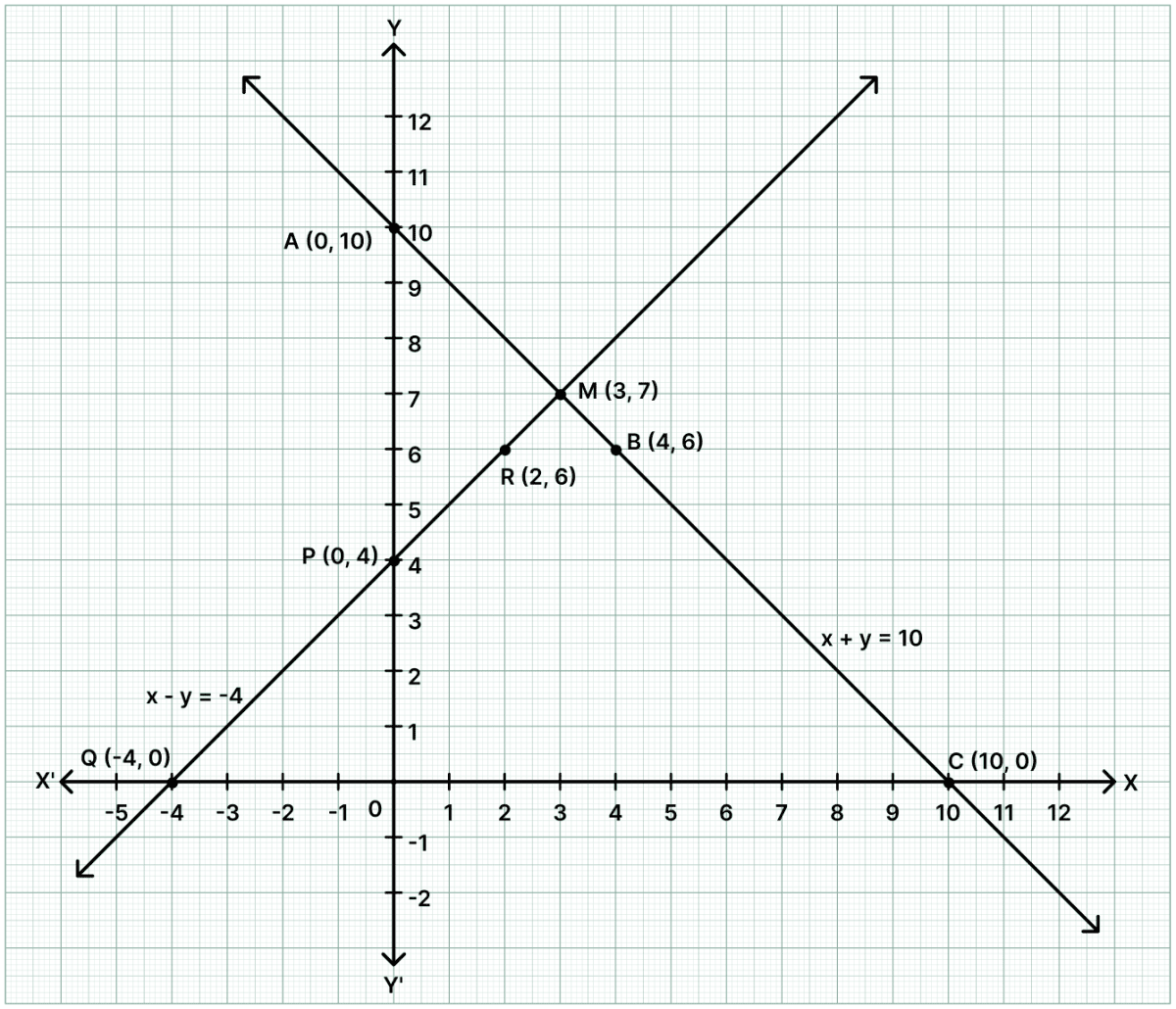
The two lines intersect at M (3, 7). So x = 3 and y = 7.
Check: 3 + 7 = 10 ✓ and 7 = 3 + 4 ✓
Hence, 3 boys and 7 girls took part in the quiz.
Use the ratios , , , to determine whether the lines representing the following pair of linear equations intersect at a point, are parallel or are coincident.
5x – 4y + 8 = 0; 7x + 6y – 9 = 0
Answer
Comparing with a1x + b1y + c1 = 0 and a2x + b2y + c2 = 0:
a1 = 5, b1 = -4, c1 = 8
a2 = 7, b2 = 6, c2 = -9
=
= =
Since ≠ , we have ≠ . So the pair has a unique solution.
Hence, the lines intersect at a point.
Use the ratios , , , to determine whether the lines representing the following pair of linear equations intersect at a point, are parallel or are coincident.
9x + 3y + 12 = 0; 18x + 6y + 24 = 0
Answer
Comparing with a1x + b1y + c1 = 0 and a2x + b2y + c2 = 0:
a1 = 9, b1 = 3, c1 = 12
a2 = 18, b2 = 6, c2 = 24
= =
= =
= =
Since , the pair has infinitely many solutions.
Hence, the lines are coincident.
Use the ratios , , , to determine whether the lines representing the following pair of linear equations intersect at a point, are parallel or are coincident.
6x – 3y + 10 = 0; 2x – y + 9 = 0
Answer
Comparing with a1x + b1y + c1 = 0 and a2x + b2y + c2 = 0:
a1 = 6, b1 = -3, c1 = 10
a2 = 2, b2 = -1, c2 = 9
= = 3
= = 3
=
Since ≠ , the pair has no solution.
Hence, the lines are parallel.
Which of the following pairs of linear equations have solutions? If they have solutions, find them graphically.
x + y = 5, 2x + 2y = 10
Answer
In standard form: x + y - 5 = 0 and 2x + 2y - 10 = 0.
= , = , = =
Since , the pair has infinitely many solutions.
Table of values for x + y = 5 (y = 5 - x):
| x | 0 | 2 | 5 |
|---|---|---|---|
| y | 5 | 3 | 0 |
Table of values for 2x + 2y = 10 (y = ):
| x | 1 | 3 | 4 |
|---|---|---|---|
| y | 4 | 2 | 1 |
Plot A (0, 5), B (2, 3), C (5, 0) for the first line and P (1, 4), Q (3, 2), R (4, 1) for the second line.
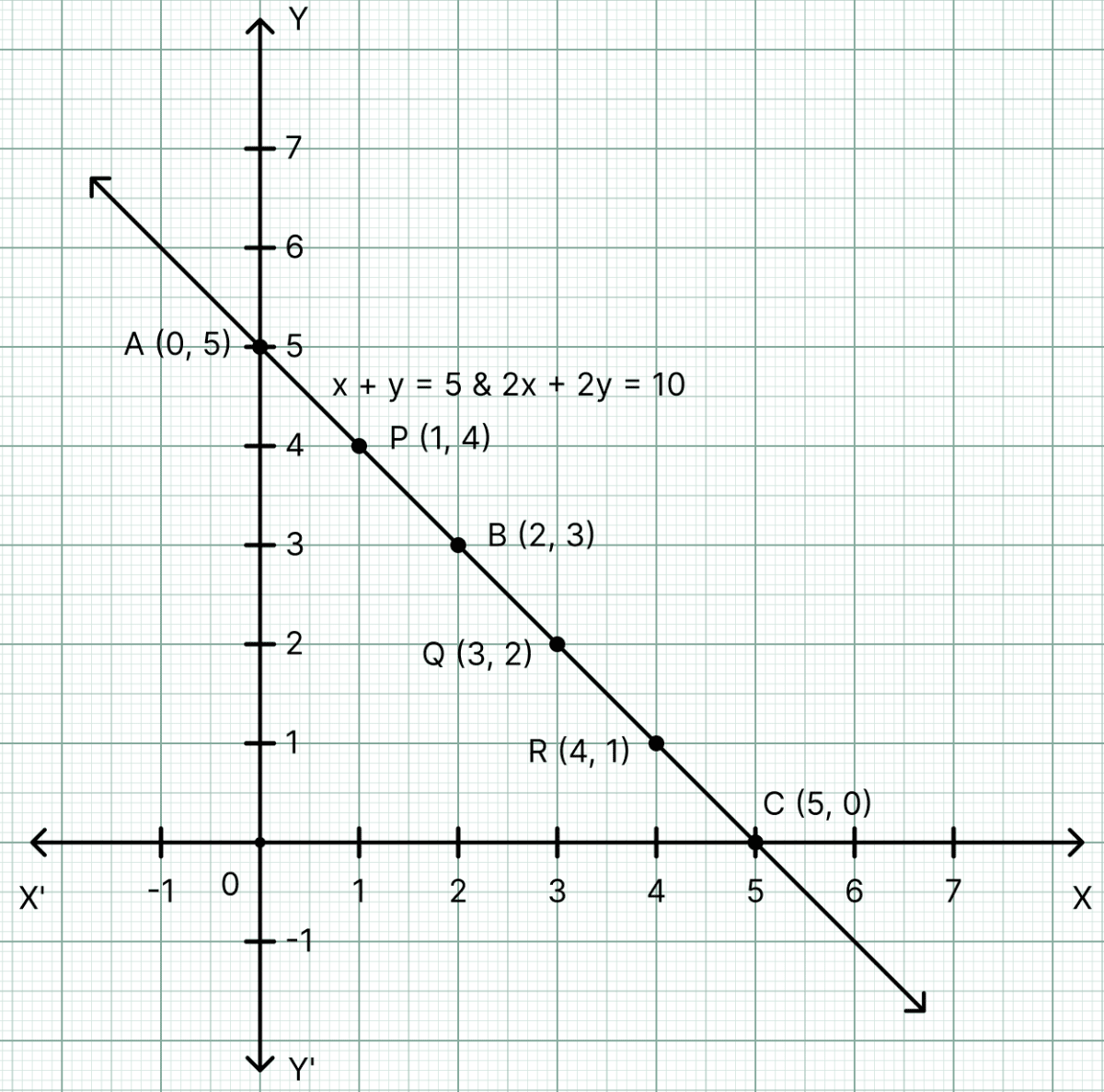
All six points lie on one straight line, so the two lines coincide. Every point on this line is a solution, for example (0, 5), (1, 4), (2, 3), (3, 2), (4, 1) and (5, 0). In general, (x, 5 - x) is a solution for every value of x.
Hence, the pair has infinitely many solutions and they are all the points (x, 5 - x) on the common line.
Which of the following pairs of linear equations have solutions? If they have solutions, find them graphically.
x – y = 8, 3x – 3y = 16
Answer
In standard form: x - y - 8 = 0 and 3x - 3y - 16 = 0.
=
= =
= =
Since ≠ , the lines are parallel and do not meet.
Hence, the pair x - y = 8, 3x - 3y = 16 has no solution.
Which of the following pairs of linear equations have solutions? If they have solutions, find them graphically.
2x + y – 6 = 0, 4x – 2y – 4 = 0
Answer
= =
= =
Since ≠ , the pair has a unique solution.
Table of values for 2x + y - 6 = 0 (y = 6 - 2x):
| x | 0 | 1 | 3 |
|---|---|---|---|
| y | 6 | 4 | 0 |
Table of values for 4x - 2y - 4 = 0 (y = 2x - 2):
| x | 0 | 1 | 3 |
|---|---|---|---|
| y | -2 | 0 | 4 |
Plot A (0, 6), B (1, 4), C (3, 0) and join them for the first line. Plot P (0, -2), Q (1, 0), R (3, 4) and join them for the second line.
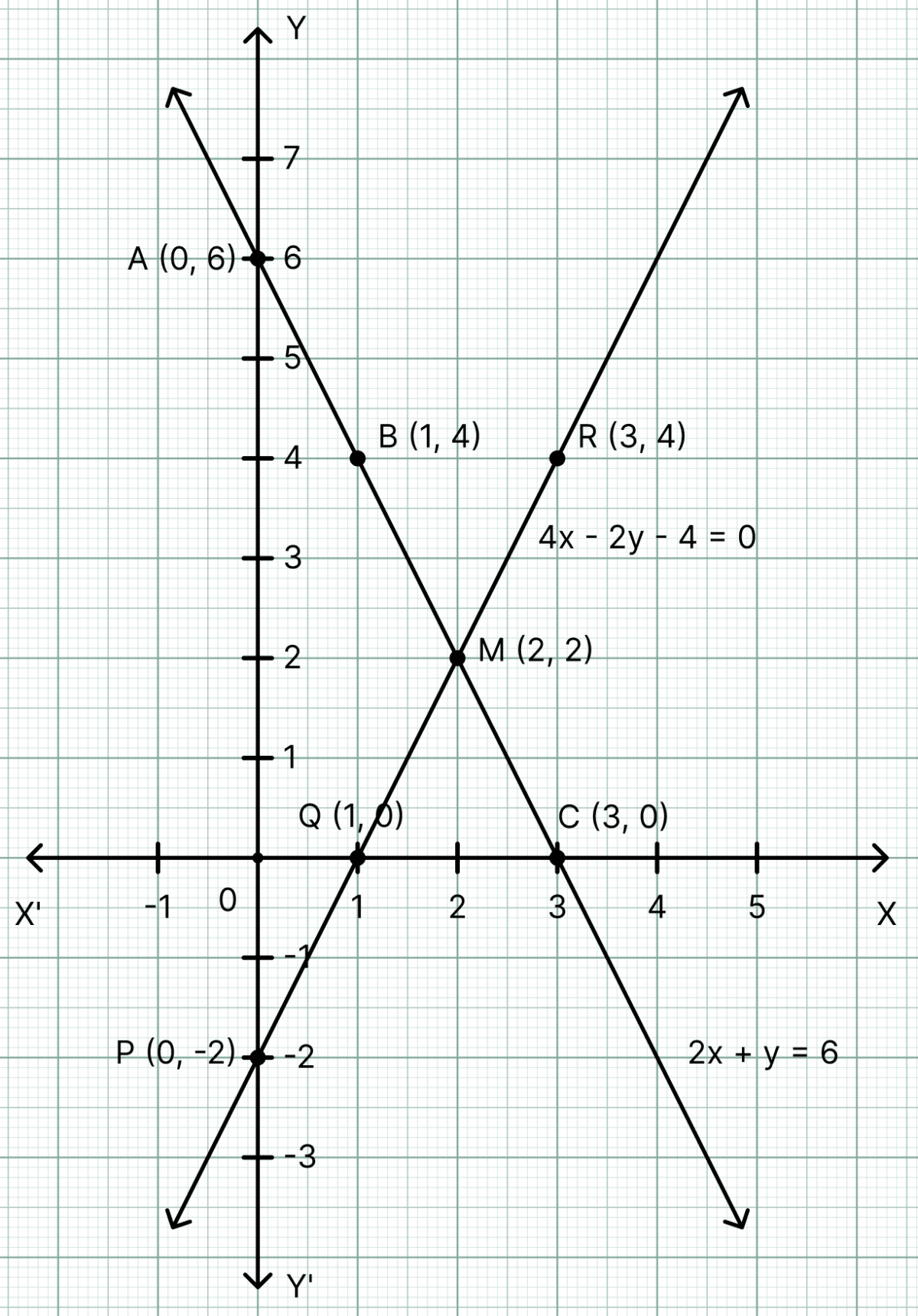
The two lines intersect at M (2, 2).
Check: 2 × 2 + 2 - 6 = 0 ✓ and 4 × 2 - 2 × 2 - 4 = 0 ✓
Hence, the pair has the unique solution x = 2, y = 2.
Which of the following pairs of linear equations have solutions? If they have solutions, find them graphically.
2x – 2y – 2 = 0, 4x – 4y – 5 = 0
Answer
= =
= =
= =
Since ≠ , the lines are parallel and do not meet.
Hence, the pair 2x - 2y - 2 = 0, 4x - 4y - 5 = 0 has no solution.
Half the perimeter of a rectangular garden, whose length is 4 m more than its width, is 36 m. Find the dimensions of the garden.
Answer
Let the length of the garden be x m and its width be y m.
Perimeter of a rectangle = 2(Length + Width)
So, half the perimeter = Length + Width.
According to the question,
x + y = 36 ...(1)
x = y + 4, that is, x - y = 4 ...(2)
Adding (1) and (2):
⇒ (x + x) + (y - y) = 36 + 4
⇒ 2x = 40
⇒ x = 20
Substituting x = 20 in (1):
⇒ 20 + y = 36
⇒ y = 16
Check: 20 + 16 = 36 ✓ and 20 = 16 + 4 ✓
Hence, the length of the garden is 20 m and its width is 16 m.
Given the linear equation 2x + 3y – 8 = 0, write another linear equation in two variables so that the graphs of the pair formed represent (i) intersecting lines (ii) parallel lines (iii) coincident lines.
Answer
For the given equation, a1 = 2, b1 = 3 and c1 = -8.
(i) Intersecting lines need ≠ .
Take x + y - 3 = 0. Here a2 = 1, b2 = 1.
= = 2 and = = 3, so ≠ . (The lines meet at (1, 2), since 2 × 1 + 3 × 2 - 8 = 0 and 1 + 2 - 3 = 0.)
Hence, x + y - 3 = 0 forms a pair of intersecting lines with 2x + 3y - 8 = 0.
(ii) Parallel lines need ≠ .
Take 4x + 6y - 12 = 0. Here a2 = 4, b2 = 6, c2 = -12.
= = , = = , = = ≠
Hence, 4x + 6y - 12 = 0 forms a pair of parallel lines with 2x + 3y - 8 = 0.
(iii) Coincident lines need .
Take 4x + 6y - 16 = 0 (2 times the given equation). Here a2 = 4, b2 = 6, c2 = -16.
= = , = = , = =
Hence, 4x + 6y - 16 = 0 forms a pair of coincident lines with 2x + 3y - 8 = 0.
Here is a problem that was posed by Mahāvīrāchārya in Gaṇita sāra saṅgraha (c. 850 CE).
The price of 9 citrons and 7 fragrant wood-apples taken together is 107; and the price of 7 citrons and 9 fragrant wood-apples taken together is 101.
O mathematician, tell me quickly the price of each citron and of each fragrant wood-apple.
(Hint: The given problem can be modelled as
9x + 7y = 107
7x + 9y = 101
Can you figure out a way of solving these equations without directly using elimination or the substitution method? What is special in this pair of equations? The x and y coefficients are interchanged in the 2 equations.
What will happen if we add the pair of equations? What will happen if we subtract the pair of equations? Can the resulting equations be solved to find the values of x and y?)
Answer
Let the price of each citron be x and the price of each fragrant wood-apple be y.
9x + 7y = 107 ...(1)
7x + 9y = 101 ...(2)
The special feature is that the coefficients of x and y are interchanged in the two equations. So adding and subtracting the equations gives very simple equations.
Adding (1) and (2):
⇒ (9x + 7x) + (7y + 9y) = 107 + 101
⇒ 16x + 16y = 208
⇒ x + y = 13 ...(3) [Dividing both sides by 16]
Subtracting (2) from (1):
⇒ (9x - 7x) + (7y - 9y) = 107 - 101
⇒ 2x - 2y = 6
⇒ x - y = 3 ...(4) [Dividing both sides by 2]
Adding (3) and (4):
⇒ (x + x) + (y - y) = 13 + 3
⇒ 2x = 16
⇒ x = 8
Substituting x = 8 in (3):
⇒ 8 + y = 13
⇒ y = 5
Check: 9 × 8 + 7 × 5 = 72 + 35 = 107 ✓ and 7 × 8 + 9 × 5 = 56 + 45 = 101 ✓
Hence, the price of each citron is 8 and the price of each fragrant wood-apple is 5.
5 pencils and 7 pens together cost ₹50, whereas 7 pencils and 5 pens together cost ₹46. Find the cost of each pencil and pen.
Answer
Let the cost of one pencil be ₹x and the cost of one pen be ₹y.
According to the question,
5x + 7y = 50 ...(1)
7x + 5y = 46 ...(2)
The coefficients are interchanged, so we add and subtract the equations.
Adding (1) and (2):
⇒ (5x + 7x) + (7y + 5y) = 50 + 46
⇒ 12x + 12y = 96
⇒ x + y = 8 ...(3) [Dividing both sides by 12]
Subtracting (1) from (2):
⇒ (7x - 5x) + (5y - 7y) = 46 - 50
⇒ 2x - 2y = -4
⇒ x - y = -2 ...(4) [Dividing both sides by 2]
Adding (3) and (4):
⇒ 2x = 6
⇒ x = 3
Substituting x = 3 in (3):
⇒ 3 + y = 8
⇒ y = 5
Check: 5 × 3 + 7 × 5 = 15 + 35 = 50 ✓ and 7 × 3 + 5 × 5 = 21 + 25 = 46 ✓
Hence, each pencil costs ₹3 and each pen costs ₹5.
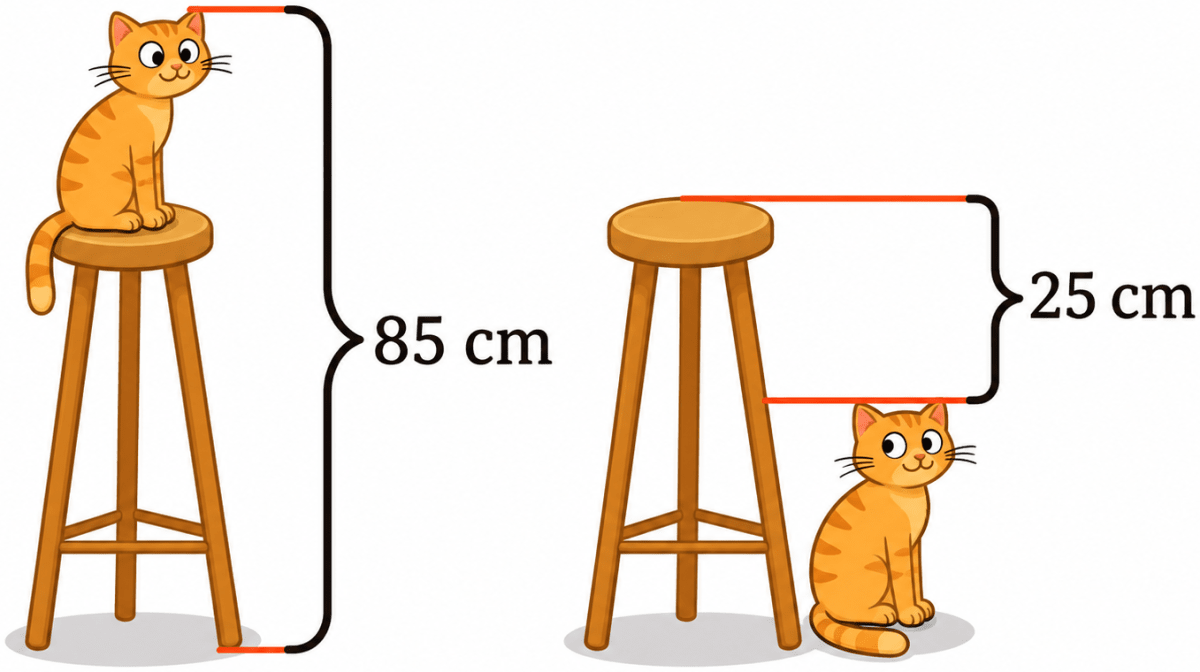
Find the height of the stool.
Answer
Let the height of the stool be x cm and the height of the cat be y cm.
In the first picture, the cat sits on the stool, and the floor to the top of the cat measures 85 cm.
⇒ x + y = 85 ...(1)
In the second picture, the cat is under the stool, and the top of the cat is 25 cm below the top of the stool.
⇒ x - y = 25 ...(2)
Adding (1) and (2):
⇒ (x + x) + (y - y) = 85 + 25
⇒ 2x = 110
⇒ x = 55
Substituting x = 55 in (1):
⇒ 55 + y = 85
⇒ y = 85 - 55
⇒ y = 30
Hence, the height of the stool is 55 cm.
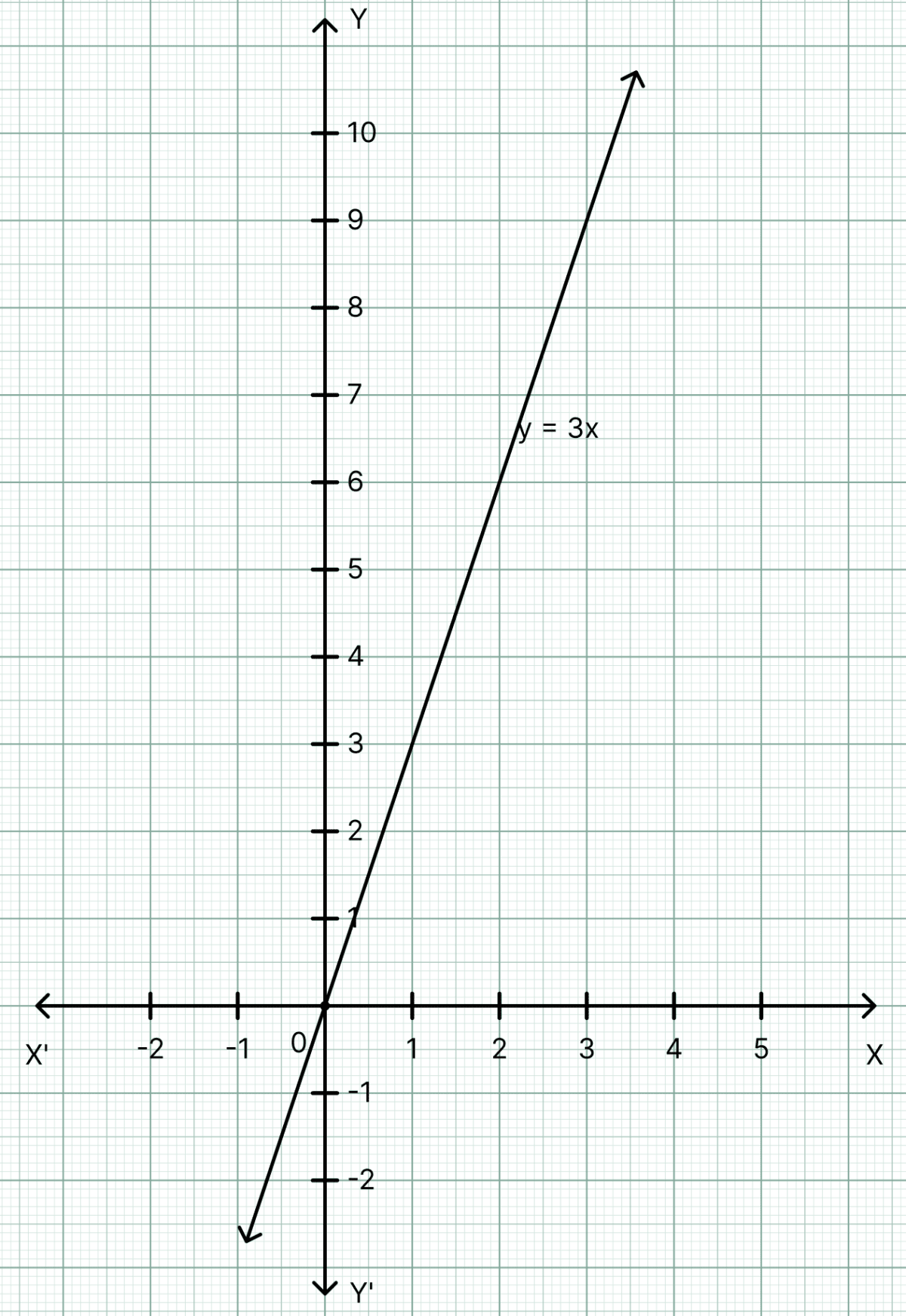
The graph of the line y = 3x, passing through (0, 0) and (2, 6) is given below.
(i) Identify the slope of the line from the graph and explain how you calculated it using the two points on the line.
(ii) What is the y-intercept of the line? Explain its significance.
(iii) A water tank is being filled so that the water level y (in cm) after x minutes follows this graph.
(a) How high is the water after 5 minutes?
(b) How many minutes will it take for the water to reach a height of 21 cm?
(iv) Without drawing a new graph, determine whether the point (4, 10) lies on this line. Justify your answer.
(v) Plot the point where this line intersects the line x = 3. Explain how you found the coordinates.
Answer
(i) The line passes through O (0, 0) and A (2, 6). Moving from O to A, we go 2 units to the right (the run) and 6 units up (the rise).
Slope = =
This agrees with m = 3 in y = 3x.
Hence, the slope of the line is 3.
(ii) Comparing y = 3x with y = mx + d, we get d = 0. Also, putting x = 0 gives y = 3 × 0 = 0, so the line cuts the y-axis at (0, 0).
The y-intercept 0 means the line passes through the origin. In the water tank situation, it means that at the start (x = 0 minutes) the water level is 0 cm, that is, the tank is empty when filling begins.
Hence, the y-intercept of the line is 0.
(iii) The water level after x minutes is y = 3x cm. The slope 3 means the level rises by 3 cm every minute.
(a) Substituting x = 5:
⇒ y = 3 × 5
⇒ y = 15
Hence, the water is 15 cm high after 5 minutes.
(b) Substituting y = 21:
⇒ 3x = 21
⇒ x =
⇒ x = 7
Hence, the water will reach a height of 21 cm in 7 minutes.
(iv) A point lies on the line only if its coordinates satisfy y = 3x.
Substituting x = 4:
⇒ y = 3 × 4 = 12
The y-coordinate of the given point is 10, and 10 ≠ 12.
Hence, the point (4, 10) does not lie on the line y = 3x.
(v) Every point on the line x = 3 has x-coordinate 3. The required point lies on both lines, so it has x = 3 and satisfies y = 3x.
Substituting x = 3 in y = 3x:
⇒ y = 3 × 3
⇒ y = 9
So the lines meet at P (3, 9). We plot P (3, 9) on the graph of y = 3x and draw the vertical line x = 3 through it.
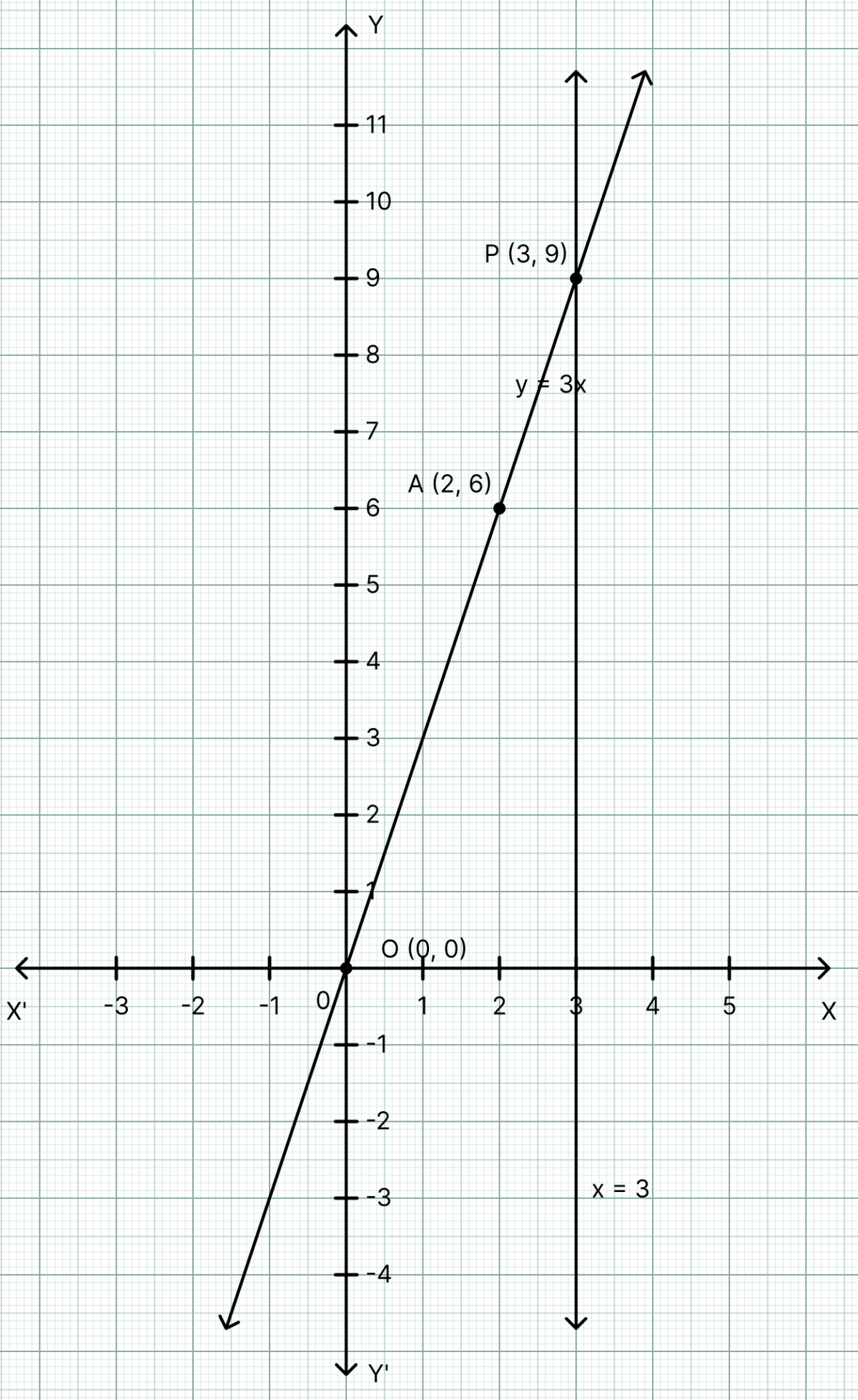
Hence, the line y = 3x intersects the line x = 3 at the point (3, 9).
In countries like the USA, temperature is measured in Fahrenheit, whereas in countries like India, it is measured in Celsius. Here is a linear equation that converts Celsius to Fahrenheit:
F = C + 32
Draw the graph of the linear equation above using Celsius on the x-axis and Fahrenheit on the y-axis.
Answer
Given: F = C + 32
We find F for a few values of C.
When C = 0: F = × 0 + 32 = 0 + 32 = 32
When C = 10: F = × 10 + 32 = 18 + 32 = 50
When C = 30: F = × 30 + 32 = 54 + 32 = 86
When C = -40: F = × (-40) + 32 = -72 + 32 = -40
| C (x-axis) | -40 | 0 | 10 | 30 |
|---|---|---|---|---|
| F (y-axis) | -40 | 32 | 50 | 86 |
Plot the points (-40, -40), (0, 32), (10, 50) and (30, 86) and draw the straight line through them.
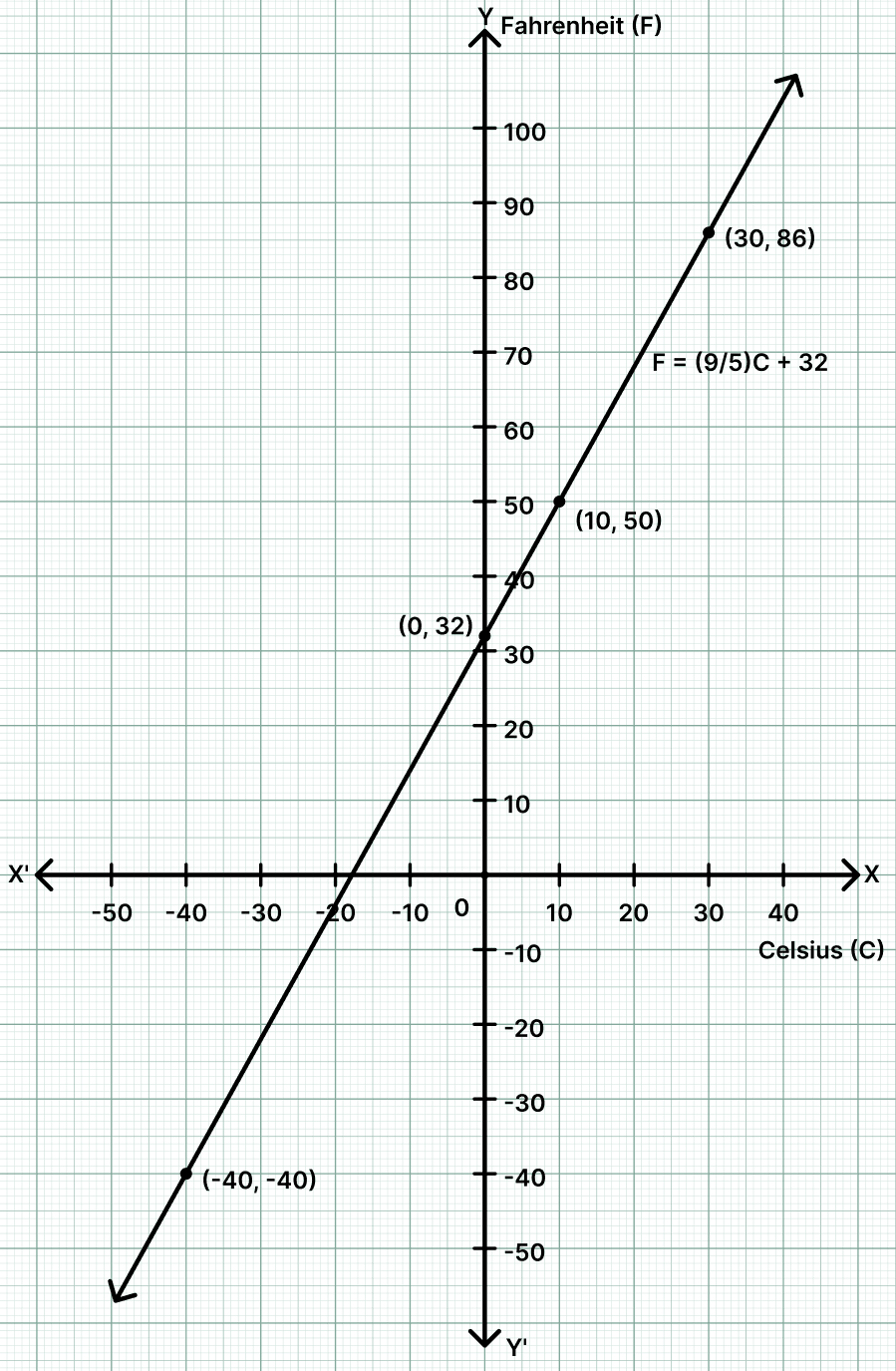
Hence, the graph of F = C + 32 is the straight line through (-40, -40), (0, 32), (10, 50) and (30, 86).
In countries like the USA, temperature is measured in Fahrenheit, whereas in countries like India, it is measured in Celsius. Here is a linear equation that converts Celsius to Fahrenheit:
F = C + 32
If the temperature is 30 °C, what is the temperature in Fahrenheit?
Answer
Substituting C = 30 in F = C + 32:
Hence, 30 °C = 86 °F.
In countries like the USA, temperature is measured in Fahrenheit, whereas in countries like India, it is measured in Celsius. Here is a linear equation that converts Celsius to Fahrenheit:
F = C + 32
If the temperature is 95 °F, what is the temperature in Celsius?
Answer
Substituting F = 95 in F = C + 32:
Hence, 95 °F = 35 °C.
In countries like the USA, temperature is measured in Fahrenheit, whereas in countries like India, it is measured in Celsius. Here is a linear equation that converts Celsius to Fahrenheit:
F = C + 32
If the temperature is 0 °C, what is the temperature in Fahrenheit and if the temperature is 0 °F, what is the temperature in Celsius?
Answer
Substituting C = 0 in F = C + 32:
⇒ F = × 0 + 32 = 32
Hence, 0 °C = 32 °F.
Substituting F = 0 in F = C + 32:
Hence, 0 °F = °C ≈ -17.78 °C.
In countries like the USA, temperature is measured in Fahrenheit, whereas in countries like India, it is measured in Celsius. Here is a linear equation that converts Celsius to Fahrenheit:
F = C + 32
Is there a temperature which is numerically the same in both Fahrenheit and Celsius? If yes, find it.
Answer
Consider F = C + 32
Let the temperature be t, with F = t and C = t.
Hence, yes: -40 °C = -40 °F.
Solve the following system of equations graphically:
2x + y = 6, 2x – y – 2 = 0.
Answer
Given:
2x + y = 6 ...(1)
2x - y - 2 = 0 ...(2)
Table of values for (1) (y = 6 - 2x):
| x | 0 | 1 | 3 |
|---|---|---|---|
| y | 6 | 4 | 0 |
Table of values for (2) (y = 2x - 2):
| x | 0 | 1 | 3 |
|---|---|---|---|
| y | -2 | 0 | 4 |
Plot A (0, 6), B (1, 4), C (3, 0) and join them to get the line 2x + y = 6. Plot P (0, -2), Q (1, 0), R (3, 4) and join them to get the line 2x - y - 2 = 0.
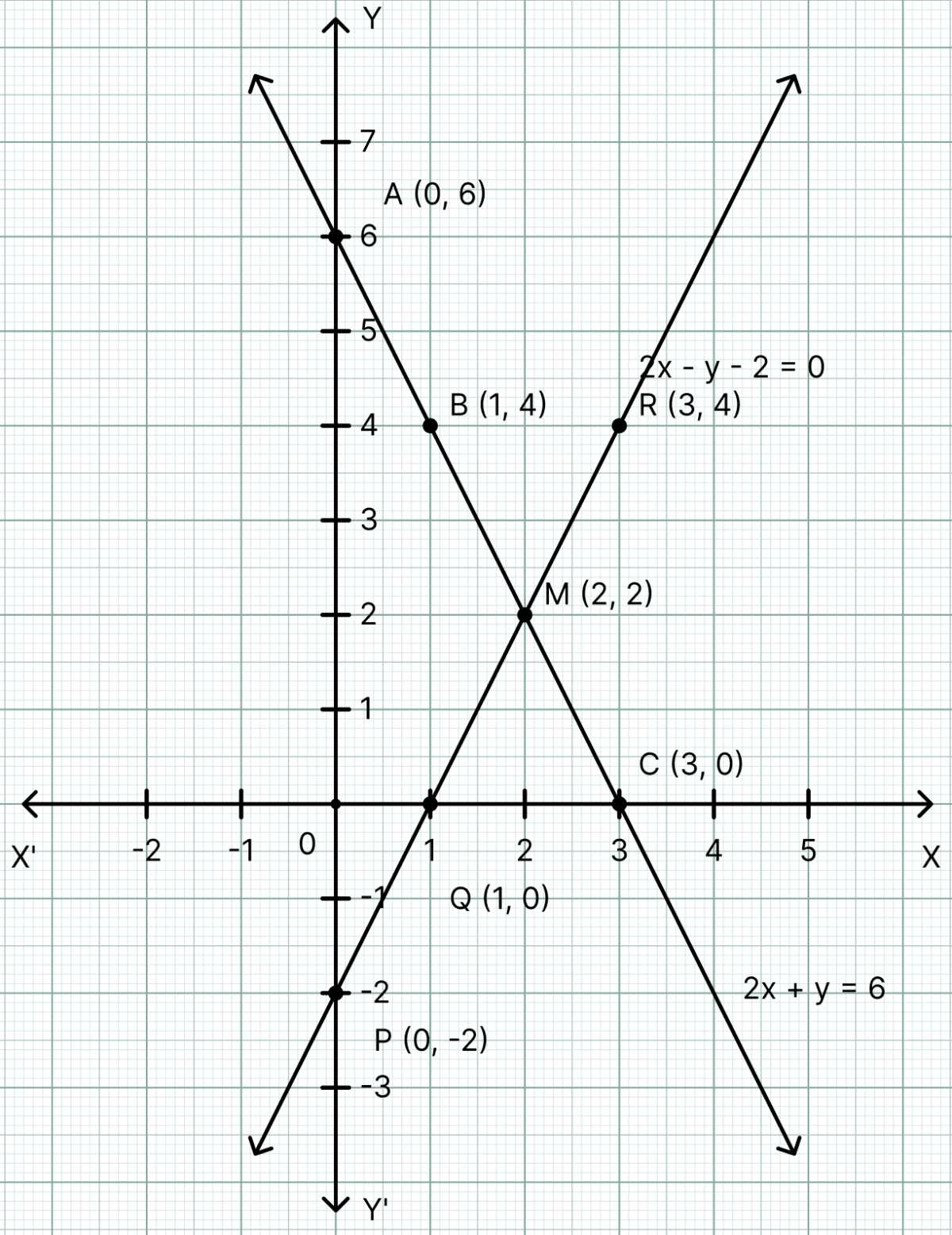
The two lines intersect at M (2, 2).
Check: 2 × 2 + 2 = 6 ✓ and 2 × 2 - 2 - 2 = 0 ✓
Hence, the solution is x = 2, y = 2.
Find the point of intersection of the lines shown on the cover page.

Answer
The two lines of light on the cover are labelled with their equations: one on the front cover and one on the back cover.
15x - 100y - 115 = 0
⇒ 15x - 100y = 115 ...(1)
15x + 100y = 335 ...(2)
The coefficients of x are equal and the coefficients of y differ only in sign, so we add and subtract the equations.
Adding (1) and (2):
⇒ (15x + 15x) + (-100y + 100y) = 115 + 335
⇒ 30x = 450
⇒ x =
⇒ x = 15
Subtracting (1) from (2):
⇒ (15x - 15x) + (100y + 100y) = 335 - 115
⇒ 200y = 220
⇒ y =
⇒ y = = 1.1
Check in (1): 15 × 15 - 100 × 1.1 - 115 = 225 - 110 - 115 = 0 ✓
Check in (2): 15 × 15 + 100 × 1.1 = 225 + 110 = 335 ✓
Also, = = 1 and = = -1, so and the lines meet in exactly one point.
Hence, the lines shown on the cover page intersect at the point (15, 1.1).
Give a formula to find the x-intercept of the line y = mx + c.
Answer
The x-intercept is where the line cuts the x-axis. At every point of the x-axis, y = 0.
Substituting y = 0 in y = mx + c:
⇒ 0 = mx + c
⇒ mx = -c
⇒ x = , provided m ≠ 0
So the line cuts the x-axis at the point .
For example, for y = 2x - 6 (m = 2, c = -6), the x-intercept is = 3, and indeed 2 × 3 - 6 = 0.
If m = 0, the line y = c is parallel to the x-axis; it has no x-intercept when c ≠ 0, and it is the x-axis itself when c = 0.
Hence, the x-intercept of the line y = mx + c is (m ≠ 0).
A person is choosing between two mobile plans.
Plan A: ₹50 monthly fee + ₹0.20 per minute of call time.
Plan B: ₹30 monthly fee + ₹0.30 per minute of call time.
For how many minutes of calling per month is Plan A cheaper than Plan B? For how many minutes is Plan B cheaper? Also find the number of minutes at which both plans cost the same.
Answer
Let the call time be x minutes per month and the monthly cost be ₹y.
Monthly cost = Monthly fee + (Charge per minute × Number of minutes)
Plan A: y = 50 + 0.2x ...(1)
Plan B: y = 30 + 0.3x ...(2)
Same cost: Equating (1) and (2):
⇒ 50 + 0.2x = 30 + 0.3x
⇒ 50 - 30 = 0.3x - 0.2x
⇒ 20 = 0.1x
⇒ x =
Multiply numerator and denominator by 10 to eliminate decimal point in denominator
⇒ x =
⇒ x = 200
Cost at 200 minutes:
Plan A = 50 + 0.2 × 200
= 50 + 40
= ₹90
Plan B = 30 + 0.3 × 200
= 30 + 60
= ₹90
Comparing the plans:
Cost of Plan B - Cost of Plan A
= (30 + 0.3x) - (50 + 0.2x)
= 0.1x - 20
Plan A is cheaper when this difference is positive:
⇒ 0.1x - 20 > 0
⇒ 0.1x > 20
⇒ x > 200
Plan B is cheaper when this difference is negative:
⇒ 0.1x - 20 < 0
⇒ x < 200
Check: for 100 minutes, Plan A = 50 + 20 = ₹70 and Plan B = 30 + 30 = ₹60, so Plan B is cheaper; for 300 minutes, Plan A = 50 + 60 = ₹110 and Plan B = 30 + 90 = ₹120, so Plan A is cheaper.
The graphs of the two plans show the same result: the lines meet at (200, 90); to the left of x = 200 the line of Plan B is lower, and to the right the line of Plan A is lower.
To draw the graphs, we find the cost of each plan at 0 minutes and at 400 minutes.
Plan A at 0 minutes = 50 + 0.2 × 0 = 50 + 0 = ₹50
Plan A at 400 minutes = 50 + 0.2 × 400 = 50 + 80 = ₹130
Plan B at 0 minutes = 30 + 0.3 × 0 = 30 + 0 = ₹30
Plan B at 400 minutes = 30 + 0.3 × 400 = 30 + 120 = ₹150
For Plan A, plot (0, 50) and (400, 130). For Plan B, plot (0, 30) and (400, 150). Mark the point where the two lines meet as M (200, 90).
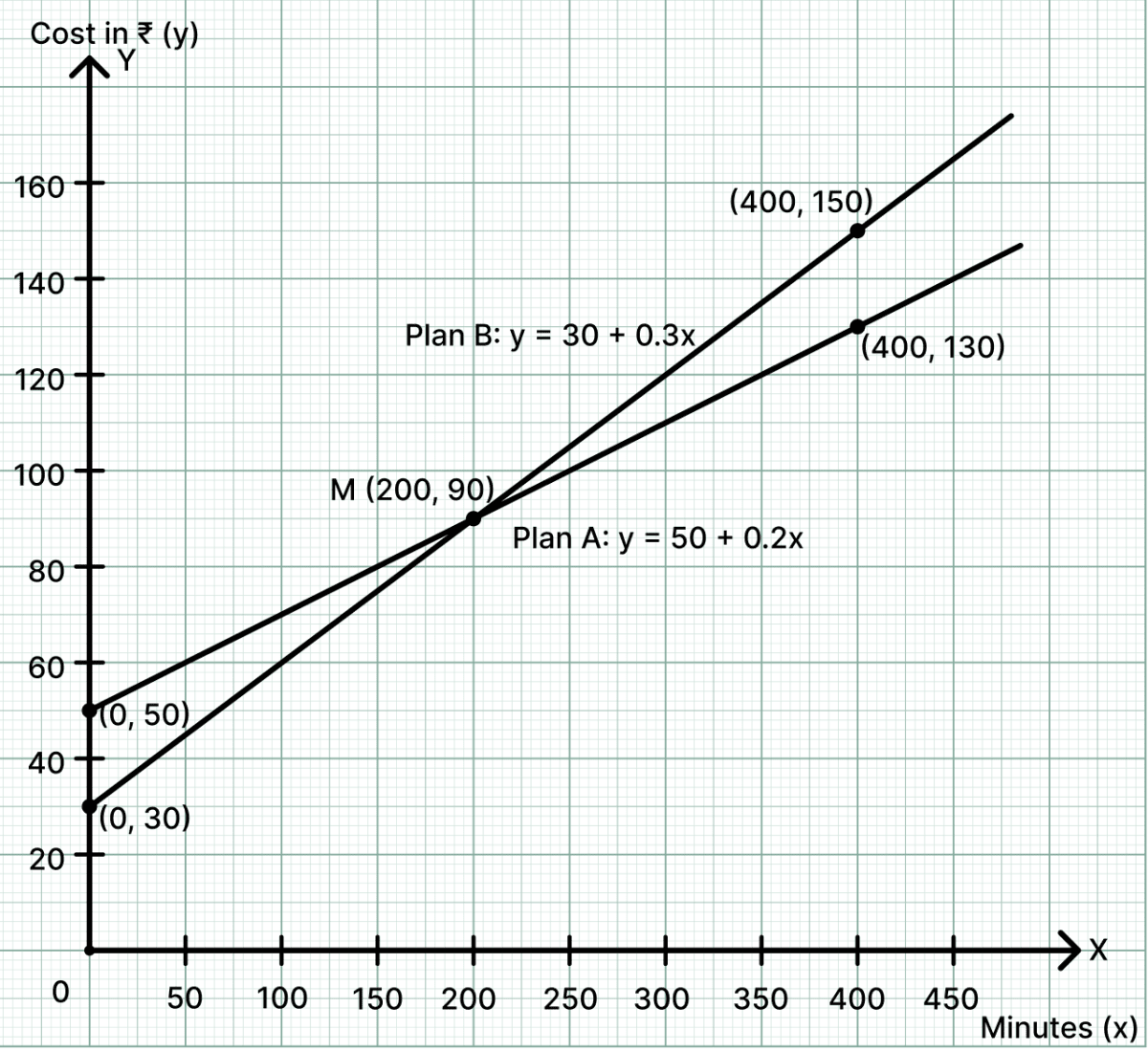
Hence, Plan A is cheaper for more than 200 minutes of calling per month, Plan B is cheaper for less than 200 minutes, and both plans cost the same (₹90) at 200 minutes.
How many lines exist that
(i) have a given slope?
(ii) have a given slope and pass through a given point?
Answer
(i) Let the given slope be m. Every line y = mx + d has slope m, whatever the value of d. Different values of d (for example, y = mx, y = mx + 1, y = mx - 2, …) give different lines, all parallel to each other. Since d can be any real number, there are infinitely many such lines. (Similarly, if the given slope is undefined, every vertical line x = h has it.)
Hence, infinitely many lines have a given slope.
(ii) Let the given slope be m and the given point be (p, q). The line is y = mx + d for some d. Since (p, q) lies on it:
⇒ q = mp + d
⇒ d = q - mp
So d has exactly one value, and the line y = mx + (q - mp) is the only such line. For example, the line with slope 2 through (1, 3) has d = 3 - 2 × 1 = 1, so it is y = 2x + 1. (If the slope is undefined, the only such line is x = p.)
Hence, exactly one line has a given slope and passes through a given point.
For what values of p does the pair of equations given below have a unique solution?
4x + py + 8 = 0; 2x + 2y + 2 = 0.
Answer
Comparing with a1x + b1y + c1 = 0 and a2x + b2y + c2 = 0:
a1 = 4, b1 = p, c1 = 8
a2 = 2, b2 = 2, c2 = 2
For a unique solution, ≠ .
When p = 4:
= = 2
= = 2
= = 4
Since the first two ratios are equal but differ from the third, the lines are parallel and have no solution.
Hence, the pair has a unique solution for all real values of p except p = 4.
Find the values of a and b for which the following system of equations has infinitely many solutions:
(a + b)x – 2by = 5a + 2b + 1; 3x – y = 14.
Answer
In standard form:
(a + b)x - 2by - (5a + 2b + 1) = 0
3x - y - 14 = 0
Here,
a1 = a + b, b1 = -2b, c1 = -(5a + 2b + 1)
a2 = 3, b2 = -1, c2 = -14
For infinitely many solutions,
From the first two ratios:
From the last two ratios:
Substituting a = 5b from (1) in (2):
⇒ 26b - 5 × 5b = 1
⇒ 26b - 25b = 1
⇒ b = 1
From (1): a = 5 × 1 = 5
Check: with a = 5 and b = 1, the first equation becomes 6x - 2y = 25 + 2 + 1, that is, 6x - 2y = 28, which is 2 times 3x - y = 14 ✓
Hence, a = 5 and b = 1.
Find the value of ‘k’ for which the following system of equations represents a pair of coincident lines:
x + 2y = 3; (k – 1)x + (k + 1)y = k + 3.
Answer
In standard form:
x + 2y - 3 = 0
(k - 1)x + (k + 1)y - (k + 3) = 0
Here,
a1 = 1, b1 = 2, c1 = -3
a2 = k - 1, b2 = k + 1, c2 = -(k + 3)
For coincident lines,
From the first two ratios:
From the last two ratios:
Both give k = 3.
Check: for k = 3, the second equation is 2x + 4y = 6, which is 2 times x + 2y = 3 ✓
Hence, k = 3.
Robot 1 starts from the origin and traces a path by repeatedly moving 3 units to the right and then 4 units upward. Robot 2 starts from the point (10, 0) and repeatedly moves 1 unit to the right and then 2 units upward. Will the paths traced by these two robots intersect and if so, where?
Answer
Each robot's path is a staircase of horizontal and vertical moves. The corner points it reaches after each complete move lie on a straight line, so we first find these two lines and where they meet.
Robot 1: rise = 4, run = 3, so
Slope = =
It starts at (0, 0), so the y-intercept is 0.
⇒ y = x ...(1)
It reaches (3, 4), (6, 8), (9, 12), … and only moves to the right, so x ≥ 0 on its path.
Robot 2: rise = 2, run = 1, so
Slope = = 2
Its line is y = 2x + d. It passes through (10, 0):
⇒ 0 = 2 × 10 + d
⇒ d = -20
⇒ y = 2x - 20 ...(2)
It reaches (11, 2), (12, 4), … and only moves to the right, so x ≥ 10 on its path.
Where do the lines meet? Equating (1) and (2):
Substituting x = 30 in (1): y = × 30 = 40
x = 30 is on both paths (30 ≥ 0 and 30 ≥ 10). Robot 1 reaches (30, 40) after 30 ÷ 3 = 10 moves, and Robot 2 reaches it after 30 - 10 = 20 moves (20 × 2 = 40 units up).
The corner points do not show the whole track, because each robot also moves along the horizontal and vertical sides of its steps. So we follow the actual moves near (30, 40).
Robot 1 is at (21, 28) after 7 moves. Its track then runs
(21, 28) → (24, 28) → (24, 32) → (27, 32) → (27, 36) → (30, 36) → (30, 40) → (33, 40) → (33, 44) → (36, 44)
Robot 2 is at (24, 28) after 14 moves. Its track then runs
(24, 28) → (25, 28) → (25, 30) → (26, 30) → (26, 32) → (27, 32) → (27, 34) → (28, 34) → (28, 36) → (29, 36) → (29, 38) → (30, 38) → (30, 40) → (31, 40) → (31, 42) → (32, 42) → (32, 44) → (33, 44) → (33, 46)
Comparing the two tracks:
Let P be the point (24, 28). Robot 1 reaches it during its 8th move and Robot 2 after 14 moves.
From (26, 32) to (27, 32), and then up from (27, 32) to (27, 34), both robots move along the same track.
From (28, 36) to (29, 36), both robots move along the same track.
From (30, 38) up to (30, 40), and then from (30, 40) to (31, 40), both robots move along the same track. Let M be the point (30, 40), a corner point of both robots.
Let Q be the point (33, 44). Robot 1 reaches it after 11 moves and Robot 2 during its 23rd move.
Before P, Robot 2's track is always below Robot 1's track, and after Q it is always above it. So the tracks have no other common points.
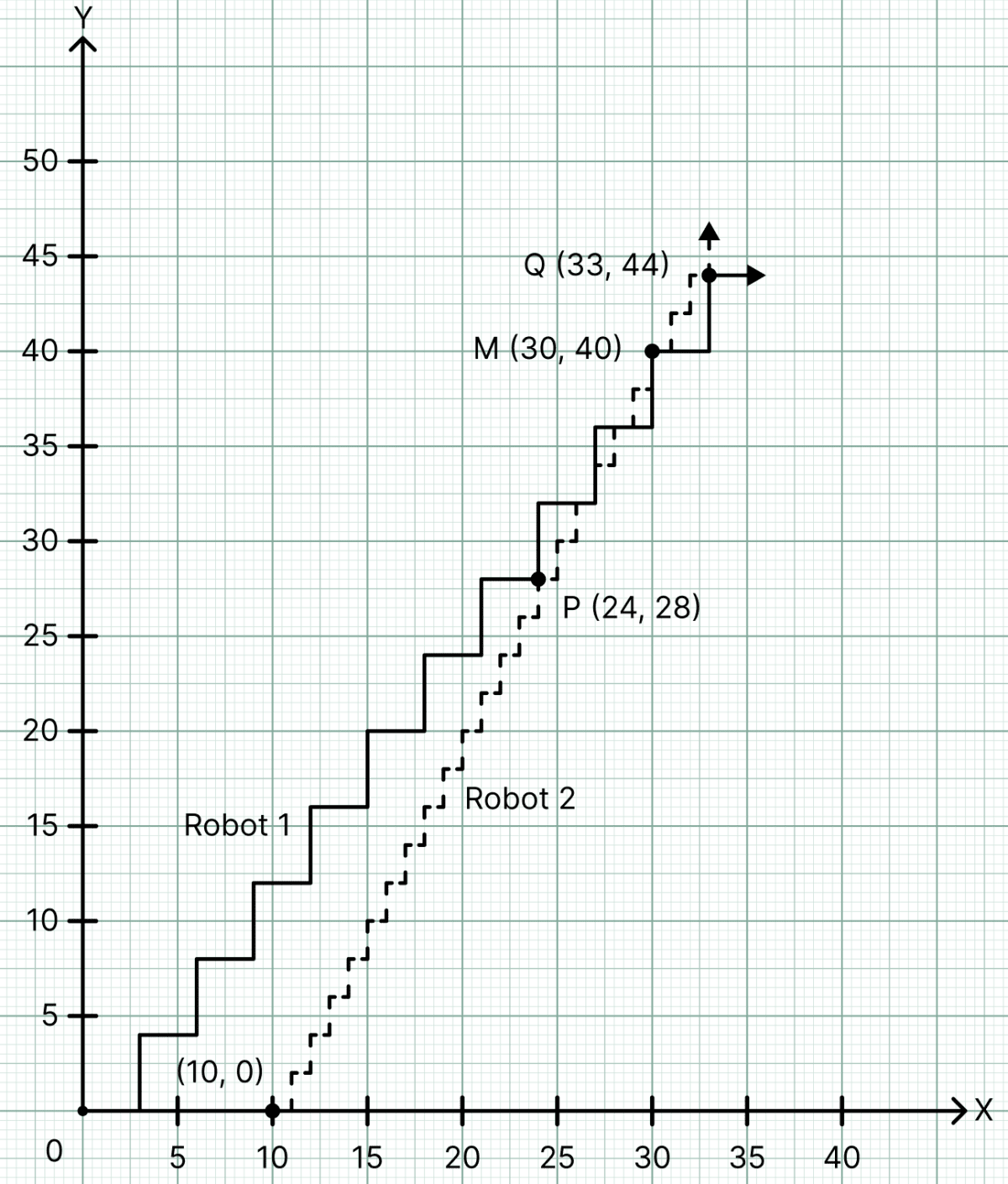
Hence, yes, the paths intersect. They first meet at P (24, 28), share short pieces of track between P and Q (33, 44), and both robots pass through M (30, 40), where the lines through their corner points meet.
Robot 1 starts from (3, 0) and traces a path by repeatedly moving 5 units to the right and then 5 units upward. Robot 2 starts from the point (7, 0) and repeatedly moves 5 units to the right and then 3 units downwards. Will the paths traced by these two robots intersect and if so, where?
Answer
Each robot's path is a staircase of horizontal and vertical moves. The corner points it reaches after each complete move lie on a straight line, so we first find these two lines and where they meet.
Robot 1: rise = 5, run = 5, so slope = = 1.
Its line is y = x + d. It passes through (3, 0):
⇒ 0 = 3 + d
⇒ d = -3
⇒ y = x - 3 ...(1)
It moves only to the right, so x ≥ 3 on its path, and there y ≥ 0.
Robot 2: rise = -3 (downwards), run = 5, so slope = .
Its line is y = x + d. It passes through (7, 0):
⇒ 0 = × 7 + d
⇒ d =
⇒ y = x + ...(2)
It moves only to the right, so x ≥ 7 on its path, and there y ≤ 0.
Where do the lines meet? Equating (1) and (2):
Substituting x = 4.5 in (1): y = 4.5 - 3 = 1.5
So the two lines meet at (4.5, 1.5). But Robot 2 starts at x = 7 and only moves to the right, so it never reaches this point. The lines through the corner points therefore do not answer the question, and we follow the actual moves.
Robot 1 first moves 5 units to the right along the x-axis, from R (3, 0) to T (8, 0).
Robot 2 first moves 5 units to the right along the x-axis, from S (7, 0) to (12, 0).
Robot 1 covers the x-axis from x = 3 to x = 8, and Robot 2 covers it from x = 7 to x = 12. So both robots trace the segment ST, from S (7, 0) to T (8, 0).
After this, Robot 1 moves up from T (8, 0), and for x > 8 its track is at y ≥ 5, above the x-axis. Robot 2 goes on to (12, 0) and then never goes above the x-axis. So the tracks have no other common point.
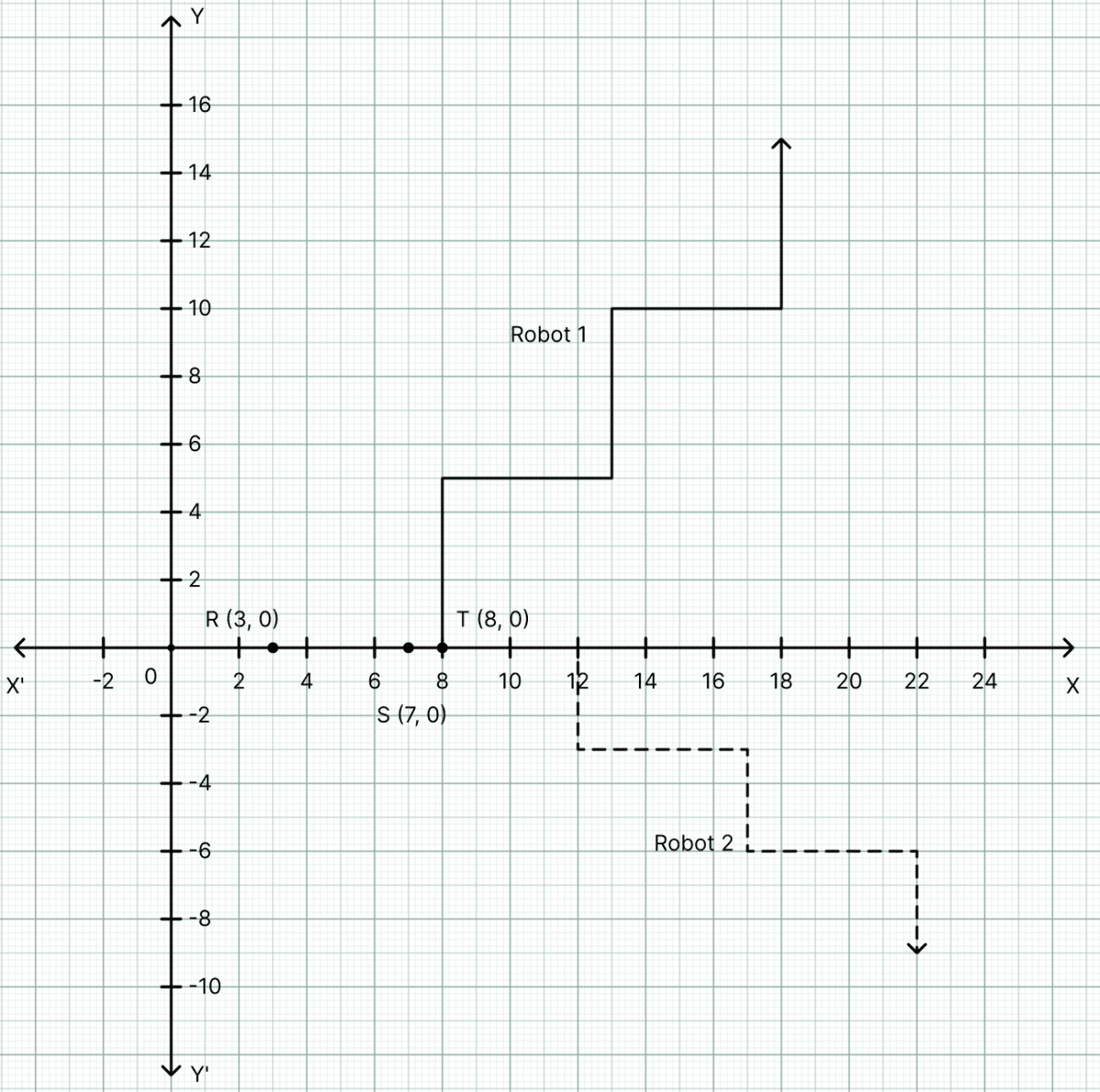
Hence, yes, the paths of the two robots intersect: they share the segment ST of the x-axis, from (7, 0) to (8, 0), and meet nowhere else.
At a certain time, Jacob notices that his digital watch reads ‘a’ minutes after two o’clock. Fifteen minutes later, it reads ‘b’ minutes after three o’ clock. He noticed that a is six times greater than b. What time was it when he looked at his watch for the second time?
Answer
First reading: a minutes after two o'clock.
Fifteen minutes later, the time is (a + 15) minutes after two o'clock. This is the same as b minutes after three o'clock, that is, (60 + b) minutes after two o'clock.
According to the question,
a + 15 = 60 + b
⇒ a - b = 45 ...(1)
a = 6b ...(2)
Substituting a = 6b from (2) in (1):
⇒ 6b - b = 45
⇒ 5b = 45
⇒ b = 9
From (2): a = 6 × 9 = 54
So, Jacob first looked at 2:54 and then at 3:09. Check: 2:54 + 15 minutes = 3:09 ✓
Hence, it was 3:09 (9 minutes past three) when he looked at his watch for the second time.
The sum of the digits of a two-digit number is 15. The number obtained by interchanging the digits exceeds the given number by 9. Find the number.
Answer
Let the ten's digit be x and the unit's digit be y.
The number = 10x + y
The number obtained by interchanging the digits = 10y + x
According to the question,
x + y = 15 ...(1)
(10y + x) - (10x + y) = 9
⇒ 10y - y + x - 10x = 9
⇒ 9y - 9x = 9
⇒ y - x = 1 ...(2) [Dividing both sides by 9]
Adding (1) and (2):
⇒ (x - x) + (y + y) = 15 + 1
⇒ 2y = 16
⇒ y = 8
Substituting y = 8 in (1):
⇒ x + 8 = 15
⇒ x = 15 - 8
⇒ x = 7
The number = 10 × 7 + 8 = 78
Check: 7 + 8 = 15 ✓ and 87 - 78 = 9 ✓
Hence, the number is 78.
In a cyclic quadrilateral ABCD, ∠A = (x + 7)°, ∠B = (y + 8)°, ∠C = (3y + 23)° and ∠D = (4x + 12)°. Find all four angles of the cyclic quadrilateral.
Answer
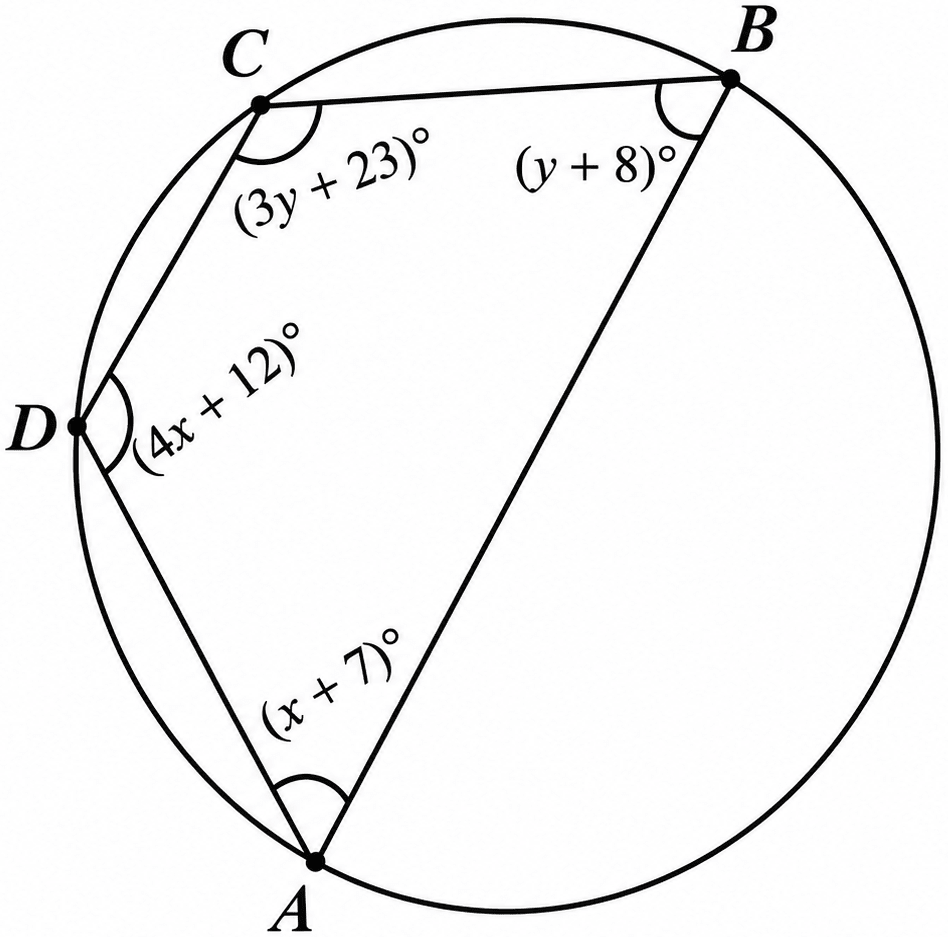
Given: ABCD is a cyclic quadrilateral with ∠A = (x + 7)°, ∠B = (y + 8)°, ∠C = (3y + 23)° and ∠D = (4x + 12)°.
We know that the opposite angles of a cyclic quadrilateral are supplementary.
∠A + ∠C = 180°
⇒ (x + 7) + (3y + 23) = 180
⇒ x + 3y + 30 = 180
⇒ x + 3y = 180 - 30
⇒ x + 3y = 150 ...(1)
∠B + ∠D = 180°
⇒ (y + 8) + (4x + 12) = 180
⇒ 4x + y + 20 = 180
⇒ 4x + y = 180 - 20
⇒ 4x + y = 160 ...(2)
From (2):
y = 160 - 4x ...(3)
Substituting (3) in (1):
⇒ x + 3(160 - 4x) = 150
⇒ x + 480 - 12x = 150
⇒ -11x = -330
⇒ x = 30
From (3): y = 160 - 4 × 30 = 160 - 120 = 40
The angles are:
∠A = (30 + 7)° = 37°
∠B = (40 + 8)° = 48°
∠C = (3 × 40 + 23)° = (120 + 23)° = 143°
∠D = (4 × 30 + 12)° = (120 + 12)° = 132°
Check: ∠A + ∠C = 37° + 143° = 180° ✓ and ∠B + ∠D = 48° + 132° = 180° ✓
Hence, ∠A = 37°, ∠B = 48°, ∠C = 143° and ∠D = 132°.
A train moving with uniform speed for a certain distance takes 6 hours less if its speed is increased by 6 km/hour. It would have taken 6 hours more had its speed been decreased by 4 km/hour. Find the distance travelled and the speed of the train.
Answer
Given:
If the speed is increased by 6 km/h, the train takes 6 hours less.
If the speed is decreased by 4 km/h, the train takes 6 hours more.
Let the speed of the train be x km/hour and the time taken be y hours.
Distance = Speed × Time = xy km
Condition 1: Speed (x + 6) km/hour, time (y - 6) hours, same distance.
⇒ (x + 6)(y - 6) = xy
⇒ xy - 6x + 6y - 36 = xy
⇒ -6x + 6y = 36
Divide both sides by 6
⇒ -x + y = 6 ...(1)
Condition 2: Speed (x - 4) km/hour, time (y + 6) hours, same distance.
⇒ (x - 4)(y + 6) = xy
⇒ xy + 6x - 4y - 24 = xy
⇒ 6x - 4y = 24
Divide both sides by 2
⇒ 3x - 2y = 12 ...(2)
From (1):
y = x + 6 ...(3)
Substituting (3) in (2):
⇒ 3x - 2(x + 6) = 12
⇒ 3x - 2x - 12 = 12
⇒ x = 12 + 12
⇒ x = 24
From (3): y = 24 + 6 = 30
Distance = 24 × 30 = 720 km
Check: at 30 km/hour, time = = 24 hours = 30 - 6 ✓; at 20 km/hour, time = = 36 hours = 30 + 6 ✓
Hence, the distance travelled is 720 km and the speed of the train is 24 km/hour.
The age of a father is equal to the sum of the ages of his four children. After 20 years, the sum of the ages of the children will be twice the age of the father. Find the age of the father.
Answer
Let the present age of the father be x years and the present sum of the ages of the four children be y years.
According to the question,
x = y ...(1)
After 20 years:
Father's age = (x + 20) years
Each of the 4 children is 20 years older, so the sum of their ages = y + 4 × 20 = (y + 80) years
According to the question, the sum of the children's ages will be twice the father's age
⇒ y + 80 = 2(x + 20)
⇒ y + 80 = 2x + 40
⇒ 2x - y = 40 ...(2)
Substituting y = x from (1) in (2):
⇒ 2x - x = 40
⇒ x = 40
Check: after 20 years, father = 60 years and children's sum = 40 + 80 = 120 = 2 × 60 ✓
Hence, the age of the father is 40 years.