
Can we use any given quadrilateral to tile the plane? If not, which quadrilaterals can be used and which cannot?
Answer
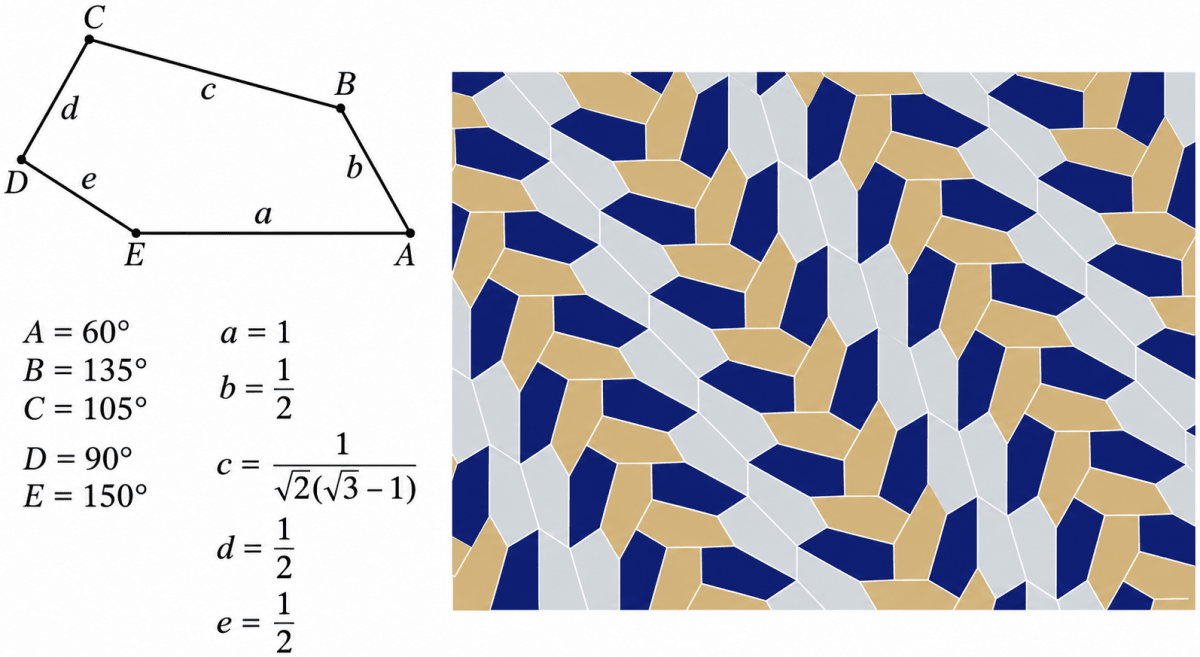
Yes. Every quadrilateral (4-gon) — convex or non-convex — can be used to tile the plane. Self-intersecting 4-gons are not counted as quadrilaterals here.
Reasoning:
The four angles of a quadrilateral add up to 360°. So four copies of the same quadrilateral can be fitted around a common point with each of the four angles used once, leaving no gap and no overlap at that point.
A tiling can be built step by step: rotate a copy of the quadrilateral through 180° about the midpoint of one of its sides. The rotated copy fits exactly along that side. Repeating this at every side of every copy that is added covers the whole plane.
For a parallelogram this is easy to see: copies of a parallelogram form a grid of two sets of parallel lines, as in the introduction of the chapter.
Hence, the plane can be tiled using copies of any given quadrilateral.
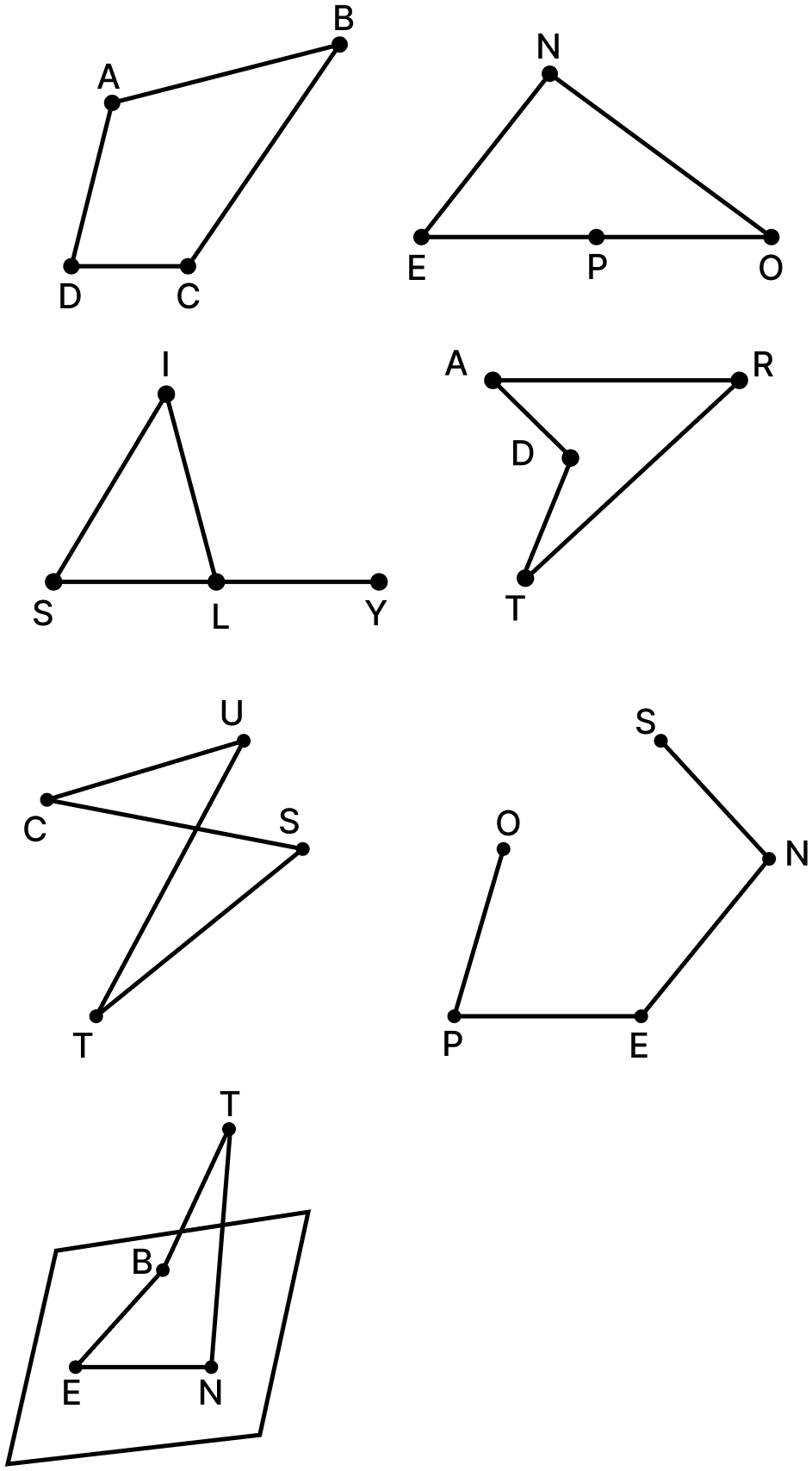
Informally, a quadrilateral is a figure with four straight sides, as in the first figure ABCD in Fig. 12.2 below. But consider the other six figures in Fig. 12.2: the five plane figures NOPE, SILY, DART, CUTS, OPENS and the non-planar BENT. Should we call all these figures quadrilaterals? If you answer ‘no’ for any of them, how will you define a quadrilateral so that such a figure is excluded? As you can see, some care is needed to precisely define what we think of as a quadrilateral.
Answer
No. Only ABCD and DART should be called quadrilaterals. The others fail for the following reasons.
NOPE: the vertices O, P and E lie on one line. The sides OP and PE lie along the same line, so the figure is really the triangle NOE.
SILY: the vertices S, L and Y lie on one line. The sides LY and YS overlap along the same line, so the figure looks like a triangle with a doubled side.
CUTS: two of its sides cross each other at a point which is not a vertex. It is a self-intersecting figure.
OPENS: it has five points and only four segments, and it does not close up — the last segment does not come back to the first point.
BENT: its four vertices do not lie in one plane. It is a non-planar figure.
DART: it has a dent at D, but it is a closed figure with four sides that meet only at their ends. It is a (non-convex) quadrilateral.
To exclude NOPE, SILY, CUTS, OPENS and BENT, we can define a quadrilateral as follows:
Take four distinct points A, B, C and D that lie in one plane, with no three of them on a line. The figure made of the four segments AB, BC, CD and DA is called quadrilateral ABCD, provided every point of these segments, other than A, B, C and D, lies on only one of the four segments.
"Four points and the four segments AB, BC, CD, DA" rules out OPENS; "in one plane" rules out BENT; "no three on a line" rules out NOPE and SILY; "every other point on only one segment" rules out CUTS.
To prepare, let us first consider how we can define a triangle. Let A, B and C be three points. Can we say that ∆ABC consists of points on the three line segments AB, BC, CA? Yes, provided A, B, C are not collinear.
When A, B, C are non-collinear, we call them the vertices of ∆ABC and the three segments AB, BC and CA the sides of ∆ABC.
Can we similarly define a quadrilateral ABCD?
Answer
Only partly. We can again say that quadrilateral ABCD consists of the points on the four segments AB, BC, CD and DA, but the single condition "the points are not collinear" is not enough.
For a triangle, "A, B, C are not collinear" is the only thing that can go wrong. With four points, even when they are not all on one line:
Three of them may be collinear — then two adjacent sides lie along one line (as in NOPE and SILY in Fig. 12.2);
The four points may not lie in one plane (as in BENT);
Two sides may cross each other at a point that is not a vertex (as in CUTS).
So the definition must add three conditions: the four points lie in one plane, no three of them are collinear, and every point of the four segments other than A, B, C and D lies on exactly one segment.
Hence, a quadrilateral ABCD can be defined like a triangle — as the points on the segments AB, BC, CD and DA — but only after adding these extra conditions.
Let ABCD be a quadrilateral.
(i) List all sides of ABCD adjacent to side AB. List all sides opposite to AB.
(ii) List all angles of ABCD adjacent to ∠A. List all angles opposite to ∠A.
(iii) Define a pair of opposite sides and a pair of opposite angles without using the names of the vertices.
Answer
(i) The sides of ABCD are AB, BC, CD and DA.
Adjacent sides of AB are the sides that share an endpoint with AB: BC (common endpoint B) and DA (common endpoint A).
The opposite side of AB is the side that shares no endpoint with AB: CD.
Hence, the sides adjacent to AB are BC and DA, and the side opposite to AB is CD.
(ii) Adjacent angles are internal angles at adjacent vertices. The vertices adjacent to A are B and D (the other endpoints of sides AB and AD).
Hence, the angles adjacent to ∠A are ∠B and ∠D, and the angle opposite to ∠A is ∠C.
(iii) A pair of opposite sides is a pair of sides of the quadrilateral that have no common endpoint.
A pair of opposite angles is a pair of internal angles at two vertices that are not the endpoints of a common side (that is, at two vertices that are not adjacent).
You have used internal angles of quadrilaterals, but they too require an exact definition, just like how we gave one for a quadrilateral. Precisely define the internal angle of a quadrilateral at a given vertex. Your answer should work for a non-convex quadrilateral too. (Hint: use the opposite vertex as well.)
Answer
Let ABCD be a quadrilateral and let B be the given vertex. Its adjacent vertices are A and C, and its opposite vertex is D.
The rays BA and BC divide the plane into two angular regions:
one region with measure less than 180°, which is ∠ABC;
the other (reflex) region with measure 360° - ∠ABC.
The internal angle must be one of these two. The opposite vertex D tells us which one.
Definition: The internal angle of quadrilateral ABCD at vertex B is
∠ABC (the angle less than 180°), if B does not lie inside ∆ACD formed by its two adjacent vertices and its opposite vertex;
the reflex angle 360° - ∠ABC, if B lies inside ∆ACD.
Check with DART (Think & Reflect-2 Q1): the vertex D lies inside ∆ART, formed by its adjacent vertices A, T and its opposite vertex R. So the internal angle at D is the reflex angle, more than 180° — the dent. The vertex A does not lie inside ∆DRT, so the internal angle at A is ∠DAR, less than 180°.
For a convex quadrilateral no vertex lies inside the triangle formed by the other three, so every internal angle is the usual angle less than 180°.
In a quadrilateral ABCD, suppose AB ‖ DC. Can ABCD be non-convex? What if we instead assume AB = CD? What if we instead assume ∠A = ∠C?
Answer
Case 1: AB ‖ DC
No, ABCD cannot be non-convex.
AB ‖ DC and AD is a transversal.
∠A + ∠D = 180° [Interior angles on the same side of the transversal AD]
So ∠A < 180° and ∠D < 180°.
AB ‖ DC and BC is a transversal.
∠B + ∠C = 180° [Interior angles on the same side of the transversal BC]
So ∠B < 180° and ∠C < 180°.
All four internal angles are less than 180°, so ABCD is convex.
Hence, if AB ‖ DC, then ABCD cannot be non-convex.
Case 2: AB = CD
Yes, ABCD can be non-convex. An example:
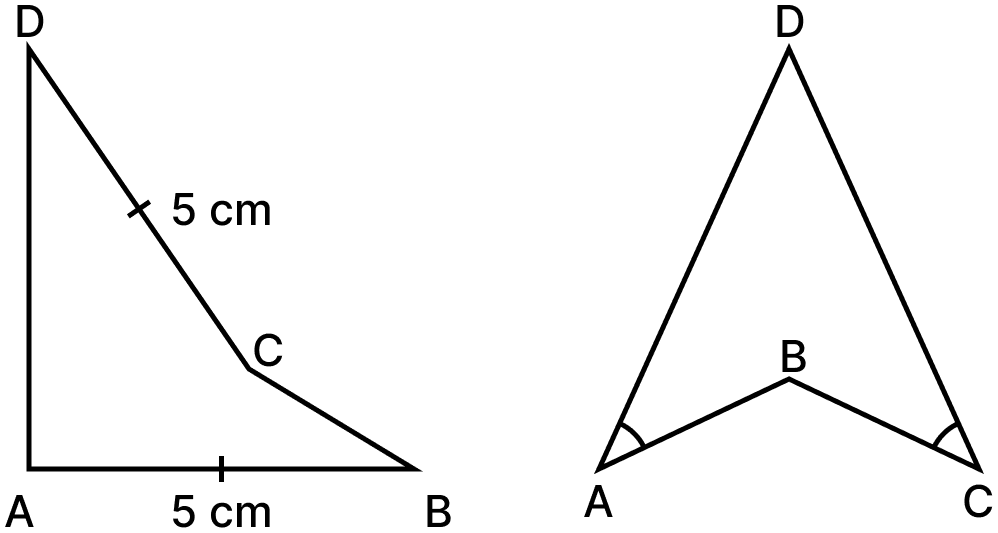
Take A = (0, 0), B = (5, 0), C = (3, 1) and D = (0, 5), with lengths in cm.
AB = 5 - 0 = 5 cm
CD =
=
=
= 5 cm
So AB = CD. But C lies inside ∆ABD, so the internal angle at C is more than 180° (a dent at C).
Hence, a quadrilateral with AB = CD can be non-convex.
Case 3: ∠A = ∠C
Yes, ABCD can be non-convex.
Take the right figure above: A = (-2, 0), B = (0, 1), C = (2, 0) and D = (0, 4). It is symmetric about the line BD, so ∠A = ∠C. But B lies inside ∆ACD, so the internal angle at B is more than 180°. Such a figure is called a dart (a non-convex kite).
Note that the dent cannot be at A or at C: then both ∠A and ∠C would be more than 180°, and ∠A + ∠C would already exceed 360°.
Hence, a quadrilateral with ∠A = ∠C can be non-convex; the dent is then at B or at D.
Consider three non-collinear points A, B, C and draw the lines AB, BC, CA. For every possible location of point D in the plane outside these lines, decide if ABCD is self-intersecting, non-convex, or convex. (Hint: the three lines divide the plane into 7 regions.)
Answer
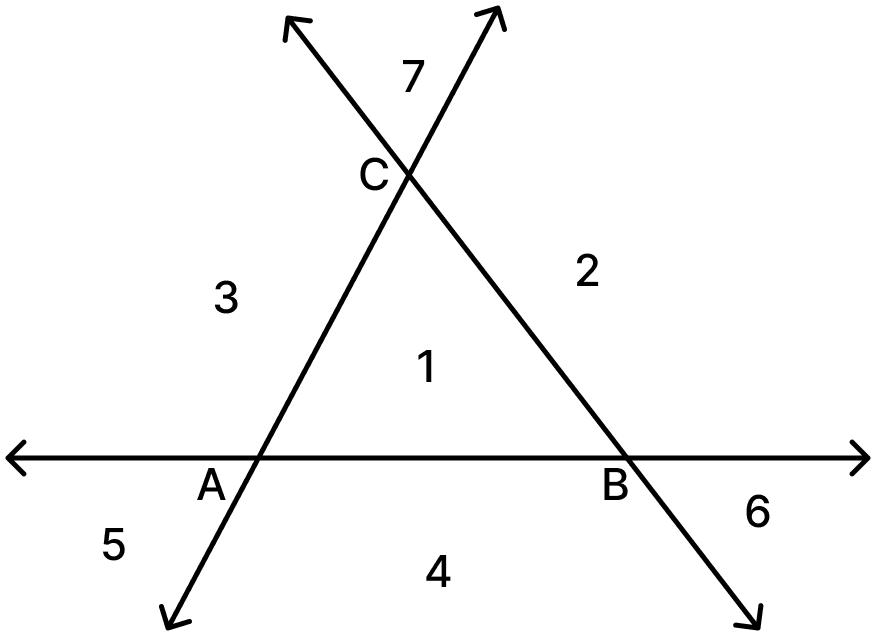
The three lines divide the plane into 7 regions, numbered as follows:
Region 1 — inside ∆ABC.
Region 2 — across side BC (on the other side of BC from A, between the lines AB and AC).
Region 3 — across side CA (on the other side of CA from B).
Region 4 — across side AB (on the other side of AB from C).
Region 5 — beyond vertex A (opposite the angle at A).
Region 6 — beyond vertex B.
Region 7 — beyond vertex C.
The quadrilateral ABCD has sides AB, BC, CD and DA.
Region 1 (D inside ∆ABC): sides CD and DA lie inside the triangle and do not cross AB or BC. D lies inside ∆ABC, so the internal angle at D is more than 180°. ABCD is non-convex (dent at D).
Region 2 (across BC): A and D lie on opposite sides of line BC, and D lies between the lines AB and AC, so the segment DA crosses the side BC. ABCD is self-intersecting.
Region 3 (across CA): D and B lie on opposite sides of AC, and A and C lie on opposite sides of BD, so the diagonals AC and BD intersect. ABCD is convex.
Region 4 (across AB): C and D lie on opposite sides of line AB, and D lies between the lines CA and CB, so the segment CD crosses the side AB. ABCD is self-intersecting.
Region 5 (beyond A): A lies inside ∆BCD. No two sides cross, and the internal angle at A is more than 180°. ABCD is non-convex (dent at A).
Region 6 (beyond B): B lies inside ∆ACD. ABCD is non-convex (dent at B).
Region 7 (beyond C): C lies inside ∆ABD. ABCD is non-convex (dent at C).
| Region of D | Type of ABCD |
|---|---|
| 1 (inside ∆ABC) | Non-convex |
| 2 (across BC) | Self-intersecting |
| 3 (across CA) | Convex |
| 4 (across AB) | Self-intersecting |
| 5 (beyond A) | Non-convex |
| 6 (beyond B) | Non-convex |
| 7 (beyond C) | Non-convex |
Hence, ABCD is convex only when D lies across side CA (opposite to B), self-intersecting when D lies across side AB or side BC, and non-convex in the remaining four regions.
Can a quadrilateral be both self-intersecting and non-planar?
Answer
No.
In a self-intersecting quadrilateral ABCD, two opposite sides cross each other — say AB and CD meet at a point E.
Then the lines AB and CD intersect at E. Two intersecting lines lie in one plane.
This plane contains the line AB, so it contains A and B. It contains the line CD, so it contains C and D.
So all four vertices A, B, C, D lie in one plane, and the quadrilateral is planar. The same argument works if BC and DA are the sides that cross.
Hence, a quadrilateral cannot be both self-intersecting and non-planar.
The angles of a quadrilateral add up to 360°. Therefore, if the opposite angles are equal, what can we say about adjacent angles? Is the converse of your answer true? Conclude that Theorem 3 can also be stated as follows. “If each pair of adjacent angles in a quadrilateral ABCD ............... then ABCD is a parallelogram.” Fill in the blank.
Answer
Theorem 3 (converse of (b)): If the opposite angles of a quadrilateral are equal, then it is a parallelogram.
Adjacent angles: Let ABCD be a quadrilateral with ∠A = ∠C and ∠B = ∠D.
∠A + ∠B + ∠C + ∠D = 360° [Angle sum of a quadrilateral]
⇒ ∠A + ∠B + ∠A + ∠B = 360° [∵ ∠C = ∠A and ∠D = ∠B]
⇒ 2(∠A + ∠B) = 360°
⇒ ∠A + ∠B =
⇒ ∠A + ∠B = 180°
In the same way, ∠B + ∠C = 180°, ∠C + ∠D = 180° and ∠D + ∠A = 180°.
So, if the opposite angles are equal, then each pair of adjacent angles adds up to 180°.
Converse: If each pair of adjacent angles adds up to 180°, then the opposite angles are equal. This is true.
∠A + ∠B = 180° ...(1)
∠B + ∠C = 180° ...(2)
From (1) and (2),
∠A + ∠B = ∠B + ∠C
⇒ ∠A = ∠C
Similarly, from ∠B + ∠C = 180° and ∠C + ∠D = 180°, we get ∠B = ∠D.
So the two conditions "opposite angles are equal" and "each pair of adjacent angles adds up to 180°" always go together, and Theorem 3 can be stated using either of them.
Hence, “If each pair of adjacent angles in a quadrilateral ABCD adds up to 180°, then ABCD is a parallelogram.”
True or false?
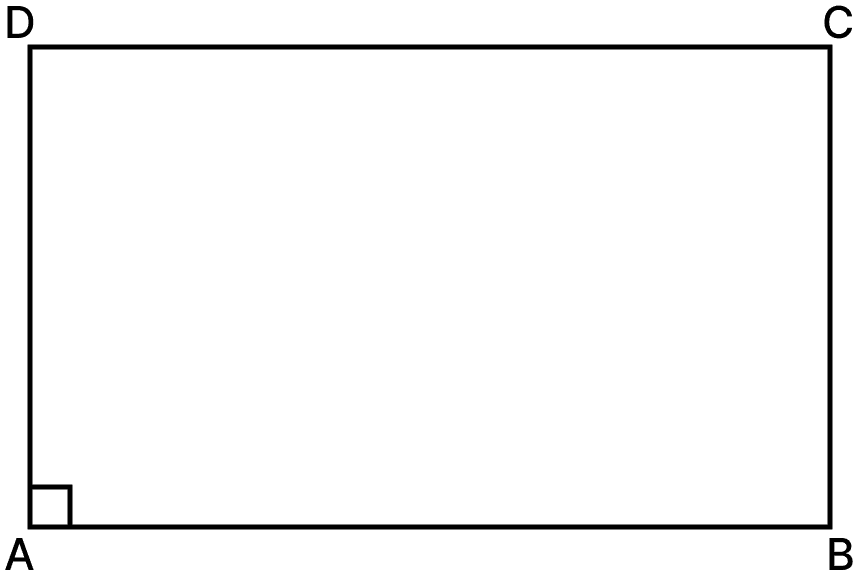
A parallelogram with a right angle is a rectangle.
Answer
True.
Let ABCD be a parallelogram with ∠A = 90°.
AD ‖ BC and AB is a transversal.
∠A + ∠B = 180° [Interior angles on the same side of the transversal]
⇒ 90° + ∠B = 180°
⇒ ∠B = 180° - 90° = 90°
∠C = ∠A = 90° and ∠D = ∠B = 90° [Opposite angles of a parallelogram are equal]
All four angles are 90°, so ABCD is a rectangle.
Hence, the statement is true: a parallelogram with a right angle is a rectangle.
True or false?
A rhombus with perpendicular diagonals is a square.
Answer
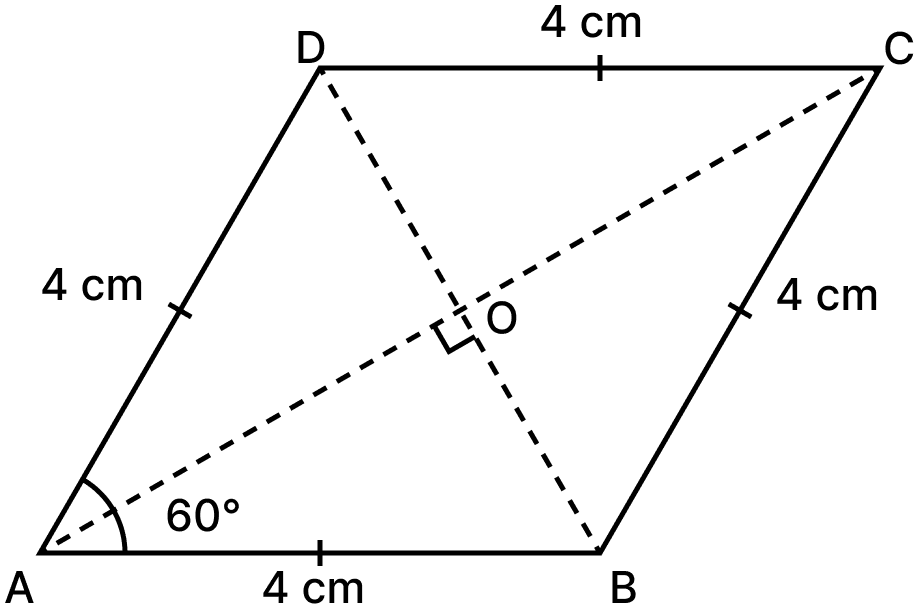
False.
The diagonals of every rhombus are perpendicular. So "a rhombus with perpendicular diagonals" means just "a rhombus", and not every rhombus is a square.
Counterexample: Take a rhombus ABCD with each side 4 cm and ∠A = 60°.
∠B = 180° - 60° = 120° [Adjacent angles of a parallelogram are supplementary]
Its diagonals AC and BD are perpendicular (it is a rhombus), but ∠A = 60° ≠ 90°, so it is not a square.
Hence, the statement is false.
True or false?
If the diagonals of a parallelogram are equal, then it is a rectangle.
Answer
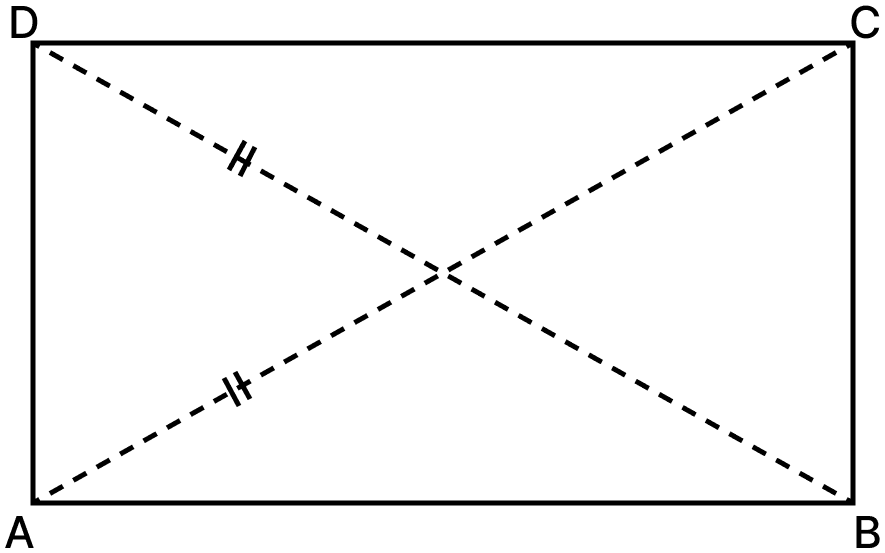
True.
Given: ABCD is a parallelogram with AC = BD.
To prove: ABCD is a rectangle.
Proof:
In ∆ABC and ∆BAD:
AB = BA [Common side]
BC = AD [Opposite sides of a parallelogram are equal]
AC = BD [Given]
∆ABC ≅ ∆BAD [By SSS condition of congruence]
∴ ∠ABC = ∠BAD [Corresponding parts of congruent triangles] ...(1)
AD ‖ BC and AB is a transversal.
∠BAD + ∠ABC = 180° [Interior angles on the same side of the transversal] ...(2)
From (1) and (2),
2∠BAD = 180°
⇒ ∠BAD = 90°
A parallelogram with a right angle is a rectangle [From Question 1(i)]
Hence, the statement is true: a parallelogram with equal diagonals is a rectangle.
The diagonal AC of a parallelogram ABCD bisects ∠A. Show that it also bisects ∠C and that ABCD is a rhombus.
Answer
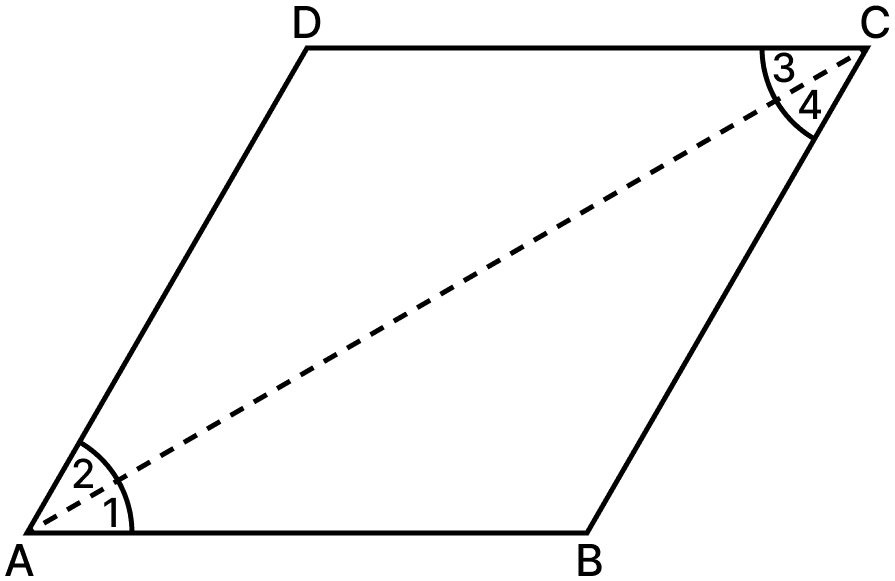
Given: ABCD is a parallelogram and AC bisects ∠A, i.e. ∠1 = ∠2, where ∠1 = ∠CAB and ∠2 = ∠CAD.
To prove: AC bisects ∠C, i.e. ∠3 = ∠4, where ∠3 = ∠ACD and ∠4 = ∠ACB; and ABCD is a rhombus.
Proof:
AB ‖ DC and AC is a transversal.
∠1 = ∠3 [Alternate angles] ...(1)
AD ‖ BC and AC is a transversal.
∠2 = ∠4 [Alternate angles] ...(2)
∠1 = ∠2 [Given] ...(3)
From (1), (2) and (3),
∠3 = ∠4
So AC bisects ∠C.
In ∆ACD,
∠2 = ∠1 = ∠3 [From (3) and (1)]
So ∠CAD = ∠ACD.
⇒ CD = AD [Sides opposite equal angles of a triangle are equal]
AB = CD and BC = AD [Opposite sides of a parallelogram are equal]
∴ AB = BC = CD = DA
All four sides are equal, so ABCD is a rhombus.
Hence proved.
The following questions examine converses of true properties. Answer them with Yes or No. If your answer is No, what extra condition can you add so that the answer becomes Yes?
If the diagonals of a quadrilateral ABCD bisect its angles, must ABCD be a rhombus?
Answer
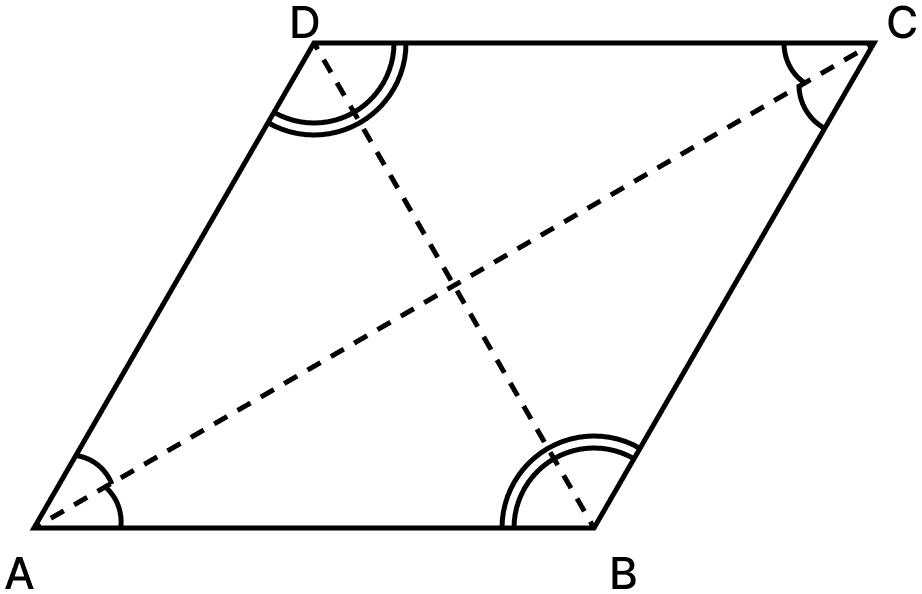
Yes.
Given: In quadrilateral ABCD, the diagonal AC bisects ∠A and ∠C, and the diagonal BD bisects ∠B and ∠D.
To prove: ABCD is a rhombus.
Proof:
In ∆ABC and ∆ADC:
∠BAC = ∠DAC [AC bisects ∠A]
AC = AC [Common side]
∠BCA = ∠DCA [AC bisects ∠C]
∆ABC ≅ ∆ADC [By ASA condition of congruence]
∴ AB = AD and CB = CD [Corresponding parts of congruent triangles] ...(1)
In ∆BAD and ∆BCD:
∠ABD = ∠CBD [BD bisects ∠B]
BD = BD [Common side]
∠ADB = ∠CDB [BD bisects ∠D]
∆BAD ≅ ∆BCD [By ASA condition of congruence]
∴ AB = CB and AD = CD [Corresponding parts of congruent triangles] ...(2)
From (1) and (2),
AB = BC = CD = DA
Hence, ABCD must be a rhombus.
The following questions examine converses of true properties. Answer them with Yes or No. If your answer is No, what extra condition can you add so that the answer becomes Yes?
If the diagonals of a quadrilateral ABCD bisect each other at right angles, must ABCD be a rhombus?
Answer
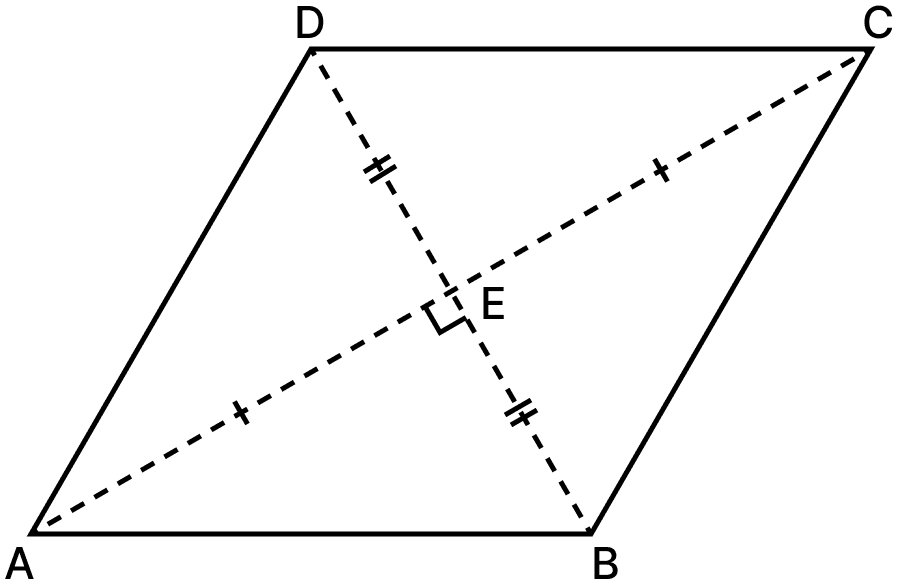
Yes.
Given: The diagonals AC and BD of quadrilateral ABCD bisect each other at E, and AC ⊥ BD.
To prove: ABCD is a rhombus.
Proof:
EA = EC and EB = ED [Given]
So ABCD is a parallelogram [Theorem 4: a quadrilateral whose diagonals bisect each other is a parallelogram]
In ∆AEB and ∆AED:
AE = AE [Common side]
∠AEB = ∠AED = 90° [Given, AC ⊥ BD]
EB = ED [Given]
∆AEB ≅ ∆AED [By SAS condition of congruence]
∴ AB = AD [Corresponding parts of congruent triangles]
AB = CD and AD = BC [Opposite sides of a parallelogram are equal]
∴ AB = BC = CD = DA
Hence, ABCD must be a rhombus.
The following questions examine converses of true properties. Answer them with Yes or No. If your answer is No, what extra condition can you add so that the answer becomes Yes?
If the diagonals of a quadrilateral ABCD are of equal length, must ABCD be a rectangle? (In the ancient Indian study of quadrilaterals, equality of diagonals was considered significant. Quadrilaterals were first classified according to whether their diagonals were equal or not, before considering equality of sides.)
Answer
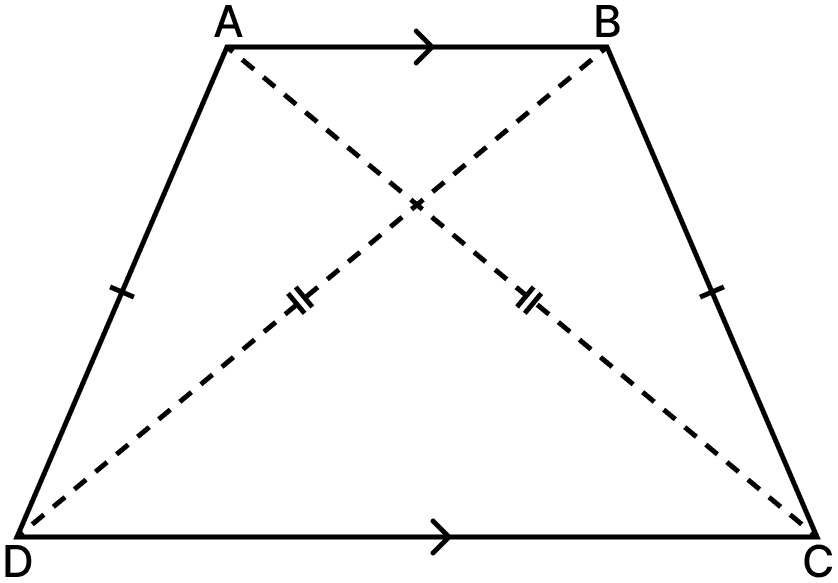
No.
Counterexample: Take A = (-1, 2), B = (1, 2), C = (3, 0) and D = (-3, 0), with lengths in cm.
Let A = (x1, y1) = (-1, 2), C = (x2, y2) = (3, 0)
AC =
=
=
= cm
Let B = (p1, q1) = (1, 2), D = (p2, q2) = (-3, 0)
BD =
=
=
= cm
So AC = BD. But AB = 1 - (-1) = 2 cm and DC = 3 - (-3) = 6 cm, so AB ≠ DC. The opposite sides are not equal, so ABCD is not a parallelogram and hence not a rectangle. (ABCD is an isosceles trapezium.)
Extra condition: the diagonals also bisect each other (that is, ABCD is a parallelogram).
If the diagonals bisect each other, ABCD is a parallelogram [Theorem 4]
A parallelogram with equal diagonals is a rectangle [Question 1(iii)]
Hence, the answer is No; if we add the condition that the diagonals bisect each other (equal diagonals that bisect each other), then ABCD must be a rectangle.
Let ABCD be a parallelogram with AB ≠ BC. Show that the pairwise intersection points of the four angle bisectors form the vertices of a rectangle (see Fig. 12.11). Why did we assume AB ≠ BC?
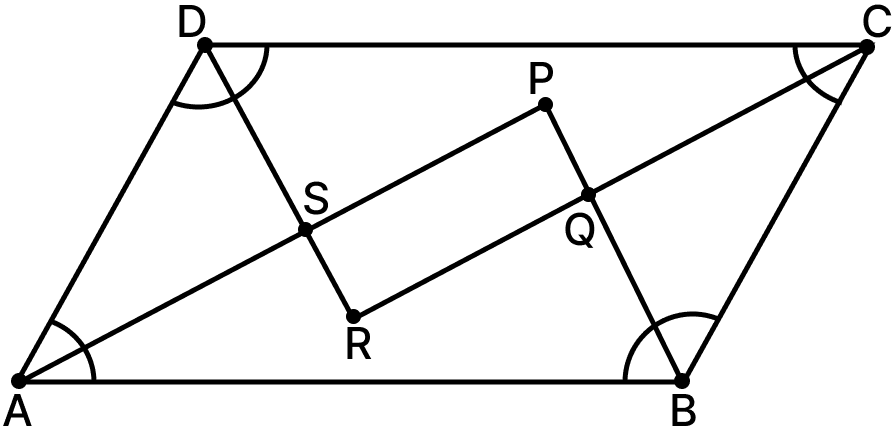
Answer
In the above figure, the bisectors of ∠A and ∠D meet at S, the bisectors of ∠A and ∠B meet at P, the bisectors of ∠B and ∠C meet at Q, and the bisectors of ∠C and ∠D meet at R.
Given: ABCD is a parallelogram with AB ≠ BC; P, Q, R, S are the intersection points of the angle bisectors as above.
To prove: PQRS is a rectangle.
Proof:
AB ‖ DC and AD is a transversal.
∠A + ∠D = 180° [Interior angles on the same side of the transversal]
⇒ ∠A + ∠D = 90°
In ∆ASD,
∠SAD + ∠SDA + ∠ASD = 180° [Angle sum of a triangle]
⇒ ∠A + ∠D + ∠ASD = 180° [AS and DS are angle bisectors]
⇒ 90° + ∠ASD = 180°
⇒ ∠ASD =
⇒ ∠ASD = 90°
∠PSR = ∠ASD = 90° [Vertically opposite angles]
In the same way:
In ∆APB, ∠A + ∠B = 90° [∠A + ∠B = 180°]
⇒ ∠APB = 180° - 90° = 90°, i.e. ∠SPQ = 90°.
In ∆BQC, ∠B + ∠C = 90° [∠B + ∠C = 180°]
⇒ ∠BQC = 90°, so ∠PQR = ∠BQC = 90° [Vertically opposite angles]
In ∆CRD, ∠C + ∠D = 90° [∠C + ∠D = 180°]
⇒ ∠CRD = 90°, i.e. ∠QRS = 90°.
All four angles of PQRS are 90°. Its opposite angles are equal, so PQRS is a parallelogram [Theorem 3]
A parallelogram with a right angle is a rectangle.
Hence, PQRS is a rectangle.
Why AB ≠ BC: If AB = BC, then ABCD is a rhombus. In a rhombus each diagonal bisects the angles at its ends, so the bisectors of ∠A and ∠C both lie along AC, and the bisectors of ∠B and ∠D both lie along BD. Then all four bisectors pass through the single point where the diagonals meet, so P, Q, R and S all coincide and no rectangle is formed.
Hence proved.
On a piece of paper, draw and then cut out two copies of the same triangle. Keep one copy aside. On the other, mark the midpoint of each side. (You can do this by folding the paper to join two vertices at a time.) Draw the triangle made by the three midpoints and cut the paper along each of these lines. Now you have four smaller triangles. Compare them to each other and to the intact copy of the original triangle. What do you notice?
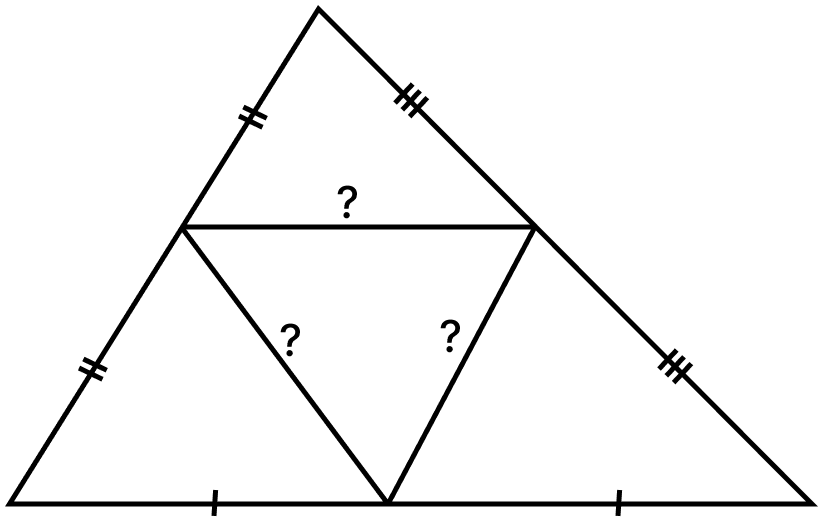
It appears that all four smaller triangles are congruent to each other! And each seems to be a smaller copy of the original triangle.
Try to prove directly that the four smaller triangles are congruent. You will see that no congruence test applies, because many quantities are unknown.
Answer
Let P, Q and R be the midpoints of the sides AB, AC and BC of ∆ABC. The four smaller triangles are ∆APQ, ∆PBR, ∆QRC and the middle triangle ∆PQR.
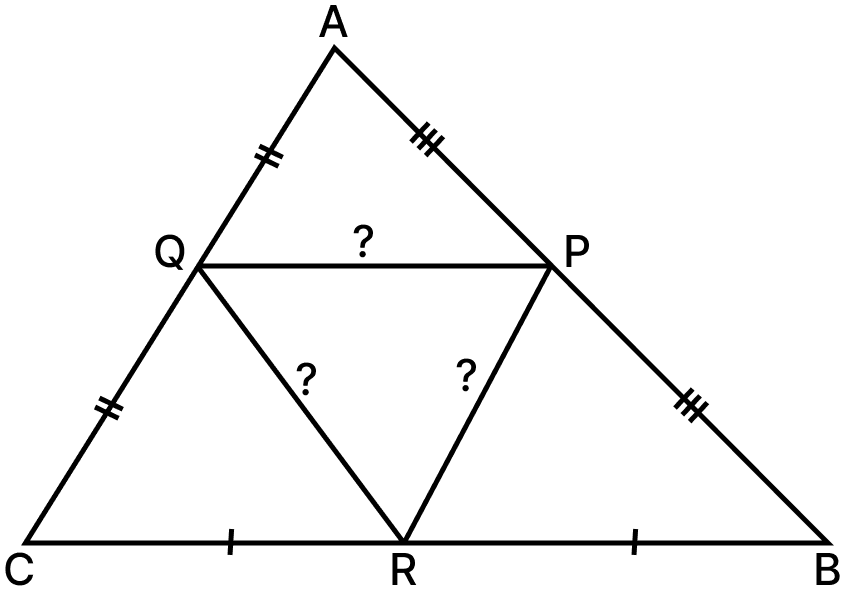
What we know from the midpoints:
AP = PB = AB, AQ = QC = AC, BR = RC = BC
Try ∆APQ and ∆PBR:
AP = PB — one pair of equal sides;
the other sides AQ and BR are halves of AC and BC, which are different in general;
the angles ∠A and ∠B are different in general;
the sides PQ and PR are new segments whose lengths we do not know.
So we have only one pair of equal parts. Each congruence test (SSS, SAS, ASA, AAS, RHS) needs three pairs of equal parts, so none applies.
For the middle triangle ∆PQR it is even worse: none of its sides PQ, QR, RP and none of its angles is known in terms of ∆ABC.
The missing information is the length of the three new segments PQ, QR and RP. Once we show that each of them is half of the side of ∆ABC parallel to it (the Midpoint Theorem), the SSS test proves that all four triangles are congruent (Exercise Set 12.3, Q1).
Read the statement of the Midpoint Theorem again. The following questions seem natural to ask. What can we say about (1) a segment PQ (with P on side AB and Q on side AC) that is parallel to the third side and has half the length, and (2) the line that passes through the midpoint of one side and is parallel to another side? We will address question (1) in Exercise 22 at the end of the chapter. For now, experiment and see if you can make a guess about question (2).
Answer
Theorem 6 (Midpoint Theorem): The segment joining the midpoints of two sides of a triangle is parallel to the third side and has half the length.
A sample set of results is used below to show the method.
Steps of the experiment:
(i) Draw any ∆ABC and mark the midpoint P of AB.
(ii) Using a ruler and a set square, draw the line through P parallel to BC. Let it meet AC at Q.
(iii) Measure AQ, QC, PQ and BC.
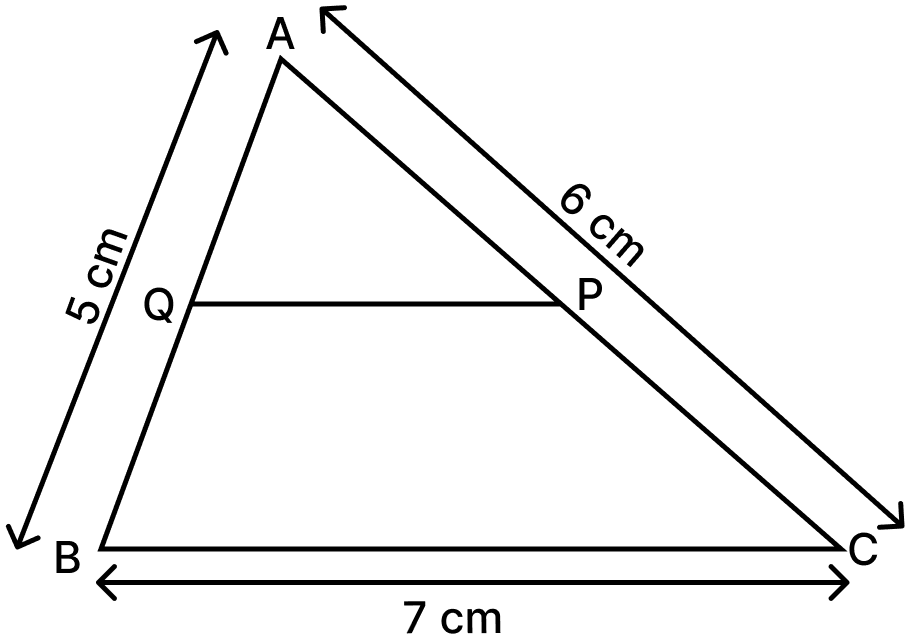
Sample measurements: AB = 6 cm, BC = 7 cm, AC = 5 cm, so AP = = 3 cm.
AQ = 2.5 cm, QC = 2.5 cm, PQ = 3.5 cm.
So AQ = QC, and PQ = = 3.5 cm = BC.
Repeating the experiment with triangles of other shapes gives the same result every time.
Guess: The line through the midpoint of one side of a triangle, drawn parallel to a second side, bisects the third side (and the part of it inside the triangle is half the length of the parallel side).
This guess is proved in the chapter as Theorem 7 (Converse of the Midpoint Theorem).
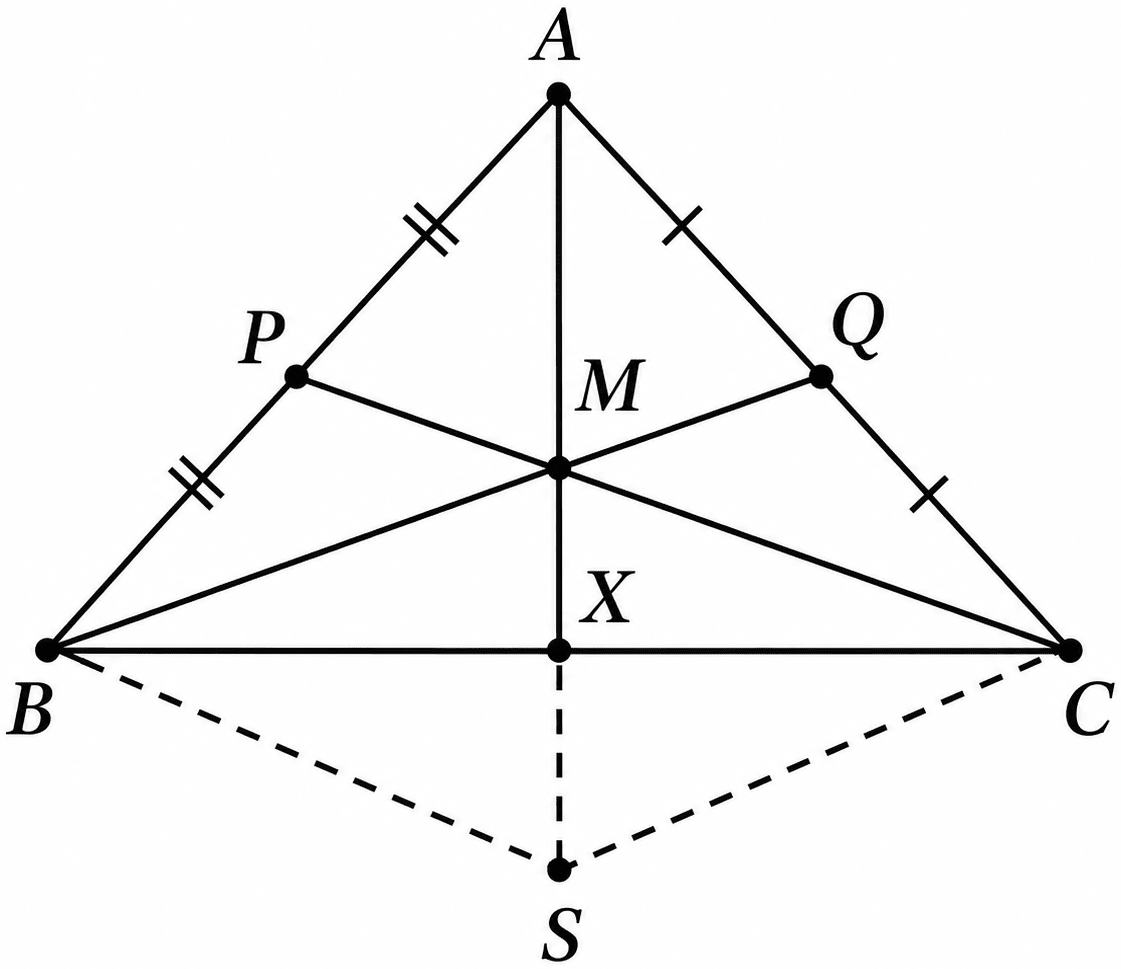
Give another proof of the Centroid Theorem using a clever construction that we will describe only partly and ask you to complete. Once again let M be the intersection point of the two medians CP and BQ. We want to show that the intersection point of line AM with side BC is the midpoint of BC. For this, extend AM up to a carefully chosen point S such that BSCM becomes a parallelogram. (Hint: To arrange MC ‖ BS, first note that PM and MC are along the same line. Now where should M be on segment AS? Does your placement of S also prove MB ‖ CS?)
Answer
Theorem 8: (Centroid Theorem) The three medians of ∆ABC pass through a common point, which divides each of the medians in the ratio 2 : 1, with the longer part connecting to the vertex. This point is called the centroid of ∆ABC.
Choice of S: extend AM beyond M to the point S such that MS = AM, i.e. M is the midpoint of AS.
Given: In ∆ABC, P and Q are the midpoints of AB and AC. The medians CP and BQ meet at M. AM is extended to S with MS = AM, and AS meets BC at X.
To prove: X is the midpoint of BC, and M divides each median in the ratio 2 : 1.
Proof:
In ∆ABS, P is the midpoint of AB and M is the midpoint of AS.
∴ PM ‖ BS and PM = BS [Midpoint Theorem] ...(1)
P, M and C lie on one line (the median CP), so MC ‖ BS.
In ∆ACS, Q is the midpoint of AC and M is the midpoint of AS.
∴ QM ‖ CS and QM = CS [Midpoint Theorem] ...(2)
Q, M and B lie on one line (the median BQ), so MB ‖ CS.
So this placement of S also gives MB ‖ CS.
In BSCM, MC ‖ BS and MB ‖ CS, so BSCM is a parallelogram.
The diagonals BC and MS of the parallelogram BSCM bisect each other [Theorem 1(c)]
∴ BX = XC and MX = XS = MS
So X is the midpoint of BC, and AX is the third median. It passes through M, so the three medians pass through the common point M.
The ratios:
MX = MS = AM [MS = AM]
⇒ AM = 2MX, i.e. AM : MX = 2 : 1.
BS = MC [Opposite sides of parallelogram BSCM]
From (1), PM = BS = MC
⇒ CM = 2MP, i.e. CM : MP = 2 : 1.
CS = MB [Opposite sides of parallelogram BSCM]
From (2), QM = CS = MB
⇒ BM = 2MQ, i.e. BM : MQ = 2 : 1.
Hence, the three medians meet at M, which divides each median in the ratio 2 : 1 with the longer part towards the vertex.
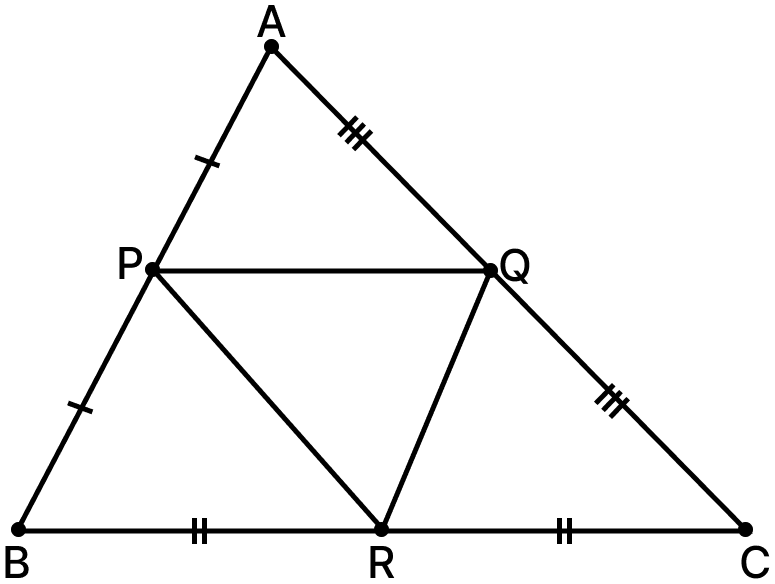
(i) If P, Q, R are the midpoints of sides AB, AC, BC respectively of ∆ABC, show that ∆PQR is congruent to ∆QPA and to two other triangles which you should identify.
(ii) Suppose someone erases ∆ABC, leaving only ∆PQR on the paper. Can you reconstruct ∆ABC from ∆PQR?
Answer
(i) Using the Midpoint Theorem in ∆ABC:
P and Q are the midpoints of AB and AC.
∴ PQ ‖ BC and PQ = BC = BR = RC [Midpoint Theorem]
Q and R are the midpoints of AC and BC.
∴ QR ‖ AB and QR = AB = AP = PB [Midpoint Theorem]
P and R are the midpoints of AB and BC.
∴ PR ‖ AC and PR = AC = AQ = QC [Midpoint Theorem]
In ∆PQR and ∆QPA:
PQ = QP [Common side]
QR = PA [Both equal AB]
RP = AQ [Both equal AC]
∆PQR ≅ ∆QPA [By SSS condition of congruence]
In ∆PQR and ∆RBP:
PQ = RB [Both equal BC]
QR = BP [Both equal AB]
RP = PR [Common side]
∆PQR ≅ ∆RBP [By SSS condition of congruence]
In ∆PQR and ∆CRQ:
PQ = CR [Both equal BC]
QR = RQ [Common side]
RP = QC [Both equal AC]
∆PQR ≅ ∆CRQ [By SSS condition of congruence]
Hence, ∆PQR ≅ ∆QPA, ∆PQR ≅ ∆RBP and ∆PQR ≅ ∆CRQ; the four triangles are congruent.
(ii) Yes.
From (i), each side of ∆ABC passes through a vertex of ∆PQR and is parallel to the opposite side of ∆PQR:
AB passes through P and AB ‖ QR;
AC passes through Q and AC ‖ PR;
BC passes through R and BC ‖ PQ.
Steps of construction:
Step 1: Through P, draw the line parallel to QR.
Step 2: Through Q, draw the line parallel to PR.
Step 3: Through R, draw the line parallel to PQ.
Step 4: The three lines meet in pairs at A, B and C.
There is only one line through a given point parallel to a given line, so each of these lines is exactly the line containing a side of ∆ABC, and their intersection points are exactly A, B and C.
Hence, ∆ABC can be reconstructed by drawing, through each vertex of ∆PQR, the line parallel to the opposite side.
In ∆ABC, let M and N be midpoints of AB and AC respectively. Let D be any point on BC. Show that MN bisects AD.
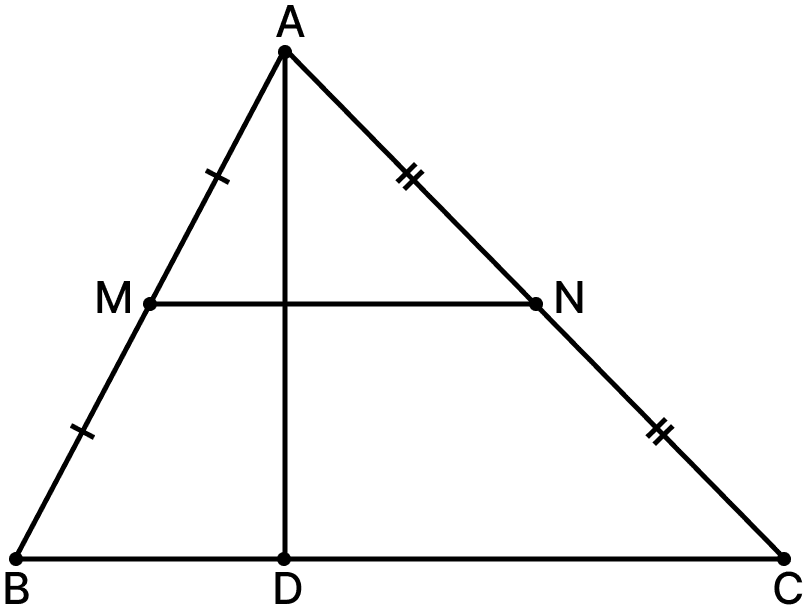
Answer
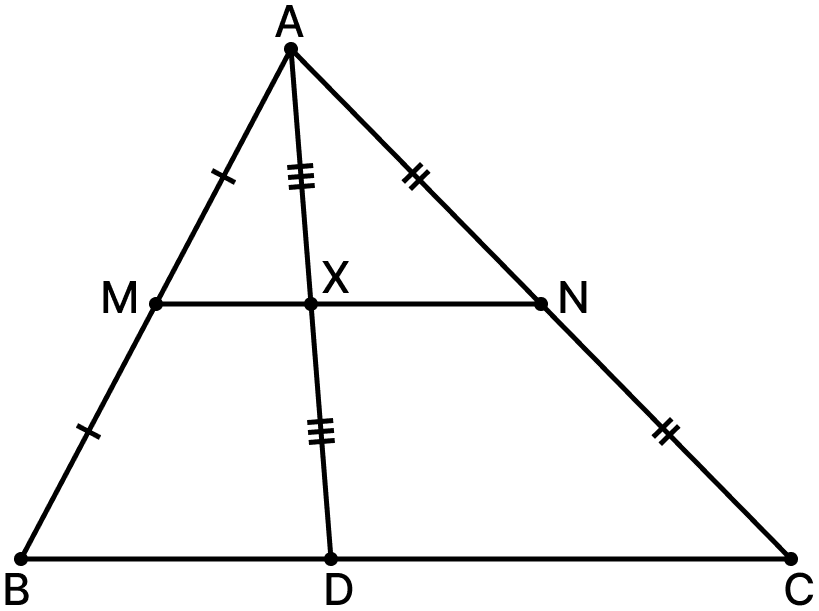
Let MN meet AD at X. We show that X is the midpoint of AD.
Given: In ∆ABC, M and N are the midpoints of AB and AC; D is a point on BC; MN meets AD at X.
To prove: AX = XD.
Proof:
M and N are the midpoints of AB and AC.
∴ MN ‖ BC [Midpoint Theorem]
D lies on BC and X lies on MN, so MX ‖ BD.
In ∆ABD, M is the midpoint of AB and the line MX through M is parallel to BD.
∴ X is the midpoint of AD [Theorem 7: Converse of the Midpoint Theorem]
⇒ AX = XD
Hence, MN bisects AD.
In a quadrilateral ABCD, suppose AB ‖ DC and AB ≠ CD. Suppose G and H are the midpoints of AC and BD respectively. Prove that GH ‖ AB. (Why did we assume AB ≠ CD?)
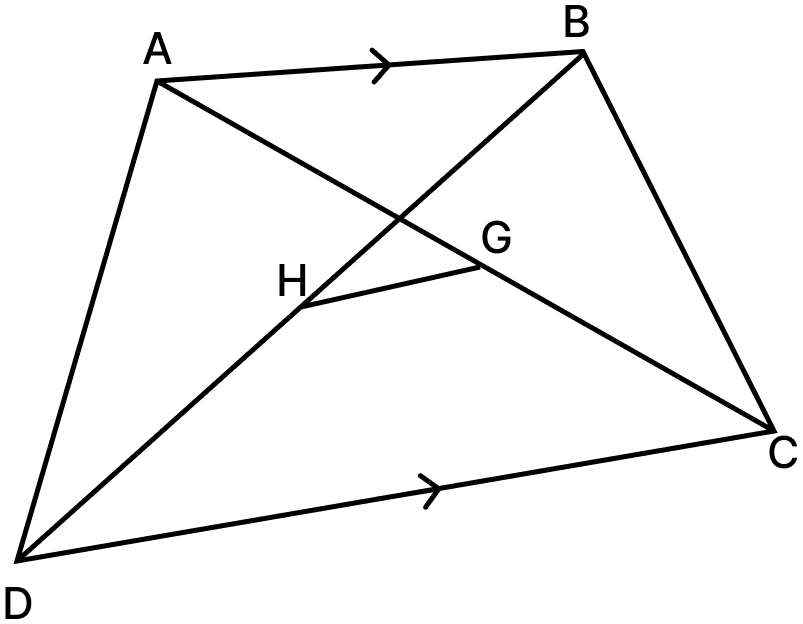
Answer
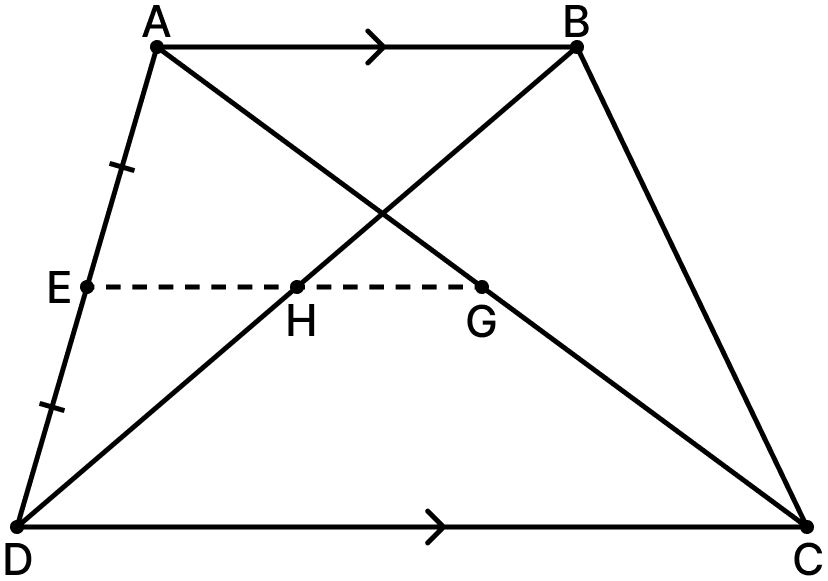
Let E be the midpoint of AD. Join EG and EH.
Given: ABCD is a quadrilateral with AB ‖ DC and AB ≠ CD; G and H are the midpoints of AC and BD.
To prove: GH ‖ AB.
Construction: Mark the midpoint E of AD; join EG and EH.
Proof:
In ∆ADC, E is the midpoint of AD and G is the midpoint of AC.
∴ EG ‖ DC and EG = DC [Midpoint Theorem] ...(1)
In ∆DAB, E is the midpoint of DA and H is the midpoint of DB.
∴ EH ‖ AB and EH = AB [Midpoint Theorem] ...(2)
AB ‖ DC [Given]
So EG and EH are both parallel to AB, and both pass through E.
There is only one line through E parallel to AB, so E, H and G lie on this line.
∴ GH lies along the line through E parallel to AB, i.e. GH ‖ AB.
Hence proved.
Why AB ≠ CD: If AB = CD, then AB is equal and parallel to CD, so ABCD is a parallelogram (Theorem 5). Its diagonals bisect each other, so the midpoints G and H of AC and BD are the same point, and there is no segment GH. With AB ≠ CD, (1) and (2) give EG = DC ≠ AB = EH, so G and H are different points.
Suppose the midpoints of sides AB, BC, CD and DA of a quadrilateral ABCD are P, Q, R and S respectively.
(i) Show that PR and QS bisect each other.
(ii) Show that if AC = BD, then PR and QS are perpendicular. Is the converse true?
Answer
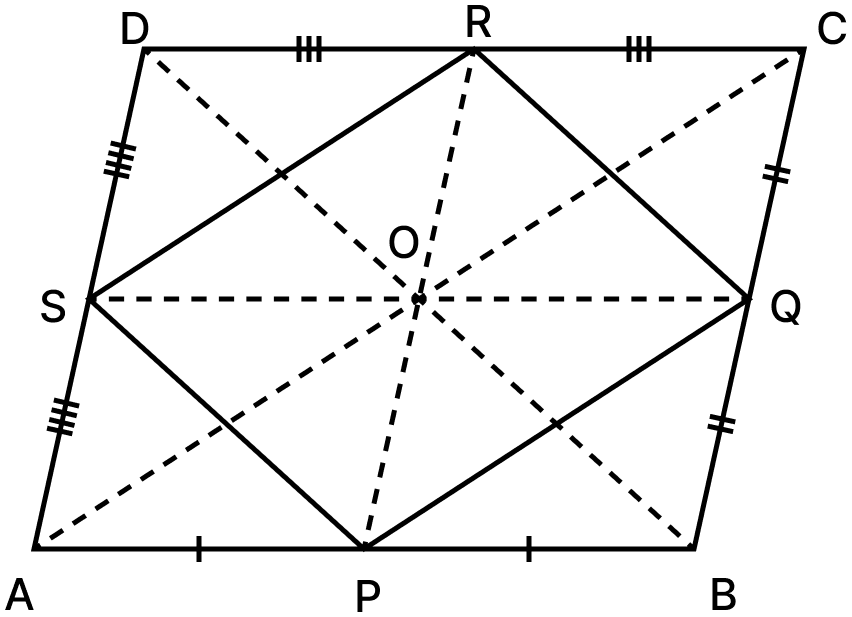
(i) PQRS is a parallelogram [Theorem 9: Midpoint Theorem for Quadrilaterals]
PR and QS are the diagonals of the parallelogram PQRS.
The diagonals of a parallelogram bisect each other [Theorem 1(c)]
Hence, PR and QS bisect each other.
(ii) In ∆ABC, P and Q are the midpoints of AB and BC.
∴ PQ = AC [Midpoint Theorem] ...(1)
In ∆BCD, Q and R are the midpoints of BC and CD.
∴ QR = BD [Midpoint Theorem] ...(2)
AC = BD [Given]
From (1) and (2), PQ = QR.
So PQRS is a parallelogram with two adjacent sides equal, i.e. a rhombus.
The diagonals of a rhombus are perpendicular, so PR ⊥ QS.
Hence, if AC = BD, then PR and QS are perpendicular.
Converse: If PR ⊥ QS, then AC = BD. This is true.
PR and QS bisect each other [Part (i)]
So the diagonals of PQRS bisect each other at right angles, and PQRS is a rhombus [Exercise Set 12.2, Q3(ii)]
∴ PQ = QR
⇒ AC = BD [From (1) and (2)]
⇒ AC = BD
Hence, the converse is true: PR ⊥ QS if and only if AC = BD.
Suppose PQRS is the Varignon parallelogram of ABCD.
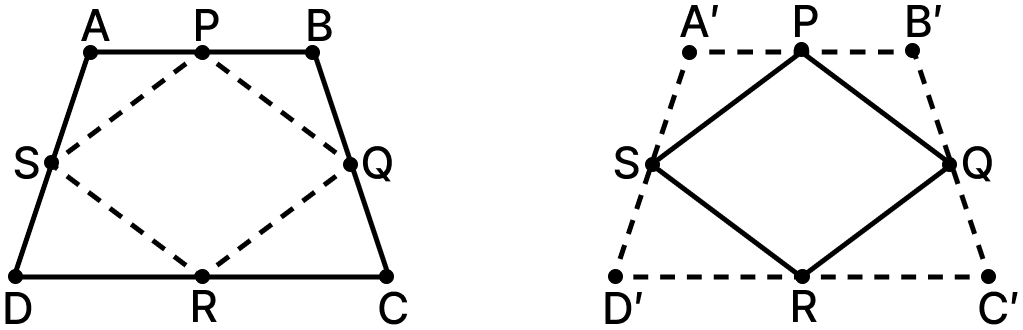
(i) Copy only PQRS on another paper. Show how you will recreate a congruent copy AʹBʹCʹDʹ of ABCD from PQRS. This will be relevant when we return to study tilings at the end of this chapter. (Hint: How will you place vertex Aʹ? How will you place Bʹ, Cʹ and Dʹ?)
(ii) There are multiple ways to construct AʹBʹCʹDʹ in (i). Justify why the quadrilateral AʹBʹCʹDʹ you constructed is congruent to ABCD. You may need to show why S is collinear with the points Aʹ and Dʹ that you constructed, and similarly for P, Q and R. (Hint: Use congruence of triangles, for example ∆SDR ≅ ∆SDʹR. )
(iii) Show that if PQRS is a square, then AC and BD are perpendicular and equal. Prove the converse.
Answer
(i) P, Q, R, S are the midpoints of AB, BC, CD, DA. So each vertex of ABCD is obtained from the previous one by going through a midpoint and the same distance beyond it.
Steps of construction:
Step 1: Placing Aʹ: measure AP and AS on the original figure. With centre P and radius AP, and with centre S and radius AS, draw two arcs on the side of PS away from Q and R. Their intersection is Aʹ. Then ∆AʹPS is a copy of ∆APS.
Step 2: Placing Bʹ: join AʹP and produce it beyond P to Bʹ so that PBʹ = AʹP.
Step 3: Placing Cʹ: join BʹQ and produce it beyond Q to Cʹ so that QCʹ = BʹQ.
Step 4: Placing Dʹ: join CʹR and produce it beyond R to Dʹ so that RDʹ = CʹR.
Step 5: Join DʹAʹ. It passes through S, and S is its midpoint (proved in (ii)).
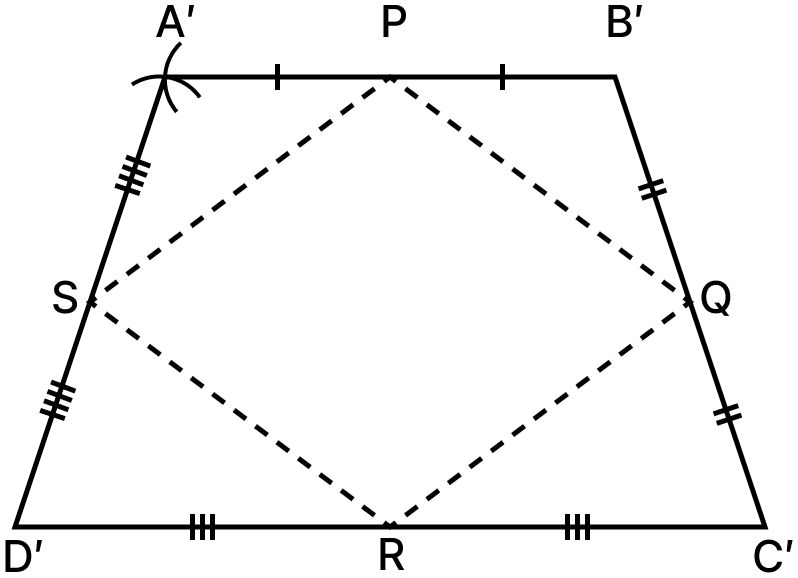
AʹBʹCʹDʹ is the required copy of ABCD.
(ii) We compare the triangles at the corners of PQRS in the two figures.
In ∆APS and ∆AʹPS:
AP = AʹP and AS = AʹS [By construction]
PS = PS [Common side]
∆APS ≅ ∆AʹPS [By SSS condition of congruence]
∴ ∠APS = ∠AʹPS and ∠ASP = ∠AʹSP ...(1)
In ∆BPQ and ∆BʹPQ:
PB = PA = PAʹ = PBʹ [P is the midpoint of AB; by construction]
PQ = PQ [Common side]
∠BPQ = 180° - ∠APS - ∠SPQ [A, P, B are collinear]
∠BʹPQ = 180° - ∠AʹPS - ∠SPQ [Aʹ, P, Bʹ are collinear]
So ∠BPQ = ∠BʹPQ [From (1)]
∆BPQ ≅ ∆BʹPQ [By SAS condition of congruence]
∴ BQ = BʹQ and ∠PQB = ∠PQBʹ ...(2)
In ∆CQR and ∆CʹQR, in the same way:
QC = QB = QBʹ = QCʹ, QR = QR, and ∠CQR = 180° - ∠BQP - ∠PQR = ∠CʹQR [From (2)]
∆CQR ≅ ∆CʹQR [By SAS condition of congruence]
∴ ∠QRC = ∠QRCʹ ...(3)
In ∆SDR and ∆SDʹR:
RD = RC = RCʹ = RDʹ
SR = SR [Common side]
∠DRS = 180° - ∠CRQ - ∠QRS = ∠DʹRS [From (3)]
∆SDR ≅ ∆SDʹR [By SAS condition of congruence]
∴ SD = SDʹ and ∠RSD = ∠RSDʹ ...(4)
S is collinear with Aʹ and Dʹ:
∠AʹSP + ∠PSR + ∠RSDʹ = ∠ASP + ∠PSR + ∠RSD [From (1) and (4)]
= 180° [A, S, D are collinear]
So Aʹ, S and Dʹ lie on one line. Also SAʹ = SA = SD = SDʹ, so S is the midpoint of AʹDʹ.
Congruence of AʹBʹCʹDʹ and ABCD:
AʹBʹ = 2AʹP = 2AP = AB; BʹCʹ = 2BʹQ = 2BQ = BC; CʹDʹ = 2CʹR = 2CR = CD; DʹAʹ = 2SAʹ = 2SA = DA.
From the congruent triangles, ∠Aʹ = ∠A, ∠Bʹ = ∠B, ∠Cʹ = ∠C and ∠Dʹ = ∠D.
So all sides and all angles of AʹBʹCʹDʹ are equal to the corresponding sides and angles of ABCD, and AʹBʹCʹDʹ fits exactly on ABCD.
Hence, AʹBʹCʹDʹ ≅ ABCD.
(iii) From the Midpoint Theorem in ∆ABC, ∆BCD, ∆CDA and ∆DAB:
PQ ‖ AC and PQ = AC ...(5)
QR ‖ BD and QR = BD ...(6)
If PQRS is a square:
PQ = QR [Sides of a square]
⇒ AC = BD [From (5) and (6)]
⇒ AC = BD
PQ ⊥ QR [Angle of a square]
AC ‖ PQ and BD ‖ QR, so AC ⊥ BD.
Hence, if PQRS is a square, then AC and BD are perpendicular and equal.
Converse: if AC ⊥ BD and AC = BD, then PQRS is a square.
PQ = AC = BD = QR [From (5) and (6)]
PQ ‖ AC, QR ‖ BD and AC ⊥ BD, so PQ ⊥ QR, i.e. ∠PQR = 90°.
PQRS is a parallelogram (Theorem 9) with two adjacent sides equal, so it is a rhombus. A rhombus with a right angle has all its angles equal to 90°, so PQRS is a square.
Hence proved.
First, trace SOME on paper with its four angles labelled 1, 2, 3, 4. Remember that they add up to 360°. Cut out 15 identical copies.
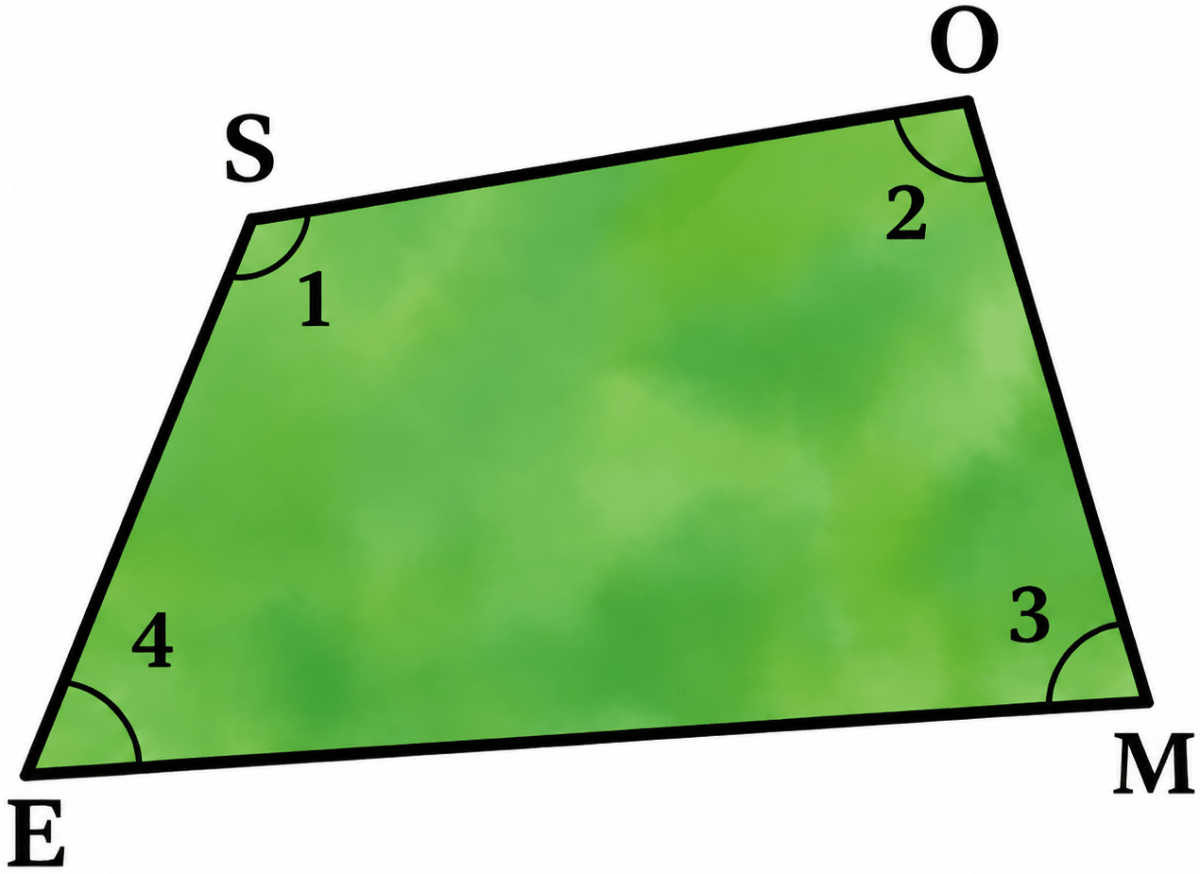
Suppose we have a tiling of the plane. Consider any vertex. As we go around this vertex and consider the angles made by consecutive lines, the total of these angles must be 360°. This suggests an idea. What if we take 4 copies of SOME and fit them together around a common point so that each angle is used once as we go around?
Answer
The four copies fit together exactly around the common point, with no gap and no overlap.
Reason: the angles at the common point are angle 1, angle 2, angle 3 and angle 4 of SOME, one from each copy, and
∠1 + ∠2 + ∠3 + ∠4 = 360° [Angle sum of a quadrilateral]
which is exactly the full angle around a point.
Two copies that are next to each other around the point must share a whole edge, so the edges along which they meet must have the same length. This can be arranged in more than one way (Fig. 12.27 shows three ways).
One convenient way is to get each copy from its neighbour by rotating it through 180° about the midpoint of their common edge. Then the four copies around the point fit edge to edge, and repeating this at every edge gives a tiling of the whole plane by copies of SOME.
Hence, four copies of SOME fit exactly around a point because the four angles of SOME add up to 360°; this is the starting idea for tiling the plane with SOME.
Justify why the plane cannot be tiled with a regular pentagon. (Hint: Read the first 3 sentences of ‘Think and Reflect’ in the section on tiling.) (There are many ways to tile the plane using a suitable irregular pentagon. The most recent method was found in 2015.)
Answer
Angle of a regular pentagon:
The diagonals from one vertex of a pentagon divide it into 3 triangles.
Sum of the angles of a pentagon = 3 × 180° = 540°
A regular pentagon has 5 equal angles.
Each angle of a regular pentagon = = 108°
Condition at a vertex of a tiling: As we go around any vertex of a tiling, the angles that meet there add up to 360°.
Case 1: The vertex is a corner of every pentagon that meets there.
Let k pentagons meet at the vertex.
k × 108° = 360°
⇒ k =
=
=
k must be a whole number, so this is impossible: 3 pentagons give 3 × 10⁸° = 324°, leaving a gap of 360° - 324° = 36°, and 4 pentagons give 4 × 10⁸° = 432° > 360°, so they overlap.
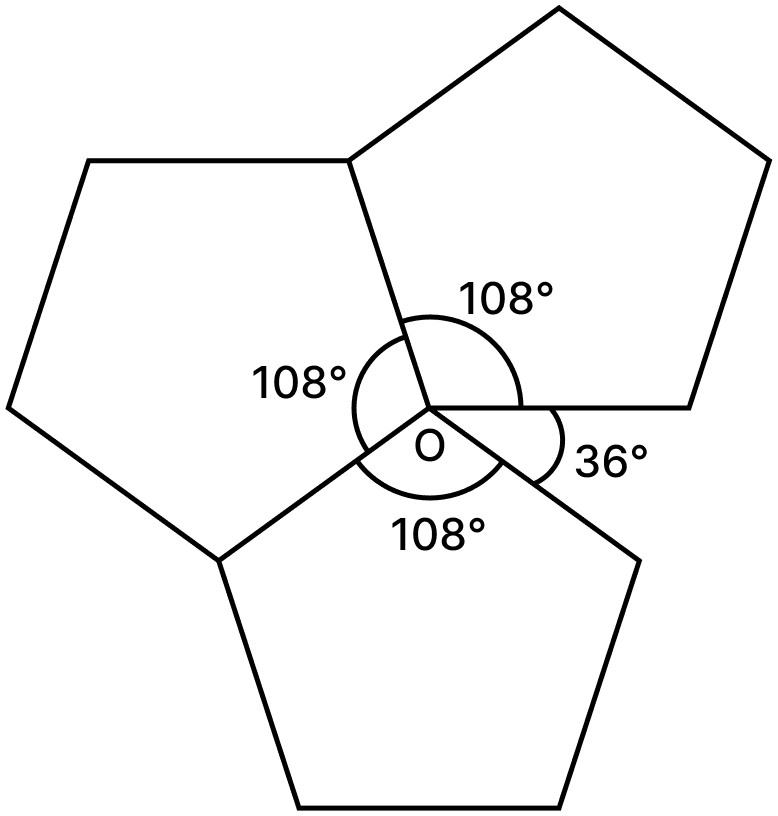
Case 2: the vertex lies on a side of one pentagon.
That pentagon contributes a straight angle, 180°. The remaining angle is 360° - 180° = 180°, which must be made of corners of other pentagons.
k × 108° = 180°
⇒ k =
=
=
Again k is not a whole number: 1 pentagon leaves a gap of 180° - 108° = 72°, and 2 pentagons need 216° > 180°.
(The vertex cannot lie on sides of two pentagons, because that already uses 180° + 180° = 360° and leaves no room for a corner.)
In every case, copies of a regular pentagon cannot fill the 360° around a vertex.
Hence, the plane cannot be tiled with copies of a regular pentagon.
Draw a non-convex 4-gon DART. Show how we can tile the plane with copies of DART. Both methods that we discussed earlier will work. Which do you prefer?
Answer
Let us take DART with D = (2, 2), A = (0, 4), R = (6, 0) and T = (0, 0), with lengths in cm.
D lies inside ∆ART, so the internal angle at D is more than 180°, and DART is non-convex.
Tiling by Method 1 (rotation about midpoints of edges):
Step 1: Draw DART and cut out many copies.
Step 2: Rotate a copy of DART through 180° about the midpoint of the edge DA. The rotated copy fits exactly along DA, with D and A interchanged.
Step 3: Repeat this at every edge of every copy that is placed. Because the four angles of DART add up to 360°, four copies meet at every vertex — one at each of its angles — and they fill the space around it.
Step 4: Rotating twice — about the midpoint of DA and then about the midpoint of the matching edge of the new copy — just shifts the dart. So the tiling is made of shifted copies of DART along its diagonals (shift by DR and by AT) together with shifted copies of the rotated dart.
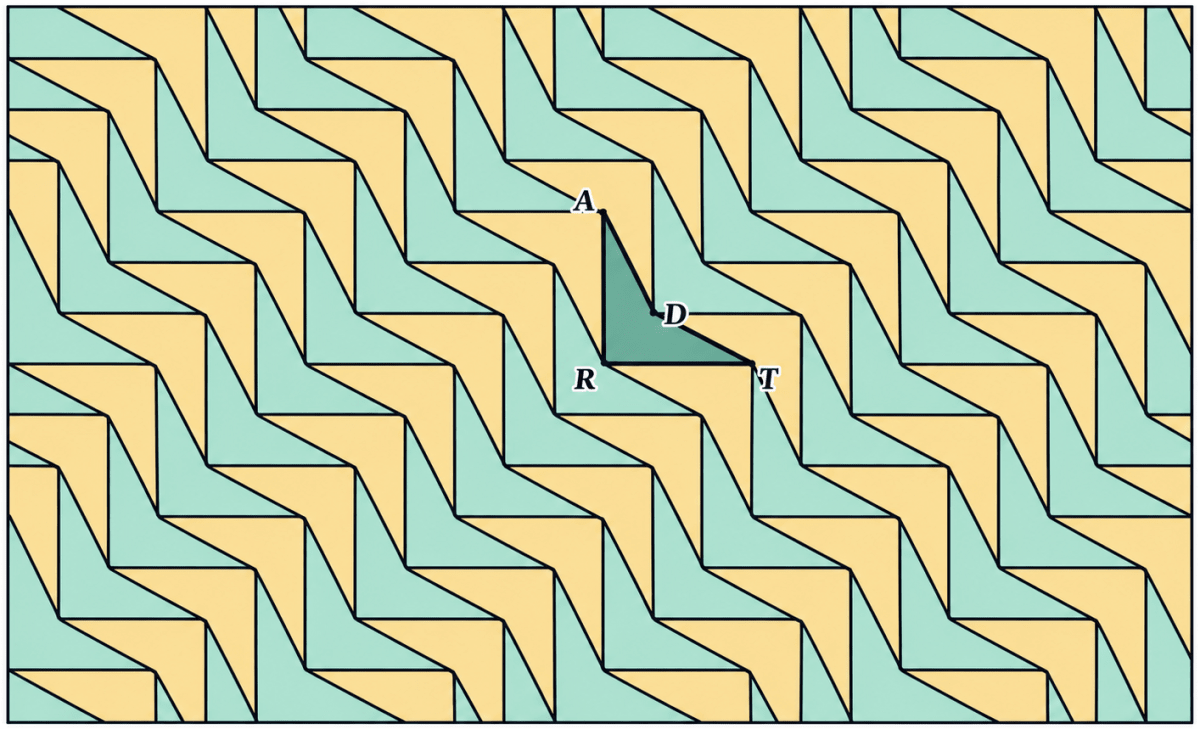
Tiling by Method 2 (Varignon grid):
Step 1: Join the midpoints of the sides of DART to get its Varignon parallelogram (Theorem 9 holds for a non-convex 4-gon too).
Step 2: Tile the plane with a grid of copies of this parallelogram.
Step 3: In a checkerboard pattern of grid cells, place copies of DART (alternately in the original and in the 180°-rotated position) so that each copy has the cell as its Varignon parallelogram. The gaps left between them are again copies of DART.
Which method is preferable: Method 1 is simpler. It needs only one instruction — rotate through 180° about the midpoint of a shared edge — and no extra lines have to be drawn. Method 2 needs the Varignon grid to be drawn first and the copies placed carefully over it.
Hence, the plane can be tiled with copies of the non-convex 4-gon DART, and Method 1 is the easier of the two methods.
Using a fact about parallelograms, show how to tile the plane using any given triangle. (Hint: Can you use the parallelogram tiling in the introduction?)
Answer
Let ABC be the given triangle and let M be the midpoint of BC.
Step 1: Rotate a copy of ∆ABC through 180° about M. B goes to C, C goes to B, and A goes to a point D such that M is the midpoint of AD. The copy is ∆DCB.
Step 2: In quadrilateral ABDC, the diagonals AD and BC bisect each other at M (MA = MD and MB = MC).
∴ ABDC is a parallelogram [Theorem 4: a quadrilateral whose diagonals bisect each other is a parallelogram]
So two copies of the triangle, ∆ABC and ∆DCB, together make the parallelogram ABDC.
Step 3: As in the introduction, the plane can be tiled with copies of any fixed parallelogram — they form a grid of two sets of parallel lines, one set parallel to AB and the other parallel to AC.
Step 4: Draw in every parallelogram of this grid the diagonal parallel to BC. Each parallelogram is cut into two copies of ∆ABC.
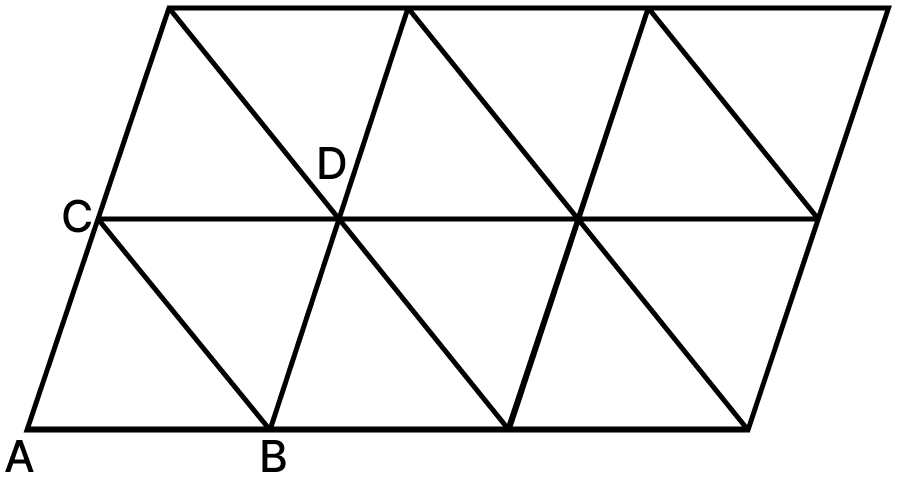
Every triangle in the figure is a copy of ∆ABC (either ∆ABC itself shifted, or its 180°-rotated copy ∆DCB shifted). They cover the plane with no gaps and no overlaps, because the parallelograms do.
Hence, the plane can be tiled with any given triangle: two copies form a parallelogram, and the parallelograms tile the plane.
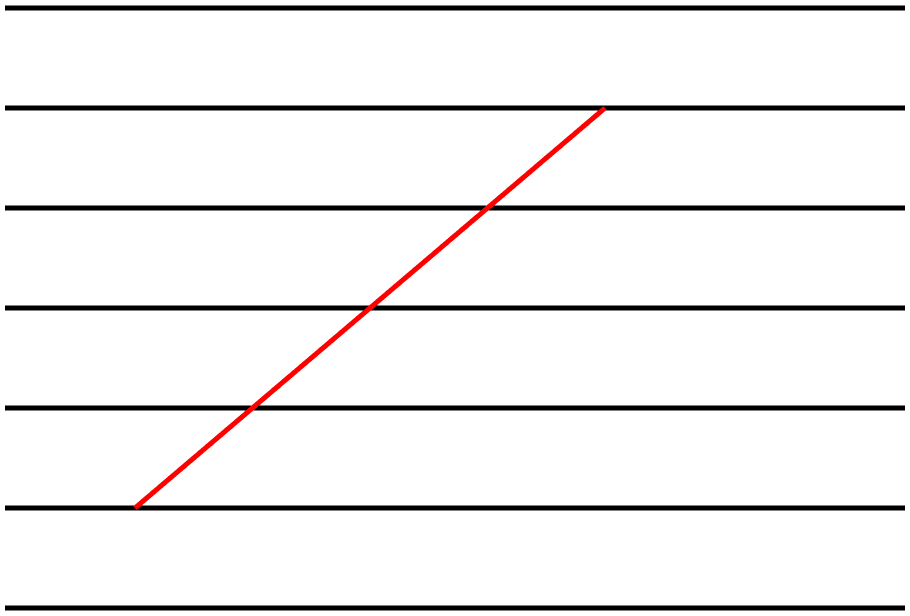
Mark the midpoint of the line drawn on the paper (see Fig. 12.33), given that the horizontal lines are equally spaced. Justify your answer.
Answer
In the figure above, there are seven equally spaced horizontal lines. The drawn line starts on the second line from the bottom and ends on the second line from the top, so it crosses four equal gaps between the lines.
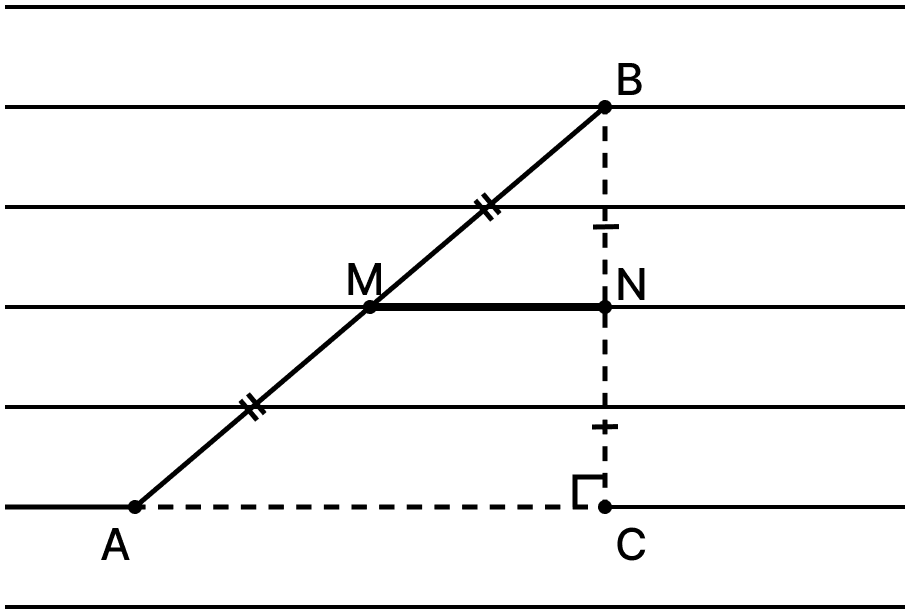
Let A be the lower end and B the upper end of the drawn line. The midpoint M of AB is the point where AB crosses the middle line between them — the fourth line from the top (two gaps above A and two gaps below B).
Justification:
Let C be the foot of the perpendicular from B to the line through A, and let BC meet the middle line at N.
The horizontal lines are equally spaced, so they cut BC into four equal parts.
∴ BN = NC (each is two gaps) and N is the midpoint of BC.
In ∆BCA, N is the midpoint of BC and the middle line through N is parallel to CA (all the lines are parallel).
∴ The middle line bisects the third side BA [Theorem 7: Converse of the Midpoint Theorem]
So the point M where AB crosses the middle line is the midpoint of AB.
Hence, the midpoint of the drawn line is the point where it crosses the fourth horizontal line from the top, the line midway between its two ends.
You know that the sum of angles of a quadrilateral is 360°, even for a non-convex quadrilateral. (Recall the proof.) Now consider a self-intersecting quadrilateral ABCD, where AB and CD intersect at point E. Show that ∠A + ∠B + ∠C + ∠D < 360°. Can you construct ABCD such that ∠A + ∠B + ∠C + ∠D = 2°?
Answer
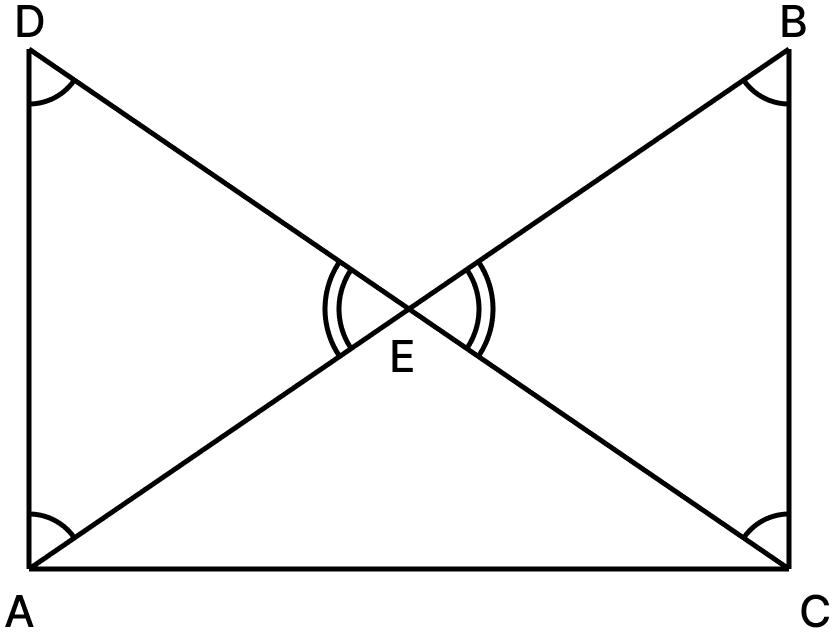
Given: ABCD is a self-intersecting quadrilateral in which AB and CD intersect at E.
To prove: ∠A + ∠B + ∠C + ∠D < 360°.
Proof:
E lies on AB and on CD. So the figure is made of two triangles, ∆AED and ∆BEC, joined at E.
∠A = ∠DAE, ∠D = ∠ADE [E lies on AB and on DC]
∠B = ∠EBC, ∠C = ∠ECB [E lies on BA and on CD]
In ∆AED,
∠DAE + ∠ADE + ∠AED = 180° [Angle sum of a triangle]
⇒ ∠A + ∠D = 180° - ∠AED ...(1)
In ∆BEC,
∠EBC + ∠ECB + ∠BEC = 180° [Angle sum of a triangle]
⇒ ∠B + ∠C = 180° - ∠BEC ...(2)
∠BEC = ∠AED [Vertically opposite angles] ...(3)
Adding (1) and (2) and using (3),
∠A + ∠B + ∠C + ∠D = 360° - 2∠AED ...(4)
∠AED > 0°, so ∠A + ∠B + ∠C + ∠D < 360°.
Hence proved.
Sum equal to 2°: From (4), we need
360° - 2∠AED = 2°
⇒ 2∠AED = 358°
⇒ ∠AED = 179°
So we need the two crossing sides to meet at an angle of 179° (and 1°).
Steps of construction:
Step 1: Draw a line and mark a point E on it. Draw a second line through E making an angle of 1° with the first.
Step 2: On the first line mark A and B on opposite sides of E, with EA = 4 cm and EB = 1 cm.
Step 3: On the second line mark C and D on opposite sides of E, with C on the same side as A (so that ∠AEC = 1°), EC = 4 cm and ED = 1 cm.
Step 4: Join AB, BC, CD and DA.
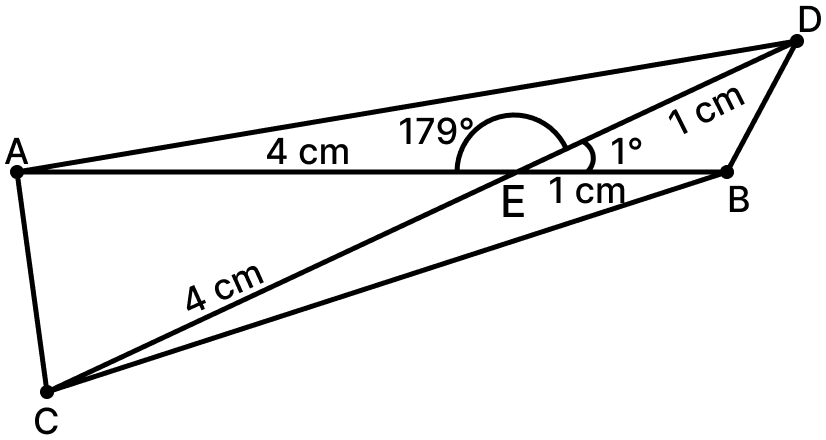
Then AB and CD cross at E with ∠AED = 180° - 1° = 179°, and by (4),
∠A + ∠B + ∠C + ∠D = 360° - 2 × 179°
= 360° - 358°
= 2°
Hence, yes: a self-intersecting ABCD in which AB and CD cross at an angle of 179° has ∠A + ∠B + ∠C + ∠D = 2°.
In a parallelogram ABCD, two points P and Q are taken on diagonal BD such that DP = BQ (see Fig. 12.34). Show that APCQ is a parallelogram.
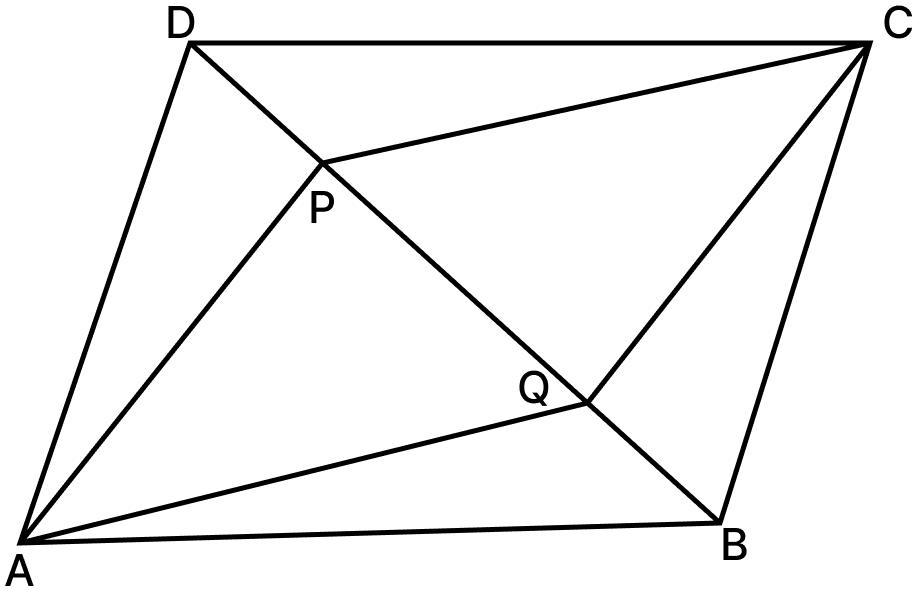
Answer
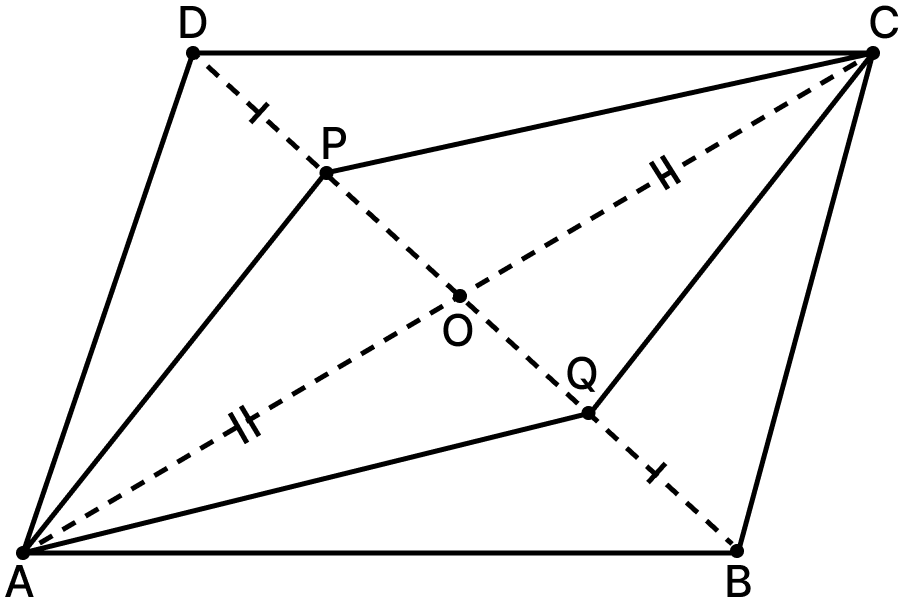
Join AC. Let the diagonals AC and BD of the parallelogram meet at O.
Given: ABCD is a parallelogram; P and Q lie on BD with DP = BQ.
To prove: APCQ is a parallelogram.
Proof:
OA = OC and OB = OD [Diagonals of a parallelogram bisect each other] ...(1)
OP = OD - DP ...(2)
OQ = OB - BQ ...(3)
OD = OB and DP = BQ [From (1) and given]
From (2) and (3), OP = OQ.
In quadrilateral APCQ, the diagonals are AC and PQ. They meet at O, with OA = OC and OP = OQ.
So the diagonals of APCQ bisect each other.
∴ APCQ is a parallelogram [Theorem 4]
Hence proved.
A right-triangle shaped cutout of a paper is folded such that point A touches point B (Fig. 12.35). Show that the crease line can be used to find the midpoint of not only AB but also that of AC.
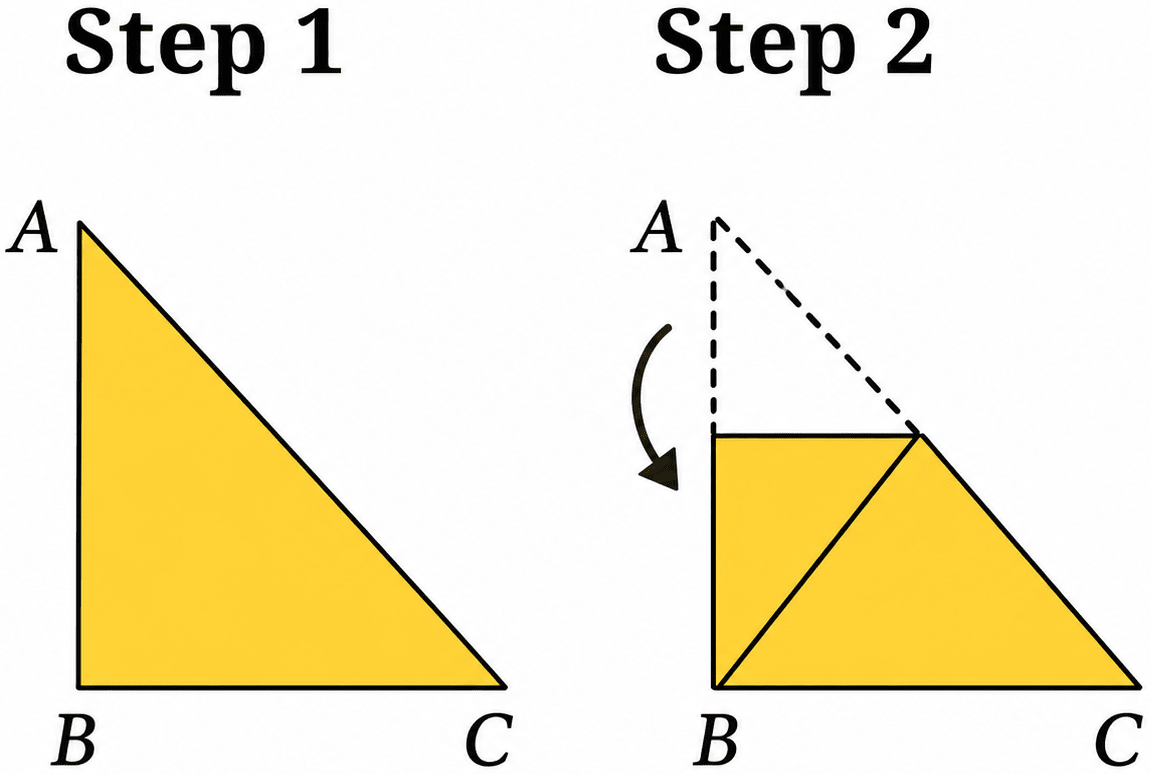
Answer
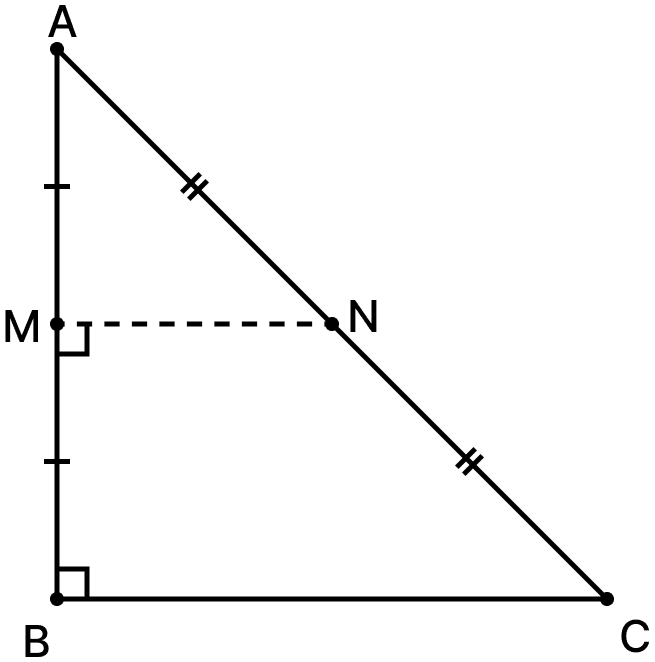
In the cutout, ∠B = 90°. When A is folded onto B, let the crease meet AB at M and AC at N.
Midpoint of AB: folding A onto B makes the part MA fall exactly on MB, so MA = MB and the crease is perpendicular to AB.
∴ M is the midpoint of AB and MN ⊥ AB.
Midpoint of AC:
MN ⊥ AB and BC ⊥ AB [∠B = 90°]
∴ MN ‖ BC [Two lines perpendicular to the same line are parallel]
In ∆ABC, M is the midpoint of AB and the crease MN through M is parallel to BC.
∴ N is the midpoint of AC [Theorem 7: Converse of the Midpoint Theorem]
Hence, the crease meets AB at its midpoint M and AC at its midpoint N.
You saw how to use the Midpoint Theorem to divide a given triangle into 4 congruent triangles. Can we divide a triangle into 3 congruent triangles? This exercise shows us how to do that and more, provided we are allowed to cut and reassemble.
(i) Draw medians AP, BQ and CR of ∆ABC, meeting in a common point M. Cut along each median to get 6 triangles. Show with justification how to assemble the 6 pieces into 3 congruent triangles! (Hint: Align ∆MPB and ∆MPC along equal sides PB and PC, matching P with itself and B with C.) Prove that you get a triangle. What are its side lengths?
(ii) Repeat the procedure with each of the 3 assembled triangles you got in (i). Show that each of the resulting 9 triangles has sides , and .
The procedure and the result above were unnoticed till 2014, when they were discovered by Lee Sallows, an amateur mathematician!
(iii) Naturally, we can next ask about the possibility of cutting a triangle and reassembling it into 2 congruent triangles. You were asked this question in the chapter Measuring Space: Perimeter and Area. Can you solve this now? (Hint: Use median AP in ∆ABC and then a median of ∆APB.)
For any two given figures with straight sides, we can ask whether one figure can be cut (using only straight cuts) into pieces and reassembled to make the other. This notion is called scissors congruence. The figures need not be in the plane. Research on such questions at a higher level is ongoing.
Answer
(i) The medians are AP, BQ and CR, where P, Q, R are the midpoints of BC, CA, AB. They meet at the centroid M.
By Centroid Theorem:
AM = AP, MP = AP
BM = BQ, MQ = BQ
CM = CR, MR = CR
The six pieces are ∆MPB, ∆MPC, ∆MQC, ∆MQA, ∆MRA and ∆MRB.
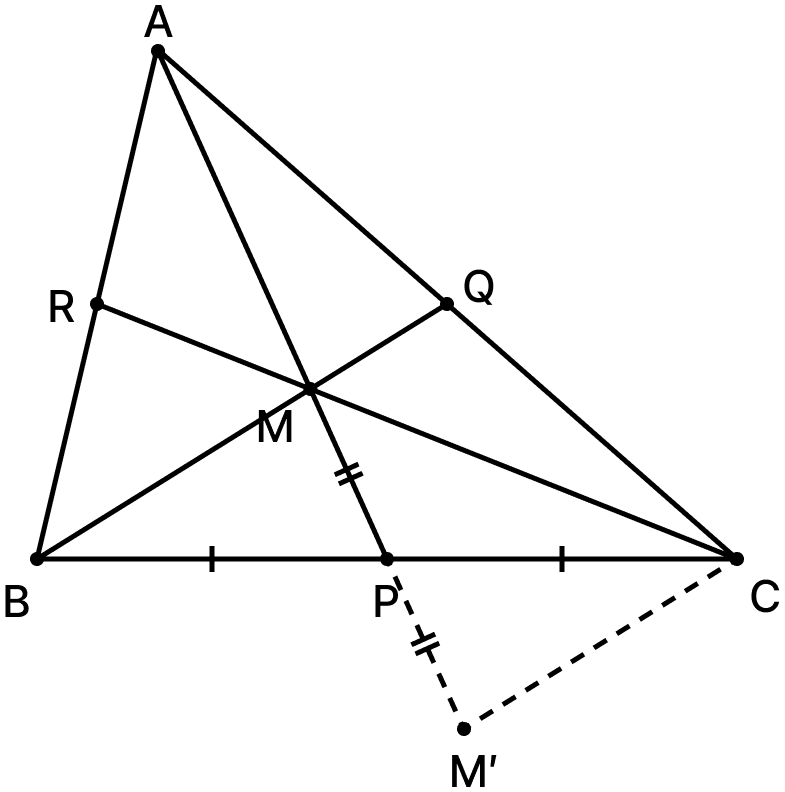
Assembling: Rotate ∆MPB through 180° about P. Since P is the midpoint of BC, B goes to C. Let M go to Mʹ; then P is the midpoint of MMʹ, i.e. PMʹ = PM. The rotated piece is ∆MʹPC, and ∆MʹPC ≅ ∆MPB.
We get a triangle:
∠MPC + ∠CPMʹ = ∠MPC + ∠BPM [∠CPMʹ = ∠BPM, rotated piece]
= 180° [B, P, C are collinear]
So M, P and Mʹ lie on one line, and the two pieces ∆MPC and ∆MʹPC together form the triangle MCMʹ.
Its side lengths:
MMʹ = MP + PMʹ
= 2MP [PMʹ = PM]
= 2 × AP
= AP
MC = CR
MʹC = MB = BQ [∆MʹPC ≅ ∆MPB]
In the same way:
∆MQC and ∆MQA (aligned along QC and QA, matching Q with itself and C with A) form a triangle with sides 2MQ = BQ, MC = CR and MA = AP.
∆MRA and ∆MRB (aligned along RA and RB, matching R with itself and A with B) form a triangle with sides 2MR = CR, MA = AP and MB = BQ.
All three triangles have sides AP, BQ and CR, so they are congruent [By SSS condition of congruence]
Hence, the 6 pieces form 3 congruent triangles, each with sides equal to of the three medians: AP, BQ and CR.
(ii) Each assembled triangle is congruent to ∆MCMʹ, so it is enough to find the medians of ∆MCMʹ (congruent triangles have equal medians).
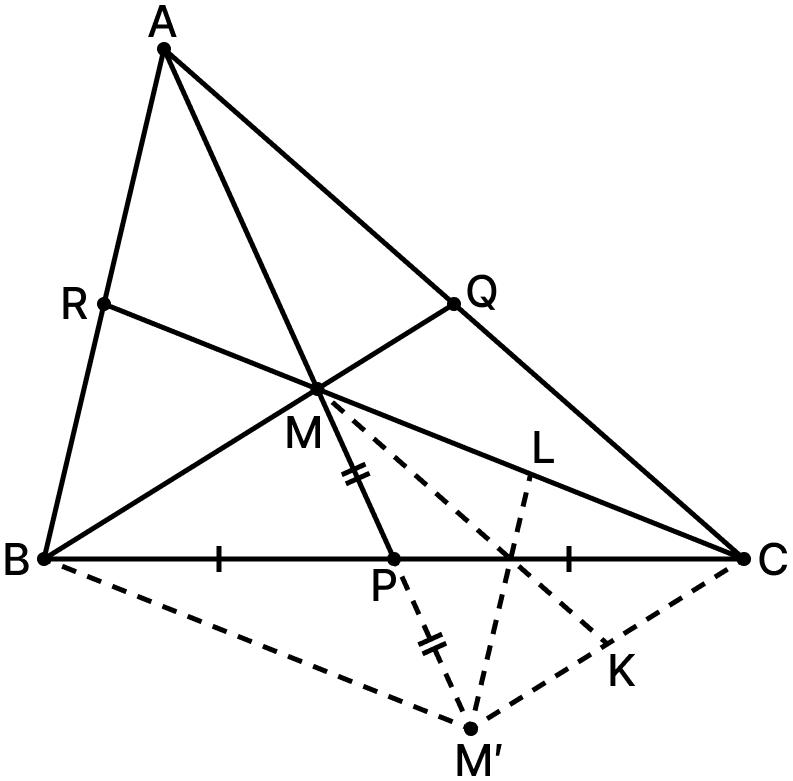
Facts used:
BMCMʹ is a parallelogram [Its diagonals BC and MMʹ bisect each other at P; Theorem 4]
∴ MʹC ‖ BM, MʹC = BM, MʹB ‖ CM and MʹB = CM ...(1)
B, M, Q are collinear with MQ = BM, and C, M, R are collinear with MR = CM [Centroid Theorem] ...(2)
Median from C: P is the midpoint of MMʹ, so CP is a median of ∆MCMʹ.
CP = BC [P is the midpoint of BC]
Median from M: let K be the midpoint of CMʹ.
KC = MʹC = BM = MQ [From (1) and (2)]
KC ‖ MQ [MʹC ‖ BM, and MQ lies along BM]
So MQCK has a pair of opposite sides equal and parallel, and it is a parallelogram [Theorem 5]
∴ MK = QC = AC
Median from Mʹ: let L be the midpoint of MC.
LR = LM + MR
= CM + CM [L is the midpoint of MC; from (2)]
= CM
= MʹB [From (1)]
LR ‖ MʹB [LR lies along CM, and MʹB ‖ CM]
So MʹBRL is a parallelogram [Theorem 5]
∴ MʹL = BR = AB
So the medians of each assembled triangle are BC, AC and AB.
Applying the procedure of (i) to such a triangle gives 3 congruent triangles whose sides are of its medians:
BC = BC, AC = AC, AB = AB
Doing this for each of the 3 assembled triangles gives 3 × 3 = 9 triangles.
Hence, each of the 9 triangles has sides , and .
(iii) Yes.
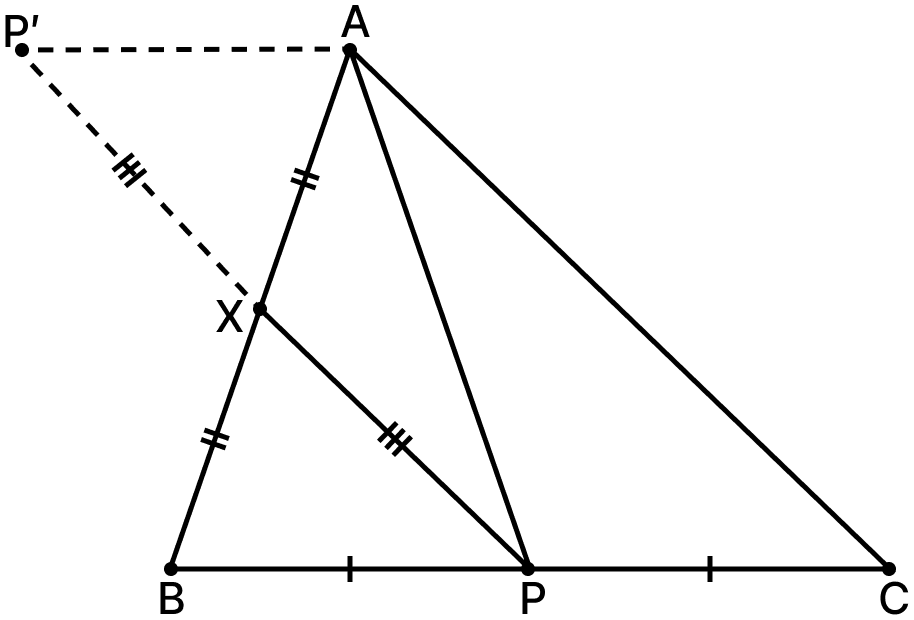
Steps:
Step 1: Cut ∆ABC along the median AP. We get ∆APB and ∆APC.
Step 2: Let X be the midpoint of AB. Cut ∆APB along its median PX. We get ∆PXA and ∆PXB.
Step 3: Rotate ∆PXB through 180° about X. B goes to A (X is the midpoint of AB). Let P go to Pʹ; then X is the midpoint of PPʹ. The rotated piece is ∆PʹXA ≅ ∆PXB.
We get a triangle: ∠PXA + ∠AXPʹ = ∠PXA + ∠BXP = 180° [A, X, B are collinear]
So P, X, Pʹ are collinear, and ∆PXA and ∆PʹXA together form the triangle APPʹ.
Its sides:
AP = AP
APʹ = BP = PC [∆PʹXA ≅ ∆PXB; P is the midpoint of BC]
PPʹ = 2PX [X is the midpoint of PPʹ]
PX = AC [Midpoint Theorem in ∆ABC: X and P are midpoints of AB and BC]
⇒ PPʹ = 2 × AC = AC
In ∆APPʹ and ∆APC:
AP = AP [Common side]
APʹ = PC
PPʹ = AC
∆APPʹ ≅ ∆APC [By SSS condition of congruence]
Hence, ∆ABC can be cut into 3 pieces (along AP and PX) and reassembled into 2 congruent triangles, ∆APC and ∆APPʹ.
A more general midpoint theorem and its converse. In a quadrilateral ABCD, suppose AB ‖ DC. Recall that such ABCD is called a trapezium. Let E be the midpoint of AD. A line drawn through E intersects side BC at F.
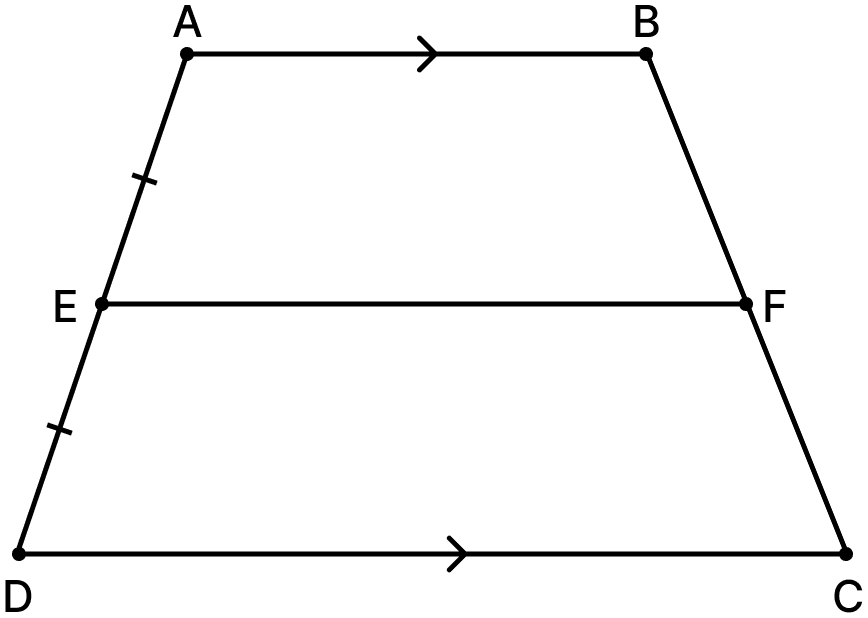
(i) If EF ‖ AB, then show that F is the midpoint of BC. Conclude that EF = .
(ii) If F is the midpoint of BC, then show that EF ‖ AB.
There are at least two ways to solve (ii). Do it directly by using the midpoint M of BD and showing that EM and FM are the same lines. Or use (i) along with the same idea used in the second proof of the converse of the Midpoint Theorem. Which way do you think is simpler?
Answer
(i)
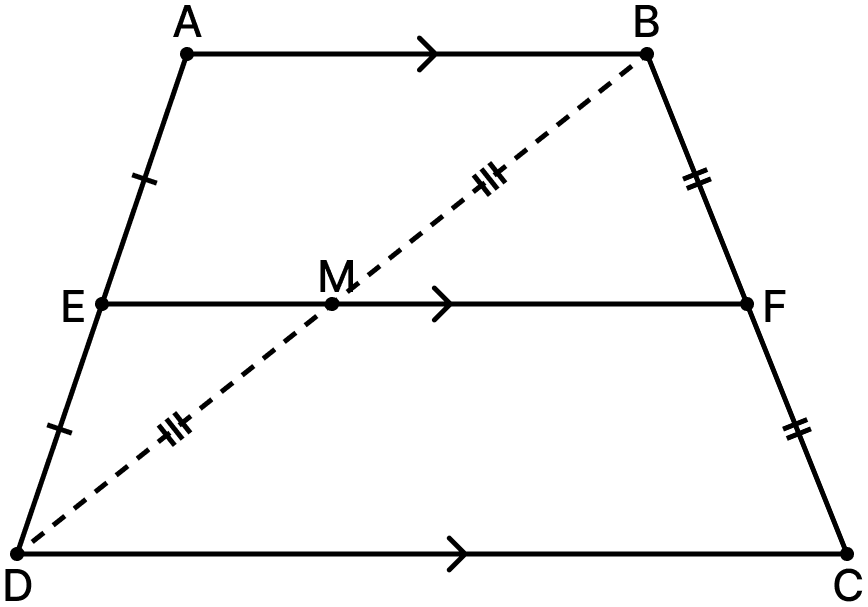
Join BD and let it meet EF at M.
Given: ABCD is a trapezium with AB ‖ DC; E is the midpoint of AD; EF ‖ AB with F on BC.
To prove: F is the midpoint of BC and EF = .
Proof:
In ∆DAB, E is the midpoint of DA and EM ‖ AB.
∴ M is the midpoint of DB [Theorem 7: Converse of the Midpoint Theorem]
and EM = AB ...(1)
EF ‖ AB and AB ‖ DC, so MF ‖ DC.
In ∆BDC, M is the midpoint of BD and MF ‖ DC.
∴ F is the midpoint of BC [Theorem 7]
and MF = DC ...(2)
EF = EM + MF
= AB + CD [From (1) and (2)]
=
Hence, F is the midpoint of BC and EF = .
(ii) Given: E and F are the midpoints of AD and BC.
To prove: EF ‖ AB.
First way (using the midpoint M of BD):
In ∆DAB, E and M are the midpoints of DA and DB.
∴ EM ‖ AB [Midpoint Theorem]
In ∆BDC, M and F are the midpoints of BD and BC.
∴ MF ‖ DC [Midpoint Theorem]
DC ‖ AB, so MF ‖ AB.
EM and FM are both lines through M parallel to AB. There is only one such line, so EM and FM are the same line. Hence E, M, F are collinear and EF ‖ AB.
Second way (using (i)):
Draw the line through E parallel to AB, and let it meet BC at Fʹ.
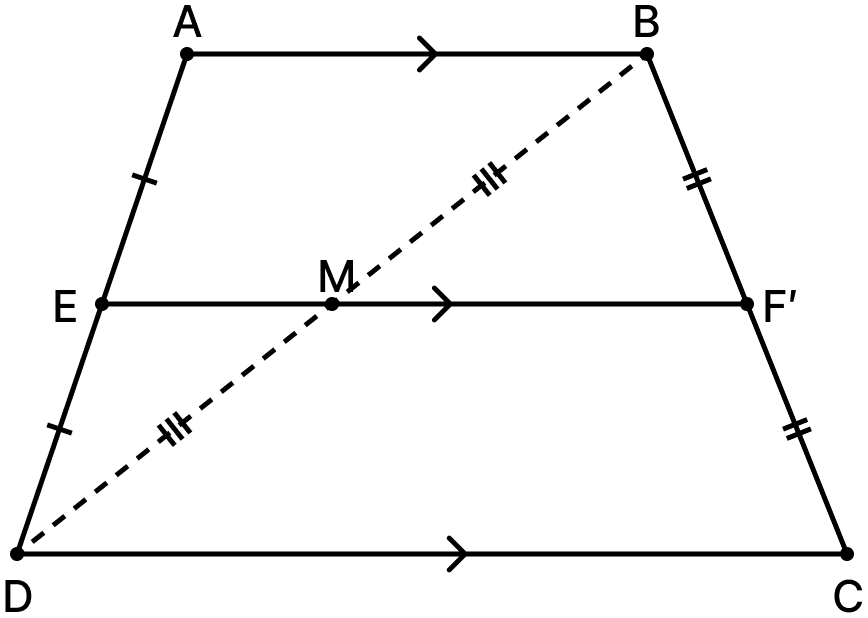
Applying the result proved in part (i) to the newly drawn parallel line EF′, Fʹ is the midpoint of BC.
But F is also the midpoint of BC, and a segment has only one midpoint. So Fʹ = F.
∴ EF = EFʹ, which is parallel to AB.
Hence, EF ‖ AB.
Which is simpler: The second way is shorter, because (i) has already done the work; the first way is more direct and does not need (i).
The diagonals AC and BD of a parallelogram ABCD intersect at O. A line through O meets AB and CD at points P and Q respectively. Show that O is the midpoint of PQ. (Multiple proofs are possible. Which is the simplest?)
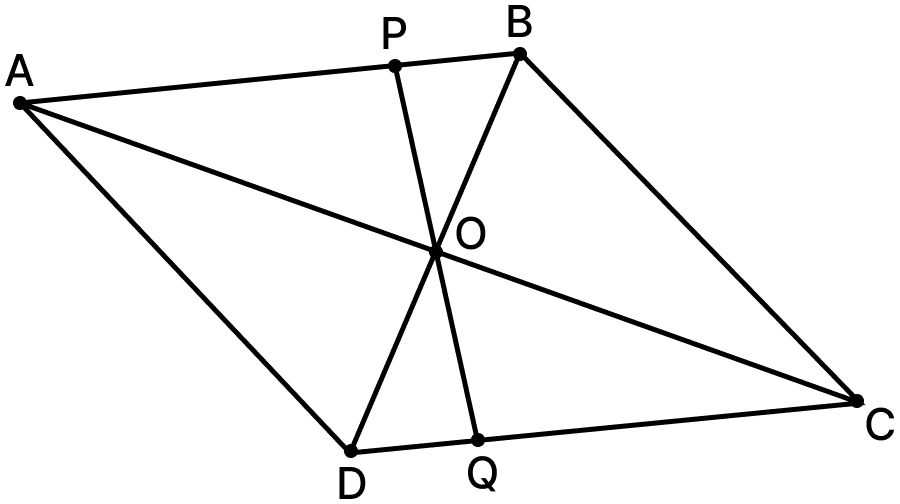
Answer
Given: ABCD is a parallelogram whose diagonals meet at O; a line through O meets AB at P and CD at Q.
To prove: OP = OQ.
Proof:
In ∆AOP and ∆COQ:
OA = OC [Diagonals of a parallelogram bisect each other]
∠AOP = ∠COQ [Vertically opposite angles]
∠OAP = ∠OCQ [Alternate angles, AB ‖ DC with transversal AC]
∆AOP ≅ ∆COQ [By ASA condition of congruence]
∴ OP = OQ [Corresponding parts of congruent triangles]
Hence, O is the midpoint of PQ.
This congruence proof is the simplest. (Another proof: join AQ and CP; APCQ has AP ‖ QC, and one can show it is a parallelogram whose diagonals AC and PQ bisect each other — this takes more steps.)
ABCD is a trapezium with parallel sides AD = 3 cm and BC = 5 cm. E and F are the midpoints of the non-parallel sides. Find the ratio of the areas of the 4-gons AEFD and EBCF.
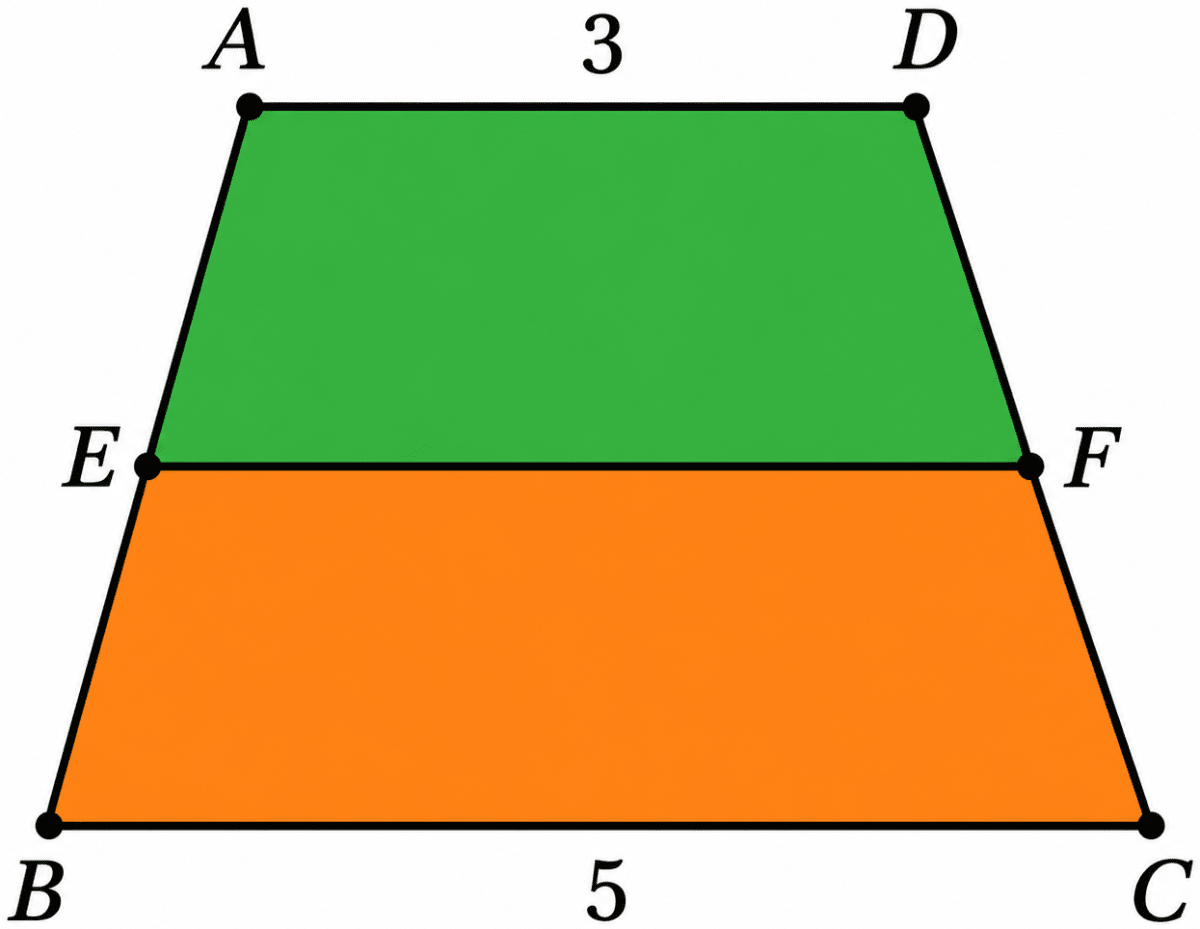
Answer
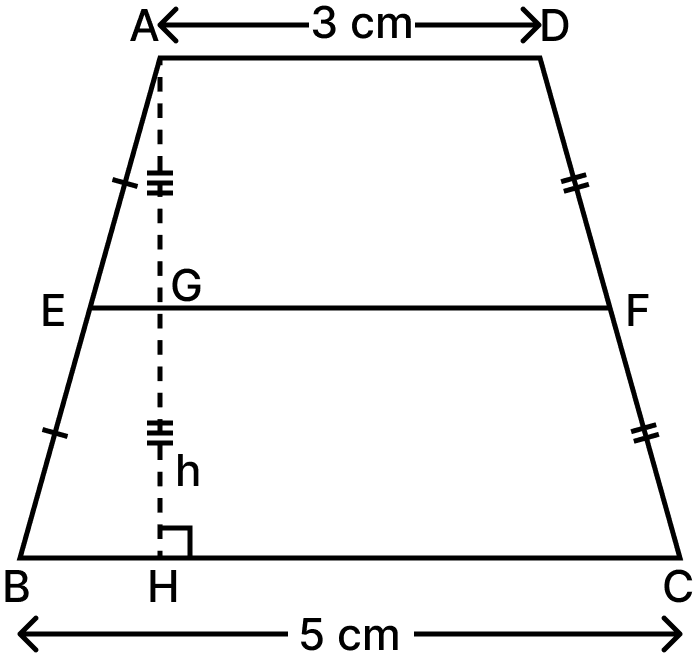
Given:
AD = 3 cm
BC = 5 cm
AD ‖ BC; E and F are the midpoints of AB and DC.
Let h be the distance between AD and BC. Draw AH ⊥ BC, meeting EF at G and BC at H. Then AH = h.
Length of EF:
EF ‖ AD ‖ BC
EF = [Question 7]
=
=
= 4 cm
Heights of the two parts:
In ∆ABH, E is the midpoint of AB and EG ‖ BH.
∴ G is the midpoint of AH [Theorem 7]
⇒ AG = GH =
AG ⊥ EF and GH ⊥ BC, so both AEFD and EBCF are trapeziums of height .
Areas:
We know the formula,
Area of a trapezium = × (Sum of the parallel sides) × Height
Area of AEFD = × (AD + EF) × AG
= × (3 + 4) ×
= × 7 ×
= cm2
Area of EBCF = × (EF + BC) × GH
= × (4 + 5) ×
= × 9 ×
= cm2
Ratio of the areas =
=
=
=
Hence, the ratio of the areas of AEFD and EBCF is 7 : 9.
Consider 4 points A, B, C, D in the plane with no three collinear. Answer the following questions. Some answers may require you to consider different cases, depending on how the points are positioned in the plane.
(i) How many different quadrilaterals do they form if the quadrilateral is allowed to be self-intersecting or non-convex?
(ii) How many of these quadrilaterals are self-intersecting? How many are convex?
Answer
(i) A quadrilateral is fixed by the order in which its four vertices are joined, going round. The same quadrilateral has 8 names: we can start at any of the 4 vertices and go round in either of 2 directions (for example, ABCD, BCDA, CDAB, DABC, DCBA, ADCB, BADC and CBAD are the same quadrilateral).
Number of ways of arranging A, B, C, D in a row = 4 × 3 × 2 × 1 = 24
Number of names of each quadrilateral = 4 × 2 = 8
Number of different quadrilaterals = = 3
They are ABCD, ABDC and ACBD.
Since no three of the points are collinear, each of these is a quadrilateral (possibly self-intersecting or non-convex).
Hence, the four points form 3 different quadrilaterals, whatever their positions.
(ii) There are two cases.
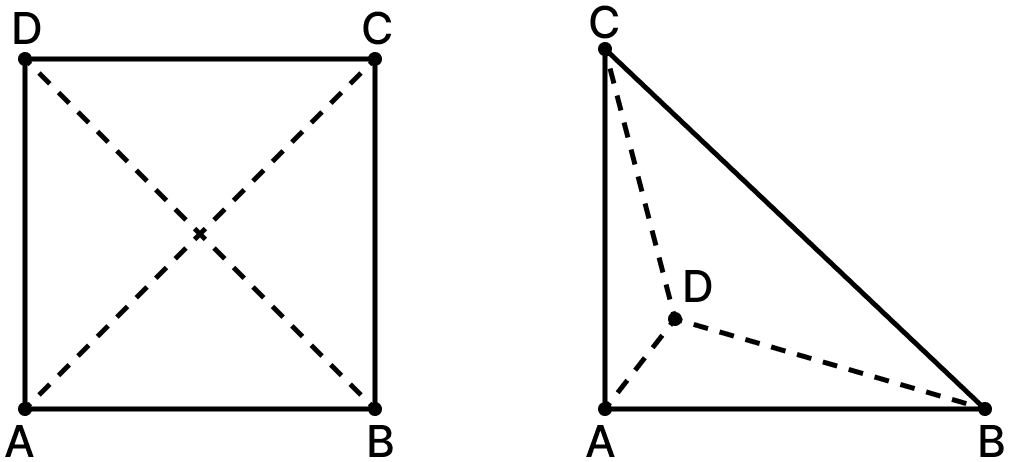
Case 1: none of the four points lies inside the triangle formed by the other three (the points are in "convex position", as on the left).
Going round the outside gives one convex quadrilateral, ABCD. In each of the other two orders (ABDC and ACBD) two sides cross, so both are self-intersecting. No quadrilateral is non-convex.
Self-intersecting: 2
Convex: 1
Case 2: one point lies inside the triangle formed by the other three (say D inside ∆ABC, as on the right).
In each of the three orders ABCD, ABDC and ACBD, the two sides at D go into the triangle, no two sides cross, and the internal angle at D is more than 180°. So all three quadrilaterals are non-convex (Exercise Set 12.1, Q4, region inside the triangle).
Self-intersecting: 0
Convex: 0
These are the only two cases: either some point lies inside the triangle of the other three, or none does.
Hence, either 2 of the quadrilaterals are self-intersecting and 1 is convex (points in convex position), or none is self-intersecting and none is convex (one point inside the triangle of the others; then all 3 are non-convex).
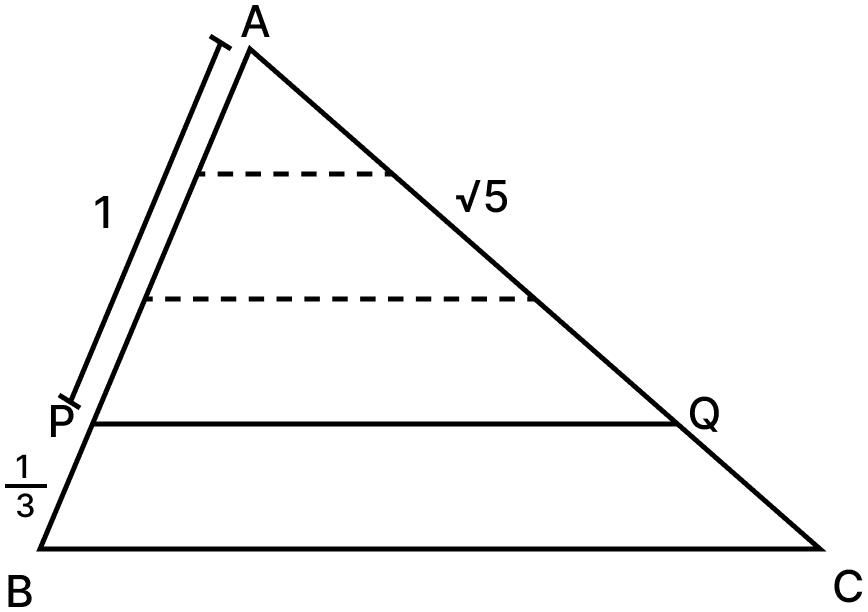
Suppose P is a point on side AB of ∆ABC and the line through P parallel to BC meets AC in point Q. Assume AP = 1, AQ = .
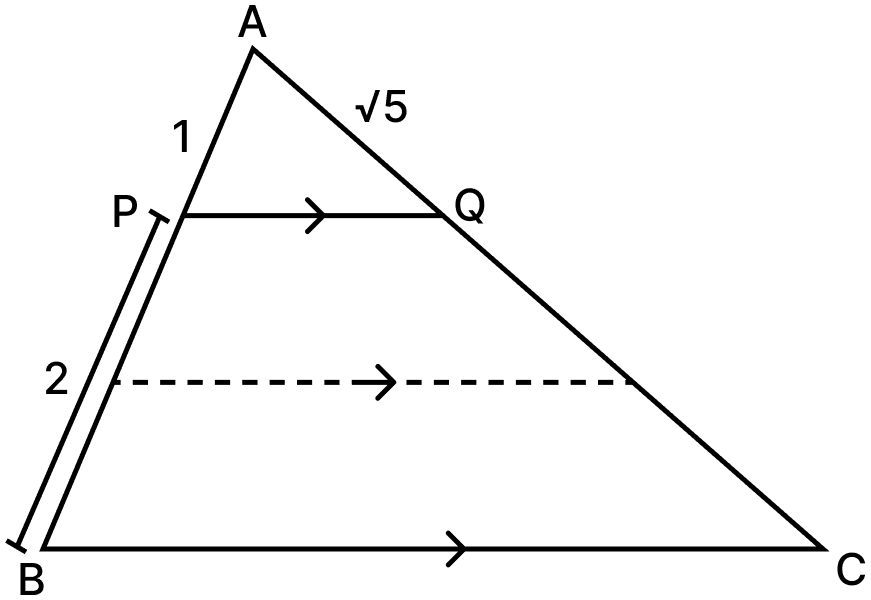
If PB = 2 find QC. (Hint: See the dotted line)
Answer
Given:
AP = 1
PB = 2
AQ =
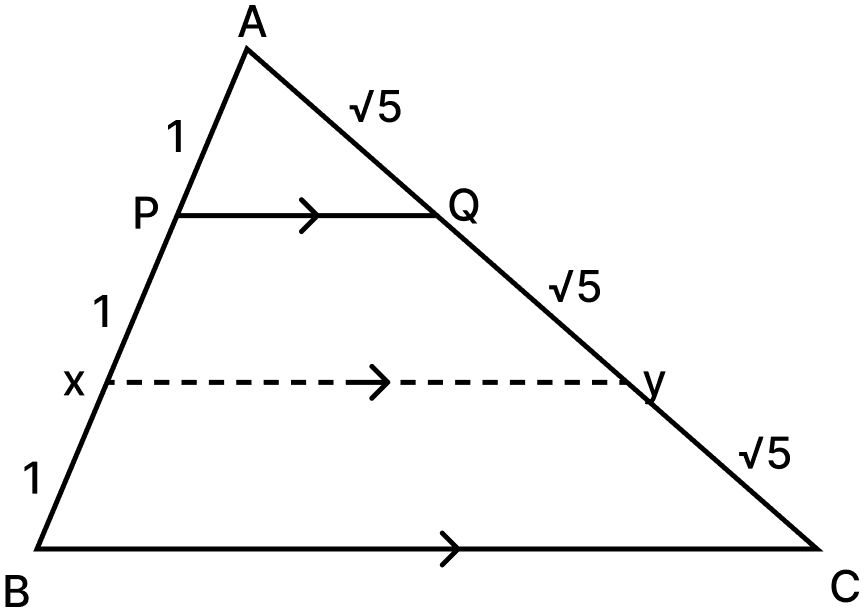
Mark X as midpoint on PB with PX = 1. Then XB = 2 - 1 = 1
∴ AP = PX = XB = 1.
Draw the line through X parallel to BC, meeting AC at Y.
The points P, X divide AB into 3 equal parts, so the parallels cut AC into 3 equal parts
∴ AQ = QY = YC =
QC = QY + YC
=
=
Hence, QC = .
Suppose P is a point on side AB of ∆ABC and the line through P parallel to BC meets AC in point Q. Assume AP = 1, AQ = .
If PB = find QC. (Hint: See the dotted lines)
Answer
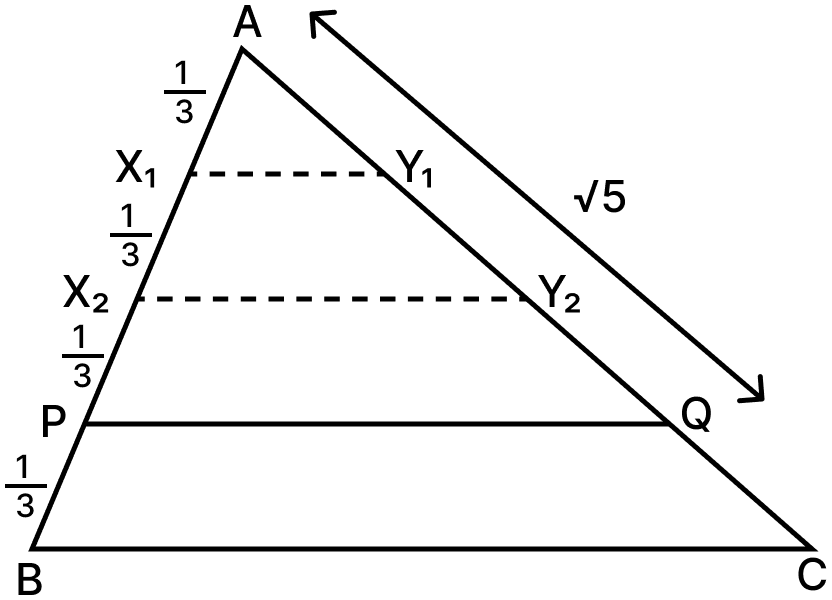
Given:
AP = 1
PB =
AQ =
Divide AP into 3 equal parts at X1 and X2.
Length of each part = = PB
So A, X1, X2, P, B divide AB into 4 equal parts. Draw lines through X1 and X2 parallel to BC, meeting AC at Y1 and Y2.
∴ AY1 = Y1Y2 = Y2Q = QC [Fact proved in Question 11(i)]
AQ = AY1 + Y1Y2 + Y2Q = 3QC
⇒ 3QC =
⇒ QC =
Hence, QC = .
Suppose P is a point on side AB of ∆ABC and the line through P parallel to BC meets AC in point Q. Assume AP = 1, AQ = .
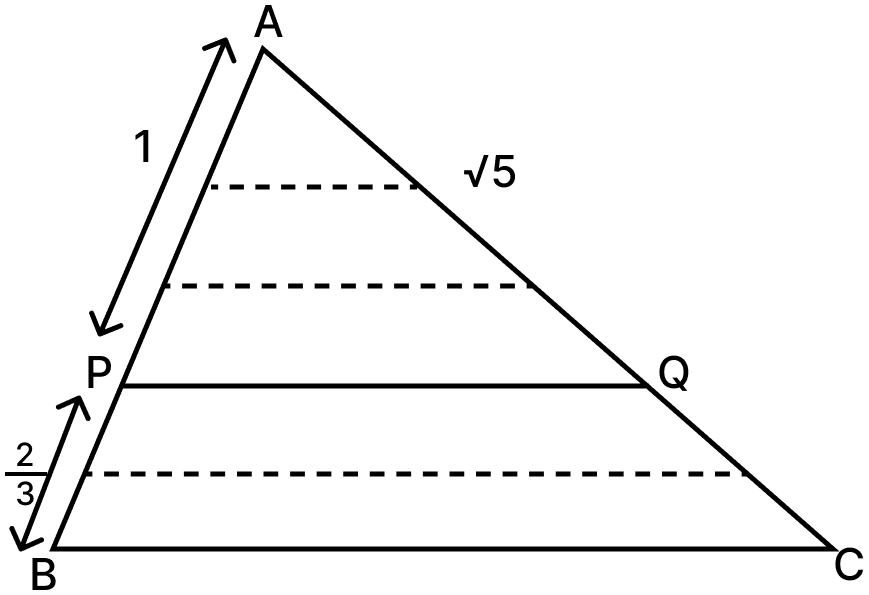
If PB = find QC.
(Hint: Divide both PB and AP suitably.)
Answer
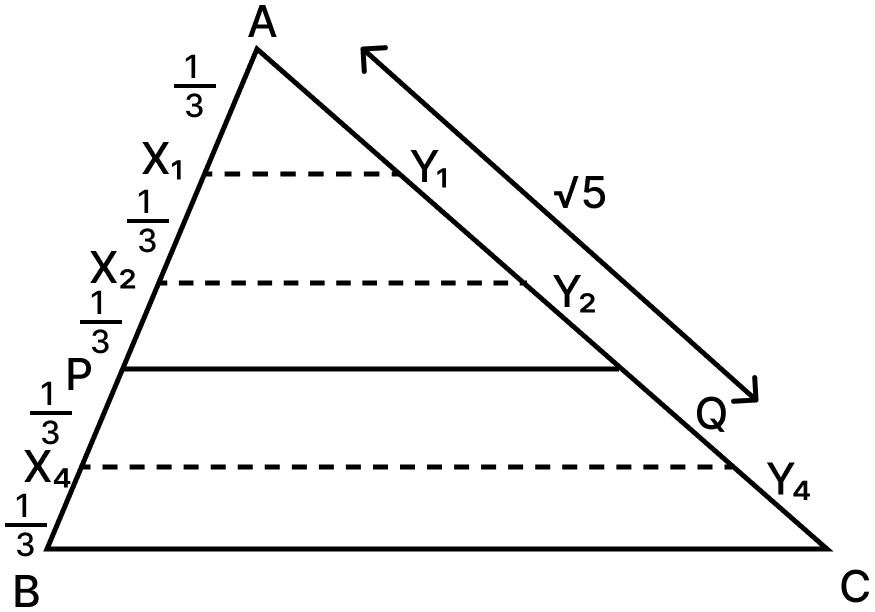
Given:
AP = 1
PB =
AQ =
Divide AP into 3 equal parts at X1, X2, each of length .
Divide PB into 2 equal parts at X4, each of length .
So AB is divided into 3 + 2 = 5 equal parts. The lines through X1, X2, X4 parallel to BC meet AC at Y1, Y2, Y4, and AC is divided into 5 equal parts AY1, Y1Y2, Y2Q, QY4, Y4C [Fact proved in Question 11(i)]
Let each part of AC be t.
AQ = 3t (3 parts)
⇒ 3t =
⇒ t =
QC = 2t (2 parts)
= 2 ×
=
Hence, QC = .
Suppose P is a point on side AB of ∆ABC and the line through P parallel to BC meets AC in point Q.
Show that if is a rational number, then .
Answer
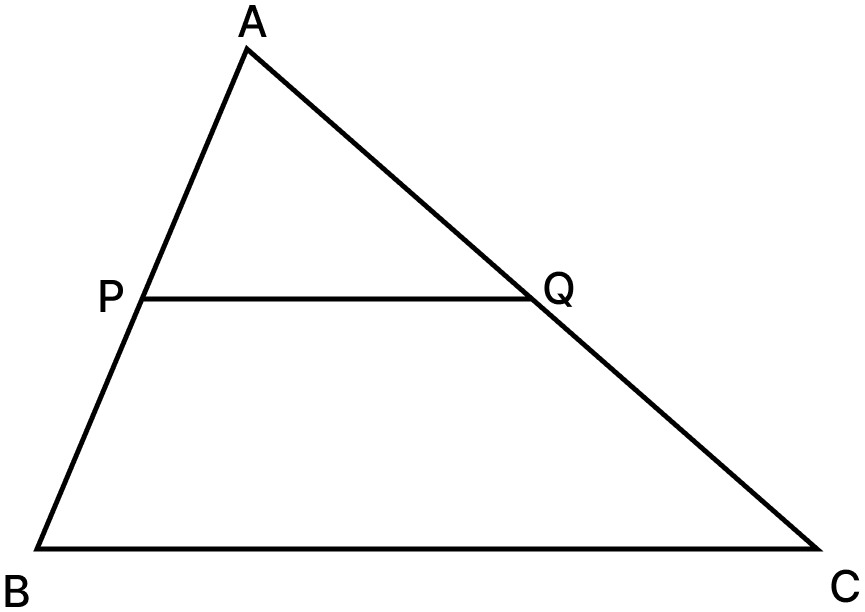
Let , where m and n are positive whole numbers.
⇒ ; call this common length s.
Divide AP into m equal parts and PB into n equal parts. Each part has length s, so AB is divided into m + n equal parts.
Draw the lines through all the division points parallel to BC. They cut AC into m + n equal parts [Fact proved in Question 11(i)]
Let each part of AC be t. The line through P is PQ, so AQ consists of m parts and QC of n parts.
AQ = mt and QC = nt
=
Hence, if is rational, then .
(i) Suppose ABCD is a parallelogram and M, N are midpoints of AB and CD respectively. Show that segments DM and BN trisect segment AC.
(ii) Use part (i) to find a procedure to trisect any given segment PQ. Find two other ways to trisect PQ, one using Exercise 11 above and a third using the Centroid Theorem.
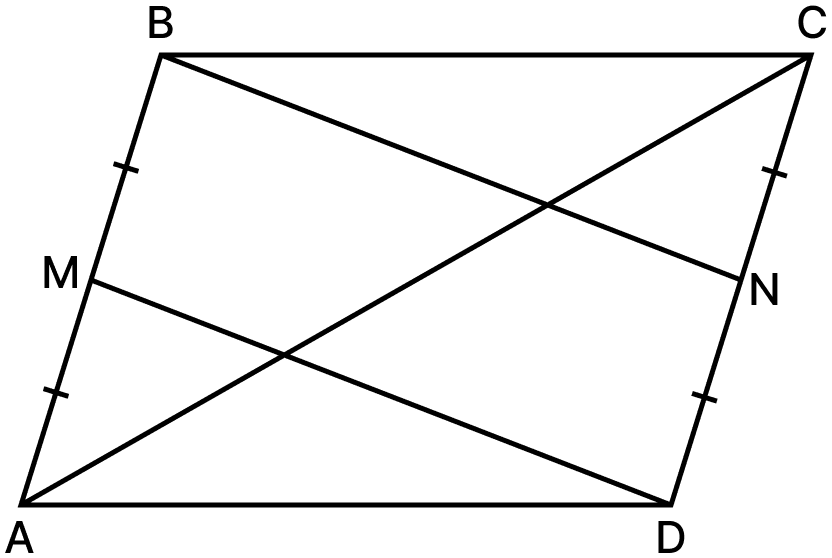
Answer
(i)
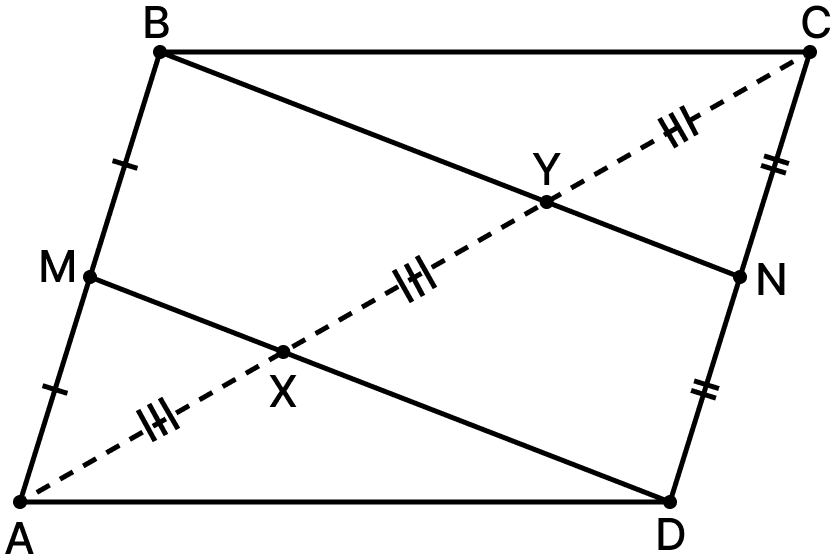
Let DM meet AC at X and BN meet AC at Y.
Given: ABCD is a parallelogram; M and N are the midpoints of AB and CD.
To prove: AX = XY = YC.
Proof:
MB = AB and DN = CD [M and N are midpoints]
AB = CD [Opposite sides of a parallelogram]
∴ MB = DN
MB ‖ DN [AB ‖ DC]
So MBND has a pair of opposite sides equal and parallel, and it is a parallelogram [Theorem 5]
∴ DM ‖ NB, i.e. MX ‖ BY and NY ‖ DX.
In ∆ABY, M is the midpoint of AB and MX ‖ BY.
∴ X is the midpoint of AY [Theorem 7]
⇒ AX = XY ...(1)
In ∆CDX, N is the midpoint of CD and NY ‖ DX.
∴ Y is the midpoint of CX [Theorem 7]
⇒ XY = YC ...(2)
From (1) and (2), AX = XY = YC.
Hence, DM and BN trisect AC.
(ii) Way 1 (using part (i)):
Steps of construction:
Step 1: Take any point B not on the line PQ. Join PB and BQ.
Step 2: Through Q draw a line parallel to PB, and through P draw a line parallel to BQ. Let them meet at D. Then PBQD is a parallelogram with PQ as a diagonal.
Step 3: Mark the midpoint M of PB and the midpoint N of QD.
Step 4: Join DM and BN. They cut PQ at T1 and T2.
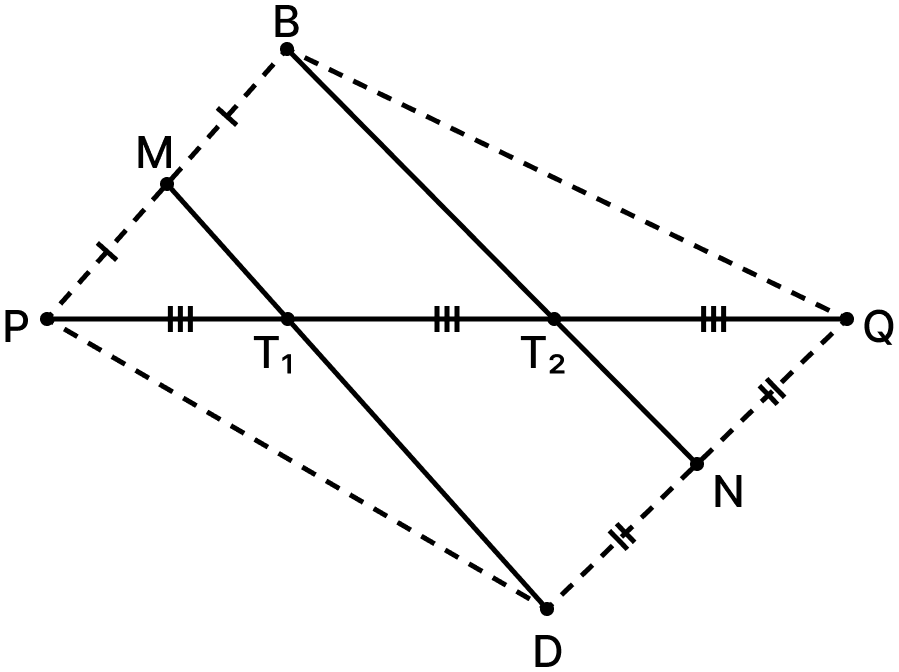
By part (i) (with A = P and C = Q), PT1 = T1T2 = T2Q.
Way 2 (using Exercise 11):
Steps of construction:
Step 1: Draw any ray from P, not along PQ. On it mark X1, X2, X3 such that PX1 = X1X2 = X2X3.
Step 2: Join X3Q.
Step 3: Through X1 and X2 draw lines parallel to X3Q, meeting PQ at T1 and T2.
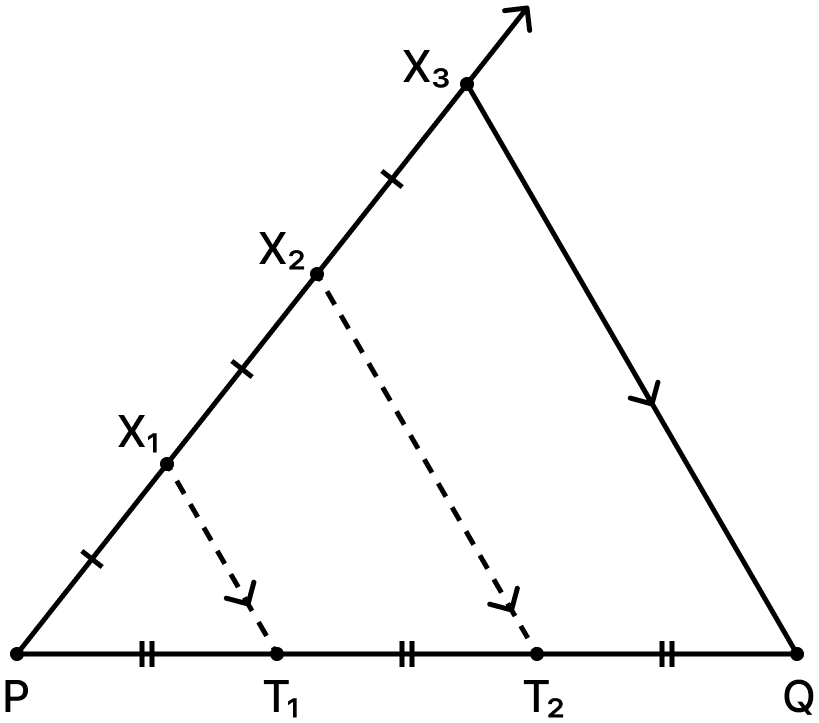
In ∆PX3Q, the equally spaced points on PX3 and the parallels to X3Q cut PQ into equal parts [Exercise 11, fact used there]
∴ PT1 = T1T2 = T2Q.
Way 3 (using the Centroid Theorem):
Steps of construction:
Step 1: Take any point B not on the line PQ. Join BQ and produce it to C so that QC = BQ. Join PB and PC.
Now Q is the midpoint of BC, so PQ is a median of ∆PBC.
Step 2: Mark the midpoint R of PC and join BR (another median). Let BR meet PQ at G.
Step 3: Mark the midpoint T of PG.
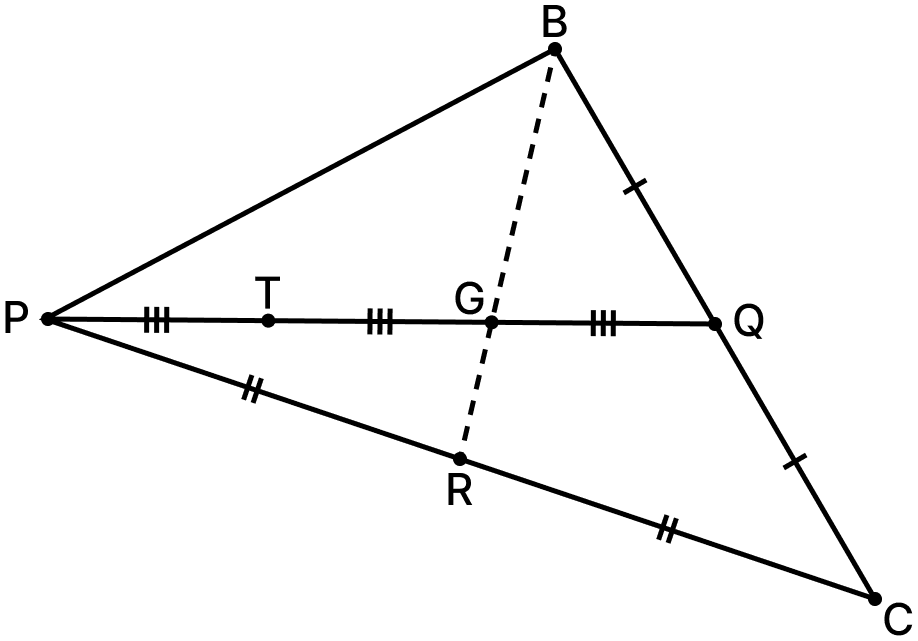
G is the centroid of ∆PBC, so PG : GQ = 2 : 1 [Centroid Theorem]
⇒ GQ = PQ and PG = PQ
PT = TG = PG = PQ
∴ PT = TG = GQ.
Hence, each of the three procedures gives the two points that trisect PQ.
Is the Midpoint Theorem for Quadrilaterals (Theorem 9) true when the quadrilateral is non-convex? How about when it is self-intersecting? Experiment and check. The pictures may look strange, but the theorem appears to be true.
(i) Can you explain why this is so? See the geometric reasoning in the text.
(ii) There is one exception: In a very special case the Varignon parallelogram becomes a single segment. When will this happen?
(iii) Does your reasoning apply even when ABCD is non-planar?
Answer
Theorem 9: The midpoints of the four sides of a quadrilateral are the vertices of a parallelogram.
Yes. Experiment shows that the midpoints of the sides form a parallelogram for non-convex and for self-intersecting quadrilaterals too.
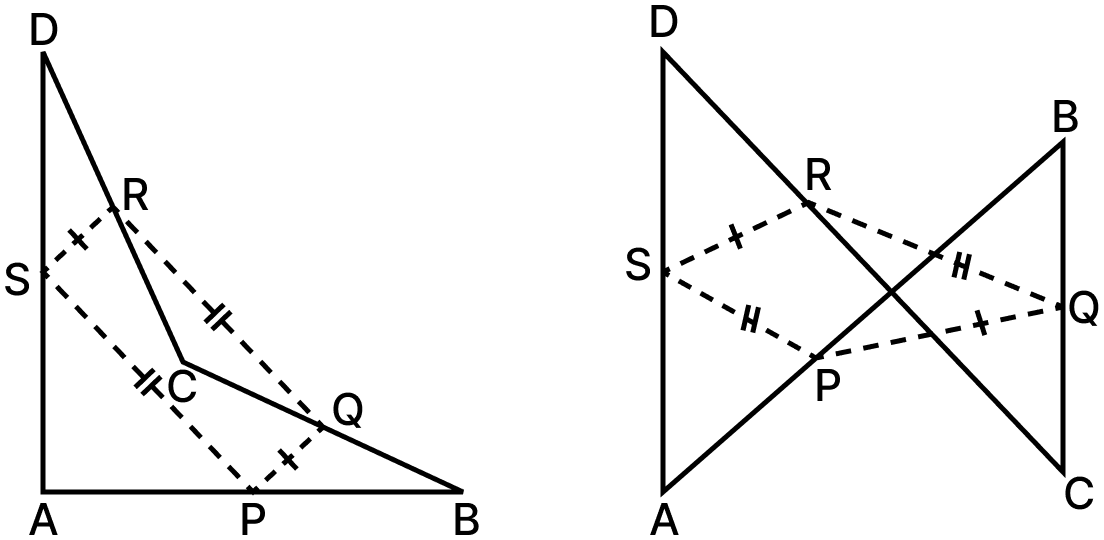
(i) The reasoning in the text uses only the Midpoint Theorem in the four triangles ABC, ADC, BCD and BAD:
In ∆ABC: PQ ‖ AC and PQ = AC.
In ∆ADC: SR ‖ AC and SR = AC.
In ∆BCD: QR ‖ BD and QR = BD.
In ∆BAD: PS ‖ BD and PS = BD.
These four triangles exist for any four points A, B, C, D with no three collinear, whether ABCD is convex, non-convex or self-intersecting. The reasoning never uses the shape of ABCD.
So PQ ‖ SR and PQ = SR, and QR ‖ PS and QR = PS: both pairs of opposite sides of PQRS are parallel and equal.
Hence, the midpoints form a parallelogram for non-convex and self-intersecting quadrilaterals as well.
(ii) PQ is parallel to AC and QR is parallel to BD.
If the lines AC and BD are parallel, then PQ and QR are parallel and share the point Q, so P, Q, R lie on one line; in the same way S lies on it. PQRS then collapses into a single segment.
If AC and BD are not parallel, PQ and QR point in different directions and PQRS is a true parallelogram.
When ABCD is convex, AC and BD intersect; when ABCD is non-convex, the line through the dent vertex and the opposite vertex still crosses the other diagonal. So AC ∥ BD can happen only for a self-intersecting ABCD.
Example: A = (0, 0), B = (1, 3), C = (4, 0), D = (3, 3). Here AC and BD are both horizontal, and the midpoints P, Q, R, S all lie on the line y = 1.5.
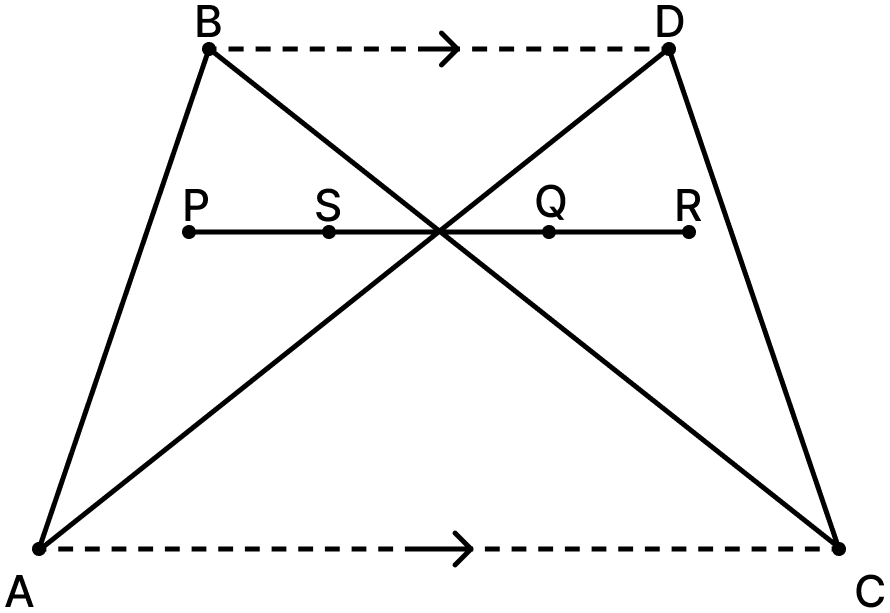
Hence, the Varignon parallelogram becomes a single segment exactly when the lines AC and BD are parallel; this happens only for a self-intersecting quadrilateral.
(iii) Yes.
When ABCD is non-planar, each of the triangles ABC, ADC, BCD and BAD still lies in its own plane, so the Midpoint Theorem still gives
PQ ‖ AC, SR ‖ AC and PQ = SR = AC.
Two lines parallel to the same line are parallel to each other (also in space), so PQ ‖ SR. Two parallel lines lie in one plane, so P, Q, R and S lie in one plane.
In this plane, PQRS has a pair of opposite sides PQ and SR that are equal and parallel, so it is a parallelogram [Theorem 5]
(Since a non-planar ABCD has AC and BD neither parallel nor intersecting, the exception of (ii) cannot occur.)
Hence, the reasoning works even when ABCD is non-planar: its Varignon figure is a (planar) parallelogram.
Let P, Q, R, S be four points on sides AB, BC, CD and DA respectively of a quadrilateral ABCD. Suppose PQRS is a parallelogram. Must P, Q, R and S be midpoints of the respective sides? This can be considered a possible converse question to Theorem 9.
Answer
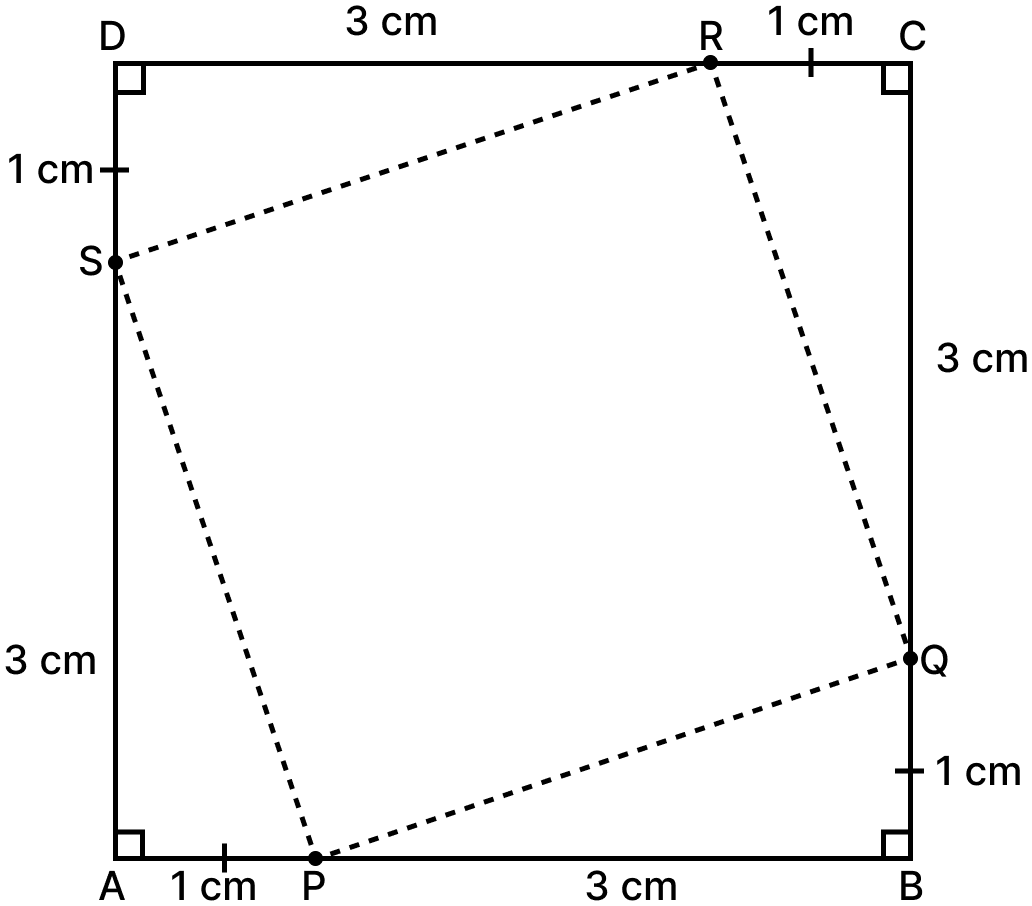
No.
Counterexample: let ABCD be a square of side 4 cm. Take P, Q, R, S on AB, BC, CD, DA with
AP = BQ = CR = DS = 1 cm
Then PB = QC = RD = SA = 4 - 1 = 3 cm. None of P, Q, R, S is a midpoint (a midpoint would be 2 cm from each end).
In ∆APS and ∆CRQ:
AP = CR = 1 cm [By choice]
∠A = ∠C = 90° [Angles of a square]
AS = CQ = 3 cm [By choice]
∆APS ≅ ∆CRQ [By SAS condition of congruence]
∴ PS = RQ [Corresponding parts of congruent triangles]
In ∆BQP and ∆DSR:
BQ = DS = 1 cm
∠B = ∠D = 90° [Angles of a square]
BP = DR = 3 cm
∆BQP ≅ ∆DSR [By SAS condition of congruence]
∴ PQ = RS
Both pairs of opposite sides of PQRS are equal, so PQRS is a parallelogram [Theorem 2]
Hence, P, Q, R and S need not be the midpoints: PQRS can be a parallelogram even when they are not midpoints, so the converse of Theorem 9 is false.
(i) Complete the following proof of the Midpoint Theorem. Extend segment PQ beyond Q until point S. By how much should we extend PQ?
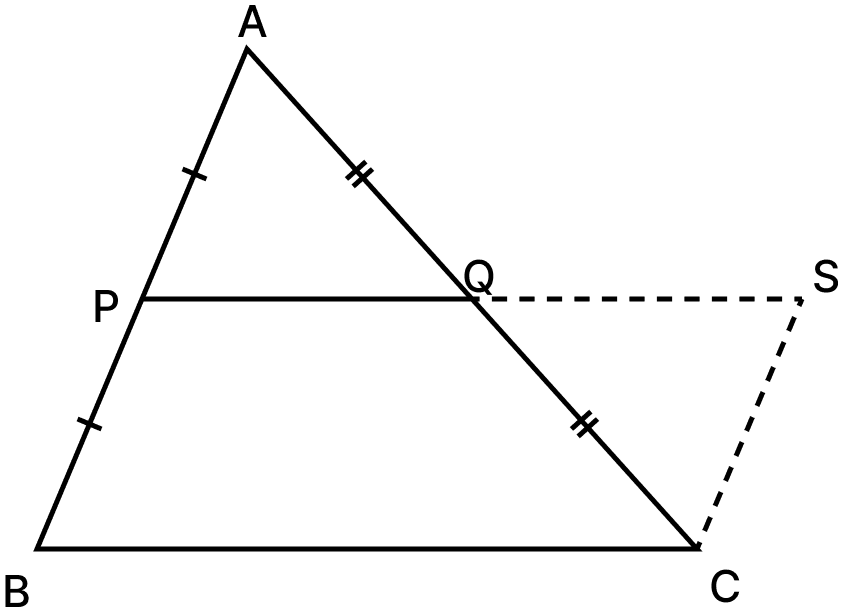
It would be good to be able to prove that ∆APQ ≅ ∆CSQ. (Why?) Use this as a guide to specify the location of S and then complete this proof.
(ii) Give a similar proof of the converse of the Midpoint Theorem (Theorem 7). Start by extending PQ up to a suitable point S.
Answer
(i)
Midpoint theorem: The segment joining the midpoints of two sides of a triangle is parallel to the third side and has half the length.
In the figure above, P and Q are the midpoints of AB and AC.
Choice of S: Extend PQ beyond Q by its own length, i.e. choose S so that QS = PQ.
Why ∆APQ ≅ ∆CSQ helps: It would give CS = AP = PB and CS ‖ AB, which makes PBCS a parallelogram; a parallelogram gives PS ‖ BC and PS = BC, which is what the theorem needs.
Given: In ∆ABC, P and Q are the midpoints of AB and AC; S lies on PQ produced with QS = PQ.
To prove: PQ ‖ BC and PQ = BC.
Proof:
In ∆APQ and ∆CSQ:
AQ = CQ [Q is the midpoint of AC]
∠AQP = ∠CQS [Vertically opposite angles]
PQ = SQ [Given]
∆APQ ≅ ∆CSQ [By SAS condition of congruence]
∴ CS = AP and ∠QCS = ∠QAP [Corresponding parts of congruent triangles]
∠QCS = ∠QAP are alternate angles for the lines CS and AB with transversal AC.
∴ CS ‖ AB, i.e. CS ‖ BP.
CS = AP = BP [P is the midpoint of AB]
So PBCS has a pair of opposite sides CS and BP that are equal and parallel.
∴ PBCS is a parallelogram [Theorem 5]
⇒ PS ‖ BC and PS = BC [Opposite sides of a parallelogram]
PQ = PS = BC [Q is the midpoint of PS]
and PQ ‖ BC.
Hence proved.
(ii)
Theorem 7: A line through the midpoint of one side of a triangle, parallel to another side, bisects the third side and is half its length.
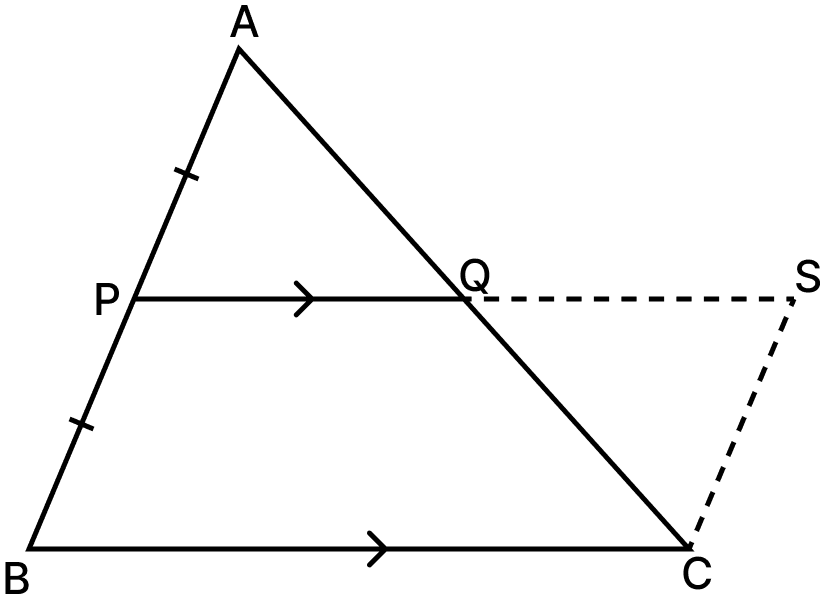
Given: In ∆ABC, P is the midpoint of AB; the line through P parallel to BC meets AC at Q.
To prove: Q is the midpoint of AC and PQ = BC.
Construction: Extend PQ beyond Q to S so that PS = BC. Join CS.
Proof:
PS ‖ BC and PS = BC [By construction]
∴ PBCS is a parallelogram [Theorem 5]
⇒ CS ‖ BP and CS = BP [Opposite sides of a parallelogram]
CS = BP = AP [P is the midpoint of AB]
In ∆APQ and ∆CSQ:
∠AQP = ∠CQS [Vertically opposite angles]
∠PAQ = ∠SCQ [Alternate angles, AB ‖ CS with transversal AC]
AP = CS
∆APQ ≅ ∆CSQ [By AAS condition of congruence]
∴ AQ = CQ and PQ = SQ [Corresponding parts of congruent triangles]
So Q is the midpoint of AC, and PQ = PS = BC.
Hence proved.
Review all the properties of a rhombus/rectangle/square that you proved in Grade 8. Formulate a converse of each. Decide if the converse is true. There are many possibilities here!
Answer
Some properties, their converses, and whether each converse is true are given below:
Rhombus
1. Property: The diagonals of a rhombus bisect each other at right angles.
Converse: If the diagonals of a quadrilateral bisect each other at right angles, then it is a rhombus.
True — The diagonals bisect each other, so it is a parallelogram (Theorem 4); the right angle gives two adjacent sides equal by SAS.
2. Property: Each diagonal of a rhombus bisects the angles at its ends.
Converse: If each diagonal of a quadrilateral bisects the angles at its ends, then it is a rhombus.
True — Two pairs of congruent triangles (ASA) give all four sides equal.
3. Property: The diagonals of a rhombus are perpendicular.
Converse: If the diagonals of a quadrilateral are perpendicular, then it is a rhombus.
False — A kite such as A = (0, 3), B = (2, 0), C = (0, -1), D = (-2, 0) has perpendicular diagonals but AB = ≠ BC = .
4. Property: The opposite angles of a rhombus are equal.
Converse: If the opposite angles of a quadrilateral are equal, then it is a rhombus.
False — A rectangle with sides 3 cm and 5 cm has all angles equal but is not a rhombus. (Such a quadrilateral is only sure to be a parallelogram, by Theorem 3.)
Rectangle
5. Property: The diagonals of a rectangle are equal.
Converse: If the diagonals of a quadrilateral are equal, then it is a rectangle.
False — An isosceles trapezium has equal diagonals.
6. Property: The diagonals of a rectangle are equal and bisect each other.
Converse: If the diagonals of a quadrilateral are equal and bisect each other, then it is a rectangle.
True — Bisecting diagonals make it a parallelogram (Theorem 4), and a parallelogram with equal diagonals is a rectangle.
Square
7. Property: The diagonals of a square are equal and bisect each other at right angles.
Converse: If the diagonals of a quadrilateral are equal and bisect each other at right angles, then it is a square.
True — Bisecting at right angles makes it a rhombus; equal diagonals that bisect each other make it a rectangle; a quadrilateral that is both a rhombus and a rectangle is a square.
8. Property: The diagonals of a square are equal and perpendicular.
Converse: If the diagonals of a quadrilateral are equal and perpendicular, then it is a square.
False — Take A = (0, 3), B = (2, 0), C = (0, -1), D = (-2, 0). Then AC = 3 - (-1) = 4 and BD = 2 - (-2) = 4, and AC ⊥ BD, but AB = ≠ BC = , so ABCD is not a square.
9. Property: The opposite sides of a rectangle are equal.
Converse: If the opposite sides of a quadrilateral are equal, then it is a rectangle.
False — A parallelogram with angles 60° and 120° has equal opposite sides but is not a rectangle. (Such a quadrilateral is only sure to be a parallelogram, by Theorem 2.)
Show that the sum of angles of a non-planar quadrilateral is always less than 360°. Can you find a non-planar quadrilateral ABCD for which ∠A + ∠B + ∠C + ∠D = 2°? (Hint: Think of a diagonal, say AC, as a hinge around which triangles ABC and ADC can rotate.) What happens to each angle of ABCD as you do this rotation?
Answer
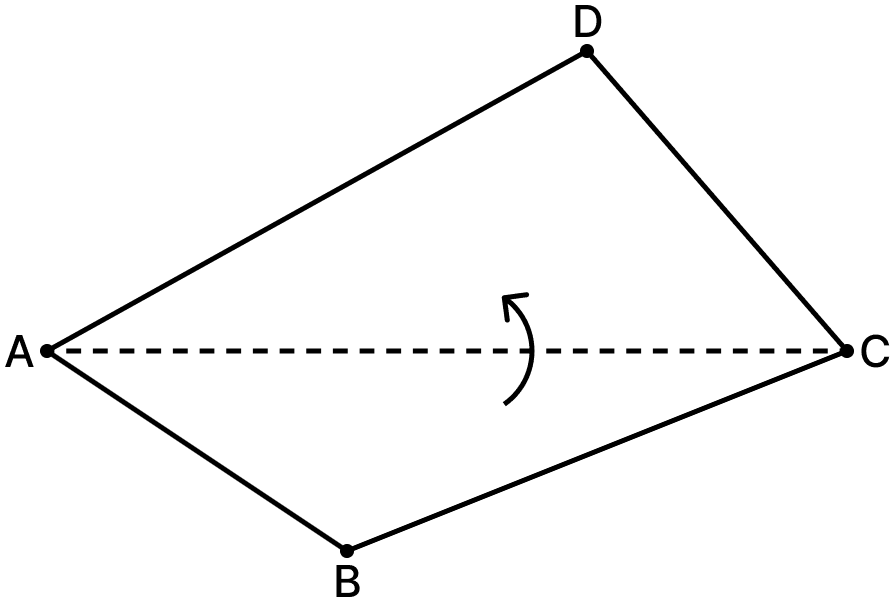
Let ABCD be a non-planar quadrilateral. Join the diagonal AC. It splits ABCD into ∆ABC and ∆ADC, which lie in two different planes meeting along AC.
The angles of ABCD are:
∠B = ∠ABC (an angle of ∆ABC) and ∠D = ∠ADC (an angle of ∆ADC);
∠A = ∠DAB and ∠C = ∠BCD, which are made of parts in the two different triangles.
Key fact: At A, the three rays AB, AC and AD do not lie in one plane. Then
∠DAB < ∠DAC + ∠CAB ...(1)
Reason (hinge idea): keep ∆ABC fixed and rotate ∆ADC about AC. When ∆ADC lies flat in the plane of ∆ABC, on the other side of AC, the angle ∠DAB is exactly ∠DAC + ∠CAB. As ∆ADC is turned out of the plane, D comes closer to B, so the side BD of ∆ABD becomes shorter while AB and AD stay the same. In a triangle with two fixed sides, the angle between them becomes smaller when the third side becomes shorter. So ∠DAB becomes less than ∠DAC + ∠CAB.
In the same way, at C,
∠BCD < ∠BCA + ∠ACD ...(2)
Adding (1) and (2),
∠A + ∠C < (∠CAB + ∠BCA) + (∠DAC + ∠ACD)
Adding ∠B + ∠D to both sides,
∠A + ∠B + ∠C + ∠D < (∠CAB + ∠BCA + ∠ABC) + (∠DAC + ∠ACD + ∠ADC)
∠A + ∠B + ∠C + ∠D < 180° + 180° [Angle sums of ∆ABC and ∆ADC]
∠A + ∠B + ∠C + ∠D < 360°
Hence, the sum of angles of a non-planar quadrilateral is less than 360°.
What happens during the rotation:
∠B and ∠D do not change, since they are angles of the rigid triangles ABC and ADC.
∠A and ∠C keep decreasing as ∆ADC is turned from the flat position on the other side of AC towards the flat position on the same side as ∆ABC. So the sum goes down steadily from 360°.
Sum equal to 2°: Yes, such a quadrilateral exists.
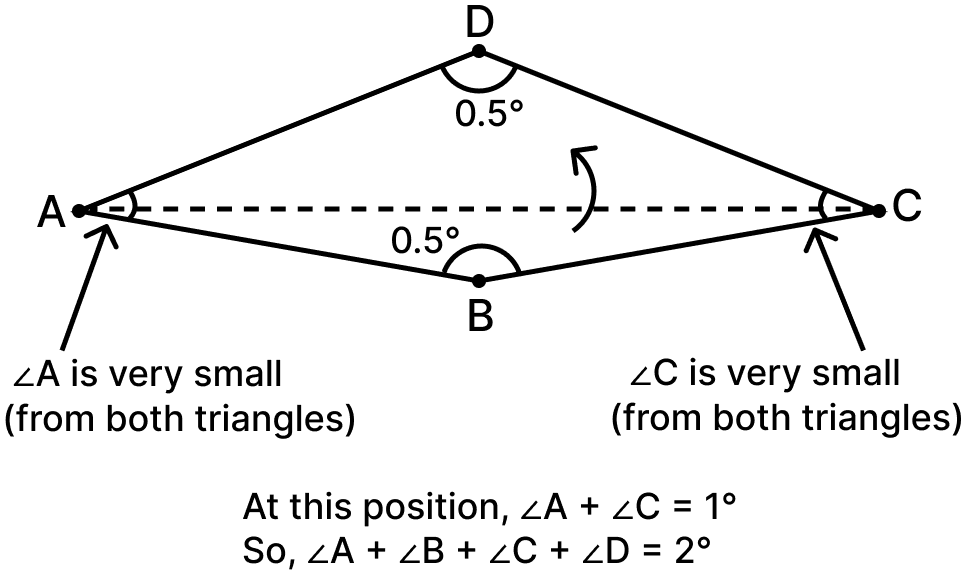
Take ∆ABC and ∆ADC congruent (ABCD a kite) with ∠ABC = ∠ADC = 0.5°, i.e. two very long, thin isosceles triangles on the common base AC.
When ∆ADC lies flat on the other side of AC, the sum is 360°.
When ∆ADC has been turned completely onto ∆ABC, D falls on B, ∠A = 0° and ∠C = 0°, and the sum becomes 0.5° + 0.5° = 1°.
As the turning is gradual, the sum passes through every value between 360° and 1°. So at some position before the end (about 179.5° of turning for these triangles), the sum is exactly 2°. In that position D is not in the plane of ∆ABC, so ABCD is a non-planar quadrilateral.
Hence, there is a non-planar quadrilateral ABCD with ∠A + ∠B + ∠C + ∠D = 2°.
Let us see a third method to tile the plane using a 4-gon.
Focus on only two coloured copies of SOME sharing a vertex. What do you see? It appears that each 4-gon is just a shifted copy of the other. Let us see exactly how. Draw two copies of SOME as shown in Fig. 12.42 so that the diagonals EO and EʹOʹ are collinear with O = Eʹ. Now place a cutout of one copy on top of SOME with diagonal EO drawn on it. Slide this cutout so that segment EO moves along EOʹ until EO matches EʹOʹ. Verify that your cutout exactly matches SʹOʹMʹEʹ.
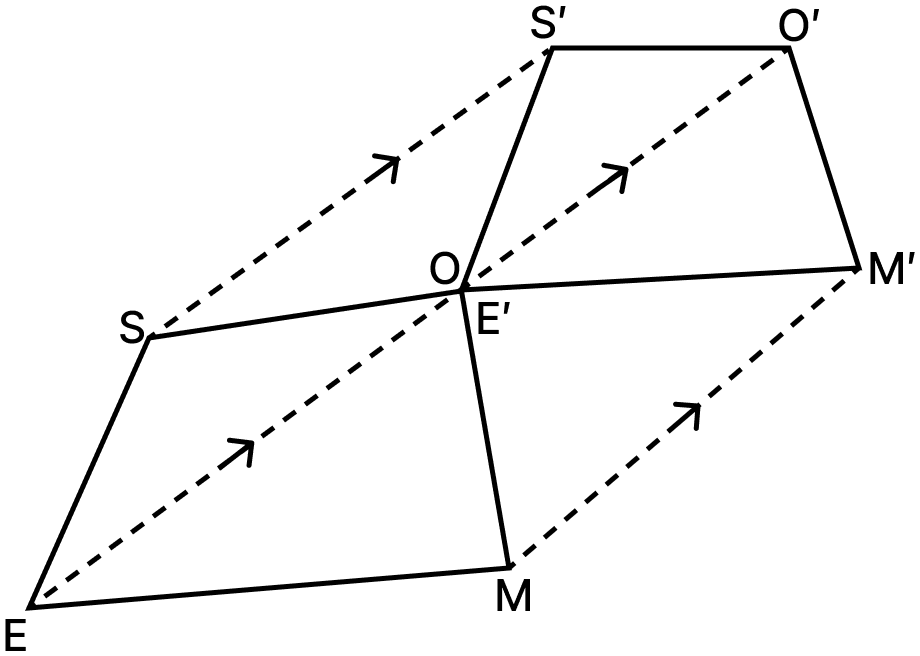
Prove the exact match of SOME with SʹOʹMʹEʹ using four parallelograms.
Answer
SʹOʹMʹEʹ is a copy of SOME placed in the same direction, with EʹOʹ on the line EO, Eʹ = O and EʹOʹ = EO.
Given: SOME ≅ SʹOʹMʹEʹ, placed in the same direction, with E, O = Eʹ, Oʹ on one line and EO = EʹOʹ.
To prove: Sliding SOME along the line EO through the distance EO carries S, O, M, E exactly to Sʹ, Oʹ, Mʹ, Eʹ.
Proof:
When the cutout slides along EOʹ through the distance EO, every point moves the same distance EO in the direction of EO. In particular E moves to O = Eʹ and O moves to Oʹ. We show that S moves to Sʹ and M moves to Mʹ.
Parallelogram 1: EEʹSʹS.
ES = EʹSʹ [Corresponding sides of the copies]
∠SEO = ∠SʹEʹOʹ [Corresponding angles of the copies]
These are corresponding angles for ES and EʹSʹ with the transversal EOʹ, so ES ‖ EʹSʹ.
So EEʹSʹS has a pair of opposite sides equal and parallel; it is a parallelogram [Theorem 5]
∴ SSʹ ‖ EEʹ and SSʹ = EEʹ = EO.
Parallelogram 2: OOʹSʹS.
OS = OʹSʹ [Corresponding sides of the copies]
∠SOE = ∠SʹOʹEʹ [Corresponding angles of the copies]
So OS ‖ OʹSʹ, and OOʹSʹS is a parallelogram [Theorem 5]
∴ SSʹ ‖ OOʹ and SSʹ = OOʹ = EO.
Parallelogram 3: EEʹMʹM
EM = EʹMʹ [Corresponding sides of the copies]
∠MEO = ∠MʹEʹOʹ [Corresponding angles]
Since EO and EʹOʹ lie on the same straight line and point in the same direction,
EM ‖ EʹMʹ [Equal corresponding angles]
Thus, in quadrilateral EEʹMʹM, one pair of opposite sides is equal and parallel.
∴ EEʹMʹM is a parallelogram. [Theorem 5]
So MMʹ ‖ EEʹ
MMʹ = EEʹ = EO
Parallelogram 4: OOʹMʹM
OM = OʹMʹ [Corresponding sides of the copies]
∠MOE = ∠MʹOʹEʹ [Corresponding angles]
Since OE and OʹEʹ lie on the same straight line and point in the same direction,
OM ‖ OʹMʹ [Equal corresponding angles]
Thus, in quadrilateral OOʹMʹM, one pair of opposite sides is equal and parallel.
∴ OOʹMʹM is a parallelogram. [Theorem 5]
So MMʹ ‖ OOʹ
MMʹ = OOʹ = EO
Conclusion
From all four parallelograms, the segments SSʹ and MMʹ are parallel to EO and equal to EO.
Also, EEʹ and OOʹ lie along EO and have length EO.
Therefore, every vertex of SOME moves through the same distance EO in the same direction.
Hence, the slid cutout of SOME matches SʹOʹMʹEʹ exactly.
Let us see a third method to tile the plane using a 4-gon.
Focus on only two coloured copies of SOME sharing a vertex. What do you see? It appears that each 4-gon is just a shifted copy of the other. Let us see exactly how. Draw two copies of SOME as shown in Fig. 12.42 so that the diagonals EO and EʹOʹ are collinear with O = Eʹ. Now place a cutout of one copy on top of SOME with diagonal EO drawn on it. Slide this cutout so that segment EO moves along EOʹ until EO matches EʹOʹ. Verify that your cutout exactly matches SʹOʹMʹEʹ.
Follow the described procedure along each diagonal of the starting coloured 4-gon in both directions to get 4 new 4-gons. Using these 4 copies, repeat the procedure 4 more times to place 4 new copies, resulting in a 3 by 3 grid of 9 copies exactly like the 9 coloured copies in Fig. 12.42. These 9 copies meet each other only at vertices and once again the blank spaces among them also form 4-gons congruent to SOME!
Answer
Let u be the slide along the diagonal EO through the distance EO, and v the slide along the diagonal SM through the distance SM.
Step 1: Slide the starting copy by u, by the reverse of u, by v and by the reverse of v. This gives 4 new copies, each touching the starting copy only at one vertex (O, E, M or S).
Step 2: Slide these new copies again along the other diagonal (for example, the copy shifted by u is now shifted by v and by the reverse of v). This places 4 more copies at the corners, giving a 3 by 3 grid of 9 copies, each a shift of SOME by a combination of u and v.
Step 3: Look at the blank space surrounded by SOME, its shift by u, its shift by v and its shift by both. Its sides are OM (from SOME), a side equal to SO (from the shift by v), a side equal to ES (from the shift by both) and a side equal to ME (from the shift by u). These are the four sides of SOME, and the gap is exactly SOME rotated through 180° about the midpoint of OM — the same copy that Method 1 places next to SOME along OM.
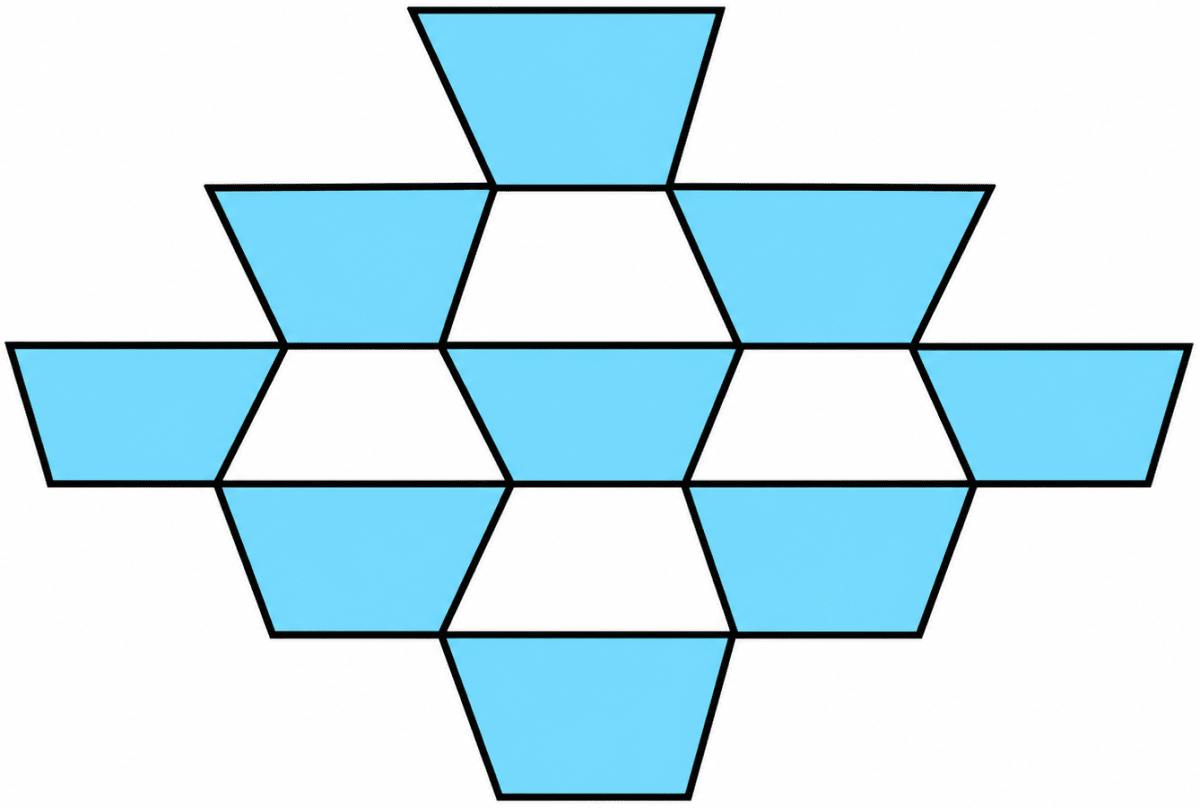
So the blank spaces among the 9 copies are 4-gons congruent to SOME, and filling them gives the same tiling as Methods 1 and 2.
Hence, sliding copies of SOME along its two diagonals gives a grid of copies that meet only at vertices, and the gaps between them are again copies of SOME.
Is there a 4-gon with given side lengths?
Recall the following fact about triangles and check it by construction. For given positive numbers a, b, c, is there a triangle whose sides have these lengths? The answer is Yes exactly when the sum of any two numbers is greater than the third. If we arrange the numbers in increasing order (suppose a ≤ b ≤ c), then this amounts to requiring a + b > c. (Hint: Start by drawing a segment of length c.)
Answer
Let a ≤ b ≤ c.
Why only a + b > c is needed: b + c ≥ b + a > a and a + c ≥ a + b > b hold automatically, because c is the largest. So the only condition that can fail is a + b > c.
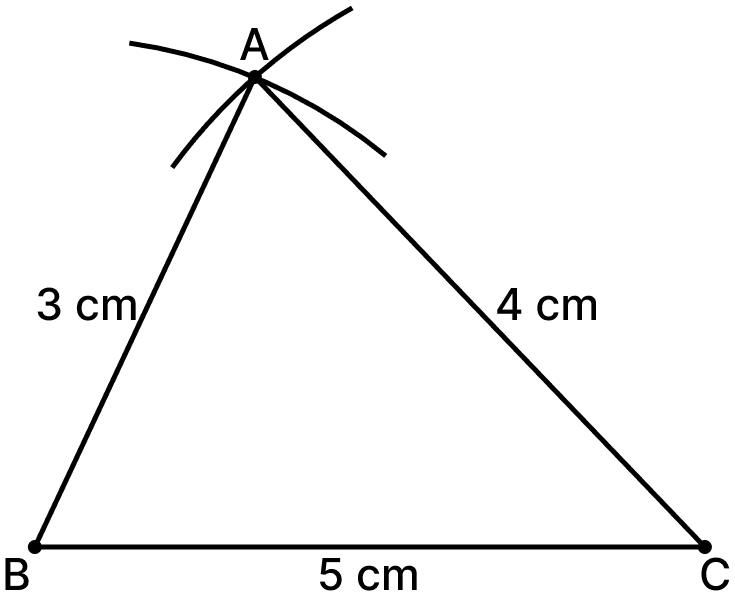
Steps of construction:
Step 1: Draw BC of length c.
Step 2: With centre B and radius a, draw an arc; with centre C and radius b, draw an arc.
Step 3: If the arcs meet at A, then ∆ABC has sides a, b, c.
Check 1: a = 3 cm, b = 4 cm, c = 5 cm.
a + b = 3 + 4 = 7 > 5
The arcs meet (at A, 1.8 cm along BC and 2.4 cm above it), and the triangle is formed.
Check 2: a = 2 cm, b = 3 cm, c = 6 cm.
a + b = 2 + 3 = 5 < 6
The arc of radius 2 cm about B reaches only 2 cm along BC, and the arc of radius 3 cm about C reaches only 3 cm back from C. Together they cover only 2 + 3 = 5 cm of the 6 cm, so the arcs do not meet, and no triangle is formed.
If a + b = c, the arcs meet only on BC itself, giving a straight segment, not a triangle.
Hence, the construction confirms that a triangle with sides a ≤ b ≤ c exists exactly when a + b > c.
Is there a 4-gon with given side lengths?
Suppose a 4-gon has 2, 5, 11 as three side lengths. Can the length of the fourth side be 100? Can it be 10? Can it be 1? What are the possible lengths of the fourth side?
Answer
Condition for a 4-gon: Each side must be less than the sum of the other three.
Reason: In a 4-gon ABCD, the diagonal AC gives triangles ABC and ACD (no three vertices are collinear).
AB < BC + AC [∆ABC]
AC < CD + DA [∆ACD]
⇒ AB < BC + CD + DA
The same holds for every side. (That this condition is also enough is shown in (iii).)
Let the fourth side be x.
x = 100:
Sum of the other three sides = 2 + 5 + 11 = 18
100 > 18, so the side of length 100 is not less than the sum of the others.
The fourth side cannot be 100.
x = 10:
The longest side is 11. Sum of the other three sides = 2 + 5 + 10 = 17
11 < 17, and each of 2, 5, 10 is also less than the sum of the other three.
A 4-gon can be built: Take a diagonal of length 5; construct the triangle with sides 2, 5, 5 on one side of it and the triangle with sides 11, 10, 5 on the other side.
2 + 5 = 7 > 5 and 5 + 10 = 15 > 11, so both triangles exist.
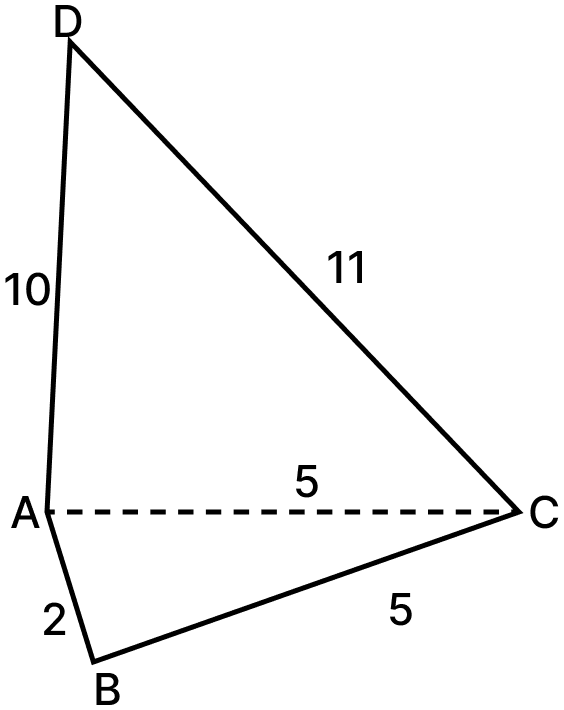
The fourth side can be 10.
x = 1:
The longest side is 11. Sum of the other three sides = 2 + 5 + 1 = 8
11 > 8, so the side of length 11 is not less than the sum of the others.
The fourth side cannot be 1.
All possible lengths:
The side 11 must be less than the sum of the others:
11 < 2 + 5 + x
⇒ 11 < 7 + x
⇒ x > 4
The side x must be less than the sum of the others:
x < 2 + 5 + 11
⇒ x < 18
The sides 2 and 5 are then automatically less than the sum of the other three.
Hence, the fourth side can have any length x with 4 < x < 18; so 10 is possible, while 100 and 1 are not.
Is there a 4-gon with given side lengths?
For given positive numbers a, b, c, d, how will you decide if there is a 4-gon whose sides have these lengths?
Answer
Arrange the numbers so that d is the largest.
Rule: a 4-gon with sides a, b, c, d exists exactly when d < a + b + c (the largest number is less than the sum of the other three).
Necessity: Each side of a 4-gon is less than the sum of the other three.
Sufficiency: suppose each number is less than the sum of the other three. Keep the sides a, b on one side of a diagonal of length t and c, d on the other. We need a length t with
|a - b| < t < a + b
and
|c - d| < t < c + d
so that both triangles exist (part (i)). Such a t exists because each lower bound is less than each upper bound:
|a - b| < c + d, since a < b + c + d and b < a + c + d;
|c - d| < a + b, since c < a + b + d and d < a + b + c.
Hence, a 4-gon with sides a, b, c, d exists exactly when the largest of the four numbers is less than the sum of the other three.
Counting diagonals of a polygon.
How should we define a diagonal of an n-gon? How many diagonals does an n-gon have? Make a table for small values of n. A 3-gon has no diagonals. A 4-gon has 2. How many diagonals does a 5-gon have? A 6-gon? Try to find a pattern and guess the answers for n = 7 and n = 8. Check your guesses by systematic counting.
Answer
Definition: A diagonal of an n-gon is a segment joining two vertices that are not adjacent (that are not the two endpoints of a side).
Counting for small n:
5-gon ABCDE: diagonals AC, AD, BD, BE, CE — 5 diagonals.
6-gon ABCDEF: from A: AC, AD, AE; from B: BD, BE, BF; from C: CE, CF; from D: DF — 3 + 3 + 2 + 1 = 9 diagonals.
| n | 3 | 4 | 5 | 6 |
|---|---|---|---|---|
| Number of diagonals | 0 | 2 | 5 | 9 |
Pattern: the differences are 2 - 0 = 2, 5 - 2 = 3, 9 - 5 = 4. They increase by 1 each time.
Guess for n = 7: 9 + 5 = 14
Guess for n = 8: 14 + 6 = 20
Checking by systematic counting: Each vertex of an n-gon can be joined to n - 1 other vertices; 2 of these are its neighbours (sides), so each vertex is an endpoint of n - 3 diagonals. Counting this way, every diagonal is counted twice (once from each end).
No. of vertices = n
Diagonals at each vertex = d = (n - 3)
Number of diagonals =
For n = 7:
Number of diagonals =
=
=
= 14
For n = 8:
Number of diagonals =
=
=
= 20
Both guesses are correct.
| n | 3 | 4 | 5 | 6 | 7 | 8 |
|---|---|---|---|---|---|---|
| Number of diagonals | 0 | 2 | 5 | 9 | 14 | 20 |
Hence, a 5-gon has 5 diagonals, a 6-gon has 9, a 7-gon has 14 and an 8-gon has 20.
Counting diagonals of a polygon.
Can you guess a formula for the number of diagonals? How many diagonals get added when we increase the number of sides by 1? Can you now justify why the formula you guessed is true for all n?
Answer
Formula: Number of diagonals of an n-gon =
Check: n = 4 gives = 2; n = 5 gives = 5; n = 6 gives = 9.
Diagonals added when the number of sides increases by 1: Start with an n-gon V1V2…Vn and insert a new vertex W between Vn and V1, to get an (n + 1)-gon.
W is joined by diagonals to every old vertex except its neighbours Vn and V1: that is n - 2 new diagonals.
The old side VnV1 is no longer a side, so it becomes 1 more diagonal.
Diagonals added = (n - 2) + 1 = n - 1
This matches the table: going from n = 5 to n = 6 adds 5 - 1 = 4 diagonals (5 → 9).
Justification for all n: the formula is true for n = 3, since = 0. Suppose it is true for some n. Then the (n + 1)-gon has
+ (n - 1) diagonals
which is the formula with n + 1 in place of n. Going step by step from n = 3 to 4, 5, 6, …, the formula holds for every n. (The counting argument in (i) also proves it directly.)
Hence, an n-gon has diagonals, and increasing the number of sides from n to n + 1 adds n - 1 diagonals.
Sum of angles of a polygon. What is the sum of angles of a (planar non-self-intersecting) n-gon? We know that the answer is 180° for n = 3 and 360° for n = 4. Find the next few values. Then find a formula in terms of n and prove it.
Answer
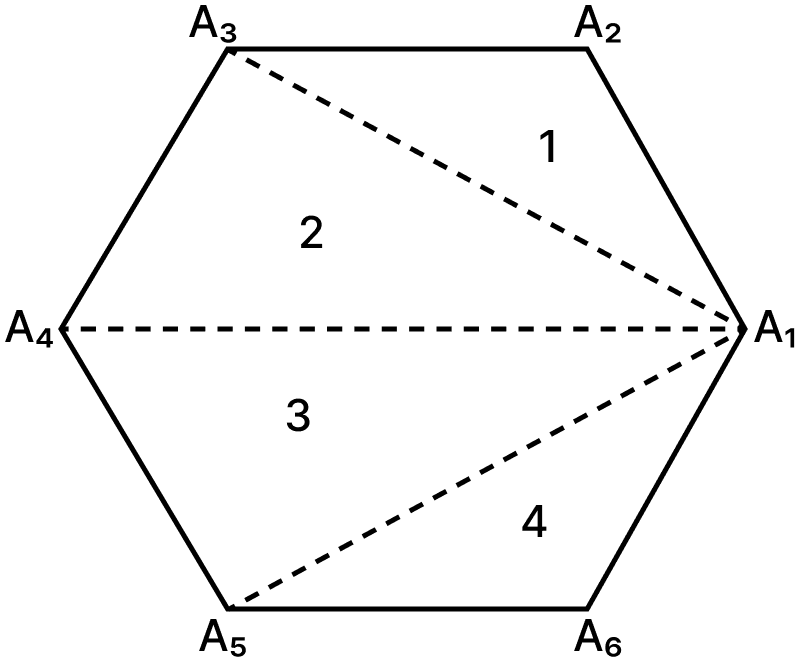
Next few values: the diagonals from one vertex of a convex n-gon divide it into n - 2 triangles (the figure shows this for n = 6: 4 triangles). The angles of these triangles together make up the angles of the n-gon.
n = 5: number of triangles = 5 - 2 = 3
Sum of angles = 3 × 180° = 540°
n = 6: number of triangles = 6 - 2 = 4
Sum of angles = 4 × 180° = 720°
n = 7: number of triangles = 7 - 2 = 5
Sum of angles = 5 × 180° = 900°
n = 8: number of triangles = 8 - 2 = 6
Sum of angles = 6 × 180° = 1080°
| n | 3 | 4 | 5 | 6 | 7 | 8 |
|---|---|---|---|---|---|---|
| Sum of angles | 180° | 360° | 540° | 720° | 900° | 1080° |
Each extra side adds 180°.
Formula: Sum of the angles of an n-gon = (n - 2) × 180°
Proof:
Convex n-gon: Join one vertex A1 to each of the n - 3 vertices that are not its neighbours. These diagonals lie inside the polygon and divide it into n - 2 triangles, A1A2A3, A1A3A4, …, A1An-1An. The angles of all these triangles together make up exactly the angles of the polygon. So the sum is (n - 2) × 180°.
Any (possibly non-convex) n-gon: we use the fact that every n-gon with n ≥ 4 has a diagonal lying inside it. (Take a vertex V whose angle is less than 180°, for example a lowest vertex, with neighbours U and W. If UW lies inside the polygon, it is such a diagonal. Otherwise some vertices lie inside ∆UVW; joining V to the one farthest from UW gives such a diagonal.)
This diagonal cuts the n-gon into a k-gon and an (n - k + 2)-gon, both with fewer sides, whose angles together make up the angles of the n-gon. Assuming the formula for polygons with fewer sides (it is true for n = 3),
Sum = (k - 2) × 180° + (n - k + 2 - 2) × 180°
= (k - 2 + n - k) × 180°
= (n - 2) × 180°
So the formula holds for 4-gons, then for 5-gons, and so on for every n.
Hence, the sum of angles of a (planar non-self-intersecting) n-gon is (n - 2) × 180°: 540° for n = 5, 720° for n = 6, 900° for n = 7 and 1080° for n = 8.
Multiple converses to a theorem. Let us see how multiple statements can be considered converses to the Midpoint Theorem and how Theorem 7 is one of them.
To formulate a converse we should express the original statement in “If … then …” form. For a complex statement, there may be multiple ways to do that. The Midpoint Theorem starts with ∆ABC and points P and Q on sides AB and AC respectively. The theorem has two assumptions and two conclusions, which we have named for further discussion.
| Assumptions: | (P MID) P is the midpoint of AB, and | (Q MID) Q is the midpoint of AC. |
|---|---|---|
| Conclusions: | (PRLL) PQ ‖ BC, and | (HALF) PQ = . |
Let us use these four named conditions to discuss various possible statements.
(i) A natural converse of the Midpoint Theorem would be: “If (PRLL) and (HALF) are true, then (P MID) and (Q MID) are true.” Write out this statement fully. Experiment and see that it seems to be true! Prove the statement. (Hint: Try to run a proof of the Midpoint Theorem backwards.)
(ii) To see Theorem 7 as a converse of the Midpoint Theorem, we first write the Midpoint Theorem as follows: “Suppose P is the midpoint of side AB of ∆ABC and Q is a point on side AC. If Q is the midpoint of AC then PQ ‖ BC.” (Also PQ = , but let us set that aside for now.) Write the converse of the second sentence in quotes by keeping the first sentence the same. Verify that Theorem 7 is what you get! (And PQ = also follows.) Now write Theorem 7 in terms of the four named conditions.
(iii) The discussion so far suggests that it is reasonable to take two of the four listed statements as assumptions and ask if the other two are true. Verify that only one such combination remains to be examined. “If (P MID) and (HALF) are true, then can we conclude (Q MID) and/or (PRLL)?” Write this out in words. This is a precise version of question (1) stated before Theorem 7. Can you answer it?
In the text, why did we focus only on Theorem 7 among the multiple possibilities? Because Theorem 7 turns out to be particularly useful. It is still important to pursue various avenues while exploring a subject: often it is only after examining multiple possibilities that we can judge what is most valuable.
Answer
(i) Statement in full: In ∆ABC, let P and Q be points on the sides AB and AC. If PQ ‖ BC and PQ = BC, then P is the midpoint of AB and Q is the midpoint of AC.
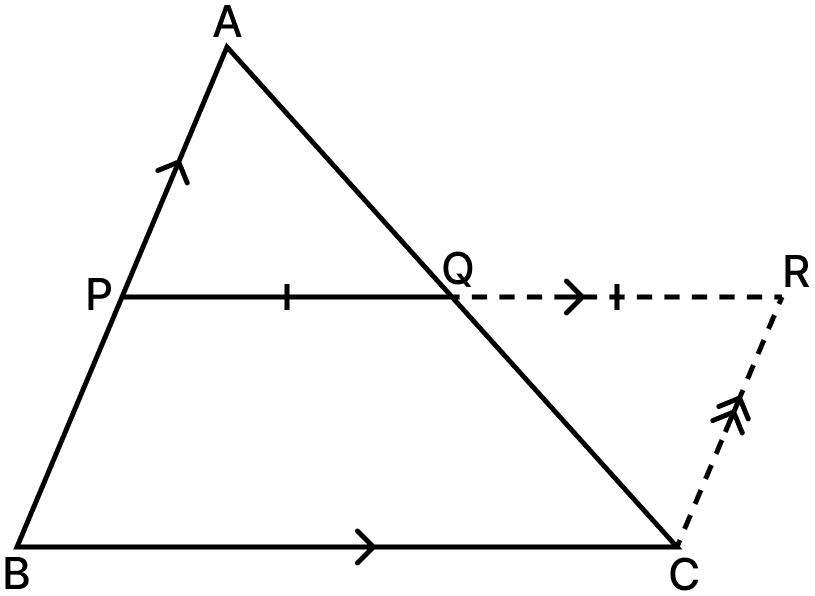
Given: In ∆ABC, P lies on AB and Q lies on AC, with PQ ‖ BC and PQ = BC.
To prove: AP = PB and AQ = QC.
Construction: Through C draw the line parallel to BA, meeting PQ produced at R.
Proof:
PR ‖ BC and BP ‖ CR [Given; by construction]
∴ BCRP is a parallelogram.
⇒ PR = BC and CR = BP [Opposite sides of a parallelogram] ...(1)
PQ = BC = PR [Given; from (1)]
So Q is the midpoint of PR, i.e. PQ = RQ.
In ∆APQ and ∆CRQ:
∠AQP = ∠CQR [Vertically opposite angles]
PQ = RQ
∠APQ = ∠CRQ [Alternate angles, AP ‖ RC with transversal PR]
∆APQ ≅ ∆CRQ [By ASA condition of congruence]
∴ AQ = CQ and AP = CR [Corresponding parts of congruent triangles]
AP = CR = BP [From (1)]
So Q is the midpoint of AC and P is the midpoint of AB.
Hence proved.
(ii) Converse of the second sentence (first sentence kept the same): “Suppose P is the midpoint of side AB of ∆ABC and Q is a point on side AC. If PQ ‖ BC, then Q is the midpoint of AC.”
This says that the line through the midpoint P of AB parallel to BC meets AC at its midpoint — exactly Theorem 7. Theorem 7 also gives PQ = .
Theorem 7 in terms of the named conditions: “If (P MID) and (PRLL) are true, then (Q MID) and (HALF) are true.”
(iii) The combinations: the number of ways of choosing 2 of the 4 conditions as assumptions is
= 6
(P MID) and (Q MID) — the Midpoint Theorem.
(PRLL) and (HALF) — part (i).
(P MID) and (PRLL) — Theorem 7.
(Q MID) and (PRLL) — Theorem 7 with the roles of the sides AB and AC interchanged.
(Q MID) and (HALF) — the same as combination 6 with the roles of AB and AC interchanged.
(P MID) and (HALF) — not yet examined.
So only one combination remains to be examined.
In words: In ∆ABC, let P be the midpoint of side AB and let Q be a point on side AC such that PQ = BC. Must Q be the midpoint of AC, and must PQ be parallel to BC?
Answer: Not necessarily.
The midpoint M of AC is one such point, since PM = BC (Midpoint Theorem). But the circle with centre P and radius BC can meet AC at a second point as well.
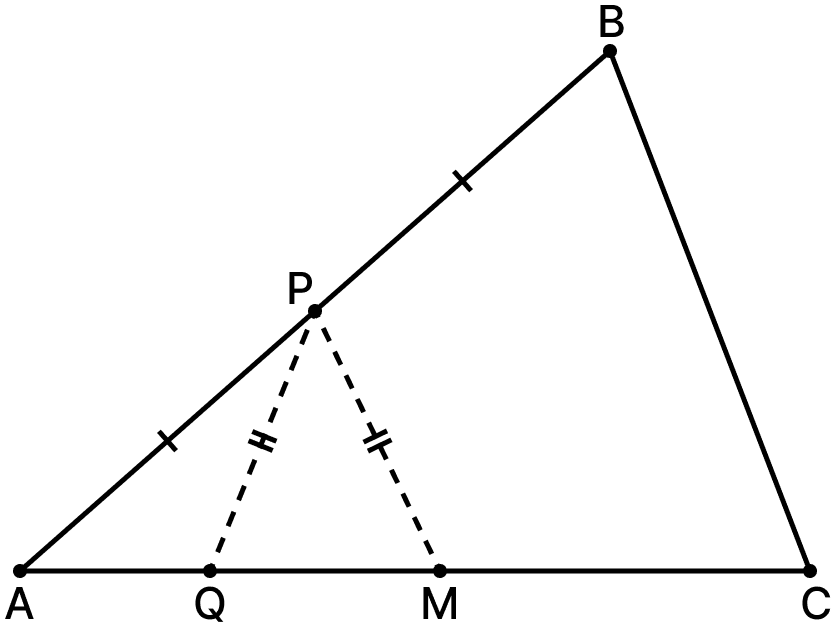
Counterexample: A = (0, 0), B = (6, 4), C = (8, 0), so P = (3, 2). Take Q = (2, 0) on AC.
Let B = (x1, y1) = (6, 4) and C = (x2, y2) = (8, 0)
BC =
=
=
=
=
Let P = (p1, q1) = (3, 2) and Q = (p2, q2) = (2, 0)
PQ =
=
=
=
= BC
So (P MID) and (HALF) hold. But AQ = 2 and QC = 8 - 2 = 6, so Q is not the midpoint of AC, and PQ is not parallel to BC (PQ is parallel to BC only for the midpoint M = (4, 0)).
Hence, from (P MID) and (HALF) we cannot conclude (Q MID) or (PRLL): Q may be the midpoint of AC, but it may also be the second point of AC at distance BC from P.
Validity of tiling methods. Show using reasoning that each of the three tiling methods we saw produces a tiling of the plane using the given 4-gon. You have to prove that when we place new copies using any of the three procedures, the entire plane is covered with no gaps and no overlaps. First, think carefully about what it means to prove this. Then find a proof for each procedure.
Answer
What has to be proved: For the copies placed by a procedure,
(a) no gaps — every point of the plane lies in at least one copy;
(b) no overlaps — no point lies inside two different copies.
Let the 4-gon be SOME, let K1, K2, K3, K4 be the midpoints of SO, OM, ME, ES, and let V = K1K2K3K4 be its Varignon parallelogram. By the Midpoint Theorem, K1K2 ‖ SM, K1K2 = SM and K2K3 ‖ OE, K2K3 = OE.
Let ∠1, ∠2, ∠3, ∠4 be the angles of SOME at S, O, M, E, so ∠1 + ∠2 + ∠3 + ∠4 = 360°. V is used only as a guide for placing copies: for a non-convex 4-gon, part of V can lie outside the 4-gon (for the dart DART of Exercise Set 12.4 Q2, a triangle of area 1 cm2 of V lies in the dent).
Method 1 (rotation about midpoints of edges):
Step 1: Two half-turns make a slide. Take any point X. Turn it through 180° about K2 to get Xʹ, and turn Xʹ through 180° about K3 to get Xʺ. Then K2 is the midpoint of XXʹ and K3 is the midpoint of XʹXʺ.
In ∆XXʹXʺ, K2K3 ‖ XXʺ and K2K3 = XXʺ [Midpoint Theorem]
⇒ XXʺ = 2K2K3
= 2 × OE [K2K3 = OE]
= OE
Also XXʺ ‖ K2K3 ‖ OE.
So every point moves the same distance OE in the same direction: the two half-turns together slide the plane along the diagonal OE (O goes to E). In the same way, two half-turns about the midpoints of two other adjacent sides slide the plane along a diagonal. So every copy placed by Method 1 is either SOME or the turned copy (SOME rotated through 180° about K2), slid by combinations of the diagonal slides along EO and SM.
Step 2: Edges match. The copy across a side, say OM, is the half-turn of SOME about K2. It has the same side OM, with O and M interchanged, and it lies on the other side of the line OM, since a half-turn about a point of a line takes each side of the line to the other side. So along every side, exactly two copies meet, one on each side, edge to edge.
Step 3: The angles fill each vertex once. Look at the vertex O of SOME. Four copies have a corner at O:
SOME itself, with ∠2;
the half-turn of SOME about K1 (across OS), whose corner at O is the image of S, with ∠1;
the half-turn of SOME about K2 (across OM), whose corner at O is the image of M, with ∠3;
SOME slid along the diagonal EO so that E goes to O, whose corner at O is the image of E, with ∠4. Its two sides at O are the slid copies of ES and EM; these are exactly the free sides at O of the two turned copies, so it fits between them edge to edge.
∠1 + ∠2 + ∠3 + ∠4 = 360°, so the four copies fill the space around O exactly once, with no gap and no overlap. Every vertex of the arrangement is a corner S, O, M or E of a slid or turned copy, so the same holds at every vertex.
Step 4: The copies fit edge to edge along every side (Step 2) and fill the angle around every vertex exactly once (Step 3), and the diagonal slides carry copies as far as we like in every direction. So the copies cover the whole plane with no gaps and no overlaps. (This also explains the two facts noted in the text: a new copy can be obtained by rotating either neighbour, because both give the same position, and the new copies fit perfectly.)
Method 2 (Varignon grid):
Step 1: Copies of V tile the plane as a grid of parallelograms (as in the introduction). The sides of V are K1K2 = SM and K2K3 = OE, so a diagonal slide along SM or EO moves a cell by exactly two cells.
Step 2: In the arrangement of Method 1, the Varignon parallelogram of each copy is a copy of V. The slid copies of SOME have their Varignon parallelograms two cells apart; the turned copy has as its Varignon parallelogram the half-turn of V about K2, which is the cell meeting V only at the corner K2. So the Varignon parallelograms of all the copies occupy the shaded cells of a checkerboard pattern of the grid.
Step 3: Method 2 places a copy of SOME on each shaded cell so that the cell is its Varignon parallelogram, in the matching (slid or turned) position. This places exactly the copies of Method 1, so by Steps 1–4 of Method 1 they cover the plane with no gaps and no overlaps. The blank cells are covered by parts of the neighbouring copies.
Method 3 (sliding along the diagonals):
By Question 18, sliding SOME along its diagonals EO and SM gives exactly the slid copies of SOME above, and the gaps are the 180°-rotated copies. This is again the same arrangement as in Method 1, so it covers the plane without gaps or overlaps.
Hence, all three procedures produce the same arrangement of copies of SOME, and this arrangement covers the whole plane with no gaps and no overlaps.
What fraction of the square is shaded?
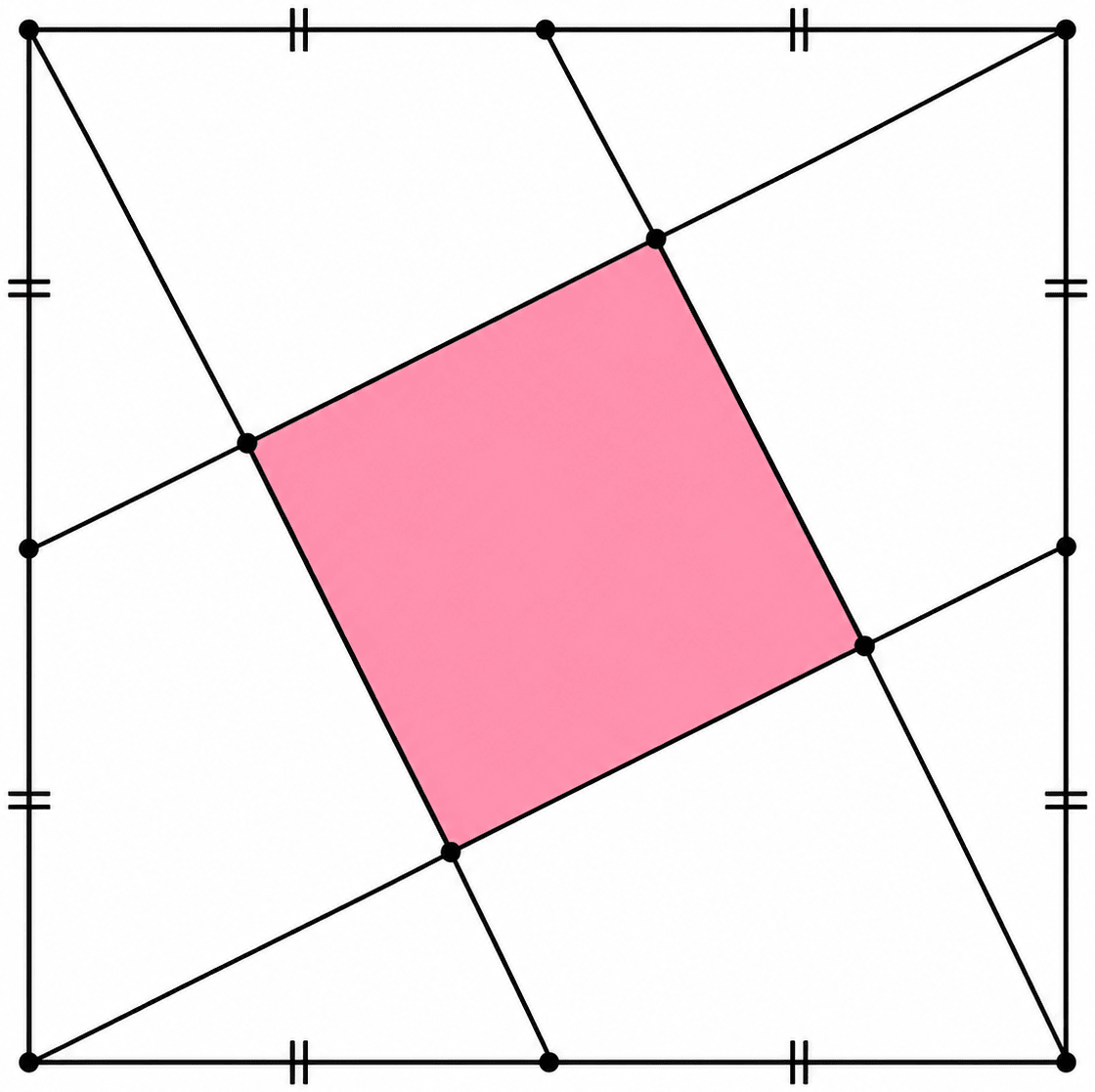
Answer
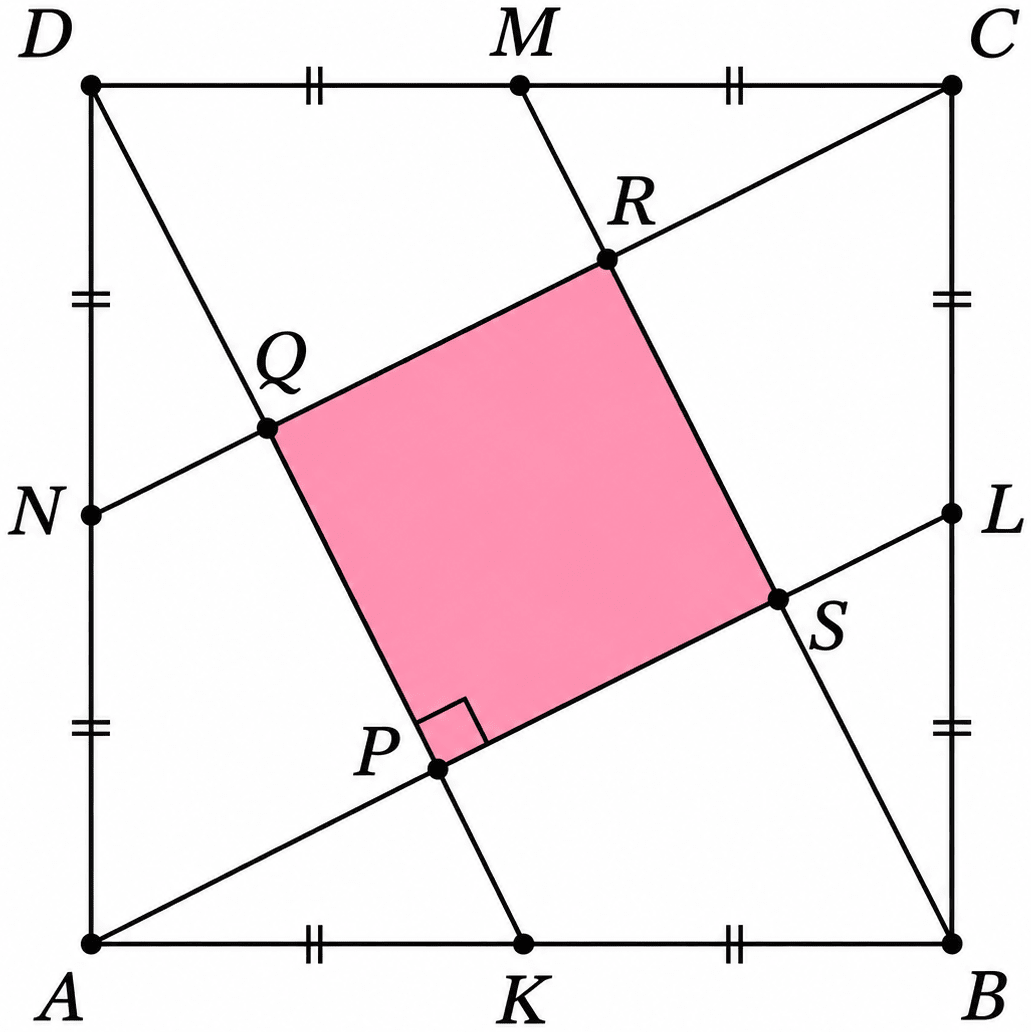
Name the square ABCD (A bottom-left, B bottom-right, C top-right, D top-left), with K, L, M, N the midpoints of AB, BC, CD, DA. The four segments are DK, MB, CN and LA. They form the shaded figure PQRS, where P = DK ∩ AL, Q = DK ∩ CN, R = MB ∩ CN and S = MB ∩ AL.
Step 1: DK ∥ MB and AL ∥ CN.
DM = DC = AB = KB and DM ‖ KB, so DKBM is a parallelogram [Theorem 5]
∴ DK ‖ MB.
AN = AD = BC = LC and AN ‖ LC, so ANCL is a parallelogram [Theorem 5]
∴ AL ‖ NC.
Step 2: DK ⊥ CN.
In ∆ADK and ∆DCN:
AD = DC [Sides of a square]
∠DAK = ∠CDN = 90°
AK = DN [Each is half a side]
∆ADK ≅ ∆DCN [By SAS condition of congruence]
∴ ∠ADK = ∠DCN ...(1)
In ∆DQC,
∠QDC + ∠QCD = (90° - ∠ADK) + ∠DCN [∠ADC = 90°]
= 90° [From (1)]
∴ ∠DQC = 180° - 90° = 90°, i.e. DK ⊥ CN.
As AL ‖ CN, also DK ⊥ AL, so ∠APD = 90°.
So PQRS has both pairs of opposite sides parallel (Step 1) and a right angle: it is a rectangle.
Step 3: AP = PS and DQ = QP.
In ∆ABS, K is the midpoint of AB and KP ‖ BS (DK ‖ MB).
∴ P is the midpoint of AS [Theorem 7]
⇒ AP = PS ...(2)
In ∆DAP, N is the midpoint of DA and NQ ‖ AP (CN ‖ AL).
∴ Q is the midpoint of DP [Theorem 7]
⇒ DQ = QP ...(3)
Step 4: AP = DQ.
In ∆APD and ∆DQC:
∠APD = ∠DQC = 90° [Step 2]
∠PDA = ∠QCD [From (1)]
AD = DC [Sides of a square]
∆APD ≅ ∆DQC [By AAS condition of congruence]
∴ AP = DQ ...(4)
Step 5: Areas. Let AP = a.
PS = AP = a [From (2)]
PQ = DQ = AP = a [From (3) and (4)]
So the rectangle PQRS has two adjacent sides equal: it is a square of side a.
Area of the shaded square PQRS = a × a = a2
DP = DQ + QP = a + a = 2a
In right-angled ∆APD, by the Baudhāyana–Pythagoras theorem:
AD2 = AP2 + DP2
= a2 + (2a)2
= a2 + 4a2
= 5a2
Area of the square ABCD = AD2 = 5a2
Fraction shaded =
=
=
Hence, of the square is shaded.