
Non-renewable resources, once exhausted, cannot be replenished. This is called
- Depletion of Resources
- Utilisation of Resources
- Sustainable Development
- None of these
Answer
Depletion of Resources
Reason — When natural resources are misused or overused, they may not be available in the future. Non-renewable resources such as oil, minerals, and coal, once exhausted, cannot be replenished. This phenomenon is called Depletion of Resources. Today, our technological society is consuming natural resources at a very fast speed and in an unchecked manner, so the natural resources are being depleted at a great speed.
The main causes for depletion of resources are
- Over use/Irrational use
- Population Growth
- Non-equitable distribution of Resources
- All of these
Answer
All of these
Reason — The four main causes identified for depletion of resources are: (i) Overuse/Irrational use of resources, (ii) Non-equitable (unequal) distribution of resources, (iii) Technological and industrial development, and (iv) Population growth. Hence, all three options listed are valid causes of depletion of resources.
Destruction of vegetation and overgrazing causes widespread soil erosion.
- True
- False
Answer
True
Reason — When vegetation is destroyed (through deforestation) and grasslands are overgrazed by livestock, there are no roots left to bind the soil and no canopy to break the force of rainfall. As a result, the fertile topsoil is easily washed away by water or blown away by wind. This is called soil erosion, and it is a major cause of depletion of soil resources.
Statement I: Natural resources are equally distributed over the world.
Statement II: Urbanisation, industrialisation and mining have resulted in destruction of forests.
- Only I is correct
- Only II is correct
- Both I and II are correct
- Both I and II are wrong
Answer
Only II is correct
Reason — Statement I is incorrect because natural resources are UNEQUALLY distributed over the world. For example, petroleum reserves are mainly confined to Middle East countries, and in India water is unequally distributed as not all states have sufficient water resources. Statement II is correct as the chapter states that urbanisation, industrialisation, and mining have resulted in destruction of forests, leading to depletion of wildlife.
Fast technological development and industrialisation causes depletion of fossil fuels.
- True
- False
Answer
True
Reason — Continuous use and consumption of resources is bound to deplete the resources if they cannot be renewed. Fast technological development and industrialisation causes depletion of fossil fuels like coal, petroleum, and natural gas, since industries demand huge amounts of energy. For example, coal is used as a source of energy for industry and is also converted into coal gas, electricity, and synthetic oil — as a result, the coal stock is rapidly depleting.
In a village, the population has doubled in the last decade. The groundwater resources are overused for agriculture and drinking purposes, causing water scarcity. Crops are failing, and villagers are migrating to nearby cities. Which sustainable practice could help address groundwater depletion in this village?
- Switching to industrialization.
- Using rainwater harvesting techniques.
- Digging more borewells.
- Constructing dams.
Answer
Using rainwater harvesting techniques
Reason — Rainwater harvesting captures and stores rainwater for future use and helps recharge the depleting groundwater. It is a sustainable practice that does not deplete the resource further. Switching to industrialisation would worsen water demand, digging more borewells would accelerate groundwater depletion, and constructing dams may not address local groundwater scarcity. Hence, rainwater harvesting is the most sustainable solution.
Natural resources are
- In unlimited quantity
- In limited quantity
- Unevenly distributed across the world
- Both (2) and (3)
Answer
Both (2) and (3)
Reason — Natural resources are not unlimited — they exist in limited quantities, and many of them (like fossil fuels and minerals) are non-renewable. Additionally, they are unevenly distributed across the world. For example, petroleum reserves are mainly in the Middle East, coal reserves in India are concentrated in Jharkhand and Madhya Pradesh, and water is unequally distributed across Indian states. Hence, both statements are correct.
Ill effects caused by Depletion of Resources are:
- Imbalance in nature
- Shortage of materials
- Struggle for existence
- All of these
Answer
All of these
Reason — According to the chapter, the ill effects caused by depletion of resources include: (1) Imbalance in nature, (2) Shortage of materials, (3) Struggle for existence, and (4) Slackening of economic growth. Since all three options listed (imbalance in nature, shortage of materials, and struggle for existence) are valid ill effects, the correct answer is "All of these".
The economic growth of a country does not depends upon the availability of resources.
- True
- False
Answer
False
Reason — The chapter clearly states that "the economic growth of a country depends upon the availability of resources." Depletion of resources adversely affects economic growth. For example, the decreased supply of petroleum in the 1970s, due to rising international prices of the commodity, slackened economic growth in India. Hence, the statement that economic growth "does not depend" on resources is false.
How does deforestation directly contribute to the depletion of soil resources?
- By increasing groundwater levels.
- By promoting plant growth in barren areas.
- By exposing soil to erosion due to lack of vegetation.
- By reducing the mineral content of soil.
Answer
By exposing soil to erosion due to lack of vegetation
Reason — Deforestation removes the vegetation cover, leaving the soil exposed to wind and water. Without tree roots to bind the soil and the canopy of trees to break the force of falling rain, the fertile topsoil is easily eroded. The chapter mentions that destruction of vegetation and overgrazing cause widespread soil erosion. Hence, deforestation directly contributes to the depletion of soil resources through erosion.
In a village, the population has doubled in the last decade. The groundwater resources are overused for agriculture and drinking purposes, causing water scarcity. Crops are failing, and villagers are migrating to nearby cities. Which sustainable practice could help address groundwater depletion in this village?
- Switching to industrialization.
- Using rainwater harvesting techniques.
- Digging more borewells.
- Constructing dams.
Answer
Using rainwater harvesting techniques
Reason — Rainwater harvesting captures rainwater for future use and helps recharge groundwater, making it the most sustainable solution to address depletion in a village facing water scarcity. The other options either worsen the demand for water (industrialisation), accelerate depletion (more borewells), or do not directly address groundwater recharge at the village level (dams).
Which technological input in agriculture has a dual impact, improving crop productivity while also degrading soil?
- Organic fertilizers.
- Pesticides and chemical fertilizers.
- Manual farming methods.
- Sustainable irrigation techniques.
Answer
Pesticides and chemical fertilizers
Reason — Technological inputs like improved seeds, irrigation facilities, pesticides, and chemical fertilizers have contributed significantly to the Green Revolution and enhanced crop productivity. However, the chapter notes that soil and water pollution are caused by indiscriminate use of fertilizers and pesticides — this is the major negative impact of technological developments in the agriculture field. Thus, they improve productivity but degrade the soil.
What is the primary reason for the uneven distribution of water resources in India?
- Overuse of water resources.
- Unequal geographical rainfall patterns.
- Lack of rivers in the southern states.
- High industrial water demand.
Answer
Unequal geographical rainfall patterns
Reason — In India, water is unequally distributed because all states do not receive the same amount of rainfall. Geographical rainfall patterns vary widely — some regions receive heavy monsoon rains while others remain dry. As a result, there is increasing demand for water supply in water-scarce areas, and inter-state disputes over water are common. Overuse, lack of rivers, and industrial demand are secondary factors; the primary reason is the unequal natural rainfall distribution.
Which of the following measures can reduce soil erosion caused by agricultural activities?
- Monoculture farming.
- Crop rotation and contour plowing.
- Expanding mining activities.
- Overuse of chemical pesticides.
Answer
Crop rotation and contour plowing
Reason — Crop rotation maintains soil fertility by alternating crops with different nutrient requirements, while contour plowing reduces surface runoff and prevents the topsoil from being washed away on sloping land. Together, these practices conserve soil and prevent erosion. In contrast, monoculture depletes specific soil nutrients, mining destroys land, and overuse of pesticides causes soil pollution — all of which worsen soil degradation.
Due to the ever increasing population, the consumption of resources is increasing at a fast rate.
- True
- False
Answer
True
Reason — The chapter clearly states that due to the ever-increasing population, the consumption of resources is increasing at a fast rate. In India, urban population is growing thrice the growth rate of the national population, putting tremendous strain on resources like land, electricity, transport, and fossil fuels. To feed more people, more land is brought under agriculture by cutting forests, depleting forests and wildlife.
A country has abundant petroleum reserves in one region while other regions struggle with fuel shortages, leading to conflicts and economic disparities. What is the main issue highlighted in this case?
- Overuse of resources.
- Unequal distribution of resources.
- Lack of industrialization.
- Decrease in population.
Answer
Unequal distribution of resources
Reason — The case clearly describes one region of a country having abundant petroleum reserves while other regions face shortages, causing conflicts and economic disparities. This is a textbook example of unequal (non-equitable) distribution of natural resources. The chapter mentions that petroleum reserves are mainly confined to the Middle East countries, which has led to serious depletion problems for worldwide needs and required extra resources like transportation and pipelines to carry resources to areas of need.
What do you mean by environmental degradation?
Answer
Environmental degradation refers to the deterioration of the environment due to human activities like deforestation, pollution, climate change, and overexploitation of natural resources. It leads to loss of biodiversity, soil erosion, air and water pollution, and negatively impacts ecosystems and human health.
What are the various causes of depletion of resources?
Answer
The main causes identified for depletion of resources are:
Overuse / Irrational Use of Resources — Overuse of resources causes depletion of soil, plant cover, minerals and wildlife.
Unequal / Non-equitable Distribution of Resources — Natural resources are unequally distributed over the world,leading to over-exploitation in resource-rich regions.
Technological and Industrial Development — Industries and fast technological development demands minerals, fuels and energy depletion.
Population Growth — Due to the ever-increasing population, the consumption of resources is increasing at a fast rate. a
How soil and water pollution is caused due to agricultural development?
Answer
Soil and water pollution are caused due to agricultural development by the indiscriminate use of fertilisers and pesticides. These chemicals may remain in the soil, reduce its quality and get washed into ponds, rivers and groundwater. Thus, while technological inputs in agriculture have increased crop production, their excessive and careless use causes soil and water pollution.
How does depletion of resources create an imbalance in nature?
Answer
Our natural resources are our assets. They bring balance in the environment and make it stable. Their depletion creates an imbalance in nature in the following ways:
Destruction of Vegetation — Increasing deforestation for bringing more land under cultivation disturbs the natural balance.
Loss of Wildlife — Destruction of forests leads to the loss of natural habitats of many species. Many animals become extinct or reach the brink of extinction.
Soil Erosion — Destruction of vegetation and overgrazing expose the soil to wind and water erosion.
Decrease in Rainfall — Overgrazing of marginal lands at the edge of deserts causes decrease in rainfall.
How is economic growth of a country dependent on availability of natural resources? Explain with the help of examples.
Answer
The economic growth of a country depends upon the availability of natural resources. Industries require resources such as minerals, forests, land, coal and petroleum for raw materials, energy and transport. When these resources are easily available, production increases and economic activities grow.
If resources become scarce, industrial production, transport and trade are affected. This slows down economic growth. For example, the decreased supply of petroleum in the 1970s, because of rising international prices, slackened economic growth in India.
Thus, availability of natural resources is essential for steady economic growth.
What are non-conventional energy resources? How these resources help in saving energy?
Answer
Non-conventional energy resources are alternative sources of energy that are renewable and can be used again and again. Examples include solar energy, wind energy, biogas, tidal energy and geothermal energy.
These resources help in saving energy in the following ways:
- They reduce the use of conventional fossil fuels such as coal, petroleum and natural gas.
- They are renewable and do not get exhausted easily.
- They cause less pollution and help protect the environment.
- They conserve non-renewable resources for future use.
What are the various impacts of depletion of resources?
Answer
The following are the various ill effects or impacts caused by depletion of resources:
Imbalance in Nature — Our natural resources are our assets that bring balance to the environment and make it stable. Increasing deforestation for bringing more land under cultivation has greatly affected this balance. Similarly, overgrazing of marginal lands at the edge of the desert causes decrease in rainfall.
Shortage of Materials — Indiscriminate use of resources has caused shortage of materials. Many materials that we used to get from forests are in short supply because forests have been cleared for making cities, roads, dams, etc. This causes an irreversible effect on the atmosphere as well as on nature.
Struggle for Existence — Because of shortage of resources, the whole world has accentuated the struggle for existence. Men and animals vie with one another for limited forest resources. A struggle for existence is also taking place between different countries, and even between neighbouring states of one country.
Slackening of Economic Growth — The economic growth of a country depends upon the availability of resources. Depletion of resources adversely affects economic growth. For example, decreased supply of petroleum in the 1970s, due to rising international prices, slackened economic growth in India.
How does deforestation contribute to the depletion of natural resources and imbalance in ecosystems?
Answer
Deforestation is one of the major causes of depletion of natural resources and ecological imbalance. It contributes in the following ways:
Contribution to Depletion of Natural Resources:
Depletion of Forest Cover — Deforestation directly reduces the forest area, depleting a vital renewable resource.
Depletion of Soil — Without tree cover, the topsoil is exposed to wind and water erosion.
Depletion of Water Resources — Forests act as giant water retainers.
Depletion of Wildlife — Reduction in forest cover and pollution are destroying wildlife.
Imbalance in Ecosystems:
Disturbance of the Water Cycle — Trees release water vapour through transpiration, contributing to cloud formation and rainfall.
Climate Change — Forests absorb carbon dioxide during photosynthesis. Their loss increases atmospheric CO₂, contributing to global warming and climate change.
Loss of Biodiversity — Destruction of forests disturbs the entire ecosystem. Many species lose their habitats and face extinction.
Soil Erosion and Land Degradation — Without forest cover, the topsoil is eroded by rainwater and wind. Eroded soil silts up rivers, leading to flooding and reduced river depth.
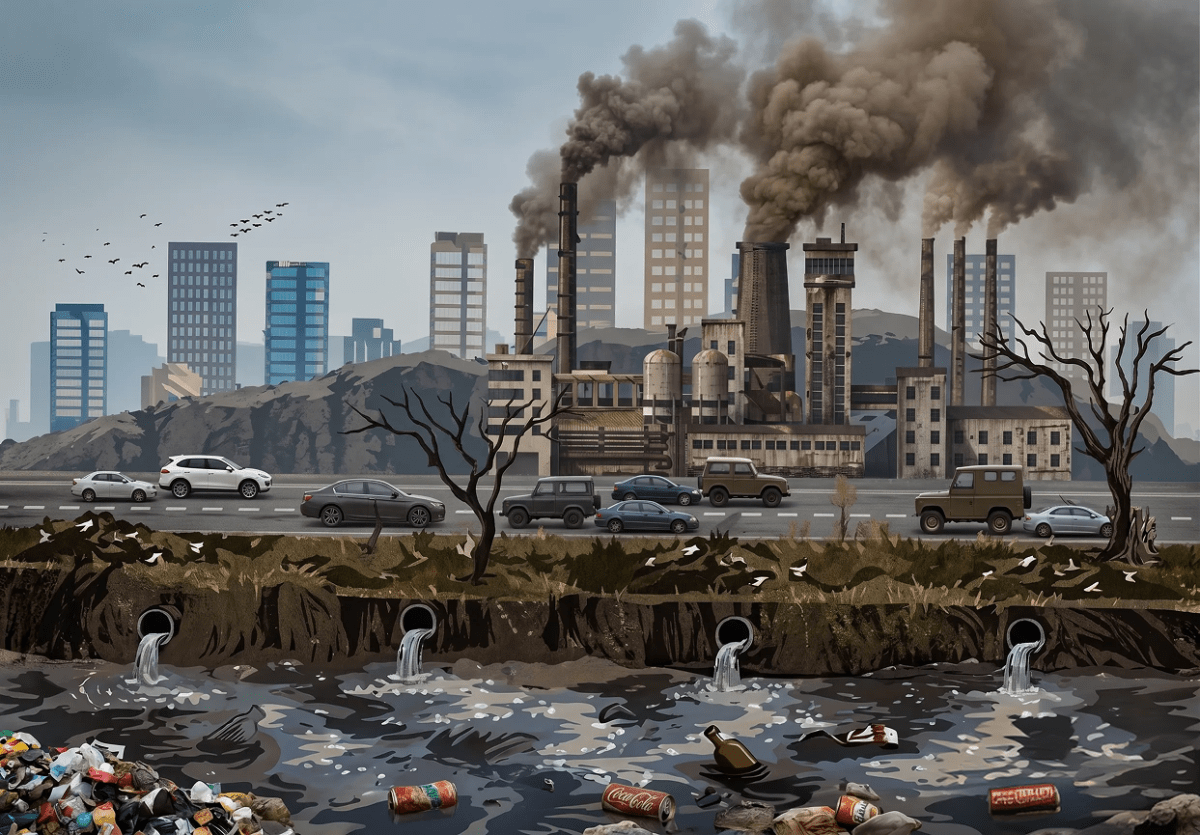
Analyse the environmental issues shown in the image. What are the potential impacts on human health (any two)?
Answer
The image depicts an industrial area with multiple factories releasing dark smoke from tall chimneys into the atmosphere, while industrial waste is being discharged into nearby water bodies. Potential Impacts on Human Health:
Respiratory Diseases — Air pollution caused by industrial smoke leads to serious respiratory diseases such as asthma, bronchitis, lung cancer, and chronic obstructive pulmonary disease (COPD).
Waterborne and Skin Diseases — Contaminated water from industrial waste causes waterborne diseases like diarrhoea, cholera, typhoid, jaundice, and dysentery. Heavy metals like lead, mercury, and arsenic in polluted water can cause skin diseases, kidney damage, neurological disorders, and even cancer in the long term.