
Conservation of natural resources includes
- preservation
- maintenance
- sustainable utilisation of natural resources
- All of these
Answer
All of these
Reason — Conservation of natural resources includes preservation, maintenance, sustainable use, restoration and enhancement of natural resources. Since preservation, maintenance and sustainable utilisation are all part of conservation, all of the given options are correct.
Aim of conservation is
- to preserve the natural resources and to ensure quality of environment.
- to ensure continuous yield of resources by establishing a balanced cycle of harvest and renewal.
- Both (a) and (b)
- None of these
Answer
Both (a) and (b)
Reason — The aim of conservation is twofold — to preserve the natural resources and ensure quality of the environment, and to ensure a continuous yield of resources by establishing a balanced cycle of harvest and renewal. Hence both the options are correct.
Statement I: Sprinklers are very effective and efficient technique for water conservation.
Statement II: Trickle irrigation technique helps in conserving water through evaporation.
- Only I is correct
- Only II is correct
- Both I and II are correct
- Both I and II are wrong
Answer
Both I and II are correct
Reason — Statement I is correct because sprinklers economise water and effectively irrigate even uneven land. Statement II is correct because drip or trickle irrigation supplies water directly to the roots through underground perforated pipes, conserving the water that would otherwise be lost through evaporation.
Contour ploughing is effective only in hilly terrains.
- True
- False
Answer
False
Reason — Contour ploughing means ploughing along the contours to prevent rainwater from washing the soil away. However, it is useful only when the land is totally flat and not in hilly terrains. Hence the statement is false.
Which of the following is not an advantage of recycling?
- Saving on the natural resources
- Obtain the commodity at cheaper price
- Increases damage to environment
- Saves energy and raw materials
Answer
Increases damage to environment
Reason — Recycling reduces damage to the environment rather than increasing it. Saving on natural resources, obtaining the commodity at a cheaper price, and saving energy and raw materials are all advantages of recycling, so "increases damage to environment" is not an advantage.
Energy can be conserved by
- reducing wastage and losses
- Improvement in efficiency by technological upgradation
- Improved operation and maintenance
- All of these
Answer
All of these
Reason — Energy can be conserved by reducing wastage and losses, improving efficiency through technological upgradation, and improving operation and maintenance. Hence all of the given options are correct.
Which of the following is not a non-conventional resource of energy?
- Hydropower generation
- Windpower
- Coal energy
- Solar energy
Answer
Coal energy
Reason — Coal is a conventional (fossil fuel) source of energy and is exhaustible. Hydropower, wind power, and solar energy are non-conventional, renewable sources of energy. Hence coal energy is not a non-conventional resource.
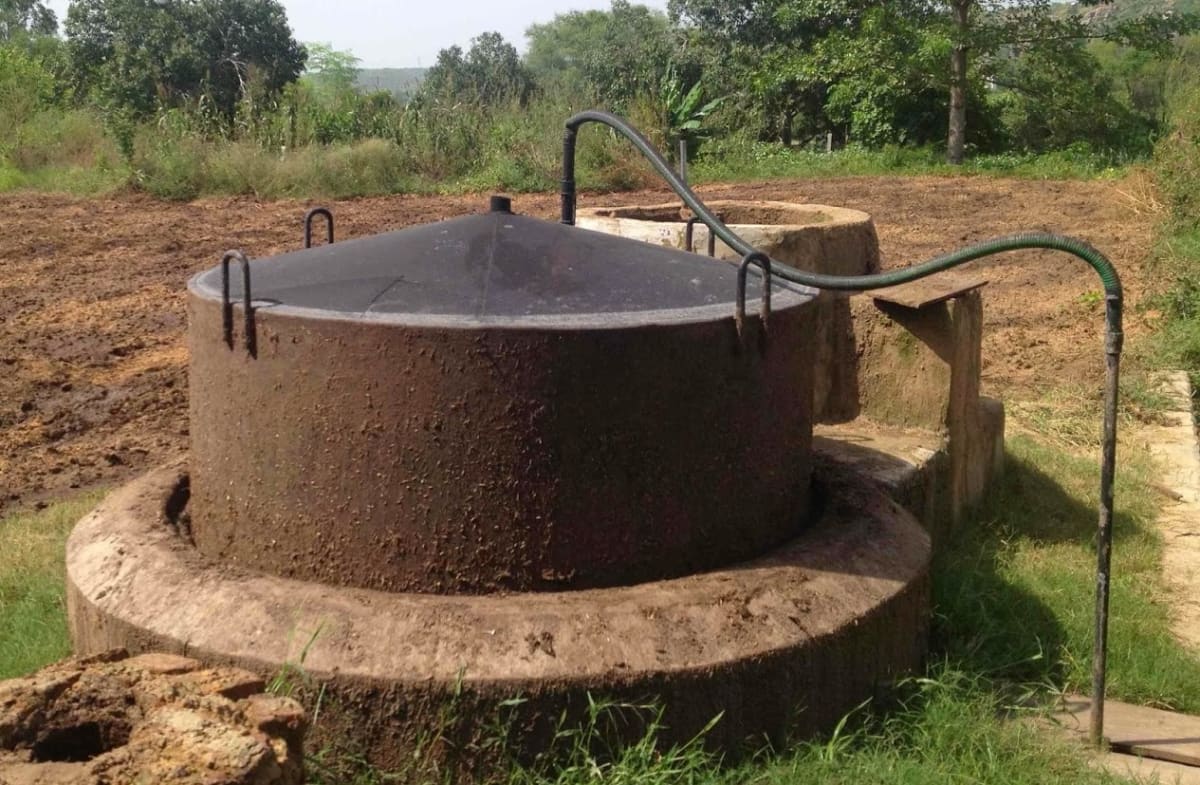
What is the main advantage of the plant shown ?
- Uses fossil fuels
- Produces eco-friendly energy
- Increases soil erosion
- Promotes deforestation
Answer
Produces eco-friendly energy
Reason — The plant shown is a biogas plant. Biogas is produced from the decomposition of organic waste such as cattle dung and domestic waste. It is cheap, renewable and environment-friendly, so its main advantage is that it produces eco-friendly energy.
Solar energy has come up in fulfilling the world's future energy requirements and pollution free use.
- True
- False
Answer
True
Reason — Solar energy is a renewable and pollution-free source of energy. It has come up as a major source for fulfilling the world's future energy requirements without causing pollution, so the statement is true.
A school starts a campaign to recycle newspapers. What is the environmental benefit of this initiative?
- Saves trees and reduces waste in landfills
- Increases carbon footprints
- Reduces soil erosion
- Promotes chemical farming
Answer
Saves trees and reduces waste in landfills
Reason — Recycling newspapers reduces the demand for fresh paper, thereby saving trees, and also reduces the amount of waste that goes into landfills. This benefits the environment by conserving natural resources and reducing pollution.
A small village relies on rainwater harvesting for its water supply. The villagers use underground storage tanks to collect rainwater during the monsoon season. This water is then used for drinking, irrigation, and household purposes throughout the year. Which practice can supplement rainwater harvesting to ensure water conservation.
- Over-irrigation of crops
- Use of sprinklers for irrigation
- Deforestation of surrounding areas
- Increased reliance on fossil fuels
Answer
Use of sprinklers for irrigation
Reason — Sprinklers economise water and irrigate land efficiently. Using sprinklers along with rainwater harvesting helps conserve the stored water, whereas over-irrigation, deforestation, and reliance on fossil fuels do not support water conservation.
Why is biogas considered a practical fuel source in rural areas of India?
- It is a non-renewable resource
- It requires imported technology
- It uses cattle dung and organic waste abundantly available
- It increases deforestation rates
Answer
It uses cattle dung and organic waste abundantly available
Reason — Biogas is generated from the decomposition of organic wastes such as cattle dung and domestic waste, which are available in plenty in Indian villages. It is cheap, renewable, and environment-friendly, making it a practical fuel source in rural areas.
A city plans to set up solar panels in areas with long sunlight hours. Which feature of solar energy makes it suitable for this?
- It is a non-renewable resource
- It produces greenhouse gases
- It is pollution-free and renewable
- It requires extensive land use
Answer
It is pollution-free and renewable
Reason — Solar energy is pollution-free and renewable, and it can be trapped more effectively in regions with long sunshine hours. This feature makes solar panels suitable for areas with long sunlight hours.
Rainwater harvesting is primarily used to increase the availability of water during the monsoon season.
- True
- False
Answer
False
Reason — Rainwater harvesting is used to store rainwater collected during the monsoon so that it can be used during the dry months, and to recharge the groundwater. Its primary purpose is to ensure the supply of water in the dry months, not during the monsoon season. Hence the statement is false.
A farmer adopts terrace farming in a hilly region to grow crops like maize and wheat. He notices that the soil erosion has significantly reduced, and the crops yield better results. What is the primary reason for reduced soil erosion in terrace farming?
- Increased water flow
- Controlled water movement across steps
- Use of chemical fertilizers
- Absence of vegetation cover
Answer
Controlled water movement across steps
Reason — In terrace farming, the mountain slope is cut into steps. This slows down and controls the flow of rainwater across the steps, so the soil eroded from one step gets deposited on the following steps. This controlled water movement significantly reduces soil erosion.
What is the primary advantage of the system shown in the picture?

- Reduces soil erosion
- Conserves water by efficient irrigation
- Promotes deforestation
- Increases water wastage
Answer
Conserves water by efficient irrigation
Reason — The system shown is a sprinkler. Sprinklers are a very effective and efficient technique that economise water and irrigate even uneven land. Hence the primary advantage of the system is that it conserves water by efficient irrigation.
Statement I: Biogas is generated from the decomposition of organic wastes like manure.
Statement II: Aerogenerators are being used to generate electricity.
- only I is correct
- only II is correct
- both I and II are correct
- both I and II are wrong
Answer
both I and II are correct
Reason — Statement I is correct because biogas is generated from the decomposition of organic wastes such as manure and domestic waste. Statement II is correct because aerogenerators (wind turbines) are being used to generate electricity from wind energy. Hence both statements are correct.
A farmer uses drip irrigation to water his crops. What is the primary advantage of this method?
- Reduces soil erosion
- Prevents water wastage through evaporation
- Improves soil fertility
- Prevents overgrazing
Answer
Prevents water wastage through evaporation
Reason — In drip irrigation, water is supplied directly to the roots of the plants through underground perforated pipes. This prevents the wastage of water that would otherwise occur through evaporation, thereby conserving water.
Assertion (A): Overgrazing can lead to desertification.
Reasoning (R): Overgrazing removes vegetation cover, leaving soil exposed to erosion.
- Both A and R are true, and R is the correct explanation of A.
- Both A and R are true, but R is not the correct explanation of A.
- A is true, but R is false.
- A is false, but R is true.
Answer
Both A and R are true, and R is the correct explanation of A.
Reason — Overgrazing removes the vegetation cover and exposes the soil to harsh winds and erosion. The continuous loss of fertile topsoil due to this exposure can ultimately lead to desertification. Hence R correctly explains A.
A city invests in public transport to reduce private vehicle usage. What is the primary environmental benefit?
- Reduced renewable energy usage
- Decreased air pollution
- Increased dependence on fossil fuels
- Higher deforestation rates
Answer
Decreased air pollution
Reason — Investing in public transport reduces the number of private vehicles on the road. Fewer vehicles burn less fuel and release fewer harmful emissions, which decreases air pollution. Hence the primary environmental benefit is decreased air pollution.
The energy source used in the picture is:

- Non-renewable
- Renewable and pollution-free
- Fossil fuel-based
- Dependent on wind speed
Answer
Renewable and pollution-free
Reason — The picture shows solar panels. Solar energy is a renewable and pollution-free source of energy because it uses sunlight, which is inexhaustible and does not cause any pollution.
A coastal community installs a tidal energy power plant. This plant uses the rise and fall of ocean tides to generate electricity for households and industries. What is a potential limitation of tidal energy in this scenario?
- High installation cost
- Excessive land requirement
- Dependency on fossil fuels
- Greenhouse gas emissions
Answer
High installation cost
Reason — Setting up a tidal energy power plant requires expensive technology and infrastructure, which makes its installation cost very high. This is a major limitation of tidal energy, even though it is a clean source of energy.
Why is conservation of resources important?
Answer
Conservation of resources is important because of the following reasons:
Depleting Resources — Natural resources are depleting at a very fast rate due to overuse, growing population and industrialisation.
For Future Generations — Conservation ensures that resources are used in a proper way so that a part of them is left for use by future generations.
What are the main aims of conservation of resources?
Answer
The aim of conservation of resources is twofold:
To preserve natural resources and ensure quality of environment — Conservation seeks to hold and control the supply of natural resources so that they are not wasted, and the quality of the environment is maintained.
To ensure continuous yield of resources — Conservation aims to ensure a continuous yield of resources by establishing a balanced cycle of harvest and renewal, so that the resources are not exhausted.
What do you mean by wind power?
Answer
Aerogenerators are used to generate electricity from wind. Wind makes the blades of the turbine spin, producing kinetic energy, which is converted into electrical energy by a generator.
Wind as an energy source will never run out. In India, wind energy is being used for running mills, irrigating fields, and carrying out other farm activities.
How conservation of soil helps to conserve water resources?
Answer
Conservation of soil also helps to conserve water resources in the following ways:
Slows Down Water Flow — Practices like terrace farming and contour ploughing slow down the flow of rainwater and recharge the groundwater.
Retains Moisture — Mulching covers the soil and prevents evaporation, so the soil retains moisture for a longer time.
Maintains Water Cycle — Afforestation protects the soil and helps forests retain water, which maintains the natural water cycle.
How LPG and CNG are environment-friendly fuels?
Answer
LPG and CNG are environment-friendly fuels for the following reasons:
LPG (Liquified Petroleum Gas) — When LPG is used in place of firewood, it saves thousands of living trees from being cut, thereby reducing deforestation.
CNG (Compressed Natural Gas) — When CNG is used in automobiles in place of petrol or diesel, it burns more cleanly and produces fewer harmful emissions.
Why should we promote the use of renewable resources?
Answer
We should promote the use of renewable resources because of the following reasons:
Replacement for Depleting Resources — Conventional resources are depleting very fast and will be exhausted forever, so renewable resources bring hope for the sustained socio-economic development of humanity.
Will Not Run Out — Renewable energy sources naturally replenish themselves and will not run out, unlike non-renewable resources.
Pollution-Free and Clean — Renewable energy sources are clean to use as there are no or fewer greenhouse gas emissions. For example, solar energy is pollution-free.
Employment Generation — Renewable energy technologies could produce many jobs in the future.
What do you mean by conservation of resources? How can minerals be conserved?
Answer
Conservation of Resources — Conservation of natural resources means holding or controlling the supply of these resources in such a way that a part of them is left for the future. Depletion of natural resources has led to serious efforts to conserve them. Conservation includes preservation, maintenance, sustainable use, restoration and enhancement of natural resources.
Conservation of Minerals — Most of the minerals are exhaustible, so they need to be conserved. Minerals can be conserved by the following practices:
Better Technology — Using better and modern technology for the extraction and processing of minerals reduces wastage.
Efficient Utilisation — Minerals should be utilised efficiently so that minimum quantity is wasted.
Reuse and Recycling — Reuse and recycling of minerals (such as metals) reduces the demand for fresh extraction.
Special Conservation Programmes — Programmes such as the National Afforestation and Eco-development Board, the National Wastelands Development Board, and the Hill Area Development Programme help in conserving mineral resources.
What is the meaning of recycling? What are the advantages of recycling?
Answer
Recycling — Recycling means salvaging used materials in order to reuse them. It helps to save money and valuable natural resources and also minimises pollution. Recycling is mostly done in the industrial sector and is of two types — internal recycling and external recycling.
Advantages of Recycling — Recycling has the following advantages:
Saving on Natural Resources — Recycling reduces the use and demand for fresh natural resources.
Cheaper Commodities — Recycled materials help to obtain the commodity at a cheaper price.
Saving Energy and Raw Materials — Recycling saves both energy and raw materials needed for manufacturing.
Reduces Environmental Damage — Recycling reduces damage to the environment. For example, recycling of paper saves trees.
Fewer Quarries — Recycling glass means fewer sandpits and limestone quarries are needed, which means lesser environmental pollution.
What are renewable energy sources? Give three examples of these sources.
Answer
Renewable Energy Sources — Renewable energy sources are non-conventional sources of energy that naturally replenish themselves and do not get exhausted with use. They are inexhaustible and can be used again and again. The rapid depletion of conventional energy resources has prompted people to tap these renewable sources, which are clean and last for a longer period of time.
Three examples of renewable energy sources are:
Solar Energy — Energy obtained from sunlight, trapped using solar cells, which is steady and pollution-free.
Wind Power — Energy obtained from moving air using aerogenerators, which never runs out and causes no pollution.
Hydropower — Energy obtained from flowing or falling water, used to spin turbines and generate electricity.
(Other examples include tidal energy and biogas/bioenergy.)
What is the difference between internal and external recycling? Give examples of each.
Answer
The difference between internal recycling and external recycling is given below:
| S.No. | Basis | Internal Recycling | External Recycling |
|---|---|---|---|
| 1. | Meaning | The process in which waste material is reclaimed as part of the manufacturing process. | The process in which worn out or used objects are recollected and reused for manufacturing new objects. |
| 2. | Place | It is carried out within the factory itself. | It is carried out after the product has been used by consumers. |
| 3. | Source of Waste | The waste comes from the manufacturing process itself. | The waste comes from used or discarded consumer products. |
| 4. | Example | Trimming of copper pipings cut to standard lengths and its waste being melted for reuse. | Worn out paper or glass bottles being recollected and reused, for example newspaper recycling. |
Differentiate between conventional and non-conventional energy resources with examples. Why conventional energy resources cannot fulfil energy requirements?
Answer
The difference between conventional and non-conventional energy resources is given below:
| S.No. | Basis | Conventional Energy Resources | Non-Conventional Energy Resources |
|---|---|---|---|
| 1. | Meaning | The traditional sources of energy that have been in use for a long time. | The newer, alternative sources of energy that are being developed to replace conventional sources. |
| 2. | Availability | They are exhaustible and get depleted with use. | They are inexhaustible and replenish themselves naturally. |
| 3. | Pollution | They cause a lot of pollution. | They cause little or no pollution. |
| 4. | Examples | Coal, petroleum, natural gas. | Solar energy, wind power, hydropower, tidal energy, biogas. |
Why conventional energy resources cannot fulfil energy requirements:
Conventional energy resources such as coal and petroleum cannot fulfil energy requirements because they are exhaustible and are being depleted at a very fast rate. If the present rate of use continues, these resources will be exhausted forever. In addition, they cause heavy pollution of air, water and soil. Because of this fast depletion, people have been compelled to find and tap non-conventional sources of energy that may last for a longer period of time.
Explain the role of technology in the conservation of resources.
Answer
Technology plays an important role in the conservation of resources in the following ways:
Efficient Utilisation of Minerals — Better technology helps in extracting and using minerals efficiently, thereby reducing wastage of exhaustible resources.
Improving Energy Efficiency — Technological improvement helps save energy by reducing wastage and losses. Energy-efficient machines and appliances also conserve energy.
Recycling of Wastes — New technologies help recycle industrial and other wastes for reuse. For example, waste paper can be recycled to produce paper again.
Harnessing Renewable Energy — Technology helps in using non-conventional sources of energy. Solar cells use sunlight, aerogenerators use wind, and biogas plants convert organic waste into fuel.
Finding Alternatives — Technology helps find substitutes for scarce resources, such as LPG in place of firewood and CNG in place of petrol or diesel.
Thus, technology conserves resources by reducing wastage, promoting recycling and developing renewable alternatives.
Discuss the environmental benefits of replacing traditional fuels like firewood with alternatives such as LPG and CNG.
Answer
Replacing traditional fuels like firewood with alternatives such as LPG and CNG has the following environmental benefits:
Saves Trees and Forests — Easy and economic supply of LPG in place of firewood can save thousands of living trees from being cut. This helps in conserving forests and reducing deforestation.
Reduces Air Pollution — LPG and CNG burn more cleanly than traditional fuels. When CNG is used in automobiles in place of petrol or diesel, it produces fewer harmful emissions.
Protects Soil — Since fewer trees are cut, the vegetation cover is preserved. This helps protect the soil from erosion and maintains soil fertility.
Conserves Exhaustible Fuels — Use of CNG helps reduce dependence on petrol and diesel, which are exhaustible conventional fuels.