
Vouchers, invoice, bills, cash memos are evidence of day-to-day transactions. These documents are called
- raw documents
- source document
- account documents
- none of these
Answer
source document
Reason — Various business documents such as vouchers, invoices, bills, cash memos and receipts are called source documents. They provide information about the nature and amount of a transaction, and transactions are recorded in the books of account on the basis of these documents.
Which of the following is not called books of original entry?
- Journal
- Cashbook
- Sales return book
- None of these
Answer
None of these
Reason — Journal, Cash Book and Sales Return Book are all books of original entry (subsidiary books) in which transactions are first recorded from the source documents. Hence, none of the given options is excluded — all are books of original entry.
A ............... account may be defined as summary of all transactions relating to a particular head of one place.
- Journal
- Ledger
- Credit book
- None of these
Answer
Ledger
Reason — A ledger account may be defined as a summary of all transactions relating to a particular head at one place. In the ledger, each account is allotted a separate page and all transactions relating to that account are recorded at one place.
Which of the following accounts document is called a 'book of final entry'?
- Journal
- Ledger
- both (a) & (b)
- None of these
Answer
Ledger
Reason — The ledger is a 'book of final entry' because it is prepared from the journal, which is the book of original entry. The process of recording transactions from the journal into classified accounts in the ledger is called 'posting'.
Statement I: Narration is written for each entry in the Journal.
Statement II: No Naration is written in a Ledger.
- (I) is correct
- (II) is correct
- Both (I) and (II) is correct
- Neither statement is correct
Answer
Both (I) and (II) is correct
Reason — Both statements are correct. In the journal, a narration (brief description) is written for each entry, whereas in the ledger no narration is written.
The left hand side of Ledger Account is called "Debit Side" and the right hand side of it is called "Credit Side" which are divided by two closely vertical parallel line.
- True
- False
Answer
True
Reason — Each ledger account is divided into two equal parts by two closely drawn vertical lines. The left hand side is called the 'debit side' and the right hand side is known as the 'credit side'.
Journal folio is term used in Ledger as a part of Ledger statement. It is the number at which our transaction is recorded in the journal.
- True
- False
Answer
True
Reason — In the ledger, the 'J.F.' (Journal Folio) column gives the page number of the journal or sub-journal from which the entry is being posted, i.e., the number at which the transaction is recorded in the journal.
Debtor's Ledger consists of accounts of customer to whom goods are sold
- on credit
- on debit
- Either (a) or (b)
- none of these
Answer
on credit
Reason — The Debtor's Ledger consists of accounts of customers to whom goods are sold on credit. Accounts in this ledger are posted from the Sales Book, Returns Inwards Book, Cash Book and Bills Receivable Book.
Creditor's Ledger contains accounts of supplies from whom goods are purchased
- on cash
- on debit
- on credit
- Either (a) or (b)
Answer
on credit
Reason — The Creditors' Ledger contains accounts of suppliers from whom goods are purchased on credit. Accounts in this ledger are posted from the Purchases Book, Returns Outwards Book, Cash Book and Bills Payable Book.
All cash receipts and cash payments are straight way recorded in the Cash Book. Which is correct?
- Cash Book is a special journal
- Cash Book is a special Ledger
- Cash Book is called Finance Book
- None of these
Answer
Cash Book is a special journal
Reason — Cash Book is a special journal in which all cash transactions are directly recorded. All cash receipts and cash payments are straightaway recorded in the Cash Book, enabling the firm to know the balance of cash at any point of time.
Every time cash is paid into bank or withdrawn from bank for office use, entries are made in both bank and cash columns. Such entries are known as
- Contra Entries
- Counter Entries
- Daily Entries
- none
Answer
Contra Entries
Reason — Every time cash is paid into the bank or withdrawn from the bank for office use, entries are made in both the bank and cash columns. Such entries are known as contra entries and are not posted in the ledger because double entry concerning them has already been completed in the cash book.
Assertion (A): The journal is the initial recording of financial transactions.
Reasoning (R): The ledger is a principal book of accounts in accounting.
- A is true but R is false.
- A is false but R is true
- Both A and R are true and R explains A
- Both A and R are true but R does not explain A.
Answer
Both A and R are true but R does not explain A.
Reason — Both A and R are true. The journal is the book of original entry where financial transactions are first recorded, and the ledger is a principal book of accounts. However, R does not explain A, as the two statements describe two different books independently.
Assertion (A): The Trial Balance is a statement that lists all ledger accounts and their balances.
Reasoning (R): It ensures the equality of debits and credits in the ledger, serving as a tool to identify errors.
- A is true but R is false.
- A is false but R is true
- Both A and R are true and R explains A
- Both A and R are true but R does not explain A.
Answer
Both A and R are true and R explains A
Reason — Both A and R are true, and R correctly explains A. The trial balance lists all ledger accounts and their balances, and its purpose is to check the equality (agreement) of debits and credits, which helps to ascertain the arithmetical accuracy of the books and identify errors.
Which statement best describes the purpose of preparing a trial balance?
- To classify all transactions into personal, real, and nominal accounts
- To identify arithmetical errors in ledger accounts
- To replace the preparation of final accounts
- To summarise cash transactions for the period
Answer
To identify arithmetical errors in ledger accounts
Reason — The main purpose of preparing a trial balance is to ascertain the arithmetical accuracy of the ledger accounts. If the totals of the debit and credit sides tally, the posting can be presumed to be free from arithmetical errors; if any error is detected, it can be rectified before preparing final accounts.
An error of principle, such as debiting an asset account instead of an expense account, will not affect the agreement of the trial balance.
- True
- False
Answer
True
Reason — An error of principle does not affect the agreement of the trial balance. In such an error the debit and credit are still recorded with equal amounts (only in a wrong type of account), so the totals of the trial balance still tally and the error remains undisclosed.
What makes the ledger a "book of final entry"?
- It records transactions chronologically
- It provides a classified summary of all accounts
- It includes narrations for each transaction
- It includes source documents for all entries
Answer
It provides a classified summary of all accounts
Reason — The ledger is a 'book of final entry' because it is prepared from the journal and provides a classified and summarised record of all accounts. The transactions recorded chronologically in the journal are posted and grouped account-wise in the ledger.
How does a three-column cash book enhance efficiency in accounting?
- By removing the need for ledger postings
- By combining cash, bank, and discount transactions in one book
- By simplifying transactions with personal accounts
- By summarizing sales and purchases
Answer
By combining cash, bank, and discount transactions in one book
Reason — A three-column cash book has columns for cash, bank and discount on both sides, thereby combining cash, bank and discount transactions in one book. It eliminates the need for opening a separate Bank Account in the ledger and saves time and labour.
A ledger can replace a trial balance for verifying arithmetical accuracy in accounts.
- True
- False
Answer
False
Reason — This statement is false. A ledger cannot replace a trial balance for verifying arithmetical accuracy. The trial balance is prepared from the ledger balances specifically to check the equality of debits and credits, which the ledger by itself does not do.
In what scenario would a ledger be more helpful than a trial balance?
- Identifying errors in debit and credit totals
- Checking the details of a specific account
- Verifying the classification of accounts
- Ensuring double-entry principles are followed
Answer
Checking the details of a specific account
Reason — A ledger would be more helpful than a trial balance when checking the details of a specific account, because the ledger contains a separate account for each item showing all its transactions, whereas the trial balance shows only the final balances of the accounts.
An error in recording the transaction amount in both debit and credit columns of the journal will not impact the trial balance.
- True
- False
Answer
True
Reason — This statement is true. If a wrong amount is written in both the debit and credit columns of the journal, both sides are equally affected. As a result, the trial balance will still agree, and the error will not be disclosed by it.
Statement I: A ledger can be used to identify specific account balances for decision-making.
Statement II: A trial balance is more detailed than a ledger for analysing transactions.
- Only I is correct
- Only II is correct
- Both I and II are correct
- Neither statement is correct
Answer
Only I is correct
Reason — Only Statement I is correct. A ledger can be used to identify specific account balances for decision-making, as it contains complete details of each account. Statement II is incorrect because the ledger (not the trial balance) is more detailed; the trial balance only summarises the final balances.
The combined method of preparing a trial balance provides both totals and balances, which makes it suitable for final accounts preparation.
- True
- False
Answer
True
Reason — This statement is true. Under the combined method (also known as the Total cum Balance method), both the totals and the balances of ledger accounts are recorded, providing the advantages of both methods and making it suitable for the preparation of final accounts.
Define a Journal.
Answer
The term 'journal' has been derived from the French word 'Jour' which means a day. A journal, therefore, means a book of daily record. In other words, a journal is that book of accounts in which transactions are originally recorded in a chronological (day-to-day) order.
What do you understand by Ledger?
Answer
A ledger is the book which contains a separate account for each debtor, creditor, asset, liability, income and expense of the business. It may be defined as a book which contains, in a summarised and classified form, a permanent record of all transactions.
Is Cash Book a Journal or a Ledger?
Answer
The Cash Book serves a double purpose and is therefore both a journal and a ledger. As a primary record, it serves as a special journal because all cash transactions are first recorded in it date-wise. It also serves as a substitute for the Cash Account in the ledger, and therefore it is a book of final entry. Thus, the Cash Book is both a principal book (ledger) and a subsidiary book (journal).
What is two column cash book?
Answer
A two column or double column cash book is maintained by those business firms which give cash discount to customers and also receive cash discount from suppliers. In this type of cash book, a discount column is added on both the debit side and the credit side along with the cash column. Thus, there are two columns of amount — one for cash and the other for discount — on both sides.
What are contra entries?
Answer
Every time cash is paid into the bank or withdrawn from the bank for office use, entries are made in both the bank and cash columns of the cash book. Such entries are known as contra entries.
Explain three column cash book.
Answer
A three column or triple column cash book is one in which one more column of Bank is added on both sides to take care of banking transactions. Thus, it has three columns on each side — discount, bank and cash. It is kept by firms which keep surplus cash in a bank account and make payments and receive receipts through cheques.
What is a Petty Cash Book?
Answer
In a business house, several small payments such as for carriage,telegrams and postage etc., have to be made. To avoid burdening the chief cashier and making the main cash book unwieldy, a separate petty cashier is appointed who maintains petty cash book for recording small expenses.
"A Trial Balance is merely a proof of arithmetical accuracy." Comment.
Answer
A trial balance is prepared to check the arithmetical accuracy of the books of account. If the totals of the debit and credit columns tally, posting and other accounting processes can be presumed to be arithmetically correct. However, a Trial Balance is not conclusive proof of complete accuracy, as errors such as complete omission, error of principle, or recording a wrong amount on both sides may remain undisclosed.
Define Trial Balance.
Answer
According to Carter, "Trial balance is a schedule or list of those debit and credit balances which are extracted from various accounts in the ledger. It also includes the balances of cash in hand and at bank as shown by the cash book."
Why is Trial Balance prepared?
Answer
A trial balance is prepared for the following reasons:
- To ascertain the arithmetical accuracy of the ledger accounts.
- To help in the preparation of final accounts.
- To present a summary of the ledger, for a ready reference of all accounts.
- To help in locating errors in book-keeping work.
- To help the auditor in checking the accounts.
Why is a Cash book considered both a journal and a ledger?
Answer
A Cash Book is considered both a journal and a ledger because it serves a double purpose. It is a journal because all cash transactions are first of all recorded in it date-wise. It is also a ledger because it is maintained in the form of a ledger account and serves as a substitute for the Cash Account in the ledger. Hence, it is both a principal book and a subsidiary book.
What is Ledger? Distinguish between Ledger and Journal.
Answer
A ledger is the book which contains a separate account for each debtor, creditor, asset, liability, income and expense of the business. It is a principal book and a book of final entry.
| Journal | Ledger |
|---|---|
| Book of original entry | Book of final entry |
| Transactions are recorded as soon as they occur | Transactions are posted after recording in the journal |
| Transactions are recorded in chronological order | Transactions are classified and grouped into accounts |
| Narration is written for each entry | Narration is generally not written |
| It has debit and credit amount columns | The debit and credit sides of an account are written on two different sides |
| Ledger folio is written against each entry | Journal folio is written in the ledger |
| Journal is not balanced | Every ledger account is balanced |
| Does not help in judging accuracy of books directly | Helps in judging accuracy of books |
| Does not directly form the basis of final accounts | Forms the basis of final accounts |
| Recording process is called “journalising” | Recording process is called “posting” |
Differentiate between ledger and subsidiary books.
Answer
The differences between subsidiary books and ledger are:
| Subsidiary Books | Ledger |
|---|---|
| Subsidiary books are books of original or prime entry. | Ledger is a book of final or secondary entry. |
| Subsidiary books help in the preparation of the ledger. | Ledger is the principal book of accounts. |
| Transactions are recorded in chronological order. | Transactions are recorded in classified and analytical form. |
| Subsidiary books provide complete information about transactions at one place. | Ledger does not provide complete information at one place because debit and credit aspects are recorded in separate accounts. |
| Recording in subsidiary books is called journalising. | Recording in the ledger is called posting. |
| Final accounts cannot be prepared directly from subsidiary books. | Final accounts can be prepared directly from the balances of ledger accounts. |
Explain the method of posting entries from journal to ledger.
Answer
Posting means the process of transferring entries recorded in the journal and sub-journals to the concerned accounts in the ledger.
The process of posting involves the following steps:
Posting the debit account — The account to be debited is posted first. On the debit side of the relevant account, the date of the transaction is recorded. In the 'Particulars' column, the name of the account to be credited is entered preceded by the word 'To'. In the 'Journal Folio' (J.F.) column, the page number of the journal on which the journal entry appears is recorded. The amount of the entry is recorded in the 'Amount' column.
Posting the credit account — The above steps are repeated for posting the account to be credited, but with one difference — in the 'Particulars' column, the name of the account to be debited is entered preceded by the word 'By'.
Explain the utility of ledger.
Answer
The ledger is the most important book of account. It is the principal book which contains all the information regarding business. The various uses of the ledger are as follows:
- The ledger provides information about the assets of the firm because a record of every asset is kept in it.
- The ledger gives a clear picture of the purchases and sales made during an accounting period.
- The ledger provides knowledge about the incomes and expenses of the business.
- The ledger is helpful in judging the arithmetical accuracy of accounts. The trial balance is prepared from the ledger.
- The ledger serves as the basis of preparing the profit and loss account.
- The ledger provides the data for preparing the balance sheet, which shows the financial position of the business on a particular date.
What is journal? Give a specimen of journal.
Answer
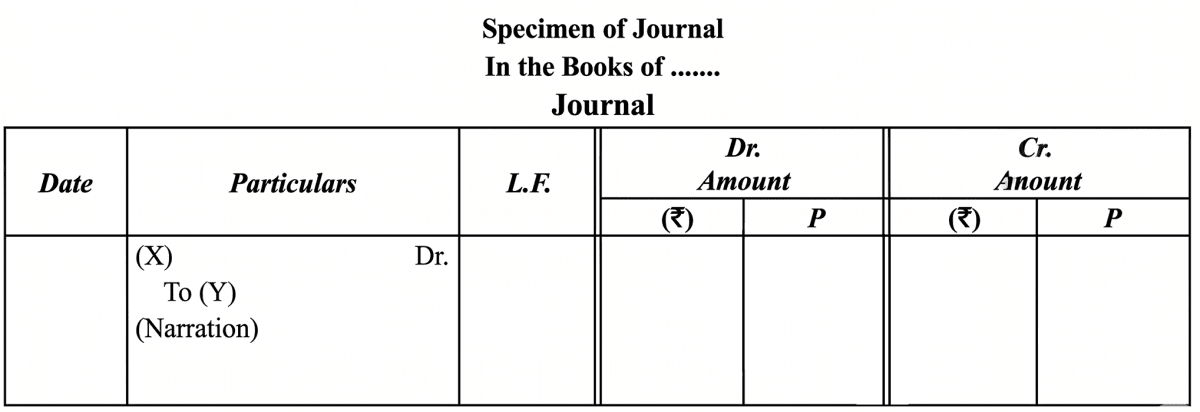
A journal is a book of original entry in which transactions are recorded in a chronological (day-to-day) order. It is so ruled that all transactions can be passed through it. The process of recording transactions in the journal is called journalising, and any entry made in the journal is called a 'Journal Entry'. The journal contains all non-cash transactions that have taken place during the accounting period.
A journal has five main columns — Date, Particulars, L.F. (Ledger Folio), Debit Amount and Credit Amount. In the 'Particulars' column, the account to be debited is written first with the word 'Dr.', and in the next line the account to be credited is written beginning with the word 'To'. A brief explanation of the entry, called 'Narration', is given below it.
A specimen of journal is given below:
Explain the uses, advantages and limitations of a journal.
Answer
Uses (Functions) of Journal — The journal performs the following functions:
- Analytical Function — The amount to be debited or credited to a ledger account is first analysed in the journal.
- Recording Function — Every journal entry is supported by a narration.
- Historical Function — Transactions are recorded in chronological order.
Advantages of Journal:
- Chronological Record — Transactions are recorded in the order in which they occur, providing a date-wise and complete record and reducing the chances of omitting a transaction.
- Explanation of Transactions — Each entry carries a narration which helps to know the details of a transaction.
- Reduced Possibility of Errors — The debit and credit amounts are written side by side and can be compared to ensure they are equal.
- Convenience — There is no need to make immediate entries in the ledger; the firm can post entries as and when convenient.
- Double Entry — The journal helps to ensure that the basic rule of double entry — "every debit must have an equal and corresponding credit" — is observed.
- Division of Labour — Several journals can be kept and entrusted to different clerks, increasing the efficiency of the accounting staff.
- Detection of Errors — Both aspects of a transaction are recorded at one place, facilitating the detection of mathematical errors.
- Reliable Evidence — Courts generally accept the journal as legal evidence in case of a dispute, as it is a book of original entry.
Limitations of Journal:
- If all transactions are recorded in the journal, it would become too long and unwieldy.
- A business firm likes to ascertain the cash balance every day; therefore, cash transactions are recorded directly in a separate cash book and left out of the journal proper.
- Since different classes of transactions are recorded in separate subsidiary books, the use of the journal proper becomes limited.
What is a Cash Book? What is its purpose?
Answer
A Cash Book is a special journal in which all cash transactions are directly recorded. All cash receipts are recorded on the debit side and all cash payments on the credit side.
The purpose (advantages) of maintaining a Cash Book is as follows:
- Economy of Time and Labour — It avoids the need for recording each cash transaction first in the journal and then posting it in the ledger.
- Systematic Record — It enables the firm to keep a systematic record of all cash transactions at one place.
- Prompt Balancing — As the cash book is balanced daily, the cash balance can be ascertained every day.
- Fixation of Responsibility — The task of handling cash and recording cash transactions can be entrusted to a responsible employee who can be held responsible for any discrepancy.
- Check on Cash — The actual cash in hand can be compared daily with the balance in the cash book, helping to detect and prevent errors and frauds.
Explain the various types of Cash Books.
Answer
A Cash Book can be of the following three types:
Simple or Single Column Cash Book — This is the simplest kind of cash book. In it, cash receipts are recorded on the debit side and cash payments on the credit side. It contains only one column of amount.
Double Column Cash Book — This cash book is maintained by firms which give cash discount to customers and receive cash discount from suppliers. A discount column is added on both the debit and credit sides along with the cash column.
Three Column Cash Book — This cash book has an additional bank column on both sides along with the cash and discount columns to take care of banking transactions. It is kept by firms which keep surplus cash in a bank.
What is a Petty Cash Book? How is it related to the main Cash Book?
Answer
A Petty Cash Book is the book in which small payments of cash, such as carriage, postage, telegrams, etc., are recorded. It is maintained to avoid making the main Cash Book unwieldy and to relieve the chief cashier from recording numerous small expenses.
Relation to the main Cash Book:
In a large business, the cash transactions are divided into two groups — the Principal Cash Book, which records all cash transactions except payments for petty expenses, and the Petty Cash Book, which records small payments. The chief cashier advances a sum of money to the petty cashier to meet petty expenses for a particular period. Thus, the petty cash book is an ancillary or subsidiary cash book that supports the main cash book.
What do you understand by Petty Cash Book? Give its advantages.
Answer
A Petty Cash Book is the book in which small payments of cash are recorded by a petty cashier who is appointed to relieve the chief cashier of recording numerous small expenses.
Advantages of Petty Cash Book:
- Saving of Time — Recording petty expenses in the petty cash book saves the time of the chief cashier.
- Saving of Labour — There is a saving in writing up the cash book and posting into the ledger, as petty expenses are divided into suitable heads.
- Control Over Fraud — The chief cashier keeps full check on the petty expenses disbursed by the petty cashier.
- Check on Petty Expenses — The amount of cash with the petty cashier is small, so the tendency to spend money is reduced, keeping petty expenses within limits.
- Prompt Writing of Cash Book — As the work of recording petty expenses is separated, the main cash book can be written up without delay.
- Evidence in Court — When a petty cash book is maintained, the reliability of the main cash book is preserved, as vouchers may not be available for petty expenses.
- Convenience — Only the totals are posted into the ledger, and the main cash book remains handy in size.
- Comparison — Petty expenses for different periods can be compared.
What is a Trial Balance? What is the objective of preparing it?
Answer
A trial balance is a statement containing the debit and credit balances extracted from the various accounts in the ledger, prepared to ascertain the arithmetical accuracy of accounts on a certain date.
Objectives of preparing a Trial Balance:
- To Ascertain Arithmetical Accuracy of Ledger Accounts — If the totals of the debit and credit sides tally, the posting and other accounting processes can be presumed to be free from arithmetical errors.
- To Help in Preparation of Final Accounts — Financial statements such as the Trading and Profit and Loss Account and the Balance Sheet are prepared on the basis of the trial balance.
- To Present a Summary of Ledger — The trial balance serves as a summary of what is contained in the ledger.
- To Help in Locating Errors — It helps in locating errors in book-keeping work.
- To Help the Auditor — It enables the auditor to see whether any corrections were made after the accounts were checked.
Explain the methods of preparing a Trial Balance. Which method do you consider to be better and why?
Answer
The various methods of preparing a trial balance are as follows:
Total Method — Under this method, the total of each side of the ledger accounts is recorded respectively in the debit and credit columns of the trial balance. Such a trial balance is known as a Gross Trial Balance.
Balances Method — Under this method, only the balances of ledger accounts are written in the two columns of the trial balance. Such a trial balance is known as a Net Trial Balance.
Combined Method — Under this method, both the totals as well as the balances of ledger accounts are recorded. The trial balance will have four amount columns — two for debit and credit totals and two for debit and credit balances. It is also known as the Total cum Balance method
Totals Method Excluding Closed Accounts — In this method, debit and credit totals are written as under the first method, but accounts having equal debit and credit totals are not included.
Better Method — The Balances Method is considered to be the better method because it provides ready-made information for the preparation of final accounts and saves much time and labour, since accounts with no balances are excluded.
Describe the errors that are disclosed by a Trial Balance.
Answer
The main errors disclosed by a trial balance are:
- Wrong Totalling of Accounts — If a ledger account or a subsidiary book is wrongly totalled, the trial balance will not agree.
- Wrong Balancing of an Account — If an account is incorrectly balanced, the difference will be reflected in the trial balance.
- Posting on the Wrong Side — If an amount is posted on the wrong side of an account, the totals will differ.
- Posting a Wrong Amount on One Side — If a wrong amount is posted to only one of the two accounts involved, the trial balance will disagree.
- Omission of Posting to One Account — If an entry is posted to one account but omitted from the other, the trial balance will not tally.
- Error in Transferring Balances — Incorrectly transferring ledger balances to the trial balance causes a difference.
Is the agreement of a Trial Balance absolute proof of the accuracy of books of account?
Answer
No, the agreement of a trial balance is not absolute or conclusive proof of the accuracy of the books of account. It only proves the arithmetical accuracy of the ledger.
There are certain errors which do not affect the agreement of the trial balance and hence remain undisclosed even when it tallies:
- An entry is not entered at all in the journal (error of complete omission).
- An entry is not posted in the ledger at all.
- A wrong account is mentioned in the journal (error of principle / commission).
- A wrong amount has been written in both the columns of the journal.
- An entry is posted twice in the ledger (error of duplication).
Therefore, the agreement of a Trial Balance is not absolute proof of the accuracy of the books of account.
Explain the advantages and limitations of a Trial Balance.
Answer
Advantages of a Trial Balance:
- Arithmetical Accuracy — It helps to ascertain the arithmetical accuracy of the ledger accounts, if the debit and credit totals tally.
- Helps in Preparation of Final Accounts — It contains all the ledger balances, which form the basis for preparing the Trading and Profit and Loss Account and the Balance Sheet.
- Summary of Ledger — It serves as a summary of the ledger, providing a ready reference of all accounts without referring to the ledger repeatedly.
- Helps in Locating Errors — It helps in locating errors in book-keeping work.
- Helps the Auditor — It enables the auditor to see whether any corrections were made after the accounts were checked.
Limitations of a Trial Balance:
Trial balance does not reveal the following errors:
- An entry not entered at all in the journal.
- An entry not posted in the ledger at all.
- A wrong account mentioned in the journal.
- A wrong amount written in both the columns of the journal.
- An entry posted twice in the ledger.
Why is it necessary to record transactions in a journal before posting them to a ledger? Analyse how skipping this step might impact accounting records.
Answer
It is necessary to record transactions in a journal before posting them to a ledger for the following reasons:
- Chronological Record — The journal records transactions date-wise in the order they occur.
- Analysis of Transactions — In the journal, each transaction is analysed to determine which account is to be debited and which is to be credited, along with the amounts.
- Narration — The journal provides a narration explaining each transaction.
- Ensures Double Entry — The journal ensures that "every debit has an equal and corresponding credit."
- Reliable Evidence — Being a book of original entry, the journal is accepted as legal evidence in case of disputes.
Impact of skipping this step:
If transactions are posted directly to the ledger without first being recorded in the journal:
- There would be a greater chance of errors and omissions.
- There would be no chronological record of transactions.
- There would be no narration, so the details and reasons behind a transaction would be lost.
- The double entry principle might be violated, as debit and credit amounts would not be compared side by side.
- In case of a dispute, there would be no reliable original record.
The trial balance shows a difference of ₹5,000. How should the accountant address this discrepancy?
Answer
The accountant should address this discrepancy through the following systematic steps:
Recheck the Totals — First, re-total the debit and credit columns of the trial balance to rule out a simple addition error.
Verify the Balances — Check that the balances of all ledger accounts have been correctly extracted and entered on the correct side of the trial balance.
Divide the Difference — Divide the difference (₹5,000) by 2 to get ₹2,500, and check whether an item of this amount has been posted on the wrong side, which would cause a double difference.
Check for the Exact Amount — Look for any account, transaction or posting of exactly ₹5,000 that may have been omitted or posted only once.
Re-check Postings — Verify the posting of entries from the journal and subsidiary books to the ledger.
Check Balancing of Ledger Accounts — Re-examine the totalling and balancing of individual ledger accounts.