
Which of the following is not salient features of accounting?
- Accounting is both an art and a science.
- Accounting records transactions and events of a financial nature only.
- Classifying means the process of grouping the entries or transactions of one nature at one place.
- If the transaction cannot be measured in terms of money, then also it should be recorded.
Answer
If the transaction cannot be measured in terms of money, then also it should be recorded.
Reason — Accounting records transactions and events of a financial nature only. If a transaction cannot be measured in terms of money, it will not be recorded. Hence option 4 is the opposite of a salient feature, while options 1, 2 and 3 are all correct salient features of accounting.
Book-keeping and accountancy are ............... to each other.
- complementary
- supplementary
- reflection
- none of these
Answer
complementary
Reason — Book-keeping and accountancy are complementary to each other. Book-keeping provides the basis for accountancy because analysis and interpretation are not possible until the transactions are recorded. But without accountancy, book-keeping is meaningless.
Without accountancy, book-keeping is meaningless because mere recording of transactions does not show the results of business.
- True
- False
Answer
True
Reason — Without accountancy, book-keeping is meaningless because mere recording of transactions does not show the results of business. Accountancy involves analysis and interpretation which reveal the net results and financial position of the business. Hence the statement is True.
Which of the following is not an objective of accounting?
- To maintain records of business
- Calculation of Profit or Loss
- Depiction of Financial Position
- Business firm are not interested to know whether it has earned a profit or suffered a loss during a period of time.
Answer
Business firm are not interested to know whether it has earned a profit or suffered a loss during a period of time.
Reason — One of the main objectives of accounting is the calculation of profit or loss — every business firm wants to know whether it has earned a profit or suffered a loss during a period of time. Hence option 4 is the opposite of an objective, while options 1, 2 and 3 are all valid objectives of accounting.
Statement I: Owners need accounting information to know the profitability and financial soundness of their investment.
Statement II: Creditors require accounting information to assess the credit worthiness and repaying capacity of the firm.
- Only I is correct
- Only II is correct
- Both I and II are correct
- Both I and II are wrong
Answer
Both I and II are correct
Reason — Both statements are correct. Owners need accounting information to know the profitability and financial soundness of their investment, and creditors require accounting information to assess the creditworthiness and repaying capacity of the firm before extending credit.
In order to borrow funds from banks and financial institutions, a business firm has to submit its final accounts.
- True
- False
Answer
True
Reason — In order to raise loans, i.e., to borrow funds from banks and financial institutions, a business firm has to submit its final accounts. These lenders carefully screen the financial statements of the firm before granting loans. Hence the statement is True.
Statement I: When a nominal account is debited, it means money has been spent or lost.
Statement II: When an account relating to some asset is debited, it means the quantity of value of that asset has increased.
- Only I is correct
- Only II is correct
- Both I and II are correct
- Both I and II are wrong
Answer
Both I and II are correct
Reason — Both statements are correct. When a nominal account is debited, it means money has been spent or lost. When an account relating to some asset is debited, it means the quantity or value of that asset has increased.
............... means the amount which the business firm owes to outsiders.
- Liability
- Capital
- Assets
- None of these
Answer
Liability
Reason — Liability means the amount which the business firm owes to outsiders. Liabilities represent the claims of those who are not the owners — that is, debts or amounts owed to creditors.
............... means the amount which the proprietor or owner has invested in the firm or can claim from the firm.
- Assets
- Liability
- Capital
- None of these
Answer
Capital
Reason — Capital means the amount which the proprietor or owner has invested in the firm or can claim from the firm. It is also known as owner's equity or net worth. From the firm's point of view, capital is a liability towards the owner.
............... are used for production and supply of goods or services.
- Fixed Assets
- Current Assets
- Liquid Assets
- Wasting Assets
Answer
Fixed Assets
Reason — Fixed assets are acquired for use over a long period of time and not for resale. They are used for production and supply of goods or services and help in earning revenue. Land and buildings, plant and machinery, furniture and fixtures are examples of fixed assets.
Assertion (A): The accounting equation is Assets = Liabilities + Capital.
Reasoning (R): This equation represents the fundamental relationship between a company's resources, debts, and ownership.
- A is true but R is false.
- A is false but R is true
- Both A and R are true and R explains A
- Both A and R are true but R does not explain A.
Answer
Both A and R are true and R explains A
Reason — The assertion is true, as the accounting equation is Assets = Liabilities + Capital. The reasoning is also true and correctly explains the assertion — the equation represents the fundamental relationship between a company's resources (assets), debts (liabilities) and ownership (capital).
Which of the following scenarios indicates a contingent liability?
- Payment of utility bills
- Lawsuit filed against the business, pending a court decision
- Salaries payable to employees
- Purchase of inventory on credit
Answer
Lawsuit filed against the business, pending a court decision
Reason — Contingent liabilities are those liabilities which shall be payable on the happening of a particular event; if the event does not happen, they shall not be payable. A lawsuit pending a court decision is a contingent liability because the payment depends on the outcome of the case. The other options are definite/actual liabilities or expenses.
A company pays ₹5,000 in advance rent. What type of account is impacted, and how?
- Prepaid Rent Account (Real, Dr)
- Prepaid Rent Account (Nominal, Cr)
- Prepaid Rent Account (Real, Cr)
- Prepaid Rent Account (Personal, Dr)
Answer
Prepaid Rent Account (Real, Dr)
Reason — Prepaid rent is an asset because the benefit (use of the premises) is yet to be received, and accounts relating to assets are real accounts. As per the rule for real accounts, "debit what comes in" — since paying advance rent creates an asset that comes into the business, the Prepaid Rent Account (a real account) is debited.
Nominal accounts reflect the financial position of a business at a given point in time.
- True
- False
Answer
False
Reason — Nominal accounts relate to expenses, losses, incomes and gains, and their balances are shown in the Profit and Loss Account to ascertain net profit or net loss. It is the Balance Sheet (showing real and personal accounts) that reflects the financial position of a business at a given point in time. Hence the statement is False.
Statement I: Capital is shown on the liability side of a balance sheet because it represents the owner's claim on business assets.
Statement II: Capital increases when the business makes a profit.
- Both I and II are correct
- I is correct, but II is incorrect
- II is correct, but I is incorrect
- Both I and II are incorrect
Answer
Both I and II are correct
Reason — Both statements are correct. Capital is shown on the liability side of the balance sheet because, from the firm's point of view, it is a liability towards the owner (owner's equity or claim on assets). Capital also increases when the business makes a profit, since net profit is credited to the capital account.
A business owner withdraws ₹20,000 in cash for personal use. Which account will be affected?
- Drawings Account (Dr), Cash Account (Cr)
- Cash Account (Dr), Drawings Account (Cr)
- Capital Account (Dr), Drawings Account (Cr)
- Expense Account (Dr), Cash Account (Cr)
Answer
Drawings Account (Dr), Cash Account (Cr)
Reason — Drawings means the amount of money or value of goods which the owner takes from the firm for personal use. When cash is withdrawn for personal use, the Drawings Account is debited (debit the receiver, i.e., the owner) and the Cash Account is credited (credit what goes out).
Which of the following actions impacts the nominal accounts of a business?
- Selling goods on credit
- Recording depreciation on machinery
- Purchasing a building for cash
- Transferring profits to the capital account
Answer
Recording depreciation on machinery
Reason — Nominal accounts relate to expenses, losses, incomes and gains. Depreciation is a loss/expense, so recording depreciation on machinery impacts a nominal account. Selling goods on credit and purchasing a building affect real and personal accounts, while transferring profits to capital affects personal accounts.
Fictitious assets like preliminary expenses represent actual resources available to the business.
- True
- False
Answer
False
Reason — Fictitious assets have no real value. They represent expenses or losses not yet written off, e.g., preliminary expenses, discount on issue of shares. They do not represent any actual resource available to the business. Hence the statement is False.
Which of the following entries will result in an increase in both assets and liabilities?
- Owner brings additional capital into the business
- Bank loan taken and credited to the bank account
- Purchase of goods on credit
- Purchase of furniture by cash
Answer
Bank loan taken and credited to the bank account
Reason — When a bank loan is taken and credited to the bank account, the bank balance (an asset) increases and the loan (a liability) also increases — so both assets and liabilities rise. Bringing in additional capital increases assets and capital (not an outside liability); purchase of goods on credit increases the Purchases (nominal) account and a liability; and purchase of furniture by cash only converts one asset into another with no change in totals.
Statement I: Capital is shown on the liability side of a balance sheet because it represents the owner's claim on business assets.
Statement II: Capital increases when the business makes a profit.
- Both I and II are correct
- I is correct, but II is incorrect
- II is correct, but I is incorrect
- Both I and II are incorrect
Answer
Both I and II are correct
Reason — Both statements are correct. Capital is shown on the liability side of the balance sheet because it represents the owner's claim (owner's equity) on business assets. Capital also increases when the business makes a profit, as net profit is credited to the capital account.
Define accounting.
Answer
According to the American Accounting Association, accounting is the process of identifying, measuring and communicating economic information to permit informed judgements and decisions by the users of accounts.
Why is book-keeping considered the foundation of accounting?
Answer
Book-keeping is considered the foundation of accounting because book-keeping provides the basis for accountancy, since analysis and interpretation are not possible until the transactions are recorded.
State two objectives of accounting.
Answer
Two objectives of accounting are:
To Maintain Records of Business — The primary objective of accounting is to maintain a systematic and up-to-date record of all financial transactions of the business.
Calculation of Profit or Loss — Another objective is to ascertain the net result of business operations during a specific period of time, for which the Profit and Loss Account is prepared.
Why is accounting important for maintaining financial health?
Answer
Accounting is important for maintaining financial health because it helps depict the financial position of a business through the Balance Sheet. Just as a doctor can know the health of a person by feeling his pulse, one can know the financial health of a firm by looking at its final accounts.
"Accounting is an art as well as a science." Comment.
Answer
Accounting is both an art and a science:
Accounting as an Art — It is the art of correctly recording the day-to-day business transactions. The records are designed to suit the particular requirements of the business.
Accounting as a Science — It is a science of maintaining business records in a regular and proper manner according to some fundamental principles.
Define the following accounting terms : (a) Asset (b) Liability (c) Capital (d) Expense (e) Revenue
Answer
(a) Asset — Asset means anything which will enable the firm to get cash or a benefit in future. According to Finny and Miller, "Assets are future economic benefits, the rights which are owned or controlled by an organisation or individual." Thus, Assets = Capital + Liabilities.
(b) Liability — Liability means the amount which the business firm owes to outsiders. Thus, Liabilities = Assets − Capital.
(c) Capital — Capital means the amount which the proprietor or owner has invested in the firm. It is also known as owner's equity or net worth. Thus, Capital = Assets − Liabilities.
(d) Expense — Expense is the monetary value of inputs. It means the cost or sacrifice incurred for earning revenue.
(e) Revenue — It is the sum of money received or to be received from customers as a result of the sale of goods or services.
What are contingent liabilities?
Answer
Contingent liabilities are those liabilities which shall be payable on the happening of a particular event. If that event does not happen, they shall not be payable — that is, they are contingent on the happening of such an event.
Explain the significance of debit and credit in accounting.
Answer
The significance of debits and credits is as follows:
When the account of a person/organisation is debited, it means the person owes the stated amount or some amount payable to him has been paid; when credited, it means the stated amount is payable to him or the same amount receivable from him has been received.
When an asset account is debited, the value of that asset has increased; when credited, the value of that asset has decreased.
When a nominal account is debited, money has been spent or lost; when credited, money has been earned or received.
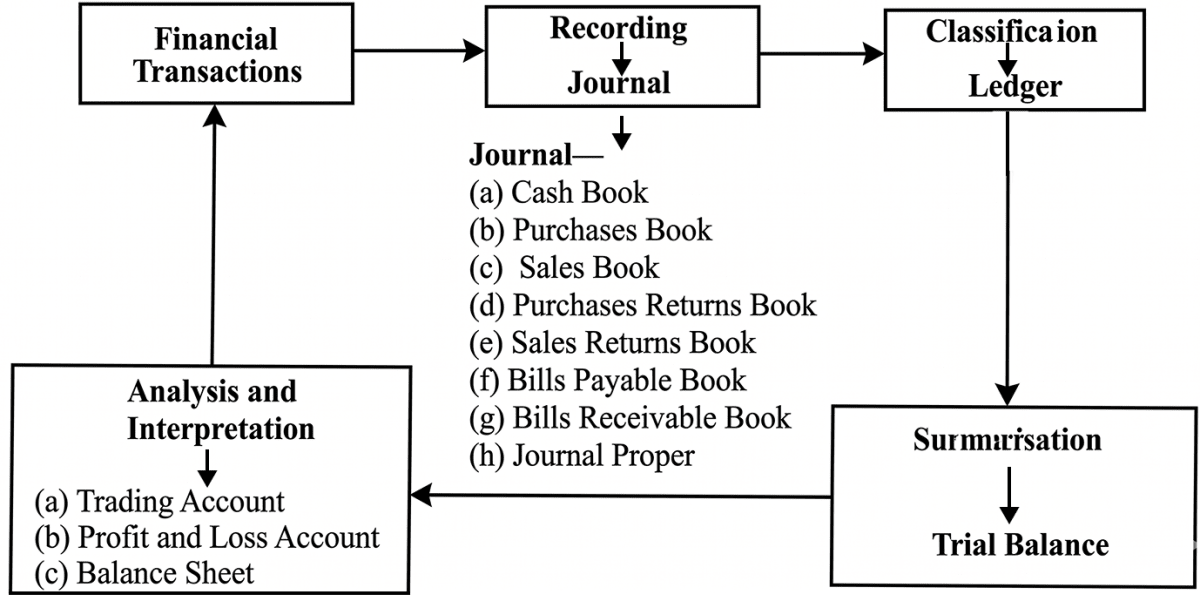
What is accounting? What are its main features?
Answer
According to the AICPA, accounting is the art of recording, classifying and summarising in a significant manner and in terms of money, transactions and events which are, in part at least, of a financial character, and interpreting the results thereof.
The main features of accounting are:
Art as well as Science — Accounting is the art of correctly recording day-to-day business transactions and a science of maintaining records in a regular and proper manner according to fundamental principles.
Financial Transactions — Accounting records transactions and events of a financial nature only.
Recording — Accounting involves recording of business transactions in a systematic manner in various subsidiary books.
Classifying — It is the process of grouping the entries or transactions of one nature at one place by opening accounts in a book called the Ledger.
Summarising — It is the process of presenting the classified data in a manner useful to the users of accounts by preparing final accounts — the Trading Account, Profit and Loss Account and Balance Sheet.
Analysis and Interpretation — The accounting statements are analysed and interpreted with the help of ratios, etc., to help the management and others judge the performance and financial position of the business.
Distinguish between book-keeping and accountancy.
Answer
| S.No. | Basis of Distinction | Book-Keeping | Accountancy |
|---|---|---|---|
| 1. | Nature | The job of a book-keeper is clerical in nature. | The job of an accountant is analytical and imaginative in nature. |
| 2. | Scope | Book-keeping is concerned mainly with the recording of transactions. | Accountancy involves classifying, summarising, analysis and presentation of information. |
| 3. | Stage | Book-keeping is the primary stage of maintaining accounts. | Accountancy is the secondary stage of maintaining accounts. It starts where book-keeping ends. |
| 4. | Results | Book-keeping merely reflects the transactions as they occur and does not provide any conclusions. | Accountancy shows the net results and financial position of the business. |
| 5. | Basis | In book-keeping, the transactions are recorded according to the principles of accountancy. | Accountancy determines its own principles. |
| 6. | Authority Level | The work of book-keeping is performed by the junior staff with comparatively less authority. | The work of accountancy is performed by the senior staff having comparatively more authority. |
Discuss the need and relevance of accounting.
Answer
The need and relevance of accounting are as follows:
Replacement of Memory — Human memory is limited and no businessman can remember all his transactions. Accounting provides a complete record of financial transactions.
Settlement of Tax Liability — When proper accounts are maintained, it becomes easy to ascertain the amount of income tax and other taxes payable by the firm.
Legal Evidence — Systematic records and accounts are accepted as documentary evidence in a court of law.
Sale of Business — If a businessman wants to sell his running business, the accounts maintained by him help in deciding its reasonable value.
Realisation of Debts — Accounting helps a businessman in realising money from his debtors, as accounts serve as proof of debt and he can enforce his claims in a court of law.
Raising Loans — In order to borrow funds from banks and financial institutions, a business firm has to submit its final accounts.
Comparative Study — A systematic record enables a businessman to compare the current year's results with those of previous years and with other firms.
Assistance to Management — Accounting provides valuable financial information that helps the management in planning business activities, taking correct decisions and controlling business operations.
Better Use of Assets — Accounting information helps management make proper and effective use of business assets.
Explain the basic terms used in accounting.
Answer
The basic terms used in accounting are:
Capital — The amount which the proprietor or owner has invested in the firm. It is also known as owner's equity. Capital = Assets − Liabilities.
Liability — The amount which the business firm owes to outsiders. Liabilities = Assets − Capital.
Asset — Anything which will enable the firm to get cash or a benefit in future. Assets = Capital + Liabilities.
Revenue — The receipt or return received by the firm from the sale of goods or services. Revenue increases owner's capital.
Expense — The monetary value of inputs or resources consumed, i.e., the cost incurred for earning revenue. Expense reduces owner's capital.
Purchases — The total amount of goods purchased by the firm on cash or credit for use or sale.
Sales — The amount of goods sold to customers on cash and credit.
Stock — The goods lying unsold on a particular date; it may be opening stock or closing stock.
Debtors — A person who owes money to the firm on account of goods sold to him on credit.
Creditors — A person to whom the firm owes money on account of goods purchased on credit.
Drawings — The amount of money or value of goods which the owner takes from the firm for personal or domestic use.
Describe the rules of debit and credit.
Answer
The basic rules of debit and credit are based on the three types of accounts:
Personal Accounts — Debit the receiver and credit the giver. For example, if Ram pays ₹1,000 to Mohan, Mohan's (receiver) account is debited and Ram's (giver) account is credited.
Real Accounts — Debit what comes in and credit what goes out. For example, if a firm purchases furniture for cash, the Furniture Account is debited (what comes in) and the Cash Account is credited (what goes out).
Nominal Accounts — Debit all expenses and losses, and credit all incomes and gains. For example, when a firm pays rent (an expense), the Rent Account is debited; when the firm receives interest (an income) on bank deposit, the Interest Account is credited.
Explain the limitations of accounting.
Answer
Accounting suffers from several limitations:
Recording of Financial Transactions Only — In accounting, only those transactions are recorded which can be expressed in terms of money. Several important transactions which do not have monetary value remain unrecorded. Therefore, accounting presents an incomplete picture of the business.
Lack of Exactness — Accounting is not absolutely precise because some estimation is involved. Valuation of inventory, calculation of depreciation and provision for bad and doubtful debts are examples where estimation is required.
Historical Values — Assets are shown at cost in accounting. Therefore, the balance sheet shows only historical values and does not reflect the real or current value of assets.
Window Dressing — In some cases, accountants and professional experts may prepare accounts and financial statements that do not reflect the true picture.
Ignoring Inflation — Accounts do not show the effect of price-level changes because they are prepared on the assumption that prices are stable.
Discuss various types of ledger accounts.
Answer
Ledger accounts may be classified into three categories:
Personal Accounts — The accounts relating to persons and organisations. For example, Ram's Account, Hari's Account, ABC & Co. Account. All accounts relating to debtors and creditors are personal accounts. The capital account and drawing account of the proprietor are also personal accounts. The balances of personal accounts are shown in the Balance Sheet.
Real Accounts — The accounts relating to tangible and intangible assets. For example, Land & Building Account, Machinery Account, Cash Account, Goodwill Account. Real accounts always have a debit balance. Balances of real accounts are shown in the Balance Sheet.
Nominal Accounts — The accounts relating to expenses, losses, incomes and gains. For example, Wages Account, Rent Account, Salary Account, Interest Account, Discount Account. A debit balance of a nominal account shows expenditure or loss, while a credit balance shows income or gain. Balances of nominal accounts are shown in the Profit and Loss Account.
"Accounting is the process of collecting, classifying, analysing and reporting business transactions." Explain.
Answer
This statement highlights the various stages involved in the accounting process:
Collecting / Recording — Accounting begins with identifying and recording financial transactions in a systematic manner.
Classifying — The recorded transactions are grouped by their nature at one place by opening accounts in a book called the Ledger.
Summarising and Analysing — The classified data is summarised in a manner useful to the users by preparing final accounts and then analysed and interpreted with the help of ratios, etc.
Reporting — Finally, the results are communicated to various users — owners, investors, creditors, employees, tax authorities, government, etc. — so that they can take sound economic decisions.