
The angles of a pentagon are in the ratio 2 : 5 : 6 : 4 : 3. The largest angle is:
54°
135°
162°
108°
Answer
According to the properties of polygons, if a polygon has n sides, then the sum of its interior angles is (2n - 4) x 90°.
A pentagon have 5 sides.
Sum of its interior angles = (2 x 5 - 4) x 90°
= (10 - 4) x 90°
= 6 x 90°
= 540°.
It is given that the interior angles of the pentagon are in the ratio 2 : 5 : 6 : 4 : 3.
So,
⇒ 2a + 5a + 6a + 4a + 3a = 540°
⇒ 20a = 540°
⇒ a =
⇒ a = 27°
The angles are:
⇒ 2a = 2 x 27° = 54°
⇒ 5a = 5 x 27° = 135°
⇒ 6a = 6 x 27° = 162°
⇒ 4a = 4 x 27° = 108°
⇒ 3a = 3 x 27° = 81°
Thus, the largest angle = 162°.
Hence, option 3 is the correct option.
At a vertex of a regular polygon, exterior angle is 120°. Then the number of sides of this polygon is:
3
4
5
6
Answer
Given, exterior angle = 120°.
The sum of the exterior angles of any convex polygon is 360°. For a regular polygon, all exterior angles are equal.
Let the number of sides of polygon be n.
By formula,
For a regular polygon,
Number of sides in it = = 3.
Hence, option 1 is the correct option.
A quadrilateral ABCD is a trapezium if:
AB = DC
AD = BC
∠A + ∠C = 180°
∠B + ∠C = 180°
Answer
In a trapezium the sum of co-interior adjacent angles = 180°.
From figure,
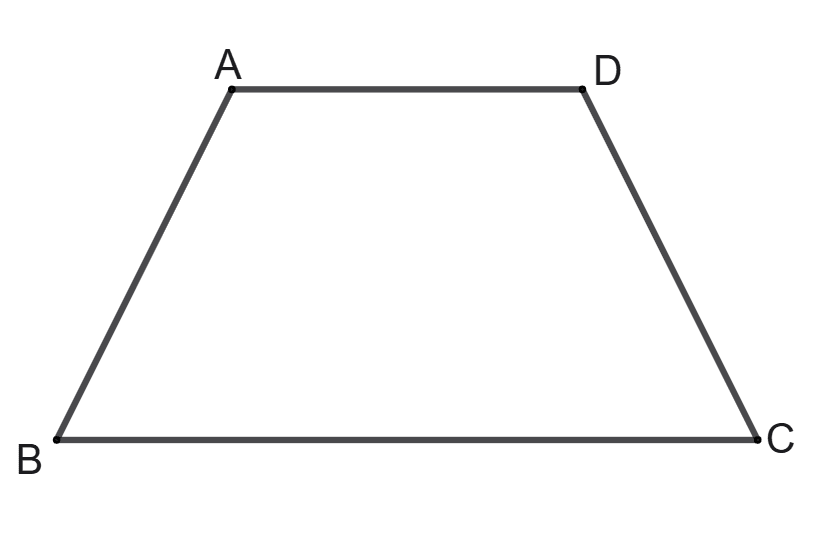
∠B and ∠C are adjacent angles.
∴ ∠B + ∠C = 180°
Hence, option 4 is the correct option.
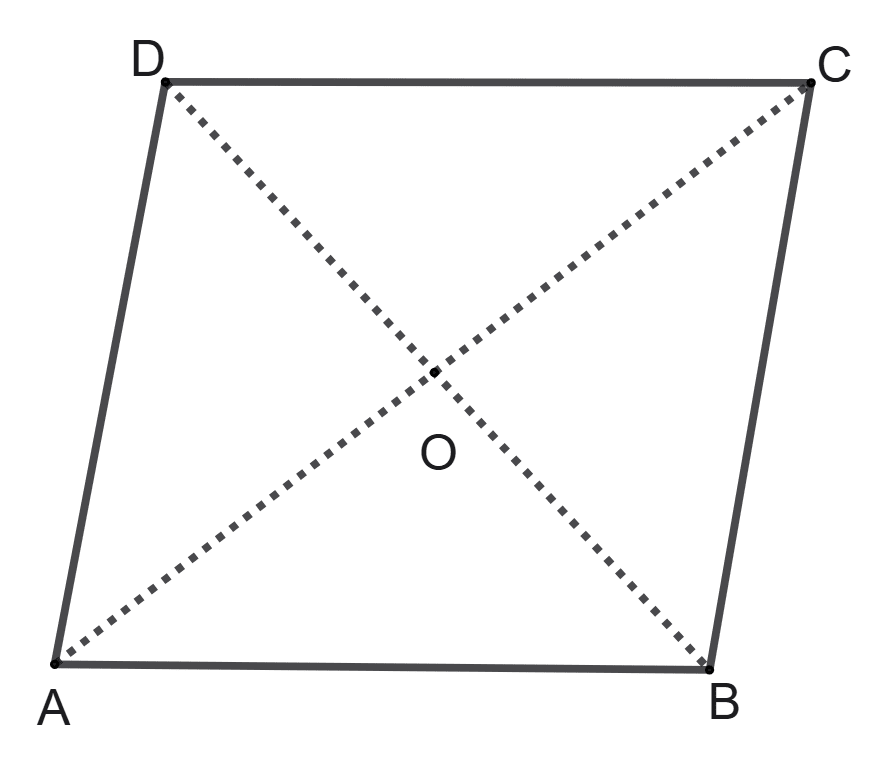
In parallelogram ABCD, diagonal AC and BD intersect each other at point O. Then:
AC = BD
∠AOB = 90°
The four triangles formed are congruent
AC and BD bisect each other
Answer
Given; ABCD is a parallelogram in which AC and BD are the diagonals of the parallelogram.
As we know that in a parallelogram, opposite sides are parallel and equal in length, opposite angles are equal and consecutive angles are supplementary.
Option 1: AC = BD is true only for rectangles or squares, not all parallelograms.
Option 2: ∠AOB = 90° is true only for rhombuses or squares, not all parallelograms.
Option 3: The four triangles formed are congruent is true only for rhombuses or squares, not all parallelograms.
Option 4: AC and BD bisect each other is a fundamental property of all parallelograms.
Hence, option 4 is the correct option.
Statement 1: The sum of the interior angles of a regular polygon is twice the sum of its exterior angles. The number of sides in the polgon is 6.
Statement 2: (2n - 4) x 90° = 2 x 360°.
Both the statements are true.
Both the statements are false.
Statement 1 is true, and statement 2 is false.
Statement 1 is false, and statement 2 is true.
Answer
Sum of all exterior angles of any polygon (regular or irregular) is always 360°.
Sum of all interior angles of an n-sided polygon (regular or irregular) is (n - 2) x 180°.
It is given that the sum of interior angles of a regular polygon is twice the sum of its exterior angles.
⇒ (n - 2) x 180° = 2 x 360°
⇒ (n - 2) x 180° = 720°
⇒ 180°n - 360° = 720°
⇒ 180°n = 720° + 360°
⇒ 180°n = 1080°
⇒ n = = 6
Thus, the number of sides is 6.
As,
⇒ (n - 2) x 180° = 2 x 360°
⇒ (2n - 4) x 90° = 2 x 360°.
∴ Both the statements are true.
Hence, option 1 is the correct option.
Statement 1: Through each vertex of a hexagon, 3 diagonals can be drawn.
Statement 2: The number of diagonals through a vertex of a polygon = The number of sides in the polygon - 3.
Both the statements are true.
Both the statements are false.
Statement 1 is true, and statement 2 is false.
Statement 1 is false, and statement 2 is true.
Answer
The number of diagonals from a single vertex in a polygon with n sides is n - 3.
If from a polygon, 3 diagonals can be drawn, then :
3 = n - 3
n = 3 + 3 = 6.
A polygon with 6 sides is a hexagon.
∴ Both the statements are true.
Hence, option 1 is the correct option.
Assertion (A): If the diagonals of a quadrilateral bisect each other at right angles, then the quadrilateral is a rhombus.
Reason (R): A quadrilateral whose diagonals bisect each other at right angles must be a square.
A is true, but R is false.
A is false, but R is true.
Both A and R are true, and R is the correct reason for A.
Both A and R are true, and R is the incorrect reason for A.
Answer
Let quadrilateral be ABCD.
Since, diagonals bisect each other at 90°.
∴ ∠AOB = ∠BOC = ∠COD = ∠DOA = 90°.
From figure,
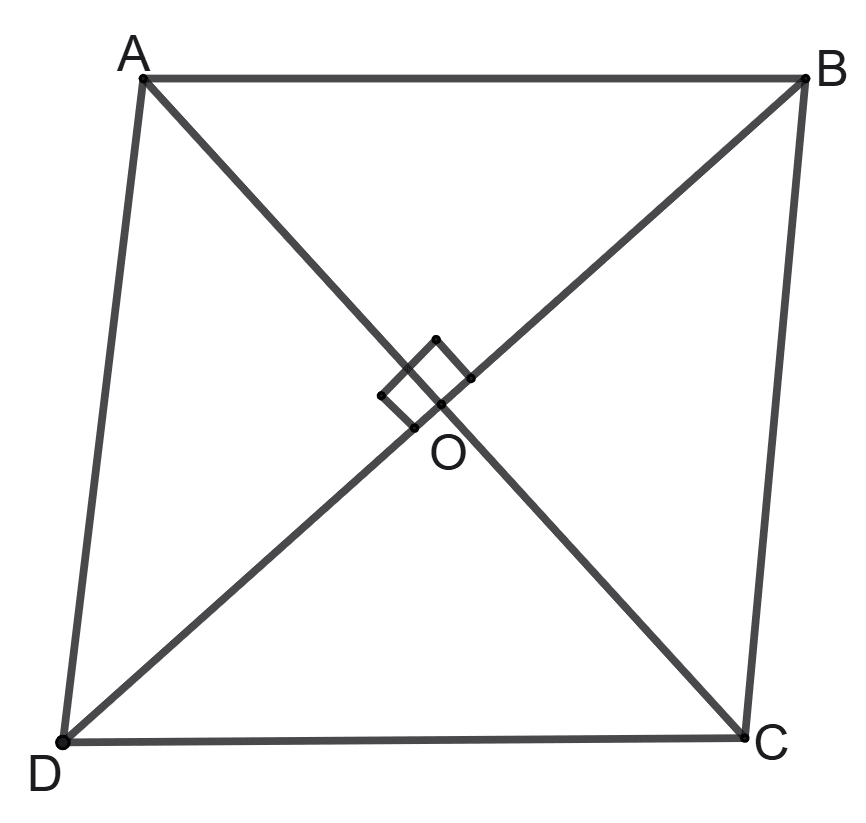
Considering △OAB and △OCD we have,
⇒ OA = OC (As diagonals bisect each other)
⇒ OB = OD (As diagonals bisect each other)
⇒ ∠AOB = ∠COD (Both equal to 90°)
Hence, △OAB ≅ △OCD by SAS axiom.
AB = CD (By C.P.C.T.) .........................(1)
∴ ∠OAB = ∠OCD (By C.P.C.T.)
The above angles are alternate angles.
Hence, we can say that AB || CD.
Considering △OAD and △OCB we have,
⇒ OA = OC (As diagonals bisect each other)
⇒ OB = OD (As diagonals bisect each other)
⇒ ∠AOD = ∠COB (Both equal to 90°)
Hence, △OAD ≅ △OCB by SAS axiom.
AD = BC (By C.P.C.T.) .....................(2)
∠OAD = ∠OCB (By C.P.C.T.)
The above angles are alternate angles.
Hence, we can say that AD || BC.
Considering △AOB and △AOD we have,
⇒ AO = AO (Common side)
⇒ OB = OD (As diagonals bisect each other)
⇒ ∠AOD = ∠AOB (Both equal to 90°)
Hence, △AOB ≅ △AOD by SAS axiom.
AB = AD (By C.P.C.T.) .....................(3)
From (i), (ii) and (iii) we get,
AB = BC = CD = AD.
Since, all the sides are equal and diagonals bisect each other.
Thus, we can say that the quadrilateral is rhombus.
∴ A is true, but R is false.
Hence, option 1 is the correct option.
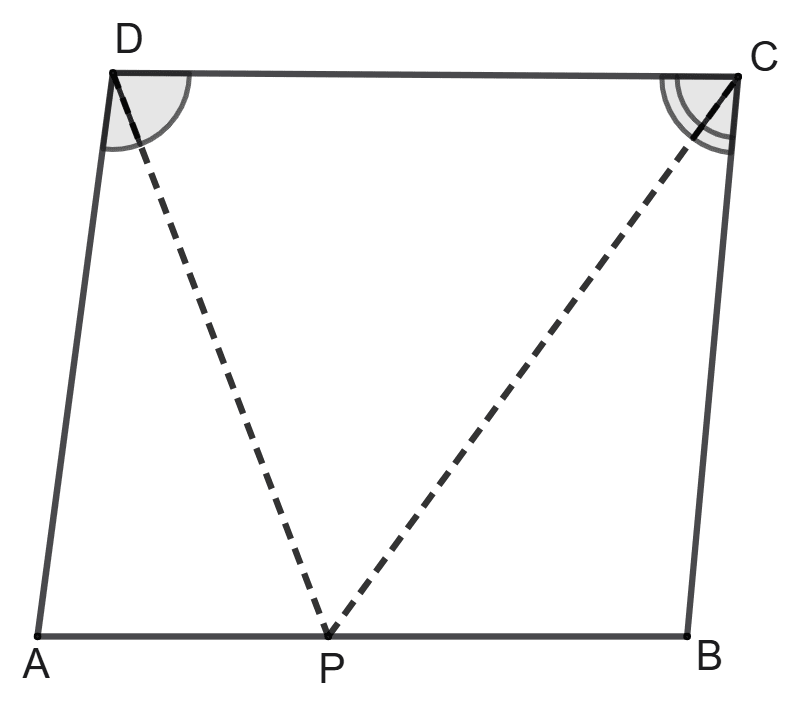
Assertion (A): In parallelogram ABCD, PD bisects ∠ADC and PC bisects angle DCB, then ∠DPC = 90°.
Reason (R): ∠PDC = x ∠ADC
∠PCD = x ∠BCD
∠PDC + ∠PCD = x (∠ADC + ∠BCD)
A is true, but R is false.
A is false, but R is true.
Both A and R are true, and R is the correct reason for A.
Both A and R are true, and R is the incorrect reason for A.
Answer
We know that consecutive angles of a parallelogram are supplementary.
ABCD is a parallelogram.
∴ ∠ADC + ∠BCD = 180° .....................(1)
PD bisects ∠ADC.
⇒ ∠PDC = ...............(2)
PC bisects ∠BCD.
⇒ ∠PCD = ...............(3)
Adding equations (2) and (3), we get :
⇒ ∠PDC + ∠PCD = + (∠ADC + ∠BCD)
= x 180°
= 90°.
In ΔPCD, according to angle sum property,
⇒ ∠PDC + ∠PCD + ∠DPC = 180°
⇒ 90° + ∠DPC = 180°
⇒ ∠DPC = 180° - 90°
⇒ ∠DPC = 90°
∴ Both A and R are true, and R is the correct reason for A.
Hence, option 3 is the correct option.
The difference between an exterior angle of (n - 1) sided regular polygon and an exterior angle of (n + 2) sided regular polygon is 6°. Find the value of n.
Answer
Exterior angle of (n - 1) sided regular polygon =
Exterior angle of (n + 2) sided regular polygon =
Given,
Difference between an exterior angle of (n - 1) sided regular polygon and an exterior angle of (n + 2) sided regular polygon is 6°.
Since, no. of sides cannot be negative.
∴ n = 13.
Hence, n = 13.
Two alternate sides of a regular polygon, when produced, meet at right angle. Find :
(i) the value of each exterior angle of the polygon;
(ii) the number of sides in the polygon.
Answer

(i) Let AB and CD be the alternate sides of regular polygon.
Given,
Two alternate sides of a regular polygon, when produced, meet at right angle.
We know that,
Interior angles of regular polygon are equal.
∴ ∠ABC = ∠BCD
⇒ 180° - ∠ABC = 180° - ∠BCD
⇒ ∠PBC = ∠BCP = x
In △ PBC,
⇒ ∠PBC + ∠BCP + ∠BPC = 180°
⇒ x + x + 90° = 180°
⇒ 2x = 180° - 90°
⇒ 2x = 90°
⇒ x =
⇒ x = 45°.
∴ ∠PBC = ∠BCP = 45°.
Hence, value of each exterior angle of the polygon = 45°.
(ii) By formula,
Number of sides in polygon = = 8.
Hence, number of sides in the polygon = 8.
In parallelogram ABCD, AP and AQ are perpendiculars from vertex of obtuse angle A as shown. If ∠x : ∠y = 2 : 1; find the angles of the parallelogram.

Answer
Given,
∠x : ∠y = 2 : 1
Let ∠x = 2a and ∠y = a.
From figure,
AQCP is a quadrilateral.
∴ ∠A + ∠P + ∠C + ∠Q = 360° (Sum of interior angles of a quadrilateral equals)
⇒ y + 90° + x + 90° = 360°
⇒ a + 90° + 2a + 90° = 360°
⇒ 3a + 180° = 360°
⇒ 3a = 360° - 180°
⇒ 3a = 180°
⇒ a =
⇒ a = 60°.
⇒ ∠x = 2 × 60° = 120° and ∠y = 60°.
From figure,
⇒ ∠C = ∠x = 120°,
⇒ ∠A = ∠C = 120° (Opposite angles of parallelogram are equal),
⇒ ∠B + ∠C = 180° (Sum of adjacent angles of a parallelogram equals to 180°)
⇒ ∠B + 120° = 180°
⇒ ∠B = 180° - 120° = 60°
⇒ ∠D = ∠B = 60° (Opposite angles of parallelogram are equal).
Hence, ∠DAB = ∠C = 120° and ∠B = ∠D = 60°.
In the given figure, AP is bisector of ∠A and CQ is bisector of ∠C of parallelogram ABCD. Prove that APCQ is a parallelogram.

Answer
Join AC.
Let AC intersect BD at point O.

As, AP is the bisector of ∠A and CQ is bisector of ∠C.
∴ ∠DAP = and ∠BCQ = .
In || gm ABCD,
⇒ ∠A = ∠C (Opposite angles of || gm are equal)
⇒
⇒ ∠DAP = ∠BCQ.
In △ ADP and △ CBQ,
⇒ ∠DAP = ∠BCQ
⇒ AD = BC (Opposite sides of || gm are equal)
⇒ ∠ADP = ∠QBC (Alternate angles are equal)
∴ △ ADP ≅ △ CBQ (By A.S.A. axiom)
We know that,
Corresponding sides of congruent triangle are equal.
∴ DP = QB ........(1)
We know that,
Diagonals of parallelogram bisect each other.
⇒ OD = OB .......(2)
⇒ OA = OC.
Subtracting equation (1) from (2), we get :
⇒ OD - DP = OB - QB
⇒ OP = OQ.
In quadrilateral APCQ,
⇒ OP = OQ and OA = OC.
Since, diagonals of quadrilateral APCQ bisect each other.
∴ APCQ is a parallelogram.
Hence, proved that APCQ is a parallelogram.
In case of a parallelogram prove that :
(i) the bisectors of any two adjacent angles intersect at 90°.
(ii) the bisectors of opposite angles are parallel to each other.
Answer
(i) Let ABCD be the parallelogram. AO and DO be the bisector of angles A and D respectively.

∴ ∠DAO = and ∠ADO = .
We know that,
In a parallelogram, consecutive angles are supplementary.
∴ ∠A + ∠D = 180°
⇒
⇒ ∠DAO + ∠ADO = 90° .........(1)
In △ AOD,
By angle sum property of triangle,
⇒ ∠DAO + ∠ADO + ∠AOD = 180°
⇒ 90° + ∠AOD = 180°
⇒ ∠AOD = 180° - 90° = 90°.
Hence, bisectors of any two adjacent angles intersect at 90°.
(ii)

From figure,
DE and BF are bisectors of angles D and B respectively.
In parallelogram ABCD,
⇒ ∠B = ∠D (Opposite angles of || gm are equal)
⇒
⇒ ∠FBC = ∠ADE.
In △ ADE and △ CBF,
⇒ ∠ADE = ∠FBC (Proved above)
⇒ AD = BC (Opposite sides of || gm ABCD are equal)
⇒ ∠DAE = ∠BCF (Opposite angles of || gm ABCD are equal)
∴ △ ADE ≅ △ CBF (By A.S.A. axiom)
We know that,
Corresponding sides of congruent triangle are equal.
∴ AE = CF
Since, AE = CF and AB = CD,
∴ BE = DF
In parallelogram ABCD,
⇒ AB || CD
⇒ BE || DF
Since,
BE = DF and BE || DF
In quadrilateral BEDF, one of the pair of opposite sides are equal and parallel.
∴ BEDF is a parallelogram.
∴ DE || BF.
Hence, proved that bisectors of opposite angles of a parallelogram are parallel.
The diagonals of a rectangle intersect each other at right angles. Prove that the rectangle is a square.
Answer
Let ABCD be the rectangle.

Since, opposite sides of rectangle are equal.
∴ AB = DC ........(1)
∴ AD = BC .........(2)
Given,
Diagonals intersect at right angle.
∴ ∠AOB = 90°, ∠AOD = 90°.
In △ AOB and △ AOD,
⇒ AO = AO (Common side)
⇒ ∠AOB = ∠AOD (Both equal to 90°)
⇒ OB = OD (Diagonals of rectangle bisect each other)
∴ △ AOB ≅ △ AOD (By S.A.S. axiom)
We know that,
Corresponding parts of congruent triangle are equal.
∴ AD = AB .......(3)
From equations (1), (2) and (3), we get :
⇒ AB = BC = CD = AD.
Since, all sides are equal and diagonals intersect at right angle.
Hence, proved that the rectangle is a square.
In the following figure, ABCD and PQRS are two parallelograms such that ∠D = 120° and ∠Q = 70°. Find the value of x.

Answer

In parallelogram ABCD,
⇒ ∠A = ∠C and ∠B = ∠D = 120° (Opposite angles of a parallelogram are equal)
⇒ ∠A + ∠B + ∠C + ∠D = 360° (By angle sum property)
⇒ ∠C + ∠D + ∠C + ∠D = 360°
⇒ 2∠C + 120° + 120° = 360°
⇒ 2∠C + 240° = 360°
⇒ 2∠C = 360° - 240°
⇒ 2∠C = 120°
⇒ ∠C = = 60°.
In parallelogram PQRS,
⇒ ∠S = ∠Q = 70° (Opposite angles of a parallelogram are equal)
In △ OSC,
By angle sum property of triangle,
⇒ ∠S + ∠C + ∠O = 180°
⇒ 70° + 60° + x = 180°
⇒ 130° + x = 180°
⇒ x = 180° - 130° = 50°.
Hence, x = 50°.
In the following figure, ABCD is a rhombus and DCFE is a square.
If ∠ABC = 56°, find :
(i) ∠DAE
(ii) ∠FEA
(iii) ∠EAC
(iv) ∠AEC

Answer
(i) In rhombus ABCD,
⇒ ∠CDA = ∠CBA = 56° (Opposite angles of rhombus are equal.)
In square DCFE,
⇒ ∠CDE = 90° (Each interior angle of a square equals to 90°)
From figure,
⇒ AD = CD (Each side of rhombus are equal) .........(1)
⇒ CD = ED (Each side of square are equal) .........(2)
From equation (1) and (2), we get :
⇒ AD = ED.
In △ ADE,
⇒ AD = ED (Proved above)
⇒ ∠AED = ∠DAE
By angle sum property of triangle,
⇒ ∠DAE + ∠AED + ∠ADE = 180°
⇒ ∠DAE + ∠DAE + (∠CDA + ∠CDE) = 180°
⇒ 2∠DAE + (56° + 90°) = 180°
⇒ 2∠DAE + 146° = 180°
⇒ 2∠DAE = 180° - 146°
⇒ 2∠DAE = 34°
⇒ ∠DAE = = 17°.
Hence, ∠DAE = 17°.
(ii) From figure,
⇒ ∠FED = 90° (Each interior angle of square equals 90°)
⇒ ∠AED = ∠DAE = 17°.
⇒ ∠FEA = ∠FED - ∠AED
⇒ ∠FEA = 90° - 17° = 73°.
Hence, ∠FEA = 73°.
(iii) In rhombus ABCD,
By angle sum property,
⇒ ∠ABC + ∠BCD + ∠CDA + ∠DAB = 360°
⇒ ∠ABC + ∠DAB + ∠CDA + ∠DAB = 360° (∠BCD = ∠DAB, as opposite angles of rhombus are equal)
⇒ 56° + 2∠DAB + 56° = 360°
⇒ 112° + 2∠DAB = 360°
⇒ 2∠DAB = 360° - 112°
⇒ 2∠DAB = 248°
⇒ ∠DAB = = 124°.
From figure,
⇒ ∠DAC = (As, diagonals of rhombus bisect interior angles)
⇒ ∠DAC = = 62°.
From figure,
⇒ ∠EAC = ∠DAC - ∠DAE = 62° - 17° = 45°.
Hence, ∠EAC = 45°.
(iv) Join EC.

From figure,
⇒ ∠DEC = (As, diagonals of square bisect interior angles)
⇒ ∠DEC = = 45°.
From figure,
⇒ ∠AEC = ∠DEC - ∠DEA = 45° - 17° = 28°.
Hence, ∠AEC = 28°.
In parallelogram ABCD, E is the mid-point of side AB and CE bisects angle BCD. Prove that :
(i) AE = AD
(ii) DE bisects angle ADC
(iii) angle DEC is a right angle
Answer

(i) In parallelogram ABCD,
AB || DC (Opposite sides are parallel)
CE is the transversal.
∴ ∠CED = ∠BCE (Alternate angles are equal)
∴ BC = EB (In triangle, side opposite to equal angles are equal) ..........(1)
From figure,
⇒ BC = AD (Opposite sides of parallelogram are equal) ........(2)
Given,
⇒ AE = EB (As, E is the mid-point of AB) ........(3)
From equation (1), (2) and (3), we get :
⇒ AE = AD.
Hence, proved that AE = AD.
(ii) In △ AED,
⇒ AD = AE (Proved above)
⇒ ∠AED = ∠ADE (Angles opposite to equal sides are equal.) .......(4)
From figure,
⇒ ∠EDC = ∠AED (Alternate angles are equal.) ..........(5)
From equations (4) and (5), we get :
⇒ ∠ADE = ∠EDC.
Hence, proved that DE bisects angle ADC.
(iii) We know that,
Sum of consecutive angles in a parallelogram equal to 180°.
∴ ∠D + ∠C = 180°
⇒
⇒ = 90°
⇒ ∠EDC + ∠ECD = 90° [As, DE and CE are bisectors of angle D and C] ...........(1)
In △ DEC,
By angle sum property of triangle,
⇒ ∠EDC + ∠ECD + ∠DEC = 180°
⇒ 90° + ∠DEC = 180°
⇒ ∠DEC = 180° - 90° = 90°.
Hence, proved that DEC is a right angle.
In parallelogram ABCD, X and Y are mid-points of opposite sides AB and DC respectively. Prove that :
(i) AX = YC
(ii) AX is parallel to YC
(iii) AXCY is a parallelogram
Answer

(i) We know that,
Opposite sides of || gm are equal.
∴ AB = CD
⇒
⇒ AX = CY (As, X and Y are mid-points of AB and CD respectively)
Hence, proved that AX = YC.
(ii) We know that,
Opposite sides of || gm are parallel.
∴ AB || DC
∴ AX || YC.
Hence, proved that AX || YC.
(iii) From figure,
AX = YC and AX || YC.
Since, one pair of opposite sides of quadrilateral AXCY are equal and parallel.
∴ AXCY is a || gm.
Hence, proved that AXCY is a parallelogram.