
If the opposite sides of a quadrilateral are equal, the quadrilateral is :
rectangle
parallelogram
square
rhombus
Answer
If the opposite sides of a quadrilateral are equal, the quadrilateral is a parallelogram.
Hence, Option 2 is the correct option.
If the opposite angles of a quadrilateral are equal, the quadrilateral is :
rectangle
parallelogram
square
rhombus
Answer
If the opposite angles of a quadrilateral are equal, the quadrilateral is a parallelogram.
Hence, Option 2 is the correct option.
If three angles of a quadrilateral are equal to 90° each, then the quadrilateral is :
rectangle
square
parallelogram
rhombus
Answer
Given,
Three angles of a quadrilateral are equal to 90° each.
We know that,
Sum of angles of a quadrilateral = 360°.
Let fourth angle be x.
∴ 3 × 90° + x = 360°
⇒ 270° + x = 360°
⇒ x = 360° - 270° = 90°.
We know that,
Each interior angle of a rectangle and square equals to 90°.
Each square is a rectangle but not each rectangle is a square.
Hence, Option 1 is the correct option.
If three angles of a quadrilateral are equal, then the quadrilateral is :
rectangle
rhombus
not a parallelogram
parallelogram
Answer
If three angles of a quadrilateral are equal, then the quadrilateral is not a parallelogram.
Hence, Option 3 is the correct option.
BEC is an equilateral triangle inside the square ABCD. The value of angle ECD is :
60°
30°
75°
45°
Answer
Given,
BEC is an equilateral triangle.
∴ ∠BCE = 60°.

From figure,
⇒ ∠ECD = ∠BCD - ∠BCE = 90° - 60° = 30°.
Hence, Option 2 is the correct option.
E is the mid-point of side AB and F is the mid point of side DC of parallelogram ABCD. Prove that AEFD is a parallelogram.
Answer

We know that,
Opposite sides of parallelogram are equal.
∴ AB = CD
⇒
⇒ AE = FD.
Also,
Opposite sides of parallelogram are parallel.
∴ AB || CD
⇒ AE || FD.
∴ AE = FD and AE || FD.
Since, one pair of opposite side of quadrilateral AEFD is parallel.
Hence, proved that AEFD is a parallelogram.
The diagonal BD of a parallelogram ABCD bisects angles B and D. Prove that ABCD is a rhombus.
Answer

Since, opposite angles of a parallelogram are equal.
∴ ∠ABC = ∠ADC = x (let)
Given,
BD bisects ∠B.
∴ ∠ABD = ∠CBD =
BD bisects ∠D.
∴ ∠ADB = ∠BDC =
⇒ ∠ABD = ∠ADB and ∠CBD = ∠CDB
In △ ABD,
⇒ ∠ABD = ∠ADB
∴ AB = AD (Sides opposite to equal angles are equal) ......(1)
In △ CBD,
⇒ ∠CBD = ∠CDB
∴ CD = BC (Sides opposite to equal angles are equal) .........(2)
As, ABCD is a parallelogram.
Thus, opposite sides are equal.
∴ AB = CD .........(3)
∴ AD = BC ..........(4)
From equations (1), (2), (3) and (4), we get :
⇒ AB = BC = CD = AD.
Since, all sides of quadrilateral ABCD are equal.
Hence, proved that ABCD is a rhombus.
The alongside figure shows a parallelogram ABCD in which AE = EF = FC. Prove that :
(i) DE is parallel to FB
(ii) DE = FB
(iii) DEBF is a parallelogram.

Answer
Join BD. Let BD intersect AC at point O.

(i) We know that,
Diagonals of parallelogram bisect each other.
∴ OB = OD and OA = OC.
From figure,
⇒ OA = OC
⇒ OA - AE = OC - FC (As, AE = FC)
⇒ OE = OF.
In quadrilateral DEBF,
⇒ OB = OD and OE = OF.
Since, diagonals of quadrilateral DEBF bisect each other,
∴ DEBF is a parallelogram.
∴ DE || FB (Opposite sides of parallelogram are parallel.)
Hence, proved that DE || FB.
(ii) We know that,
Opposite sides of parallelogram are equal.
In parallelogram DEBF,
∴ DE = FB.
Hence, proved that DE = FB.
(iii) Since, one pair of opposite sides of quadrilateral DEBF is equal and parallel,
i.e. DE || FB and DE = FB,
∴ DEBF is a parallelogram.
Hence, proved that DEBF is a parallelogram.
In the alongside figure, ABCD is a parallelogram in which AP bisects angle A and BQ bisects angle B. Prove that :
(i) AQ = BP
(ii) PQ = CD
(iii) ABPQ is a parallelogram

Answer

(i) Let ∠A = 2x.
We know that,
Sum of consecutive angles in a parallelogram equals to 180°.
⇒ ∠A + ∠B = 180°
⇒ 2x + ∠B = 180°
⇒ ∠B = 180° - 2x.
⇒ ∠PAB = = x.
⇒ ∠QBA = = 90° - x.
In △ ABP,
⇒ ∠PAB + ∠ABP + ∠BPA = 180° (By angle sum property of triangle)
⇒ x + 180° - 2x + ∠BPA = 180°
⇒ 180° - x + ∠BPA = 180°
⇒ ∠BPA = 180° - 180° + x = x.
∴ ∠BPA = ∠PAB (Both equal to x)
∴ AB = BP (In a triangle sides opposite to equal angles are equal) ..........(1)
In △ ABQ,
⇒ ∠QBA + ∠BAQ + ∠AQB = 180° (By angle sum property of triangle)
⇒ 90° - x + 2x + ∠AQB = 180°
⇒ 90° + x + ∠AQB = 180°
⇒ ∠AQB = 180° - 90° - x = 90° - x.
∴ ∠AQB = ∠QBA (Both equal to 90° - x)
∴ AB = AQ (In a triangle sides opposite to equal angles are equal) ..........(2)
From equation (1) and (2), we get :
⇒ AQ = BP.
Hence, proved that AQ = BP.
(ii) Given,
ABCD is a parallelogram.
We know that,
Opposite sides of parallelogram are equal and parallel.
∴ AB = CD ............(1)
∴ AD || BC.
Since, AD || BC
∴ AQ || BP
Join PQ.
We know that,
AQ = BP (Proved above)
In quadrilateral ABPQ,
AQ = BP and AQ || BP.
Since, one of the pair of opposite sides of quadrilateral ABPQ are equal and parallel.
∴ ABPQ is a parallelogram.
∴ AB = PQ [Opposite sides of parallelogram are equal] .........(2)
From (1) and (2), we get :
PQ = CD.
Hence, proved that PQ = CD.
(iii) In quadrilateral ABPQ,
AQ || BP and AQ = BP.
∴ ABPQ is a parallelogram (Since, one of the pair of opposite sides of quadrilateral ABPQ are equal and parallel.)
Hence, proved that ABPQ is a parallelogram.
In the given figure, ABCD is a parallelogram. Prove that : AB = 2BC.

Answer
Given,
ABCD is a parallelogram.
∴ AB || CD (Opposite sides of parallelogram are parallel)
From figure,
AE is the transversal.
⇒ ∠BAE = ∠AED (Alternate angles are equal) ........(1)
⇒ ∠DAE = ∠BAE (Since, AE is the bisector of angle A) .........(2)
From equations (1) and (2), we get :
⇒ ∠AED = ∠DAE.
In △ DAE,
⇒ ∠AED = ∠DAE
⇒ AD = DE (In a triangle, sides opposite to equal angles are equal) .......(3)
From figure,
BE is the transversal.
⇒ ∠CEB = ∠EBA (Alternate angles are equal) ........(4)
⇒ ∠CBE = ∠EBA (Since, BE is the bisector of angle B) .........(5)
From equations (4) and (5), we get :
⇒ ∠CEB = ∠CBE.
In △ CBE,
⇒ ∠CEB = ∠CBE
⇒ BC = CE (In a triangle, sides opposite to equal angles are equal) .......(6)
In parallelogram ABCD,
⇒ AB = CD (Opposite sides of parallelogram are equal)
⇒ AB = DE + EC
⇒ AB = AD + BC [From equation (3) and (6)]
⇒ AB = BC + BC (AD = BC, as opposite sides of parallelogram are equal)
⇒ AB = 2 BC.
Hence, proved that AB = 2 BC.
Prove that the bisectors of opposite angles of a parallelogram are parallel.
Answer
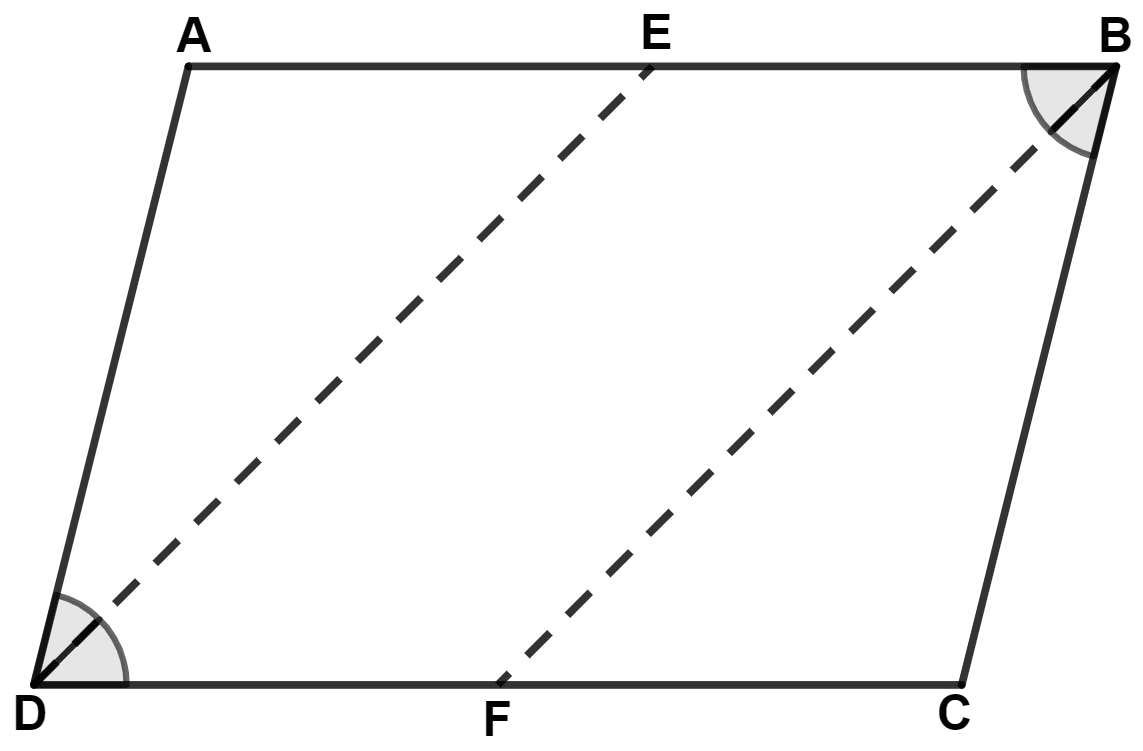
From figure,
DE and BF are bisectors of angles D and B respectively.
In parallelogram ABCD,
⇒ ∠B = ∠D (Opposite angles of || gm are equal)
⇒
⇒ ∠FBC = ∠ADE.
In △ ADE and △ CBF,
⇒ ∠ADE = ∠FBC (Proved above)
⇒ AD = BC (Opposite sides of || gm ABCD are equal)
⇒ ∠DAE = ∠BCF (Opposite angles of || gm ABCD are equal)
∴ △ ADE ≅ △ CBF (By A.S.A. axiom)
We know that,
Corresponding sides of congruent triangle are equal.
∴ AE = CF
Since, AE = CF and AB = CD,
∴ BE = DF
In parallelogram ABCD,
⇒ AB || CD
⇒ BE || DF
Since,
BE = DF and BE || DF
In quadrilateral BEDF, one of the pair of opposite sides are equal and parallel.
∴ BEDF is a parallelogram.
∴ DE || BF.
Hence, proved that bisectors of opposite angles of a parallelogram are parallel.
Prove that the bisectors of interior angles of a parallelogram form a rectangle.
Answer
Let ABCD be the parallelogram.
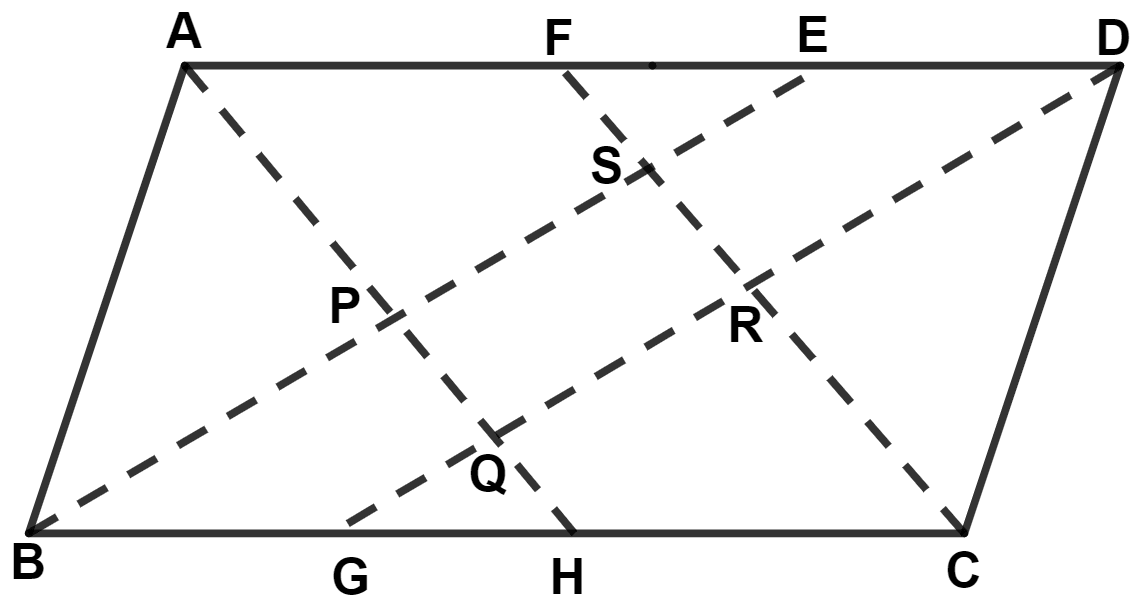
From figure,
AH, BE, CF and DG are bisectors of ∠A, ∠B, ∠C and ∠D respectively.
We know that,
Consecutive angles of parallelogram are supplementary.
Considering ∠A + ∠B = 180°,
⇒
⇒ = 90°
⇒ = 90° ............(1)
Considering ∠B + ∠C = 180°,
⇒
⇒ = 90°
⇒ = 90° ............(2)
Considering ∠C + ∠D = 180°,
⇒
⇒ = 90°
⇒ = 90° .........(3)
Considering ∠D + ∠A = 180°,
⇒
⇒ = 90°
⇒ = 90° .........(4)
In △ PAB,
By angle sum property of triangle,
⇒ ∠PAB + ∠ABP + ∠BPA = 180°
⇒ + ∠BPA = 180°
⇒ 90° + ∠BPA = 180° [From equation (1)]
⇒ ∠BPA = 180° - 90° = 90°.
From figure,
⇒ ∠SPQ = ∠BPA = 90° (Vertically opposite angles are equal)
In △ BSC,
By angle sum property of triangle,
⇒ ∠SBC + ∠SCB + ∠BSC = 180°
⇒ + ∠BSC = 180°
⇒ 90° + ∠BSC = 180° [From equation (2)]
⇒ ∠BSC = 180° - 90° = 90°.
From figure,
⇒ ∠PSR = ∠BSC = 90°.
In △ DRC,
By angle sum property of triangle,
⇒ ∠RCD + ∠CDR + ∠DRC = 180°
⇒ + ∠DRC = 180°
⇒ 90° + ∠DRC = 180° [From equation (3)]
⇒ ∠DRC = 180° - 90° = 90°.
From figure,
⇒ ∠SRQ = ∠DRC = 90° (Vertically opposite angles are equal)
In △ AQD,
By angle sum property of triangle,
⇒ ∠QAD + ∠ADQ + ∠DQA = 180°
⇒ + ∠DQA = 180°
⇒ 90° + ∠DQA = 180° [From equation (4)]
⇒ ∠DQA = 180° - 90° = 90°.
From figure,
⇒ ∠RQP = ∠DQA = 90°.
Since, all the interior angles of quadrilateral PQRS equals to 90°.
∴ PQRS is a rectangle.
Hence, proved that bisectors of interior angles of a parallelogram form a rectangle.
Prove that the bisectors of the interior angles of a rectangle form a square.
Answer
In rectangle,
All the interior angles equal to 90°. So, bisectors divide interior angles into two 45° angles.
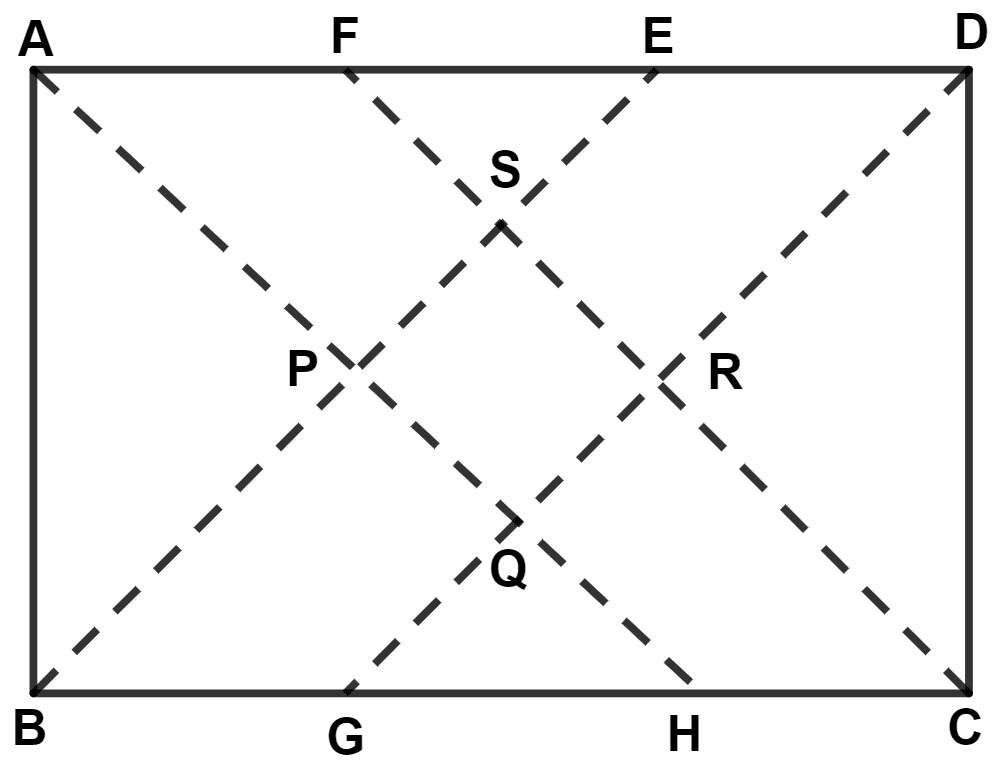
In △ BSC,
By angle sum property of triangle,
⇒ ∠SBC + ∠SCB + ∠BSC = 180°
⇒ + ∠BSC = 180°
⇒ 45° + 45° + ∠BSC = 180°
⇒ ∠BSC = 180° - 90° = 90°.
Since,
⇒ ∠SBC = ∠SCB
∴ BS = SC (Sides opposite to equal angles are equal) .....(1)
From figure,
⇒ ∠PSR = ∠BSC = 90°.
In △ APB and △ DRC,
⇒ ∠PAB = ∠RDC (Both equal to 45°)
⇒ ∠PBA = ∠RCD (Both equal to 45°)
⇒ AB = CD (Opposite sides of rectangle are equal)
∴ △ APB ≅ △ DRC (By A.S.A. axiom)
We know that,
Corresponding parts of congruent triangle are equal.
∴ BP = CR .........(2)
Subtracting equation (2) from (1), we get :
⇒ BS - BP = SC - CR
⇒ PS = SR .............(3)
In △ DRC,
By angle sum property of triangle,
⇒ ∠RCD + ∠CDR + ∠DRC = 180°
⇒ + ∠DRC = 180°
⇒ 45° + 45° + ∠DRC = 180°
⇒ ∠DRC = 180° - 90° = 90°.
From figure,
⇒ ∠SRQ = ∠DRC = 90° (Vertically opposite angles are equal)
In △ PAB,
By angle sum property of triangle,
⇒ ∠PAB + ∠ABP + ∠BPA = 180°
⇒ + ∠BPA = 180°
⇒ 45° + 45° + ∠BPA = 180°
⇒ ∠BPA = 180° - 90° = 90°.
From figure,
⇒ ∠SPQ = ∠BPA = 90° (Vertically opposite angles are equal)
In △ AQD,
By angle sum property of triangle,
⇒ ∠DAQ + ∠QDA + ∠AQD = 180°
⇒ + ∠AQD = 180°
⇒ 45° + 45° + ∠AQD = 180°
⇒ ∠AQD = 180° - 90° = 90°.
Since,
⇒ ∠DAQ = ∠QDA
∴ AQ = QD (Sides opposite to equal angles are equal) .....(4)
From figure,
⇒ ∠PQR = ∠AQD = 90°.
Since, △ APB ≅ △ DRC
∴ AP = DR .........(5)
Subtracting equation (5) from (4), we get :
⇒ AQ - AP = QD - DR
⇒ PQ = QR ...........(6)
In △ BSC and △ AQD,
⇒ ∠B = ∠A (Both equal to 45°)
⇒ ∠C = ∠D (Both equal to 45°)
⇒ ∠S = ∠Q (Both equal to 90°)
∴ △ BSC ≅ △ AQD (By A.A.A. axiom)
We know that,
Corresponding parts of congruent triangle are equal.
∴ BS = AQ .........(7)
In △ AQD,
⇒ ∠A = ∠D (Both equal to 45°)
⇒ DQ = AQ (Sides opposite to equal angles are equal) .........(8)
From equation (7) and (8), we get :
⇒ BS = DQ .........(9)
In △ CDR,
⇒ ∠C = ∠D (Both equal to 45°)
⇒ DR = CR (Sides opposite to equal angles are equal) .........(10)
From equation (2) and (10), we get :
⇒ BP = DR .....(11)
Subtracting equation (11) from (9), we get :
⇒ BS - BP = DQ - DR
⇒ PS = QR .........(12)
From equation (3), (6) and (12), we get :
⇒ PQ = QR = RS = PS.
Since, all sides of quadrilateral PQRS are equal and each interior angle equals to 90°.
∴ PQRS is a square.
Hence, proved that bisectors of the interior angles of a rectangle form a square.
In parallelogram ABCD, the bisectors of angle A meets DC at P and AB = 2AD.
Prove that :
(i) BP bisects angle B.
(ii) Angle APB = 90°.
Answer

(i) Let AD = x.
Given,
AB = 2AD = 2x.
Given,
AP is the bisector of angle A,
∴ ∠1 = ∠2 .............(1)
From figure,
⇒ ∠2 = ∠5 [Alternate angles are equal] ......(2)
From equation (1) and (2), we get :
⇒ ∠1 = ∠5
In △ ADP,
⇒ ∠1 = ∠5
⇒ DP = AD = x (Sides opposite to equal angles are equal)
From figure,
⇒ AB = CD (Opposite sides of parallelogram are equal)
⇒ CD = 2x
⇒ DP + PC = 2x
⇒ x + PC = 2x
⇒ PC = 2x - x = x.
Also,
⇒ BC = AD = x (Opposite sides of parallelogram are equal)
In △ BCP,
⇒ BC = PC (Both equal to x)
⇒ ∠6 = ∠4 (Angles opposite to equal sides are equal) ......(3)
⇒ ∠6 = ∠3 (Alternate angles are equal) ..........(4)
From equation (3) and (4), we get :
⇒ ∠3 = ∠4.
∴ BP is the bisector of angle B.
Hence, proved that BP bisects angle B.
(ii) We know that,
Consecutive angles of parallelogram are supplementary.
Considering ∠A + ∠B = 180°,
⇒
⇒ = 90°
⇒ = 90° ............(1)
In △ PAB,
By angle sum property of triangle,
⇒ ∠PAB + ∠ABP + ∠APB = 180°
⇒ + ∠APB = 180°
⇒ 90° + ∠APB = 180° [From equation (1)]
⇒ ∠APB = 180° - 90° = 90°.
Hence, proved that ∠APB = 90°.
Points M and N are taken on the diagonal AC of a parallelogram ABCD such that AM = CN. Prove that BMDN is a parallelogram.
Answer
Join BD. Let BD intersect AC at point O.

In parallelogram ABCD,
Diagonals of || gm bisect each other.
⇒ OA = OC .........(1)
⇒ OB = OD
Given,
⇒ AM = CN .........(2)
Subtracting equation (2) from (1), we get :
⇒ OA - AM = OC - CN
⇒ OM = ON.
In quadrilateral BMDN,
⇒ OM = ON and OB = OD.
∴ Diagonals of quadrilateral BMDN bisect each other.
∴ BMDN is a parallelogram.
Hence, proved that BMDN is a parallelogram.
In the following figure, ABCD is a parallelogram. Prove that :
(i) AP bisects angle A
(ii) BP bisects angle B
(iii) ∠DAP + ∠CBP = ∠APB
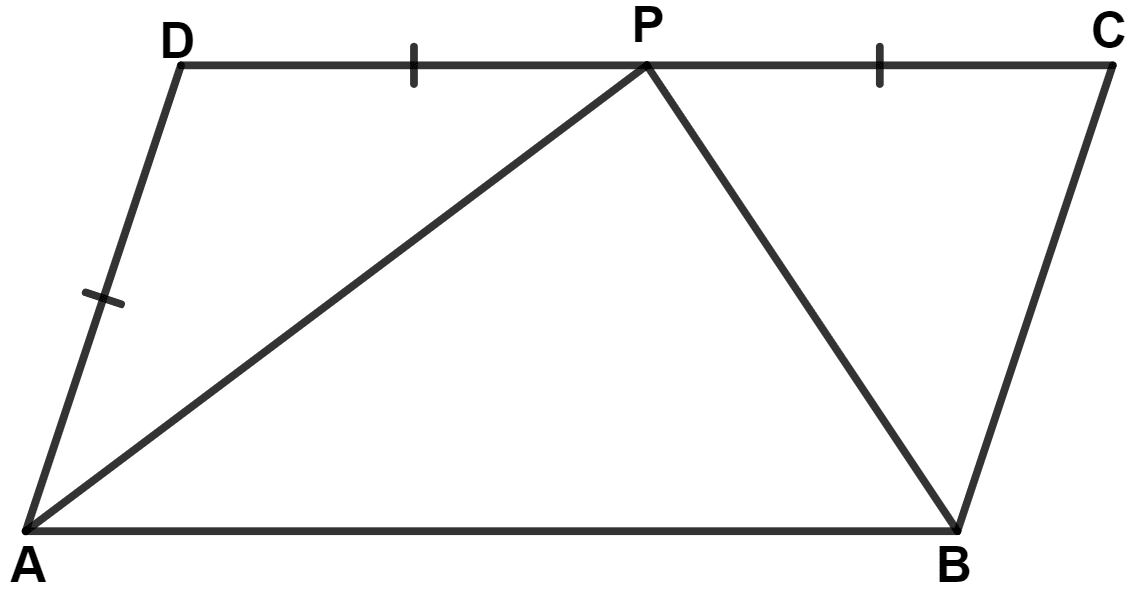
Answer
(i) In △ ADP,
⇒ AD = DP (Given)
∴ ∠APD = ∠PAD (Angles opposite to equal sides are equal) .......(1)
In parallelogram ABCD,
AB || DC and AP is the transversal.
∴ ∠APD = ∠PAB (Alternate angles are equal) ........(2)
From equation (1) and (2), we get :
⇒ ∠PAD = ∠PAB.
∴ AP bisects angle A.
Hence, proved that AP bisects angle A.
(ii) In || gm ABCD,
⇒ BC = AD (Opposite sides of || gm are equal)
∴ BC = PC
∴ ∠BPC = ∠PBC (Angles opposite to equal sides are equal) .......(3)
In parallelogram ABCD,
AB || DC and BP is the transversal.
∴ ∠BPC = ∠PBA (Alternate angles are equal) ........(4)
From equation (1) and (2), we get :
⇒ ∠PBC = ∠PBA.
∴ BP bisects angle B.
Hence, proved that BP bisects angle B.
(iii) We know that,
Consecutive angles of a || gm are supplementary.
∴ ∠A + ∠B = 180°,
⇒
⇒ = 90°
⇒ = 90°
⇒ ∠PAB + ∠PBA = 90° .........(1)
In △ APB,
⇒ ∠PAB + ∠PBA + ∠APB = 180°
⇒ 90° + ∠APB = 180°
⇒ ∠APB = 180° - 90°
⇒ ∠APB = 90° ........(2)
From figure,
⇒ ∠PAB = ∠DAP (As, AP bisects ∠A)
⇒ ∠PBA = ∠CBP (As, BP bisects ∠B)
Substituting value of ∠PAB and ∠PBA in equation (1), we get :
⇒ ∠DAP + ∠CBP = 90° .........(3)
From equation (3) and (4), we get :
⇒ ∠DAP + ∠CBP = ∠APB.
Hence, proved that ∠DAP + ∠CBP = ∠APB.
ABCD is a square. A is joined to a point P on BC and D is joined to a point Q on AB. If AP = DQ; prove that AP and DQ are perpendicular to each other.
Answer
Let AP and DQ intersect at point O.
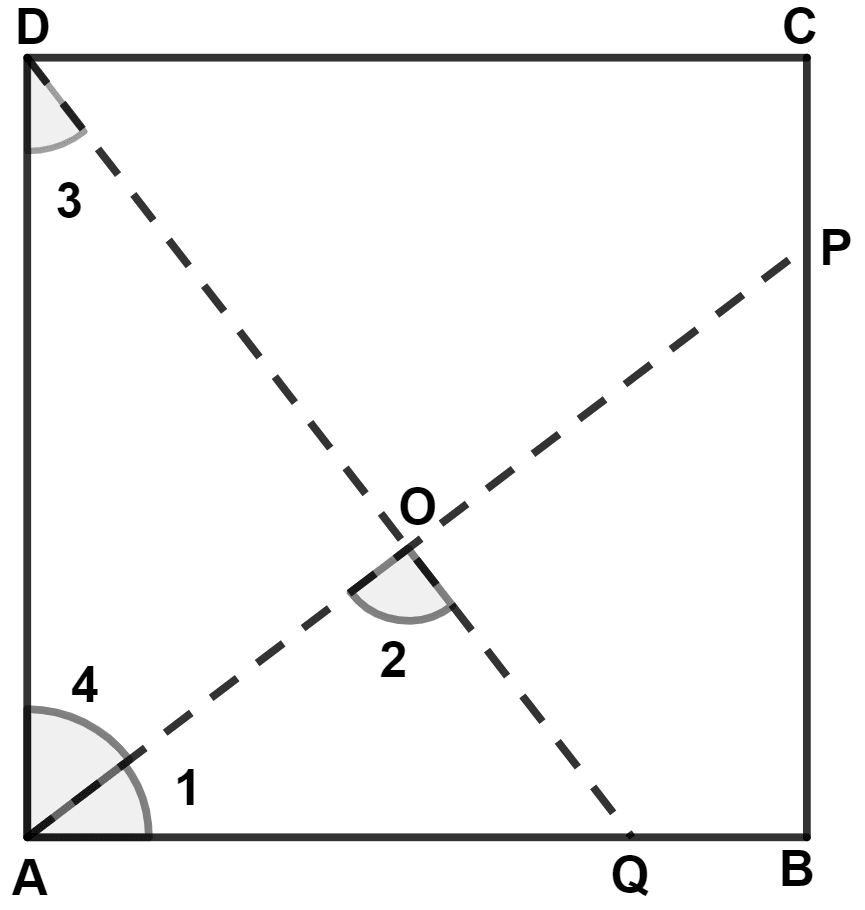
In △ DAQ and △ ABP,
⇒ ∠DAQ = ∠ABP (Interior angle of square equal to 90°)
⇒ DQ = AP (Given)
⇒ AD = AB (Each side of square equal in length)
∴ △ DAQ ≅ △ ABP (By R.H.S. congruence rule)
We know that,
Corresponding parts of congruent triangle are equal.
∴ ∠3 = ∠1 ........(1)
From figure,
⇒ ∠1 + ∠4 = 90°
Substituting value of ∠1 from equation (1) in above equation, we get :
⇒ ∠3 + ∠4 = 90°
In triangle AOD,
By angle sum property of triangle,
⇒ ∠ODA + ∠OAD + ∠AOD = 180°
⇒ ∠3 + ∠4 + ∠AOD = 180°
⇒ 90° + ∠AOD = 180°
⇒ ∠AOD = 180° - 90° = 90°.
∴ AP ⊥ DQ.
Hence, proved that AP and DQ are perpendicular to each other.
In a quadrilateral ABCD, AB = AD and CB = CD. Prove that :
(i) AC bisects angle BAD.
(ii) AC is perpendicular bisector of BD.
Answer

(i) In △ ABC and △ ADC,
⇒ AB = AD (Given)
⇒ BC = CD (Given)
⇒ AC = AC (Common side)
∴ △ ABC ≅ △ ADC (By S.S.S. axiom)
We know that,
Corresponding parts of congruent triangle are equal.
⇒ ∠BAC = ∠DAC
∴ AC bisects ∠BAD.
Hence, proved that AC bisects angle BAD.
(ii) Since, AC bisects ∠BAD
∴ ∠BAO = ∠DAO
In △ AOB and △ AOD,
⇒ AB = AD (Given)
⇒ AO = AO (Common side)
⇒ ∠BAO = ∠DAO (Proved above)
∴ △ AOB ≅ △ AOD (By S.A.S. axiom)
We know that,
Corresponding parts of congruent triangle are equal.
⇒ ∠BOA = ∠DOA ........(1)
From figure,
⇒ ∠BOA + ∠DOA = 180° (Linear pair)
⇒ ∠BOA + ∠BOA = 180° [From equation (1)]
⇒ 2∠BOA = 180°
⇒ ∠BOA = = 90°.
∴ AC is perpendicular bisector of BD.
Hence, proved that AC is perpendicular bisector of BD.