
The midpoints of the sides of a triangle are joined together to get four triangles. These four triangles are:
not equal to each other
congruent to each other
not congruent to each other
none of these
Answer
From figure,
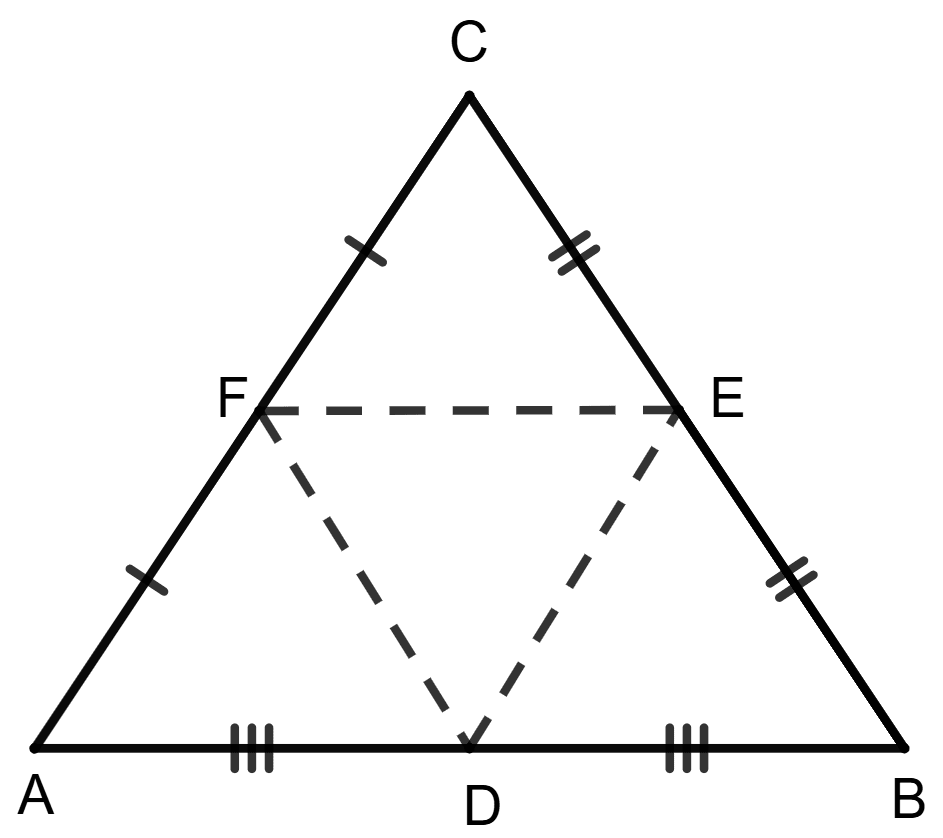
In △ABC,
D, E and F are mid-points of AB, BC and CA respectively.
Now join DE, EF and FD.
To prove :
△ADF ≅ △DBE ≅ △ECF ≅ △DEF
In △ABC,
D and E are midpoints of AB and BC.
∴ DE || AC (By, mid-point theorem) or,
DE || FC ........(1)
DE || AF ........(2)
D and F are midpoints of AB and AC.
∴ DF || BC (By, mid-point theorem) or,
DF || EC ........(3)
DF || BE ......(4)
F and E are midpoints of AC and BC.
∴ FE || AB (By, mid-point theorem) or,
FE || AD .........(5)
FE || DB .........(6)
From (1) and (3) we get,
DE || FC and DF || EC.
Since, opposite sides of a parallelogram are parallel.
∴ DECF is a parallelogram
We know that,
Diagonal of || gm divides it into two congruent triangles.
Diagonal FE divides the parallelogram DECF in two congruent triangles DEF and CEF.
∴ △DEF ≅ △ECF .........(7)
From (2) and (5) we get,
DE || AF and FE || AD.
Since, opposite sides of a parallelogram are parallel.
∴ ADEF is a parallelogram.
We know that,
Diagonal of || gm divides it into two congruent triangles.
Diagonal FD divides the parallelogram in two congruent triangles DEF and AFD.
∴ △DEF ≅ △AFD .........(8)
From (4) and (6) we get,
DF || BE and FE || DB.
∴ DBEF is a parallelogram.
We know that,
Diagonal DE divides the parallelogram in two congruent triangles DEF and DBE.
∴ △DEF ≅ △DBE .........(9)
From equations 7, 8 and 9 we get,
△AFD ≅ △DBE ≅ △ECF ≅ △DEF.
Thus, the four triangles formed are congruent to each other.
Hence, option 2 is the correct option.
In the given figure, AB || CD || EF. If AC = 7 cm, AE = 14 cm and BF = 20 cm, then DF is equal to:
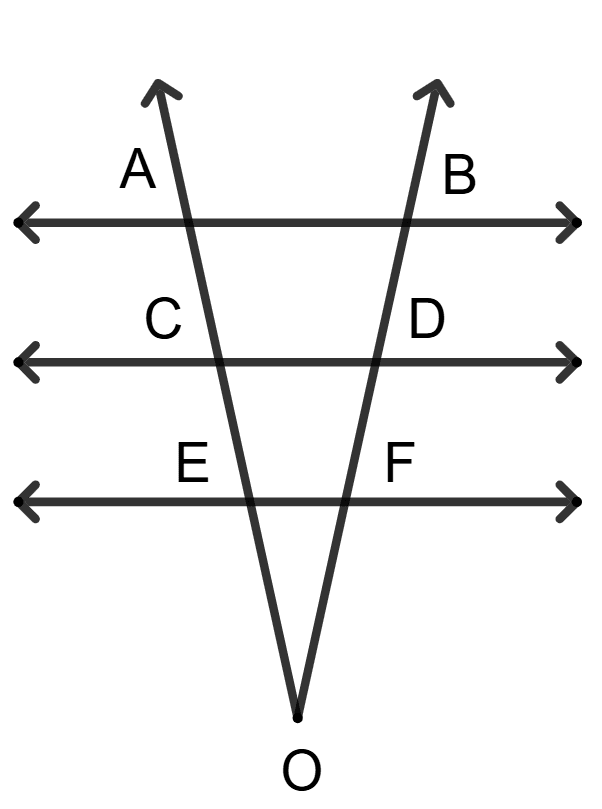
7 cm
14 cm
10 cm
16 cm
Answer
Given, AB || CD || EF, AC = 7 cm, AE = 14 cm and BF = 20 cm.
Let the length of DF be x cm.
According to equal intercept theorem,
If a transversal makes equal intercepts on three or more parallel lines, then any other line cutting them will also make equal intercepts.
From figure,
⇒ AE = AC + CE
⇒ 14 = 7 + CE
⇒ CE = 7 cm.
Since, OA makes equal intercept, so OB will also make equal intercepts.
∴ BD = DF = x (let)
From figure,
⇒ BF = BD + DF
⇒ 20 = x + x
⇒ 2x = 20
⇒ x = = 10 cm.
Hence, option 3 is the correct option.
In the given figure, AB || CD || EF and E is the mid-point of side AD, then :
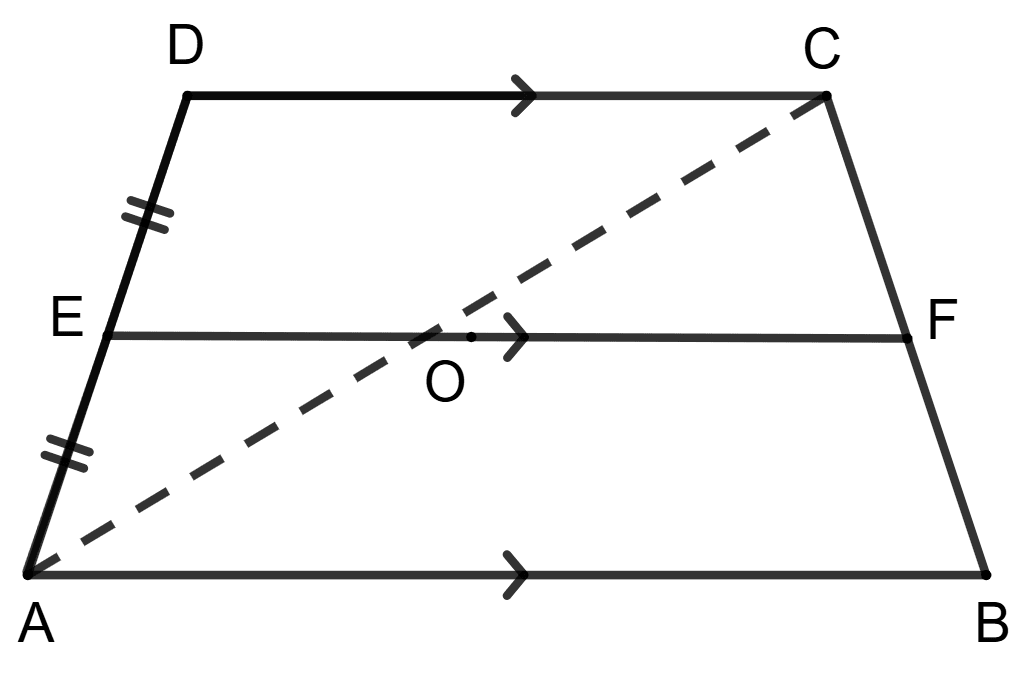
OE : OF = 1 : 3
OE = OF
OF = 2 x OE
CF = FB
Answer
Given,
E is mid-point of AD.
Since, EF || DC ⇒ EO || DC
According to converse of the mid-point theorem, in any triangle, a straight line through the midpoint of one side that is parallel to a second side, then that line bisects the third side.
⇒ OA = OC
⇒ O is the mid-point of AC.
Since, EF || AB ⇒ OF || AB
According to converse of the mid-point theorem,
F will be the mif-point of BC.
⇒ CF = FB
Hence, option 4 is the correct option.
In rhombus PQRS; A, B and C are mid-points of sides PQ, QR and RS respectively. If ∠P = 60°, the angle PQR is equal to:
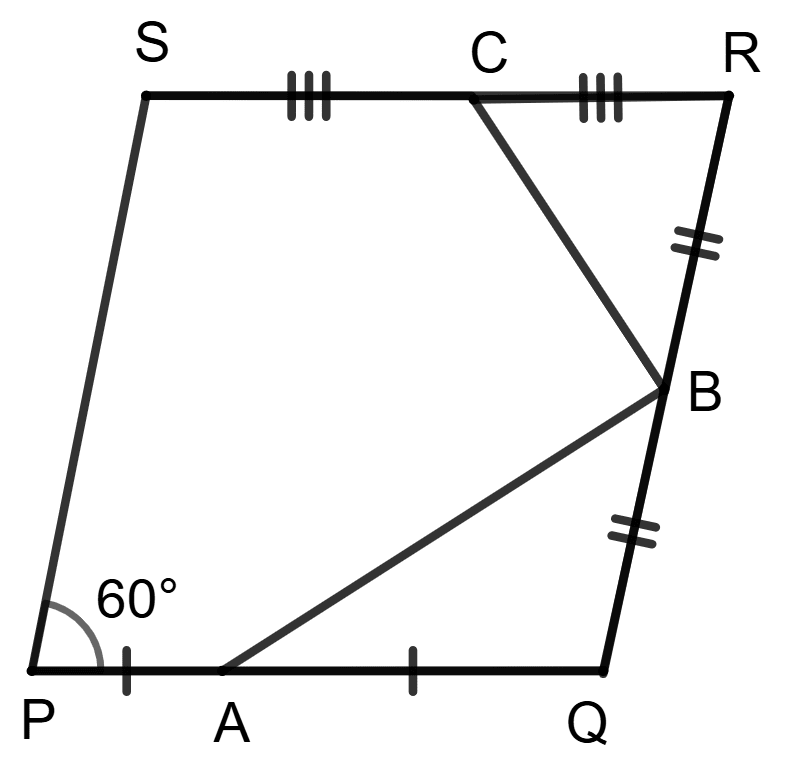
60°
90°
120°
none of these
Answer
Given, ∠P = 60°
∠P and ∠PQR are consecutive angles in the rhombus.
The sum of consecutive angles in a rhombus is 180°.
⇒ ∠P + ∠PQR = 180°
⇒ 60° + ∠PQR = 180°
⇒ ∠PQR = 180° - 60°
⇒ ∠PQR = 120°.
Hence, option 3 is the correct option.
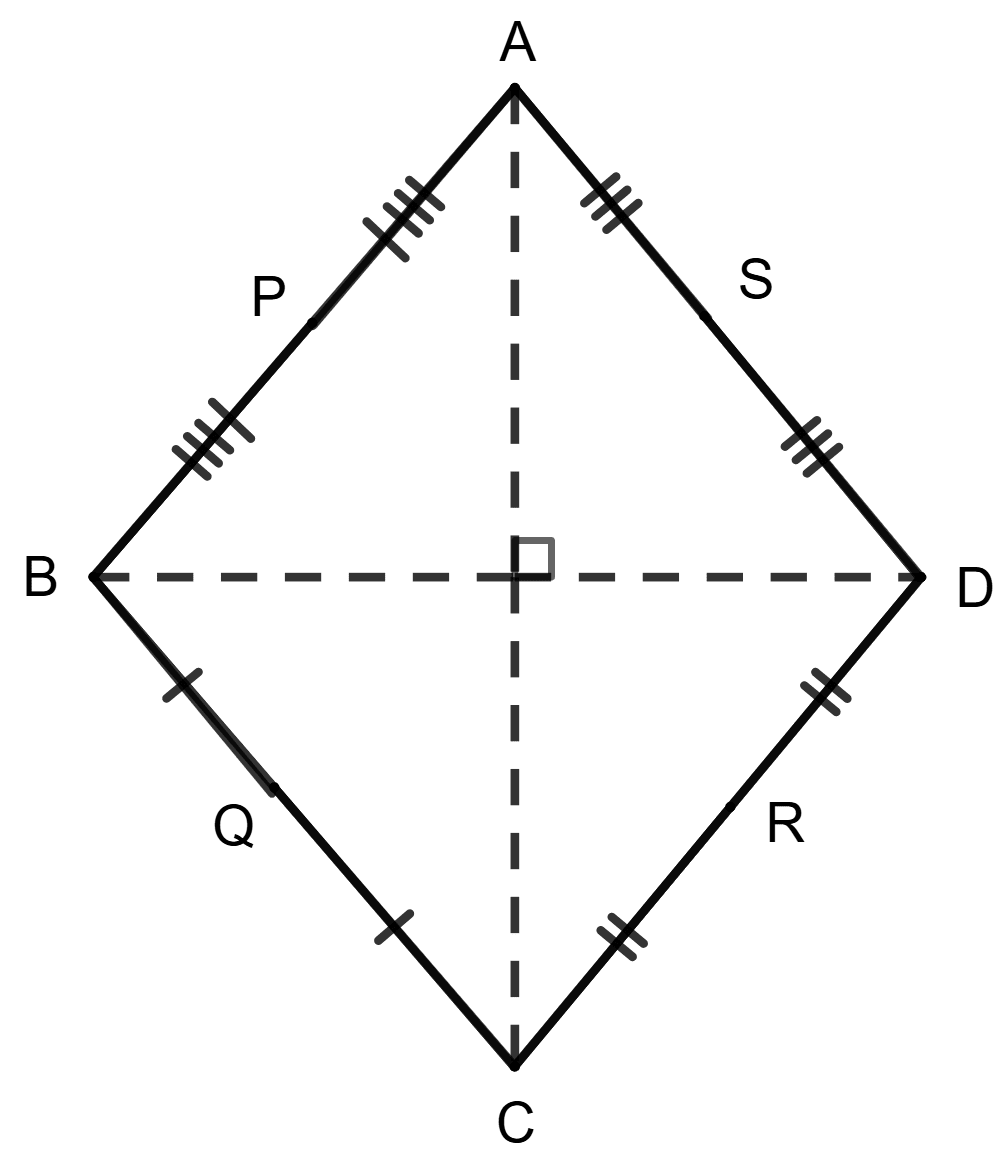
Statement 1: The diagonals of a quadrilateral are perpendicular to each other; P, Q, R and S are the midpoints of sides AB, BC, CD and DA respectively. Then PQRS will be a rectangle.
Statement 2: Quadrilateral PQRS will be a square as each of its angles will be 90°.
Both the statements are true.
Both the statements are false.
Statement 1 is true, and statement 2 is false.
Statement 1 is false, and statement 2 is true.
Answer
From figure,
PA = PB ⇒ P is mid-point of AB
SA = SD ⇒ S is mid-point of AD
BQ = CQ ⇒ Q is mid-point of BC
CR = RD ⇒ R is mid-point of CD
So, statement 1 is true.
By mid-point theorem,
The line segment joining the mid-points of any two sides of a triangle is parallel to the third side and is equal to half of it.
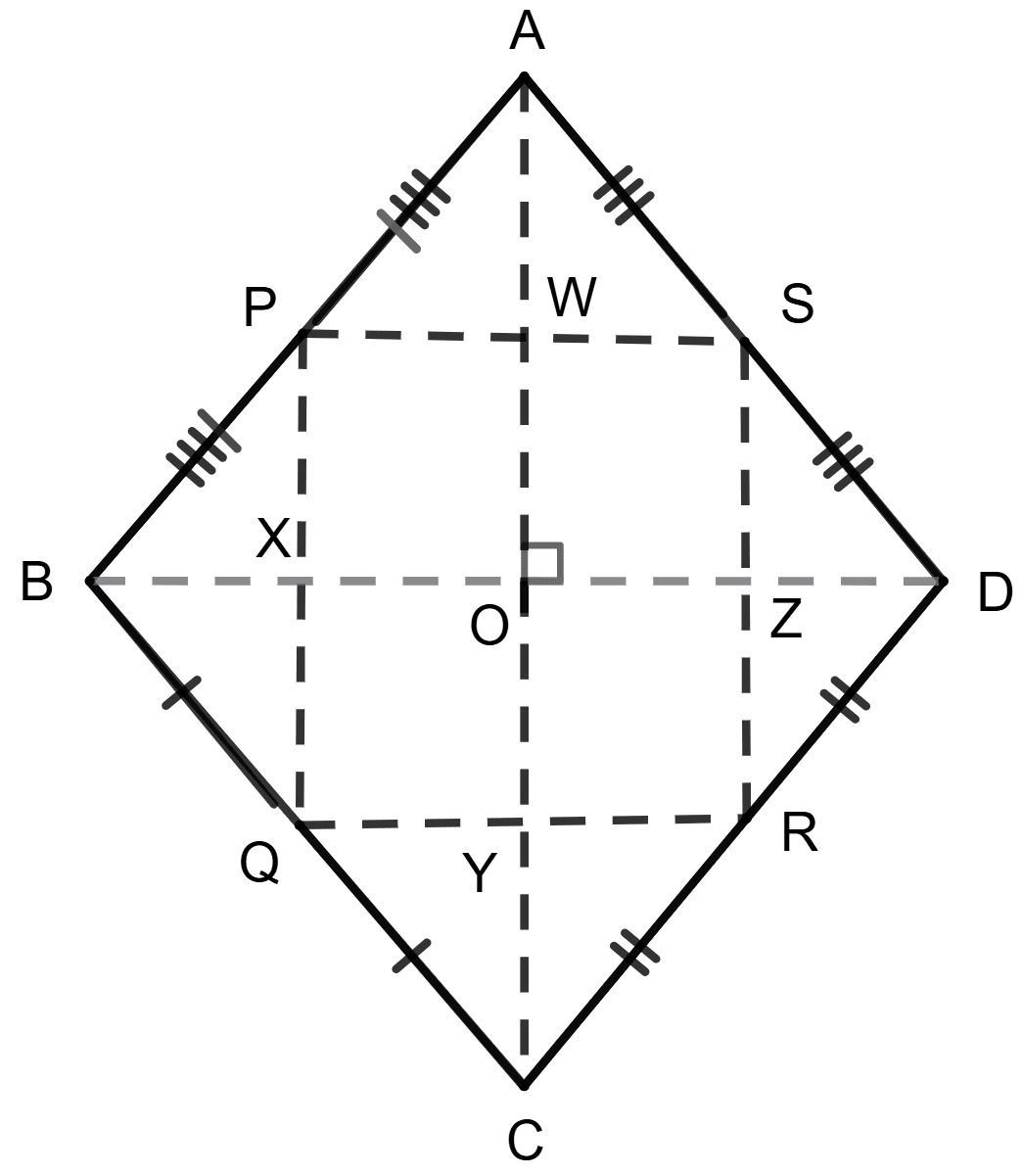
In △ ABC,
P and Q are mid-points of AB and BC respectively.
⇒ PQ = AC and PQ || AC. [By mid-point theorem] ................(1)
In △ ADC,
S and R are mid-points of AD and CD respectively.
⇒ SR = AC and SR || AC. [By mid-point theorem] .................(2)
From (1) and (2), we get :
PQ = SR and PQ || SR.
In △ BCD,
R and Q are mid-points of CD and BC respectively.
⇒ QR = BD and QR || BD. [By mid-point theorem] .................(3)
In △ ABD,
S and P are mid-points of AD and AB respectively.
⇒ PS = BD and PS || BD. [By mid-point theorem] .................(4)
From (3) and (4), we get :
QR = PS and QR || PS.
Since, diagonals of quadrilateral intersect at right angle.
∴ ∠AOD = ∠COD = ∠AOB = ∠BOC = 90°.
From figure,
PQ || AC
∴ ∠PXO = ∠AOD = 90° (Corresponding angles are equal)
∴ ∠QXO = ∠COD = 90° (Corresponding angles are equal)
SR || AC
∴ ∠SZO = ∠AOB = 90° (Corresponding angles are equal)
∴ ∠RZO = ∠BOC = 90° (Corresponding angles are equal)
PS || BD
∴ ∠S = ∠RZO = 90° (Corresponding angles are equal)
∴ ∠P = ∠QXO = 90° (Corresponding angles are equal)
QR || BD
∴ ∠R = ∠SZO = 90° (Corresponding angles are equal)
∴ ∠Q = ∠PXO = 90° (Corresponding angles are equal)
Since, in quadrilateral PQRS,
Each interior angle is equal to 90° and opposite sides are parallel and equal, and we can prove that PQRS is a rectangle but cannot prove that all sides are equal thus we cannot prove that it is a square.
∴ Statement 1 is true, and statement 2 is false.
Hence, option 3 is the correct option.
Statement 1: AD is median of triangle ABC and DE is parallel to BA. Then DE will bisect AC.
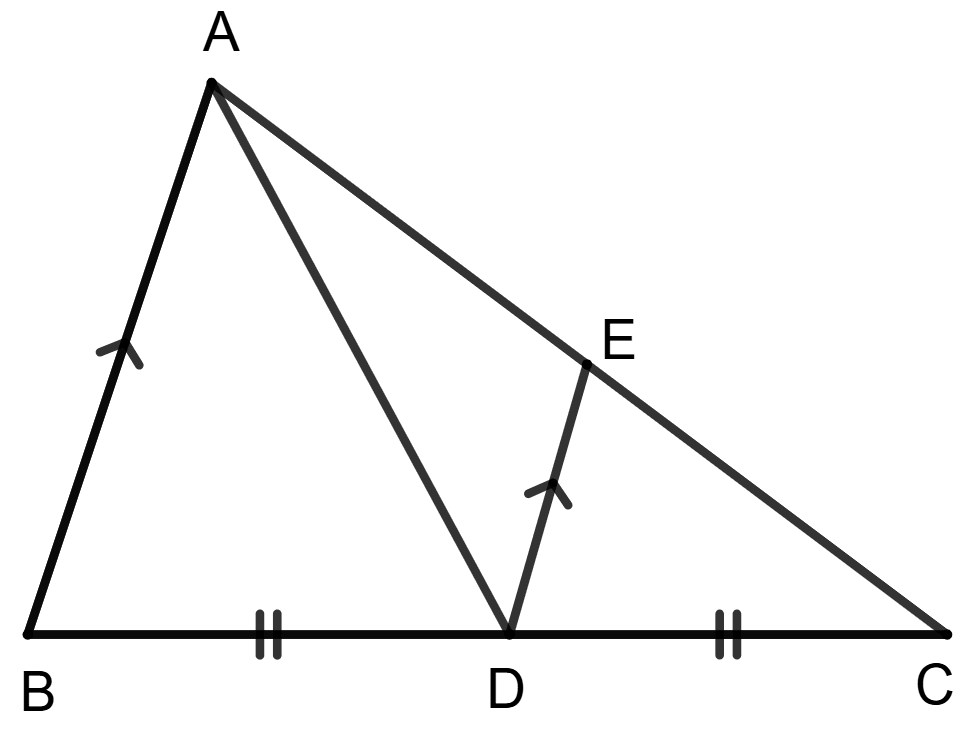
Statement 2: DE is median of triangle ADC.
Both the statements are true.
Both the statements are false.
Statement 1 is true, and statement 2 is false.
Statement 1 is false, and statement 2 is true.
Answer
In △ ABC,
From figure,
BD = DC.
∴ D is the mid-point of BC.
A median of a triangle is a line segment that connects a vertex of the triangle to the midpoint of the opposite side.
So, AD is the median of triangle ABC.
By converse of mid-point theorem,
The straight line drawn through the mid-point of one side of a triangle parallel to another, bisects the third side.
Since, D is mid-point of BC and AB || DE
∴ E is the mid-point of AC.
Thus, DE is a median of triangle ADC.
Thus, DE will bisect AC.
∴ Both the statements are true.
Hence, option 1 is the correct option.
Assertion (A): The figure formed by joining the mid-points of the sides of a quadrilateral ABCD is a square.
Reason (R): Diagonals of quadrilateral ABCD are not equal and are not perpendicular to each other.
A is true, but R is false.
A is false, but R is true.
Both A and R are true, and R is the correct reason for A.
Both A and R are true, and R is the incorrect reason for A.
Answer
For the figure formed by joining the midpoints of a quadrilateral to be a square, the diagonals of the original quadrilateral must be both equal and perpendicular to each other.
The reason states that the diagonals are not equal and not perpendicular.
∴ A is false, but R is true.
Hence, option 2 is the correct option.
Assertion (A): R, S, D and E are mid-points of OC, OB, AB and AC respectively, then DERS is a parallelogram.
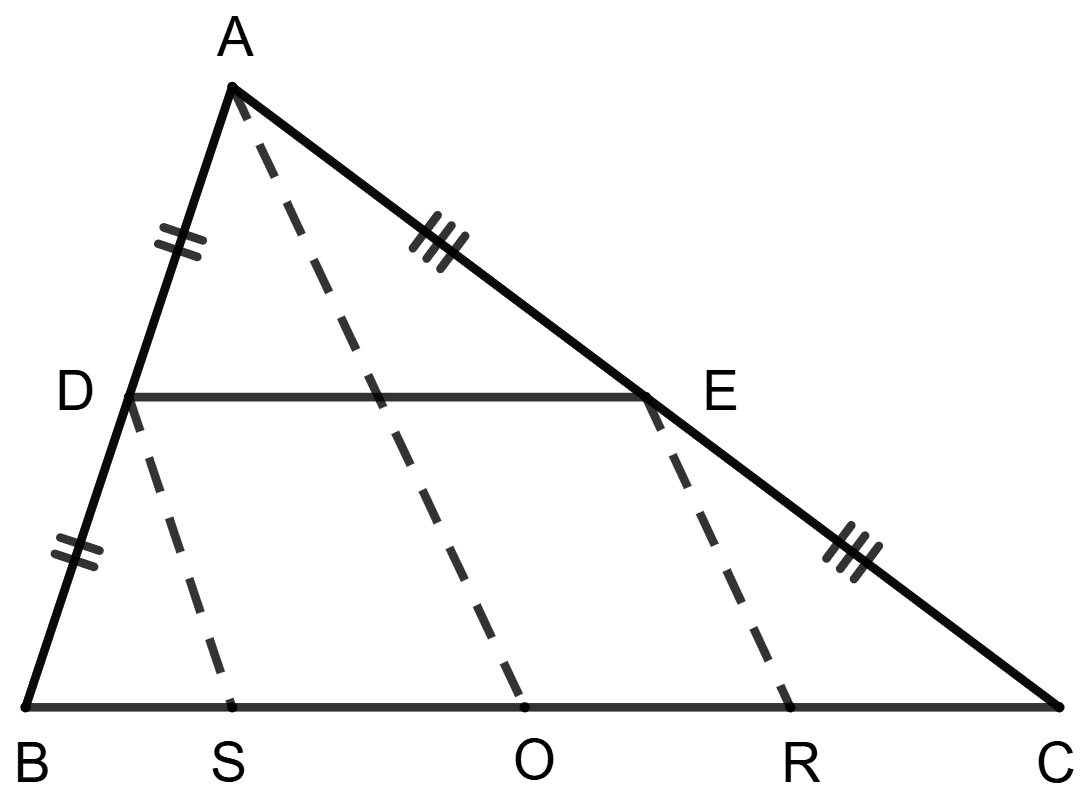
Reason (R): DS ∥ AO ∥ ER and DS = ER = .
A is true, but R is false.
A is false, but R is true.
Both A and R are true, and R is the correct reason for A.
Both A and R are true, and R is the incorrect reason for A.
Answer
By mid-point theorem,
The line segment joining the mid-points of any two sides of a triangle is parallel to the third side and is equal to half of it.
In △ABO,
D and S are respective midpoints of AB and BO.
∴ DS || AO and DS = AO [By mid-point theorem].................(1)
In △ACO,
E and R are respective midpoints of AC and CO.
∴ ER || AO and ER = AO [By mid-point theorem]..................(2)
From (1) and (2) we get,
DS || ER and DS = ER = AO
So, reason (R) is true.
We know that,
If one pair of opposite sides of a quadrilateral are equal in length and parallel, then the quadrilateral is a parallelogram.
∴ DERS is a parallelogram.
So, assertion (A) is true.
∴ Both A and R are true, and R is the correct reason for A.
Hence, option 3 is the correct option.
In triangle ABC, D and E are mid-points of the sides AB and AC respectively. Through E, a straight line is drawn parallel to AB to meet BC at F. Prove that BDEF is a parallelogram. If AB = 8 cm and BC = 9 cm; find the perimeter of the parallelogram BDEF.
Answer
By mid-point theorem,
The line segment joining the mid-points of any two sides of a triangle is parallel to the third side and is equal to half of it.
By converse of mid-point theorem,
The straight line drawn through the mid-point of one side of a triangle parallel to another, bisects the third side.
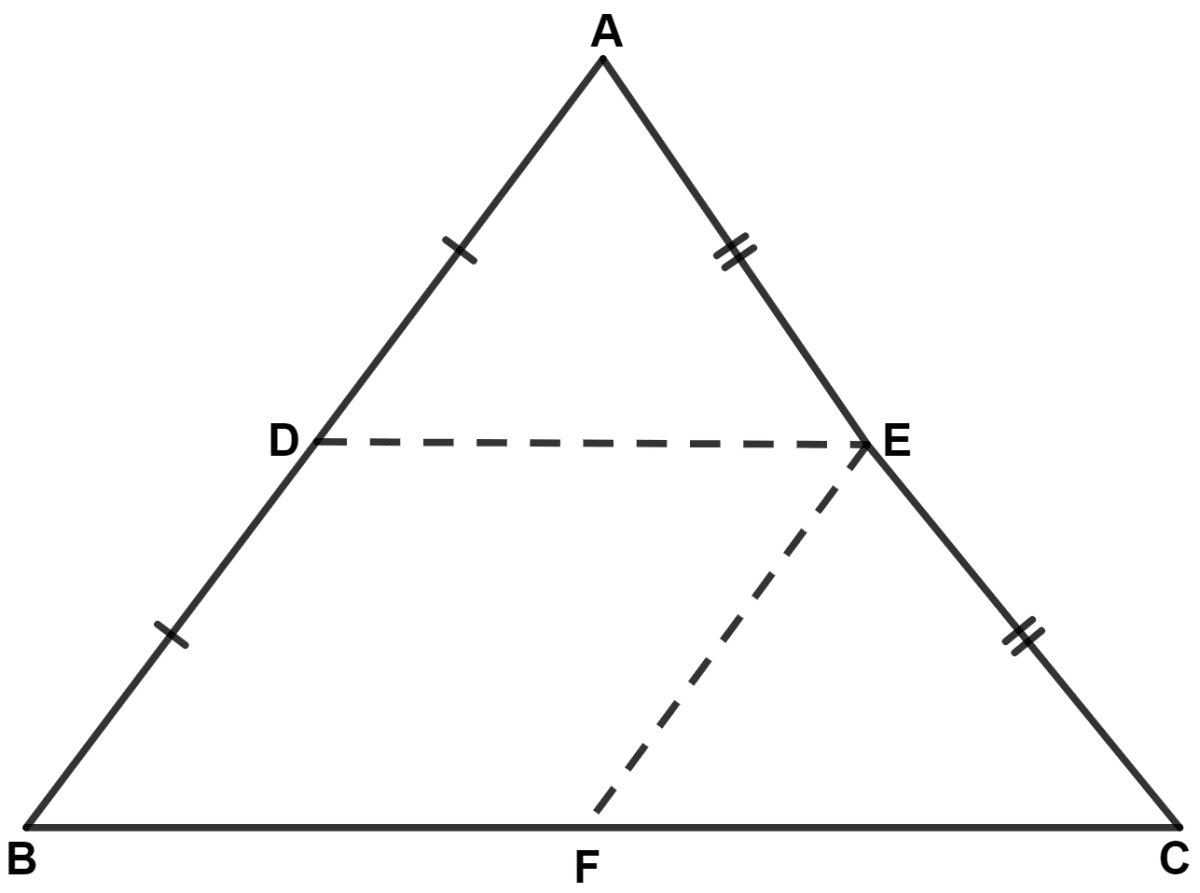
Given,
E is mid-point of AC and EF || AB.
∴ F is mid-point of BC (By converse of mid-point theorem).
Since, D and E are mid-points of sides AB and AC respectively.
∴ DE || BC and DE = (By mid-point theorem)
⇒ DE || BF and DE = BF (As F is mid-point of BC).
Given,
EF || AB
∴ EF || BD.
Since, E and F are mid-points of sides AC and BC respectively.
∴ EF = = BD. (By mid-point theorem)
Since, opposite sides of quadrilateral BDEF are parallel and equal.
∴ BDEF is a parallelogram.
From figure,
⇒ BD = = 4 cm,
⇒ BF = = 4.5 cm.
Perimeter of BDEF = BD + DE + EF + BF
= BD + BF + BD + BF (Since opposite sides of parallelogram are equal)
= 4 + 4.5 + 4 + 4.5
= 17 cm.
Hence, perimeter of parallelogram BDEF = 17 cm.
P, Q and R are mid-points of sides AB, BC and CD respectively of a rhombus ABCD. Show that PQ is perpendicular to QR.
Answer
Join diagonals of rhombus AC and BD.
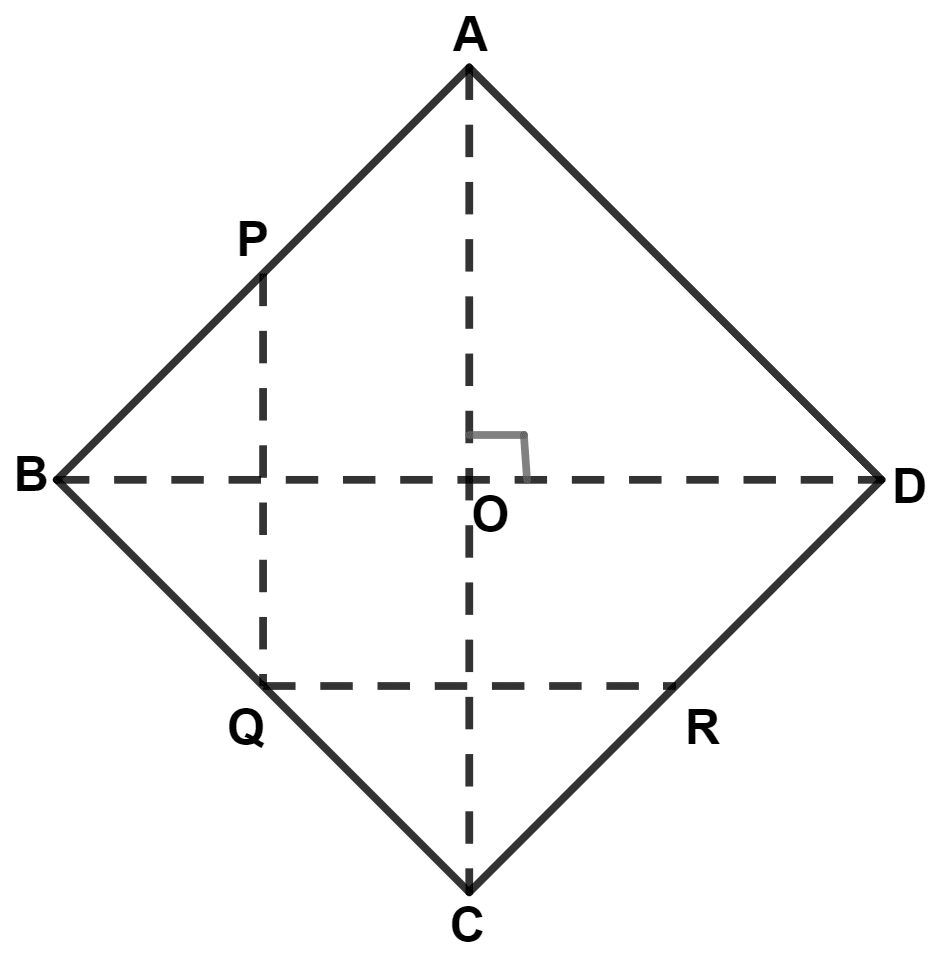
We know that,
Diagonals of rhombus intersect at 90°.
By mid-point theorem,
The line segment joining the mid-points of any two sides of a triangle is parallel to the third side and is equal to half of it.
In △ ABC,
P and Q are mid-points of sides AB and BC respectively.
∴ PQ || AC (By mid-point theorem)
In △ BCD,
R and Q are mid-points of sides CD and BC respectively.
∴ QR || BD (By mid-point theorem)
Since, AC ⊥ BD and PQ || AC and QR || BD.
∴ PQ ⊥ QR.
Hence, PQ is perpendicular to QR.
The diagonals of a quadrilateral ABCD are perpendicular to each other. Prove that the quadrilateral obtained by joining the mid-points of its adjacent sides is a rectangle.
Answer
By mid-point theorem,
The line segment joining the mid-points of any two sides of a triangle is parallel to the third side and is equal to half of it.
Let ABCD be a quadrilateral where P, Q, R and S are the mid-point of AB, BC, CD and DA.
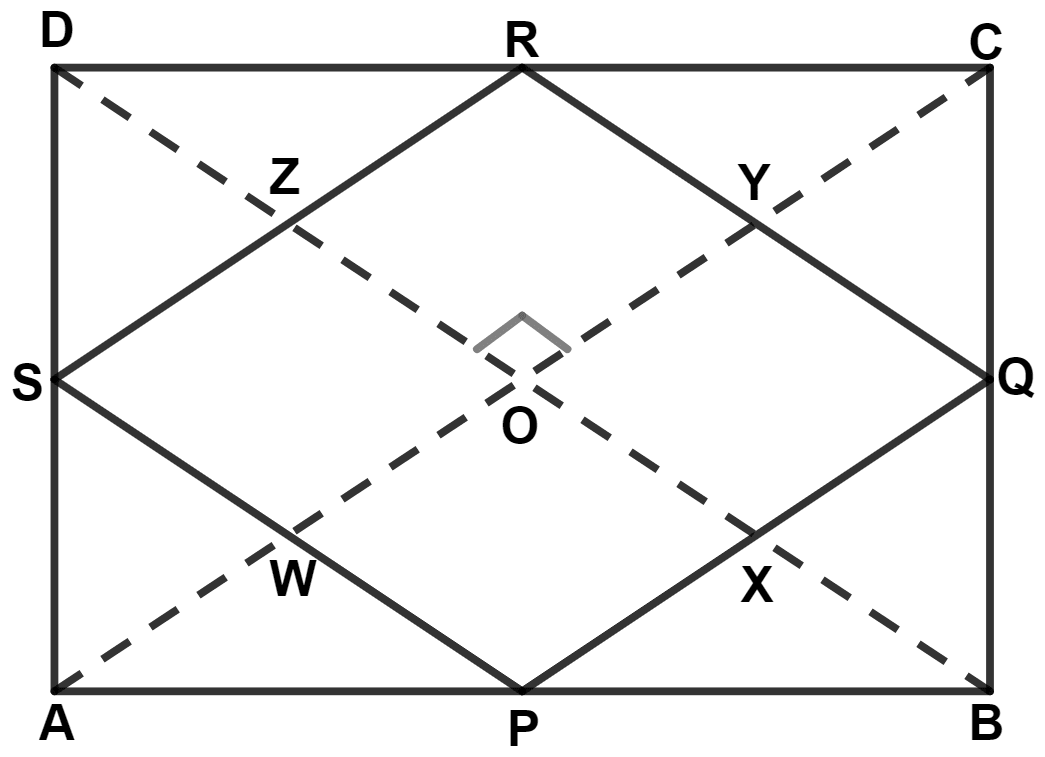
In △ ABC,
P and Q are mid-points of AB and BC respectively.
⇒ PQ = and PQ || AC. [By mid-point theorem] .......(1)
In △ ADC,
S and R are mid-points of AD and CD respectively.
⇒ SR = and SR || AC. [By mid-point theorem] .......(2)
From (1) and (2), we get :
PQ = SR and PQ || SR.
In △ BCD,
R and Q are mid-points of CD and BC respectively.
⇒ QR = and QR || BD. [By mid-point theorem] .......(3)
In △ ABD,
S and P are mid-points of AD and AB respectively.
⇒ PS = and PS || BD. [By mid-point theorem] .......(4)
From (3) and (4), we get :
QR = PS and QR || PS.
Since, diagonals of quadrilateral intersect at right angle.
∴ ∠AOD = ∠COD = AOB = ∠BOC = 90°.
From figure,
PQ || AC
∴ ∠PXO = ∠AOD = 90° (Corresponding angles are equal)
∴ ∠QXO = ∠COD = 90° (Corresponding angles are equal)
SR || AC
∴ ∠SZO = ∠AOB = 90° (Corresponding angles are equal)
∴ ∠RZO = ∠BOC = 90° (Corresponding angles are equal)
PS || BD
∴ ∠S = ∠RZO = 90° (Corresponding angles are equal)
∴ ∠P = ∠QXO = 90° (Corresponding angles are equal)
QR || BD
∴ ∠R = ∠SZO = 90° (Corresponding angles are equal)
∴ ∠Q = ∠PXO = 90° (Corresponding angles are equal)
Since, in quadrilateral PQRS,
Each interior angle is equal to 90° and opposite sides are parallel and equal.
∴ PQRS is a rectangle.
Hence, proved that the the figure obtained by joining the mid-points of the adjacent sides of the quadrilateral is a rectangle.
In △ ABC, E is mid-point of the median AD and BE produced meets side AC at point Q. Show that BE : EQ = 3 : 1.
Answer
Draw DY || BQ.
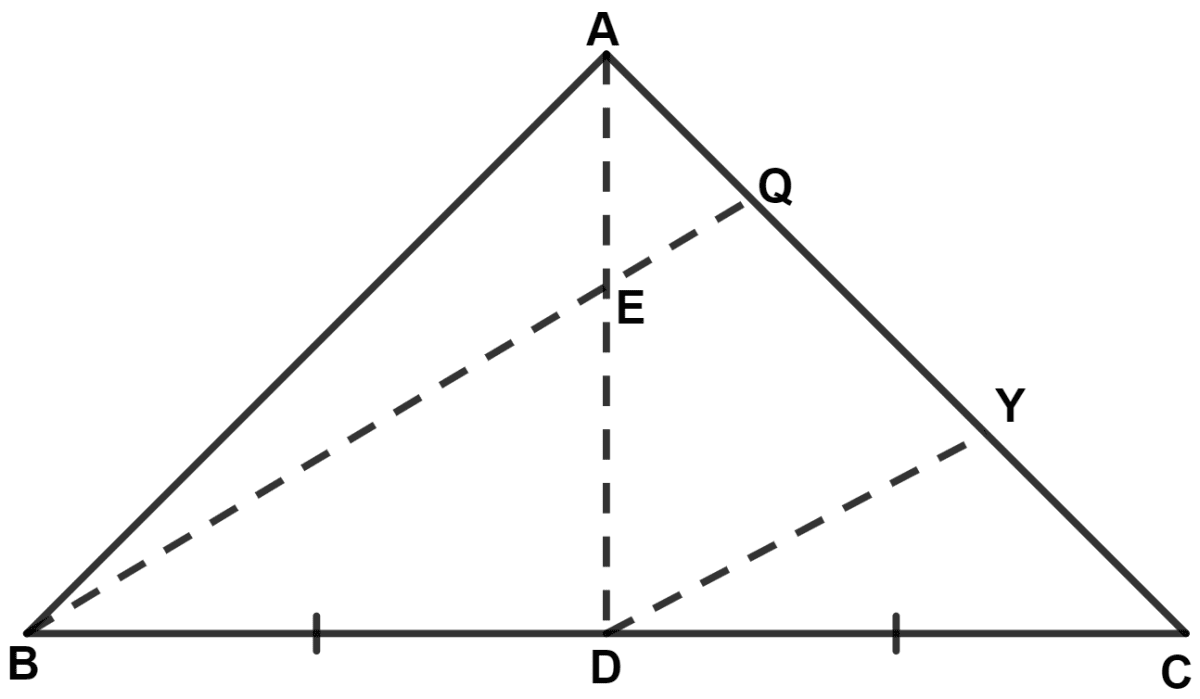
In △ BCQ and △ DCY,
⇒ ∠BCQ = ∠DCY (Common)
⇒ ∠BQC = ∠DYC (Corresponding angles are equal)
∴ △ BCQ ~ △ DCY (By A.A. axiom)
We know that,
Corresponding sides of similar triangle are proportional.
..........(1)
Since, D is the mid-point of BC.
∴ BC = 2CD
Considering L.H.S. of the equation (1), we get :
In △ AEQ and △ ADY,
⇒ ∠EAQ = ∠DAY (Common)
⇒ ∠AEQ = ∠ADY (Corresponding angles are equal)
∴ △ AEQ ~ △ ADY (By A.A. axiom)
We know that,
Corresponding sides of similar triangle are proportional.
(Since, E is the mid-point of AD)
............(2)
Dividing equation (1) by (2), we get :
Hence, proved that BE : EQ = 3 : 1.
In the given figure, M is the mid-point of AB and DE, whereas N is mid-point of BC and DF. Show that : EF = AC.
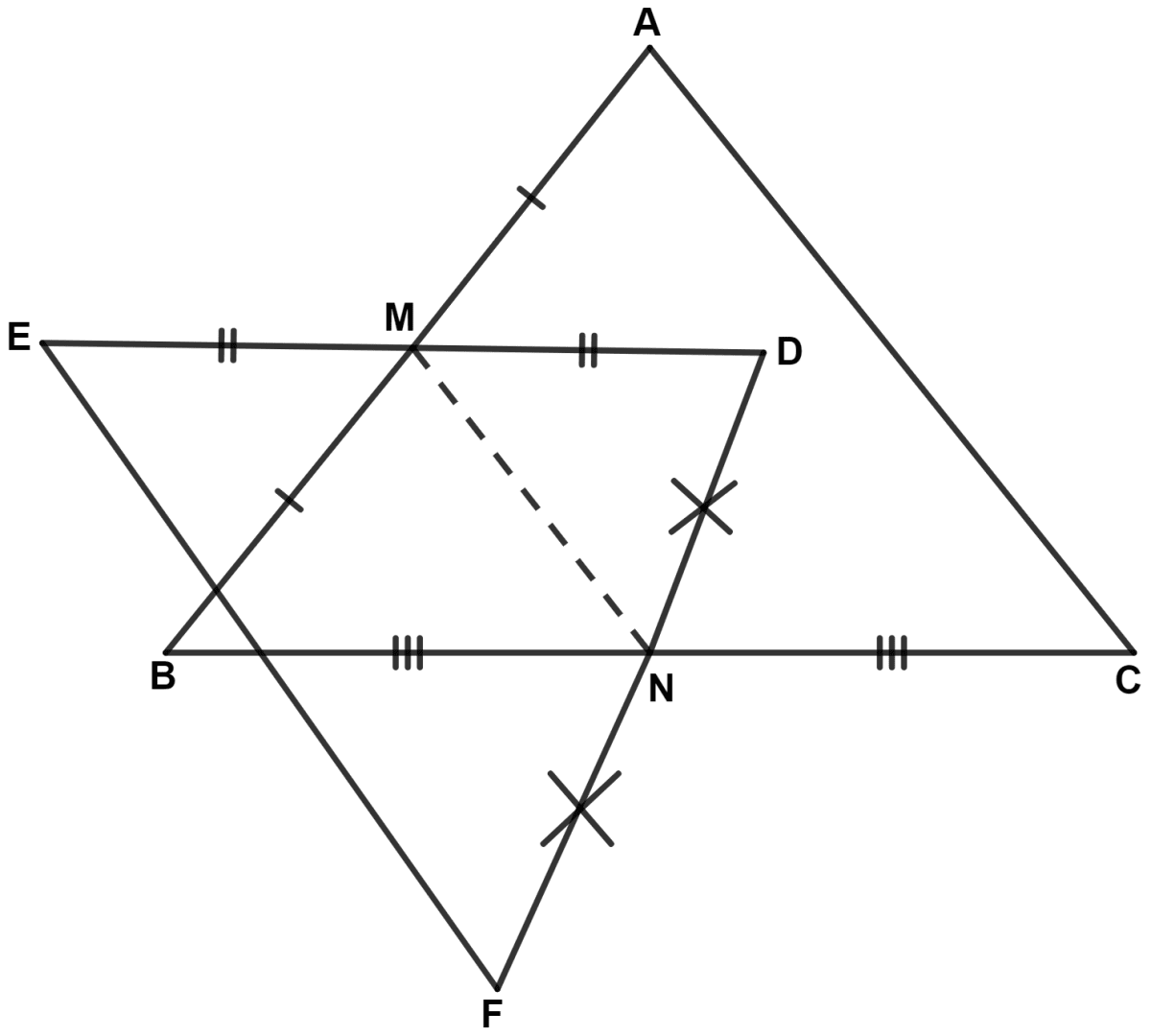
Answer
By mid-point theorem,
The line segment joining the mid-points of any two sides of a triangle is parallel to the third side and is equal to half of it.
In △ EDF,
M is the mid-point of ED and N is the mid-point of DF.
∴ MN = (By mid-point theorem)
⇒ EF = 2MN .............(1)
In △ ABC,
M is the mid-point of AB and N is the mid-point of BC.
∴ MN = (By mid-point theorem)
⇒ AC = 2MN .............(2)
From (1) and (2), we get :
⇒ EF = AC.
Hence, proved that EF = AC.
In triangle ABC; D and E are mid-points of the sides AB and AC respectively. Through E, a straight line is drawn parallel to AB to meet BC at F. Prove that BDEF is a parallelogram. If AB = 16 cm, AC = 12 cm and BC = 18 cm, find the perimeter of the parallelogram BDEF.
Answer
By mid-point theorem,
The line segment joining the mid-points of any two sides of a triangle is parallel to the third side and is equal to half of it.
By converse of mid-point theorem,
The straight line drawn through the mid-point of one side of a triangle parallel to another, bisects the third side.
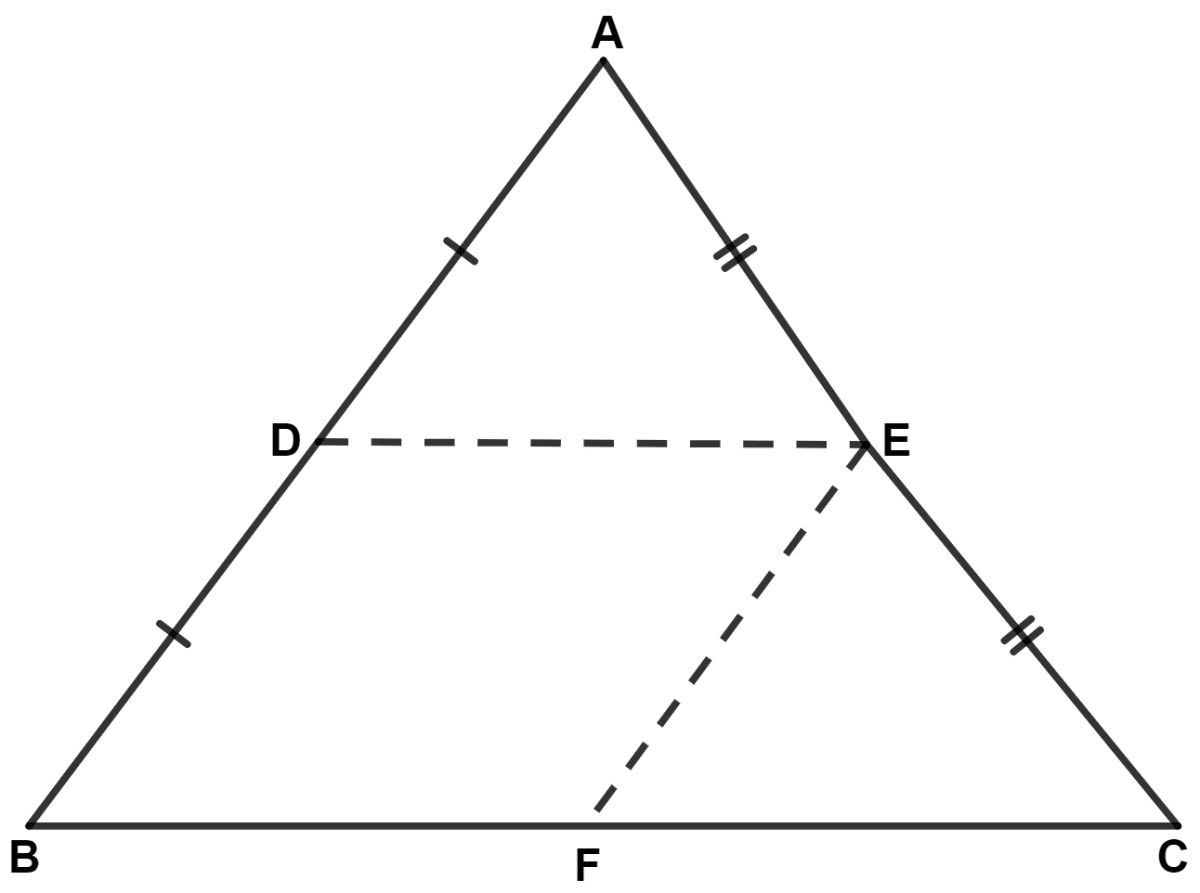
Given,
E is mid-point of AC and EF || AB.
∴ F is mid-point of BC (By converse of mid-point theorem).
Since, D and E are mid-points of sides AB and AC respectively.
∴ DE || BC and DE = (By mid-point theorem)
⇒ DE || BF and DE = BF (As F is mid-point of BC).
Given,
EF || BC
∴ EF || BD.
Since, E and F are mid-points of sides AC and BC respectively.
∴ EF = = BD. (By mid-point theorem)
Since, opposite sides of quadrilateral BDEF are parallel and equal.
∴ BDEF is a parallelogram.
From figure,
⇒ BD = = 8 cm,
⇒ BF = = 9 cm.
Perimeter of BDEF = BD + DE + EF + BF
= BD + BF + BD + BF (Since opposite sides of parallelogram are equal)
= 8 + 9 + 8 + 9
= 34 cm.
Hence, perimeter of parallelogram BDEF = 34 cm.
In the given figure, AD and CE are medians and DF // CE. Prove that : FB = .
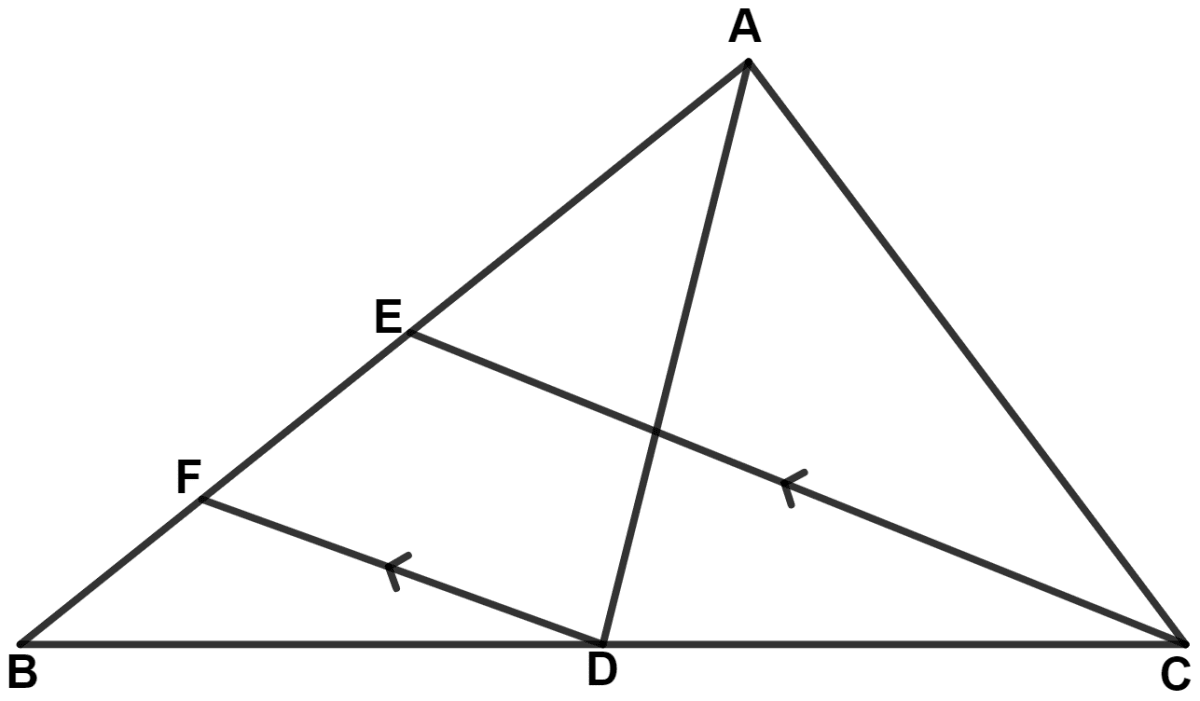
Answer
By mid-point theorem,
The line segment joining the mid-points of any two sides of a triangle is parallel to the third side and is equal to half of it.
By converse of mid-point theorem,
The straight line drawn through the mid-point of one side of a triangle parallel to another, bisects the third side.
Since, AD and CE are medians.
∴ D is the mid-point of BC and E is the mid-point of AB.
In △ BEC,
DF || CE and D is the mid-point of BC.
∴ F is the mid-point of BE. (By converse of mid-point theorem)
∴ FB = .......(1)
Since, E is the mid-point of AB.
∴ BE = .......(2)
Substituting value of BE from equation (2) in (1), we get :
∴ FB = .
Hence, proved that FB = .
In parallelogram ABCD, E is the mid-point of AB and AP is parallel to EC which meets DC at point O and BC produced at P. Prove that :
(i) BP = 2AD
(ii) O is mid-point of AP.
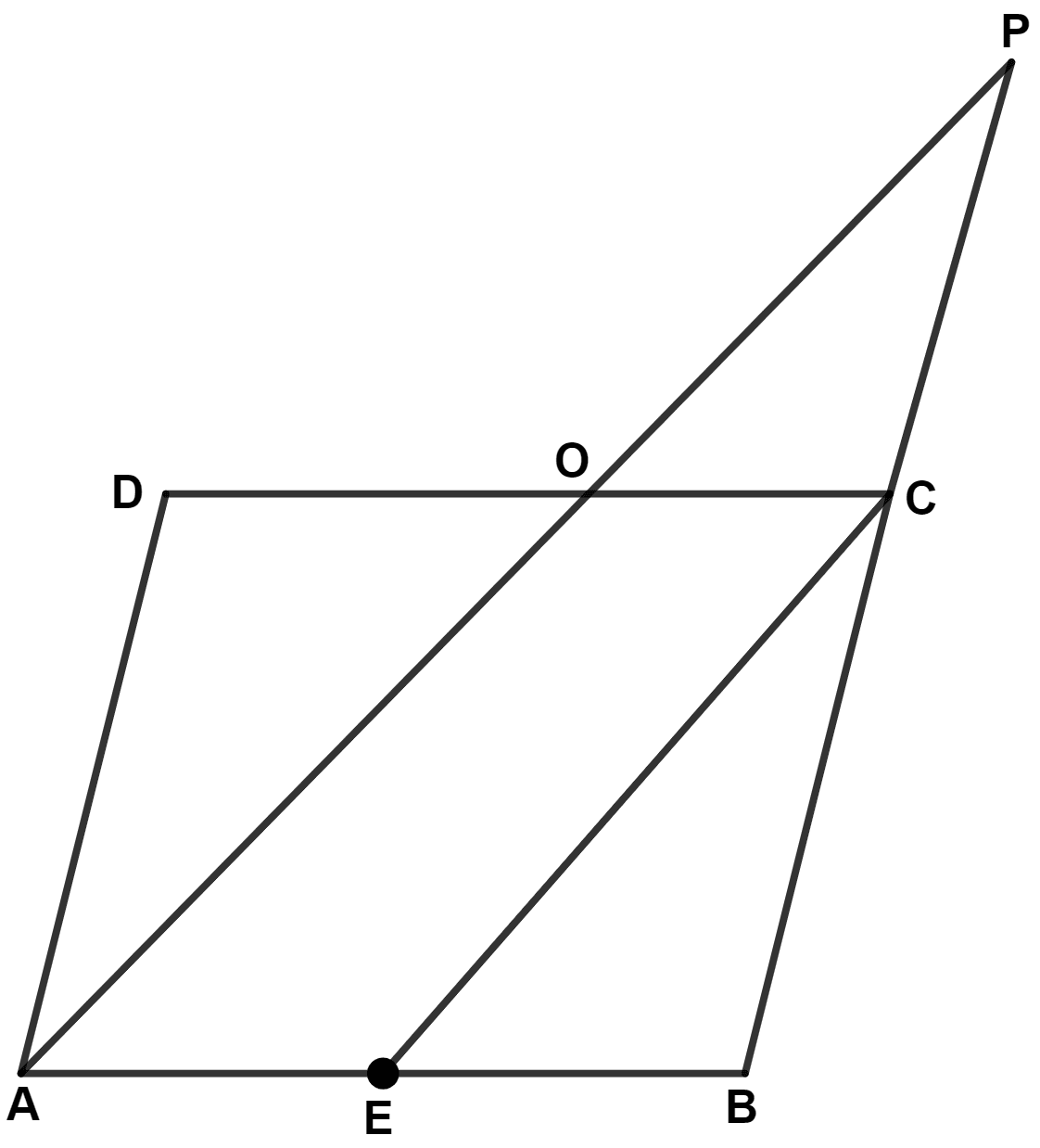
Answer
By mid-point theorem,
The line segment joining the mid-points of any two sides of a triangle is parallel to the third side and is equal to half of it.
By converse of mid-point theorem,
The straight line drawn through the mid-point of one side of a triangle parallel to another, bisects the third side.
(i) In △ ABP,
⇒ E is the mid-point of AB and EC || AP.
∴ C is the mid-point of BP. (By converse of mid-point theorem)
∴ BP = 2BC .........(1)
Since, ABCD is a parallelogram.
∴ AD = BC (Opposite sides of parallelogram are equal) .......(2)
From equation (1) and (2), we get :
⇒ BP = 2AD.
Hence, proved that BP = 2AD.
(ii) Since, opposite sides of parallelogram are parallel.
∴ AB || CD
⇒ AB || OC.
In △ ABP,
⇒ E is the mid-point of AB and OC || AB.
∴ O is the mid-point of AP. (By converse of mid-point theorem)
Hence, O is the mid-point of AP.
In a trapezium ABCD, sides AB and DC are parallel to each other. E is mid-point of AD and F is mid-point of BC.
Prove that :
AB + DC = 2EF.
Answer
Join BE and produce to meet CD produced at point P.
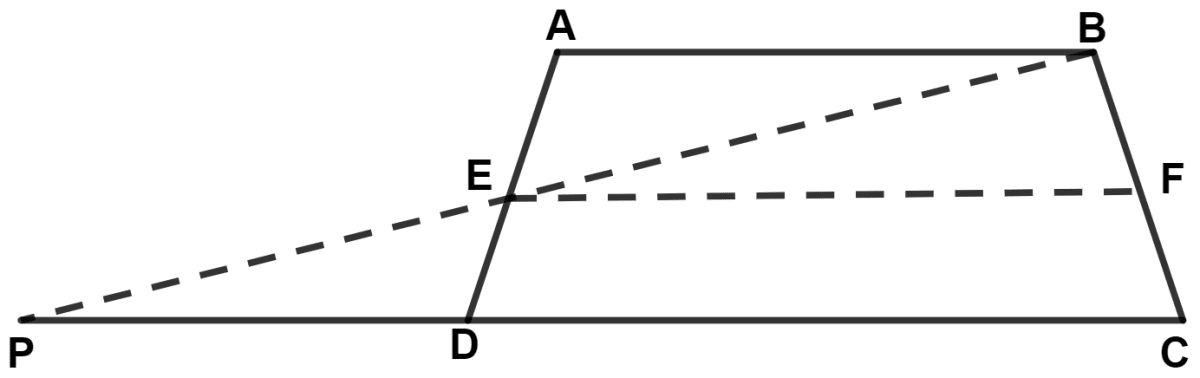
In △ PDE and △ BAE,
⇒ ∠PED = ∠BEF (Vertically opposite angles are equal)
⇒ AE = ED (Since, E is the mid-point of AD)
⇒ ∠EDP = ∠EAB (Alternate angles are equal)
∴ △ PDE ≅ △ BAE (By A.S.A. axiom)
We know that,
Corresponding parts of congruent triangle are equal.
∴ BE = EP and AB = PD.
In △ BPC,
Since, E and F are mid-points of sides BP and BC respectively.
∴ EF = .
To prove :
AB + CD = 2EF ........(1)
Substituting value in L.H.S. of equation (1), we get :
⇒ AB + CD = PD + CD = PC.
Substituting value in R.H.S. of equation (2), we get :
⇒ 2EF = = PC.
Since, L.H.S. = R.H.S.
Hence, proved that AB + CD = 2EF.
In △ ABC, AD is the median and DE is parallel to BA, where E is a point in AC. Prove that BE is also a median.
Answer
By converse of mid-point theorem,
The straight line drawn through the mid-point of one side of a triangle parallel to another, bisects the third side.
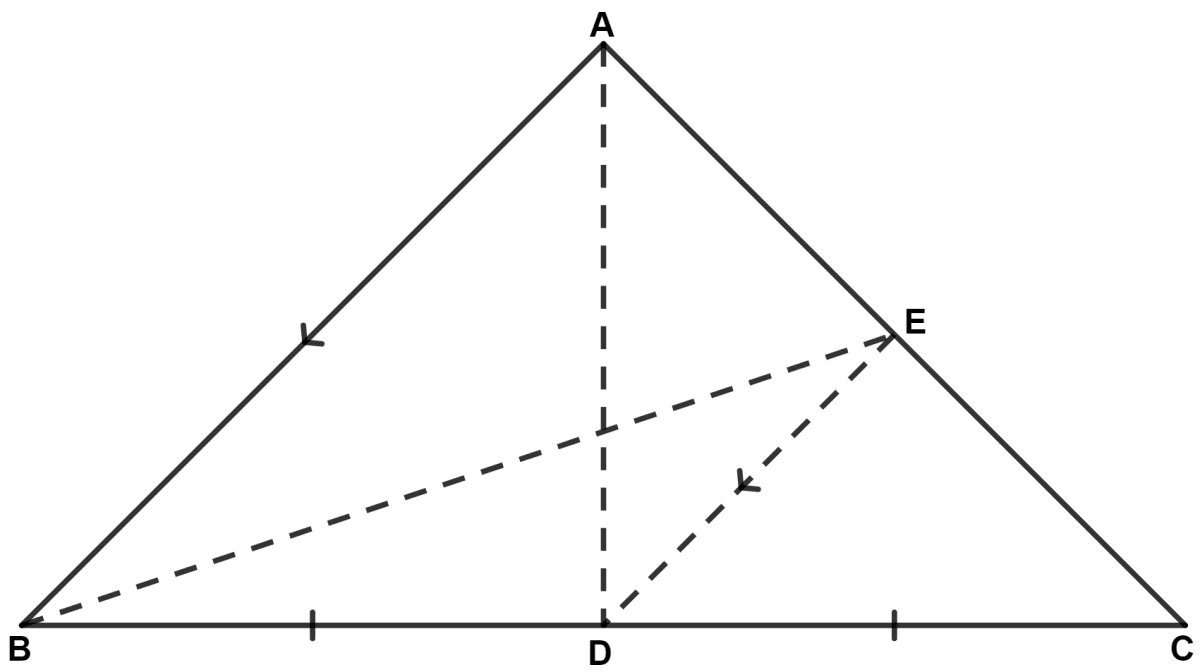
In △ ABC,
Since, AD is the median.
∴ D is the mid-point of BC.
Since, D is mid-point of BC and DE || AB.
∴ E is the mid-point of AC. (By converse of mid-point theorem)
Join BE.
Hence, proved that BE is also a median.
Adjacent sides of a parallelogram are equal and one of diagonals is equal to any one of the sides of this parallelogram. Show that its diagonals are in the ratio .
Answer
Let ABCD be the required parallelogram.
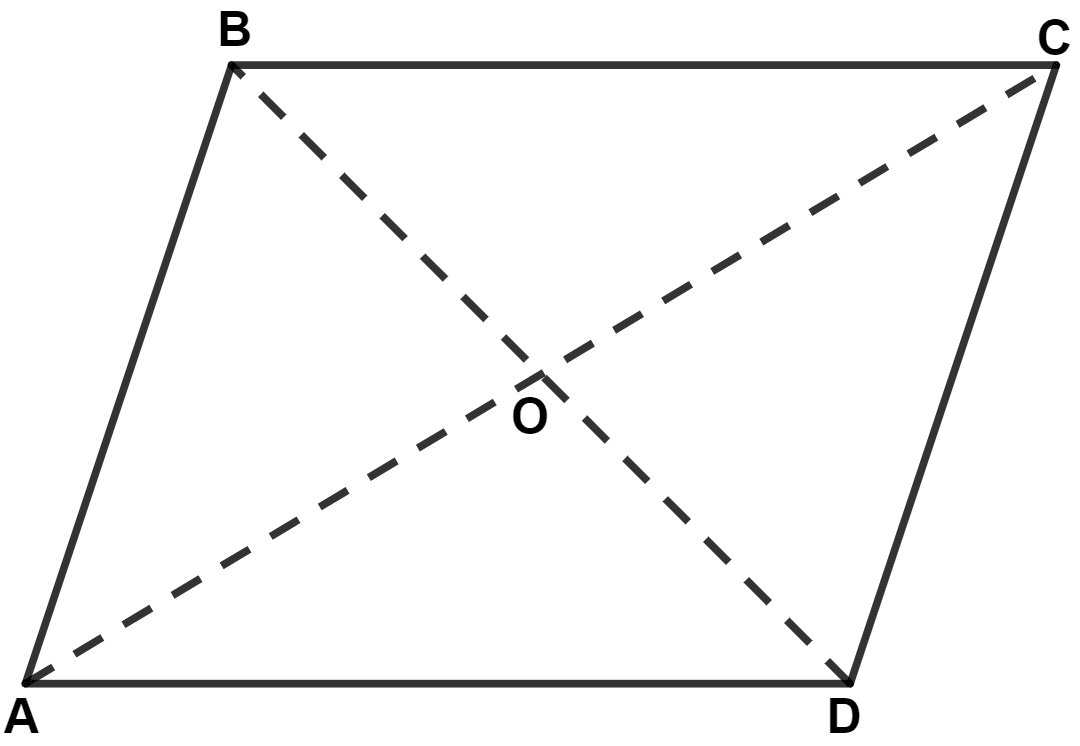
∴ AB = CD and BC = AD. (Opposite sides of parallelogram are equal)
Given,
Adjacent sides of a parallelogram are equal.
∴ AB = BC.
∴ AB = BC = CD = AD
Since, all sides of parallelogram are equal.
∴ ABCD is a rhombus.
Given, one of the diagonals is equal to its sides. Let diagonal BD be equal to sides.
∴ AB = BC = CD = AD = BD = a (let).
From figure,
⇒ BO = (Since, in a rhombus diagonals bisect each other at right angle).
Hence, △ AOB is right-angled at O.
In △ AOB,
By pythagoras theorem,
⇒ AB2 = BO2 + AO2
⇒ a2 = + AO2
⇒ AO2 =
⇒ AO2 =
⇒ AO2 =
⇒ AO = ,
⇒ AC = 2AO = units.
The ratio of the diagonals is:
∴ AC : BD = : 1.
Hence, proved that diagonals are in the ratio : 1.