
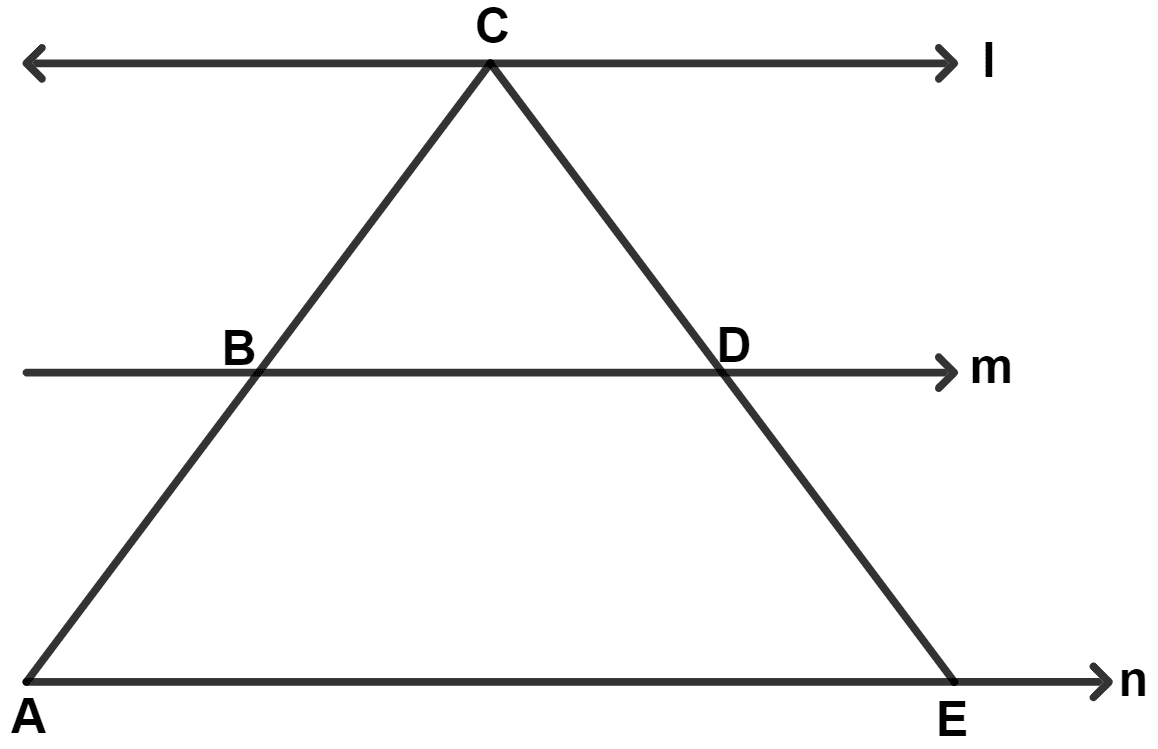
In the given figure, l // m // n and D is mid-point of CE. If AE = 12.6 cm, then BD is :
12.6 cm
25.2 cm
6.3 cm
18.9 cm
Answer
By mid-point theorem,
The line segment joining the mid-points of any two sides of a triangle is parallel to the third side and is equal to half of it.
By converse of mid-point theorem,
The straight line drawn through the mid-point of one side of a triangle parallel to another, bisects the third side.
In △ AEC,
Given,
⇒ m // n
∴ BD // AE.
D is mid-point of CE.
∴ B is the mid-point of AC. (By converse of mid-point theorem)
Also,
⇒ BD = = 6.3 cm
Hence, Option 3 is the correct option.
In a trapezium ABCD, AB // DC, E is mid-point of AD and F is mid-point of BC, then :
2EF =
2EF = AB + DC
EF = AB + DC
EF =
Answer
Join AC. Let AC intersects EF at point O.
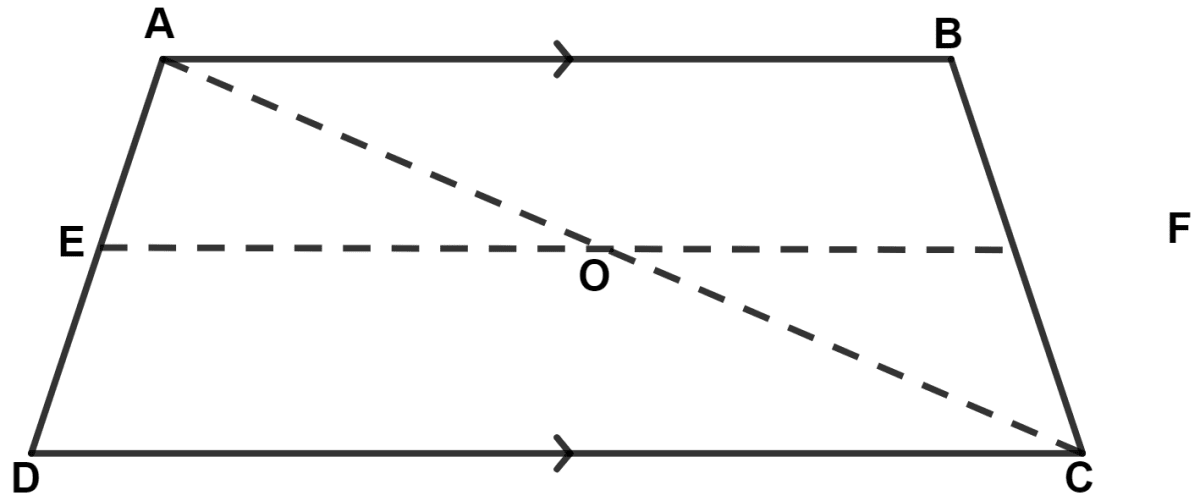
We know that,
In trapezium the line joining the mid-points of non-parallel sides are parallel to the parallel sides of trapezium.
∴ AB || EF || DC.
By mid-point theorem,
The line segment joining the mid-points of any two sides of a triangle is parallel to the third side and is equal to half of it.
By converse of mid-point theorem,
The straight line drawn through the mid-point of one side of a triangle parallel to another, bisects the third side.
Given,
⇒ EF || DC
⇒ EO || DC
In △ ADC,
E is mid-point of AD and EO || DC.
∴ O is mid-point of AC. (By converse of mid-point theorem)
∴ EO = (By mid-point theorem) ..........(1)
Given,
⇒ EF || AB
⇒ OF || AB
In △ ABC,
O is mid-point of AC and F is mid-point of BC.
∴ OF = (By mid-point theorem) ..........(2)
Adding equations (1) and (2), we get :
⇒ EO + OF =
⇒ EF =
⇒ 2EF = AB + DC.
Hence, Option 2 is the correct option.
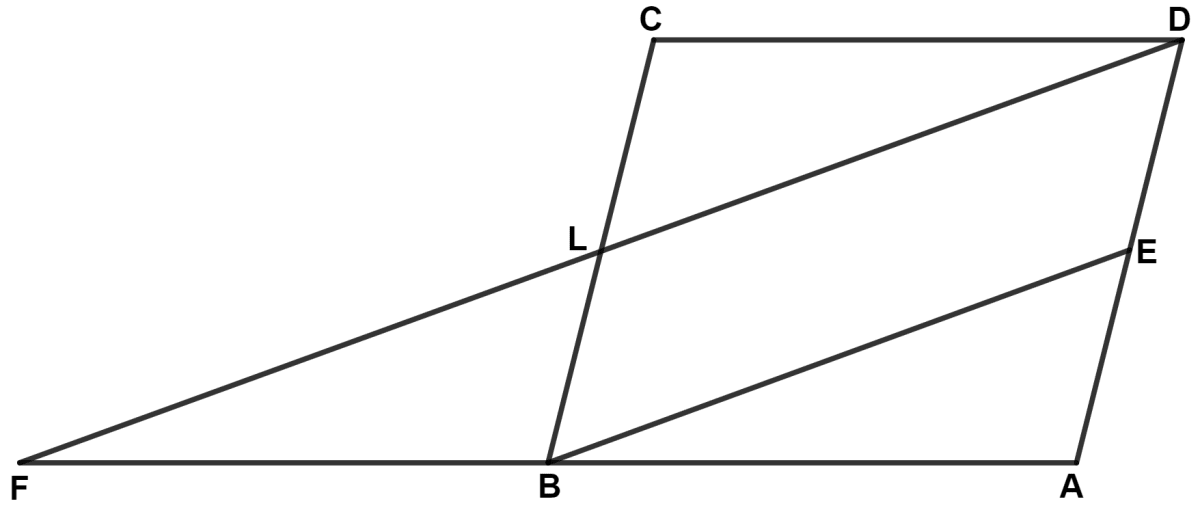
The given figure shows a parallelogram ABCD in which E is mid-point of AD and DL // EB. Then, BF is equal to :
AD
BE
AE
AB
Answer
By equal intercept theorem,
If a transversal makes equal intercepts on three or more parallel lines, then any other line cutting them will also make equal intercepts.
In parallelogram ABCD,
DL || EB
Since, E is mid-point of AD.
∴ AE = ED
∴ BL = LC (By equal intercept theorem)
In △ BLF and △ DLC,
⇒ ∠BLF = ∠DLC (Vertically opposite angles are equal)
⇒ BL = LC (Proved above)
⇒ ∠LBF = ∠LCD (Alternate angles are equal)
∴ △ BLF ≅ △ DLC (By A.S.A. axiom)
We know that,
Corresponding parts of congruent triangle are equal.
∴ BF = CD .........(1)
We know that,
Opposite sides of parallelogram are equal.
∴ AB = CD .........(2)
From equation (1) and (2), we get :
⇒ BF = AB.
Hence, Option 4 is the correct option.
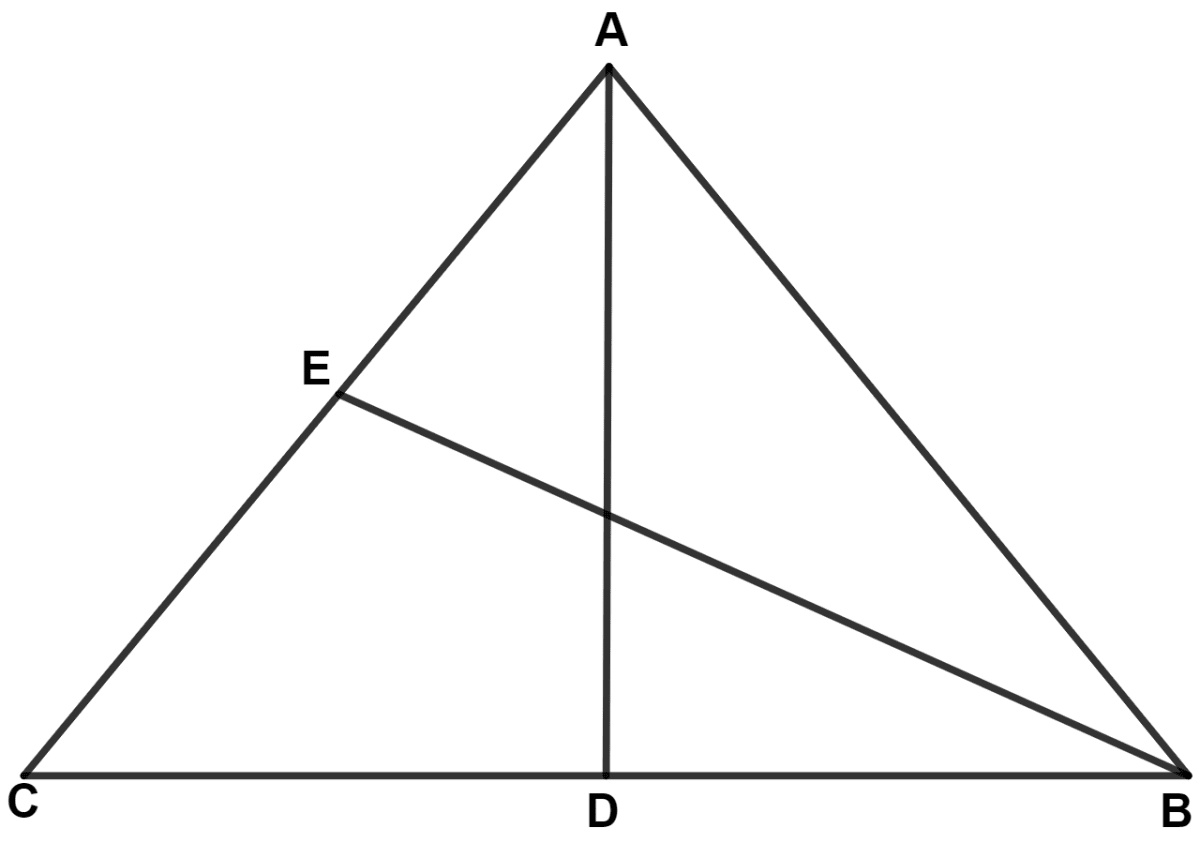
In the given figure AD and BE are medians, then ED is equal to :
2AB
Answer
Join ED.
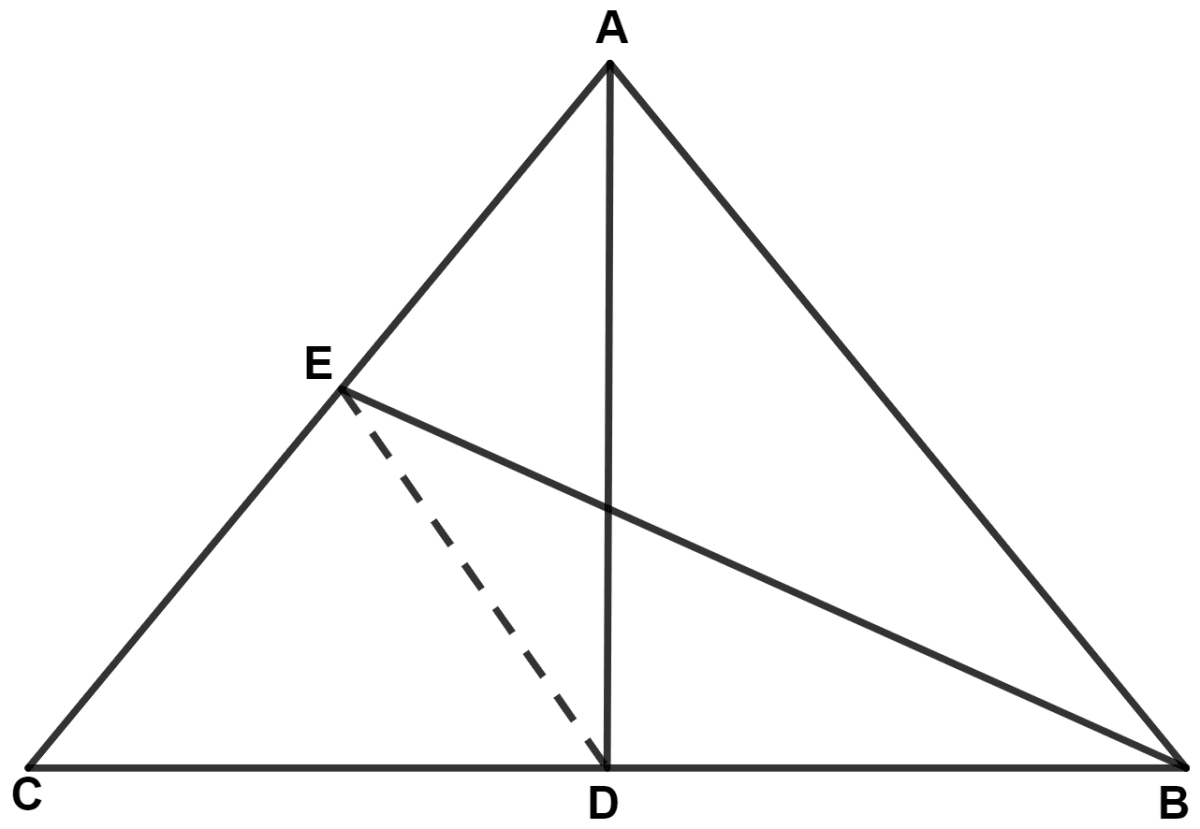
By mid-point theorem,
The line segment joining the mid-points of any two sides of a triangle is parallel to the third side and is equal to half of it.
Since, AD and BE are medians.
∴ D is mid-point of BC and E is mid-point of AC.
In △ ABC,
∴ ED = (By mid-point theorem)
Hence, Option 2 is the correct option.
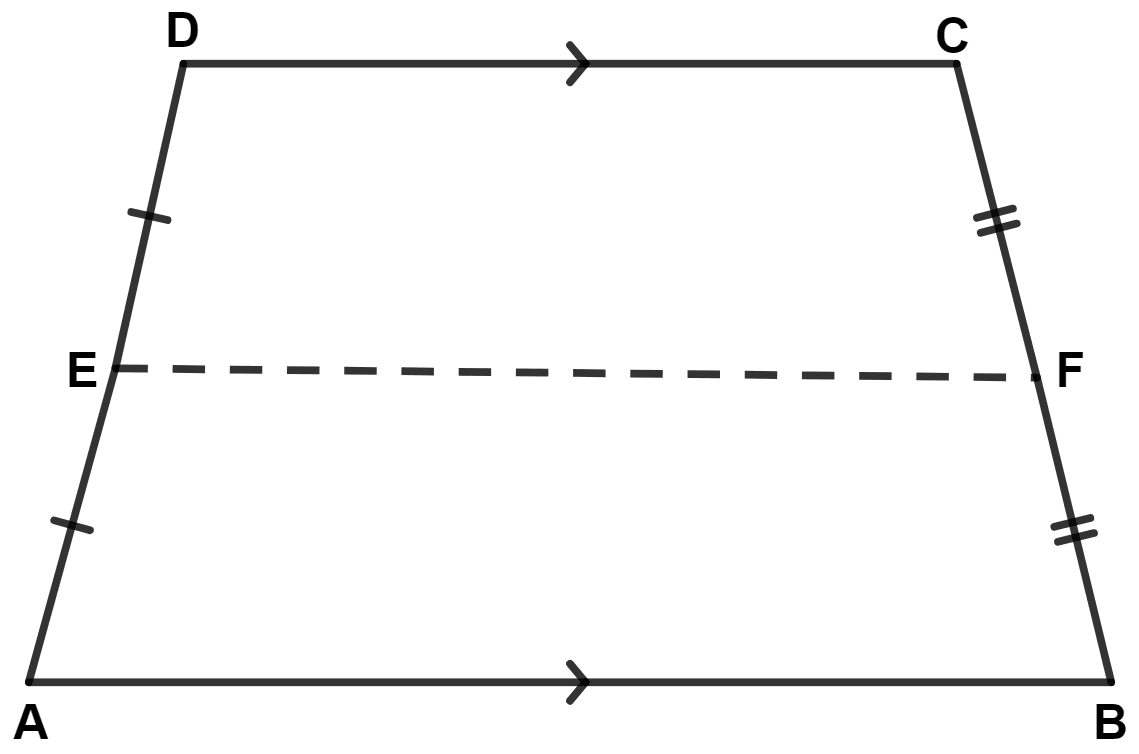
In the quadrilateral ABCD, if AB // CD, E is mid-point of side AD and F is mid-point of BC. If AB = 20 cm and EF = 16 cm, the length of side DC is :
18 cm
12 cm
24 cm
32 cm
Answer
Join BD. Let BD intersect EF at point O.
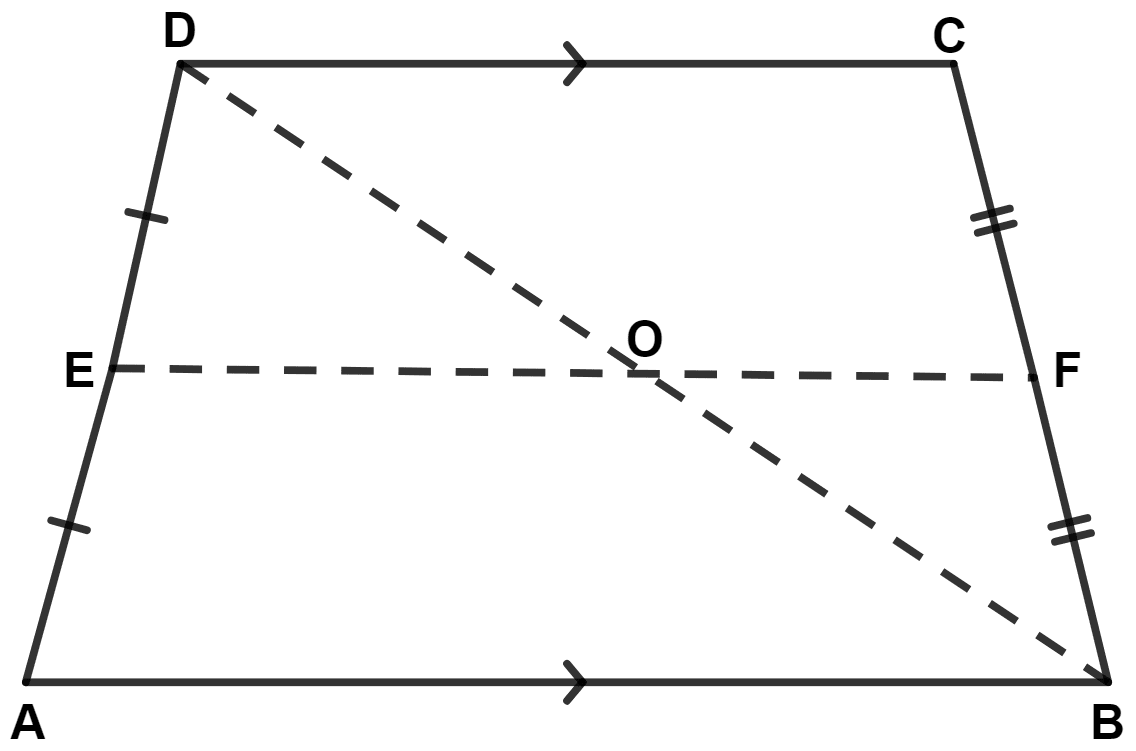
We know that,
In trapezium the line joining the mid-points of non-parallel sides are parallel to the parallel sides of trapezium.
∴ AB || EF || DC.
By mid-point theorem,
The line segment joining the mid-points of any two sides of a triangle is parallel to the third side and is equal to half of it.
By converse of mid-point theorem,
The straight line drawn through the mid-point of one side of a triangle parallel to another, bisects the third side.
Given,
⇒ EF || AB
⇒ EO || AB
In △ ABD,
E is mid-point of AD and EO || AB.
∴ O is mid-point of BD. (By converse of mid-point theorem)
∴ EO = (By mid-point theorem) ..........(1)
Given,
⇒ EF || DC
⇒ OF || DC
In △ BCD,
O is mid-point of BD and F is mid-point of BC.
∴ OF = (By mid-point theorem) ..........(2)
Adding equations (1) and (2), we get :
⇒ EO + OF =
⇒ EF =
Substituting values we get :
Hence, Option 2 is the correct option.
Use the following figure to find :
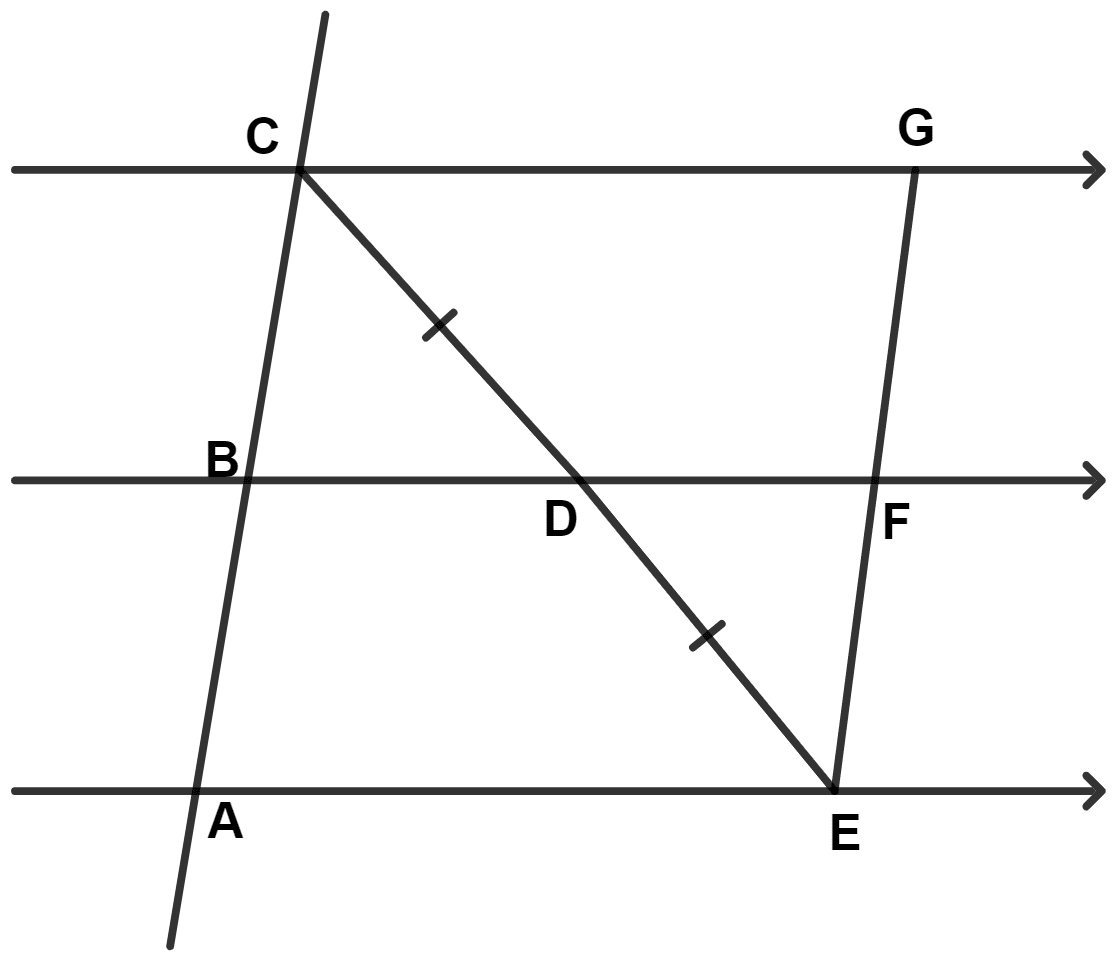
(i) BC, if AB = 7.2 cm.
(ii) GE, if FE = 4 cm.
(iii) AE, if BD = 4.1 cm.
(iv) DF, if CG = 11 cm.
Answer
By equal intercept theorem,
If a transversal makes equal intercepts on three or more parallel lines, then any other line cutting them will also make equal intercepts.
(i) From figure,
CG || BF || AE
Since, CD = DE
∴ BC = AB = 7.2 cm (By equal intercept theorem)
Hence, BC = 7.2 cm.
(ii) From figure,
CG || BF || AE
Since, CD = DE
∴ FG = FE = 4 cm (By equal intercept theorem)
From figure,
⇒ GE = FG + FE = 4 + 4 = 8 cm.
Hence, GE = 8 cm.
(iii) By mid-point theorem,
The line segment joining the mid-points of any two sides of a triangle is parallel to the third side and is equal to half of it.
By converse of mid-point theorem,
The straight line drawn through the mid-point of one side of a triangle parallel to another, bisects the third side.
In △ AEC,
D is mid-point of CE
⇒ BF || AE
∴ BD || AE.
∴ B is mid-point of AC. (By converse of mid-point theorem)
∴ BD = (By mid-point theorem)
⇒ AE = 2BD = 2 × 4.1 = 8.2 cm
Hence, AE = 8.2 cm.
(iv) In △ EGC,
D is mid-point of CE.
⇒ BF || CG
∴ DF || CG.
∴ F is mid-point of GE. (By converse of mid-point theorem)
∴ DF = (By mid-point theorem)
⇒ DF = = 5.5 cm
Hence, DF = 5.5 cm.
In the figure, given below, 2AD = AB, P is mid-point of AB, Q is mid-point of DR and PR // BS. Prove that :
(i) AQ // BS
(ii) DS = 3RS
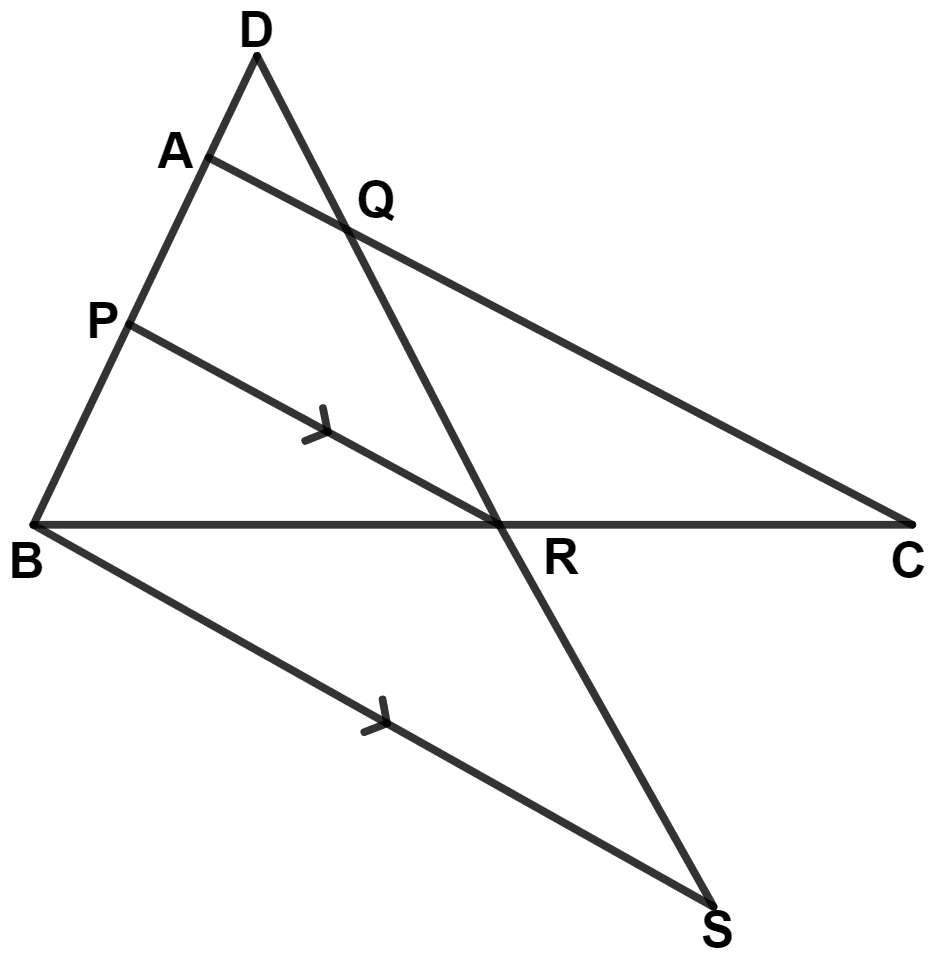
Answer
Given,
P is mid-point of AB.
∴ AP = PB
Since, 2AD = AB
∴ AD =
∴ AP = AB = AD.
(i) By mid-point theorem,
The line segment joining the mid-points of any two sides of a triangle is parallel to the third side and is equal to half of it.
In △ DPR,
A and Q are mid-points of DP and DR respectively.
∴ AQ || PR [By mid-point theorem] .......(1)
Given,
⇒ PR || BS ...........(2)
From equations (1) and (2), we get :
⇒ AQ || BS.
Hence, proved that AQ || BS.
(ii) By equal intercept theorem,
If a transversal makes equal intercepts on three or more parallel lines, then any other line cutting them will also make equal intercepts.
From figure,
PR || BS
Since, AD = AP = PB
∴ DQ = QR = RS .........(3)
From figure,
⇒ DS = DQ + QR + RS
⇒ DS = RS + RS + RS [From equation (3)]
⇒ DS = 3RS.
Hence, proved that DS = 3RS.
The side AC of a triangle ABC is produced to point E so that CE = . D is the mid-point of BC and ED produced meets AB at F. Lines through D and C are drawn parallel to AB which meet AC at point P and EF at point R respectively. Prove that :
(i) 3DF = EF
(ii) 4CR = AB.
Answer
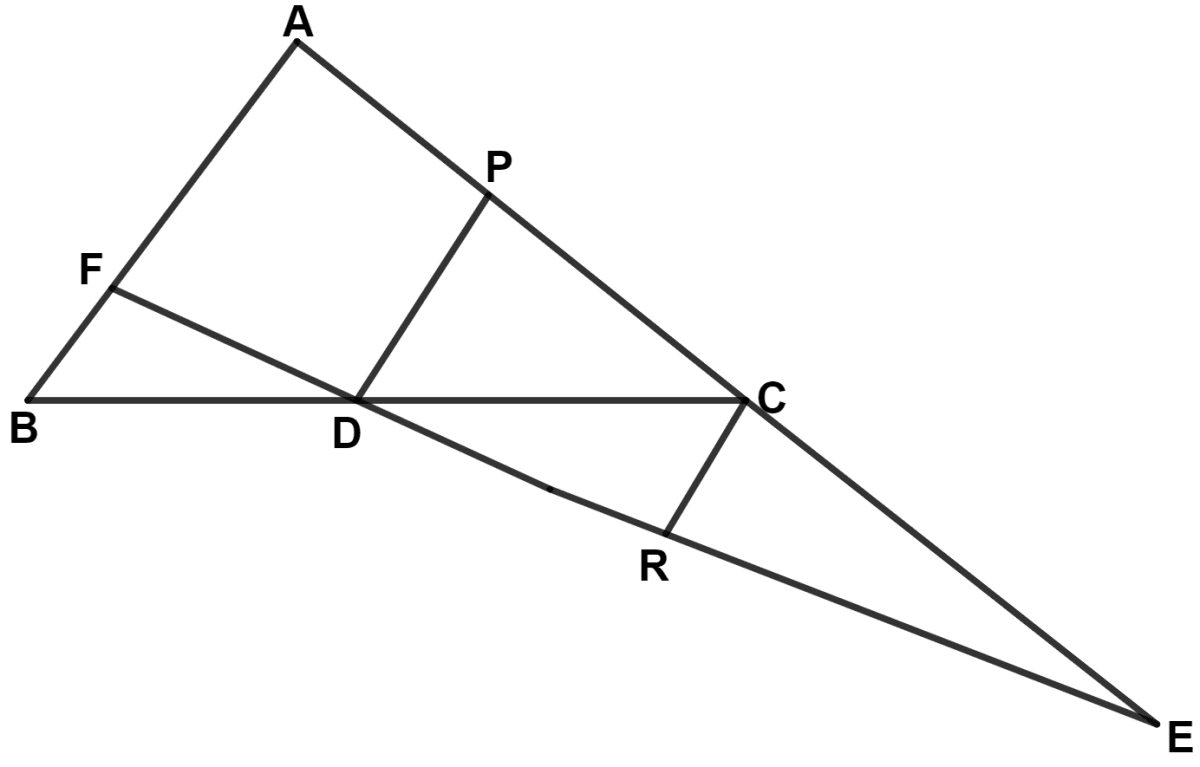
By mid-point theorem,
The line segment joining the mid-points of any two sides of a triangle is parallel to the third side and is equal to half of it.
By converse of mid-point theorem,
The straight line drawn through the mid-point of one side of a triangle parallel to another, bisects the third side.
By equal intercept theorem,
If a transversal makes equal intercepts on three or more parallel lines, then any other line cutting them will also make equal intercepts.
(i) In △ ABC,
D is the mid-point of BC and DP || AB.
∴ P is the mid-point of AC. (By converse of mid-point theorem)
∴ AP = PC
Given,
⇒ CE =
∴ CE = PC
Since, AP = PC and CE = PC,
∴ AP = PC = CE.
Since,
⇒ AB || DP || CR
⇒ AF || DP || CR (Since, point F lies on straight line AB)
In △ AEF,
AF || PD || CR and AP = PC = CE
∴ DF = DR = RE = x (let) [By equal intercept theorem]
From figure,
⇒ EF = DF + DR + RE = x + x + x = 3x = 3DF.
Hence, proved that 3DF = EF.
(ii) In △ ABC,
D is mid-point of BC and DP || AB.
∴ P is the mid-point of AC. (By converse of mid-point theorem)
∴ PD = (By mid-point theorem) .........(1)
In △ PED,
Given,
⇒ CE =
⇒ CE = PC (Since, P is mid-point of AC)
∴ C is the mid-point of PE.
C is mid-point of PE and DP || CR.
∴ R is the mid-point of DE. (By converse of mid-point theorem)
∴ CR = (By mid-point theorem) .........(2)
Substituting value of PD from equation (1) in equation (2), we get :
⇒ CR =
⇒ CR =
⇒ 4CR = AB.
Hence, proved that 4CR = AB.
In triangle ABC, the medians BP and CQ are produced upto points M and N respectively such that BP = PM and CQ = QN. Prove that :
(i) M, A and N are collinear.
(ii) A is the mid-point of MN.
Answer
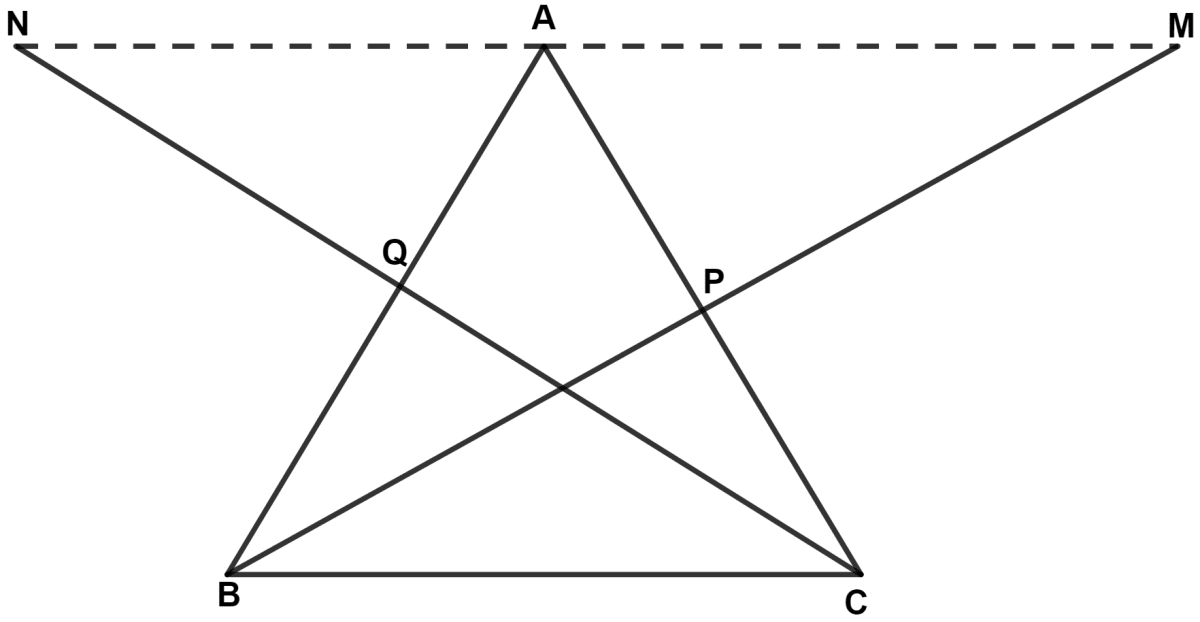
In △ AQN and △ BQC,
⇒ AQ = BQ (Since, CQ is the median)
⇒ QN = CQ (Given)
⇒ ∠AQN = ∠CQB (Vertically opposite angles are equal)
∴ △ AQN ≅ △ BQC (By S.A.S. axiom)
We know that,
Corresponding parts of congruent triangle are equal.
⇒ ∠QAN = ∠QBC ........(1)
⇒ BC = AN ..........(2)
In △ APM and △ CPB,
⇒ AP = CP (Since, BP is the median)
⇒ PM = BP (Given)
⇒ ∠APM = ∠CPB (Vertically opposite angles are equal)
∴ △ APM ≅ △ CPB (By S.A.S. axiom)
⇒ ∠PAM = ∠PCB [By C.P.C.T.C.] ........(3)
⇒ BC = AM [By C.P.C.T.C.] ..........(4)
(i) In △ ABC,
By angle sum property of triangle,
⇒ ∠ABC + ∠ACB + ∠BAC = 180°
⇒ ∠QBC + ∠PCB + ∠BAC = 180°
⇒ ∠QAN + ∠PAM + ∠BAC = 180° [From equations (1) and (3)]
Since, the sum of above angles equal to 180°.
∴ N, A and M lies in a straight line.
Hence, proved that M, A and N are collinear.
(ii) From equations (2) and (4), we get :
⇒ AM = AN.
Hence, proved that A is the mid-point of MN.
In triangle ABC, angle B is obtuse. D and E are mid-points of sides AB and BC respectively and F is a point on side AC such that EF is parallel to AB. Show that BEFD is a parallelogram.
Answer
By mid-point theorem,
The line segment joining the mid-points of any two sides of a triangle is parallel to the third side and is equal to half of it.
By converse of mid-point theorem,
The straight line drawn through the mid-point of one side of a triangle parallel to another, bisects the third side.
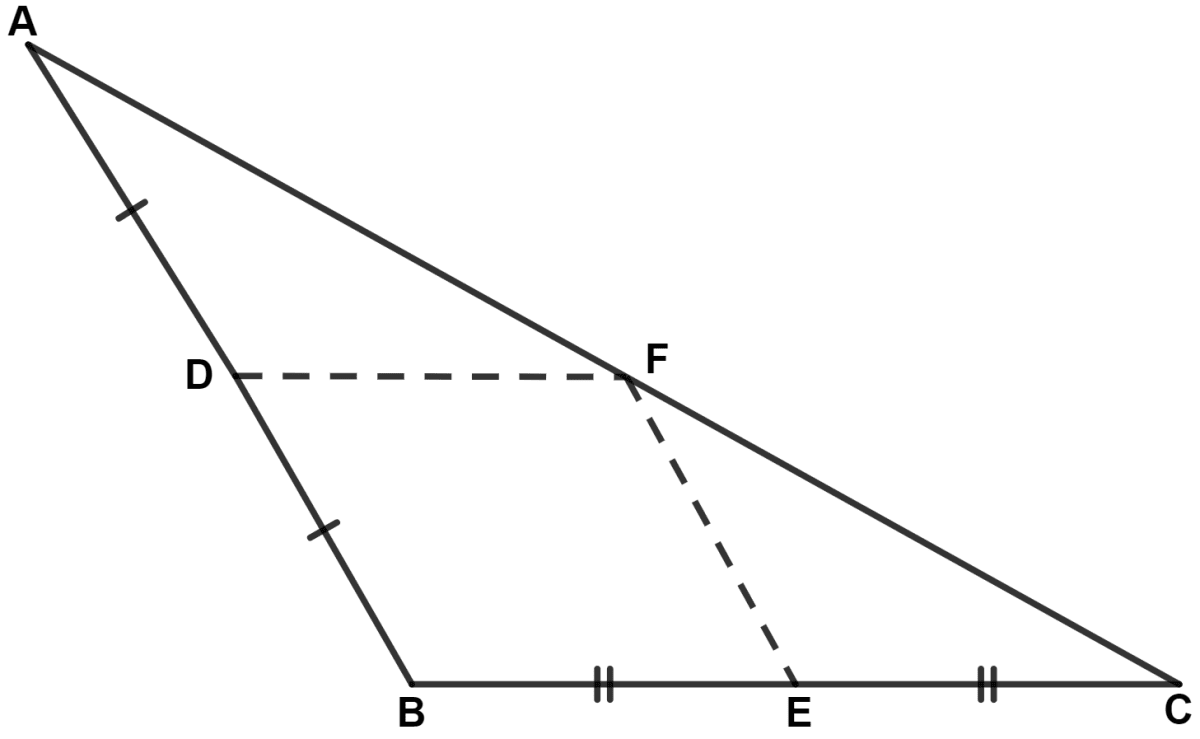
In △ ABC,
E is the mid-point of BC and FE || AB.
∴ F is the mid-point of AC. (By converse of mid-point theorem)
Since,
⇒ FE || AB
∴ FE || BD.
D and F are mid-point of sides AB and AC respectively.
∴ DF || BC (By mid-point theorem)
∴ DF || BE.
Since, opposite sides of quadrilateral BEFD are parallel.
Hence, proved that BEFD is a parallelogram.
In parallelogram ABCD, E and F are mid-points of the sides AB and CD respectively. The line segments AF and BF meet the line segments ED and EC at points G and H respectively. Prove that :
(i) triangles HEB and FHC are congruent;
(ii) GEHF is a parallelogram.
Answer
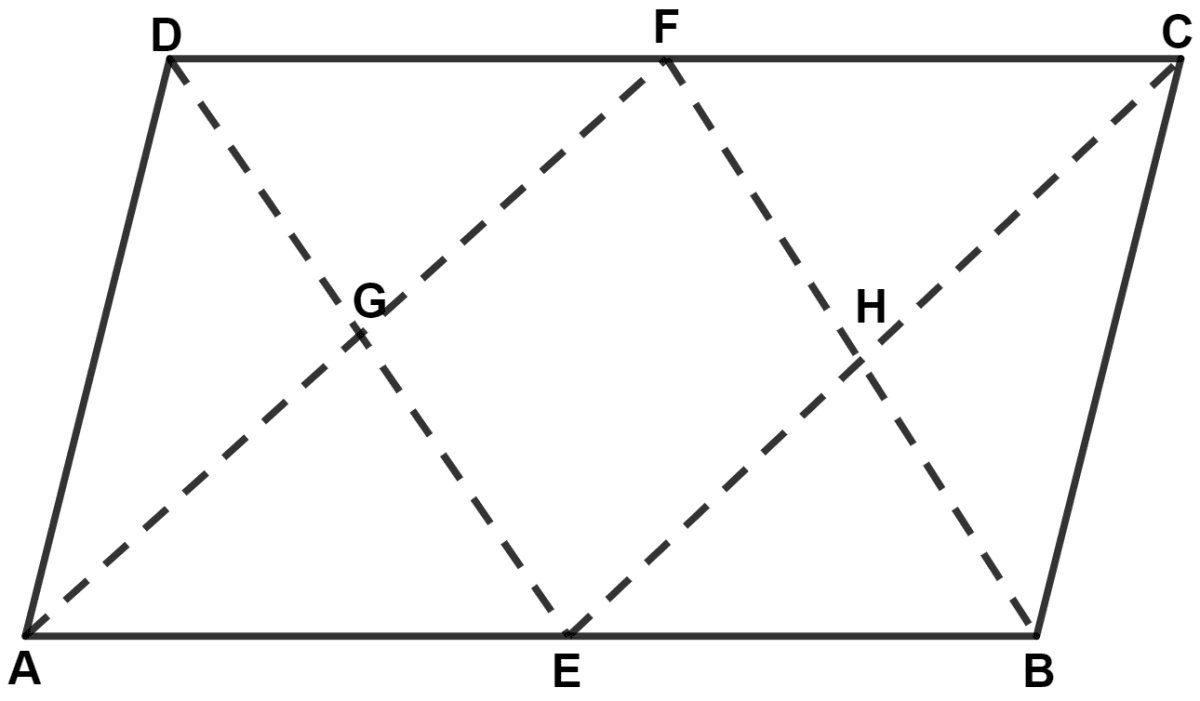
(i) In △ HEB and △ FHC,
⇒ BE = CF (Since, opposite sides of parallelogram are equal i.e. AB = CD and E and F are mid-points of AB and CD respectively)
⇒ ∠HBE = ∠HFC (Alternate angles are equal)
⇒ ∠EHB = ∠FHC (Vertically opposite angles are equal)
∴ △ HEB ≅ △ FHC (By A.A.S. axiom)
Hence, proved that triangles HEB and FHC are congruent.
(ii) Since,
△ HEB ≅ △ FHC
We know that,
Corresponding parts of congruent triangle are equal.
⇒ EH = CH and BH = FH.
⇒ H is the mid-point of BF and CE.
In △ AGE and △ DGF,
⇒ AE = DF (Since, opposite sides of parallelogram are equal i.e. AB = CD and E and F are mid-points of AB and CD respectively)
⇒ ∠GEA = ∠GDF (Alternate angles are equal)
⇒ ∠AGE = ∠DGF (Vertically opposite angles are equal)
∴ △ AGE ≅ △ DGF (By A.A.S. axiom)
∴ AG = GF and EG = DG [By C.P.C.T.C.]
⇒ G is the mid-point of DE and AF.
In △ ECD,
F and H are mid-points of sides CD and EC respectively.
∴ FH || DE [By mid-point theorem]
⇒ FH || GE
F and G are mid-points of sides CD and ED respectively.
∴ GF || EC [By mid-point theorem]
⇒ GF || EH
Since, opposite sides of quadrilateral GEFH are parallel.
Hence, proved that GEHF is a parallelogram.
In triangle ABC, D and E are points on side AB such that AD = DE = EB. Through D and E, lines are drawn parallel to BC which meet side AC at points F and G respectively. Through F and G, lines are drawn parallel to AB which meet side BC at points M and N respectively. Prove that : BM = MN = NC.
Answer
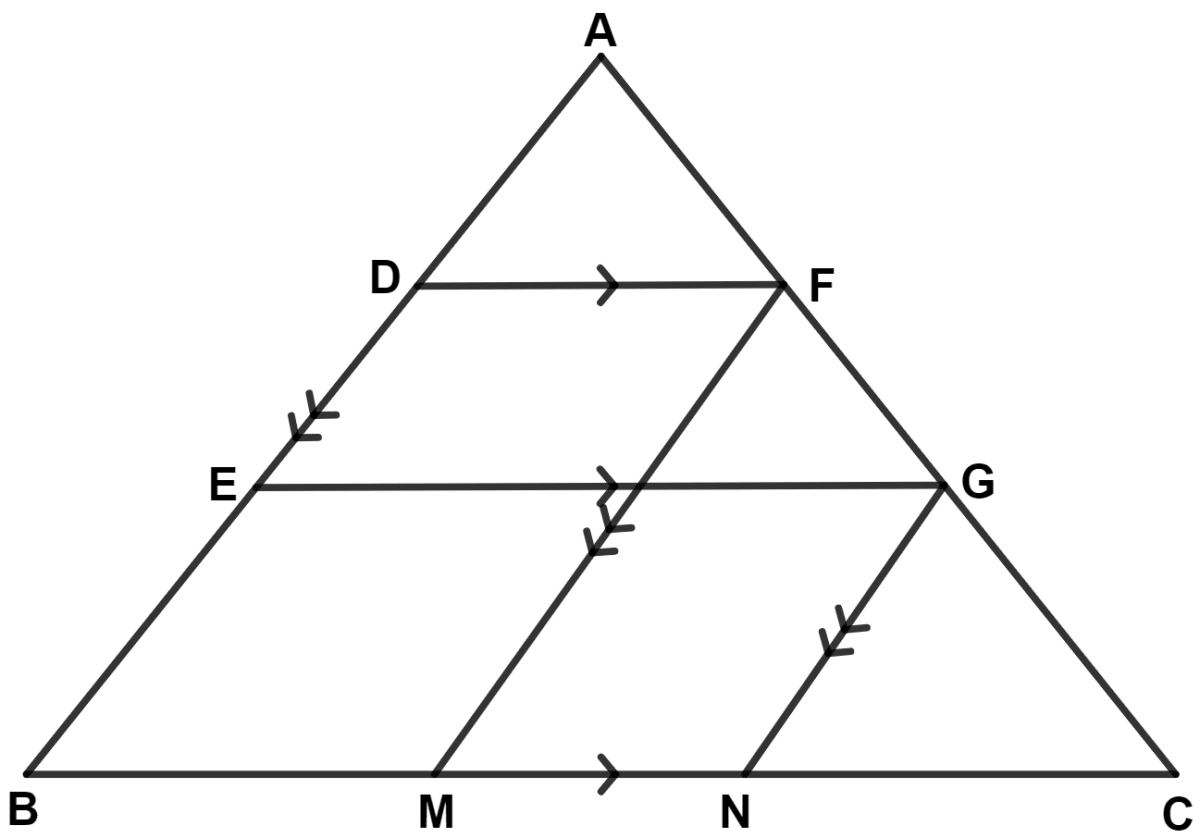
By mid-point theorem,
The line segment joining the mid-points of any two sides of a triangle is parallel to the third side and is equal to half of it.
By converse of mid-point theorem,
The straight line drawn through the mid-point of one side of a triangle parallel to another, bisects the third side.
By equal intercept theorem,
If a transversal makes equal intercepts on three or more parallel lines, then any other line cutting them will also make equal intercepts.
In △ AEG,
D is the mid-point of AE and DF || EG.
∴ F is mid-point of AG (By converse of mid-point theorem)
∴ AF = FG .........(1)
Since,
DF || EG || BC and DE || BE
∴ FG = GC [By equal intercept theorem]...........(2)
From equation (1) and (2), we get :
⇒ AF = FG = GC
Since, AB || FM || GN and AF = FG = GC
∴ BM = MN = NC [By equal intercept theorem]
Hence, proved that BM = MN = NC.
In triangle ABC; M is the mid-point of AB, N is mid-point of AC and D is any point in base BC. Use intercept theorem to show that MN bisects AD.
Answer
Let MN intersects at AD at point X.
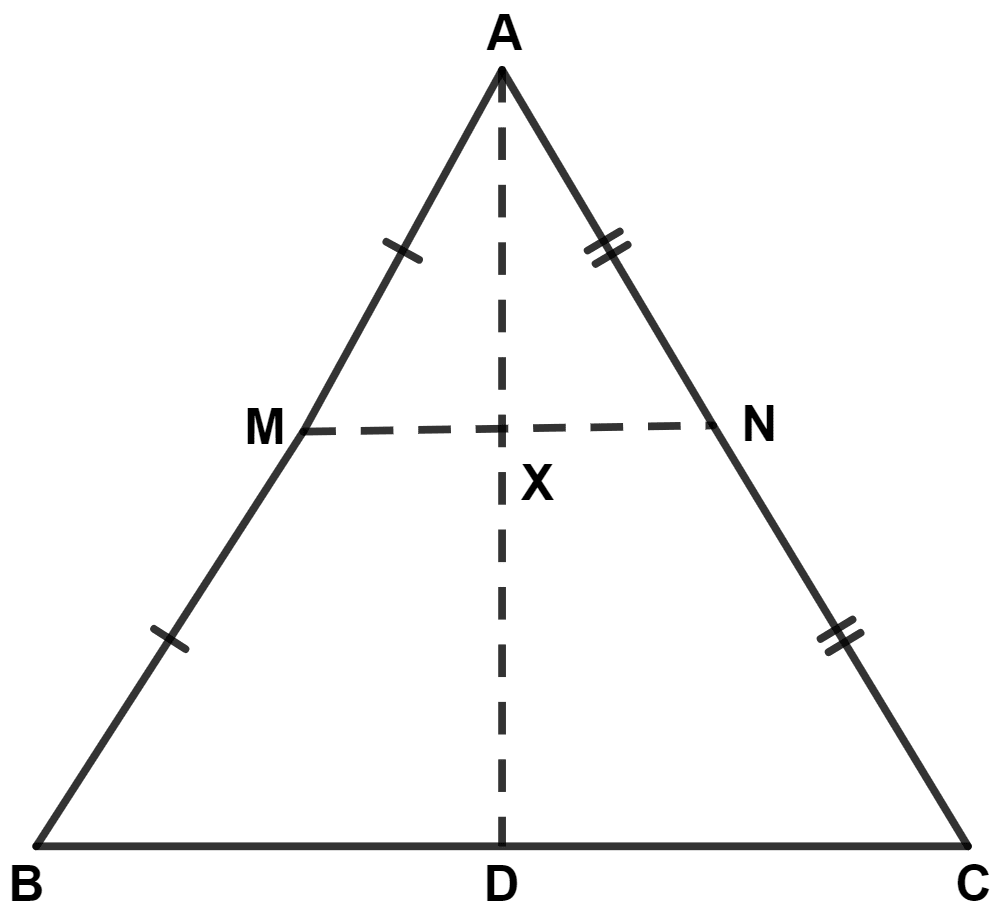
By mid-point theorem,
The line segment joining the mid-points of any two sides of a triangle is parallel to the third side and is equal to half of it.
In △ ABC,
M is mid-point of AB and N is mid-point of AC.
∴ MN || BC (By mid-point theorem)
By equal intercept theorem,
If a transversal makes equal intercepts on three or more parallel lines, then any other line cutting them will also make equal intercepts.
Since,
M is mid-point of AB.
∴ AM = MB
N is mid-point of AC.
∴ AN = CN
From figure,
MN || BC, AM = BM and AN = CN
∴ AX = DX (By equal intercept theorem)
Hence, proved that MN bisects AD.
If the quadrilateral formed by joining the mid-points of the adjacent sides of quadrilateral ABCD is a rectangle, show that the diagonals AC and BD intersect at right angle.
Answer
Let ABCD be a quadrilateral and P, Q, R and S are the mid-point of AB, BC, CD and DA.
Diagonal AC and BD intersect at point O.
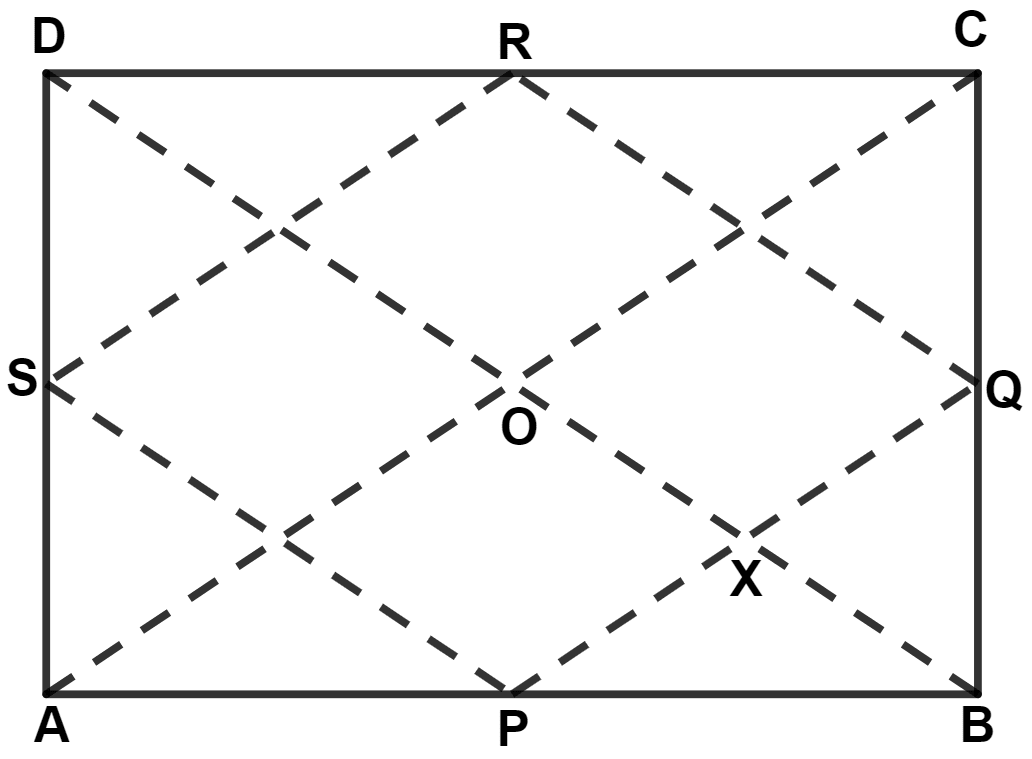
By mid-point theorem,
The line segment joining the mid-points of any two sides of a triangle is parallel to the third side and is equal to half of it.
In △ ABC,
P and Q are mid-points of AB and BC.
∴ PQ || AC (By mid-point theorem)
From figure,
⇒ ∠AOD = ∠PXO (Corresponding angles are equal) ............(1)
In △ BCD,
R and Q are mid-points of CD and BC.
∴ QR || BD (By mid-point theorem)
Interior angles of a rectangle equals to 90°.
⇒ ∠RQX = ∠Q = 90°.
From figure,
⇒ ∠PXO = ∠RQX = 90° (Corresponding angles are equal) ............(2)
From (1) and (2), we get :
⇒ ∠AOD = ∠PXO = 90°.
Hence, AC and BD intersect at right angles.