KnowledgeBoat Logo
|
OPEN IN APP

Chapter 11

Mid-point Theorem and its Converse [Including Intercept Theorem]

Class - 9 Concise Mathematics Selina


Exercise 11(A)

Question 1(a)

In the given figure, ABCD is a rectangle. As per the given information, the length of PQ is :
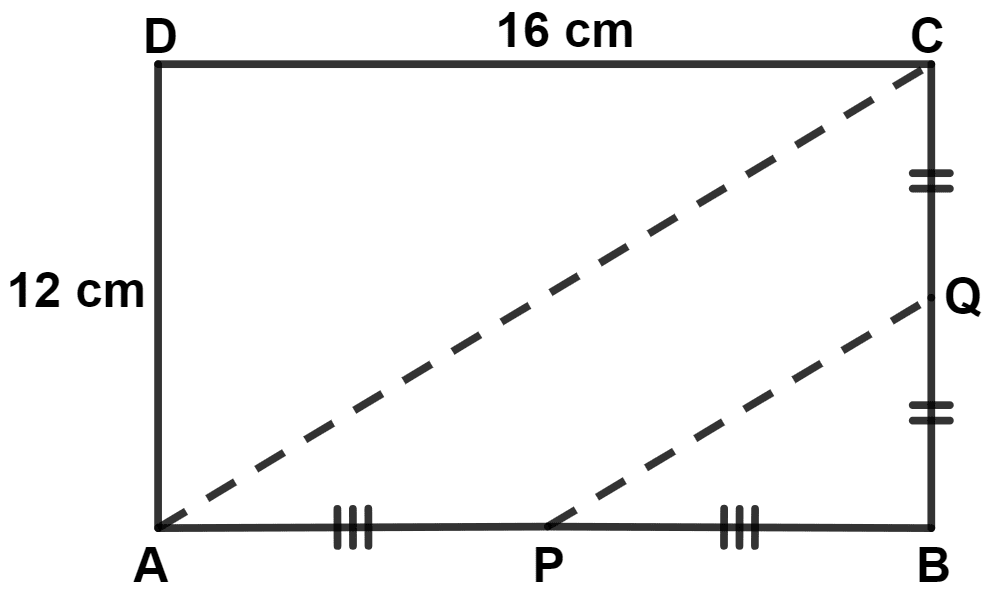
In the given figure, ABCD is a rectangle. As per the given information, the length of PQ is : Mid-point Theorem, Concise Mathematics Solutions ICSE Class 9.
  1. 12 cm

  2. 14 cm

  3. 20 cm

  4. 10 cm

Answer

From figure,

AP = PB and BQ = QC.

∴ P is the mid-point of AB and Q is the mid-point of BC.

In △ ADC,

⇒ AD2 + CD2 = AC2 (By pythagoras theorem)

⇒ 122 + 162 = AC2

⇒ 144 + 256 = AC2

⇒ AC2 = 400

⇒ AC = 400\sqrt{400} = 20 cm.

By mid-point theorem,

The line segment joining the mid-points of any two sides of a triangle is parallel to the third side and is equal to half of it.

∴ PQ = 12AC=12×20\dfrac{1}{2} AC = \dfrac{1}{2} \times 20 = 10 cm.

Hence, Option 4 is the correct option.

Question 1(b)

The quadrilateral obtained by joining the mid-points (in order) of the sides of quadrilateral ABCD is :

  1. rectangle

  2. rhombus

  3. parallelogram

  4. square

Answer

Let ABCD be the quadrilateral. P, Q, R and S are the mid-points of sides AB, BC, CD and DA.

Join PQRS, AC and BD.
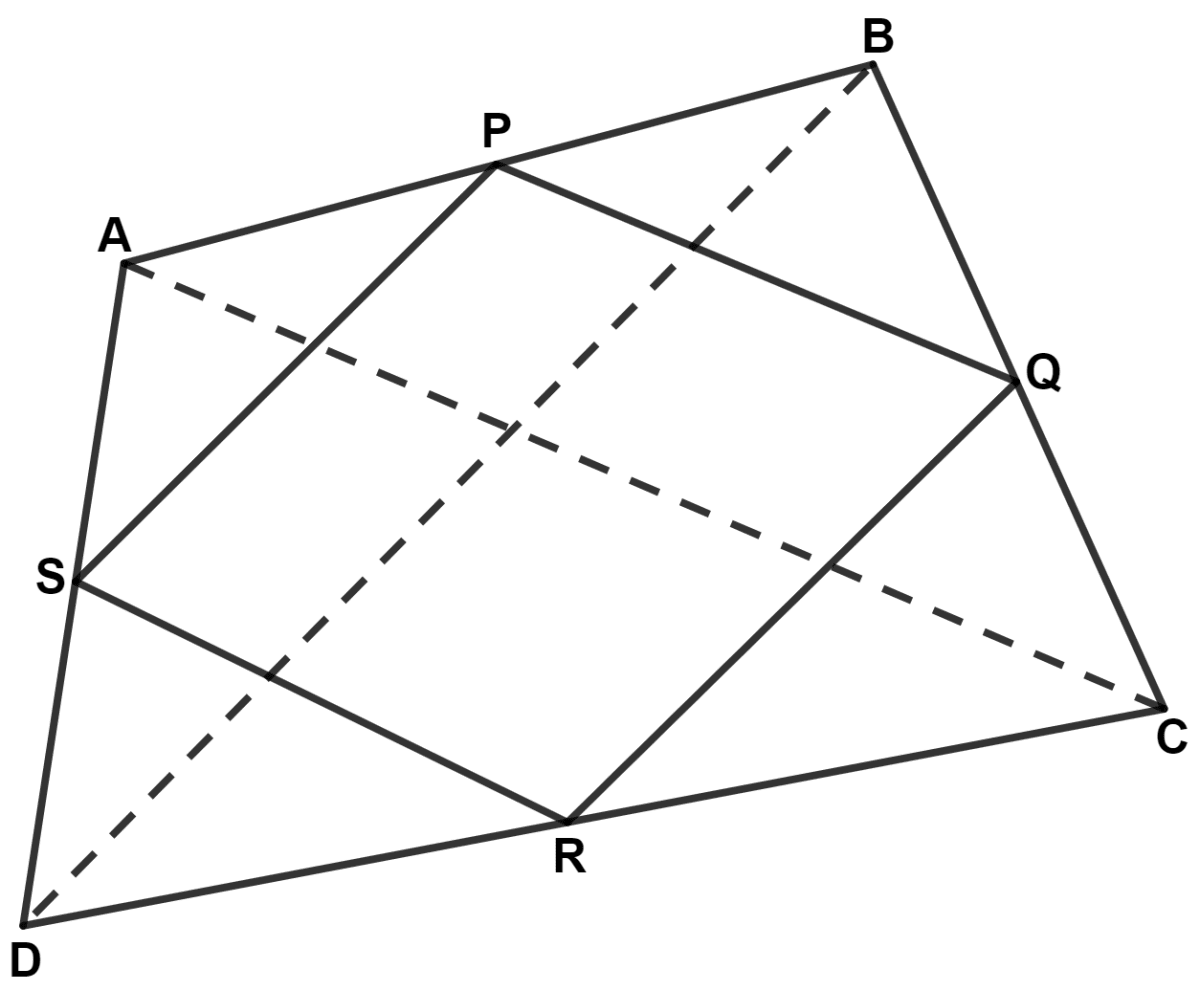
The quadrilateral obtained by joining the mid-points (in order) of the sides of quadrilateral ABCD is : Mid-point Theorem, Concise Mathematics Solutions ICSE Class 9.

By mid-point theorem,

The line segment joining the mid-points of any two sides of a triangle is parallel to the third side and is equal to half of it.

In △ ABC,

P and Q are mid-points of sides AB and BC respectively.

∴ PQ || AC and PQ = 12AC\dfrac{1}{2}AC (By mid-point theorem) .......(1)

In △ ADC,

S and R are mid-points of sides AD and DC respectively.

∴ SR || AC and SR = 12AC\dfrac{1}{2}AC (By mid-point theorem) ........(2)

From equations (1) and (2), we get :

⇒ PQ = SR and PQ || SR.

In △ ABD,

P and S are mid-points of sides AB and AD respectively.

∴ SP || BD and SP = 12BD\dfrac{1}{2}BD (By mid-point theorem) .......(3)

In △ CBD,

Q and R are mid-points of sides BC and DC respectively.

∴ QR || BD and QR = 12BD\dfrac{1}{2}BD (By mid-point theorem) ........(4)

From equations (3) and (4), we get :

⇒ SP = QR and SP || QR.

Since, opposite sides are parallel and equal.

∴ PQRS is a parallelogram.

Hence, Option 3 is the correct option.

Question 1(c)

If BC = 12 cm, AB = 14.8 cm, AC = 12.8 cm, the perimeter of quadrilateral BCYX is :
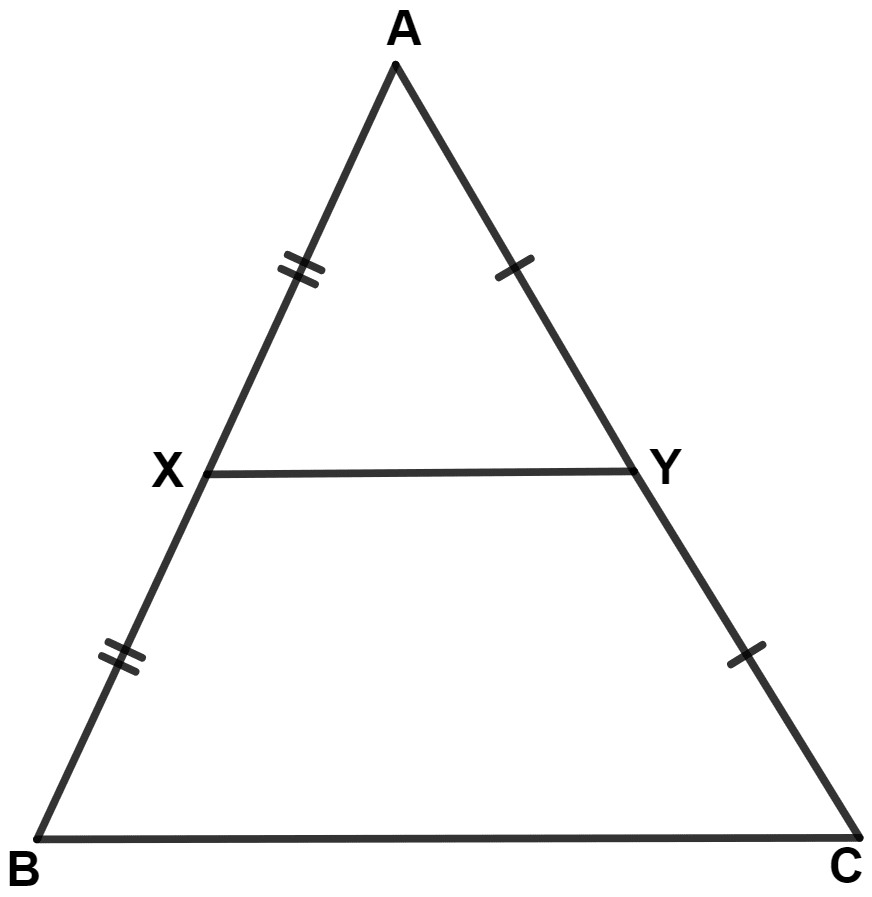
If BC = 12 cm, AB = 14.8 cm, AC = 12.8 cm, the perimeter of quadrilateral BCYX is : Mid-point Theorem, Concise Mathematics Solutions ICSE Class 9.
  1. 31.8 cm

  2. 15.9 cm

  3. 29.8 cm

  4. 32.8 cm

Answer

From figure,

X and Y are the mid-point of AB and AC respectively.

∴ BX = AB2=14.82\dfrac{AB}{2} = \dfrac{14.8}{2} = 7.4 cm and CY = AC2=12.82\dfrac{AC}{2} = \dfrac{12.8}{2} = 6.4 cm.

By mid-point theorem,

The line segment joining the mid-points of any two sides of a triangle is parallel to the third side and is equal to half of it.

In △ ABC,

∴ XY = 12BC=12×12\dfrac{1}{2}BC = \dfrac{1}{2} \times 12 = 6 cm.

Perimeter of BCYX = BC + CY + XY + BX = 12 + 6.4 + 6 + 7.4 = 31.8 cm

Hence, Option 1 is the correct option.

Question 1(d)

In the given figure, AB = AC, P, Q and R are mid-points of sides BC, CA and AB respectively, then △ PQR is :
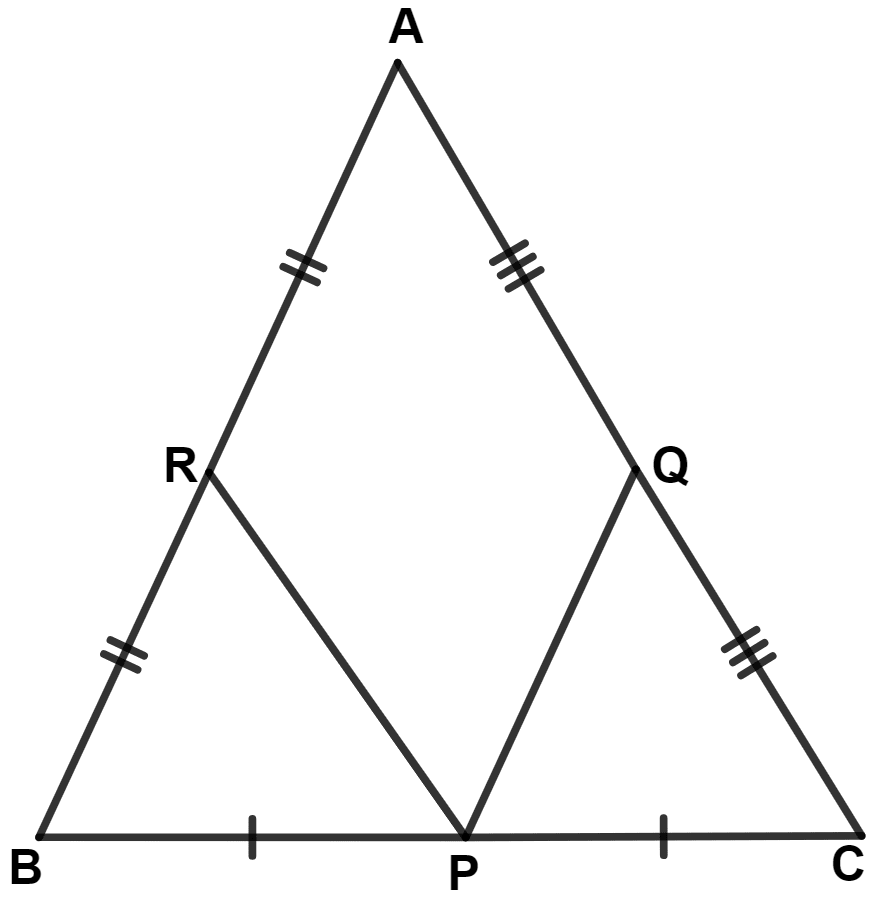
In the given figure, AB = AC, P, Q and R are mid-points of sides BC, CA and AB respectively, then △ PQR is : Mid-point Theorem, Concise Mathematics Solutions ICSE Class 9.
  1. scalene

  2. isosceles

  3. equilateral

  4. obtuse angled

Answer

Given,

AB = AC = x (let)

From figure,

AR = RB, BP = PC and AQ = QC.

∴ R, P and Q are mid-points of sides AB, BC and AC respectively.

Join QR.
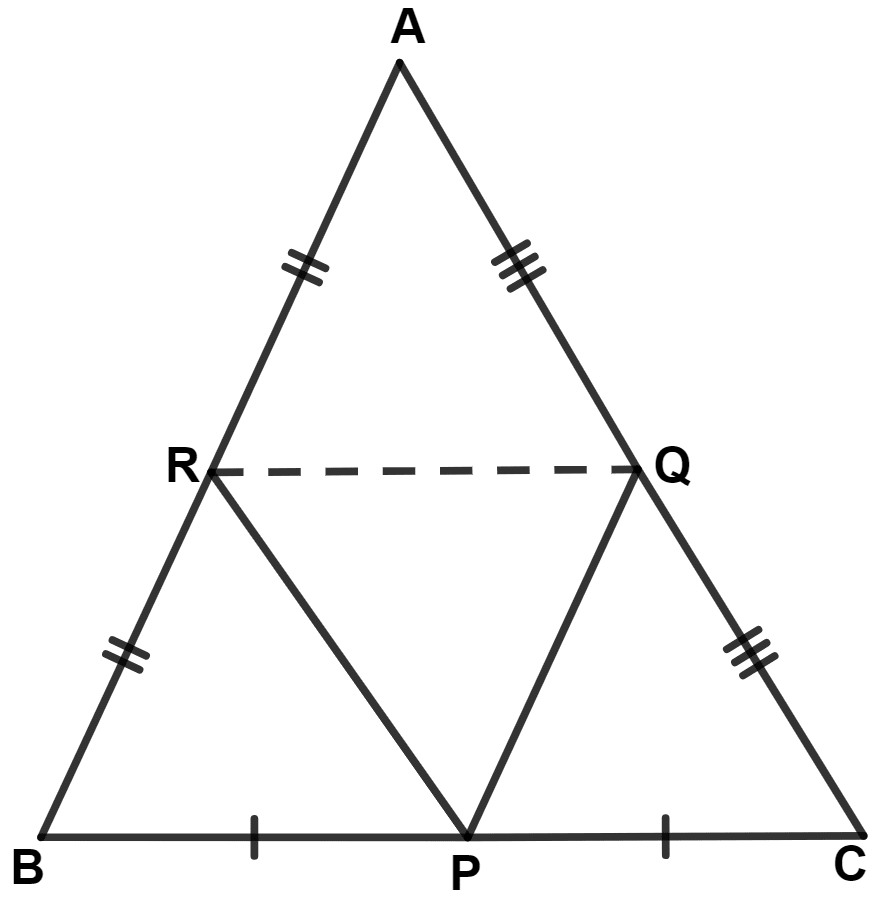
In the given figure, AB = AC, P, Q and R are mid-points of sides BC, CA and AB respectively, then △ PQR is : Mid-point Theorem, Concise Mathematics Solutions ICSE Class 9.

By mid-point theorem,

The line segment joining the mid-points of any two sides of a triangle is parallel to the third side and is equal to half of it.

∴ PQ = 12AB=x2\dfrac{1}{2}AB = \dfrac{x}{2}, PR = 12AC=x2\dfrac{1}{2}AC = \dfrac{x}{2} and QR = 12BC\dfrac{1}{2}BC.

In △ PQR,

PQ = PR.

∴ △ PQR is an isosceles triangle.

Hence, Option 2 is the correct option.

Question 1(e)

P, Q, R and S are the mid-points of sides AB, BC, CD and DA respectively of rectangle ABCD, then quadrilateral PQRS is :

  1. rectangle

  2. rhombus

  3. square

  4. parallelogram

Answer

By mid-point theorem,

The line segment joining the mid-points of any two sides of a triangle is parallel to the third side and is equal to half of it.

Join AC and BD.
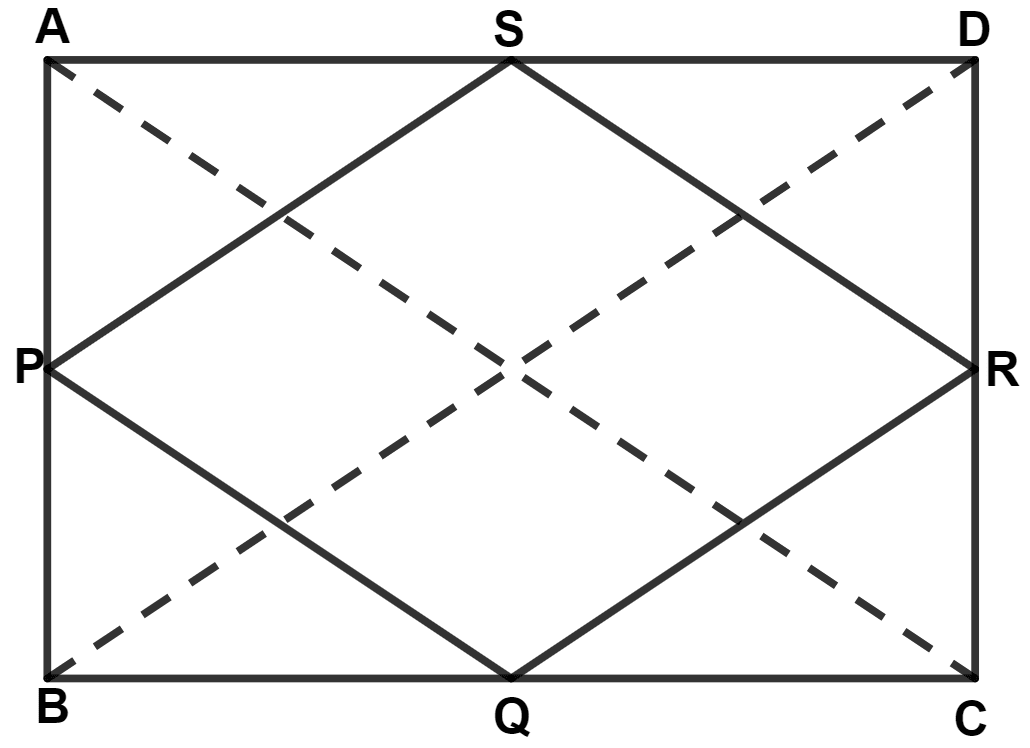
P, Q, R and S are the mid-points of sides AB, BC, CD and DA respectively of rectangle ABCD, then quadrilateral PQRS is : Mid-point Theorem, Concise Mathematics Solutions ICSE Class 9.

We know that,

Diagonals of a rectangle are equal.

∴ AC = BD = x (let)

In Δ ABC, P and Q are the mid-points of sides AB and BC respectively.

∴ PQ || AC and PQ = 12AC=12x\dfrac{1}{2}AC = \dfrac{1}{2}x (By mid-point theorem) ........(1)

In Δ ADC, S and R are mid-points of sides AD and CD respectively.

∴ SR || AC and SR = 12AC=12x\dfrac{1}{2}AC = \dfrac{1}{2}x (By mid-point theorem) .........(2)

From equations (1) and (2), we get :

PQ || SR and PQ = SR

In Δ ABD, P and S are the mid-points of sides AB and AD respectively.

∴ PS || BD and PS = 12BD=12x\dfrac{1}{2}BD = \dfrac{1}{2}x (By mid-point theorem) ........(3)

In Δ BDC, Q and R are mid-points of sides BC and CD respectively.

∴ QR || BD and QR = 12BD=12x\dfrac{1}{2}BD = \dfrac{1}{2}x (By mid-point theorem) .........(4)

From equations (3) and (4), we get :

PQ || SR and PS = QR

By using equation (1), (2), (3) and (4), we get :

⇒ PQ = QR = SR = PS

∴ PQRS is a rhombus.

Hence, Option 2 is the correct option.

Question 2

In triangle ABC, M is the mid-point of AB and a straight line through M and parallel to BC cuts AC at N. Find the lengths of AN and MN, if BC = 7 cm and AC = 5 cm.

Answer
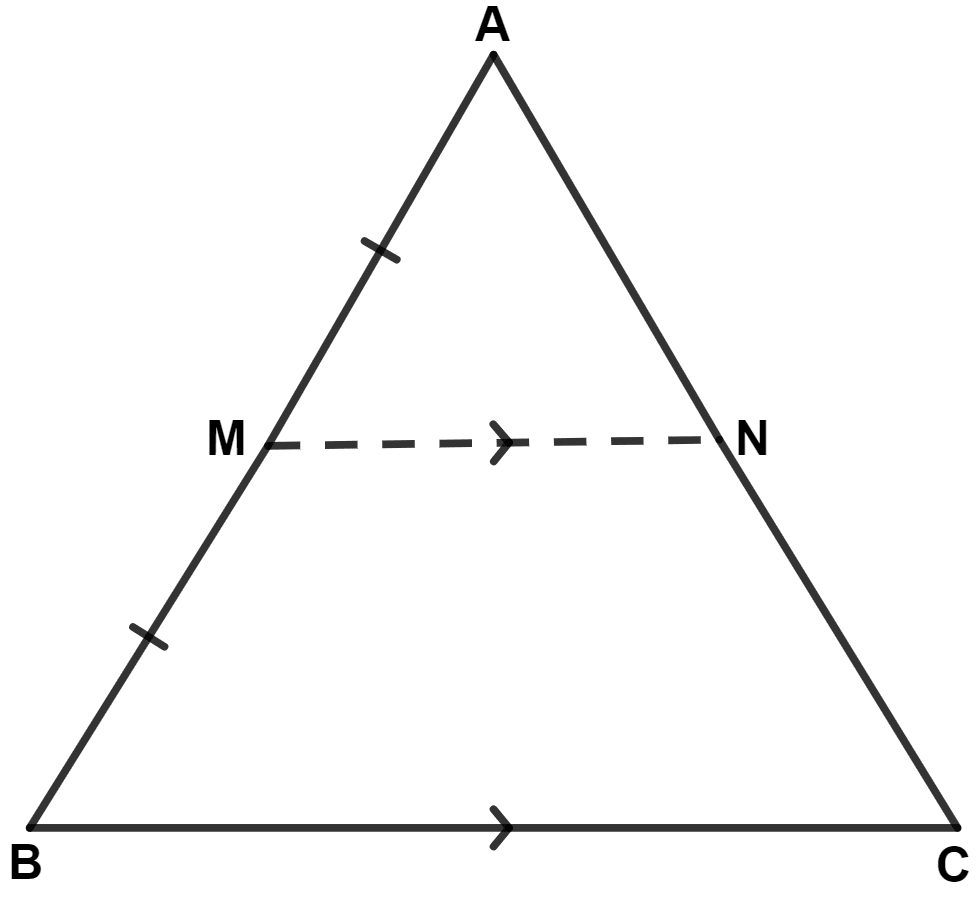
In triangle ABC, M is the mid-point of AB and a straight line through M and parallel to BC cuts AC at N. Find the lengths of AN and MN, if BC = 7 cm and AC = 5 cm. Mid-point Theorem, Concise Mathematics Solutions ICSE Class 9.

By converse of mid-point theorem,

The straight line drawn through the mid-point of one side of a triangle parallel to another, bisects the third side.

∴ N bisects AC.

∴ AN = AC2=52\dfrac{AC}{2} = \dfrac{5}{2} = 2.5 cm.

By mid-point theorem,

The line segment joining the mid-points of any two sides of a triangle is parallel to the third side and is equal to half of it.

∴ MN = 12BC=12×7\dfrac{1}{2}BC = \dfrac{1}{2} \times 7 = 3.5 cm.

Hence, AN = 2.5 cm and MN = 3.5 cm.

Question 3

Prove that the figure obtained by joining the mid-points of the adjacent sides of a rectangle is a rhombus.

Answer

Let ABCD be the rectangle and P, Q, R and S be the mid-points of sides AB, BC, CD and DA respectively. Join PQRS.
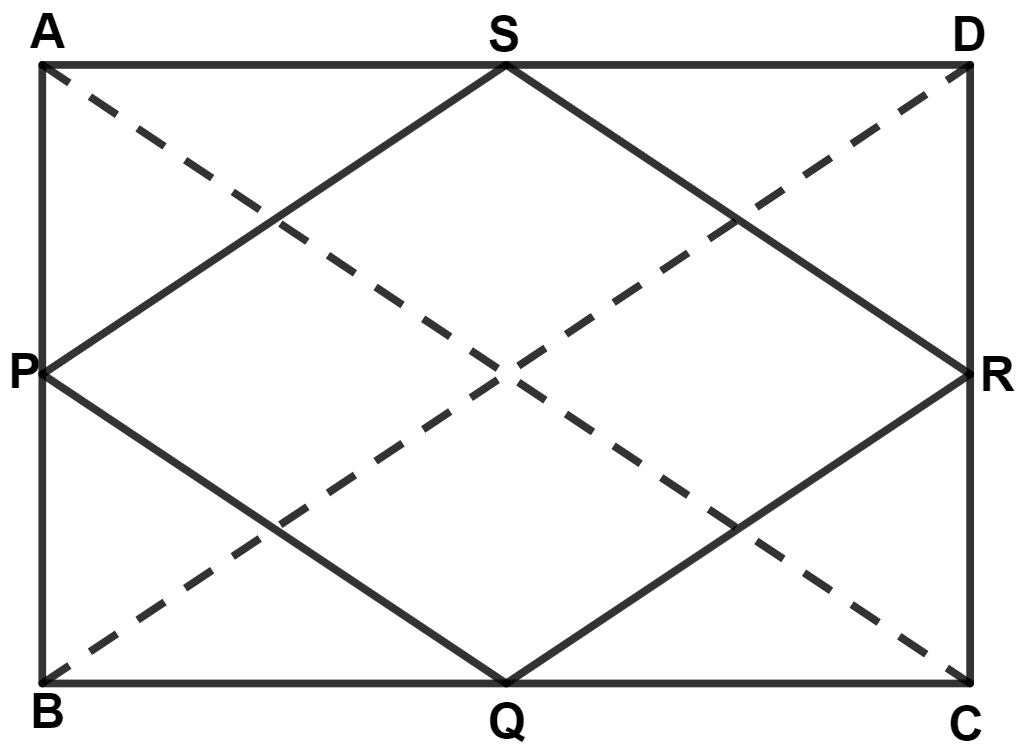
Prove that the figure obtained by joining the mid-points of the adjacent sides of a rectangle is a rhombus. Mid-point Theorem, Concise Mathematics Solutions ICSE Class 9.

By mid-point theorem,

The line segment joining the mid-points of any two sides of a triangle is parallel to the third side and is equal to half of it.

Join AC and BD.

We know that,

Diagonals of a rectangle are equal.

∴ AC = BD = x (let)

In Δ ABC, P and Q are the mid-points of sides AB and BC respectively.

∴ PQ || AC and PQ = 12AC=12x\dfrac{1}{2}AC = \dfrac{1}{2}x (By mid-point theorem) ........(1)

In Δ ADC, S and R are mid-points of sides AD and CD respectively.

∴ SR || AC and SR = 12AC=12x\dfrac{1}{2}AC = \dfrac{1}{2}x (By mid-point theorem) .........(2)

From equations (1) and (2), we get :

PQ || SR and PQ = SR

In Δ ABD, P and S are the mid-points of sides AB and AD respectively.

∴ PS || BD and PS = 12BD=12x\dfrac{1}{2}BD = \dfrac{1}{2}x (By mid-point theorem) ........(3)

In Δ BDC, Q and R are mid-points of sides BC and CD respectively.

∴ QR || BD and QR = 12BD=12x\dfrac{1}{2}BD = \dfrac{1}{2}x (By mid-point theorem) .........(4)

From equations (3) and (4), we get :

PQ || SR and PS = QR

By using equation (1), (2), (3) and (4), we get :

⇒ PQ = QR = SR = PS

Since, opposite sides are parallel and all the sides are equal.

∴ PQRS is a rhombus.

Hence, proved that the figure obtained by joining the mid-points of the adjacent sides of a rectangle is a rhombus.

Question 4

D, E and F are the mid-points of the sides AB, BC and CA of an isosceles △ ABC in which AB = BC. Prove that △ DEF is also isosceles.

Answer
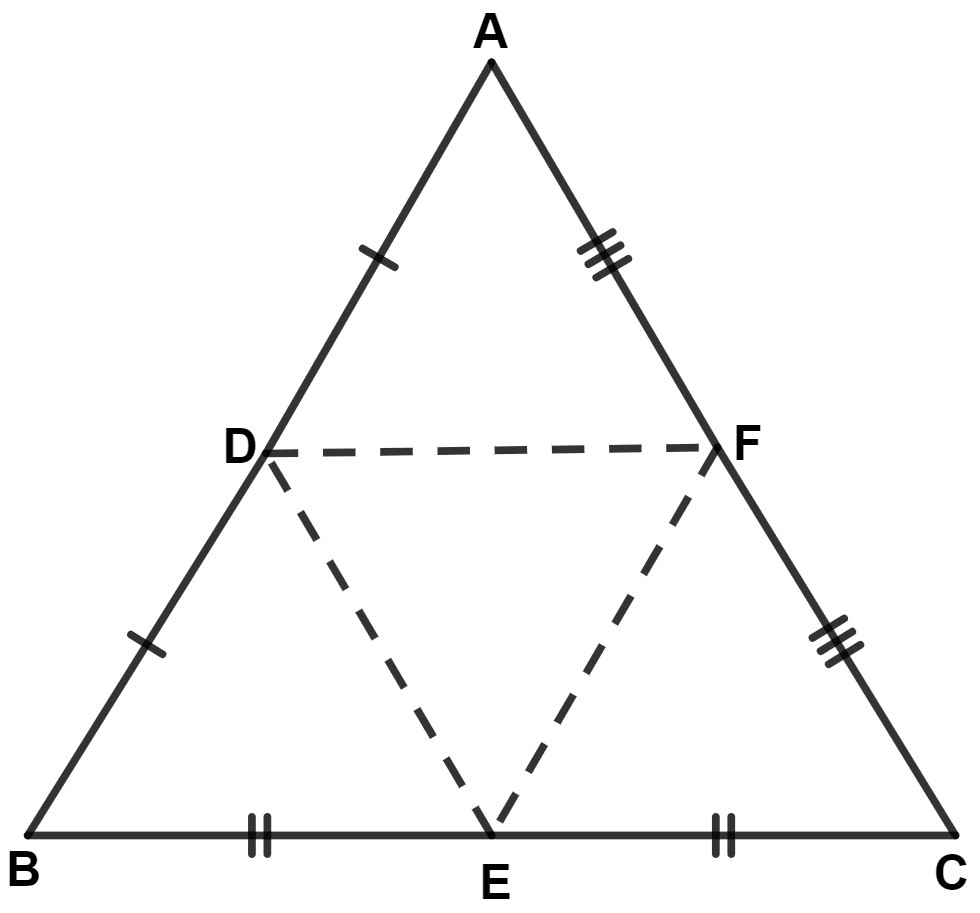
D, E and F are the mid-points of the sides AB, BC and CA of an isosceles △ ABC in which AB = BC. Prove that △ DEF is also isosceles. Mid-point Theorem, Concise Mathematics Solutions ICSE Class 9.

Join D, E and F.

Given,

AB = BC = x (let)

Given,

D, E and F are mid-points of sides AB, BC and AC respectively.

By mid-point theorem,

The line segment joining the mid-points of any two sides of a triangle is parallel to the third side and is equal to half of it.

∴ DF = 12BC=x2\dfrac{1}{2}BC = \dfrac{x}{2}, FE = 12AB=x2\dfrac{1}{2}AB = \dfrac{x}{2} and DE = 12AC\dfrac{1}{2}AC.

In △ DEF,

DF = FE.

∴ △ DEF is an isosceles triangle.

Hence, proved that DEF is an isosceles triangle.

Question 5

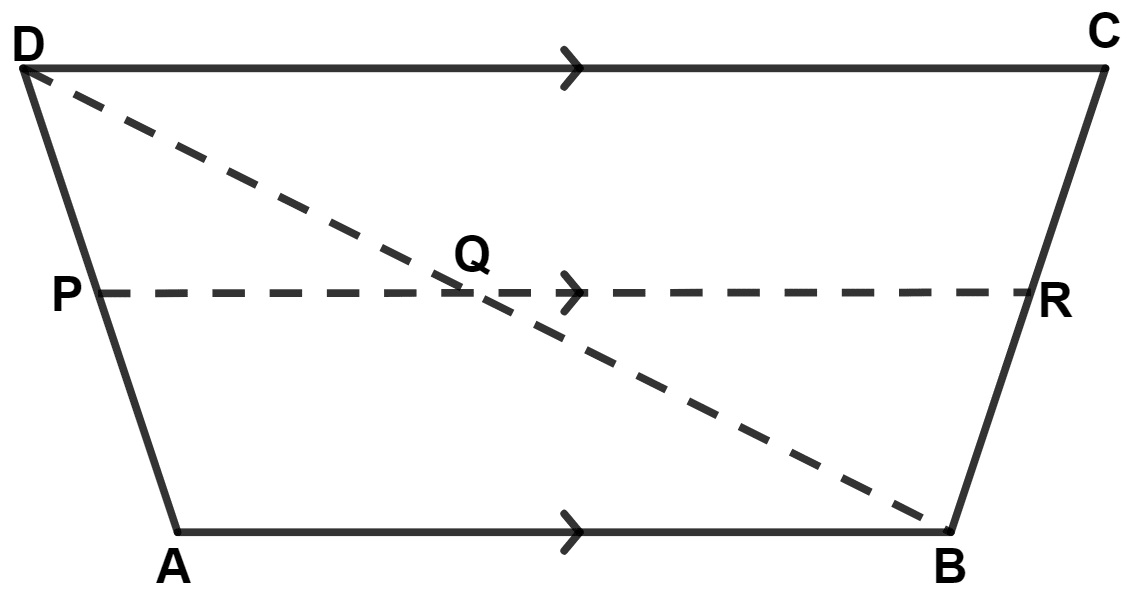
The following figure shows a trapezium ABCD in which AB // DC. P is the mid-point of AD and PR // AB. Prove that :

PR = 12\dfrac{1}{2} (AB + CD)

The following figure shows a trapezium ABCD in which AB // DC. P is the mid-point of AD and PR // AB. Prove that : Mid-point Theorem, Concise Mathematics Solutions ICSE Class 9.

Answer

By mid-point theorem,

The line segment joining the mid-points of any two sides of a triangle is parallel to the third side and is equal to half of it.

By converse of mid-point theorem,

The straight line drawn through the mid-point of one side of a triangle parallel to another, bisects the third side.

Given,

⇒ PR // AB

⇒ PQ // AB

In △ ABD,

P is mid-point of AD and PQ // AB.

∴ Q is mid-point of BD. (By converse of mid-point theorem)

∴ PQ = 12AB\dfrac{1}{2}AB (By mid-point theorem) ..........(1)

Given,

⇒ PR // DC

⇒ QR // DC

In △ BCD,

Q is mid-point of BD and QR // DC.

∴ R is mid-point of BC. (By converse of mid-point theorem)

∴ QR = 12CD\dfrac{1}{2}CD (By mid-point theorem) ..........(2)

Adding equations (1) and (2), we get :

⇒ PQ + QR = 12AB+12CD\dfrac{1}{2}AB + \dfrac{1}{2}CD

⇒ PR = 12(AB+CD)\dfrac{1}{2}(AB + CD).

Hence, proved that PR = 12(AB+CD)\dfrac{1}{2}(AB + CD).

Question 6

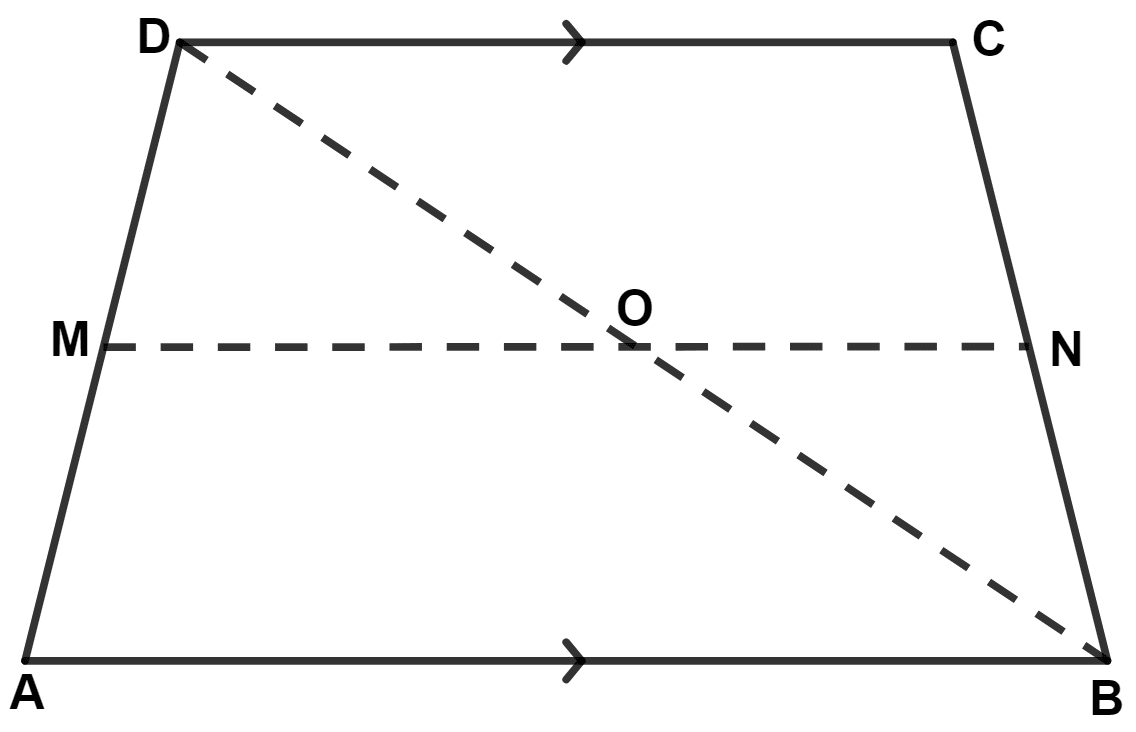
The figure, given below, shows a trapezium ABCD. M and N are the mid-points of the non-parallel sides AD and BC respectively. Find :

(i) MN, if AB = 11 cm and DC = 8 cm.

(ii) AB, if DC = 20 cm and MN = 27 cm.

(iii) DC, if MN = 15 cm and AB = 23 cm.
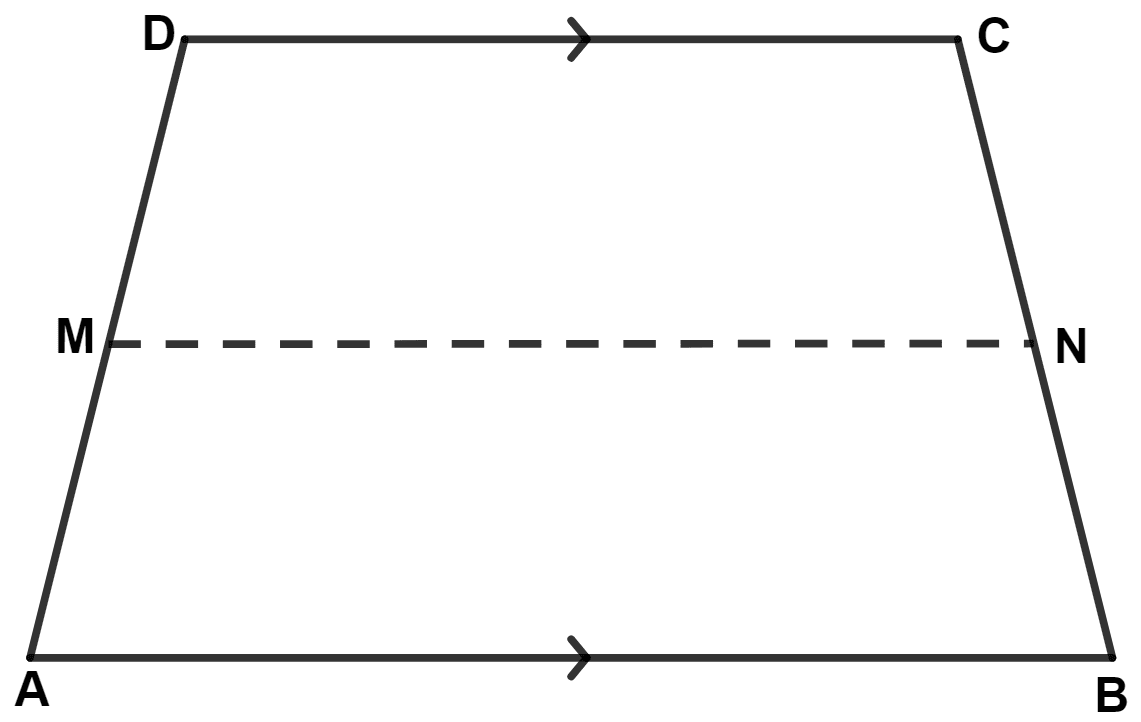
The figure, given below, shows a trapezium ABCD. M and N are the mid-points of the non-parallel sides AD and BC respectively. Find : Mid-point Theorem, Concise Mathematics Solutions ICSE Class 9.

Answer

The figure, given below, shows a trapezium ABCD. M and N are the mid-points of the non-parallel sides AD and BC respectively. Find : Mid-point Theorem, Concise Mathematics Solutions ICSE Class 9.

Join BD. Let BD intersects MN at point O.

We know that,

In trapezium the line joining the mid-points of non-parallel sides are parallel to the parallel sides of trapezium.

∴ MN || AB || DC.

By mid-point theorem,

The line segment joining the mid-points of any two sides of a triangle is parallel to the third side and is equal to half of it.

By converse of mid-point theorem,

The straight line drawn through the mid-point of one side of a triangle parallel to another, bisects the third side.

Given,

⇒ MN || AB

⇒ MO || AB

In △ ABD,

M is mid-point of AD and MO || AB.

∴ O is mid-point of BD. (By converse of mid-point theorem)

∴ MO = 12AB\dfrac{1}{2}AB (By mid-point theorem) ..........(1)

Given,

⇒ MN || DC

⇒ ON || DC

In △ BCD,

O is mid-point of BD and N is mid-point of BC.

∴ ON = 12CD\dfrac{1}{2}CD (By mid-point theorem) ..........(2)

Adding equations (1) and (2), we get :

⇒ MO + ON = 12AB+12CD\dfrac{1}{2}AB + \dfrac{1}{2}CD

⇒ MN = 12(AB+CD)\dfrac{1}{2}(AB + CD) ..........(3)

(i) Given,

⇒ AB = 11 cm

⇒ DC = 8 cm

Substituting values in equation (3), we get :

MN=12(AB+CD)MN=12×(11+8)MN=12×19MN=9.5 cm.\Rightarrow MN = \dfrac{1}{2}(AB + CD) \\[1em] \Rightarrow MN = \dfrac{1}{2} \times (11 + 8) \\[1em] \Rightarrow MN = \dfrac{1}{2} \times 19 \\[1em] \Rightarrow MN = 9.5 \text{ cm}.

Hence, MN = 9.5 cm

(ii) Given,

⇒ MN = 27 cm

⇒ DC = 20 cm

Substituting values in equation (3), we get :

MN=12(AB+CD)27=12×(AB+20)27×2=AB+20AB+20=54AB=5420=34 cm.\Rightarrow MN = \dfrac{1}{2}(AB + CD) \\[1em] \Rightarrow 27 = \dfrac{1}{2} \times (AB + 20) \\[1em] \Rightarrow 27 \times 2 = AB + 20 \\[1em] \Rightarrow AB + 20 = 54 \\[1em] \Rightarrow AB = 54 - 20 = 34 \text{ cm}.

Hence, AB = 34 cm.

(iii) Given,

⇒ MN = 15 cm

⇒ AB = 23 cm

Substituting values in equation (3), we get :

MN=12(AB+CD)15=12×(23+DC)15×2=23+DC23+DC=30DC=3023=7 cm.\Rightarrow MN = \dfrac{1}{2}(AB + CD) \\[1em] \Rightarrow 15 = \dfrac{1}{2} \times (23 + DC) \\[1em] \Rightarrow 15 \times 2 = 23 + DC \\[1em] \Rightarrow 23 + DC = 30 \\[1em] \Rightarrow DC = 30 - 23 = 7 \text{ cm}.

Hence, DC = 7 cm.

Question 7

The diagonals of a quadrilateral intersect at right angles. Prove that the figure obtained by joining the mid-points of the adjacent sides of the quadrilateral is a rectangle.

Answer

By mid-point theorem,

The line segment joining the mid-points of any two sides of a triangle is parallel to the third side and is equal to half of it.

Let ABCD be a quadrilateral where P, Q, R and S are the mid-point of AB, BC, CD and DA.
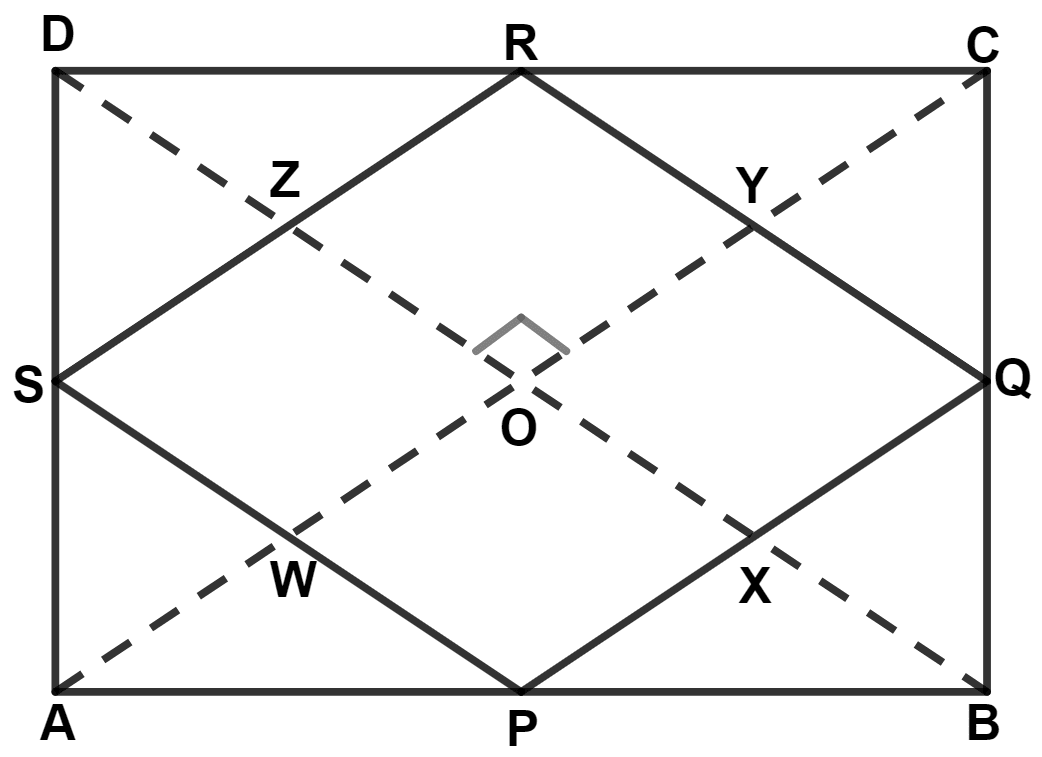
The diagonals of a quadrilateral intersect at right angles. Prove that the figure obtained by joining the mid-points of the adjacent sides of the quadrilateral is a rectangle. Mid-point Theorem, Concise Mathematics Solutions ICSE Class 9.

In △ ABC,

P and Q are mid-points of AB and BC respectively.

⇒ PQ = 12AC\dfrac{1}{2}AC and PQ || AC. [By mid-point theorem] .......(1)

In △ ADC,

S and R are mid-points of AD and CD respectively.

⇒ SR = 12AC\dfrac{1}{2}AC and SR || AC. [By mid-point theorem] .......(2)

From (1) and (2), we get :

PQ = SR and PQ || SR.

In △ BCD,

R and Q are mid-points of CD and BC respectively.

⇒ QR = 12BD\dfrac{1}{2}BD and QR || BD. [By mid-point theorem] .......(3)

In △ ABD,

S and P are mid-points of AD and AB respectively.

⇒ PS = 12BD\dfrac{1}{2}BD and PS || BD. [By mid-point theorem] .......(4)

From (3) and (4), we get :

QR = PS and QR || PS.

Since, diagonals of quadrilateral intersect at right angle.

∴ ∠AOD = ∠COD = AOB = ∠BOC = 90°.

From figure,

PQ || AC

∴ ∠PXO = ∠AOD = 90° (Corresponding angles are equal)

∴ ∠QXO = ∠COD = 90° (Corresponding angles are equal)

SR || AC

∴ ∠SZO = ∠AOB = 90° (Corresponding angles are equal)

∴ ∠RZO = ∠BOC = 90° (Corresponding angles are equal)

PS || BD

∴ ∠S = ∠RZO = 90° (Corresponding angles are equal)

∴ ∠P = ∠QXO = 90° (Corresponding angles are equal)

QR || BD

∴ ∠R = ∠SZO = 90° (Corresponding angles are equal)

∴ ∠Q = ∠PXO = 90° (Corresponding angles are equal)

Since, in quadrilateral PQRS,

Each interior angle equal to 90° and opposite sides are parallel and equal.

∴ PQRS is a rectangle.

Hence, proved that the the figure obtained by joining the mid-points of the adjacent sides of the quadrilateral is a rectangle.

Question 8

L and M are the mid-points of sides AB and DC respectively of parallelogram ABCD. Prove that segments DL and BM trisect diagonal AC.

Answer

From figure,
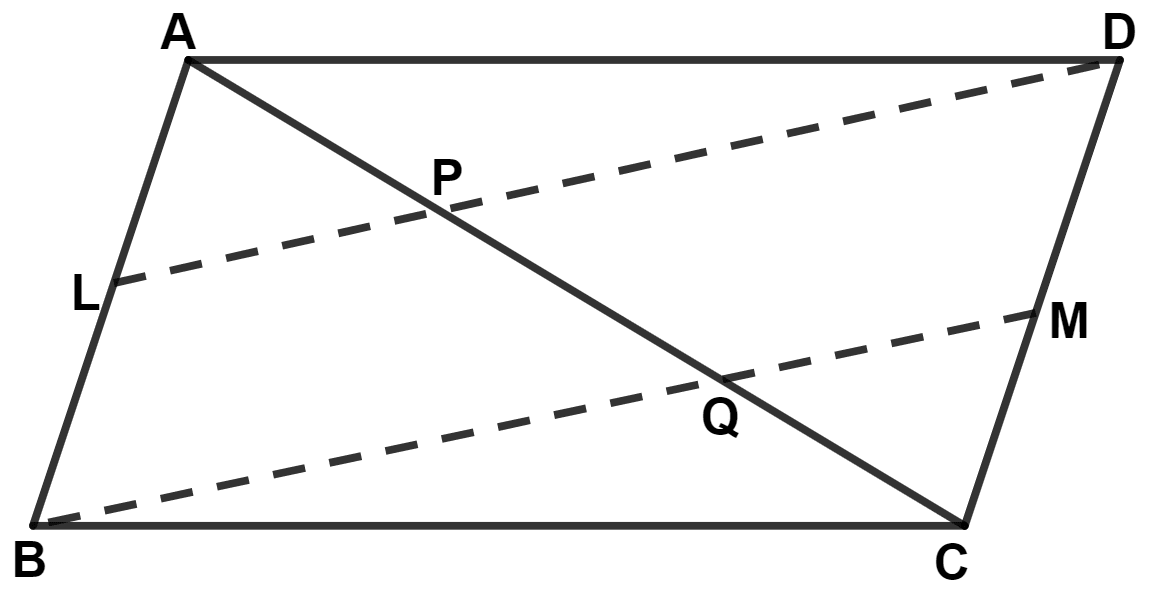
L and M are the mid-points of sides AB and DC respectively of parallelogram ABCD. Prove that segments DL and BM trisect diagonal AC. Mid-point Theorem, Concise Mathematics Solutions ICSE Class 9.

As, ABCD is a parallelogram.

∴ AB = CD

AB2=CD2\dfrac{AB}{2} = \dfrac{CD}{2}

⇒ BL = DM

As, AB || CD

∴ BL || DM

Since, in quadrilateral DLBM,

BL = DM and BL || DM

∴ DLBM is a parallelogram.

So we get, DL parallel to MB.

Suppose DL and BM intersect AC at P and Q respectively.

By converse of mid-point theorem,

The straight line drawn through the mid-point of one side of a triangle parallel to another, bisects the third side.

In triangle ABQ,

⇒ PL || QB (As, DL || MB)

⇒ Given, L is the midpoint of AB.

∴ P is the mid point of AQ (By converse of mid-point theorem)

∴ AP = PQ ........(1)

In triangle CDP,

⇒ QM || PD (As, BM || DL)

⇒ Given, M is the midpoint of CD.

∴ Q is the mid point of CP (By converse of mid-point theorem)

∴ PQ = CQ ........(2)

From equations (1) and (2), we get,

⇒ AP = PQ = CQ.

Hence, proved that DL and BM trisect the diagonal AC.

Question 9

ABCD is a quadrilateral in which AD = BC. E, F, G and H are the mid-points of AB, BD, CD and AC respectively. Prove that EFGH is a rhombus.
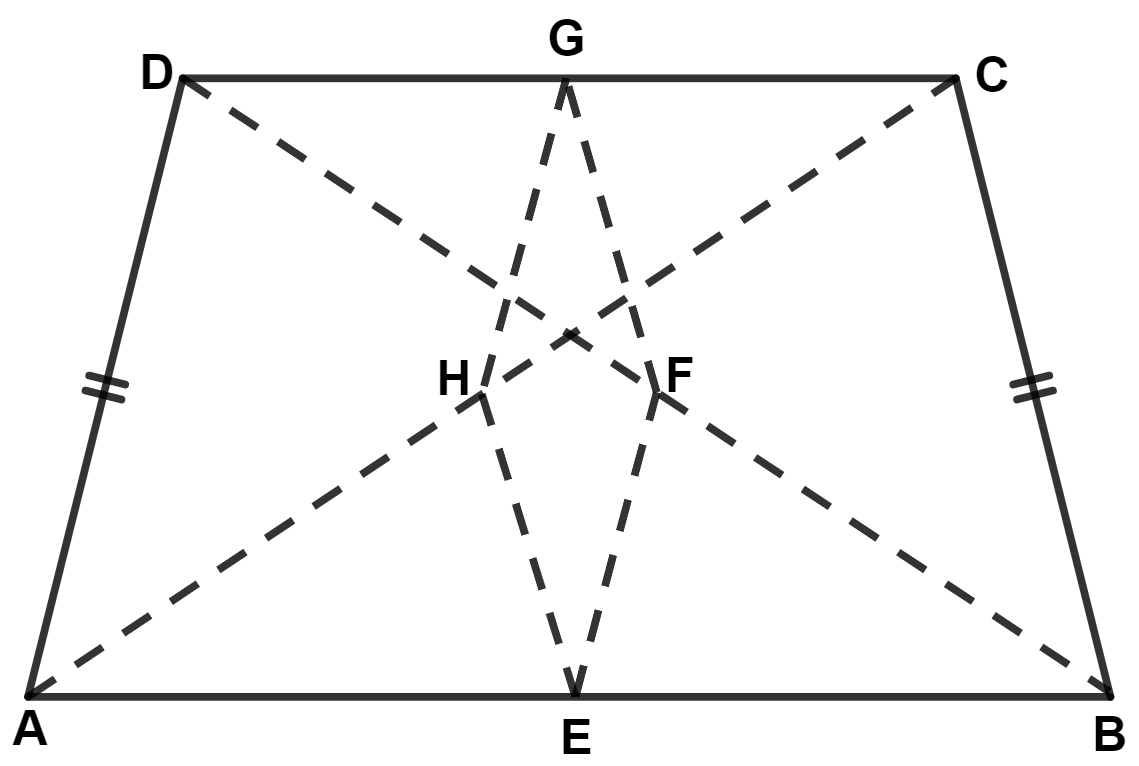
ABCD is a quadrilateral in which AD = BC. E, F, G and H are the mid-points of AB, BD, CD and AC respectively. Prove that EFGH is a rhombus. Mid-point Theorem, Concise Mathematics Solutions ICSE Class 9.

Answer

By mid-point theorem,

The line segment joining the mid-points of any two sides of a triangle is parallel to the third side and is equal to half of it.

In △ ADC,

G and H are mid-points of sides CD and AC respectively.

⇒ GH = 12AD\dfrac{1}{2}AD

⇒ AD = 2GH .........(1)

In △ ABD,

E and F are mid-points of sides AB and BD respectively.

⇒ EF = 12AD\dfrac{1}{2}AD

⇒ AD = 2EF .........(2)

From equations (1) and (2), we get :

⇒ AD = 2GH = 2EF ........(3)

In △ BCD,

G and F are mid-points of sides CD and BD respectively.

⇒ GF = 12BC\dfrac{1}{2}BC

⇒ BC = 2GF .........(4)

In △ ABC,

E and H are mid-points of sides AB and AC respectively.

⇒ EH = 12BC\dfrac{1}{2}BC

⇒ BC = 2EH .........(5)

From equations (4) and (5), we get :

⇒ BC = 2GF = 2EH ........(6)

Given,

⇒ AD = BC .............(7)

From equations (3), (6) and (7), we get :

⇒ 2GH = 2EF = 2GF = 2EH

⇒ GH = EF = GF = EH.

Since, all sides of quadrilateral EFGH are equal.

∴ EFGH is a rhombus.

Hence, proved that EFGH is a rhombus.

Question 10

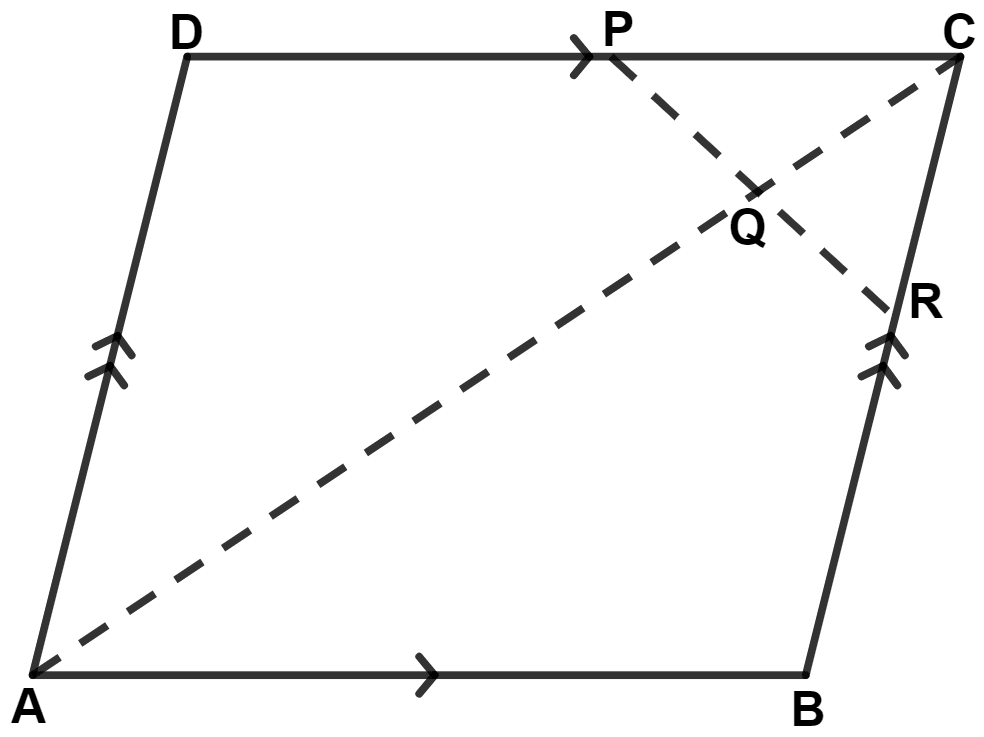
A parallelogram ABCD has P the mid-point of DC and Q a point of AC such that CQ = 14AC\dfrac{1}{4}AC. PQ produced meets BC at R.

A parallelogram ABCD has P the mid-point of DC and Q a point of AC such that CQ = 1/4AC. PQ produced meets BC at R. Mid-point Theorem, Concise Mathematics Solutions ICSE Class 9.

Prove that :

(i) R is the mid-point of BC,

(ii) PR = 12DB\dfrac{1}{2}DB.

Answer

By mid-point theorem,

The line segment joining the mid-points of any two sides of a triangle is parallel to the third side and is equal to half of it.

By converse of mid-point theorem,

The straight line drawn through the mid-point of one side of a triangle parallel to another, bisects the third side.
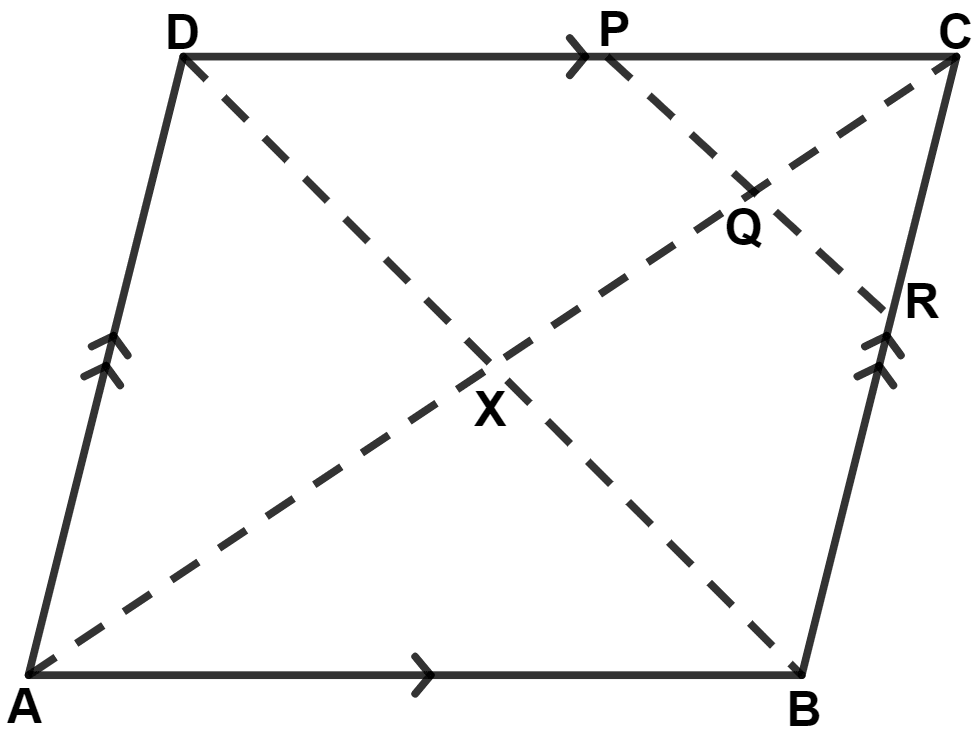
A parallelogram ABCD has P the mid-point of DC and Q a point of AC such that CQ = 1/4AC. PQ produced meets BC at R. Mid-point Theorem, Concise Mathematics Solutions ICSE Class 9.

We know that,

Diagonals of parallelogram bisect each other.

∴ AX = CX and BX = DX.

Given,

⇒ CQ = 14AC\dfrac{1}{4}AC

⇒ CQ = 14×(AX+CX)\dfrac{1}{4} \times (AX + CX)

⇒ CQ = 14×(CX+CX)=14×2CX=CX2\dfrac{1}{4} \times (CX + CX) = \dfrac{1}{4} \times 2CX = \dfrac{CX}{2}.

∴ Q is the mid-point of CX.

(i) In △ CDX,

P and Q are mid-point of sides CD and CX.

∴ PQ || DX (By mid-point theorem)

Since, DXB and PQR are straight line.

∴ PR || DB

∴ QR || XB.

In △ CXB,

Q is the mid-point of CX and QR || XB.

∴ R is the mid-point of BC (By converse of mid-point theorem).

Hence, proved that R is the mid-point of BC.

(ii) In △ BCD,

P and R are mid-point of sides CD and BC.

∴ PR || BD and PR = 12BD\dfrac{1}{2}BD.

Hence, proved that PR = 12BD\dfrac{1}{2}BD.

Exercise 11(B)

Question 1(a)

In the given figure, l // m // n and D is mid-point of CE. If AE = 12.6 cm, then BD is :

In the given figure, l // m // n and D is mid-point of CE. If AE = 12.6 cm, then BD is : Mid-point Theorem, Concise Mathematics Solutions ICSE Class 9.
  1. 12.6 cm

  2. 25.2 cm

  3. 6.3 cm

  4. 18.9 cm

Answer

By mid-point theorem,

The line segment joining the mid-points of any two sides of a triangle is parallel to the third side and is equal to half of it.

By converse of mid-point theorem,

The straight line drawn through the mid-point of one side of a triangle parallel to another, bisects the third side.

In △ AEC,

Given,

⇒ m // n

∴ BD // AE.

D is mid-point of CE.

∴ B is the mid-point of AC. (By converse of mid-point theorem)

Also,

⇒ BD = 12AE=12×12.6\dfrac{1}{2}AE = \dfrac{1}{2} \times 12.6 = 6.3 cm

Hence, Option 3 is the correct option.

Question 1(b)

In a trapezium ABCD, AB // DC, E is mid-point of AD and F is mid-point of BC, then :

  1. 2EF = 12(AB+DC)\dfrac{1}{2}(AB + DC)

  2. 2EF = AB + DC

  3. EF = AB + DC

  4. EF = 12×AB×DC\dfrac{1}{2} \times AB \times DC

Answer

Join AC. Let AC intersects EF at point O.

In a trapezium ABCD, AB // DC, E is mid-point of AD and F is mid-point of BC, then : Mid-point Theorem, Concise Mathematics Solutions ICSE Class 9.

We know that,

In trapezium the line joining the mid-points of non-parallel sides are parallel to the parallel sides of trapezium.

∴ AB || EF || DC.

By mid-point theorem,

The line segment joining the mid-points of any two sides of a triangle is parallel to the third side and is equal to half of it.

By converse of mid-point theorem,

The straight line drawn through the mid-point of one side of a triangle parallel to another, bisects the third side.

Given,

⇒ EF || DC

⇒ EO || DC

In △ ADC,

E is mid-point of AD and EO || DC.

∴ O is mid-point of AC. (By converse of mid-point theorem)

∴ EO = 12DC\dfrac{1}{2}DC (By mid-point theorem) ..........(1)

Given,

⇒ EF || AB

⇒ OF || AB

In △ ABC,

O is mid-point of AC and F is mid-point of BC.

∴ OF = 12AB\dfrac{1}{2}AB (By mid-point theorem) ..........(2)

Adding equations (1) and (2), we get :

⇒ EO + OF = 12DC+12AB\dfrac{1}{2}DC + \dfrac{1}{2}AB

⇒ EF = 12(DC+AB)\dfrac{1}{2}(DC + AB)

⇒ 2EF = AB + DC.

Hence, Option 2 is the correct option.

Question 1(c)

The given figure shows a parallelogram ABCD in which E is mid-point of AD and DL // EB. Then, BF is equal to :

The given figure shows a parallelogram ABCD in which E is mid-point of AD and DL // EB. Then, BF is equal to : Mid-point Theorem, Concise Mathematics Solutions ICSE Class 9.
  1. AD

  2. BE

  3. AE

  4. AB

Answer

By equal intercept theorem,

If a transversal makes equal intercepts on three or more parallel lines, then any other line cutting them will also make equal intercepts.

In parallelogram ABCD,

DL || EB

Since, E is mid-point of AD.

∴ AE = ED

∴ BL = LC (By equal intercept theorem)

In △ BLF and △ DLC,

⇒ ∠BLF = ∠DLC (Vertically opposite angles are equal)

⇒ BL = LC (Proved above)

⇒ ∠LBF = ∠LCD (Alternate angles are equal)

∴ △ BLF ≅ △ DLC (By A.S.A. axiom)

We know that,

Corresponding parts of congruent triangle are equal.

∴ BF = CD .........(1)

We know that,

Opposite sides of parallelogram are equal.

∴ AB = CD .........(2)

From equation (1) and (2), we get :

⇒ BF = AB.

Hence, Option 4 is the correct option.

Question 1(d)

In the given figure AD and BE are medians, then ED is equal to :

In the given figure AD and BE are medians, then ED is equal to : Mid-point Theorem, Concise Mathematics Solutions ICSE Class 9.
  1. 2AB

  2. 12AB\dfrac{1}{2}AB

  3. 14AB\dfrac{1}{4}AB

  4. 18AB\dfrac{1}{8}AB

Answer

Join ED.

In the given figure AD and BE are medians, then ED is equal to : Mid-point Theorem, Concise Mathematics Solutions ICSE Class 9.

By mid-point theorem,

The line segment joining the mid-points of any two sides of a triangle is parallel to the third side and is equal to half of it.

Since, AD and BE are medians.

∴ D is mid-point of BC and E is mid-point of AC.

In △ ABC,

∴ ED = 12AB\dfrac{1}{2}AB (By mid-point theorem)

Hence, Option 2 is the correct option.

Question 1(e)

In the quadrilateral ABCD, if AB // CD, E is mid-point of side AD and F is mid-point of BC. If AB = 20 cm and EF = 16 cm, the length of side DC is :

In the quadrilateral ABCD, if AB // CD, E is mid-point of side AD and F is mid-point of BC. If AB = 20 cm and EF = 16 cm, the length of side DC is : Mid-point Theorem, Concise Mathematics Solutions ICSE Class 9.
  1. 18 cm

  2. 12 cm

  3. 24 cm

  4. 32 cm

Answer

Join BD. Let BD intersect EF at point O.

In the quadrilateral ABCD, if AB // CD, E is mid-point of side AD and F is mid-point of BC. If AB = 20 cm and EF = 16 cm, the length of side DC is : Mid-point Theorem, Concise Mathematics Solutions ICSE Class 9.

We know that,

In trapezium the line joining the mid-points of non-parallel sides are parallel to the parallel sides of trapezium.

∴ AB || EF || DC.

By mid-point theorem,

The line segment joining the mid-points of any two sides of a triangle is parallel to the third side and is equal to half of it.

By converse of mid-point theorem,

The straight line drawn through the mid-point of one side of a triangle parallel to another, bisects the third side.

Given,

⇒ EF || AB

⇒ EO || AB

In △ ABD,

E is mid-point of AD and EO || AB.

∴ O is mid-point of BD. (By converse of mid-point theorem)

∴ EO = 12AB\dfrac{1}{2}AB (By mid-point theorem) ..........(1)

Given,

⇒ EF || DC

⇒ OF || DC

In △ BCD,

O is mid-point of BD and F is mid-point of BC.

∴ OF = 12CD\dfrac{1}{2}CD (By mid-point theorem) ..........(2)

Adding equations (1) and (2), we get :

⇒ EO + OF = 12AB+12CD\dfrac{1}{2}AB + \dfrac{1}{2}CD

⇒ EF = 12(AB+CD)\dfrac{1}{2}(AB + CD)

Substituting values we get :

16=12(20+CD)16×2=20+CD32=20+CDCD=3220=12 cm.\Rightarrow 16 = \dfrac{1}{2}(20 + CD) \\[1em] \Rightarrow 16 \times 2 = 20 + CD \\[1em] \Rightarrow 32 = 20 + CD \\[1em] \Rightarrow CD = 32 - 20 = 12\text{ cm}.

Hence, Option 2 is the correct option.

Question 2

Use the following figure to find :

Use the following figure to find : Mid-point Theorem, Concise Mathematics Solutions ICSE Class 9.

(i) BC, if AB = 7.2 cm.

(ii) GE, if FE = 4 cm.

(iii) AE, if BD = 4.1 cm.

(iv) DF, if CG = 11 cm.

Answer

By equal intercept theorem,

If a transversal makes equal intercepts on three or more parallel lines, then any other line cutting them will also make equal intercepts.

(i) From figure,

CG || BF || AE

Since, CD = DE

∴ BC = AB = 7.2 cm (By equal intercept theorem)

Hence, BC = 7.2 cm.

(ii) From figure,

CG || BF || AE

Since, CD = DE

∴ FG = FE = 4 cm (By equal intercept theorem)

From figure,

⇒ GE = FG + FE = 4 + 4 = 8 cm.

Hence, GE = 8 cm.

(iii) By mid-point theorem,

The line segment joining the mid-points of any two sides of a triangle is parallel to the third side and is equal to half of it.

By converse of mid-point theorem,

The straight line drawn through the mid-point of one side of a triangle parallel to another, bisects the third side.

In △ AEC,

D is mid-point of CE

⇒ BF || AE

∴ BD || AE.

∴ B is mid-point of AC. (By converse of mid-point theorem)

∴ BD = 12AE\dfrac{1}{2}AE (By mid-point theorem)

⇒ AE = 2BD = 2 × 4.1 = 8.2 cm

Hence, AE = 8.2 cm.

(iv) In △ EGC,

D is mid-point of CE.

⇒ BF || CG

∴ DF || CG.

∴ F is mid-point of GE. (By converse of mid-point theorem)

∴ DF = 12CG\dfrac{1}{2}CG (By mid-point theorem)

⇒ DF = 12×11\dfrac{1}{2} \times 11 = 5.5 cm

Hence, DF = 5.5 cm.

Question 3

In the figure, given below, 2AD = AB, P is mid-point of AB, Q is mid-point of DR and PR // BS. Prove that :

(i) AQ // BS

(ii) DS = 3RS

In the figure, given below, 2AD = AB, P is mid-point of AB, Q is mid-point of DR and PR // BS. Prove that : Mid-point Theorem, Concise Mathematics Solutions ICSE Class 9.

Answer

Given,

P is mid-point of AB.

∴ AP = PB

Since, 2AD = AB

∴ AD = AB2\dfrac{AB}{2}

∴ AP = AB = AD.

(i) By mid-point theorem,

The line segment joining the mid-points of any two sides of a triangle is parallel to the third side and is equal to half of it.

In △ DPR,

A and Q are mid-points of DP and DR respectively.

∴ AQ || PR [By mid-point theorem] .......(1)

Given,

⇒ PR || BS ...........(2)

From equations (1) and (2), we get :

⇒ AQ || BS.

Hence, proved that AQ || BS.

(ii) By equal intercept theorem,

If a transversal makes equal intercepts on three or more parallel lines, then any other line cutting them will also make equal intercepts.

From figure,

PR || BS

Since, AD = AP = PB

∴ DQ = QR = RS .........(3)

From figure,

⇒ DS = DQ + QR + RS

⇒ DS = RS + RS + RS [From equation (3)]

⇒ DS = 3RS.

Hence, proved that DS = 3RS.

Question 4

The side AC of a triangle ABC is produced to point E so that CE = 12AC\dfrac{1}{2}AC. D is the mid-point of BC and ED produced meets AB at F. Lines through D and C are drawn parallel to AB which meet AC at point P and EF at point R respectively. Prove that :

(i) 3DF = EF

(ii) 4CR = AB.

Answer

The side AC of a triangle ABC is produced to point E so that CE = 1/2AC. D is the mid-point of BC and ED produced meets AB at F. Lines through D and C are drawn parallel to AB which meet AC at point P and EF at point R respectively. Prove that : Mid-point Theorem, Concise Mathematics Solutions ICSE Class 9.

By mid-point theorem,

The line segment joining the mid-points of any two sides of a triangle is parallel to the third side and is equal to half of it.

By converse of mid-point theorem,

The straight line drawn through the mid-point of one side of a triangle parallel to another, bisects the third side.

By equal intercept theorem,

If a transversal makes equal intercepts on three or more parallel lines, then any other line cutting them will also make equal intercepts.

(i) In △ ABC,

D is the mid-point of BC and DP || AB.

∴ P is the mid-point of AC. (By converse of mid-point theorem)

∴ AP = PC

Given,

⇒ CE = 12AC\dfrac{1}{2}AC

∴ CE = PC

Since, AP = PC and CE = PC,

∴ AP = PC = CE.

Since,

⇒ AB || DP || CR

⇒ AF || DP || CR (Since, point F lies on straight line AB)

In △ AEF,

AF || PD || CR and AP = PC = CE

∴ DF = DR = RE = x (let) [By equal intercept theorem]

From figure,

⇒ EF = DF + DR + RE = x + x + x = 3x = 3DF.

Hence, proved that 3DF = EF.

(ii) In △ ABC,

D is mid-point of BC and DP || AB.

∴ P is the mid-point of AC. (By converse of mid-point theorem)

∴ PD = 12AB\dfrac{1}{2}AB (By mid-point theorem) .........(1)

In △ PED,

Given,

⇒ CE = 12AC\dfrac{1}{2}AC

⇒ CE = PC (Since, P is mid-point of AC)

∴ C is the mid-point of PE.

C is mid-point of PE and DP || CR.

∴ R is the mid-point of DE. (By converse of mid-point theorem)

∴ CR = 12PD\dfrac{1}{2}PD (By mid-point theorem) .........(2)

Substituting value of PD from equation (1) in equation (2), we get :

⇒ CR = 12×12AB\dfrac{1}{2} \times \dfrac{1}{2}AB

⇒ CR = 14AB\dfrac{1}{4}AB

⇒ 4CR = AB.

Hence, proved that 4CR = AB.

Question 5

In triangle ABC, the medians BP and CQ are produced upto points M and N respectively such that BP = PM and CQ = QN. Prove that :

(i) M, A and N are collinear.

(ii) A is the mid-point of MN.

Answer

In triangle ABC, the medians BP and CQ are produced upto points M and N respectively such that BP = PM and CQ = QN. Prove that : Mid-point Theorem, Concise Mathematics Solutions ICSE Class 9.

In △ AQN and △ BQC,

⇒ AQ = BQ (Since, CQ is the median)

⇒ QN = CQ (Given)

⇒ ∠AQN = ∠CQB (Vertically opposite angles are equal)

∴ △ AQN ≅ △ BQC (By S.A.S. axiom)

We know that,

Corresponding parts of congruent triangle are equal.

⇒ ∠QAN = ∠QBC ........(1)

⇒ BC = AN ..........(2)

In △ APM and △ CPB,

⇒ AP = CP (Since, BP is the median)

⇒ PM = BP (Given)

⇒ ∠APM = ∠CPB (Vertically opposite angles are equal)

∴ △ APM ≅ △ CPB (By S.A.S. axiom)

⇒ ∠PAM = ∠PCB [By C.P.C.T.C.] ........(3)

⇒ BC = AM [By C.P.C.T.C.] ..........(4)

(i) In △ ABC,

By angle sum property of triangle,

⇒ ∠ABC + ∠ACB + ∠BAC = 180°

⇒ ∠QBC + ∠PCB + ∠BAC = 180°

⇒ ∠QAN + ∠PAM + ∠BAC = 180° [From equations (1) and (3)]

Since, the sum of above angles equal to 180°.

∴ N, A and M lies in a straight line.

Hence, proved that M, A and N are collinear.

(ii) From equations (2) and (4), we get :

⇒ AM = AN.

Hence, proved that A is the mid-point of MN.

Question 6

In triangle ABC, angle B is obtuse. D and E are mid-points of sides AB and BC respectively and F is a point on side AC such that EF is parallel to AB. Show that BEFD is a parallelogram.

Answer

By mid-point theorem,

The line segment joining the mid-points of any two sides of a triangle is parallel to the third side and is equal to half of it.

By converse of mid-point theorem,

The straight line drawn through the mid-point of one side of a triangle parallel to another, bisects the third side.

In triangle ABC, angle B is obtuse. D and E are mid-points of sides AB and BC respectively and F is a point on side AC such that EF is parallel to AB. Show that BEFD is a parallelogram. Mid-point Theorem, Concise Mathematics Solutions ICSE Class 9.

In △ ABC,

E is the mid-point of BC and FE || AB.

∴ F is the mid-point of AC. (By converse of mid-point theorem)

Since,

⇒ FE || AB

∴ FE || BD.

D and F are mid-point of sides AB and AC respectively.

∴ DF || BC (By mid-point theorem)

∴ DF || BE.

Since, opposite sides of quadrilateral BEFD are parallel.

Hence, proved that BEFD is a parallelogram.

Question 7

In parallelogram ABCD, E and F are mid-points of the sides AB and CD respectively. The line segments AF and BF meet the line segments ED and EC at points G and H respectively. Prove that :

(i) triangles HEB and FHC are congruent;

(ii) GEHF is a parallelogram.

Answer

In parallelogram ABCD, E and F are mid-points of the sides AB and CD respectively. The line segments AF and BF meet the line segments ED and EC at points G and H respectively. Prove that : Mid-point Theorem, Concise Mathematics Solutions ICSE Class 9.

(i) In △ HEB and △ FHC,

⇒ BE = CF (Since, opposite sides of parallelogram are equal i.e. AB = CD and E and F are mid-points of AB and CD respectively)

⇒ ∠HBE = ∠HFC (Alternate angles are equal)

⇒ ∠EHB = ∠FHC (Vertically opposite angles are equal)

∴ △ HEB ≅ △ FHC (By A.A.S. axiom)

Hence, proved that triangles HEB and FHC are congruent.

(ii) Since,

△ HEB ≅ △ FHC

We know that,

Corresponding parts of congruent triangle are equal.

⇒ EH = CH and BH = FH.

⇒ H is the mid-point of BF and CE.

In △ AGE and △ DGF,

⇒ AE = DF (Since, opposite sides of parallelogram are equal i.e. AB = CD and E and F are mid-points of AB and CD respectively)

⇒ ∠GEA = ∠GDF (Alternate angles are equal)

⇒ ∠AGE = ∠DGF (Vertically opposite angles are equal)

∴ △ AGE ≅ △ DGF (By A.A.S. axiom)

∴ AG = GF and EG = DG [By C.P.C.T.C.]

⇒ G is the mid-point of DE and AF.

In △ ECD,

F and H are mid-points of sides CD and EC respectively.

∴ FH || DE [By mid-point theorem]

⇒ FH || GE

F and G are mid-points of sides CD and ED respectively.

∴ GF || EC [By mid-point theorem]

⇒ GF || EH

Since, opposite sides of quadrilateral GEFH are parallel.

Hence, proved that GEHF is a parallelogram.

Question 8

In triangle ABC, D and E are points on side AB such that AD = DE = EB. Through D and E, lines are drawn parallel to BC which meet side AC at points F and G respectively. Through F and G, lines are drawn parallel to AB which meet side BC at points M and N respectively. Prove that : BM = MN = NC.

Answer

In triangle ABC, D and E are points on side AB such that AD = DE = EB. Through D and E, lines are drawn parallel to BC which meet side AC at points F and G respectively. Through F and G, lines are drawn parallel to AB which meet side BC at points M and N respectively. Prove that : Mid-point Theorem, Concise Mathematics Solutions ICSE Class 9.

By mid-point theorem,

The line segment joining the mid-points of any two sides of a triangle is parallel to the third side and is equal to half of it.

By converse of mid-point theorem,

The straight line drawn through the mid-point of one side of a triangle parallel to another, bisects the third side.

By equal intercept theorem,

If a transversal makes equal intercepts on three or more parallel lines, then any other line cutting them will also make equal intercepts.

In △ AEG,

D is the mid-point of AE and DF || EG.

∴ F is mid-point of AG (By converse of mid-point theorem)

∴ AF = FG .........(1)

Since,

DF || EG || BC and DE || BE

∴ FG = GC [By equal intercept theorem]...........(2)

From equation (1) and (2), we get :

⇒ AF = FG = GC

Since, AB || FM || GN and AF = FG = GC

∴ BM = MN = NC [By equal intercept theorem]

Hence, proved that BM = MN = NC.

Question 9

In triangle ABC; M is the mid-point of AB, N is mid-point of AC and D is any point in base BC. Use intercept theorem to show that MN bisects AD.

Answer

Let MN intersects at AD at point X.

In triangle ABC; M is the mid-point of AB, N is mid-point of AC and D is any point in base BC. Use intercept theorem to show that MN bisects AD. Mid-point Theorem, Concise Mathematics Solutions ICSE Class 9.

By mid-point theorem,

The line segment joining the mid-points of any two sides of a triangle is parallel to the third side and is equal to half of it.

In △ ABC,

M is mid-point of AB and N is mid-point of AC.

∴ MN || BC (By mid-point theorem)

By equal intercept theorem,

If a transversal makes equal intercepts on three or more parallel lines, then any other line cutting them will also make equal intercepts.

Since,

M is mid-point of AB.

∴ AM = MB

N is mid-point of AC.

∴ AN = CN

From figure,

MN || BC, AM = BM and AN = CN

∴ AX = DX (By equal intercept theorem)

Hence, proved that MN bisects AD.

Question 10

If the quadrilateral formed by joining the mid-points of the adjacent sides of quadrilateral ABCD is a rectangle, show that the diagonals AC and BD intersect at right angle.

Answer

Let ABCD be a quadrilateral and P, Q, R and S are the mid-point of AB, BC, CD and DA.

Diagonal AC and BD intersect at point O.

If the quadrilateral formed by joining the mid-points of the adjacent sides of quadrilateral ABCD is a rectangle, show that the diagonals AC and BD intersect at right angle. Mid-point Theorem, Concise Mathematics Solutions ICSE Class 9.

By mid-point theorem,

The line segment joining the mid-points of any two sides of a triangle is parallel to the third side and is equal to half of it.

In △ ABC,

P and Q are mid-points of AB and BC.

∴ PQ || AC (By mid-point theorem)

From figure,

⇒ ∠AOD = ∠PXO (Corresponding angles are equal) ............(1)

In △ BCD,

R and Q are mid-points of CD and BC.

∴ QR || BD (By mid-point theorem)

Interior angles of a rectangle equals to 90°.

⇒ ∠RQX = ∠Q = 90°.

From figure,

⇒ ∠PXO = ∠RQX = 90° (Corresponding angles are equal) ............(2)

From (1) and (2), we get :

⇒ ∠AOD = ∠PXO = 90°.

Hence, AC and BD intersect at right angles.

Question 1(a)

The midpoint of the side of a triangle are joined together to get four triangles. These four triangles are:

  1. not equal to each other

  2. congruent to each other

  3. not congruent to each other

  4. none of these

Answer

From figure,

The midpoint of the side of a triangle are joined together to get four triangles. These four triangles, Are not equal to each other. 2. congruent to each other. 3. not congruent to each other. 4. none of these: Mid-Point Theorem, Concise Mathematics Solutions ICSE Class 9.

In △ABC,

D, E and F are mid-points of AB, BC and CA respectively.

Now join DE, EF and FD.

To prove :

△ADF ≅ △DBE ≅ △ECF ≅ △DEF

In △ABC,

D and E are midpoints of AB and BC.

∴ DE || AC (By, mid-point theorem) or,

DE || FC ........(1)

DE || AF ........(2)

D and F are midpoints of AB and AC.

∴ DF || BC (By, mid-point theorem) or,

DF || EC ........(3)

DF || BE ......(4)

F and E are midpoints of AC and BC.

∴ FE || AB (By, mid-point theorem) or,

FE || AD .........(5)

FE || DB .........(6)

From (1) and (3) we get,

DE || FC and DF || EC.

Since, opposite sides of a parallelogram are parallel.

∴ DECF is a parallelogram

We know that,

Diagonal of || gm divides it into two congruent triangles.

Diagonal FE divides the parallelogram DECF in two congruent triangles DEF and CEF.

∴ △DEF ≅ △ECF .........(7)

From (2) and (5) we get,

DE || AF and FE || AD.

Since, opposite sides of a parallelogram are parallel.

∴ ADEF is a parallelogram.

We know that,

Diagonal of || gm divides it into two congruent triangles.

Diagonal FD divides the parallelogram in two congruent triangles DEF and AFD.

∴ △DEF ≅ △AFD .........(8)

From (4) and (6) we get,

DF || BE and FE || DB.

∴ DBEF is a parallelogram.

We know that,

Diagonal DE divides the parallelogram in two congruent triangles DEF and DBE.

∴ △DEF ≅ △DBE .........(9)

From equations 7, 8 and 9 we get,

△AFD ≅ △DBE ≅ △ECF ≅ △DEF.

Thus, the four triangles formed are congruent to each other.

Hence, option 2 is the correct option.

Question 1(b)

In the given figure, AB || CD || EF. If AC = 7 cm, AE = 14 cm and BF = 20 cm, then DF is equal to:

In the given figure, AB || CD || EF. If AC = 7 cm, AE = 14 cm and BF = 20 cm, then DF is equal to: Mid-Point Theorem, Concise Mathematics Solutions ICSE Class 9.
  1. 7 cm

  2. 14 cm

  3. 10 cm

  4. 16 cm

Answer

Given, AB || CD || EF, AC = 7 cm, AE = 14 cm and BF = 20 cm.

Let the length of DF be x cm.

According to equal intercept theorem,

If a transversal makes equal intercepts on three or more parallel lines, then any other line cutting them will also make equal intercepts.

From figure,

⇒ AE = AC + CE

⇒ 14 = 7 + CE

⇒ CE = 7 cm.

Since, OA makes equal intercept, so OB will also make equal intercepts.

∴ BD = DF = x (let)

From figure,

⇒ BF = BD + DF

⇒ 20 = x + x

⇒ 2x = 20

⇒ x = 202\dfrac{20}{2} = 10 cm.

Hence, option 3 is the correct option.

Question 1(c)

In the given figure, AB || CD || EF and E is the mid-point of side AD, then :

In the given figure, AB || CD || EF and E is the mid-point of side AD, then. Mid-Point Theorem, Concise Mathematics Solutions ICSE Class 9.
  1. OE : OF = 1 : 3

  2. OE = OF

  3. OF = 2 x OE

  4. CF = FB

Answer

Given,

E is mid-point of AD.

Since, EF || DC ⇒ EO || DC

According to converse of the mid-point theorem, in any triangle, a straight line through the midpoint of one side that is parallel to a second side, then that line bisects the third side.

⇒ OA = OC

⇒ O is the mid-point of AC.

Since, EF || AB ⇒ OF || AB

According to converse of the mid-point theorem,

F will be the mif-point of BC.

⇒ CF = FB

Hence, option 4 is the correct option.

Question 1(d)

In rhombus PQRS; A, B and C are mid-points of sides PQ, QR and RS respectively. If ∠P = 60°, the angle PQR is equal to:

In rhombus PQRS; A, B and C are mid-points of sides PQ, QR and RS respectively. If ∠P = 60°, the angle PQR is equal to: Mid-Point Theorem, Concise Mathematics Solutions ICSE Class 9.
  1. 60°

  2. 90°

  3. 120°

  4. none of these

Answer

Given, ∠P = 60°

∠P and ∠PQR are consecutive angles in the rhombus.

The sum of consecutive angles in a rhombus is 180°.

⇒ ∠P + ∠PQR = 180°

⇒ 60° + ∠PQR = 180°

⇒ ∠PQR = 180° - 60°

⇒ ∠PQR = 120°.

Hence, option 3 is the correct option.

Question 1(e)

Statement 1: The diagonals of a quadrilateral are perpendicular to each other; P, Q, R and S are the midpoints of sides AB, BC, CD and DA respectively.

The diagonals of a quadrilateral are perpendicular to each other; P, Q, R and S are the midpoints of sides AB, BC, CD and DA respectively. Quadrilateral PQRS is a square. Mid-Point Theorem, Concise Mathematics Solutions ICSE Class 9.

Statement 2: Quadrilateral PQRS is a square.

  1. Both the statements are true.

  2. Both the statements are false.

  3. Statement 1 is true, and statement 2 is false.

  4. Statement 1 is false, and statement 2 is true.

Answer

From figure,

PA = PB ⇒ P is mid-point of AB

SA = SD ⇒ S is mid-point of AD

BQ = CQ ⇒ Q is mid-point of BC

CR = RD ⇒ R is mid-point of CD

So, statement 1 is true.

By mid-point theorem,

The line segment joining the mid-points of any two sides of a triangle is parallel to the third side and is equal to half of it.

The diagonals of a quadrilateral are perpendicular to each other; P, Q, R and S are the midpoints of sides AB, BC, CD and DA respectively. Quadrilateral PQRS is a square. Mid-Point Theorem, Concise Mathematics Solutions ICSE Class 9.

In △ ABC,

P and Q are mid-points of AB and BC respectively.

⇒ PQ = 12\dfrac{1}{2} AC and PQ || AC. [By mid-point theorem] ................(1)

In △ ADC,

S and R are mid-points of AD and CD respectively.

⇒ SR = 12\dfrac{1}{2} AC and SR || AC. [By mid-point theorem] .................(2)

From (1) and (2), we get :

PQ = SR and PQ || SR.

In △ BCD,

R and Q are mid-points of CD and BC respectively.

⇒ QR = 12\dfrac{1}{2} BD and QR || BD. [By mid-point theorem] .................(3)

In △ ABD,

S and P are mid-points of AD and AB respectively.

⇒ PS = 12\dfrac{1}{2} BD and PS || BD. [By mid-point theorem] .................(4)

From (3) and (4), we get :

QR = PS and QR || PS.

Since, diagonals of quadrilateral intersect at right angle.

∴ ∠AOD = ∠COD = ∠AOB = ∠BOC = 90°.

From figure,

PQ || AC

∴ ∠PXO = ∠AOD = 90° (Corresponding angles are equal)

∴ ∠QXO = ∠COD = 90° (Corresponding angles are equal)

SR || AC

∴ ∠SZO = ∠AOB = 90° (Corresponding angles are equal)

∴ ∠RZO = ∠BOC = 90° (Corresponding angles are equal)

PS || BD

∴ ∠S = ∠RZO = 90° (Corresponding angles are equal)

∴ ∠P = ∠QXO = 90° (Corresponding angles are equal)

QR || BD

∴ ∠R = ∠SZO = 90° (Corresponding angles are equal)

∴ ∠Q = ∠PXO = 90° (Corresponding angles are equal)

Since, in quadrilateral PQRS,

Each interior angle is equal to 90° and opposite sides are parallel and equal, and we can prove that PQRS is a rectangle but cannot prove that all sides are equal.

So, statement 2 is false.

∴ Statement 1 is true, and statement 2 is false.

Hence, option 3 is the correct option.

Question 1(f)

Statement 1: AD is median of triangle ABC and DE is parallel to BA.

AD is median of triangle ABC and DE is parallel to BA. DE is median of triangle ADC. Mid-Point Theorem, Concise Mathematics Solutions ICSE Class 9.

Statement 2: DE is median of triangle ADC.

  1. Both the statements are true.

  2. Both the statements are false.

  3. Statement 1 is true, and statement 2 is false.

  4. Statement 1 is false, and statement 2 is true.

Answer

In △ ABC,

From figure,

BD = DC.

∴ D is the mid-point of BC.

A median of a triangle is a line segment that connects a vertex of the triangle to the midpoint of the opposite side.

So, AD is the median of triangle ABC.

So, statement 1 is true.

By converse of mid-point theorem,

The straight line drawn through the mid-point of one side of a triangle parallel to another, bisects the third side.

Since, D is mid-point of BC and AB || DE

∴ E is the mid-point of AC.

Thus, DE is a median of triangle ADC.

So, statement 2 is true.

∴ Both the statements are true.

Hence, option 1 is the correct option.

Question 1(g)

Assertion (A): The figure formed by joining the mid-points of the sides of a quadrilateral ABCD is a square.

Reason (R): Diagonals of quadrilateral ABCD are not equal and are not perpendicular to each other.

  1. A is true, but R is false.

  2. A is false, but R is true.

  3. Both A and R are true, and R is the correct reason for A.

  4. Both A and R are true, and R is the incorrect reason for A.

Answer

For the figure formed by joining the midpoints of a quadrilateral to be a square, the diagonals of the original quadrilateral must be both equal and perpendicular to each other.

The reason states that the diagonals are not equal and not perpendicular.

∴ A is false, but R is true.

Hence, option 2 is the correct option.

Question 1(h)

Assertion (A): R, S, D and E are mid-points of OC, OB, AB and AC respectively, then DERS is a parallelogram.

R, S, D and E are mid-points of OC, OB, AB and AC respectively, then DERS is a parallelogram.DS ∥ AO ∥ ER and DS = ER = 1/2 AO. Mid-Point Theorem, Concise Mathematics Solutions ICSE Class 9.

Reason (R): DS ∥ AO ∥ ER and DS = ER = 12AO\dfrac{1}{2}AO.

  1. A is true, but R is false.

  2. A is false, but R is true.

  3. Both A and R are true, and R is the correct reason for A.

  4. Both A and R are true, and R is the incorrect reason for A.

Answer

By mid-point theorem,

The line segment joining the mid-points of any two sides of a triangle is parallel to the third side and is equal to half of it.

In △ABO,

D and S are respective midpoints of AB and BO.

∴ DS || AO and DS = 12\dfrac{1}{2} AO [By mid-point theorem].................(1)

In △ACO,

E and R are respective midpoints of AC and CO.

∴ ER || AO and ER = 12\dfrac{1}{2} AO [By mid-point theorem]..................(2)

From (1) and (2) we get,

DS || ER and DS = ER = 12\dfrac{1}{2} AO

So, reason (R) is true.

We know that,

If one pair of opposite sides of a quadrilateral are equal in length and parallel, then the quadrilateral is a parallelogram.

∴ DERS is a parallelogram.

So, assertion (A) is true.

∴ Both A and R are true, and R is the correct reason for A.

Hence, option 3 is the correct option.

Question 2

In triangle ABC, D and E are mid-points of the sides AB and AC respectively. Through E, a straight line is drawn parallel to AB to meet BC at F. Prove that BDEF is a parallelogram. If AB = 8 cm and BC = 9 cm; find the perimeter of the parallelogram BDEF.

Answer

By mid-point theorem,

The line segment joining the mid-points of any two sides of a triangle is parallel to the third side and is equal to half of it.

By converse of mid-point theorem,

The straight line drawn through the mid-point of one side of a triangle parallel to another, bisects the third side.

In triangle ABC, D and E are mid-points of the sides AB and AC respectively. Through E, a straight line is drawn parallel to AB to meet BC at F. Prove that BDEF is a parallelogram. If AB = 8 cm and BC = 9 cm; find the perimeter of the parallelogram BDEF. Mid-point Theorem, Concise Mathematics Solutions ICSE Class 9.

Given,

E is mid-point of AC and EF || AB.

∴ F is mid-point of BC (By converse of mid-point theorem).

Since, D and E are mid-points of sides AB and AC respectively.

∴ DE || BC and DE = 12BC\dfrac{1}{2}BC (By mid-point theorem)

⇒ DE || BF and DE = BF (As F is mid-point of BC).

Given,

EF || AB

∴ EF || BD.

Since, E and F are mid-points of sides AC and BC respectively.

∴ EF = 12AB\dfrac{1}{2}AB = BD. (By mid-point theorem)

Since, opposite sides of quadrilateral BDEF are parallel and equal.

∴ BDEF is a parallelogram.

From figure,

⇒ BD = 12AB=12×8\dfrac{1}{2}AB = \dfrac{1}{2} \times 8 = 4 cm,

⇒ BF = 12BC=12×9\dfrac{1}{2}BC = \dfrac{1}{2} \times 9 = 4.5 cm.

Perimeter of BDEF = BD + DE + EF + BF

= BD + BF + BD + BF (Since opposite sides of parallelogram are equal)

= 4 + 4.5 + 4 + 4.5

= 17 cm.

Hence, perimeter of parallelogram BDEF = 17 cm.

Question 3

P, Q and R are mid-points of sides AB, BC and CD respectively of a rhombus ABCD. Show that PQ is perpendicular to QR.

Answer

Join diagonals of rhombus AC and BD.

P, Q and R are mid-points of sides AB, BC and CD respectively of a rhombus ABCD. Show that PQ is perpendicular to QR. Mid-point Theorem, Concise Mathematics Solutions ICSE Class 9.

We know that,

Diagonals of rhombus intersect at 90°.

By mid-point theorem,

The line segment joining the mid-points of any two sides of a triangle is parallel to the third side and is equal to half of it.

In △ ABC,

P and Q are mid-points of sides AB and BC respectively.

∴ PQ || AC (By mid-point theorem)

In △ BCD,

R and Q are mid-points of sides CD and BC respectively.

∴ QR || BD (By mid-point theorem)

Since, AC ⊥ BD and PQ || AC and QR || BD.

∴ PQ ⊥ QR.

Hence, PQ is perpendicular to QR.

Question 4

The diagonals of a quadrilateral ABCD are perpendicular to each other. Prove that the quadrilateral obtained by joining the mid-points of its adjacent sides is a rectangle.

Answer

By mid-point theorem,

The line segment joining the mid-points of any two sides of a triangle is parallel to the third side and is equal to half of it.

Let ABCD be a quadrilateral where P, Q, R and S are the mid-point of AB, BC, CD and DA.

The diagonals of a quadrilateral ABCD are perpendicular to each other. Prove that the quadrilateral obtained by joining the mid-points of its adjacent sides is a rectangle. Mid-point Theorem, Concise Mathematics Solutions ICSE Class 9.

In △ ABC,

P and Q are mid-points of AB and BC respectively.

⇒ PQ = 12AC\dfrac{1}{2}AC and PQ || AC. [By mid-point theorem] .......(1)

In △ ADC,

S and R are mid-points of AD and CD respectively.

⇒ SR = 12AC\dfrac{1}{2}AC and SR || AC. [By mid-point theorem] .......(2)

From (1) and (2), we get :

PQ = SR and PQ || SR.

In △ BCD,

R and Q are mid-points of CD and BC respectively.

⇒ QR = 12BD\dfrac{1}{2}BD and QR || BD. [By mid-point theorem] .......(3)

In △ ABD,

S and P are mid-points of AD and AB respectively.

⇒ PS = 12BD\dfrac{1}{2}BD and PS || BD. [By mid-point theorem] .......(4)

From (3) and (4), we get :

QR = PS and QR || PS.

Since, diagonals of quadrilateral intersect at right angle.

∴ ∠AOD = ∠COD = AOB = ∠BOC = 90°.

From figure,

PQ || AC

∴ ∠PXO = ∠AOD = 90° (Corresponding angles are equal)

∴ ∠QXO = ∠COD = 90° (Corresponding angles are equal)

SR || AC

∴ ∠SZO = ∠AOB = 90° (Corresponding angles are equal)

∴ ∠RZO = ∠BOC = 90° (Corresponding angles are equal)

PS || BD

∴ ∠S = ∠RZO = 90° (Corresponding angles are equal)

∴ ∠P = ∠QXO = 90° (Corresponding angles are equal)

QR || BD

∴ ∠R = ∠SZO = 90° (Corresponding angles are equal)

∴ ∠Q = ∠PXO = 90° (Corresponding angles are equal)

Since, in quadrilateral PQRS,

Each interior angle is equal to 90° and opposite sides are parallel and equal.

∴ PQRS is a rectangle.

Hence, proved that the the figure obtained by joining the mid-points of the adjacent sides of the quadrilateral is a rectangle.

Question 5

In △ ABC, E is mid-point of the median AD and BE produced meets side AC at point Q. Show that BE : EQ = 3 : 1.

Answer

Draw DY || BQ.

In △ ABC, E is mid-point of the median AD and BE produced meets side AC at point Q. Show that BE : EQ = 3 : 1. Mid-point Theorem, Concise Mathematics Solutions ICSE Class 9.

In △ BCQ and △ DCY,

⇒ ∠BCQ = ∠DCY (Common)

⇒ ∠BQC = ∠DYC (Corresponding angles are equal)

∴ △ BCQ ~ △ DCY (By A.A. axiom)

We know that,

Corresponding sides of similar triangle are proportional.

BQDY=BCDC=CQCY\Rightarrow \dfrac{BQ}{DY} = \dfrac{BC}{DC} = \dfrac{CQ}{CY} ..........(1)

Since, D is the mid-point of BC.

∴ BC = 2CD

Considering L.H.S. of the equation (1), we get :

BQDY=2CDDCBQDY=2 ........(1)\Rightarrow \dfrac{BQ}{DY} = \dfrac{2CD}{DC} \\[1em] \Rightarrow \dfrac{BQ}{DY} = 2 \text{ ........(1)}

In △ AEQ and △ ADY,

⇒ ∠EAQ = ∠DAY (Common)

⇒ ∠AEQ = ∠ADY (Corresponding angles are equal)

∴ △ AEQ ~ △ ADY (By A.A. axiom)

We know that,

Corresponding sides of similar triangle are proportional.

EQDY=AEAD=12\Rightarrow \dfrac{EQ}{DY} = \dfrac{AE}{AD} = \dfrac{1}{2} (Since, E is the mid-point of AD)

EQDY=12\Rightarrow \dfrac{EQ}{DY} = \dfrac{1}{2} ............(2)

Dividing equation (1) by (2), we get :

BQDYEQDY=212BQ×DYEQ×DY=4BQEQ=4BE+EQEQ=4BE+EQ=4EQBE=4EQEQBE=3EQBEEQ=31.\Rightarrow \dfrac{\dfrac{BQ}{DY}}{\dfrac{EQ}{DY}} = \dfrac{2}{\dfrac{1}{2}} \\[1em] \Rightarrow \dfrac{BQ \times DY}{EQ \times DY} = 4 \\[1em] \Rightarrow \dfrac{BQ}{EQ} = 4 \\[1em] \Rightarrow \dfrac{BE + EQ}{EQ} = 4 \\[1em] \Rightarrow BE + EQ = 4EQ \\[1em] \Rightarrow BE = 4EQ - EQ \\[1em] \Rightarrow BE = 3EQ \\[1em] \Rightarrow \dfrac{BE}{EQ} = \dfrac{3}{1}.

Hence, proved that BE : EQ = 3 : 1.

Question 6

In the given figure, M is the mid-point of AB and DE, whereas N is mid-point of BC and DF. Show that : EF = AC.

In the given figure, M is the mid-point of AB and DE, whereas N is mid-point of BC and DF. Show that : EF = AC. Mid-point Theorem, Concise Mathematics Solutions ICSE Class 9.

Answer

By mid-point theorem,

The line segment joining the mid-points of any two sides of a triangle is parallel to the third side and is equal to half of it.

In △ EDF,

M is the mid-point of ED and N is the mid-point of DF.

∴ MN = 12EF\dfrac{1}{2}EF (By mid-point theorem)

⇒ EF = 2MN .............(1)

In △ ABC,

M is the mid-point of AB and N is the mid-point of BC.

∴ MN = 12AC\dfrac{1}{2}AC (By mid-point theorem)

⇒ AC = 2MN .............(2)

From (1) and (2), we get :

⇒ EF = AC.

Hence, proved that EF = AC.

Question 7

In triangle ABC; D and E are mid-points of the sides AB and AC respectively. Through E, a straight line is drawn parallel to AB to meet BC at F. Prove that BDEF is a parallelogram. If AB = 16 cm, AC = 12 cm and BC = 18 cm, find the perimeter of the parallelogram BDEF.

Answer

By mid-point theorem,

The line segment joining the mid-points of any two sides of a triangle is parallel to the third side and is equal to half of it.

By converse of mid-point theorem,

The straight line drawn through the mid-point of one side of a triangle parallel to another, bisects the third side.

In triangle ABC; D and E are mid-points of the sides AB and AC respectively. Through E, a straight line is drawn parallel to AB to meet BC at F. Prove that BDEF is a parallelogram. If AB = 16 cm, AC = 12 cm and BC = 18 cm, find the perimeter of the parallelogram BDEF. Mid-point Theorem, Concise Mathematics Solutions ICSE Class 9.

Given,

E is mid-point of AC and EF || AB.

∴ F is mid-point of BC (By converse of mid-point theorem).

Since, D and E are mid-points of sides AB and AC respectively.

∴ DE || BC and DE = 12BC\dfrac{1}{2}BC (By mid-point theorem)

⇒ DE || BF and DE = BF (As F is mid-point of BC).

Given,

EF || BC

∴ EF || BD.

Since, E and F are mid-points of sides AC and BC respectively.

∴ EF = 12AB\dfrac{1}{2}AB = BD. (By mid-point theorem)

Since, opposite sides of quadrilateral BDEF are parallel and equal.

∴ BDEF is a parallelogram.

From figure,

⇒ BD = 12AB=12×16\dfrac{1}{2}AB = \dfrac{1}{2} \times 16 = 8 cm,

⇒ BF = 12BC=12×18\dfrac{1}{2}BC = \dfrac{1}{2} \times 18 = 9 cm.

Perimeter of BDEF = BD + DE + EF + BF

= BD + BF + BD + BF (Since opposite sides of parallelogram are equal)

= 8 + 9 + 8 + 9

= 34 cm.

Hence, perimeter of parallelogram BDEF = 34 cm.

Question 8

In the given figure, AD and CE are medians and DF // CE. Prove that : FB = 14AB\dfrac{1}{4}AB.

In the given figure, AD and CE are medians and DF // CE. Prove that : FB = 1/4AB. Mid-point Theorem, Concise Mathematics Solutions ICSE Class 9.

Answer

By mid-point theorem,

The line segment joining the mid-points of any two sides of a triangle is parallel to the third side and is equal to half of it.

By converse of mid-point theorem,

The straight line drawn through the mid-point of one side of a triangle parallel to another, bisects the third side.

Since, AD and CE are medians.

∴ D is the mid-point of BC and E is the mid-point of AB.

In △ BEC,

DF || CE and D is the mid-point of BC.

∴ F is the mid-point of BE. (By converse of mid-point theorem)

∴ FB = 12BE\dfrac{1}{2}BE .......(1)

Since, E is the mid-point of AB.

∴ BE = 12AB\dfrac{1}{2}AB .......(2)

Substituting value of BE from equation (2) in (1), we get :

∴ FB = 12×12×AB=14AB\dfrac{1}{2} \times \dfrac{1}{2} \times AB = \dfrac{1}{4}AB.

Hence, proved that FB = 14AB\dfrac{1}{4}AB.

Question 9

In parallelogram ABCD, E is the mid-point of AB and AP is parallel to EC which meets DC at point O and BC produced at P. Prove that :

(i) BP = 2AD

(ii) O is mid-point of AP.

In parallelogram ABCD, E is the mid-point of AB and AP is parallel to EC which meets DC at point O and BC produced at P. Prove that : Mid-point Theorem, Concise Mathematics Solutions ICSE Class 9.

Answer

By mid-point theorem,

The line segment joining the mid-points of any two sides of a triangle is parallel to the third side and is equal to half of it.

By converse of mid-point theorem,

The straight line drawn through the mid-point of one side of a triangle parallel to another, bisects the third side.

(i) In △ ABP,

⇒ E is the mid-point of AB and EC || AP.

∴ C is the mid-point of BP. (By converse of mid-point theorem)

∴ BP = 2BC .........(1)

Since, ABCD is a parallelogram.

∴ AD = BC (Opposite sides of parallelogram are equal) .......(2)

From equation (1) and (2), we get :

⇒ BP = 2AD.

Hence, proved that BP = 2AD.

(ii) Since, opposite sides of parallelogram are parallel.

∴ AB || CD

⇒ AB || OC.

In △ ABP,

⇒ E is the mid-point of AB and OC || AB.

∴ O is the mid-point of AP. (By converse of mid-point theorem)

Hence, O is the mid-point of AP.

Question 10

In a trapezium ABCD, sides AB and DC are parallel to each other. E is mid-point of AD and F is mid-point of BC.

Prove that :

AB + DC = 2EF.

Answer

Join BE and produce to meet CD produced at point P.

In a trapezium ABCD, sides AB and DC are parallel to each other. E is mid-point of AD and F is mid-point of BC. Mid-point Theorem, Concise Mathematics Solutions ICSE Class 9.

In △ PDE and △ BAE,

⇒ ∠PED = ∠BEF (Vertically opposite angles are equal)

⇒ AE = ED (Since, E is the mid-point of AD)

⇒ ∠EDP = ∠EAB (Alternate angles are equal)

∴ △ PDE ≅ △ BAE (By A.S.A. axiom)

We know that,

Corresponding parts of congruent triangle are equal.

∴ BE = EP and AB = PD.

In △ BPC,

Since, E and F are mid-points of sides BP and BC respectively.

∴ EF = 12PC\dfrac{1}{2}PC.

To prove :

AB + CD = 2EF ........(1)

Substituting value in L.H.S. of equation (1), we get :

⇒ AB + CD = PD + CD = PC.

Substituting value in R.H.S. of equation (2), we get :

⇒ 2EF = 2×12PC2 \times \dfrac{1}{2}PC = PC.

Since, L.H.S. = R.H.S.

Hence, proved that AB + CD = 2EF.

Question 11

In △ ABC, AD is the median and DE is parallel to BA, where E is a point in AC. Prove that BE is also a median.

Answer

By converse of mid-point theorem,

The straight line drawn through the mid-point of one side of a triangle parallel to another, bisects the third side.

In △ ABC, AD is the median and DE is parallel to BA, where E is a point in AC. Prove that BE is also a median. Mid-point Theorem, Concise Mathematics Solutions ICSE Class 9.

In △ ABC,

Since, AD is the median.

∴ D is the mid-point of BC.

Since, D is mid-point of BC and DE || AB.

∴ E is the mid-point of AC. (By converse of mid-point theorem)

Join BE.

Hence, proved that BE is also a median.

Question 12

Adjacent sides of a parallelogram are equal and one of diagonals is equal to any one of the sides of this parallelogram. Show that its diagonals are in the ratio 3:1\sqrt{3} : 1.

Answer

Let ABCD be the required parallelogram.

Adjacent sides of a parallelogram are equal and one of diagonals is equal to any one of the sides of this parallelogram. Show that its diagonals are in the ratio 3 : 1. Mid-point Theorem, Concise Mathematics Solutions ICSE Class 9.

∴ AB = CD and BC = AD. (Opposite sides of parallelogram are equal)

Given,

Adjacent sides of a parallelogram are equal.

∴ AB = BC.

∴ AB = BC = CD = AD

Since, all sides of parallelogram are equal.

∴ ABCD is a rhombus.

Given, one of the diagonals is equal to its sides. Let diagonal BD be equal to sides.

∴ AB = BC = CD = AD = BD = a (let).

From figure,

⇒ BO = BD2=a2\dfrac{BD}{2} = \dfrac{a}{2} (Since, in a rhombus diagonals bisect each other at right angle).

Hence, △ AOB is right-angled at O.

In △ AOB,

By pythagoras theorem,

⇒ AB2 = BO2 + AO2

⇒ a2 = (a2)2\Big(\dfrac{a}{2}\Big)^2 + AO2

⇒ AO2 = a2a24a^2 - \dfrac{a^2}{4}

⇒ AO2 = 4a2a24\dfrac{4a^2 - a^2}{4}

⇒ AO2 = 3a24\dfrac{3a^2}{4}

⇒ AO = 3a2\dfrac{\sqrt{3}a}{2},

⇒ AC = 2AO = 2×3a2=3a2 \times \dfrac{\sqrt{3}a}{2} = \sqrt{3}a units.

The ratio of the diagonals is:

ACBD=3aa=31\Rightarrow \dfrac{AC}{BD} = \dfrac{\sqrt{3}a}{a} = \dfrac{\sqrt{3}}{1}

∴ AC : BD = 3\sqrt{3} : 1.

Hence, proved that diagonals are in the ratio 3\sqrt{3} : 1.

PrevNext