If the lengths of the sides of a triangle are in the ratio 5 : 12 : 13; then the triangle is :
acute-angled triangle
scalene triangle
scalene right-angled triangle
obtuse-angled triangle
Answer
Given,
Lengths of the sides of a triangle are in the ratio 5 : 12 : 13.
Let length of the sides of triangle are 5x, 12x and 13x.
Squaring all the sides, we get :
⇒ (13x)2 = 169x2
⇒ (12x)2 = 144x2
⇒ (5x)2 = 25x2
⇒ (12x)2 + (5x)2 = 144x2 + 25x2 = 169x2.
Since,
⇒ (13x)2 = (12x)2 + (5x)2.
∴ Triangle obeys pythagoras theorem.
∴ Triangle is a scalene right-angled triangle.
Hence, Option 3 is the correct option.
In a right-angled triangle, hypotenuse is 10 cm and the ratio of the other two sides is 3 : 4, the sides are :
6 cm and 4 cm
8 cm and 6 cm
3 cm and 4 cm
8 cm and 4 cm
Answer
Given,
Hypotenuse is 10 cm and the ratio of the other two sides is 3 : 4.
Let other two sides be 3x and 4x.
By pythagoras theorem,
⇒ (Hypotenuse)2 = (Perpendicular)2 + (Base)2
⇒ 102 = (3x)2 + (4x)2
⇒ 100 = 9x2 + 16x2
⇒ 100 = 25x2
⇒ x2 =
⇒ x2 = 4
⇒ x = .
Since, side cannot be negative.
∴ x = 2.
⇒ 3x = 3(2) = 6 cm and 4x = 4(2) = 8 cm.
Hence, Option 2 is the correct option.
ABC is an isosceles triangle with AB = AC = 12 cm and BC = 8 cm. The area of the triangle is :
cm2
cm2
cm2
cm2
Answer
Let AD be the altitude.
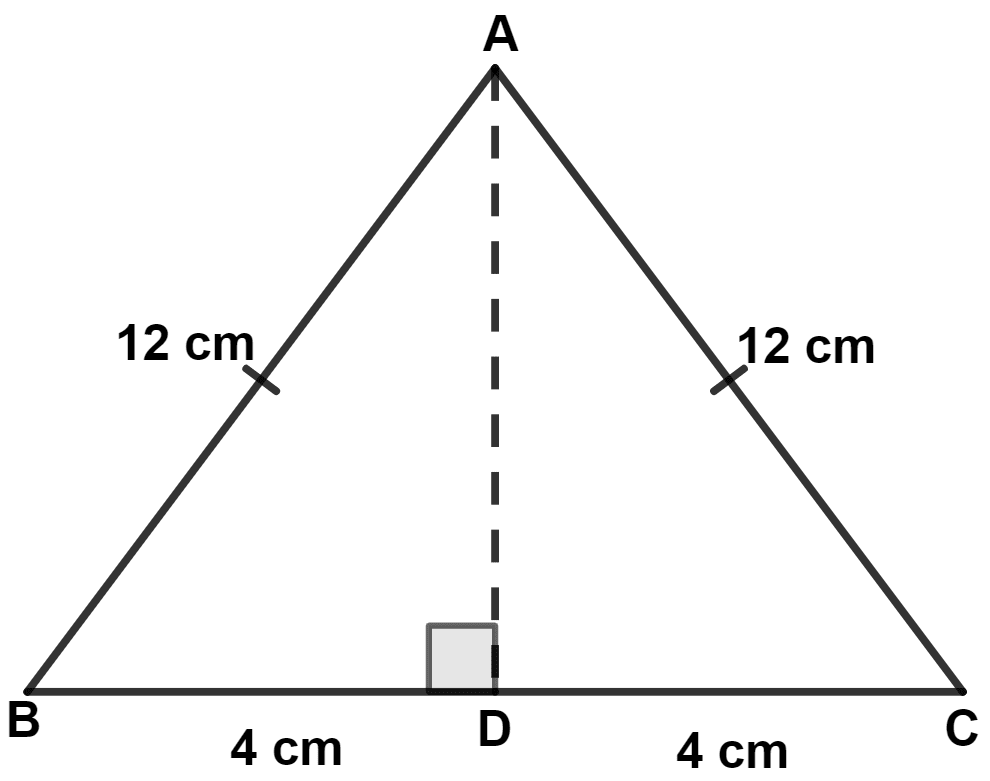
In an isosceles triangle, the altitude from the vertex bisects the base.
∴ BD = CD = = 4 cm.
In right angle triangle ABD,
By pythagoras theorem,
⇒ (Hypotenuse)2 = (Perpendicular)2 + (Base)2
⇒ AB2 = AD2 + BD2
⇒ 122 = AD2 + 42
⇒ 144 = AD2 + 16
⇒ AD2 = 144 - 16
⇒ AD2 = 128
⇒ AD = cm.
Area of right angle triangle = × base × height
From figure,
⇒ Area of △ ABC = Area of △ ABD + Area of △ ACD
⇒ Area of △ ABC =
⇒ Area of △ ABC
Hence, Option 1 is the correct option.
In a rhombus, its diagonals are 30 cm and 40 cm, its perimeter is :
20 cm
10 cm
60 cm
100 cm
Answer
Let ABCD be the rhombus, with diagonals AC and BD intersecting at O.
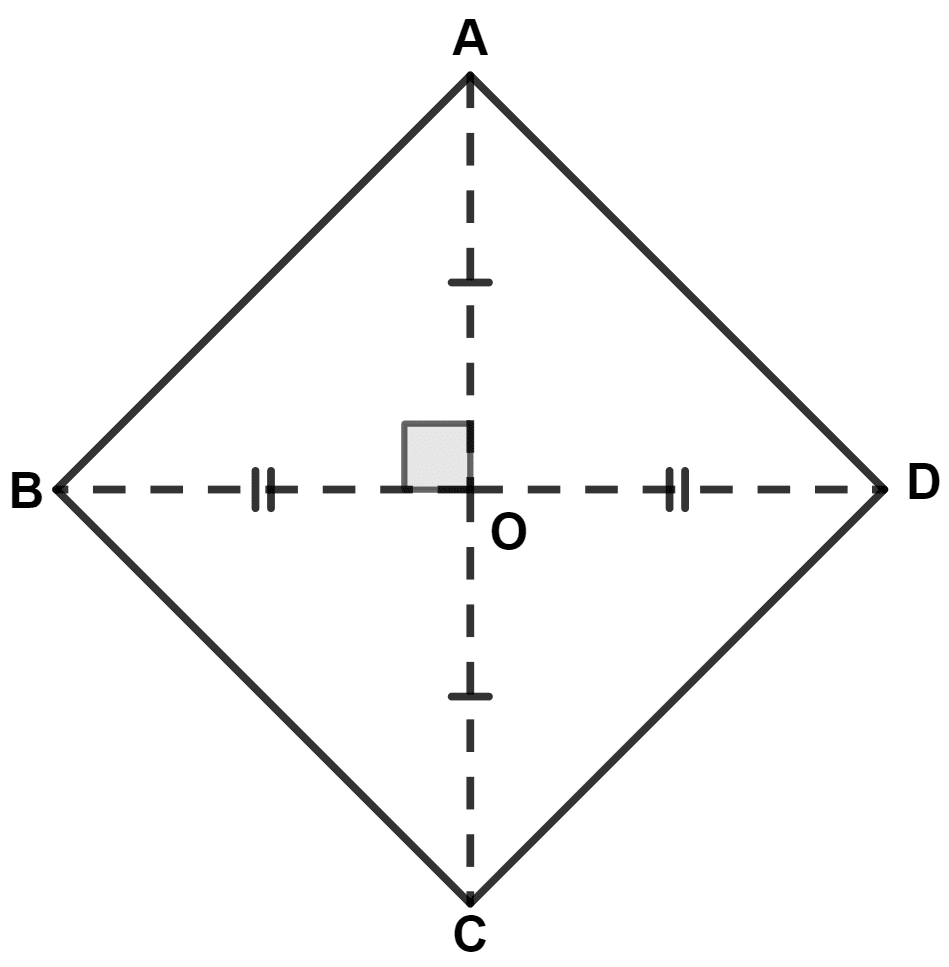
We know that,
Diagonals of rhombus intersect at right angles.
Let AC = 40 cm and BD = 30 cm.
∴ AO = = 15 cm.
In right angle triangle AOB,
By pythagoras theorem,
⇒ (Hypotenuse)2 = (Perpendicular)2 + (Base)2
⇒ AB2 = AO2 + BO2
⇒ AB2 = (20)2 + (15)2
⇒ AB2 = 400 + 225
⇒ AB2 = 625
⇒ AB = = 25 cm.
We know that,
All sides of rhombus are equal.
∴ Perimeter of rhombus = 4 × side = 4 × 25 = 100 cm.
Hence, Option 4 is the correct option.
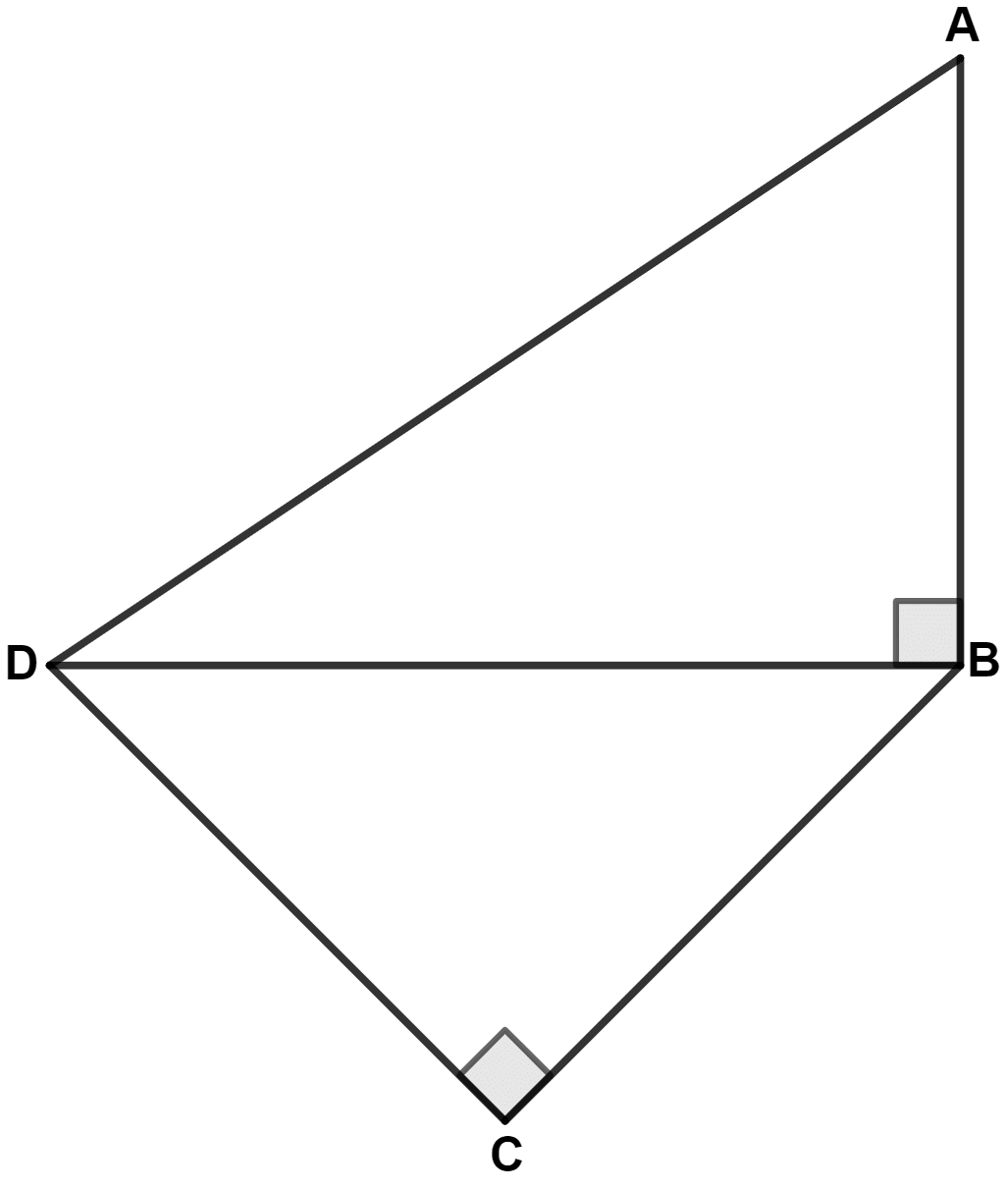
In the given figure, AD = 13 cm, DC = 12 cm and BC = 3 cm, then AB is equal to :
4 cm
3 cm
5 cm
6 cm
Answer
In right angled △ DCB,
By pythagoras theorem,
⇒ (Hypotenuse)2 = (Perpendicular)2 + (Base)2
⇒ BD2 = DC2 + BC2
⇒ BD2 = (12)2 + (3)2
⇒ BD2 = 144 + 9
⇒ BD2 = 153
⇒ BD = cm.
In right angle △ ABD,
By pythagoras theorem,
⇒ (Hypotenuse)2 = (Perpendicular)2 + (Base)2
⇒ AD2 = AB2 + BD2
⇒ 132 = AB2 +
⇒ 169 = AB2 + 153
⇒ AB2 = 169 - 153
⇒ AB2 = 16
⇒ AB = = 4 cm.
Hence, Option 1 is the correct option.
A ladder 13 m long rests against a vertical wall. If the foot of the ladder is 5 m from the foot of the wall, find the distance of the other end of the ladder from the ground.
Answer
Let AB be the ladder.
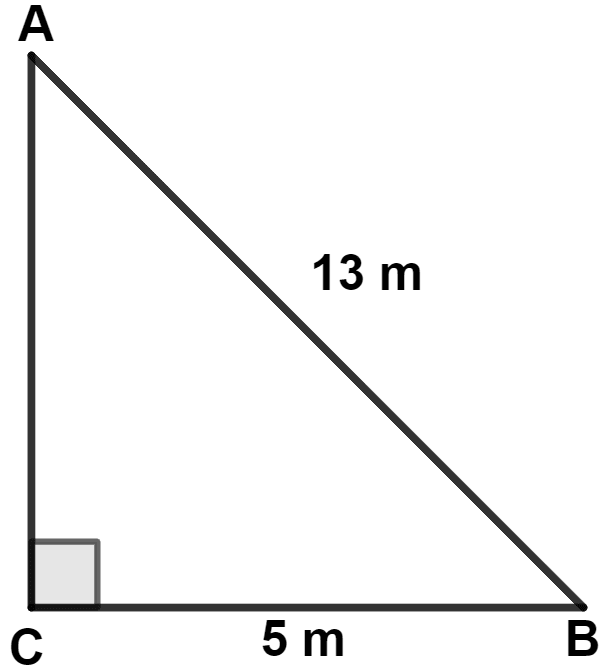
From figure,
In right angle △ ACB,
By pythagoras theorem,
⇒ (Hypotenuse)2 = (Perpendicular)2 + (Base)2
⇒ AB2 = AC2 + BC2
⇒ 132 = AC2 + 52
⇒ 169 = AC2 + 25
⇒ AC2 = 169 - 25
⇒ AC2 = 144
⇒ AC = = 12 m.
Hence, the distance of the other end of the ladder from the ground is 12 m.
A man goes 40 m due north and then 50 m due west. Find his distance from the starting point.
Answer
Let A be the initial position of the man.
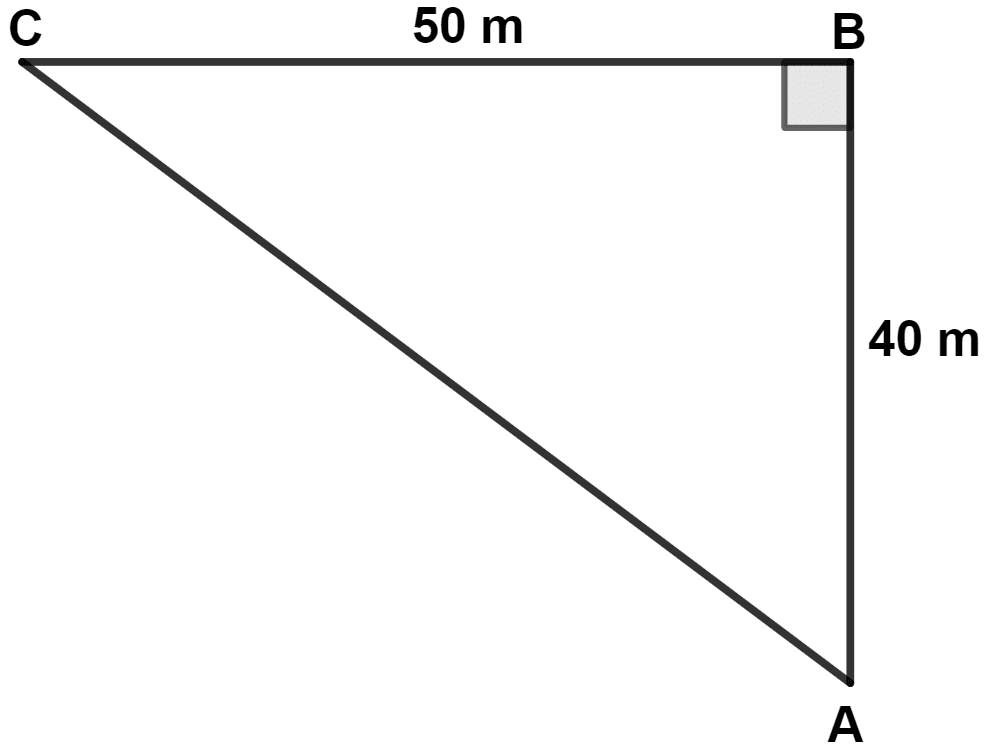
From figure,
ABC is a right-angled triangle.
By pythagoras theorem,
⇒ (Hypotenuse)2 = (Perpendicular)2 + (Base)2
⇒ AC2 = AB2 + BC2
⇒ AC2 = 402 + 502
⇒ AC2 = 1600 + 2500
⇒ AC2 = 4100
⇒ AC =
⇒ AC = 64.03 m.
Hence, distance from starting point is 64.03 meters.
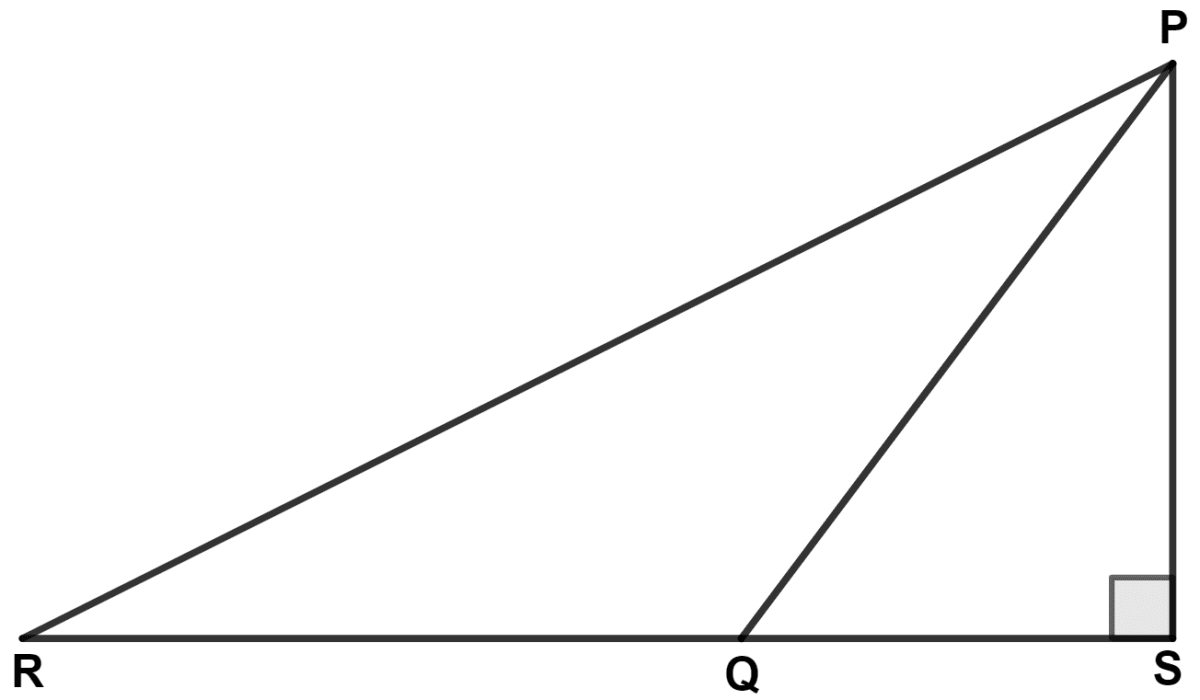
In the figure : ∠PSQ = 90°, PQ = 10 cm, QS = 6 cm and RQ = 9 cm. Calculate the length of PR.
Answer
In right angled triangle PQS,
By pythagoras theorem,
⇒ (Hypotenuse)2 = (Perpendicular)2 + (Base)2
⇒ PQ2 = PS2 + QS2
⇒ 102 = PS2 + 62
⇒ PS2 = 102 - 62
⇒ PS2 = 100 - 36
⇒ PS2 = 64
⇒ PS = = 8 cm.
From figure,
RS = RQ + QS = 9 + 6 = 15 cm.
In right angled triangle PRS,
By pythagoras theorem,
⇒ (Hypotenuse)2 = (Perpendicular)2 + (Base)2
⇒ PR2 = PS2 + RS2
⇒ PR2 = 82 + 152
⇒ PR2 = 64 + 225
⇒ PR2 = 289
⇒ PR = = 17 cm.
Hence, PR = 17 cm.
In a quadrilateral PQRS, ∠Q = ∠S = 90° then prove that 2PR2 - QR2 = PQ2 + PS2 + SR2.
Answer
In quadrilateral PQRS, since ∠Q = ∠S = 90°, triangles PQR and PSR are right-angled triangles.
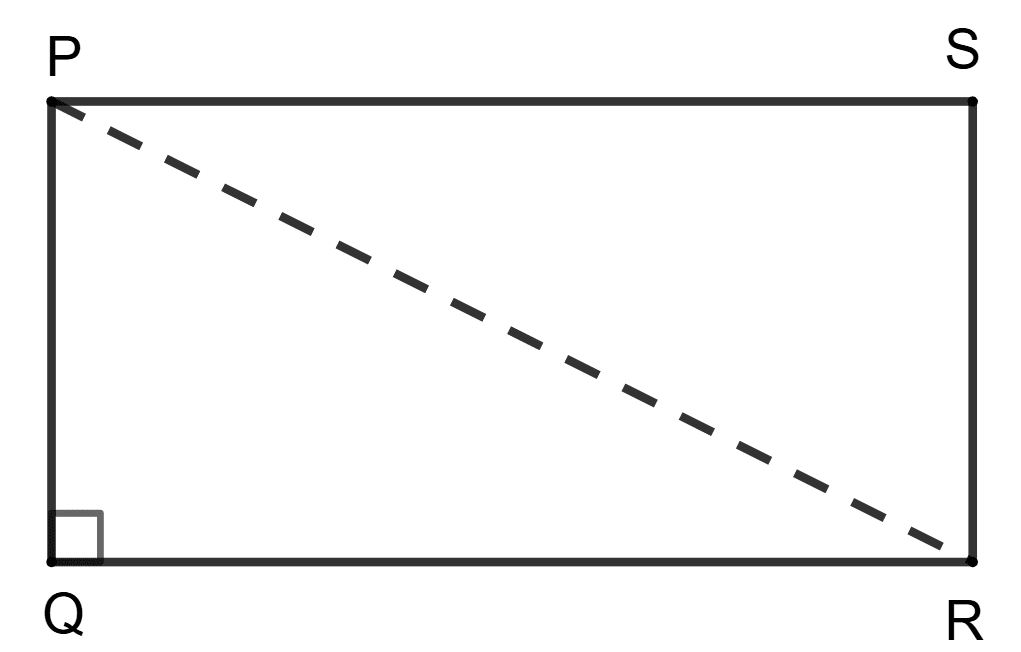
According to Pythagoras theorem,
In a right-angled triangle, the square of the length of the hypotenuse is equal to the sum of the squares of the lengths of the other two sides.
⇒ Hypotenuse2 = Base2 + Height2
In triangle PQR,
⇒ PR2 = PQ2 + QR2 ......................(1)
In triangle PSR,
⇒ PR2 = PS2 + SR2 ..................(2)
Adding eq (1) and (2):
⇒ PR2 + PR2 = PQ2 + QR2 + PS2 + SR2
⇒ 2PR2 = PQ2 + PS2 + SR2 + QR2
⇒ 2PR2 - QR2 = PQ2 + PS2 + SR2
Hence, proved that 2PR2 - QR2 = PQ2 + PS2 + SR2.
AD is drawn perpendicular to base BC of an equilateral triangle ABC. Given BC = 10 cm, find the length of AD, correct to 1 place of decimal.
Answer
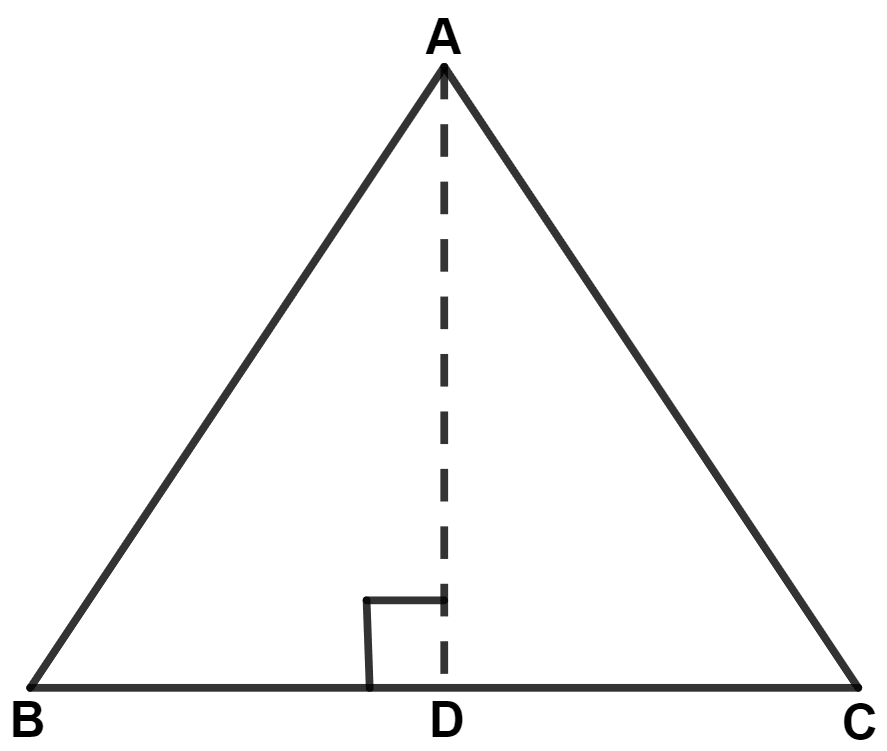
In △ ABD and △ ACD,
⇒ ∠ADB = ∠ADC (Both equal to 90°)
⇒ AD = AD (Common side)
⇒ AB = AC (Since, ABC is an equilateral triangle)
∴ △ ABD ≅ △ ACD (By S.A.S. axiom)
We know that,
Corresponding parts of congruent triangle are equal.
∴ BD = CD = = 5 cm.
In right-angled triangle ABD,
By pythagoras theorem,
⇒ (Hypotenuse)2 = (Perpendicular)2 + (Base)2
⇒ AB2 = AD2 + BD2
⇒ 102 = AD2 + 52
⇒ AD2 = 102 - 52
⇒ AD2 = 100 - 25
⇒ AD2 = 75
⇒ AD = = 8.7 cm.
Hence, AD = 8.7 cm.
In triangle ABC, given below, AB = 8 cm, BC = 6 cm and AC = 3 cm. Calculate the length of OC.
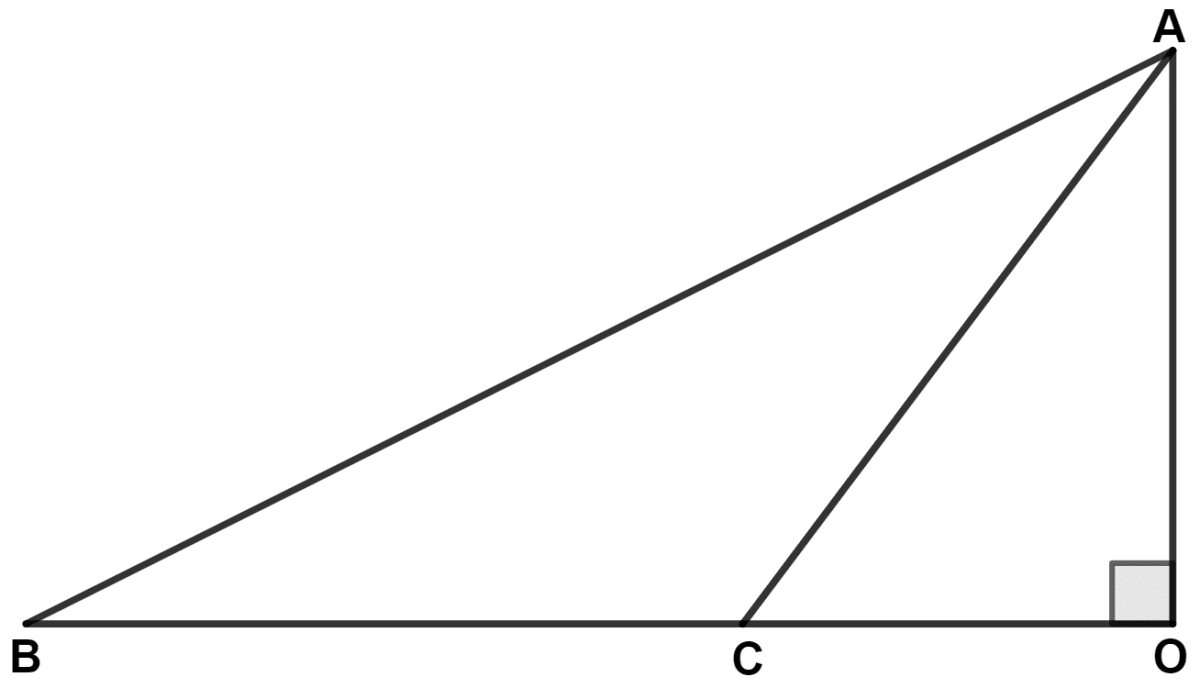
Answer
Let length of OC be x cm.
In right angled triangle AOC,
By pythagoras theorem,
⇒ (Hypotenuse)2 = (Perpendicular)2 + (Base)2
⇒ AC2 = AO2 + OC2
⇒ 32 = AO2 + x2
⇒ AO2 = 32 - x2
⇒ AO2 = 9 - x2
⇒ AO = cm.
From figure,
BO = BC + CO = (6 + x) cm.
In right angled triangle AOB,
By pythagoras theorem,
⇒ (Hypotenuse)2 = (Perpendicular)2 + (Base)2
⇒ AB2 = AO2 + BO2
⇒ 82 = + (6 + x)2
⇒ 64 = 9 - x2 + 36 + x2 + 12x
⇒ 64 = 45 + 12x
⇒ 12x = 64 - 45
⇒ 12x = 19
⇒ x = .
Hence, OC = cm.
In triangle ABC,
AB = AC = x; BC = 10 cm and the area of the triangle is 60 cm2. Find x.
Answer
In △ ABC,
Draw AD ⊥ BC
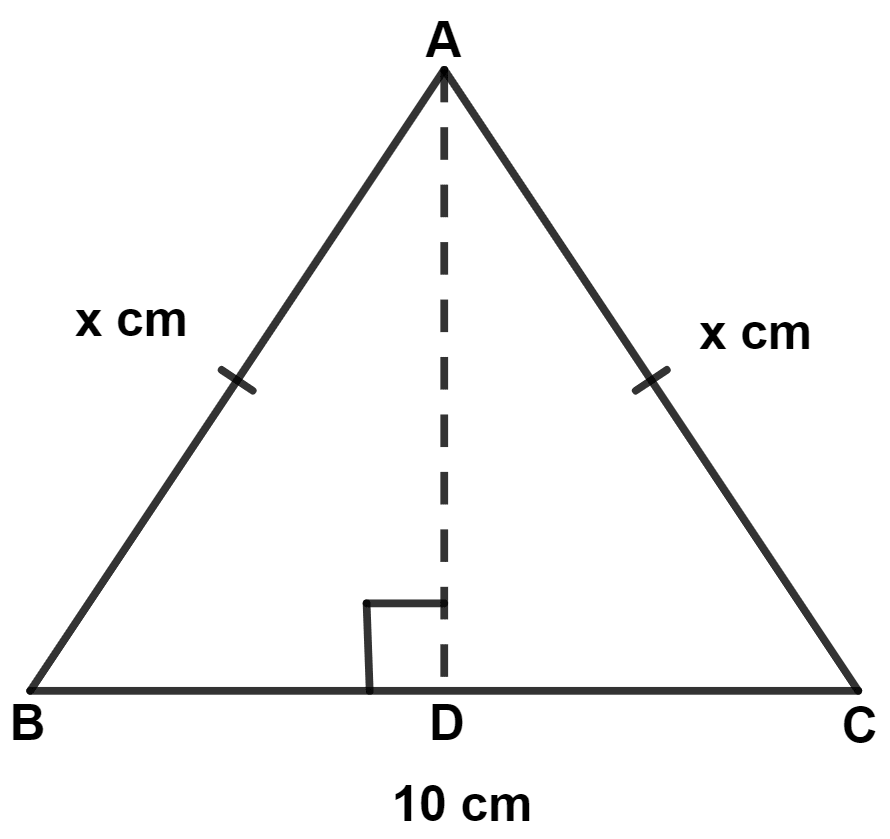
By formula,
Area of triangle = base × height
Given,
Area of triangle ABC = 60 cm2
We know that,
In an isosceles triangle, the altitude from the vertex bisects the base.
∴ BD = CD = = 5 cm.
In right-angled triangle ADB,
By pythagoras theorem,
⇒ (Hypotenuse)2 = (Perpendicular)2 + (Base)2
⇒ AB2 = AD2 + BD2
⇒ x2 = 122 + 52
⇒ x2 = 144 + 25
⇒ x2 = 169
⇒ x = = 13 cm.
Hence, x = 13 cm.
If the sides of a triangle are in the ratio 1 : : 1, show that it is a right-angled triangle.
Answer
Let ABC be the triangle.
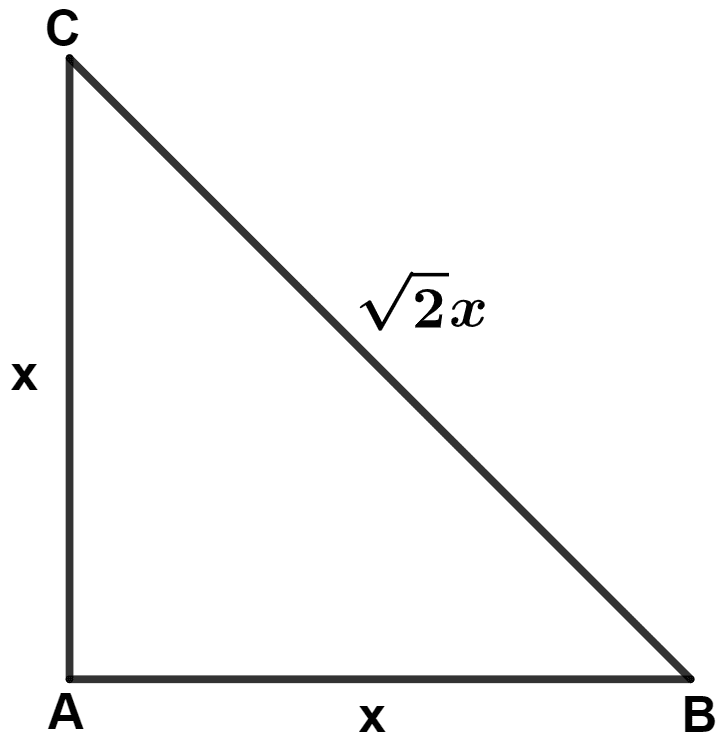
Given,
Sides of a triangle are in the ratio 1 : : 1.
Let AB = x, BC = and AC = x.
Squaring both sides we get :
AB2 = x2, BC2 = 2x2 and AC2 = x2.
⇒ AB2 + AC2 = x2 + x2 = 2x2 = BC2.
Since,
⇒ BC2 = AB2 + AC2.
∴ Triangle ABC satisfies pythagoras theorem.
Hence, proved that ABC is a right-angled triangle.
Two poles of heights 6 m and 11 m stand vertically on a plane ground. If the distance between their feet is 12 m; find the distance between their tips.
Answer
Let AB and CD be two poles of height 6 m and 11 m respectively.
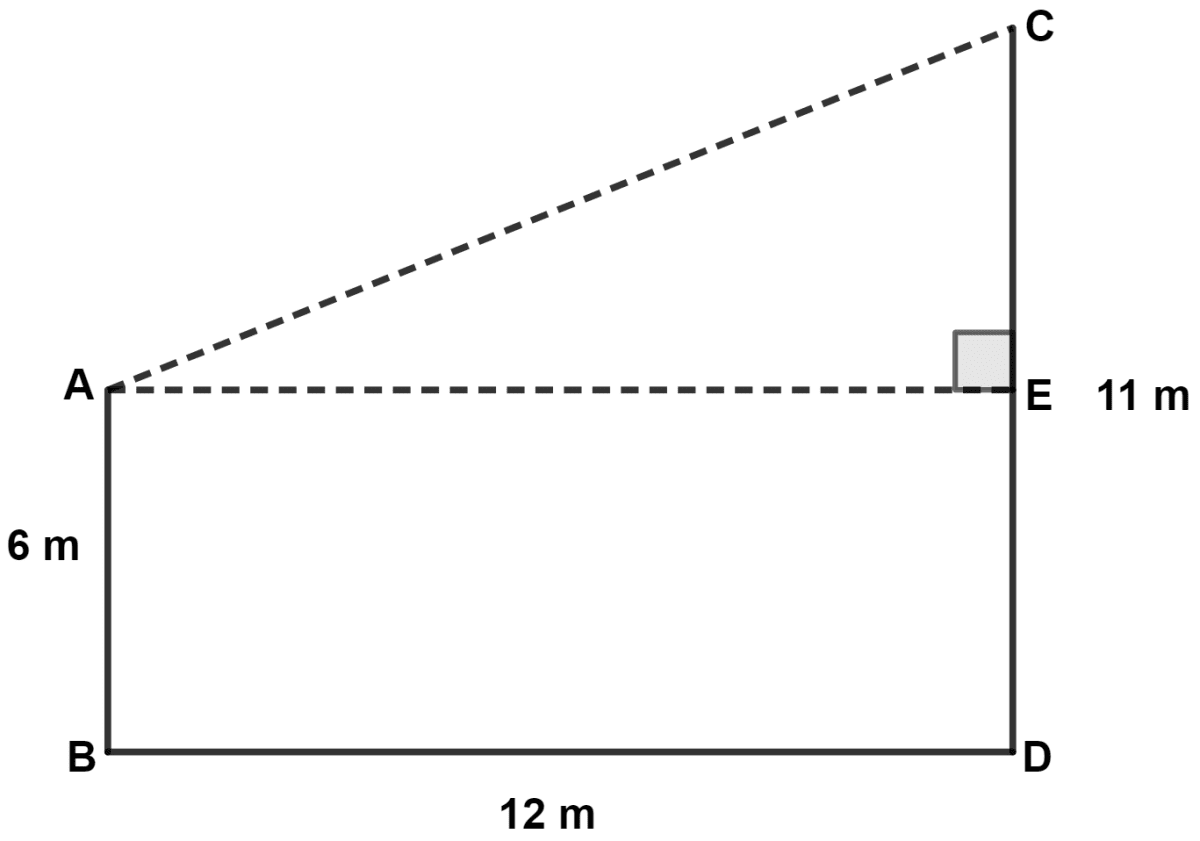
From figure,
ABDE is a rectangle.
∴ AE = BD = 12 m and ED = AB = 6 m.
From figure,
CE = CD - ED = 11 - 6 = 5 m.
In right-angled triangle,
By pythagoras theorem,
⇒ (Hypotenuse)2 = (Perpendicular)2 + (Base)2
⇒ AC2 = CE2 + AE2
⇒ AC2 = 52 + 122
⇒ AC2 = 25 + 144
⇒ AC2 = 169
⇒ AC = = 13 m.
Hence, the distance between the tips of two poles is 13 m.
In △ ABC, ∠C = 90° and AC = BC, then AB2 is equal to :
AC2
2AC2
BC2
2BC2 - AC2
Answer
ABC is a right-angled triangle at C.

By pythagoras theorem,
⇒ (Hypotenuse)2 = (Perpendicular)2 + (Base)2
⇒ AB2 = AC2 + BC2
⇒ AB2 = AC2 + AC2 (Since, AC = BC)
⇒ AB2 = 2AC2.
Hence, Option 2 is the correct option.
In the given diagram, AE2 + BD2 is equal to :

AB2 - DE2
DE2 - AB2
AB2 + DE2
DE × AB
Answer
By Formula,
By pythagoras theorem,
(Hypotenuse)2 = (Perpendicular)2 + (Base)2.
In right-angled triangle ABC,
⇒ AB2 = AC2 + BC2 ........(1)
In right-angled triangle DEC,
⇒ DE2 = CD2 + EC2 ........(2)
In right-angled triangle AEC,
⇒ AE2 = AC2 + EC2 ........(3)
In right-angled triangle BDC,
⇒ BD2 = CD2 + BC2 ........(4)
Adding equations (3) and (4), we get :
⇒ AE2 + BD2 = AC2 + EC2 + CD2 + BC2
= (AC2 + BC2) + (CD2 + EC2)
= AB2 + DE2 [From equations (1) and (2)].
Hence, Option 3 is the correct option.
In the given figure, the value of AB × CD is :

AC × BC
AC × CD
AC × AB
AC2 + BC2
Answer
By formula,
⇒ Area of triangle = × base × height
From figure,
⇒ Area of △ ABC = × AB × CD .........(1)
⇒ Area of △ ABC = × BC × AC .........(2)
From equations (1) and (2), we get :
⇒ × AB × CD = × BC × AC
⇒ AB × CD = BC × AC.
Hence, Option 1 is the correct option.
ABC is an isosceles triangle right-angled at C. Then 2AC2 is equal to :
BC2
AC2
AC2 - BC2
AB2
Answer

Since, ABC is an isosceles triangle right-angled at C.
∴ ∠A = ∠B
∴ BC = AC [Sides opposite to equal angles are equal] ........(1)
In right-angled △ ABC,
By pythagoras theorem,
⇒ (Hypotenuse)2 = (Perpendicular)2 + (Base)2
⇒ AB2 = AC2 + BC2
⇒ AB2 = AC2 + AC2 [From equation (1)]
⇒ AB2 = 2AC2.
Hence, Option 4 is the correct option.
In the figure, given below, AD ⊥ BC. Prove that :
c2 = a2 + b2 - 2ax.

Answer
By formula,
By pythagoras theorem,
⇒ (Hypotenuse)2 = (Perpendicular)2 + (Base)2
In right-angled △ ABD,
⇒ AB2 = AD2 + BD2
⇒ c2 = h2 + (a - x)2 .............(1)
In right-angled △ ACD,
⇒ AC2 = AD2 + CD2
⇒ b2 = h2 + x2
⇒ h2 = b2 - x2 ..........(2)
Substituting value of h2 from equation (2) in (1), we get :
⇒ c2 = b2 - x2 + (a - x)2
⇒ c2 = b2 - x2 + a2 + x2 - 2ax
⇒ c2 = a2 + b2 - 2ax.
Hence, proved that c2 = a2 + b2 - 2ax.
In equilateral △ ABC, AD ⊥ BC and BC = x cm. Find, in terms of x, the length of AD.
Answer

In △ ABD and △ ACD,
⇒ ∠ADB = ∠ADC (Both equal to 90°)
⇒ AD = AD (Common side)
⇒ AB = AC (Since, ABC is an equilateral triangle)
∴ △ ABD ≅ △ ACD (By S.A.S. axiom)
We know that,
Corresponding parts of congruent triangle are equal.
∴ BD = CD = cm.
In right-angled triangle ABD,
By pythagoras theorem,
⇒ (Hypotenuse)2 = (Perpendicular)2 + (Base)2
⇒ AB2 = AD2 + BD2
⇒ x2 = AD2 +
⇒ AD2 = x2 -
⇒ AD2 =
⇒ AD2 =
⇒ AD2 =
⇒ AD = cm.
Hence, AD = cm.
ABC is a triangle, right-angled at B. M is a point on BC. Prove that :
AM2 + BC2 = AC2 + BM2.
Answer

By formula,
By pythagoras theorem,
⇒ (Hypotenuse)2 = (Perpendicular)2 + (Base)2
In right-angled △ ABM,
⇒ AM2 = AB2 + BM2
⇒ AB2 = AM2 - BM2 ...........(1)
In right-angled △ ABC,
⇒ AC2 = AB2 + BC2
⇒ AB2 = AC2 - BC2 ...........(2)
From equations (1) and (2), we get :
⇒ AM2 - BM2 = AC2 - BC2
⇒ AM2 + BC2 = AC2 + BM2.
Hence, proved AM2 + BC2 = AC2 + BM2.
M and N are the mid-points of the sides QR and PQ respectively of a △ PQR, right-angled at Q. Prove that :
(i) PM2 + RN2 = 5 MN2
(ii) 4 PM2 = 4 PQ2 + QR2
(iii) 4 RN2 = PQ2 + 4 QR2
(iv) 4 (PM2 + RN2) = 5 PR2
Answer

Since, M and N are the mid-points of the sides QR and PQ respectively.
PN = NQ and QM = RM
(i) In △ MNQ,
By pythagoras theorem,
⇒ MN2 = NQ2 + QM2 ..........(1)
In △ PQM,
By pythagoras theorem,
⇒ PM2 = PQ2 + QM2
⇒ PM2 = (PN + NQ)2 + QM2
⇒ PM2 = PN2 + NQ2 + 2.PN.NQ + QM2
⇒ PM2 = MN2 + PN2 + 2.PN.NQ [From equation (1)] ...........(2)
In △ RNQ,
By pythagoras theorem,
⇒ RN2 = NQ2 + RQ2
⇒ RN2 = NQ2 + (QM + RM)2
⇒ RN2 = NQ2 + QM2 + RM2 + 2.QM.RM
⇒ RN2 = MN2 + RM2 + 2.QM.RM [From equation (1)] ...........(3)
Adding equations (2) and (3), we get :
⇒ PM2 + RN2 = MN2 + PN2 + 2.PN.NQ + MN2 + RM2 + 2.QM.RM
⇒ PM2 + RN2 = 2MN2 + PN2 + RM2 + 2.PN.NQ + 2.QM.RM
Substituting PN = QN and RM = QM in above equation, we get :
⇒ PM2 + RN2 = 2MN2 + QN2 + QM2 + 2.NQ.NQ + 2.QM.QM
⇒ PM2 + RN2 = 2MN2 + QN2 + QM2 + 2 QN2 + 2 QM2
⇒ PM2 + RN2 = 2MN2 + (QN2 + QM2) + 2 (QN2 + QM2)
⇒ PM2 + RN2 = 2MN2 + MN2 + 2MN2 [From equation (1)]
⇒ PM2 + RN2 = 5MN2.
Hence, proved that PM2 + RN2 = 5MN2.
(ii) In △ PQM,
By pythagoras theorem,
⇒ PM2 = PQ2 + QM2
Multiplying both sides of the above equation by 4, we get :
⇒ 4PM2 = 4PQ2 + 4QM2
⇒ 4PM2 = 4PQ2 +
⇒ 4PM2 = 4PQ2 +
⇒ 4PM2 = 4PQ2 + QR2.
Hence, proved that 4PM2 = 4PQ2 + QR2.
(iii) In △ RQN,
By pythagoras theorem,
⇒ RN2 = NQ2 + QR2
Multiplying both sides of the above equation by 4, we get :
⇒ 4RN2 = 4NQ2 + 4QR2
⇒ 4RN2 = 4QR2 +
⇒ 4RN2 = 4QR2 +
⇒ 4RN2 = 4QR2 + PQ2.
Hence, proved that 4RN2 = PQ2 + 4QR2.
(iv) Proved in part (i), we get :
⇒ PM2 + RN2 = 5MN2
Multiplying both side of the above equation by 4, we get :
⇒ 4(PM2 + RN2) = 4 × 5 MN2
⇒ 4(PM2 + RN2) = 4 × 5 (NQ2 + MQ2)
⇒ 4(PM2 + RN2) = 4 × 5
⇒ 4(PM2 + RN2) = 4 × 5 (PQ2 + RQ2)
⇒ 4(PM2 + RN2) = 5 (PQ2 + RQ2) .....(4)
In right angled triangle PQR,
By pythagoras theorem,
⇒ PR2 = PQ2 + RQ2
Substituting above value of PR2 in equation (4), we get :
⇒ 4(PM2 + RN2) = 5 PR2.
Hence, proved that 4(PM2 + RN2) = 5 PR2.
In triangle ABC, ∠B = 90° and D is the mid-point of BC. Prove that : AC2 = AD2 + 3CD2.
Answer

Given,
D is the mid-point of BC.
∴ CD = BD ........(1)
By formula,
By pythagoras theorem,
⇒ (Hypotenuse)2 = (Perpendicular)2 + (Base)2
In right-angled △ ABC,
⇒ AC2 = AB2 + BC2
⇒ AC2 = AB2 + (BD + CD)2
⇒ AC2 = AB2 + (CD + CD)2 ..........[From equation (1)]
⇒ AC2 = AB2 + (2CD)2
⇒ AC2 = AB2 + 4 CD2 ...........(2)
In right-angled △ ABD,
⇒ AD2 = AB2 + BD2
⇒ AD2 = AB2 + CD2 [From equation (1)] .......(3)
Subtracting equation (3) from (2), we get :
⇒ AC2 - AD2 = AB2 + 4 CD2 - (AB2 + CD2)
⇒ AC2 - AD2 = AB2 - AB2 + 4 CD2 - CD2
⇒ AC2 - AD2 = 3 CD2
⇒ AC2 = AD2 + 3 CD2.
Hence, proved that AC2 = AD2 + 3 CD2.
In a rectangle ABCD, prove that :
AC2 + BD2 = AB2 + BC2 + CD2 + DA2.
Answer

In rectangle the interior angles equal to 90° and opposite sides are equal.
∴ ∠A = ∠B = ∠C = ∠D = 90°, AB = DC and BC = AD.
By formula,
By pythagoras theorem,
⇒ (Hypotenuse)2 = (Perpendicular)2 + (Base)2
In right-angled △ ACD,
⇒ AC2 = AD2 + CD2 ........(1)
In right-angled △ BCD,
⇒ BD2 = BC2 + CD2
⇒ BD2 = BC2 + AB2 (As CD = AB) .........(2)
Adding equation (1) and (2), we get :
⇒ AC2 + BD2 = AD2 + CD2 + BC2 + AB2.
Hence, proved that AC2 + BD2 = AB2 + BC2 + CD2 + DA2.
In a quadrilateral ABCD, ∠B = 90° and ∠D = 90°. Prove that :
2AC2 - AB2 = BC2 + CD2 + DA2.
Answer

In right-angled triangle ABC,
By pythagoras theorem,
⇒ AC2 = AB2 + BC2
⇒ AB2 = AC2 - BC2 .........(1)
In right-angled triangle ADC,
By pythagoras theorem,
⇒ AC2 = AD2 + DC2 ........(2)
To prove :
2AC2 - AB2 = BC2 + CD2 + DA2.
Solving L.H.S. of the equation :
⇒ 2AC2 - AB2 = 2AC2 - (AC2 - BC2) [From equation (1)]
= 2AC2 - AC2 + BC2
= AC2 + BC2
= AD2 + DC2 + BC2 [From equation (2)]
= R.H.S.
Hence, proved that 2AC2 - AB2 = BC2 + CD2 + DA2.
O is any point inside a rectangle ABCD. Prove that :
OB2 + OD2 = OC2 + OA2.
Answer

Through point O, draw PQ || BC so that P lies on AB and Q lies on DC.
Since, PQ || BC and AB ⊥ BC,
∴ AB ⊥ PQ and DC ⊥ PQ.
∴ BPQC and APQD are both rectangles.
In right-angled triangle OBP,
By pythagoras theorem,
⇒ OB2 = OP2 + BP2 ..........(1)
In right-angled triangle OQD,
By pythagoras theorem,
⇒ OD2 = OQ2 + DQ2 ..........(2)
In right-angled triangle OQC,
By pythagoras theorem,
⇒ OC2 = OQ2 + QC2 ..........(3)
In right-angled triangle OAP,
By pythagoras theorem,
⇒ OA2 = OP2 + AP2 ..........(4)
Adding equations (1) and (2), we get :
⇒ OB2 + OD2 = OP2 + BP2 + OQ2 + DQ2
= OP2 + CQ2 + OQ2 + AP2 (As, BP = CQ and DQ = AP)
= CQ2 + OQ2 + OP2 + AP2
= OC2 + OA2. [From equation (3) and (4)]
Hence, proved that OB2 + OD2 = OC2 + OA2.
In the following figure, OP, OQ and OR are drawn perpendiculars to the sides BC, CA and AB respectively of triangle ABC. Prove that :
AR2 + BP2 + CQ2 = AQ2 + CP2 + BR2.

Answer
Join OA, OB and OC.

By formula,
By pythagoras theorem,
(Hypotenuse)2 = (Perpendicular)2 + (Base)2
In right-angled triangle AOR,
⇒ AO2 = AR2 + OR2
⇒ AR2 = AO2 - OR2 ..........(1)
In right-angled triangle BOP,
⇒ BO2 = BP2 + OP2
⇒ BP2 = BO2 - OP2 ..........(2)
In right-angled triangle COQ,
⇒ CO2 = CQ2 + OQ2
⇒ CQ2 = CO2 - OQ2 ..........(3)
In right-angled triangle AOQ,
⇒ AO2 = AQ2 + OQ2
⇒ AQ2 = AO2 - OQ2 ..........(4)
In right-angled triangle COP,
⇒ CO2 = CP2 + OP2
⇒ CP2 = CO2 - OP2 ..........(5)
In right-angled triangle BOR,
⇒ BO2 = BR2 + OR2
⇒ BR2 = BO2 - OR2 ..........(6)
Adding equations (1), (2) and (3), we get :
⇒ AR2 + BP2 + CQ2 = AO2 - OR2 + BO2 - OP2 + CO2 - OQ2 ..........(7)
Adding equations (4), (5) and (6), we get :
⇒ AQ2 + CP2 + BR2 = AO2 - OQ2 + CO2 - OP2 + BO2 - OR2
⇒ AQ2 + CP2 + BR2 = AO2 - OR2 + BO2 - OP2 + CO2 - OQ2 ...........(8)
From equations (7) and (8), we get :
⇒ AR2 + BP2 + CQ2 = AQ2 + CP2 + BR2.
Hence, proved that AR2 + BP2 + CQ2 = AQ2 + CP2 + BR2.
Angle AOB is:

60°
90°
45°
none of these
Answer
5, 12, and 13 are pythagorean triplets.
As,
132 = 122 + 52
So, side BO = 13 units is the hypotenuse.
We know that,
Angle opposite to hypotenuse is a right-angle triangle.
So, ∠OAB = 90°
According to angle sum property,
⇒ ∠OAB + ∠ABO + ∠AOB = 180°
⇒ 90° + ∠ABO + ∠AOB = 180°
⇒ ∠ABO + ∠AOB = 180° - 90°
⇒ ∠ABO + ∠AOB = 90°
Thus, ∠AOB, ∠ABO cannot be defined individually.
Hence, option 4 is the correct option.
Ranbeer runs 10 km due North and 24 km due West. The distance between his two position is:
34 km
17 km
26 km
none of these
Answer
Starting from point A, Ranbeer runs 10 km due north and reached at point B then 24 km due west, ending at point C.

According to Pythagoras Theorem, in a right-angled triangle, the square of the length of the hypotenuse is equal to the sum of the squares of the lengths of the other two sides.
⇒ Hypotenuse2 = Base2 + Height2
In triangle ABC,
⇒ AC2 = AB2 + BC2
⇒ AC2 = 102 + 242
⇒ AC2 = 100 + 576
⇒ AC2 = 676
⇒ AC =
⇒ AC = 26 km.
Hence, option 3 is the correct option.
Angle AOB is:

60°
90°
45°
none of these
Answer
Since, AO = BO = x
Squaring all the sides we get :
AB2 =
OB = x2
OA = x2
In triangle AOB,
⇒ AO2 + BO2 = x2 + x2 = 2x2 = AB2.
Thus, AOB is a right angle triangle with AB as hypotenuse.
Since, AB is hypotenuse, then ∠AOB (angle opposite to hypotenuse) = 90°
Hence, option 2 is the correct option.
The sides of a rectangle are 12 cm and 16 cm. The length of its diagonal is:
28 cm
4 cm
cm
cm
Answer
ABCD is a rectangle such that AB = 16 cm and BC = 12 cm.

Join AC. AC is a diagonal of the rectangle ABCD.
According to Pythagoras theorem, in a right-angled triangle, the square of the length of the hypotenuse is equal to the sum of the squares of the lengths of the other two sides.
⇒ Hypotenuse2 = Base2 + Height2
In triangle ABC,
⇒ AC2 = AB2 + BC2
⇒ AC2 = 162 + 122
⇒ AC = cm
Hence, option 3 is the correct option.
Statement 1: ABCD is a rhombus, its diagonal AC = 16 cm and diagonal BD = 12 cm, perimeter of rhombus = 64 cm.
Statement 2: OA = 8 cm, OB = 6 cm. Then, AB = 10 cm
And, perimeter of rhombus = 40 cm

Both the statements are true.
Both the statements are false.
Statement 1 is true, and statement 2 is false.
Statement 1 is false, and statement 2 is true.
Answer
Given, ABCD is a rhombus, diagonal AC = 16 cm and diagonal BD = 12 cm.
The diagonals of a rhombus bisect each other at right angles.
∴ ∠AOB = 90°
Each diagonal is divided into two equal segments.
∴ AC = 16 cm ⇒ AO = OC = = 8 cm
∴ BD = 12 cm ⇒ BO = OD = = 6 cm
According to Pythagoras theorem, in a right-angled triangle, the square of the length of the hypotenuse is equal to the sum of the squares of the lengths of the other two sides.
⇒ Hypotenuse2 = Base2 + Height2
In Δ AOB,
⇒ AB2 = BO2 + OA2
⇒ AB2 = 62 + 82
⇒ AB2 = 36 + 64
⇒ AB2 = 100
⇒ AB =
⇒ AB = 10 cm
According to formula, perimeter of rhombus = 4 x length of side
= 4 x 10
= 40 cm.
∴ Statement 1 is false, and statement 2 is true.
Hence, option 4 is the correct option.
Statement 1: Area of given triangle ABC = 6 x 5 cm2.

Statement 2: Area of given triangle ABC = x 6 x 4 cm2.

Both the statements are true.
Both the statements are false.
Statement 1 is true, and statement 2 is false.
Statement 1 is false, and statement 2 is true.
Answer
Draw a perpendicular bisector, AD.
The perpendicular bisector of the base also passes through the midpoint of the base, effectively dividing it into two equal segments.
BD = DC = = 3 cm
According to Pythagoras theorem, in a right-angled triangle, the square of the length of the hypotenuse is equal to the sum of the squares of the lengths of the other two sides.
⇒ Hypotenuse2 = Base2 + Height2
In Δ ABD,
⇒ AB2 = AD2 + BD2
⇒ 52 = AD2 + 32
⇒ 25 = AD2 + 9
⇒ AD2 = 25 - 9
⇒ AD2 = 16
⇒ AD =
⇒ AD = 4 cm.
Using formula, area of triangle = x base x height
Here, base, BC = 6 cm and height, AD = 4 cm
⇒ Area of triangle = x 6 x 4 cm2
∴ Statement 1 is false, and statement 2 is true.
Hence, option 4 is the correct option.
Assertion (A): Angle BOC = 90°.
Reason (R): OC2 = 32 + 42 = 25
OB2 = 62 + 82 = 100
OC2 + OB2 = 125 = BC2

A is true, but R is false.
A is false, but R is true.
Both A and R are true, and R is the correct reason for A.
Both A and R are true, and R is the incorrect reason for A.
Answer
Given, OD = 3 cm and DC = 4 cm
According to Pythagoras theorem, in a right-angled triangle, the square of the length of the hypotenuse is equal to the sum of the squares of the lengths of the other two sides.
⇒ Hypotenuse2 = Base2 + Height2
In Δ ODC,
⇒ OC2 = OD2 + DC2
⇒ OC2 = 32 + 42
⇒ OC2 = 9 + 16
⇒ OC2 = 25
⇒ OC =
⇒ OC = 5 cm
Similarly, it it given that OA = 6 cm and AB = 8 cm
In Δ OAB,
⇒ OB2 = OA2 + AB2
⇒ OB2 = 62 + 82
⇒ OB2 = 36 + 64
⇒ OB2 = 100
⇒ OB =
⇒ OB = 10 cm
Squaring all sides of triangle BOC,
⇒ OB2 = 102 = 100
⇒ OC2 = 52 = 25
⇒ BC2 = = 125
Since,
⇒ BC2 = OC2 + OB2
Since, sides of triangle BOC, satisfy pythagoras theorem. So, BOC is a right angle triangle with BC as hypotenuse.
∴ ∠BOC = 90°.
∴ Both A and R are true, and R is the correct reason for A.
Hence, option 3 is the correct option.
Assertion (A): x =

Reason (R): AC2 = 82 + 62 = x2 + x2
A is true, but R is false.
A is false, but R is true.
Both A and R are true, and R is the correct reason for A.
Both A and R are true, and R is the incorrect reason for A.
Answer
In Δ ABC,
Since angle ABC = 90°.
According to Pythagoras theorem, in a right-angled triangle, the square of the length of the hypotenuse is equal to the sum of the squares of the lengths of the other two sides.
⇒ Hypotenuse2 = Base2 + Height2
⇒ AC2 = AB2 + BC2
⇒ AC2 = 82 + 62 ........................(1)
In Δ ADC,
Since angle ADC = 90°.
Using pythagoras theorem,
⇒ AC2 = AD2 + DC2
⇒ AC2 = x2 + x2 .....................(2)
From equation (1) and (2),
⇒ 82 + 62 = x2 + x2
⇒ 64 + 36 = 2x2
⇒ 2x2 = 100
⇒ x2 =
⇒ x2 = 50
⇒ x =
⇒ x = 5
∴ Both A and R are true, and R is the correct reason for A.
Hence, option 3 is the correct option.
In the given figure, AB // CD, AB = 7 cm, BD = 25 cm and CD = 17 cm; find the length of side BC.

Answer
In right-angled triangle ABD,
By pythagoras theorem,
⇒ (Hypotenuse)2 = (Perpendicular)2 + Base2
⇒ BD2 = AD2 + AB2
⇒ 252 = AD2 + 72
⇒ 625 = AD2 + 49
⇒ AD2 = 625 - 49
⇒ AD2 = 576
⇒ AD = = 24 cm.
Draw BE perpendicular to CD.

From figure,
ABED is a rectangle. Since, opposite sides of rectangle are equal.
∴ ED = AB = 7 cm and BE = AD = 24 cm.
⇒ CE = CD - ED = 17 - 7 = 10 cm.
In right-angled triangle BEC,
By pythagoras theorem,
⇒ (Hypotenuse)2 = (Perpendicular)2 + Base2
⇒ BC2 = BE2 + CE2
⇒ BC2 = 242 + 102
⇒ BC2 = 576 + 100
⇒ BC2 = 676
⇒ BC = = 26 cm.
Hence, BC = 26 cm.
In the given figure, ∠B = 90°, XY // BC, AB = 12 cm, AY = 8 cm and AX : XB = 1 : 2 = AY : YC. Find the lengths of AC and BC.

Answer
Given,
AX : XB = 1 : 2
Let AX = x and XB = 2x.
From figure,
⇒ AX + XB = AB
⇒ x + 2x = 12
⇒ 3x = 12
⇒ x = = 4 cm.
⇒ AX = x = 4 cm and XB = 2x = 2(4) = 8 cm.
Given,
AY : YC = 1 : 2
From figure,
⇒ AC = AY + YC = 8 + 16 = 24 cm.
In right-angled triangle ABC,
By pythagoras theorem,
⇒ (Hypotenuse)2 = (Perpendicular)2 + Base2
⇒ AC2 = AB2 + BC2
⇒ 242 = 122 + BC2
⇒ 576 = 144 + BC2
⇒ BC2 = 576 - 144
⇒ BC2 = 432
⇒ BC = = 20.78 cm.
Hence, AC = 24 cm and BC = 20.78 cm.
In △ ABC, ∠B = 90°. Find the sides of the triangle, if :
(i) AB = (x - 3) cm, BC = (x + 4) cm and AC = (x + 6) cm
(ii) AB = x cm, BC = (4x + 4) cm and AC = (4x + 5) cm.
Answer
(i) In right-angled triangle ABC,

By pythagoras theorem,
⇒ (Hypotenuse)2 = (Perpendicular)2 + Base2
⇒ AC2 = AB2 + BC2
⇒ (x + 6)2 = (x - 3)2 + (x + 4)2
⇒ x2 + 62 + 12x = x2 + 9 - 6x + x2 + 16 + 8x
⇒ x2 + 36 + 12x = x2 + 9 - 6x + x2 + 16 + 8x
⇒ x2 + 36 + 12x = 2x2 + 25 + 2x
⇒ 2x2 - x2 + 2x - 12x + 25 - 36 = 0
⇒ x2 - 10x - 11 = 0
⇒ x2 - 11x + x - 11 = 0
⇒ x(x - 11) + 1(x - 11) = 0
⇒ (x + 1)(x - 11) = 0
⇒ x + 1 = 0 or x - 11 = 0
⇒ x = -1 or x = 11.
Since, side cannot be negative.
∴ x = 11.
AB = x - 3 = 11 - 3 = 8 cm,
BC = x + 4 = 11 + 4 = 15 cm,
AC = x + 6 = 11 + 6 = 17 cm.
Hence, AB = 8 cm, BC = 15 cm and AC = 17 cm.
(ii) In right-angled triangle ABC,

By pythagoras theorem,
⇒ (Hypotenuse)2 = (Perpendicular)2 + Base2
⇒ AC2 = AB2 + BC2
⇒ (4x + 5)2 = x2 + (4x + 4)2
⇒ (4x)2 + 52 + 2 × (4x) × 5 = x2 + (4x)2 + 42 + 2 × (4x) × 4
⇒ 16x2 + 25 + 40x = x2 + 16x2 + 16 + 32x
⇒ 16x2 + 25 + 40x = 17x2 + 16 + 32x
⇒ 17x2 - 16x2 + 16 - 25 + 32x - 40x = 0
⇒ x2 - 8x - 9 = 0
⇒ x2 - 9x + x - 9 = 0
⇒ x(x - 9) + 1(x - 9) = 0
⇒ (x + 1)(x - 9) = 0
⇒ x + 1 = 0 or x - 9 = 0
⇒ x = -1 or x = 9.
Since, side cannot be negative.
∴ x = 9.
AB = x = 9 cm,
BC = 4x + 4 = 4(9) + 4 = 36 + 4 = 40 cm,
AC = 4x + 5 = 4(9) + 5 = 35 + 5 = 41 cm.
Hence, AB = 9 cm, BC = 40 cm and AC = 41 cm.
If a side of a rhombus is 10 cm and one of the diagonals is 16 cm, find the other diagonal.
Answer
Let ABCD be the rhombus and the diagonals intersect at point O.
Let diagonal AC = 16 cm.

We know that,
Diagonals of rhombus bisect each other at right angles.
∴ AO = OC = = 8 cm and BO = OD = x cm (let).
In right angle triangle AOB,
By pythagoras theorem,
⇒ (Hypotenuse)2 = (Perpendicular)2 + Base2
⇒ AB2 = AO2 + OB2
⇒ 102 = 82 + x2
⇒ 100 = 64 + x2
⇒ x2 = 100 - 64
⇒ x2 = 36
⇒ x = = 6 cm.
From figure,
⇒ BD = BO + OD = 6 + 6 = 12 cm.
Hence, length of other diagonal = 12 cm.
In the given figure, diagonals AC and BD intersect at right angle. Show that :
AB2 + CD2 = AD2 + BC2

Answer
By formula,
By pythagoras theorem,
⇒ (Hypotenuse)2 = (Perpendicular)2 + Base2
In right angle triangle AOB,
⇒ AB2 = OB2 + OA2 ..........(1)
In right angle triangle COD,
⇒ CD2 = OD2 + OC2 ..........(2)
In right angle triangle AOD,
⇒ AD2 = OD2 + OA2 ..........(3)
In right angle triangle BOC,
⇒ BC2 = OB2 + OC2 ..........(4)
Adding equations (1) and (2), we get :
⇒ AB2 + CD2 = OB2 + OA2 + OD2 + OC2
⇒ AB2 + CD2 = (OA2 + OD2) + (OC2 + OB2)
Substituting value from (3) and (4) in above equation, we get :
⇒ AB2 + CD2 = AD2 + BC2.
Hence, proved that AB2 + CD2 = AD2 + BC2.
Diagonals of rhombus ABCD intersect each other at point O. Prove that :
OA2 + OC2 = 2AD2 -
Answer
By formula,
By pythagoras theorem,
⇒ (Hypotenuse)2 = (Perpendicular)2 + Base2
In right angle triangle AOD,

By pythagoras theorem,
⇒ AD2 = OA2 + OD2
⇒ OA2 = AD2 - OD2 ..........(1)
In right angle triangle COD,
By pythagoras theorem,
⇒ CD2 = OC2 + OD2
⇒ OC2 = CD2 - OD2 ..........(2)
To prove :
OA2 + OC2 = 2AD2 -
Solving L.H.S. of the above equation, we get :
⇒ OA2 + OC2 = AD2 - OD2 + CD2 - OD2
⇒ OA2 + OC2 = AD2 + CD2 - 2OD2 .........(3)
Since, all sides of a rhombus are equal and diagonals of rhombus bisect each other,
∴ CD = AD and OD =
Substituting value of CD and OD in equation (3), we get :
⇒ OA2 + OC2 = AD2 + AD2 -
⇒ OA2 + OC2 = 2AD2 -
⇒ OA2 + OC2 = 2AD2 - = R.H.S.
Hence, proved that OA2 + OC2 = 2AD2 - .
In the figure, AB = BC and AD is perpendicular to CD. Prove that :
AC2 = 2.BC.DC.

Answer
By formula,
By pythagoras theorem,
⇒ (Hypotenuse)2 = (Perpendicular)2 + Base2
In right angle triangle ABD,
By pythagoras theorem,
⇒ AB2 = AD2 + BD2
⇒ AD2 = AB2 - BD2 .........(1)
In right angle triangle ACD,
By pythagoras theorem,
⇒ AC2 = AD2 + DC2
= (AB2 - BD2) + (DB + BC)2 [From equation (1)]
= AB2 - BD2 + DB2 + BC2 + 2.DB.BC
= AB2 + BC2 + 2.DB.BC
= BC2 + BC2 + 2.DB.BC [As, AB = BC]
= 2BC2 + 2.DB.BC
= 2BC(BC + DB)
= 2BC.DC
Hence, proved that AC2 = 2BC.DC
In an isosceles triangle ABC; AB = AC and D is a point on BC produced. Prove that :
AD2 = AC2 + BD.CD
Answer
By formula,
By pythagoras theorem,
⇒ (Hypotenuse)2 = (Perpendicular)2 + Base2
Draw AE perpendicular to BC.

In right angle triangle AED,
By pythagoras theorem,
⇒ AD2 = AE2 + ED2
⇒ AD2 = AE2 + (EC + CD)2 .........(1)
In right angle triangle AEC,
By pythagoras theorem,
⇒ AC2 = AE2 + EC2
⇒ AE2 = AC2 - EC2 .........(2)
Substituting value of AE2 from equation (2) in (1), we get :
⇒ AD2 = AC2 - EC2 + (EC + CD)2
⇒ AD2 = AC2 - EC2 + EC2 + CD2 + 2.EC.CD
⇒ AD2 = AC2 + CD(CD + 2EC) ..........(3)
Since, ABC is an isosceles triangle.
We know that,
In an isosceles triangle altitude from the vertex bisects the base.
∴ E is the mid-point of BC.
⇒ EC = BC
⇒ BC = 2EC.
From figure,
⇒ BD = BC + CD
⇒ BD = 2EC + CD
Substituting above value in equation (3), we get :
⇒ AD2 = AC2 + CD.BD
Hence, proved that AD2 = AC2 + BD.CD
In triangle ABC, angle A = 90°, CA = AB and D is a point on AB produced. Prove that :
DC2 - BD2 = 2AB.AD.

Answer
By formula,
By pythagoras theorem,
⇒ (Hypotenuse)2 = (Perpendicular)2 + Base2
In right angle triangle ACD,
By pythagoras theorem,
⇒ CD2 = AC2 + AD2
⇒ CD2 = AC2 + (AB + BD)2
⇒ CD2 = AC2 + AB2 + BD2 + 2.AB.BD .........(1)
In right angle triangle ABC,
By pythagoras theorem,
⇒ BC2 = AC2 + AB2
⇒ BC2 = AB2 + AB2 (Since, CA = AB)
⇒ BC2 = 2AB2
⇒ AB2 = BC2 .........(2)
Substituting value of AB2 from equation (2) in (1), we get :
⇒ CD2 = AC2 + + BD2 + 2.AB.BD
⇒ CD2 - BD2 = AB2 + + 2.AB.BD [As, AC = AB]
⇒ CD2 - BD2 = AB2 + AB2 + 2.AB.(AD - AB) [From equation (2)]
⇒ CD2 - BD2 = 2AB2 + 2.AB.AD - 2.AB2
⇒ CD2 - BD2 = 2.AB.AD
Hence, proved that CD2 - BD2 = 2.AB.AD
In triangle ABC, AB = AC and BD is perpendicular to AC. Prove that :
BD2 - CD2 = 2CD × AD
Answer
By formula,
By pythagoras theorem,
⇒ (Hypotenuse)2 = (Perpendicular)2 + Base2

In right-angled triangle ABD,
By pythagoras theorem,
⇒ AB2 = AD2 + BD2
⇒ AD2 = AB2 - BD2 .......(1)
From figure,
⇒ AC = AD + DC
Squaring both sides, we get :
⇒ AC2 = (AD + DC)2
⇒ AC2 = AD2 + DC2 + 2AD.DC
⇒ AC2 = AB2 - BD2 + DC2 + 2AD.DC [From equation (1)]
Substituting AB = AC, in above equation :
⇒ AC2 = AC2 - BD2 + DC2 + 2AD.DC
⇒ AC2 - AC2 + BD2 - DC2 = 2AD.DC
⇒ BD2 - DC2 = 2CD × AD.
Hence, proved that BD2 - DC2 = 2CD × AD.
In the following figure, AD is perpendicular to BC and D divides BC in the ratio 1 : 3.
Prove that : 2AC2 = 2AB2 + BC2.

Answer
Given,
D divides BC in the ratio 1 : 3.
⇒ BD : DC = 1 : 3
Let BD = x and DC = 3x
From figure,
⇒ BC = BD + DC = x + 3x = 4x.
In right angle triangle ADC,
By pythagoras theorem,
⇒ AC2 = AD2 + CD2 ............(1)
In right angle triangle ABD,
By pythagoras theorem,
⇒ AB2 = AD2 + BD2 ............(2)
Subtracting equation (2) from (1), we get :
⇒ AC2 - AB2 = AD2 + CD2 - (AD2 + BD2)
⇒ AC2 - AB2 = CD2 - BD2
Substituting value of BD and CD in above equation, we get :
Hence, proved that 2AC2 = 2AB2 + BC2.
In the given figure, AB = 16 cm, BC = 12 cm and CA = 6 cm; find the length of CD.

Answer
By formula,
By pythagoras theorem,
⇒ (Hypotenuse)2 = (Perpendicular)2 + Base2
Let CD be x cm.
In right angle triangle ACD,
By pythagoras theorem,
⇒ AC2 = AD2 + CD2
⇒ 62 = AD2 + x2
⇒ 36 = AD2 + x2
⇒ AD2 = 36 - x2 ........(1)
In right angle triangle ABD,
By pythagoras theorem,
⇒ AB2 = AD2 + BD2
⇒ 162 = AD2 + (BC + CD)2
⇒ 256 = 36 - x2 + (12 + x)2 [From equation (1)]
⇒ 256 = 36 - x2 + 122 + x2 + 2(12)x
⇒ 256 = 36 + 144 + 24x
⇒ 256 = 180 + 24x
⇒ 24x = 256 - 180
⇒ 24x = 76
⇒ x = cm.
Hence, CD = cm.
In a quadrilateral ABCD, ∠A + ∠D = 90°, prove that : AC2 + BD2 = AD2 + BC2.
Answer
Produce AB and DC such that they meet at point E.

By formula,
By pythagoras theorem,
⇒ (Hypotenuse)2 = (Perpendicular)2 + Base2
In △ AED,
⇒ ∠A + ∠D + ∠E = 180°
⇒ 90° + ∠E = 180°
⇒ ∠E = 180° - 90° = 90°.
By pythagoras theorem,
⇒ AD2 = AE2 + DE2 .........(1)
In △ BEC,
By pythagoras theorem,
⇒ BC2 = BE2 + CE2 .........(2)
In △ AEC,
By pythagoras theorem,
⇒ AC2 = AE2 + CE2 .........(3)
In △ BED,
By pythagoras theorem,
⇒ BD2 = BE2 + DE2 .........(4)
Adding equations (1) and (2), we get :
⇒ AD2 + BC2 = AE2 + DE2 + BE2 + CE2
⇒ AD2 + BC2 = (AE2 + CE2) + (BE2 + DE2)
⇒ AD2 + BC2 = AC2 + BD2.
Hence, proved that AC2 + BD2 = AD2 + BC2.