
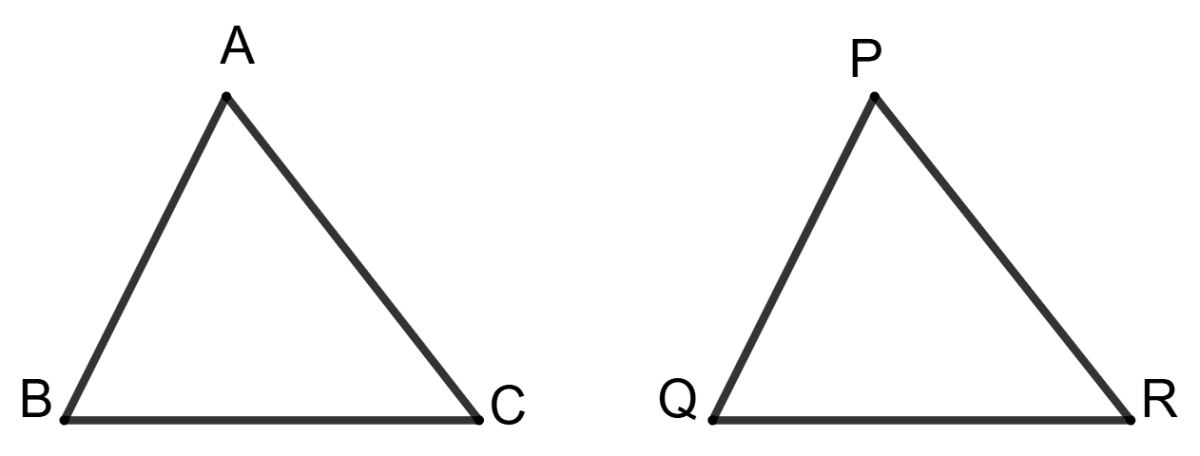
In triangles ABC and PQR, ∠A = ∠Q and ∠B = ∠R. In order to make these triangles congruent, we must have AB equal to:
PQ
PR
QR
none of these
Answer
Given in triangles ABC and PQR,
⇒ ∠A = ∠Q,
⇒ ∠B = ∠R,
So, AB should be equal to QR. That will make, △ABC ≅ △QRP by A.S.A. axiom.
Hence, option 3 is the correct option.
If two sides and an angle of one triangle are equal to two sides and an angle of the other triangle, then the triangle must be congruent
no
yes
can't say
Answer
Given, statement "If two sides and an angle of one triangle are equal to two sides and an angle of another triangle, then the two triangles must be congruent."
The statement cannot be necessarily true as the angles must be included angles.
Hence, option 3 is the correct option.
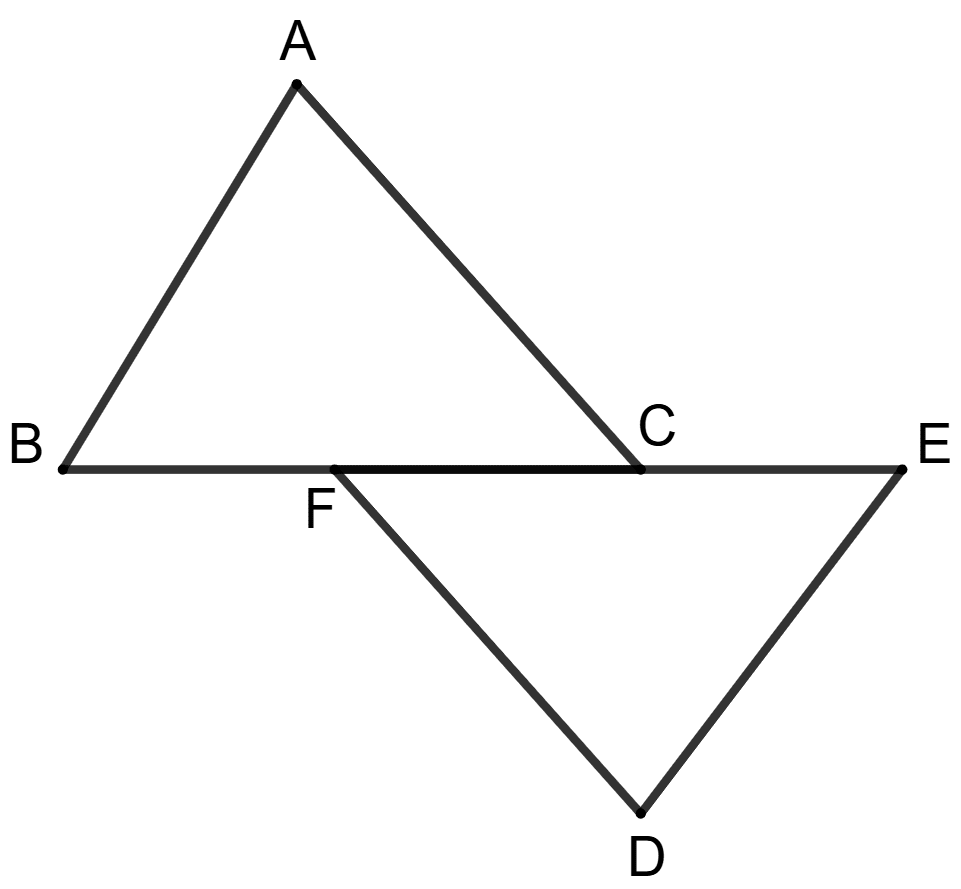
If BA = DE, AC = DF and BF = EC, then the triangles ABC and DEF are congruent by axiom.
ASA
AAS
RHS
SSS
Answer
Given, BF = EC
Adding FC both sides, we get
⇒ BF + FC = EC + FC
⇒ BC = EF ...........................(1)
Now,
⇒ BA = DE (Given)
⇒ AC = DF (Given)
⇒ BC = EF (From equation (1))
∴ ΔABC ≅ ΔDEF (By SSS congruency criterion)
Hence, option 4 is the correct option.
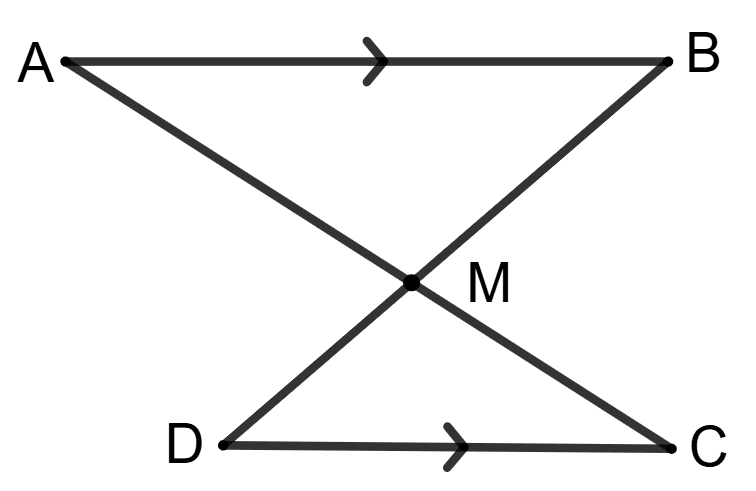
If BM = DM then AM = CM :
yes
no
can't say
none of these
Answer
Given, BM = DM
⇒ M bisects line BD.
AB is parallel to CD.
In ΔABM and ΔCDM,
⇒ BM = DM
⇒ ∠MBA = ∠MDC (Alternate angles are equal)
⇒ ∠MAB = ∠MCD (Alternate angles are equal)
∴ ΔABM ≅ ΔCDM (By AAS congruency criterion)
By C.P.C.T.
⇒ AM = CM
Hence, option 1 is the correct option.
Statement 1: ∠A = ∠Q and ∠B = ∠R, then to get the triangles, congruent, we must have AB = PR.
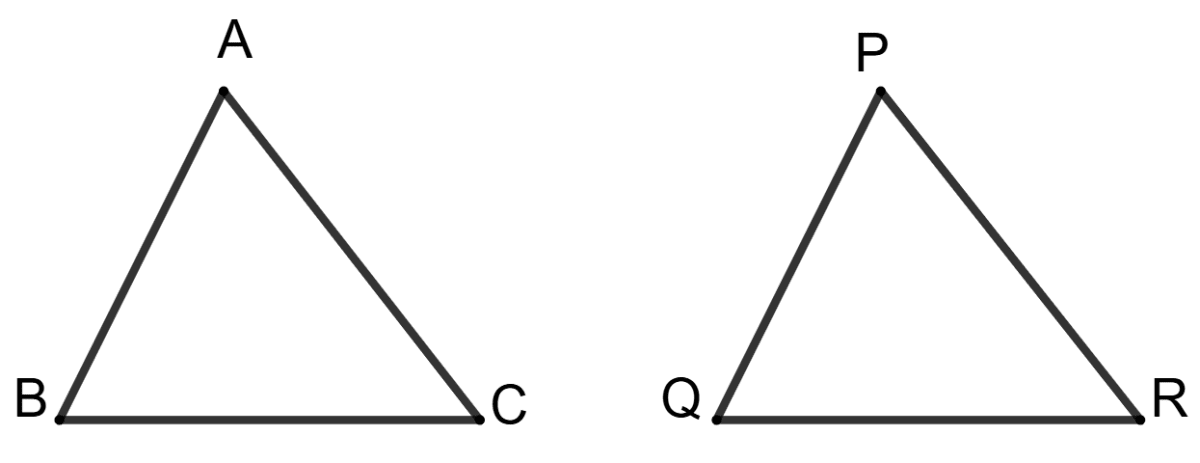
Statement 2: The given Δs will be congruent, if AB = QR.
Both the statements are true.
Both the statements are false.
Statement 1 is true, and statement 2 is false.
Statement 1 is false, and statement 2 is true.
Answer
Given in triangles ABC and PQR,
⇒ ∠A = ∠Q,
⇒ ∠B = ∠R,
To get △ABC ≅ △QRP, there should be one more condition.
In order to get triangles congruent any two sides can be equal not necessarily AB = PR, it can also be AB = QR.
∴ Statement 1 is false, and statement 2 is true.
Hence, option 4 is the correct option.
Statement 1: MM' is a plane mirror and A is an object, then I the image of object A in mirror MM' and so IO = AO.
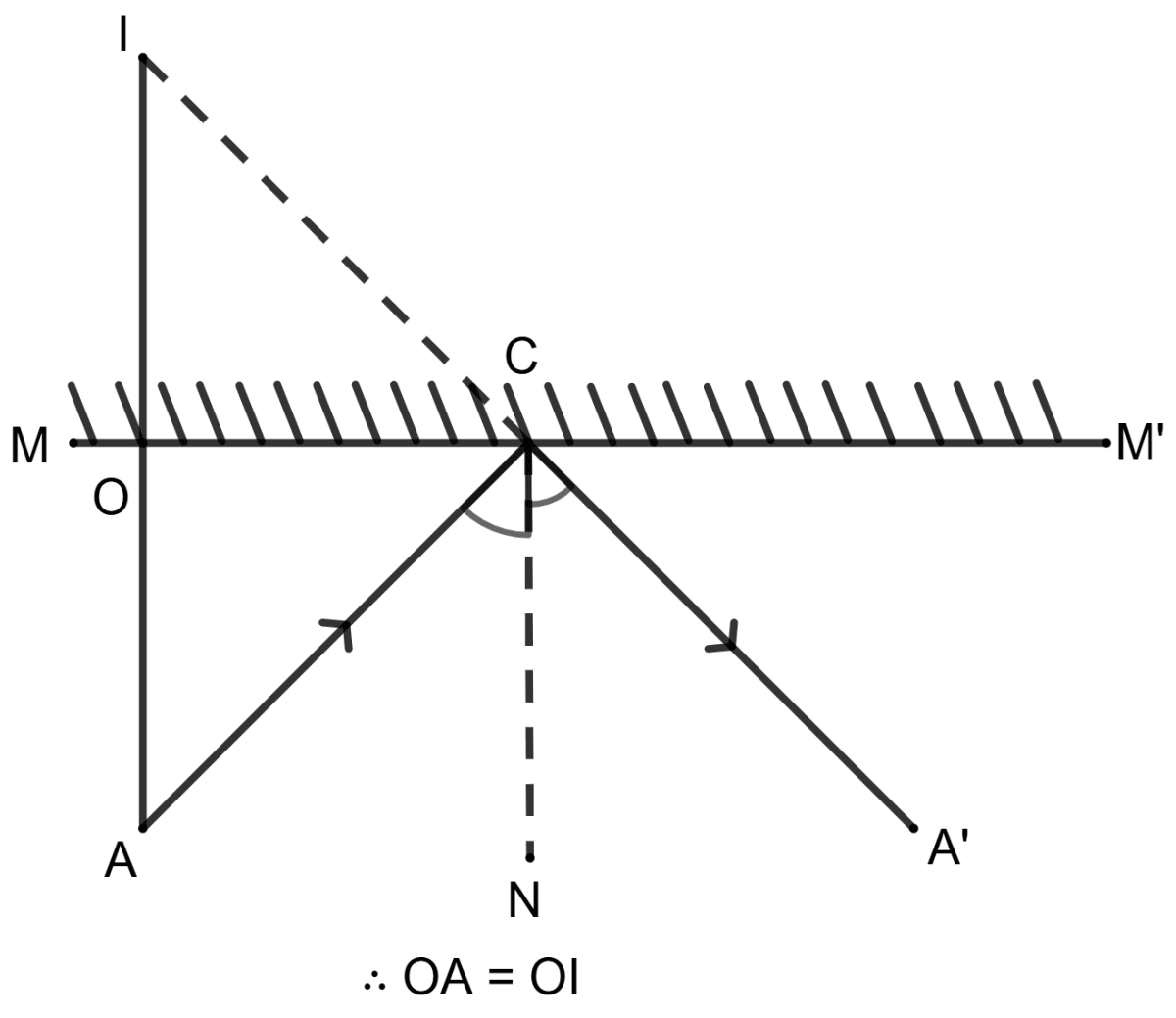
∴ OA = OI
Statement 2: ΔAOC ≅ ΔIOC by ASA. And, so IO = AO.
Both the statements are true.
Both the statements are false.
Statement 1 is true, and statement 2 is false.
Statement 1 is false, and statement 2 is true.
Answer
Given, MM' is a plane mirror and A is an object, then I is an image of object A.
The image I of object A is located at the same distance behind the mirror as the object is in front of it, i.e. OA = OI.
So, statement 1 is true.
In △AOC and △IOC,
⇒ ∠AOC = ∠IOC (Both equal to 90°)
⇒ OC = OC (Common)
⇒ ∠ACO = ∠OCI (By law of reflection)
∴ △AOC ≅ △IOC (By ASA congruency criterion)
So, statement 2 is true.
∴ Both the statements are true.
Hence, option 1 is the correct option.
Statement 1: If two angles and a side of one triangle are equal to two angles and a side of some another triangle, the triangles are congruent.
Statement 2: The two triangle will be congruent, if corresponding sides of the two triangles are equal.
Both the statements are true.
Both the statements are false.
Statement 1 is true, and statement 2 is false.
Statement 1 is false, and statement 2 is true.
Answer
Given, statement "If two sides and an angle of one triangle are equal to two sides and an angle of another triangle, then the two triangles must be congruent."
The above statement is true and the triangles can be congruent by two axioms A.A.S. or A.S.A.
So, statement 1 is true.
Two triangles are congruent (by S.S.S. axiom) when all corresponding sides are equal in length, and all corresponding angles are equal in measure.
So, statement 2 is true.
Hence, option 1 is the correct option.
Assertion (A): If PQ = PR, ΔPQS ≅ ΔPRT
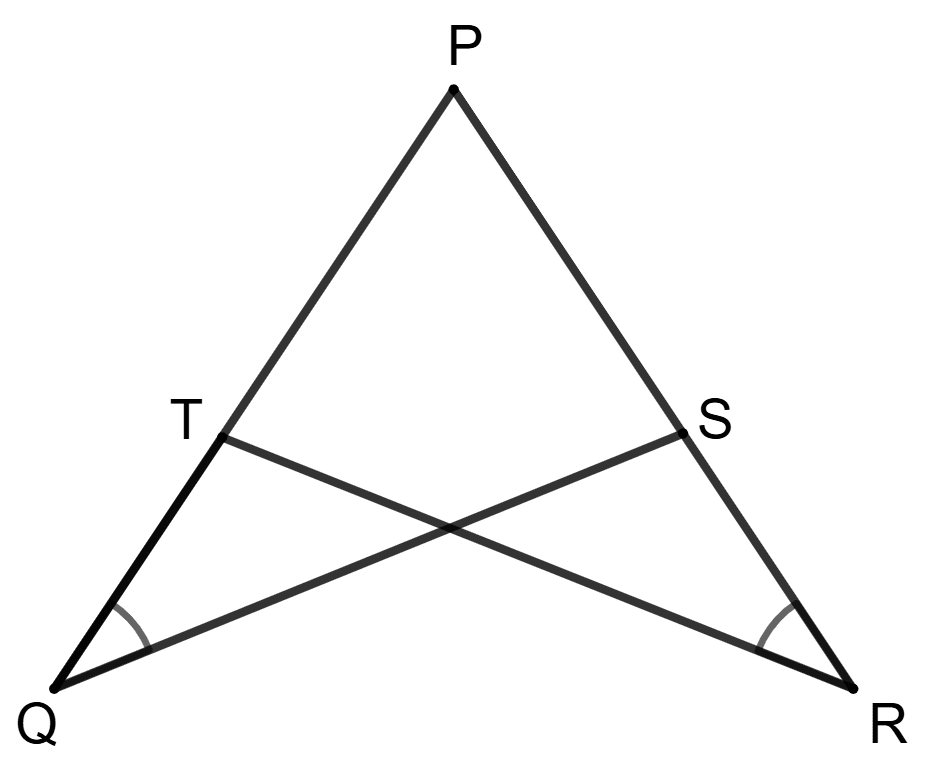
Reason (R): PQ = PR, ∠P = ∠P and ∠Q = ∠R
A is true, but R is false.
A is false, but R is true.
Both A and R are true and R is the correct reason for A.
Both A and R are true and R is the incorrect reason for A.
Answer
In ΔPQS and ΔPRT,
⇒ ∠QPS = ∠RPT (Common)
⇒ ∠PQS = ∠PRT (Given)
⇒ PQ = PR (Given)
∴ ΔPQS ≅ ΔPRT (By ASA congruency criterion)
∴ Both A and R are true, and R is the correct reason for A.
Hence, option 3 is the correct option.
Assertion (A): ΔABD ≅ ΔACE
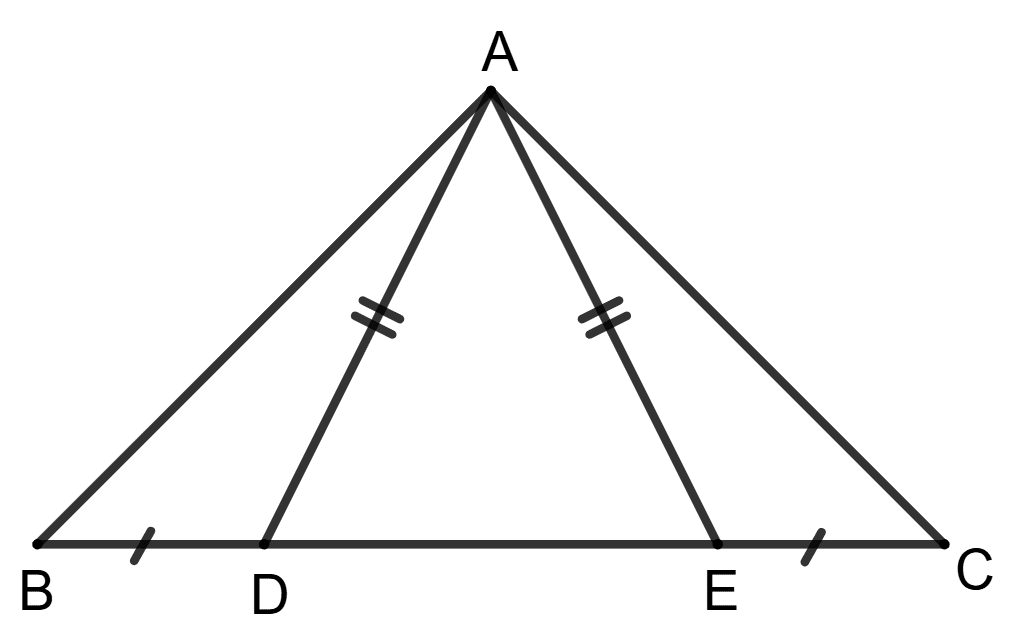
Reason (R): ∠ADE + ∠ADB = ∠AEC + ∠AED
But AD = AE
⇒ ∠ADE = ∠AED
∴ ∠ADB = ∠AEC
⇒ ∠ABD ≅ ∠AEC
A is true, but R is false.
A is false, but R is true.
Both A and R are true and R is the correct reason for A.
Both A and R are true and R is the incorrect reason for A.
Answer
In ΔADE,
⇒ AD = AE (Given)
⇒ ∠ADE = ∠AED = x ..................(1) [Angles opposite to equal sides of the triangle are also equal]
As we know ∠ADE, ∠ADB and ∠AEC, ∠AED forms linear pairs.
So, ∠ADE + ∠ADB = ∠AEC + ∠AED
Using equation (1), we get
⇒ x + ∠ADB = ∠AEC + x
⇒ ∠ADB = ∠AEC
So, reason (R) is true.
In ΔABD and ΔACE,
⇒ ∠ADB = ∠AEC (Proved above)
⇒ AD = AE (Given)
⇒ BD = EC (Given)
∴ ΔABD ≅ ΔACE (By SAS congruency criterion)
∴ Both A and R are true, and R is the correct reason for A.
Hence, option 3 is the correct option.
Which of the following pairs of triangles are congruent ? In each case, state the condition of congruency :
(a) In △ ABC and △ DEF, AB = DE, BC = EF and ∠B = ∠E.
(b) In △ ABC and △ DEF, ∠B = ∠E = 90°; AC = DF and BC = EF.
(c) In △ ABC and △ QRP, AB = QR, ∠B = ∠R and ∠C = ∠P.
(d) In △ ABC and △ PQR, AB = PQ, AC = PR and BC = QR.
(e) In △ ABC and △ PQR, BC = QR, ∠A = 90°, ∠C = ∠R = 40° and ∠Q = 50°.
Answer
(a) Given,
In △ ABC and △ DEF,
⇒ AB = DE
⇒ BC = EF
⇒ ∠B = ∠E
∴ △ ABC ≅ △ DEF (By S.A.S. axiom)
Hence, △ ABC and △ DEF are congruent by S.A.S. axiom.
(b) Given,
In △ ABC and △ DEF,
⇒ AC = DF
⇒ BC = EF
⇒ ∠B = ∠E (Both equal to 90°)
∴ △ ABC ≅ △ DEF (By R.H.S. axiom)
Hence, △ ABC and △ DEF are congruent by R.H.S. axiom.
(c) Given,
In △ ABC and △ QRP,
⇒ AB = QR
⇒ ∠B = ∠R
⇒ ∠C = ∠P
∴ △ ABC ≅ △ QRP (By A.A.S. or A.S.A. axiom)
Hence, △ ABC and △ DEF are congruent by A.A.S. or A.S.A. axiom.
(d) Given,
In △ ABC and △ PQR,
⇒ AB = PQ
⇒ AC = PR
⇒ BC = QR
∴ △ ABC ≅ △ PQR (By S.S.S. axiom)
Hence, △ ABC and △ PQR are congruent by S.S.S. axiom.
(e) In △ ABC,
⇒ ∠A + ∠B + ∠C = 180°
⇒ 90° + ∠B + 40° = 180°
⇒ ∠B + 130° = 180°
⇒ ∠B = 180° - 130° = 50°.
In △ ABC and △ PQR,
⇒ BC = QR (Given)
⇒ ∠B = ∠Q (Both equal to 50°)
⇒ ∠C = ∠R (Both equal to 40°)
∴ △ ABC ≅ △ PQR (By A.S.A. axiom)
Hence, △ ABC and △ PQR are congruent by A.S.A. axiom.
In quadrilateral ABCD, AB = AD and CB = CD. Prove that AC is perpendicular bisector of BD.
Answer
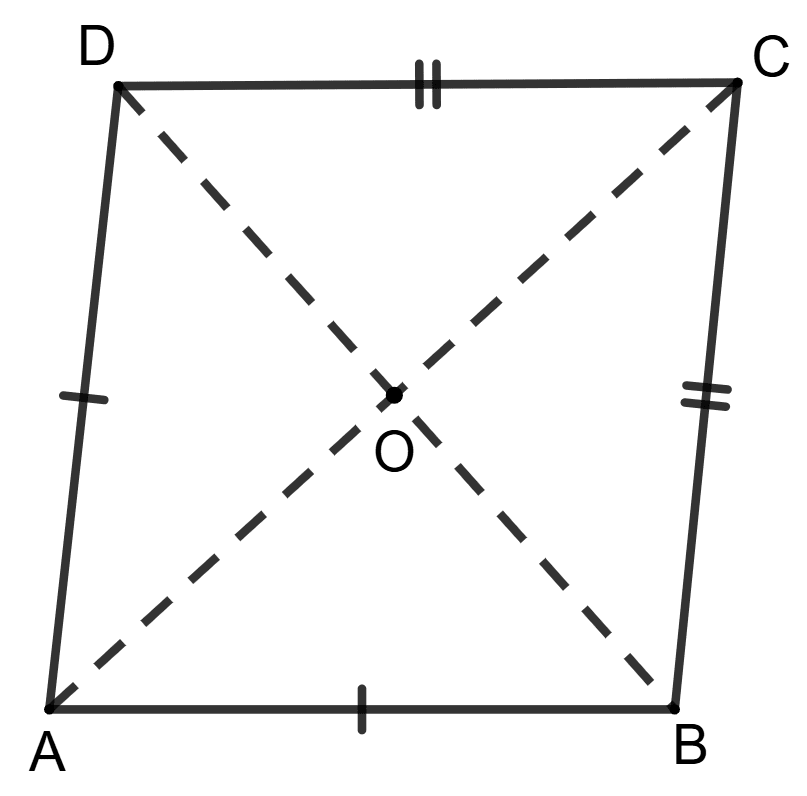
In △ ABC and △ ADC,
⇒ AB = AD (Given)
⇒ BC = CD (Given)
⇒ AC = AC (Common side)
∴ △ ABC ≅ △ ADC (By S.S.S. axiom)
We know that,
Corresponding parts of congruent triangle are equal.
⇒ ∠BAC = ∠DAC
⇒ ∠BAO = ∠DAO
In △ AOB and △ AOD,
⇒ AB = AD (Given)
⇒ AO = AO (Common side)
⇒ ∠BAO = ∠DAO (Proved above)
∴ △ AOB ≅ △ AOD (By S.A.S. axiom)
We know that,
Corresponding parts of congruent triangle are equal.
⇒ ∠BOA = ∠DOA .......(1)
⇒ OB = OD
From figure,
⇒ ∠BOA + ∠DOA = 180° (Linear pair)
⇒ ∠BOA + ∠BOA = 180° [From equation (1)]
⇒ 2∠BOA = 180°
⇒ ∠BOA = = 90°.
∴ AC is perpendicular bisector of BD.
Hence, proved that AC is perpendicular bisector of BD.
In the given figure : AB // FD, AC // GE and BD = CE; prove that :
(i) BG = DF
(ii) CF = EG.
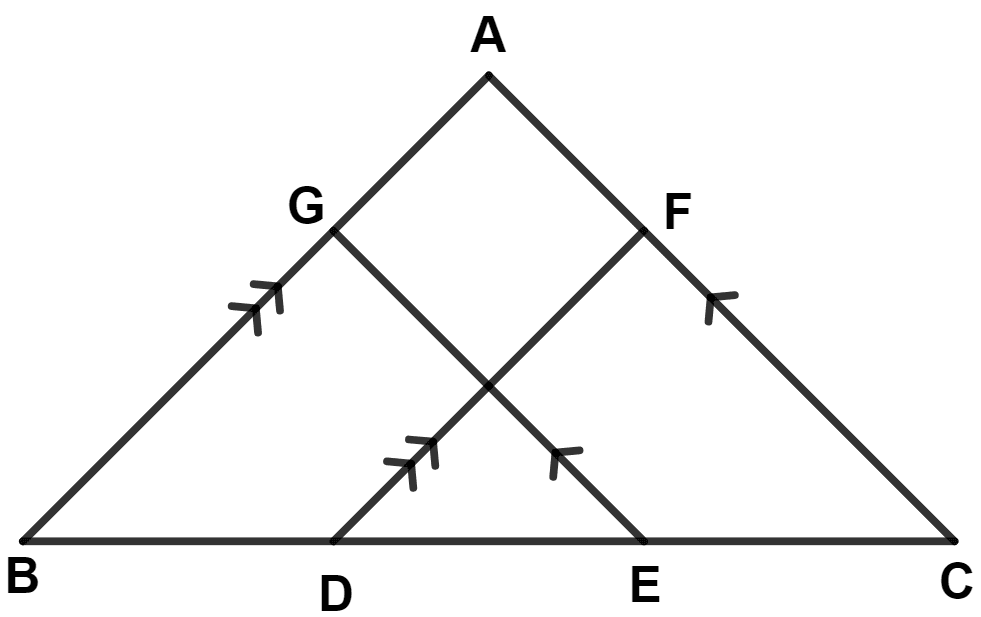
Answer
Given,
⇒ BD = CE
Adding DE on both sides, we get :
⇒ BD + DE = CE + DE
⇒ BE = DC.
In △ BGE and △ DFC,
⇒ BE = DC (Proved above)
⇒ ∠GBE = ∠FDC (Corresponding angles are equal)
⇒ ∠GEB = ∠FCD (Corresponding angles are equal)
∴ ∆ BGE ≅ ∆ DFC (By A.S.A. axiom)
We know that,
Corresponding parts of congruent triangles are equal.
∴ BG = DF and CF = EG.
Hence, proved that BG = DF and CF = EG.
In a triangle ABC, AB = AC. Show that the altitude AD is median also.
Answer
△ ABC is shown below:
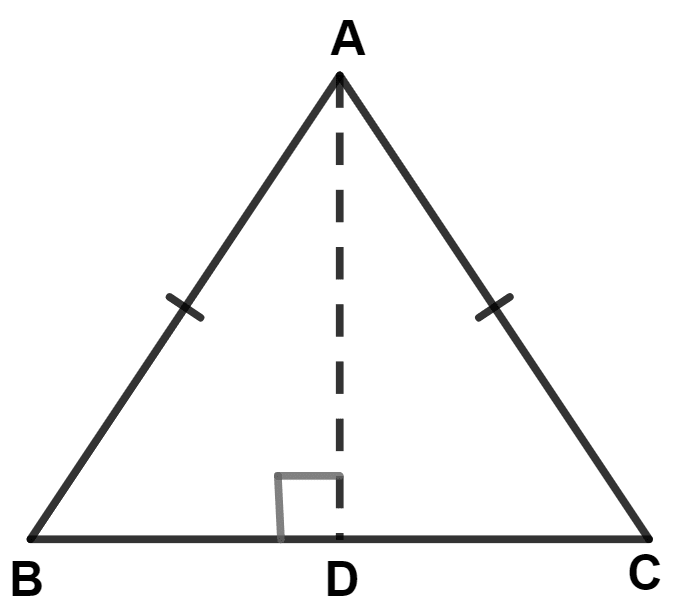
In △ ABD and △ ACD,
⇒ AB = AC (Given)
⇒ ∠ADB = ∠ADC (Both equal to 90°)
⇒ AD = AD (Common side)
∴ ∆ ABD ≅ ∆ ACD (By R.H.S. axiom)
We know that,
Corresponding parts of congruent triangles are equal.
∴ BD = CD.
Hence, proved that altitude AD is median also.
In the following figure, BL = CM. Prove that AD is a median of triangle ABC.
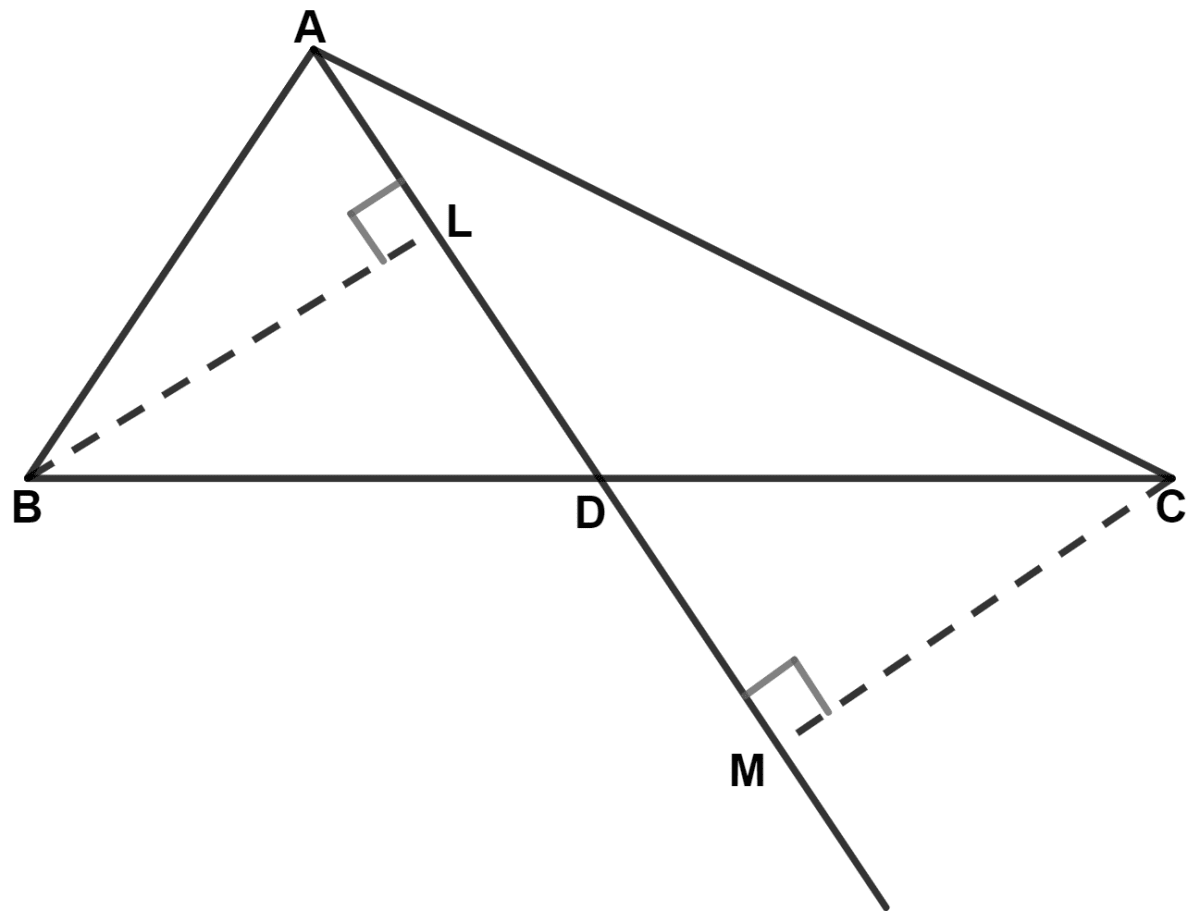
Answer
In △ BLD and △ CMD,
⇒ BL = CM (Given)
⇒ ∠BLD = ∠CMD (Both equal to 90°)
⇒ ∠BDL = ∠CDM (Vertically opposite angles are equal)
∴ ∆ BLD ≅ ∆ CMD (By A.A.S. axiom)
We know that,
Corresponding parts of congruent triangles are equal.
∴ BD = CD.
Thus, we can say that :
AD bisects BC in two equal halves.
Hence, proved that AD is a median of triangle ABC.
In the following figure, AB = AC and AD is perpendicular to BC. BE bisects angle B and EF is perpendicular to AB. Prove that :
(i) BD = CD
(ii) ED = EF
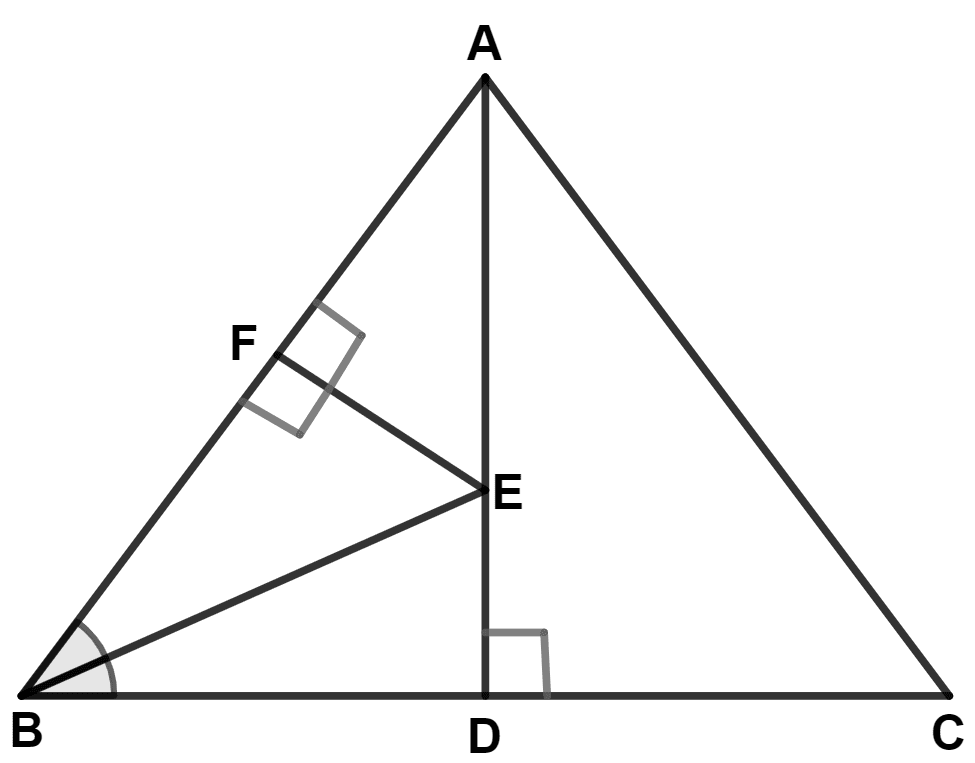
Answer
(i) In △ ABD and △ ACD,
⇒ AD = AD (Common side)
⇒ AB = AC (Given)
⇒ ∠ADB = ∠ADC (Since, AD is perpendicular to BC)
∴ ∆ ABD ≅ ∆ ACD (By R.H.S. axiom)
We know that,
Corresponding parts of congruent triangles are equal.
∴ BD = CD.
Hence, proved that BD = CD.
(ii) In △ EBD and △ EBF,
⇒ EB = EB (Common side)
⇒ ∠EBF = ∠EBD (Since, BE bisects angle B)
⇒ ∠EFB = ∠EDB (Both equal to 90°)
∴ ∆ EBD ≅ ∆ EBF (By A.A.S. axiom)
We know that,
Corresponding parts of congruent triangles are equal.
∴ ED = EF.
Hence, proved that ED = EF.
AD and BC are equal perpendiculars to a line segment AB. If AD and BC are on different sides of AB prove that CD bisects AB.
Answer
Let CD intersect AB at point O.
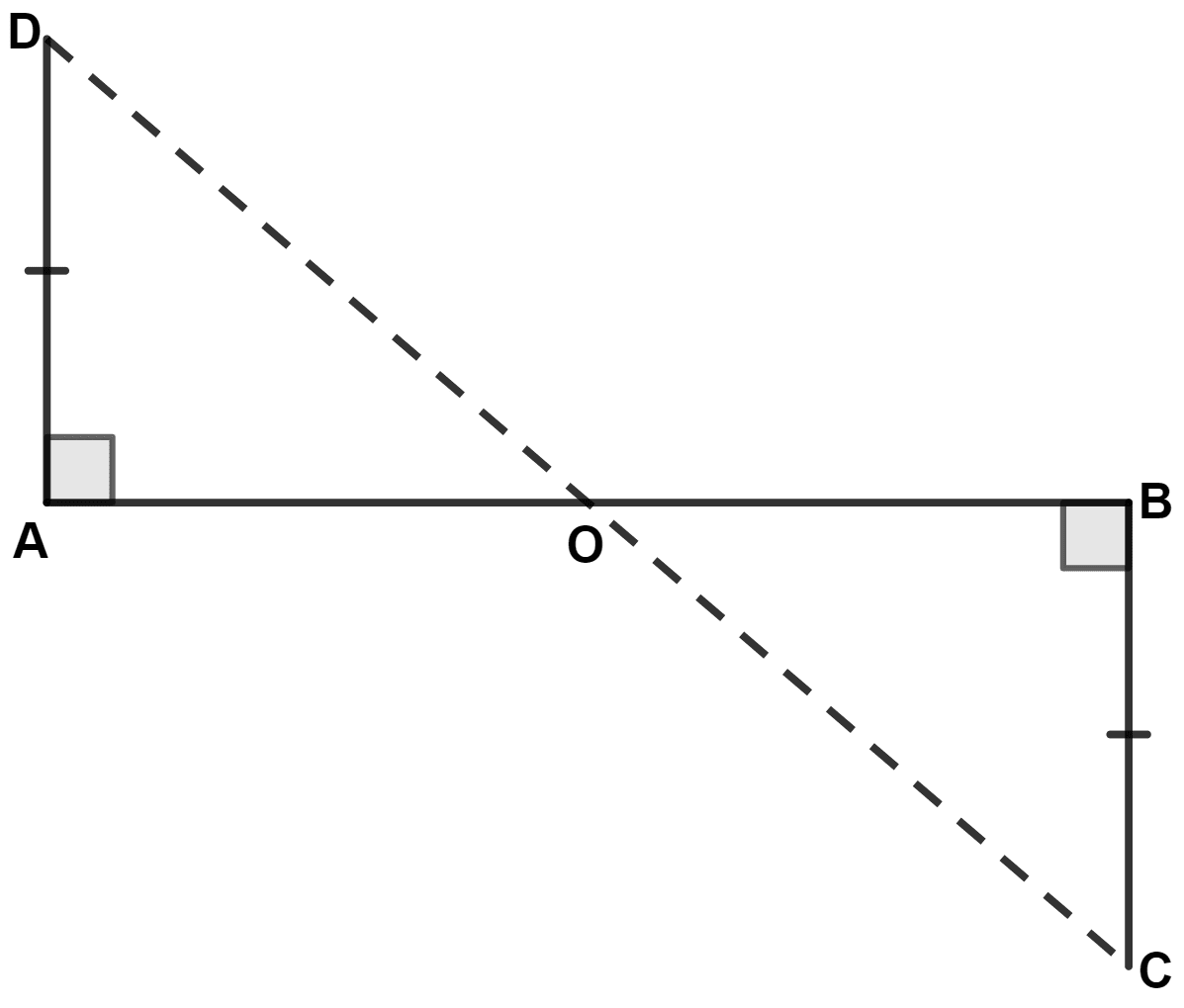
In △ AOD and △ BOC,
⇒ ∠DAO = ∠CBO (Both equal to 90°)
⇒ ∠DOA = ∠COB (Vertically opposite angles are equal)
⇒ AD = BC (Given)
∴ ∆ AOD ≅ ∆ BOC (By A.A.S. axiom)
We know that,
Corresponding parts of congruent triangles are equal.
∴ AO = OB.
Hence, proved that CD bisects AB.
In △ ABC, AB = AC and the bisectors of angles B and C intersect at point O. Prove that :
(i) BO = CO
(ii) AO bisects angle BAC.
Answer
(i) In Δ ABC,

AB = AC (Given)
⇒ ∠B = ∠C [Angles opposite to equal sides are equal]
Also OB and OC are bisectors of angles B and C.
⇒ ∠OBC = ∠OCB
∴ OB = OC [Sides opposite to equal angles are equal]
Hence, proved that BO = CO.
(ii) In Δ AOB and Δ AOC,
⇒ OA = OA (Common side)
⇒ AB = AC (Given)
⇒ OB = OC (Proved above)
∴ Δ AOB ≅ Δ AOC (By S.S.S. axiom)
We know that,
Corresponding parts of congruent triangles are equal.
∴ ∠OAB = ∠OAC
Hence, proved that AO bisects angle BAC.
In the following figure, AB = EF, BC = DE and ∠B = ∠E = 90°. Prove that AD = FC.

Answer
Given,
⇒ BC = DE
Adding CD on both sides, we get :
⇒ BC + CD = DE + CD
⇒ BD = CE.
In △ ABD and △ FEC,
⇒ ∠ABD = ∠FEC (Both equal to 90°)
⇒ AB = EF (Given)
⇒ BD = CE (Proved above)
∴ ∆ ABD ≅ ∆ FEC (By S.A.S. axiom)
We know that,
Corresponding parts of congruent triangles are equal.
∴ AD = FC.
Hence, proved that AD = FC.
A point O is taken inside a rhombus ABCD such that its distances from the vertices B and D are equal. Show that AOC is a straight line.
Answer
Rhombus ABCD with point O taken inside having equal distances from the vertices B and D is shown below:
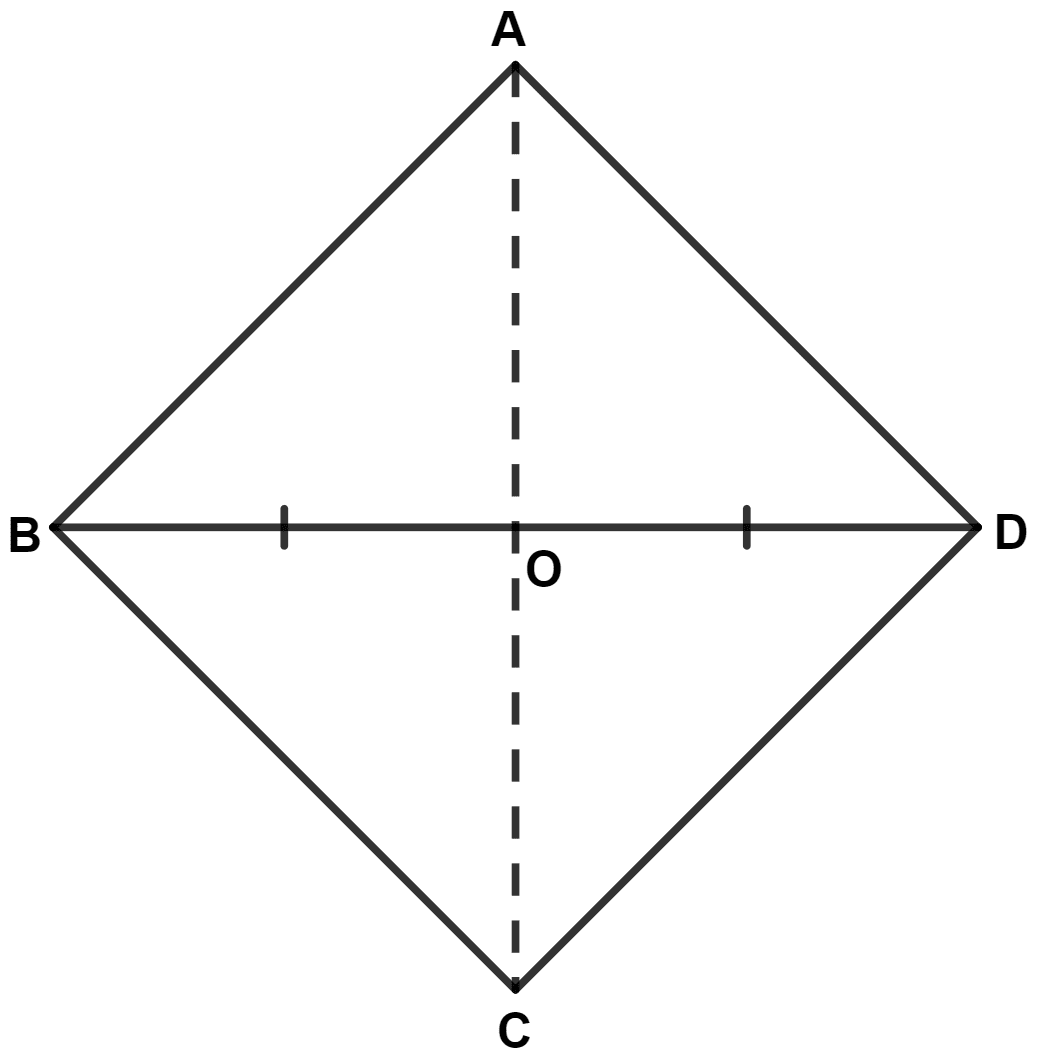
In △ AOB and △ AOD,
⇒ AO = AO (Common side)
⇒ AB = AD (All sides of rhombus are equal)
⇒ OB = OD (O is equidistant from vertices B and D)
∴ ∆ AOB ≅ ∆ AOD (By S.S.S. axiom)
We know that,
Corresponding parts of congruent triangles are equal.
∴ ∠AOB = ∠AOD = x (let)
Since, BOD is a straight line.
∴ ∠AOB + ∠AOD = 180°
⇒ x + x = 180°
⇒ 2x = 180°
⇒ x = = 90°
∴ ∠AOB = ∠AOD = 90°.
From figure,
∠BOC = ∠AOD = 90° (Vertically opposite angles are equal).
Since,
∠AOB + ∠BOC = 90° + 90° = 180°.
Thus, it can be said that points A, O and C lie on a straight line.
Hence, proved that AOC is a straight line.
In the given figure, ABCD is a rectangle and X and Y are the mid-points of the sides DC and AB respectively. P and Q are the points of AD and BC respectively such that DP = BQ.
Prove that △ APX ≅ △ CQY.
![In the given figure, ABCD is a rectangle and X and Y are the mid-points of the sides DC and AB respectively. P and Q are the points of AD and BC respectively such that DP = BQ. Triangles [Congruency in Triangles], Concise Mathematics Solutions ICSE Class 9.](https://cdn1.knowledgeboat.com/img/cm9/q12-test-yourself-c9-icse-class-9-concise-maths-upd-2027-new-updated-658x429.png)
Answer
Given, ABCD is a rectangle.
X and Y are midpoints of DC and AB respectively.
P and Q are points on AD and BC respectively such that DP = BQ
Comparing sides AX and CY,
In rectangle, opposite sides are equal, so AB = CD.
Since X and Y are mid-points:
DX =
YB =
Therefore, DX = YB........(1)
Consider △ ADX and △ CBY,
⇒ AD = CB (opposite sides of a rectangle)
⇒ ∠D = ∠B = 90°
⇒ DX = YB (Proven above)
So, △ ADX ≅ △ CBY (By S.A.S axiom)
∴ AX = CY (By C.P.C.T.C.) ........(2)
Comparing sides AP and CQ,
Given,
AD = BC and DP = BQ.
AD - DP = BC - BQ
∴ AP = CQ .......(3)
Consider △ DPX and △ BQY:
⇒ DP = BQ (given)
⇒ ∠D = ∠B = 90°
⇒ DX = BY (Proved above)
So, △ DPX ≅ △ BQY (By S.A.S axiom)
∴ PX = QY ..........(4)
Consider △ APX and △ CQY.
⇒ AX = CY (From equation (2))
⇒ AP = CQ (From equation (3))
⇒ PX = QY (From equation (4))
Since all the three corresponding sides are equal,
∴ △ APX ≅ △ CQY (By S.S.S axiom)
Hence proved that s△ APX ≅ △ CQY.