
In the given figure, arc APB = arc CQD, then :
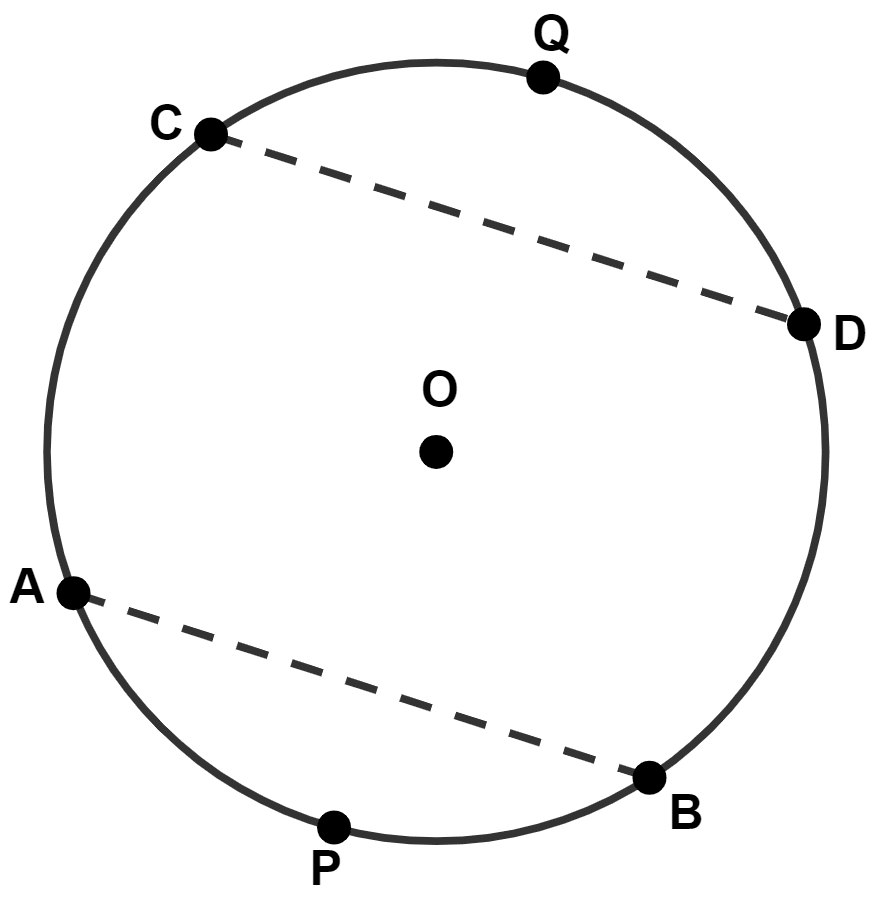
AB = CD
AB > CD
AB < CD
none of the above
Answer
We know that,
Equal arcs subtends equal chords.
Given,
⇒ arc APB = arc CQD
⇒ AB = CD.
Hence, Option 1 is the correct option.
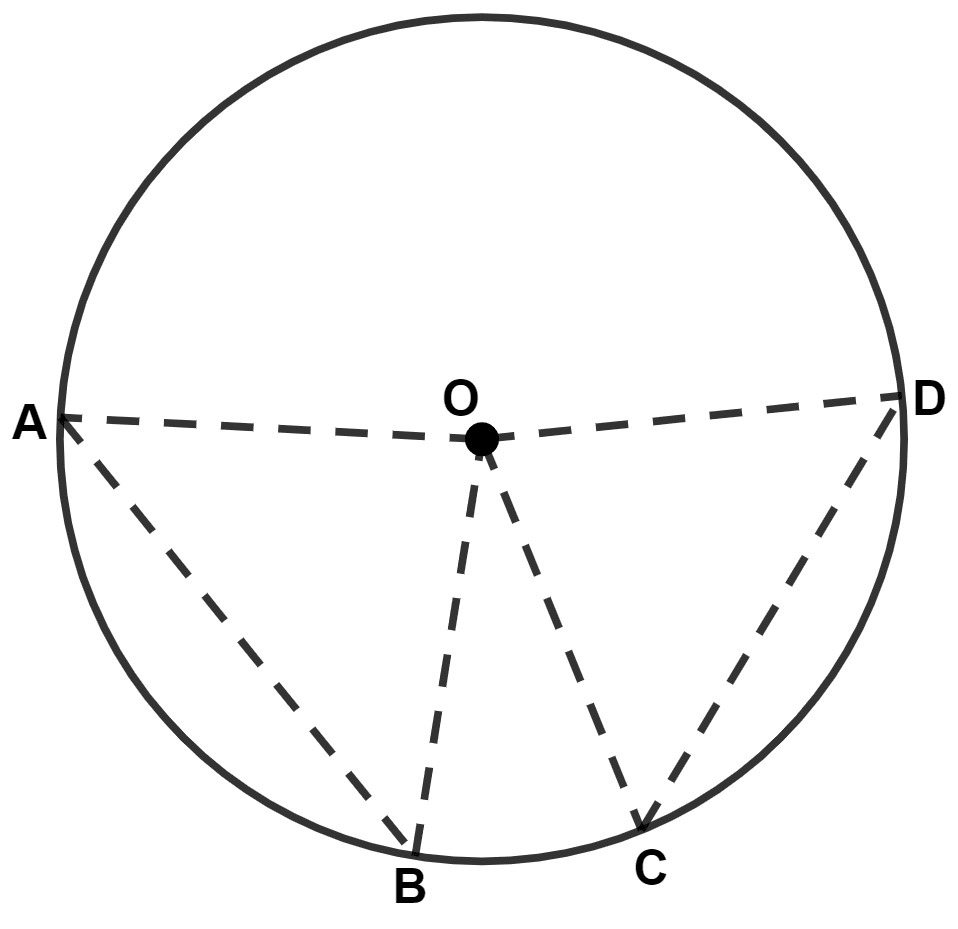
In the given figure, O is center of the circle and ∠COD is greater than ∠AOB, then :
AB > CD
AB < CD
AB = CD
AB + CD = AD
Answer
We know that,
Greater the chord, greater is the angle subtended by it at the center.
Given,
⇒ ∠AOB < ∠COD
⇒ AB < CD
Hence, Option 2 is the correct option.
In a circle, O is its center and AB, CD are its two chords. If AB : CD = 3 : 2, then ratio between ∠AOB and ∠COD is :
1 : 1
3 : 2
2 : 5
3 : 5
Answer
Ratio of the angles subtended by the chords on the center is equal to the ratio of the chords.
⇒
⇒ ∠AOB : ∠COD = 3 : 2.
Hence, Option 2 is the correct option.
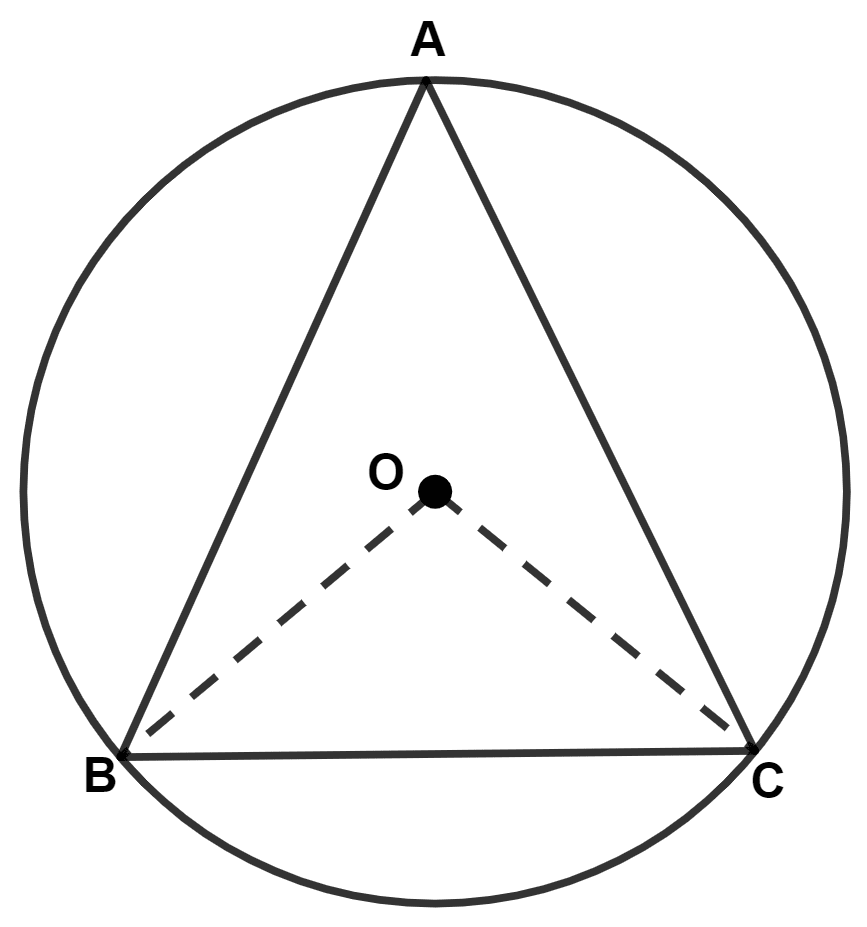
In the given figure, O is the center of the circle and ABC is an equilateral triangle, then ∠AOB is equal to :
105°
90°
60°
120°
Answer
Since, ABC is an equilateral triangle.
∴ AB = BC = AC.
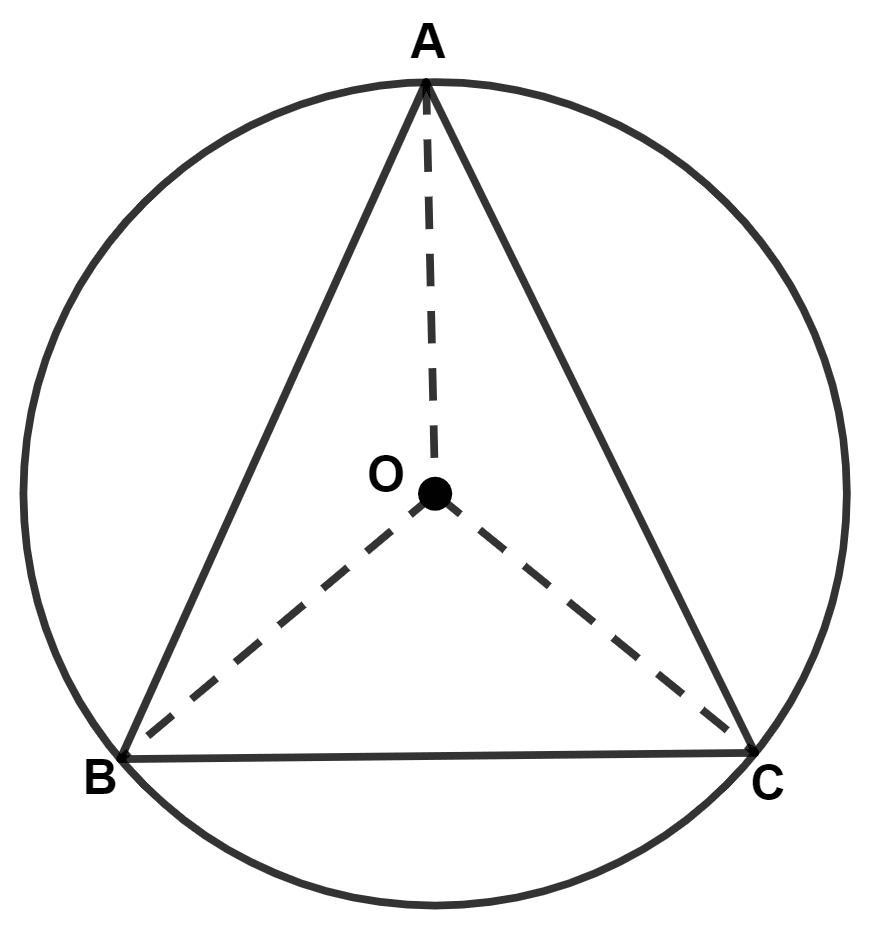
We know that,
Equal chords subtend equal angles at the center.
∴ ∠AOB = ∠BOC = ∠COA = x (let)
We know that,
Angles around a point add to 360 °.
∴ ∠AOB + ∠BOC + ∠COA = 360°
⇒ x + x + x = 360°
⇒ 3x = 360°
⇒ x = = 120°
⇒ ∠AOB = 120°.
Hence, Option 4 is the correct option.
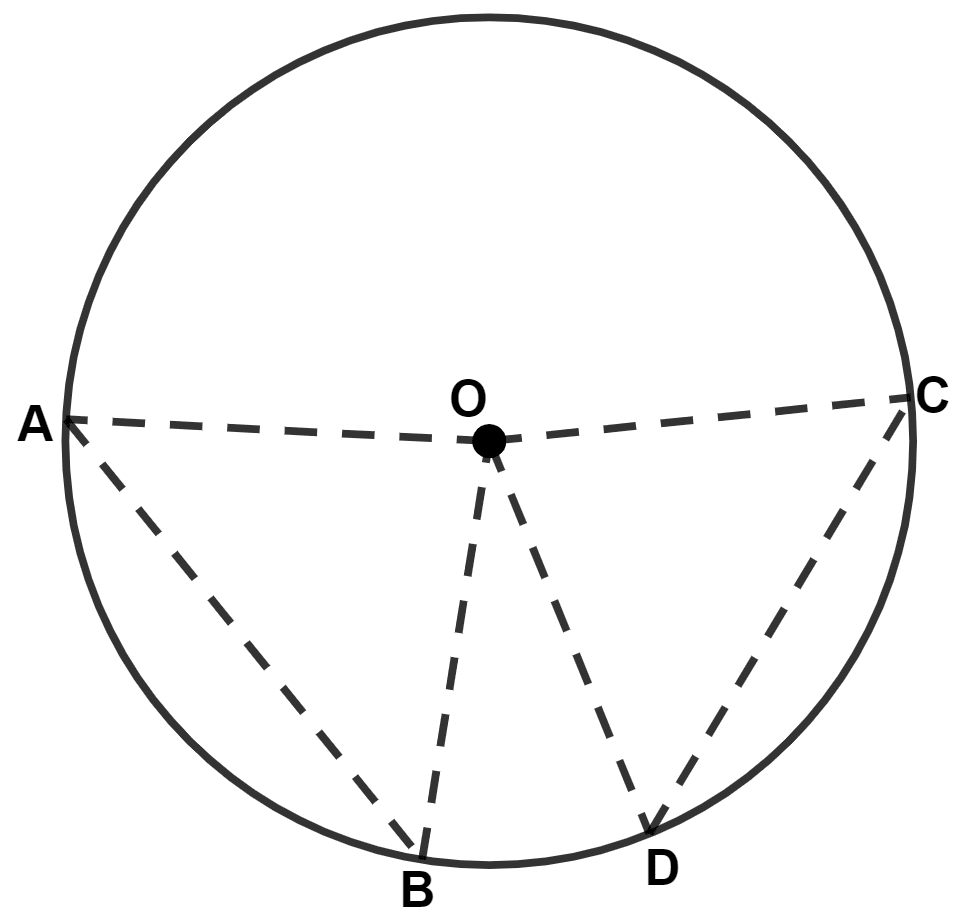
In the given figure, O is the center of the circle and chord AB : chord CD = 5 : 3. If angle DOC = 60°; then ∠AOB is :
120°
75°
100°
80°
Answer
Ratio of the angles subtended by the chords on the center is equal to the ratio of the chords.
Hence, Option 3 is the correct option.
In the given figure, a square is inscribed in a circle with center O. Find :
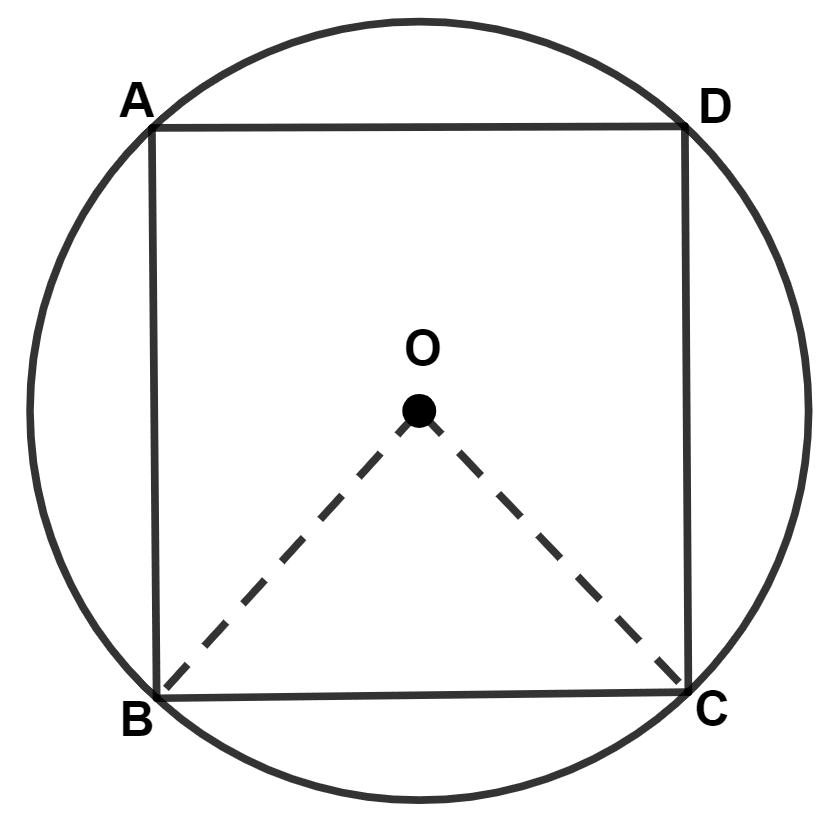
(i) ∠BOC
(ii) ∠OCB
(iii) ∠COD
(iv) ∠BOD
Is BD a diameter of the circle?
Answer
Join OA and OD.
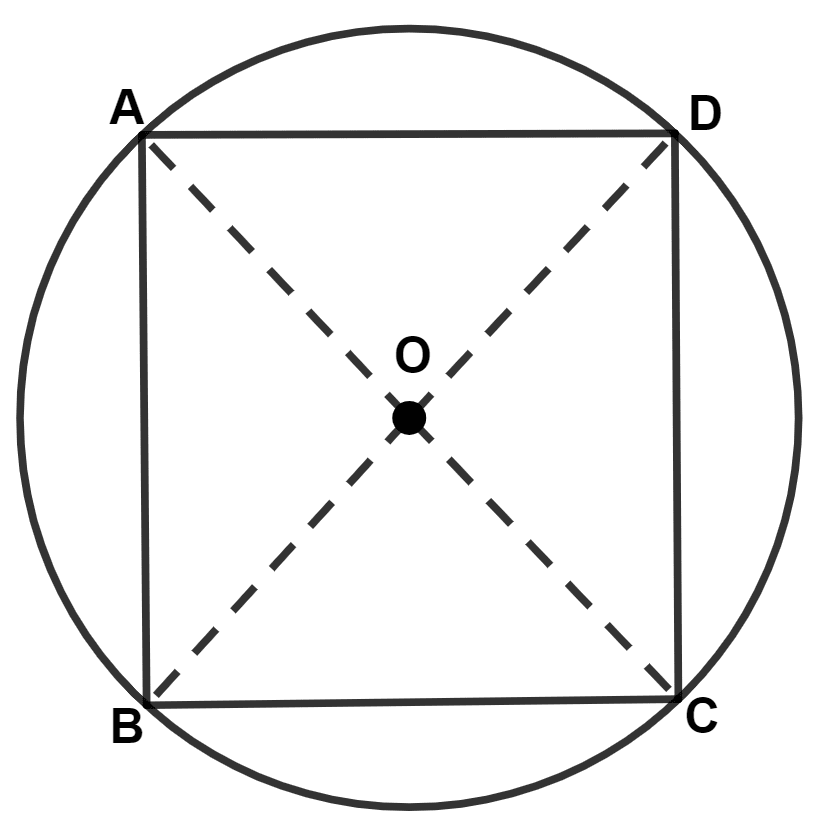
(i) We know that,
Diagonals of a square bisect each other at 90°.
∴ ∠BOC = 90°.
Hence, ∠BOC = 90°.
(ii) From figure,
OB and OC are the radius of the circle.
In △ OBC,
⇒ OB = OC
⇒ ∠OCB = ∠OBC = x (let) [Angle opposite to equal sides are equal]
By angle sum property of triangle,
⇒ ∠OCB + ∠OBC + ∠BOC = 180°
⇒ x + x + 90° = 180°
⇒ 2x + 90° = 180°
⇒ 2x = 180° - 90°
⇒ 2x = 90°
⇒ x =
⇒ x = 45°
⇒ ∠OCB = 45°.
Hence, ∠OCB = 45°.
(iii) We know that,
Diagonals of a square bisect each other at 90°.
∴ ∠COD = 90°.
Hence, ∠COD = 90°.
(iv) From figure,
⇒ ∠BOD = ∠BOC + ∠COD = 90° + 90° = 180°.
Hence, ∠BOD = 180° and BD is the diameter of the circle.
In the given figure, AB is a side of a regular pentagon and BC is a side of a regular hexagon.
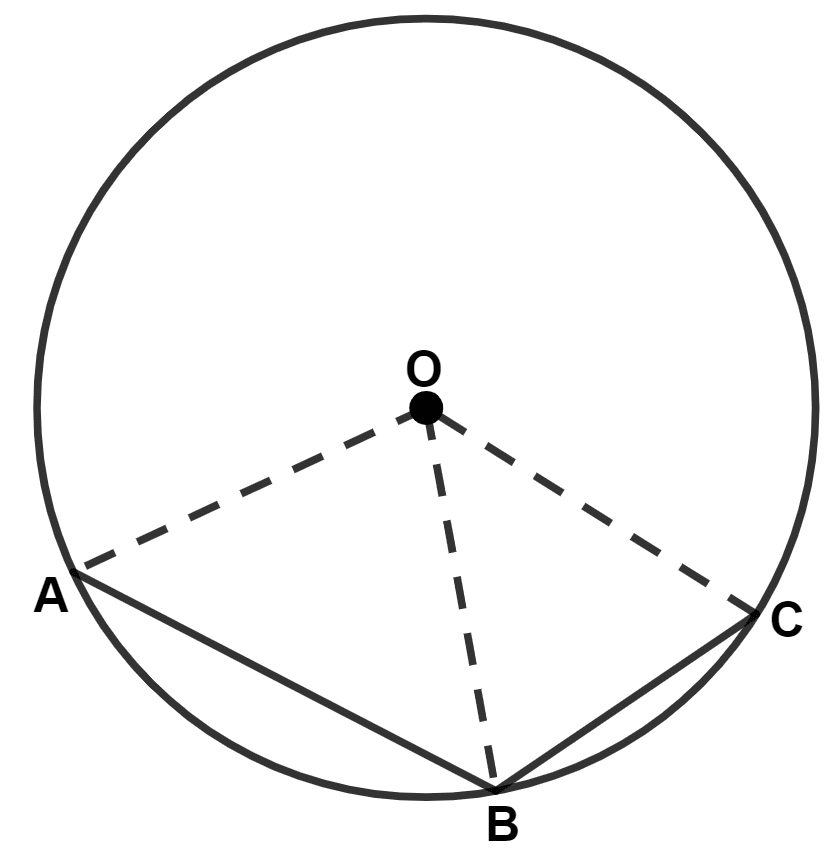
(i) ∠AOB
(ii) ∠BOC
(iii) ∠AOC
(iv) ∠OBA
(v) ∠OBC
(vi) ∠ABC
Answer
We know that,
The angle subtended by each side of an n-sided regular polygon at the center of circle = .
(i) Given,
AB is the side of the pentagon.
Angle subtended by each arm of the pentagon at the center of the circle is = 72°.
Hence, ∠AOB = 72°.
(ii) Given,
BC is the side of the hexagon.
Angle subtended by each arm of the hexagon at the center of the circle is = 60°.
Hence, ∠BOC = 60°.
(iii) From figure,
⇒ ∠AOC = ∠AOB + ∠BOC = 72° + 60° = 132°.
Hence, ∠AOC = 132°.
(iv) In △ OAB,
⇒ OA = OB
⇒ ∠OBA = ∠OAB = x (let) [Angle opposite to equal sides are equal]
By angle sum property of triangle,
⇒ ∠OAB + ∠OBA + ∠AOB = 180°
⇒ x + x + 72° = 180°
⇒ 2x + 72° = 180°
⇒ 2x = 180° - 72°
⇒ 2x = 108°
⇒ x =
⇒ x = 54°
⇒ ∠OBA = 54°.
Hence, ∠OBA = 54°.
(v) In △ OBC,
⇒ OC = OB
⇒ ∠OBC = ∠OCB = y (let) [Angle opposite to equal sides are equal]
By angle sum property of triangle,
⇒ ∠OBC + ∠OCB + ∠BOC = 180°
⇒ y + y + 60° = 180°
⇒ 2y + 60° = 180°
⇒ 2y = 180° - 60°
⇒ 2y = 120°
⇒ y =
⇒ y = 60°
⇒ ∠OBC = 60°.
Hence, ∠OBC = 60°.
(vi) From figure,
⇒ ∠ABC = ∠OBA + ∠OBC = 54° + 60° = 114°.
Hence, ∠ABC = 114°.
In the given figure, arc AB and arc BC are equal in length.
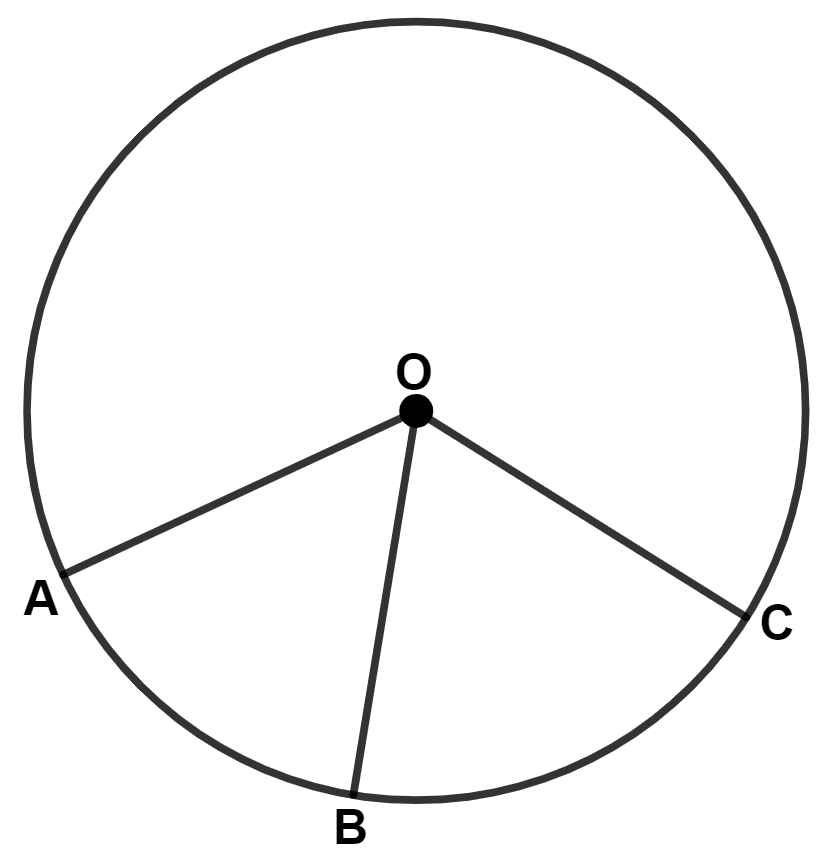
If ∠AOB = 48°, find :
(i) ∠BOC
(ii) ∠OBC
(iii) ∠AOC
(iv) ∠OAC
Answer
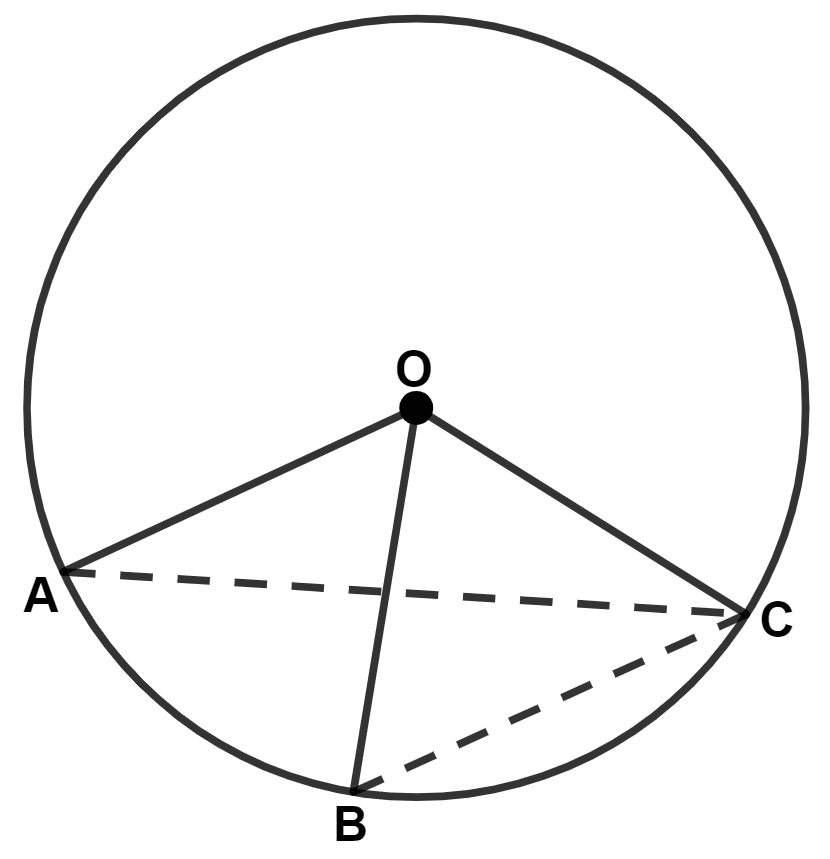
(i) We know that,
If two arcs are of a circle are equal, they subtend equal angles at the center.
∴ ∠BOC = ∠AOB = 48°.
Hence, ∠BOC = 48°.
(ii) Join BC.
In △ OBC,
⇒ OC = OB (Radius of same circle)
⇒ ∠OBC = ∠OCB = y (let) [Angle opposite to equal sides are equal]
By angle sum property of triangle,
⇒ ∠OBC + ∠OCB + ∠BOC = 180°
⇒ y + y + 48° = 180°
⇒ 2y + 48° = 180°
⇒ 2y = 180° - 48°
⇒ 2y = 132°
⇒ y =
⇒ y = 66°
⇒ ∠OBC = 66°.
Hence, ∠OBC = 66°.
(iii) From figure,
⇒ ∠AOC = ∠AOB + ∠BOC = 48° + 48° = 96°.
Hence, ∠AOC = 96°.
(iv) Join AC.
In △ AOC,
⇒ OC = OA (Radius of same circle)
⇒ ∠OAC = ∠OCA = x (let) [Angle opposite to equal sides are equal]
By angle sum property of triangle,
⇒ ∠OAC + ∠OCA + ∠AOC = 180°
⇒ x + x + 96° = 180°
⇒ 2x + 96° = 180°
⇒ 2x = 180° - 96°
⇒ 2x = 84°
⇒ x =
⇒ x = 42°
⇒ ∠OAC = 42°.
Hence, ∠OAC = 42°.
In the given figure, the lengths of arcs AB and BC are in the ratio 3 : 2.
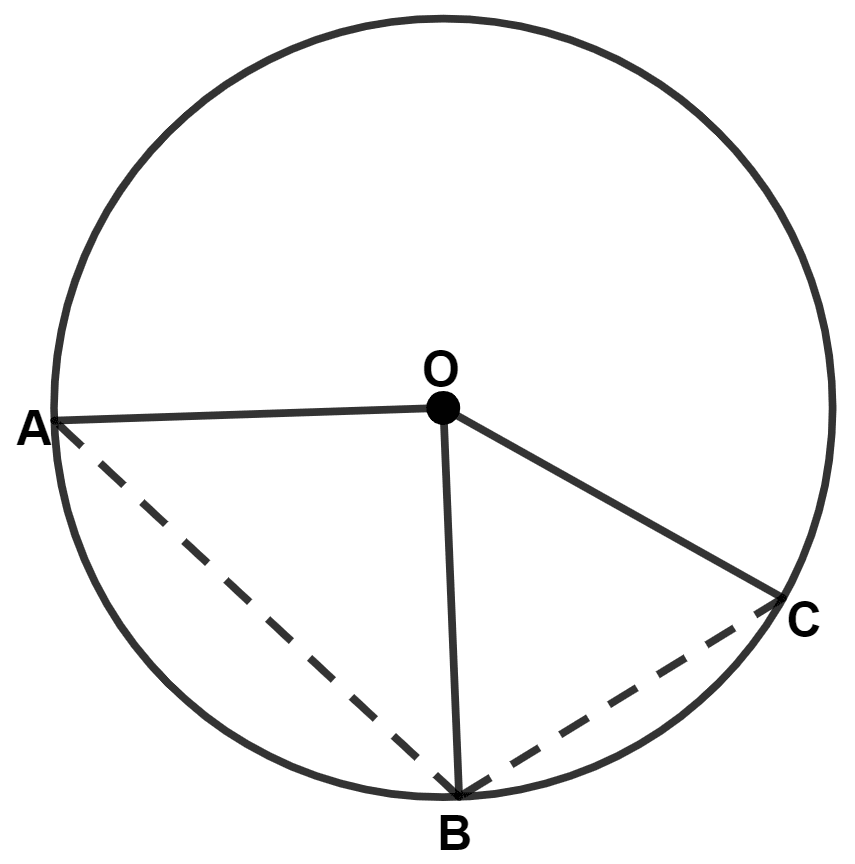
If ∠AOB = 96°, find :
(i) ∠BOC
(ii) ∠ABC
Answer
(i) We know that,
Ratio of the angles subtended by the chords on the center is equal to the ratio of the chords.
Hence, ∠BOC = 64°.
(ii) In △ AOB,
⇒ OA = OB (Radius of same circle)
⇒ ∠OBA = ∠OAB = x (let) [Angle opposite to equal sides are equal]
By angle sum property of triangle,
⇒ ∠OAB + ∠OBA + ∠AOB = 180°
⇒ x + x + 96° = 180°
⇒ 2x + 96° = 180°
⇒ 2x = 180° - 96°
⇒ 2x = 84°
⇒ x =
⇒ x = 42°
⇒ ∠OBA = 42°.
In △ BOC,
⇒ OB = OC (Radius of same circle)
⇒ ∠OCB = ∠OBC = y (let) [Angle opposite to equal sides are equal]
By angle sum property of triangle,
⇒ ∠OCB + ∠OBC + ∠BOC = 180°
⇒ y + y + 64° = 180°
⇒ 2y + 64° = 180°
⇒ 2y = 180° - 64°
⇒ 2y = 116°
⇒ y =
⇒ y = 58°
⇒ ∠OBC = 58°.
From figure,
⇒ ∠ABC = ∠OBA + ∠OBC = 42° + 58° = 100°.
Hence, ∠ABC = 100°.
In the given figure, AB = BC = DC and ∠AOB = 50°. Find :
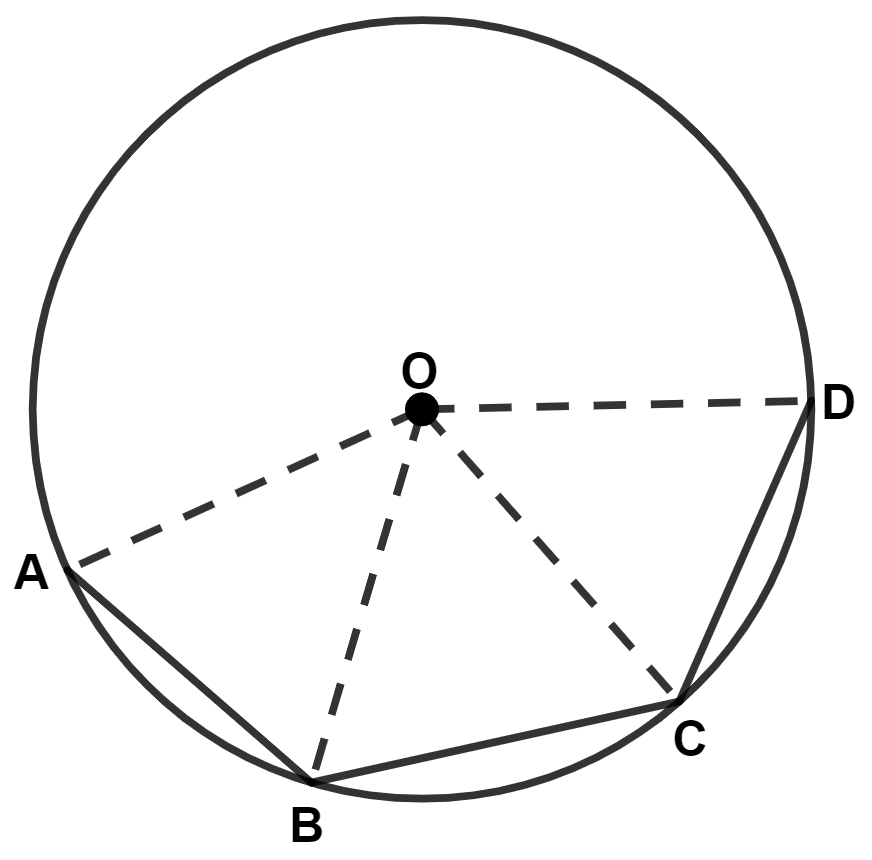
(i) ∠AOC
(ii) ∠AOD
(iii) ∠BOD
(iv) ∠OAC
(v) ∠ODA
Answer
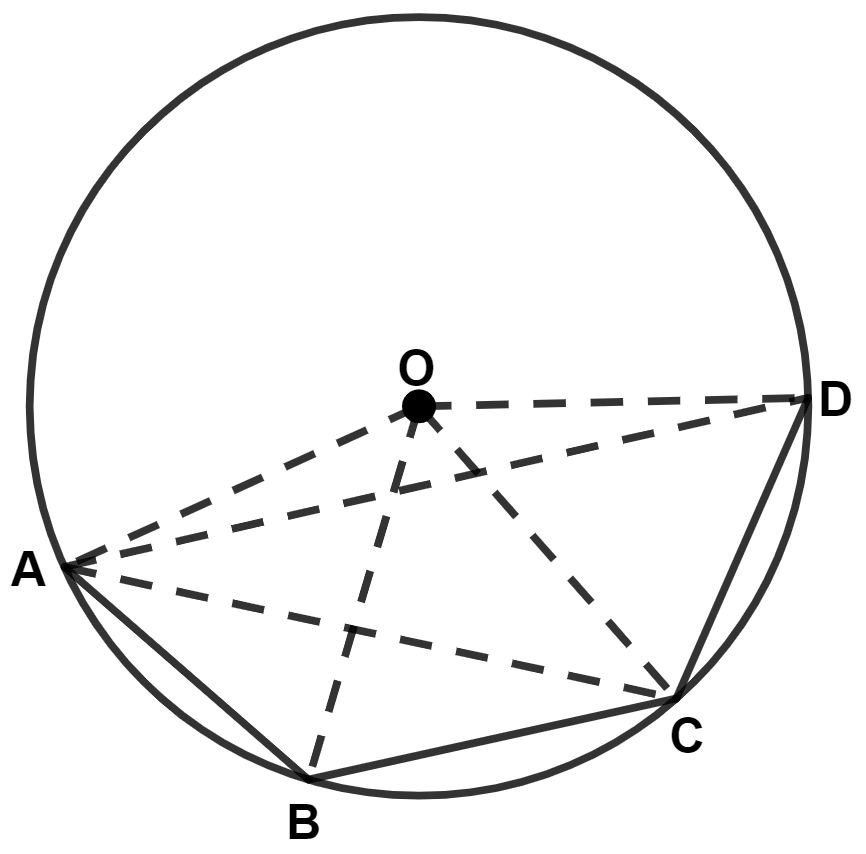
(i) We know that,
Equal chords subtend equal angles at the center.
Since, AB = BC = DC
∴ ∠BOC = ∠AOB = 50°.
From figure,
⇒ ∠AOC = ∠BOC + ∠AOB = 50° + 50° = 100°.
Hence, ∠AOC = 100°.
(ii) We know that,
Equal chords subtend equal angles at the center.
Since, AB = BC = DC
∴ ∠DOC = ∠AOB = 50°.
From figure,
⇒ ∠AOD = ∠AOC + ∠DOC = 100° + 50° = 150°.
Hence, ∠AOD = 150°.
(iii) From figure,
⇒ ∠BOD = ∠BOC + ∠DOC = 50° + 50° = 100°.
Hence, ∠BOD = 100°.
(iv) Join AC.
In △ AOC,
⇒ OA = OC (Radius of same circle)
⇒ ∠OAC = ∠OCA = y (let) [Angle opposite to equal sides are equal]
By angle sum property of triangle,
⇒ ∠OAC + ∠OCA + ∠AOC = 180°
⇒ y + y + 100° = 180°
⇒ 2y + 100° = 180°
⇒ 2y = 180° - 100°
⇒ 2y = 80°
⇒ y =
⇒ y = 40°
⇒ ∠OAC = 40°.
Hence, ∠OAC = 40°.
(v) Join AD.
In △ OAD,
⇒ OA = OD (Radius of same circle)
⇒ ∠ODA = ∠OAD = x (let) [Angle opposite to equal sides are equal]
By angle sum property of triangle,
⇒ ∠OAD + ∠ODA + ∠AOD = 180°
⇒ x + x + 150° = 180°
⇒ 2x + 150° = 180°
⇒ 2x = 180° - 150°
⇒ 2x = 30°
⇒ x =
⇒ x = 15°
⇒ ∠ODA = 15°.
Hence, ∠OAD = 15°.
In the given figure, AB is a side of a regular hexagon and AC is a side of regular eight sided polygon. Find :
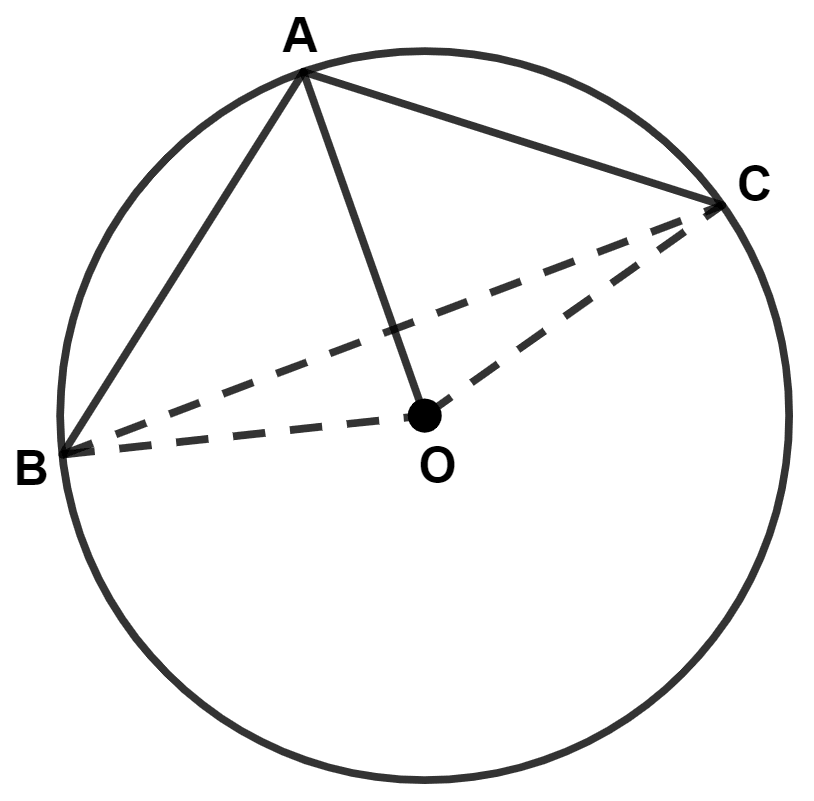
(i) ∠AOB
(ii) ∠AOC
(iii) ∠BOC
(iv) ∠OBC
Answer
We know that,
The angle subtended by each side of an n-sided regular polygon at the center of circle = .
(i) Given,
AB is the side of the hexagon.
Angle subtended by each arm of the hexagon at the center of the circle is = 60°.
Hence, ∠AOB = 60°.
(ii) Given,
AC is the side of a regular eight sided polygon.
Angle subtended by each arm of the regular eight sided polygon at the center of the circle is = 45°.
Hence, ∠AOC = 45°.
(iii) From figure,
⇒ ∠BOC = ∠AOB + ∠AOC = 60° + 45° = 105°.
Hence, ∠BOC = 105°.
(iv) In △ OBC,
⇒ OB = OC (Radius of same circle)
⇒ ∠OBC = ∠OCB = x (let) [Angle opposite to equal sides are equal]
By angle sum property of triangle,
⇒ ∠OBC + ∠OCB + ∠BOC = 180°
⇒ x + x + 105° = 180°
⇒ 2x + 105° = 180°
⇒ 2x = 180° - 105°
⇒ 2x = 75°
⇒ x =
⇒ x = 37.5°
⇒ ∠OBC = 37.5°.
Hence, ∠OBC = 37.5°=37°30'.
In the given figure, O is the centre of the circle and the length of arc AB is twice the length of arc BC.
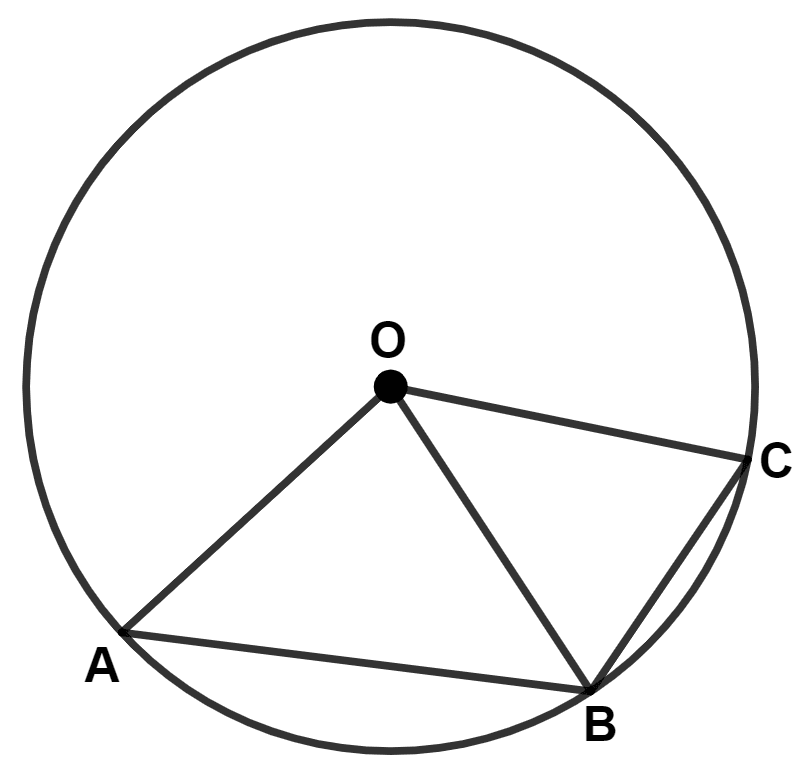
If ∠AOB = 100°, find :
(i) ∠BOC
(ii) ∠OAC
Answer
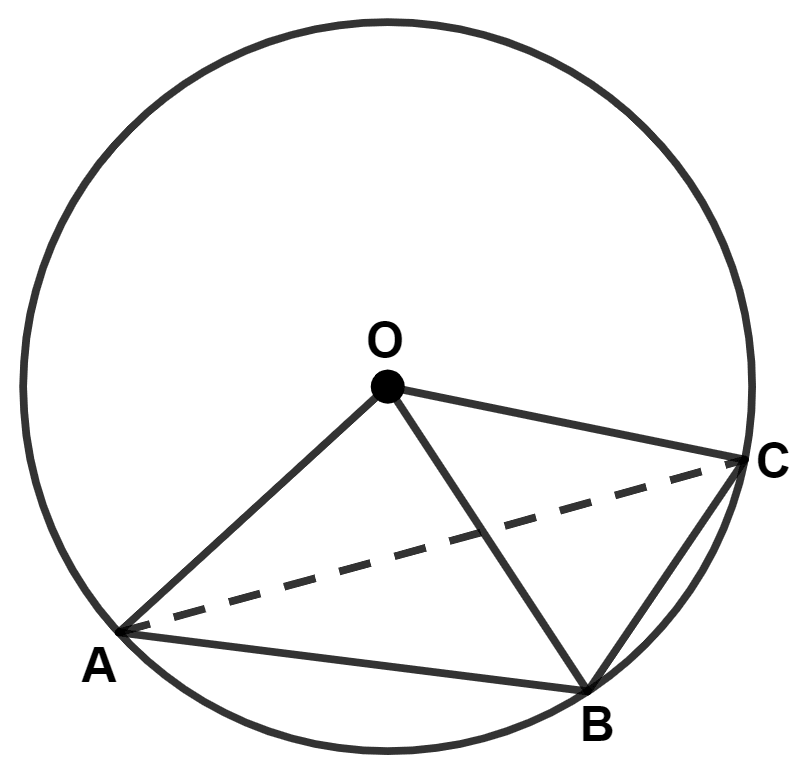
(i) We know that,
Ratio of the angles subtended by the chords on the center is equal to the ratio of the chords.
Hence, ∠BOC = 50°.
(ii) Join AC.
From figure,
⇒ ∠AOC = ∠AOB + ∠BOC = 100° + 50° = 150°.
In △ OAC,
⇒ OA = OC (Radius of same circle)
⇒ ∠OCA = ∠OAC = x (let) [Angle opposite to equal sides are equal]
By angle sum property of triangle,
⇒ ∠OAC + ∠OCA + ∠AOC = 180°
⇒ x + x + 150° = 180°
⇒ 2x + 150° = 180°
⇒ 2x = 180° - 150°
⇒ 2x = 30°
⇒ x =
⇒ x = 15°
⇒ ∠OAC = 15°.
Hence, ∠OAC = 15°.