
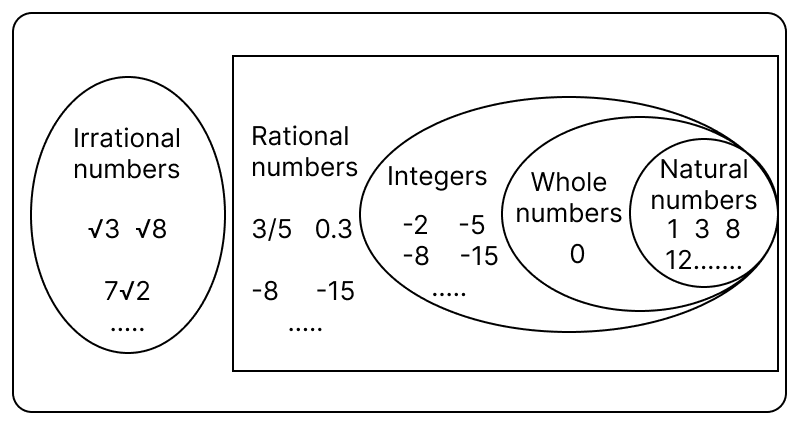
(i) Real numbers are numbers which include both rational and irrational numbers.
(ii) Every rational number can be expressed as , where p and q are integers and q ≠ 0.
(iii) Irrational numbers cannot be expressed as , where p and q are integers and q ≠ 0.
Answer the following questions :
(a) Is the difference between a rational number and an irrational number always rational?
(b) Is 0.5555 ....... a rational number ?
(c) Is 0.505005 ...... a rational number ?
(d) Is the product of irrational number (3 - ) and its rationalising factor a rational number?
Answer
(a) No, because rational - irrational = irrational
Example : 2 - is an irrational number as is an irrational number.
Hence, required answer is no.
(b) As 0.5555 is a repeating decimal number, so it is a rational number.
Hence, required answer is Yes.
(c) 0.505005 is non-terminating and non-repeating number.
So it is an irrational number, not a rational number.
Hence, required answer is No.
(d) Rationalizing factor of 3 - is 3 +
= (3 - ) × (3 - )
= (3)2 -
= 9 - 7
= 2.
2 is a rational number.
Hence, required answer is Yes.
According to Taruner Swapna Scheme of West Bengal Government, backward / economically disadvantaged students of West Bengal can receive financial aid and devices like Smartphones / Tablets for digital learning, bridging the digital gap and supporting online studies.

Rohan who resides in Purulia district of West Bengal received a tablet and he decided to complete his education through e-learning. One day he was studying number system, where he learnt about rational and irrational numbers, etc. He was particularly interested in irrational numbers like 7 + .
Based on the above information, answer the following :
(i) What is the rationalising factor of 7 + ?
(ii) What is the reciprocal of 7 + ? Are rationalising factor and reciprocal same?
(iii) If x = 7 + , then find the value of .
Answer
(i) For a number of the form a + , the rationalizing factor is a - .
So, for 7 + , the rationalizing factor is 7 - .
Hence rationalizing factor = 7 - .
(ii) Reciprocal of 7 + is :
Multiplying numerator and denominator by the rationalising factor :
=
=
= 7 - .
Hence, reciprocal of 7 + = 7 - . Thus, the reciprocal and the rationalising factor both are same.
(iii) Given,
x = 7 + ,
= 7 -
= 14.
Hence, value = 14.