Since, 90 = 2 x 3 x 3 x 5, 9023 is not a terminating decimal;
True
False
none of these
Answer
A fraction has a terminating decimal if, when simplified, its denominator consists solely of the prime factors 2 and/or 5.
90 = 2 x 3 x 3 x 5
Since, 90 consists 2, 3 and 5.
So, 9023 is not a terminating decimal.
Hence, option 1 is the correct option.
27 is irrational and 3 is also irrational, then which of the following is rational:
27−3
27+3
27×3
none of these
Answer
As we know that
⇒27×3=81=9.
9 is rational number. So, 27×3 is also a rational number.
Hence, option 3 is the correct option.
If x = 6−5, then x−x1 is equal to:
1
11
26
-2 5
Answer
Given, x = 6−5
⇒x1=6−51=6−51×(6+5)(6+5)=(6)2−(5)26+5=6−56+5=16+5
Now,
⇒x−x1=6−5−(16+5)=6−5−6−5=−25.
Hence, option 4 is correct option.
2−32+3−2+32−3 is equal to:
4
23
1
83
Answer
Given, 2−32+3−2+32−3
Solving,
⇒(2−3)×(2+3)(2+3)×(2+3)−(2+3)×(2−3)(2−3)×(2−3)⇒(2)2−(3)2(2+3)2−(2)2−(3)2(2−3)2⇒4−3(2)2+(3)2+2×2×3−4−3(2)2+(3)2−2×2×3⇒14+3+43−14+3−43⇒7+43−(7−43)⇒7+43−7+43⇒83.
Hence, option 4 is correct option.
Statement 1: If a = 33 and b = 125, then a x b is irrational.
Statement 2: a x b = 33×125=2315×3=215
Both the statements are true.
Both the statements are false.
Statement 1 is true, and statement 2 is false.
Statement 1 is false, and statement 2 is true.
Answer
Given, a = 33 and b = 125
⇒a×b=33×125=33×4×35=33×4×35=33×235=235×33=23153=215=7.5
7.5 is rational number. Thus, a x b is a rational number.
∴ Statement 1 is false, and statement 2 is true.
Hence, option 4 is correct option.
Statement 1: If x = 5+2, then x−x1=4.
Statement 2: x1=5+21×5−25−2=5−2
Both the statements are true.
Both the statements are false.
Statement 1 is true, and statement 2 is false.
Statement 1 is false, and statement 2 is true.
Answer
Given, x = 5 + 2
⇒x1=5+21=5+21×5−25−2=(5)2−(2)25−2=5−45−2=15−2=5−2.
So, statement 2 is true.
⇒x−x1=5+2−(5−2)=5+2−5+2=4.
So, statement 1 is true.
∴ Both statements are true.
Hence, option 1 is correct option.
Assertion (A): x+x1=4 and x1=2+3, then x =2−3
Reason (R):
x+x1=4⇒x+2+3=4⇒x=2−3
A is true, but R is false.
A is false, but R is true.
Both A and R are true, and R is the correct reason for A.
Both A and R are true, and R is the incorrect reason for A.
Answer
Given, x1=2+3 and x+x1=4
And,
⇒x+x1=4=x+2+3=4=x=4−(2+3)=x=4−2−3=x=2−3.
So, assertion (A) is true.
If, x1=2+3
⇒x=2+31=2+31×2−32−3 (On rationalizing)=(2)2−(3)22−3=4−32−3=12−3=2−3.
So, reason (R) is true.
∴ Both A and R are true, and R is the correct reason for A.
Hence, option 3 is correct option.
Assertion (A): 22,23,24,25,26 and 27 are irrational numbers between 21 and 28.
Reason (R): 25 is not an irrational number as 25 = 5; which is rational number.
A is true, but R is false.
A is false, but R is true.
Both A and R are true, and R is the correct reason for A.
Both A and R are true, and R is the incorrect reason for A.
Answer
Though all the given values 22,23,24,25,26,27 lie between 21 and 28
But 25 is not an irrational number, as 25 = 5, which is a rational number.
∴ A is false, but R is true.
Hence, option 2 is the correct option.
Simplify :
x−x2−y2x2+y2−y÷x2+y2+yx2−y2+x
Answer
Solving,
⇒x−x2−y2x2+y2−y÷x2+y2+yx2−y2+x⇒x−x2−y2x2+y2−y×x2−y2+xx2+y2+y⇒x2−(x2−y2)2(x2+y2)2−y2⇒x2−(x2−y2)x2+y2−y2⇒y2x2.
Hence, x−x2−y2x2+y2−y÷x2+y2+yx2−y2+x=y2x2.
Evaluate, correct to one place of decimal, the expression 20−105, if 5=2.2 and 10=3.2
Answer
Solving,
⇒20−105⇒25−105⇒2×2.2−3.25⇒4.4−3.25⇒1.25⇒1250⇒625=4.2
Another method of solving is by rationalizing,
⇒20−105×20+1020+10⇒(20)2−(10)25(20+10)⇒20−105(20+10)⇒105(20+10)⇒2(25+10)⇒22×2.2+3.2⇒24.4+3.2⇒27.6⇒3.8
Hence, x−x2−y2x2+y2−y÷x2+y2+yx2−y2+x = 3.8 or 4.2
If x = 3−2, find the value of :
(i) x+x1
(ii) x2+x21
(iii) x3+x31
(iv) x3+x31−3(x2+x21)+x+x1
Answer
(i) Given,
x = 3−2
x1=3−21
Rationalizing,
⇒3−21×3+23+2⇒(3)2−(2)23+2⇒3−23+2⇒3+2∴x1=3+2⇒x+x1=3−2+(3+2)=23.
Hence, x+x1=23.
(ii) Solving,
⇒x2+x21=(3−2)2+(3+2)2=(3)2+(2)2−2×3×2+(3)2+(2)2+2×3×2⇒3+2−26+2+3+26⇒10.
Hence, x2+x21=10.
(iii) Solving,
⇒x3+x31=(3−2)3+(3+2)3=(3)3−(2)3−3×3×2×(3−2)+(3)3+(2)3+3×3×2×(3+2)=33−22−36(3−2)+33+22+36(3+2)=33+33−22+22−318+312+318+312=63+612=63+6×23=63+123=183.
Hence, x3+x31=183.
(iv) Substituting values from part (i), (ii) and (iii), we get :
⇒x3+x31−3(x2+x21)+x+x1=183−3×10+23=203−30=10(23−3).
Hence, x3+x31−3(x2+x21)+x+x1=10(23−3).
State true or false :
(i) Negative of an irrational number is irrational.
(ii) The product of a non-zero rational number and an irrational number is a rational number.
Answer
(i) True
For example, 3 is irrational and −3 is also irrational.
(ii) False
For example, 2 is rational number and 2 is irrational, product of these numbers i.e. 22 is also irrational.
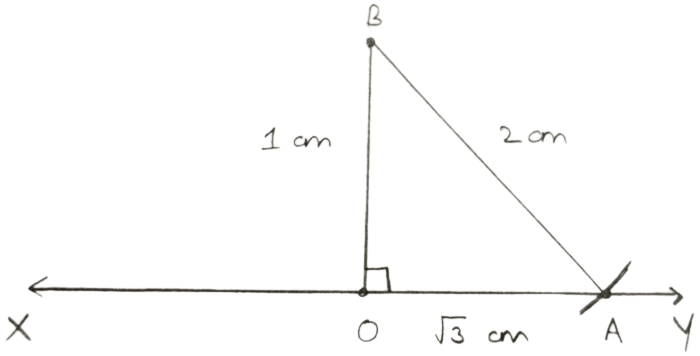
Draw a line segment of length 3 cm.
Answer
Steps of construction :
Draw a line segment XY.
Draw OB = 1 cm which is perpendicular to the line XY at point O.
From B draw an arc of 2 cm cutting XY at A.
Join BA and OA.
So, OAB is the right angle triangle.
By pythagoras theorem,
⇒ AB2 = OB2 + OA2
⇒ 22 = 12 + OA2
⇒ OA2 = 4 - 1
⇒ OA2 = 3
⇒ OA = 3 cm.
Hence, OA is the required line of 3 cm.
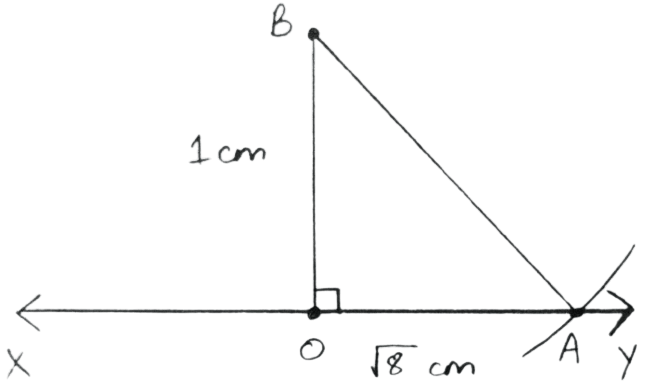
Draw a line segment of length 8 cm.
Answer
Steps of construction :
Draw a line segment XY.
Draw OB = 1 cm which is perpendicular to the line XY at O.
From B draw an arc of 3 cm cutting XY at A.
Join BA and OA.
So, OAB is the right angle triangle.
By pythagoras theorem,
⇒ AB2 = OB2 + OA2
⇒ 32 = 12 + OA2
⇒ OA2 = 9 - 1
⇒ OA2 = 8
⇒ OA = 8 cm.
Hence, OA is the required line of 8 cm.
Show that :
x3+x31=52, if x = 2 + 3
Answer
(i) Given,
x = 2 + 3
∴x1=2+31
Rationalizing,
⇒2+31×2−32−3⇒22−(3)22−3⇒4−32−3⇒2−3.∴x1=2−3
Substituting value of x and x1 in x3+x31, we get :
⇒x3+x31=(2+3)3+(2−3)3=23+(3)3+3×2×3×(2+3)+23−(3)3−3×2×3×(2−3)=8+33+63(2+3)+8−33−63(2−3)=8+8+33−33+123+18−123+18=8+8+18+18=52.
Hence, proved that x3+x31=52.
Show that :
x2+x21=34, if x =3+22.
Answer
Given,
x = 3+22
∴x1=3+221
Rationalizing,
⇒3+221×3−223−22⇒32−(22)23−22⇒9−83−22⇒3−22∴x1=3−22
Substituting value of x and x1 in x2+x21, we get :
⇒x2+x21=(3+22)2+(3−22)2⇒32+(22)2+2×3×22+32+(22)2−2×3×22⇒9+8+122+9+8−122⇒34.
Hence, proved that x2+x21=34.
Show that :
32+2332−23+3−223 = 11
Answer
Given,
Equation : 32+2332−23+3−223 = 11
Solving L.H.S. of the equation :
⇒32+2332−23+3−223⇒32(3+2)32(3−2)+3−223⇒3+23−2+3−223⇒(3)2−(2)2(3−2)2+23(3+2)⇒3−2(3)2+(2)2−2×3×2+6+26⇒13+2−26+6+26⇒11.
Since, L.H.S. = R.H.S.
Hence, proved that 32+2332−23+3−223 = 11.
Show that x is irrational, if :
(i) x2 = 6
(ii) x2 = 0.009
(iii) x2 = 27
Answer
(i) Given,
⇒ x2 = 6
⇒ x = 6
⇒ x = 2.449.....
Since, x is non-terminating as well as non-recurring.
Hence, proved that x is irrational.
(ii) Given,
⇒ x2 = 0.009
⇒ x = 0.009
⇒ x = 0.094.....
Since, x is non-terminating as well as non-recurring.
Hence, proved that x is irrational.
(iii) Given,
⇒ x2 = 27
⇒ x = 27
⇒ x = 5.196.....
Since, x is non-terminating as well as non-recurring.
Hence, proved that x is irrational.
Show that x is rational, if :
(i) x2 = 16
(ii) x2 = 0.0004
(iii) x2 = 197
Answer
(i) Given,
⇒ x2 = 16
⇒ x = 16
⇒ x = ±4.
Integers are considered as rational numbers.
Hence, proved that x is rational.
(ii) Given,
⇒ x2 = 0.0004
⇒ x = 0.0004
⇒ x = 0.02.
Terminating decimals are considered as rational numbers.
Hence, proved that x is rational.
(iii) Given,
⇒ x2 = 197
⇒ x2 = 916
⇒ x = 916
⇒ x = 34 = 1.333.....
Recurring decimals are considered as rational number.
Hence, proved that x is rational.
Find the value of :
1+21+2+31+...+2025+20261
Answer
Rationalizing a general term,
n+n+11
To rationalize, we multiply the numerator and denominator by the conjugate, (n+1−n):
n+1+n1×n+1−nn+1−n=(n+1)2−(n)2n+1−n=(n+1)−nn+1−n=n+1−n
Expanding the series,
First term: 1+21=2−1
Second term: 2+31=3−2
Third term: 3+41=4−3
...
Last term: 2025+20261=2026−2025
Adding all the series,
(2−1)+(3−2)+(4−3)+⋯+(2026−2025)
2−1+3−2+4−3+⋯+2026−2025
Everything cancels except the first and last term.
-1 + 2026.
Hence, solution = 2026 - 1.