
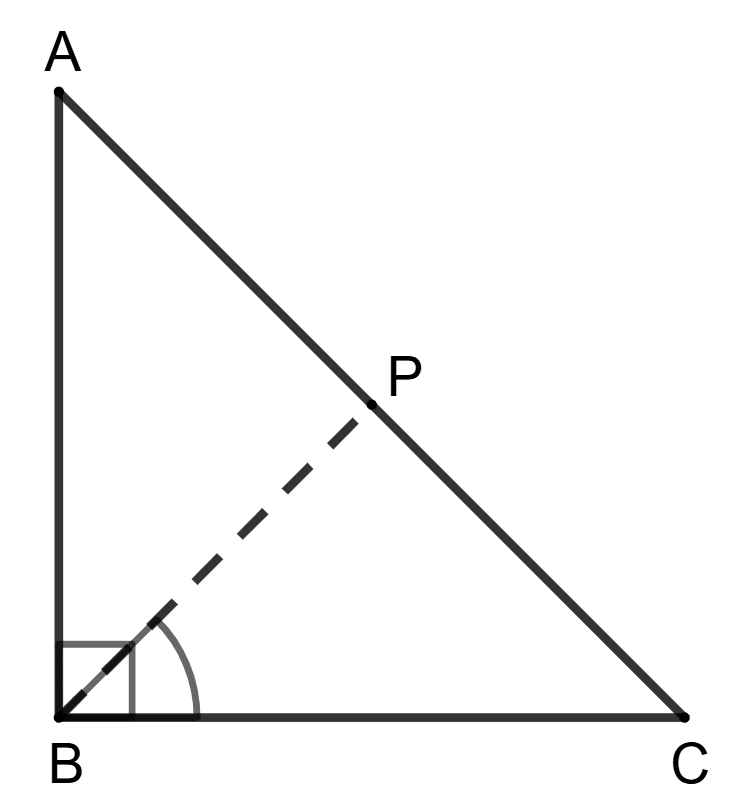
∠ABC = 90° and P is a point on side AC. Then:
PA = PB
PA > PB
PA < PB
none of these
Answer
In the right angled triangle ABC,
Let, ∠ACB = x
From figure,
⇒ ∠PCB = ∠ACB = x
⇒ ∠PBC = ∠PCB = x
By angle sum property of triangle,
⇒ ∠ABC + ∠ACB + ∠BAC = 180°
⇒ 90° + x + ∠BAC = 180°
⇒ ∠BAC = 180° - 90° - x = 90° - x
⇒ ∠BAP = ∠BAC = 90° - x.
From figure,
⇒ ∠ABP = ∠ABC - ∠PBC = 90° - x.
∴ ∠BAP = ∠ABP = 90° - x ...................(1)
In △ BAP,
⇒ ∠BAP = ∠ABP [From (1)]
∴ PB = PA (Sides opposite to equal angles in a triangle are equal)
Hence, option 1 is the correct option.
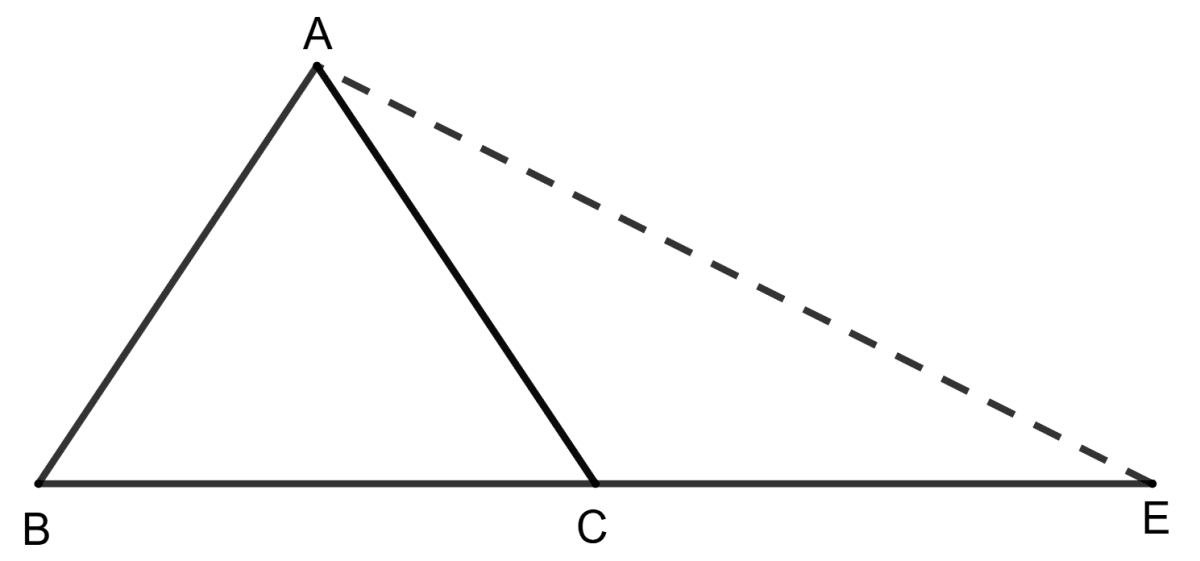
Triangles ABC is equilateral and BC = CE, then angle AEC is:
60°
45°
30°
120°
Answer
Since, ABC is an equilateral triangle, ∠A = ∠B = ∠C = 60°.
From figure,
⇒ ∠ACB + ∠ACE = 180° [Linear pairs]
⇒ 60° + ∠ACE = 180°
⇒ ∠ACE = 120°.
From figure, BC = CE (Given) ....................(1)
⇒ BC = AC (Side of equilateral triangle) ...................(2)
⇒ AC = CE (From equation (1) and (2))
⇒ ∠AEC = ∠CAE = y (let) [As angles opposite to equal sides of a triangle are equal]
By angle sum property in triangle AEC,
⇒ ∠AEC + ∠CAE + ∠ACE = 180°
⇒ y + y + 120° = 180°
⇒ 2y = 60°
⇒ y = 30°.
∴ ∠AEC = 30°.
Hence, option 3 is the correct option.
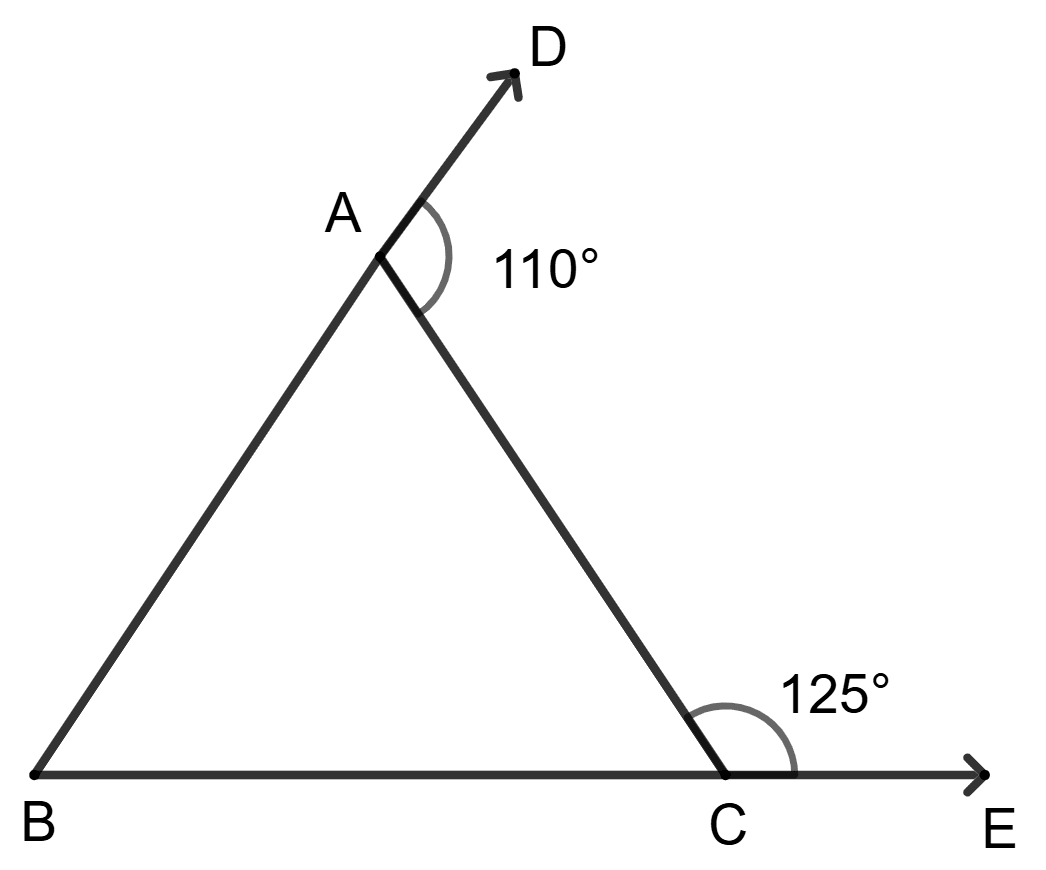
Side BA is produced upto point D and side BC upto point E such that ∠DAC = 110° and ∠ACE = 125°. Then the largest side of the triangle ABC is
AB
BC
AC
none of these
Answer
From figure, ∠DAC and ∠BAC forms linear pair.
⇒ ∠DAC + ∠BAC = 180°
⇒ 110° + ∠BAC = 180°
⇒ ∠BAC = 180° - 110°
⇒ ∠BAC = 70°
Similarly, ∠ACE and ∠ACB forms linear pair.
⇒ ∠ACE + ∠ACB = 180°
⇒ 125° + ∠ACB = 180°
⇒ ∠ACB = 180° - 125°
⇒ ∠ACB = 55°
In ΔABC, according to angle sum property,
⇒ ∠ABC + ∠ACB + ∠BAC = 180°
⇒ ∠ABC + 55° + 70° = 180°
⇒ ∠ABC + 125° = 180°
⇒ ∠ABC = 180° - 125°
⇒ ∠ABC = 55°
As we know that the side opposite to the largest angle in a triangle is the longest side.
Since, ∠BAC is the largest angle of the triangle.
So, BC is the largest side of the triangle ABC.
Hence, option 2 is the correct option.
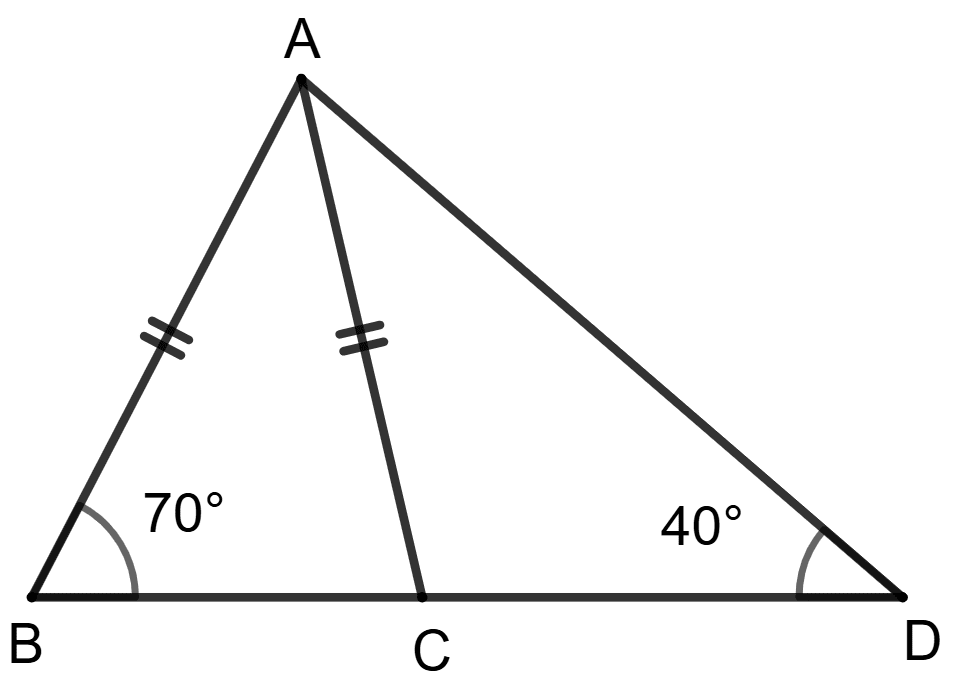
In the given figure,
AC = CD
AB > CD
AB < CD
none of these
Answer
Since, AB = AC.
∴ ∠ABC = ∠ACB = 70° (As angles opposite to equal sides of an isosceles triangle are equal.)
From figure,
⇒ ∠ACB + ∠ACD = 180° [Linear pairs]
⇒ 70° + ∠ACD = 180°
⇒ ∠ACD = 110°.
In △ACD,
⇒ ∠CAD + ∠ADC + ∠ACD = 180°
⇒ ∠CAD + 40° + 110° = 180°
⇒ ∠CAD + 150° = 180°
⇒ ∠CAD = 30°.
In △ACD,
∠ADC = 40°
∠CAD = 30°
∴ ∠ADC > ∠CAD
∴ AC > CD (As side opposite to greater angle is greater.)
Since, AB = AC,
∴ AB > CD.
Hence, option 2 is the correct option.
Statement (1): In the given figure, AC = DC = BD and ∠B = 30°. Then ΔCAD will be equilateral.
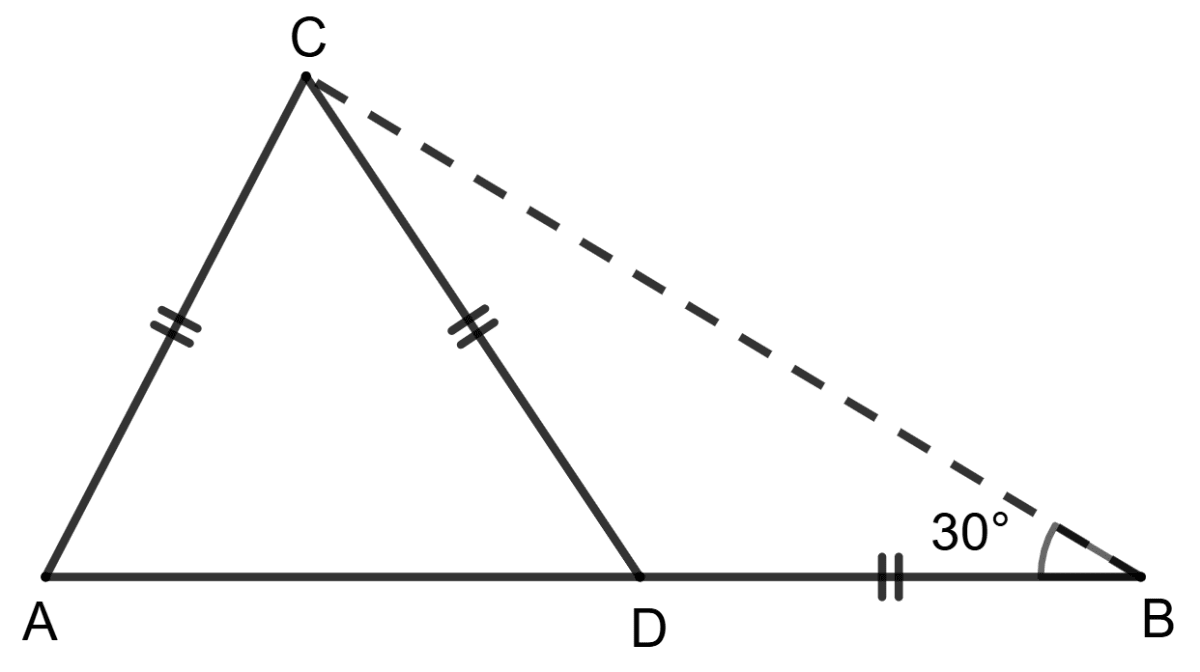
Statement (2): ∠CDA = ∠CAD
= 30° + 30° = 60°
Both the statements are true.
Both the statements are false.
Statement 1 is true, and statement 2 is false.
Statement 1 is false, and statement 2 is true.
Answer
In ΔBDC,
⇒ DC = DB
⇒ ∠DBC = ∠DCB = 30° (Angles opposite to equal sides of a triangle are always equal)
In ΔBDC, according to angle sum property,
⇒ ∠BDC + ∠DBC + ∠DCB = 180°
⇒ ∠BDC + 30° + 30° = 180°
⇒ ∠BDC + 60° = 180°
⇒ ∠BDC = 180° - 60°
⇒ ∠BDC = 120°
Since ∠BDC and ∠CDA forms linear pair.
⇒ ∠BDC + ∠CDA = 180°
⇒ 120° + ∠CDA = 180°
⇒ ∠CDA = 180° - 120°
⇒ ∠CDA = 60°
Since, AC = DC
⇒ ∠CDA = ∠CAD = 60° (Angles opposite to equal sides of a triangle is always equal)
In ΔACD, according to angle sum property,
⇒ ∠ACD + ∠CDA + ∠CAD = 180°
⇒ ∠ACD + 60° + 60° = 180°
⇒ ∠ACD + 120° = 180°
⇒ ∠ACD = 180° - 120°
⇒ ∠ACD = 60°
So, ΔCAD is equilateral.
∴ Both the statements are true.
Hence, option 1 is the correct option.
Statement (1): AB = AC and D is any point in side BC of △ABC. Then AB will be greater than AD.
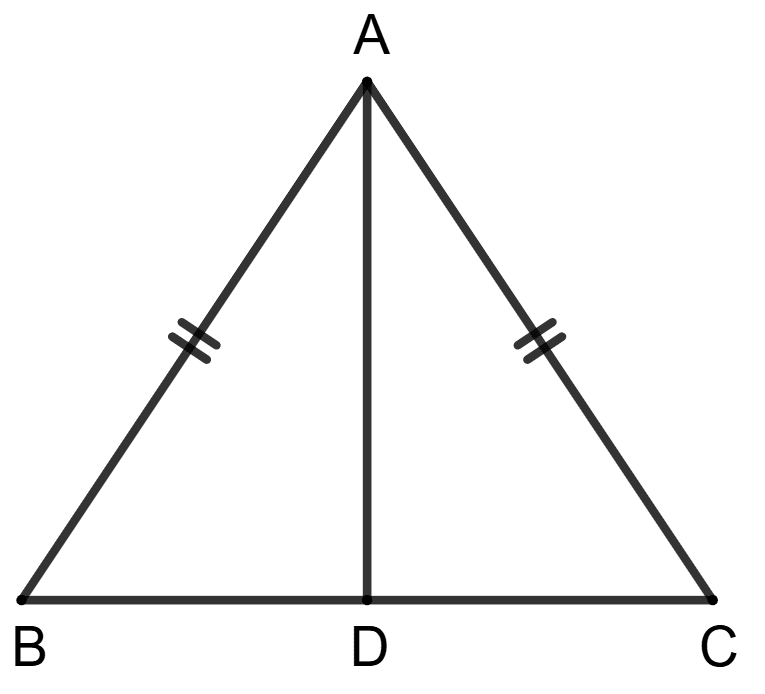
Statement (2): AB = AC
⇒ ∠C = ∠B
In ΔADC, ∠ADB = ∠C + ∠DAC
⇒ ∠ADB > ∠C
⇒ ∠ADB > ∠B
So, AB > AD
Both the statements are true.
Both the statements are false.
Statement 1 is true, and statement 2 is false.
Statement 1 is false, and statement 2 is true.
Answer
Since AB = AC, ΔABC is an isosceles triangle.
The angles opposite to equal sides of a triangle are equal.
⇒ ∠B = ∠C
∠ADB is an exterior angle to ΔADC.
Therefore, ∠ADB > ∠C
⇒ ∠ADB > ∠B
⇒ AB > AD (Side opposite to the largest angle in a triangle is the longest side)
∴ Both the statements are true.
Hence, option 1 is the correct option.
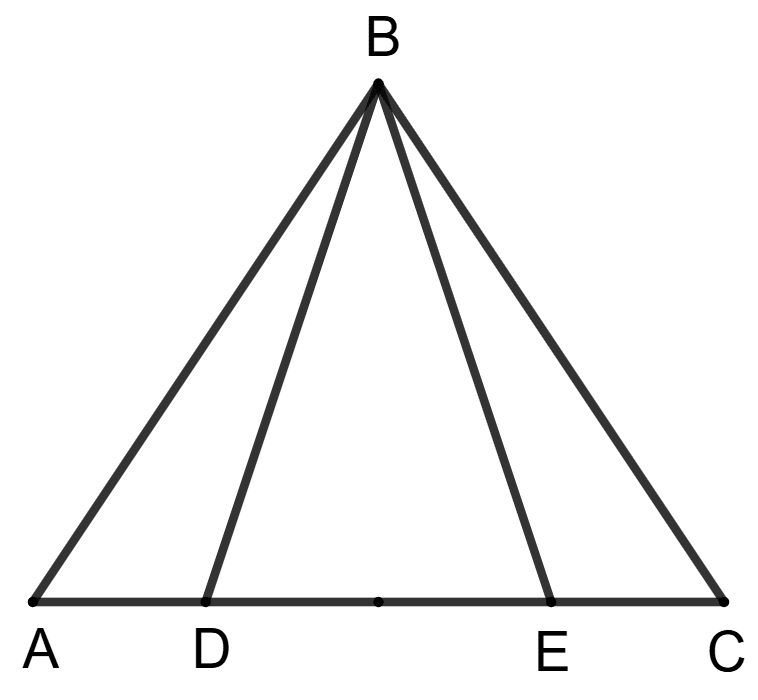
Assertion (A): In the given figure, AB = BC and AD = CE. Then BD will be equal to BE.
Reason (R): ΔBAD ≅ ΔBCE by SAS.
A is true, but R is false.
A is false, but R is true.
Both A and R are true and R is the correct reason for A.
Both A and R are true and R is the incorrect reason for A.
Answer
It is given that AB = BC.
⇒ ∠BAC = ∠BCA [Angles opposite to equal sides of the triangle are also equal]
⇒ ∠BAD = ∠BCE ..................(1)
In ΔBAD and ΔBCE,
⇒ AB = BC [Given]
⇒ AD = CE [Given]
⇒ ∠BAD = ∠BCE
∴ ΔBAD ≅ ΔBCE (By SAS congruency criterion)
So, reason (R) is true.
By C.P.C.T.,
BE = BD
So, assertion (A) is true.
∴ Both A and R are true and R is the correct reason for A.
Hence, option 3 is the correct option.
Assertion (A): In the given figure, S is any point on side QR.
∴ PQ + QR + RP > 2PS
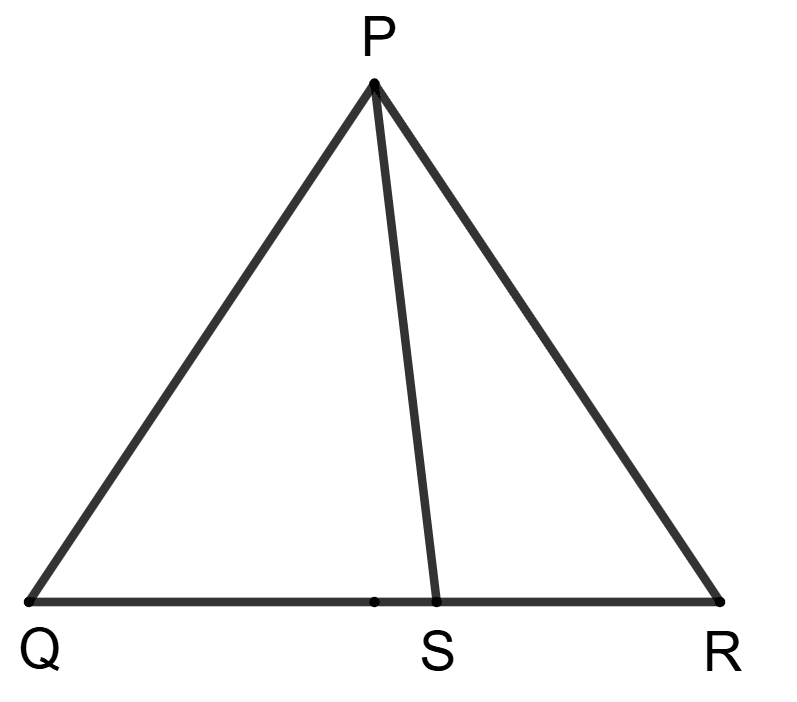
Reason (R): In ΔPQS, PQ + QS > PS and in ΔPRS, PR + SR > PS
A is true, but R is false.
A is false, but R is true.
Both A and R are true and R is the correct reason for A.
Both A and R are true and R is the incorrect reason for A.
Answer
In △ PQS,
⇒ PQ + QS > PS ......(1) [Sum of any two sides of a triangle is greater than the third side]
In △ PRS,
⇒ RP + RS > PS ......(2) [Sum of any two sides of a triangle is greater than the third side]
So, reason (R) is true.
Adding equations (1) and (2), we get :
⇒ PQ + QS + RP + RS > PS + PS
⇒ PQ + (QS + RS) + RP > 2PS
⇒ PQ + QR + RP > 2PS.
So, assertion (A) is true.
∴ Both A and R are true, and R is the correct reason for A.
Hence, option 3 is the correct option.
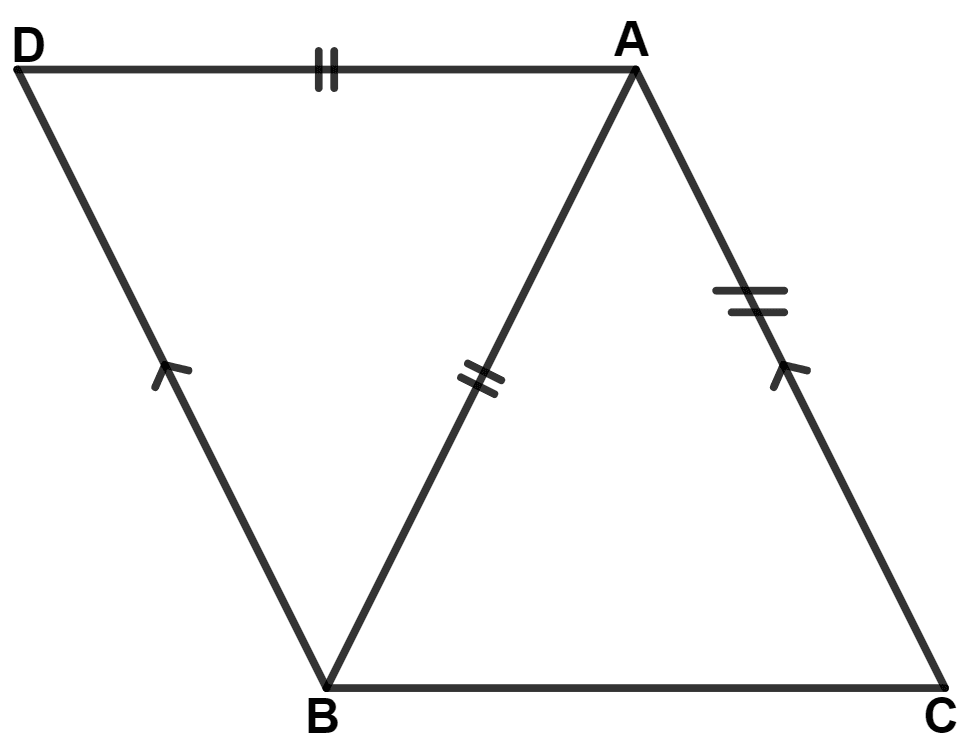
In the figure given alongside, AD = AB = AC, BD is parallel to CA and angle ACB = 65°. Find angle DAC.
Answer
From figure,
In △ ABC,
⇒ AB = AC (Given)
⇒ ∠ABC = ∠ACB = 65° (Angles opposite to equal sides are equal)
By angle sum property of triangle,
⇒ ∠ABC + ∠ACB + ∠BAC = 180°
⇒ 65° + 65° + ∠BAC = 180°
⇒ 130° + ∠BAC = 180°
⇒ ∠BAC = 180° - 130° = 50°.
Given,
BD || CA
∴ ∠DBA = ∠BAC = 50° (Alternate angles are equal)
In △ DAB,
⇒ AD = AB (Given)
⇒ ∠ADB = ∠DBA = 50° (Angles opposite to equal sides are equal)
By angle sum property of triangle,
⇒ ∠ADB + ∠DBA + ∠DAB = 180°
⇒ 50° + 50° + ∠DAB = 180°
⇒ 100° + ∠DAB = 180°
⇒ ∠DAB = 180° - 100° = 80°.
From figure,
⇒ ∠DAC = ∠DAB + ∠BAC = 80° + 50° = 130°.
Hence, ∠DAC = 130°.
Prove that a triangle ABC is isosceles, if :
(i) altitude AD bisects angle BAC or,
(ii) bisector of angle BAC is perpendicular to base BC.
Answer
Let AD be the altitude on side BC.
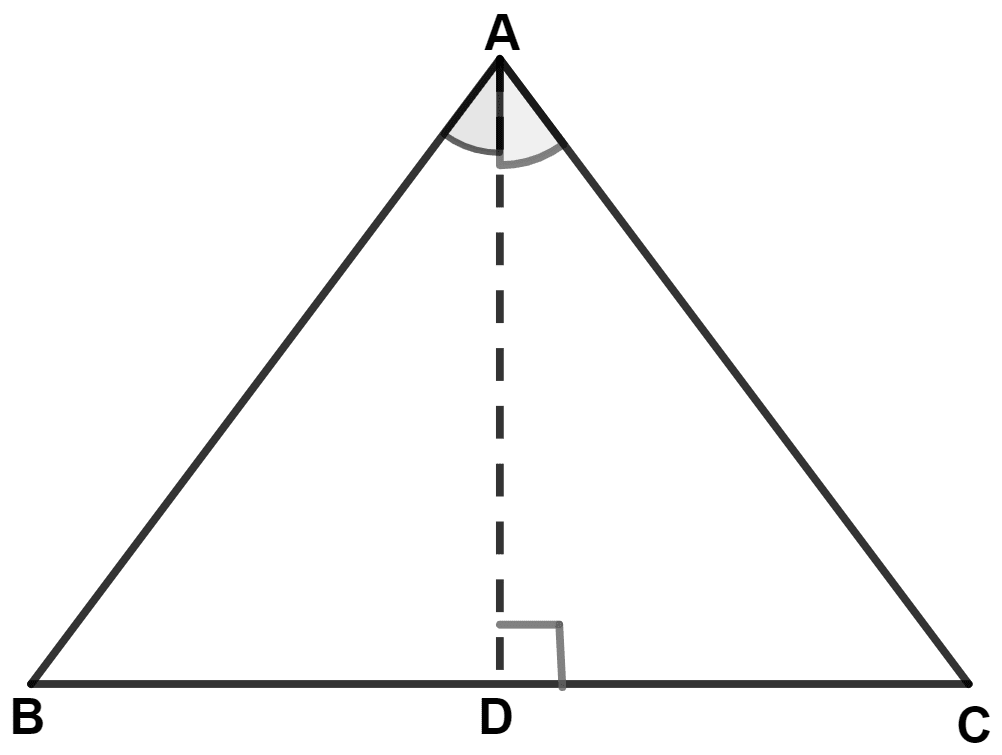
We know that,
Altitude from a point is always perpendicular to other side.
Let altitude AD bisect angle BAC.
Hence, segment AD satisfies both the conditions.
In △ ADB and △ ADC,
⇒ AD = AD (Common side)
⇒ ∠BAD = ∠CAD (Since, AD bisects angle BAC)
⇒ ∠ADB = ∠ADC (Since, AD is altitude to side BC)
∴ Δ ADB ≅ Δ ADC (By A.S.A. axiom)
We know that,
Corresponding parts of congruent triangle are equal.
⇒ AB = AC.
Hence, proved that ABC is an isosceles triangle.
In △ABC, angle ∠ACB = 90°. D is a point on side AB so that DA = DC.
(i) Prove that △BDC is an isosceles triangle.
(ii) If ∠BDC = 60°, show that ∠A = 30°.
Answer
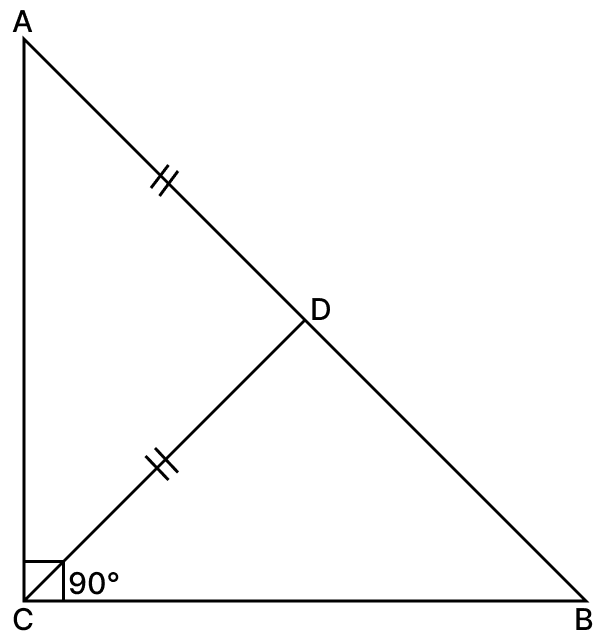
(i) In △ADC,
Since AD = DC, △ADC is an isosceles triangle.
In isosceles triangle, angles opposite to equal sides are equal.
∴ ∠DAC = ∠DCA.
Let ∠DCA be 'x'.
In △ABC,
∠ACB = 90°
⇒ ∠ACB = ∠DCA + ∠DCB
⇒ ∠DCB = ∠ACB - ∠DCA
⇒ ∠DCB = 90° - x ........(1)
By angle sum property of triangle,
In triangle ABC,
⇒ ∠ACB + ∠A + ∠B = 180°
⇒ ∠B = 180° - (∠ACB + ∠A)
⇒ ∠B = 180° - (90° + x)
⇒ ∠B = 90° - x ........(2)
From equation (1) & (2), we get :
∠DCB = ∠B
Since, ∠DCB = ∠B, the sides opposite to them must be equal (CD = BD)
∴ △BDC is an isosceles triangle.
Hence, proved that △BDC is an isosceles triangle.
(ii) Given, ∠BDC = 60°
From figure,
∠ADC + ∠BDC = 180°
∠ADC + 60° = 180°
∠ADC = 120°
Since, triangle ADC is an isosceles triangle, with AD = CD.
Thus, ∠DAC = ∠DCA = a (let)
By angle sum property of triangle,
∠DAC + ∠DCA + ∠ADC = 180°
a + a + 120° = 180°
2a = 180° - 120°
2a = 60°
a = = 30°.
Hence proved that ∠A = 30°.
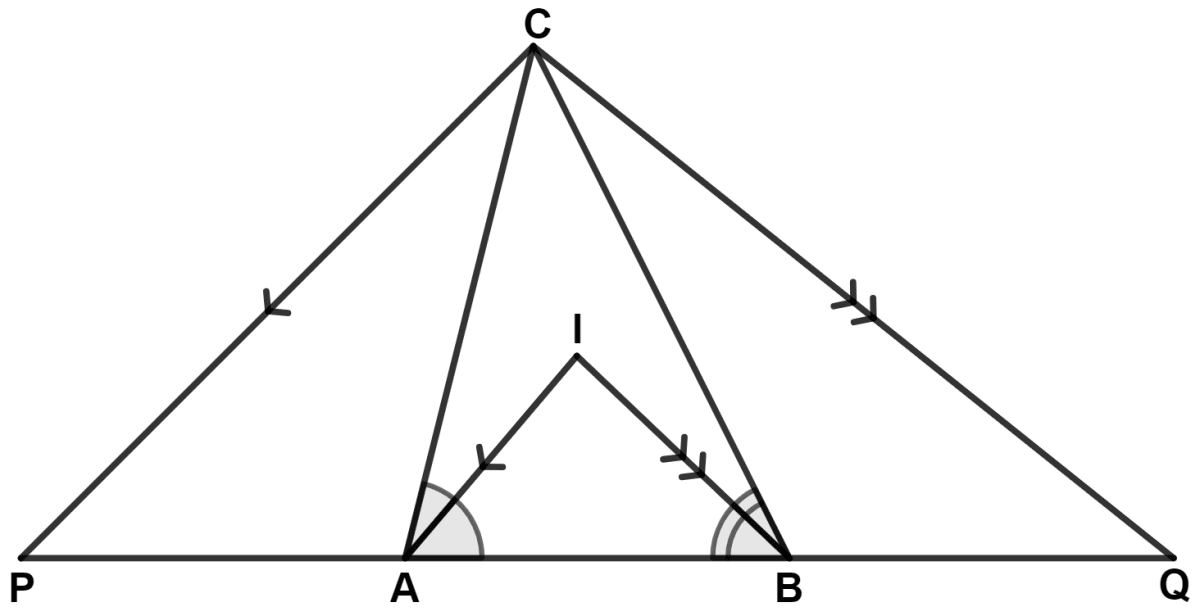
In the following figure; IA and IB are bisectors of angles CAB and CBA respectively. CP is parallel to IA and CQ is parallel to IB.
Prove that :
PQ = The perimeter of Δ ABC.
Answer
From figure,
IA || CP and CA is a transversal.
⇒ ∠CAI = ∠PCA (Alternate angles are equal) .........(1)
Also, IA || CP and AP is a transversal
⇒ ∠IAB = ∠APC (Corresponding angles are equal) ......(2)
Since, IA is the bisector of ∠CAB.
∴ ∠CAI = ∠IAB .........(3)
Substituting values from equation (1) and (2) in equation (3), we get :
⇒ ∠PCA = ∠APC
⇒ AC = AP (Sides opposite to equal angles are equal)
From figure,
IB || CQ and CB is a transversal.
⇒ ∠CBI = ∠QCB (Alternate angles are equal) .........(4)
Also, IB || CQ and BQ is a transversal
⇒ ∠IBA = ∠BQC (Corresponding angles are equal) ......(5)
Since, IB is the bisector of ∠CBA.
∴ ∠CBI = ∠IBA .........(6)
Substituting values from equation (4) and (5) in equation (6), we get :
⇒ ∠QCB = ∠BQC
⇒ BQ = BC (Sides opposite to equal angles are equal)
From figure,
PQ = AP + AB + BQ = AC + AB + BC
= Perimeter of △ ABC.
Hence, proved that PQ = Perimeter of △ ABC.
The given figure shows an equilateral triangle ABC with each side 15 cm. Also DE // BC, DF // AC and EG //AB. If DE + DF + EG = 20 cm, find FG.
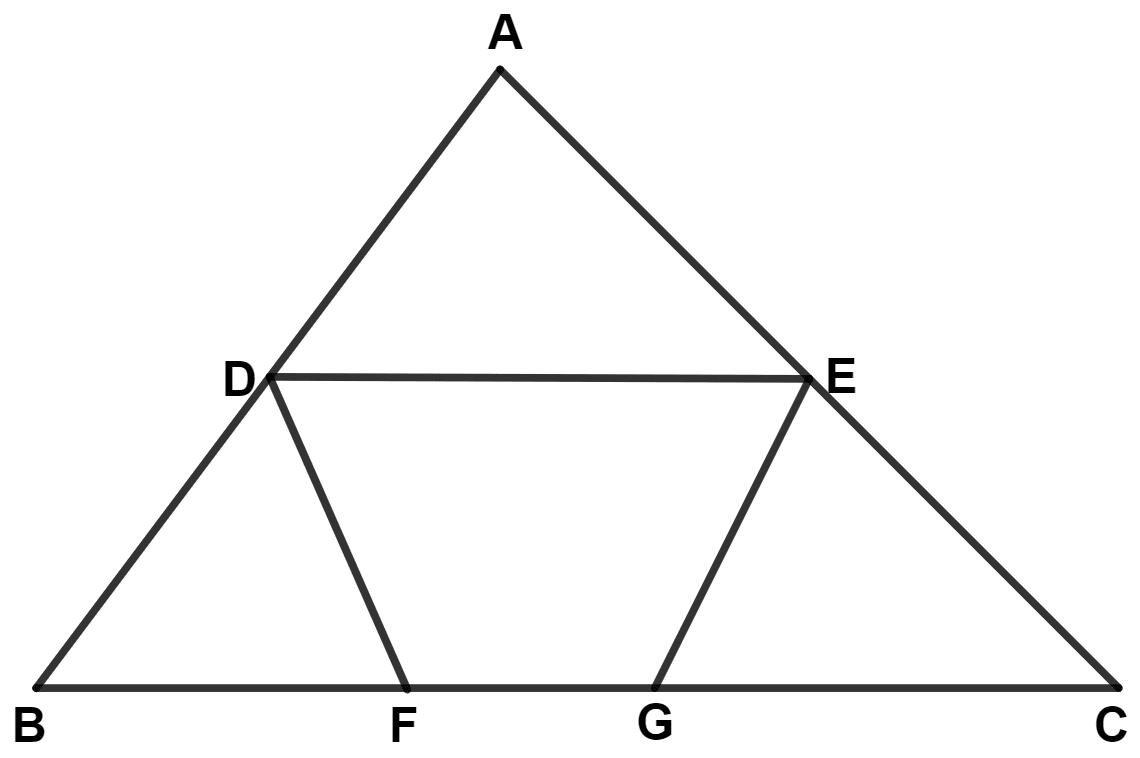
Answer
Given,
ABC is an equilateral triangle.
∴ AB = BC = AC = 15 cm and ∠A = ∠B = ∠C = 60°.
In △ ADE,
⇒ ∠ADE = ∠ABC = 60° (Corresponding angles are equal)
⇒ ∠AED = ∠ACB = 60° (Corresponding angles are equal)
By angle sum property of triangle,
⇒ ∠AED + ∠ADE + ∠DAE = 180°
⇒ 60° + 60° + ∠DAE = 180°
⇒ ∠DAE + 120° = 180°
⇒ ∠DAE = 180° - 120° = 60°.
∴ △ ADE is an equilateral triangle with each side equal to x cm.
∴ AD = DE = EA = x cm.
In △ BDF,
⇒ ∠BFD = ∠BCA = 60° (Corresponding angles are equal)
⇒ ∠DBF = ∠B = 60°
By angle sum property of triangle,
⇒ ∠BFD + ∠DBF + ∠BDF = 180°
⇒ 60° + 60° + ∠BDF = 180°
⇒ ∠BDF + 120° = 180°
⇒ ∠BDF = 180° - 120° = 60°.
∴ △ BDF is an equilateral triangle with each side equal to y cm.
∴ DB = BF = FD = y cm.
In △ EGC,
⇒ ∠EGC = ∠ABC = 60° (Corresponding angles are equal)
⇒ ∠ECG = ∠C = 60°
By angle sum property of triangle,
⇒ ∠EGC + ∠ECG + ∠GEC = 180°
⇒ 60° + 60° + ∠GEC = 180°
⇒ ∠GEC + 120° = 180°
⇒ ∠GEC = 180° - 120° = 60°.
∴ △ EGC is an equilateral triangle with each side equal to z cm.
∴ EG = GC = CE = z cm.
Given,
⇒ AB = 15
⇒ AD + BD = 15
⇒ x + y = 15 ..........(1)
⇒ AC = 15
⇒ AE + EC = 15
⇒ x + z = 15 ..........(2)
Given,
⇒ DE + DF + EG = 20
⇒ x + y + z = 20
⇒ 15 + z = 20 [From equation (1)]
⇒ z = 20 - 15 = 5 cm.
Substituting value of z in equation (2), we get :
⇒ x + 5 = 15
⇒ x = 15 - 5 = 10 cm.
Substituting value of x in equation (1), we get :
⇒ 10 + y = 15
⇒ y = 15 - 10 = 5 cm.
From figure,
⇒ BC = 15 cm
⇒ BF + FG + GC = 15
⇒ y + FG + z = 15
⇒ 5 + FG + 5 = 15
⇒ FG + 10 = 15
⇒ FG = 15 - 10 = 5 cm.
Hence, FG = 5 cm.
In triangle ABC, bisector of angle BAC meets opposite side BC at point D. If BD = CD, prove that △ ABC is isosceles.
Answer
Produce AD upto E such that AD = DE.
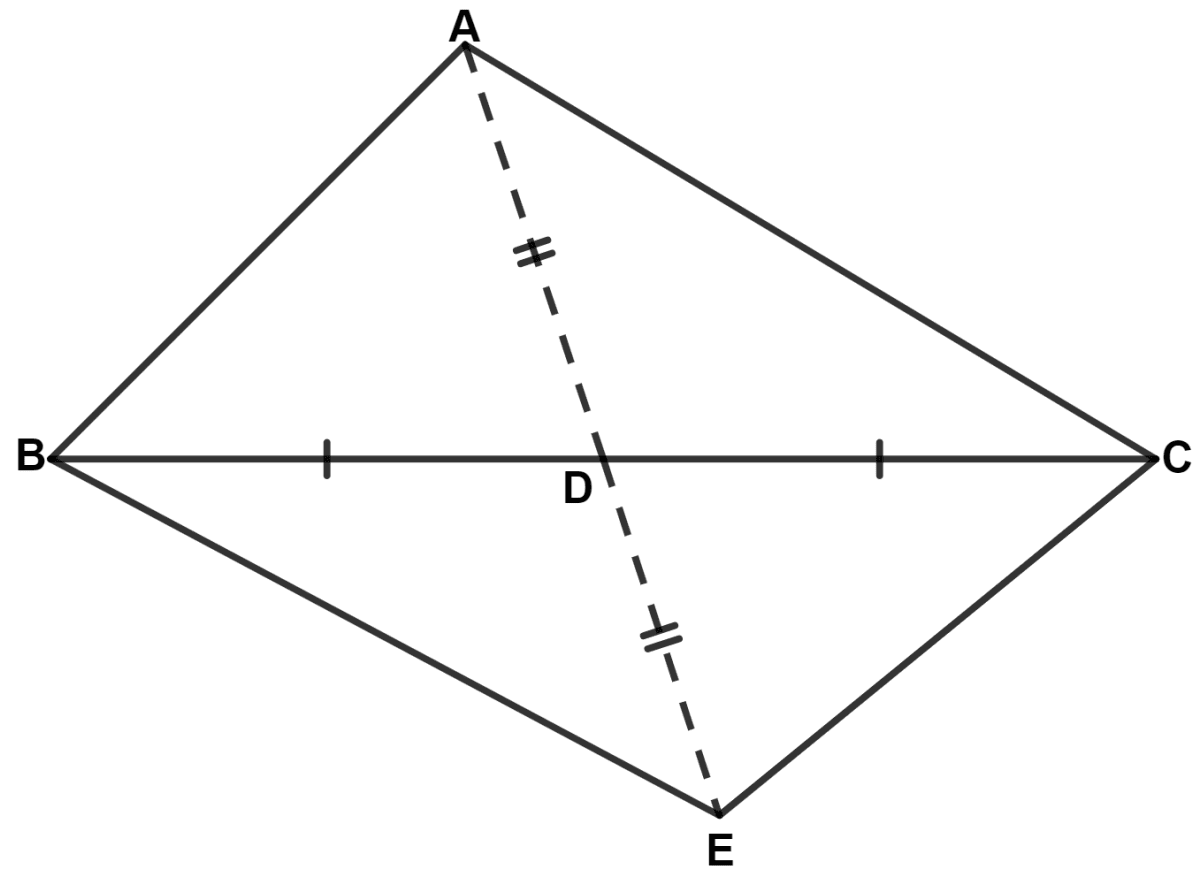
In △ ABD and △ EDC,
⇒ AD = DE (Given)
⇒ BD = CD (Given)
⇒ ∠ADB = ∠EDC (Vertically opposite angles are equal)
∴ △ ABD ≅ △ EDC (By S.A.S. axiom)
We know that,
Corresponding parts of congruent triangle are equal.
⇒ AB = CE .........(1)
⇒ ∠BAD = ∠CED
⇒ ∠BAD = ∠CAD (As AD is the bisector BAC)
∴ ∠CAD = ∠CED
∴ CE = AC (Sides opposite to equal angles are equal) ..........(2)
From equations (1) and (2), we get :
⇒ AB = AC.
Hence, proved that ABC is an isosceles triangle.
In Δ ABC, D is a point on BC such that AB = AD = BD = DC. Show that :
∠ADC : ∠C = 4 : 1.
Answer
Given,
AB = AD = BD
∴ Δ ABD is an equilateral triangle.
∴ ∠ABD = ∠ADB = ∠BAD = 60°.
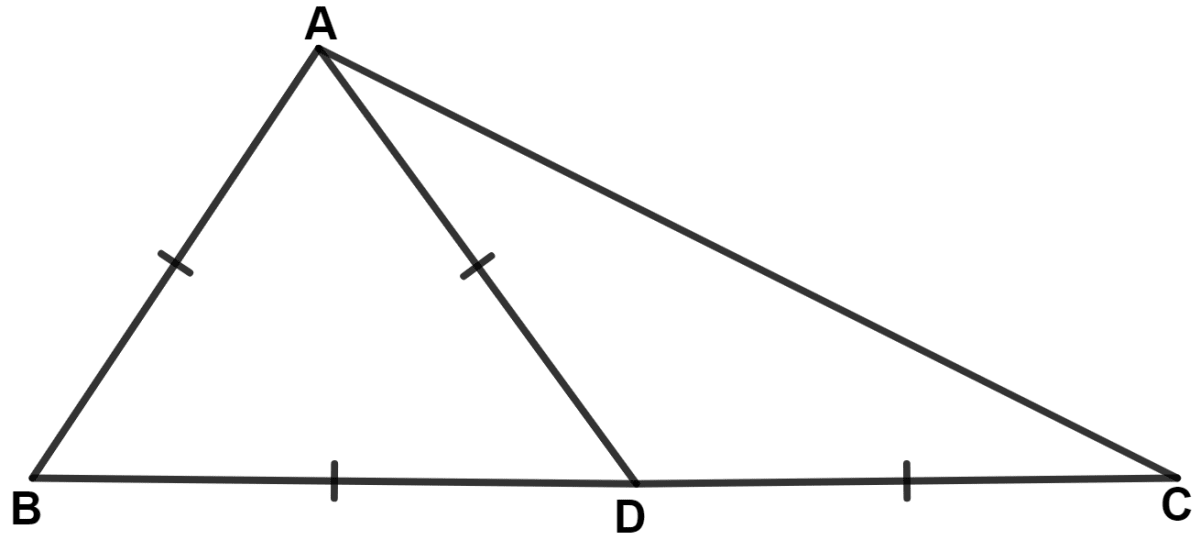
Since, BDC is a straight line.
∴ ∠ADB + ∠ADC = 180°
⇒ 60° + ∠ADC = 180°
⇒ ∠ADC = 180° - 60° = 120°.
In Δ ADC,
⇒ AD = DC (Given)
∴ ∠DAC = ∠DCA = x (let) [Angles opposite to equal sides are equal]
By angle sum property of triangle,
⇒ ∠DAC + ∠DCA + ∠ADC = 180°
⇒ x + x + 120° = 180°
⇒ 2x = 180° - 120°
⇒ 2x = 60°
⇒ x = = 30°
⇒ ∠DCA = ∠C = 30°.
⇒ ∠ADC : ∠C = 120° : 30° = 4 : 1.
Hence, proved that ∠ADC : ∠C = 4 : 1.
Using the information, given in each of the following figures, find the values of a and b.
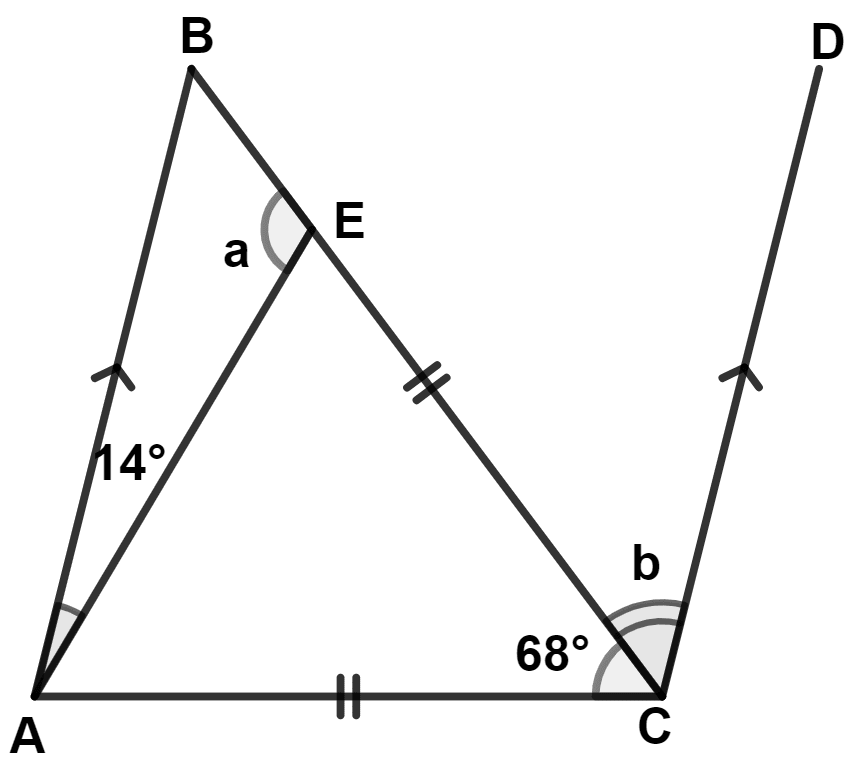
Answer
In △ CAE,
⇒ AC = CE (Given)
∴ ∠AEC = ∠EAC = x (let) [Angles opposite to equal sides are equal]
By angle sum property of triangle,
⇒ ∠AEC + ∠EAC + ∠ACE = 180
⇒ x + x + 68° = 180°
⇒ 2x = 180° - 68°
⇒ 2x = 112°
⇒ x = = 56°
⇒ ∠AEC = ∠EAC = 56°.
Since, B, E and C are in a straight line.
∴ ∠BEA + ∠AEC = 180°
⇒ a + 56° = 180°
⇒ a = 180° - 56° = 124°.
In △ ABE,
By angle sum property of triangle,
⇒ ∠ABE + ∠BEA + ∠EAB = 180°
⇒ ∠ABE + 124° + 14° = 180°
⇒ ∠ABE + 138° = 180°
⇒ ∠ABE = 180° - 138° = 42°.
Since, AB || CD
⇒ b = ∠ABE = 42°. (Alternate angles are equal)
Hence, a = 124° and b = 42°.
Using the information, given in each of the following figures, find the values of a and b.
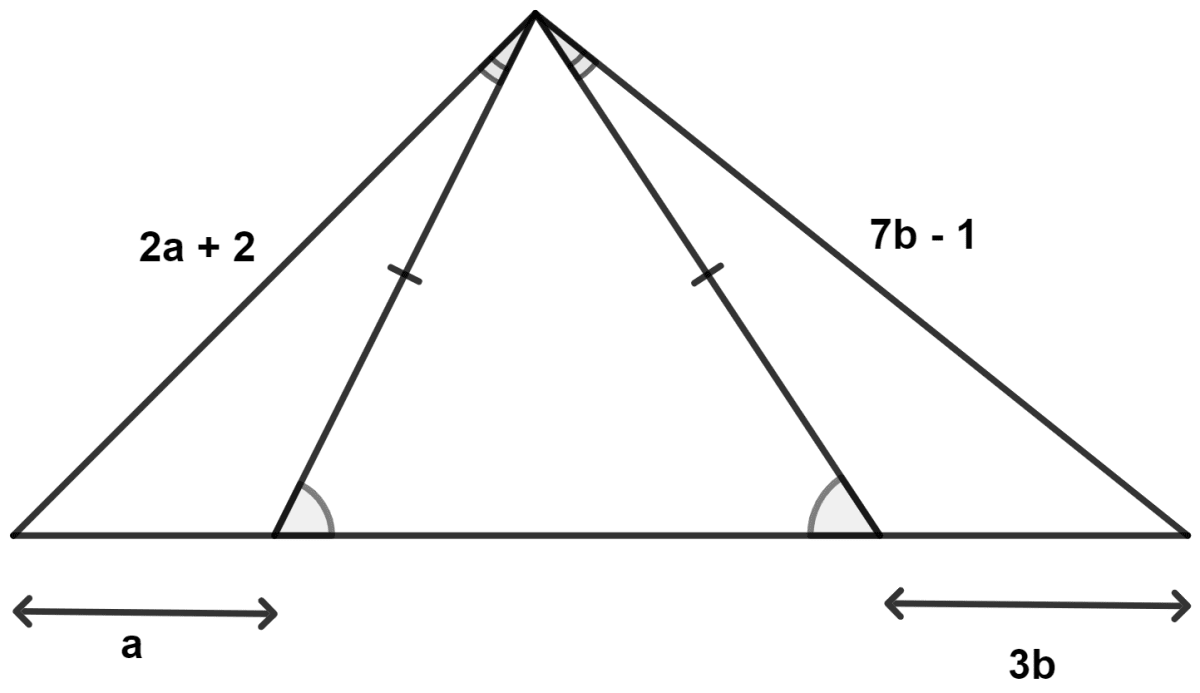
Answer
In △ ADE,
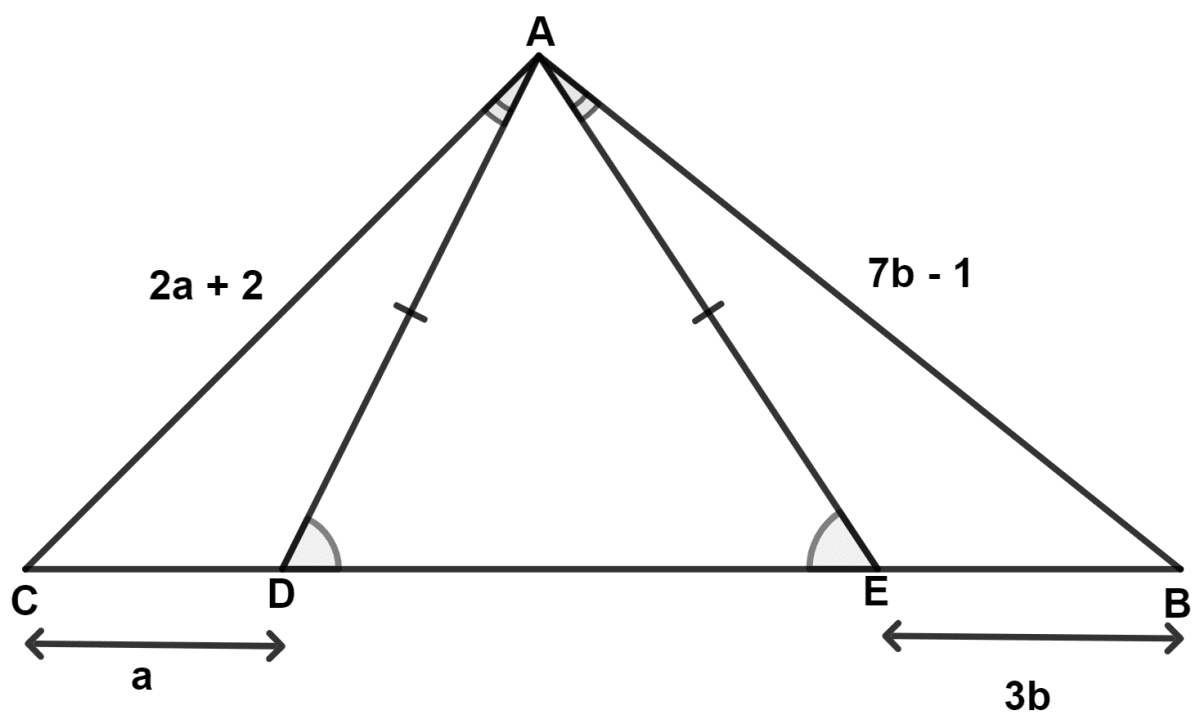
⇒ AD = AE (Given)
∴ ∠ADE = ∠AED (Angles opposite to equal sides are equal)
⇒ 180° - ∠ADE = 180° - ∠AED
⇒ ∠ADC = ∠AEB
In △ ABE and △ CAD,
⇒ ∠EAB = ∠CAB (Given)
⇒ ∠ADC = ∠AEB (Proved above)
⇒ AE = AD (Given)
∴ △ ABE ≅ △ CAD (By A.S.A. axiom)
We know that,
Corresponding sides of congruent triangle are equal.
∴ AC = AB and CD = EB.
Considering CD = EB,
⇒ a = 3b .........(1)
Considering AC = AB,
⇒ 2a + 2 = 7b - 1
Substituting value of a from equation (1) in above equation, we get :
⇒ 2(3b) + 2 = 7b - 1
⇒ 6b + 2 = 7b - 1
⇒ 7b - 6b = 2 + 1
⇒ b = 3.
Substituting value of b in equation (1), we get :
⇒ a = 3(3) = 9.
Hence, a = 9 and b = 3.
In the following figure; AB is the largest side and BC is the smallest side of triangle ABC.
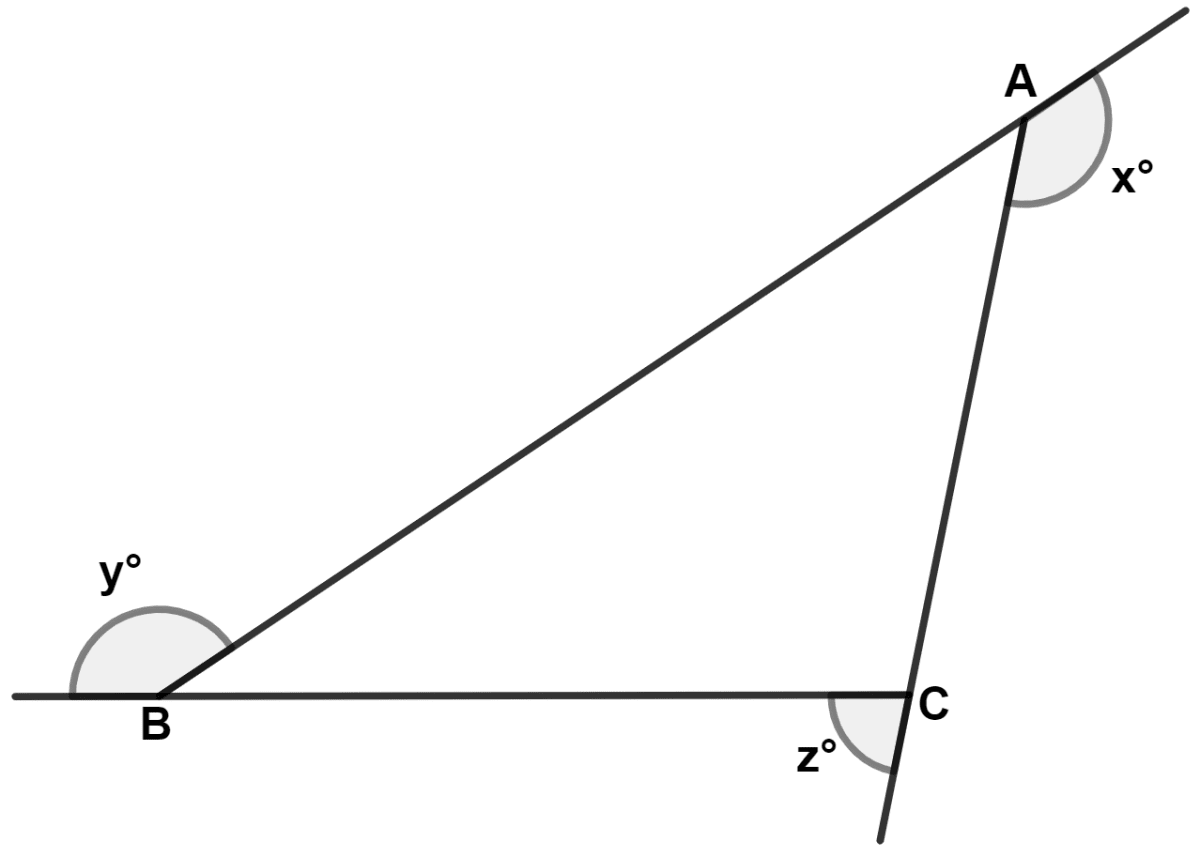
Write the angles x°, y° and z° in ascending order of their values.
Answer
Given,
AB is the largest side and BC is the smallest side of triangle ABC.
∴ AB > AC > BC
⇒ ∠C > ∠B > ∠A (If two sides of a triangle are unequal, the greater side has the greater angle opposite to it.)
⇒ 180° - ∠C < 180° - ∠B < 180° - ∠A
⇒ z° < y° < x°.
Hence, z° < y° < x°.
In quadrilateral ABCD, side AB is the longest and side DC is the shortest. Prove that :
(i) ∠C > ∠A
(ii) ∠D > ∠B
Answer
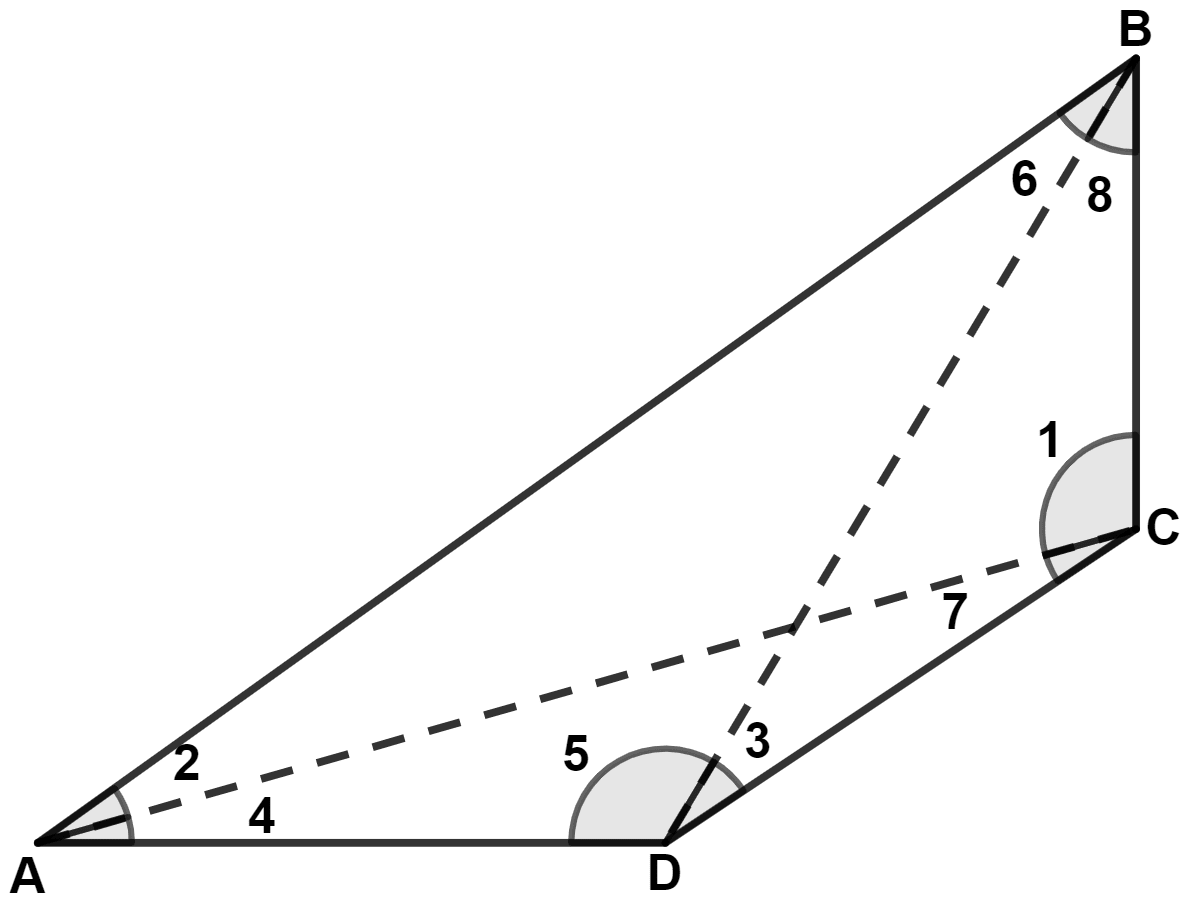
(i) Given,
In quadrilateral ABCD,
AB is the longest sides and DC is the shortest side.
Join BD and AC.
In △ ABC,
⇒ AB > BC
∴ ∠1 > ∠2 .......(1) [If two sides of a triangle are unequal, the greater side has the greater angle opposite to it.]
In △ ADC,
⇒ AD > DC
∴ ∠7 > ∠4 .......(2) [If two sides of a triangle are unequal, the greater side has the greater angle opposite to it.]
Adding equations (1) and (2), we get :
⇒ ∠1 + ∠7 > ∠2 + ∠4
⇒ ∠C > ∠A.
Hence, proved that ∠C > ∠A.
(ii) In △ ABD,
⇒ AB > AD
∴ ∠5 > ∠6 .......(1) [If two sides of a triangle are unequal, the greater side has the greater angle opposite to it.]
In △ BDC,
⇒ BC > CD
∴ ∠3 > ∠8 .......(2) [If two sides of a triangle are unequal, the greater side has the greater angle opposite to it.]
Adding equations (1) and (2), we get :
⇒ ∠5 + ∠3 > ∠6 + ∠8
⇒ ∠D > ∠B.
Hence, proved that ∠D > ∠B.
In triangle ABC, side AC is greater than side AB. If the internal bisector of angle A meets the opposite side at point D, prove that : ∠ADC is greater than ∠ADB.
Answer
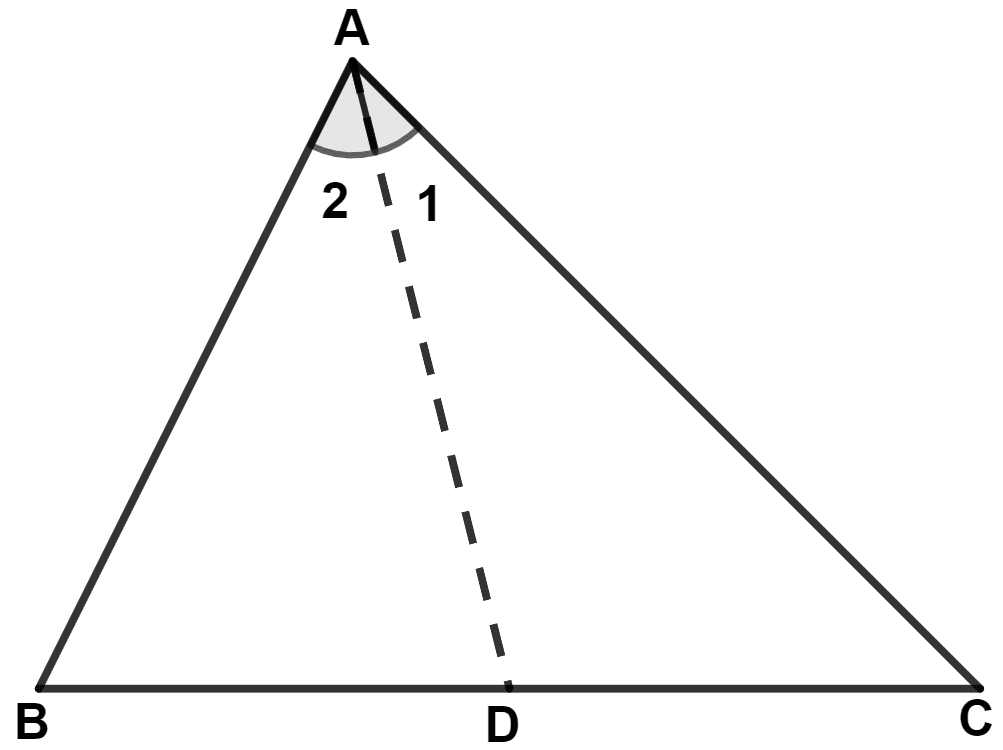
In △ ADC,
⇒ ∠ADB = ∠1 + ∠C [In a triangle an exterior angle is equal to the sum of two opposite interior angles.] .........(1)
In △ ADB,
⇒ ∠ADC = ∠2 + ∠B [In a triangle an exterior angle is equal to the sum of two opposite interior angles.] .........(2)
In △ ABC,
⇒ AC > AB (Given)
⇒ ∠B > ∠C [If two sides of a triangle are unequal, the greater side has the greater angle opposite to it.]
Since, AD is the bisector of angle A.
∴ ∠2 + ∠B > ∠1 + ∠C .........(3)
From equations (1), (2) and (3), we get :
⇒ ∠ADC > ∠ADB.
Hence, proved that ∠ADC is greater than ∠ADB.
In isosceles triangle ABC, sides AB and AC are equal. If point D lies in base BC and point E lies on BC produced (BC being produced through vertex C), prove that :
(i) AC > AD
(ii) AE > AC
(iii) AE > AD
Answer
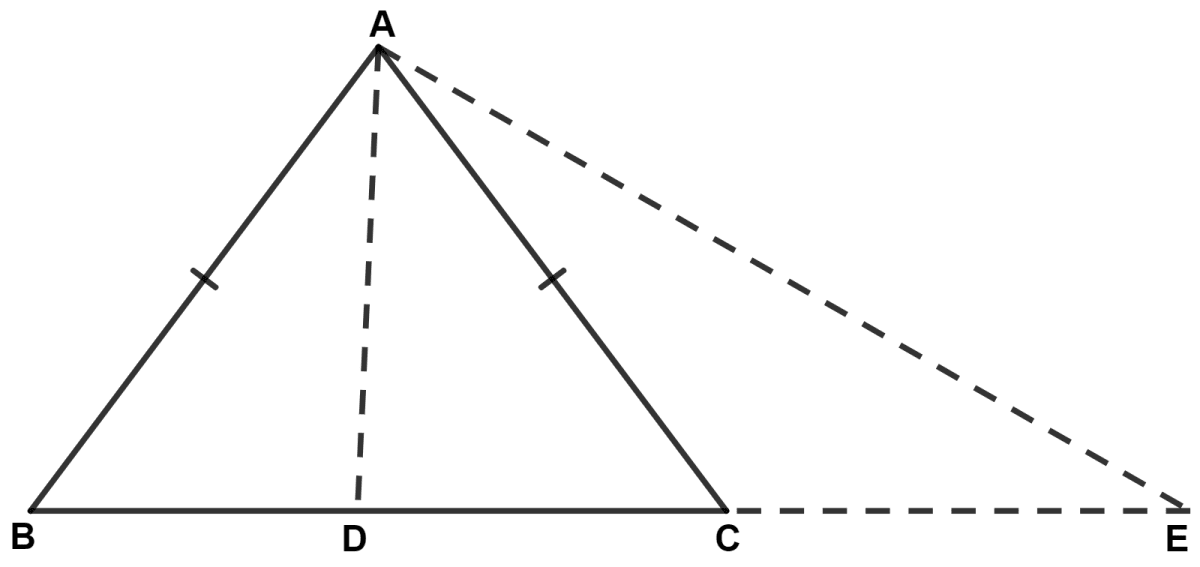
(i) In ∆ ABC,
⇒ AB = AC (Given)
⇒ ∠ACB = ∠ABC [Angles opposite to equal sides are equal] .......(1)
⇒ ∠ACD = ∠ABD [From figure, ∠ACB = ∠ACD and ∠ABC = ∠ABD] .........(2)
We know that exterior angle of a triangle is always greater than each of the interior opposite angle.
In ∆ ADC,
⇒ ∠ADB > ∠ACD
⇒ ∠ADB > ∠ABD [Using equation (2)]
⇒ AB > AD [If two angles of a triangle are unequal, the greater angle has the greater side opposite to it.]
⇒ AC > AD [As, AB = AC] .....(3)
Hence, proved that AC > AD.
(ii) We know that exterior angle of a triangle is always greater than each of the interior opposite angle.
In ∆ ACE,
⇒ ∠ACD > ∠AEC ........(4)
From equation (2),
⇒ ∠ACD = ∠ABD
From figure,
⇒ ∠ABD = ∠ABE
⇒ ∠ACD = ∠ABE
⇒ ∠AEC = ∠AEB
Substituting value of ∠ACD and ∠AEC in equation (4), we get :
⇒ ∠ABE > ∠AEB
In △ AEB,
⇒ AE > AB [If two angles of a triangle are unequal, the greater angle has the greater side opposite to it.]
As, AB = AC,
∴ AE > AC
Hence, proved that AE > AC.
(iii) Since, AE > AC and AC > AD,
∴ AE > AD.
Hence, proved that AE > AD.
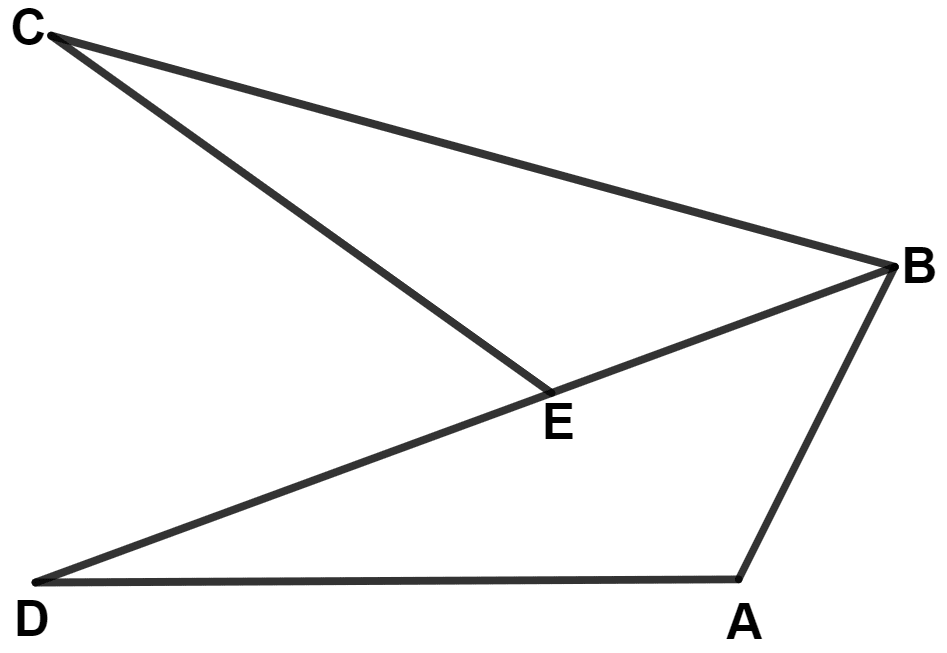
Given : ED = EC
Prove : AB + AD > BC.
Answer
We know that,
The sum of any two sides of the triangle is always greater than the third side of the triangle.
In △ CEB,
⇒ EC + EB > BC
⇒ ED + EB > BC (As, EC = ED)
⇒ BD > BC
In △ ADB,
⇒ AD + AB > BD
Since, BD > BC and AD + AB > BD
∴ AD + AB > BC.
Hence, proved that AB + AD > BC.