
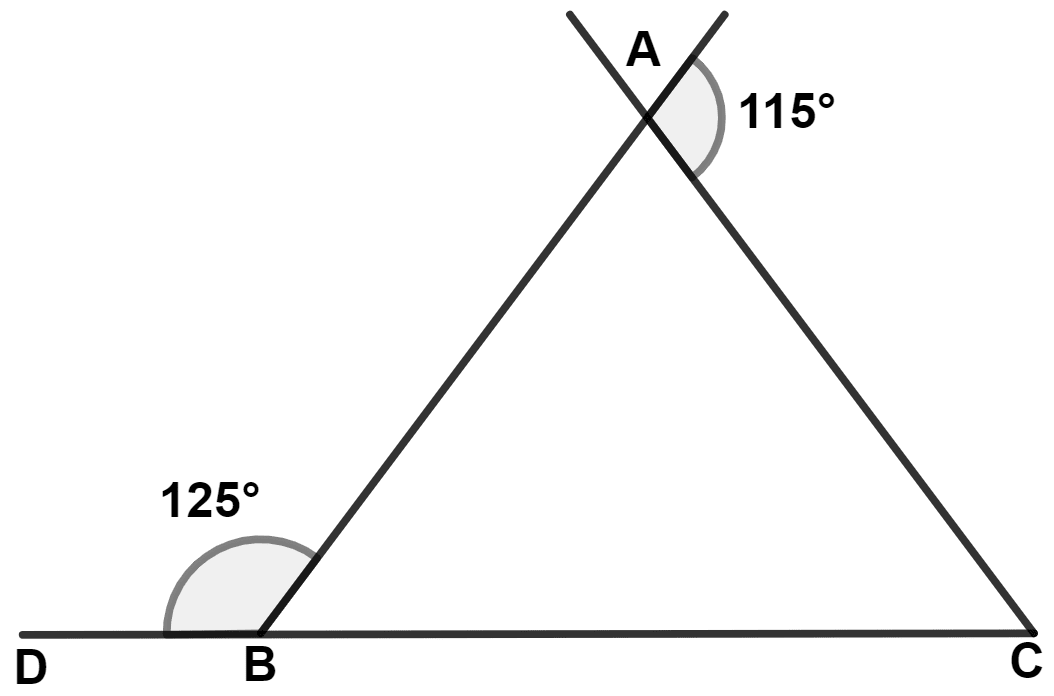
In the adjoining figure, we find :
AB = AC
BC > AB
AB > BC
AC = BC
Answer
From figure,
DBC is a straight line.
∴ ∠ABD + ∠ABC = 180°
⇒ 125° + ∠ABC = 180°
⇒ ∠ABC = 180° - 125° = 55°.
We know that,
Exterior angle is equal to the sum of two opposite interior angle.
∴ Ext. ∠A = ∠ABC + ∠ACB
⇒ 115° = 55° + ∠ACB
⇒ ∠ACB = 115° - 55° = 60°.
In △ ABC,
By angle sum property of triangle,
⇒ ∠ABC + ∠ACB + ∠BAC = 180°
⇒ 55° + 60° + ∠BAC = 180°
⇒ 115° + ∠BAC = 180°
⇒ ∠BAC = 180° - 115° = 65°.
Since, ∠BAC > ∠ACB,
∴ BC > AB (If two angles of a triangle are unequal, the greater angle has the greater side opposite to it.)
Hence, Option 2 is the correct option.
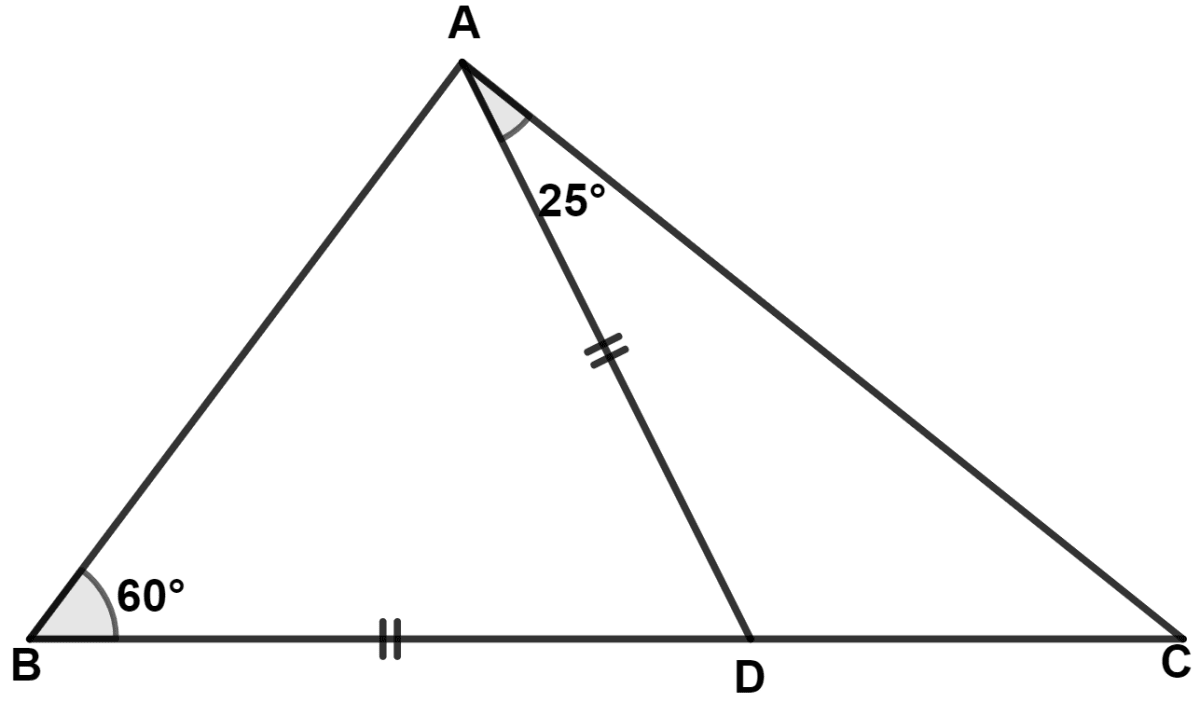
In the adjoining figure, we find :
BD = DC
BD < DC
BD > DC
AD = CD
Answer
In △ ABD,
⇒ AD = BD (Given)
⇒ ∠A = ∠B = 60° (Angles opposite to equal sides are equal)
By angle sum property of triangle,
⇒ ∠A + ∠B + ∠D = 180°
⇒ 60° + 60° + ∠D = 180°
⇒ 120° + ∠D = 180°
⇒ ∠D = 180° - 120° = 60°.
Since, each angle of triangle equals 60°.
∴ ABD is an equilateral triangle, AB = BD = DA.
From figure,
BDC is a straight line.
∴ ∠ADB + ∠ADC = 180°
⇒ 60° + ∠ADC = 180°
⇒ ∠ADC = 180° - 60° = 120°.
In △ ADC,
By angle sum property of triangle,
⇒ ∠DAC + ∠ADC + ∠DCA = 180°
⇒ 25° + 120° + ∠DCA = 180°
⇒ 145° + ∠DCA = 180°
⇒ ∠DCA = 180° - 145° = 35°.
Since, ∠DCA > ∠DAC
∴ AD > DC
Since, AD = BD,
∴ BD > DC. (If two angles of a triangle are unequal, the greater angle has the greater side opposite to it.)
Hence, Option 3 is the correct option.
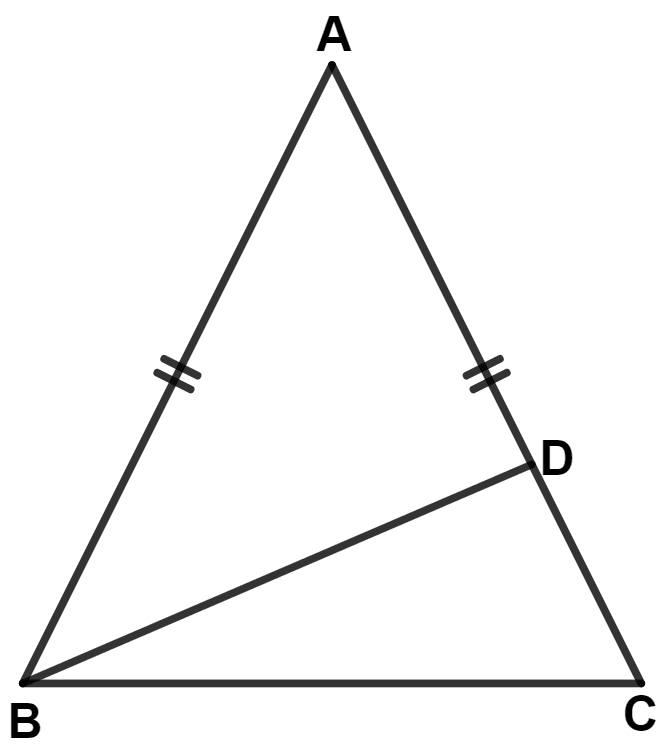
In the given figure, AB = AC, then :
BD = BC
BD = CD
BD < CD
BD > CD
Answer
In △ ABC,
⇒ AB = AC (Given)
⇒ ∠C = ∠B (Angles opposite to equal sides are equal)
In △ ABD,
⇒ AD = AC - CD
⇒ AD < AB
⇒ ∠ABD < ∠ADB (If two sides of a triangle are unequal, the greater side has the greater angle opposite to it.)
In △ BDC,
⇒ ∠DBC = ∠B - ∠ABD = ∠C - ∠ABD
∴ ∠DBC < ∠C
⇒ CD < BD
⇒ BD > CD.
Hence, Option 4 is the correct option.
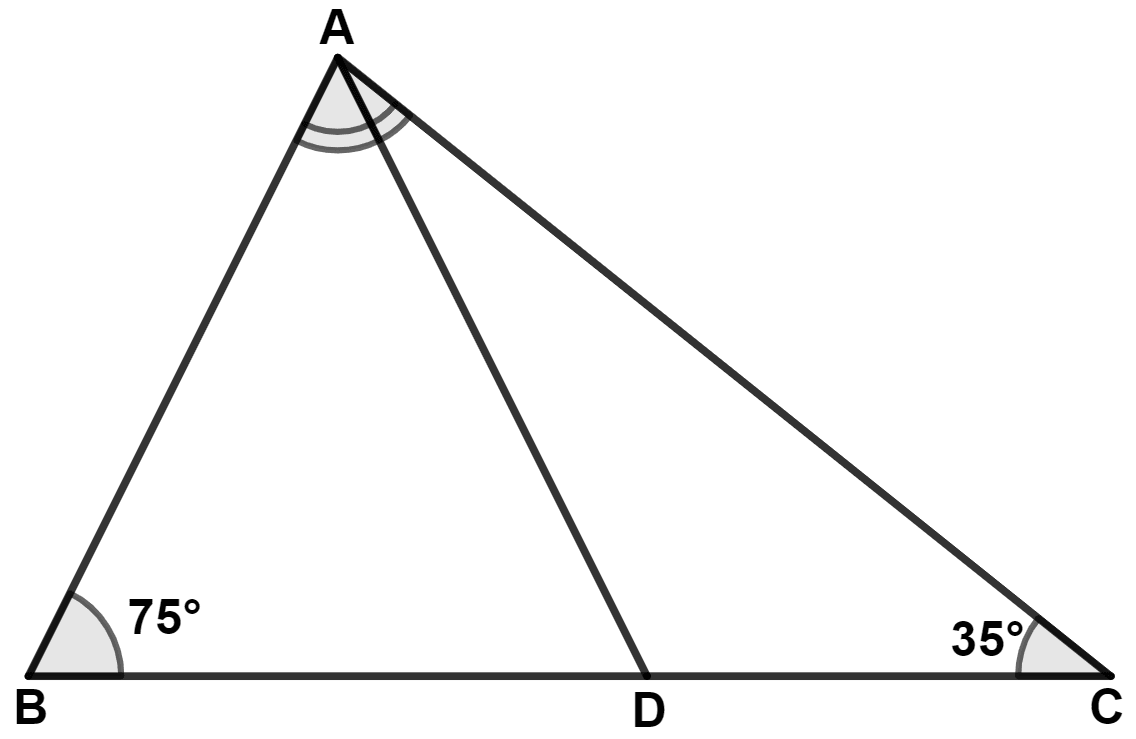
In the given figure, we find :
BD > AB
BD < AB
BD = AB
DC < AB
Answer
In △ ABC,
By angle sum property of triangle,
⇒ ∠A + ∠B + ∠C = 180°
⇒ ∠A + 75° + 35° = 180°
⇒ ∠A + 110° = 180°
⇒ ∠A = 180° - 110° = 70°.
From figure,
AD bisects angle A.
∴ ∠BAD = ∠DAC = = 35°.
In △ ABD,
By angle sum property of triangle,
⇒ ∠ABD + ∠BAD + ∠ADB = 180°
⇒ 75° + 35° + ∠ADB = 180°
⇒ ∠ADB + 110° = 180°
⇒ ∠ADB = 180° - 110° = 70°.
Since, ∠BAD < ∠ADB
∴ BD < AB (If two angles of a triangle are unequal, the greater angle has the greater side opposite to it.)
Hence, Option 2 is the correct option.
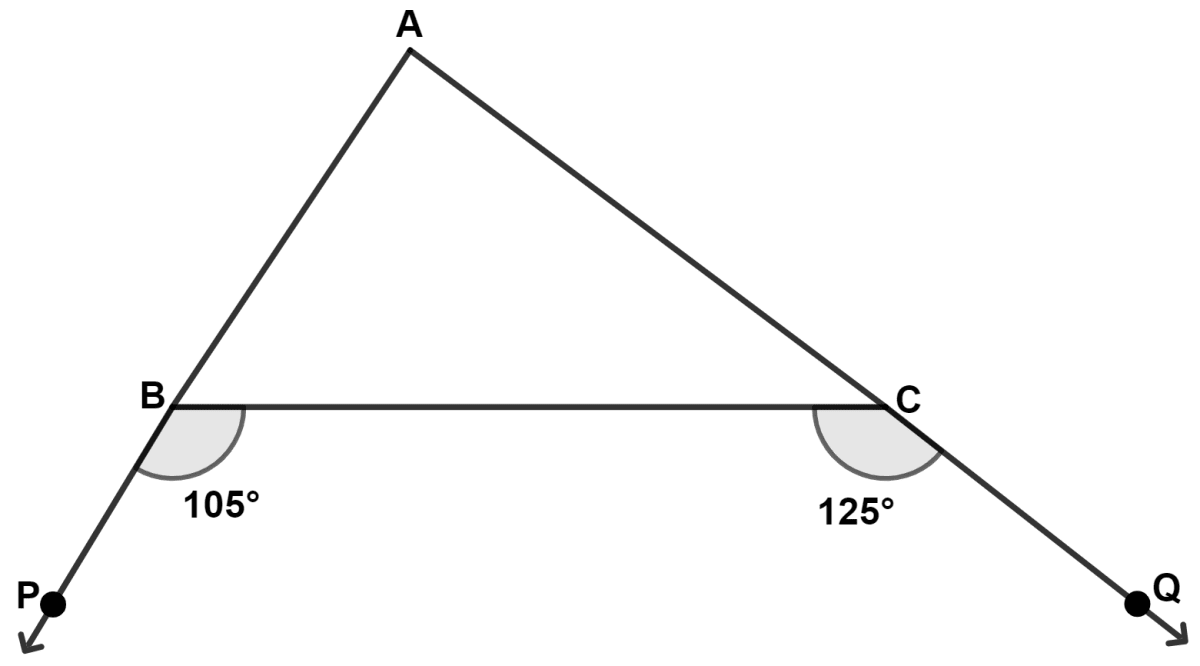
In the given figure, we find :
AB > AC
AC > AB
AB < BC
AC = AB
Answer
From figure,
ABP is a straight line.
∴ ∠PBC + ∠ABC = 180°
⇒ 105° + ∠ABC = 180°
⇒ ∠ABC = 180° - 105° = 75°.
ACQ is a straight line.
∴ ∠ACB + ∠BCQ = 180°
⇒ 125° + ∠ACB = 180°
⇒ ∠ACB = 180° - 125° = 55°.
Since, ∠ABC > ∠ACB
∴ AC > AB (If two angles of a triangle are unequal, the greater angle has the greater side opposite to it.)
Hence, Option 2 is the correct option.
In a quadrilateral ABCD,
AB + BC + CD + DA > AC + BD
AB + BC + CD + DA < AC + BD
AB + BC + CD + DA = AC + BD
AB + BC < AC
Answer
We know that,
The sum of lengths of two sides of a triangle is always greater than the third side.
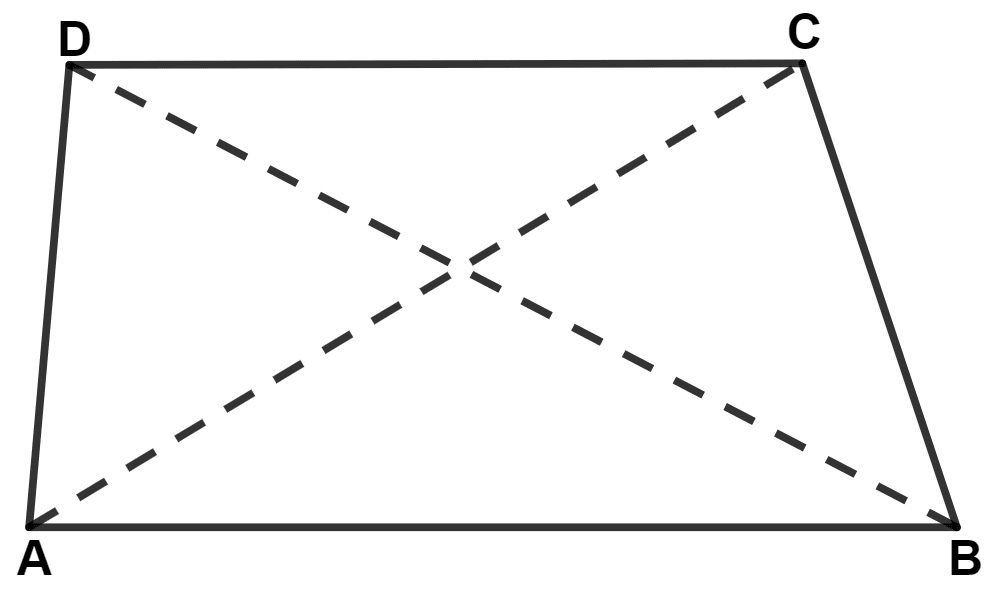
In △ ABC,
⇒ AB + BC > AC ........(1)
In △ ADC,
⇒ AD + CD > AC ........(2)
In △ ADB,
⇒ AD + AB > BD ........(3)
In △ DCB,
⇒ DC + CB > BD ........(4)
Adding equations (1), (2), (3) and (4) we get,
⇒ AB + BC + AD + CD + AD + AB + DC + CB > AC + AC + BD + BD
⇒ AB + AB + BC + BC + CD + CD + AD + AD > 2AC + 2BD
⇒ 2(AB + BC + CD + AD) > 2(AC + BD)
⇒ AB + BC + CD + AD > AC + BD.
Hence, Option 1 is the correct option.
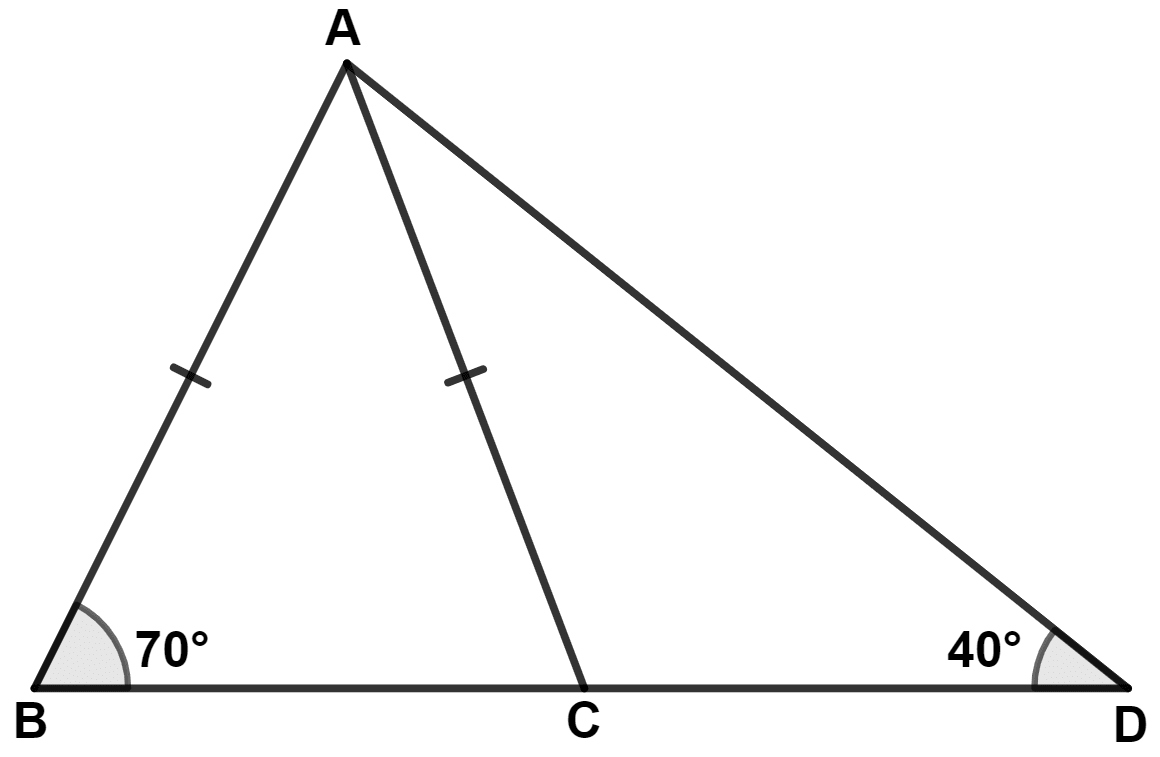
From the following figure, prove that : AB > CD.
Answer
In △ ABC,
⇒ AB = AC (Given)
⇒ ∠C = ∠B = 70°
By angle sum property of triangle,
⇒ ∠BAC + ∠B + ∠C = 180°
⇒ ∠BAC + 70° + 70° = 180°
⇒ ∠BAC + 140° = 180°
⇒ ∠BAC = 180° - 140° = 40°.
In △ ABD,
By angle sum property of triangle,
⇒ ∠BAD + ∠B + ∠D = 180°
⇒ ∠BAD + 70° + 40° = 180°
⇒ ∠BAD + 110° = 180°
⇒ ∠BAD = 180° - 110° = 70°.
From figure,
⇒ ∠CAD = ∠BAD - ∠BAC = 70° - 40° = 30°.
In △ ACD,
Since, ∠CDA > ∠CAD
∴ AC > CD (If two angles of a triangle are unequal, the greater angle has the greater side opposite to it.)
Since, AB = AC
∴ AB > CD.
Hence, proved that AB > CD.
In a triangle PQR; QR = PR and ∠P = 36°. Which is the largest side of the triangle ?
Answer
In △ PQR,
⇒ PR = QR (Given)
⇒ ∠Q = ∠P = 36°
By angle sum property of triangle,
⇒ ∠Q + ∠P + ∠R = 180°
⇒ 36° + 36° + ∠R = 180°
⇒ 72° + ∠R = 180°
⇒ ∠R = 180° - 72° = 108°.
Since, ∠R is greatest angle.
∴ PQ is the largest side. (In a triangle, side opposite to greatest angle is largest.)
Hence, PQ is the largest side.
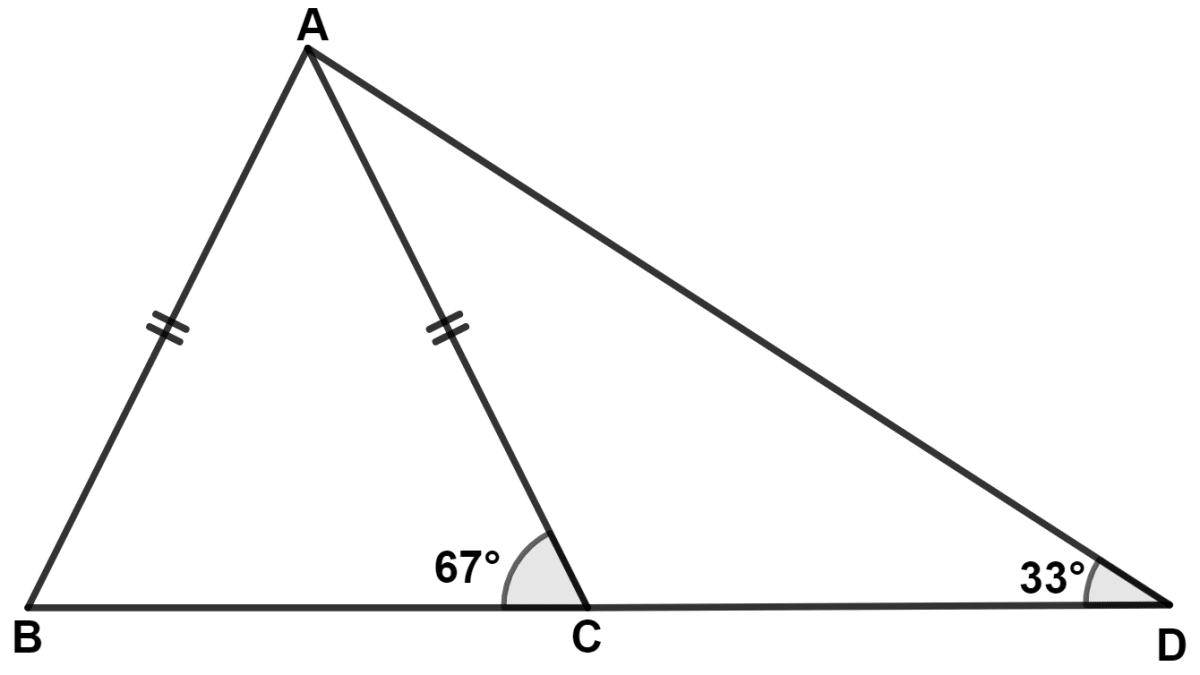
In each of the following figures, write BC, AC and CD in ascending order of their lengths.
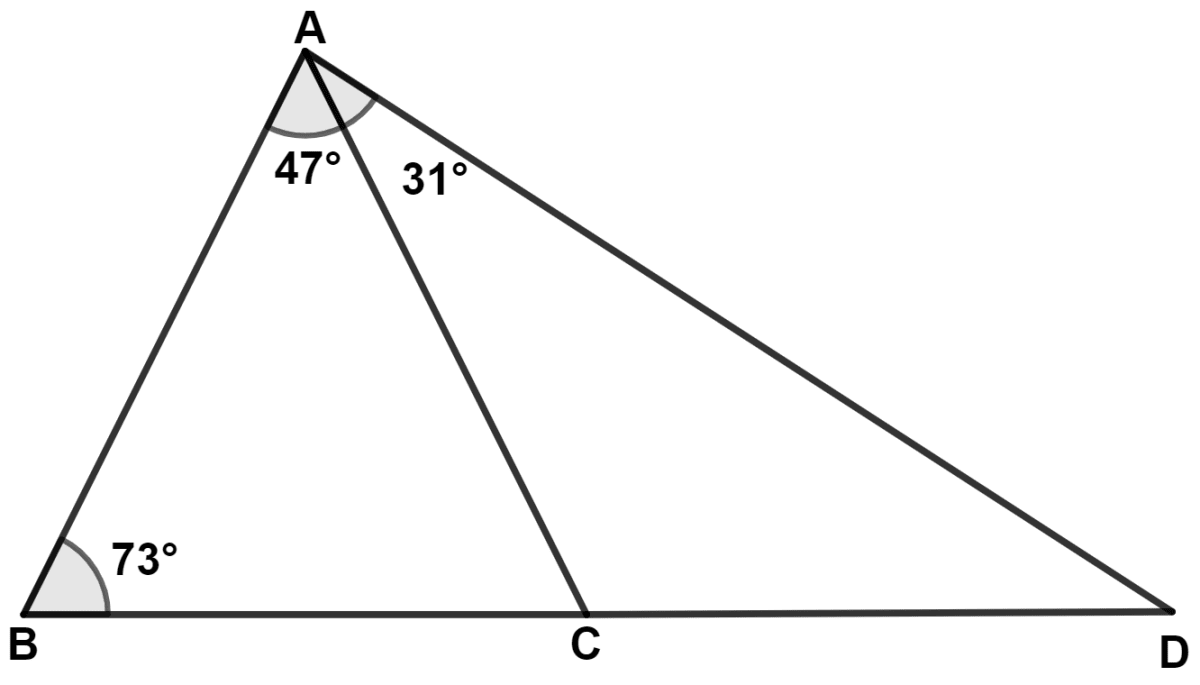
Answer
(i) In △ ABC,
⇒ AC = AB (Given)
⇒ ∠B = ∠C = 67°.
By angle sum property of triangle,
⇒ ∠BAC + ∠B + ∠C = 180°
⇒ ∠BAC + 67° + 67° = 180°
⇒ ∠BAC + 134° = 180°
⇒ ∠BAC = 180° - 134° = 46°.
In △ ABD,
By angle sum property of triangle,
⇒ ∠BAD + ∠B + ∠D = 180°
⇒ ∠BAD + 67° + 33° = 180°
⇒ ∠BAD + 100° = 180°
⇒ ∠BAD = 180° - 100° = 80°.
From figure,
⇒ ∠CAD = ∠BAD - ∠BAC = 80° - 46° = 34°.
We know that,
If two angles of a triangle are unequal, the greater angle has the greater side opposite to it.
In △ ABC,
Since, ∠BAC < ∠ABC
⇒ BC < AC ........(1)
In △ ACD,
Since, ∠CDA < ∠CAD
⇒ AC < CD ........(2)
From equation (1) and (2), we get :
⇒ BC < AC < CD.
Hence, BC < AC < CD.
(ii) In △ ABC,
⇒ ∠BAC < ∠ABC
⇒ BC < AC [If two angles of a triangle are unequal, the greater angle has the greater side opposite to it.] .......(1)
By angle sum property of triangle,
⇒ ∠ACB + ∠BAC + ∠ABC = 180°
⇒ ∠ACB + 47° + 73° = 180°
⇒ ∠ACB + 120° = 180°
⇒ ∠ACB = 180° - 120° = 60°.
From figure,
As, BCD is a straight line.
⇒ ∠ACB + ∠ACD = 180°
⇒ 60° + ∠ACD = 180°
⇒ ∠ACD = 180° - 60° = 120°.
In △ ACD,
By angle sum property of triangle,
⇒ ∠ADC + ∠ACD + ∠CAD = 180°
⇒ ∠ADC + 120° + 31° = 180°
⇒ ∠ADC + 151° = 180°
⇒ ∠ADC = 180° - 151° = 29°.
Since, ∠ADC < ∠CAD, we get :
AC < CD [If two angles of a triangle are unequal, the greater angle has the greater side opposite to it.] .......(2)
From equations (1) and (2), we get :
⇒ BC < AC < CD.
Hence, BC < AC < CD.
Arrange the sides of △ BOC in descending order of their lengths. BO and CO are bisectors of angles ABC and ACB respectively.

Answer
From figure,
DAC is a straight line.
∴ ∠DAB + ∠BAC = 180°
⇒ 137° + ∠BAC = 180°
⇒ ∠BAC = 180° - 137° = 43°.
EBC is a straight line.
∴ ∠EBA + ∠ABC = 180°
⇒ 106° + ∠ABC = 180°
⇒ ∠ABC = 180° - 106° = 74°.
In △ ABC,
By angle sum property of triangle,
⇒ ∠ABC + ∠BAC + ∠ACB = 180°
⇒ 74° + 43° + ∠ACB = 180°
⇒ 117° + ∠ACB = 180°
⇒ ∠ACB = 180° - 117° = 63°.
Since, OB is the bisector of angle ABC.
∴ ∠OBC = = 37°.
Since, OC is the bisector of angle ACB.
∴ ∠OCB = = 31.5°.
In △ OBC,
By angle sum property of triangle,
⇒ ∠OBC + ∠OCB + ∠BOC = 180°
⇒ 37° + 31.5° + ∠BOC = 180°
⇒ 68.5° + ∠BOC = 180°
⇒ ∠BOC = 180° - 68.5° = 111.5°
∴ ∠BOC > ∠OBC > ∠OCB
∴ BC > CO > BO (If two angles of a triangle are unequal, the greater angle has the greater side opposite to it.)
Hence, sides of triangle BOC in descending order are BC > CO > BO.
D is a point in side BC of triangle ABC. If AD > AC, show that AB > AC.
Answer
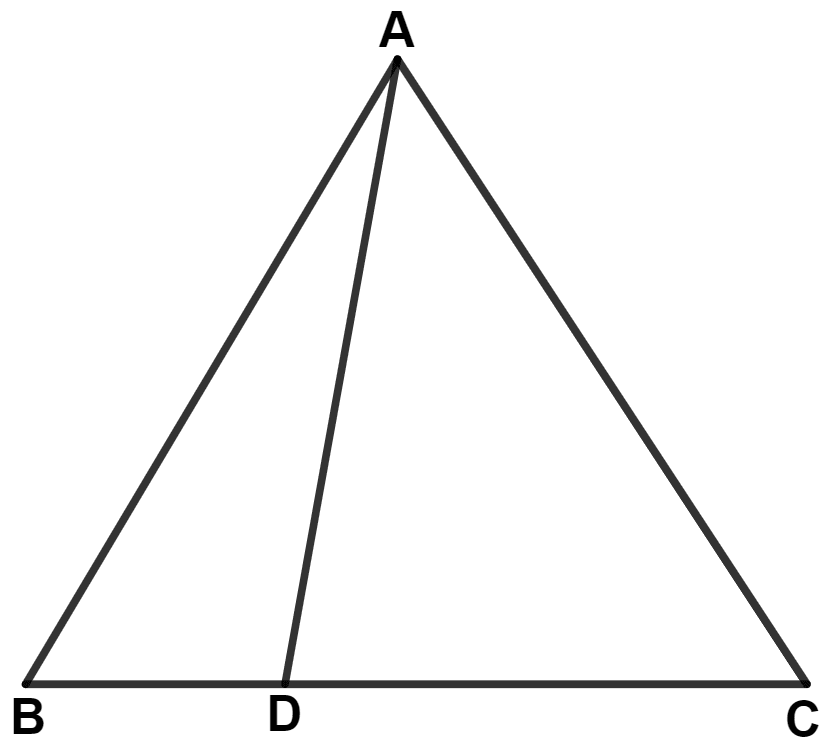
In △ ADC,
⇒ AD > AC (Given)
∴ ∠ACD > ∠ADC (If two sides of a triangle are unequal, the greater side has the greater angle opposite to it.) .......(1)
In △ ABD,
⇒ ∠ADC = ∠ABD + ∠BAD (An exterior angle is equal to sum of two opposite interior angles) .........(2)
Substituting value of ∠ADC from equation (2) in (1), we get :
⇒ ∠ACD > ∠ABD + ∠BAD ......(3)
∴ ∠ACD > ∠ABD .....(4)
From figure,
⇒ ∠ACD = ∠ACB and ∠ABD = ∠ABC
Substituting above values in equation (4), we get :
⇒ ∠ACB > ∠ABC
Thus, in △ ABC,
⇒ AB > AC (If two angles of a triangle are unequal, the greater angle has the greater side opposite to it.)
Hence, proved that AB > AC.
In the following figure, ∠BAC = 60° and ∠ABC = 65°. Prove that :
(i) CF > AF
(ii) DC > DF
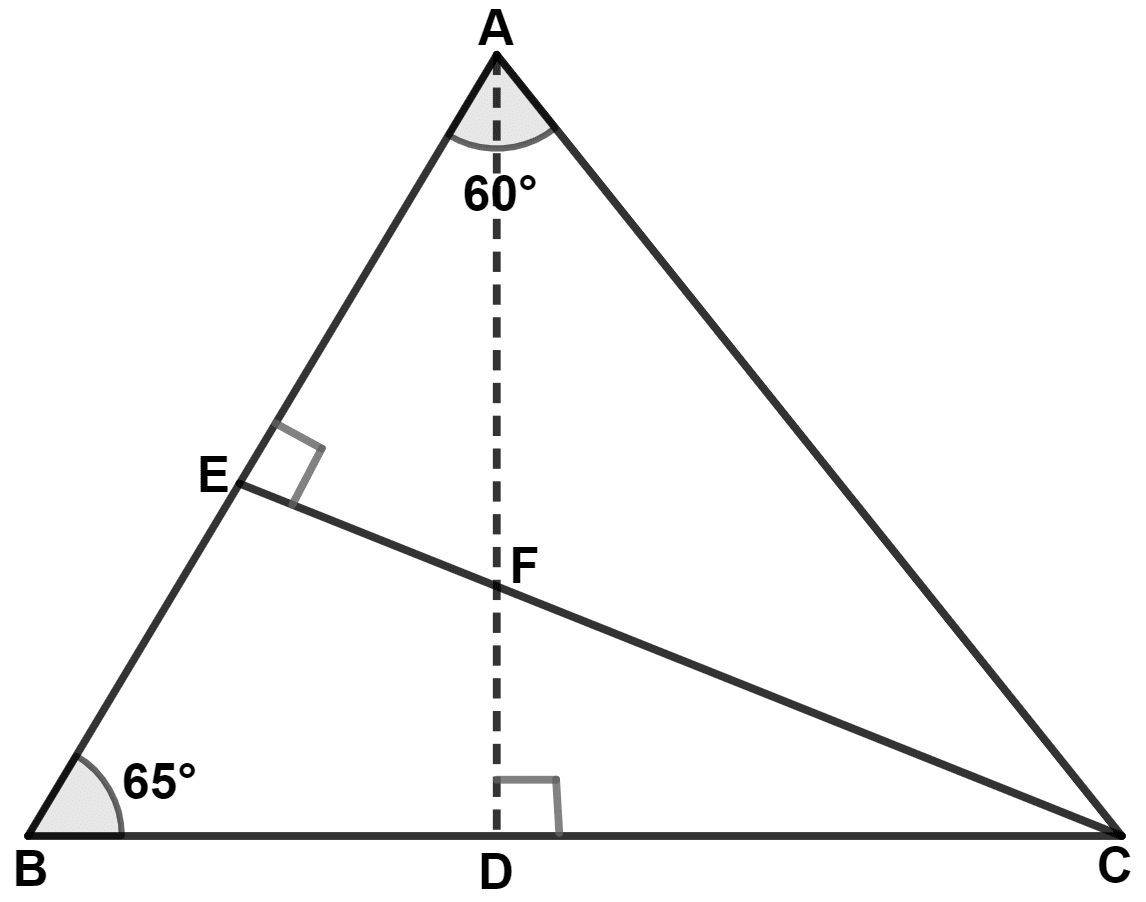
Answer
(i) In △ BEC,
⇒ ∠CBE + ∠BEC + ∠BCE = 180°
⇒ 65° + 90° + ∠BCE = 180°
⇒ ∠BCE = 180° - 90° - 65° = 25°.
From figure,
⇒ ∠DCF = ∠BCE = 25° .......(1)
In △ CDF,
⇒ ∠DCF + ∠FDC + ∠CFD = 180°
⇒ 25° + 90° + ∠CFD = 180°
⇒ ∠CFD = 180° - 90° - 25° = 65° .........(2)
From figure,
AFD is a straight line,
⇒ ∠AFC + ∠CFD = 180°
⇒ ∠AFC + 65° = 180°
⇒ ∠AFC = 180° - 65° = 115° ........(3)
In △ ACE,
By angle sum property of triangle,
⇒ ∠ACE + ∠CEA + ∠EAC = 180°
⇒ ∠ACE + ∠CEA + ∠BAC = 180° (From figure, ∠EAC = ∠BAC)
⇒ ∠ACE + 90° + 60° = 180°
⇒ ∠ACE + 150° = 180°
⇒ ∠ACE = 180° - 150° = 30° ........(4)
In △ AFC,
By angle sum property of triangle,
⇒ ∠AFC + ∠ACF + ∠FAC = 180°
⇒ 115° + ∠ACE + ∠FAC = 180° (From figure, ∠ACF = ∠ACE)
⇒ 115° + 30° + ∠FAC = 180°
⇒ ∠FAC + 145° = 180°
⇒ ∠FAC = 180° - 145° = 35° ........(5)
In △ AFC,
⇒ ∠FAC > ∠ACF
∴ CF > AF (If two angles of a triangle are unequal, the greater angle has the greater side opposite to it.)
Hence, proved that CF > AF.
(ii) In △ CDF,
⇒ ∠DCF = 25° ........[From equation (1)]
⇒ ∠CFD = 65° ........[From equation (2)]
⇒ ∠CFD > ∠DCF
∴ DC > DF (If two angles of a triangle are unequal, the greater angle has the greater side opposite to it.)
Hence, proved that DC > DF.
In the following figure;
AC = CD; ∠BAD = 110° and ∠ACB = 74°.
Prove that : BC > CD.
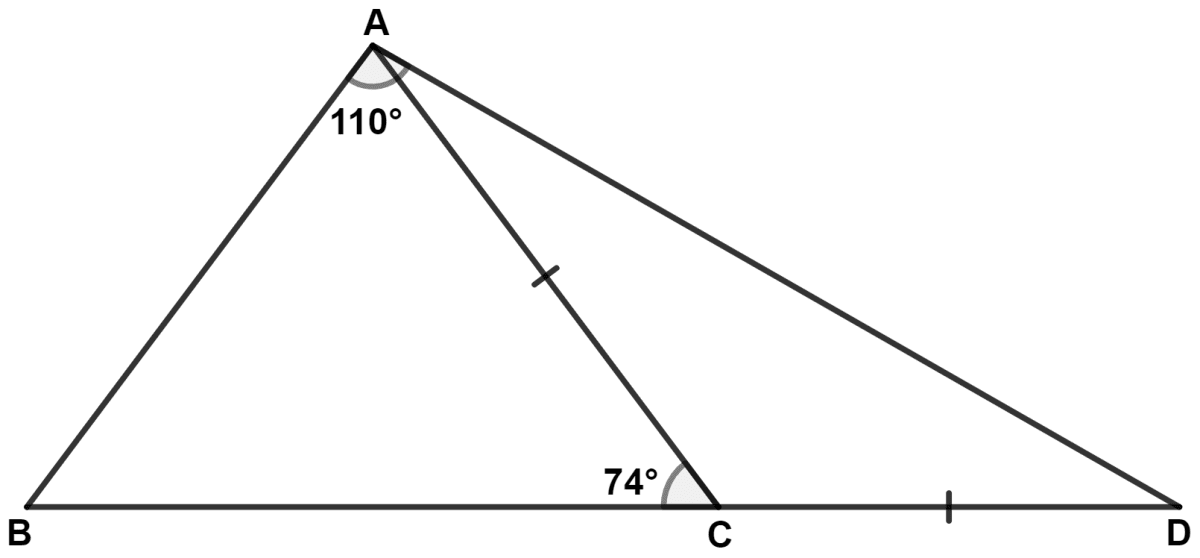
Answer
Since, BCD is a straight line.
∴ ∠BCA + ∠ACD = 180°
⇒ 74° + ∠ACD = 180°
⇒ ∠ACD = 180° - 74° = 106°.
In △ ACD,
AC = CD (Given)
∴ ∠CAD = ∠CDA = x (let) [Angles opposite to equal sides are equal]
By angle sum property of triangle,
⇒ ∠ACD + ∠CAD + ∠CDA = 180°
⇒ 106° + x + x = 180°
⇒ 106° + 2x = 180°
⇒ 2x = 180° - 106°
⇒ 2x = 74°
⇒ x = = 37°.
From figure,
⇒ ∠BAC = ∠BAD - ∠CAD = 110° - 37° = 73°.
In △ ABC,
By angle sum property of triangle,
⇒ ∠BAC + ∠ABC + ∠ACB = 180°
⇒ 73° + ∠ABC + 74° = 180°
⇒ ∠ABC + 147° = 180°
⇒ ∠ABC = 180° - 147°
⇒ ∠ABC = 33°.
∴ ∠ACB > ∠BAC > ∠ABC
∴ AB > BC > AC [If two angles of a triangle are unequal, the greater angle has the greater side opposite to it.] .......(1)
Given,
AC = CD ......(2)
From equations (1) and (2), we get :
BC > CD.
Hence, proved that BC > CD.
From the following figure; prove that :
(i) AB > BD
(ii) AC > CD
(iii) AB + AC > BC
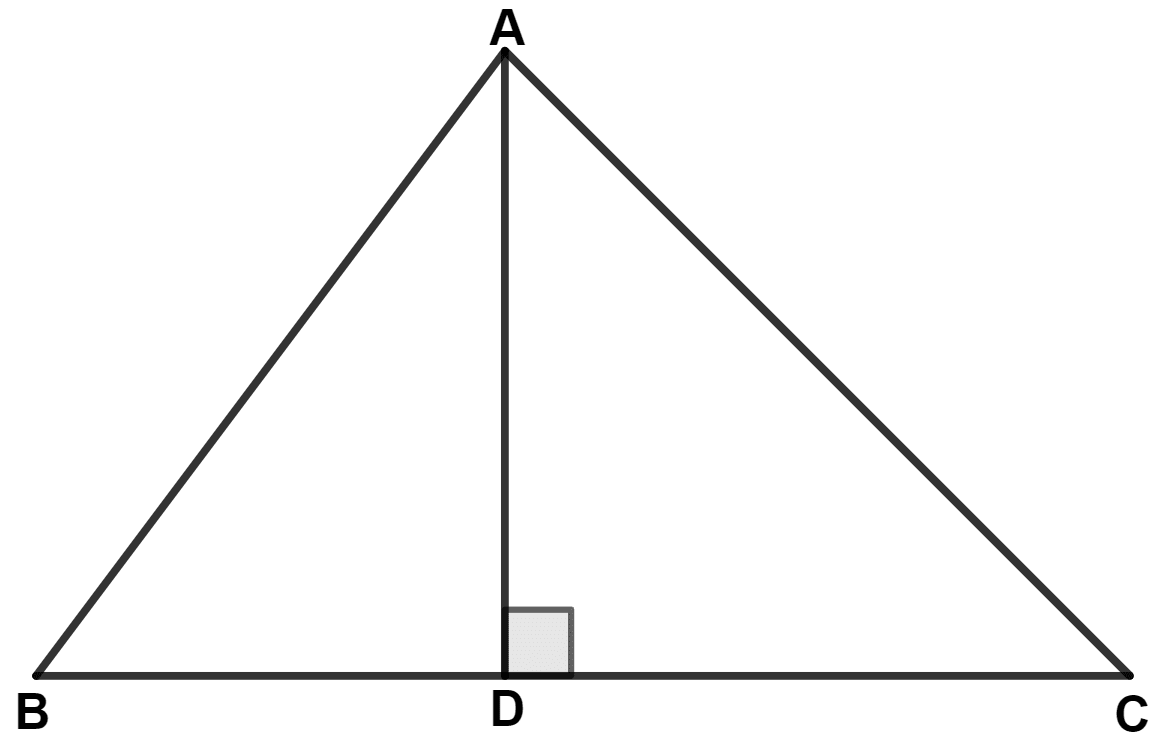
Answer
(i) Since, BDC is a straight line.
∴ ∠ADB + ∠ADC = 180°
⇒ ∠ADB + 90° = 180°
⇒ ∠ADB = 180° - 90° = 90°.
In △ ABD,
∠BAD and ∠ABD will be definitely less than 90° as sum of angles of triangle equals to 180°.
∴ ∠ADB > ∠BAD
∴ AB > BD [If two angles of a triangle are unequal, the greater angle has the greater side opposite to it.] ...........(1)
Hence, proved that AB > BD.
(ii) From figure,
⇒ ∠ADC = 90°.
In △ ADC,
∠DAC and ∠DCA will be definitely less than 90° as sum of angles of triangle equals to 180°.
∴ ∠ADC > ∠DAC
∴ AC > CD [If two angles of a triangle are unequal, the greater angle has the greater side opposite to it.] ...........(2)
Hence, proved that AC > CD.
(iii) Adding equations (1) and (2), we get :
⇒ AB + AC > BD + CD
⇒ AB + AC > BC.
Hence, proved that AB + AC > BC.
In a quadrilateral ABCD; prove that :
(i) AB + BC + CD > DA
(ii) AB + BC + CD + DA > 2AC
(iii) AB + BC + CD + DA > 2BD
Answer
Let ABCD be the quadrilateral. Join AC and BD.
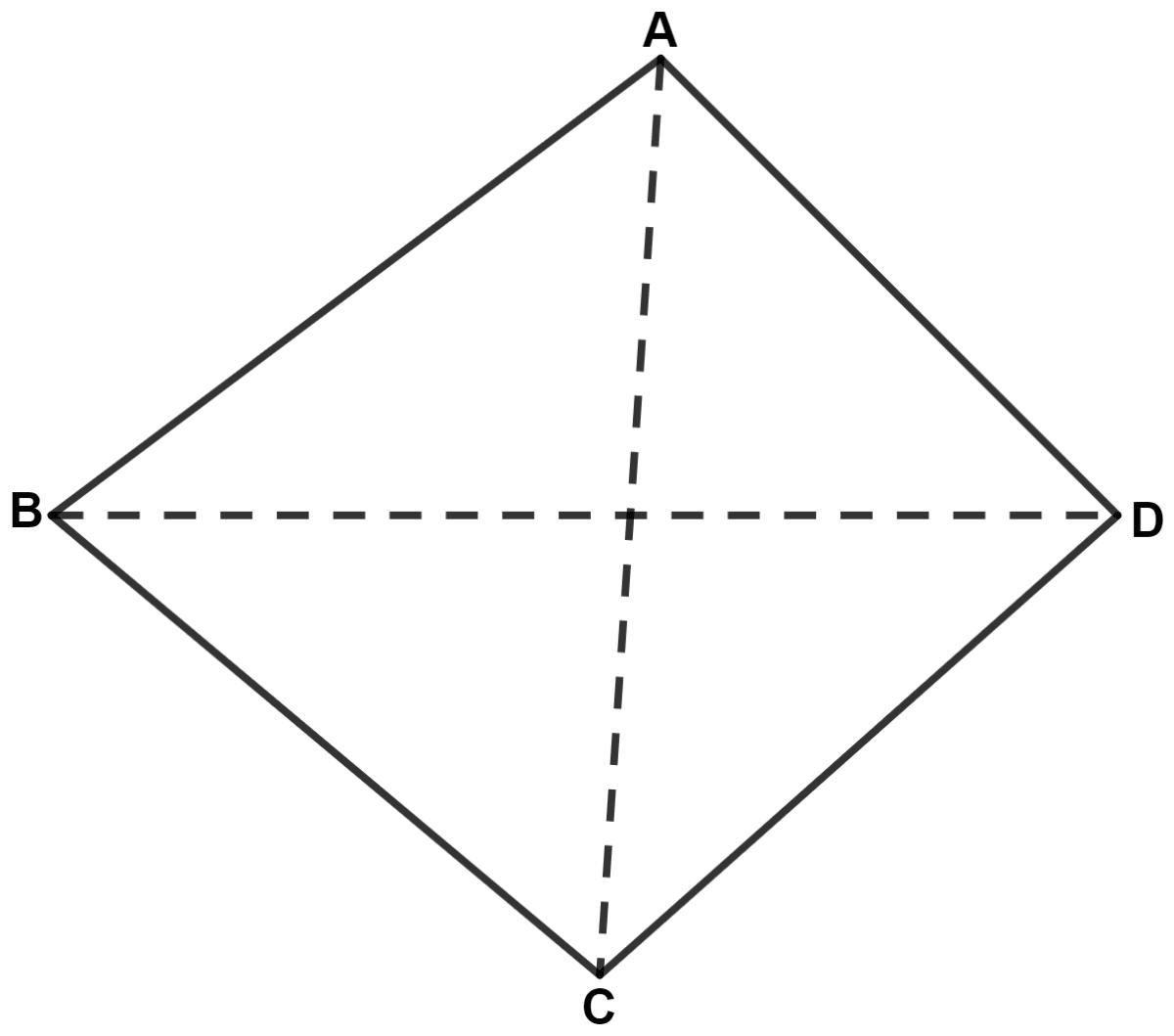
(i) In △ ABC,
⇒ AB + BC > AC (Sum of two sides in a triangle is greater tha the third triangle) ........(1)
In △ ACD,
⇒ AC + CD > DA (Sum of two sides in a triangle is greater tha the third triangle) ............(2)
Adding equations (1) and (2), we get :
⇒ AB + BC + AC + CD > AC + DA
⇒ AB + BC + CD > AC + DA - AC
⇒ AB + BC + CD > DA ........(3)
Hence, proved that AB + BC + CD > DA.
(ii) In △ ACD,
⇒ CD + DA > AC (Sum of two sides in a triangle is greater tha the third triangle) ............(4)
Adding equations (1) and (4), we get :
⇒ AB + BC + CD + DA > AC + AC
⇒ AB + BC + CD + DA > 2AC.
Hence, proved that AB + BC + CD + DA > 2AC.
(iii) In △ ABD,
⇒ AB + DA > BD (Sum of two sides in a triangle is greater tha the third triangle) .........(5)
In △ BCD,
⇒ BC + CD > BD (Sum of two sides in a triangle is greater tha the third triangle) .........(6)
Adding equations (5) and (6), we get :
⇒ AB + DA + BC + CD > BD + BD
⇒ AB + BC + CD + DA > 2BD.
Hence, proved that AB + BC + CD + DA > 2BD.
In the following figure, ABC is an equilateral triangle and P is any point in AC; prove that :
(i) BP > PA
(ii) BP > PC
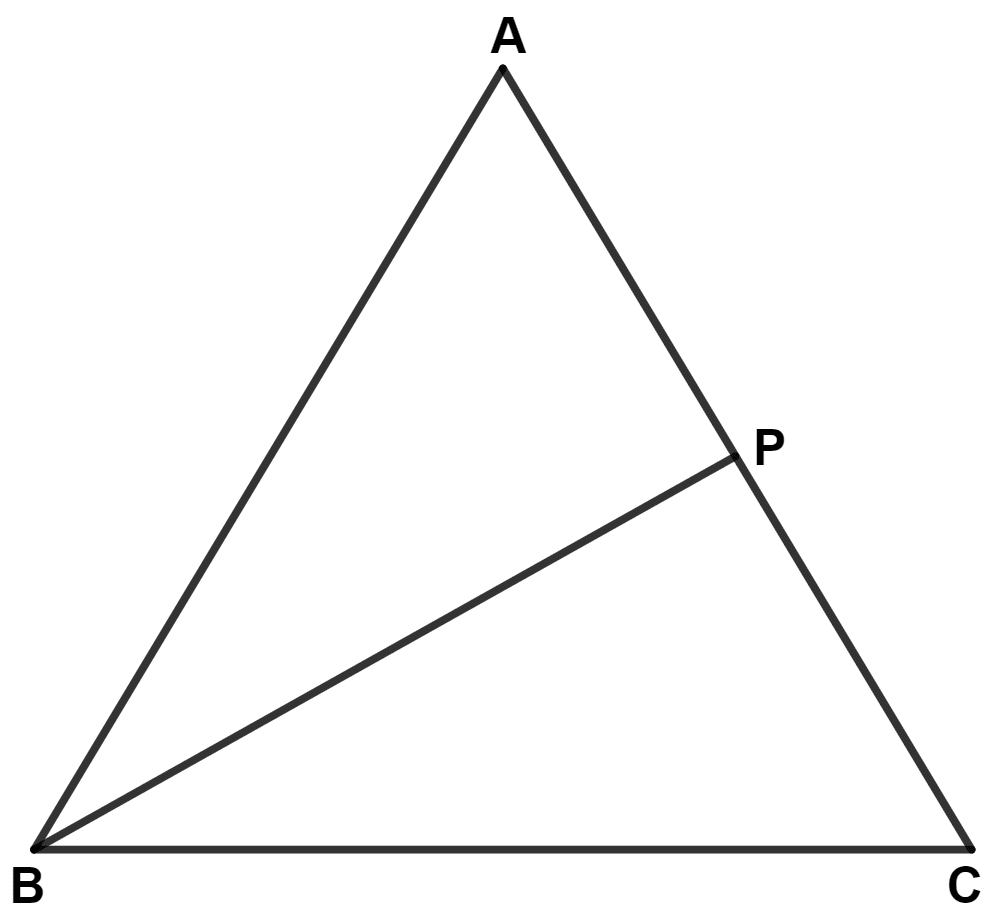
Answer
(i) Since, ABC is an equilateral triangle.
∴ ∠A = ∠B = ∠C = 60°.
In △ ABP,
∠ABP = ∠B - ∠PBC
∴ ∠ABP < ∠B
∴ ∠ABP < ∠A (Since, ∠B = ∠A)
∴ PA < BP or BP > PA [If two angles of a triangle are unequal, the greater angle has the greater side opposite to it.]
Hence, proved that BP > PA.
(ii) In △ BPC,
∠PBC = ∠B - ∠ABP
∴ ∠PBC < ∠B
∴ ∠PBC < ∠C (Since, ∠B = ∠C)
∴ PC < BP or BP > PC [If two angles of a triangle are unequal, the greater angle has the greater side opposite to it.]
Hence, proved that BP > PC.
In the following diagram; AD = AB and AE bisects angle A. Prove that :
(i) BE = DE
(ii) ∠ABD > ∠C
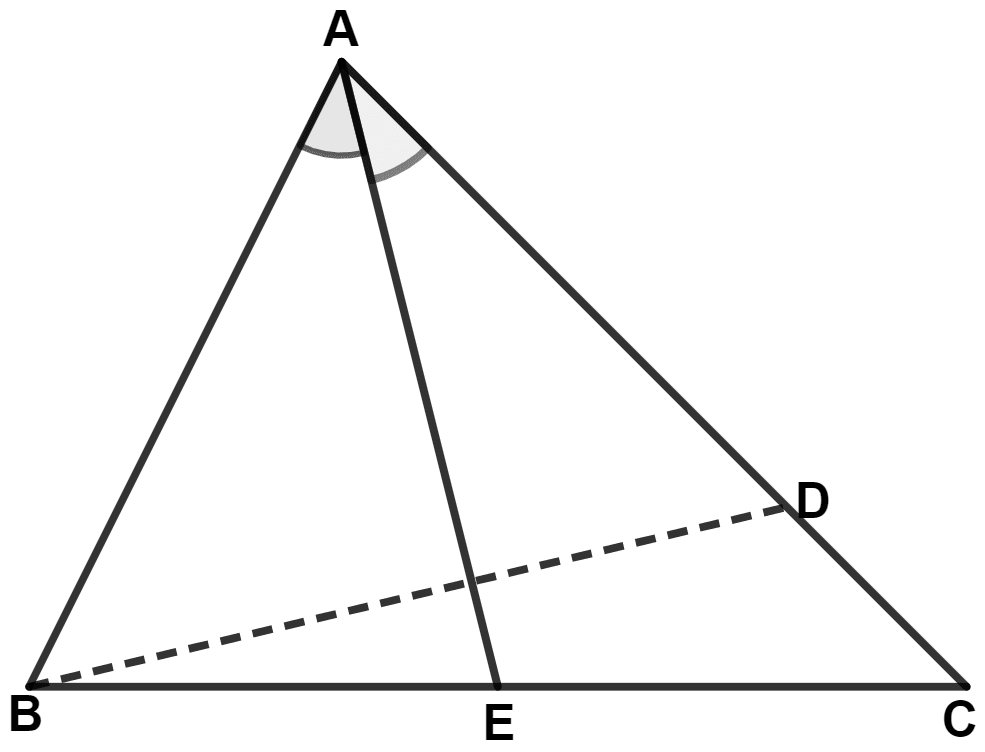
Answer
Join ED.
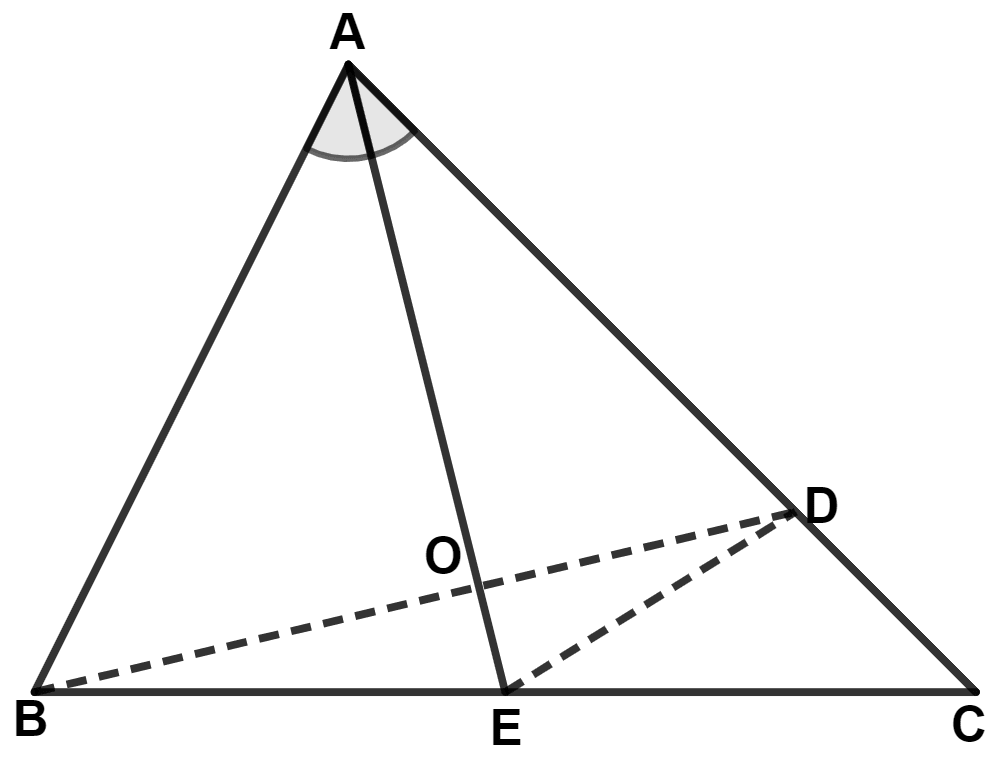
In △ AOB and △ AOD,
⇒ AB = AD (Given)
⇒ AO = AO (Common)
⇒ ∠BAO = ∠DAO (AO is the bisector of angle A)
∴ △ AOB ≅ △ AOD (By S.A.S. axiom)
We know that,
Corresponding parts of congruent triangle are equal.
⇒ BO = OD ..........(1) [By C.P.C.T.C.]
⇒ ∠AOB = ∠AOD .........(2) [By C.P.C.T.C.]
⇒ ∠ABO = ∠ADO [By C.P.C.T.C.]
⇒ ∠ABD = ∠ADB ..........(3)
From figure,
⇒ ∠AOB = ∠DOE and ∠AOD = ∠BOE (Vertically opposite angles are equal)
Substituting values of ∠AOB and ∠AOD from above equation in equation (2), we get :
⇒ ∠DOE = ∠BOE .............(4)
(i) In △ BOE and △ DOE,
⇒ BO = OD [From equation (1)]
⇒ OE = OE [Common side]
⇒ ∠BOE = ∠DOE [From equation (4)]
∴ △ BOE ≅ △ DOE (By S.A.S. axiom)
We know that,
Corresponding parts of congruent triangle are equal.
⇒ BE = DE.
Hence, proved that BE = DE.
(ii) In triangle BCD,
⇒ ∠ADB = ∠C + ∠CBD (An exterior angle is equal to sum of two opposite interior angles)
⇒ ∠ADB > ∠C
⇒ ∠ABD > ∠C (Since, ∠ABD = ∠ADB)
Hence, proved that ∠ABD > ∠C.