
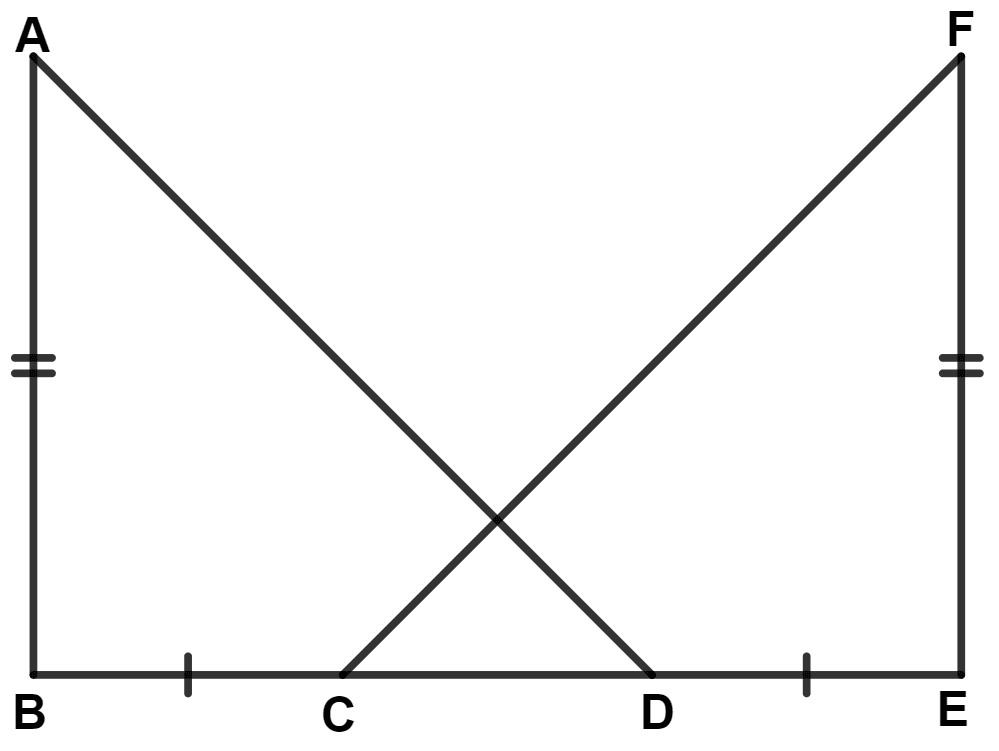
In the given figure, AB ⊥ BE, EF ⊥ BE, AB = EF and BC = DE, then :
△ ABD ≅ △ EFC
△ ABD ≅ △ FEC
△ ABD ≅ △ ECF
△ ABD ≅ △ CEF
Answer
Since, AB ⊥ BE and EF ⊥ BE,
∴ ∠ABE = 90° and ∠FEB = 90°.
From figure,
⇒ ∠ABD = ∠ABE = 90°
⇒ ∠FEC = ∠FEB = 90°
Given,
⇒ BC = DE
⇒ BC + CD = CD + DE
⇒ BD = CE.
In △ ABD and △ FEC,
⇒ AB = FE (Given)
⇒ BD = CE (Proved above)
⇒ ∠ABD = ∠FEC (Both equal to 90°)
∴ △ ABD ≅ △ FEC (By S.A.S. axiom)
Hence, Option 2 is the correct option.
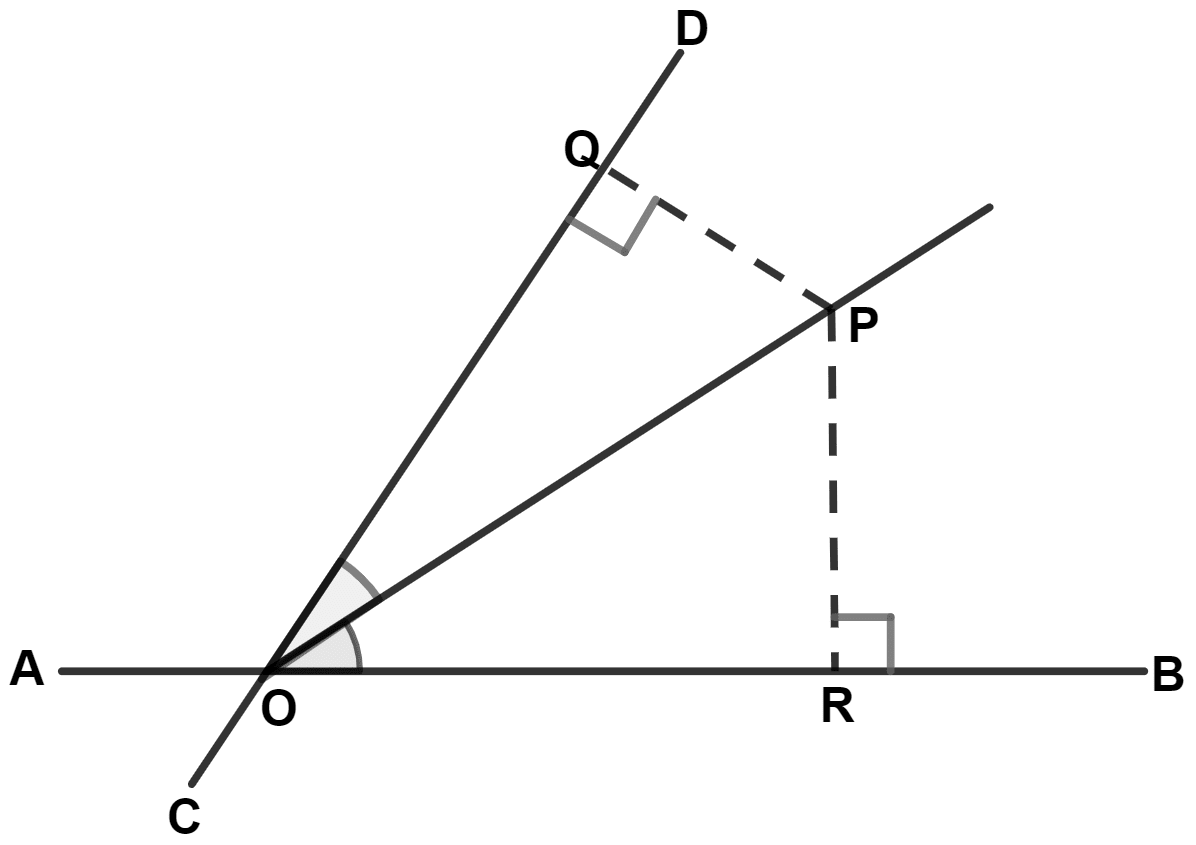
From the adjoining figure, we find :
OP = OR
OP = OQ
PQ = PR
PR ≠ PQ
Answer
In △ OPQ and △ OPR,
⇒ OP = OP (Common side)
⇒ ∠POQ = ∠POR (Given)
⇒ ∠OQP = ∠ORP (Both equal to 90°)
∴ △ OPQ ≅ △ OPR (By A.A.S. axiom)
We know that,
Corresponding sides of congruent triangle are equal.
∴ PQ = PR.
Hence, Option 3 is the correct option.
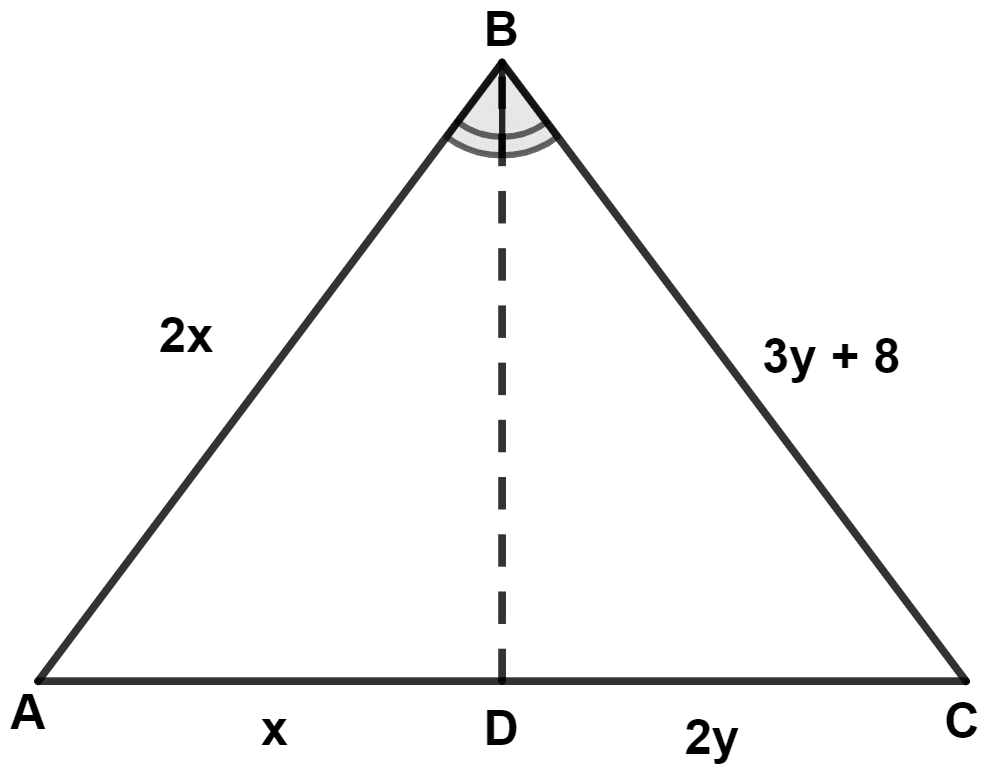
From the given figure, if ∠A = ∠C, we get :
x = 8, y = 16
x = -8, y = 16
x = 16, y = -8
x = 16, y = 8
Answer
In △ ABD and △ CBD,
⇒ ∠A = ∠C (Given)
⇒ BD = BD (Common side)
⇒ ∠ABD = ∠CBD (Given)
∴ △ ABD ≅ △ CBD (By A.A.S. axiom)
We know that,
Corresponding sides of congruent triangle are equal.
∴ AB = BC and AD = CD.
Considering AD = CD,
⇒ x = 2y ......(1)
Considering AB = BC,
⇒ 2x = 3y + 8
Substituting value of x from equation (1) in above equation, we get :
⇒ 2(2y) = 3y + 8
⇒ 4y = 3y + 8
⇒ 4y - 3y = 8
⇒ y = 8
⇒ x = 2y = 2(8) = 16.
Hence, Option 4 is the correct option.
ABCD is a rectangle. X and Y are points on sides AD and BC respectively such that AX = BY, then :
AY ≠ BX
△ ABX ≅ △ BYA
△ ABX ≅ △ AYB
△ ABX ≅ △ BAY
Answer
Rectangle ABCD is shown in the figure below:
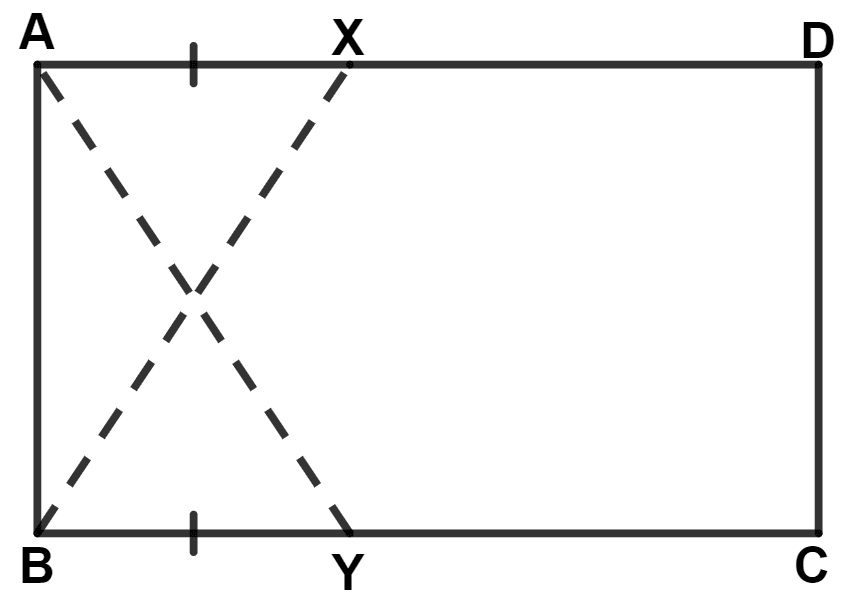
In △ ABX and △ BAY,
⇒ AX = BY (Given)
⇒ AB = AB (Common side)
⇒ ∠XAB = ∠YBA (Both equal to 90°)
∴ △ ABX ≅ △ BAY (By S.A.S. axiom)
Hence, Option 4 is the correct option.
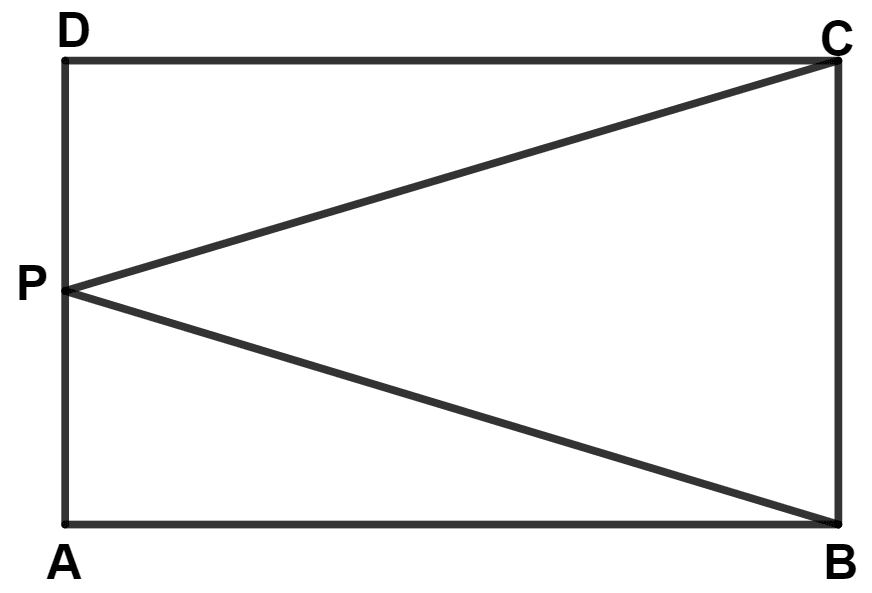
In the given figure, P is mid-point of side AD of rectangle ABCD; then :
∠PBC = ∠PBA
∠PBC = ∠PCB
∠BPA = ∠BPC
∠PBC = ∠BPA
Answer
In △ PCD and △ PBA,
⇒ ∠D = ∠A (Both equal to 90°)
⇒ AP = PD (P is mid-point of AD)
⇒ DC = AB (Opposite sides of rectangle are equal)
∴ △ PCD ≅ △ PBA (By S.A.S. axiom)
We know that,
Corresponding sides of congruent triangle are equal.
∴ ∠PCD = ∠PBA
⇒ 90° - ∠PCD = 90° - ∠PBA
⇒ ∠PCB = ∠PBC.
Hence, Option 2 is the correct option.
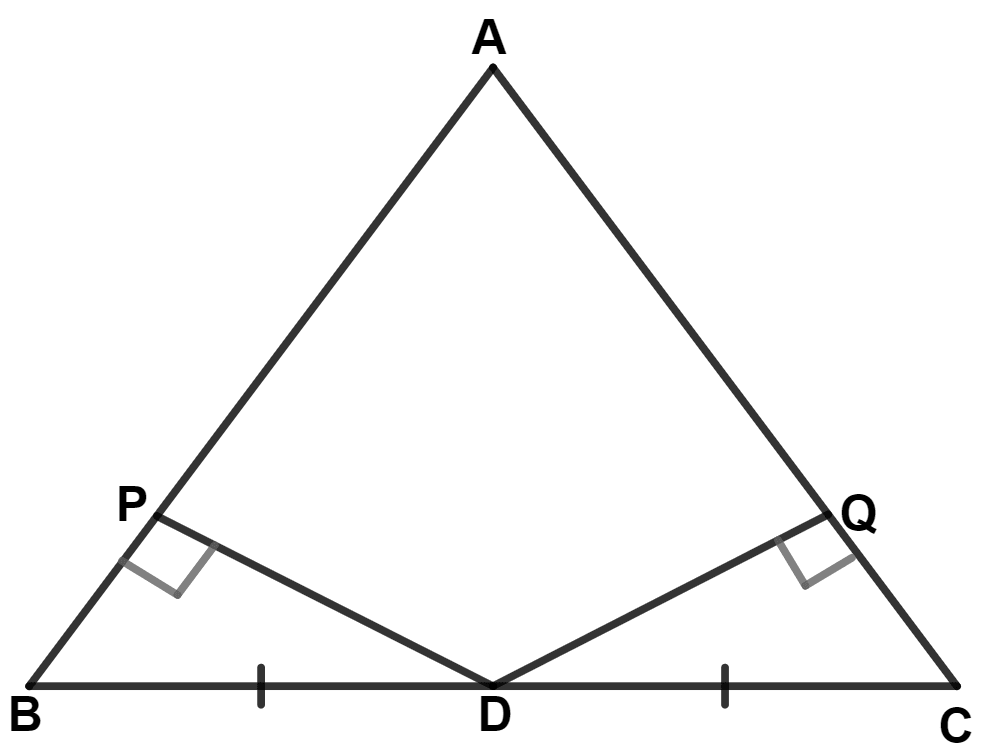
In the given figure, AB = AC. Prove that :
(i) DP = DQ
(ii) AP = AQ
(iii) AD bisects angle A
Answer
(i) In △ ABC,
⇒ AB = AC (Given)
∴ ∠B = ∠C (Angles opposite to equal sides are equal)
In △ PDB and △ QDC,
⇒ ∠P = ∠Q (Both equal to 90°)
⇒ ∠B = ∠C (Proved above)
⇒ BD = CD (Given)
∴ △ PDB ≅ △ QDC (By A.A.S. axiom)
We know that,
Corresponding sides of congruent triangle are equal.
∴ DP = DQ
Hence, proved that DP = DQ.
(ii) Since, △ PDB ≅ △ QDC
∴ BP = QC = y (let) [By C.P.C.T.C.]
⇒ AB = AC = x (let)
From figure,
⇒ AP = AB - BP = x - y
⇒ AQ = AC - QC = x - y
∴ AP = AQ.
Hence, proved that AP = AQ.
(iii) Join AD.
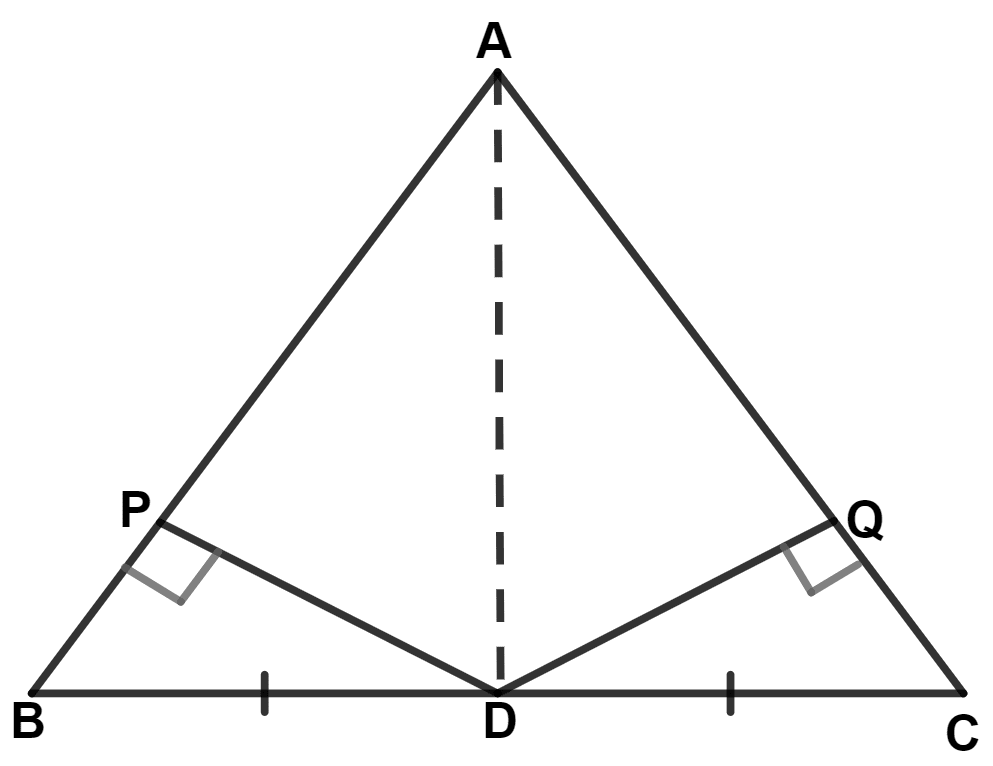
In △ ABD and △ ACD,
⇒ AB = AC (Proved above)
⇒ BD = CD (Given)
⇒ AD = AD (Common side)
∴ △ ABD ≅ △ ACD (By S.S.S. axiom)
We know that,
Corresponding sides of congruent triangle are equal.
∴ ∠BAD = ∠CAD.
Hence, proved that AD bisects angle A.
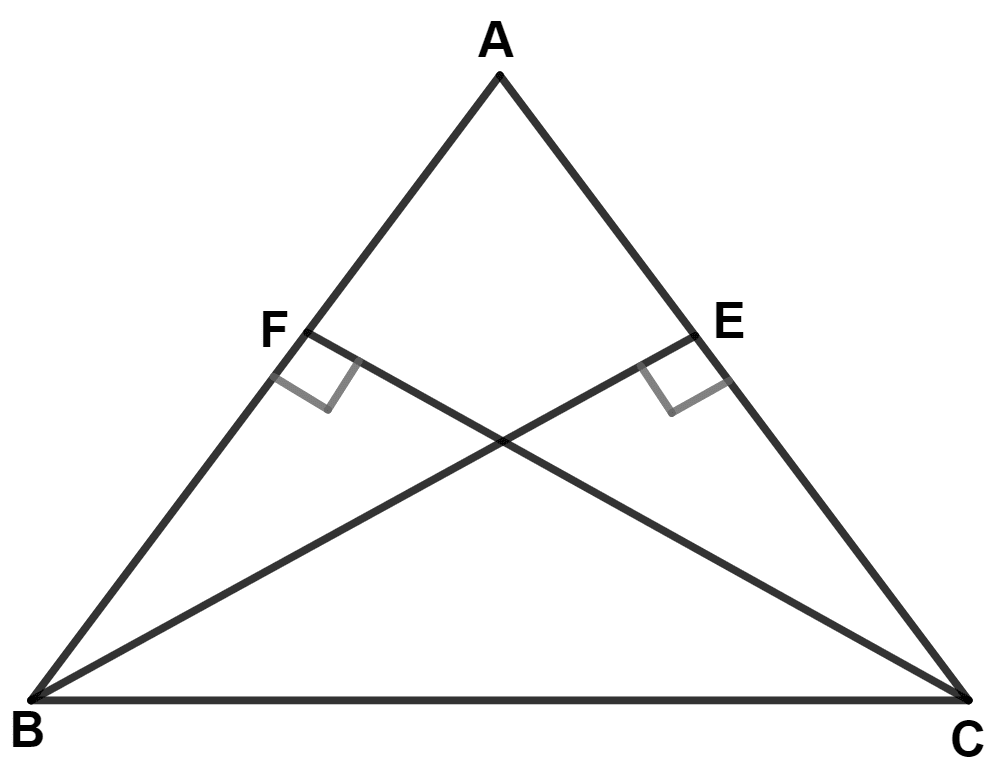
In triangle ABC, AB = AC; BE ⊥ AC and CF ⊥ AB. Prove that :
(i) BE = CF
(ii) AF = AE
Answer
(i) In △ ABC,
⇒ AB = AC (Given)
∴ ∠B = ∠C (Angles opposite to equal sides are equal)
In △ BCF and △ CBE,
⇒ ∠B = ∠C (Proved above)
⇒ BC = BC (Common side)
⇒ ∠F = ∠E (Both equal to 90°)
∴ △ BCF ≅ △ CBE (By A.A.S. axiom)
We know that,
Corresponding sides of congruent triangle are equal.
∴ BE = CF.
Hence, proved that BE = CF.
(ii) Since, △ BCF ≅ △ CBE
∴ BF = CE = y (let) [By C.P.C.T.C.]
⇒ AB = AC = x (let)
From figure,
⇒ AF = AB - BF = x - y
⇒ AE = AC - AE = x - y
∴ AF = AE.
Hence, proved that AF = AE.
In isosceles triangle ABC, AB = AC. The side BA is produced to D such that BA = AD. Prove that : ∠BCD = 90°.
Answer
In △ ABC,
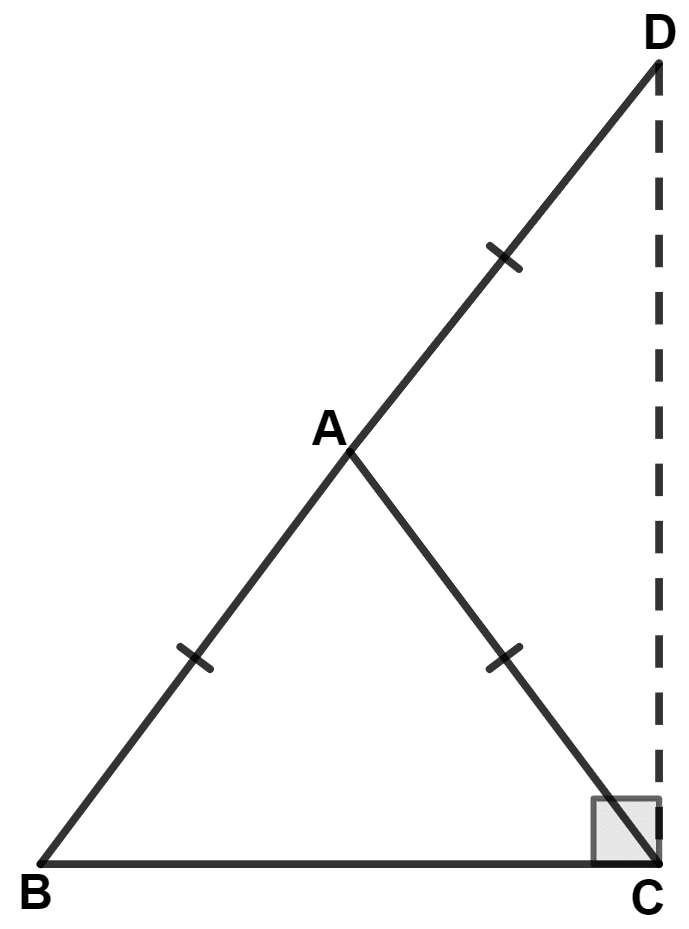
⇒ AB = AC (Given)
⇒ ∠B = ∠C (Angles opposite to equal sides are equal) .........(1)
In △ ACD,
⇒ AC = AD (Given)
⇒ ∠ADC = ∠ACD (Angles opposite to equal sides are equal) .......(2)
Adding equation (1) and (2), we get :
⇒ ∠B + ∠ADC = ∠C + ∠ACD
⇒ ∠B + ∠ADC = ∠BCD ....(3)
In △ BCD,
⇒ ∠B + ∠ADC + ∠BCD = 180° (By angle sum property of triangle)
⇒ ∠BCD + ∠BCD = 180°
⇒ 2∠BCD = 180°
⇒ ∠BCD = = 90°.
Hence, proved that ∠BCD = 90°.
In a triangle ABC, AB = AC and ∠A = 36°. If the internal bisector of ∠C meets AB at point D, prove that AD = BC.
Answer
In △ ABC,
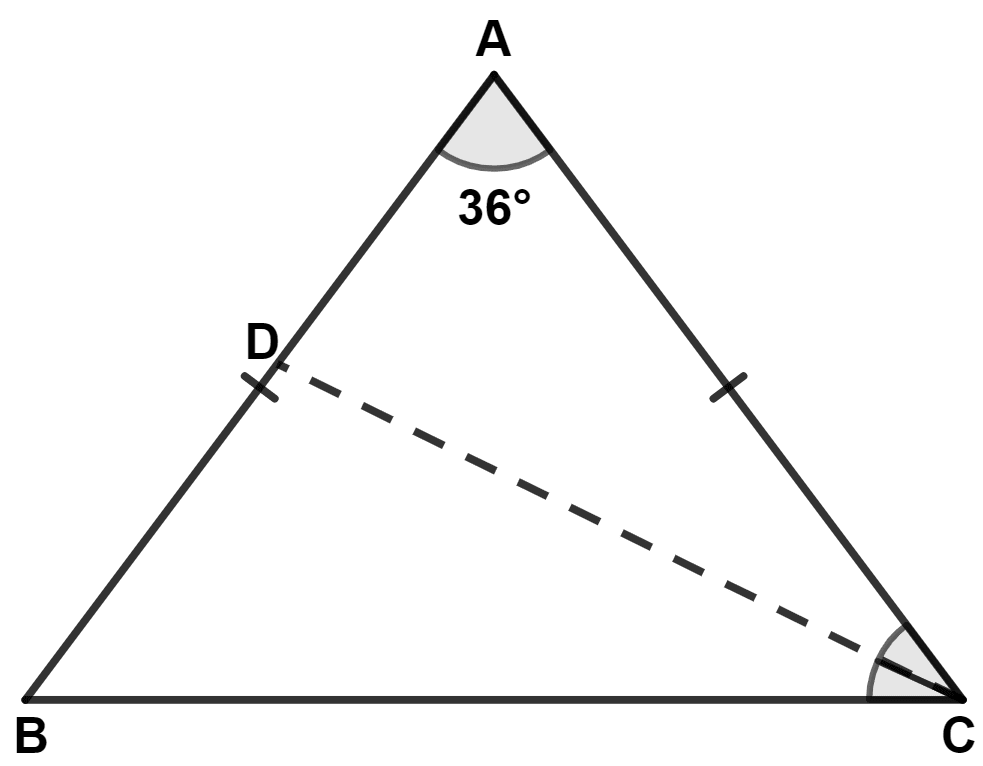
⇒ AB = AC (Given)
∴ ∠B = ∠C = x (let) [Angles opposite to equal sides are equal]
By angle sum property of triangle,
⇒ ∠A + ∠B + ∠C = 180°
⇒ 36° + x + x = 180°
⇒ 36° + 2x = 180°
⇒ 2x = 180° - 36°
⇒ 2x = 144°
⇒ x = = 72°.
Since, CD is bisector of angle C,
∴ ∠ACD = ∠BCD = = 36°.
In △ ACD,
⇒ ∠ACD = ∠DAC (Both equal to 36°)
∴ AD = DC [Sides opposite to equal angles are equal] ........(1)
In △ DCB,
By angle sum property of triangle,
⇒ ∠CDB + ∠DCB + ∠DBC = 180°
⇒ ∠CDB + 36° + 72° = 180°
⇒ ∠CDB + 108° = 180°
⇒ ∠CDB = 180° - 108° = 72°.
∴ ∠CDB = ∠DBC (Both equal to 72°)
∴ BC = CD (Sides opposite to equal angles are equal) ...........(2)
From equation (1) and (2), we get :
⇒ AD = BC.
Hence, proved that AD = BC.
If the bisector of an angle of a triangle bisects the opposite side, prove that the triangle is isosceles.
Answer
Let AD bisect BC and also the angle A.

In △ ABD and △ ACD,
⇒ BD = CD (Since, AD bisects BC)
⇒ AD = AD (Common side)
⇒ ∠BAD = ∠CAD (Since, AD bisects angle A)
∴ △ ABD ≅ △ ACD (By S.A.S. axiom)
We know that,
Corresponding sides of congruent triangle are equal.
∴ AB = AC
∴ ABC is an isosceles triangle.
Hence, proved that if the bisector of an angle of a triangle bisects the opposite side, the triangle is isosceles.
Prove that the bisectors of the base angles of an isosceles triangle are equal.
Answer
In isosceles triangle △ ABC,
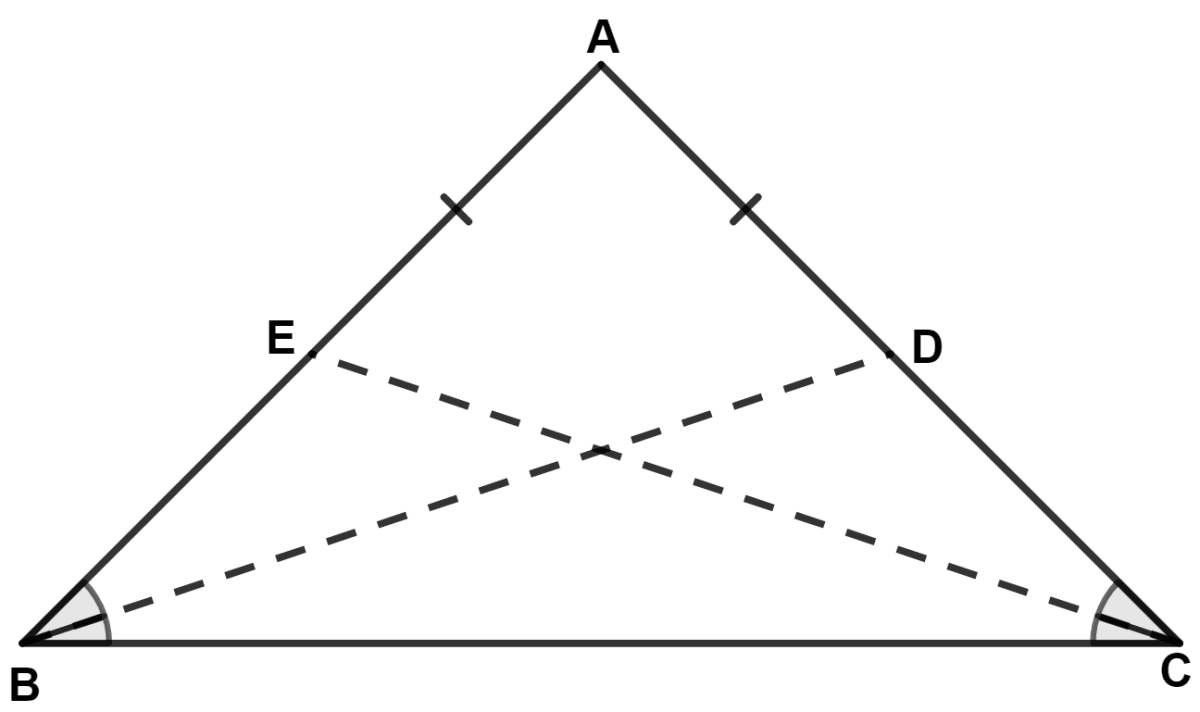
Let AB = AC,
∴ ∠C = ∠B = x (let) [Angles opposite to equal sides are equal]
From figure,
BD and CE are bisectors of angle B and C.
∴ ∠CBD = and ∠BCE = .
∴ ∠CBD = ∠BCE.
In △ CBD and △ BCE,
⇒ ∠CBD = ∠BCE (Proved above)
⇒ ∠C = ∠B (Proved above)
⇒ BC = BC (Common side)
∴ △CBD ≅ △BCE (By A.S.A. axiom)
We know that,
Corresponding sides of congruent triangle are equal.
∴ BD = CE.
Hence, proved that the bisectors of the base angles of an isosceles triangle are equal.
In the given figure, AB = AC and ∠DBC = ∠ECB = 90°.
Prove that :
(i) BD = CE
(ii) AD = AE

Answer
(i) In △ ABC,
⇒ AB = AC (Given)
⇒ ∠ABC = ∠ACB (Angles opposite to equal sides are equal) .......(1)
From figure,
⇒ ∠DBC = ∠ECB (Both equal to 90°) .......(2)
Subtracting equation (1) from (2), we get :
⇒ ∠DBC - ∠ABC = ∠ECB - ∠ACB
⇒ ∠DBA = ∠ECA .........(3)
In △ DBA and △ ECA,
⇒ ∠DBA = ∠ECA (Proved above)
⇒ AB = AC (Given)
⇒ ∠DAB = ∠EAC (Vertically opposite angles are equal)
∴ △ DBA ≅ △ ∠ECA (By A.S.A. axiom)
We know that,
Corresponding sides of congruent triangle are equal.
∴ BD = CE.
Hence, proved that BD = CE.
(ii) Since,
△ DBA ≅ △ ∠ECA
∴ AD = AE (By C.P.C.T.C.)
Hence, proved that AD = AE.
In triangle ABC; AB = AC. P, Q and R are mid-points of sides AB, AC and BC respectively. Prove that :
(i) PR = QR
(ii) BQ = CP
Answer
(i) In triangle ABC,
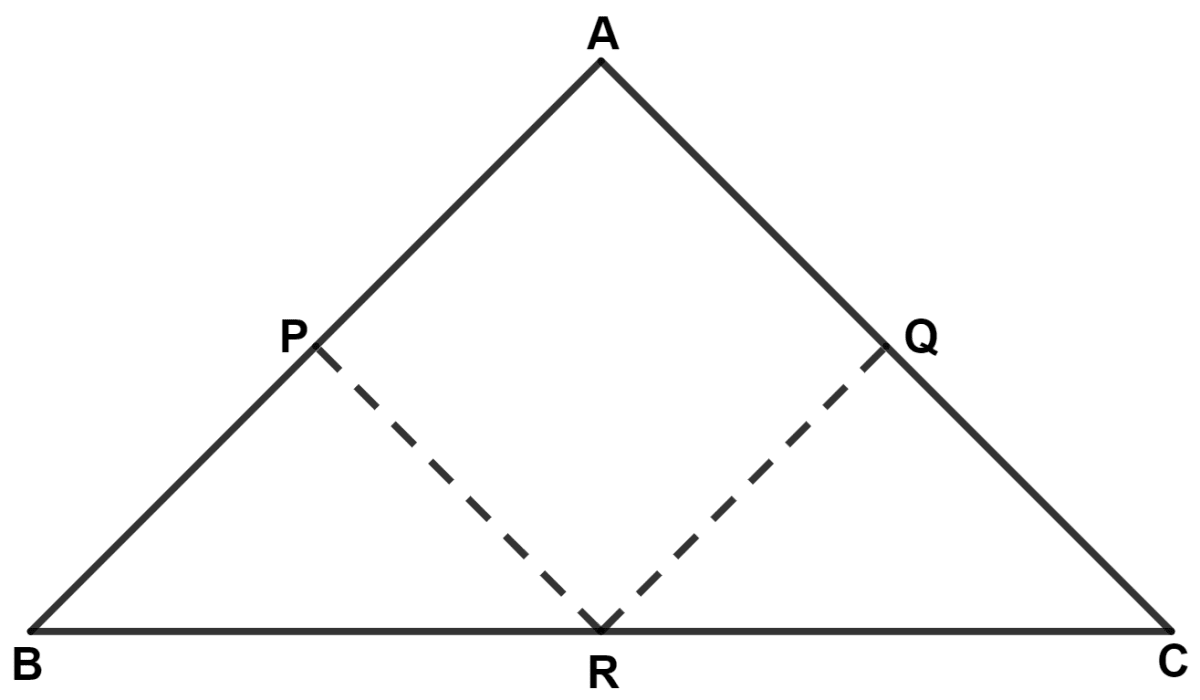
⇒ AB = AC (Given)
⇒
⇒ AP = AQ [Since P and Q are mid-points of AB and AC] ........(1)
By mid-point theorem,
The line segment in a triangle joining the midpoint of any two sides of the triangle is said to be parallel to its third side and is also half of the length of the third side.
Since, P and R are mid-points of sides AB and BC respectively.
∴ PR =
∴ PR = AQ .........(2)
From figure,
Q and R are mid-points of AC and BC respectively.
⇒ QR = [By mid-point theorem]
⇒ QR = AP ........(3)
From equations (1), (2) and (3), we get :
⇒ PR = QR.
Hence, proved that PR = QR.
(ii) From figure,
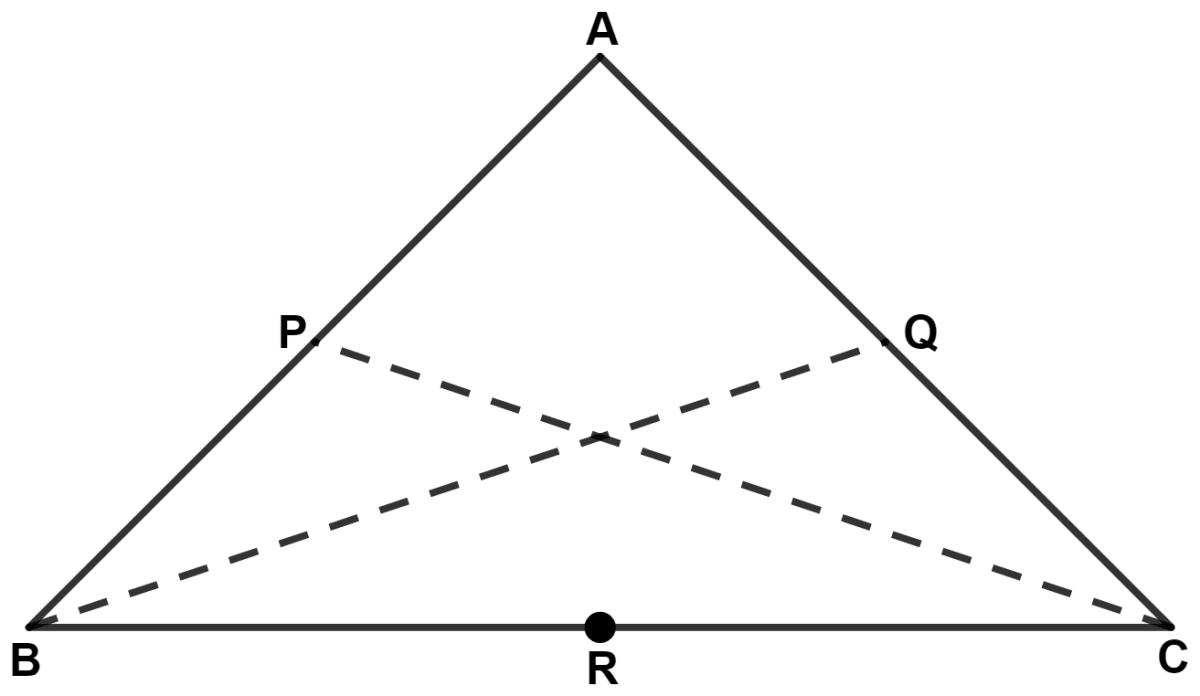
In triangle ABC,
⇒ AB = AC
⇒ ∠B = ∠C (Angles opposite to equal sides are equal)
⇒ (As AB = AC)
⇒ BP = CQ.
In △ BPC and △ CQB,
⇒ BP = CQ (Proved above)
⇒ ∠B = ∠C (Proved above)
⇒ BC = BC (Common side)
∴ Δ BPC ≅ Δ CQB (By S.A.S. axiom)
We know that,
Corresponding parts of congruent triangle are equal.
⇒ BQ = CP.
Hence, proved that BQ = CP.
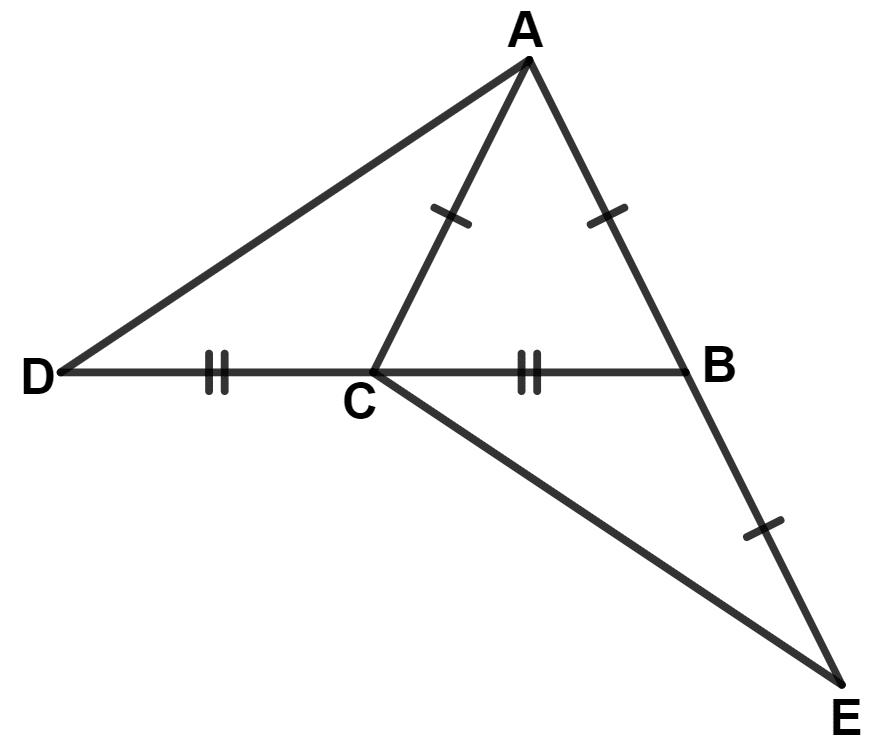
From the following figure, prove that :
(i) ∠ACD = ∠CBE
(ii) AD = CE
Answer
(i) In Δ ACB,
⇒ AC = AB (Given)
∴ ∠ABC = ∠ACB (Angles opposite to equal sides are equal) ........(1)
Since, DCB is a straight line.
∴ ∠ACD + ∠ACB = 180° ......(2)
Since, ABE is a straight line.
∴ ∠ABC + ∠CBE = 180° ......(3)
Equating equations (2) and (3), we get :
⇒ ∠ACD + ∠ACB = ∠ABC + ∠CBE
⇒ ∠ACD + ∠ACB = ∠ACB + ∠CBE [From equation (1)]
⇒ ∠ACD = ∠CBE.
Hence, proved that ∠ACD = ∠CBE.
(ii) In △ ACD and △ CBE,
⇒ DC = CB (Given)
⇒ AC = BE (Given)
⇒ ∠ACD = ∠CBE (Proved above)
∴ Δ ACD ≅ Δ CBE (By S.A.S. axiom)
We know that,
Corresponding parts of congruent triangles are equal.
⇒ AD = CE.
Hence, proved that AD = CE.
ABC is a triangle. The bisector of the angle BCA meets AB in X. A point Y lies on CX such that AX = AY.
Prove that : ∠CAY = ∠ABC.
Answer
In △ ABC,
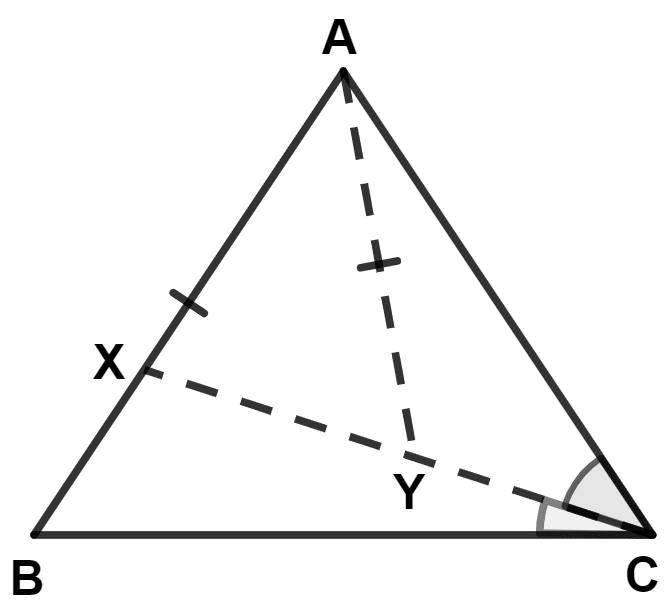
CX is the angle bisector of ∠C.
⇒ ∠ACX = ∠BCX
⇒ ∠ACY = ∠BCX ........(1)
In △ AXY,
⇒ AX = AY (Given)
⇒ ∠AXY = ∠AYX (Angles opposite to equal sides are equal) ...........(2)
From figure,
⇒ ∠XYC = ∠AXB = 180° (Since, XYC and AXB is a straight line)
⇒ ∠AYX + ∠AYC = ∠AXY + ∠BXY
⇒ ∠AXY + ∠AYC = ∠AXY + ∠BXY [From equation (2)]
⇒ ∠AYC = ∠AXY - ∠AXY + ∠BXY
⇒ ∠AYC = ∠BXY ..........(3)
By angle sum property of triangle AYC and BXC,
⇒ ∠AYC + ∠ACY + ∠CAY = ∠BXC + ∠BCX + ∠XBC
⇒ ∠BXY + ∠BCX + ∠CAY = ∠BXC + ∠BCX + ∠XBC [From equations (1) and (3)]
⇒ ∠BXC + ∠BCX + ∠CAY = ∠BXC + ∠BCX + ∠XBC [∵ From fig. ∠BXY = ∠BXC and ∠XBC = ∠ABC]
⇒ ∠CAY = ∠ABC.
Hence, proved that ∠CAY = ∠ABC.