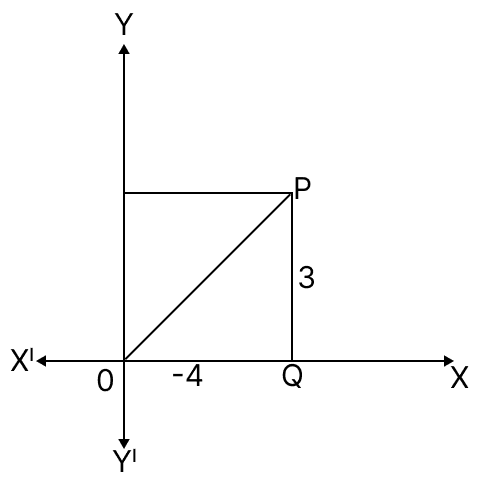
Statement 1: For the point P, x = -4 and y = 3, the distance of P from origin is 3 + 4 = 7.
Statement 2: P = (-4, 3) and its distance from origin = (−4)2+(3)2.
Both the statements are true.
Both the statements are false.
Statement 1 is true, and statement 2 is false.
Statement 1 is false, and statement 2 is true.
Answer
Given, point P, x = -4 and y = 3.
Using distance formula,
Distance between points = (x2−x1)2+(y2−y1)2
Distance of P(-4, 3) from origin (0, 0)
=(0−(−4))2+(0−3)2=42+(−3)2=16+9=25=5 units.
∴ Statement 1 is false, and statement 2 is true.
Hence, option 4 is the correct option.
Question 1(f)
Statement 1: The point P(x, y) is at a distance of 6 unit from origin, then P lies in the first quadrant.
Statement 2: Point P can lie in any quadrant.
Both the statements are true.
Both the statements are false.
Statement 1 is true, and statement 2 is false.
Statement 1 is false, and statement 2 is true.
Answer
Given, the point P(x, y) is at a distance of 6 unit from origin.
By distance formula,
Distance between two points = (x2−x1)2+(y2−y1)2
⇒6=(x−0)2+(y−0)2⇒6=(x)2+(y)2⇒62=x2+y2⇒x2+y2=36.
The above equation defines a circle centered at the origin with radius 6. That circle covers all four quadrants, so P can lie anywhere on that circle, not necessarily in the first quadrant.
∴ Statement 1 is false, and statement 2 is true.
Hence, option 4 is the correct option.
Question 1(g)
Assertion (A): If A = (2x, y), B(x, 2y) and AB = 5 unit, then x + y = 5.
Reason (R):(x−2x)2+(2y−y)2 = 5
⇒ x2 + y2 = 25
A is true, but R is false.
A is false, but R is true.
Both A and R are true, and R is the correct reason for A.
Both A and R are true, and R is the incorrect reason for A.
Answer
Given, A = (2x, y), B = (x, 2y).
By distance formula,
Distance between two points = (x2−x1)2+(y2−y1)2
Find the points on the y-axis which are at a distance of 25 units from the point (-4, 7).
Answer
Let the point on y-axis be (0, y).
Let (0, y) = (x1, y1) and (-4, 7) = (x2, y2)
⇒ Distance between the given points =
(x2−x1)2+(y2−y1)2⇒25=(−4−0)2+(7−y)2⇒25=(−4)2+(7−y)2⇒(25)2=(−4)2+(7−y)2⇒20=16+49+y2−14y⇒20=65+y2−14y⇒65+y2−14y−20=0⇒y2−14y+45=0⇒y2−(9y+5y)+45=0⇒y2−9y−5y+45=0⇒(y2−9y)−(5y−45)=0⇒y(y−9)−5(y−9)=0⇒(y−9)(y−5)=0⇒y=9 or 5
Hence, the the points on the y-axis are (0, 9) or (0, 5).
Question 3
Find the value of k, if the points (5, k) and (k, 7) are equidistant from point (2, 4).
Answer
Given (2, 4) is equidistant from (5, k) and (k, 7).
i.e. distance between (2, 4) and (5, k) = distance between (2, 4) and (k, 7)
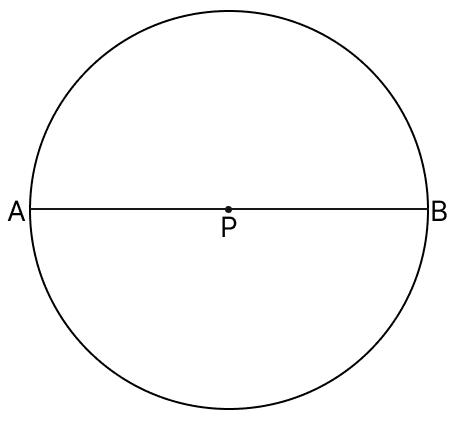
The centre of a circle is (2a, a - 7). Find the value (values) of a, if the circle passes through the point (11, -9) and has diameter 102 units.
Answer
Radius of circle = 2Diameter
= 2102
= 52
⇒ Distance between the given points = (x2−x1)2+(y2−y1)2
Radius of the circle = The distance between the center (2a, a - 7) and the point (11, -9), which lies on the circle
52=(2a−11)2+((a−7)−(−9))2⇒(52)2=(2a−11)2+(a−7+9)2⇒(52)2=(2a−11)2+(a+2)2⇒50=4a2+121−44a+a2+4+4a⇒50=5a2+125−40a⇒5a2+125−40a−50=0⇒5a2−40a+75=0⇒a2−8a+15=0⇒a2−(3a+5a)+15=0⇒a2−3a−5a+15=0⇒a(a−3)−5(a−3)=0⇒(a−3)(a−5)=0⇒a=3 or 5
Hence, the value of a = 3 or a = 5.
Question 5
Show that (-3, 2), (-5, -5), (2, -3) and (4, 4) are the vertices of a rhombus.
Answer
The points A(-3, 2), B(-5, -5), C(2, -3) and D(4, 4) are the vertices of a quadrilateral. We need to show that this quadrilateral is a rhombus.
Distance between the given points = (x2−x1)2+(y2−y1)2
Distance between points A(-3, 2) and B(-5, -5):
=((−5)−(−3))2+((−5)−2)2=(−2)2+(−7)2=4+49=53
Distance between points B(-5, -5) and C(2, -3):
=(2−(−5))2+((−3)−(−5))2=72+22=49+4=53
Distance between points C(2, -3) and D(4, 4):
=(4−2)2+(4−(−3))2=22+72=4+49=53
Distance between points D(4, 4) and A(-3, 2):
=(4−2)2+(4−(−3))2=22+72=4+49=53
AB = BC = CD = DA = 53
Since all sides are equal, the quadrilateral is a rhombus.
Hence, the points (-3, 2), (-5, -5), (2, -3) and (4, 4) are the vertices of a rhombus.
Question 6
Points A (-3, -2), B (-6, a), C (-3, -4) and D(0, -1) are the vertices of quadrilateral ABCD; find a if 'a' is negative and AB = CD.
Answer
Given:
Points A(-3, -2), B(-6, a), C(-3, -4) and D(0, -1) are the vertices of quadrilateral ABCD and AB = CD.
Distance between the given points = (x2−x1)2+(y2−y1)2
Hence, the co-ordinates of the circumcentre of the triangle is (8, 5).
Question 8
Given A = (3, 1) and B = (0, y - 1). Find y if AB = 5.
Answer
Distance between the given points = (x2−x1)2+(y2−y1)2
Distance between A(3, 1) and B(0, y - 1):
⇒(0−3)2+((y−1)−1)2=5⇒(−3)2+(y−1−1)2=52⇒9+(y−2)2=25⇒9+y2+4−4y=25⇒y2−4y+13=25⇒y2−4y−25+13=0⇒y2−4y−12=0⇒y2−6y+2y−12=0⇒(y2−6y)+(2y−12)=0⇒y(y−6)+2(y−6)=0⇒(y−6)(y+2)=0⇒y=6 or −2
Hence, the values of y are 6 and -2.
Question 9
Given A = (x + 2, -2) and B = (11, 6). Find x if AB = 17.
Answer
Distance between the given points = (x2−x1)2+(y2−y1)2
Distance between A(x + 2, -2) and B(11, 6):
⇒(11−(x+2))2+(6−(−2))2=17⇒(11−x−2)2+(6+2)2=172⇒(9−x)2+82=289⇒81+x2−18x+64=289⇒x2−18x+145=289⇒x2−18x+145−289=0⇒x2−18x−144=0⇒x2−24x+6x−144=0⇒(x2−24x)+(6x−144)=0⇒x(x−24)+6(x−24)=0⇒(x−24)(x+6)=0⇒x=24 and −6
Hence, the values of x are 24 and -6.
Question 10
The centre of a circle is (2x - 1, 3x + 1). Find x if the circle passes through (-3, -1) and the length of its diameter is 20 units.
Answer
The diameter of the circle is given as 20 units, so the radius is 10 units.
Distance between the centre A (2x - 1, 3x + 1) and point B (-3, -1) = Radius of circle AB = 10
Distance between the given points = (x2−x1)2+(y2−y1)2
⇒ AB2 = 100
Distance between B(-3, -1) and A(2x - 1, 3x + 1):
⇒((2x−1)−(−3))2+((3x+1)−(−1))2=100⇒(2x−1+3)2+(3x+1+1)2=100⇒(2x+2)2+(3x+2)2=100⇒4x2+4+8x+9x2+4+12x=100⇒13x2+8+20x=100⇒13x2+8+20x−100=0⇒13x2+20x−92=0⇒x=26−20+400+4784 or 26−20−400+4784⇒x=26−20+5184 or 26−20−5184⇒x=26−20+72 or 26−20−72⇒x=2652 or 26−92⇒x=2 or 13−46
Hence, the values of x are 2 and 13−46.
Question 11
The length of line PQ is 10 units and the co-ordinates of P are (2, -3); calculate the co-ordinates of point Q, if its abscissa is 10.
Answer
Let the co-ordinates of point Q be (10, y).
Distance between the given points = (x2−x1)2+(y2−y1)2
Distance between P(2, -3) and Q(10, y):
⇒(10−2)2+(y−(−3))2=10⇒(10−2)2+(y−(−3))2=100⇒82+(y+3)2=100⇒64+y2+9+6y=100⇒y2+6y+73=100⇒y2+6y+73−100=0⇒y2+6y−27=0⇒y2+9y−3y−27=0⇒(y2+9y)−(3y+27)=0⇒y(y+9)−3(y+9)=0⇒(y+9)(y−3)=0⇒y=−9 or 3
Hence, the required co-ordinates of the point Q are (10, -9) and (10, 3).
Question 12
Point P (2, -7) is the centre of a circle with radius 13 units, PT is perpendicular to chord AB and T = (-2, -4); Calculate the length of :
(i) AT
(ii) AB.
Answer
(i) Given:
Radius = PA = PB = 13 units
Distance between the given points = (x2−x1)2+(y2−y1)2
Distance between P(2, -7) and T(-2, -4):
=(−2−2)2+(−4+7)2=(−4)2+(3)2=16+9=25=5
Using Pythagoras theorem in triangle PAT,
PA2 = PT2 + AT2
⇒ AT2 = PA2 - PT2
⇒ AT2 = 132 - 52
⇒ AT2 = 169 - 25
⇒ AT2 = 144
⇒ AT = 144
⇒ AT = 12 units
Hence, the value of AT = 12 units.
(ii) We know that the perpendicular from the center of a circle to a chord bisects the chord.
AB = 2AT
= 2 x 12 units
= 24 units
Hence, the length of AB = 24 units.
Question 13
Calculate the distance between the points P(2, 2) and Q(5, 4) correct to three significant figures.
Answer
∵ Distance between the given points = (x2−x1)2+(y2−y1)2
Distance between P(2, 2) and Q(5, 4):
=(5−2)2+(4−2)2=32+22=9+4=13=3.605 units
Hence, the distance between the points P(2, 2) and Q(5, 4) is 3.605 units.
Question 14
Calculate the distance between A(7, 3) and B on the x-axis whose abscissa is 11.
Answer
We know that any point on x-axis has co-ordinates of the form (x, 0).
The abscissa of point B is 11.
So, the point B is (11, 0).
Distance between the given points = (x2−x1)2+(y2−y1)2
Distance between A(7, 3) and B(11, 0):
=(11−7)2+(0−3)2=42+(−3)2=16+9=25=5 units
Hence, the distance between A(7, 3) and B(11, 0) is 5 units.
Question 15
Calculate the distance between A(5, -3) and B on the y-axis whose ordinate is 9.
Answer
We know that any point on the y-axis has co-ordinates of the form (0, y).
The ordinate of point B is 9.
So, the point B is (0, 9).
Distance between the given points = (x2−x1)2+(y2−y1)2
Distance between A(5, -3) and B(0, 9):
=(0−5)2+(9−(−3))2=(−5)2+122=25+144=169=13
Hence, the distance between A(5, -3) and B(0, 9) is 13 units.
Question 16
Find the point on y-axis whose distances from the points A(6, 7) and B(4, -3) are in the ratio 1 : 2.
Answer
Let the point on y-axis be P(0, y).
Distance between the given points = (x2−x1)2+(y2−y1)2
It is given that the point on y-axis whose distances from the points A(6, 7) and B(4, -3) are in the ratio 1 : 2.
⇒PBPA=21⇒y2+6y+25y2−14y+85=21⇒y2+6y+25y2−14y+85=41⇒4(y2−14y+85)=y2+6y+25⇒4y2−56y+340=y2+6y+25⇒4y2−56y+340−y2−6y−25=0⇒3y2−62y+315=0⇒y=662+3844−3780 or 662−3844−3780⇒y=662+64 or 662−64⇒y=662+8 or 662−8⇒y=670 or 654⇒y=335 or 9
Hence, the required points on y-axis are (0, 9) and (0,335).
Question 17
The distances of point P(x, y) from the points A(1, -3) and B(-2, 2) are in the ratio 2 : 3.
Show that : 5x2 + 5y2 - 34x + 70y + 58 = 0.
Answer
Distance between the given points = (x2−x1)2+(y2−y1)2
If two vertices of an equilateral triangle be (0,0) and (3, 3), find the third vertex using distance formula.
Answer
Given,
A = (0, 0)
B =(3, 3)
Distance between the given points = (x2−x1)2+(y2−y1)2
Length of AB:
=(3−0)2+(3−0)2=(3)2+(3)2=9+3=12
Let the third vertex be C(x, y)
Since the triangle is equilateral, the distance from C to A and C to B must also be 12.
Length of AC = Length of AB
⇒(x−0)2+(y−0)2=12Squaring on both sides⇒x2+y2=12........(1)
Length of BC = Length of AB
⇒(x−3)2+(y−3)2=12Squaring on both sides⇒(x−3)2+(y−3)2=12⇒x2−6x+9+y2−23y+3=12⇒x2+y2−6x−23y+12=12⇒x2+y2−6x−23y=0..........(2)Substitute equation (1) in (2)⇒12−6x−23y=0Divide by 2⇒6−3x−3y=0⇒3y=6−3x⇒y=36−3x=23−x3⇒y=3(2−x)