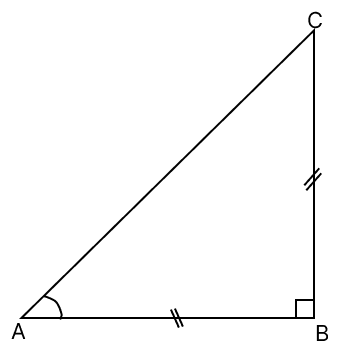
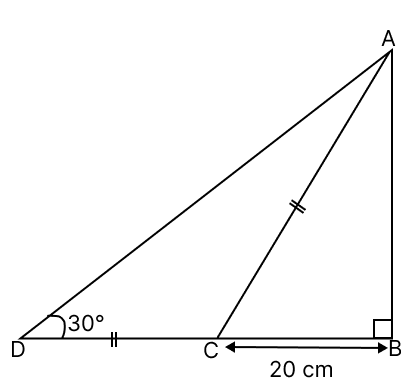
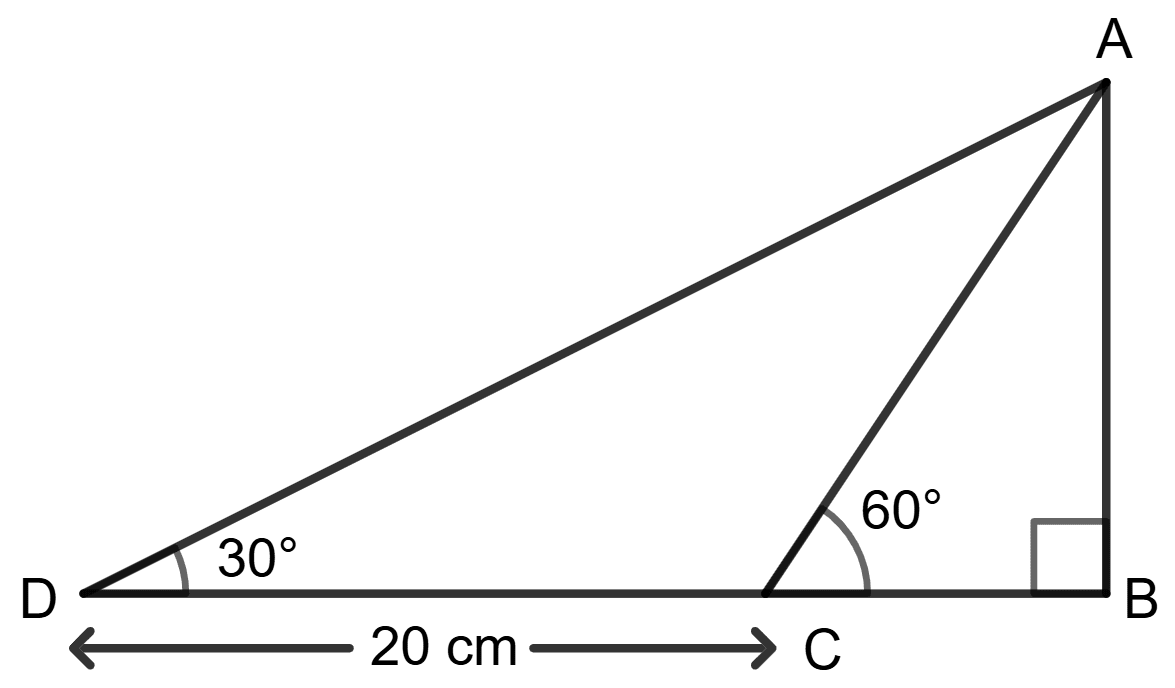
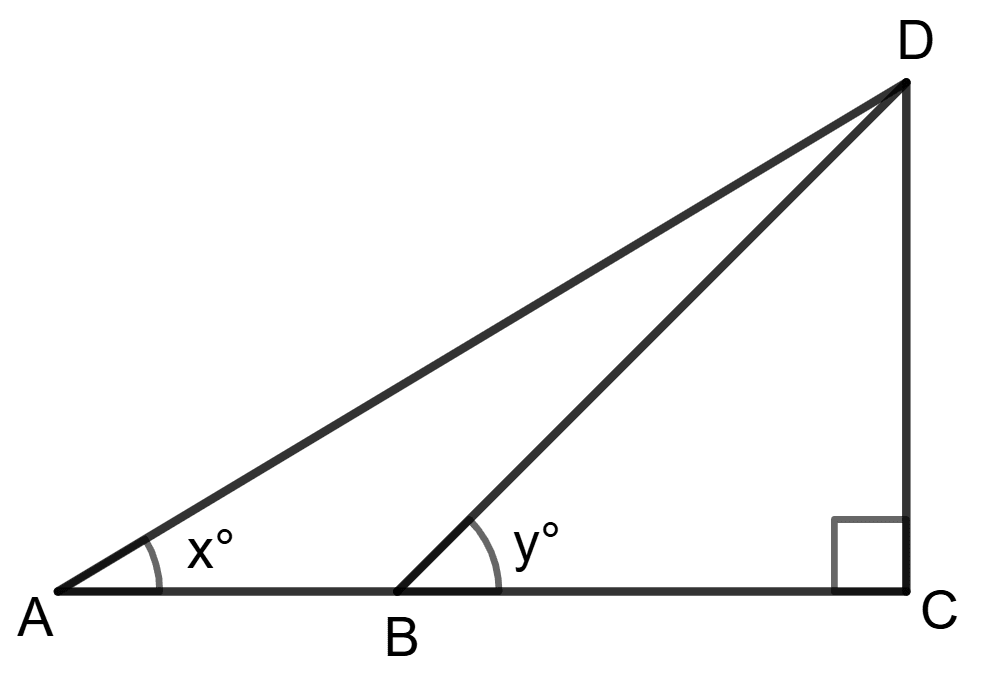
Since ΔABC is a right angled triangle, using pythagoras theorem,
⇒ Hypotenuse2 = Base2 + Height2
⇒ AC2 = CB2 + AB2
⇒x2=202+(3x+20)2⇒x2=400+(3x2+400+40x)⇒x2=(31200+x2+400+40x)⇒3x2=1200+x2+400+40x⇒3x2=1600+x2+40x⇒3x2−1600−x2−40x=0⇒2x2−40x−1600=0⇒2(x2−20x−800)=0⇒x2−20x−800=0⇒x2−40x+20x−800=0⇒x(x−40)+20(x−40)=0⇒(x−40)(x+20)=0⇒(x−40)=0 or (x+20)=0⇒x=40 or x=−20.
As length of side of triangles cannot be negative. So, x = 40 cm.
DC = AC = x = 40 cm.
AB=3x+20=340+20=360=203 cm.
Hence, option 1 is the correct option.
Question 1(e)
Statement 1: At a particular time, the length of the shadow of a 50 m tower is 503 m.
Statement 2: The sun's altitude is 30°.
Both the statements are true.
Both the statements are false.
Statement 1 is true, and statement 2 is false.
Statement 1 is false, and statement 2 is true.
Answer
In figure,
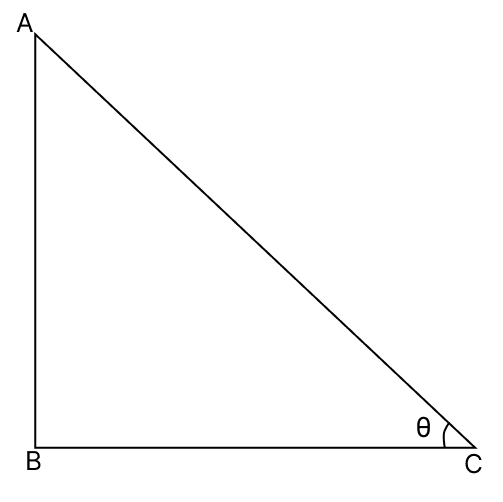
Let AB be the tower and BC be the shadow.
Join AC.
Given, AB = 50 m and BC = 50 3 m.
As tower is perpendicular to its shadow, thus ΔABC is a right angled triangle,
∴ Both A and R are true, and R is the correct reason for A.
Hence, option 3 is the correct option.
Question 1(h)
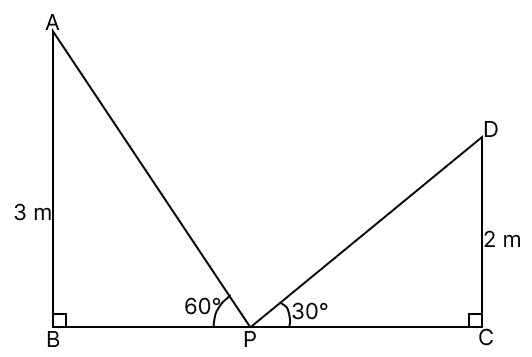
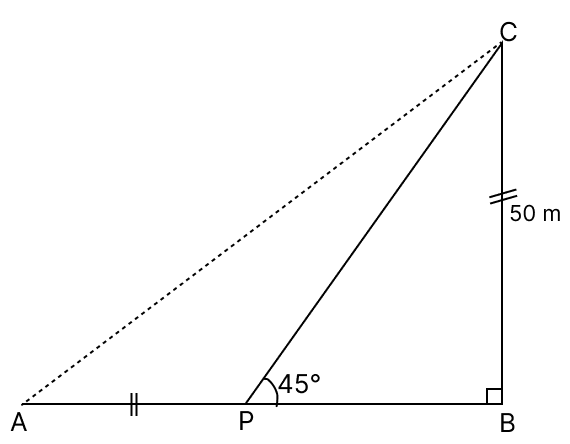
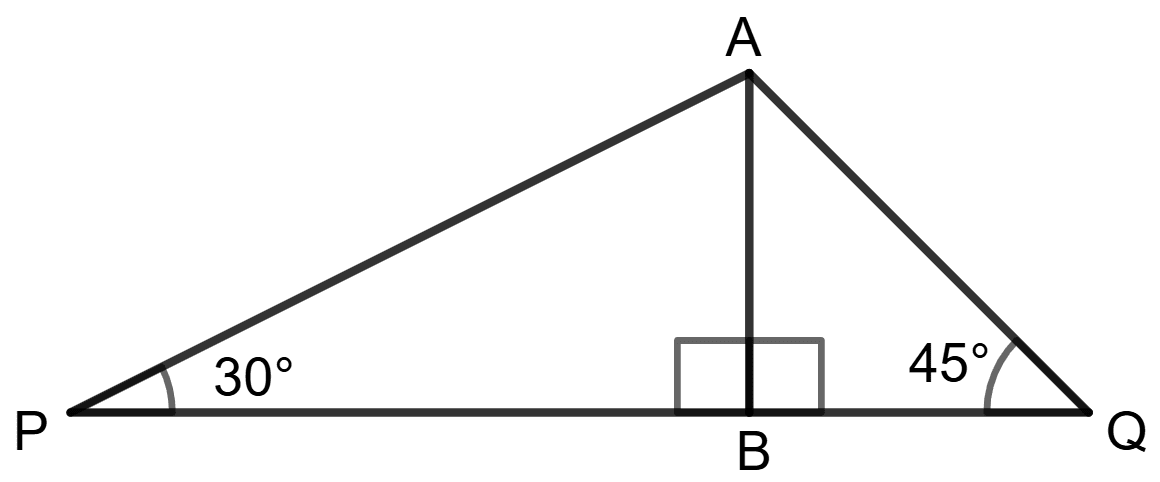
Assertion (A): The length of the line AB is 100 m.
Reason (R): tan 45° = PB50 ⇒ PB = 50 m and AB = 50 m + 50 m = 100 m
A is true, but R is false.
A is false, but R is true.
Both A and R are true, and R is the correct reason for A.
Both A and R are true, and R is the incorrect reason for A.
Answer
From figure,
⇒ BC = AP
⇒ AP = 50 m
By formula,
tan θ = BasePerpendicular
In ΔPBC,
⇒tan 45°=PBBC⇒1=PB50⇒PB=50 m.
From figure,
AB = AP + PB = 50 m + 50 m = 100 m.
∴ Both A and R are true, and R is the correct reason for A.
Hence, option 3 is the correct option.
Question 2
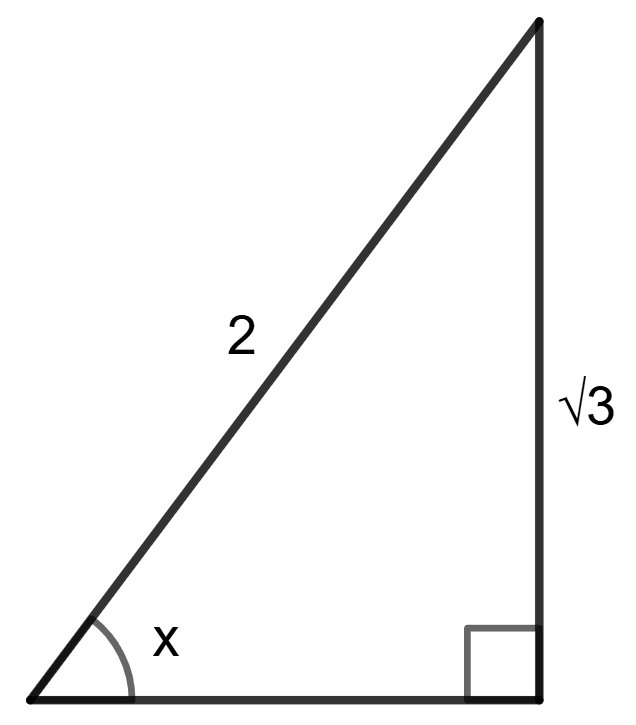
Find the value of cot x.
Answer
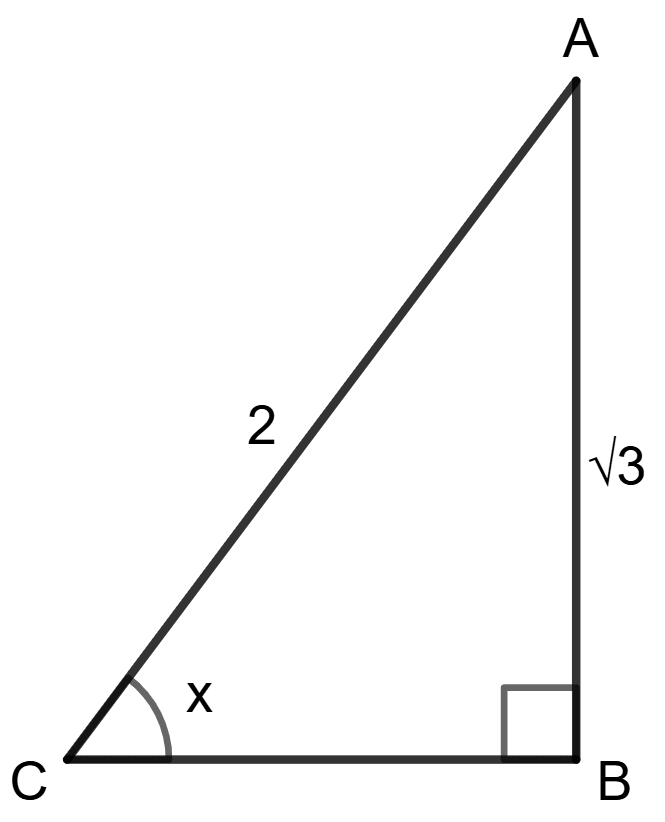
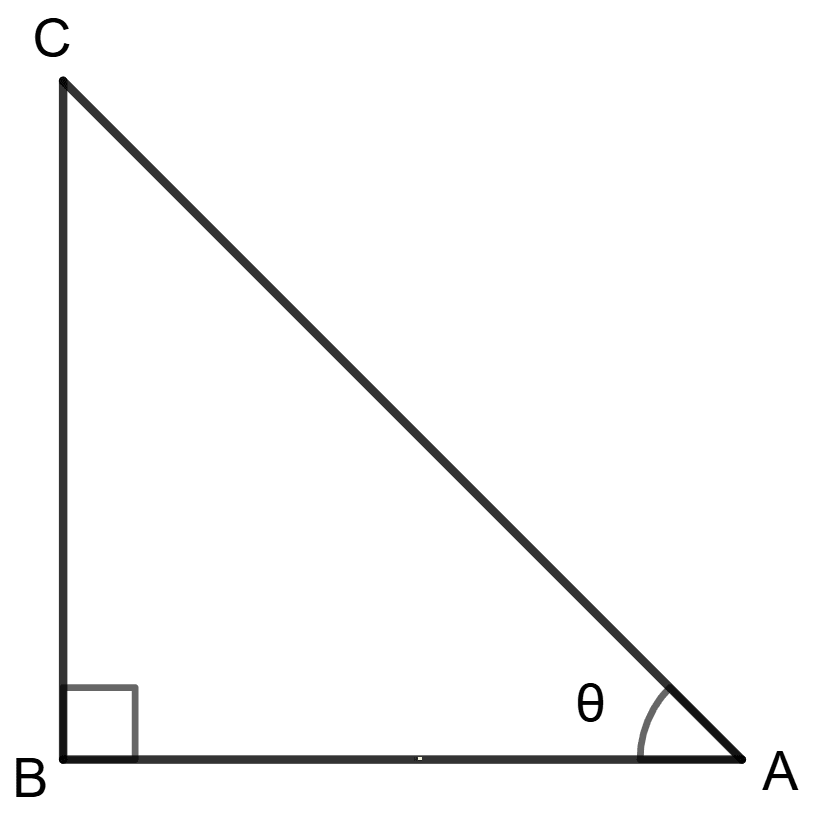
In Δ ABC, according to Pythagoras theorem,
⇒ AC2 = BC2 + AB2 (∵ AC is hypotenuse)
⇒ 22 = BC2 + (3)2
⇒ 4 = BC2 + 3
⇒ BC2 = 4 - 3
⇒ BC2 = 1
⇒ BC = 1
⇒ BC = 1
cot x=PerpendicularBasecot x=ABCBcot x=31
Hence, cot x = 31.
Question 3
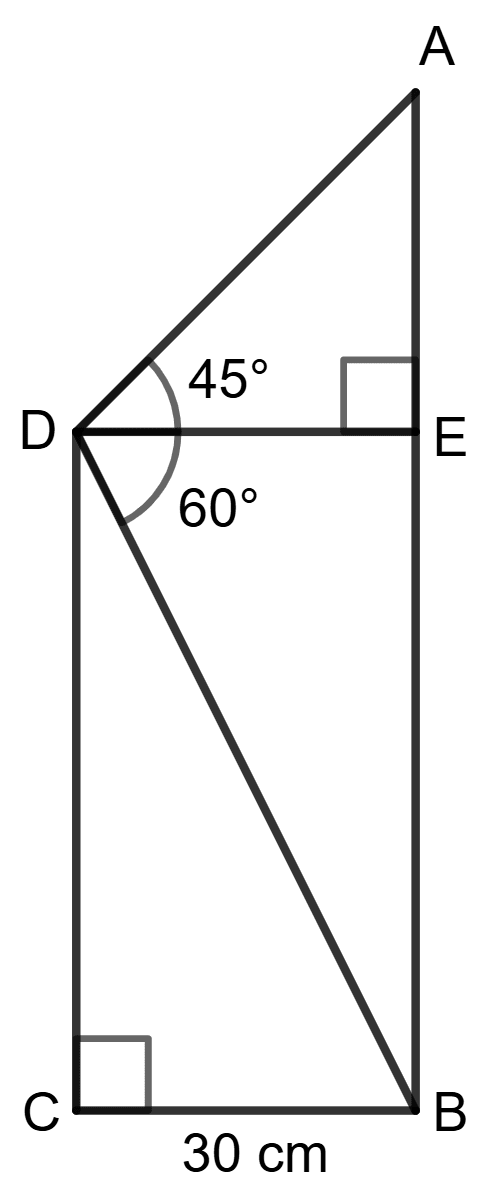
Find the length of AB.
Answer
DE = CB = 30 cm
In Δ ADE,
tan 45°=BasePerpendicular⇒1=DEAE⇒1=30AE⇒AE=30cm
In Δ DEB,
tan 60°=BasePerpendicular⇒3=DEEB⇒3=30EB⇒EB=303=51.96
AB = AE + EB
= 30 + 51.96 cm
= 81.96 cm
Hence, AB = 81.96 cm.
Question 4
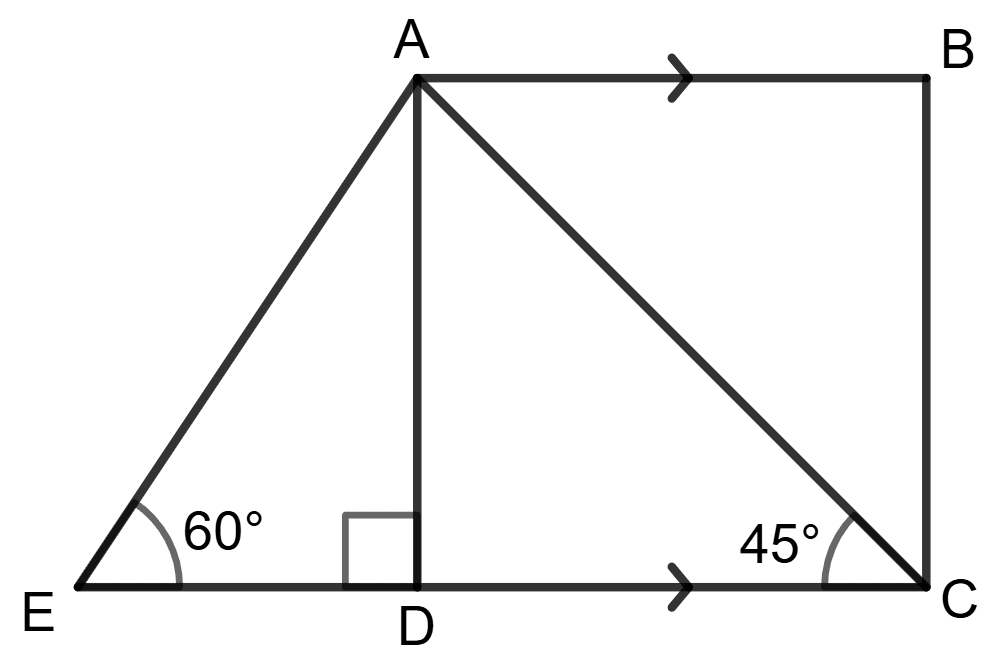
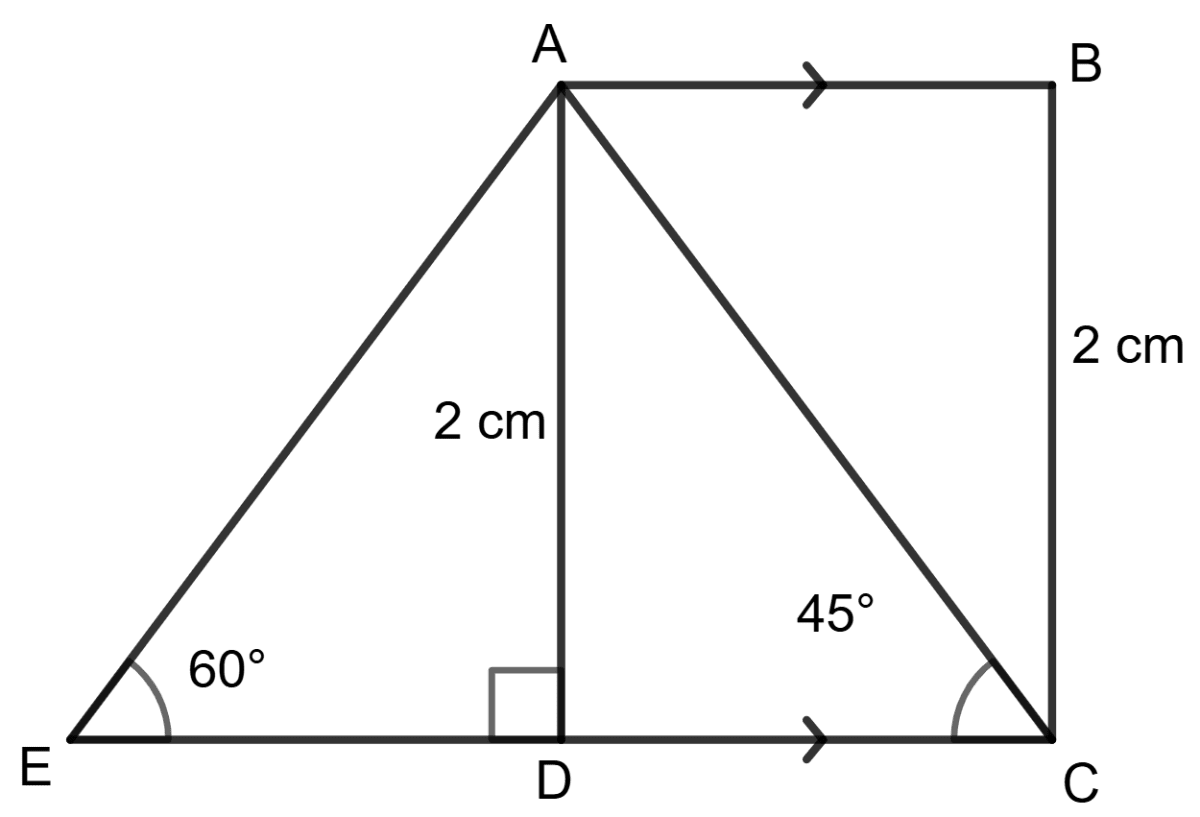
In the given figure, AB and EC are parallel to each other. Sides AD and BC are 2 cm each and are perpendicular to AB.
Given that ∠AED = 60° and ∠ACD = 45°; calculate :
(i) AB
(ii) AC
(iii) AE
Answer
(i) In Δ ADC,
tan 45°=BasePerpendicular⇒1=DCAD⇒1=DC2⇒DC=2
DC = AB = 2 cm
Hence, AB = 2 cm.
(ii) In Δ ADC,
sin 45°=HypotenusePerpendicular⇒21=ACAD⇒21=AC2⇒AC=22=2.83cm
Hence, AC = 2.83 cm.
(iii) In Δ ADE,
sin 60°=HypotenusePerpendicular⇒23=AEAD⇒23=AE2⇒AE=34=2.31cm
Hence, AC = 2.31 cm.
Question 5
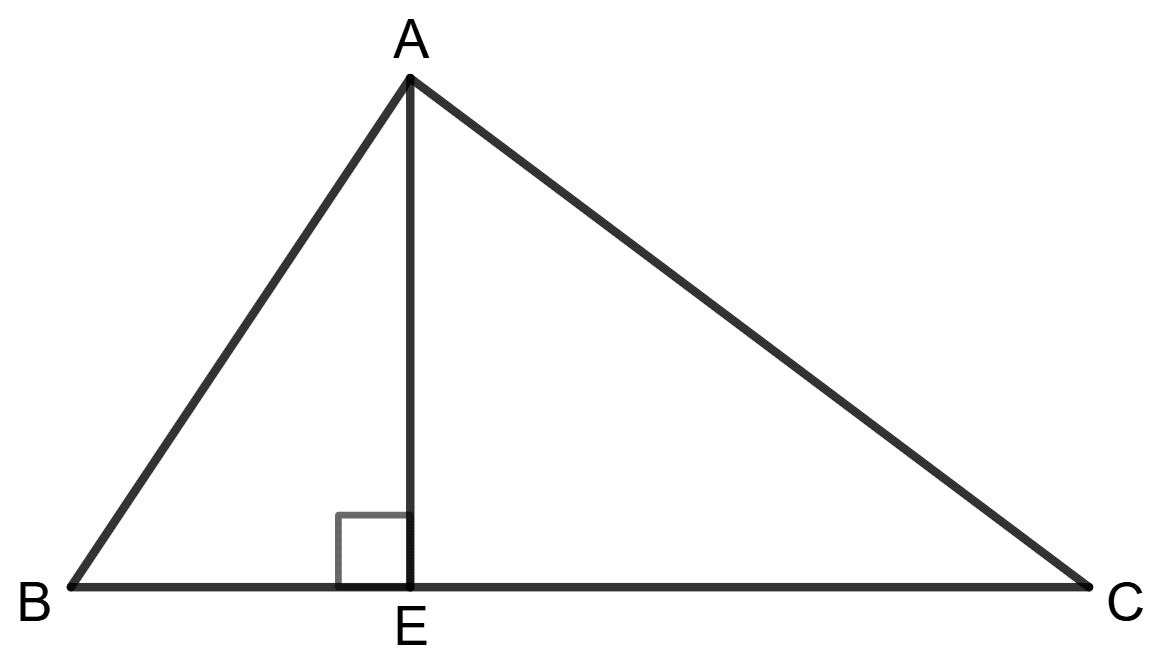
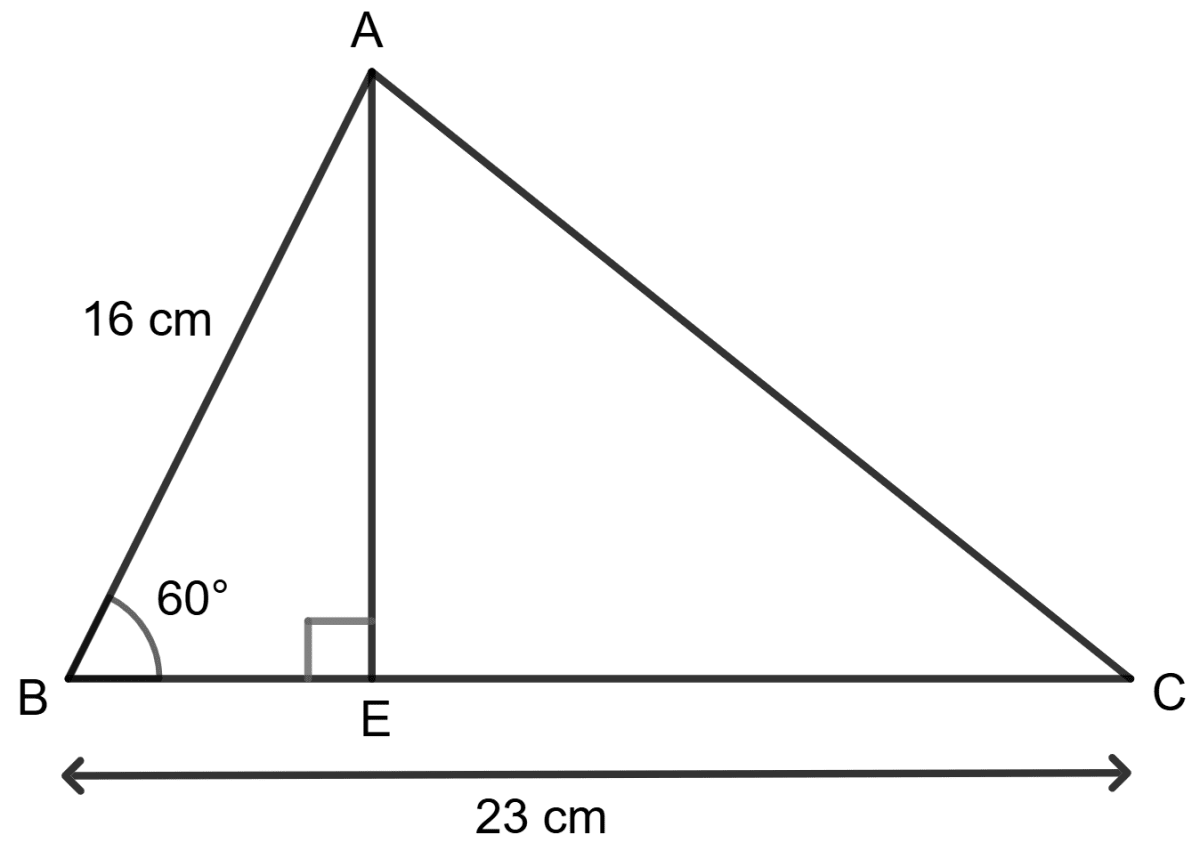
In the given figure, ∠B = 60°, AB = 16 cm and BC = 23 cm. Calculate :
(i) BE
(ii) AC.
Answer
(i) In Δ ABE,
cos 60°=HypotenuseBase⇒21=ABBE⇒21=16BE⇒BE=216=8cm
Hence, BE = 8 cm.
(ii) In Δ ABE, according to Pythagoras theorem,
⇒ AB2 = BE2 + EA2 (∵ AB is hypotenuse)
⇒ 162 = 82 + EA2
⇒ 256 = 64 + EA2
⇒ EA2 = 256 - 64
⇒ EA2 = 192
⇒ EA = 192
⇒ EA = 8 3
EC = BC - BE
= 23 - 8 cm
= 15 cm
In Δ AEC, according to Pythagoras theorem,
⇒ AC2 = AE2 + EC2 (∵ AC is hypotenuse)
⇒ AC2 = (8 3)2 + 152
⇒ AC2 = 192 + 225
⇒ AC2 = 417
⇒ AC = 417 = 20.42 cm
Hence, AC = 20.42 cm.
Question 6
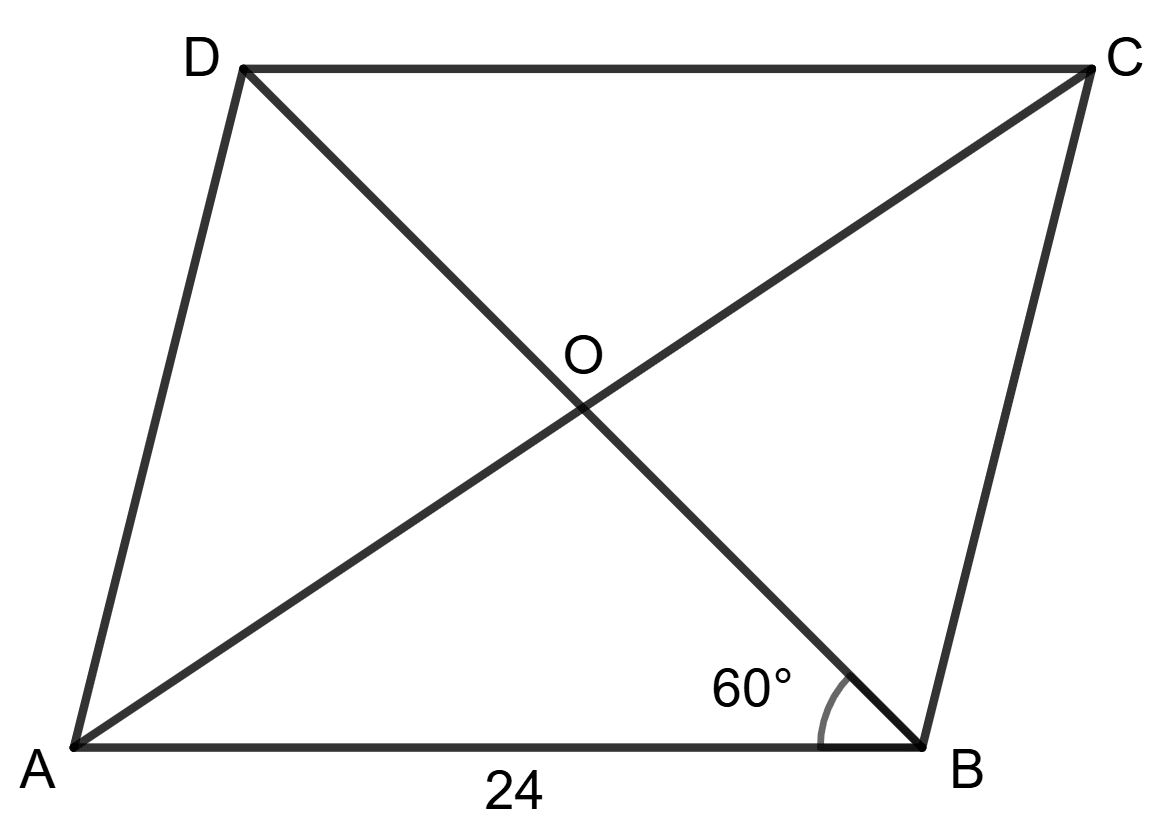
Find :
(i) BC
(ii) AD
(iii) AC
Answer
(i) In Δ ABC,
tan 30°=BasePerpendicular⇒31=BCAB⇒31=BC12⇒BC=123⇒BC=20.78
Hence, BC = 20.78 cm.
(ii) In Δ ABC, according to angle sum property,
∠ ABC + ∠ BAC + ∠ ACB = 180°
⇒ 90° + ∠ BAC + 30° = 180°
⇒ 120° + ∠ BAC = 180°
⇒ ∠ BAC = 180° - 120°
⇒ ∠ BAC = 60° = ∠ BAD
In Δ ABD,
cos 60°=HypotenuseBase⇒21=ABAD⇒21=12AD⇒AD=212⇒AD=6
Hence, AD = 6 cm.
(iii) In Δ ABC,
sin 30°=HypotenusePerpendicular⇒21=ACAB⇒21=AC12⇒AC=12×2⇒AC=24
Hence, AC = 24 cm.
Question 7
In right-angled triangle ABC; ∠B = 90°. Find the magnitude of angle A, if :
(i) AB is 3 times of BC.
(ii) BC is 3 times of AB.
Answer
(i) AB = 3 BC
BCAB=3
cot θ=BCABcot θ=3cot θ=cot 30°
So, θ = 30°
Hence, magnitude of angle A = 30°.
(ii) BC = 3 AB
ABBC=3
tan θ=ABBCtan θ=3tan θ=tan 60°
So, θ = 60°
Hence, magnitude of angle A = 60°.
Question 8
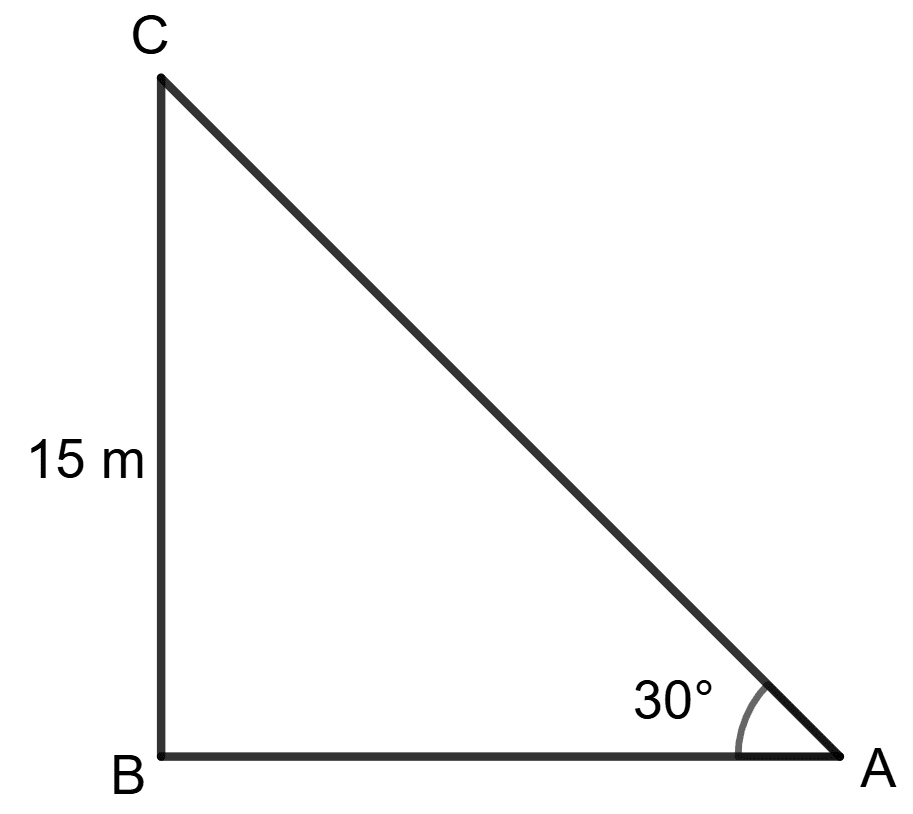
A ladder is placed against a vertical tower. If the ladder makes an angle of 30° with the ground and reaches upto a height of 15 m of the tower; find the length of the ladder.
Answer
AC is the ladder and BC is the tower.
In Δ ABC,
sin 30°=HypotenusePerpendicular⇒21=ACBC⇒21=AC15⇒AC=15×2⇒AC=30
Hence, length of the ladder = 30 m.
Question 9
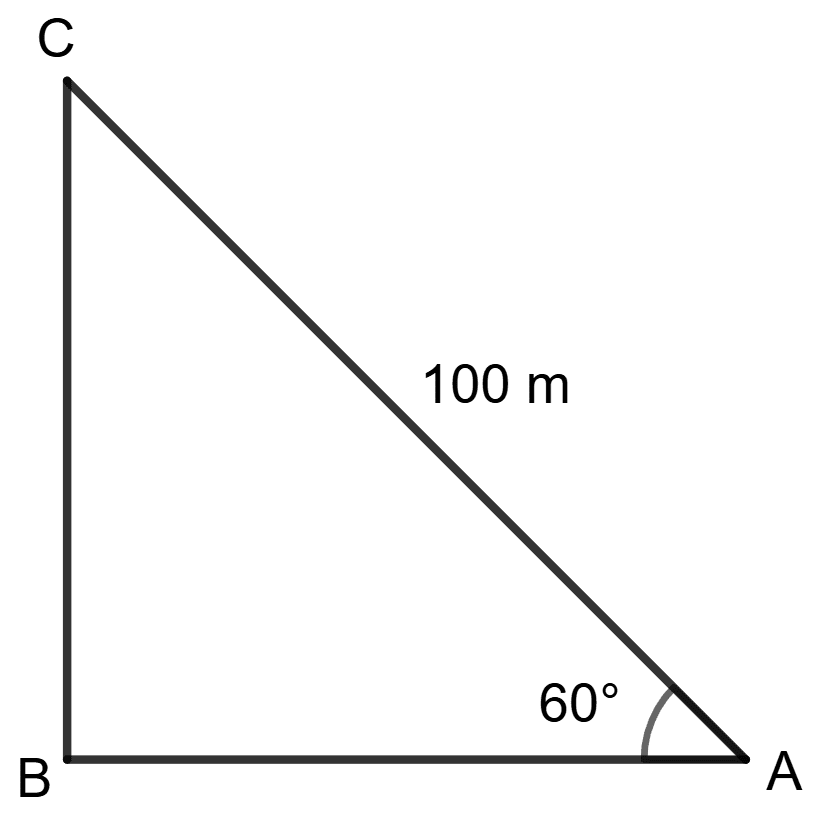
A kite is attached to a 100 m long string. Find the greatest height reached by the kite when its string makes an angle of 60° with the level ground.
Answer
AC is the string and BC is the height of kite.
In Δ ABC,
sin 60°=HypotenusePerpendicular⇒23=ACBC⇒23=100BC⇒BC=23×100⇒BC=503=86.60
Hence, the greatest height reached by the kite = 86.60 m.
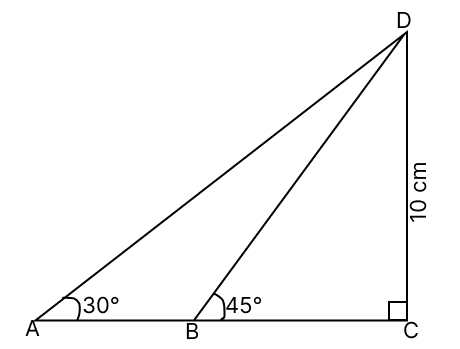
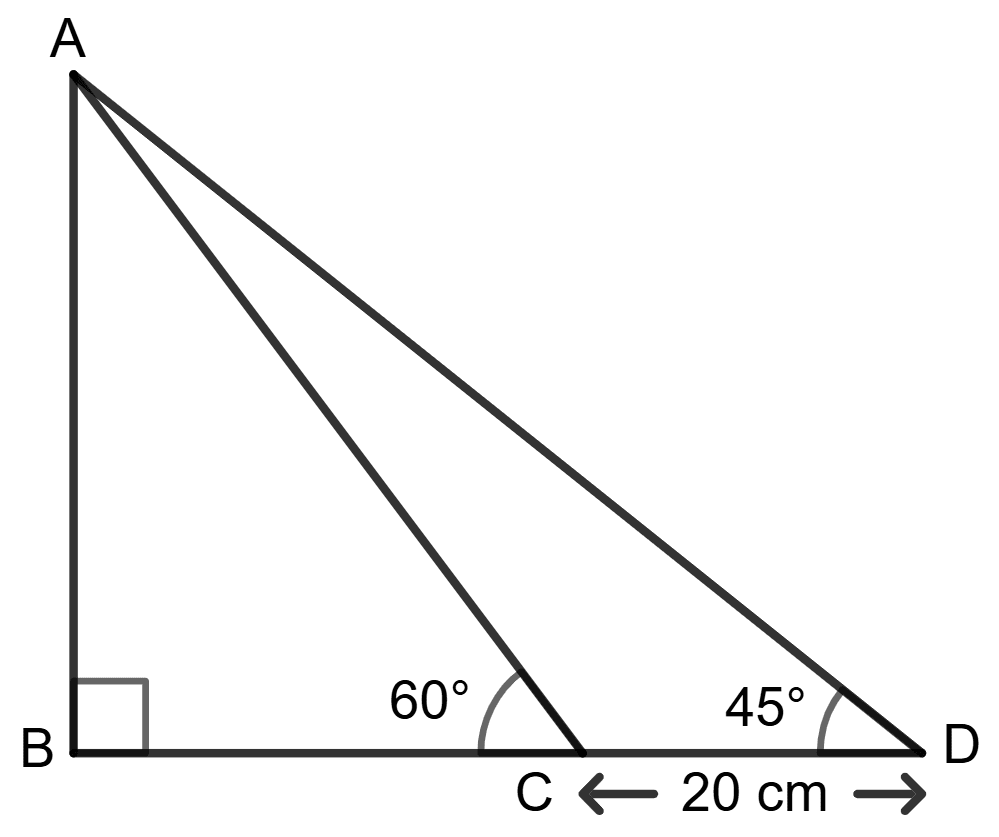
Question 10(i)
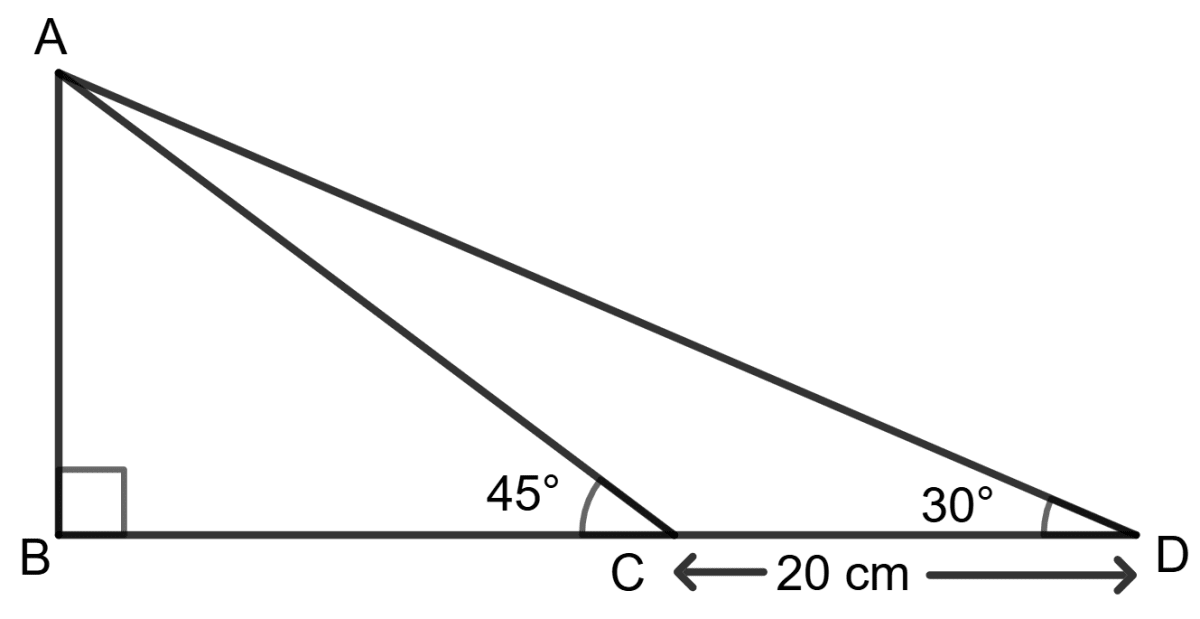
Find AB and BC, if :
Answer
Let BC be x cm.
BD = BC + CD = (x + 20) cm
In Δ ABD,
tan 30°=BasePerpendicular⇒31=BDAB⇒31=x+20AB⇒x+20=AB3..............(1)
In Δ ABC,
tan 45°=BasePerpendicular⇒1=BCAB⇒1=xAB⇒x=AB..............(2)
From equation (1),
AB + 20 = AB 3
⇒ AB 3 - AB = 20
⇒ AB(3 - 1) = 20
⇒ AB(1.73 - 1) = 20
⇒ AB x (0.73) = 20
⇒ AB = 0.7320
⇒ AB = 27.32 cm
And BC = x = AB = 27.32 cm
Hence, AB = BC = 27.32 cm.
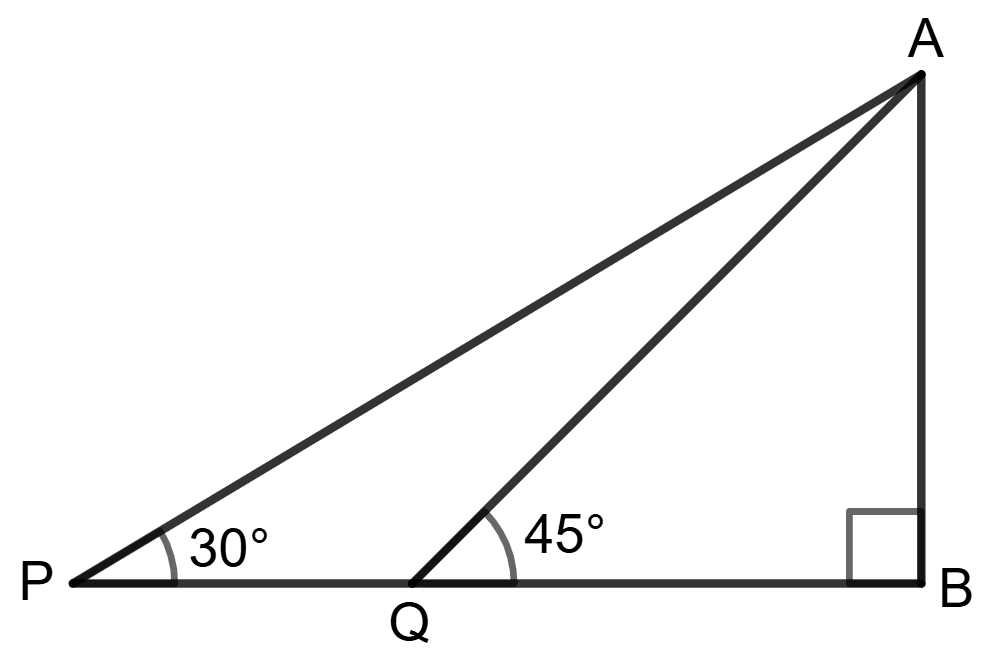
Question 10(ii)
Find AB and BC, if :
Answer
Let BC be x cm
BD = BC + CD = x + 20 cm
In Δ ABD,
tan 30°=BasePerpendicular⇒31=BDAB⇒31=x+20AB⇒x+20=AB3..............(1)
In Δ ABC,
tan 60°=BasePerpendicular⇒3=BCAB⇒3=xAB⇒x=3AB..............(2)