KnowledgeBoat Logo
|
OPEN IN APP

Chapter 22

Solution of Right Triangles

Class - 9 Concise Mathematics Selina


Exercise 22

Question 1(a)

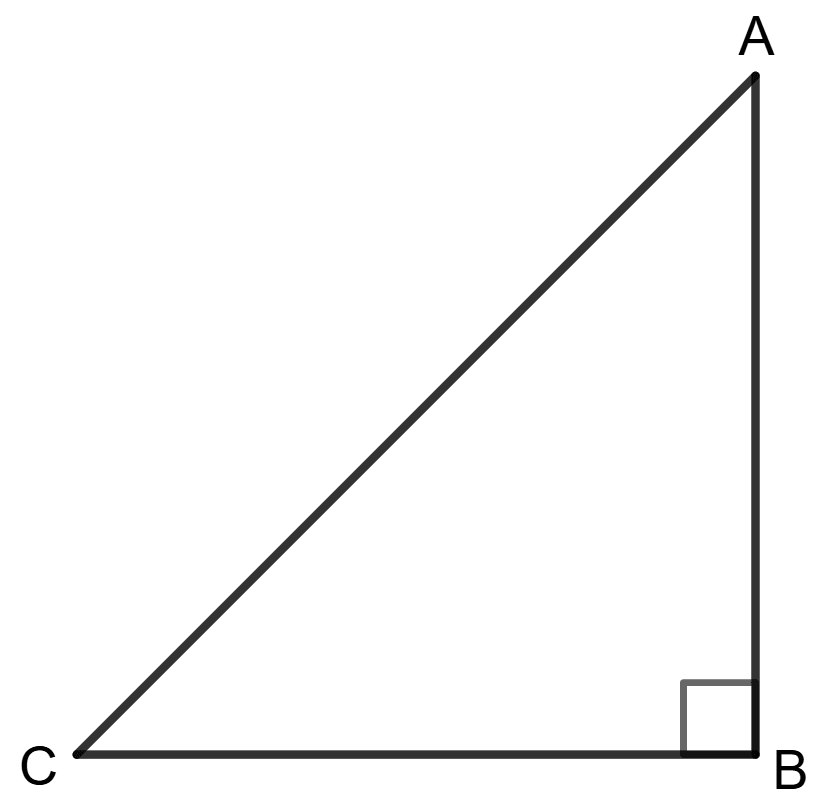
The given figure, shows an isosceles triangle with angle ABC = 90°, the measure of angle BAC is :

  1. 30°

  2. 45°

  3. 60°

  4. 40°

The given figure, shows an isosceles triangle with angle ABC = 90°, the measure of angle BAC is : Solution of Right Triangles, Concise Mathematics Solutions ICSE Class 9.

Answer

Given that Δ ABC is isosceles, ∠ BAC = ∠ BCA.

Let ∠BAC = ∠BCA = x.

Using the angle sum property of a triangle, which states that the sum of all angles in a triangle is 180°:

⇒ ∠BAC + ∠BCA + ∠ABC = 180°

⇒ x + x + 90° = 180°

⇒ 2x + 90° = 180°

⇒ 2x = 180° - 90°

⇒ 2x = 90°

⇒ x = 90°2\dfrac{90°}{2}

⇒ x = 45°

Hence, ∠BAC = 45°.

Hence, option 2 is the correct option.

Question 1(b)

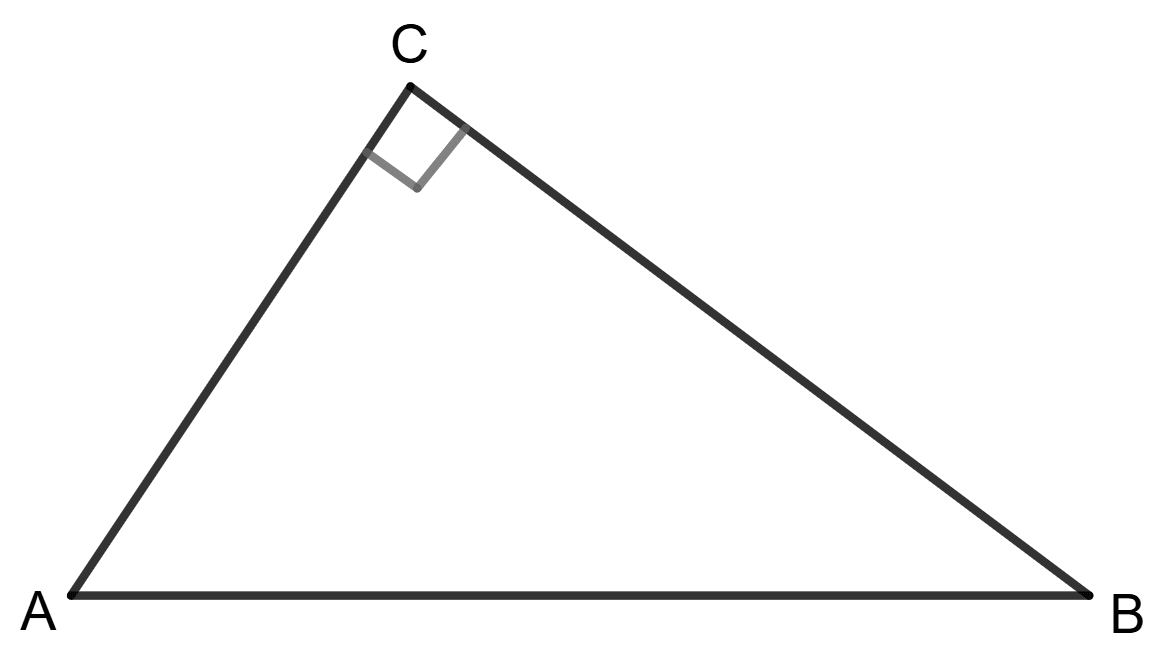
In the given triangle, ∠ACB = 90° and angle CAB = 60°, the value of cot ∠ABC is :

  1. 2

  2. 1

  3. 3{\sqrt3}

  4. 13\dfrac{1}{\sqrt3}

In the given triangle, ∠ACB = 90° and angle CAB = 60°, the value of cot ∠ABC is : Solution of Right Triangles, Concise Mathematics Solutions ICSE Class 9.

Answer

Let ∠ABC be x.

Using the angle sum property of a triangle, which states that the sum of all angles in a triangle is 180°:

⇒ ∠CAB + ∠ ACB + ∠ ABC = 180°

⇒ 60° + 90° + x = 180°

⇒ 150° + x = 180°

⇒ x = 180° - 150°

⇒ x = 30°

Now, cot ∠ABC = cot 30°

= 3\sqrt3

Hence, option 3 is the correct option.

Question 1(c)

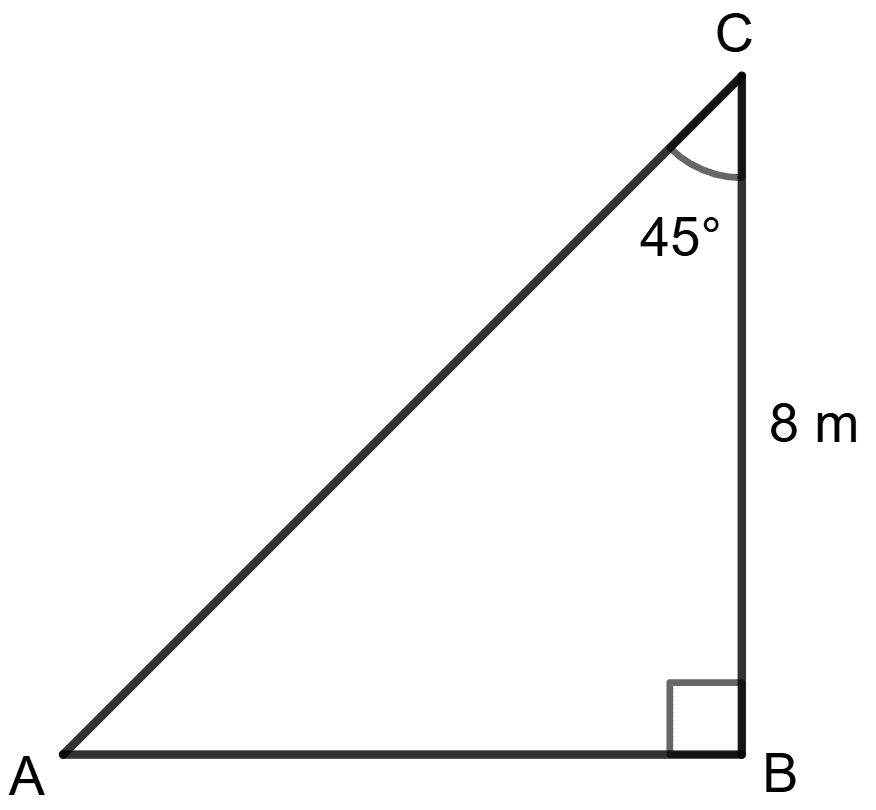
In the given triangle, the length of AB is :

  1. 424{\sqrt2}

  2. 4 m

  3. 8 m

  4. 6 m

In the given triangle, the length of AB is : Solution of Right Triangles, Concise Mathematics Solutions ICSE Class 9.

Answer

Let ∠BAC be x.

Using the angle sum property of a triangle, which states that the sum of all angles in a triangle is 180°:

⇒ ∠BAC + ∠BCA + ∠ABC = 180°

⇒ x + 45° + 90° = 180°

⇒ x + 135° = 180°

⇒ x = 180° - 135°

⇒ x = 45°

Thus, ∠BAC = ∠BCA = 45°. Therefore, Δ ABC is an isosceles triangle, meaning AB = BC = 8 m.

Hence, option 3 is the correct option.

Question 1(d)

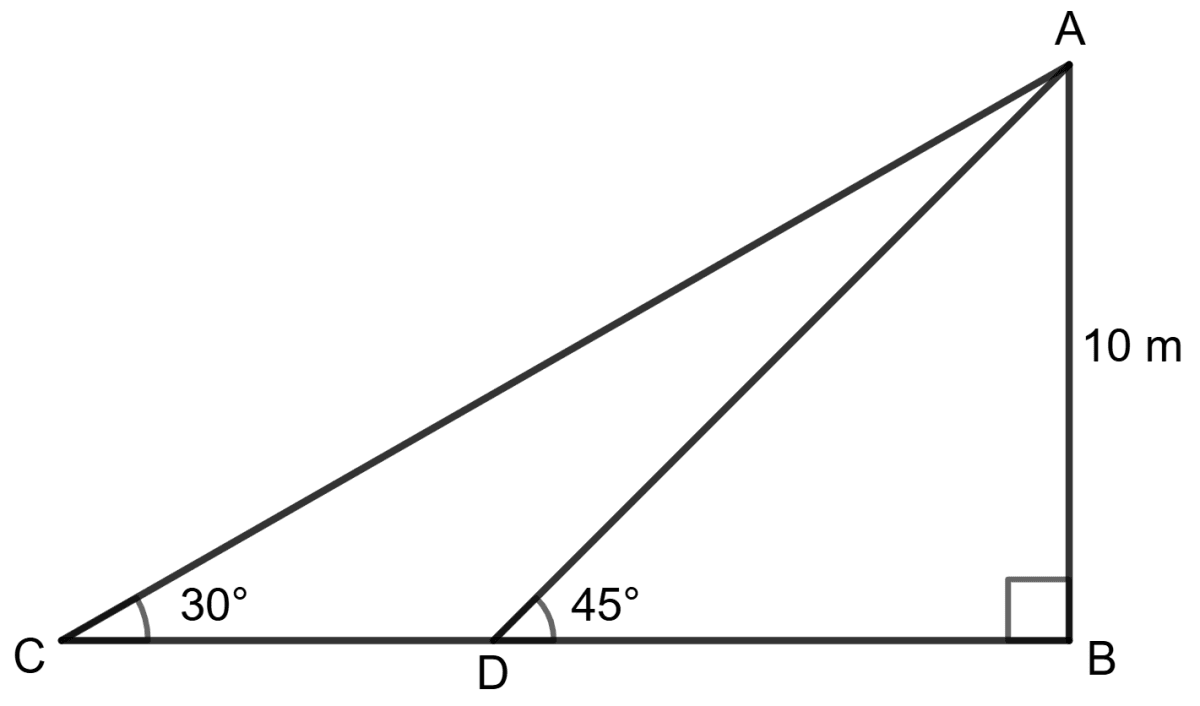
From the information given in the triangle shown below, the length of CD is :

(take 3{\sqrt3} = 1.732)

(i) 7.32 m

(ii) 27.32 m

(iii) 10 m

(iv) 17.32 m

From the information given in the triangle shown below, the length of CD is : Solution of Right Triangles, Concise Mathematics Solutions ICSE Class 9.

Answer

In Δ ABD,

tan 45°=PerpendicularBase1=ABBD1=10BDBD=10m\text{tan 45°} = \dfrac{Perpendicular}{Base}\\[1em] ⇒ 1 = \dfrac{AB}{BD}\\[1em] ⇒ 1 = \dfrac{10}{BD}\\[1em] ⇒ BD = 10 m

In Δ ABC,

tan 30°=PerpendicularBase13=ABBC11.732=10BCBC=10×1.732mBC=17.32m\text{tan 30°} = \dfrac{Perpendicular}{Base}\\[1em] ⇒ \dfrac{1}{\sqrt3} = \dfrac{AB}{BC}\\[1em] ⇒ \dfrac{1}{1.732} = \dfrac{10}{BC}\\[1em] ⇒ BC = 10 \times 1.732 m\\[1em] ⇒ BC = 17.32 m

As, BC = BD + CD

⇒ 17.32 = 10 + CD

⇒ CD = 17.32 - 10

⇒ CD = 7.32

Hence, option 1 is the correct option.

Question 1(e)

In the given triangle, the length of AB is :

  1. 160 cm

  2. 120 cm

  3. 60 cm

  4. 40 cm

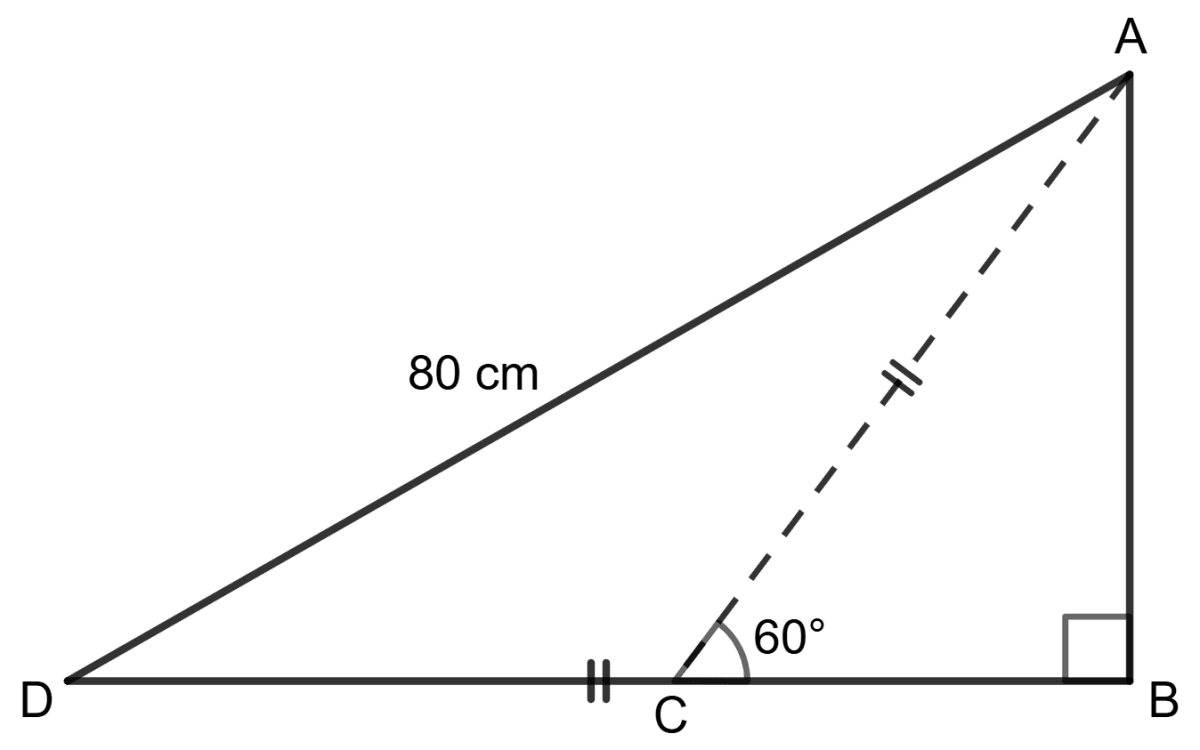
In the given triangle, the length of AB is : Solution of Right Triangles, Concise Mathematics Solutions ICSE Class 9.

Answer

Let AC = x. Therefore, DC = x.

In Δ ABC,

cos 60°=BaseHypotenuse12=BCxBC=x2\text{cos 60°} = \dfrac{Base}{Hypotenuse}\\[1em] ⇒ \dfrac{1}{2} = \dfrac{BC}{x}\\[1em] ⇒ BC = \dfrac{x}{2}

sin 60°=PerpendicularHypotenuse32=ABxAB=x32\text{sin 60°} = \dfrac{Perpendicular}{Hypotenuse}\\[1em] ⇒ \dfrac{\sqrt3}{2} = \dfrac{AB}{x}\\[1em] ⇒ AB = \dfrac{x\sqrt3}{2}

BD=BC+CDBD=x2+xBD=x+2x2BD=3x2BD = BC + CD\\[1em] ⇒ BD = \dfrac{x}{2} + x\\[1em] ⇒ BD = \dfrac{x + 2x}{2}\\[1em] ⇒ BD = \dfrac{3x}{2}

In Δ ABD, according to Pythagoras theorem,

⇒ AD2 = BD2 + AB2 (∵ AD is hypotenuse)

802=(3x2)2+(3x2)26400=9x24+3x246400=9x2+3x246400=12x246400=3x2x2=64003x=64003x=803⇒ 80^2 = \Big(\dfrac{3x}{2}\Big)^2 + \Big(\dfrac{\sqrt3x}{2}\Big)^2 \\[1em] ⇒ 6400 = \dfrac{9x^2}{4} + \dfrac{3x^2}{4} \\[1em] ⇒ 6400 = \dfrac{9x^2 + 3x^2}{4}\\[1em] ⇒ 6400 = \dfrac{12x^2}{4}\\[1em] ⇒ 6400 = 3x^2\\[1em] ⇒ x^2 = \dfrac{6400}{3}\\[1em] ⇒ x = \sqrt\dfrac{6400}{3}\\[1em] ⇒ x = \dfrac{80}{\sqrt3}

Substituting the value of x in AB,

AB=x32AB=803×32AB=803×32AB=40mAB = \dfrac{x\sqrt3}{2}\\[1em] ⇒ AB = \dfrac{\dfrac{80}{\sqrt3} \times \sqrt3}{2}\\[1em] ⇒ AB = \dfrac{\dfrac{80}{\cancel {\sqrt3}} \times \cancel {\sqrt3}}{2}\\[1em] ⇒ AB = 40 m

Hence, option 4 is the correct option.

Question 2(i)

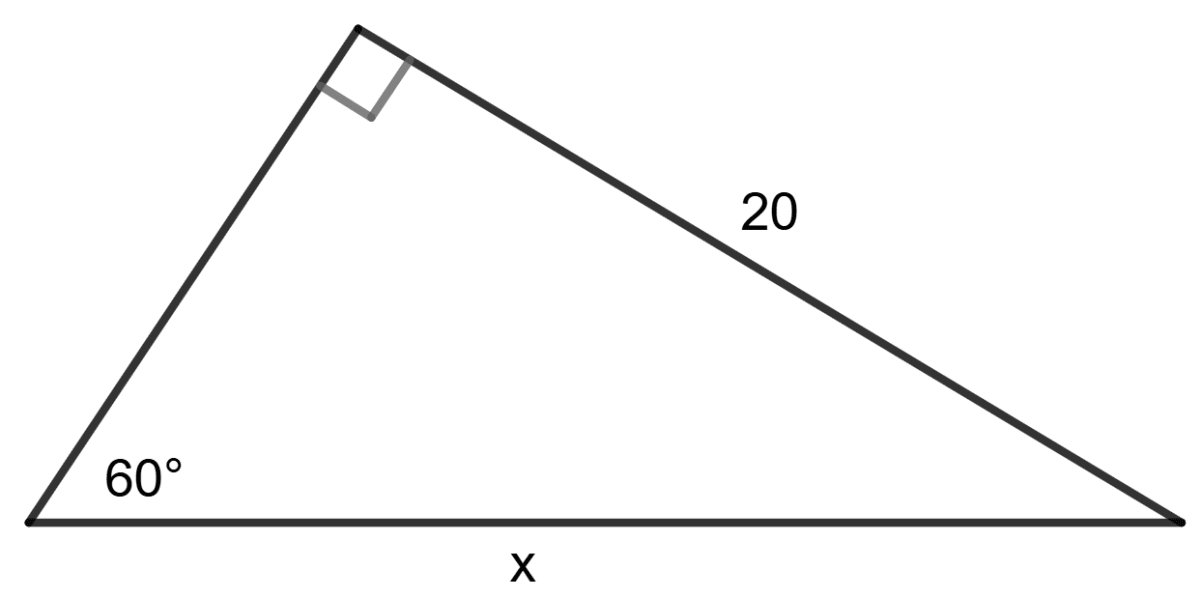
Find 'x', if :

Find 'x', if : Solution of Right Triangles, Concise Mathematics Solutions ICSE Class 9.

Answer

sin 60°=PerpendicularHypotenuse32=20xx=20×23x=403x=23.1\text{sin 60°} = \dfrac{Perpendicular}{Hypotenuse}\\[1em] ⇒ \dfrac{\sqrt3}{2} = \dfrac{20}{x}\\[1em] ⇒ x = \dfrac{20 \times 2}{\sqrt3}\\[1em] ⇒ x = \dfrac{40}{\sqrt3} \\[1em] ⇒ x = 23.1

Hence, x = 23.1.

Question 2(ii)

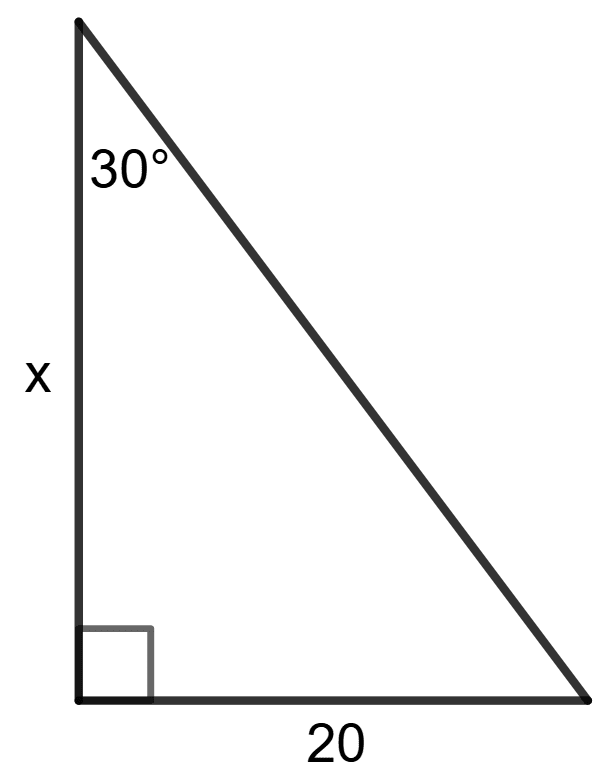
Find 'x', if :

Find 'x', if : Solution of Right Triangles, Concise Mathematics Solutions ICSE Class 9.

Answer

tan 30°=PerpendicularBase13=20xx=20×3x=34.64\text{tan 30°} = \dfrac{Perpendicular}{Base}\\[1em] ⇒ \dfrac{1}{\sqrt3} = \dfrac{20}{x}\\[1em] ⇒ x = 20 \times \sqrt3\\[1em] ⇒ x = 34.64

Hence, x = 34.64.

Question 2(iii)

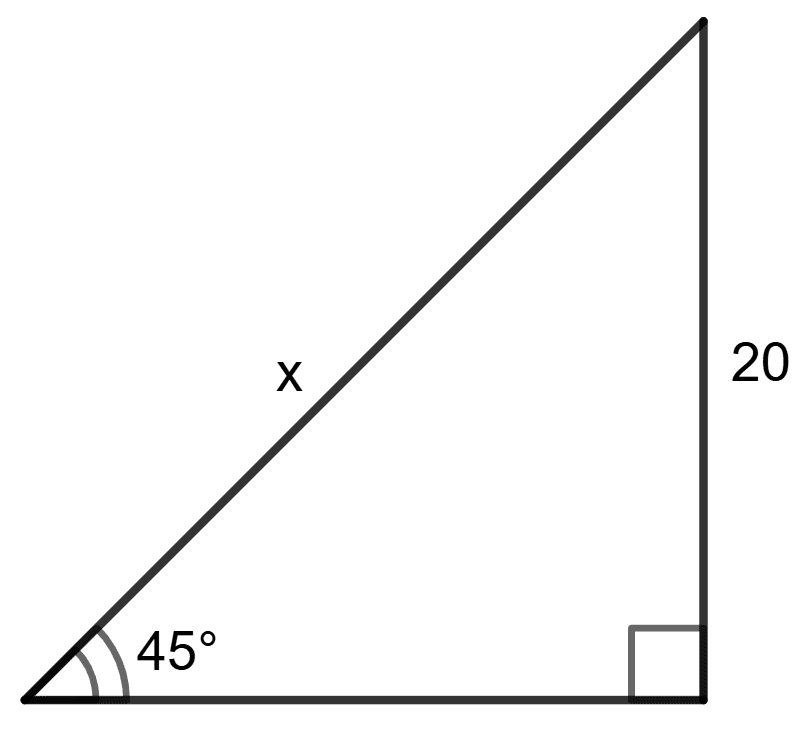
Find 'x', if :

Find 'x', if : Solution of Right Triangles, Concise Mathematics Solutions ICSE Class 9.

Answer

sin 45°=PerpendicularHypotenuse12=20xx=20×2x=28.28\text{sin 45°} = \dfrac{Perpendicular}{Hypotenuse}\\[1em] ⇒ \dfrac{1}{\sqrt2} = \dfrac{20}{x}\\[1em] ⇒ x = 20 \times \sqrt2\\[1em] ⇒ x = 28.28

Hence, x = 28.28.

Question 3(i)

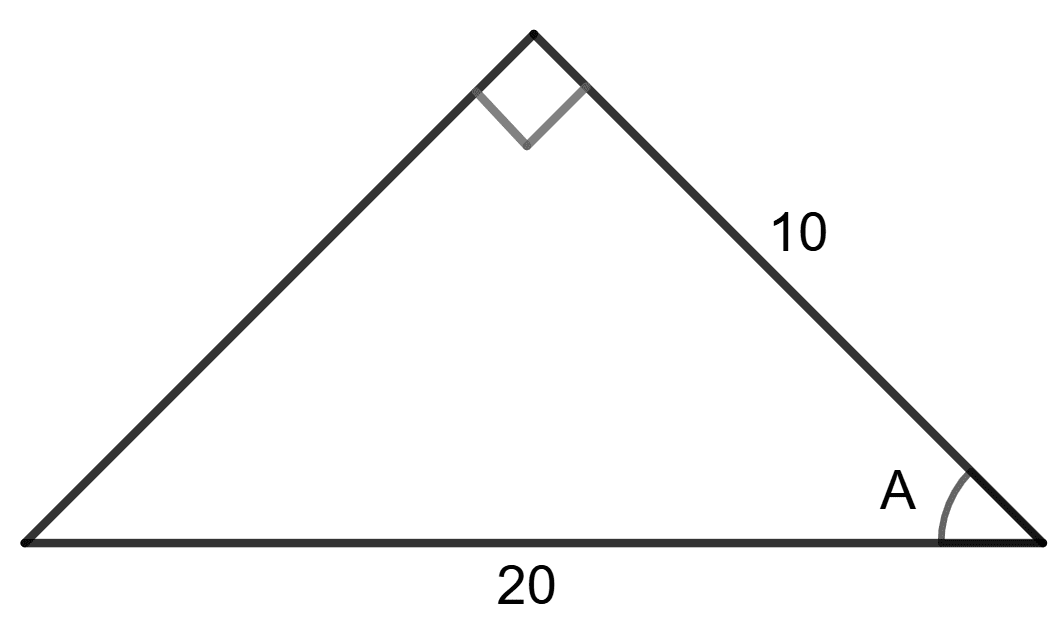
Find angle 'A' if :

Find angle 'A' if : Solution of Right Triangles, Concise Mathematics Solutions ICSE Class 9.

Answer

cos A=BaseHypotenusecos A=1020cos A=12cos A=cos 60°\text{cos A} = \dfrac{Base}{Hypotenuse}\\[1em] ⇒ \text{cos A} = \dfrac{10}{20}\\[1em] ⇒ \text{cos A} = \dfrac{1}{2}\\[1em] ⇒ \text{cos A} = \text{cos 60°}

Hence, A = 60°.

Question 3(ii)

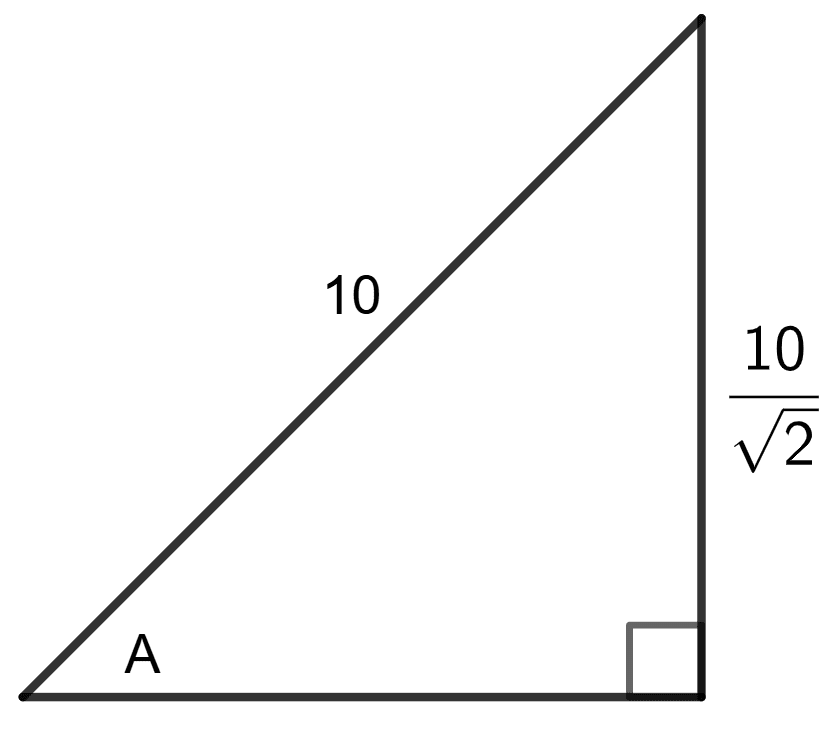
Find angle 'A' if :

Find angle 'A' if : Solution of Right Triangles, Concise Mathematics Solutions ICSE Class 9.

Answer

sin A=PerpendicularHypotenusesin A=10210sin A=12sin A=sin 45°\text{sin A} = \dfrac{Perpendicular}{Hypotenuse}\\[1em] ⇒ \text{sin A} = \dfrac{\dfrac{10}{\sqrt2}}{10}\\[1em] ⇒ \text{sin A} = \dfrac{1}{\sqrt2}\\[1em] ⇒ \text{sin A} = \text{sin 45°}

Hence, A = 45°.

Question 3(iii)

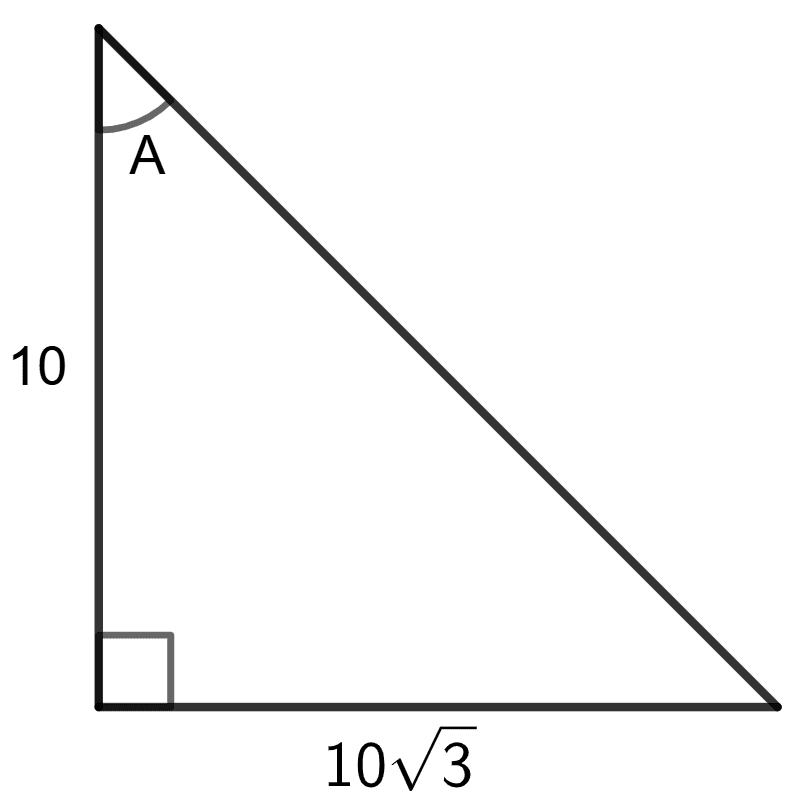
Find angle 'A' if :

Find angle 'A' if : Solution of Right Triangles, Concise Mathematics Solutions ICSE Class 9.

Answer

tan A=PerpendicularBasetan A=10310tan A=3tan A=tan 60°\text{tan A} = \dfrac{Perpendicular}{Base}\\[1em] ⇒ \text{tan A} = \dfrac{10\sqrt3}{10}\\[1em] ⇒ \text{tan A} = \sqrt3\\[1em] ⇒ \text{tan A} = \text{tan 60°}

Hence, A = 60°.

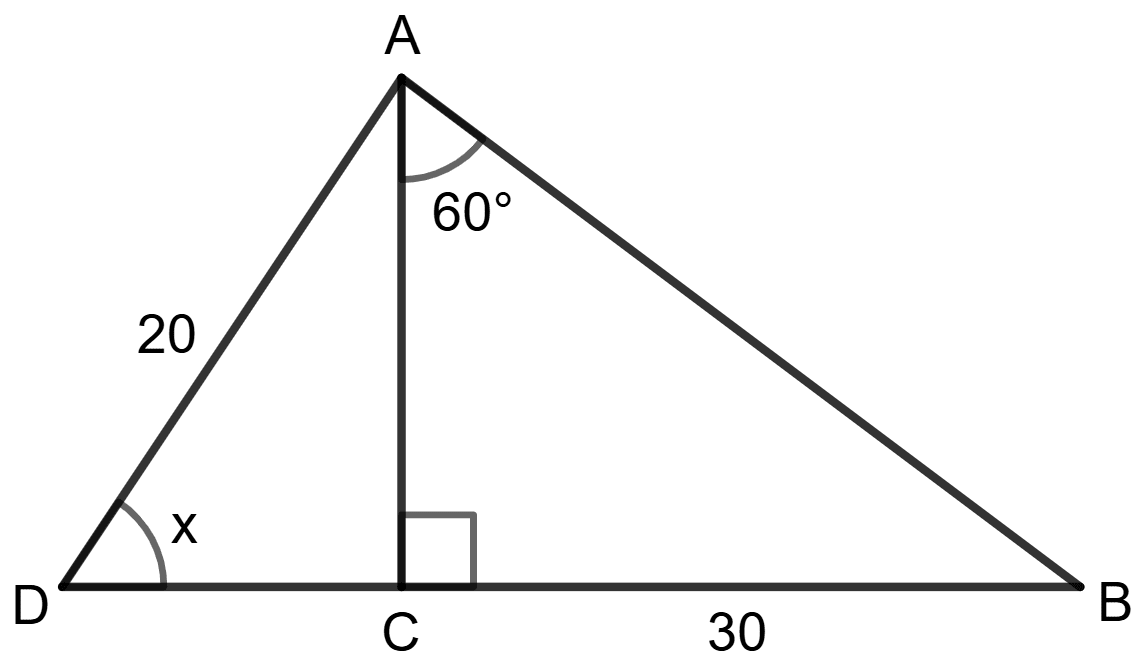
Question 4

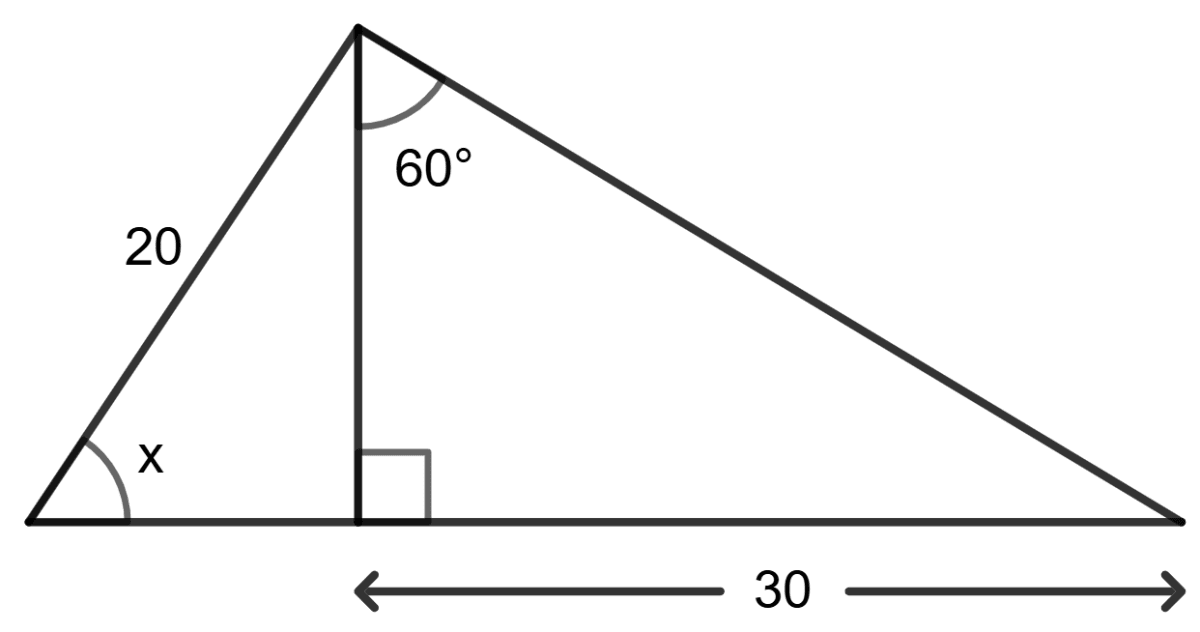
Find angle 'x' if :

Find angle 'x' if : Solution of Right Triangles, Concise Mathematics Solutions ICSE Class 9.

Answer

In Δ ABC,

Find angle 'x' if : Solution of Right Triangles, Concise Mathematics Solutions ICSE Class 9.

tan 60°=PerpendicularBase3=CBAC3=30ACAC=303AC=30×33AC=103\text{tan 60°} = \dfrac{Perpendicular}{Base}\\[1em] ⇒ \sqrt3 = \dfrac{CB}{AC}\\[1em] ⇒ \sqrt3 = \dfrac{30}{AC}\\[1em] ⇒ AC = \dfrac{30}{\sqrt3}\\[1em] ⇒ AC = \dfrac{30 \times \sqrt3}{3}\\[1em] ⇒ AC = 10\sqrt3

In Δ ADC,

sin x=PerpendicularHypotenusesin x=ACADsin x=10320sin x=32sin x=sin 60°\text{sin x} = \dfrac{Perpendicular}{Hypotenuse}\\[1em] ⇒ \text{sin x} = \dfrac{AC}{AD}\\[1em] ⇒ \text{sin x} = \dfrac{10\sqrt3}{20}\\[1em] ⇒ \text{sin x} = \dfrac{\sqrt3}{2}\\[1em] ⇒ \text{sin x} = \text {sin 60°}

Hence, x = 60°.

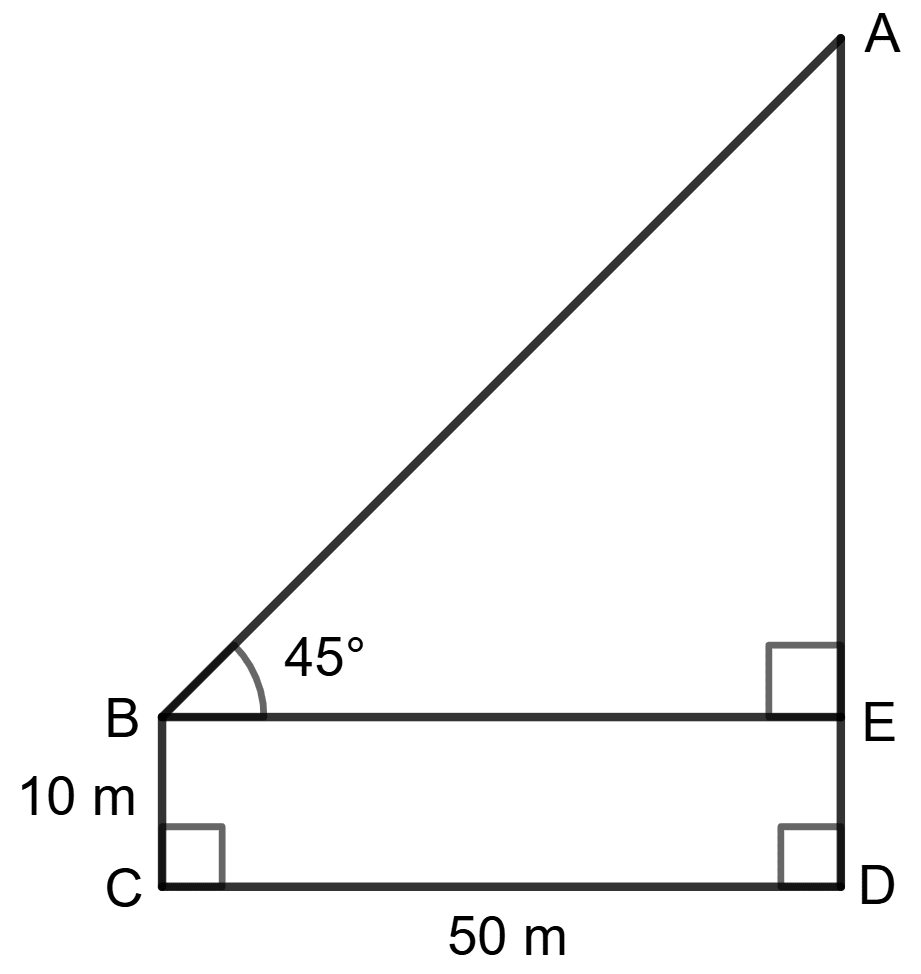
Question 5(i)

Find AD, if :

Find AD, if : Solution of Right Triangles, Concise Mathematics Solutions ICSE Class 9.

Answer

BE = CD = 50 m

ED = BC = 10 m

In Δ ABE,

tan 45°=PerpendicularBase1=AEBE1=AE50AE=50\text{tan 45°} = \dfrac{Perpendicular}{Base}\\[1em] ⇒ 1 = \dfrac{AE}{BE}\\[1em] ⇒ 1 = \dfrac{AE}{50}\\[1em] ⇒ AE = 50

AD = AE + ED

⇒ AD = 50 + 10 m

⇒ AD = 60 m

Hence, AD = 60 m.

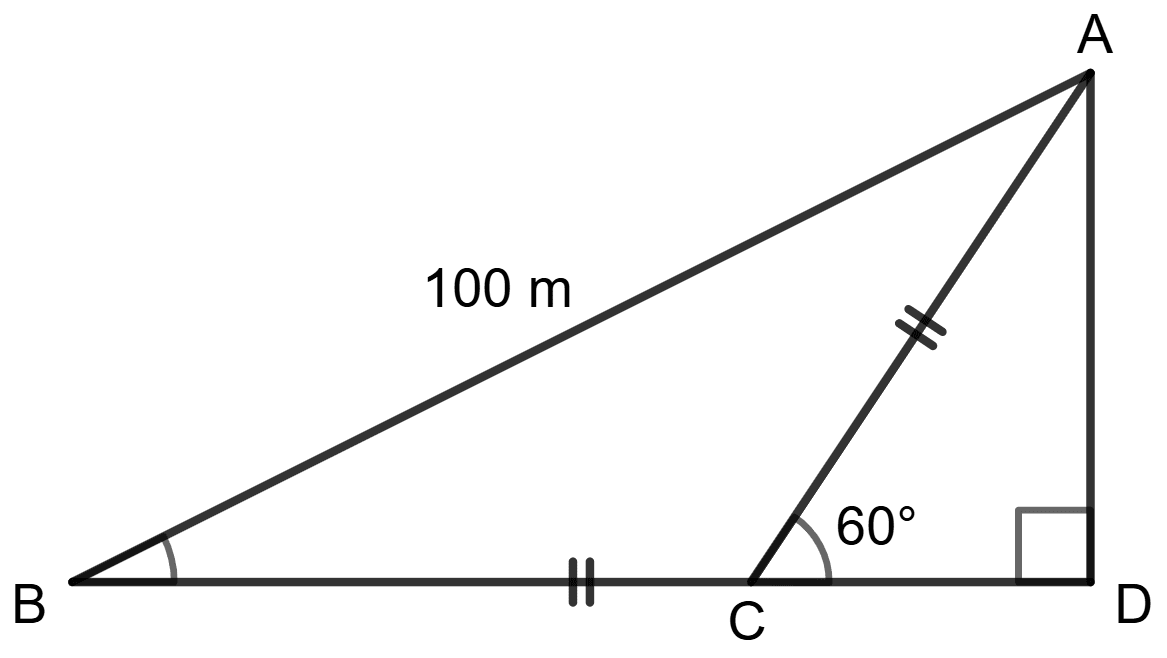
Question 5(ii)

Find AD, if :

Find AD, if : Solution of Right Triangles, Concise Mathematics Solutions ICSE Class 9.

Answer

Let AC = x. Therefore, BC = x.

In Δ ADC,

cos 60°=BaseHypotenuse12=CDxCD=x2\text{cos 60°} = \dfrac{Base}{Hypotenuse}\\[1em] ⇒ \dfrac{1}{2} = \dfrac{CD}{x}\\[1em] ⇒ CD = \dfrac{x}{2}\\[1em]

And,

sin 60°=PerpendicularHypotenuse32=ADxAD=x32\text{sin 60°} = \dfrac{Perpendicular}{Hypotenuse}\\[1em] ⇒ \dfrac{\sqrt3}{2} = \dfrac{AD}{x}\\[1em] ⇒ AD = \dfrac{x\sqrt3}{2}\\[1em]

BD = BC + CDBD=x+x2BD=2x+x2BD=3x2\text{BD = BC + CD}\\[1em] ⇒ BD = x + \dfrac{x}{2}\\[1em] ⇒ BD = \dfrac{2x + x}{2}\\[1em] ⇒ BD = \dfrac{3x}{2}

In Δ ABD, according to Pythagoras theorem,

⇒ AB2 = BD2 + AD2 (∵ AB is hypotenuse)

1002=(3x2)2+(3x2)210000=9x24+3x2410000=9x2+3x2410000=12x2410000=3x2x2=100003x=100003x=1003⇒ 100^2 = \Big(\dfrac{3x}{2}\Big)^2 + \Big(\dfrac{\sqrt3x}{2}\Big)^2 \\[1em] ⇒ 10000 = \dfrac{9x^2}{4} + \dfrac{3x^2}{4} \\[1em] ⇒ 10000 = \dfrac{9x^2 + 3x^2}{4}\\[1em] ⇒ 10000 = \dfrac{12x^2}{4}\\[1em] ⇒ 10000 = 3x^2\\[1em] ⇒ x^2 = \dfrac{10000}{3}\\[1em] ⇒ x = \sqrt\dfrac{10000}{3}\\[1em] ⇒ x = \dfrac{100}{\sqrt3}

Substituting the value of x in AD,

AD=x32AD=1003×32AD=1003×32AD=50mAD = \dfrac{x\sqrt3}{2}\\[1em] ⇒ AD = \dfrac{\dfrac{100}{\sqrt3} \times \sqrt3}{2}\\[1em] ⇒ AD = \dfrac{\dfrac{100}{\cancel {\sqrt3}} \times \cancel {\sqrt3}}{2}\\[1em] ⇒ AD = 50 m

Hence, AD = 50 m.

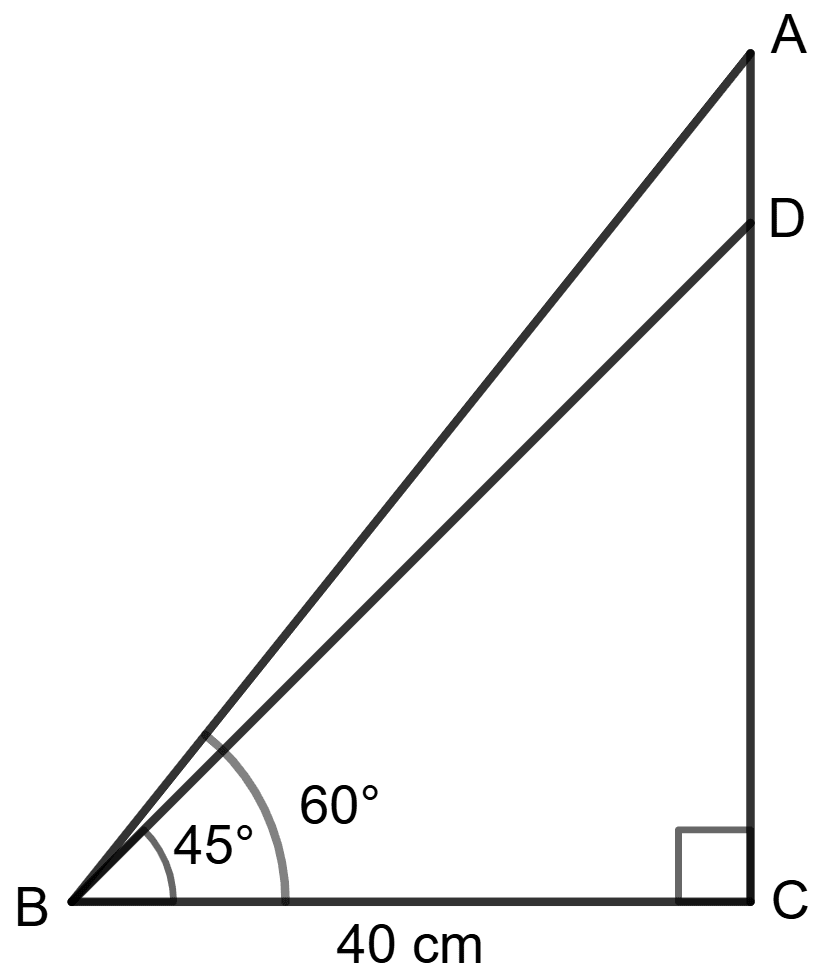
Question 6

Find the length of AD.

Given :

∠ABC = 60°,
∠DBC = 45°
and BC = 40 cm.

Find the length of AD. Solution of Right Triangles, Concise Mathematics Solutions ICSE Class 9.

Answer

In Δ BDC,

tan 45°=PerpendicularBase1=DCBC1=DC40DC=40\text{tan 45°} = \dfrac{Perpendicular}{Base}\\[1em] ⇒ 1 = \dfrac{DC}{BC}\\[1em] ⇒ 1 = \dfrac{DC}{40}\\[1em] ⇒ DC = 40

In Δ ABC,

tan 60°=PerpendicularBase3=ACBC3=AC40AC=403=69.28\text{tan 60°} = \dfrac{Perpendicular}{Base}\\[1em] ⇒ \sqrt3 = \dfrac{AC}{BC}\\[1em] ⇒ \sqrt3 = \dfrac{AC}{40}\\[1em] ⇒ AC = 40\sqrt3 = 69.28

AD = AC - DC

⇒ AD = 69.28 - 40 = 29.28 cm

Hence, AD = 29.28 cm.

Question 7

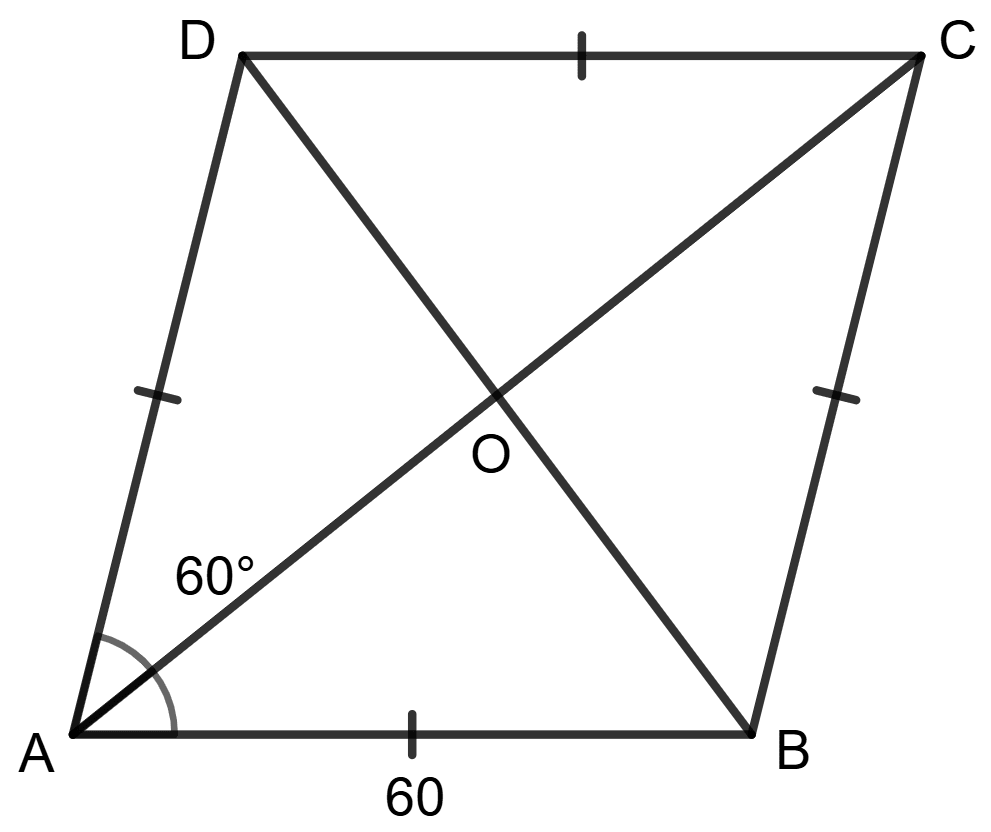
Find lengths of diagonals AC and BD.

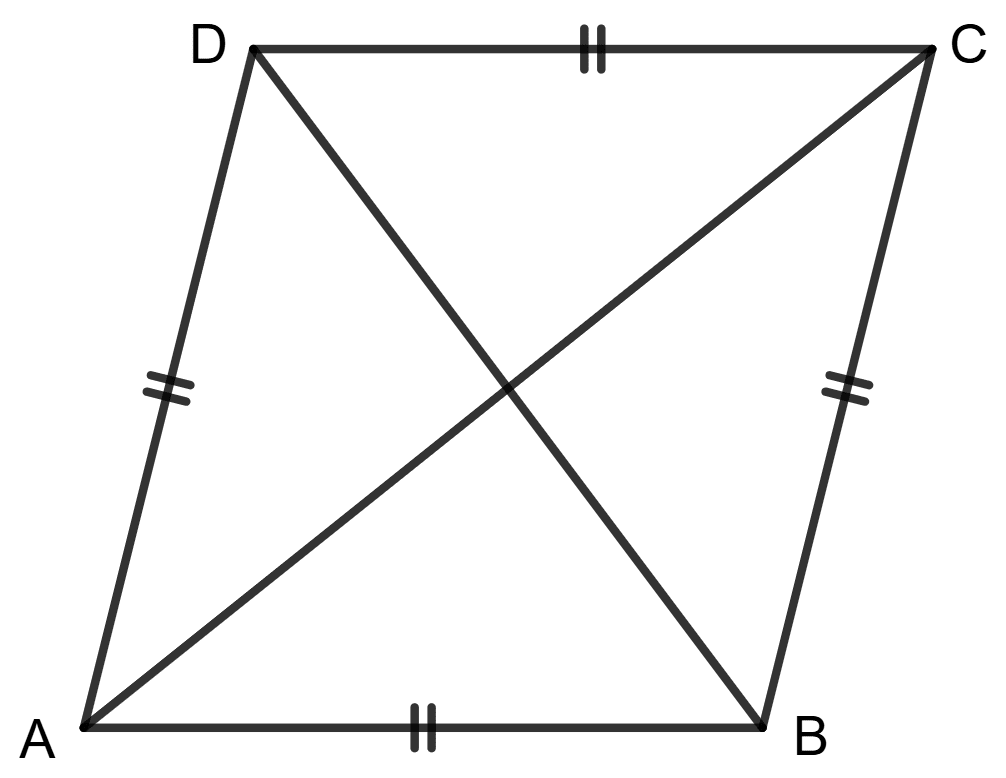
Given AB = 60 cm and ∠BAD = 60°.

Find lengths of diagonals AC and BD. Solution of Right Triangles, Concise Mathematics Solutions ICSE Class 9.

Answer

ABCD is a rhombus as AB = BC = CD = DA and ∠ BAD = 60°.

Find lengths of diagonals AC and BD. Solution of Right Triangles, Concise Mathematics Solutions ICSE Class 9.

Now in Δ ABD,

AB = AD (Sides of rhombus)

⇒ ∠ ABD = ∠ ADB (Angles opposite to equal side of Δ)

Let ∠ ABD = x.

According to the angle sum property,

∠ ABD + ∠ ADB + ∠ BAD = 180°

⇒ x + x + 60° = 180°

⇒ 2x + 60° = 180°

⇒ 2x = 180° - 60°

⇒ 2x = 120°

⇒ x = 120°2\dfrac{120°}{2}

⇒ x = 60°

ABCD is a rhombus. So, diagonals AC and BD bisect each other at 90°.

AO = OC and BO = OD

In Δ AOD,

cos 60°=BaseHypotenuse12=OD60OD=602=30\text{cos 60°} = \dfrac{Base}{Hypotenuse}\\[1em] ⇒ \dfrac{1}{2} = \dfrac{OD}{60}\\[1em] ⇒ OD = \dfrac{60}{2} = 30

And,

sin 60°=PerpendicularHypotenuse32=AO60AO=6032=51.96\text{sin 60°} = \dfrac{Perpendicular}{Hypotenuse}\\[1em] ⇒ \dfrac{\sqrt3}{2} = \dfrac{AO}{60}\\[1em] ⇒ AO = \dfrac{60\sqrt3}{2} = 51.96

AC = 2 x AO = 2 x 51.96 = 103.92 cm

BD = 2 x BO = 2 x 30 = 60 cm

Hence, AC = 103.92 cm and BD = 60 cm.

Question 8

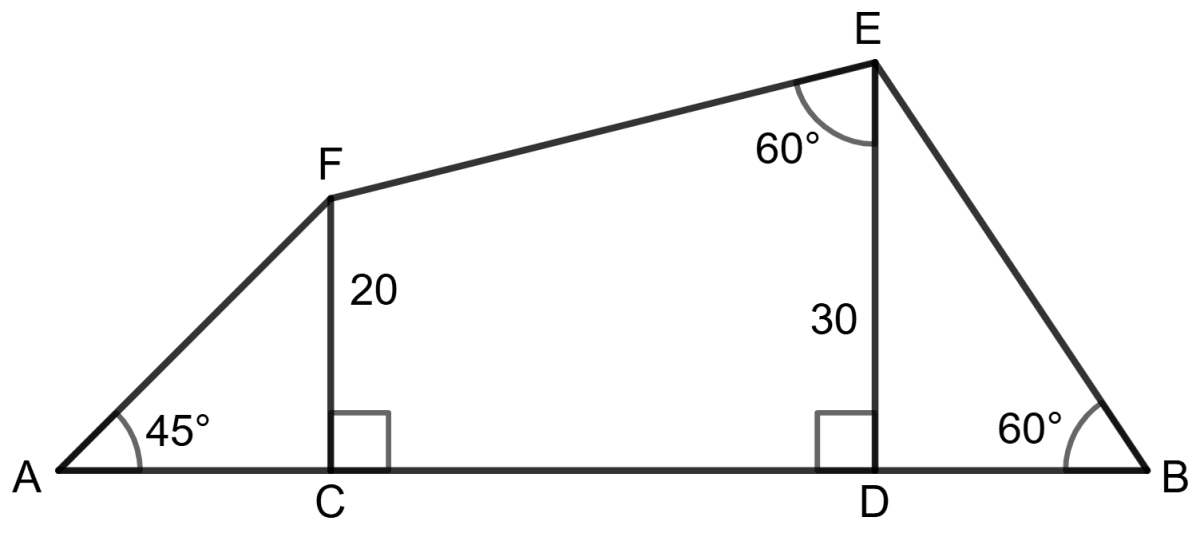
Find AB.

Find AB. Solution of Right Triangles, Concise Mathematics Solutions ICSE Class 9.

Answer

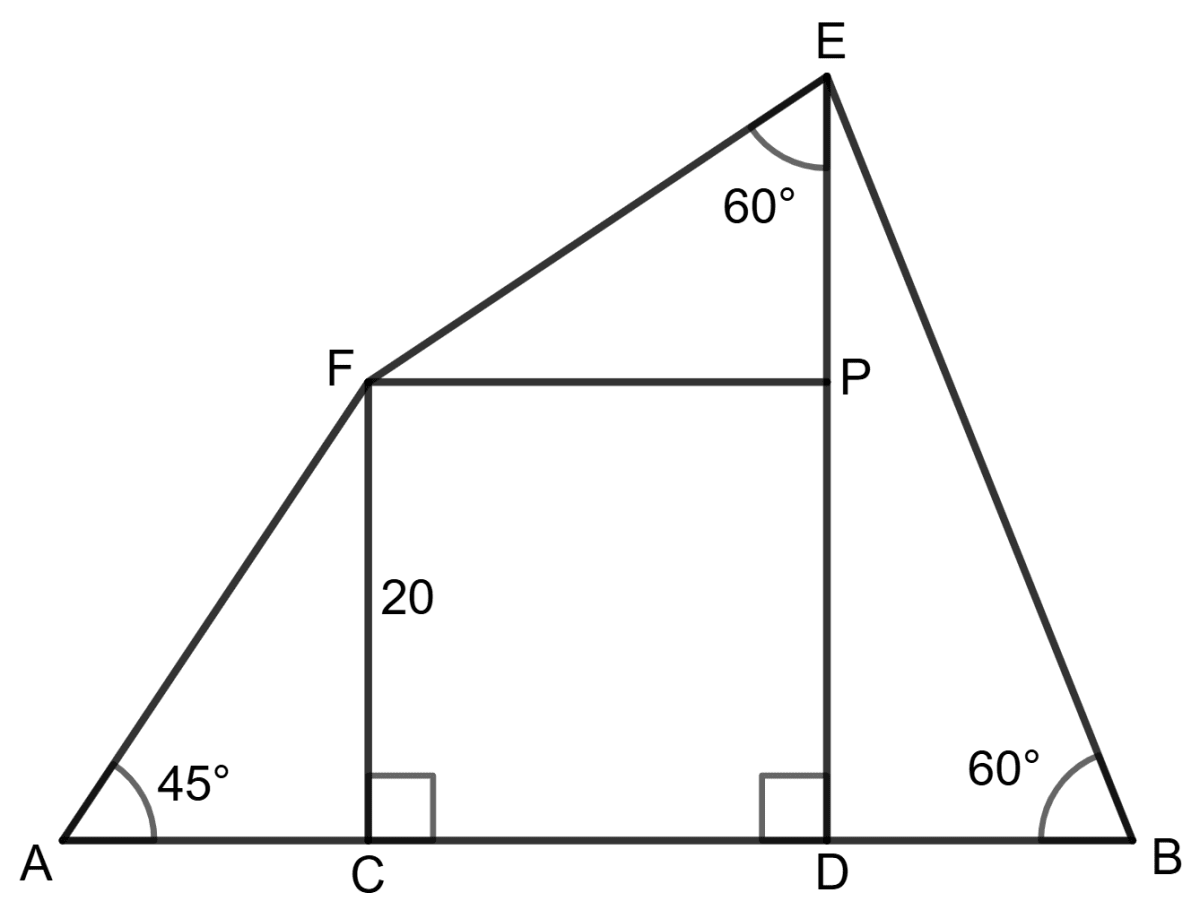
Draw a line FP parallel to CD such that FP = CD and FC = PD.

Find AB. Solution of Right Triangles, Concise Mathematics Solutions ICSE Class 9.

In Δ ACF,

tan 45°=PerpendicularBase1=20ACAC=20\text{tan 45°} = \dfrac{Perpendicular}{Base}\\[1em] ⇒ 1 = \dfrac{20}{AC}\\[1em] ⇒ AC = 20

In Δ DEB,

tan 60°=PerpendicularBase3=30BDBD=303BD=30×33×3BD=3033BD=103=17.32\text{tan 60°} = \dfrac{Perpendicular}{Base}\\[1em] ⇒ \sqrt3 = \dfrac{30}{BD}\\[1em] ⇒ BD = \dfrac{30}{\sqrt3}\\[1em] ⇒ BD = \dfrac{30 \times \sqrt3}{\sqrt3 \times \sqrt3}\\[1em] ⇒ BD = \dfrac{30\sqrt3}{3}\\[1em] ⇒ BD = 10\sqrt3 = 17.32

As, FC = 20 and ED = 30

EP = ED - PD = ED - FC = 30 - 20 = 10 cm

In Δ EFP,

tan 60°=PerpendicularBase3=FP10FP=103=17.32\text{tan 60°} = \dfrac{Perpendicular}{Base}\\[1em] ⇒ \sqrt3 = \dfrac{FP}{10}\\[1em] ⇒ FP = 10 \sqrt3 = 17.32

Thus AB = AC + CD + BD

= 20 + 17.32 + 17.32

= 54.64

Hence, AB = 54.64.

Question 9

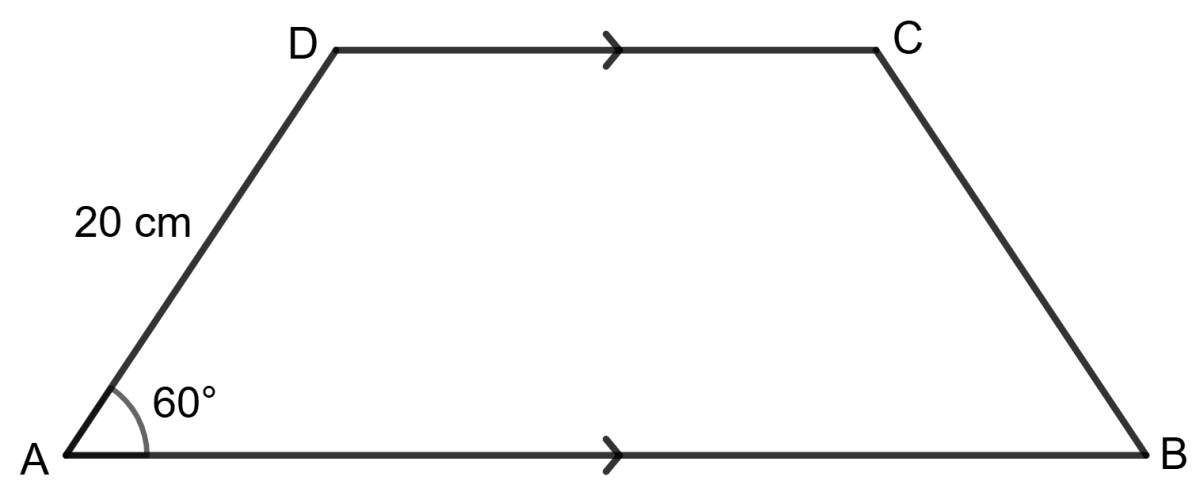
In trapezium ABCD, as shown, AB // DC, AD = DC = BC = 20 cm and ∠A = 60°.

Find :

(i) length of AB

(ii) distance between AB and DC.

In trapezium ABCD, as shown, AB // DC, AD = DC = BC = 20 cm and ∠A = 60°. Solution of Right Triangles, Concise Mathematics Solutions ICSE Class 9.

Answer

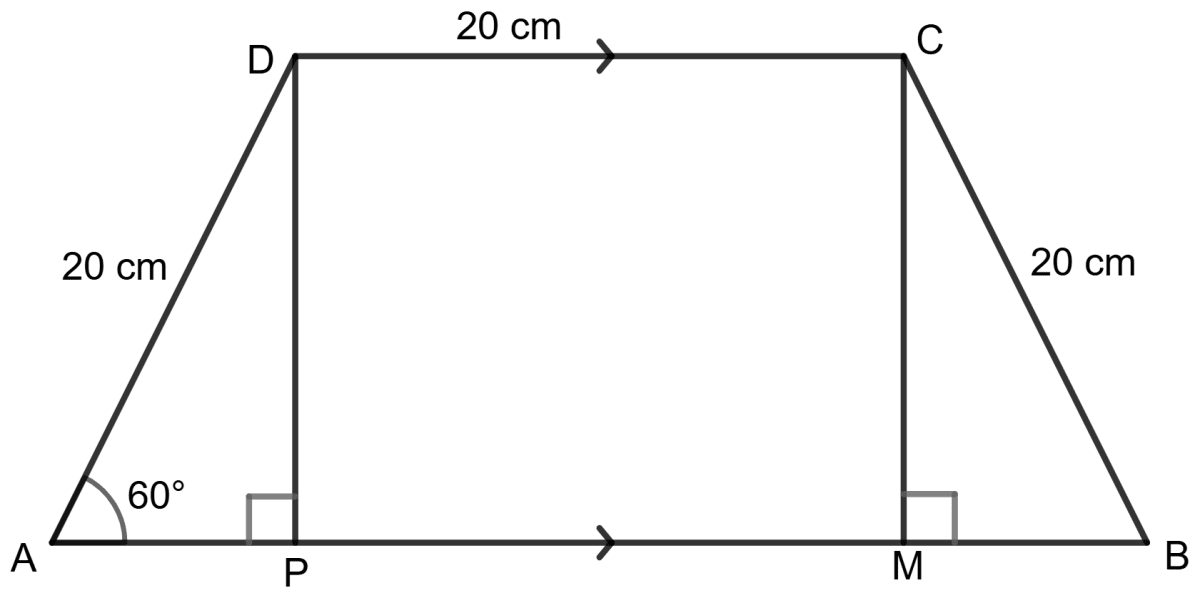
(i) Draw two perpendicular lines, DP and CM, from points D and C to AB, respectively. Since AB is parallel to CD, PMCD will form a rectangle.

In trapezium ABCD, as shown, AB // DC, AD = DC = BC = 20 cm and ∠A = 60°. Solution of Right Triangles, Concise Mathematics Solutions ICSE Class 9.

In Δ APD,

cos 60° = BaseHypotenuse\dfrac{Base}{Hypotenuse}

12=APAD\dfrac{1}{2} = \dfrac{AP}{AD}

12=AP20\dfrac{1}{2} = \dfrac{AP}{20}

⇒ AP = 10

Now, Δ APD and Δ BMC,

DP = CM (Height of same quadrilateral)

AD = CB (Both are 20 cm)

∠ DPA = ∠ CMB

So, Δ APD ≅ Δ BMC (∵ RHS congruency)

And, by using corresponding sides of congruent triangle,

AP = MB = 10 cm

PM = DC = 20 cm

AB = AP + PM + MB

= 10 + 20 + 10 cm

= 40 cm

Hence, AB = 40 cm.

(ii) In Δ APD,

sin 60° = PerpendicularHypotenuse\dfrac{Perpendicular}{Hypotenuse}

32=PDAD\dfrac{\sqrt3}{2} = \dfrac{PD}{AD}

32=PD20\dfrac{\sqrt3}{2} = \dfrac{PD}{20}

⇒ PD = 10 3\sqrt3 = 17.32 cm

Hence, PD = 17.32 cm.

Question 10

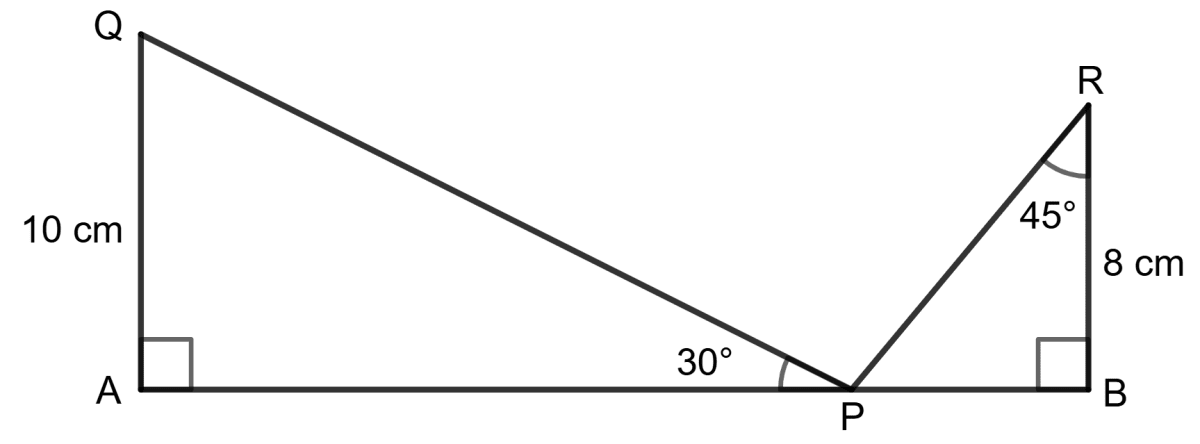
Use the information given to find the length of AB.

Use the information given to find the length of AB. Solution of Right Triangles, Concise Mathematics Solutions ICSE Class 9.

Answer

In Δ APQ,

tan 30°=PerpendicularBase13=AQAP13=10APAP=103=17.32cm\text{tan 30°} = \dfrac{Perpendicular}{Base}\\[1em] ⇒ \dfrac{1}{\sqrt3} = \dfrac{AQ}{AP}\\[1em] ⇒ \dfrac{1}{\sqrt3} = \dfrac{10}{AP}\\[1em] ⇒ AP = 10 \sqrt3 = 17.32 cm

In Δ PBR,

tan 45°=PerpendicularBase1=PBBR1=PB8PB=8cm\text{tan 45°} = \dfrac{Perpendicular}{Base}\\[1em] ⇒ 1 = \dfrac{PB}{BR}\\[1em] ⇒ 1 = \dfrac{PB}{8}\\[1em] ⇒ PB = 8 cm

AB = AP + PB

= 17.32 + 8 cm

= 25.32 cm

Hence, AB = 25.32 cm.

Test Yourself

Question 1(a)

The value of angle A is :

The value of angle A is : Solution of Right Triangles, Concise Mathematics Solutions ICSE Class 9.
  1. 45°

  2. 30°

  3. 60°

  4. none of these

Answer

From figure,

AB = BC ....................(1)

By formula,

tan θ = PerpendicularBase\dfrac{\text{Perpendicular}}{\text{Base}}

From figure,

⇒ tan A = BCAB\dfrac{BC}{AB}

⇒ tan A = ABAB\dfrac{AB}{AB} [from equation (1)]

⇒ tan A = 1

⇒ tan A = tan 45°

⇒ A = 45°.

Hence, option 1 is the correct option.

Question 1(b)

The length of AB is:

The length of AB is: Solution of Right Triangles, Concise Mathematics Solutions ICSE Class 9.
  1. 20 cm

  2. 10 (3\sqrt{3} - 1) cm

  3. 10310\sqrt{3} cm

  4. 10(3+1)10(\sqrt{3} + 1) cm

Answer

The length of AB is: Solution of Right Triangles, Concise Mathematics Solutions ICSE Class 9.

Since CD is perpendicular on AB.

By formula,

tan θ = PerpendicularBase\dfrac{\text{Perpendicular}}{\text{Base}}

From figure,

tan B=CDDBtan 30°=10DB13=10DBDB=103.\Rightarrow \text{tan B} = \dfrac{CD}{DB}\\[1em] \Rightarrow \text{tan 30°} = \dfrac{10}{DB}\\[1em] \Rightarrow \dfrac{1}{\sqrt{3}} = \dfrac{10}{DB}\\[1em] \Rightarrow DB = 10\sqrt{3}.

As ΔACD is a right angled triangle,

tan A=CDADtan 45°=10AD1=10ADAD=10.\Rightarrow \text{tan A} = \dfrac{CD}{AD} \\[1em] \Rightarrow \text{tan 45°} = \dfrac{10}{AD} \\[1em] \Rightarrow 1 = \dfrac{10}{AD} \\[1em] \Rightarrow AD = 10.

From figure,

AB = AD + DB = 10 + 103=10(1+3)10\sqrt{3} = 10(1 + \sqrt{3}) cm.

Hence, option 4 is the correct option.

Question 1(c)

The length of AB is:

The length of AB is: Solution of Right Triangles, Concise Mathematics Solutions ICSE Class 9.
  1. (10 - 3\sqrt{3}) cm

  2. 10(3\sqrt{3} - 1) cm

  3. 10 3\sqrt{3} cm

  4. 10(3\sqrt{3} + 1) cm

Answer

By formula,

tan θ = PerpendicularBase\dfrac{\text{Perpendicular}}{\text{Base}}

In triangle BCD,

tan B=CDBCtan 45°=10BC1=10BCBC=10.\Rightarrow \text{tan B} = \dfrac{CD}{BC}\\[1em] \Rightarrow \text{tan 45°} = \dfrac{10}{BC}\\[1em] \Rightarrow 1 = \dfrac{10}{BC}\\[1em] \Rightarrow BC = 10.

In triangle ACD,

tan A=CDACtan 30°=10AC13=10ACAC=103.\Rightarrow \text{tan A} = \dfrac{CD}{AC}\\[1em] \Rightarrow \text{tan 30°} = \dfrac{10}{AC}\\[1em] \Rightarrow \dfrac{1}{\sqrt{3}} = \dfrac{10}{AC}\\[1em] \Rightarrow AC = 10\sqrt{3}.

From figure,

⇒ AB = AC - BC

⇒ AB = 10310\sqrt{3} - 10 cm

⇒ AB = 10(3\sqrt{3} - 1) cm.

Hence, option 2 is the correct option.

Question 1(d)

Length of AB is equal to:

The length of AB is: Solution of Right Triangles, Concise Mathematics Solutions ICSE Class 9.
  1. 20320\sqrt{3} cm

  2. 203\dfrac{20}{\sqrt{3}} cm

  3. 20 cm

  4. none of these

Answer

From figure,

DC = CA = x (let)

By formula,

tan θ = PerpendicularBase\dfrac{\text{Perpendicular}}{\text{Base}}

In triangle ABD,

tan D=ABDBtan 30°=ABDC+CB13=ABx+20AB=x+203.\Rightarrow \text{tan D} = \dfrac{AB}{DB} \\[1em] \Rightarrow \text{tan 30°} = \dfrac{AB}{DC + CB} \\[1em] \Rightarrow \dfrac{1}{\sqrt{3}} = \dfrac{AB}{x + 20} \\[1em] \Rightarrow AB = \dfrac{x + 20}{\sqrt{3}}.

Since ΔABC is a right angled triangle, using pythagoras theorem,

⇒ Hypotenuse2 = Base2 + Height2

⇒ AC2 = CB2 + AB2

x2=202+(x+203)2x2=400+(x2+400+40x3)x2=(1200+x2+400+40x3)3x2=1200+x2+400+40x3x2=1600+x2+40x3x21600x240x=02x240x1600=02(x220x800)=0x220x800=0x240x+20x800=0x(x40)+20(x40)=0(x40)(x+20)=0(x40)=0 or (x+20)=0x=40 or x=20.\Rightarrow x^2 = 20^2 + \Big(\dfrac{x + 20}{\sqrt{3}}\Big)^2\\[1em] \Rightarrow x^2 = 400 + \Big(\dfrac{x^2 + 400 + 40x}{3}\Big)\\[1em] \Rightarrow x^2 = \Big(\dfrac{1200 + x^2 + 400 + 40x}{3}\Big)\\[1em] \Rightarrow 3x^2 = 1200 + x^2 + 400 + 40x\\[1em] \Rightarrow 3x^2 = 1600 + x^2 + 40x\\[1em] \Rightarrow 3x^2 - 1600 - x^2 - 40x = 0\\[1em] \Rightarrow 2x^2 - 40x - 1600 = 0\\[1em] \Rightarrow 2(x^2 - 20x - 800) = 0 \\[1em] \Rightarrow x^2 - 20x - 800 = 0\\[1em] \Rightarrow x^2 - 40x + 20x - 800 = 0\\[1em] \Rightarrow x(x - 40) + 20(x - 40) = 0\\[1em] \Rightarrow (x - 40)(x + 20) = 0\\[1em] \Rightarrow (x - 40) = 0 \text{ or } (x + 20) = 0\\[1em] \Rightarrow x = 40 \text{ or } x = -20.

As length of side of triangles cannot be negative. So, x = 40 cm.

DC = AC = x = 40 cm.

AB=x+203=40+203=603=203AB = \dfrac{x + 20}{\sqrt{3}} = \dfrac{40 + 20}{\sqrt{3}} = \dfrac{60}{\sqrt{3}} = 20\sqrt{3} cm.

Hence, option 1 is the correct option.

Question 1(e)

Statement 1: At a particular time, the length of the shadow of a 50 m tower is 50350\sqrt{3} m.

Statement 2: The sun's altitude is 30°.

  1. Both the statements are true.

  2. Both the statements are false.

  3. Statement 1 is true, and statement 2 is false.

  4. Statement 1 is false, and statement 2 is true.

Answer

In figure,

Let AB be the tower and BC be the shadow.

Join AC.

At a particular time, the length of the shadow of a 50 m tower is: Solution of Right Triangles, Concise Mathematics Solutions ICSE Class 9.

Given, AB = 50 m and BC = 50 3\sqrt{3} m.

As tower is perpendicular to its shadow, thus ΔABC is a right angled triangle,

By formula,

tan θ=PerpendicularBasetan θ=50503tan θ=13tan θ=tan 30°θ=30°.\Rightarrow \text{tan θ} = \dfrac{\text{Perpendicular}}{\text{Base}} \\[1em] \Rightarrow \text{tan θ} = \dfrac{50}{50\sqrt{3}} \\[1em] \Rightarrow \text{tan θ} = \dfrac{1}{\sqrt{3}} \\[1em] \Rightarrow \text{tan θ} = \text{tan 30°} \\[1em] \Rightarrow \text{θ} = 30°.

∴ Both the statements are true.

Hence, option 1 is the correct option.

Question 1(f)

Statement 1: The distance between B and C = 5 m.

The distance between B and C = 5 m; Solution of Right Triangles, Concise Mathematics Solutions ICSE Class 9.

Statement 2: BC = 333\sqrt{3} m.

  1. Both the statements are true.

  2. Both the statements are false.

  3. Statement 1 is true, and statement 2 is false.

  4. Statement 1 is false, and statement 2 is true.

Answer

By formula,

tan θ = PerpendicularBase\dfrac{\text{Perpendicular}}{\text{Base}}

In ΔABP,

tan P=ABBPtan 60°=3BP3=3BPBP=33BP=3 cm.\Rightarrow \text{tan P} = \dfrac{AB}{BP}\\[1em] \Rightarrow \text{tan 60°} = \dfrac{3}{BP}\\[1em] \Rightarrow \sqrt{3} = \dfrac{3}{BP}\\[1em] \Rightarrow BP = \dfrac{3}{\sqrt{3}}\\[1em] \Rightarrow BP = \sqrt{3}\text{ cm}.

In ΔPCD,

tan P=DCPCtan 30°=2PC13=2PCPC=23 cm.\Rightarrow \text{tan P} = \dfrac{DC}{PC}\\[1em] \Rightarrow \text{tan 30°} = \dfrac{2}{PC}\\[1em] \Rightarrow \dfrac{1}{\sqrt{3}} = \dfrac{2}{PC}\\[1em] \Rightarrow PC = 2 \sqrt{3}\text{ cm}.

From figure,

BC = BP + PC =3+23=33= \sqrt{3} + 2\sqrt{3} = 3\sqrt{3}.

∴ Statement 1 is false, and statement 2 is true.

Hence, option 4 is the correct option.

Question 1(g)

Assertion (A): In rhombus ABCD, angle ABC = 120° and length of its each side is 20 cm. The length of diagonal BD = 20 cm.

In rhombus ABCD, angle ABC = 120° and length of its each side is 20 cm. The length of diagonal BD = 20 cm. Solution of Right Triangles, Concise Mathematics Solutions ICSE Class 9.

Reason (R): In ΔAOB, cos 60° = OB20 cm\dfrac{\text{OB}}{\text{20 cm}} and BD = 2 x OB

  1. A is true, but R is false.

  2. A is false, but R is true.

  3. Both A and R are true, and R is the correct reason for A.

  4. Both A and R are true, and R is the incorrect reason for A.

Answer

Given, angle ABC = 120° and length of its each side = 20 cm.

As we know that, each diagonal divides the angles at its endpoints into two equal parts.

The diagonal BD bisects ∠ABC and ∠ADC.

⇒ ∠ABD = ∠CBD = 120°2\dfrac{120°}{2} = 60°

By formula,

cos θ = BaseHypotenuse\dfrac{\text{Base}}{\text{Hypotenuse}}

We know that,

Diagonals of rhombus are perpendicular to each other.

Thus, triangle AOB is a right angle triangle.

In ΔAOB,

cos B=OBABcos 60°=OB2012=OB20OB=202OB=10\Rightarrow \text{cos B} = \dfrac{\text{OB}}{\text{AB}}\\[1em] \Rightarrow \text{cos 60°} = \dfrac{\text{OB}}{20}\\[1em] \Rightarrow \dfrac{1}{2} = \dfrac{\text{OB}}{20}\\[1em] \Rightarrow \text{OB} = \dfrac{20}{2}\\[1em] \Rightarrow \text{OB} = 10

Since, diagonals of a rhombus bisect each other.

⇒ BD = 2 x OB

So, reason (R) is true.

⇒ BD = 2 x 10 cm = 20 cm

So, assertion (A) is true.

∴ Both A and R are true, and R is the correct reason for A.

Hence, option 3 is the correct option.

Question 1(h)

Assertion (A): The length of the line AB is 100 m.

The length of the line AB is 100 m. Solution of Right Triangles, Concise Mathematics Solutions ICSE Class 9.

Reason (R): tan 45° = 50PB\dfrac{50}{PB} ⇒ PB = 50 m and AB = 50 m + 50 m = 100 m

  1. A is true, but R is false.

  2. A is false, but R is true.

  3. Both A and R are true, and R is the correct reason for A.

  4. Both A and R are true, and R is the incorrect reason for A.

Answer

From figure,

⇒ BC = AP

⇒ AP = 50 m

By formula,

tan θ = PerpendicularBase\dfrac{\text{Perpendicular}}{\text{Base}}

In ΔPBC,

tan 45°=BCPB1=50PBPB=50 m.\Rightarrow \text{tan 45°} = \dfrac{BC}{PB}\\[1em] \Rightarrow 1 = \dfrac{50}{PB}\\[1em] \Rightarrow PB = 50 \text{ m}.

From figure,

AB = AP + PB = 50 m + 50 m = 100 m.

∴ Both A and R are true, and R is the correct reason for A.

Hence, option 3 is the correct option.

Question 2

Find the value of cot x.

Find the value of cot x. Solution of Right Triangles, Concise Mathematics Solutions ICSE Class 9.

Answer

Find the value of cot x. Solution of Right Triangles, Concise Mathematics Solutions ICSE Class 9.

In Δ ABC, according to Pythagoras theorem,

⇒ AC2 = BC2 + AB2 (∵ AC is hypotenuse)

⇒ 22 = BC2 + (3\sqrt3)2

⇒ 4 = BC2 + 3

⇒ BC2 = 4 - 3

⇒ BC2 = 1

⇒ BC = 1\sqrt1

⇒ BC = 1

cot x=BasePerpendicularcot x=CBABcot x=13\text{cot x} = \dfrac{Base}{Perpendicular}\\[1em] \text{cot x} = \dfrac{CB}{AB}\\[1em] \text{cot x} = \dfrac{1}{\sqrt3}

Hence, cot x = 13\dfrac{1}{\sqrt3}.

Question 3

Find the length of AB.

Find the length of AB. Solution of Right Triangles, Concise Mathematics Solutions ICSE Class 9.

Answer

DE = CB = 30 cm

In Δ ADE,

tan 45°=PerpendicularBase1=AEDE1=AE30AE=30cm\text{tan 45°} = \dfrac{Perpendicular}{Base}\\[1em] ⇒ 1 = \dfrac{AE}{DE}\\[1em] ⇒ 1 = \dfrac{AE}{30}\\[1em] ⇒ AE = 30 cm

In Δ DEB,

tan 60°=PerpendicularBase3=EBDE3=EB30EB=303=51.96\text{tan 60°} = \dfrac{Perpendicular}{Base}\\[1em] ⇒ \sqrt3 = \dfrac{EB}{DE}\\[1em] ⇒ \sqrt3 = \dfrac{EB}{30}\\[1em] ⇒ EB = 30\sqrt3 = 51.96

AB = AE + EB

= 30 + 51.96 cm

= 81.96 cm

Hence, AB = 81.96 cm.

Question 4

In the given figure, AB and EC are parallel to each other. Sides AD and BC are 2 cm each and are perpendicular to AB.

In the given figure, AB and EC are parallel to each other. Sides AD and BC are 2 cm each and are perpendicular to AB. Solution of Right Triangles, Concise Mathematics Solutions ICSE Class 9.

Given that ∠AED = 60° and ∠ACD = 45°; calculate :

(i) AB

(ii) AC

(iii) AE

Answer

In the given figure, AB and EC are parallel to each other. Sides AD and BC are 2 cm each and are perpendicular to AB. Solution of Right Triangles, Concise Mathematics Solutions ICSE Class 9.

(i) In Δ ADC,

tan 45°=PerpendicularBase1=ADDC1=2DCDC=2\text{tan 45°} = \dfrac{Perpendicular}{Base}\\[1em] ⇒ 1 = \dfrac{AD}{DC}\\[1em] ⇒ 1 = \dfrac{2}{DC}\\[1em] ⇒ DC = 2

DC = AB = 2 cm

Hence, AB = 2 cm.

(ii) In Δ ADC,

sin 45°=PerpendicularHypotenuse12=ADAC12=2ACAC=22=2.83cm\text{sin 45°} = \dfrac{Perpendicular}{Hypotenuse}\\[1em] ⇒ \dfrac{1}{\sqrt2} = \dfrac{AD}{AC}\\[1em] ⇒ \dfrac{1}{\sqrt2} = \dfrac{2}{AC}\\[1em] ⇒ AC = 2\sqrt2 = 2.83 cm

Hence, AC = 2.83 cm.

(iii) In Δ ADE,

sin 60°=PerpendicularHypotenuse32=ADAE32=2AEAE=43=2.31cm\text{sin 60°} = \dfrac{Perpendicular}{Hypotenuse}\\[1em] ⇒ \dfrac{\sqrt3}{2} = \dfrac{AD}{AE}\\[1em] ⇒ \dfrac{\sqrt3}{2} = \dfrac{2}{AE}\\[1em] ⇒ AE = \dfrac{4}{\sqrt3} = 2.31 cm

Hence, AC = 2.31 cm.

Question 5

In the given figure, ∠B = 60°, AB = 16 cm and BC = 23 cm. Calculate :

(i) BE

(ii) AC.

In the given figure, ∠B = 60°, AB = 16 cm and BC = 23 cm. Calculate : Solution of Right Triangles, Concise Mathematics Solutions ICSE Class 9.

Answer

In the given figure, ∠B = 60°, AB = 16 cm and BC = 23 cm. Calculate : Solution of Right Triangles, Concise Mathematics Solutions ICSE Class 9.

(i) In Δ ABE,

cos 60°=BaseHypotenuse12=BEAB12=BE16BE=162=8cm\text{cos 60°} = \dfrac{Base}{Hypotenuse}\\[1em] ⇒ \dfrac{1}{2} = \dfrac{BE}{AB}\\[1em] ⇒ \dfrac{1}{2} = \dfrac{BE}{16}\\[1em] ⇒ BE = \dfrac{16}{2} = 8 cm

Hence, BE = 8 cm.

(ii) In Δ ABE, according to Pythagoras theorem,

⇒ AB2 = BE2 + EA2 (∵ AB is hypotenuse)

⇒ 162 = 82 + EA2

⇒ 256 = 64 + EA2

⇒ EA2 = 256 - 64

⇒ EA2 = 192

⇒ EA = 192\sqrt{192}

⇒ EA = 8 3\sqrt{3}

EC = BC - BE

= 23 - 8 cm

= 15 cm

In Δ AEC, according to Pythagoras theorem,

⇒ AC2 = AE2 + EC2 (∵ AC is hypotenuse)

⇒ AC2 = (8 3\sqrt{3})2 + 152

⇒ AC2 = 192 + 225

⇒ AC2 = 417

⇒ AC = 417\sqrt{417} = 20.42 cm

Hence, AC = 20.42 cm.

Question 6

Find :

(i) BC

(ii) AD

(iii) AC

Find : Solution of Right Triangles, Concise Mathematics Solutions ICSE Class 9.

Answer

(i) In Δ ABC,

tan 30°=PerpendicularBase13=ABBC13=12BCBC=123BC=20.78\text{tan 30°} = \dfrac{Perpendicular}{Base}\\[1em] ⇒ \dfrac{1}{\sqrt3} = \dfrac{AB}{BC}\\[1em] ⇒ \dfrac{1}{\sqrt3} = \dfrac{12}{BC}\\[1em] ⇒ BC = 12 \sqrt3\\[1em] ⇒ BC = 20.78

Hence, BC = 20.78 cm.

(ii) In Δ ABC, according to angle sum property,

∠ ABC + ∠ BAC + ∠ ACB = 180°

⇒ 90° + ∠ BAC + 30° = 180°

⇒ 120° + ∠ BAC = 180°

⇒ ∠ BAC = 180° - 120°

⇒ ∠ BAC = 60° = ∠ BAD

In Δ ABD,

cos 60°=BaseHypotenuse12=ADAB12=AD12AD=122AD=6\text{cos 60°} = \dfrac{Base}{Hypotenuse}\\[1em] ⇒ \dfrac{1}{2} = \dfrac{AD}{AB}\\[1em] ⇒ \dfrac{1}{2} = \dfrac{AD}{12}\\[1em] ⇒ AD = \dfrac{12}{2}\\[1em] ⇒ AD = 6

Hence, AD = 6 cm.

(iii) In Δ ABC,

sin 30°=PerpendicularHypotenuse12=ABAC12=12ACAC=12×2AC=24\text{sin 30°} = \dfrac{Perpendicular}{Hypotenuse}\\[1em] ⇒ \dfrac{1}{2} = \dfrac{AB}{AC}\\[1em] ⇒ \dfrac{1}{2} = \dfrac{12}{AC}\\[1em] ⇒ AC = 12 \times 2\\[1em] ⇒ AC = 24

Hence, AC = 24 cm.

Question 7

In right-angled triangle ABC; ∠B = 90°. Find the magnitude of angle A, if :

(i) AB is 3{\sqrt3} times of BC.

(ii) BC is 3{\sqrt3} times of AB.

Answer

In right-angled triangle ABC; ∠B = 90°. Find the magnitude of angle A, if : Solution of Right Triangles, Concise Mathematics Solutions ICSE Class 9.

(i) AB = 3{\sqrt3} BC

ABBC=3\dfrac{AB}{BC} = \sqrt3

cot θ=ABBCcot θ=3cot θ=cot 30°\text{cot θ} = \dfrac{AB}{BC}\\[1em] \text{cot θ} = \sqrt3\\[1em] \text{cot θ} = \text{cot 30°}\\[1em]

So, θ = 30°

Hence, magnitude of angle A = 30°.

(ii) BC = 3{\sqrt3} AB

BCAB=3\dfrac{BC}{AB} = \sqrt3

tan θ=BCABtan θ=3tan θ=tan 60°\text{tan θ} = \dfrac{BC}{AB}\\[1em] \text{tan θ} = \sqrt3\\[1em] \text{tan θ} = \text{tan 60°}\\[1em]

So, θ = 60°

Hence, magnitude of angle A = 60°.

Question 8

A ladder is placed against a vertical tower. If the ladder makes an angle of 30° with the ground and reaches upto a height of 15 m of the tower; find the length of the ladder.

Answer

AC is the ladder and BC is the tower.

A ladder is placed against a vertical tower. If the ladder makes an angle of 30° with the ground and reaches upto a height of 15 m of the tower; find the length of the ladder. Solution of Right Triangles, Concise Mathematics Solutions ICSE Class 9.

In Δ ABC,

sin 30°=PerpendicularHypotenuse12=BCAC12=15ACAC=15×2AC=30\text{sin 30°} = \dfrac{Perpendicular}{Hypotenuse}\\[1em] ⇒ \dfrac{1}{2} = \dfrac{BC}{AC}\\[1em] ⇒ \dfrac{1}{2} = \dfrac{15}{AC}\\[1em] ⇒ AC = 15 \times 2\\[1em] ⇒ AC = 30

Hence, length of the ladder = 30 m.

Question 9

A kite is attached to a 100 m long string. Find the greatest height reached by the kite when its string makes an angle of 60° with the level ground.

Answer

AC is the string and BC is the height of kite.

A kite is attached to a 100 m long string. Find the greatest height reached by the kite when its string makes an angle of 60° with the level ground. Solution of Right Triangles, Concise Mathematics Solutions ICSE Class 9.

In Δ ABC,

sin 60°=PerpendicularHypotenuse32=BCAC32=BC100BC=3×1002BC=503=86.60\text{sin 60°} = \dfrac{Perpendicular}{Hypotenuse}\\[1em] ⇒ \dfrac{\sqrt3}{2} = \dfrac{BC}{AC}\\[1em] ⇒ \dfrac{\sqrt3}{2} = \dfrac{BC}{100}\\[1em] ⇒ BC = \dfrac{\sqrt3 \times 100}{2}\\[1em] ⇒ BC = 50\sqrt3 = 86.60

Hence, the greatest height reached by the kite = 86.60 m.

Question 10(i)

Find AB and BC, if :

Find AB and BC, if : Solution of Right Triangles, Concise Mathematics Solutions ICSE Class 9.

Answer

Let BC be x cm.

BD = BC + CD = (x + 20) cm

In Δ ABD,

tan 30°=PerpendicularBase13=ABBD13=ABx+20x+20=AB3..............(1)\text{tan 30°} = \dfrac{Perpendicular}{Base}\\[1em] ⇒ \dfrac{1}{\sqrt3} = \dfrac{AB}{BD}\\[1em] ⇒ \dfrac{1}{\sqrt3} = \dfrac{AB}{x + 20}\\[1em] ⇒ x + 20 = AB\sqrt3 ..............(1)

In Δ ABC,

tan 45°=PerpendicularBase1=ABBC1=ABxx=AB..............(2)\text{tan 45°} = \dfrac{Perpendicular}{Base}\\[1em] ⇒ 1 = \dfrac{AB}{BC}\\[1em] ⇒ 1 = \dfrac{AB}{x}\\[1em] ⇒ x = AB ..............(2)

From equation (1),

AB + 20 = AB 3\sqrt3

⇒ AB 3\sqrt3 - AB = 20

⇒ AB(3\sqrt3 - 1) = 20

⇒ AB(1.73 - 1) = 20

⇒ AB x (0.73) = 20

⇒ AB = 200.73\dfrac{20}{0.73}

⇒ AB = 27.32 cm

And BC = x = AB = 27.32 cm

Hence, AB = BC = 27.32 cm.

Question 10(ii)

Find AB and BC, if :

Find AB and BC, if : Solution of Right Triangles, Concise Mathematics Solutions ICSE Class 9.

Answer

Let BC be x cm

BD = BC + CD = x + 20 cm

In Δ ABD,

tan 30°=PerpendicularBase13=ABBD13=ABx+20x+20=AB3..............(1)\text{tan 30°} = \dfrac{Perpendicular}{Base}\\[1em] ⇒ \dfrac{1}{\sqrt3} = \dfrac{AB}{BD}\\[1em] ⇒ \dfrac{1}{\sqrt3} = \dfrac{AB}{x + 20}\\[1em] ⇒ x + 20 = AB\sqrt3 ..............(1)

In Δ ABC,

tan 60°=PerpendicularBase3=ABBC3=ABxx=AB3..............(2)\text{tan 60°} = \dfrac{Perpendicular}{Base}\\[1em] ⇒ \sqrt3 = \dfrac{AB}{BC}\\[1em] ⇒ \sqrt3 = \dfrac{AB}{x}\\[1em] ⇒ x = \dfrac{AB}{\sqrt3} ..............(2)

From equation (1),

AB3+20=AB3AB+203=3AB34.64=3ABABAB=34.642AB=17.32\dfrac{AB}{\sqrt3} + 20 = AB\sqrt3\\[1em] ⇒ AB + 20\sqrt3 = 3AB\\[1em] ⇒ 34.64 = 3AB - AB\\[1em] ⇒ AB = \dfrac{34.64}{2}\\[1em] ⇒ AB = 17.32

From equation (2),

x = AB3\dfrac{AB}{\sqrt3}

x = 17.323\dfrac{17.32}{\sqrt3}

x = 10 cm

Hence, AB = 17.32 cm and BC = 10 cm.

Question 10(iii)

Find AB and BC, if :

Find AB and BC, if : Solution of Right Triangles, Concise Mathematics Solutions ICSE Class 9.

Answer

Let BC be x cm

BD = BC + CD = x + 20 cm

In Δ ABD,

tan 45°=PerpendicularBase1=ABBD1=ABx+20x+20=AB..............(2)\text{tan 45°} = \dfrac{Perpendicular}{Base}\\[1em] ⇒ 1 = \dfrac{AB}{BD}\\[1em] ⇒ 1 = \dfrac{AB}{x + 20}\\[1em] ⇒ x + 20 = AB ..............(2)

In Δ ABC,

tan 60°=PerpendicularBase3=ABBC3=ABxx=AB3..............(2)\text{tan 60°} = \dfrac{Perpendicular}{Base}\\[1em] ⇒ \sqrt3 = \dfrac{AB}{BC}\\[1em] ⇒ \sqrt3 = \dfrac{AB}{x}\\[1em] ⇒ x = \dfrac{AB}{\sqrt3} ..............(2)

From equation (1),

AB3+20=ABAB+203=3AB34.64=3ABAB34.64=AB(1.731)34.64=AB×(0.73)AB=34.640.73AB=47.32\dfrac{AB}{\sqrt3} + 20 = AB\\[1em] ⇒ AB + 20\sqrt3 = \sqrt3AB\\[1em] ⇒ 34.64 = \sqrt3AB - AB\\[1em] ⇒ 34.64 = AB(1.73 - 1)\\[1em] ⇒ 34.64 = AB \times (0.73)\\[1em] ⇒ AB = \dfrac{34.64}{0.73}\\[1em] ⇒ AB = 47.32

From equation (2),

x = AB3\dfrac{AB}{\sqrt3}

x = 47.323\dfrac{47.32}{\sqrt3}

x = 27.32 cm

Hence, AB = 47.32 cm and BC = 27.32 cm.

Question 11(i)

Find PQ, if AB = 150 m, ∠P = 30° and ∠Q = 45°

Find PQ, if AB = 150 m, ∠P = 30° and ∠Q = 45°: Solution of Right Triangles, Concise Mathematics Solutions ICSE Class 9.

Answer

In Δ APB,

tan 30°=PerpendicularBase13=ABPB13=150PBPB=1503=259.80\text{tan 30°} = \dfrac{Perpendicular}{Base}\\[1em] ⇒ \dfrac{1}{\sqrt3} = \dfrac{AB}{PB}\\[1em] ⇒ \dfrac{1}{\sqrt3} = \dfrac{150}{PB}\\[1em] ⇒ PB = 150\sqrt3 = 259.80

And, in Δ ABQ,

tan 45°=PerpendicularBase1=ABBQ1=150BQBQ=150\text{tan 45°} = \dfrac{Perpendicular}{Base}\\[1em] ⇒ 1 = \dfrac{AB}{BQ}\\[1em] ⇒ 1 = \dfrac{150}{BQ}\\[1em] ⇒ BQ = 150

As, PQ = PB + BQ

= 259.80 + 150 m

= 409.80 m

Hence, PQ = 409.80 m.

Question 11(ii)

Find PQ, if AB = 150 m, ∠P = 30° and ∠Q = 45°

Find PQ, if AB = 150 m, ∠P = 30° and ∠Q = 45°: Solution of Right Triangles, Concise Mathematics Solutions ICSE Class 9.

Answer

In Δ APB,

tan 30°=PerpendicularBase13=ABPB13=150PBPB=1503=259.80\text{tan 30°} = \dfrac{Perpendicular}{Base}\\[1em] ⇒ \dfrac{1}{\sqrt3} = \dfrac{AB}{PB}\\[1em] ⇒ \dfrac{1}{\sqrt3} = \dfrac{150}{PB}\\[1em] ⇒ PB = 150\sqrt3 = 259.80

And, in Δ ABQ,

tan 45°=PerpendicularBase1=ABBQ1=150BQBQ=150\text{tan 45°} = \dfrac{Perpendicular}{Base}\\[1em] ⇒ 1 = \dfrac{AB}{BQ}\\[1em] ⇒ 1 = \dfrac{150}{BQ}\\[1em] ⇒ BQ = 150

As, PQ = PB - BQ

= 259.80 - 150 m

= 109.80 m

Hence, PQ = 109.80 m.

Question 12

If tan x°=512\text{tan x°} = \dfrac{5}{12}, tan y°=34\text{tan y°} = \dfrac{3}{4} and AB = 48 m; find the length of CD.

If tan x° = 5/12, tan y° = 3/4 and AB = 48 m; find the length of CD. Solution of Right Triangles, Concise Mathematics Solutions ICSE Class 9.

Answer

Given:

tan x°=512\text{tan x°} = \dfrac{5}{12}, tan y°=34\text{tan y°} = \dfrac{3}{4} and AB = 48 m

Let BC be x m.

AC = AB + BC = (48 + x) m.

In Δ ADC,

tan x°=PerpendicularBase512=DCAC512=DC48+x12 CD = 240 + 5x................(1)\text{tan x°} = \dfrac{Perpendicular}{Base}\\[1em] ⇒ \dfrac{5}{12} = \dfrac{DC}{AC}\\[1em] ⇒ \dfrac{5}{12} = \dfrac{DC}{48 + x}\\[1em] ⇒ \text{12 CD = 240 + 5x} ................(1)

And, in Δ BDC,

tan y°=PerpendicularBase34=DCBC34=DCx4CD=3xx=4CD3................(2)\text{tan y°} = \dfrac{Perpendicular}{Base}\\[1em] ⇒ \dfrac{3}{4} = \dfrac{DC}{BC}\\[1em] ⇒ \dfrac{3}{4} = \dfrac{DC}{x}\\[1em] ⇒ 4 CD = 3x \\[1em] ⇒ x = \dfrac{4 CD}{3}................(2)

From equation (1),

240 + 5 ×4CD3\times \dfrac{4CD}{3} = 12 CD

⇒ 240 + 20CD3\dfrac{20CD}{3} = 12 CD

⇒ 720 + 20 CD = 36 CD

⇒ 720 = 36 CD - 20 CD

⇒ 16 CD = 720

⇒ CD = 72016\dfrac{720}{16}

⇒ CD = 45

Hence, CD = 45 m.

Question 13

The perimeter of a rhombus is 96 cm and obtuse angle of it is 120°. Find the lengths of its diagonals.

Answer

ABCD is a rhombus.

The perimeter of a rhombus is 96 cm and obtuse angle of it is 120°. Find the lengths of its diagonals. Solution of Right Triangles, Concise Mathematics Solutions ICSE Class 9.

Perimeter of rhombus = 4 x side

Hence, side AB = BC = CD = DA = 964\dfrac{96}{4} = 24 cm

∠ ABC = 120°

As we know that diagonal of a rhombus bisect each other at 90°.

In Δ ABO,

∠ ABO = 120°2\dfrac{120°}{2} = 60°

sin60°=PerpendicularHypotenuse32=AOAB32=AO24AO=2432AO=20.78sin 60° = \dfrac{Perpendicular}{Hypotenuse}\\[1em] ⇒ \dfrac{\sqrt3}{2} = \dfrac{AO}{AB}\\[1em] ⇒ \dfrac{\sqrt3}{2} = \dfrac{AO}{24}\\[1em] ⇒ AO = \dfrac{24 \sqrt3}{2}\\[1em] ⇒ AO = 20.78

∴ AC = 2 x AO = 2 x 20.78 = 41.56 cm

Similarly,

cos 60°=BaseHypotenuse12=BOAB12=BO24BO=242BO=12\text{cos 60°} = \dfrac{Base}{Hypotenuse}\\[1em] ⇒ \dfrac{1}{2} = \dfrac{BO}{AB}\\[1em] ⇒ \dfrac{1}{2} = \dfrac{BO}{24}\\[1em] ⇒ BO = \dfrac{24}{2}\\[1em] ⇒ BO = 12

∴ BD = 2 x BO = 2 x 12 = 24 cm

Hence, the lengths of the diagonals are: AC = 41.56 cm and BD = 24 cm.

PrevNext