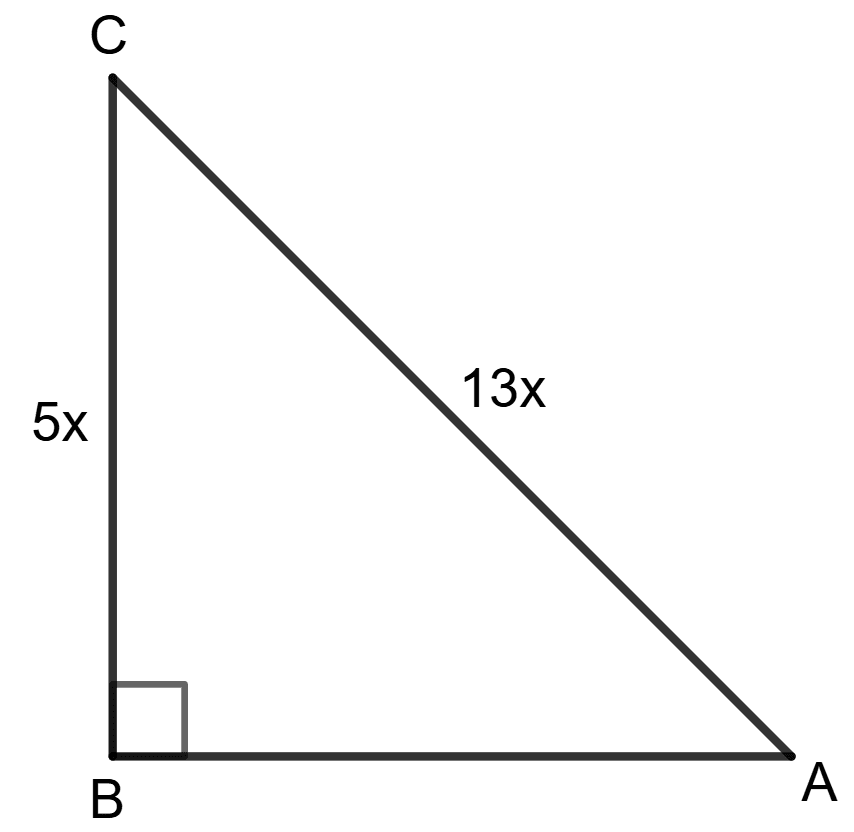
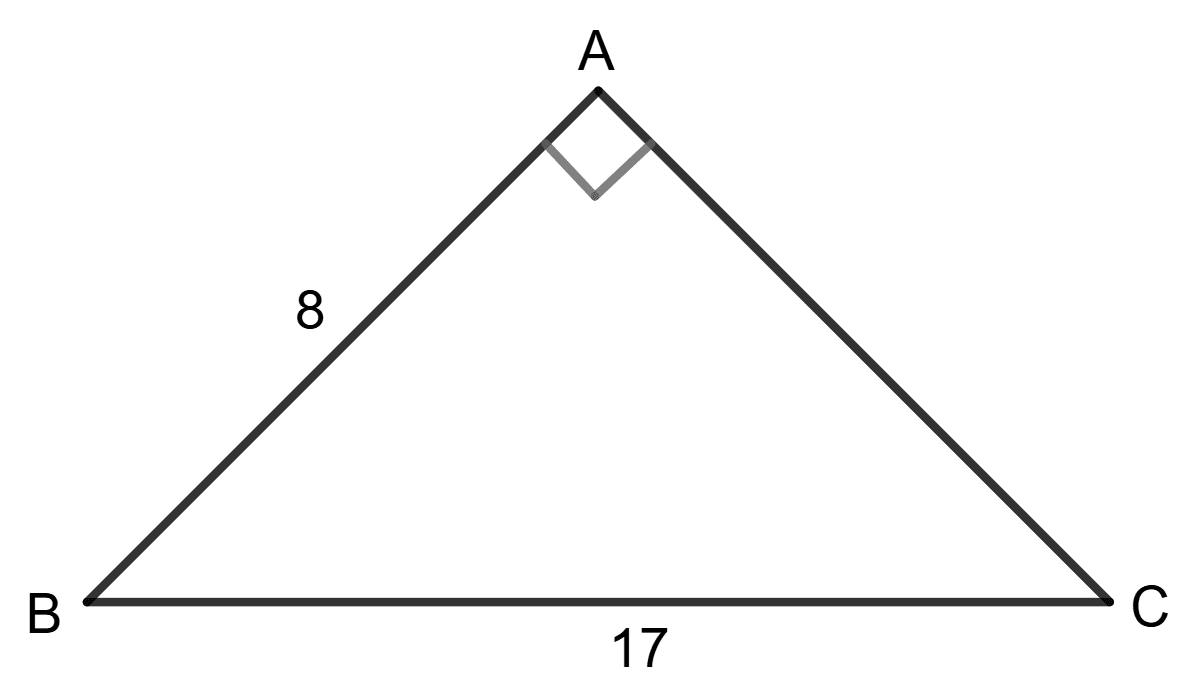
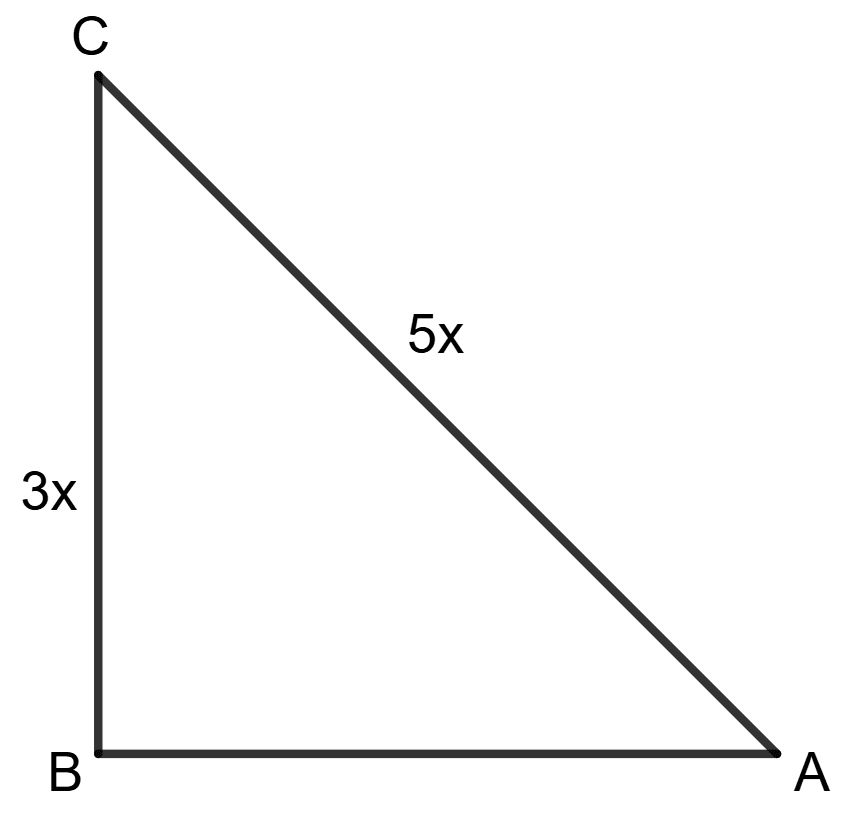
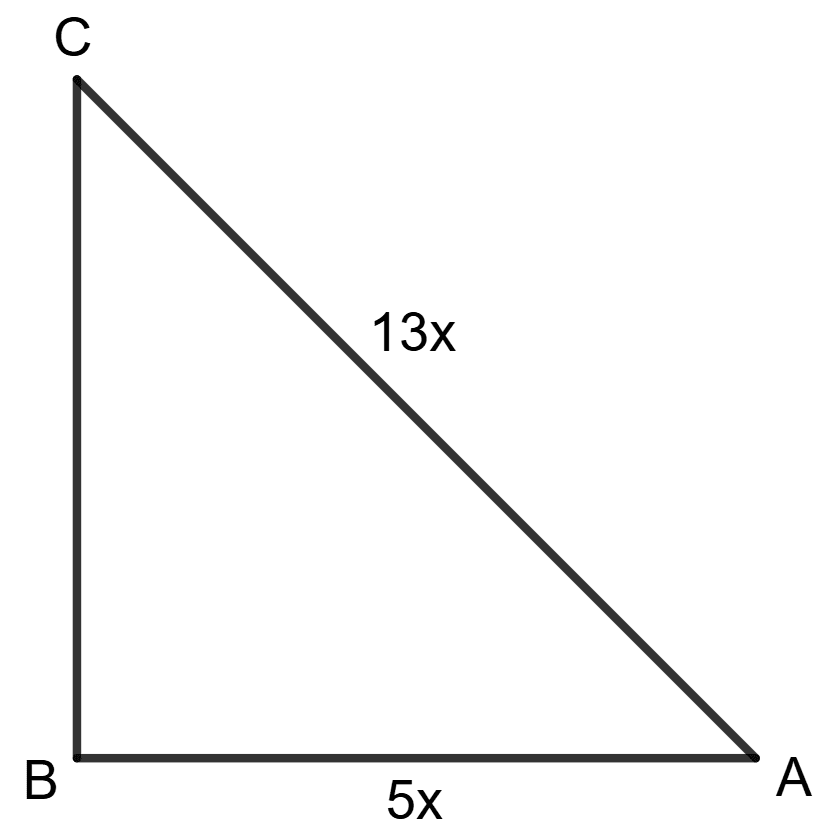
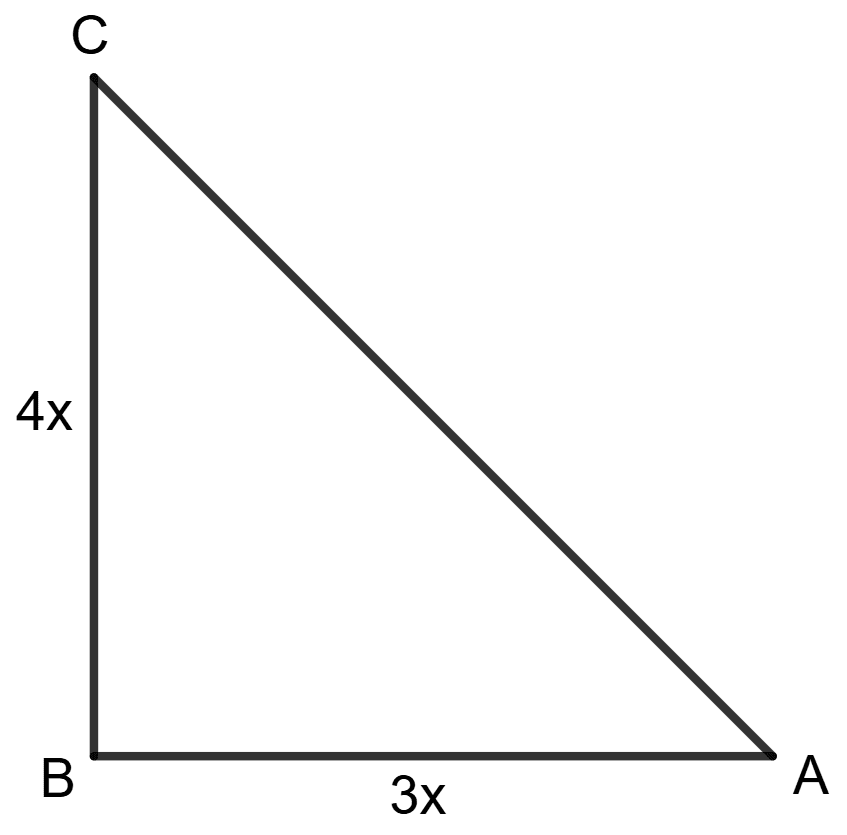
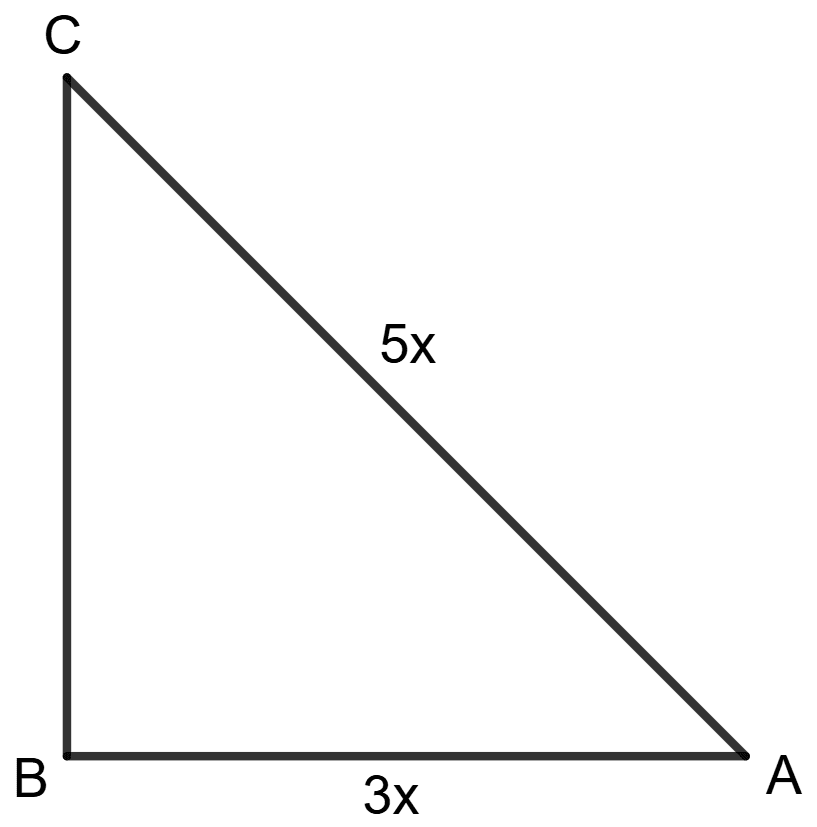
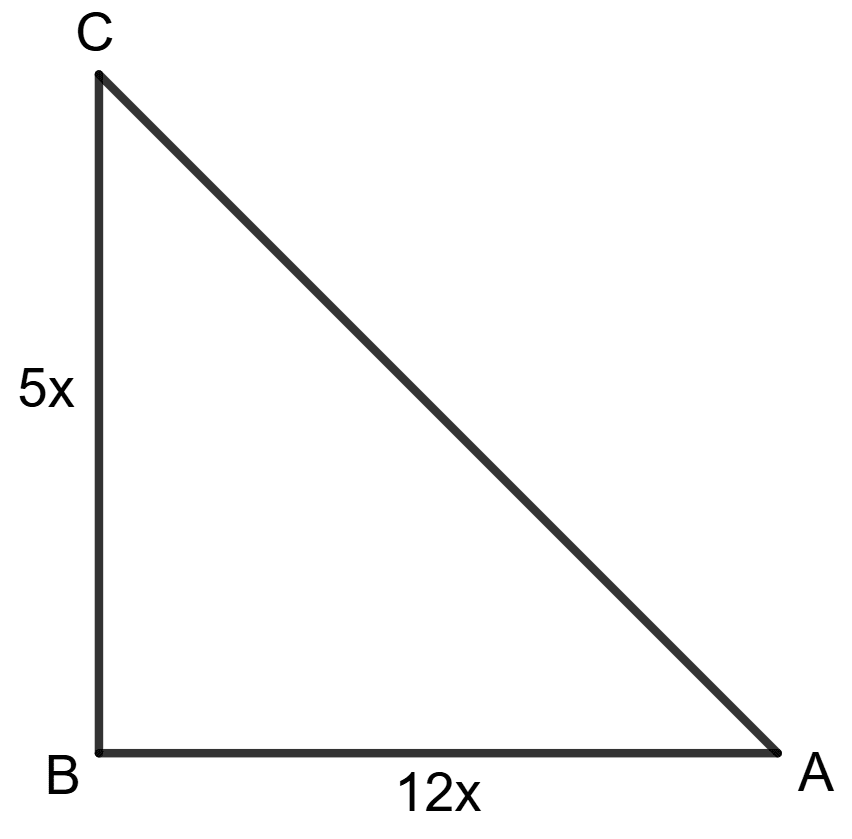
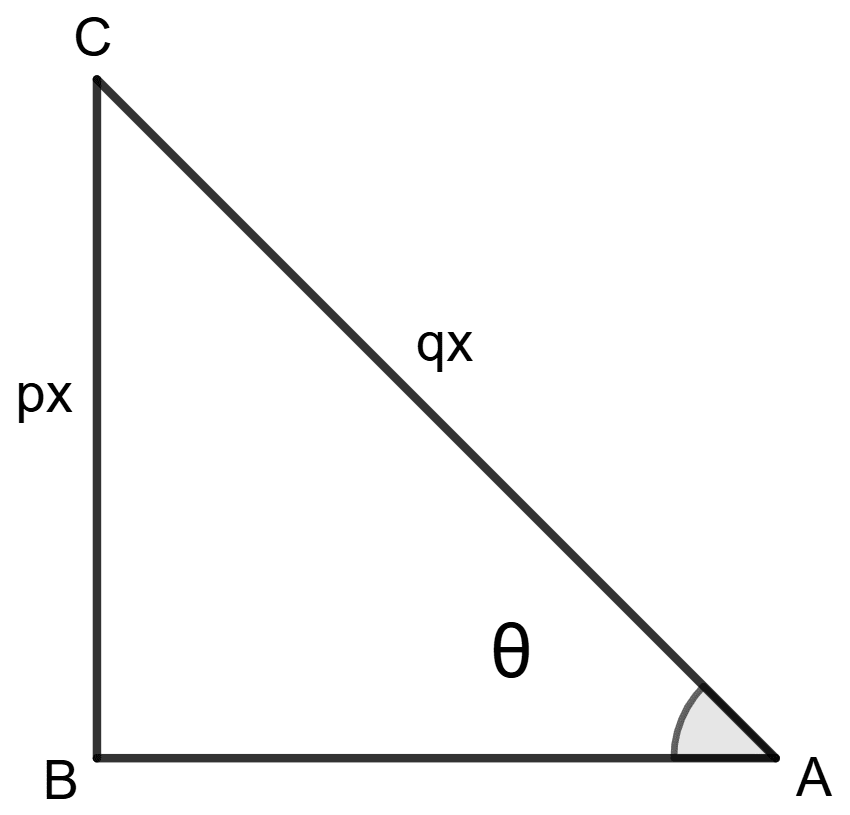
If sin A = 5 13 A = \dfrac{5}{13} A = 13 5 the value of tan A is :
5 12 \dfrac{5}{12} 12 5
12 13 \dfrac{12}{13} 13 12
12 5 \dfrac{12}{5} 5 12
13 12 \dfrac{13}{12} 12 13
Answer
Given:
sin A = 5 13 A = \dfrac{5}{13} A = 13 5
i.e., Perpendicular Hypotenuse = 5 13 \dfrac{\text{Perpendicular}}{\text{Hypotenuse}} = \dfrac{5}{13} Hypotenuse Perpendicular = 13 5
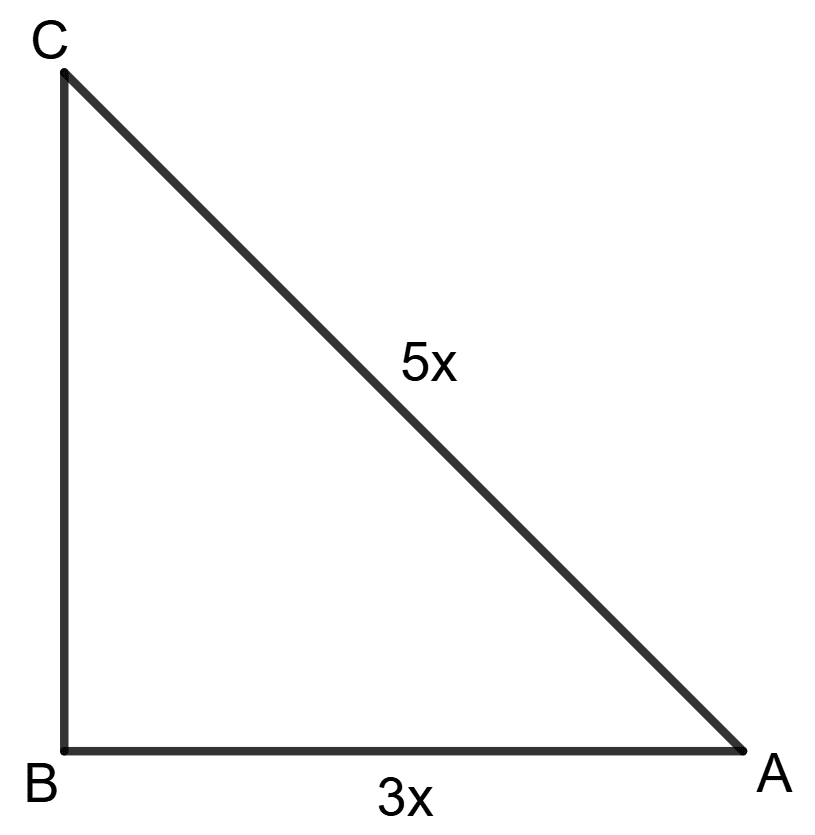
∴ If length of BC = 5x unit, length of AC = 13x unit.
In Δ ABC,
⇒ AC2 = AB2 + BC2 (∵ AC is hypotenuse)
⇒ (13x)2 = (5x)2 + BC2
⇒ 169x2 = 25x2 + BC2
⇒ BC2 = 169x2 - 25x2
⇒ BC2 = 144x2
⇒ BC = 144 x 2 \sqrt{144x^2} 144 x 2
⇒ BC = 12x
tan A = Perpendicular Base \dfrac{\text{Perpendicular}}{\text{Base}} Base Perpendicular
= B C A B \dfrac{BC}{AB} A B BC = 5 x 12 x \dfrac{5x}{12x} 12 x 5 x = 5 12 \dfrac{5}{12} 12 5
Hence, option 1 is the correct option.
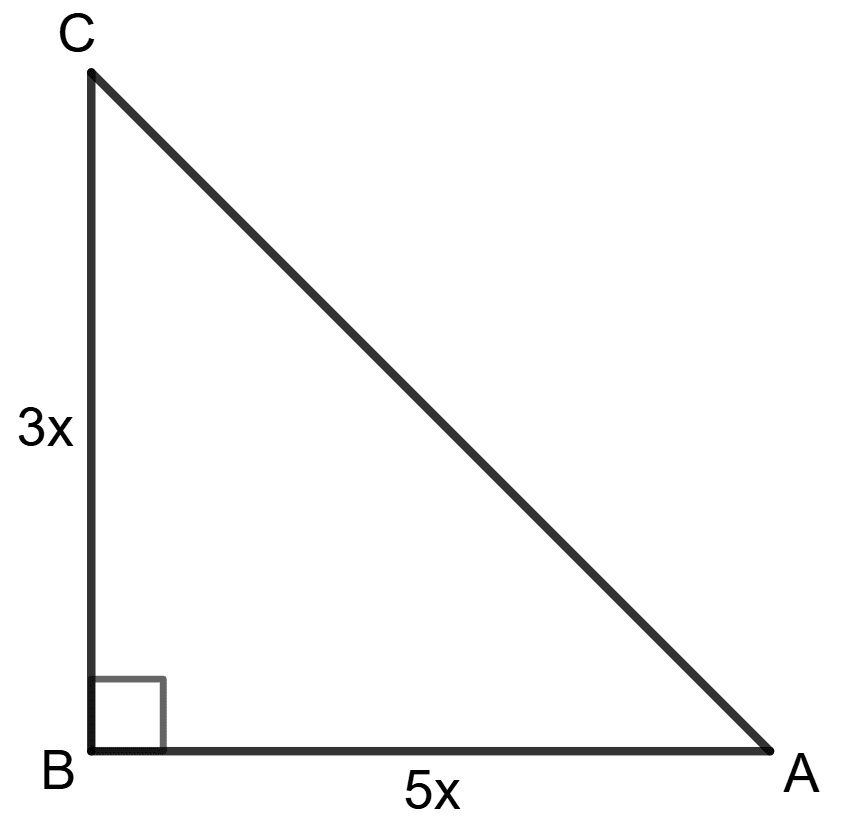
If tan A = 3 5 A = \dfrac{3}{5} A = 5 3 , the value of sin2 A + cos2 A is :
9 25 \dfrac{9}{25} 25 9
1
9 16 \dfrac{9}{16} 16 9
16 9 \dfrac{16}{9} 9 16
Answer
Given:
tan A = 3 5 A = \dfrac{3}{5} A = 5 3
i.e. P e r p e n d i c u l a r B a s e = 3 5 \dfrac{Perpendicular}{Base} = \dfrac{3}{5} B a se P er p e n d i c u l a r = 5 3
∴ If length of BC = 3x unit, length of AB = 5x unit.
In Δ ABC,
⇒ AC2 = AB2 + BC2 (∵ AC is hypotenuse)
⇒ AC2 = (5x)2 + (3x)2
⇒ AC2 = 25x2 + 9x2
⇒ AC2 = 34x2
⇒ AC = 34 x 2 \sqrt{34\text{x}^2} 34 x 2
⇒ AC = 34 \sqrt{34} 34 x
sin A = P e r p e n d i c u l a r H y p o t e n u s e A = \dfrac{Perpendicular}{Hypotenuse} A = Hy p o t e n u se P er p e n d i c u l a r =
= B C A C = 3 x 34 x = 3 34 = \dfrac{BC}{AC} = \dfrac{3x}{\sqrt{34}x} = \dfrac{3}{\sqrt{34}} = A C BC = 34 x 3 x = 34 3
cos A = B a s e H y p o t e n u s e A = \dfrac{Base}{Hypotenuse} A = Hy p o t e n u se B a se
= A B A C = 5 x 34 x = 5 34 = \dfrac{AB}{AC} = \dfrac{5x}{\sqrt{34}x} = \dfrac{5}{\sqrt{34}} = A C A B = 34 x 5 x = 34 5
Now, sin2 A + cos2 A
= ( 3 34 ) 2 + ( 5 34 ) 2 = ( 9 34 ) + ( 25 34 ) = ( 9 + 25 34 ) = ( 34 34 ) = 1 = \Big(\dfrac{3}{\sqrt{34}}\Big)^2 + \Big(\dfrac{5}{\sqrt{34}}\Big)^2\\[1em] = \Big(\dfrac{9}{34}\Big) + \Big(\dfrac{25}{34}\Big)\\[1em] = \Big(\dfrac{9 + 25}{34}\Big)\\[1em] = \Big(\dfrac{34}{34}\Big)\\[1em] = 1 = ( 34 3 ) 2 + ( 34 5 ) 2 = ( 34 9 ) + ( 34 25 ) = ( 34 9 + 25 ) = ( 34 34 ) = 1
Hence, option 2 is the correct option.
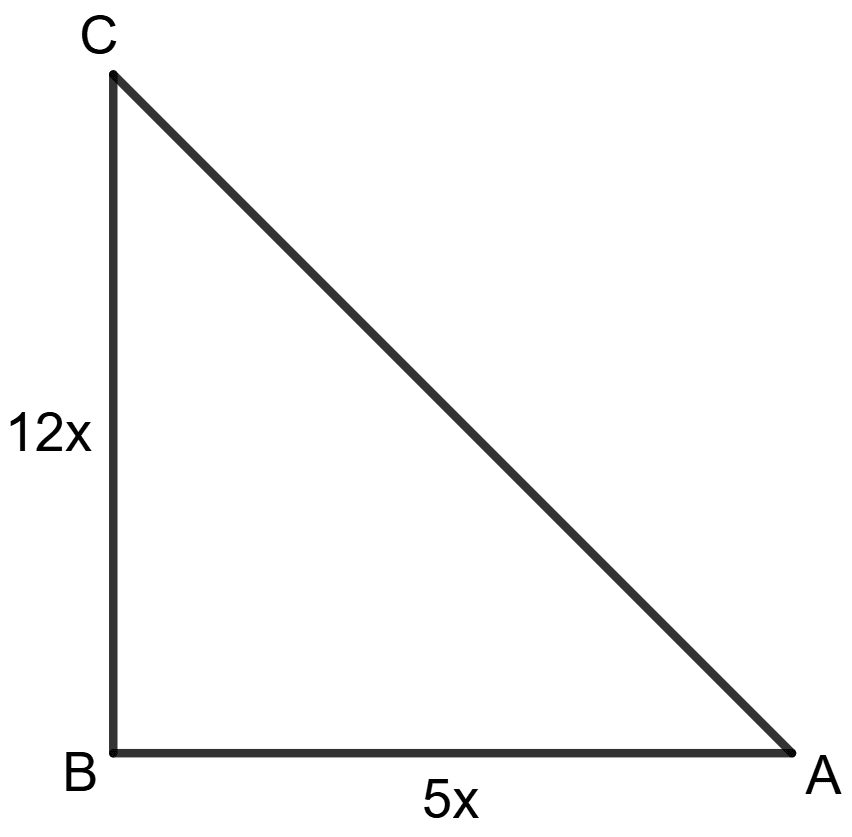
If cot A = 5 12 A = \dfrac{5}{12} A = 12 5 , the value of cot2 A - cosec2 A is :
1
2
-2
-1
Answer
Given:
cot A = 5 12 A = \dfrac{5}{12} A = 12 5
i.e. B a s e P e r p e n d i c u l a r = 5 12 \dfrac{Base}{Perpendicular} = \dfrac{5}{12} P er p e n d i c u l a r B a se = 12 5
∴ If length of AB = 5x unit, length of BC = 12x unit.
In Δ ABC,
⇒ AC2 = AB2 + BC2 (∵ AC is hypotenuse)
⇒ AC2 = (5x)2 + (12x)2
⇒ AC2 = 25x2 + 144x2
⇒ AC2 = 1692
⇒ AC = 169 x 2 \sqrt{169\text{x}^2} 169 x 2
⇒ AC = 13x
cosec A = H y p o t e n u s e P e r p e n d i c u l a r A = \dfrac{Hypotenuse}{Perpendicular} A = P er p e n d i c u l a r Hy p o t e n u se
A C B C = 13 x 12 x = 13 12 \dfrac{AC}{BC} = \dfrac{13x}{12x} = \dfrac{13}{12} BC A C = 12 x 13 x = 12 13
Now, cot2 A - cosec2 A
= ( 5 12 ) 2 − ( 13 12 ) 2 = ( 25 144 ) − ( 169 144 ) = ( 25 − 169 144 ) = ( − 144 144 ) = − 1 = \Big(\dfrac{5}{12}\Big)^2 - \Big(\dfrac{13}{12}\Big)^2\\[1em] = \Big(\dfrac{25}{144}\Big) - \Big(\dfrac{169}{144}\Big)\\[1em] = \Big(\dfrac{25 - 169}{144}\Big)\\[1em] = \Big(\dfrac{- 144}{144}\Big)\\[1em] = - 1 = ( 12 5 ) 2 − ( 12 13 ) 2 = ( 144 25 ) − ( 144 169 ) = ( 144 25 − 169 ) = ( 144 − 144 ) = − 1
Hence, option 4 is the correct option.
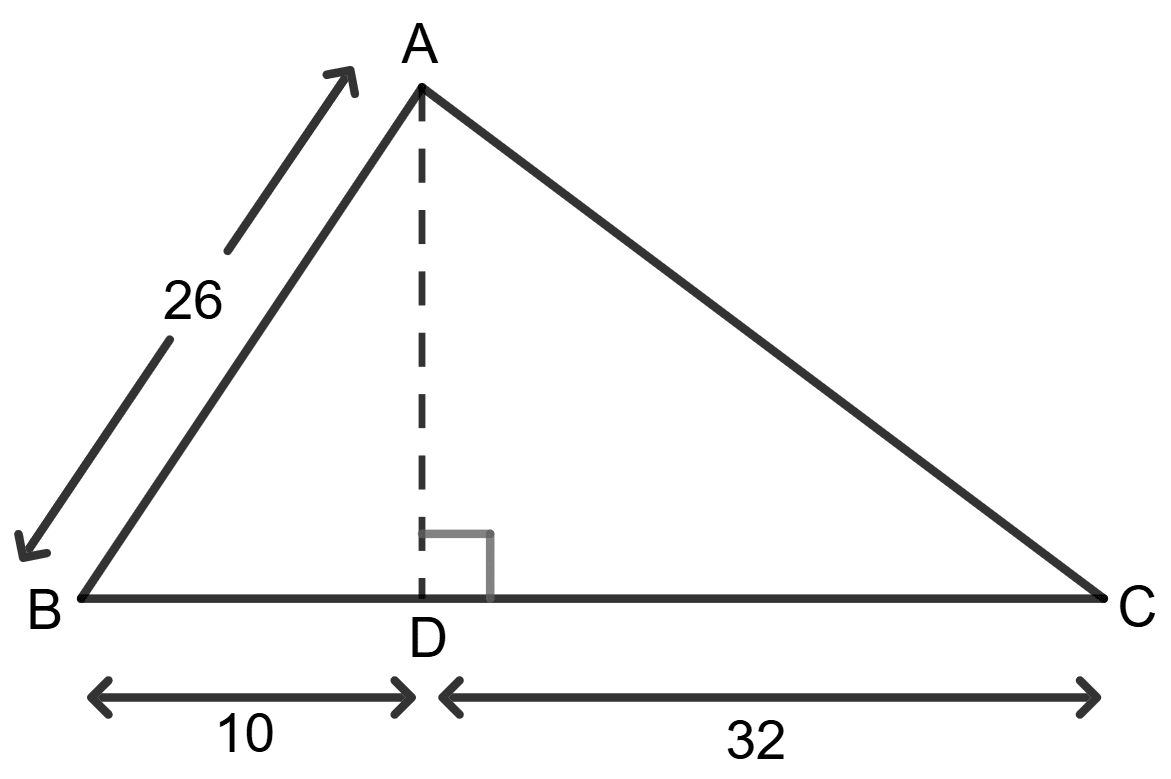
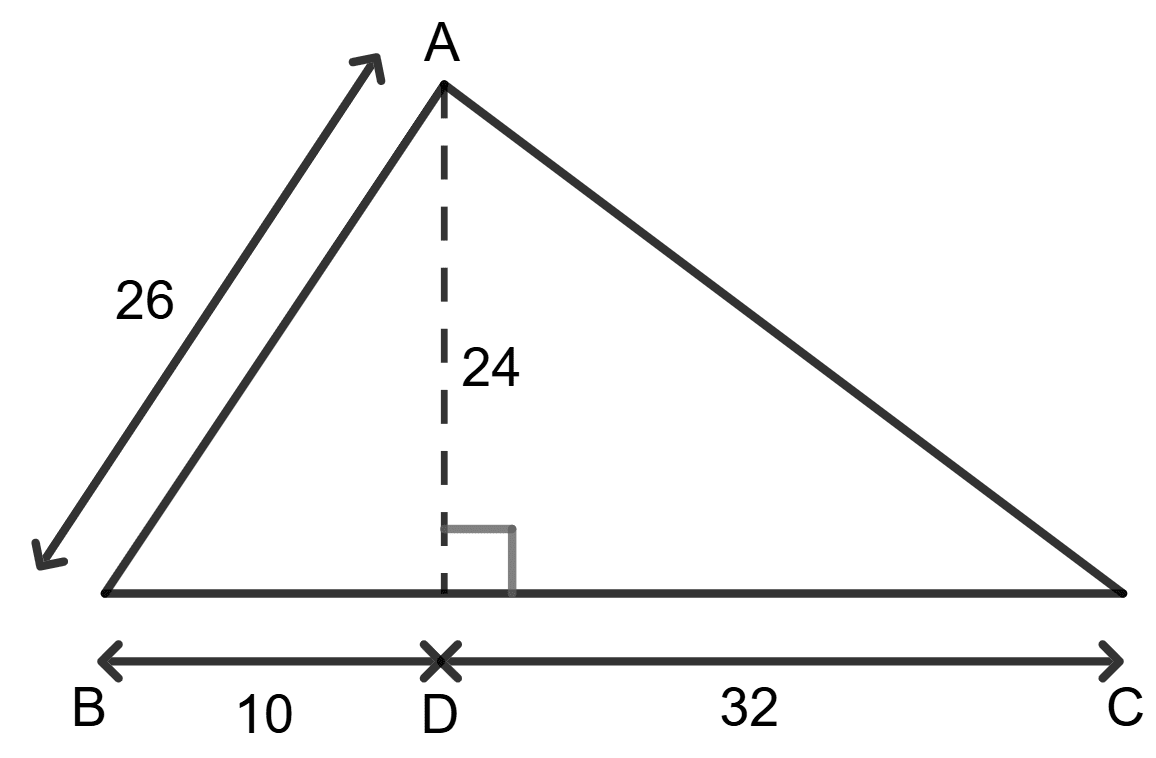
In the given figure (each observation is in cm) tan C is :
3 5 \dfrac{3}{5} 5 3
4 3 \dfrac{4}{3} 3 4
3 4 \dfrac{3}{4} 4 3
4 5 \dfrac{4}{5} 5 4
Answer
In Δ ABD,
AB2 = AD2 + BD2
⇒ (26)2 = AD2 + (10)2
⇒ 676 = AD2 + 100
⇒ AD2 = 676 - 100
⇒ AD2 = 576
⇒ AD = 576 \sqrt{576} 576
⇒ AD = 24 cm
In Δ ADC,
AC2 = AD2 + DC2
⇒ AC2 = (24)2 + (32)2
⇒ AC2 = 576 + 1,024
⇒ AC2 = 1,600
⇒ AC = 1 , 600 \sqrt{1,600} 1 , 600
⇒ AC = 40 cm
tan A = P e r p e n d i c u l a r B a s e A = \dfrac{Perpendicular}{Base} A = B a se P er p e n d i c u l a r
= 24 32 \dfrac{24}{32} 32 24
= 3 4 \dfrac{3}{4} 4 3
Hence, option 3 is the correct option.
If 5 cos A = 3, the value of sec2 A - tan2 A is :
1
-1
3 4 \dfrac{3}{4} 4 3
4 3 \dfrac{4}{3} 3 4
Answer
Given:
5 cos A = 3
⇒ cos A = 3 5 \dfrac{3}{5} 5 3
i.e., Base Hypotenuse = 3 5 \dfrac{\text{Base}}{\text{Hypotenuse}} = \dfrac{3}{5} Hypotenuse Base = 5 3
∴ If length of AB = 3x unit, length of AC = 5x unit.
In Δ ABC,
AC2 = BC2 + AB2
⇒ (5x)2 = BC2 + (3x)2
⇒ 25x2 = BC2 + 9x2
⇒ BC2 = 25x2 - 9x2
⇒ BC2 = 16x2
⇒ BC = 16 x 2 \sqrt{16\text{x}^2} 16 x 2
⇒ BC = 4x
sec A = H y p o t e n u s e B a s e \dfrac{Hypotenuse}{Base} B a se Hy p o t e n u se
= A C B A = 5 x 3 x = 5 3 \dfrac{AC}{BA} = \dfrac{5x}{3x} = \dfrac{5}{3} B A A C = 3 x 5 x = 3 5
tan A = P e r p e n d i c u l a r B a s e \dfrac{Perpendicular}{Base} B a se P er p e n d i c u l a r
= B C B A = 4 x 3 x = 4 3 \dfrac{BC}{BA} = \dfrac{4x}{3x} = \dfrac{4}{3} B A BC = 3 x 4 x = 3 4
Now, sec2 A - tan2 A
= ( 5 3 ) 2 − ( 4 3 ) 2 = 25 9 − 16 9 = 25 − 16 9 = 9 9 = 1 = \Big(\dfrac{5}{3}\Big)^2 - \Big(\dfrac{4}{3}\Big)^2\\[1em] = \dfrac{25}{9} - \dfrac{16}{9}\\[1em] = \dfrac{25 - 16}{9}\\[1em] = \dfrac{9}{9}\\[1em] = 1 = ( 3 5 ) 2 − ( 3 4 ) 2 = 9 25 − 9 16 = 9 25 − 16 = 9 9 = 1
Hence, option 1 is the correct option.
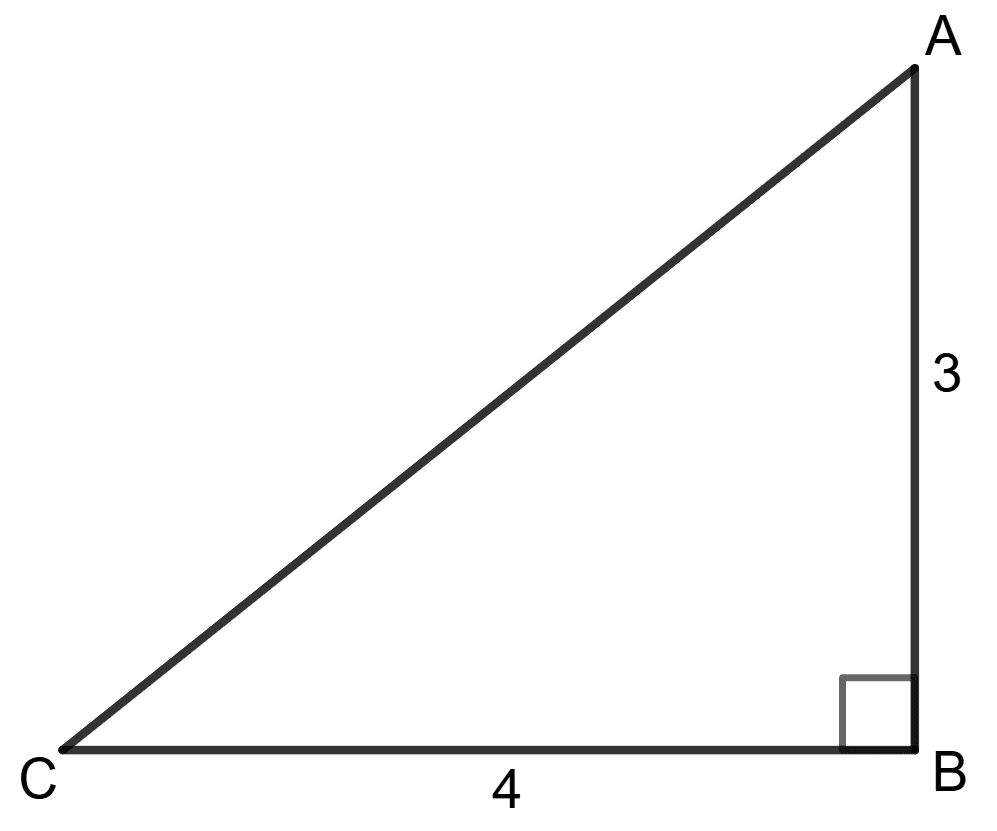
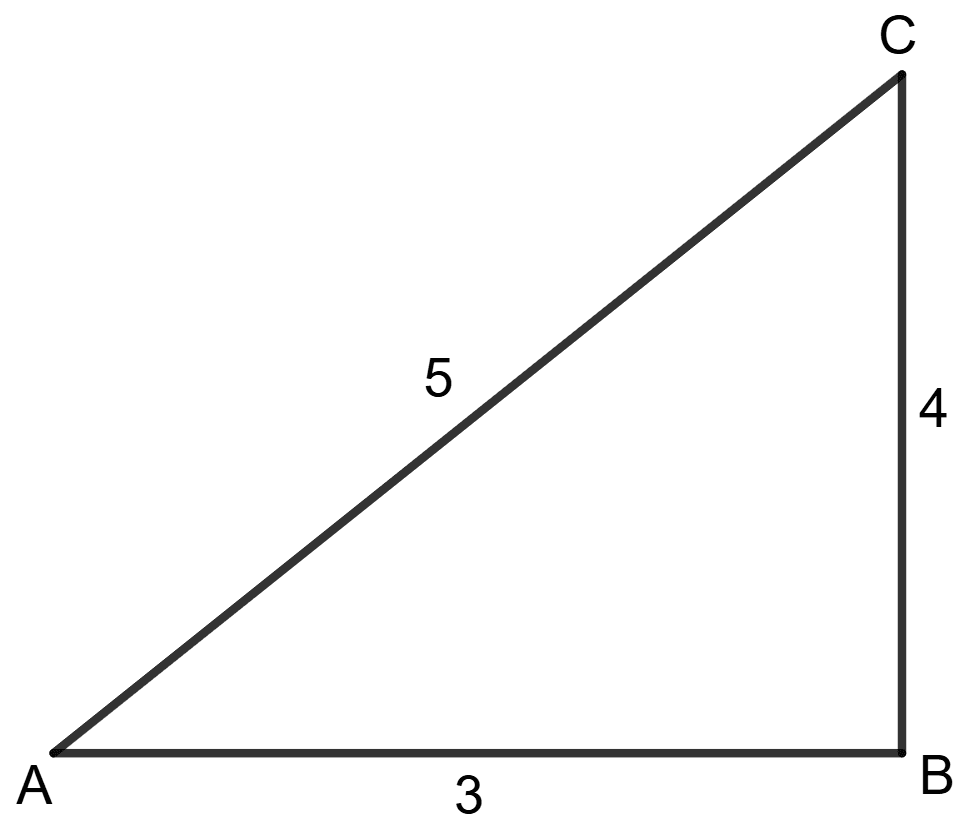
From the following figure, find the values of :
(i) sin A
(ii) cos A
(iii) cot A
(iv) sec C
(v) cosec C
(vi) tan C.
Answer
In Δ ABC,
⇒ AC2 = AB2 + BC2 (∵ AC is hypotenuse)
⇒ AC2 = 32 + 42
⇒ AC2 = 9 + 16
⇒ AC2 = 25
⇒ AC = 25 \sqrt{25} 25
⇒ AC = 5
(i) sin A = P e r p e n d i c u l a r H y p o t e n u s e A = \dfrac{Perpendicular}{Hypotenuse} A = Hy p o t e n u se P er p e n d i c u l a r
= C B A C = 4 5 = \dfrac{CB}{AC}\\[1em] = \dfrac{4}{5}\\[1em] = A C CB = 5 4
Hence, sin A = 4 5 A = \dfrac{4}{5} A = 5 4 .
(ii) cos A = B a s e H y p o t e n u s e A = \dfrac{Base}{Hypotenuse} A = Hy p o t e n u se B a se
= A B A C = 3 5 = \dfrac{AB}{AC}\\[1em] = \dfrac{3}{5}\\[1em] = A C A B = 5 3
Hence, cos A = 3 5 A = \dfrac{3}{5} A = 5 3 .
(iii) cot A = B a s e P e r p e n d i c u l a r A = \dfrac{Base}{Perpendicular} A = P er p e n d i c u l a r B a se
= A B B C = 3 4 = \dfrac{AB}{BC}\\[1em] = \dfrac{3}{4}\\[1em] = BC A B = 4 3
Hence, cot A = 3 4 A = \dfrac{3}{4} A = 4 3 .
(iv) sec C = H y p o t e n u s e B a s e C = \dfrac{Hypotenuse}{Base} C = B a se Hy p o t e n u se
= A C A B = 5 4 = 1 1 4 = \dfrac{AC}{AB}\\[1em] = \dfrac{5}{4}\\[1em] = 1\dfrac{1}{4}\\[1em] = A B A C = 4 5 = 1 4 1
Hence, sec A = 5 4 = 1 1 4 A = \dfrac{5}{4} = 1\dfrac{1}{4} A = 4 5 = 1 4 1 .
(v) cosec C = H y p o t e n u s e P e r p e n d i c u l a r C = \dfrac{Hypotenuse}{Perpendicular} C = P er p e n d i c u l a r Hy p o t e n u se
= A C A B = 5 3 = 1 2 3 = \dfrac{AC}{AB}\\[1em] = \dfrac{5}{3}\\[1em] = 1\dfrac{2}{3}\\[1em] = A B A C = 3 5 = 1 3 2
Hence, cosec C = 5 3 = 1 2 3 C = \dfrac{5}{3} = 1\dfrac{2}{3} C = 3 5 = 1 3 2 .
(vi) tan C = P e r p e n d i c u l a r B a s e C = \dfrac{Perpendicular}{Base} C = B a se P er p e n d i c u l a r
= A B B C = 3 4 = \dfrac{AB}{BC}\\[1em] = \dfrac{3}{4}\\[1em] = BC A B = 4 3
Hence, tan C = 3 4 C = \dfrac{3}{4} C = 4 3 .
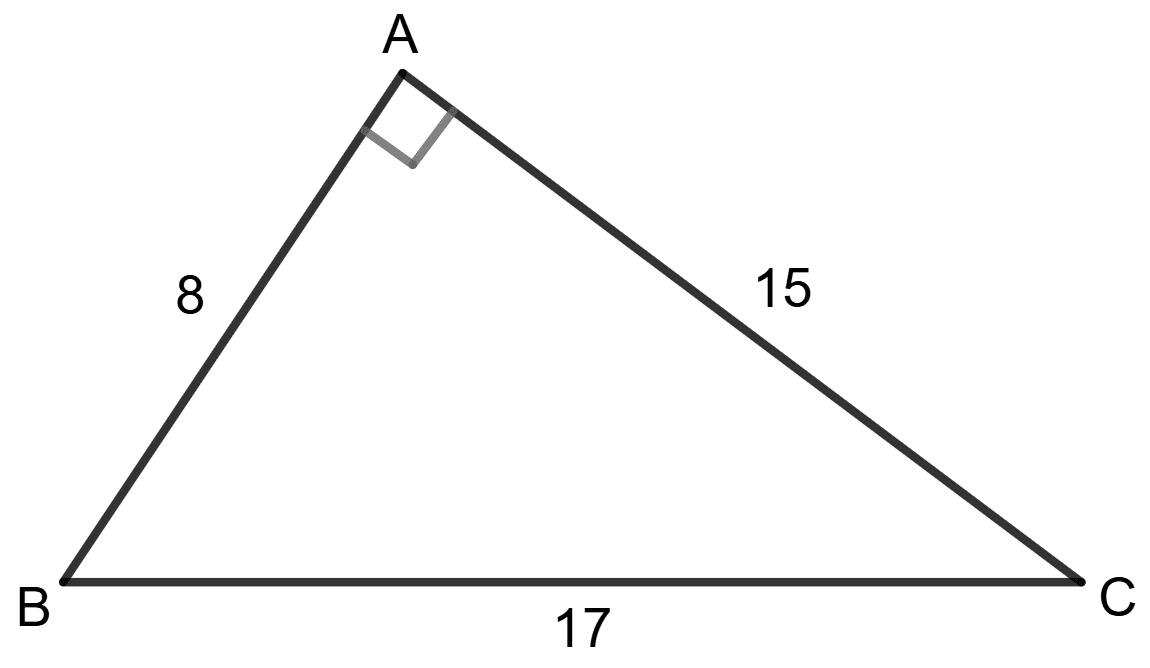
From the following figure, find the values of :
(i) cos B
(ii) tan C
(iii) sin2 B + cos2 B
(iv) sin B.cos C + cos B.sin C
Answer
In Δ BAC,
⇒ BC2 = AB2 + AC2 (∵ BC is hypotenuse)
⇒ (17)2 = (8)2 + AC2
⇒ 289 = 64 + AC2
⇒ AC2 = 289 - 64
⇒ AC2 = 225
⇒ AC = 225 \sqrt{225} 225
⇒ AC = 15
(i) cos B = B a s e H y p o t e n u s e B = \dfrac{Base}{Hypotenuse} B = Hy p o t e n u se B a se
= A B B C = 8 17 = \dfrac{AB}{BC}\\[1em] = \dfrac{8}{17} = BC A B = 17 8
Hence, cos B = 8 17 B = \dfrac{8}{17} B = 17 8 .
(ii) tan C = P e r p e n d i c u l a r B a s e C = \dfrac{Perpendicular}{Base} C = B a se P er p e n d i c u l a r
= A B A C = 8 15 = \dfrac{AB}{AC}\\[1em] = \dfrac{8}{15}\\[1em] = A C A B = 15 8
Hence, tan C = 8 15 C = \dfrac{8}{15} C = 15 8 .
(iii) sin2 B + cos2 B
= ( P e r p e n d i c u l a r H y p o t e n u s e ) 2 + ( B a s e H y p o t e n u s e ) 2 = ( A C B C ) 2 + ( A B B C ) 2 = ( 15 17 ) 2 + ( 8 17 ) 2 = 225 289 + 64 289 = 225 + 64 289 = 289 289 = 1 = \Big(\dfrac{Perpendicular}{Hypotenuse}\Big)^2 + \Big(\dfrac{Base}{Hypotenuse}\Big)^2\\[1em] = \Big(\dfrac{AC}{BC}\Big)^2 + \Big(\dfrac{AB}{BC}\Big)^2\\[1em] = \Big(\dfrac{15}{17}\Big)^2 + \Big(\dfrac{8}{17}\Big)^2\\[1em] = \dfrac{225}{289} + \dfrac{64}{289}\\[1em] = \dfrac{225 + 64}{289}\\[1em] = \dfrac{289}{289}\\[1em] = 1 = ( Hy p o t e n u se P er p e n d i c u l a r ) 2 + ( Hy p o t e n u se B a se ) 2 = ( BC A C ) 2 + ( BC A B ) 2 = ( 17 15 ) 2 + ( 17 8 ) 2 = 289 225 + 289 64 = 289 225 + 64 = 289 289 = 1
Hence, sin2 B + cos2 B = 1.
(iv) sin B.cos C + cos B.sin C
= P e r p e n d i c u l a r H y p o t e n u s e . B a s e H y p o t e n u s e + B a s e H y p o t e n u s e . P e r p e n d i c u l a r H y p o t e n u s e = A C B C . A C B C + A B B C . A B B C = ( A C B C ) 2 + ( A B B C ) 2 = ( 15 17 ) 2 + ( 8 17 ) 2 = 225 289 + 64 289 = 225 + 64 289 = 289 289 = 1 = \dfrac{Perpendicular}{Hypotenuse} .\dfrac{Base}{Hypotenuse} + \dfrac{Base}{Hypotenuse} . \dfrac{Perpendicular}{Hypotenuse}\\[1em] = \dfrac{AC}{BC} .\dfrac{AC}{BC} + \dfrac{AB}{BC} . \dfrac{AB}{BC}\\[1em] = \Big(\dfrac{AC}{BC}\Big)^2 + \Big(\dfrac{AB}{BC}\Big)^2\\[1em] = \Big(\dfrac{15}{17}\Big)^2 + \Big(\dfrac{8}{17}\Big)^2\\[1em] = \dfrac{225}{289} + \dfrac{64}{289}\\[1em] = \dfrac{225 + 64}{289}\\[1em] = \dfrac{289}{289}\\[1em] = 1 = Hy p o t e n u se P er p e n d i c u l a r . Hy p o t e n u se B a se + Hy p o t e n u se B a se . Hy p o t e n u se P er p e n d i c u l a r = BC A C . BC A C + BC A B . BC A B = ( BC A C ) 2 + ( BC A B ) 2 = ( 17 15 ) 2 + ( 17 8 ) 2 = 289 225 + 289 64 = 289 225 + 64 = 289 289 = 1
Hence, sin B.cos C + cos B.sin C = 1.
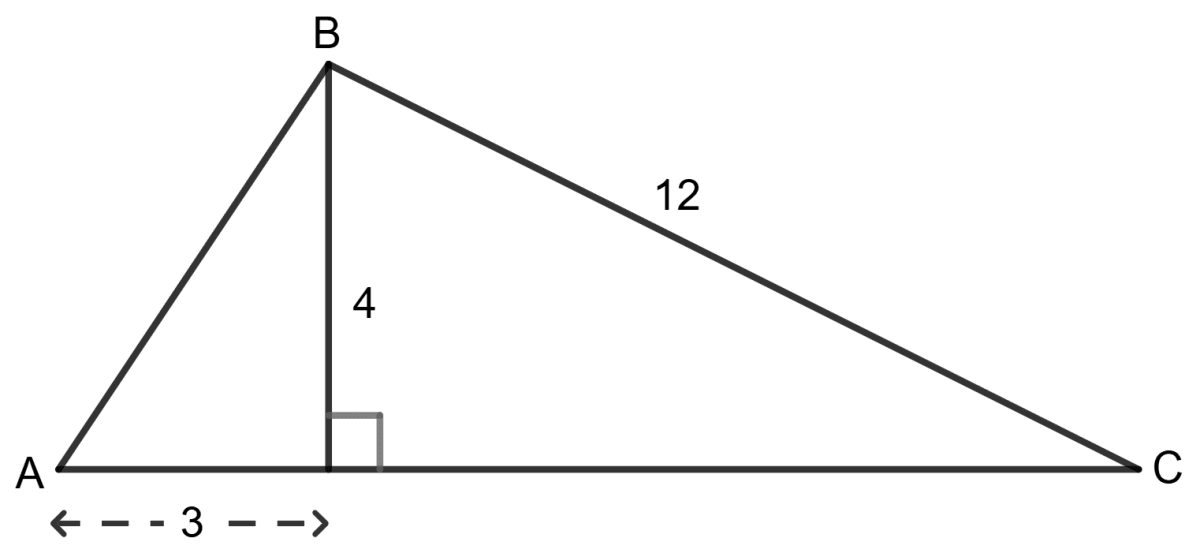
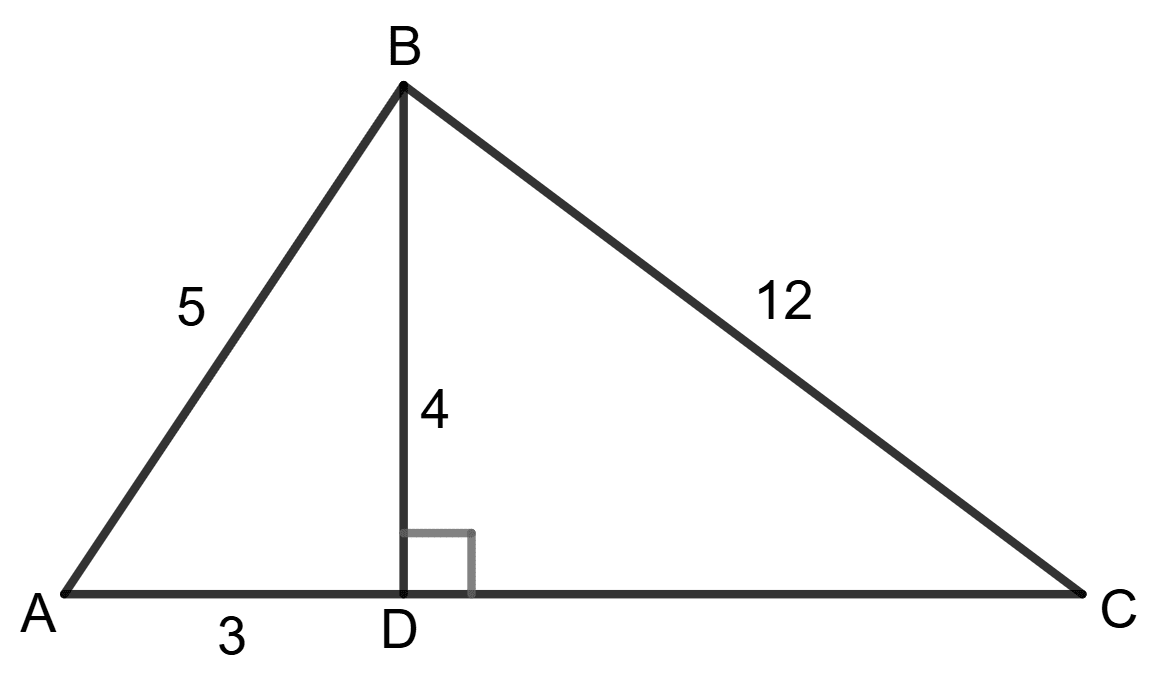
From the following figure, find the values of :
(i) cos A
(ii) cosec A
(iii) tan2 A – sec2 A
(iv) sin C
(v) sec C
(v) cot2 C - 1 sin 2 C \dfrac{1}{\text{sin}^2 \text{ C}} sin 2 C 1
Answer
In Δ ADB,
⇒ AB2 = AD2 + BD2 (∵ AB is hypotenuse)
⇒ AB2 = (3)2 + (4)2
⇒ AB2 = 9 + 16
⇒ AB2 = 25
⇒ AB = 25 \sqrt{25} 25
⇒ AB = 5
In Δ CDB,
⇒ BC2 = BD2 + DC2 (∵ BC is hypotenuse)
⇒ (12)2 = (4)2 + DC2
⇒ 144 = 16 + DC2
⇒ DC2 = 144 - 16
⇒ DC2 = 128
⇒ DC = 128 \sqrt{128} 128
⇒ DC = 8 2 8\sqrt{2} 8 2
(i) cos A = B a s e H y p o t e n u s e A = \dfrac{Base}{Hypotenuse} A = Hy p o t e n u se B a se
= A D A B = 3 5 = \dfrac{AD}{AB}\\[1em] = \dfrac{3}{5} = A B A D = 5 3
Hence, cos A = 3 5 A = \dfrac{3}{5} A = 5 3 .
(ii) cosec A = H y p o t e n u s e P e r p e n d i c u l a r A = \dfrac{Hypotenuse}{Perpendicular} A = P er p e n d i c u l a r Hy p o t e n u se
= A D B D = 5 4 = \dfrac{AD}{BD}\\[1em] = \dfrac{5}{4} = B D A D = 4 5
Hence, cosec A = 5 4 A = \dfrac{5}{4} A = 4 5 .
(iii) tan2 A – sec2 A
tan A = P e r p e n d i c u l a r B a s e A = \dfrac{Perpendicular}{Base} A = B a se P er p e n d i c u l a r
= B D A D = 4 3 = \dfrac{BD}{AD}\\[1em] = \dfrac{4}{3} = A D B D = 3 4
sec A = H y p o t e n u s e B a s e A = \dfrac{Hypotenuse}{Base} A = B a se Hy p o t e n u se
= A B A D = 5 3 = \dfrac{AB}{AD}\\[1em] = \dfrac{5}{3} = A D A B = 3 5
tan2 A – sec2 A
= ( 4 3 ) 2 − ( 5 3 ) 2 = ( 16 9 ) − ( 25 9 ) = ( 16 − 25 9 ) = ( − 9 9 ) = − 1 = \Big(\dfrac{4}{3}\Big)^2 - \Big(\dfrac{5}{3}\Big)^2\\[1em] = \Big(\dfrac{16}{9}\Big) - \Big(\dfrac{25}{9}\Big)\\[1em] = \Big(\dfrac{16 - 25}{9}\Big)\\[1em] = \Big(\dfrac{-9}{9}\Big)\\[1em] = -1 = ( 3 4 ) 2 − ( 3 5 ) 2 = ( 9 16 ) − ( 9 25 ) = ( 9 16 − 25 ) = ( 9 − 9 ) = − 1
Hence, tan2 A – sec2 A = -1.
(iv) sin C = P e r p e n d i c u l a r H y p o t e n u s e C = \dfrac{Perpendicular}{Hypotenuse} C = Hy p o t e n u se P er p e n d i c u l a r
= B D B C = 4 12 = 1 3 = \dfrac{BD}{BC}\\[1em] = \dfrac{4}{12}\\[1em] = \dfrac{1}{3}\\[1em] = BC B D = 12 4 = 3 1
Hence, sin C = 1 3 C = \dfrac{1}{3} C = 3 1 .
(v) sec C = H y p o t e n u s e B a s e C = \dfrac{Hypotenuse}{Base} C = B a se Hy p o t e n u se
= B C D C = 12 8 2 = 3 2 2 = 3 × 2 2 2 × 2 = 3 2 2 × 2 = 3 2 4 = \dfrac{BC}{DC}\\[1em] = \dfrac{12}{8 \sqrt{2}}\\[1em] = \dfrac{3}{2 \sqrt{2}}\\[1em] = \dfrac{3 \times \sqrt{2}}{2 \sqrt{2} \times \sqrt{2}}\\[1em] = \dfrac{3 \sqrt{2}}{2 \times 2}\\[1em] = \dfrac{3 \sqrt{2}}{4} = D C BC = 8 2 12 = 2 2 3 = 2 2 × 2 3 × 2 = 2 × 2 3 2 = 4 3 2
Hence, sec C = 3 2 4 C = \dfrac{3 \sqrt{2}}{4} C = 4 3 2 .
(vi) cot2 C - 1 sin 2 C \dfrac{1}{\text{sin}^2 \text{ C}} sin 2 C 1
cot C = B a s e P e r p e n d i c u l a r C = \dfrac{Base}{Perpendicular} C = P er p e n d i c u l a r B a se
= B a s e P e r p e n d i c u l a r = 8 2 4 = 2 2 = \dfrac{Base}{Perpendicular}\\[1em] = \dfrac{8 \sqrt{2}}{4}\\[1em] = 2 \sqrt{2} = P er p e n d i c u l a r B a se = 4 8 2 = 2 2
sin C = P e r p e n d i c u l a r H y p o t e n u s e C = \dfrac{Perpendicular}{Hypotenuse} C = Hy p o t e n u se P er p e n d i c u l a r
= 4 12 = 1 3 = \dfrac{4}{12}\\[1em] = \dfrac{1}{3} = 12 4 = 3 1
Now, cot2 C - 1 sin 2 C \dfrac{1}{\text{sin}^2 \text{ C}} sin 2 C 1
= ( 2 2 ) 2 − 1 ( 1 3 ) 2 = ( 2 2 ) 2 − 9 1 = 4 × 2 − 9 = 8 − 9 = − 1 = (2 \sqrt{2})^2 - \dfrac{1}{\Big(\dfrac{1}{3}\Big)^2}\\[1em] = (2 \sqrt{2})^2 - \dfrac{9}{1}\\[1em] = 4 \times 2 - 9\\[1em] = 8 - 9\\[1em] = -1 = ( 2 2 ) 2 − ( 3 1 ) 2 1 = ( 2 2 ) 2 − 1 9 = 4 × 2 − 9 = 8 − 9 = − 1
Hence, cot2 C - 1 sin 2 C = − 1 \dfrac{1}{\text{sin}^2 \text{ C}} = -1 sin 2 C 1 = − 1 .
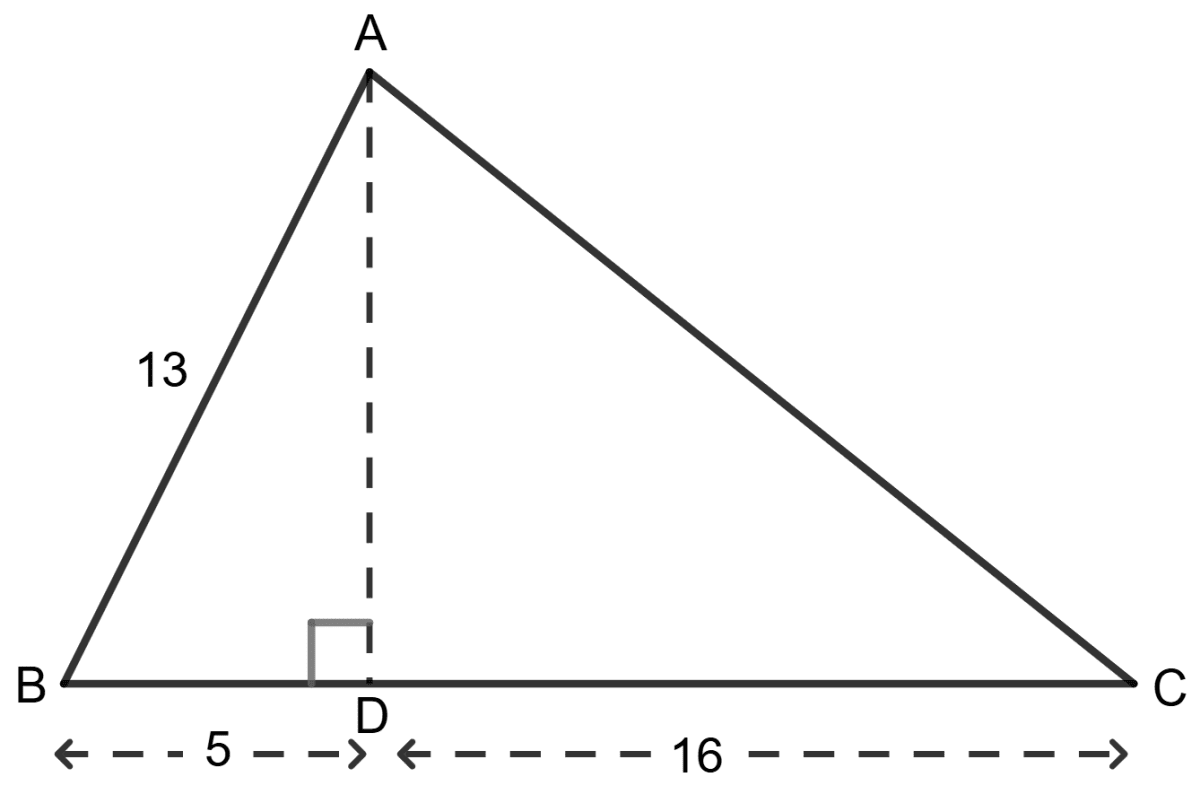
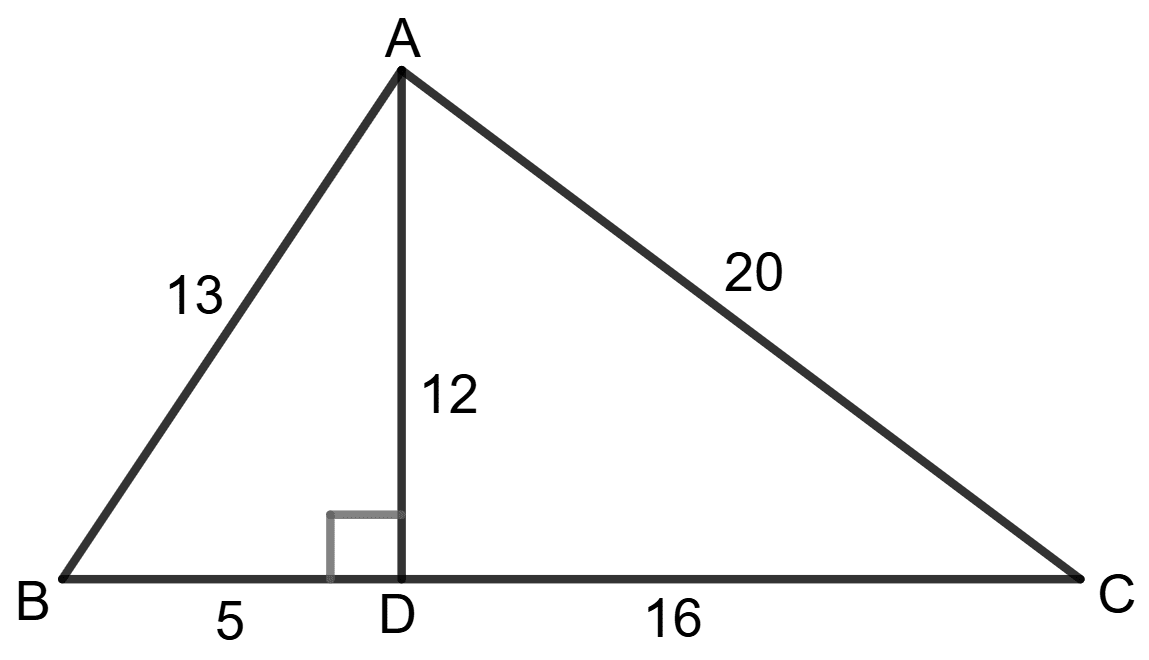
From the following figure, find the values of :
(i) sin B
(ii) tan C
(iii) sec2 B – tan2 B
(iv) sin2 C + cos2 C
Answer
In Δ ABD,
⇒ AB2 = BD2 + DA2 (∵ AB is hypotenuse)
⇒ 132 = 52 + DA2
⇒ 169 = 25 + DA2
⇒ DA2 = 169 - 25
⇒ DA2 = 144
⇒ DA = 144 \sqrt{144} 144
⇒ DA = 12
In Δ ADC,
⇒ AC2 = AD2 + DC2 (∵ AB is hypotenuse)
⇒ AC2 = 122 + 162
⇒ AC2 = 144 + 256
⇒ AC2 = 400
⇒ AC = 400 \sqrt{400} 400
⇒ AC = 20
(i) sin B = P e r p e n d i c u l a r H y p o t e n u s e B = \dfrac{Perpendicular}{Hypotenuse} B = Hy p o t e n u se P er p e n d i c u l a r
= A D A B = 12 13 = \dfrac{AD}{AB}\\[1em] = \dfrac{12}{13} = A B A D = 13 12
Hence, sin B = 12 13 B = \dfrac{12}{13} B = 13 12 .
(ii) tan C = P e r p e n d i c u l a r B a s e C = \dfrac{Perpendicular}{Base} C = B a se P er p e n d i c u l a r
= A D D C = 12 16 = 3 4 = \dfrac{AD}{DC}\\[1em] = \dfrac{12}{16}\\[1em] = \dfrac{3}{4} = D C A D = 16 12 = 4 3
Hence, tan C = 3 4 C = \dfrac{3}{4} C = 4 3 .
(iii) sec2 B – tan2 B
sec B = H y p o t e n u s e B a s e B = \dfrac{Hypotenuse}{Base} B = B a se Hy p o t e n u se
= A B B D = 13 5 = \dfrac{AB}{BD}\\[1em] = \dfrac{13}{5} = B D A B = 5 13
tan B = P e r p e n d i c u l a r B a s e B = \dfrac{Perpendicular}{Base} B = B a se P er p e n d i c u l a r
= A D B D = 12 5 = \dfrac{AD}{BD}\\[1em] = \dfrac{12}{5} = B D A D = 5 12
sec2 B – tan2 B
= ( 13 5 ) 2 − ( 12 5 ) 2 = ( 169 25 ) − ( 144 25 ) = ( 169 − 144 25 ) = ( 25 25 ) = 1 = \Big(\dfrac{13}{5}\Big)^2 - \Big(\dfrac{12}{5}\Big)^2\\[1em] = \Big(\dfrac{169}{25}\Big) - \Big(\dfrac{144}{25}\Big)\\[1em] = \Big(\dfrac{169 - 144}{25}\Big)\\[1em] = \Big(\dfrac{25}{25}\Big)\\[1em] = 1 = ( 5 13 ) 2 − ( 5 12 ) 2 = ( 25 169 ) − ( 25 144 ) = ( 25 169 − 144 ) = ( 25 25 ) = 1
Hence, sec2 B – tan2 B = 1.
(iv) sin2 C + cos2 C
sin C = P e r p e n d i c u l a r H y p o t e n u s e C = \dfrac{Perpendicular}{Hypotenuse} C = Hy p o t e n u se P er p e n d i c u l a r
= A D A C = 12 20 = 3 5 = \dfrac{AD}{AC}\\[1em] = \dfrac{12}{20}\\[1em] = \dfrac{3}{5} = A C A D = 20 12 = 5 3
cos C = B a s e H y p o t e n u s e C = \dfrac{Base}{Hypotenuse} C = Hy p o t e n u se B a se
= D C A C = 16 20 = 4 5 = \dfrac{DC}{AC}\\[1em] = \dfrac{16}{20}\\[1em] = \dfrac{4}{5} = A C D C = 20 16 = 5 4
Now,
sin2 C + cos2 C
= ( 3 5 ) 2 + ( 4 5 ) 2 = ( 9 25 ) + ( 16 25 ) = ( 9 + 16 25 ) = ( 25 25 ) = 1 = \Big(\dfrac{3}{5}\Big)^2 + \Big(\dfrac{4}{5}\Big)^2\\[1em] = \Big(\dfrac{9}{25}\Big) + \Big(\dfrac{16}{25}\Big)\\[1em] = \Big(\dfrac{9 + 16}{25}\Big)\\[1em] = \Big(\dfrac{25}{25}\Big)\\[1em] = 1 = ( 5 3 ) 2 + ( 5 4 ) 2 = ( 25 9 ) + ( 25 16 ) = ( 25 9 + 16 ) = ( 25 25 ) = 1
Hence, sin2 C + cos2 C = 1.
Given : sin A = 3 5 \text{sin A} = \dfrac{3}{5} sin A = 5 3 , find :
(i) tan A
(ii) cos A
Answer
(i) Given:
sin A = 3 5 A = \dfrac{3}{5} A = 5 3
i.e., P e r p e n d i c u l a r H y p o t e n u s e = 3 5 \dfrac{Perpendicular}{Hypotenuse} = \dfrac{3}{5} Hy p o t e n u se P er p e n d i c u l a r = 5 3
∴ If length of BC = 3x unit, length of AC = 5x unit.
In Δ ABC,
⇒ AC2 = AB2 + BC2 (∵ AC is hypotenuse)
⇒ (5x)2 = AB2 + (3x)2
⇒ 25x2 = AB2 + 9x2
⇒ AB2 = 25x2 - 9x2
⇒ AB2 = 16x2
⇒ AB = 16 x 2 \sqrt{16\text{x}^2} 16 x 2
⇒ AB = 4x
tan A = P e r p e n d i c u l a r B a s e A = \dfrac{Perpendicular}{Base} A = B a se P er p e n d i c u l a r
= B C B A = 3 x 4 x = 3 4 \dfrac{BC}{BA} = \dfrac{3x}{4x} = \dfrac{3}{4} B A BC = 4 x 3 x = 4 3
Hence, tan A = 3 4 A = \dfrac{3}{4} A = 4 3 .
(ii) cos A = B a s e H y p o t e n u s e A = \dfrac{Base}{Hypotenuse} A = Hy p o t e n u se B a se
= B A A C = 4 x 5 x = 4 5 = \dfrac{BA}{AC} =\dfrac{4x}{5x} = \dfrac{4}{5} = A C B A = 5 x 4 x = 5 4
Hence, cos A = 4 5 A = \dfrac{4}{5} A = 5 4 .
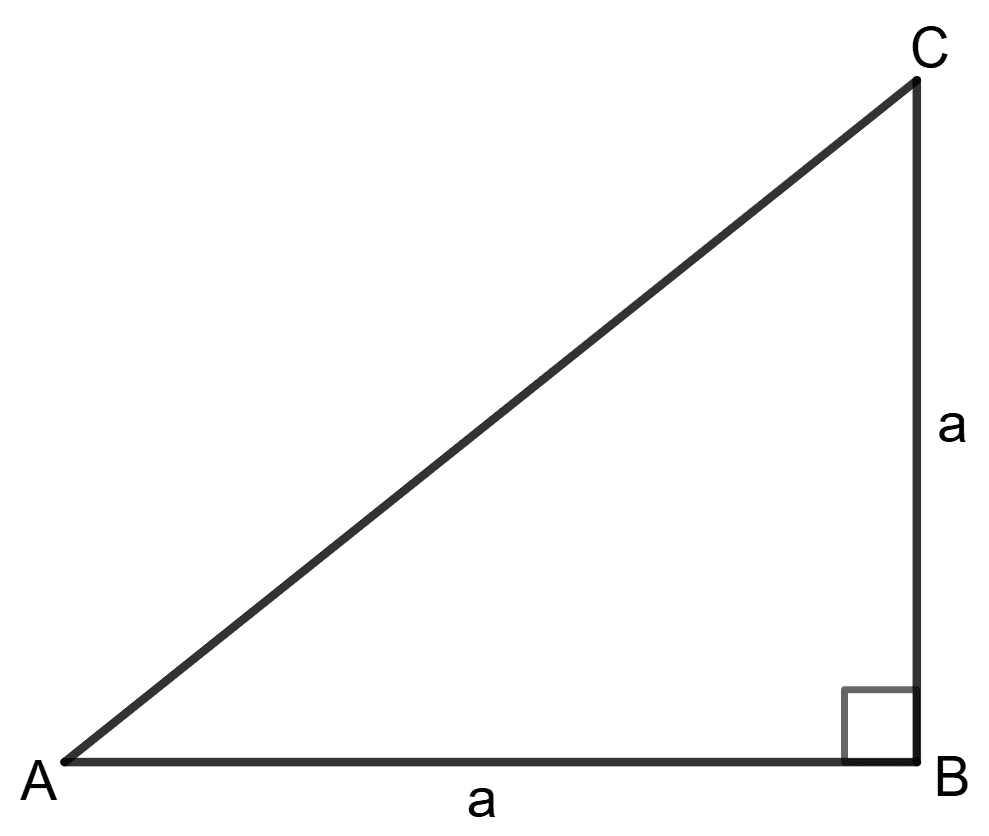
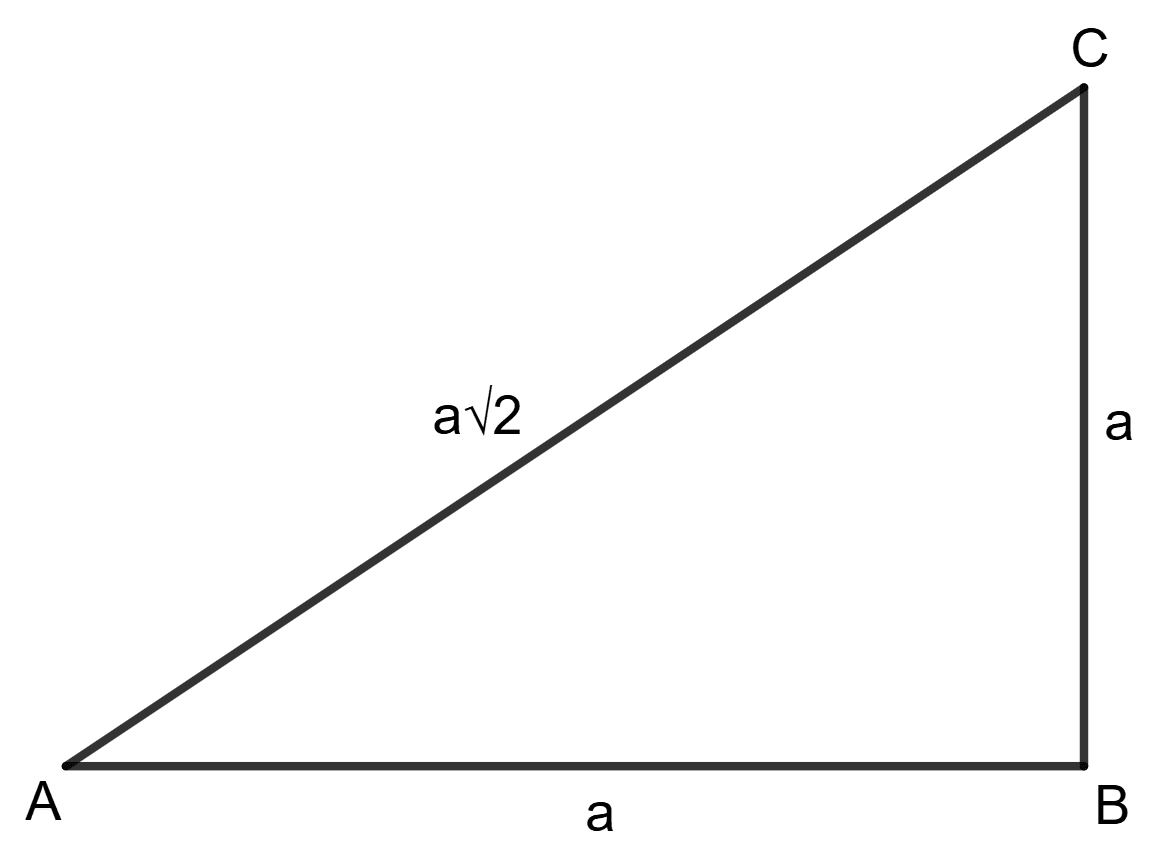
From the following figure, find the values of :
(i) sin A
(ii) sec A
(iii) cos2 A + sin2 A
Answer
In Δ ABC,
⇒ AC2 = AB2 + BC2 (∵ AC is hypotenuse)
⇒ AC2 = a2 + a2
⇒ AC2 = 2a2
⇒ AC = 2 a 2 \sqrt{2a^2} 2 a 2
⇒ AC = a 2 a \sqrt{2} a 2
(i) sin A = P e r p e n d i c u l a r H y p o t e n u s e A = \dfrac{Perpendicular}{Hypotenuse} A = Hy p o t e n u se P er p e n d i c u l a r
= C B A C = a a 2 = a × 2 a 2 × 2 = a 2 a × 2 = a 2 a × 2 = 2 2 = \dfrac{CB}{AC}\\[1em] = \dfrac{a}{a \sqrt{2}}\\[1em] = \dfrac{a \times \sqrt{2}}{a \sqrt{2} \times \sqrt{2}}\\[1em] = \dfrac{a \sqrt{2}}{a \times 2}\\[1em] = \dfrac{\cancel{a} \sqrt{2}}{\cancel{a} \times 2}\\[1em] = \dfrac{\sqrt{2}}{2}\\[1em] = A C CB = a 2 a = a 2 × 2 a × 2 = a × 2 a 2 = a × 2 a 2 = 2 2
Hence, sin A = 1 2 = 2 2 A = \dfrac{1}{\sqrt{2}} = \dfrac{\sqrt{2}}{2} A = 2 1 = 2 2 .
(ii) sec A = H y p o t e n u s e B a s e A = \dfrac{Hypotenuse}{Base} A = B a se Hy p o t e n u se
= A C A B = a 2 a = a 2 a = 2 = \dfrac{AC}{AB}\\[1em] = \dfrac{a \sqrt{2}}{a}\\[1em] = \dfrac{\cancel{a} \sqrt{2}}{\cancel{a}}\\[1em] = \sqrt{2} = A B A C = a a 2 = a a 2 = 2
Hence, sec A = 2 A = \sqrt{2} A = 2 .
(iii) cos2 A + sin2 A
cos A = B a s e H y p o t e n u s e A = \dfrac{Base}{Hypotenuse} A = Hy p o t e n u se B a se
= A B A C = a a 2 = a × 2 a 2 × 2 = a 2 a × 2 = a 2 a × 2 = 2 2 = \dfrac{AB}{AC}\\[1em] = \dfrac{a}{a \sqrt{2}}\\[1em] = \dfrac{a \times \sqrt{2}}{a \sqrt{2} \times \sqrt{2}}\\[1em] = \dfrac{a \sqrt{2}}{a \times 2}\\[1em] = \dfrac{\cancel{a} \sqrt{2}}{\cancel{a} \times 2}\\[1em] = \dfrac{\sqrt{2}}{2}\\[1em] = A C A B = a 2 a = a 2 × 2 a × 2 = a × 2 a 2 = a × 2 a 2 = 2 2
sin A = P e r p e n d i c u l a r H y p o t e n u s e A = \dfrac{Perpendicular}{Hypotenuse} A = Hy p o t e n u se P er p e n d i c u l a r
= C B A C = a a 2 = a × 2 a 2 × 2 = a 2 a × 2 = a 2 a × 2 = 2 2 = \dfrac{CB}{AC}\\[1em] = \dfrac{a}{a \sqrt{2}}\\[1em] = \dfrac{a \times \sqrt{2}}{a \sqrt{2} \times \sqrt{2}}\\[1em] = \dfrac{a \sqrt{2}}{a \times 2}\\[1em] = \dfrac{\cancel{a} \sqrt{2}}{\cancel{a} \times 2}\\[1em] = \dfrac{\sqrt{2}}{2}\\[1em] = A C CB = a 2 a = a 2 × 2 a × 2 = a × 2 a 2 = a × 2 a 2 = 2 2
Now, cos2 A + sin2 A
= ( 2 2 ) 2 + ( 2 2 ) 2 = 2 4 + 2 4 = 2 + 2 4 = 4 4 = 1 = \Big(\dfrac{\sqrt{2}}{2}\Big)^2 + \Big(\dfrac{\sqrt{2}}{2}\Big)^2\\[1em] = \dfrac{2}{4} + \dfrac{2}{4}\\[1em] = \dfrac{2 + 2}{4}\\[1em] = \dfrac{4}{4}\\[1em] = 1 = ( 2 2 ) 2 + ( 2 2 ) 2 = 4 2 + 4 2 = 4 2 + 2 = 4 4 = 1
Hence, cos2 A + sin2 A = 1.
Given : cos A = 5 13 \text{cos A} = \dfrac{5}{13} cos A = 13 5
evaluate :
(i) sin A − cot A 2 tan A \dfrac{\text{sin A} - \text{cot A}}{2 \text{ tan A}} 2 tan A sin A − cot A
(ii) cot A + 1 cos A \text{cot A} + \dfrac{1}{\text{cos A}} cot A + cos A 1
Answer
Given:
cos A = 5 13 A = \dfrac{5}{13} A = 13 5
i.e. Base Hypotenuse = 5 13 \dfrac{\text{Base}}{\text{Hypotenuse}} = \dfrac{5}{13} Hypotenuse Base = 13 5
∴ If length of BA = 5x unit, length of AC = 13x unit.
In Δ ABC,
⇒ AC2 = AB2 + BC2 (∵ AC is hypotenuse)
⇒ (13x)2 = (5x)2 + BC2
⇒ 169x2 = 25x2 + BC2
⇒ BC2 = 169x2 - 25x2
⇒ BC2 = 144x2
⇒ BC = 144 x 2 \sqrt{144\text{x}^2} 144 x 2
⇒ BC = 12x
(i) sin A = P e r p e n d i c u l a r H y p o t e n u s e A = \dfrac{Perpendicular}{Hypotenuse} A = Hy p o t e n u se P er p e n d i c u l a r
= B C A C = 12 x 13 x = 12 13 = \dfrac{BC}{AC} = \dfrac{12x}{13x} = \dfrac{12}{13} = A C BC = 13 x 12 x = 13 12
cot A = B a s e P e r p e n d i c u l a r A = \dfrac{Base}{Perpendicular} A = P er p e n d i c u l a r B a se
= A B B C = 5 x 12 x = 5 12 = \dfrac{AB}{BC} = \dfrac{5x}{12x} = \dfrac{5}{12} = BC A B = 12 x 5 x = 12 5
tan A = P e r p e n d i c u l a r B a s e A = \dfrac{Perpendicular}{Base} A = B a se P er p e n d i c u l a r
= B C A B = 12 x 5 x = 12 5 = \dfrac{BC}{AB} = \dfrac{12x}{5x} = \dfrac{12}{5} = A B BC = 5 x 12 x = 5 12
Now,
= sin A − cot A 2 tan A = 12 13 − 5 12 2 × 12 5 = 12 × 12 13 × 12 − 5 × 13 12 × 13 24 5 = 144 156 − 65 156 24 5 = 144 − 65 156 24 5 = 79 156 24 5 = 79 × 5 156 × 24 = 395 3 , 744 = \dfrac{\text{sin A} - \text{cot A}}{2 \text{ tan A}}\\[1em] = \dfrac{\dfrac{12}{13} - \dfrac{5}{12}}{2 \times \dfrac{12}{5}}\\[1em] = \dfrac{\dfrac{12 \times 12}{13 \times 12} - \dfrac{5 \times 13}{12 \times 13}}{\dfrac{24}{5}}\\[1em] = \dfrac{\dfrac{144}{156} - \dfrac{65}{156}}{\dfrac{24}{5}}\\[1em] = \dfrac{\dfrac{144 - 65}{156}}{\dfrac{24}{5}}\\[1em] = \dfrac{\dfrac{79}{156}}{\dfrac{24}{5}}\\[1em] = \dfrac{79 \times 5}{156 \times 24}\\[1em] = \dfrac{395}{3,744} = 2 tan A sin A − cot A = 2 × 5 12 13 12 − 12 5 = 5 24 13 × 12 12 × 12 − 12 × 13 5 × 13 = 5 24 156 144 − 156 65 = 5 24 156 144 − 65 = 5 24 156 79 = 156 × 24 79 × 5 = 3 , 744 395
Hence, sin A − cot A 2 tan A = 395 3 , 744 \dfrac{\text{sin A} - \text{cot A}}{2 \text{ tan A}} = \dfrac{395}{3,744} 2 tan A sin A − cot A = 3 , 744 395 .
(ii) cos A = 5 13 A = \dfrac{5}{13} A = 13 5
cot A = 5 12 A = \dfrac{5}{12} A = 12 5
To find,
cot A + 1 cos A \text{cot A} + \dfrac{1}{\text{cos A}} cot A + cos A 1
cot A + 1 cos A = 5 12 + 1 5 13 = 5 12 + 13 5 = 5 × 5 12 × 5 + 13 × 12 5 × 12 = 25 60 + 156 60 = 25 + 156 60 = 181 60 \text{cot A} + \dfrac{1}{\text{cos A}} = \dfrac{5}{12} + \dfrac{1}{\dfrac{5}{13}}\\[1em] = \dfrac{5}{12} + \dfrac{13}{5}\\[1em] = \dfrac{5 \times 5}{12 \times 5} + \dfrac{13 \times 12}{5 \times 12}\\[1em] = \dfrac{25}{60} + \dfrac{156}{60}\\[1em] = \dfrac{25 + 156}{60}\\[1em] = \dfrac{181}{60} cot A + cos A 1 = 12 5 + 13 5 1 = 12 5 + 5 13 = 12 × 5 5 × 5 + 5 × 12 13 × 12 = 60 25 + 60 156 = 60 25 + 156 = 60 181
Hence, cot A + 1 cos A = 181 60 \text{cot A} + \dfrac{1}{\text{cos A}} = \dfrac{181}{60} cot A + cos A 1 = 60 181 .
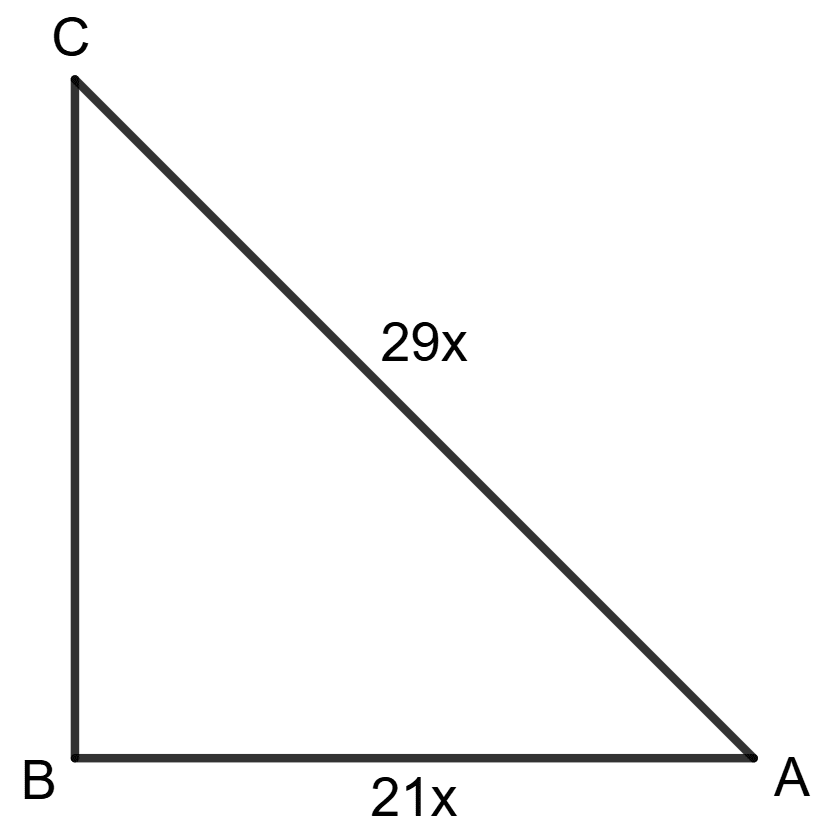
Given : sec A = 29 21 \text{sec A} =\dfrac{29}{21} sec A = 21 29 , evaluate : sin A − 1 tan A \text{sin A} - \dfrac{1}{\text{tan A}} sin A − tan A 1
Answer
Given:
sec A = 29 21 A = \dfrac{29}{21} A = 21 29
i.e. Hypotenuse Base = 29 21 \dfrac{\text{Hypotenuse}}{\text{Base}} = \dfrac{29}{21} Base Hypotenuse = 21 29
∴ If length of AB = 21x unit, length of AC = 29x unit.
In Δ ABC,
⇒ AC2 = AB2 + BC2 (∵ AC is hypotenuse)
⇒ (29x)2 = (21x)2 + BC2
⇒ 841x2 = 441x2 + BC2
⇒ BC2 = 841x2 - 441x2
⇒ BC2 = 400x2
⇒ BC = 400 x 2 \sqrt{400\text{x}^2} 400 x 2
⇒ BC = 20x
sin A = P e r p e n d i c u l a r H y p o t e n u s e A = \dfrac{Perpendicular}{Hypotenuse} A = Hy p o t e n u se P er p e n d i c u l a r
= B C A C = 20 x 29 x = 20 29 = \dfrac{BC}{AC} = \dfrac{20x}{29x} = \dfrac{20}{29} = A C BC = 29 x 20 x = 29 20
tan A = P e r p e n d i c u l a r B a s e A = \dfrac{Perpendicular}{Base} A = B a se P er p e n d i c u l a r
= B C A B = 20 x 21 x = 20 21 = \dfrac{BC}{AB} = \dfrac{20x}{21x} = \dfrac{20}{21} = A B BC = 21 x 20 x = 21 20
Now,
sin A − 1 tan A = 20 29 − 1 20 21 = 20 29 − 21 20 = 20 × 20 29 × 20 − 21 × 29 20 × 29 = 400 580 − 609 580 = 400 − 609 580 = − 209 580 \text{sin A} - \dfrac{1}{\text{tan A}}\\[1em] = \dfrac{20}{29} - \dfrac{1}{\dfrac{20}{21}}\\[1em] = \dfrac{20}{29} - \dfrac{21}{20}\\[1em] = \dfrac{20 \times 20}{29 \times 20} - \dfrac{21 \times 29}{20 \times 29}\\[1em] = \dfrac{400}{580} - \dfrac{609}{580}\\[1em] = \dfrac{400 - 609}{580}\\[1em] = \dfrac{- 209}{580}\\[1em] sin A − tan A 1 = 29 20 − 21 20 1 = 29 20 − 20 21 = 29 × 20 20 × 20 − 20 × 29 21 × 29 = 580 400 − 580 609 = 580 400 − 609 = 580 − 209
Hence, sin A − 1 tan A = − 209 580 \text{sin A} - \dfrac{1}{\text{tan A}} = \dfrac{- 209}{580} sin A − tan A 1 = 580 − 209 .
Given : tan A = 4 3 \text{tan A} = \dfrac{4}{3} tan A = 3 4 , find : cosec A cot A − sec A \dfrac{\text{cosec A}}{\text{cot A} - \text{sec A}} cot A − sec A cosec A
Answer
Given:
tan A = 4 3 A = \dfrac{4}{3} A = 3 4
i.e., Perpendicular Base = 4 3 \dfrac{\text{Perpendicular}}{\text{Base}} = \dfrac{4}{3} Base Perpendicular = 3 4
∴ If length of AB = 3x unit, length of BC = 4x unit.
In Δ ABC,
⇒ AC2 = AB2 + BC2 (∵ AC is hypotenuse)
⇒ AC2 = (3x)2 + (4x)2
⇒ AC2 = 9x2 + 16x2
⇒ AC2 = 25x2
⇒ AC = 25 x 2 \sqrt{25\text{x}^2} 25 x 2
⇒ AC = 5x
cosec A = H y p o t e n u s e P e r p e n d i c u l a r A = \dfrac{Hypotenuse}{Perpendicular} A = P er p e n d i c u l a r Hy p o t e n u se
= A C B C = 5 x 4 x = 5 4 = \dfrac{AC}{BC} = \dfrac{5x}{4x} = \dfrac{5}{4} = BC A C = 4 x 5 x = 4 5
cot A = B a s e P e r p e n d i c u l a r A = \dfrac{Base}{Perpendicular} A = P er p e n d i c u l a r B a se
= A B B C = 3 x 4 x = 3 4 = \dfrac{AB}{BC} = \dfrac{3x}{4x} = \dfrac{3}{4} = BC A B = 4 x 3 x = 4 3
sec A = H y p o t e n u s e B a s e A = \dfrac{Hypotenuse}{Base} A = B a se Hy p o t e n u se
= A C A B = 5 x 3 x = 5 3 = \dfrac{AC}{AB} = \dfrac{5x}{3x} = \dfrac{5}{3} = A B A C = 3 x 5 x = 3 5
Now,
cosec A cot A − sec A = 5 4 3 4 − 5 3 = 5 4 3 × 3 4 × 3 − 5 × 4 3 × 4 = 5 4 9 12 − 20 12 = 5 4 9 − 20 12 = 5 4 − 11 12 = 5 × 12 − 11 × 4 = − 60 44 = − 15 11 \dfrac{\text{cosec A}}{\text{cot A} - \text{sec A}}\\[1em] = \dfrac{\dfrac{5}{4}}{\dfrac{3}{4} - \dfrac{5}{3}}\\[1em] = \dfrac{\dfrac{5}{4}}{\dfrac{3 \times 3}{4 \times 3} - \dfrac{5 \times 4}{3 \times 4}}\\[1em] = \dfrac{\dfrac{5}{4}}{\dfrac{9}{12} - \dfrac{20}{12}}\\[1em] = \dfrac{\dfrac{5}{4}}{\dfrac{9 - 20}{12}}\\[1em] = \dfrac{\dfrac{5}{4}}{\dfrac{- 11}{12}}\\[1em] = \dfrac{5 \times 12}{- 11 \times 4}\\[1em] = \dfrac{- 60}{44}\\[1em] = \dfrac{- 15}{11} cot A − sec A cosec A = 4 3 − 3 5 4 5 = 4 × 3 3 × 3 − 3 × 4 5 × 4 4 5 = 12 9 − 12 20 4 5 = 12 9 − 20 4 5 = 12 − 11 4 5 = − 11 × 4 5 × 12 = 44 − 60 = 11 − 15
Hence, cosec A cot A − sec A = − 15 11 \dfrac{\text{cosec A}}{\text{cot A} - \text{sec A}} = \dfrac{- 15}{11} cot A − sec A cosec A = 11 − 15 .
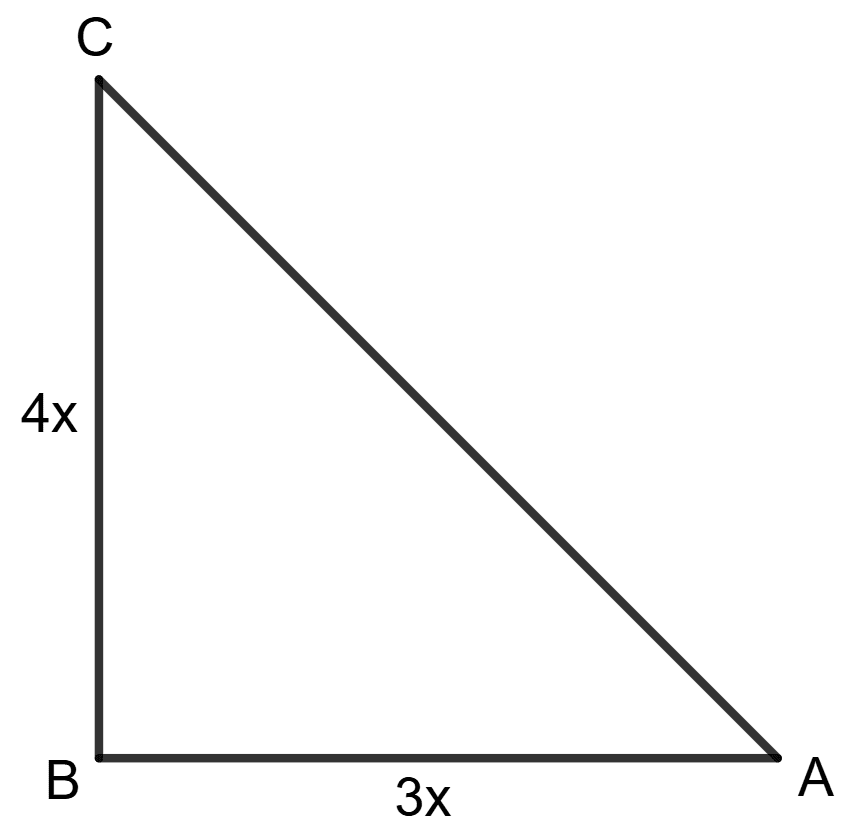
Given : 4 cot A = 3, find :
(i) sin A
(ii) sec A
(iii) cosec2 A - cot2 A
Answer
Given:
4 cot A = 3
cot A = 3 4 A = \dfrac{3}{4} A = 4 3
i.e., Base Perpendicular = 3 4 \dfrac{\text{Base}}{\text{Perpendicular}} = \dfrac{3}{4} Perpendicular Base = 4 3
∴ If length of AB = 3x unit, length of BC = 4x unit.
In Δ ABC,
⇒ AC2 = AB2 + BC2 (∵ AC is hypotenuse)
⇒ AC2 = (3x)2 + (4x)2
⇒ AC2 = 9x2 + 16x2
⇒ AC2 = 25x2
⇒ AC = 25 x 2 \sqrt{25\text{x}^2} 25 x 2
⇒ AC = 5x
(i) sin A = P e r p e n d i c u l a r H y p o t e n u s e A = \dfrac{Perpendicular}{Hypotenuse} A = Hy p o t e n u se P er p e n d i c u l a r
= B C A C = 4 x 5 x = 4 5 = \dfrac{BC}{AC} = \dfrac{4x}{5x} = \dfrac{4}{5} = A C BC = 5 x 4 x = 5 4
Hence, sin A = 4 5 A = \dfrac{4}{5} A = 5 4 .
(ii) sec A = H y p o t e n u s e B a s e A = \dfrac{Hypotenuse}{Base} A = B a se Hy p o t e n u se
= A C A B = 5 x 3 x = 5 3 = 1 2 3 = \dfrac{AC}{AB} = \dfrac{5x}{3x} = \dfrac{5}{3} = 1\dfrac{2}{3} = A B A C = 3 x 5 x = 3 5 = 1 3 2
Hence, sec A = 5 3 = 1 2 3 A = \dfrac{5}{3} = 1\dfrac{2}{3} A = 3 5 = 1 3 2 .
(iii) cosec2 A - cot2 A
cosec A = H y p o t e n u s e P e r p e n d i c u l a r A = \dfrac{Hypotenuse}{Perpendicular} A = P er p e n d i c u l a r Hy p o t e n u se
= A C B C = 5 x 4 x = 5 4 = \dfrac{AC}{BC} = \dfrac{5x}{4x} = \dfrac{5}{4} = BC A C = 4 x 5 x = 4 5
cot A = B a s e P e r p e n d i c u l a r A = \dfrac{Base}{Perpendicular} A = P er p e n d i c u l a r B a se
= A B B C = 3 x 4 x = 3 4 = \dfrac{AB}{BC} = \dfrac{3x}{4x} = \dfrac{3}{4} = BC A B = 4 x 3 x = 4 3
Now,
cosec 2 A − cot 2 A = ( 5 4 ) 2 − ( 3 4 ) 2 = 25 16 − 9 16 = 25 − 9 16 = 16 16 = 1 \text{cosec}^2 A - \text{cot}^2 A\\[1em] = \Big(\dfrac{5}{4}\Big)^2 - \Big(\dfrac{3}{4}\Big)^2\\[1em] = \dfrac{25}{16} - \dfrac{9}{16}\\[1em] = \dfrac{25 - 9}{16}\\[1em] = \dfrac{16}{16}\\[1em] = 1 cosec 2 A − cot 2 A = ( 4 5 ) 2 − ( 4 3 ) 2 = 16 25 − 16 9 = 16 25 − 9 = 16 16 = 1
Hence, cosec2 A - cot2 A = 1.
Given : cos A = 0.6; find all other trigonometrical ratios for angle A.
Answer
Given:
cos A = 0.6
cos A = 6 10 A = \dfrac{6}{10} A = 10 6
cos A = 3 5 A = \dfrac{3}{5} A = 5 3
i.e. Base Hypotenuse = 3 5 \dfrac{\text{Base}}{\text{Hypotenuse}} = \dfrac{3}{5} Hypotenuse Base = 5 3
∴ If length of AB = 3x unit, length of AC = 5x unit.
In Δ ABC,
⇒ AC2 = AB2 + BC2 (∵ AC is hypotenuse)
⇒ (5x)2 = (3x)2 + BC2
⇒ 25x2 = 9x2 + BC2
⇒ BC2 = 25x2 - 9x2
⇒ BC2 = 16x2
⇒ BC = 16 x 2 \sqrt{16\text{x}^2} 16 x 2
⇒ BC = 4x
sin A = P e r p e n d i c u l a r H y p o t e n u s e A = \dfrac{Perpendicular}{Hypotenuse} A = Hy p o t e n u se P er p e n d i c u l a r
= B C A C = 4 x 5 x = 4 5 = \dfrac{BC}{AC} = \dfrac{4x}{5x} = \dfrac{4}{5} = A C BC = 5 x 4 x = 5 4
tan A = P e r p e n d i c u l a r B a s e A = \dfrac{Perpendicular}{Base} A = B a se P er p e n d i c u l a r
= B C A B = 4 x 3 x = 4 3 = 1 1 3 = \dfrac{BC}{AB} = \dfrac{4x}{3x} = \dfrac{4}{3} = 1\dfrac{1}{3} = A B BC = 3 x 4 x = 3 4 = 1 3 1
cot A = B a s e P e r p e n d i c u l a r A = \dfrac{Base}{Perpendicular} A = P er p e n d i c u l a r B a se
= A B B C = 3 x 4 x = 3 4 = \dfrac{AB}{BC} = \dfrac{3x}{4x} = \dfrac{3}{4} = BC A B = 4 x 3 x = 4 3
cosec A = H y p o t e n u s e P e r p e n d i c u l a r A = \dfrac{Hypotenuse}{Perpendicular} A = P er p e n d i c u l a r Hy p o t e n u se
= A C B C = 5 x 4 x = 5 4 = 1 1 4 = \dfrac{AC}{BC} = \dfrac{5x}{4x} = \dfrac{5}{4} = 1\dfrac{1}{4} = BC A C = 4 x 5 x = 4 5 = 1 4 1
sec A = H y p o t e n u s e B a s e A = \dfrac{Hypotenuse}{Base} A = B a se Hy p o t e n u se
= A C A B = 5 x 3 x = 5 3 = 1 2 3 = \dfrac{AC}{AB} = \dfrac{5x}{3x} = \dfrac{5}{3} = 1\dfrac{2}{3} = A B A C = 3 x 5 x = 3 5 = 1 3 2
Hence, sin A = 4 5 A = \dfrac{4}{5} A = 5 4 , tan A = 1 1 3 A = 1\dfrac{1}{3} A = 1 3 1 , cot A = 3 4 A = \dfrac{3}{4} A = 4 3 , cosec A = 1 1 4 A = 1\dfrac{1}{4} A = 1 4 1 and sec A = 1 2 3 A = 1\dfrac{2}{3} A = 1 3 2 .
In a right-angled triangle, it is given that A is an acute angle and tan A = 5 12 \text{tan A} = \dfrac{5}{12} tan A = 12 5 .
Find the values of :
(i) cos A
(ii) sin A
(iii) cos A + sin A cos A − sin A \dfrac{\text{cos A} + \text{sin A}}{\text{cos A} - \text{sin A}} cos A − sin A cos A + sin A
Answer
Given:
tan A = 5 12 A = \dfrac{5}{12} A = 12 5
i.e., Perpendicular Base = 5 12 \dfrac{\text{Perpendicular}}{\text{Base}} = \dfrac{5}{12} Base Perpendicular = 12 5
∴ If length of BC = 5x unit, length of AB = 12x unit.
In Δ ABC,
⇒ AC2 = BC2 + AB2 (∵ AC is hypotenuse)
⇒ AC2 = (5x)2 + (12x)2
⇒ AC2 = 25x2 + 144x2
⇒ AC2 = 169x2
⇒ AC = 169 x 2 \sqrt{169\text{x}^2} 169 x 2
⇒ AC = 13x
(i) cos A = B a s e H y p o t e n u s e A = \dfrac{Base}{Hypotenuse} A = Hy p o t e n u se B a se
= A B A C = 12 x 13 x = 12 13 = \dfrac{AB}{AC} = \dfrac{12x}{13x} = \dfrac{12}{13} = A C A B = 13 x 12 x = 13 12
Hence, cos A = 12 13 A = \dfrac{12}{13} A = 13 12 .
(ii) sin A = P e r p e n d i c u l a r H y p o t e n u s e A = \dfrac{Perpendicular}{Hypotenuse} A = Hy p o t e n u se P er p e n d i c u l a r
= B C A C = 5 x 13 x = 5 13 = \dfrac{BC}{AC} = \dfrac{5x}{13x} = \dfrac{5}{13} = A C BC = 13 x 5 x = 13 5
Hence, sin A = 5 13 A = \dfrac{5}{13} A = 13 5 .
(iii) cos A + sin A cos A − sin A \dfrac{\text{cos A} + \text{sin A}}{\text{cos A} - \text{sin A}} cos A − sin A cos A + sin A
= 12 13 + 5 13 12 13 − 5 13 = 12 + 5 13 12 − 5 13 = 17 13 7 13 = 17 7 = 2 3 7 = \dfrac{\dfrac{12}{13} + \dfrac{5}{13}}{\dfrac{12}{13} - \dfrac{5}{13}}\\[1em] = \dfrac{\dfrac{12 + 5}{13}}{\dfrac{12 - 5}{13}}\\[1em] = \dfrac{\dfrac{17}{\cancel{13}}}{\dfrac{7}{\cancel{13}}}\\[1em] = \dfrac{17}{7}\\[1em] = 2\dfrac{3}{7} = 13 12 − 13 5 13 12 + 13 5 = 13 12 − 5 13 12 + 5 = 13 7 13 17 = 7 17 = 2 7 3
Hence, cos A + sin A cos A − sin A = 2 3 7 \dfrac{\text{cos A} + \text{sin A}}{\text{cos A} - \text{sin A}} = 2\dfrac{3}{7} cos A − sin A cos A + sin A = 2 7 3 .
Given : sin θ = p q \text{sin θ} = \dfrac{p}{q} sin θ = q p , find cos θ + sin θ in terms of p and q.
Answer
Given:
sin θ = p q \dfrac{p}{q} q p
i.e. Perpendicular Hypotenuse = p q \dfrac{\text{Perpendicular}}{\text{Hypotenuse}} = \dfrac{p}{q} Hypotenuse Perpendicular = q p
∴ If length of BC = px unit, length of AC = qx unit.
In Δ ABC,
⇒ AC2 = BC2 + AB2 (∵ AC is hypotenuse)
⇒ (qx)2 = (px)2 + AB2
⇒ AB2 = q2 x2 - p2 x2
⇒ AB = q 2 x 2 − p 2 x 2 \sqrt{q^2\text{x}^2 - p^2\text{x}^2} q 2 x 2 − p 2 x 2
⇒ AB = (q 2 − p 2 \sqrt{q^2 - p^2} q 2 − p 2 ) x
cos θ = B a s e H y p o t e n u s e \dfrac{Base}{Hypotenuse} Hy p o t e n u se B a se
= A B A C = ( q 2 − p 2 ) x q x = q 2 − p 2 q = \dfrac{AB}{AC} = \dfrac{\sqrt{(q^2 - p^2)}x}{qx} = \dfrac{\sqrt{q^2 - p^2}}{q} = A C A B = q x ( q 2 − p 2 ) x = q q 2 − p 2
Now,
cos θ + sin θ = q 2 − p 2 q + p q = q 2 − p 2 + p q \text{cos θ} + \text{sin θ} = \dfrac{\sqrt{q^2 - p^2}}{q} + \dfrac{p}{q}\\[1em] = \dfrac{\sqrt{q^2 - p^2} + p}{q} cos θ + sin θ = q q 2 − p 2 + q p = q q 2 − p 2 + p
Hence, cos θ + sin θ = q 2 − p 2 + p q \dfrac{\sqrt{q^2 - p^2} + p}{q} q q 2 − p 2 + p .
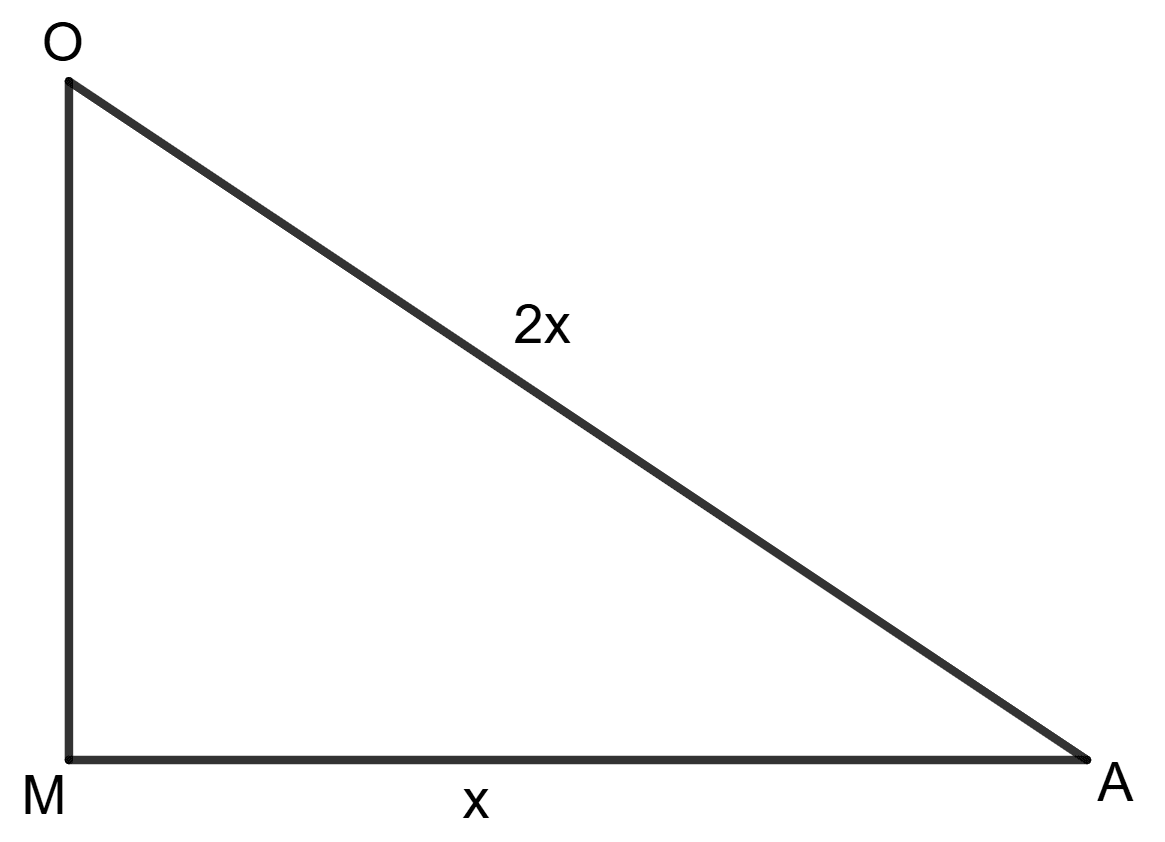
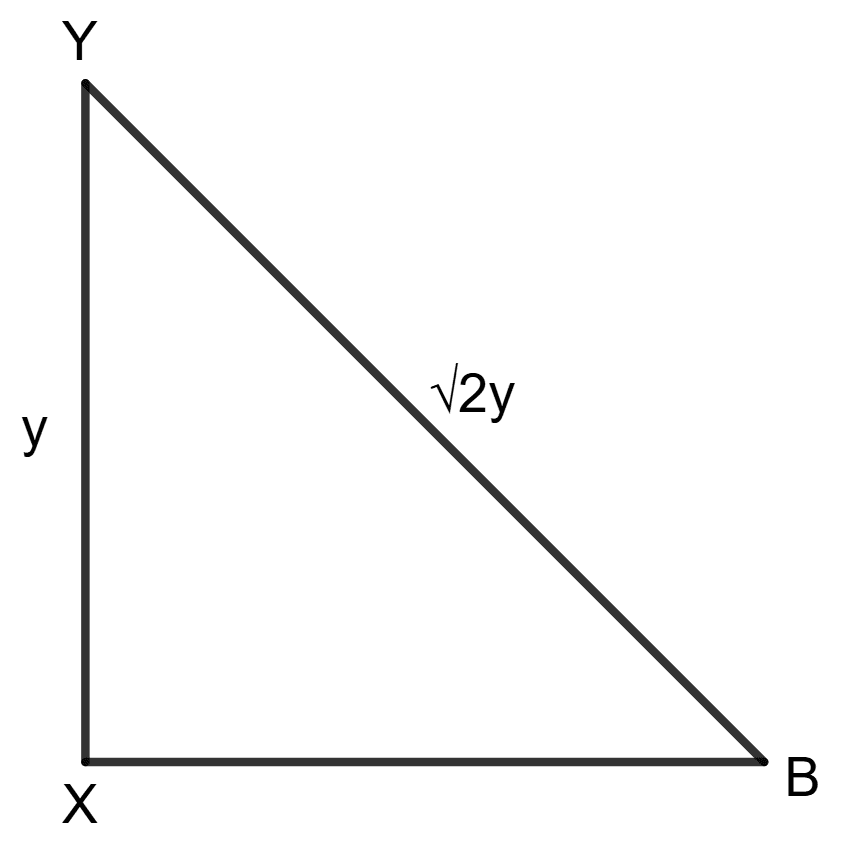
If cos A = 1 2 \text{cos A} = \dfrac{1}{2} cos A = 2 1 and sin B = 1 2 \text{sin B} = \dfrac{1}{\sqrt2} sin B = 2 1 , find the value of : tan A − tan B 1 + tan A tan B \dfrac{\text{tan A} - \text{tan B}}{1 + \text{tan A } \text{tan B}} 1 + tan A tan B tan A − tan B . Here angles A and B are from different right triangles.
Answer
Given:
cos A = 1 2 A = \dfrac{1}{2} A = 2 1
i.e., Base Hypotenuse = 1 2 \dfrac{\text{Base}}{\text{Hypotenuse}} = \dfrac{1}{2} Hypotenuse Base = 2 1
∴ If length of AM = 1x unit, length of AO = 2x unit.
In Δ AMO,
⇒ AO2 = AM2 + MO2 (∵ AC is hypotenuse)
⇒ (2x)2 = (1x)2 + MO2
⇒ 4x2 = 1x2 + MO2
⇒ MO2 = 4x2 - 1x2
⇒ MO2 = 3x2
⇒ MO = 3 x 2 \sqrt{3\text{x}^2} 3 x 2
⇒ MO = 3 \sqrt{3} 3 x
tan A = P e r p e n d i c u l a r B a s e A = \dfrac{Perpendicular}{Base} A = B a se P er p e n d i c u l a r
= O M M A = 3 x 1 x = 3 1 = 3 = \dfrac{OM}{MA} = \dfrac{\sqrt{3} x}{1x} = \dfrac{\sqrt{3}}{1} = \sqrt{3} = M A OM = 1 x 3 x = 1 3 = 3
And,
sin B = 1 2 B = \dfrac{1}{\sqrt{2}} B = 2 1
i.e., Perpendicular Hypotenuse = 1 2 \dfrac{\text{Perpendicular}}{\text{Hypotenuse}} = \dfrac{1}{\sqrt{2}} Hypotenuse Perpendicular = 2 1
∴ If length of XY = y unit, length of YB = y 2 \sqrt{2} 2 unit.
In Δ BXY,
⇒ YB2 = YX2 + BX2 (∵ AC is hypotenuse)
⇒ (2 \sqrt{2} 2 y)2 = (y)2 + BX2
⇒ 2y2 = y2 + BX2
⇒ BX2 = 2y2 - y2
⇒ BX2 = y2
⇒ BX = y 2 \sqrt{\text{y}^2} y 2
⇒ BX = y
tan B = P e r p e n d i c u l a r B a s e B = \dfrac{Perpendicular}{Base} B = B a se P er p e n d i c u l a r
= Y X X B = y y = 1 = \dfrac{YX}{XB} = \dfrac{y}{y}= 1 = XB Y X = y y = 1
Now,
tan A − tan B 1 + tan A tan B = 3 − 1 1 + 3 = ( 3 − 1 ) × ( 1 − 3 ) ( 1 + 3 ) × ( 1 − 3 ) = ( 3 − 3 − 1 + 3 ) 1 2 − 3 2 = 2 3 − 4 1 − 3 = 2 ( 3 − 2 ) − 2 = 2 ( 3 − 2 ) − 2 = − 3 + 2 = 2 − 3 \dfrac{\text{tan A} - \text{tan B}}{1 + \text{tan A } \text{tan B}}\\[1em] = \dfrac{{\sqrt{3} - 1}}{1 + {\sqrt{3}}}\\[1em] = \dfrac{(\sqrt{3} - 1) \times (1 - \sqrt{3})}{(1 + \sqrt{3}) \times (1 - \sqrt{3})}\\[1em] = \dfrac{(\sqrt{3} - 3 - 1 + \sqrt{3})}{1^2 - \sqrt{3}^2}\\[1em] = \dfrac{2 \sqrt{3} - 4}{1 - 3}\\[1em] = \dfrac{2 (\sqrt{3} - 2)}{-2}\\[1em] = \dfrac{\cancel{2} (\sqrt{3} - 2)}{-\cancel{2}}\\[1em] = -\sqrt{3} + 2\\[1em] = 2 - \sqrt{3} 1 + tan A tan B tan A − tan B = 1 + 3 3 − 1 = ( 1 + 3 ) × ( 1 − 3 ) ( 3 − 1 ) × ( 1 − 3 ) = 1 2 − 3 2 ( 3 − 3 − 1 + 3 ) = 1 − 3 2 3 − 4 = − 2 2 ( 3 − 2 ) = − 2 2 ( 3 − 2 ) = − 3 + 2 = 2 − 3
Hence, tan A − tan B 1 + tan A tan B = 2 − 3 \dfrac{\text{tan A} - \text{tan B}}{1 + \text{tan A } \text{tan B}} = 2 - \sqrt{3} 1 + tan A tan B tan A − tan B = 2 − 3 .
If cos A = 1 2 \text{cos A} = \dfrac{1}{\sqrt2} cos A = 2 1 and sin B = 3 2 \text{sin B} = \dfrac{\sqrt3}{2} sin B = 2 3 , the value of tan B − tan A 1 + tan A tan B \dfrac{\text{tan B} - \text{tan A}}{1 + \text{tan A tan B}} 1 + tan A tan B tan B − tan A is :
2 − 3 2 - {\sqrt3} 2 − 3 2 + 3 2 + {\sqrt3} 2 + 3 3 − 2 {\sqrt3} - 2 3 − 2 3 + 2 {\sqrt3} + 2 3 + 2 Answer
Given:
cos A = 1 2 A = \dfrac{1}{\sqrt2} A = 2 1
i.e., Base Hypotenuse = 1 2 \dfrac{\text{Base}}{\text{Hypotenuse}} = \dfrac{1}{\sqrt2} Hypotenuse Base = 2 1
∴ If length of AM = x unit, length of AO = x 2 \sqrt{2} 2 unit.
In Δ AMO,
⇒ AO2 = AM2 + MO2 (∵ AC is hypotenuse)
⇒ (2 \sqrt{2} 2 x)2 = (x)2 + MO2
⇒ 2x2 = x2 + MO2
⇒ MO2 = 2x2 - x2
⇒ MO2 = x2
⇒ MO = x 2 \sqrt{\text{x}^2} x 2
⇒ MO = x
tan A = P e r p e n d i c u l a r B a s e A = \dfrac{Perpendicular}{Base} A = B a se P er p e n d i c u l a r
= O M M A = x x = 1 = \dfrac{OM}{MA} = \dfrac{x}{x} = 1 = M A OM = x x = 1
And,
sin B = 3 2 B = \dfrac{\sqrt3}{2} B = 2 3
i.e. Perpendicular Hypotenuse = 3 2 \dfrac{\text{Perpendicular}}{\text{Hypotenuse}} = \dfrac{\sqrt3}{2} Hypotenuse Perpendicular = 2 3
∴ If length of XY = 3 \sqrt{3} 3 y unit, length of YB = 2y unit.
In Δ BXY,
⇒ YB2 = YX2 + BX2 (∵ AC is hypotenuse)
⇒ (2y)2 = (3 \sqrt{3} 3 y)2 + BX2
⇒ 4y2 = 3y2 + BX2
⇒ BX2 = 4y2 - 3y2
⇒ BX2 = y2
⇒ BX = y 2 \sqrt{\text{y}^2} y 2
⇒ BX = y
tan B = P e r p e n d i c u l a r B a s e B = \dfrac{Perpendicular}{Base} B = B a se P er p e n d i c u l a r
= X Y B X = 3 y y = 3 1 = \dfrac{XY}{BX} = \dfrac{\sqrt{3}y}{y} = \dfrac{\sqrt{3}}{1} = BX X Y = y 3 y = 1 3
Now,
tan B − tan A 1 + tan A tan B = 3 1 − 1 1 + 3 1 × 1 = 3 − 1 1 + 3 = ( 3 − 1 ) × ( 1 − 3 ) ( 1 + 3 ) × ( 1 − 3 ) = ( 3 − 3 − 1 + 3 ) 1 2 − 3 2 = 2 3 − 4 1 − 3 = 2 ( 3 − 2 ) − 2 = 2 ( 3 − 2 ) − 2 = − 3 + 2 = 2 − 3 \dfrac{\text{tan B} - \text{tan A}}{1 + \text{tan A } \text{tan B}}\\[1em] = \dfrac{\dfrac{\sqrt{3}}{1} - 1}{1 + \dfrac{\sqrt{3}}{1} \times 1}\\[1em] = \dfrac{\sqrt{3} - 1}{1 + \sqrt{3}}\\[1em] = \dfrac{(\sqrt{3} - 1) \times (1 - \sqrt{3})}{(1 + \sqrt{3}) \times (1 - \sqrt{3})}\\[1em] = \dfrac{(\sqrt{3} - 3 - 1 + \sqrt{3})}{1^2 - \sqrt{3}^2}\\[1em] = \dfrac{2 \sqrt{3} - 4}{1 - 3}\\[1em] = \dfrac{2 (\sqrt{3} - 2)}{-2}\\[1em] = \dfrac{\cancel{2} (\sqrt{3} - 2)}{-\cancel{2}}\\[1em] = -\sqrt{3} + 2\\[1em] = 2 - \sqrt{3} 1 + tan A tan B tan B − tan A = 1 + 1 3 × 1 1 3 − 1 = 1 + 3 3 − 1 = ( 1 + 3 ) × ( 1 − 3 ) ( 3 − 1 ) × ( 1 − 3 ) = 1 2 − 3 2 ( 3 − 3 − 1 + 3 ) = 1 − 3 2 3 − 4 = − 2 2 ( 3 − 2 ) = − 2 2 ( 3 − 2 ) = − 3 + 2 = 2 − 3
Hence, option 1 is the correct option.
From the given figure, the value of cos y is :
1 3 \dfrac{1}{3} 3 1 1 4 \dfrac{1}{4} 4 1 12 13 \dfrac{12}{13} 13 12 1 1 12 1\dfrac{1}{12} 1 12 1 Answer
In Δ ABC,
⇒ AC2 = AB2 + BC2 (∵ AC is hypotenuse)
⇒ AC2 = 42 + 32
⇒ AC2 = 16 + 9
⇒ AC2 = 25
⇒ AC = 25 \sqrt{25} 25
⇒ AC = 5
In Δ ADC,
⇒ DC2 = AC2 + DA2 (∵ DC is hypotenuse)
⇒ DC2 = 52 + 122
⇒ DC2 = 25 + 144
⇒ DC2 = 169
⇒ DC = 169 \sqrt{169} 169
⇒ DC = 13
cos y = B a s e H y p o t e n u s e \dfrac{Base}{Hypotenuse} Hy p o t e n u se B a se
= D A D C = 12 13 = \dfrac{DA}{DC}\\[1em] = \dfrac{12}{13} = D C D A = 13 12
Hence, option 3 is the correct option.
ABCD is a rhombus with diagonals BD and AC equal to 12 cm and 16 cm respectively. The value of cosec x is :
1 2 3 1\dfrac{2}{3} 1 3 2 3 1 3 3\dfrac{1}{3} 3 3 1 1 2 \dfrac{1}{2} 2 1 1 1 3 1\dfrac{1}{3} 1 3 1 Answer
The diagonals of a rhombus bisect each other at right angles.
∴ ∠AOB = 90°
In Δ AOB,
⇒ AB2 = BO2 + OA2 (∵ AB is hypotenuse)
⇒ AB2 = 62 + 82
⇒ AB2 = 36 + 64
⇒ AB2 = 100
⇒ AB = 100 \sqrt{100} 100
⇒ AB = 10 cm
cosec x = H y p o t e n u s e P e r p e n d i c u l a r x = \dfrac{Hypotenuse}{Perpendicular} x = P er p e n d i c u l a r Hy p o t e n u se
= A B O B = 10 6 = 5 3 = 1 2 3 = \dfrac{AB}{OB}\\[1em] = \dfrac{10}{6}\\[1em] = \dfrac{5}{3}\\[1em] = 1\dfrac{2}{3} = OB A B = 6 10 = 3 5 = 1 3 2
Hence, option 1 is the correct option.
If sin A - cosec A = 2, the value of sin2 A + cosec2 A is :
2 0 4 6 Answer
Given:
sin A - cosec A = 2
Squaring both sides,
⇒ (sin A - cosec A)2 = (2)2
⇒ (sin A)2 + (cosec A)2 - 2 x sin A x cosec A = 4
⇒ sin2 A + cosec2 A - 2 x sin A \text{sin A} sin A x 1 sin A \dfrac{1}{\text{sin A}} sin A 1 = 4
⇒ sin2 A + cosec2 A - 2 x sin A \cancel{\text{sin A}} sin A x 1 sin A \dfrac{1}{\cancel{\text{sin A}}} sin A 1 = 4
⇒ sin2 A + cosec2 A - 2 = 4
⇒ sin2 A + cosec2 A = 4 + 2
⇒ sin2 A + cosec2 A = 6
Hence, option 4 is the correct option.
If cot A = 5 \text{cot A} = {\sqrt5} cot A = 5 , the value of cosec2 A - sec2 A is :
5 24 \dfrac{5}{24} 24 5 4 4 5 4\dfrac{4}{5} 4 5 4 5 24 Answer
Given:
cot A = 5 cot A = Base Perpendicular = 5 1 \text{cot A} = {\sqrt5}\\[1em] \text{cot A} = \dfrac{\text{Base}}{\text{Perpendicular}} = \dfrac{\sqrt5}{1}\\[1em] cot A = 5 cot A = Perpendicular Base = 1 5
∴ If length of AB = 5 \sqrt{5} 5 x unit, length of BC = x unit.
In Δ ABC,
⇒ AC2 = AB2 + BC2 (∵ AC is hypotenuse)
⇒ AC2 = ( 5 (\sqrt{5} ( 5 x)2 + (x)2
⇒ AC2 = 5x2 + x2
⇒ AC2 = 6x2
⇒ AC = 6 x 2 \sqrt{6\text{x}^2} 6 x 2
⇒ AC = 6 \sqrt{6} 6 x
cosec A = H y p o t e n u s e P e r p e n d i c u l a r A = \dfrac{Hypotenuse}{Perpendicular} A = P er p e n d i c u l a r Hy p o t e n u se
= A C B C = 6 x x = 6 1 = \dfrac{AC}{BC} = \dfrac{\sqrt{6}\text{x}}{\text{x}} = \dfrac{\sqrt{6}}{1} = BC A C = x 6 x = 1 6
sec A = H y p o t e n u s e B a s e A = \dfrac{Hypotenuse}{Base} A = B a se Hy p o t e n u se
= A C A B = 6 x 5 x = 6 5 = \dfrac{AC}{AB} = \dfrac{\sqrt{6}\text{x}}{\sqrt{5}\text{x}} = \dfrac{\sqrt{6}}{\sqrt{5}} = A B A C = 5 x 6 x = 5 6
Now, cosec2 A - sec2 A
= ( 6 1 ) 2 − ( 6 5 ) 2 = 6 1 − 6 5 = 6 × 5 1 × 5 − 6 × 1 5 × 1 = 30 5 − 6 5 = 30 − 6 5 = 24 5 = 4 4 5 = \Big(\dfrac{\sqrt{6}}{1}\Big)^2 - \Big(\dfrac{\sqrt{6}}{\sqrt{5}}\Big)^2\\[1em] = \dfrac{6}{1} - \dfrac{6}{5}\\[1em] = \dfrac{6 \times 5}{1 \times 5} - \dfrac{6 \times 1}{5 \times 1}\\[1em] = \dfrac{30}{5} - \dfrac{6}{5}\\[1em] = \dfrac{30 - 6}{5}\\[1em] = \dfrac{24}{5}\\[1em] = 4\dfrac{4}{5} = ( 1 6 ) 2 − ( 5 6 ) 2 = 1 6 − 5 6 = 1 × 5 6 × 5 − 5 × 1 6 × 1 = 5 30 − 5 6 = 5 30 − 6 = 5 24 = 4 5 4
Hence, option 2 is the correct option.
From the following figure, find :
(i) y
(ii) sin x°
(iii) (sec x° - tan x°)(sec x° + tan x°)
Answer
(i) In Δ ABC,
⇒ AC2 = AB2 + BC2 (∵ AC is hypotenuse)
⇒ 22 = y2 + 12
⇒ 4 = y2 + 1
⇒ y2 = 4 - 1
⇒ y2 = 3
⇒ y = 3 \sqrt{3} 3
Hence, the value of y = 3 \sqrt{3} 3 .
(ii) sin x ° = P e r p e n d i c u l a r H y p o t e n u s e x° = \dfrac{Perpendicular}{Hypotenuse} x ° = Hy p o t e n u se P er p e n d i c u l a r
= A B A C = 3 2 = \dfrac{AB}{AC}\\[1em] = \dfrac{\sqrt{3}}{2} = A C A B = 2 3
Hence, sin x ° = 3 2 x° = \dfrac{\sqrt{3}}{2} x ° = 2 3 .
(iii) (sec x° - tan x°)(sec x° + tan x°)
sec x ° = H y p o t e n u s e B a s e x° = \dfrac{Hypotenuse}{Base} x ° = B a se Hy p o t e n u se
= A C C B = 2 1 = 2 = \dfrac{AC}{CB}\\[1em] = \dfrac{2}{1} = 2 = CB A C = 1 2 = 2
tan x ° = P e r p e n d i c u l a r B a s e x° = \dfrac{Perpendicular}{Base} x ° = B a se P er p e n d i c u l a r
= A B C B = 3 1 = 3 = \dfrac{AB}{CB}\\[1em] = \dfrac{\sqrt{3}}{1} = 3 = CB A B = 1 3 = 3
Now, (sec x° - tan x°)(sec x° + tan x°)
= ( 2 − 3 ) ( 2 + 3 ) = ( 2 ) 2 − ( 3 ) 2 = 4 − 3 = 1 = (2 - \sqrt{3})(2 + \sqrt{3}) \\[1em] = (2)^2 - (\sqrt{3})^2 \\[1em] = 4 - 3 \\[1em] = 1 = ( 2 − 3 ) ( 2 + 3 ) = ( 2 ) 2 − ( 3 ) 2 = 4 − 3 = 1
Hence, (sec x° - tan x°)(sec x° + tan x°) = 1.
Use the given figure to find :
(i) sin x°
(ii) cos y°
(iii) 3 tan x° - 2 sin y° + 4 cos y°
Answer
In Δ BCD,
⇒ BD2 = BC2 + CD2 (∵ BD is hypotenuse)
⇒ BD2 = 62 + 82
⇒ BD2 = 36 + 64
⇒ BD2 = 100
⇒ BD = 100 \sqrt{100} 100
⇒ BD = 10
In Δ ACD,
⇒ AD2 = AC2 + CD2 (∵ AD is hypotenuse)
⇒ 172 = AC2 + 82
⇒ 289 = AC2 + 64
⇒ AC2 = 289 - 64
⇒ AC2 = 225
⇒ AC = 225 \sqrt{225} 225
⇒ AC = 15
(i) sin x ° = P e r p e n d i c u l a r H y p o t e n u s e x° = \dfrac{Perpendicular}{Hypotenuse} x ° = Hy p o t e n u se P er p e n d i c u l a r
= D C A D = 8 17 = \dfrac{DC}{AD}\\[1em] = \dfrac{8}{17} = A D D C = 17 8
Hence, sin x ° = 8 17 x° = \dfrac{8}{17} x ° = 17 8 .
(ii) cos y ° = B a s e H y p o t e n u s e y° = \dfrac{Base}{Hypotenuse} y ° = Hy p o t e n u se B a se
= B C B D = 6 10 = 3 5 = \dfrac{BC}{BD}\\[1em] = \dfrac{6}{10}\\[1em] = \dfrac{3}{5} = B D BC = 10 6 = 5 3
Hence, cos y ° = 3 5 y° = \dfrac{3}{5} y ° = 5 3 .
(iii) 3 tan x° - 2 sin y° + 4 cos y°
tan x ° = P e r p e n d i c u l a r B a s e x° = \dfrac{Perpendicular}{Base} x ° = B a se P er p e n d i c u l a r
= D C A C = 8 15 = \dfrac{DC}{AC}\\[1em] = \dfrac{8}{15} = A C D C = 15 8
sin y ° = P e r p e n d i c u l a r H y p o t e n u s e y° = \dfrac{Perpendicular}{Hypotenuse} y ° = Hy p o t e n u se P er p e n d i c u l a r
= C D B D = 8 10 = 4 5 = \dfrac{CD}{BD}\\[1em] = \dfrac{8}{10}\\[1em] = \dfrac{4}{5} = B D C D = 10 8 = 5 4
cos y ° = B a s e H y p o t e n u s e y° = \dfrac{Base}{Hypotenuse} y ° = Hy p o t e n u se B a se
= B C B D = 6 10 = 3 5 = \dfrac{BC}{BD}\\[1em] = \dfrac{6}{10}\\[1em] = \dfrac{3}{5} = B D BC = 10 6 = 5 3
Now, 3 tan x° - 2 sin y° + 4 cos y°
= 3 × 8 15 − 2 × 4 5 + 4 × 3 5 = 24 15 − 8 5 + 12 5 = 24 15 + − 8 + 12 5 = 24 15 + 4 5 = 24 15 + 4 × 3 5 × 3 = 24 15 + 12 15 = 24 + 12 15 = 36 15 = 12 5 = 2 2 5 = 3 \times \dfrac{8}{15} - 2 \times \dfrac{4}{5} + 4 \times \dfrac{3}{5}\\[1em] = \dfrac{24}{15} - \dfrac{8}{5} + \dfrac{12}{5}\\[1em] = \dfrac{24}{15} + \dfrac{- 8 + 12}{5}\\[1em] = \dfrac{24}{15} + \dfrac{4}{5}\\[1em] = \dfrac{24}{15} + \dfrac{4 \times 3}{5 \times 3}\\[1em] = \dfrac{24}{15} + \dfrac{12}{15}\\[1em] = \dfrac{24 + 12}{15}\\[1em] = \dfrac{36}{15}\\[1em] = \dfrac{12}{5}\\[1em] = 2\dfrac{2}{5} = 3 × 15 8 − 2 × 5 4 + 4 × 5 3 = 15 24 − 5 8 + 5 12 = 15 24 + 5 − 8 + 12 = 15 24 + 5 4 = 15 24 + 5 × 3 4 × 3 = 15 24 + 15 12 = 15 24 + 12 = 15 36 = 5 12 = 2 5 2
Hence, 3 tan x° - 2 sin y° + 4 cos y° = 2 2 5 2\dfrac{2}{5} 2 5 2 .
In the diagram, given below, triangle ABC is right-angled at B and BD is perpendicular to AC. Find :
(i) cos ∠DBC
(ii) cot ∠DBA
Answer
In Δ ABC,
⇒ AC2 = AB2 + BC2 (∵ AC is hypotenuse)
⇒ AC2 = 122 + 52
⇒ AC2 = 144 + 25
⇒ AC2 = 169
⇒ AC = 169 \sqrt{169} 169
⇒ AC = 13
Let ∠CBD be x°.
So, ∠DBA = 90° - x°.
In Δ DAB, according to angle sum property
⇒ ∠ DAB + ∠ADB + ∠DBA = 180°
⇒ ∠ DAB + 90° + (90° - x°) = 180°
⇒ ∠ DAB + 180° - x° = 180°
⇒ ∠ DAB - x° = 0
⇒ ∠ DAB = x°
From figure,
∠ DAB = ∠ CAB = x°
∴ ∠ CBD = ∠ CAB = x°
(i) cos ∠DBC = cos ∠CAB = B a s e H y p o t e n u s e \dfrac{Base}{Hypotenuse} Hy p o t e n u se B a se
= A B A C = 12 13 = \dfrac{AB}{AC}\\[1em] = \dfrac{12}{13} = A C A B = 13 12
Hence, cos ∠DBC = 12 13 \dfrac{12}{13} 13 12 .
(ii) In Δ BCD, according to angle sum property
⇒ ∠ DBC + ∠DCB + ∠CDB = 180°
⇒ ∠ DCB + x° + 90° = 180°
⇒ ∠ DCB = 180° - 90° - x°
⇒ ∠ DCB = 90° - x°
From figure,
∠ DCB = ∠ ACB = 90° - x°
∴ ∠ DBA = ∠ ACB = 90° - x°
cot ∠DBA = cot ∠ACB = B a s e P e r p e n d i c u l a r \dfrac{Base}{Perpendicular} P er p e n d i c u l a r B a se
= B C A B = 5 12 = \dfrac{BC}{AB}\\[1em] = \dfrac{5}{12} = A B BC = 12 5
Hence, cot ∠DBA = 5 12 \dfrac{5}{12} 12 5 .
In the given figure, triangle ABC is right-angled at B. D is the foot of the perpendicular from B to AC. Given that BC = 3 cm and AB = 4 cm. Find :
(i) tan ∠DBC
(ii) sin ∠DBA
Answer
In Δ ABC,
⇒ AC2 = AB2 + BC2 (∵ AC is hypotenuse)
⇒ AC2 = 42 + 32
⇒ AC2 = 16 + 9
⇒ AC2 = 25
⇒ AC = 25 \sqrt{25} 25
⇒ AC = 5
Let CD = y and BD = x
In Δ BCD,
⇒ BC2 = CD2 + BD2 (∵ BC is hypotenuse)
⇒ 32 = y2 + x2
⇒ 9 = y2 + x2 ................(1)
In Δ ABD,
⇒ AB2 = AD2 + BD2 (∵ BC is hypotenuse)
⇒ 42 = (5 - y)2 + x2
⇒ 16 = 25 + y2 - 10y + x2 ................(2)
Subtracting (1) from (2), we get
⇒ 16 - 9 = (25 + y2 - 10y + x2 ) - (y2 + x2 )
⇒ 7 = 25 + y2 - 10y + x2 - y2 - x2
⇒ 7 = 25 - 10y
⇒ 7 - 25 = -10y
⇒ -10y = -18
⇒ y = 18 10 \dfrac{18}{10} 10 18 = 1.8
AD = 5 - 1.8 = 3.2
Using equation (1),
⇒ 9 = (1.8)2 + x2
⇒ x2 = 9 - 3.24
⇒ x2 = 5.76
⇒ x = 5.76 \sqrt{5.76} 5.76
⇒ x = 2.4
(i) cos ∠DBC = P e r p e n d i c u l a r B a s e \dfrac{Perpendicular}{Base} B a se P er p e n d i c u l a r
= C D B D = 1.8 2.4 = 3 4 = \dfrac{CD}{BD}\\[1em] = \dfrac{1.8}{2.4}\\[1em] = \dfrac{3}{4} = B D C D = 2.4 1.8 = 4 3
Hence, tan ∠DBC = 3 4 \dfrac{3}{4} 4 3 .
(ii) sin ∠DBA = P e r p e n d i c u l a r H y p o t e n u s e \dfrac{Perpendicular}{Hypotenuse} Hy p o t e n u se P er p e n d i c u l a r
= A D A B = 3.2 4 = 4 5 = \dfrac{AD}{AB}\\[1em] = \dfrac{3.2}{4}\\[1em] = \dfrac{4}{5} = A B A D = 4 3.2 = 5 4
Hence, sin ∠DBA = 4 5 \dfrac{4}{5} 5 4 .
In triangle ABC, AB = AC = 15 cm and BC = 18 cm, find cos ∠ABC.
Answer
In isosceles triangle ABC, the perpendicular drawn from angle A to the side BC divides BC into 2 equal parts.
BD = DC = 18 2 \dfrac{18}{2} 2 18 = 9
cos ∠ABC = B a s e H y p o t e n u s e \dfrac{Base}{Hypotenuse} Hy p o t e n u se B a se
= B D A B = 9 15 = 3 5 = \dfrac{BD}{AB}\\[1em] = \dfrac{9}{15}\\[1em] = \dfrac{3}{5} = A B B D = 15 9 = 5 3
Hence, cos ∠ABC = 3 5 \dfrac{3}{5} 5 3 .
In the figure, given below, ABC is an isosceles triangle with BC = 8 cm and AB = AC = 5 cm. Find :
(i) sin B
(ii) tan C.
(iii) sin2 B + cos2 B
(iv) tan C - cot B
Answer
In isosceles Δ ABC, the perpendicular drawn from angle A to the side BC divides BC into 2 equal parts.
BD = DC = 8 2 \dfrac{8}{2} 2 8 = 4
In Δ ABD,
⇒ AB2 = BD2 + AD2 (∵ AB is hypotenuse)
⇒ 52 = 42 + AD2
⇒ 25 = 16 + AD2
⇒ AD2 = 25 - 16
⇒ AD2 = 9
⇒ AD = 9 \sqrt{9} 9
⇒ AD = 3
(i) sin B = P e r p e n d i c u l a r H y p o t e n u s e \dfrac{Perpendicular}{Hypotenuse} Hy p o t e n u se P er p e n d i c u l a r
A D A B = 3 5 \dfrac{AD}{AB} = \dfrac{3}{5} A B A D = 5 3
Hence, sin B = 3 5 \dfrac{3}{5} 5 3
(ii) tan C = P e r p e n d i c u l a r B a s e \dfrac{Perpendicular}{Base} B a se P er p e n d i c u l a r
A D D C = 3 4 \dfrac{AD}{DC} = \dfrac{3}{4} D C A D = 4 3
Hence, tan C = 3 4 \dfrac{3}{4} 4 3
(iii) sin2 B + cos2 B
sin B = P e r p e n d i c u l a r H y p o t e n u s e \dfrac{Perpendicular}{Hypotenuse} Hy p o t e n u se P er p e n d i c u l a r
A D A B = 3 5 \dfrac{AD}{AB} = \dfrac{3}{5} A B A D = 5 3
cos B = B a s e H y p o t e n u s e \dfrac{Base}{Hypotenuse} Hy p o t e n u se B a se
B D A B = 4 5 \dfrac{BD}{AB} = \dfrac{4}{5} A B B D = 5 4
Now, sin2 B + cos2 B
= ( 3 5 ) 2 + ( 4 5 ) 2 = 9 25 + 16 25 = 9 + 16 25 = 25 25 = 1 = \Big(\dfrac{3}{5}\Big)^2 + \Big(\dfrac{4}{5}\Big)^2\\[1em] = \dfrac{9}{25} + \dfrac{16}{25}\\[1em] = \dfrac{9 + 16}{25}\\[1em] = \dfrac{25}{25}\\[1em] = 1 = ( 5 3 ) 2 + ( 5 4 ) 2 = 25 9 + 25 16 = 25 9 + 16 = 25 25 = 1
Hence, sin2 B + cos2 B = 1.
(iv) tan C - cot B
tan C = P e r p e n d i c u l a r B a s e \dfrac{Perpendicular}{Base} B a se P er p e n d i c u l a r
= A D D C = 3 4 = \dfrac{AD}{DC} = \dfrac{3}{4} = D C A D = 4 3
cot B = B a s e P e r p e n d i c u l a r \dfrac{Base}{Perpendicular} P er p e n d i c u l a r B a se
= B D A D = 4 3 = \dfrac{BD}{AD} = \dfrac{4}{3} = A D B D = 3 4
Now, tan C - cot B
= 3 4 − 4 3 = 3 × 3 4 × 3 − 4 × 4 3 × 4 = 9 12 − 16 12 = 9 − 16 12 = − 7 12 = \dfrac{3}{4} - \dfrac{4}{3}\\[1em] = \dfrac{3 \times 3}{4 \times 3}- \dfrac{4 \times 4}{3 \times 4}\\[1em] = \dfrac{9}{12} - \dfrac{16}{12}\\[1em] = \dfrac{9 - 16}{12}\\[1em] = \dfrac{-7}{12} = 4 3 − 3 4 = 4 × 3 3 × 3 − 3 × 4 4 × 4 = 12 9 − 12 16 = 12 9 − 16 = 12 − 7
Hence, tan C - cot B = − 7 12 \dfrac{-7}{12} 12 − 7 .
In triangle ABC; ∠ABC = 90°, ∠CAB = x°, tan x° = 3 4 \text{tan x°} = \dfrac{3}{4} tan x° = 4 3 and BC = 15 cm. Find the measures of AB and AC.
Answer
Given:
tan x° = 3 4 tan x° = P e r p e n d i c u l a r B a s e = 3 4 ⇒ B C A B = 3 4 \text{tan x°} = \dfrac{3}{4}\\[1em] \text{tan x°} = \dfrac{Perpendicular}{Base} = \dfrac{3}{4} \\[1em] \Rightarrow \dfrac{BC}{AB} = \dfrac{3}{4} tan x° = 4 3 tan x° = B a se P er p e n d i c u l a r = 4 3 ⇒ A B BC = 4 3
∴ If length of AB = 4x unit, length of BC = 3x unit.
BC = 15 cm (∵ Given)
∴ 3x = 15
⇒ x = 15 3 \dfrac{15}{3} 3 15 = 5 cm
∴ AB = 4x = 4 x 5 = 20 cm
In Δ ABC,
⇒ AC2 = BC2 + AB2 (∵ AB is hypotenuse)
⇒ AC2 = (15)2 + (20)2
⇒ AC2 = 225 + 400
⇒ AC2 = 625
⇒ AC = 625 \sqrt{625} 625
⇒ AC = 25 cm
Hence, AB = 20 cm and AC = 25 cm.
Using the measurements given in the following figure :
(i) Find the value of sin Φ and tan θ.
(ii) Write an expression for AD in terms of θ.
Answer
(i) In Δ BCD,
⇒ BD2 = BC2 + CD2 (∵ BD is hypotenuse)
⇒ 132 = 122 + CD2
⇒ 169 = 144 + CD2
⇒ CD2 = 169 - 144
⇒ CD2 = 25
⇒ CD = 25 \sqrt{25} 25
⇒ CD = 5
sin Φ = P e r p e n d i c u l a r H y p o t e n u s e \dfrac{Perpendicular}{Hypotenuse} Hy p o t e n u se P er p e n d i c u l a r
= C D B D = 5 13 = \dfrac{CD}{BD} = \dfrac{5}{13} = B D C D = 13 5
Draw a line parallel to BC from point D such that it meets AB at point E. This line DE will be ⊥ to AB.
From figure,
DE = BC = 12
In Δ BED,
⇒ BD2 = BE2 + DE2 (∵ BD is hypotenuse)
⇒ 132 = BE2 + 122
⇒ 169 = BE2 + 144
⇒ BE2 = 169 - 144
⇒ BE2 = 25
⇒ BE = 25 \sqrt{25} 25
⇒ BE = 5
And, AE = AB - BE = 14 - 5 = 9
tan θ = B a s e P e r p e n d i c u l a r \dfrac{Base}{Perpendicular} P er p e n d i c u l a r B a se
= D E A E = 12 9 = 4 3 = \dfrac{DE}{AE} = \dfrac{12}{9} = \dfrac{4}{3} = A E D E = 9 12 = 3 4
Hence, sin Φ = 5 13 \dfrac{5}{13} 13 5 and tan θ = 4 3 \dfrac{4}{3} 3 4
(ii) sin θ = P e r p e n d i c u l a r H y p o t e n u s e \dfrac{Perpendicular}{Hypotenuse} Hy p o t e n u se P er p e n d i c u l a r
sin θ = D E A D = 12 A D \dfrac{DE}{AD} = \dfrac{12}{AD} A D D E = A D 12
AD = 12 sin θ \dfrac{12}{\text{sin θ}} sin θ 12 = 12 cosec θ
cos θ = B a s e H y p o t e n u s e \dfrac{Base}{Hypotenuse} Hy p o t e n u se B a se
cos θ = A E A D = 9 A D \dfrac{AE}{AD} = \dfrac{9}{AD} A D A E = A D 9
AD = 9 cos θ \dfrac{9}{\text{cos θ}} cos θ 9 = 9 sec θ
Hence, AD = 12 cosec θ or 9 sec θ.
In the given figure; BC = 15 cm and sin B = 4 5 \text{sin B} = \dfrac{4}{5} sin B = 5 4 .
(i) Calculate the measures of AB and AC.
(ii) Now, if tan ∠ADC = 1; calculate the measures of CD and AD.
Answer
(i) Given:
sin B = 4 5 sin B = P e r p e n d i c u l a r H y p o t e n u s e = 4 5 \text{sin B} = \dfrac{4}{5}\\[1em] \text{sin B} = \dfrac{Perpendicular}{Hypotenuse} = \dfrac{4}{5} sin B = 5 4 sin B = Hy p o t e n u se P er p e n d i c u l a r = 5 4
∴ If length of AC = 4x cm, length of AB = 5x cm.
In Δ ABC,
⇒ AB2 = BC2 + AC2 (∵ AB is hypotenuse)
⇒ (5x)2 = BC2 + (4x)2
⇒ 25x2 = BC2 + 16x2
⇒ BC2 = 25x2 - 16x2
⇒ BC2 = 9x2
⇒ BC = 9 x 2 \sqrt{9\text{x}^2} 9 x 2
⇒ BC = 3x
It is given that BC = 15 cm
3x = 15
x = 15 3 \dfrac{15}{3} 3 15
x = 5 cm
AB = 5x = 5 x 5 cm = 25 cm
AC = 4x = 4 x 5 cm = 20 cm
Hence, AB = 25 cm and AC = 20 cm.
(ii) tan ∠ADC = 1
tan ∠ADC = P e r p e n d i c u l a r B a s e = 1 \text{tan ∠ADC} = \dfrac{Perpendicular}{Base} = 1 tan ∠ADC = B a se P er p e n d i c u l a r = 1
∴ If length of AC = x unit, length of CD = x unit.
From (i), we know AC = 20 cm
∴ x = 20 cm
So, AC = CD = 20 cm
In Δ ACD,
⇒ AD2 = AC2 + CD2 (∵ AD is hypotenuse)
⇒ AD2 = 202 + 202
⇒ AD2 = 400 + 400
⇒ AD2 = 800
⇒ AD = 800 \sqrt{800} 800
⇒ AD = 20 2 20\sqrt{2} 20 2
Hence, CD = 20 cm and AD = 20 2 \sqrt{2} 2 cm.
If sin A + cosec A = 2; find the value of sin2 A + cosec2 A.
Answer
sin A + cosec A = 2
Squaring both sides,
(sin A + cosec A)2 = 22
⇒ sin2 A + cosec2 A + 2 x sin A x cosec A = 4
⇒ sin2 A + cosec2 A + 2 x sin A x 1 sin A \dfrac{1}{\text{sin A}} sin A 1 = 4
⇒ sin2 A + cosec2 A + 2 x sin A {\cancel{\text{sin A}}} sin A x 1 sin A \dfrac{1}{\cancel{\text{sin A}}} sin A 1 = 4
⇒ sin2 A + cosec2 A + 2 = 4
⇒ sin2 A + cosec2 A = 4 - 2
⇒ sin2 A + cosec2 A = 2
Hence, sin2 A + cosec2 A = 2.
If tan A + cot A = 5; find the value of tan2 A + cot2 A.
Answer
tan A + cot A = 5
Squaring both sides,
(tan A + cot A)2 = 52
⇒ tan2 A + cot2 A + 2 x tan A x cot A = 25
⇒ tan2 A + cot2 A + 2 x tan A x 1 tan A \dfrac{1}{\text{tan A}} tan A 1 = 25
⇒ tan2 A + cot2 A + 2 x tan A {\cancel{\text{tan A}}} tan A x 1 tan A \dfrac{1}{\cancel{\text{tan A}}} tan A 1 = 25
⇒ tan2 A + cot2 A + 2 = 25
⇒ tan2 A + cot2 A = 25 - 2
⇒ tan2 A + cot2 A = 23
Hence, tan2 A + cot2 A = 23.
Given : 4 sin θ = 3 cos θ; find the value of :
(i) sin θ
(ii) cos θ
(iii) cot2 θ - cosec2 θ
(iv) 4 cos2 θ - 3 sin2 θ + 2
Answer
Given:
4 sin θ = 3 cos θ
⇒ sin θ cos θ = 3 4 ⇒ tan θ = 3 4 ⇒ tan θ = Perpendicular Base ⇒ Perpendicular Base = 3 4 ⇒ \dfrac{\text{sin θ}}{\text{cos θ}} = \dfrac{3}{4}\\[1em] ⇒ \text{tan θ} = \dfrac{3}{4}\\[1em] ⇒ \text{tan θ} = \dfrac{\text{Perpendicular}}{\text{Base}}\\[1em] ⇒ \dfrac{\text{Perpendicular}}{\text{Base}} = \dfrac{3}{4}\\[1em] ⇒ cos θ sin θ = 4 3 ⇒ tan θ = 4 3 ⇒ tan θ = Base Perpendicular ⇒ Base Perpendicular = 4 3
∴ If length of BC = 3x unit, length of AB = 4x unit.
In Δ ABC,
⇒ AC2 = BC2 + AB2 (∵ AC is hypotenuse)
⇒ AC2 = (3x)2 + (4x)2
⇒ AC2 = 9x2 + 16x2
⇒ AC2 = 25x2
⇒ AC = 25 x 2 \sqrt{25 \text{x}^2} 25 x 2
⇒ AC = 5x
(i) sin θ = P e r p e n d i c u l a r H y p o t e n u s e \dfrac{Perpendicular}{Hypotenuse} Hy p o t e n u se P er p e n d i c u l a r
C B A C = 3 x 5 x = 3 5 \dfrac{CB}{AC} = \dfrac{3x}{5x} = \dfrac{3}{5} A C CB = 5 x 3 x = 5 3
Hence, sin θ = 3 5 \dfrac{3}{5} 5 3 .
(ii) cos θ = B a s e H y p o t e n u s e \dfrac{Base}{Hypotenuse} Hy p o t e n u se B a se
A B A C = 4 x 5 x = 4 5 \dfrac{AB}{AC} = \dfrac{4x}{5x} = \dfrac{4}{5} A C A B = 5 x 4 x = 5 4
Hence, cos θ = 4 5 \dfrac{4}{5} 5 4 .
(iii) cot2 θ - cosec2 θ + 2
cot θ = B a s e P e r p e n d i c u l a r \dfrac{Base}{Perpendicular} P er p e n d i c u l a r B a se
A B B C = 4 x 3 x = 4 3 \dfrac{AB}{BC} = \dfrac{4x}{3x} = \dfrac{4}{3} BC A B = 3 x 4 x = 3 4
cosec θ = H y p o t e n u s e P e r p e n d i c u l a r \dfrac{Hypotenuse}{Perpendicular} P er p e n d i c u l a r Hy p o t e n u se
A C C B = 5 x 3 x = 5 3 \dfrac{AC}{CB} = \dfrac{5x}{3x} = \dfrac{5}{3} CB A C = 3 x 5 x = 3 5
Now, cot2 θ - cosec2 θ
= ( 4 3 ) 2 − ( 5 3 ) 2 = 16 9 − 25 9 = 16 − 25 9 = − 9 9 = − 1 = \Big(\dfrac{4}{3}\Big)^2 - \Big(\dfrac{5}{3}\Big)^2 \\[1em] = \dfrac{16}{9} - \dfrac{25}{9} \\[1em] = \dfrac{16 - 25}{9} \\[1em] = \dfrac{- 9}{9} \\[1em] = -1 = ( 3 4 ) 2 − ( 3 5 ) 2 = 9 16 − 9 25 = 9 16 − 25 = 9 − 9 = − 1
Hence, cot2 θ - cosec2 θ + 2 = -1.
(iv) 4 cos2 θ - 3 sin2 θ + 2
cos θ = B a s e H y p o t e n u s e \dfrac{Base}{Hypotenuse} Hy p o t e n u se B a se
A B A C = 4 x 5 x = 4 5 \dfrac{AB}{AC} = \dfrac{4x}{5x} = \dfrac{4}{5} A C A B = 5 x 4 x = 5 4
sin θ = P e r p e n d i c u l a r H y p o t e n u s e \dfrac{Perpendicular}{Hypotenuse} Hy p o t e n u se P er p e n d i c u l a r
C B A C = 3 x 5 x = 3 5 \dfrac{CB}{AC} = \dfrac{3x}{5x} = \dfrac{3}{5} A C CB = 5 x 3 x = 5 3
Now, 4 cos2 θ - 3 sin2 θ + 2
= 4 × ( 4 5 ) 2 − 3 × ( 3 5 ) 2 + 2 = 4 × 16 25 − 3 × 9 25 + 2 = 64 25 − 27 25 + 2 = 64 − 27 25 + 2 = 37 25 + 2 = 37 25 + 2 × 25 25 = 37 25 + 50 25 = 37 + 50 25 = 87 25 = 3 12 25 = 4 \times \Big(\dfrac{4}{5}\Big)^2 - 3 \times \Big(\dfrac{3}{5}\Big)^2 + 2\\[1em] = 4 \times \dfrac{16}{25} - 3 \times \dfrac{9}{25} + 2\\[1em] = \dfrac{64}{25} - \dfrac{27}{25} + 2\\[1em] = \dfrac{64 - 27}{25} + 2\\[1em] = \dfrac{37}{25} + 2\\[1em] = \dfrac{37}{25} + \dfrac{2 \times 25}{25}\\[1em] = \dfrac{37}{25} + \dfrac{50}{25}\\[1em] = \dfrac{37 + 50}{25}\\[1em] = \dfrac{87}{25}\\[1em] = 3\dfrac{12}{25} = 4 × ( 5 4 ) 2 − 3 × ( 5 3 ) 2 + 2 = 4 × 25 16 − 3 × 25 9 + 2 = 25 64 − 25 27 + 2 = 25 64 − 27 + 2 = 25 37 + 2 = 25 37 + 25 2 × 25 = 25 37 + 25 50 = 25 37 + 50 = 25 87 = 3 25 12
Hence, 4 cos2 θ - 3 sin2 θ + 2 = 3 12 25 3\dfrac{12}{25} 3 25 12 .
Given : 17 cos θ = 15; find the value of tan θ + 2 sec θ.
Answer
Given:
17 cos θ = 15
cos θ = 15 17 \dfrac{15}{17} 17 15
⇒ cos θ = B a s e H y p o t e n u s e = 15 17 \Rightarrow \text{cos θ} = \dfrac{Base}{Hypotenuse} = \dfrac{15}{17}\\[1em] ⇒ cos θ = Hy p o t e n u se B a se = 17 15
∴ If length of AC = 17x unit, length of AB = 15x unit.
In Δ ABC,
⇒ AC2 = BC2 + AB2 (∵ AC is hypotenuse)
⇒ (17x)2 = BC2 + (15x)2
⇒ 289x2 = BC2 + 225x2
⇒ BC2 = 289x2 - 225x2
⇒ BC = 64 x 2 \sqrt{64 \text{x}^2} 64 x 2
⇒ BC = 8x
tan θ = P e r p e n d i c u l a r B a s e \dfrac{Perpendicular}{Base} B a se P er p e n d i c u l a r
= C B A B = 8 x 15 x = 8 15 = \dfrac{CB}{AB} = \dfrac{8x}{15x} = \dfrac{8}{15} = A B CB = 15 x 8 x = 15 8
sec θ = H y p o t e n u s e B a s e \dfrac{Hypotenuse}{Base} B a se Hy p o t e n u se
= A C A B = 17 x 15 x = 17 15 = \dfrac{AC}{AB} = \dfrac{17x}{15x} = \dfrac{17}{15} = A B A C = 15 x 17 x = 15 17
Now, tan θ + 2 sec θ
= 8 15 + 2 × 17 15 = 8 15 + 34 15 = 8 + 34 15 = 42 15 = 14 5 = 2 4 5 = \dfrac{8}{15} + 2 \times \dfrac{17}{15}\\[1em] = \dfrac{8}{15} + \dfrac{34}{15}\\[1em] = \dfrac{8 + 34}{15}\\[1em] = \dfrac{42}{15}\\[1em] = \dfrac{14}{5}\\[1em] = 2\dfrac{4}{5} = 15 8 + 2 × 15 17 = 15 8 + 15 34 = 15 8 + 34 = 15 42 = 5 14 = 2 5 4
Hence, tan θ + 2 sec θ = 2 4 5 2\dfrac{4}{5} 2 5 4 .
Given: 5 cos A - 12 sin A = 0; evaluate :
sin A + cos A 2 cos A − sin A \dfrac{\text{sin A} + \text{cos A }}{2\text{ cos A } - \text{sin A}} 2 cos A − sin A sin A + cos A
Answer
Given:
5 cos A - 12 sin A = 0
⇒ 5 cos A = 12 sin A
⇒ sin A cos A = 5 12 \dfrac{\text{sin A}}{\text{cos A}} = \dfrac{5}{12} cos A sin A = 12 5
⇒ tan A = 5 12 \text{tan A} = \dfrac{5}{12} tan A = 12 5
⇒ tan A = P e r p e n d i c u l a r B a s e = 5 12 ⇒ \text{tan A} = \dfrac{Perpendicular}{Base} = \dfrac{5}{12} \\[1em] ⇒ tan A = B a se P er p e n d i c u l a r = 12 5
∴ If length of BC = 5x unit, length of AB = 12x unit.
In Δ ABC,
⇒ AC2 = BC2 + AB2 (∵ AC is hypotenuse)
⇒ AC2 = (5x)2 + (12x)2
⇒ AC2 = 25x2 + 144x2
⇒ AC2 = 169x2
⇒ AC = 169 x 2 \sqrt{169 \text{x}^2} 169 x 2
⇒ AC = 13x
sin A = P e r p e n d i c u l a r H y p o t e n u s e \dfrac{Perpendicular}{Hypotenuse} Hy p o t e n u se P er p e n d i c u l a r
C B A C = 5 x 13 x = 5 13 \dfrac{CB}{AC} = \dfrac{5x}{13x} = \dfrac{5}{13} A C CB = 13 x 5 x = 13 5
cos A = B a s e H y p o t e n u s e \dfrac{Base}{Hypotenuse} Hy p o t e n u se B a se
A B A C = 12 x 13 x = 12 13 \dfrac{AB}{AC} = \dfrac{12x}{13x} = \dfrac{12}{13} A C A B = 13 x 12 x = 13 12
Now,
sin A + cos A 2 cos A − sin A = 5 13 + 12 13 2 × 12 13 − 5 13 = 5 + 12 13 24 13 − 5 13 = 17 13 24 − 5 13 = 17 13 19 13 = 17 13 19 13 = 17 19 \dfrac{\text{sin A} + \text{cos A }}{2\text{ cos A } - \text{sin A}}\\[1em] = \dfrac{\dfrac{5}{13} + \dfrac{12}{13}}{2 \times \dfrac{12}{13} - \dfrac{5}{13}}\\[1em] = \dfrac{\dfrac{5 + 12}{13}}{\dfrac{24}{13} - \dfrac{5}{13}}\\[1em] = \dfrac{\dfrac{17}{13}}{\dfrac{24 - 5}{13}}\\[1em] = \dfrac{\dfrac{17}{13}}{\dfrac{19}{13}}\\[1em] = \dfrac{\dfrac{17}{\cancel{13}}}{\dfrac{19}{\cancel{13}}}\\[1em] = \dfrac{17}{19} 2 cos A − sin A sin A + cos A = 2 × 13 12 − 13 5 13 5 + 13 12 = 13 24 − 13 5 13 5 + 12 = 13 24 − 5 13 17 = 13 19 13 17 = 13 19 13 17 = 19 17
Hence, sin A + cos A 2 cos A − sin A = 17 19 \dfrac{\text{sin A} + \text{cos A }}{2\text{ cos A } - \text{sin A}} = \dfrac{17}{19} 2 cos A − sin A sin A + cos A = 19 17 .
2 tan 30° 1 + tan 2 30° \dfrac{\text{2 tan 30°}}{1 + \text{tan}^2 \text{ 30°}} 1 + tan 2 30° 2 tan 30° is equal to :
sin 60°
cos 60°
sec 60°
cosec 60°
Answer
2 tan 30° 1 + tan 2 30° = 2 × 1 3 1 + ( 1 3 ) 2 = 2 3 1 + 1 3 = 2 3 3 + 1 3 = 2 × 3 4 × 3 = 6 4 3 = 3 2 3 = 3 2 = sin 60 ° \dfrac{\text{2 tan 30°}}{1 + \text{tan}^2 \text{ 30°}} = \dfrac{2 \times \dfrac{1}{\sqrt{3}}}{1 + \Big(\dfrac{1}{\sqrt{3}}\Big)^2}\\[1em] = \dfrac{\dfrac{2}{\sqrt{3}}}{1 + \dfrac{1}{3}}\\[1em] = \dfrac{\dfrac{2}{\sqrt{3}}}{\dfrac{3 + 1}{3}}\\[1em] = \dfrac{2 \times 3}{4 \times {\sqrt{3}}}\\[1em] = \dfrac{6}{4{\sqrt{3}}}\\[1em] = \dfrac{3}{2{\sqrt{3}}}\\[1em] = \dfrac{{\sqrt{3}}}{2}\\[1em] = \text{sin} 60° 1 + tan 2 30° 2 tan 30° = 1 + ( 3 1 ) 2 2 × 3 1 = 1 + 3 1 3 2 = 3 3 + 1 3 2 = 4 × 3 2 × 3 = 4 3 6 = 2 3 3 = 2 3 = sin 60°
Hence, option 1 is the correct option.
If tan 3A - 3 {\sqrt3} 3 = 0 and 0 ≤ 3A ≤ 90° ; the measure of angle A is :
15°
20°
30°
10°
Answer
tan 3A - 3 {\sqrt3} 3 = 0
tan 3A = 3 {\sqrt3} 3
tan 3A = tan 60°
So, 3A = 60°
A = 60 ° 3 \dfrac{60°}{3} 3 60°
A = 20°
Hence, option 2 is the correct option.
If cot A = tan A and 0 ≤ A ≤ 90°, the measure of angle A is :
30°
60°
45°
90°
Answer
cot A = tan A
⇒ 1 tan A \dfrac{1}{\text{tan A}} tan A 1 = tan A
⇒ tan2 A = 1
⇒ tan A = 1
⇒ tan A = tan 45°
Hence, A = 45°
Hence, option 3 is the correct option.
The value of :
cos2 60° - 2 sin3 30° + 3 cot4 45° is :
1
-2
3
2
Answer
cos 2 60 ° − 2 sin 3 30 ° + 3 cot 4 45 ° = ( 1 2 ) 2 − 2 × ( 1 2 ) 3 + 3 × ( 1 ) 2 = 1 4 − 2 × 1 8 + 3 = 1 4 − 1 4 + 3 = 3 \text{cos}^2 60° - 2 \text{sin}^3 30° + 3 \text{cot}^4 45° = \Big(\dfrac{1}{2}\Big)^2 - 2 \times \Big(\dfrac{1}{2}\Big)^3 + 3 \times (1)^2\\[1em] = \dfrac{1}{4} - 2 \times \dfrac{1}{8} + 3\\[1em] = \dfrac{1}{4} - \dfrac{1}{4} + 3\\[1em] = 3 cos 2 60° − 2 sin 3 30° + 3 cot 4 45° = ( 2 1 ) 2 − 2 × ( 2 1 ) 3 + 3 × ( 1 ) 2 = 4 1 − 2 × 8 1 + 3 = 4 1 − 4 1 + 3 = 3
Hence, option 3 is the correct option.
The value of cos 60° - cos 0° + 2 sin 90° cot 60° × cot 30° \dfrac{\text{cos 60° - cos 0°} + \text{2 sin 90°}}{\text{ cot 60°}\times \text{ cot 30°}} cot 60° × cot 30° cos 60° - cos 0° + 2 sin 90° is :
1 1 2 1\dfrac{1}{2} 1 2 1
2 3 \dfrac{2}{3} 3 2
-2
1
Answer
cos 60° - cos 0° + 2 sin 90° cot 60° × cot 30° = 1 2 − 1 + 2 × 1 1 3 × 3 = 1 2 − 1 + 2 1 = 1 2 + 1 = 1 + 2 2 = 3 2 = 1 1 2 \dfrac{\text{cos 60° - cos 0°} + \text{2 sin 90°}}{\text{ cot 60°}\times \text{ cot 30°}} = \dfrac{\dfrac{1}{2} - 1 + 2 \times 1}{\dfrac{1}{\sqrt3}\times \sqrt3}\\[1em] = \dfrac{\dfrac{1}{2} - 1 + 2}{1}\\[1em] = \dfrac{1}{2} + 1\\[1em] = \dfrac{1 + 2}{2}\\[1em] = \dfrac{3}{2}\\[1em] = 1\dfrac{1}{2} cot 60° × cot 30° cos 60° - cos 0° + 2 sin 90° = 3 1 × 3 2 1 − 1 + 2 × 1 = 1 2 1 − 1 + 2 = 2 1 + 1 = 2 1 + 2 = 2 3 = 1 2 1
Hence, option 1 is the correct option.
Find the value of:
sin 30° cos 30°
Answer
sin 30° cos 30° = 1 2 × 3 2 = 3 4 \text{sin 30° cos 30°} = \dfrac{1}{2} \times \dfrac{\sqrt3}{2}\\[1em] = \dfrac{\sqrt3}{4}\\[1em] sin 30° cos 30° = 2 1 × 2 3 = 4 3
Hence, sin 30° cos 30° = 3 4 \dfrac{\sqrt3}{4} 4 3 .
Find the value of:
tan 30° tan 60°
Answer
tan 30° tan 60° = 1 3 × 3 = 1 3 × 3 = 1 \text{tan 30° tan 60°} = \dfrac{1}{\sqrt3} \times \sqrt3\\[1em] = \dfrac{1}{\cancel{\sqrt3}} \times \cancel{\sqrt3}\\[1em] = 1 tan 30° tan 60° = 3 1 × 3 = 3 1 × 3 = 1
Hence, tan 30° tan 60° = 1.
Find the value of:
cos2 60° + sin2 30°
Answer
cos 2 60 ° + sin 2 30 ° = ( 1 2 ) 2 + ( 1 2 ) 2 = 1 4 + 1 4 = 1 + 1 4 = 2 4 = 1 2 \text{cos}^2 60° + \text{sin}^2 30° = \Big(\dfrac{1}{2}\Big)^2 + \Big(\dfrac{1}{2}\Big)^2\\[1em] = \dfrac{1}{4} + \dfrac{1}{4}\\[1em] = \dfrac{1 + 1}{4}\\[1em] = \dfrac{2}{4}\\[1em] = \dfrac{1}{2} cos 2 60° + sin 2 30° = ( 2 1 ) 2 + ( 2 1 ) 2 = 4 1 + 4 1 = 4 1 + 1 = 4 2 = 2 1
Hence, cos2 60° + sin2 30° = 1 2 \dfrac{1}{2} 2 1 .
Find the value of:
cosec2 60° - tan2 30°
Answer
cosec 2 60 ° − tan 2 30 ° = ( 2 3 ) 2 − ( 1 3 ) 2 = 4 3 − 1 3 = 4 − 1 3 = 3 3 = 1 \text{cosec}^2 60° - \text{tan}^2 30° = \Big(\dfrac{2}{\sqrt3}\Big)^2 - \Big(\dfrac{1}{\sqrt3}\Big)^2\\[1em] = \dfrac{4}{3} - \dfrac{1}{3}\\[1em] = \dfrac{4 - 1}{3}\\[1em] = \dfrac{3}{3}\\[1em] = 1 cosec 2 60° − tan 2 30° = ( 3 2 ) 2 − ( 3 1 ) 2 = 3 4 − 3 1 = 3 4 − 1 = 3 3 = 1
Hence, cosec2 60° - tan2 30° = 1.
Find the value of:
sin2 30° + cos2 30° + cot2 45°
Answer
sin 2 30 ° + cos 2 30 ° + cot 2 45 ° = ( 1 2 ) 2 + ( 3 2 ) 2 + ( 1 ) 2 = 1 4 + 3 4 + 1 = 1 + 3 4 + 1 = 4 4 + 1 = 1 + 1 = 2 \text{sin}^2 30° + \text{cos}^2 30° + \text{cot}^2 45° = \Big(\dfrac{1}{2}\Big)^2 + \Big(\dfrac{\sqrt3}{2}\Big)^2 + (1)^2\\[1em] = \dfrac{1}{4} + \dfrac{3}{4} + 1\\[1em] = \dfrac{1 + 3}{4} + 1\\[1em] = \dfrac{4}{4} + 1\\[1em] = 1 + 1\\[1em] = 2 sin 2 30° + cos 2 30° + cot 2 45° = ( 2 1 ) 2 + ( 2 3 ) 2 + ( 1 ) 2 = 4 1 + 4 3 + 1 = 4 1 + 3 + 1 = 4 4 + 1 = 1 + 1 = 2
Hence, sin2 30° + cos2 30° + cot2 45° = 2.
Find the value of:
cos2 60° + sec2 30° + tan2 45°
Answer
cos 2 60 ° + sec 2 30 ° + tan 2 45 ° = ( 1 2 ) 2 + ( 2 3 ) 2 + ( 1 ) 2 = 1 4 + 4 3 + 1 = 1 × 3 4 × 3 + 4 × 4 3 × 4 + 1 × 12 12 = 3 12 + 16 12 + 12 12 = 3 + 16 + 12 12 = 31 12 = 2 7 12 \text{cos}^2 60° + \text{sec}^2 30° + \text{tan}^2 45° = \Big(\dfrac{1}{2}\Big)^2 + \Big(\dfrac{2}{\sqrt3}\Big)^2 + (1)^2\\[1em] = \dfrac{1}{4} + \dfrac{4}{3} + 1\\[1em] = \dfrac{1 \times 3}{4 \times 3} + \dfrac{4 \times 4}{3 \times 4} + \dfrac{1 \times 12}{12}\\[1em] = \dfrac{3}{12} + \dfrac{16}{12} + \dfrac{12}{12}\\[1em] = \dfrac{3 + 16 + 12}{12}\\[1em] = \dfrac{31}{12}\\[1em] = 2\dfrac{7}{12} cos 2 60° + sec 2 30° + tan 2 45° = ( 2 1 ) 2 + ( 3 2 ) 2 + ( 1 ) 2 = 4 1 + 3 4 + 1 = 4 × 3 1 × 3 + 3 × 4 4 × 4 + 12 1 × 12 = 12 3 + 12 16 + 12 12 = 12 3 + 16 + 12 = 12 31 = 2 12 7
Hence, cos2 60° + sec2 30° + tan2 45° = 2 7 12 2\dfrac{7}{12} 2 12 7 .
Find the value of :
tan2 30° + tan2 45° + tan2 60°
Answer
tan2 30° + tan2 45° + tan2 60°
= ( 1 3 ) 2 + ( 1 ) 2 + ( 3 ) 2 = 1 3 + 1 + 3 = 1 3 + 1 × 3 3 + 3 × 3 3 = 1 3 + 3 3 + 9 3 = 1 + 3 + 9 3 = 13 3 = 4 1 3 = \Big(\dfrac{1}{\sqrt3}\Big)^2 + (1)^2 + (\sqrt3)^2\\[1em] = \dfrac{1}{3} + 1 + 3\\[1em] = \dfrac{1}{3} + \dfrac{1 \times 3}{3} + \dfrac{3 \times 3}{3}\\[1em] = \dfrac{1}{3} + \dfrac{3}{3} + \dfrac{9}{3}\\[1em] = \dfrac{1 + 3 + 9}{3}\\[1em] = \dfrac{13}{3}\\[1em] = 4\dfrac{1}{3} = ( 3 1 ) 2 + ( 1 ) 2 + ( 3 ) 2 = 3 1 + 1 + 3 = 3 1 + 3 1 × 3 + 3 3 × 3 = 3 1 + 3 3 + 3 9 = 3 1 + 3 + 9 = 3 13 = 4 3 1
Hence, tan2 30° + tan2 45° + tan2 60° = 4 1 3 4\dfrac{1}{3} 4 3 1 .
Find the value of :
tan 45° cosec 30° + sec 60° cot 45° − 5 sin 90° 2 cos 0° \dfrac{\text{tan 45°}}{\text{cosec 30°}} + \dfrac{\text{sec 60°}}{\text{cot 45°}} - \dfrac{\text{5 sin 90°}}{\text{2 cos 0°}} cosec 30° tan 45° + cot 45° sec 60° − 2 cos 0° 5 sin 90°
Answer
tan 45° cosec 30° + sec 60° cot 45° − 5 sin 90° 2 cos 0° \dfrac{\text{tan 45°}}{\text{cosec 30°}} + \dfrac{\text{sec 60°}}{\text{cot 45°}} - \dfrac{\text{5 sin 90°}}{\text{2 cos 0°}} cosec 30° tan 45° + cot 45° sec 60° − 2 cos 0° 5 sin 90°
= 1 2 + 2 1 − 5 × 1 2 × 1 = 1 2 + 2 × 2 1 × 2 − 5 2 = 1 2 + 4 2 − 5 2 = 1 + 4 − 5 2 = 0 = \dfrac{1}{2} + \dfrac{2}{1} - \dfrac{5 \times 1}{2 \times 1}\\[1em] = \dfrac{1}{2} + \dfrac{2 \times 2}{1 \times 2} - \dfrac{5}{2}\\[1em] = \dfrac{1}{2} + \dfrac{4}{2} - \dfrac{5}{2}\\[1em] = \dfrac{1 + 4 - 5}{2}\\[1em] = 0 = 2 1 + 1 2 − 2 × 1 5 × 1 = 2 1 + 1 × 2 2 × 2 − 2 5 = 2 1 + 2 4 − 2 5 = 2 1 + 4 − 5 = 0
Hence, tan 45° cosec 30° + sec 60° cot 45° − 5 sin 90° 2 cos 0° = 0 \dfrac{\text{tan 45°}}{\text{cosec 30°}} + \dfrac{\text{sec 60°}}{\text{cot 45°}} - \dfrac{\text{5 sin 90°}}{\text{2 cos 0°}} = 0 cosec 30° tan 45° + cot 45° sec 60° − 2 cos 0° 5 sin 90° = 0
Find the value of :
3 sin2 30° + 2 tan2 60° - 5 cos2 45°
Answer
3 sin2 30° + 2 tan2 60° - 5 cos2 45°
= 3 × ( 1 2 ) 2 + 2 × ( 3 ) 2 − 5 × ( 1 2 ) 2 = 3 × 1 4 + 2 × 3 − 5 × 1 2 = 3 4 + 6 − 5 2 = 3 4 + 6 × 4 4 − 5 × 2 2 × 2 = 3 4 + 24 4 − 10 4 = 3 + 24 − 10 4 = 17 4 = 4 1 4 = 3 \times \Big(\dfrac{1}{2}\Big)^2 + 2 \times (\sqrt3)^2 - 5 \times \Big(\dfrac{1}{\sqrt2}\Big)^2\\[1em] = 3 \times \dfrac{1}{4} + 2 \times 3 - 5 \times \dfrac{1}{2}\\[1em] = \dfrac{3}{4} + 6 - \dfrac{5}{2}\\[1em] = \dfrac{3}{4} + \dfrac{6 \times 4}{4} - \dfrac{5 \times 2}{2 \times 2}\\[1em] = \dfrac{3}{4} + \dfrac{24}{4} - \dfrac{10}{4}\\[1em] = \dfrac{3 + 24 - 10}{4}\\[1em] = \dfrac{17}{4}\\[1em] = 4\dfrac{1}{4} = 3 × ( 2 1 ) 2 + 2 × ( 3 ) 2 − 5 × ( 2 1 ) 2 = 3 × 4 1 + 2 × 3 − 5 × 2 1 = 4 3 + 6 − 2 5 = 4 3 + 4 6 × 4 − 2 × 2 5 × 2 = 4 3 + 4 24 − 4 10 = 4 3 + 24 − 10 = 4 17 = 4 4 1
Hence, 3 sin2 30° + 2 tan2 60° - 5 cos2 45° = 4 1 4 4\dfrac{1}{4} 4 4 1 .
Prove that :
sin 60° cos 30° + cos 60°. sin 30° = 1
Answer
sin 60° cos 30° + cos 60°. sin 30° = 1
L.H.S = sin 60° cos 30° + cos 60°. sin 30°
= 3 2 × 3 2 + 1 2 × 1 2 = 3 4 + 1 4 = 3 + 1 4 = 4 4 = 1 = \dfrac{\sqrt3}{2} \times \dfrac{\sqrt3}{2} + \dfrac{1}{2} \times \dfrac{1}{2} \\[1em] = \dfrac{3}{4} + \dfrac{1}{4}\\[1em] = \dfrac{3 + 1}{4}\\[1em] = \dfrac{4}{4}\\[1em] = 1 = 2 3 × 2 3 + 2 1 × 2 1 = 4 3 + 4 1 = 4 3 + 1 = 4 4 = 1
R.H.S = 1
∴ L.H.S = R.H.S
Hence proved, sin 60° cos 30° + cos 60°. sin 30° = 1.
Prove that :
cos 30°. cos 60° - sin 30°. sin 60° = 0
Answer
cos 30°. cos 60° - sin 30°. sin 60° = 0
L.H.S. = cos 30°. cos 60° - sin 30°. sin 60°
= 3 2 × 1 2 − 1 2 × 3 2 = 3 4 − 3 4 = 0 = \dfrac{\sqrt3}{2} \times \dfrac{1}{2} - \dfrac{1}{2} \times \dfrac{\sqrt3}{2} \\[1em] = \dfrac{\sqrt3}{4} - \dfrac{\sqrt3}{4}\\[1em] = 0 = 2 3 × 2 1 − 2 1 × 2 3 = 4 3 − 4 3 = 0
R.H.S. = 0
∴ L.H.S. = R.H.S.
Hence proved, cos 30°. cos 60° - sin 30°. sin 60° = 0.
Prove that :
cosec2 45° - cot2 45° = 1
Answer
cosec2 45° - cot2 45° = 1
L.H.S. = cosec2 45° - cot2 45°
= ( 2 ) 2 − ( 1 ) 2 = 2 − 1 = 1 = (\sqrt2)^2 - (1)^2 \\[1em] = 2 - 1\\[1em] = 1 = ( 2 ) 2 − ( 1 ) 2 = 2 − 1 = 1
R.H.S. = 1
∴ L.H.S. = R.H.S.
Hence proved, cosec2 45° - cot2 45° = 1.
Prove that :
cos2 30° - sin2 30° = cos 60°
Answer
cos2 30° - sin2 30° = cos 60°
L.H.S. = cos2 30° - sin2 30°
= ( 3 4 ) 2 − ( 1 4 ) 2 = 3 4 − 1 4 = 3 − 1 4 = 2 4 = 1 2 = \Big(\dfrac{\sqrt3}{4}\Big)^2 - \Big(\dfrac{1}{4}\Big)^2 \\[1em] = \dfrac{3}{4} - \dfrac{1}{4}\\[1em] = \dfrac{3 - 1}{4}\\[1em] = \dfrac{2}{4}\\[1em] = \dfrac{1}{2} = ( 4 3 ) 2 − ( 4 1 ) 2 = 4 3 − 4 1 = 4 3 − 1 = 4 2 = 2 1
R.H.S.. = cos 60° = 1 2 \dfrac{1}{2} 2 1
∴ L.H.S. = R.H.S.
Hence proved, cos2 30° - sin2 30° = cos 60°.
Prove that :
( tan 60° + 1 tan 60° - 1 ) 2 = 1 + cos 30° 1 - cos 30° \Big(\dfrac{\text{tan 60° + 1}}{\text{tan 60° - 1}}\Big)^2 = \dfrac{\text{1 + cos 30°}}{\text{1 - cos 30°}} ( tan 60° - 1 tan 60° + 1 ) 2 = 1 - cos 30° 1 + cos 30°
Answer
( tan 60° + 1 tan 60° - 1 ) 2 = 1 + cos 30° 1 - cos 30° \Big(\dfrac{\text{tan 60° + 1}}{\text{tan 60° - 1}}\Big)^2 = \dfrac{\text{1 + cos 30°}}{\text{1 - cos 30°}} ( tan 60° - 1 tan 60° + 1 ) 2 = 1 - cos 30° 1 + cos 30°
L.H.S. = ( tan 60° + 1 tan 60° - 1 ) 2 = ( 3 + 1 3 − 1 ) 2 = ( ( 3 + 1 ) × ( 3 + 1 ) ( 3 − 1 ) × ( 3 + 1 ) ) 2 = ( ( 3 + 1 ) 2 ( 3 ) 2 − ( 1 ) 2 ) 2 = ( 3 + 1 + 2 × 1 × 3 3 − 1 ) 2 = ( 4 + 2 3 2 ) 2 = ( 2 + 3 ) 2 = 4 + 3 + 2 × 2 × 3 = 7 + 4 3 \text{L.H.S.} = \Big(\dfrac{\text{tan 60° + 1}}{\text{tan 60° - 1}}\Big)^2\\[1em] = \Big(\dfrac{\sqrt3 + 1}{\sqrt3 - 1}\Big)^2\\[1em] = \Big(\dfrac{(\sqrt3 + 1) \times (\sqrt3 + 1)}{(\sqrt3 - 1) \times (\sqrt3 + 1)}\Big)^2\\[1em] = \Big(\dfrac{(\sqrt3 + 1)^2}{(\sqrt3)^2 - (1)^2}\Big)^2\\[1em] = \Big(\dfrac{3 + 1 + 2 \times 1 \times \sqrt3}{3 - 1}\Big)^2\\[1em] = \Big(\dfrac{4 + 2\sqrt3}{2}\Big)^2\\[1em] = (2 + \sqrt3)^2\\[1em] = 4 + 3 + 2 \times 2 \times \sqrt3\\[1em] = 7 + 4\sqrt3 L.H.S. = ( tan 60° - 1 tan 60° + 1 ) 2 = ( 3 − 1 3 + 1 ) 2 = ( ( 3 − 1 ) × ( 3 + 1 ) ( 3 + 1 ) × ( 3 + 1 ) ) 2 = ( ( 3 ) 2 − ( 1 ) 2 ( 3 + 1 ) 2 ) 2 = ( 3 − 1 3 + 1 + 2 × 1 × 3 ) 2 = ( 2 4 + 2 3 ) 2 = ( 2 + 3 ) 2 = 4 + 3 + 2 × 2 × 3 = 7 + 4 3
R.H.S. = 1 + cos 30° 1 - cos 30° = 1 + 3 2 1 − 3 2 = 2 + 3 2 2 − 3 2 = 2 + 3 2 2 − 3 2 = 2 + 3 2 − 3 = ( 2 + 3 ) × ( 2 + 3 ) ( 2 − 3 ) × ( 2 + 3 ) = ( 2 + 3 ) 2 ( 2 ) 2 − ( 3 ) 2 = 4 + 3 + 2 × 2 × 3 4 − 3 = 7 + 4 3 \text{R.H.S.} = \dfrac{\text{1 + cos 30°}}{\text{1 - cos 30°}}\\[1em] = \dfrac{1 + \dfrac{\sqrt3}{2}}{1 - \dfrac{\sqrt3}{2}}\\[1em] = \dfrac{\dfrac{2 + \sqrt3}{2}}{\dfrac{2 - \sqrt3}{2}}\\[1em] = \dfrac{\dfrac{2 + \sqrt3}{\cancel{2}}}{\dfrac{2 - \sqrt3}{\cancel{2}}}\\[1em] = \dfrac{2 + \sqrt3}{2 - \sqrt3}\\[1em] = \dfrac{(2 + \sqrt3) \times (2 + \sqrt3)}{(2 - \sqrt3) \times (2 + \sqrt3)}\\[1em] = \dfrac{(2 + \sqrt3)^2}{(2)^2 - (\sqrt3)^2}\\[1em] = \dfrac{4 + 3 + 2 \times 2 \times \sqrt3}{4 - 3}\\[1em] = 7 + 4\sqrt3\\[1em] R.H.S. = 1 - cos 30° 1 + cos 30° = 1 − 2 3 1 + 2 3 = 2 2 − 3 2 2 + 3 = 2 2 − 3 2 2 + 3 = 2 − 3 2 + 3 = ( 2 − 3 ) × ( 2 + 3 ) ( 2 + 3 ) × ( 2 + 3 ) = ( 2 ) 2 − ( 3 ) 2 ( 2 + 3 ) 2 = 4 − 3 4 + 3 + 2 × 2 × 3 = 7 + 4 3
∴ L.H.S. = R.H.S.
Hence, ( tan 60° + 1 tan 60° - 1 ) 2 = 1 + cos 30° 1 - cos 30° \Big(\dfrac{\text{tan 60° + 1}}{\text{tan 60° - 1}}\Big)^2 = \dfrac{\text{1 + cos 30°}}{\text{1 - cos 30°}} ( tan 60° - 1 tan 60° + 1 ) 2 = 1 - cos 30° 1 + cos 30°
Prove that :
3 cosec2 60° - 2 cot2 30° + sec2 45° = 0.
Answer
3 cosec2 60° - 2 cot2 30° + sec2 45° = 0.
L.H.S. = 3 cosec2 60° - 2 cot2 30° + sec2 45°
= 3 × ( 2 3 ) 2 − 2 × ( 3 ) 2 + ( 2 ) 2 = 3 × ( 4 3 ) − 2 × 3 + 2 = 4 − 6 + 2 = 0 = 3 \times \Big(\dfrac{2}{\sqrt3}\Big)^2 - 2 \times ({\sqrt3})^2 + ({\sqrt2})^2\\[1em] = 3 \times \Big(\dfrac{4}{3}\Big) - 2 \times 3 + 2\\[1em] = 4 - 6 + 2\\[1em] = 0 = 3 × ( 3 2 ) 2 − 2 × ( 3 ) 2 + ( 2 ) 2 = 3 × ( 3 4 ) − 2 × 3 + 2 = 4 − 6 + 2 = 0
R.H.S. = 0
∴ L.H.S. = R.H.S.
Hence, 3 cosec2 60° - 2 cot2 30° + sec2 45° = 0.
Prove that :
sin ( 2 × 30 ° ) = 2 tan 30° 1 + tan 2 30° \text{sin }(2 \times 30°) = \dfrac{2 \text{ tan 30°}}{1 + \text{tan}^2 \text{ 30°}} sin ( 2 × 30° ) = 1 + tan 2 30° 2 tan 30°
Answer
sin ( 2 × 30 ° ) = 2 tan 30° 1 + tan 2 30° \text{sin }(2 \times 30°) = \dfrac{2 \text{ tan 30°}}{1 + \text{tan}^2 \text{ 30°}} sin ( 2 × 30° ) = 1 + tan 2 30° 2 tan 30°
L.H.S. = sin (2 x 30°) = sin 60° = 3 2 \dfrac{\sqrt3}{2} 2 3
R.H.S.
= 2 tan 30° 1 + tan 2 30° = 2 × 1 3 1 + ( 1 3 ) 2 = 2 3 1 + 1 3 = 2 3 3 + 1 3 = 2 3 4 3 = 2 × 3 4 × 3 = 3 2 = \dfrac{2 \text{ tan 30°}}{1 + \text{tan}^2 \text{ 30°}}\\[1em] = \dfrac{2 \times \dfrac{1}{\sqrt3}}{1 + \Big(\dfrac{1}{\sqrt3}\Big)^2}\\[1em] = \dfrac{\dfrac{2}{\sqrt3}}{1 + \dfrac{1}{3}}\\[1em] = \dfrac{\dfrac{2}{\sqrt3}}{\dfrac{3 + 1}{3}}\\[1em] = \dfrac{\dfrac{2}{\sqrt3}}{\dfrac{4}{3}}\\[1em] = \dfrac{2 \times 3}{4 \times \sqrt3}\\[1em] = \dfrac{\sqrt3}{2}\\[1em] = 1 + tan 2 30° 2 tan 30° = 1 + ( 3 1 ) 2 2 × 3 1 = 1 + 3 1 3 2 = 3 3 + 1 3 2 = 3 4 3 2 = 4 × 3 2 × 3 = 2 3
∴ L.H.S. = R.H.S.
Hence, sin ( 2 × 30 ° ) = 2 tan 30° 1 + tan 2 30° \text{sin }(2 \times 30°) = \dfrac{2 \text{ tan 30°}}{1 + \text{tan}^2 \text{ 30°}} sin ( 2 × 30° ) = 1 + tan 2 30° 2 tan 30°
Prove that :
cos ( 2 × 30 ° ) = 1 − tan 2 30° 1 + tan 2 30° \text{cos }(2 \times 30°) = \dfrac{1 - \text{tan}^2 \text{ 30°}}{1 + \text{tan}^2 \text{ 30°}} cos ( 2 × 30° ) = 1 + tan 2 30° 1 − tan 2 30°
Answer
cos ( 2 × 30 ° ) = 1 − tan 2 30° 1 + tan 2 30° \text{cos }(2 \times 30°) = \dfrac{1 - \text{tan}^2 \text{ 30°}}{1 + \text{tan}^2 \text{ 30°}} cos ( 2 × 30° ) = 1 + tan 2 30° 1 − tan 2 30°
L.H.S. = cos (2 x 30°) = cos 60° = 1 2 \dfrac{1}{2} 2 1
R.H.S.
= 1 − tan 2 30° 1 + tan 2 30° = 1 − ( 1 3 ) 2 1 + ( 1 3 ) 2 = 1 − 1 3 1 + 1 3 = 3 3 − 1 3 3 3 + 1 3 = 3 − 1 3 3 + 1 3 = 2 3 4 3 = 2 3 4 3 = 2 4 = 1 2 = \dfrac{1 - \text{tan}^2 \text{ 30°}}{1 + \text{tan}^2 \text{ 30°}}\\[1em] = \dfrac{1 - \Big(\dfrac{1}{\sqrt3}\Big)^2}{1 + \Big(\dfrac{1}{\sqrt3}\Big)^2}\\[1em] = \dfrac{1 - \dfrac{1}{3}}{1 + \dfrac{1}{3}}\\[1em] = \dfrac{\dfrac{3}{3} - \dfrac{1}{3}}{\dfrac{3}{3} + \dfrac{1}{3}}\\[1em] = \dfrac{\dfrac{3 - 1}{3}}{\dfrac{3 + 1}{3}}\\[1em] = \dfrac{\dfrac{2}{3}}{\dfrac{4}{3}}\\[1em] = \dfrac{\dfrac{2}{\cancel{3}}}{\dfrac{4}{\cancel{3}}}\\[1em] = \dfrac{2}{4}\\[1em] = \dfrac{1}{2} = 1 + tan 2 30° 1 − tan 2 30° = 1 + ( 3 1 ) 2 1 − ( 3 1 ) 2 = 1 + 3 1 1 − 3 1 = 3 3 + 3 1 3 3 − 3 1 = 3 3 + 1 3 3 − 1 = 3 4 3 2 = 3 4 3 2 = 4 2 = 2 1
∴ L.H.S. = R.H.S.
Hence, cos ( 2 × 30 ° ) = 1 − tan 2 30° 1 + tan 2 30° \text{cos }(2 \times 30°) = \dfrac{1 - \text{tan}^2 \text{ 30°}}{1 + \text{tan}^2 \text{ 30°}} cos ( 2 × 30° ) = 1 + tan 2 30° 1 − tan 2 30°
Prove that :
tan ( 2 × 30 ° ) = 2 tan 30° 1 − tan 2 30° \text{tan} (2 \times 30°) = \dfrac{\text{2 tan 30°}}{1 - \text{tan}^2 \text{ 30°}} tan ( 2 × 30° ) = 1 − tan 2 30° 2 tan 30°
Answer
tan ( 2 × 30 ° ) = 2 tan 30° 1 − tan 2 30° \text{tan} (2 \times 30°) = \dfrac{\text{2 tan 30°}}{1 - \text{tan}^2 \text{ 30°}} tan ( 2 × 30° ) = 1 − tan 2 30° 2 tan 30°
L.H.S. = tan 2 x 30° = tan 60° = 3 \sqrt3 3
R.H.S.
= 2 tan 30° 1 − tan 2 30° = 2 × 1 3 1 − ( 1 3 ) 2 = 2 3 1 − 1 3 = 2 3 3 3 − 1 3 = 2 3 3 − 1 3 = 2 3 2 3 = 2 × 3 2 × 3 = 3 = \dfrac{\text{2 tan 30°}}{1 - \text{tan}^2 \text{ 30°}}\\[1em] = \dfrac{2 \times \dfrac{1}{\sqrt3}}{1 - \Big(\dfrac{1}{\sqrt3}\Big)^2}\\[1em] = \dfrac{\dfrac{2}{\sqrt3}}{1 - \dfrac{1}{3}}\\[1em] = \dfrac{\dfrac{2}{\sqrt3}}{\dfrac{3}{3} - \dfrac{1}{3}}\\[1em] = \dfrac{\dfrac{2}{\sqrt3}}{\dfrac{3 - 1}{3}}\\[1em] = \dfrac{\dfrac{2}{\sqrt3}}{\dfrac{2}{3}}\\[1em] = \dfrac{2 \times 3}{2 \times \sqrt3}\\[1em] = \sqrt3 = 1 − tan 2 30° 2 tan 30° = 1 − ( 3 1 ) 2 2 × 3 1 = 1 − 3 1 3 2 = 3 3 − 3 1 3 2 = 3 3 − 1 3 2 = 3 2 3 2 = 2 × 3 2 × 3 = 3
∴ L.H.S. = R.H.S.
Hence, tan ( 2 × 30 ° ) = 2 tan 30° 1 − tan 2 30° \text{tan} (2 \times 30°) = \dfrac{\text{2 tan 30°}}{1 - \text{tan}^2 \text{ 30°}} tan ( 2 × 30° ) = 1 − tan 2 30° 2 tan 30°
ABC is an isosceles right-angled triangle. Assuming AB = BC = x, find the value of each of the following trigonometric ratios :
(i) sin 45°
(ii) cos 45°
(iii) tan 45°
Answer
In Δ ABC,
⇒ AC2 = BC2 + AB2 (∴ AC is hypotenuse)
⇒ AC2 = x2 + x2
⇒ AC2 = 2x2
⇒ AC = 2 x 2 \sqrt{2\text{x}^2} 2 x 2
⇒ AC = 2 \sqrt{2} 2 x
As Δ ABC is isosceles right angled triangle, ∠BAC = ∠BCA = 90 ° 2 \dfrac{90°}{2} 2 90° = 45°
(i) sin 45°
sin 45° = sin A = sin C
sin A = P e r p e n d i c u l a r H y p o t e n u s e \dfrac{Perpendicular}{Hypotenuse} Hy p o t e n u se P er p e n d i c u l a r
= B C A C = x 2 x = 1 2 \dfrac{BC}{AC} = \dfrac{x}{\sqrt2x} = \dfrac{1}{\sqrt2} A C BC = 2 x x = 2 1
Hence, sin 45° = 1 2 \dfrac{1}{\sqrt2} 2 1 .
(ii) cos 45°
cos 45° = cos A = cos C
cos A = B a s e H y p o t e n u s e \dfrac{Base}{Hypotenuse} Hy p o t e n u se B a se
= A B A C = x 2 x = 1 2 \dfrac{AB}{AC} = \dfrac{x}{\sqrt2x} = \dfrac{1}{\sqrt2} A C A B = 2 x x = 2 1
Hence, cos 45° = 1 2 \dfrac{1}{\sqrt2} 2 1 .
(iii) tan 45°
tan 45° = tan A = tan C
tan A = P e r p e n d i c u l a r B a s e \dfrac{Perpendicular}{Base} B a se P er p e n d i c u l a r
= B C A B = x x \dfrac{BC}{AB} = \dfrac{x}{x} A B BC = x x = 1
Hence, tan 45° = 1 .
Prove that :
sin 60° = 2 sin 30° cos 30°.
Answer
sin 60° = 2 sin 30° cos 30°.
L.H.S. = sin 60° = 3 2 \dfrac{\sqrt3}{2} 2 3
R.H.S.= 2 sin 30° cos 30°
= 2 × 1 2 × 3 2 = 2 × 1 2 × 3 2 = 3 2 = 2 \times \dfrac{1}{2} \times \dfrac{\sqrt3}{2}\\[1em] = \cancel{2} \times \dfrac{1}{\cancel{2}} \times \dfrac{\sqrt3}{2}\\[1em] = \dfrac{\sqrt3}{2} = 2 × 2 1 × 2 3 = 2 × 2 1 × 2 3 = 2 3
∴ L.H.S. = R.H.S.
Hence proved, sin 60° = 2 sin 30° cos 30°.
Prove that :
4 (sin4 30° + cos4 60°) - 3 (cos2 45° - sin2 90°) = 2
Answer
4 (sin4 30° + cos4 60°) - 3 (cos2 45° - sin2 90°) = 2
L.H.S. = 4 (sin4 30° + cos4 60°) - 3 (cos2 45° - sin2 90°)
= 4 × ( ( 1 2 ) 4 + ( 1 2 ) 4 ) − 3 × ( ( 1 2 ) 2 − ( 1 ) 2 ) = 4 × ( 1 16 + 1 16 ) − 3 × ( 1 2 − 1 ) = 4 × ( 1 + 1 16 ) − 3 × ( 1 2 − 2 2 ) = 4 × ( 2 16 ) − 3 × ( 1 − 2 2 ) = 4 × ( 1 8 ) − 3 × ( − 1 2 ) = 1 2 + 3 2 = 1 + 3 2 = 4 2 = 2 = 4 \times \Big(\Big(\dfrac{1}{2}\Big)^4 + \Big(\dfrac{1}{2}\Big)^4\Big) - 3 \times \Big(\Big(\dfrac{1}{\sqrt2}\Big)^2 - (1)^2\Big)\\[1em] = 4 \times \Big(\dfrac{1}{16} + \dfrac{1}{16}\Big) - 3 \times \Big(\dfrac{1}{2} - 1\Big)\\[1em] = 4 \times \Big(\dfrac{1 + 1}{16}\Big) - 3 \times \Big(\dfrac{1}{2} - \dfrac{2}{2}\Big)\\[1em] = 4 \times \Big(\dfrac{2}{16}\Big) - 3 \times \Big(\dfrac{1 - 2}{2}\Big)\\[1em] = 4 \times \Big(\dfrac{1}{8}\Big) - 3 \times \Big(\dfrac{-1}{2}\Big)\\[1em] = \dfrac{1}{2} + \dfrac{3}{2}\\[1em] = \dfrac{1 + 3}{2}\\[1em] = \dfrac{ 4}{2}\\[1em] = 2 = 4 × ( ( 2 1 ) 4 + ( 2 1 ) 4 ) − 3 × ( ( 2 1 ) 2 − ( 1 ) 2 ) = 4 × ( 16 1 + 16 1 ) − 3 × ( 2 1 − 1 ) = 4 × ( 16 1 + 1 ) − 3 × ( 2 1 − 2 2 ) = 4 × ( 16 2 ) − 3 × ( 2 1 − 2 ) = 4 × ( 8 1 ) − 3 × ( 2 − 1 ) = 2 1 + 2 3 = 2 1 + 3 = 2 4 = 2
R.H.S. = 2
∴ L.H.S. = R.H.S.
Hence, 4 (sin4 30° + cos4 60°) - 3 (cos2 45° - sin2 90°) = 2.
If sin x = cos x and x is acute, state the value of x.
Answer
sin x = cos x
As we know that sin2 x + cos2 x = 1
⇒ sin2 x + sin2 x = 1
⇒ 2sin2 x = 1
⇒ sin2 x = 1 2 \dfrac{1}{2} 2 1
⇒ sin x = 1 2 \dfrac{1}{\sqrt2} 2 1
⇒ sin x = sin 45°
⇒ x = 45°
Hence, the value of x = 45°.
If sec A = cosec A and 0° ≤ A ≤ 90°, state the value of A.
Answer
sec A = cosec A
1 cos A = 1 sin A \dfrac{1}{\text{cos A}} = \dfrac{1}{\text{sin A}} cos A 1 = sin A 1
sin A = cos A
As we know that sin2 A + cos2 A = 1
⇒ sin2 A + sin2 A = 1
⇒ 2sin2 A = 1
⇒ sin2 A = 1 2 \dfrac{1}{2} 2 1
⇒ sin A = 1 2 \dfrac{1}{\sqrt2} 2 1
⇒ sin A = sin 45°
⇒ A = 45°
Hence, the value of A = 45°.
If tan θ = cot θ and 0° ≤ θ ≤ 90°, state the value of θ.
Answer
tan θ = cot θ
sin θ cos θ = cos θ sin θ \dfrac{\text{sin θ}}{\text{cos θ}} = \dfrac{\text{cos θ}}{\text{sin θ}} cos θ sin θ = sin θ cos θ
sin 2 θ = cos 2 θ \text{sin}^2 \text{θ} = \text{cos}^2 \text{θ} sin 2 θ = cos 2 θ
As we know that sin2 θ + cos2 θ = 1
⇒ sin2 θ + sin2 θ = 1
⇒ 2sin2 θ = 1
⇒ sin2 θ = 1 2 \dfrac{1}{2} 2 1
⇒ sin θ = 1 2 \dfrac{1}{\sqrt2} 2 1
⇒ sin θ = sin 45°
⇒ θ = 45°
Hence, the value of θ = 45°.
If sin x = cos y; write the relation between x and y, if both the angles x and y are acute.
Answer
sin x = cos y
cos y = sin (90° - y)
So, sin x = sin (90° - y)
⇒ x = 90° - y
⇒ x + y = 90°
Hence, the relation between x and y is x + y = 90°.
If sin x = cos y, then x + y = 45°; write true or false.
Answer
False
Reason:
sin x = cos y
It is only possible only when x = y = 45°.
sin 45° = cos 45° = 1
sec θ. cot θ = cosec θ write true or false.
Answer
True
Reason:
sec θ. cot θ = cosec θ
L.H.S. = sec θ. cot θ
= 1 cos θ × cos θ sin θ = 1 cos θ × cos θ sin θ = 1 sin θ = cosec θ = \dfrac{1}{\text{cos θ}} \times \dfrac{\text{cos θ}}{\text{sin θ}}\\[1em] = \dfrac{1}{\cancel{\text{cos θ}}} \times \dfrac{\cancel{\text{cos θ}}}{\text{sin θ}}\\[1em] = \dfrac{1}{\text{sin θ}}\\[1em] = \text{cosec θ} = cos θ 1 × sin θ cos θ = cos θ 1 × sin θ cos θ = sin θ 1 = cosec θ
R.H.S. = cosec θ
∴ L.H.S. = R.H.S.
For any angle θ, state the value of :
sin2 θ + cos2 θ.
Answer
1
Reason:
sin2 θ + cos2 θ = 1
Let take θ = 30°
sin2 30° = ( 1 2 ) 2 = 1 4 \Big(\dfrac{1}{2}\Big)^2 = \dfrac{1}{4} ( 2 1 ) 2 = 4 1
cos2 30° = ( 3 2 ) 2 = 3 4 \Big(\dfrac{\sqrt3}{2}\Big)^2 = \dfrac{3}{4} ( 2 3 ) 2 = 4 3
Now, sin2 30° + cos2 30°
= 1 4 + 3 4 = 1 + 3 4 = 4 4 = 1 = \dfrac{1}{4} + \dfrac{3}{4}\\[1em] = \dfrac{1 + 3}{4}\\[1em] = \dfrac{4}{4}\\[1em] = 1 = 4 1 + 4 3 = 4 1 + 3 = 4 4 = 1
State for any acute angle θ whether :
sin θ increases or decreases as θ increases.
Answer
sin θ increases as θ increases
Reason — As we know,
sin 0° = 0
sin 30° = 1 2 \dfrac{1}{2} 2 1 = 0.5
sin 45° = 1 2 \dfrac{1}{\sqrt2} 2 1 = 0.70
sin 60° = 3 2 \dfrac{\sqrt3}{2} 2 3 = 0.87
sin 90° = 1
State for any acute angle θ whether :
cos θ increases or decreases as θ increases.
Answer
cos θ decreases as θ increases
Reason — As we know,
cos 0° = 1
cos 30° = 3 2 \dfrac{\sqrt3}{2} 2 3 = 0.87
cos 45° = 1 2 \dfrac{1}{\sqrt2} 2 1 = 0.70
cos 60° = 1 2 \dfrac{1}{2} 2 1 = 0.5
cos 90° = 0
State for any acute angle θ whether :
tan θ increases or decreases as θ decreases.
Answer
tan θ decreases as θ decreases.
Reason — As we know,
tan 90° = not defined
tan 60° = 3 \sqrt3 3 = 1.73
tan 45° = 1
tan 30° = 1 3 \dfrac{1}{\sqrt3} 3 1 = 0.58
tan 0° = 0
If A = 30°, then sin 2 A 1 - cos 2 A \dfrac{\text{sin 2 A}}{\text{1 - cos 2 A}} 1 - cos 2 A sin 2 A is equal to :
cot A
tan A
sec A
cosec A
Answer
sin 2 A 1 - cos 2 A = sin (2 x 30°) 1 - cos (2 x 30°) = sin 60° 1 - cos 60° = 3 2 1 − 1 2 = 3 2 2 2 − 1 2 = 3 2 2 − 1 2 = 3 2 1 2 = 3 2 1 2 = 3 1 = cot A \dfrac{\text{sin 2 A}}{\text{1 - cos 2 A}}\\[1em] = \dfrac{\text{sin (2 x 30°)}}{\text{1 - cos (2 x 30°)}}\\[1em] = \dfrac{\text{sin 60°}}{\text{1 - cos 60°}}\\[1em] = \dfrac{\dfrac{\sqrt3}{2}}{1 - \dfrac{1}{2}}\\[1em] = \dfrac{\dfrac{\sqrt3}{2}}{\dfrac{2}{2} - \dfrac{1}{2}}\\[1em] = \dfrac{\dfrac{\sqrt3}{2}}{\dfrac{2 - 1}{2}}\\[1em] = \dfrac{\dfrac{\sqrt3}{2}}{\dfrac{1}{2}}\\[1em] = \dfrac{\dfrac{\sqrt3}{\cancel{2}}}{\dfrac{1}{\cancel{2}}}\\[1em] = \dfrac{\sqrt3}{1}\\[1em] = \text {cot A} 1 - cos 2 A sin 2 A = 1 - cos (2 x 30°) sin (2 x 30°) = 1 - cos 60° sin 60° = 1 − 2 1 2 3 = 2 2 − 2 1 2 3 = 2 2 − 1 2 3 = 2 1 2 3 = 2 1 2 3 = 1 3 = cot A
Hence, option 1 is the correct option.
If A = 60° and B = 30°; the value of sin A cos B + cos A sin B is equal to :
1 2 \dfrac{1}{2} 2 1
1
2
2 {\sqrt2} 2
Answer
sin A cos B + cos A sin B = sin 60°. cos 30° + cos 60°. sin 30°
= 3 2 × 3 2 + 1 2 × 1 2 = 3 4 + 1 4 = 3 + 1 4 = 4 4 = 1 = \dfrac{\sqrt3}{2} \times \dfrac{\sqrt3}{2} + \dfrac{1}{2} \times \dfrac{1}{2}\\[1em] = \dfrac{3}{4} + \dfrac{1}{4}\\[1em] = \dfrac{3 + 1}{4} \\[1em] = \dfrac{4}{4} \\[1em] = 1 = 2 3 × 2 3 + 2 1 × 2 1 = 4 3 + 4 1 = 4 3 + 1 = 4 4 = 1
Hence, option 2 is the correct option.
If A = 30° ; 3 sin A - 4 sin3 A is equal to:
cos 3A
tan 3A
sin 3A
cot 3A
Answer
3 sin A - 4 sin3 A = 3 sin 30° - 4 sin3 30°
= 3 × 1 2 − 4 × ( 1 2 ) 2 = 3 2 − 4 × 1 8 = 3 2 − 1 2 = 3 − 1 2 = 2 2 = 1 = sin 90° = sin 3 x 30° = sin 3A = 3 \times \dfrac{1}{2} - 4 \times \Big(\dfrac{1}{2}\Big)^2\\[1em] = \dfrac{3}{2} - 4 \times \dfrac{1}{8}\\[1em] = \dfrac{3}{2} - \dfrac{1}{2}\\[1em] = \dfrac{3 - 1}{2} \\[1em] = \dfrac{2}{2} \\[1em] = 1\\[1em] = \text{sin 90°}\\[1em] = \text{sin 3 x 30°}\\[1em] = \text{sin 3A}\\[1em] = 3 × 2 1 − 4 × ( 2 1 ) 2 = 2 3 − 4 × 8 1 = 2 3 − 2 1 = 2 3 − 1 = 2 2 = 1 = sin 90° = sin 3 x 30° = sin 3A
Hence, option 3 is the correct option.
If A = 30°, then cos4 A - sin4 A is equal to :
sin 60°
tan 60°
cot 60°
cos 60°
Answer
cos4 A - sin4 A = cos4 30° - sin4 30°
= ( 3 2 ) 4 − ( 1 2 ) 4 = 9 16 − 1 16 = 9 − 1 16 = 8 16 = 1 2 = cos 60° = \Big(\dfrac{\sqrt3}{2}\Big)^4 - \Big(\dfrac{1}{2}\Big)^4\\[1em] = \dfrac{9}{16} - \dfrac{1}{16}\\[1em] = \dfrac{9 - 1}{16}\\[1em] = \dfrac{8}{16}\\[1em] = \dfrac{1}{2}\\[1em] = \text {cos 60°} = ( 2 3 ) 4 − ( 2 1 ) 4 = 16 9 − 16 1 = 16 9 − 1 = 16 8 = 2 1 = cos 60°
Hence, option 4 is the correct option.
If A = 45° ; then 2 sin A cos A is equal to :
1
0
-1
2
Answer
2 sin A cos A = 2 sin 45°. cos 45°
= 2 × 1 2 × 1 2 = 2 × 1 2 = 2 × 1 2 = 1 = 2 \times \dfrac{1}{\sqrt2} \times \dfrac{1}{\sqrt2}\\[1em] = 2 \times \dfrac{1}{2}\\[1em] = \cancel{2} \times \dfrac{1}{\cancel{2}}\\[1em] = 1 = 2 × 2 1 × 2 1 = 2 × 2 1 = 2 × 2 1 = 1
Hence, option 1 is the correct option.
Given A = 60° and B = 30°, prove that :
sin (A + B) = sin A cos B + cos A sin B
Answer
sin (A + B) = sin A cos B + cos A sin B
L.H.S. = sin (A + B) = sin (60° + 30°)
= sin 90° = 1
R.H.S. = sin A cos B + cos A sin B
= sin 60° cos 30° + cos 60° sin 30°
= 3 2 × 3 2 + 1 2 × 1 2 = 3 4 + 1 4 = 3 + 1 4 = 4 4 = 1 = \dfrac{\sqrt3}{2} \times \dfrac{\sqrt3}{2} + \dfrac{1}{2} \times \dfrac{1}{2}\\[1em] = \dfrac{3}{4} + \dfrac{1}{4}\\[1em] = \dfrac{3 + 1}{4}\\[1em] = \dfrac{4}{4}\\[1em] = 1 = 2 3 × 2 3 + 2 1 × 2 1 = 4 3 + 4 1 = 4 3 + 1 = 4 4 = 1
∴ L.H.S. = R.H.S.
Hence, sin (A + B) = sin A cos B + cos A sin B.
Given A = 60° and B = 30°, prove that :
cos (A + B) = cos A cos B - sin A sin B
Answer
cos (A + B) = cos A cos B - sin A sin B
L.H.S. = cos (A + B) = cos (60° + 30°)
= cos 90° = 0
R.H.S. = cos A cos B - sin A sin B
= cos 60° cos 30° - sin 60° sin 30°
= 1 2 × 3 2 − 3 2 × 1 2 = 3 4 − 3 4 = 0 = \dfrac{1}{2} \times \dfrac{\sqrt3}{2} - \dfrac{\sqrt3}{2} \times \dfrac{1}{2}\\[1em] = \dfrac{\sqrt3}{4} - \dfrac{\sqrt3}{4}\\[1em] = 0 = 2 1 × 2 3 − 2 3 × 2 1 = 4 3 − 4 3 = 0
∴ L.H.S. = R.H.S.
Hence, cos (A + B) = cos A cos B - sin A sin B.
Given A = 60° and B = 30°, prove that :
cos (A - B) = cos A cos B + sin A sin B
Answer
cos (A - B) = cos A cos B + sin A sin B
L.H.S. = cos (A - B) = cos (60° - 30°)
= cos 30° = 3 2 \dfrac{\sqrt3}{2} 2 3
R.H.S. = cos A cos B + sin A sin B
= cos 60° cos 30° + sin 60° sin 30°
= 1 2 × 3 2 + 3 2 × 1 2 = 3 4 + 3 4 = 2 × 3 4 = 3 2 = \dfrac{1}{2} \times \dfrac{\sqrt3}{2} + \dfrac{\sqrt3}{2} \times \dfrac{1}{2}\\[1em] = \dfrac{\sqrt3}{4} + \dfrac{\sqrt3}{4}\\[1em] = 2 \times \dfrac{\sqrt3}{4}\\[1em] = \dfrac{\sqrt3}{2}\\[1em] = 2 1 × 2 3 + 2 3 × 2 1 = 4 3 + 4 3 = 2 × 4 3 = 2 3
∴ L.H.S. = R.H.S.
Hence, cos (A - B) = cos A cos B + sin A sin B.
Given A = 60° and B = 30°, prove that :
tan (A - B) = tan A - tan B 1 + tan A . tan B \text{tan (A - B)} = \dfrac{\text{tan A - tan B}}{\text{1 + \text{ tan A }} . \text{ tan B}} tan (A - B) = 1 + tan A . tan B tan A - tan B
Answer
tan (A - B) = tan A - tan B 1 + tan A . tan B \text{tan (A - B)} = \dfrac{\text{tan A - tan B}}{\text{1 + tan} \text{ A } . \text{ tan B}} tan (A - B) = 1 + tan A . tan B tan A - tan B
L.H.S. = tan (A - B) = tan (60° - 30°)
= tan 30° = 1 3 \dfrac{1}{\sqrt3} 3 1
R.H.S. = tan A - tan B 1 + tan A . tan B = tan 60° - tan 30° 1 + tan 60° . tan 30° = 3 − 1 3 1 + 3 × 1 3 = 3 × 3 3 − 1 3 1 + 3 × 1 3 = 3 3 − 1 3 1 + 1 = 3 − 1 3 1 + 1 = 2 3 2 = 2 3 2 = 1 3 \text{R.H.S.} = \dfrac{\text{tan A - tan B}}{\text{1 + tan} \text{ A } . \text{ tan B}}\\[1em] = \dfrac{\text{tan 60° - tan 30°}}{\text{1 + tan} \text{ 60° } . \text{ tan 30°}}\\[1em] = \dfrac{\sqrt3 - \dfrac{1}{\sqrt3}}{1 + \sqrt3 \times \dfrac{1}{\sqrt3}}\\[1em] = \dfrac{\dfrac{\sqrt3 \times \sqrt3}{\sqrt3} - \dfrac{1}{\sqrt3}}{1 + \cancel{\sqrt3} \times \dfrac{1}{\cancel{\sqrt3}}}\\[1em] = \dfrac{\dfrac{3}{\sqrt3} - \dfrac{1}{\sqrt3}}{1 + 1}\\[1em] = \dfrac{\dfrac{3 - 1}{\sqrt3}}{1 + 1}\\[1em] = \dfrac{\dfrac{2}{\sqrt3}}{2}\\[1em] = \dfrac{\dfrac{\cancel{2}}{\sqrt3}}{\cancel{2}}\\[1em] = \dfrac{1}{\sqrt3} R.H.S. = 1 + tan A . tan B tan A - tan B = 1 + tan 60° . tan 30° tan 60° - tan 30° = 1 + 3 × 3 1 3 − 3 1 = 1 + 3 × 3 1 3 3 × 3 − 3 1 = 1 + 1 3 3 − 3 1 = 1 + 1 3 3 − 1 = 2 3 2 = 2 3 2 = 3 1
∴ L.H.S. = R.H.S.
Hence, tan (A - B) = tan A - tan B 1 + tan A . tan B \text{tan (A - B)} = \dfrac{\text{tan A - tan B}}{\text{1 + tan} \text{ A } . \text{ tan B}} tan (A - B) = 1 + tan A . tan B tan A - tan B .
If A = 30°, then prove that :
sin 2 A = 2 sin A cos A = 2 tan A 1 + tan 2 A \text{sin 2 A} = \text{2 sin A cos A} = \dfrac{\text{2 tan A}}{1 + \text{tan}^2 \text{ A}} sin 2 A = 2 sin A cos A = 1 + tan 2 A 2 tan A
Answer
sin 2 A = 2 sin A cos A = 2 tan A 1 + tan 2 A \text{sin 2 A} = \text{2 sin A cos A} = \dfrac{\text{2 tan A}}{1 + \text{tan}^2 \text{ A}} sin 2 A = 2 sin A cos A = 1 + tan 2 A 2 tan A
1st term = sin 2 A = sin (2 x 30°) = sin 60° = 3 2 \text{1st term} = \text{sin 2 A} = \text{sin (2 x 30°)} = \text{sin 60°} = \dfrac{\sqrt3}{2} 1st term = sin 2 A = sin (2 x 30°) = sin 60° = 2 3
2nd term = 2 sin A cos A = 2 × sin 30° × cos 30° = 2 × 1 2 × 3 2 = 2 × 1 2 × 3 2 = 3 2 \text{2nd term} = \text{2 sin A cos A}\\[1em] = 2 \times \text{sin 30°} \times \text{cos 30°}\\[1em] = 2 \times \dfrac{1}{2} \times \dfrac{\sqrt3}{2}\\[1em] = \cancel{2} \times \dfrac{1}{\cancel{2}} \times \dfrac{\sqrt3}{2}\\[1em] = \dfrac{\sqrt3}{2} 2nd term = 2 sin A cos A = 2 × sin 30° × cos 30° = 2 × 2 1 × 2 3 = 2 × 2 1 × 2 3 = 2 3
3rd term = 2 tan A 1 + tan 2 A = 2 tan 30° 1 + tan 2 30° = 2 × 1 3 1 + ( 1 3 ) 2 = 2 3 1 + 1 3 = 2 3 3 3 + 1 3 = 2 3 3 + 1 3 = 2 3 4 3 = 2 × 3 4 × 3 = 3 2 \text{3rd term} = \dfrac{\text{2 tan A}}{1 + \text{tan}^2 \text{ A}}\\[1em] = \dfrac{\text{2 tan 30°}}{1 + \text{tan}^2 \text{ 30°}}\\[1em] = \dfrac{2 \times \dfrac{1}{\sqrt3}}{1 + \Big(\dfrac{1}{\sqrt3}\Big)^2}\\[1em] = \dfrac{\dfrac{2}{\sqrt3}}{1 + \dfrac{1}{3}}\\[1em] = \dfrac{\dfrac{2}{\sqrt3}}{\dfrac{3}{3} + \dfrac{1}{3}}\\[1em] = \dfrac{\dfrac{2}{\sqrt3}}{\dfrac{3 + 1}{3}}\\[1em] = \dfrac{\dfrac{2}{\sqrt3}}{\dfrac{4}{3}}\\[1em] = \dfrac{2 \times 3}{4 \times \sqrt3}\\[1em] = \dfrac{\sqrt3}{2} 3rd term = 1 + tan 2 A 2 tan A = 1 + tan 2 30° 2 tan 30° = 1 + ( 3 1 ) 2 2 × 3 1 = 1 + 3 1 3 2 = 3 3 + 3 1 3 2 = 3 3 + 1 3 2 = 3 4 3 2 = 4 × 3 2 × 3 = 2 3
∴ 1st term = 2nd term = 3rd term
Hence, sin 2 A = 2 sin A cos A = 2 tan A 1 + tan 2 A \text{sin 2 A} = \text{2 sin A cos A} = \dfrac{\text{2 tan A}}{1 + \text{tan}^2 \text{ A}} sin 2 A = 2 sin A cos A = 1 + tan 2 A 2 tan A .
If A = 30°, then prove that :
cos 2 A = cos 2 A − sin 2 A = 1 − tan 2 A 1 + tan 2 A \text{cos 2 A} = \text{cos}^2 \text{ A} - \text{sin}^2 \text{ A} = \dfrac{1 - \text{tan}^2 \text{ A}}{1 + \text{tan}^2 \text{ A}} cos 2 A = cos 2 A − sin 2 A = 1 + tan 2 A 1 − tan 2 A
Answer
cos 2 A = cos 2 A − sin 2 A = 1 − tan 2 A 1 + tan 2 A \text{cos 2 A} = \text{cos}^2 \text{ A} - \text{sin}^2 \text{ A} = \dfrac{1 - \text{tan}^2 \text{ A}}{1 + \text{tan}^2 \text{ A}} cos 2 A = cos 2 A − sin 2 A = 1 + tan 2 A 1 − tan 2 A
1st term = cos 2 A = cos (2 x 30°) = cos 60° = 1 2 \text{1st term} = \text{cos 2 A} = \text{cos (2 x 30°)} = \text{cos 60°} = \dfrac{1}{2} 1st term = cos 2 A = cos (2 x 30°) = cos 60° = 2 1
2nd term = cos 2 A − sin 2 A = cos 2 30° − sin 2 30° = ( 3 2 ) 2 − ( 1 2 ) 2 = 3 4 − 1 4 = 3 − 1 4 = 2 4 = 1 2 \text{2nd term} = \text{cos}^2 \text{ A} - \text{sin}^2 \text{ A}\\[1em] = \text{cos}^2 \text{ 30°} - \text{sin}^2 \text{ 30°}\\[1em] = \Big(\dfrac{\sqrt3}{2}\Big)^2 - \Big(\dfrac{1}{2}\Big)^2\\[1em] = \dfrac{3}{4} - \dfrac{1}{4}\\[1em] = \dfrac{3 - 1}{4}\\[1em] = \dfrac{2}{4}\\[1em] = \dfrac{1}{2} 2nd term = cos 2 A − sin 2 A = cos 2 30° − sin 2 30° = ( 2 3 ) 2 − ( 2 1 ) 2 = 4 3 − 4 1 = 4 3 − 1 = 4 2 = 2 1
3rd term = 1 − tan 2 A 1 + tan 2 A = 1 − tan 2 30° 1 + tan 2 30° = 1 − ( 1 3 ) 2 1 + ( 1 3 ) 2 = 3 3 − 1 3 3 3 + 1 3 = 3 − 1 3 3 + 1 3 = 2 3 4 3 = 2 3 4 3 = 2 4 = 1 2 \text{3rd term} = \dfrac{1 - \text{tan}^2 \text{ A}}{1 + \text{tan}^2 \text{ A}}\\[1em] = \dfrac{1 - \text{tan}^2 \text{ 30°}}{1 + \text{tan}^2 \text{ 30°}}\\[1em] = \dfrac{1 - \Big(\dfrac{1}{\sqrt3}\Big)^2}{1 + \Big(\dfrac{1}{\sqrt3}\Big)^2}\\[1em] = \dfrac{\dfrac{3}{3} - \dfrac{1}{3}}{\dfrac{3}{3} + \dfrac{1}{3}}\\[1em] = \dfrac{\dfrac{3 - 1}{3}}{\dfrac{3 + 1}{3}}\\[1em] = \dfrac{\dfrac{2}{3}}{\dfrac{4}{3}}\\[1em] = \dfrac{\dfrac{2}{\cancel{3}}}{\dfrac{4}{\cancel{3}}}\\[1em] = \dfrac{2}{4}\\[1em] = \dfrac{1}{2} 3rd term = 1 + tan 2 A 1 − tan 2 A = 1 + tan 2 30° 1 − tan 2 30° = 1 + ( 3 1 ) 2 1 − ( 3 1 ) 2 = 3 3 + 3 1 3 3 − 3 1 = 3 3 + 1 3 3 − 1 = 3 4 3 2 = 3 4 3 2 = 4 2 = 2 1
∴ 1st term = 2nd term = 3rd term
Hence, cos 2 A = cos 2 A − sin 2 A = 1 − tan 2 A 1 + tan 2 A \text{cos 2 A} = \text{cos}^2 \text{ A} - \text{sin}^2 \text{ A} = \dfrac{1 - \text{tan}^2 \text{ A}}{1 + \text{tan}^2 \text{ A}} cos 2 A = cos 2 A − sin 2 A = 1 + tan 2 A 1 − tan 2 A
If A = 30°, then prove that :
2 cos2 A - 1 = 1 - 2 sin2 A
Answer
2 cos2 A - 1 = 1 - 2 sin2 A
L.H.S. = 2 cos 2 A − 1 = 2 cos 2 30 ° − 1 = 2 × ( 3 2 ) 2 − 1 = 2 × 3 4 − 1 = 3 2 − 2 2 = 3 − 2 2 = 1 2 \text{L.H.S.} = 2 \text{cos}^2 A - 1\\[1em] = 2 \text{cos}^2 30° - 1\\[1em] = 2 \times \Big(\dfrac{\sqrt3}{2}\Big)^2 - 1\\[1em] = 2 \times \dfrac{3}{4} - 1\\[1em] = \dfrac{3}{2} - \dfrac{2}{2}\\[1em] = \dfrac{3 - 2}{2}\\[1em] = \dfrac{1}{2} L.H.S. = 2 cos 2 A − 1 = 2 cos 2 30° − 1 = 2 × ( 2 3 ) 2 − 1 = 2 × 4 3 − 1 = 2 3 − 2 2 = 2 3 − 2 = 2 1
R.H.S. = 1 − 2 sin 2 A = 1 − 2 sin 2 30 ° = 1 − 2 × ( 1 2 ) 2 = 1 − 2 × 1 4 = 2 2 − 1 2 = 2 − 1 2 = 1 2 \text{R.H.S.} = 1 - 2 \text{sin}^2 A \\[1em] = 1 - 2 \text{sin}^2 30°\\[1em] = 1 - 2 \times \Big(\dfrac{1}{2}\Big)^2\\[1em] = 1 - 2 \times \dfrac{1}{4}\\[1em] = \dfrac{2}{2} - \dfrac{1}{2}\\[1em] = \dfrac{2 - 1}{2}\\[1em] = \dfrac{1}{2} R.H.S. = 1 − 2 sin 2 A = 1 − 2 sin 2 30° = 1 − 2 × ( 2 1 ) 2 = 1 − 2 × 4 1 = 2 2 − 2 1 = 2 2 − 1 = 2 1
∴ L.H.S. = R.H.S.
Hence, 2 cos2 A - 1 = 1 - 2 sin2 A.
If A = 30°, then prove that :
sin 3A = 3 sin A - 4 sin3 A
Answer
sin 3A = 3 sin A - 4 sin3 A
L.H.S. = sin 3A
= sin (3 x 30°)
= sin 90°
= 1
R.H.S. = 3 sin A − 4 sin 3 A = 3 sin 30° − 4 sin 3 30 ° = 3 × 1 2 − 4 × ( 1 2 ) 3 = 3 2 − 4 × 1 8 = 3 2 − 1 2 = 3 − 1 2 = 2 2 = 1 \text{R.H.S.} = 3 \text{sin A} - 4 \text{sin}^3 A\\[1em] = 3 \text{sin 30°} - 4 \text{sin}^3 30°\\[1em] = 3 \times \dfrac{1}{2} - 4 \times \Big(\dfrac{1}{2}\Big)^3\\[1em] = \dfrac{3}{2} - 4 \times \dfrac{1}{8}\\[1em] = \dfrac{3}{2} - \dfrac{1}{2}\\[1em] = \dfrac{3 - 1}{2}\\[1em] = \dfrac{2}{2}\\[1em] = 1 R.H.S. = 3 sin A − 4 sin 3 A = 3 sin 30° − 4 sin 3 30° = 3 × 2 1 − 4 × ( 2 1 ) 3 = 2 3 − 4 × 8 1 = 2 3 − 2 1 = 2 3 − 1 = 2 2 = 1
∴ L.H.S. = R.H.S.
Hence, sin 3A = 3 sin A - 4 sin3 A.
If A = B = 45°, show that :
sin (A - B) = sin A cos B - cos A sin B
Answer
sin (A - B) = sin A cos B - cos A sin B
L.H.S. = sin (A - B)
= sin (45° - 45°)
= sin 0°
= 0
R.H.S. = sin A cos B - cos A sin B
= sin 45° . cos 45° - cos 45°. sin 45°
= 1 2 × 1 2 − 1 2 × 1 2 = 1 2 − 1 2 = 0 = \dfrac {1}{\sqrt2} \times \dfrac {1}{\sqrt2} - \dfrac {1}{\sqrt2} \times \dfrac {1}{\sqrt2}\\[1em] = \dfrac {1}{2} - \dfrac {1}{2}\\[1em] = 0 = 2 1 × 2 1 − 2 1 × 2 1 = 2 1 − 2 1 = 0
∴ L.H.S. = R.H.S.
Hence, sin (A - B) = sin A cos B - cos A sin B.
If A = B = 45°, show that :
cos (A + B) = cos A cos B - sin A sin B
Answer
cos (A + B) = cos A cos B - sin A sin B
L.H.S. = cos (A + B)
= cos (45° + 45°)
= cos 90°
= 0
R.H.S. = cos A cos B - sin A sin B
= cos 45° . cos 45° - sin 45°. sin 45°
= 1 2 × 1 2 − 1 2 × 1 2 = 1 2 − 1 2 = 0 = \dfrac {1}{\sqrt2} \times \dfrac {1}{\sqrt2} - \dfrac {1}{\sqrt2} \times \dfrac {1}{\sqrt2}\\[1em] = \dfrac {1}{2} - \dfrac {1}{2}\\[1em] = 0 = 2 1 × 2 1 − 2 1 × 2 1 = 2 1 − 2 1 = 0
∴ L.H.S. = R.H.S.
Hence, cos (A + B) = cos A cos B - sin A sin B.
If 2sin A - 1 = 0 and A is an acute angle, the measure of angle A is :
30°
45°
60°
90°
Answer
2sin A - 1 = 0
⇒ 2sin A = 1
⇒ sin A = 1 2 \dfrac{1}{2} 2 1
⇒ sin A = sin 30°
⇒ A = 30°
Hence, option 1 is the correct option.
If cos A (cos A - 1) = 0; the measure of angle A is :
90° or 0°
90° and 0°
45° or 90°
45° and 90°
Answer
cos A (cos A - 1) = 0
⇒ cos A = 0 or cos A = 1
⇒ cos A = cos 90° or cos A = cos 0°
The measure of angle A is 90° or 0°.
Hence, option 1 is the correct option.
If tan4 A - 1 = 0 and angle A is acute, then A is :
30°
45°
± 45°
± 30°
Answer
tan4 A - 1 = 0
⇒ tan4 A = 1
⇒ (tan A)4 = 1
⇒ tan A = tan 45°
⇒ A = 45°
Hence, option 2 is the correct option.
If 2sin 3A - 1 = 0 ; the value of angle A is :
20°
60°
10°
30°
Answer
2sin 3A - 1 = 0
⇒ 2sin 3A = 1
⇒ sin 3A = 1 2 \dfrac{1}{2} 2 1
⇒ sin 3A = sin 30°
So, 3A = 30°
⇒ A = 30 ° 3 \dfrac{30°}{3} 3 30°
⇒ A = 10°
Hence, option 3 is the correct option.
If 3tan2 A - 1 = 0 and angle A is acute, the measure of angle A is :
20°
45°
60°
30°
Answer
3tan2 A - 1 = 0
⇒ 3tan2 A = 1
⇒ tan2 A = 1 3 \dfrac{1}{3} 3 1
⇒ tan A = 1 3 \sqrt{\dfrac{1}{3}} 3 1
⇒ tan A = 1 3 \dfrac{1}{\sqrt3} 3 1
⇒ tan A = tan 30°
⇒ A = 30°
Hence, option 4 is the correct option.
Solve the following equations for A, if :
2 sin A = 1
Answer
2 sin A = 1
⇒ sin A = 1 2 \dfrac{1}{2} 2 1
⇒ sin A = sin 30°
Hence, A = 30°.
Solve the following equations for A, if :
2 cos 2 A = 1
Answer
2 cos 2 A = 1
⇒ cos 2A = 1 2 \dfrac{1}{2} 2 1
⇒ cos 2A = cos 60°
So, 2A = 60°
⇒ A = 60 ° 2 \dfrac{60°}{2} 2 60°
⇒ A = 30°
Hence, A = 30°.
Solve the following equations for A, if :
sin 3 A = 3 2 \dfrac{\sqrt3}{2} 2 3
Answer
sin 3 A = 3 2 \dfrac{\sqrt3}{2} 2 3
⇒ sin 3A = sin 60°
So, 3A = 60°
⇒ A = 60 ° 3 \dfrac{60°}{3} 3 60°
⇒ A = 20°
Hence, A = 20°.
Solve the following equations for A, if :
sec 2 A = 2
Answer
sec 2 A = 2
⇒ sec 2A = sec 60°
So, 2A = 60°
⇒ A = 60 ° 2 \dfrac{60°}{2} 2 60°
⇒ A = 30°
Hence, A = 30°.
Solve the following equations for A, if :
3 {\sqrt3} 3 tan A = 1
Answer
3 {\sqrt3} 3 tan A = 1
⇒ tan A = 1 3 \dfrac{1}{\sqrt3} 3 1
⇒ tan A = tan 30°
So, A = 30°
Hence, A = 30°.
Solve the following equations for A, if :
tan 3 A = 1
Answer
tan 3 A = 1
⇒ tan 3A = tan 45°
So, 3A = 45°
⇒ A = 45 ° 3 \dfrac{45°}{3} 3 45°
⇒ A = 15°
Hence, A = 15°.
Solve the following equations for A, if :
2 sin 3 A = 1
Answer
2 sin 3 A = 1
⇒ sin 3A = 1 2 \dfrac{1}{2} 2 1
⇒ sin 3A = sin 30°
So, 3A = 30°
⇒ A = 30 ° 3 \dfrac{30°}{3} 3 30°
⇒ A = 10°
Hence, A = 10°.
Solve the following equations for A, if :
3 {\sqrt3} 3 cot 2 A = 1
Answer
3 {\sqrt3} 3 cot 2 A = 1
⇒ cot 2A = 1 3 \dfrac{1}{\sqrt3} 3 1
⇒ cot 2A = cot 60°
So, 2A = 60°
⇒ A = 60 ° 2 \dfrac{60°}{2} 2 60°
⇒ A = 30°
Hence, A = 30°.
Calculate the value of A, if :
(sin A - 1) (2 cos A - 1) = 0
Answer
(sin A - 1) (2 cos A - 1) = 0
⇒ (sin A - 1) = 0 and (2 cos A - 1) = 0
⇒ sin A = 1 and cos A = 1 2 \dfrac{1}{2} 2 1
⇒ sin A = sin 90° and cos A = cos 60°
Hence, A = 90° and 60°.
Calculate the value of A, if :
(tan A - 1) (cosec 3A - 1) = 0
Answer
(tan A - 1) (cosec 3A - 1) = 0
⇒ (tan A - 1) = 0 and (cosec 3A - 1) = 0
⇒ tan A = 1 and cosec 3A = 1
⇒ tan A = tan 45° and cosec 3A = cosec 90°
So, A = 45° and 3A = 90°
⇒ A = 45° and A = 30°
Hence, A = 45° and 30°.
Calculate the value of A, if :
(sec 2A - 1) (cosec 3A - 1) = 0
Answer
(sec 2A - 1) (cosec 3A - 1) = 0
⇒ sec 2A - 1 = 0 and cosec 3A - 1 = 0
⇒ sec 2A = 1 and cosec 3A = 1
⇒ sec 2A = sec 0° and cosec 3A = cosec 90°
So, 2A = 0° and 3A = 90°
⇒ A = 0° and A = 90 ° 3 = 30 ° \dfrac{90°}{3} = 30° 3 90° = 30°
Hence, A = 0° and 30°.
Calculate the value of A, if :
cos 3A (2 sin 2A - 1) = 0
Answer
cos 3A. (2 sin 2A - 1) = 0
⇒ cos 3A = 0 and 2sin 2A - 1 = 0
⇒ cos 3A = 0 and 2sin 2A = 1
⇒ cos 3A = 0 and sin 2A = 1 2 \dfrac{1}{2} 2 1
⇒ cos 3A = cos 90° and sin 2A = sin 30°
So, 3A = 90° and 2A = 30°
⇒ A = 90 ° 3 = 30 ° \dfrac{90°}{3} = 30° 3 90° = 30° and A = 30 ° 2 = 15 ° \dfrac{30°}{2} = 15° 2 30° = 15°
Hence, A = 30° and 15°.
Calculate the value of A, if :
(cosec 2A - 2) (cot 3A - 1) = 0
Answer
(cosec 2A - 2) (cot 3A - 1) = 0
⇒ cosec 2A - 2 = 0 and cot 3A - 1 = 0
⇒ cosec 2A = 2 and cot 3A = 1
⇒ cosec 2A = cosec 30° and cot 3A = cot 45°
So, 2A = 30° and 3A = 45°
⇒ A = 30 ° 2 = 15 ° \dfrac{30°}{2} = 15° 2 30° = 15° and A = 45 ° 3 = 15 ° \dfrac{45°}{3} = 15° 3 45° = 15°
Hence, A = 15°.
If 2 sin x° - 1 = 0 and x° is an acute angle; find:
(i) sin x°
(ii) x°
(iii) cos x° and
(iv) tan x°.
Answer
(i) 2 sin x° - 1 = 0
⇒ 2 sin x° = 1
⇒ sin x° = 1 2 \dfrac{1}{2} 2 1
Hence, sin x° = 1 2 \dfrac{1}{2} 2 1 .
(ii) x°
⇒ sin x° = 1 2 \dfrac{1}{2} 2 1
⇒ sin x° = sin 30°
Hence, x° = 30°.
(iii) cos x°
⇒ cos 30° = 3 2 \dfrac{\sqrt3}{2} 2 3
Hence, cos x° = 3 2 \dfrac{\sqrt3}{2} 2 3 .
(iv) tan x°.
⇒ tan 30° = 1 3 \dfrac{1}{\sqrt3} 3 1
Hence, tan x° = 1 3 \dfrac{1}{\sqrt3} 3 1 .
If 4 cos2 x° - 1 = 0 and 0 ≤ x° ≤ 90°, find:
(i) x°
(ii) sin2 x° + cos2 x°
(iii) 1 cos 2 x° − tan 2 x° \dfrac{1}{\text{cos}^2 \text{ x°}} - \text{tan}^2 \text{ x°} cos 2 x° 1 − tan 2 x°
Answer
(i) 4 cos2 x° - 1 = 0
⇒ 4 cos2 x° = 1
⇒ cos2 x° = 1 4 \dfrac{1}{4} 4 1
⇒ cos x° = 1 4 \sqrt{\dfrac{1}{4}} 4 1
⇒ cos x° = 1 2 \dfrac{1}{2} 2 1
⇒ cos x° = cos 60°
Hence, x° = 60°.
(ii) sin2 x° + cos2 x°
⇒ sin2 60° + cos2 60°
= ( 3 2 ) 2 + ( 1 2 ) 2 = 3 4 + 1 4 = 3 + 1 4 = 4 4 = 1 = \Big(\dfrac{\sqrt3}{2}\Big)^2 + \Big(\dfrac{1}{2}\Big)^2 \\[1em] = \dfrac{3}{4} + \dfrac{1}{4} \\[1em] = \dfrac{3 + 1}{4}\\[1em] = \dfrac{4}{4}\\[1em] = 1 = ( 2 3 ) 2 + ( 2 1 ) 2 = 4 3 + 4 1 = 4 3 + 1 = 4 4 = 1
Hence, sin2 x° + cos2 x° = 1.
(iii) 1 cos 2 x° − tan 2 x° \dfrac{1}{\text{cos}^2 \text{ x°}} - \text{tan}^2 \text{ x°} cos 2 x° 1 − tan 2 x°
= 1 cos 2 60° − tan 2 60° = 1 ( 1 2 ) 2 − ( 3 ) 2 = 4 1 − 3 = 4 − 3 = 1 = \dfrac{1}{\text{cos}^2 \text{ 60°}} - \text{tan}^2 \text{ 60°}\\[1em] = \dfrac{1}{\Big(\dfrac{1}{2}\Big)^2} - (\sqrt3)^2\\[1em] = \dfrac{4}{1} - 3\\[1em] = 4 - 3\\[1em] = 1 = cos 2 60° 1 − tan 2 60° = ( 2 1 ) 2 1 − ( 3 ) 2 = 1 4 − 3 = 4 − 3 = 1
Hence, 1 cos 2 x° − tan 2 x° = 1 \dfrac{1}{\text{cos}^2 \text{ x°}} - \text{tan}^2 \text{ x°} = 1 cos 2 x° 1 − tan 2 x° = 1 .
If 4 sin2 θ - 1 = 0 and angle θ is less than 90°, find the value of θ and hence the value of cos2 θ + tan2 θ.
Answer
4 sin2 θ - 1 = 0
⇒ 4 sin2 θ = 1
⇒ sin2 θ = 1 4 \dfrac{1}{4} 4 1
⇒ sin θ = 1 4 \sqrt{\dfrac{1}{4}} 4 1
⇒ sin θ = 1 2 \dfrac{1}{2} 2 1
⇒ sin θ = sin 30°
So, θ = 30°
Now, cos2 θ + tan2 θ
= cos2 30° + tan2 30°
= ( 3 2 ) 2 + ( 1 3 ) 2 = 3 4 + 1 3 = 3 × 3 4 × 3 + 1 × 4 3 × 4 = 9 12 + 4 12 = 9 + 4 12 = 13 12 = 1 1 12 = \Big(\dfrac{\sqrt3}{2}\Big)^2 + \Big(\dfrac{1}{\sqrt3}\Big)^2\\[1em] = \dfrac{3}{4} + \dfrac{1}{3}\\[1em] = \dfrac{3 \times 3}{4 \times 3} + \dfrac{1 \times 4}{3 \times 4}\\[1em] = \dfrac{9}{12} + \dfrac{4}{12}\\[1em] = \dfrac{9 + 4}{12}\\[1em] = \dfrac{13}{12}\\[1em] = 1\dfrac{1}{12} = ( 2 3 ) 2 + ( 3 1 ) 2 = 4 3 + 3 1 = 4 × 3 3 × 3 + 3 × 4 1 × 4 = 12 9 + 12 4 = 12 9 + 4 = 12 13 = 1 12 1
Hence, θ = 30° and cos2 30° + tan2 30° = 13 12 \dfrac{13}{12} 12 13 = 1 1 12 1\dfrac{1}{12} 1 12 1 .
If sin 3A = 1 and 0 ≤ A ≤ 90°, find :
(i) sin A
(ii) cos 2 A
(iii) tan2 A - 1 cos 2 A \dfrac{1}{\text{cos}^2 \text{ A}} cos 2 A 1
Answer
sin 3A = 1
⇒ sin 3A = sin 90°
So, 3A = 90°
⇒ A = 90 ° 3 = 30 ° \dfrac{90°}{3} = 30° 3 90° = 30°
(i) sin A = sin 30° = 1 2 \dfrac{1}{2} 2 1
Hence, sin A = 1 2 \dfrac{1}{2} 2 1 .
(ii) cos 2 A
= cos (2 x 30°)
= cos 60°
= 1 2 \dfrac{1}{2} 2 1
Hence, cos 2A = 1 2 \dfrac{1}{2} 2 1 .
(iii) tan2 A - 1 cos 2 A \dfrac{1}{\text{cos}^2 \text{ A}} cos 2 A 1
= tan 2 30° − 1 cos 2 30° = ( 1 3 ) 2 − 1 ( 3 2 ) 2 = 1 3 − 1 3 4 = 1 3 − 4 3 = 1 − 4 3 = − 3 3 = − 1 = \text{tan}^2 \text{30°} - \dfrac{1}{\text{cos}^2 \text{30°}}\\[1em] = \Big(\dfrac{1}{\sqrt3}\Big)^2 - \dfrac{1}{\Big(\dfrac{\sqrt3}{2}\Big)^2}\\[1em] = \dfrac{1}{3} - \dfrac{1}{\dfrac{3}{4}}\\[1em] = \dfrac{1}{3} - \dfrac{4}{3}\\[1em] = \dfrac{1 - 4}{3}\\[1em] = \dfrac{- 3}{3}\\[1em] = - 1 = tan 2 30° − cos 2 30° 1 = ( 3 1 ) 2 − ( 2 3 ) 2 1 = 3 1 − 4 3 1 = 3 1 − 3 4 = 3 1 − 4 = 3 − 3 = − 1
Hence, tan2 A - 1 cos 2 A \dfrac{1}{\text{cos}^2 \text{ A}} cos 2 A 1 = -1.
If 2 cos 2A = 3 {\sqrt3} 3 and A is acute, find :
(i) A
(ii) sin 3A
(iii) sin2 (75° - A) + cos2 (45° + A)
Answer
(i) 2 cos 2A = 3 {\sqrt3} 3
⇒ cos 2A = 3 2 \dfrac{\sqrt3}{2} 2 3
⇒ cos 2A = cos 30°
So, 2A = 30°
⇒ A = 30 ° 2 = 15 ° \dfrac{30°}{2} = 15° 2 30° = 15°
Hence, A = 15°.
(ii) sin 3A
= sin (3 x 15°)
= sin 45°
= 1 2 \dfrac{1}{\sqrt2} 2 1
Hence, sin 3A = 1 2 \dfrac{1}{\sqrt2} 2 1 .
(iii) sin2 (75° - A) + cos2 (45° + A)
= sin2 (75° - 15°) + cos2 (45° + 15°)
= sin2 60° + cos2 60°
= ( 3 2 ) 2 + ( 1 2 ) 2 = 3 4 + 1 4 = 3 + 1 4 = 4 4 = 1 = \Big(\dfrac{\sqrt3}{2}\Big)^2 + \Big(\dfrac{1}{2}\Big)^2\\[1em] = \dfrac{3}{4} + \dfrac{1}{4}\\[1em] = \dfrac{3 + 1}{4} \\[1em] = \dfrac{4}{4} \\[1em] = 1 = ( 2 3 ) 2 + ( 2 1 ) 2 = 4 3 + 4 1 = 4 3 + 1 = 4 4 = 1
Hence, sin2 (75° - A) + cos2 (45° + A) = 1.
If sin A = cos A, the measurement of angle A is :
0°
30°
45°
60°
Answer
Given:
sin A = cos A
⇒ sin A = sin (90° - A)
So, A = 90° - A
⇒ A + A = 90°
⇒ 2A = 90°
⇒ A = 90 ° 2 \dfrac{90°}{2} 2 90°
⇒ A = 45°
Hence, option 3 is the correct option.
If sin A = cos B and A ≠ B then the relation between angles A and B is :
A + B = 180°
A - B = 90°
B - A = 90°
A + B = 90°
Answer
Given:
sin A = cos B
⇒ sin A = sin (90° - B)
So, A = 90° - B
⇒ A + B = 90°
Hence, option 4 is the correct option.
If A + B = 90°, the value of
cos A sin B × tan B cot A \dfrac{\text{cos A}}{\text{sin B}}\times \dfrac{\text{tan B}}{\text{cot A}} sin B cos A × cot A tan B is :
1
2
sin A
cos B
Answer
Given:
cos A sin B × tan B cot A ⇒ cos A sin (90° - A) × tan (90° - A) cot A ⇒ cos A cos A × cot A cot A ⇒ c o s A c o s A × c o t A c o t A ⇒ 1 \dfrac{\text{cos A}}{\text{sin B}}\times \dfrac{\text{tan B}}{\text{cot A}}\\[1em] ⇒ \dfrac{\text{cos A}}{\text{sin (90° - A)}}\times \dfrac{\text{tan (90° - A)}}{\text{cot A}}\\[1em] ⇒ \dfrac{\text{cos A}}{\text{cos A}}\times \dfrac{\text{cot A}}{\text{cot A}}\\[1em] ⇒ \dfrac{\cancel{cos A}}{\cancel{cos A}}\times \dfrac{\cancel{cot A}}{\cancel{cot A}}\\[1em] ⇒ 1 sin B cos A × cot A tan B ⇒ sin (90° - A) cos A × cot A tan (90° - A) ⇒ cos A cos A × cot A cot A ⇒ cos A cos A × co t A co t A ⇒ 1
Hence, option 1 is the correct option.
The value of :
cosec 40° cos 50° + sin 50° sec 40° is:
1
2
3
0
Answer
Given:
cosec 40° cos 50° + sin 50° sec 40°
= cosec 40° cos (90° - 40°) + sin (90° - 40°) sec 40°
= cosec 40° sin 40° + cos 40° sec 40°
= 1 sin 40° × sin 40° + cos 40° × 1 cos 40° \dfrac{1}{\text{sin 40°}} \times \text{sin 40°} + \text{cos 40°} \times \dfrac{1}{\text{cos 40°}} sin 40° 1 × sin 40° + cos 40° × cos 40° 1
= 1 + 1
= 2
Hence, option 2 is the correct option.
In a triangle ABC, sec A + C 2 \text{sec}\dfrac{A + C}{2} sec 2 A + C is equal to:
0
sec B 2 \text{sec}\dfrac{B}{2} sec 2 B
cosec B
cosec B 2 \text{cosec}\dfrac{B}{2} cosec 2 B
Answer
Given:
In Δ ABC,
⇒ ∠ A + ∠ B + ∠ C = 180 ° ⇒ ∠ A + ∠ C = 180 ° − ∠ B ⇒ A + C 2 = 180 ° − B 2 ⇒ A + C 2 = 90 ° − B 2 ⇒ sec A + C 2 = sec ( 90 ° − B 2 ) ⇒ sec A + C 2 = cosec B 2 ⇒ ∠ A + ∠ B + ∠ C = 180°\\[1em] ⇒ ∠ A + ∠ C = 180° - ∠ B\\[1em] ⇒ \dfrac{A + C}{2} = \dfrac{180° - B}{2}\\[1em] ⇒ \dfrac{A + C}{2} = 90° - \dfrac{B}{2}\\[1em] ⇒ \text{sec}\dfrac{A + C}{2} = \text{sec}{\Big(90° - \dfrac{B}{2}\Big)}\\[1em] ⇒ \text{sec}\dfrac{A + C}{2} = \text{cosec}\dfrac{B}{2}\\[1em] ⇒ ∠ A + ∠ B + ∠ C = 180° ⇒ ∠ A + ∠ C = 180° − ∠ B ⇒ 2 A + C = 2 180° − B ⇒ 2 A + C = 90° − 2 B ⇒ sec 2 A + C = sec ( 90° − 2 B ) ⇒ sec 2 A + C = cosec 2 B
Hence, option 4 is the correct option.
Evaluate:
cos 22° sin 68° \dfrac{\text{cos 22°}}{\text{sin 68°}} sin 68° cos 22°
Answer
cos 22° sin 68° = cos (90° - 68°) sin 68° = sin 68° sin 68° = s i n 68 ° s i n 68 ° = 1 \dfrac{\text{cos 22°}}{\text{sin 68°}} = \dfrac{\text{cos (90° - 68°)}}{\text{sin 68°}}\\[1em] = \dfrac{\text{sin 68°}}{\text{sin 68°}}\\[1em] = \dfrac{\cancel{sin 68°}}{\cancel{sin 68°}}\\[1em] = 1 sin 68° cos 22° = sin 68° cos (90° - 68°) = sin 68° sin 68° = s in 68° s in 68° = 1
Hence, cos 22° sin 68° \dfrac{\text{cos 22°}}{\text{sin 68°}} sin 68° cos 22° = 1.
Evaluate:
tan 47° cot 43° \dfrac{\text{tan 47°}}{\text{cot 43°}} cot 43° tan 47°
Answer
tan 47° cot 43° = tan (90° - 43°) cot 43° = cot 43° cot 43° = c o t 43 ° c o t 43 ° = 1 \dfrac{\text{tan 47°}}{\text{cot 43°}} = \dfrac{\text{tan (90° - 43°)}}{\text{cot 43°}}\\[1em] = \dfrac{\text{cot 43°}}{\text{cot 43°}}\\[1em] = \dfrac{\cancel{cot 43°}}{\cancel{cot 43°}}\\[1em] = 1 cot 43° tan 47° = cot 43° tan (90° - 43°) = cot 43° cot 43° = co t 43° co t 43° = 1
Hence, tan 47° cot 43° \dfrac{\text{tan 47°}}{\text{cot 43°}} cot 43° tan 47° = 1.
Evaluate:
sec 75° cosec 15° \dfrac{\text{sec 75°}}{\text{cosec 15°}} cosec 15° sec 75°
Answer
sec 75° cosec 15° = sec (90° - 15°) cosec 15° = cosec 15° cosec 15° = c o s e c 15 ° c o s e c 15 ° = 1 \dfrac{\text{sec 75°}}{\text{cosec 15°}} = \dfrac{\text{sec (90° - 15°)}}{\text{cosec 15°}}\\[1em] = \dfrac{\text{cosec 15°}}{\text{cosec 15°}}\\[1em] = \dfrac{\cancel{cosec 15°}}{\cancel{cosec 15°}}\\[1em] = 1 cosec 15° sec 75° = cosec 15° sec (90° - 15°) = cosec 15° cosec 15° = cosec 15° cosec 15° = 1
Hence, sec 75° cosec 15° \dfrac{\text{sec 75°}}{\text{cosec 15°}} cosec 15° sec 75° = 1.
Evaluate:
cos 55° sin 35° \dfrac{\text{cos 55°}}{\text{sin 35°}} sin 35° cos 55° + cot 35° tan 55° \dfrac{\text{cot 35°}}{\text{tan 55°}} tan 55° cot 35°
Answer
cos 55° sin 35° + cot 35° tan 55° = cos (90° - 45°) sin 35° + cot (90° - 55°) tan 55° = sin 45° sin 35° + tan 55° tan 55° = s i n 45 ° s i n 35 ° + t a n 55 ° t a n 55 ° = 1 + 1 = 2 \dfrac{\text{cos 55°}}{\text{sin 35°}} + \dfrac{\text{cot 35°}}{\text{tan 55°}}\\[1em] = \dfrac{\text{cos (90° - 45°)}}{\text{sin 35°}} + \dfrac{\text{cot (90° - 55°)}}{\text{tan 55°}}\\[1em] = \dfrac{\text{sin 45°}}{\text{sin 35°}} + \dfrac{\text{tan 55°}}{\text{tan 55°}}\\[1em] = \dfrac{\cancel{sin 45°}}{\cancel{sin 35°}} + \dfrac{\cancel{tan 55°}}{\cancel{tan 55°}}\\[1em] = 1 + 1\\[1em] = 2 sin 35° cos 55° + tan 55° cot 35° = sin 35° cos (90° - 45°) + tan 55° cot (90° - 55°) = sin 35° sin 45° + tan 55° tan 55° = s in 35° s in 45° + t an 55° t an 55° = 1 + 1 = 2
Hence, cos 55° sin 35° + cot 35° tan 55° \dfrac{\text{cos 55°}}{\text{sin 35°}} + \dfrac{\text{cot 35°}}{\text{tan 55°}} sin 35° cos 55° + tan 55° cot 35° = 2.
Evaluate:
sin2 40° - cos2 50°
Answer
sin2 40° - cos2 50°
= sin2 (90° - 50°) - cos2 50°
= cos2 50° - cos2 50°
= 0
Hence, sin2 40° - cos2 50° = 0.
Evaluate:
sec2 18° - cosec2 72°
Answer
sec2 18° - cosec2 72°
= sec2 (90° - 72°) - cosec2 72°
= cosec2 72° - cosec2 72°
= 0
Hence, sec2 18° - cosec2 72° = 0.
Evaluate:
sin 15° cos 15° - cos 75° sin 75°
Answer
sin 15° cos 15° - cos 75° sin 75°
= sin (90° - 75°) cos (90° - 75°) - cos (90° - 15°) sin 75°
= cos 75° sin 75° - cos 75° sin 75°
= 0
Hence, sin 15° cos 15° - cos 75° sin 75° = 0.
Evaluate:
sin 42° sin 48° - cos 42° cos 48°
Answer
sin 42° sin 48° - cos 42° cos 48°
= sin (90° - 48°) sin 48° - cos (90° - 48°) cos 48°
= cos 48° sin 48° - sin 48° cos 48°
= 0
Hence, sin 42° sin 48° - cos 42° cos 48° = 0.
Evaluate :
sin (90° - A) sin A - cos (90° - A) cos A
Answer
sin (90° - A) sin A - cos (90° - A) cos A
= cos A sin A - sin A cos A
= 0
Hence, sin (90° - A) sin A - cos (90° - A) cos A = 0.
Evaluate :
sin2 35° - cos2 55°
Answer
sin2 35° - cos2 55°
= sin2 (90° - 55°) - cos2 55°
= cos2 55° - cos2 55°
= 0
Hence, sin2 35° - cos2 55° = 0.
Evaluate :
cot 54° tan 36° \dfrac{\text{cot 54°}}{\text{tan 36°}} tan 36° cot 54° + tan 20° cot 70° \dfrac{\text{tan 20°}}{\text{cot 70°}} cot 70° tan 20° - 2
Answer
cot 54° tan 36° + tan 20° cot 70° − 2 = cot (90° - 36°) tan 36° + tan (90° - 70°) cot 70° − 2 = tan 36° tan 36° + cot 70° cot 70° − 2 = t a n 36 ° t a n 36 ° + c o t 70 ° c o t 70 ° − 2 = 1 + 1 − 2 = 2 − 2 = 0 \dfrac{\text{cot 54°}}{\text{tan 36°}} + \dfrac{\text{tan 20°}}{\text{cot 70°}} - 2\\[1em] = \dfrac{\text{cot (90° - 36°)}}{\text{tan 36°}} + \dfrac{\text{tan (90° - 70°)}}{\text{cot 70°}} - 2\\[1em] = \dfrac{\text{tan 36°}}{\text{tan 36°}} + \dfrac{\text{cot 70°}}{\text{cot 70°}} - 2\\[1em] = \dfrac{\cancel{tan 36°}}{\cancel{tan 36°}} + \dfrac{\cancel{cot 70°}}{\cancel{cot 70°}} - 2\\[1em] = 1 + 1 - 2\\[1em] = 2 - 2\\[1em] = 0 tan 36° cot 54° + cot 70° tan 20° − 2 = tan 36° cot (90° - 36°) + cot 70° tan (90° - 70°) − 2 = tan 36° tan 36° + cot 70° cot 70° − 2 = t an 36° t an 36° + co t 70° co t 70° − 2 = 1 + 1 − 2 = 2 − 2 = 0
Hence, cot 54° tan 36° + tan 20° cot 70° − 2 = 0 \dfrac{\text{cot 54°}}{\text{tan 36°}} + \dfrac{\text{tan 20°}}{\text{cot 70°}} - 2 = 0 tan 36° cot 54° + cot 70° tan 20° − 2 = 0 .
Evaluate :
cos2 25° - sin2 65° - tan2 45°
Answer
cos2 25° - sin2 65° - tan2 45°
= cos2 (90° - 65°) - sin2 65° - tan2 45°
= sin2 65° - sin2 65° - tan2 45°
= - tan2 45°
= - 1
Hence, cos2 25° - sin2 65° - tan2 45° = -1.
Evaluate :
( sin 77° cos 13° ) 2 \Big(\dfrac{\text{sin 77°}}{\text{cos 13°}}\Big)^2 ( cos 13° sin 77° ) 2 + ( cos 77° sin 13° ) 2 \Big(\dfrac{\text{cos 77°}}{\text{sin 13°}}\Big)^2 ( sin 13° cos 77° ) 2 - 2 cos2 45°
Answer
( sin 77° cos 13° ) 2 + ( cos 77° sin 13° ) 2 − 2 cos 2 45 ° = ( sin (90° - 13°) cos 13° ) 2 + ( cos (90° - 13°) sin 13° ) 2 − 2 cos 2 45 ° = ( cos 13° cos 13° ) 2 + ( sin 13° sin 13° ) 2 − 2 cos 2 45 ° = ( c o s 13 ° c o s 13 ° ) 2 + ( s i n 13 ° s i n 13 ° ) 2 − 2 cos 2 45 ° = 1 2 + 1 2 − 2 × ( 1 2 ) 2 = 1 + 1 − 2 × ( 1 2 ) = 2 − 1 = 1 \Big(\dfrac{\text{sin 77°}}{\text{cos 13°}}\Big)^2 + \Big(\dfrac{\text{cos 77°}}{\text{sin 13°}}\Big)^2 - \text{2 cos}^2 45°\\[1em] = \Big(\dfrac{\text{sin (90° - 13°)}}{\text{cos 13°}}\Big)^2 + \Big(\dfrac{\text{cos (90° - 13°)}}{\text{sin 13°}}\Big)^2 - \text{2 cos}^2 45°\\[1em] = \Big(\dfrac{\text{cos 13°}}{\text{cos 13°}}\Big)^2 + \Big(\dfrac{\text{sin 13°}}{\text{sin 13°}}\Big)^2 - \text{2 cos}^2 45°\\[1em] = \Big(\dfrac{\cancel{cos 13°}}{\cancel{cos 13°}}\Big)^2 + \Big(\dfrac{\cancel{sin 13°}}{\cancel{sin 13°}}\Big)^2 - \text{2 cos}^2 45°\\[1em] = 1^2 + 1^2 - 2 \times \Big(\dfrac{1}{\sqrt2}\Big)^2\\[1em] = 1 + 1 - 2 \times \Big(\dfrac{1}{2}\Big)\\[1em] = 2 - 1\\[1em] = 1 ( cos 13° sin 77° ) 2 + ( sin 13° cos 77° ) 2 − 2 cos 2 45° = ( cos 13° sin (90° - 13°) ) 2 + ( sin 13° cos (90° - 13°) ) 2 − 2 cos 2 45° = ( cos 13° cos 13° ) 2 + ( sin 13° sin 13° ) 2 − 2 cos 2 45° = ( cos 13° cos 13° ) 2 + ( s in 13° s in 13° ) 2 − 2 cos 2 45° = 1 2 + 1 2 − 2 × ( 2 1 ) 2 = 1 + 1 − 2 × ( 2 1 ) = 2 − 1 = 1
Hence, ( sin 77° cos 13° ) 2 + ( cos 77° sin 13° ) − 2 cos 2 45 ° = 1 \Big(\dfrac{\text{sin 77°}}{\text{cos 13°}}\Big)^2 + \Big(\dfrac{\text{cos 77°}}{\text{sin 13°}}\Big) - \text{2 cos}^2 45° = 1 ( cos 13° sin 77° ) 2 + ( sin 13° cos 77° ) − 2 cos 2 45° = 1 .
Show that :
tan 10° tan 15° tan 75° tan 80° = 1
Answer
tan 10° tan 15° tan 75° tan 80° = 1
L.H.S. = tan 10° tan 15° tan 75° tan 80°
= tan (90° - 80°) tan (90° - 75°) tan 75° tan 80°
= cot 80° cot 75° tan 75° tan 80°
= 1 tan 80° × 1 tan 75° × tan 75° × tan 80° \dfrac{1}{\text{tan 80°}} \times \dfrac{1}{\text{tan 75°}} \times \text{tan 75°} \times \text{tan 80°} tan 80° 1 × tan 75° 1 × tan 75° × tan 80°
= 1 t a n 80 ° × 1 t a n 75 ° × t a n 75 ° × t a n 80 ° \dfrac{1}{\cancel{tan 80°}} \times \dfrac{1}{\cancel{tan 75°}} \times \cancel{tan 75°} \times \cancel{tan 80°} t an 80° 1 × t an 75° 1 × t an 75° × t an 80°
= 1
R.H.S. = 1
∴ L.H.S. = R.H.S.
Hence, tan 10° tan 15° tan 75° tan 80° = 1.
Show that :
sin 42° sec 48° + cos 42° cosec 48° = 2
Answer
sin 42° sec 48° + cos 42° cosec 48° = 2
L.H.S. = sin 42° sec 48° + cos 42° cosec 48°
= sin (90° - 48°) sec 48° + cos (90° - 48°) cosec 48°
= cos 48° sec 48° + sin 48° cosec 48°
= cos 48° 1 cos 48° + sin 48° 1 sin 48° \text{cos 48°} \dfrac{1}{\text{cos 48°}} + \text{sin 48°} \dfrac{1}{\text{sin 48°}} cos 48° cos 48° 1 + sin 48° sin 48° 1
= c o s 48 ° 1 c o s 48 ° + s i n 48 ° 1 s i n 48 ° \cancel{cos 48°} \dfrac{1}{\cancel{cos 48°}} + \cancel{sin 48°} \dfrac{1}{\cancel{sin 48°}} cos 48° cos 48° 1 + s in 48° s in 48° 1
= 1 + 1
= 2
R.H.S. = 2
∴ L.H.S. = R.H.S.
Hence, sin 42° sec 48° + cos 42° cosec 48° = 2.
Express the following in terms of angles between 0° and 45° :
sin 59° + tan 63°
Answer
sin 59° + tan 63°
= sin (90° - 31°) + tan (90° - 27°)
= cos 31° + cot 27°
Hence, sin 59° + tan 63° = cos 31° + cot 27°.
Express the following in terms of angles between 0° and 45° :
cosec 68° + cot 72°
Answer
cosec 68°+ cot 72°
= cosec (90° - 22°) + cot (90° - 18°)
= sec 22° + tan 18°
Hence, cosec 68°+ cot 72° = sec 22° + tan 18°.
Express the following in terms of angles between 0° and 45° :
cos 74° + sec 67°
Answer
cos 74° + sec 67°
= cos (90° - 16°) + sec (90° - 23°)
= sin 16° + cosec 23°
Hence, cos 74° + sec 67° = sin 16° + cosec 23°.
For triangle ABC, show that :
(i) sin A + B 2 = cos C 2 \text{sin}\dfrac{A+B}{2} = \text{cos}\dfrac{C}{2} sin 2 A + B = cos 2 C
(ii) tan B + C 2 = cot A 2 \text{tan}\dfrac{B+C}{2} = \text{cot}\dfrac{A}{2} tan 2 B + C = cot 2 A
Answer
(i) sin A + B 2 = cos C 2 \text{sin}\dfrac{A+B}{2} = \text{cos}\dfrac{C}{2} sin 2 A + B = cos 2 C
According to angle sum property,
∠ A + ∠ B + ∠ C = 180 ° ∠ A + ∠ B = 180 ° − ∠ C ⇒ A + B 2 = 180 ° − C 2 ∠ A + ∠ B + ∠ C = 180°\\[1em] ∠ A + ∠ B = 180° - ∠ C\\[1em] ⇒ \dfrac{A + B}{2} = \dfrac{180° - C}{2}\\[1em] ∠ A + ∠ B + ∠ C = 180° ∠ A + ∠ B = 180° − ∠ C ⇒ 2 A + B = 2 180° − C
L.H.S. = sin A + B 2 = sin 180 ° − C 2 = sin ( 90 ° − C 2 ) = cos C 2 \text{L.H.S.} = \text{sin}\dfrac{A+B}{2}\\[1em] = \text{sin}\dfrac{180° - C}{2}\\[1em] = \text{sin}\Big(90° - \dfrac{C}{2}\Big)\\[1em] = \text{cos}\dfrac{C}{2} L.H.S. = sin 2 A + B = sin 2 180° − C = sin ( 90° − 2 C ) = cos 2 C
R.H.S. = cos C 2 \text{cos}\dfrac{C}{2} cos 2 C
∴ L.H.S. = R.H.S.
Hence, sin A + B 2 = cos C 2 \text{sin}\dfrac{A+B}{2} = \text{cos}\dfrac{C}{2} sin 2 A + B = cos 2 C .
(ii) tan B + C 2 = cot A 2 \text{tan}\dfrac{B+C}{2} = \text{cot}\dfrac{A}{2} tan 2 B + C = cot 2 A
According to angle sum property,
∠ A + ∠ B + ∠ C = 180 ° ∠ B + ∠ C = 180 ° − ∠ A ⇒ B + C 2 = 180 ° − A 2 ∠ A + ∠ B + ∠ C = 180°\\[1em] ∠ B + ∠ C = 180° - ∠ A\\[1em] ⇒ \dfrac{B + C}{2} = \dfrac{180° - A}{2}\\[1em] ∠ A + ∠ B + ∠ C = 180° ∠ B + ∠ C = 180° − ∠ A ⇒ 2 B + C = 2 180° − A
L.H.S. = tan B + C 2 = tan ( 180 ° − A 2 ) = tan ( 90 ° − A 2 ) = cot A 2 \text{L.H.S.} = \text{tan}\dfrac{B+C}{2}\\[1em] = \text{tan}\Big(\dfrac{180° - A}{2}\Big)\\[1em] = \text{tan}\Big(90° - \dfrac{A}{2}\Big)\\[1em] = \text{cot}\dfrac{A}{2} L.H.S. = tan 2 B + C = tan ( 2 180° − A ) = tan ( 90° − 2 A ) = cot 2 A
R.H.S. = cot A 2 \text{cot}\dfrac{A}{2} cot 2 A
∴ L.H.S. = R.H.S.
Hence, tan B + C 2 = cot A 2 \text{tan}\dfrac{B+C}{2} = \text{cot}\dfrac{A}{2} tan 2 B + C = cot 2 A .
Evaluate :
3 sin 72° cos 18° \text{3}\dfrac{\text{ sin 72°}}{\text{ cos 18°}} 3 cos 18° sin 72° - sec 32° cosec 58° \dfrac{\text{sec 32°}}{\text{cosec 58°}} cosec 58° sec 32°
Answer
3 sin 72° cos 18° − sec 32° cosec 58° = 3 sin (90° - 18°) cos 18° − sec (90° - 58°) cosec 58° = 3 cos 18° cos 18° − cosec 58° cosec 58° = 3 c o s 18 ° c o s 18 ° − c o s e c 58 ° c o s e c 58 ° = 3 − 1 = 2 \text{3}\dfrac{\text{ sin 72°}}{\text{ cos 18°}} - \dfrac{\text{sec 32°}}{\text{cosec 58°}}\\[1em] = \text{3}\dfrac{\text{ sin (90° - 18°)}}{\text{ cos 18°}} - \dfrac{\text{sec (90° - 58°)}}{\text{cosec 58°}}\\[1em] = \text{3}\dfrac{\text{ cos 18°}}{\text{ cos 18°}} - \dfrac{\text{cosec 58°}}{\text{cosec 58°}}\\[1em] = \text{3}\dfrac{\cancel{ cos 18°}}{\cancel{ cos 18°}} - \dfrac{\cancel{cosec 58°}}{\cancel{cosec 58°}}\\[1em] = 3 - 1\\[1em] = 2 3 cos 18° sin 72° − cosec 58° sec 32° = 3 cos 18° sin (90° - 18°) − cosec 58° sec (90° - 58°) = 3 cos 18° cos 18° − cosec 58° cosec 58° = 3 cos 18° cos 18° − cosec 58° cosec 58° = 3 − 1 = 2
Hence, 3 sin 72° cos 18° − sec 32° cosec 58° = 2 \text{3}\dfrac{\text{ sin 72°}}{\text{ cos 18°}} - \dfrac{\text{sec 32°}}{\text{cosec 58°}} = 2 3 cos 18° sin 72° − cosec 58° sec 32° = 2 .
Evaluate :
3 cos 80° cosec 10° + 2 sin 59° sec 31°
Answer
3 cos 80° cosec 10° + 2 sin 59° sec 31°
= 3 cos (90° - 10°) cosec 10° + 2 sin (90° - 31°) sec 31°
= 3 sin 10° cosec 10° + 2 cos 31° sec 31°
= 3 sin 10° × 1 sin 10° + 2 cos 31° × 1 cos 31° 3 \text{sin 10°} \times \dfrac{1}{\text{sin 10°}} + 2 \text{cos 31°} \times \dfrac{1}{\text{cos 31°}} 3 sin 10° × sin 10° 1 + 2 cos 31° × cos 31° 1
= 3 s i n 10 ° × 1 s i n 10 ° + 2 c o s 31 ° × 1 c o s 31 ° 3 \cancel{sin 10°} \times \dfrac{1}{\cancel{sin 10°}} + 2 \cancel{cos 31°} \times \dfrac{1}{\cancel{cos 31°}} 3 s in 10° × s in 10° 1 + 2 cos 31° × cos 31° 1
= 3 + 2
= 5
Hence, 3 cos 80° cosec 10° + 2 sin 59° sec 31° = 5.
Evaluate :
sin 80° cos 10° \dfrac{\text{sin 80°}}{\text{cos 10°}} cos 10° sin 80° + sin 59° sec 31°
Answer
sin 80° cos 10° + sin 59° sec 31° = sin (90° - 10°) cos 10° + sin (90° - 31°) sec 31° = cos 10° cos 10° + cos 31° sec 31° = c o s 10 ° c o s 10 ° + cos 31° 1 cos 31° = 1 + c o s 31 ° 1 c o s 31 ° = 1 + 1 = 2 \dfrac{\text{sin 80°}}{\text{cos 10°}} + \text{sin 59° sec 31°}\\[1em] = \dfrac{\text{sin (90° - 10°)}}{\text{cos 10°}} + \text{sin (90° - 31°) sec 31°}\\[1em] = \dfrac{\text{cos 10°}}{\text{cos 10°}} + \text{cos 31° sec 31°}\\[1em] = \dfrac{\cancel{cos 10°}}{\cancel{cos 10°}} + \text{cos 31°}\dfrac{1}{\text{cos 31°}}\\[1em] = 1 + \cancel{cos 31°}\dfrac{1}{\cancel{cos 31°}}\\[1em] = 1 + 1\\[1em] = 2 cos 10° sin 80° + sin 59° sec 31° = cos 10° sin (90° - 10°) + sin (90° - 31°) sec 31° = cos 10° cos 10° + cos 31° sec 31° = cos 10° cos 10° + cos 31° cos 31° 1 = 1 + cos 31° cos 31° 1 = 1 + 1 = 2
Hence, sin 80° cos 10° + sin 59° sec 31° = 2 \dfrac{\text{sin 80°}}{\text{cos 10°}} + \text{sin 59° sec 31°} = 2 cos 10° sin 80° + sin 59° sec 31° = 2 .
Evaluate :
tan (55° - A) - cot (35° + A)
Answer
tan (55° - A) - cot (35° + A)
= tan [(90° - 35°) - A] - cot (35° + A)
= tan [90° - (35° + A)] - cot (35° + A)
= cot (35° + A) - cot (35° + A)
= 0
Hence, tan (55° - A) - cot (35° + A) = 0.
Evaluate :
cosec (65° + A) - sec (25° - A)
Answer
cosec (65° + A) - sec (25° - A)
= cosec [(90° - 25°) + A] - sec (25° - A)
= cosec [90° - (25° - A)] - sec (25° - A)
= sec (25° - A) - sec (25° - A)
= 0
Hence, cosec (65° + A) - sec (25° - A) = 0.
Evaluate :
2 tan 57° cot 33° 2\dfrac{\text{tan 57°}}{\text{cot 33°}} 2 cot 33° tan 57° - cot 70° tan 20° \dfrac{\text{cot 70°}}{\text{tan 20°}} tan 20° cot 70° - 2 cos 45° {\sqrt2} \text{cos 45°} 2 cos 45°
Answer
2 tan 57° cot 33° − cot 70° tan 20° − 2 cos45° = 2 tan (90° - 33°) cot 33° − cot (90° - 20°) tan 20° − 2 cos45° = 2 cot 33° cot 33° − tan 20° tan 20° − 2 1 2 = 2 c o t 33 ° c o t 33 ° − t a n 20 ° t a n 20 ° − 2 1 2 = 2 − 1 − 1 = 0 2\dfrac{\text{tan 57°}}{\text{cot 33°}} - \dfrac{\text{cot 70°}}{\text{tan 20°}} - {\sqrt2} \text{cos45°}\\[1em] = 2\dfrac{\text{tan (90° - 33°)}}{\text{cot 33°}} - \dfrac{\text{cot (90° - 20°)}}{\text{tan 20°}} - {\sqrt2} \text{cos45°}\\[1em] = 2\dfrac{\text{cot 33°}}{\text{cot 33°}} - \dfrac{\text{tan 20°}}{\text{tan 20°}} - {\sqrt2} \dfrac{1}{\sqrt2}\\[1em] = 2\dfrac{\cancel{cot 33°}}{\cancel{cot 33°}} - \dfrac{\cancel{tan 20°}}{\cancel{tan 20°}} - \cancel{\sqrt2} \dfrac{1}{\cancel{\sqrt2}}\\[1em] = 2 - 1 - 1\\[1em] = 0 2 cot 33° tan 57° − tan 20° cot 70° − 2 cos45° = 2 cot 33° tan (90° - 33°) − tan 20° cot (90° - 20°) − 2 cos45° = 2 cot 33° cot 33° − tan 20° tan 20° − 2 2 1 = 2 co t 33° co t 33° − t an 20° t an 20° − 2 2 1 = 2 − 1 − 1 = 0
Hence, 2 tan 57° cot 33° − cot 70° tan 20° − 2 cos45° = 0 2\dfrac{\text{tan 57°}}{\text{cot 33°}} - \dfrac{\text{cot 70°}}{\text{tan 20°}} - {\sqrt2} \text{cos45°} = 0 2 cot 33° tan 57° − tan 20° cot 70° − 2 cos45° = 0 .
Evaluate :
cot 2 41° tan 2 49° \dfrac{\text{cot}^2 \text{ 41°}}{\text{tan}^2 \text{ 49°}} tan 2 49° cot 2 41° - 2 sin 2 75° cos 2 15° 2\dfrac{\text{ sin}^2 \text{ 75°}}{\text{ cos}^2 \text{ 15°}} 2 cos 2 15° sin 2 75°
Answer
cot 2 41° tan 2 49° − 2 sin 2 75° cos 2 15° = cot 2 (90° - 49°) tan 2 49° − 2 sin 2 (90° - 15°) cos 2 15° = tan 2 49° tan 2 49° − 2 cos 2 15° cos 2 15° = t a n 2 49 ° t a n 2 49 ° − 2 c o s 2 15 ° c o s 2 15 ° = 1 − 2 = − 1 \dfrac{\text{cot}^2 \text{ 41°}}{\text{tan}^2 \text{ 49°}} - 2\dfrac{\text{ sin}^2 \text{ 75°}}{\text{ cos}^2 \text{ 15°}}\\[1em] = \dfrac{\text{cot}^2 \text{ (90° - 49°)}}{\text{tan}^2 \text{ 49°}} - 2\dfrac{\text{ sin}^2 \text{ (90° - 15°)}}{\text{ cos}^2 \text{ 15°}}\\[1em] = \dfrac{\text{tan}^2 \text{49°}}{\text{tan}^2 \text{ 49°}} - 2\dfrac{\text{ cos}^2 \text{15°}}{\text{ cos}^2 \text{ 15°}}\\[1em] = \dfrac{\cancel{tan^2 49°}}{\cancel{tan^2 49°}} - 2\dfrac{\cancel{ cos^2 15°}}{\cancel{ cos^2 15°}}\\[1em] = 1 - 2\\[1em] = - 1 tan 2 49° cot 2 41° − 2 cos 2 15° sin 2 75° = tan 2 49° cot 2 (90° - 49°) − 2 cos 2 15° sin 2 (90° - 15°) = tan 2 49° tan 2 49° − 2 cos 2 15° cos 2 15° = t a n 2 49° t a n 2 49° − 2 co s 2 15° co s 2 15° = 1 − 2 = − 1
Hence, cot 2 41° tan 2 49° − 2 sin 2 75° cos 2 15° = − 1 \dfrac{\text{cot}^2 \text{ 41°}}{\text{tan}^2 \text{ 49°}} - 2\dfrac{\text{ sin}^2 \text{ 75°}}{\text{ cos}^2 \text{ 15°}} = -1 tan 2 49° cot 2 41° − 2 cos 2 15° sin 2 75° = − 1 .
Evaluate :
cos 70° sin 20° \dfrac{\text{cos 70°}}{\text{sin 20°}} sin 20° cos 70° + cos 59° sin 31° \dfrac{\text{cos 59°}}{\text{sin 31°}} sin 31° cos 59° - 8 sin2 30°
Answer
cos 70° sin 20° + cos 59° sin 31° − 8 sin 2 30° = cos (90° - 70°) sin 20° + cos (90° - 31°) sin 31° − 8 × ( 1 2 ) 2 = sin 70° sin 20° + sin 31° sin 31° − 8 × ( 1 4 ) = s i n 70 ° s i n 20 ° + s i n 31 ° s i n 31 ° − 2 = 1 + 1 − 2 = 0 \dfrac{\text{cos 70°}}{\text{sin 20°}} + \dfrac{\text{cos 59°}}{\text{sin 31°}} - \text{8 sin}^2 \text{30°}\\[1em] =\dfrac{\text{cos (90° - 70°)}}{\text{sin 20°}} + \dfrac{\text{cos (90° - 31°)}}{\text{sin 31°}} - 8 \times \Big(\dfrac{1}{2}\Big)^2\\[1em] =\dfrac{\text{sin 70°}}{\text{sin 20°}} + \dfrac{\text{sin 31°}}{\text{sin 31°}} - 8 \times \Big(\dfrac{1}{4}\Big)\\[1em] =\dfrac{\cancel{sin 70°}}{\cancel{sin 20°}} + \dfrac{\cancel{sin 31°}}{\cancel{sin 31°}} - 2\\[1em] = 1 + 1 - 2\\[1em] = 0 sin 20° cos 70° + sin 31° cos 59° − 8 sin 2 30° = sin 20° cos (90° - 70°) + sin 31° cos (90° - 31°) − 8 × ( 2 1 ) 2 = sin 20° sin 70° + sin 31° sin 31° − 8 × ( 4 1 ) = s in 20° s in 70° + s in 31° s in 31° − 2 = 1 + 1 − 2 = 0
Hence, cos 70° sin 20° + cos 59° sin 31° − 8 sin 2 30° = 0 \dfrac{\text{cos 70°}}{\text{sin 20°}} + \dfrac{\text{cos 59°}}{\text{sin 31°}} - \text{8 sin}^2 \text{30°} = 0 sin 20° cos 70° + sin 31° cos 59° − 8 sin 2 30° = 0 .
Evaluate :
14 sin 30° + 6 cos 60° - 5 tan 45°.
Answer
14 sin 30° + 6 cos 60° - 5 tan 45°
= 14 × 1 2 + 6 × 1 2 − 5 × 1 = 14 \times \dfrac{1}{2} + 6 \times \dfrac{1}{2} - 5 \times 1 = 14 × 2 1 + 6 × 2 1 − 5 × 1
= 7 + 3 - 5
= 10 - 5
= 5
Hence, 14 sin 30° + 6 cos 60° - 5 tan 45° = 5.
A triangle ABC is right-angled at B; find the value of sec A . sin C - tan A . tan C sin B \dfrac{\text{sec A . sin C - tan A . tan C}}{\text{sin B}} sin B sec A . sin C - tan A . tan C .
Answer
Given:
ABC is right-angled triangle at B.
∠ A + ∠ B + ∠ C = 180°
⇒ ∠ A + 90° + ∠ C = 180°
⇒ ∠ A + ∠ C = 180° - 90°
⇒ ∠ A + ∠ C = 90°
⇒ ∠ A = 90° - ∠ C
Now,
sec A . sin C - tan A . tan C sin B = sec (90° - C) . sin C - tan (90° - C). tan C sin B = cosec C . sin C - cot C. tan C sin B = 1 sin C × sin C − 1 tan C × tan C sin B = 1 s i n C × s i n C − 1 t a n C × t a n C sin B = 1 − 1 sin B = 0 \dfrac{\text{sec A . sin C - tan A . tan C}}{\text{sin B}}\\[1em] = \dfrac{\text{sec (90° - C) . sin C - tan (90° - C). tan C}}{\text{sin B}}\\[1em] = \dfrac{\text{cosec C . sin C - cot C. tan C}}{\text{sin B}}\\[1em] = \dfrac{\dfrac{1}{\text{sin C}} \times \text{sin C} - \dfrac{1}{\text{tan C}} \times \text{tan C}}{\text{sin B}}\\[1em] = \dfrac{\dfrac{1}{\cancel{sin C}} \times \cancel{sin C} - \dfrac{1}{\cancel{tan C}} \times \cancel{tan C}}{\text{sin B}}\\[1em] = \dfrac{1 - 1}{\text{sin B}}\\[1em] = 0 sin B sec A . sin C - tan A . tan C = sin B sec (90° - C) . sin C - tan (90° - C). tan C = sin B cosec C . sin C - cot C. tan C = sin B sin C 1 × sin C − tan C 1 × tan C = sin B s in C 1 × s in C − t an C 1 × t an C = sin B 1 − 1 = 0
Hence, sec A . sin C - tan A . tan C sin B = 0 \dfrac{\text{sec A . sin C - tan A . tan C}}{\text{sin B}} = 0 sin B sec A . sin C - tan A . tan C = 0 .
In each case, given below, find the value of angle A, where 0° ≤ A ≤ 90°.
(i) sin (90° - 3A) . cosec 42° = 1
(ii) cos (90° - A) . sec 77° = 1
Answer
(i) sin (90° - 3A) . cosec 42° = 1
⇒ cos 3A . cosec 42° = 1
⇒ cos 3A x 1 sin 42° \dfrac{1}{\text{sin 42°}} sin 42° 1 = 1
⇒ cos 3A = sin 42°
⇒ cos 3A = sin (90° - 48°)
⇒ cos 3A = cos 48°
So, 3A = 48°
⇒ A = 48 ° 3 \dfrac{48°}{3} 3 48°
⇒ A = 16°
Hence, A = 16°.
(ii) cos (90° - A) . sec 77° = 1
⇒ sin A . sec 77° = 1
⇒ sin A x 1 cos 77° \dfrac{1}{\text{cos 77°}} cos 77° 1 = 1
⇒ sin A = cos 77°
⇒ sin A = cos (90° - 13°)
⇒ sin A = sin 13°
So, A = 13°
Hence, A = 13°.
The value of tan A is :
5 12 \dfrac{5}{12} 12 5
12 13 \dfrac{12}{13} 13 12
5 13 \dfrac{5}{13} 13 5
13 12 \dfrac{13}{12} 12 13
Answer
Since ΔPQR is a right angled triangle, using pythagoras theorem,
⇒ Hypotenuse2 = Base2 + Height2
⇒ PQ2 = QR2 + PR2
⇒ 132 = PR2 + 122
⇒ 169 = PR2 + 144
⇒ PR2 = 169 - 144
⇒ PR2 = 25
⇒ PR = 25 \sqrt{25} 25
⇒ PR = 5 cm.
By formula, tan A = Height Base \dfrac{\text{Height}}{\text{Base}} Base Height
From figure,
tan A = P R R Q = 5 12 . \text{tan A} = \dfrac{PR}{RQ} \\[1em] = \dfrac{5}{12}. tan A = RQ PR = 12 5 .
Hence, option 1 is the correct option.
The value of sin B - cos A is;
1 2 \dfrac{1}{2} 2 1
1
0
none of these
Answer
Since ΔABC is a right angled triangle.
By formula,
sin θ = Perpendicular Hypotenuse \dfrac{\text{Perpendicular}}{\text{Hypotenuse}} Hypotenuse Perpendicular and cos θ = Base Hypotenuse \dfrac{\text{Base}}{\text{Hypotenuse}} Hypotenuse Base .
So, sin B = AC AB = 3 5 \dfrac{\text{AC}}{\text{AB}} = \dfrac{3}{5} AB AC = 5 3
cos A = AC AB = 3 5 \dfrac{\text{AC}}{\text{AB}} = \dfrac{3}{5} AB AC = 5 3
The value of sin B - cos A = 3 5 − 3 5 \dfrac{3}{5} - \dfrac{3}{5} 5 3 − 5 3 = 0.
Hence, option 3 is the correct option.
The value of cos 60° - sin 90° + 2 cos 0° is :
1 2 \dfrac{1}{2} 2 1
− 1 2 -\dfrac{1}{2} − 2 1
− 1 1 2 -1\dfrac{1}{2} − 1 2 1
1 1 2 1\dfrac{1}{2} 1 2 1
Answer
Solving,
⇒ cos 60° - sin 90° + 2 cos 0° = 1 2 − 1 + 2 × 1 = 1 2 − 1 + 2 = 1 2 + 1 = 1 + 2 2 = 3 2 = 1 1 2 . \Rightarrow \text{cos 60° - sin 90° + 2 cos 0° } = \dfrac{1}{2} - 1 + 2 \times 1\\[1em] = \dfrac{1}{2} - 1 + 2\\[1em] = \dfrac{1}{2} + 1\\[1em] = \dfrac{1 + 2}{2}\\[1em] = \dfrac{3}{2}\\[1em] = 1\dfrac{1}{2}. ⇒ cos 60° - sin 90° + 2 cos 0° = 2 1 − 1 + 2 × 1 = 2 1 − 1 + 2 = 2 1 + 1 = 2 1 + 2 = 2 3 = 1 2 1 .
Hence, option 4 is the correct option.
The value of sin 23° - cos 67° is :
1
0
cos 44°
-cos 44°
Answer
Given,
⇒ sin 23° - cos 67°
⇒ sin 23° - cos (90° - 23°)
⇒ sin 23° - sin 23°
⇒ 0.
Hence, option 2 is the correct option.
Statement 1: The angle C of a right angled triangle is 90°, then tan A = cot B.
Statement 2: Since, angle C of triangle ABC = 90°.
∴ ∠A + ∠B = 90° ⇒ ∠A = 90° - ∠B
Both the statements are true.
Both the statements are false.
Statement 1 is true, and statement 2 is false.
Statement 1 is false, and statement 2 is true.
Answer
Given, ∠C = 90°.
By angle sum property of triangle,
⇒ ∠A + ∠B + ∠C = 180°
⇒ ∠A + ∠B + 90° = 180°
⇒ ∠A + ∠B = 180° - 90°
⇒ ∠A + ∠B = 90°
⇒ ∠A = 90° - ∠B
So, statement 2 is true.
⇒ tan A = tan (90° - ∠B)
⇒ tan A = cot B
So, statement 1 is true.
∴ Both the statements are true.
Hence, option 1 is the correct option.
Statement 1: If 3 cos A = 4, sec A = 3 4 \dfrac{3}{4} 4 3 .
Statement 2: 3 cos A = 4 ⇒ cos A = 4 3 \dfrac{4}{3} 3 4 and sec A = 1 cos A = 3 4 \dfrac{1}{\text{cos A}} = \dfrac{3}{4} cos A 1 = 4 3 .
Both the statements are true.
Both the statements are false.
Statement 1 is true, and statement 2 is false.
Statement 1 is false, and statement 2 is true.
Answer
Given,
⇒ 3 cos A = 4
⇒ cos A = 4 3 \dfrac{4}{3} 3 4
⇒ 1 cos A = 1 4 3 \dfrac{1}{\text{cos A}} = \dfrac{1}{\dfrac{4}{3}} cos A 1 = 3 4 1
⇒ sec A = 3 4 \dfrac{3}{4} 4 3 .
∴ Both the statements are true.
Hence, option 1 is the correct option.
Assertion (A): The value of sin2 30° - 2 cos3 60° + 2 tan4 45° is 2.
Reason (R): sin 30° = 1 2 \dfrac{1}{2} 2 1 , cos 60° = 1 2 \dfrac{1}{2} 2 1 , and tan 45° = 1
A is true, but R is false.
A is false, but R is true.
Both A and R are true, and R is the correct reason for A.
Both A and R are true, and R is the incorrect reason for A.
Answer
We know that,
sin 30° = 1 2 \dfrac{1}{2} 2 1 , cos 60° = 1 2 \dfrac{1}{2} 2 1 , and tan 45° = 1.
So, reason (R) is true.
sin 2 30 ° − 2 cos 3 60 ° + 2 tan 4 45 ° = ( 1 2 ) 2 − 2 × ( 1 2 ) 3 + 2 × 1 4 = 1 4 − 2 × 1 8 + 2 = 1 4 − 1 4 + 2 = 2. \text{sin}^2 30° - \text{2 cos}^3 60° + \text{2 tan}^4 45° = \Big(\dfrac{1}{2}\Big)^2 - 2 \times \Big(\dfrac{1}{2}\Big)^3 + 2 \times 1^4\\[1em] = \dfrac{1}{4} - 2 \times \dfrac{1}{8} + 2\\[1em] = \dfrac{1}{4} - \dfrac{1}{4} + 2\\[1em] = 2. sin 2 30° − 2 cos 3 60° + 2 tan 4 45° = ( 2 1 ) 2 − 2 × ( 2 1 ) 3 + 2 × 1 4 = 4 1 − 2 × 8 1 + 2 = 4 1 − 4 1 + 2 = 2.
So, assertion (A) is true.
∴ Both A and R are true, and R is the correct reason for A.
Hence, option 3 is the correct option.
Assertion (A): If A = 30°, the value of 4 sin A sin (60° - A) sin (60° + A) = 1.
Reason (R): 60° - A = 30° and 60° + A = 90°.
A is true, but R is false.
A is false, but R is true.
Both A and R are true, and R is the correct reason for A.
Both A and R are true, and R is the incorrect reason for A.
Answer
If A = 30°,
60° - A = 60° - 30° = 30° and 60° + A = 60° + 30° = 90°.
So, reason (R) is true.
sin A = sin 30° = 1 2 \dfrac{1}{2} 2 1
sin (60° - A) = sin 30° = 1 2 \dfrac{1}{2} 2 1
sin (60° + A) = sin 90° = 1
Substituting values in 4 sin A sin (60° - A) sin (60° + A), we get :
⇒ 4 × 1 2 × 1 2 × 1 ⇒ 4 × 1 4 ⇒ 1. \Rightarrow 4 \times \dfrac{1}{2} \times \dfrac{1}{2} \times 1\\[1em] \Rightarrow 4 \times \dfrac{1}{4}\\[1em] \Rightarrow 1. ⇒ 4 × 2 1 × 2 1 × 1 ⇒ 4 × 4 1 ⇒ 1.
∴ Both A and R are true, and R is the correct reason for A.
Hence, option 3 is the correct option.
If cosec θ = 5 \text{cosec θ} = {\sqrt5} cosec θ = 5 find the value of :
(i) 2 - sin2 θ - cos2 θ
(ii) 2 + 1 sin 2 θ − cos 2 θ sin 2 θ 2 + \dfrac{1}{\text{sin}^2 \text{ θ}} - \dfrac{\text{cos}^2 \text{ θ}}{\text{sin}^2 \text{ θ}} 2 + sin 2 θ 1 − sin 2 θ cos 2 θ
Answer
Given:
cosec θ = 5 \text{cosec θ} = {\sqrt5} cosec θ = 5
⇒ cosec θ = H y p o t e n u s e P e r p e n d i c u l a r = 5 ⇒ \text{cosec θ} = \dfrac{Hypotenuse}{Perpendicular} = {\sqrt5}\\[1em] ⇒ cosec θ = P er p e n d i c u l a r Hy p o t e n u se = 5
∴ If length of AC = 5 \sqrt{5} 5 x unit, length of BC = x unit.
In Δ ABC,
⇒ AC2 = BC2 + AB2 (∵ AC is hypotenuse)
⇒ (5 \sqrt{5} 5 x)2 = (x)2 + AB2
⇒ 5x2 = x2 + AB2
⇒ AB2 = 5x2 - x2
⇒ AB2 = 4x2
⇒ AB = 4 x 2 \sqrt{4 \text{x}^2} 4 x 2
⇒ AB = 2x
(i) sin θ = P e r p e n d i c u l a r H y p o t e n u s e \dfrac{Perpendicular}{Hypotenuse} Hy p o t e n u se P er p e n d i c u l a r
= B C C A = x 5 x = 1 5 = \dfrac{BC}{CA} = \dfrac{x}{\sqrt{5}x} = \dfrac{1}{\sqrt{5}} = C A BC = 5 x x = 5 1
cos θ = B a s e H y p o t e n u s e \dfrac{Base}{Hypotenuse} Hy p o t e n u se B a se
= A B A C = 2 x 5 x = 2 5 = \dfrac{AB}{AC} = \dfrac{2x}{\sqrt{5}x} = \dfrac{2}{\sqrt{5}} = A C A B = 5 x 2 x = 5 2
Now,
2 - sin2 θ - cos2 θ
= 2 − ( 1 5 ) 2 − ( 2 5 ) 2 = 2 − 1 5 − 4 5 = 2 + − 1 − 4 5 = 2 + − 5 5 = 2 − 1 = 1 = 2 - \Big(\dfrac{1}{\sqrt{5}}\Big)^2 - \Big(\dfrac{2}{\sqrt{5}}\Big)^2\\[1em] = 2 - \dfrac{1}{5} - \dfrac{4}{5}\\[1em] = 2 + \dfrac{-1 - 4}{5}\\[1em] = 2 + \dfrac{-5}{5}\\[1em] = 2 - 1\\[1em] = 1 = 2 − ( 5 1 ) 2 − ( 5 2 ) 2 = 2 − 5 1 − 5 4 = 2 + 5 − 1 − 4 = 2 + 5 − 5 = 2 − 1 = 1
Hence, 2 - sin2 θ - cos2 θ = 1.
(ii) 2 + 1 sin 2 θ − cos 2 θ sin 2 θ 2 + \dfrac{1}{\text{sin}^2 \text{ θ}} - \dfrac{\text{cos}^2 \text{ θ}}{\text{sin}^2 \text{ θ}} 2 + sin 2 θ 1 − sin 2 θ cos 2 θ
= 2 + 1 ( 1 5 ) 2 − ( 2 5 ) 2 ( 1 5 ) 2 = 2 + 1 1 5 − 4 5 1 5 = 2 + 5 1 − 4 5 1 5 = 2 + 5 − 4 1 = 7 − 4 = 3 = 2 + \dfrac{1}{\Big(\dfrac{1}{\sqrt{5}}\Big)^2} - \dfrac{\Big(\dfrac{2}{\sqrt{5}}\Big)^2}{\Big(\dfrac{1}{\sqrt{5}}\Big)^2}\\[1em] = 2 + \dfrac{1}{\dfrac{1}{5}} - \dfrac{\dfrac{4}{5}}{\dfrac{1}{5}}\\[1em] = 2 + \dfrac{5}{1} - \dfrac{\dfrac{4}{\cancel{5}}}{\dfrac{1}{\cancel{5}}}\\[1em] = 2 + 5 - \dfrac{4}{1}\\[1em] = 7 - 4\\[1em] = 3 = 2 + ( 5 1 ) 2 1 − ( 5 1 ) 2 ( 5 2 ) 2 = 2 + 5 1 1 − 5 1 5 4 = 2 + 1 5 − 5 1 5 4 = 2 + 5 − 1 4 = 7 − 4 = 3
Hence, 2 + 1 sin 2 θ − cos 2 θ sin 2 θ 2 + \dfrac{1}{\text{sin}^2 \text{ θ}} - \dfrac{\text{cos}^2 \text{ θ}}{\text{sin}^2 \text{ θ}} 2 + sin 2 θ 1 − sin 2 θ cos 2 θ = 3.
In the given figure; ∠C = 90° and D is mid-point of AC. Find :
(i) tan ∠CAB tan ∠CDB \dfrac{\text{tan ∠CAB}}{\text{tan ∠CDB}} tan ∠CDB tan ∠CAB
(ii) tan ∠ABC tan ∠DBC \dfrac{\text {tan ∠ABC}}{\text {tan ∠DBC}} tan ∠DBC tan ∠ABC
Answer
Since D is the mid-point of A. So, AC = 2DC
(i) tan ∠CAB = P e r p e n d i c u l a r B a s e = B C A C \text{tan ∠CAB} = \dfrac{Perpendicular}{Base} = \dfrac{BC}{AC} tan ∠CAB = B a se P er p e n d i c u l a r = A C BC
tan ∠CDB = P e r p e n d i c u l a r B a s e = B C D C \text{tan ∠CDB} = \dfrac{Perpendicular}{Base} = \dfrac{BC}{DC} tan ∠CDB = B a se P er p e n d i c u l a r = D C BC
Now,
tan ∠CAB tan ∠CDB = B C A C B C D C = B C × D C A C × B C = B C × D C A C × B C = D C A C = D C 2 × D C = D C 2 × D C = 1 2 \dfrac{\text{tan ∠CAB}}{\text{tan ∠CDB}}\\[1em] = \dfrac{\dfrac{BC}{AC}}{\dfrac{BC}{DC}}\\[1em] = \dfrac{BC \times DC}{AC \times BC}\\[1em] = \dfrac{\cancel{BC} \times DC}{AC \times \cancel{BC}}\\[1em] = \dfrac{DC}{AC}\\[1em] = \dfrac{DC}{2 \times DC}\\[1em] = \dfrac{\cancel{DC}}{2 \times \cancel{DC}}\\[1em] = \dfrac{1}{2} tan ∠CDB tan ∠CAB = D C BC A C BC = A C × BC BC × D C = A C × BC BC × D C = A C D C = 2 × D C D C = 2 × D C D C = 2 1
Hence, tan ∠CAB tan ∠CDB = 1 2 \dfrac{\text{tan ∠CAB}}{\text{tan ∠CDB}} = \dfrac{1}{2} tan ∠CDB tan ∠CAB = 2 1
(ii) tan ∠ABC = P e r p e n d i c u l a r B a s e = A C B C \text{tan ∠ABC} = \dfrac{Perpendicular}{Base} = \dfrac{AC}{BC} tan ∠ABC = B a se P er p e n d i c u l a r = BC A C
tan ∠DBC = P e r p e n d i c u l a r B a s e = D C B C \text{tan ∠DBC} = \dfrac{Perpendicular}{Base} = \dfrac{DC}{BC} tan ∠DBC = B a se P er p e n d i c u l a r = BC D C
Now,
tan ∠ABC tan ∠DBC = A C B C D C B C = A C × B C B C × D C = A C × B C B C × D C = A C D C = 2 × D C D C = 2 × D C D C = 2 \dfrac{\text {tan ∠ABC}}{\text {tan ∠DBC}}\\[1em] = \dfrac{\dfrac{AC}{BC}}{\dfrac{DC}{BC}}\\[1em] = \dfrac{AC \times BC}{BC \times DC}\\[1em] = \dfrac{AC \times \cancel{BC}}{\cancel{BC} \times DC}\\[1em] = \dfrac{AC}{DC}\\[1em] = \dfrac{2 \times DC}{DC}\\[1em] = \dfrac{2 \times \cancel{DC}}{\cancel{DC}}\\[1em] = 2 tan ∠DBC tan ∠ABC = BC D C BC A C = BC × D C A C × BC = BC × D C A C × BC = D C A C = D C 2 × D C = D C 2 × D C = 2
Hence, tan ∠ABC tan ∠DBC = 2 \dfrac{\text {tan ∠ABC}}{\text {tan ∠DBC}} = 2 tan ∠DBC tan ∠ABC = 2
If 3 cos A = 4 sin A, find the value of :
(i) cos A
(ii) 3 - cot2 A + cosec2 A
Answer
Given:
3 cos A = 4 sin A
cos A sin A = 4 3 \dfrac{\text{cos A}}{\text{sin A}} = \dfrac{4}{3} sin A cos A = 3 4
cot A = 4 3 \text{cot A} = \dfrac{4}{3} cot A = 3 4
cot A = B a s e P e r p e n d i c u l a r = 4 3 \text{cot A} = \dfrac{Base}{Perpendicular} = \dfrac{4}{3} cot A = P er p e n d i c u l a r B a se = 3 4
∴ If length of AB = 4x unit, length of BC = 3x unit.
In Δ ABC,
⇒ AC2 = AB2 + BC2 (∵ AC is hypotenuse)
⇒ AC2 = (4x)2 + (3x)2
⇒ AC2 = 16x2 + 9x2
⇒ AC2 = 25x2
⇒ AC = 25 x 2 \sqrt{25\text{x}^2} 25 x 2
⇒ AC = 5x
(i) cos A = B a s e H y p o t e n u s e A = \dfrac{Base}{Hypotenuse} A = Hy p o t e n u se B a se
= A B A C = 4 x 5 x = 4 5 = \dfrac{AB}{AC} = \dfrac{4x}{5x} = \dfrac{4}{5} = A C A B = 5 x 4 x = 5 4
Hence, cos A = 4 5 A = \dfrac{4}{5} A = 5 4 .
(ii) 3 - cot2 A + cosec2 A
cot A = B a s e P e r p e n d i c u l a r A = \dfrac{Base}{Perpendicular} A = P er p e n d i c u l a r B a se
= A B B C = 4 x 3 x = 4 3 = \dfrac{AB}{BC} = \dfrac{4x}{3x} = \dfrac{4}{3} = BC A B = 3 x 4 x = 3 4
cosec A = H y p o t e n u s e P e r p e n d i c u l a r A = \dfrac{Hypotenuse}{Perpendicular} A = P er p e n d i c u l a r Hy p o t e n u se
= A C B C = 5 x 3 x = 5 3 = \dfrac{AC}{BC} = \dfrac{5x}{3x} = \dfrac{5}{3} = BC A C = 3 x 5 x = 3 5
Now,
3 - cot2 A + cosec2 A
= 3 − ( 4 3 ) 2 + ( 5 3 ) 2 = 3 − 16 9 + 25 9 = 3 + − 16 + 25 9 = 3 + 9 9 = 3 + 1 = 4 = 3 - \Big(\dfrac{4}{3}\Big)^2 + \Big(\dfrac{5}{3}\Big)^2\\[1em] = 3 - \dfrac{16}{9} + \dfrac{25}{9}\\[1em] = 3 + \dfrac{-16 + 25}{9}\\[1em] = 3 + \dfrac{9}{9}\\[1em] = 3 + 1\\[1em] = 4 = 3 − ( 3 4 ) 2 + ( 3 5 ) 2 = 3 − 9 16 + 9 25 = 3 + 9 − 16 + 25 = 3 + 9 9 = 3 + 1 = 4
Hence, 3 - cot2 A + cosec2 A = 4.
Use the information given in the following figure to evaluate :
10 sin x + 6 sin y − 6 cot y \dfrac{10}{\text{sin x}} + \dfrac{6}{\text{sin y}} - \text{6 cot y} sin x 10 + sin y 6 − 6 cot y .
Answer
From the figure, in Δ ADC,
⇒ AC2 = DC2 + AD2 (∵ AC is hypotenuse)
⇒ 202 = DC2 + 122
⇒ 400 = DC2 + 144
⇒ DC2 = 400 - 144
⇒ DC2 = 256
⇒ DC = 256 \sqrt{256} 256
⇒ DC = 16
BD = BC - DC
= 21 - 16 = 5
In Δ ABD,
⇒ AB2 = AD2 + BD2 (∵ AB is hypotenuse)
⇒ AB2 = 122 + 52
⇒ AB2 = 144 + 25
⇒ AB2 = 169
⇒ AB = 169 \sqrt{169} 169
⇒ AB = 13
sin x = P e r p e n d i c u l a r H y p o t e n u s e \dfrac{Perpendicular}{Hypotenuse} Hy p o t e n u se P er p e n d i c u l a r
= B D A B = 5 13 = \dfrac{BD}{AB} = \dfrac{5}{13} = A B B D = 13 5
sin y = P e r p e n d i c u l a r H y p o t e n u s e \dfrac{Perpendicular}{Hypotenuse} Hy p o t e n u se P er p e n d i c u l a r
= A D A C = 12 20 = 3 5 = \dfrac{AD}{AC} = \dfrac{12}{20} = \dfrac{3}{5} = A C A D = 20 12 = 5 3
cot y = B a s e P e r p e n d i c u l a r \dfrac{Base}{Perpendicular} P er p e n d i c u l a r B a se
= D C A D = 16 12 = 4 3 = \dfrac{DC}{AD} = \dfrac{16}{12} = \dfrac{4}{3} = A D D C = 12 16 = 3 4
Now,
10 sin x + 6 sin y − 6 cot y = 10 5 13 + 6 3 5 − 6 × 4 3 = 10 × 13 5 + 6 × 5 3 − 24 3 = 130 5 + 30 3 − 24 3 = 26 + 10 − 8 = 28 \dfrac{10}{\text{sin x}} + \dfrac{6}{\text{sin y}} - \text{6 cot y}\\[1em] = \dfrac{10}{\dfrac{5}{13}} + \dfrac{6}{\dfrac{3}{5}} - 6 \times \dfrac{4}{3}\\[1em] = \dfrac{10 \times 13}{5} + \dfrac{6 \times 5}{3} - \dfrac{24}{3}\\[1em] = \dfrac{130}{5} + \dfrac{30}{3} - \dfrac{24}{3}\\[1em] = 26 + 10 - 8\\[1em] = 28 sin x 10 + sin y 6 − 6 cot y = 13 5 10 + 5 3 6 − 6 × 3 4 = 5 10 × 13 + 3 6 × 5 − 3 24 = 5 130 + 3 30 − 3 24 = 26 + 10 − 8 = 28
Hence, 10 sin x + 6 sin y − 6 cot y = 28. \dfrac{10}{\text{sin x}} + \dfrac{6}{\text{sin y}} - \text{6 cot y} = 28. sin x 10 + sin y 6 − 6 cot y = 28.
Evaluate :
cos 3 A - 2 cos 4 A sin 3 A + 2 sin 4 A \dfrac{\text{cos 3 A - 2 cos 4 A}}{\text{sin 3 A + 2 sin 4 A}} sin 3 A + 2 sin 4 A cos 3 A - 2 cos 4 A , when A = 15°.
Answer
cos 3 A - 2 cos 4 A sin 3 A + 2 sin 4 A = cos (3 x 15°) - 2 cos (4 x 15°) sin (3 x 15°) + 2 sin (4 x 15°) = cos 45° - 2 cos 60° sin 45° + 2 sin 60° = ( 1 2 ) − 2 × ( 1 2 ) ( 1 2 ) + 2 × ( 3 2 ) = 1 2 − 1 1 2 + 3 = 1 2 − 1 × 2 2 1 2 + 3 × 2 2 = 1 2 − 2 2 1 2 + 6 2 = 1 − 2 2 1 + 6 2 = 1 − 2 2 1 + 6 2 = 1 − 2 1 + 6 = ( 1 − 2 ) × ( 1 − 6 ) ( 1 + 6 ) × ( 1 − 6 ) = 1 − 2 − 6 + 12 1 − 6 = 1 − 2 − 6 + 2 3 − 5 = 1 5 ( − 1 + 2 + 6 − 2 3 ) \dfrac{\text{cos 3 A - 2 cos 4 A}}{\text{sin 3 A + 2 sin 4 A}}\\[1em] = \dfrac{\text{cos (3 x 15°) - 2 cos (4 x 15°)}}{\text{sin (3 x 15°) + 2 sin (4 x 15°)}}\\[1em] = \dfrac{\text{cos 45° - 2 cos 60°}}{\text{sin 45° + 2 sin 60°}}\\[1em] = \dfrac{\Big(\dfrac{1}{\sqrt2}\Big) - 2 \times \Big(\dfrac{1}{2}\Big)}{\Big(\dfrac{1}{\sqrt2}\Big) + 2 \times \Big(\dfrac{\sqrt3}{2}\Big)}\\[1em] = \dfrac{\dfrac{1}{\sqrt2} - 1}{\dfrac{1}{\sqrt2} + \sqrt3}\\[1em] = \dfrac{\dfrac{1}{\sqrt2} - \dfrac{1 \times \sqrt2}{\sqrt2}}{\dfrac{1}{\sqrt2} + \dfrac{\sqrt3 \times \sqrt2}{\sqrt2}}\\[1em] = \dfrac{\dfrac{1}{\sqrt2} - \dfrac{\sqrt2}{\sqrt2}}{\dfrac{1}{\sqrt2} + \dfrac{\sqrt6}{\sqrt2}}\\[1em] = \dfrac{\dfrac{1 - \sqrt2}{\sqrt2}}{\dfrac{1 + \sqrt6}{\sqrt2}}\\[1em] = \dfrac{\dfrac{1 - \sqrt2}{\cancel{\sqrt2}}}{\dfrac{1 + \sqrt6}{\cancel{\sqrt2}}}\\[1em] = \dfrac{1 - \sqrt2}{1 + \sqrt6}\\[1em] = \dfrac{(1 - \sqrt2) \times (1 - \sqrt6)}{(1 + \sqrt6) \times (1 - \sqrt6)}\\[1em] = \dfrac{1 - \sqrt2 - \sqrt6 + \sqrt{12}}{1 - 6}\\[1em] = \dfrac{1 - \sqrt2 - \sqrt6 + 2\sqrt3}{-5}\\[1em] = \dfrac{1}{5}(- 1 + \sqrt2 + \sqrt6 - 2\sqrt3) sin 3 A + 2 sin 4 A cos 3 A - 2 cos 4 A = sin (3 x 15°) + 2 sin (4 x 15°) cos (3 x 15°) - 2 cos (4 x 15°) = sin 45° + 2 sin 60° cos 45° - 2 cos 60° = ( 2 1 ) + 2 × ( 2 3 ) ( 2 1 ) − 2 × ( 2 1 ) = 2 1 + 3 2 1 − 1 = 2 1 + 2 3 × 2 2 1 − 2 1 × 2 = 2 1 + 2 6 2 1 − 2 2 = 2 1 + 6 2 1 − 2 = 2 1 + 6 2 1 − 2 = 1 + 6 1 − 2 = ( 1 + 6 ) × ( 1 − 6 ) ( 1 − 2 ) × ( 1 − 6 ) = 1 − 6 1 − 2 − 6 + 12 = − 5 1 − 2 − 6 + 2 3 = 5 1 ( − 1 + 2 + 6 − 2 3 )
Hence, cos 3 A - 2 cos 4 A sin 3 A + 2 sin 4 A = 1 5 ( − 1 + 2 + 6 − 2 3 ) \dfrac{\text{cos 3 A - 2 cos 4 A}}{\text{sin 3 A + 2 sin 4 A}} = \dfrac{1}{5}(- 1 + \sqrt2 + \sqrt6 - 2\sqrt3) sin 3 A + 2 sin 4 A cos 3 A - 2 cos 4 A = 5 1 ( − 1 + 2 + 6 − 2 3 )
Evaluate :
3 sin 3 B + 2 cos(2 B + 5°) 2 cos 3 B - sin(2 B - 10°) \dfrac{\text{3 sin 3 B + 2 cos(2 B + 5°)}}{\text{2 cos 3 B - sin(2 B - 10°)}} 2 cos 3 B - sin(2 B - 10°) 3 sin 3 B + 2 cos(2 B + 5°) ; when B = 20°.
Answer
3 sin 3 B + 2 cos(2 B + 5°) 2 cos 3 B - sin(2 B - 10°) = 3 sin (3 x 20°) + 2 cos((2 x 20°) + 5°) 2 cos (3 x 20°) - sin((2 x 20°) - 10°) = 3 sin 60° + 2 cos(40° + 5°) 2 cos 60° - sin(40° - 10°) = 3 sin 60° + 2 cos 45° 2 cos 60° - sin 30° = 3 × 3 2 + 2 × 1 2 2 × 1 2 − 1 2 = 3 3 2 + 2 2 2 2 − 1 2 = 3 3 2 + 2 × 2 2 × 2 2 − 1 2 = 3 3 2 + 2 2 2 1 2 = 3 3 + 2 2 2 1 2 = 3 3 + 2 2 2 1 2 = 3 3 + 2 2 \dfrac{\text{3 sin 3 B + 2 cos(2 B + 5°)}}{\text{2 cos 3 B - sin(2 B - 10°)}}\\[1em] = \dfrac{\text{3 sin (3 x 20°) + 2 cos((2 x 20°) + 5°)}}{\text{2 cos (3 x 20°) - sin((2 x 20°) - 10°)}}\\[1em] = \dfrac{\text{3 sin 60° + 2 cos(40° + 5°)}}{\text{2 cos 60° - sin(40° - 10°)}}\\[1em] = \dfrac{\text{3 sin 60° + 2 cos 45°}}{\text{2 cos 60° - sin 30°}}\\[1em] = \dfrac{3 \times \dfrac{\sqrt3}{2} + 2 \times \dfrac{1}{\sqrt2}}{2 \times \dfrac{1}{2} - \dfrac{1}{2}}\\[1em] = \dfrac{\dfrac{3\sqrt3}{2} + \dfrac{2}{\sqrt2}}{\dfrac{2}{2} - \dfrac{1}{2}}\\[1em] = \dfrac{\dfrac{3\sqrt3}{2} + \dfrac{2 \times \sqrt2}{\sqrt2 \times \sqrt2}}{\dfrac{2 - 1}{2}}\\[1em] = \dfrac{\dfrac{3\sqrt3}{2} + \dfrac{2\sqrt2}{2}}{\dfrac{1}{2}}\\[1em] = \dfrac{\dfrac{3\sqrt3 + 2\sqrt2}{2}}{\dfrac{1}{2}}\\[1em] = \dfrac{\dfrac{3\sqrt3 + 2\sqrt2}{\cancel2}}{\dfrac{1}{\cancel2}}\\[1em] = 3\sqrt3 + 2\sqrt2 2 cos 3 B - sin(2 B - 10°) 3 sin 3 B + 2 cos(2 B + 5°) = 2 cos (3 x 20°) - sin((2 x 20°) - 10°) 3 sin (3 x 20°) + 2 cos((2 x 20°) + 5°) = 2 cos 60° - sin(40° - 10°) 3 sin 60° + 2 cos(40° + 5°) = 2 cos 60° - sin 30° 3 sin 60° + 2 cos 45° = 2 × 2 1 − 2 1 3 × 2 3 + 2 × 2 1 = 2 2 − 2 1 2 3 3 + 2 2 = 2 2 − 1 2 3 3 + 2 × 2 2 × 2 = 2 1 2 3 3 + 2 2 2 = 2 1 2 3 3 + 2 2 = 2 1 2 3 3 + 2 2 = 3 3 + 2 2
Hence, 3 sin 3 B + 2 cos(2 B + 5°) 2 cos 3 B - sin(2 B - 10°) = 3 3 + 2 2 . \dfrac{\text{3 sin 3 B + 2 cos(2 B + 5°)}}{\text{2 cos 3 B - sin(2 B - 10°)}} = 3\sqrt3 + 2\sqrt2. 2 cos 3 B - sin(2 B - 10°) 3 sin 3 B + 2 cos(2 B + 5°) = 3 3 + 2 2 .
Solve for x :
2 cos 3x - 1 = 0
Answer
2 cos 3x - 1 = 0
⇒ 2 cos 3x = 1
⇒ cos 3x = 1 2 \dfrac{1}{2} 2 1
⇒ cos 3x = cos 60°
So, 3x = 60°
⇒ x = 60 ° 3 = 20 ° \dfrac{60°}{3} = 20° 3 60° = 20°
Hence, x = 20°.
Solve for x :
cos x 3 − 1 = 0 \dfrac{x}{3} - 1 = 0 3 x − 1 = 0
Answer
cos x 3 − 1 = 0 \text{cos }\dfrac{x}{3} - 1 = 0 cos 3 x − 1 = 0
⇒ cos x 3 = 1 ⇒ cos x 3 = cos 0° ⇒ \text{cos } \dfrac{x}{3} = 1\\[1em] ⇒ \text{cos } \dfrac{x}{3} = \text{cos 0°} ⇒ cos 3 x = 1 ⇒ cos 3 x = cos 0°
So,
⇒ x 3 = 0 ° ⇒ x = 3 × 0 ° ⇒ x = 0 ° ⇒ \dfrac{x}{3} = 0°\\[1em] ⇒ x = 3 \times 0°\\[1em] ⇒ x = 0°\\[1em] ⇒ 3 x = 0° ⇒ x = 3 × 0° ⇒ x = 0°
Hence, x = 0°.
Solve for x :
sin (x + 10°) = 1 2 \dfrac{1}{2} 2 1
Answer
sin (x + 10°) = 1 2 \dfrac{1}{2} 2 1
⇒ sin (x + 10°) = sin 30°
So, x + 10° = 30°
⇒ x = 30° - 10° = 20°
Hence, x = 20°.
Solve for x :
cos (2x - 30°) = 0
Answer
cos (2x - 30°) = 0
⇒ cos (2x - 30°) = cos 90°
So, 2x - 30° = 90°
⇒ 2x = 90° + 30°
⇒ x = 120 ° 2 \dfrac{120°}{2} 2 120°
⇒ x = 60°
Hence, x = 60°.
Solve for x :
2 cos (3x - 15°) = 1
Answer
2 cos (3x - 15°) = 1
⇒ cos (3x - 15°) = 1 2 \dfrac{1}{2} 2 1
⇒ cos (3x - 15°) = cos 60°
So, 3x - 15° = 60°
⇒ 3x = 60° + 15°
⇒ x = 75 ° 3 \dfrac{75°}{3} 3 75°
⇒ x = 25°
Hence, x = 25°.
Solve for x :
tan2 (x - 5°) = 3
Answer
tan2 (x - 5°) = 3
⇒ tan (x - 5°) = 3 \sqrt3 3
⇒ tan (x - 5°) = tan 60°
So, x - 5° = 60°
⇒ x = 60° + 5°
⇒ x = 65°
Hence, x = 65°.
Solve for x :
3 tan2 (2x - 20°) = 1
Answer
3 tan2 (2x - 20°) = 1
⇒ tan2 (2x - 20°) = 1 3 \dfrac{1}{3} 3 1
⇒ tan (2x - 20°) = 1 3 \sqrt\dfrac{1}{3} 3 1
⇒ tan (2x - 20°) = 1 3 \dfrac{1}{\sqrt3} 3 1
⇒ tan (2x - 20°) = tan 30°
So, 2x - 20° = 30°
⇒ 2x = 30° + 20°
⇒ 2x = 50°
⇒ x = 50 ° 2 \dfrac{50°}{2} 2 50°
⇒ x = 25°
Hence, x = 25°.
Solve for x :
c o s ( x 2 + 10 ° ) cos\Big(\dfrac{x}{2} + 10°\Big) cos ( 2 x + 10° ) = 3 2 \dfrac{\sqrt3}{2} 2 3
Answer
cos ( x 2 + 10 ° ) \text{cos}\Big(\dfrac{x}{2} + 10°\Big) cos ( 2 x + 10° ) = 3 2 \dfrac{\sqrt3}{2} 2 3
⇒ cos ( x 2 + 10 ° ) = cos 30° ⇒ \text{cos } \Big(\dfrac{x}{2} + 10°\Big) = \text{cos 30°} ⇒ cos ( 2 x + 10° ) = cos 30°
So,
⇒ ( x 2 + 10 ° ) = 30 ° ⇒ x 2 = 30 ° − 10 ° ⇒ x = 20 ° × 2 ⇒ x = 40 ° ⇒ \Big(\dfrac{x}{2} + 10°\Big) = 30°\\[1em] ⇒ \dfrac{x}{2} = 30° - 10°\\[1em] ⇒ x = 20° \times 2\\[1em] ⇒ x = 40° \\[1em] ⇒ ( 2 x + 10° ) = 30° ⇒ 2 x = 30° − 10° ⇒ x = 20° × 2 ⇒ x = 40°
Hence, x = 40°.
Solve for x :
sin2 x + sin2 30° = 1
Answer
sin2 x + sin2 30° = 1
⇒ sin 2 x + ( 1 2 ) 2 = 1 ⇒ sin 2 x + ( 1 4 ) = 1 ⇒ sin 2 x = 1 − ( 1 4 ) ⇒ sin 2 x = 4 4 − 1 4 ⇒ sin 2 x = 4 − 1 4 ⇒ sin 2 x = 3 4 ⇒ sin x = 3 4 ⇒ sin x = 3 2 ⇒ sin x = sin 60 ° ⇒ \text{sin }^2 x + \Big(\dfrac{1}{2}\Big)^2 = 1\\[1em] ⇒ \text{sin }^2 x + \Big(\dfrac{1}{4}\Big) = 1\\[1em] ⇒ \text{sin }^2 x = 1 - \Big(\dfrac{1}{4}\Big)\\[1em] ⇒ \text{sin }^2 x = \dfrac{4}{4} - \dfrac{1}{4}\\[1em] ⇒ \text{sin }^2 x = \dfrac{4 - 1}{4}\\[1em] ⇒ \text{sin }^2 x = \dfrac{3}{4}\\[1em] ⇒ \text{sin } x = \sqrt\dfrac{3}{4}\\[1em] ⇒ \text{sin } x = \dfrac{\sqrt3}{2}\\[1em] ⇒ \text{sin } x = \text{sin } 60°\\[1em] ⇒ sin 2 x + ( 2 1 ) 2 = 1 ⇒ sin 2 x + ( 4 1 ) = 1 ⇒ sin 2 x = 1 − ( 4 1 ) ⇒ sin 2 x = 4 4 − 4 1 ⇒ sin 2 x = 4 4 − 1 ⇒ sin 2 x = 4 3 ⇒ sin x = 4 3 ⇒ sin x = 2 3 ⇒ sin x = sin 60°
So, x = 60°
Hence, x = 60°.
Solve for x :
cos2 30° + cos2 x = 1
Answer
cos2 30° + cos2 x = 1
⇒ ( 1 2 ) 2 + cos 2 x = 1 ⇒ ( 1 4 ) + cos 2 x = 1 ⇒ cos 2 x = 1 − ( 1 4 ) ⇒ cos 2 x = 4 4 − 1 4 ⇒ cos 2 x = 4 − 1 4 ⇒ cos x = 3 4 ⇒ cos x = 3 2 ⇒ cos x = cos 60° ⇒ \Big(\dfrac{1}{2}\Big)^2 + \text{cos }^2 x = 1\\[1em] ⇒ \Big(\dfrac{1}{4}\Big) + \text{cos }^2 x = 1\\[1em] ⇒ \text{cos }^2 x = 1 - \Big(\dfrac{1}{4}\Big)\\[1em] ⇒ \text{cos }^2 x = \dfrac{4}{4} - \dfrac{1}{4}\\[1em] ⇒ \text{cos }^2 x = \dfrac{4 - 1}{4}\\[1em] ⇒ \text{cos } x = \sqrt\dfrac{3}{4}\\[1em] ⇒ \text{cos } x = \dfrac{\sqrt3}{2}\\[1em] ⇒ \text{cos } x = \text{cos 60°} \\[1em] ⇒ ( 2 1 ) 2 + cos 2 x = 1 ⇒ ( 4 1 ) + cos 2 x = 1 ⇒ cos 2 x = 1 − ( 4 1 ) ⇒ cos 2 x = 4 4 − 4 1 ⇒ cos 2 x = 4 4 − 1 ⇒ cos x = 4 3 ⇒ cos x = 2 3 ⇒ cos x = cos 60°
So, x = 60°
Hence, x = 60°.
Solve for x :
cos2 30° + sin2 2x = 1
Answer
cos2 30° + sin2 2x = 1
⇒ ( 3 2 ) 2 + sin 2 2 x = 1 ⇒ ( 3 4 ) + sin 2 2 x = 1 ⇒ sin 2 2 x = 1 − 3 4 ⇒ sin 2 2 x = 4 4 − 3 4 ⇒ sin 2 2 x = 4 − 3 4 ⇒ sin 2 2 x = 1 4 ⇒ sin 2 x = 1 4 ⇒ sin 2 x = 1 2 ⇒ sin 2 x = sin 30 ° ⇒ \Big(\dfrac{\sqrt3}{2}\Big)^2 + \text{sin }^2 2x = 1\\[1em] ⇒ \Big(\dfrac{3}{4}\Big) + \text{sin }^2 2x = 1\\[1em] ⇒ \text{sin}^2 2x = 1 - \dfrac{3}{4}\\[1em] ⇒ \text{sin}^2 2x = \dfrac{4}{4} - \dfrac{3}{4}\\[1em] ⇒ \text{sin}^2 2x = \dfrac{4 - 3}{4}\\[1em] ⇒ \text{sin}^2 2x = \dfrac{1}{4}\\[1em] ⇒ \text{sin} 2x = \sqrt\dfrac{1}{4}\\[1em] ⇒ \text{sin} 2x = \dfrac{1}{2}\\[1em] ⇒ \text{sin} 2x = \text{sin }30° ⇒ ( 2 3 ) 2 + sin 2 2 x = 1 ⇒ ( 4 3 ) + sin 2 2 x = 1 ⇒ sin 2 2 x = 1 − 4 3 ⇒ sin 2 2 x = 4 4 − 4 3 ⇒ sin 2 2 x = 4 4 − 3 ⇒ sin 2 2 x = 4 1 ⇒ sin 2 x = 4 1 ⇒ sin 2 x = 2 1 ⇒ sin 2 x = sin 30°
So, 2x = 30°
⇒ x = 30 ° 2 \dfrac{30°}{2} 2 30°
⇒ x = 15°
Hence, x = 15°.
Solve for x :
sin2 60° + cos2 (3x - 9°) = 1
Answer
sin2 60° + cos2 (3x - 9°) = 1
⇒ ( 3 2 ) 2 + cos 2 ( 3 x − 9 ° ) = 1 ⇒ ( 3 4 ) + cos 2 ( 3 x − 9 ° ) = 1 ⇒ cos 2 ( 3 x − 9 ° ) = 1 − 3 4 ⇒ cos 2 ( 3 x − 9 ° ) = 4 4 − 3 4 ⇒ cos 2 ( 3 x − 9 ° ) = 4 − 3 4 ⇒ cos 2 ( 3 x − 9 ° ) = 1 4 ⇒ cos ( 3 x − 9 ° ) = 1 4 ⇒ cos ( 3 x − 9 ° ) = 1 2 ⇒ cos ( 3 x − 9 ° ) = cos 60 ° ⇒ \Big(\dfrac{\sqrt3}{2}\Big)^2 + \text{cos }^2 (3x - 9°) = 1\\[1em] ⇒ \Big(\dfrac{3}{4}\Big) + \text{cos }^2 (3x - 9°) = 1\\[1em] ⇒ \text{cos}^2 (3x - 9°) = 1 - \dfrac{3}{4}\\[1em] ⇒ \text{cos}^2 (3x - 9°) = \dfrac{4}{4} - \dfrac{3}{4}\\[1em] ⇒ \text{cos}^2 (3x - 9°) = \dfrac{4 - 3}{4} \\[1em] ⇒ \text{cos}^2 (3x - 9°) = \dfrac{1}{4} \\[1em] ⇒ \text{cos} (3x - 9°) = \sqrt\dfrac{1}{4} \\[1em] ⇒ \text{cos} (3x - 9°) = \dfrac{1}{2} \\[1em] ⇒ \text{cos} (3x - 9°) = \text{cos } 60° ⇒ ( 2 3 ) 2 + cos 2 ( 3 x − 9° ) = 1 ⇒ ( 4 3 ) + cos 2 ( 3 x − 9° ) = 1 ⇒ cos 2 ( 3 x − 9° ) = 1 − 4 3 ⇒ cos 2 ( 3 x − 9° ) = 4 4 − 4 3 ⇒ cos 2 ( 3 x − 9° ) = 4 4 − 3 ⇒ cos 2 ( 3 x − 9° ) = 4 1 ⇒ cos ( 3 x − 9° ) = 4 1 ⇒ cos ( 3 x − 9° ) = 2 1 ⇒ cos ( 3 x − 9° ) = cos 60°
So, 3x - 9° = 60°
⇒ 3x = 60° + 9°
⇒ 3x = 69°
⇒ x = 69 ° 3 \dfrac{69°}{3} 3 69°
⇒ x = 23°
Hence, x = 23°.
If 2 cos (A + B) = 2 sin (A - B) = 1; find the values of A and B.
Answer
2 cos (A + B) = 1
⇒ cos (A + B) = 1 2 \dfrac{1}{2} 2 1
⇒ cos (A + B) = cos 60°
So, A + B = 60° ...............(1)
2 sin (A - B) = 1
⇒ sin (A - B) = 1 2 \dfrac{1}{2} 2 1
⇒ sin (A - B) = sin 30°
So, A - B = 30° ...............(2)
Adding equation (1) and (2), we get
(A + B) + (A - B) = 60° + 30°
⇒ A + B + A - B = 90°
⇒ 2A = 90°
⇒ A = 90 ° 2 \dfrac{90°}{2} 2 90°
⇒ A = 45°
From equation (2), A - B = 30°
⇒ 45° - B = 30°
⇒ B = 45° - 30°
⇒ B = 15°
Hence, A = 45° and B = 15°.
For the triangle ABC, show that
sin 2 A 2 \text{sin}^2\dfrac{A}{2} sin 2 2 A + sin 2 B + C 2 \text{sin}^2\dfrac{B+C}{2} sin 2 2 B + C = 1.
Answer
For triangle ABC,
∠ A + ∠ B + ∠ C = 180°
⇒ ∠ B + ∠ C = 180° - ∠ A
⇒ B + C 2 = 180 ° − A 2 \dfrac{B + C}{2} = \dfrac{180° - A}{2} 2 B + C = 2 180° − A
⇒ B + C 2 = 90 ° − A 2 \dfrac{B + C}{2} = 90° - \dfrac{A}{2} 2 B + C = 90° − 2 A
L.H.S. = sin 2 A 2 + sin 2 B + C 2 = sin 2 A 2 + sin 2 ( 90 ° − A 2 ) = sin 2 A 2 + cos 2 A 2 = 1 \text{L.H.S.} = \text{sin}^2\dfrac{A}{2} + \text{sin}^2\dfrac{B+C}{2}\\[1em] = \text{sin}^2\dfrac{A}{2} + \text{sin}^2\Big(90° - \dfrac{A}{2}\Big)\\[1em] = \text{sin}^2\dfrac{A}{2} + \text{cos}^2\dfrac{A}{2}\\[1em] = 1 L.H.S. = sin 2 2 A + sin 2 2 B + C = sin 2 2 A + sin 2 ( 90° − 2 A ) = sin 2 2 A + cos 2 2 A = 1
R.H.S. = 1
∴ L.H.S. = R.H.S.
Hence, sin 2 A 2 \text{sin}^2\dfrac{A}{2} sin 2 2 A + sin 2 B + C 2 \text{sin}^2\dfrac{B+C}{2} sin 2 2 B + C = 1.
If sec (90° - 3A).cos 48° = 1 and 0 ≤ 3A ≤ 90°; find the value of angle A.
Answer
Given:
sec (90° - 3A) . cos 48° = 1
⇒ cosec 3A . cos 48° = 1
⇒ 1 sin 3A \dfrac{1}{\text{sin 3A}} sin 3A 1 . cos 48° = 1
⇒ sin 3A = cos 48°
⇒ sin 3A = cos (90° - 42°)
⇒ sin 3A = sin 42°
So, 3A = 42°
⇒ A = 42 ° 3 \dfrac{42°}{3} 3 42°
⇒ A = 14°
Hence, A = 14°.
In △ABC, angle C is 90° then find the value of sin (A + B).
Answer
In △ ABC,
∠ A + ∠ B + ∠ C = 180°
⇒ ∠ A + ∠ B + 90° = 180°
⇒ ∠ A + ∠ B = 180° - 90°
⇒ ∠ A + ∠ B = 90°
⇒ sin(A + B) = sin 90°
⇒ sin(A + B) = 1
Hence, sin (A + B) = 1.
If sec A sin A = 0, find the value of cos A.
Answer
sec A sin A = 0
⇒ 1 cos A \dfrac{1}{\text{cos A}} cos A 1 sin A = 0
⇒ tan A = 0
⇒ tan A = tan 0°
Thus, A = 0°.
Now, cos A = cos 0° = 1
Hence, cos A = 1.
Find angle A, if sec 2A = cosec (A + 48°).
Answer
We know that,
sec θ = cosec (90° - θ)
Solving,
⇒ sec 2A = cosec (A + 48°)
⇒ cosec (90° - 2A) = cosec (A + 48°)
⇒ 90° - 2A = A + 48°
⇒ A + 2A = 90° - 48°
⇒ 3A = 42°
⇒ A = 42 ° 3 \dfrac{42°}{3} 3 42° = 14°.
Hence, A = 14°.