
The radius of a sphere is 2r, then its volume is equal to :
πr3
4πr3
Answer
Given:
Radius of a sphere = 2r
By formula,
Volume of sphere = π(radius)3
= x π x (2r)3
= x π x 8r3
= πr3
= πr3
Hence, option 4 is the correct option.
The total surface area of a cube is 96 cm2. The volume of the cube is:
8 cm3
512 cm3
64 cm3
27 cm3
Answer
Given,
Total surface area of a cube = 96 cm2
By formula,
Total surface area of a cube = 6 x side2
⇒ 6 x side2 = 96
⇒ side2 =
⇒ side2 = 16
⇒ side =
⇒ side = 4 cm.
Volume of cube = side3
= 43
= 64 cm3.
Hence, option 3 is the correct option.
If a solid cube of side 16 cm is cut into eight identical cubes. The side of each cube is:
2 cm
4 cm
6 cm
8 cm
Answer
Given,
Side of the original cube = 16 cm
Let s be the side of each smaller cube.
As we know,
Volume of a cube = side3
Volume of the original cube = Volume of 8 identical cubes
⇒ (16)3 = 8 x s3
⇒ 4096 = 8 x s3
⇒ s3 =
⇒ s3 = 512
⇒ s =
⇒ s = 8 cm.
Hence, option 4 is the correct option.
The diameters of two solid spheres are in the ratio 5 : 7. The ratio between areas of their curved surfaces is :
5 : 7
7 : 5
49 : 25
25 : 49
Answer
Given,
The diameters of two solid spheres are in the ratio 5 : 7.
Let the diameters of two spheres be 5a and 7a.
So, their radius will be r1 = and r2 =
By formula,
Curved surface area of sphere = 4πr2
Hence, option 4 is the correct option.
The radius of a cylinder is doubled and its curved surface area is kept as same, the height of the cylinder is:
same
doubled
halved
none of these
Answer
Let the original radius and height of a cylinder be r and h units, respectively.
Given, radius of the cylinder is doubled.
∴ New radius = 2r
Let H be the new height of the cylinder.
By formula,
Curved surface area = 2π x radius x height
Original curved surface area = 2πrh
New curved surface area = 2π x (2r) x H = 4πrH
Given,
Curved surface area remains same.
⇒ 2πrh = 4πrH
⇒ H = .
Hence, option 3 is the correct option.
Statement 1: Each side of a cuboid is doubled, its total surface area is also doubled.
Statement 2: The surface area of resulting cuboid is 2 x 2 x 2 times the original area.
Both the statements are true.
Both the statements are false.
Statement 1 is true, and statement 2 is false.
Statement 1 is false, and statement 2 is true.
Answer
Let the original cuboid have length l, breadth b, and height h.
So, sides of new cuboid = 2l, 2b and 2h.
As we know that surface area of the cuboid = 2(lb + bh + hl)
The surface area of new cuboid = 2[(2l) x (2b) + (2b) x (2h) + (2h) x (2l)]
= 2(4lb + 4bh + 4hl)
= 2 x 2 x [2(lb + bh + hl)]
= 4 x surface area of the cuboid
= 2 x 2 x surface area of the cuboid
∴ Both the statements are false.
Hence, option 2 is the correct option.
Assertion (A): The radius of a hemisphere increases from r cm to 2r cm. The ratio between the surface area of the original hemisphere and the resulting hemisphere is 1 : 4.
Reason (R): Surface area in the first case = πr2 + 2πr2
and
Surface area in the second case = π(2r)2 + 2π(2r)2
A is true, but R is false.
A is false, but R is true.
Both A and R are true, and R is the correct reason for A.
Both A and R are true, and R is the incorrect reason for A.
Answer
Let A1 be the surface area of the original hemisphere.
A1 = πr2 + 2πr2 = 3πr2.
Let A2 be the surface area of the resulting hemisphere.
A2 = π(2r)2 + 2π(2r)2
= 3π(2r)2
= 3π x 4r2
= 12πr2.
Ratio between the surface area of the original hemisphere and the resulting hemisphere is :
∴ Both A and R are true, and R is the correct reason for A.
Hence, option 3 is the correct option.
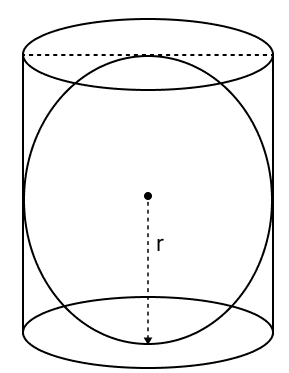
Assertion (A): A sphere is inscribed in a cylinder the ratio of the volume of the cylinder to the volume of the sphere is 1 : 4.
Reason (R): Required ratio = πr2 x 2r : πr3
A is true, but R is false.
A is false, but R is true.
Both A and R are true, and R is the correct reason for A.
Both A and R are true, and R is the incorrect reason for A.
Answer
Let r be the radius of the sphere.
From figure,
The radius of the cylinder is also r and the height of the cylinder is 2r.
By formula,
Volume of a cylinder (Vcylinder) = πr2h
= πr2(2r)
= 2πr3.
By formula,
Volume of a sphere (Vsphere) = πr3
Ratio of the volume of the cylinder to the volume of the sphere :
∴ A is false, but R is true.
Hence, option 2 is the correct option.
A hollow square-shaped tube open at both ends is made of iron. The internal square is of 5 cm side and the length of the tube is 8 cm. There are 192 cm3 of iron in this tube. Find its thickness.
Answer
Given:
Volume of iron = 192 cm3
Length of the tube = 8 cm
Internal side of the square = 5 cm
Let x be the thickness of the tube.
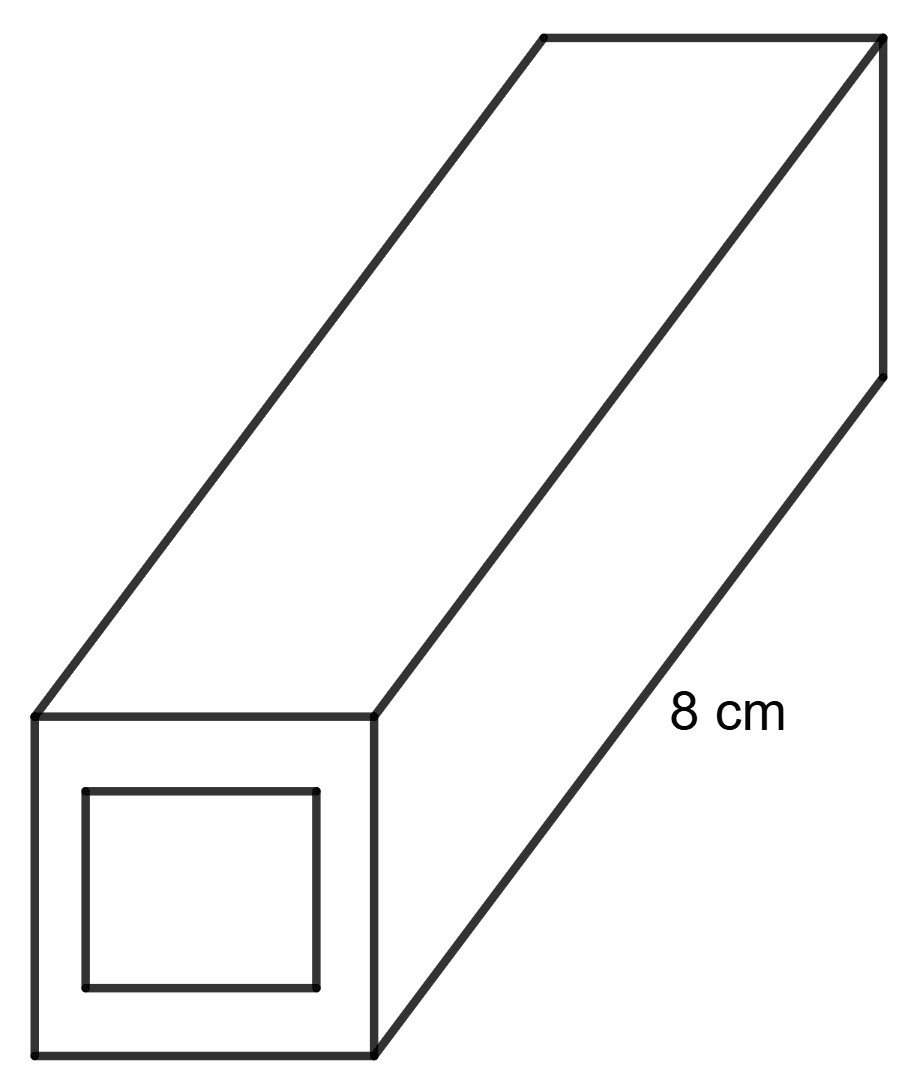
External side of the square = (5 + 2x) cm
Internal volume of the tube = Internal Side x Internal Side x length
= 5 x 5 x 8 cm3
= 200 cm3
External volume of the tube = External side x External side x length
= (5 + 2x) x (5 + 2x) x 8 cm3
= (4x2 + 20x + 25) x 8 cm3
= 32x2 + 160x + 200 cm3
Volume of iron = External volume - Internal volume
⇒ (32x2 + 160x + 200) - 200 cm3 = 192 cm3
⇒ 32x2 + 160x + 200 - 200 - 192 = 0
⇒ 32x2 + 160x - 192 = 0
Divide through by 32:
⇒ x2 + 5x - 6 = 0
⇒ x2 + 6x - 1x - 6 = 0
⇒ x(x + 6) - 1(x + 6) = 0
⇒ (x + 6)(x - 1) = 0
⇒ x = - 6 or 1
Since thickness cannot be negative, x = 1.
Hence, the thickness of the pipe is 1 cm.
Four identical cubes are joined end to end to form a cuboid. If the total surface area of the resulting cuboid is 648 cm2; find the length of edge of each cube.
Also, find the ratio between the surface area of the resulting cuboid and the surface area of a cube.
Answer
Given:
Total surface area of the cuboid = 648 cm2
Let a be the side of each cube.
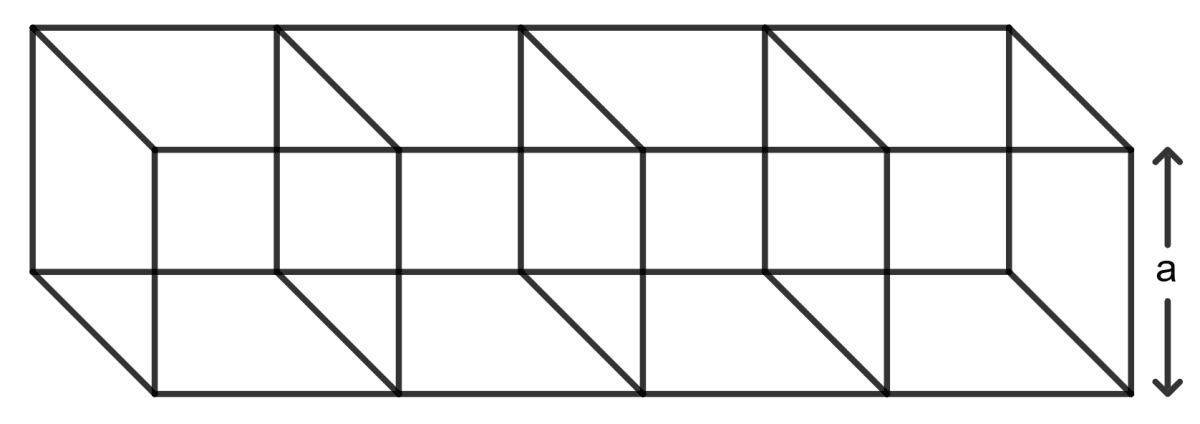
When four identical cubes are placed adjacently, the cuboid's dimensions are:
Length = a + a + a + a = 4a
Breadth = a
Height = a
Total surface area of the cuboid = 2(lb + bh + hl)
⇒ 2(4a x a + a x a + a x 4a) = 648
⇒ 2(4a2 + a2 + 4a2) = 648
⇒ 2 x 9a2 = 648
⇒ 18a2 = 648
⇒ a2 =
⇒ a2 = 36
⇒ a =
⇒ a = 6
Thus, the length of the edge of each cube is 6 cm.
Hence, the edge of each cube is 6 cm, and the ratio of the surface area of the resulting cuboid to that of one cube is 3:1.
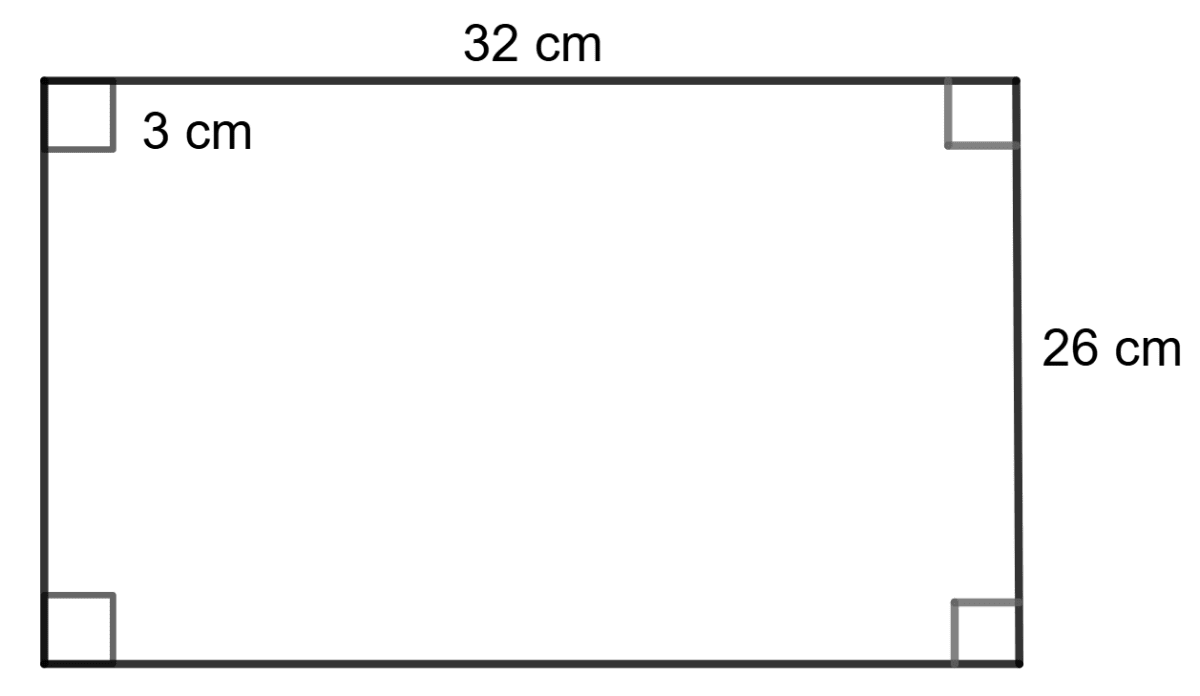
A rectangular card-board sheet has length 32 cm and breadth 26 cm. Squares each of side 3 cm, are cut from the corners of the sheet and the sides are folded to make a rectangular container. Find the capacity of the container formed.
Answer
Given:
Length of the sheet = 32 cm
Breadth of the sheet = 26 cm
Side of square = 3 cm
Inner length of the sheet = 32 - 3 - 3 cm = 26 cm
Inner breadth of the sheet = 26 - 3 - 3 cm = 20 cm
Height of the container (equal to the side of the square) = 3 cm
Volume of container = l x b x h
= 26 x 20 x 3 cm3
= 1,560 cm3
Hence, the volume of the container is 1,560 cm3.
A swimming pool is 18 m long and 8 m wide. Its deep and shallow ends are 2 m and 1.2 m respectively. Find the capacity of the pool, assuming that the bottom of the pool slopes uniformly.
Answer
Given:
Length of the pool = 18 m
Width of the pool = 8 m
Depth at the deep end = 2 m
Depth at the shallow end = 1.2 m
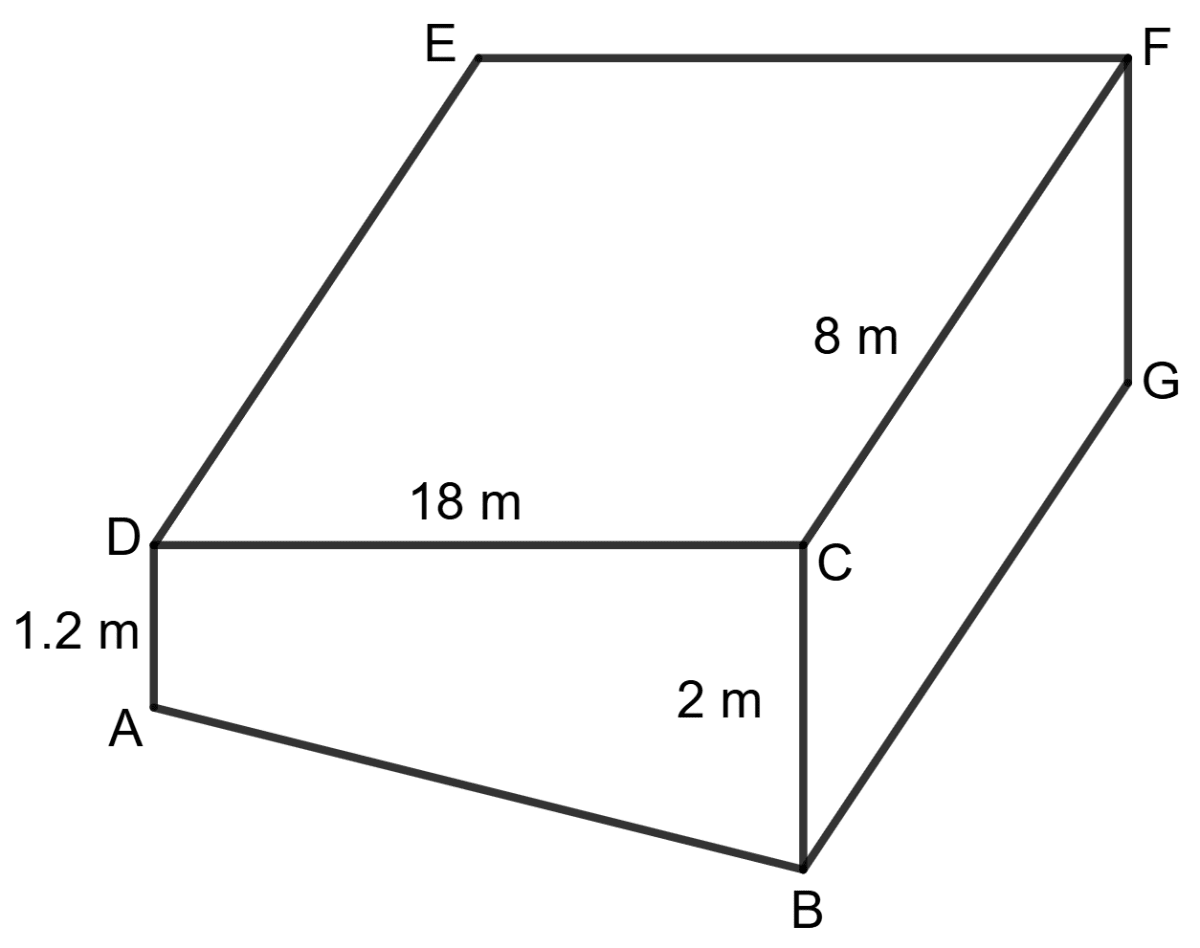
Volume of the pool = Area of base x width
Area of base(ABCD) = Area of trapezium = x (sum of parallel side) x height
∵ Height (Length of pool) = 18 m
= x (2 + 1.2) x 18 m2
= x 3.2 x 18 m2
= 1.6 x 18 m2
= 28.8 m2
Volume of the pool = 28.8 x 8 m3
= 230.4 m3
Hence, the capacity of the pool is 230.4 m3.
The following figure shows a closed victory-stand whose dimensions are given in cm.
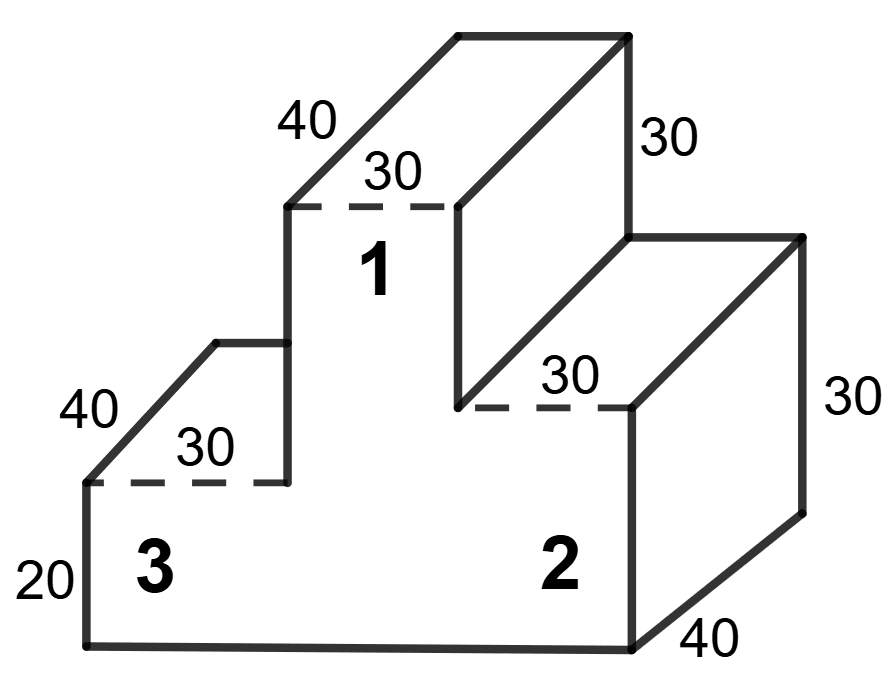
Find the volume and the surface area of the victory stand.
Answer
Given:
The dimensions of step 1 = 30 cm x 40 cm x (30 + 30) cm
The dimensions of step 2 = 40 cm x 30 cm x 30 cm
The dimensions of step 3 = 40 cm x 30 cm x 20 cm
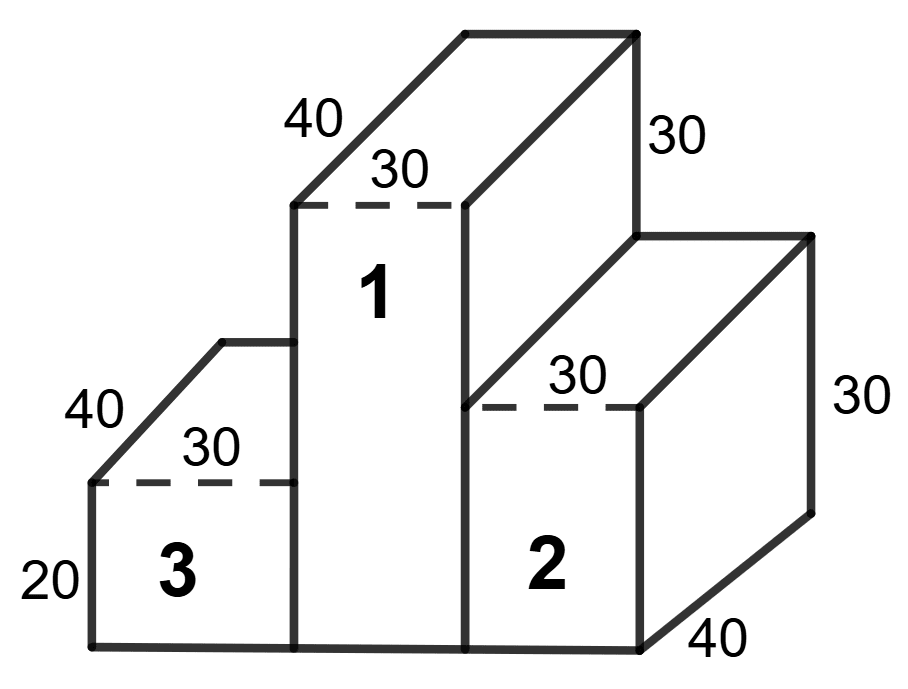
Total volume of victory stand = Volume of step 1 + Volume of step 2 + Volume of step 3
(∵ Volume of cuboid = l x b x h)
Total volume of victory stand = 40 x 30 x 60 + 40 x 30 x 30 + 40 x 30 x 20 cm3
= 72,000 + 36,000 + 24,000 cm3
= 1,32,000 cm3
We know that
Total surface area = Area of front and back + Area of vertical faces + Area of top faces
Putting the values, we get
= 2(30 x 20 + 30 x 60 + 30 x 30) + (20 x 40 + 40 x 40 + 30 x 40 + 30 x 40) + 3(30 x 40) cm2
= 2(600 + 1,800 + 900) + (800 + 1,600 + 1,200 + 1,200) + 3 x 1,200 cm2
= 2 x 3,300 + 4,800 + 3,600 cm2
= 6,600 + 4,800 + 3,600 cm2
= 15,000 cm2
Hence, the volume of the victory stand is 1,32,000 cm3 and the surface area is 15,000 cm2.
Each face of a cube has perimeter equal to 32 cm. Find its surface area and its volume.
Answer
Given:
Perimeter of each face = 32 cm
Perimeter of square = 4 x side
⇒ 4 x side = 32 cm
⇒ side = cm
⇒ side = 8 cm
Surface area of cube = 6 x side2
= 6 x (8)2 cm2
= 6 x 64 cm2
= 384 cm2
Volume of cube = side3
= 83 cm3
= 512 cm3
Hence, the surface area is 384 cm2 and the volume is 512 cm3.
A school auditorium is 40 m long, 30 m broad and 12 m high. If each student requires 1.2 m2 of the floor area; find the maximum number of students that can be accommodated in this auditorium. Also, find the volume of air available in the auditorium, for each student.
Answer
Given:
Dimension of the auditorium = 40 m x 30 m x 12 m
Area of the floor = l x b
= 40 x 30 m2
= 1,200 m2
Each student requires 1.2 m2 of floor area.
Thus, maximum number of students =
= 1,000
Volume of auditorium = l x b x h
= 40 x 30 x 12 m3
= 14,400 m3
Air available per student = = 14.4 m3
Hence, the maximum number of students that can be accommodated in the auditorium = 1,000 and the volume of air available per student = 14.4 m3.
The internal dimensions of a rectangular box are 12 cm x cm 9 cm. If the length of the longest rod that can be placed in this box is 17cm; find x.
Answer
Given:
Dimensions of the box = 12 cm x cm 9 cm
Length of longest diagonal =
Hence, the value of x is 8 cm.
The internal length, breadth and height of a box are 30 cm, 24 cm and 15 cm. Find the largest number of cubes which can be placed inside this box if the edge of each cube is
(i) 3 cm
(ii) 4 cm
(iii) 5 cm
Answer
(i) Given:
Dimensions of box = 30 cm x 24 cm x 15 cm
Edge of cube = 3 cm
Number of cubes which can be placed along length = = 10
Number of cubes which can be placed along breadth = = 8
Number of cubes which can be placed along height = = 5
The total number of cubes placed = 10 x 8 x 5 = 400
Hence, the number of cubes = 400.
(ii) Given:
Dimensions of box = 30 cm x 24 cm x 15 cm
Edge of cube = 4 cm
Number of cubes which can be placed along length = = 7.5 = 7 (taking only integer value)
Number of cubes which can be placed along breadth = = 6
Number of cubes which can be placed along height = = 3.75 = 3 (taking only integer value)
The total number of cubes placed = 7 x 6 x 3 = 126
Hence, the number of cubes = 126.
(iii) Given:
Dimensions of box = 30 cm x 24 cm x 15 cm
Edge of cube = 5 cm
Number of cubes which can be placed along length = = 6
Number of cubes which can be placed along breadth = = 4.8 = 4 (taking only integer value)
Number of cubes which can be placed along height = = 3
The total number of cubes placed = 6 x 4 x 3 = 72
Hence, the number of cubes = 72.
A rectangular field is 112 m long and 62 m broad. A cubical tank of edge 6 m is dug at each of the four corners of the field and the earth so removed is evenly spread on the remaining field. Find the rise in level.
Answer
Given:
Dimensions of the rectangular field = 112 m x 62 m
Edge of each cubical tank = 6 m
Let h be the rise in level.
Volume of 4 tanks = Volume of the removed earth
4 x Volume of 1 tank = (Area of field - 4 x Area of tank) x Rise in level
⇒ 4 x (6)3 = (112 x 62 - 4 x 62) x h
⇒ 4 x 216 = (6,944 - 4 x 36) x h
⇒ 864 = (6,944 - 144) x h
⇒ 864 = 6,800 x h
⇒ h =
⇒ h = 0.127 m
⇒ h = 12.7 cm
Hence, the rise in level of the field is 12.7 cm.
When length of each side of a cube is increased by 3 cm, its volume is increased by 2457 cm3. Find its side. How much will its volume decrease, if length of each side of it is reduced by 20% ?
Answer
Let a be the side of the original cube.
Side of the new cube = a + 3
Volume of the new cube = a3 + 2457
⇒ a3 + 2457 = (a + 3)3
⇒ a3 + 2457 = a3 + 33 + 3 x a2 x 3 + 3 x a x 32
⇒ + 2457 = + 27 + 9a2 + 27a
⇒ 2457 = 27 + 9a2 + 27a
⇒ 9a2 + 27a - 2457 + 27 = 0
⇒ 9a2 + 27a - 2430 = 0
⇒ a2 + 3a - 270 = 0
⇒ a2 + 18a - 15a - 270 = 0
⇒ a(a + 18) - 15(a + 18) = 0
⇒ (a + 18)(a - 15) = 0
⇒ a = -18 or 15
Since the side cannot be negative, the side of the original cube, a = 15 cm.
Volume of original cube = side3
= (15)3 cm3
= 3375 cm3
When the length of side is reduced by 20%.
New side of the cube = side - 20% of side
= 15 - x 15
= 15 - x 15
= 15 - 3
= 12 cm
New volume of the cube = side3
= (12)3 cm3
= 1728 cm3
Decrease in volume = 3375 - 1728 cm3
= 1647 cm3
Hence, the side of the original cube is 15 cm and the decrease in volume is 1647 cm3.
A rectangular tank 30 cm x 20 cm x 12 cm contains water to a depth of 6 cm. A metal cube of side 10 cm is placed in the tank with its one face resting on the bottom of the tank. Find the volume of water, in litres, that must be poured in the tank so that the metal cube is just submerged in the water.
Answer
Given:
Dimensions of the tank = 30 cm x 20 cm x 12 cm
Side of the cube = 10 cm
Initial depth of water in the tank = 6 cm
Initial volume of water in tank = 30 x 20 x 6 = 3600 cm3
Volume of cube = side cm3 = 10 x 10 x 10 = 1000 cm3
Volume of water required to fill the tank to a depth of 10 cm = 30 x 20 x 10 = 6000 cm3
Additional volume of water required to just submerge the cube = Volume of water at 10 cm depth - Volume of water at 6 cm depth - Volume of cube
= 6000 - 3600 - 1000
= 1400 cm3 = 1.4 litre
Hence, the volume of water that must be poured into the tank so that the metal cube is just submerged is 1.4 litre.
The dimensions of a solid metallic cuboid are 72 cm x 30 cm x 75 cm. It is melted and recast into identical solid metal cubes with each of edge 6 cm. Find the number of cubes formed.
Also, find the cost of polishing the surfaces of all the cubes formed at the rate ₹ 150 per sq.m.
Answer
Given:
Dimensions of the solid cuboid = 72 cm x 30 cm x 75 cm
Side of the cube = 6 cm
Let n be the number of cubes.
Volume of solid cuboid = Number of cubes x Volume of one cube
⇒ l x b x h = n x side3
⇒ 72 x 30 x 75 = n x (6)3
⇒ 162,000 = n x 216
⇒ n =
⇒ n = 750
Total surface area of one cube = 6 x side2
= 6 x (6)2 cm2
= 216 cm2
Total surface area of 750 cubes = 750 x 216 cm2
= 162,000 cm2
= 16.2 m2
Rate of polishing = ₹ 150 per sq.m
Total cost = Total surface area x Rate of polishing
= ₹ 16.2 x 150
= ₹ 2,430
Hence, the number of cubes formed = 750 and the total cost of polishing = ₹ 2,430.
The dimensions of a car petrol tank are 50 cm x 32 cm x 24 cm, which is full of petrol. If a car's average consumption is 15 km per litre, find the maximum distance that can be covered by the car.
Answer
Given:
Dimensions of tank = 50 cm x 32 cm x 24 cm
Volume of tank = 50 x 32 x 24 cm3
= 38,400 cm3
= 38.4 litre (∵ 100 cm3 = 1 litre)
Average consumption of car = 15 km per litre
Maximum distance covered by car = Volume of tank x Average consumption of car
= 38.4 x 15
= 576 km
Hence, the maximum distance that can be covered by the car is 576 km.
The dimensions of a rectangular box are in the ratio 4 : 2 : 3. The difference between cost of covering it with paper at 12 per m2 and with paper at the rate of 13.50 per m2 is ₹ 1,248. Find the dimensions of the box.
Answer
Given:
The ratio of dimensions of the rectangular box = 4 : 2 : 3
Let the dimension be 4a, 2a and 3a.
Total surface area of box = 2(lb + bh + hl)
= 2(4a x 2a + 2a x 3a + 3a x 4a)
= 2(8a2 + 6a2 + 12a2)
= 2 x 26a2
= 52a2
The difference between cost of covering it with paper at 12 per m2 and with paper at the rate of 13.50 per m2 = ₹ 1,248
⇒ Total surface area x 13.5 per m2 - Total surface area x 12 per m2 = ₹ 1,248
⇒ 52a2 x 13.5 - 52a2 x 12 = ₹ 1,248
⇒ 52a2 (13.5 - 12) = ₹ 1,248
⇒ 52a2 x 1.5 = ₹ 1,248
⇒ 78a2 = ₹ 1,248
⇒ a2 =
⇒ a2 = 16
⇒ a =
⇒ a = 4 m
So, the dimensions are 4a, 2a and 3a
= 4 x 4 m, 2 x 4 m and 3 x 4 m
= 16 m, 8 m and 12 m
Hence, the dimensions of the box are 16 m , 8 m and 12 m.
The length of the diagonal of a cuboid is cm and its volume and total surface area is respectively 780 cm3 and 562 cm3. Find the dimension of the cuboid.
Answer
Let the dimensions of the cuboid be l, b and h cm and diagonal be d cm.
Given,
Volume = 780 cm3
TSA = 562 cm2
d =
By formula,
d2 = l2 + b2 + h2
= l2 + b2 + h2
338 = l2 + b2 + h2..........(1)
We know that,
Volume of cuboid = l × b × h
780 = l × b × h ..........(2)
By formula,
TSA = 2(lb + bh + hl)
562 = 2(lb + bh + hl)..........(3)
By using identity,
(l + b + h)2 = l2 + b2 + h2 + 2(lb + bh + hl)
By substituting the values we get,
(l + b + h)2 = 338 + 562
(l + b + h)2 = 900
l + b + h =
l + b + h = 30..........(4)
From equation (2) & (4)
Sum of the dimensions = 30
Product of the dimensions = 780
780 = 5 x 12 x 13
and,
5 + 12 + 13 = 30.
∴ The dimensions are 5, 12 and 13 cm.
l = 5 cm, b = 12 cm, h = 13 cm.
Hence, dimensions of the cuboid = 5 cm, 12 cm and 13 cm.