
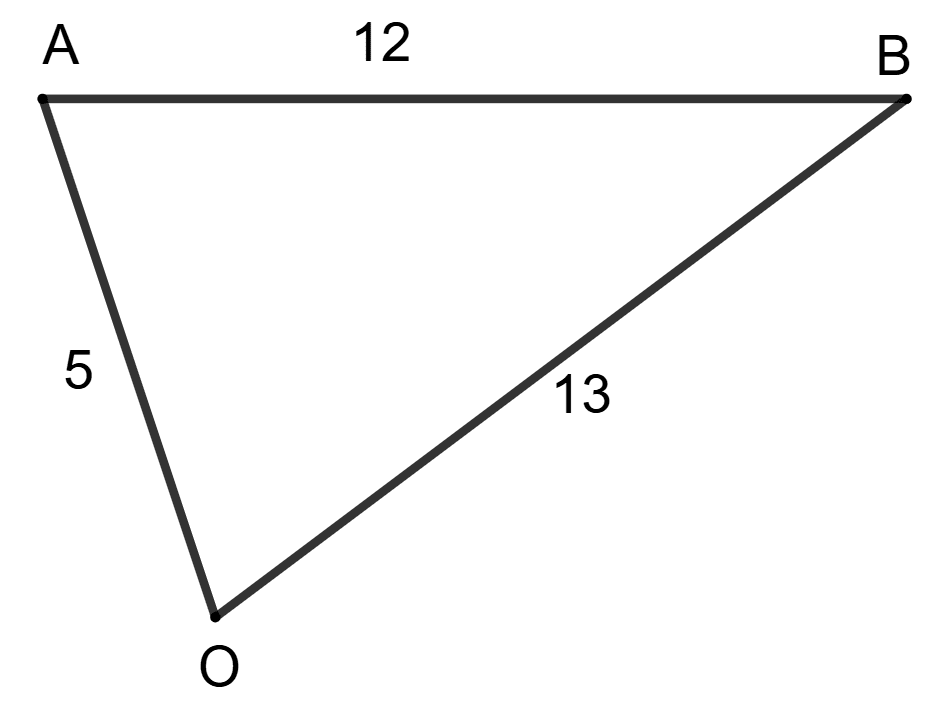
Angle AOB is:
60°
90°
45°
none of these
Answer
5, 12, and 13 are pythagorean triplets.
As,
132 = 122 + 52
So, side BO = 13 units is the hypotenuse.
We know that,
Angle opposite to hypotenuse is a right-angle triangle.
So, ∠OAB = 90°
According to angle sum property,
⇒ ∠OAB + ∠ABO + ∠AOB = 180°
⇒ 90° + ∠ABO + ∠AOB = 180°
⇒ ∠ABO + ∠AOB = 180° - 90°
⇒ ∠ABO + ∠AOB = 90°
Thus, ∠AOB, ∠ABO cannot be defined individually.
Hence, option 4 is the correct option.
Ranbeer runs 10 km due North and 24 km due West. The distance between his two position is:
34 km
17 km
26 km
none of these
Answer
Starting from point A, Ranbeer runs 10 km due north and reached at point B then 24 km due west, ending at point C.
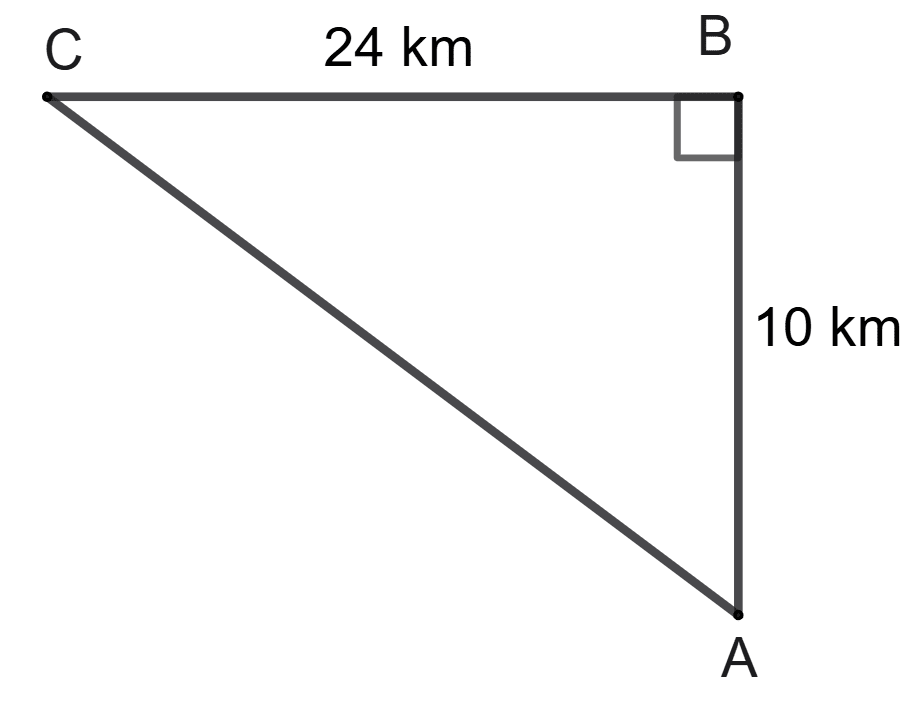
According to Pythagoras Theorem, in a right-angled triangle, the square of the length of the hypotenuse is equal to the sum of the squares of the lengths of the other two sides.
⇒ Hypotenuse2 = Base2 + Height2
In triangle ABC,
⇒ AC2 = AB2 + BC2
⇒ AC2 = 102 + 242
⇒ AC2 = 100 + 576
⇒ AC2 = 676
⇒ AC =
⇒ AC = 26 km.
Hence, option 3 is the correct option.
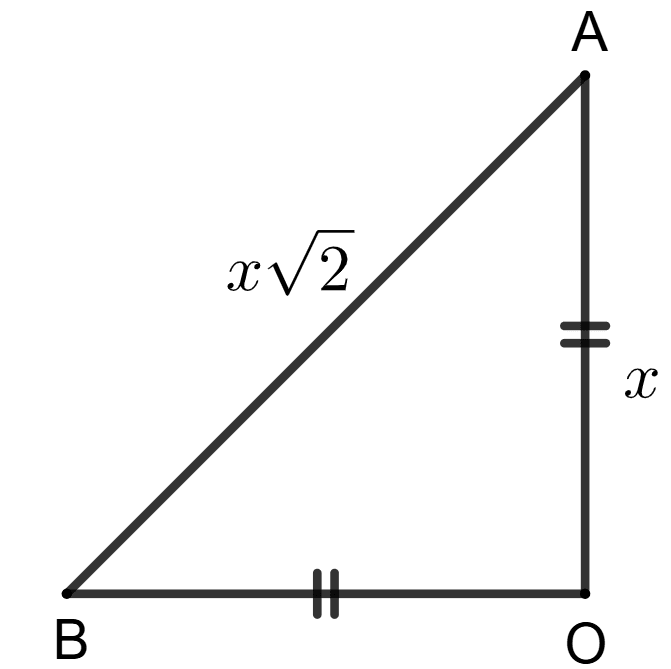
Angle AOB is:
60°
90°
45°
none of these
Answer
Since, AO = BO = x
Squaring all the sides we get :
AB2 =
OB = x2
OA = x2
In triangle AOB,
⇒ AO2 + BO2 = x2 + x2 = 2x2 = AB2.
Thus, AOB is a right angle triangle with AB as hypotenuse.
Since, AB is hypotenuse, then ∠AOB (angle opposite to hypotenuse) = 90°
Hence, option 2 is the correct option.
The sides of a rectangle are 12 cm and 16 cm. The length of its diagonal is:
28 cm
4 cm
cm
cm
Answer
ABCD is a rectangle such that AB = 16 cm and BC = 12 cm.
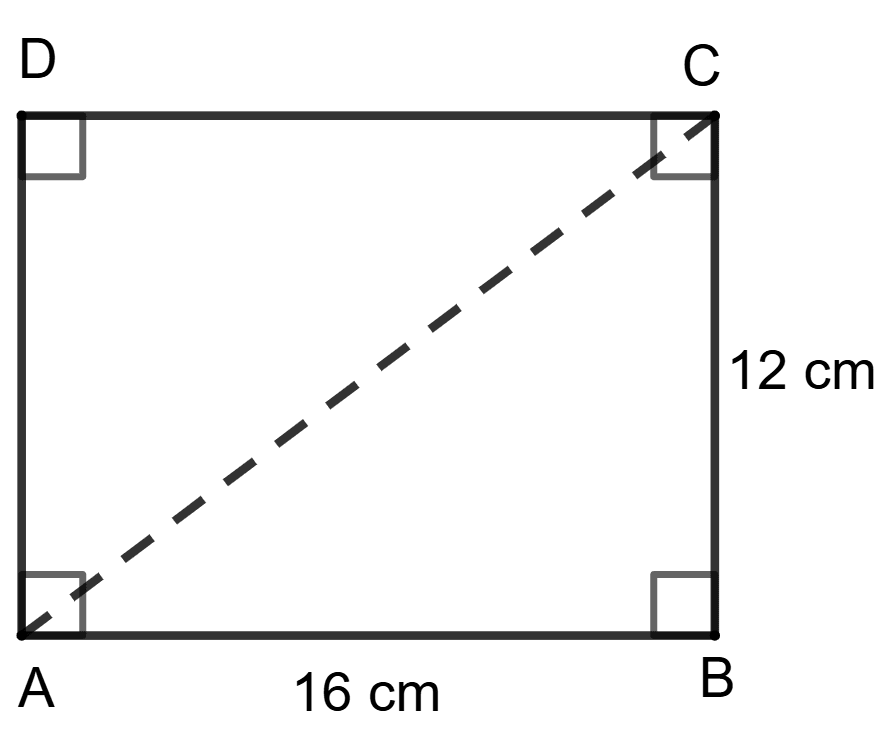
Join AC. AC is a diagonal of the rectangle ABCD.
According to Pythagoras theorem, in a right-angled triangle, the square of the length of the hypotenuse is equal to the sum of the squares of the lengths of the other two sides.
⇒ Hypotenuse2 = Base2 + Height2
In triangle ABC,
⇒ AC2 = AB2 + BC2
⇒ AC2 = 162 + 122
⇒ AC = cm
Hence, option 3 is the correct option.
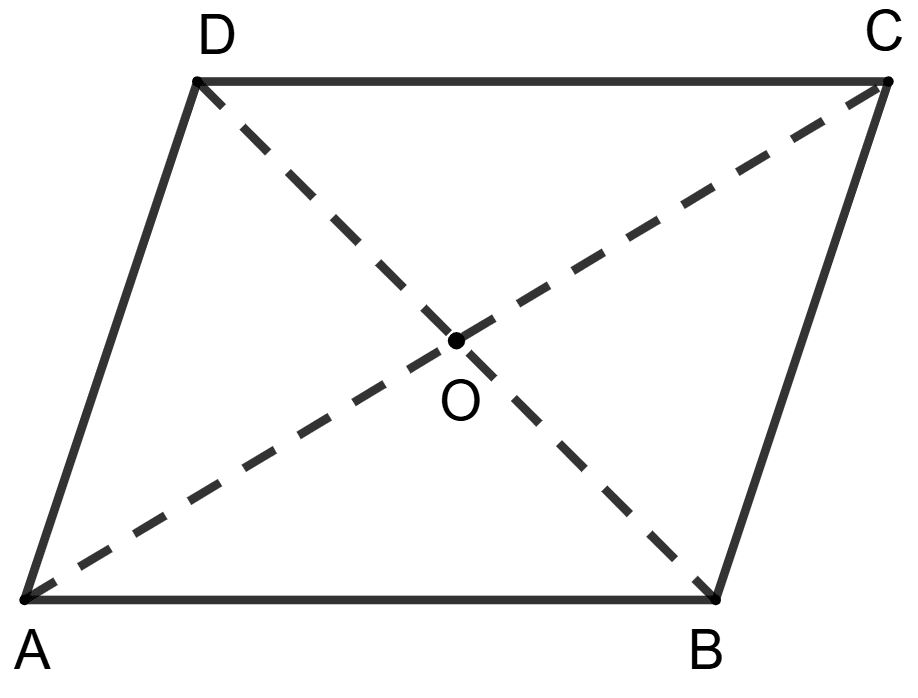
Statement 1: ABCD is a rhombus, its diagonal AC = 16 cm and diagonal BD = 12 cm, perimeter of rhombus = 64 cm.
Statement 2: OA = 8 cm, OB = 6 cm. Then, AB = 10 cm
And, perimeter of rhombus = 40 cm
Both the statements are true.
Both the statements are false.
Statement 1 is true, and statement 2 is false.
Statement 1 is false, and statement 2 is true.
Answer
Given, ABCD is a rhombus, diagonal AC = 16 cm and diagonal BD = 12 cm.
The diagonals of a rhombus bisect each other at right angles.
∴ ∠AOB = 90°
Each diagonal is divided into two equal segments.
∴ AC = 16 cm ⇒ AO = OC = = 8 cm
∴ BD = 12 cm ⇒ BO = OD = = 6 cm
According to Pythagoras theorem, in a right-angled triangle, the square of the length of the hypotenuse is equal to the sum of the squares of the lengths of the other two sides.
⇒ Hypotenuse2 = Base2 + Height2
In Δ AOB,
⇒ AB2 = BO2 + OA2
⇒ AB2 = 62 + 82
⇒ AB2 = 36 + 64
⇒ AB2 = 100
⇒ AB =
⇒ AB = 10 cm
According to formula, perimeter of rhombus = 4 x length of side
= 4 x 10
= 40 cm.
∴ Statement 1 is false, and statement 2 is true.
Hence, option 4 is the correct option.
Statement 1: Area of given triangle ABC = 6 x 5 cm2.
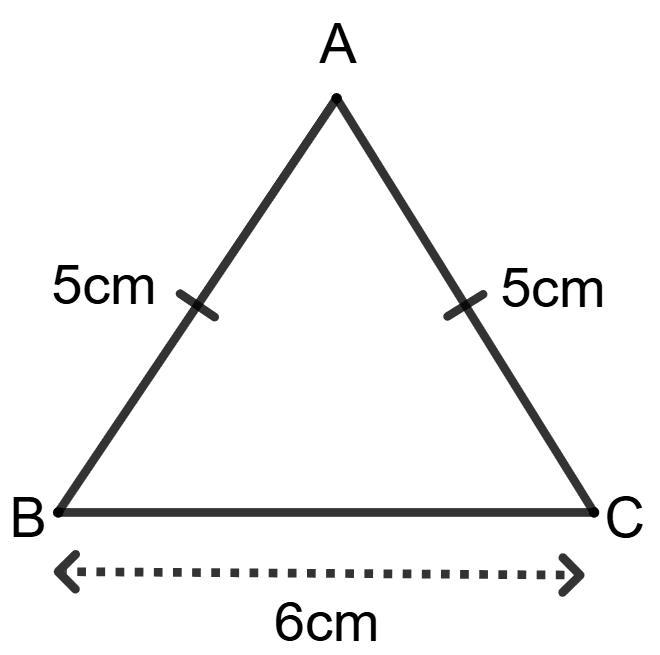
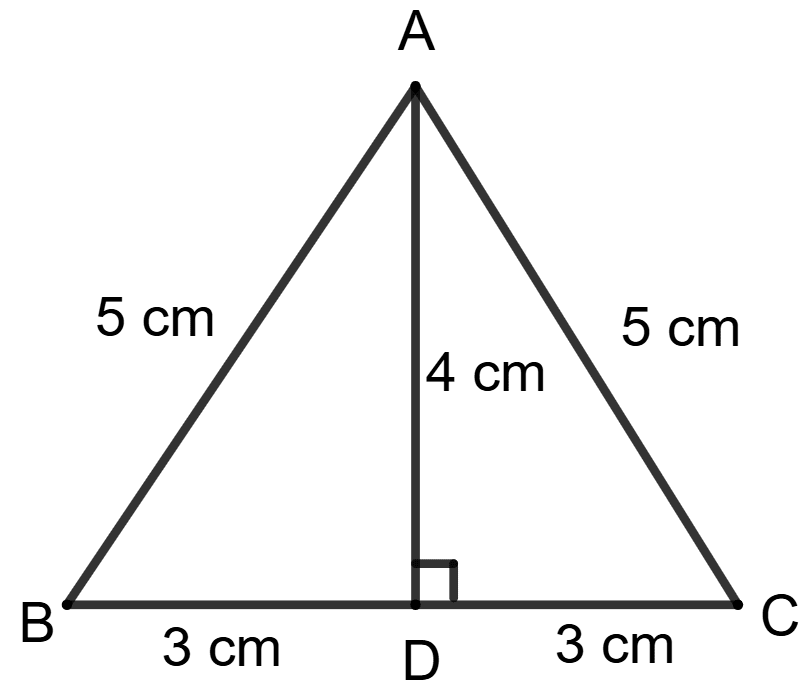
Statement 2: Area of given triangle ABC = x 6 x 4 cm2.
Both the statements are true.
Both the statements are false.
Statement 1 is true, and statement 2 is false.
Statement 1 is false, and statement 2 is true.
Answer
Draw a perpendicular bisector, AD.
The perpendicular bisector of the base also passes through the midpoint of the base, effectively dividing it into two equal segments.
BD = DC = = 3 cm
According to Pythagoras theorem, in a right-angled triangle, the square of the length of the hypotenuse is equal to the sum of the squares of the lengths of the other two sides.
⇒ Hypotenuse2 = Base2 + Height2
In Δ ABD,
⇒ AB2 = AD2 + BD2
⇒ 52 = AD2 + 32
⇒ 25 = AD2 + 9
⇒ AD2 = 25 - 9
⇒ AD2 = 16
⇒ AD =
⇒ AD = 4 cm.
Using formula, area of triangle = x base x height
Here, base, BC = 6 cm and height, AD = 4 cm
⇒ Area of triangle = x 6 x 4 cm2
∴ Statement 1 is false, and statement 2 is true.
Hence, option 4 is the correct option.
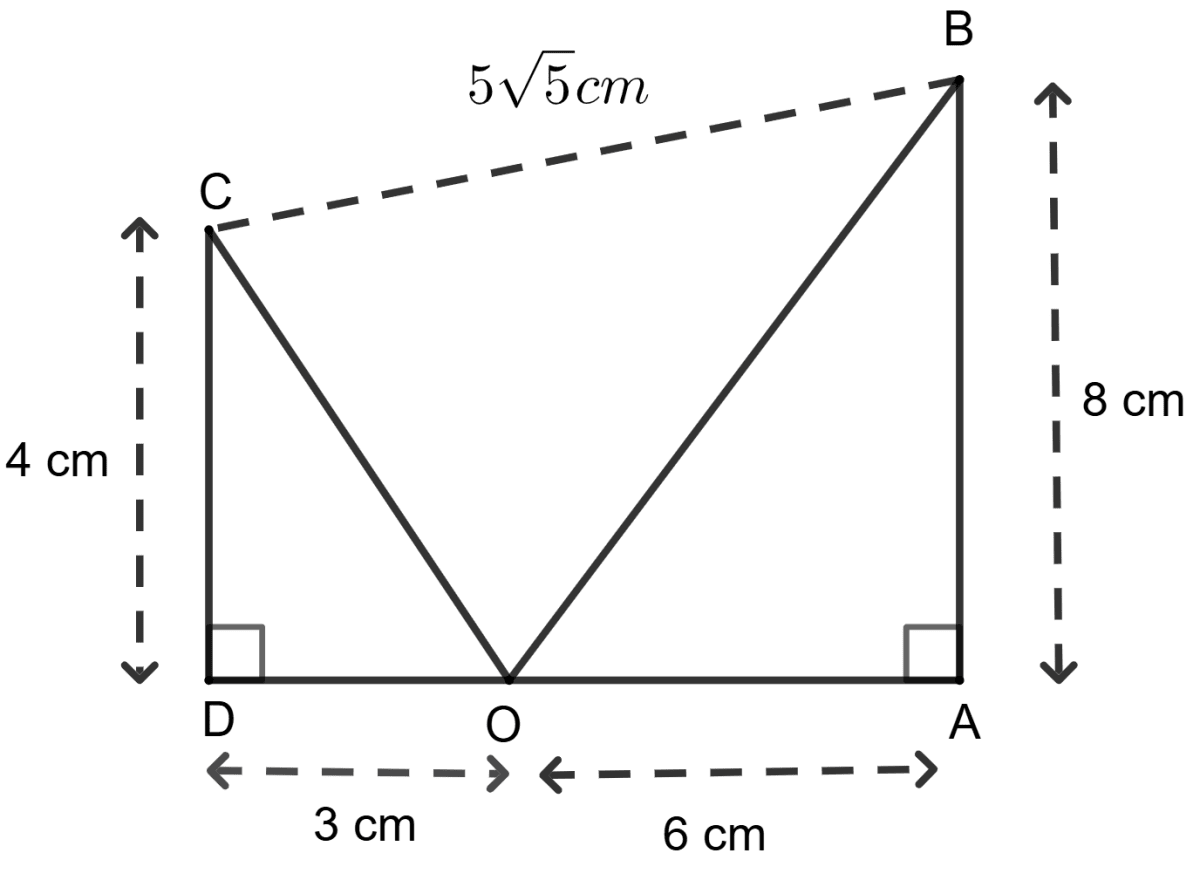
Assertion (A): Angle BOC = 90°.
Reason (R): OC2 = 32 + 42 = 25
OB2 = 62 + 82 = 100
OC2 + OB2 = 125 = BC2
A is true, but R is false.
A is false, but R is true.
Both A and R are true, and R is the correct reason for A.
Both A and R are true, and R is the incorrect reason for A.
Answer
Given, OD = 3 cm and DC = 4 cm
According to Pythagoras theorem, in a right-angled triangle, the square of the length of the hypotenuse is equal to the sum of the squares of the lengths of the other two sides.
⇒ Hypotenuse2 = Base2 + Height2
In Δ ODC,
⇒ OC2 = OD2 + DC2
⇒ OC2 = 32 + 42
⇒ OC2 = 9 + 16
⇒ OC2 = 25
⇒ OC =
⇒ OC = 5 cm
Similarly, it it given that OA = 6 cm and AB = 8 cm
In Δ OAB,
⇒ OB2 = OA2 + AB2
⇒ OB2 = 62 + 82
⇒ OB2 = 36 + 64
⇒ OB2 = 100
⇒ OB =
⇒ OB = 10 cm
Squaring all sides of triangle BOC,
⇒ OB2 = 102 = 100
⇒ OC2 = 52 = 25
⇒ BC2 = = 125
Since,
⇒ BC2 = OC2 + OB2
Since, sides of triangle BOC, satisfy pythagoras theorem. So, BOC is a right angle triangle with BC as hypotenuse.
∴ ∠BOC = 90°.
∴ Both A and R are true, and R is the correct reason for A.
Hence, option 3 is the correct option.
Assertion (A): x =
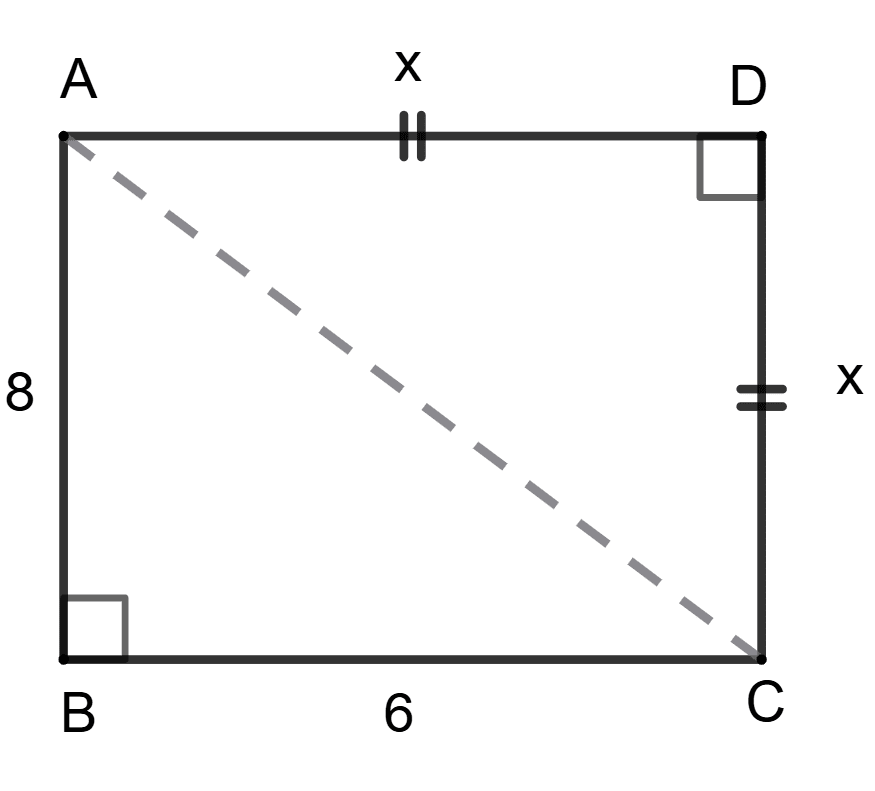
Reason (R): AC2 = 82 + 62 = x2 + x2
A is true, but R is false.
A is false, but R is true.
Both A and R are true, and R is the correct reason for A.
Both A and R are true, and R is the incorrect reason for A.
Answer
In Δ ABC,
Since angle ABC = 90°.
According to Pythagoras theorem, in a right-angled triangle, the square of the length of the hypotenuse is equal to the sum of the squares of the lengths of the other two sides.
⇒ Hypotenuse2 = Base2 + Height2
⇒ AC2 = AB2 + BC2
⇒ AC2 = 82 + 62 ........................(1)
In Δ ADC,
Since angle ADC = 90°.
Using pythagoras theorem,
⇒ AC2 = AD2 + DC2
⇒ AC2 = x2 + x2 .....................(2)
From equation (1) and (2),
⇒ 82 + 62 = x2 + x2
⇒ 64 + 36 = 2x2
⇒ 2x2 = 100
⇒ x2 =
⇒ x2 = 50
⇒ x =
⇒ x = 5
∴ Both A and R are true, and R is the correct reason for A.
Hence, option 3 is the correct option.
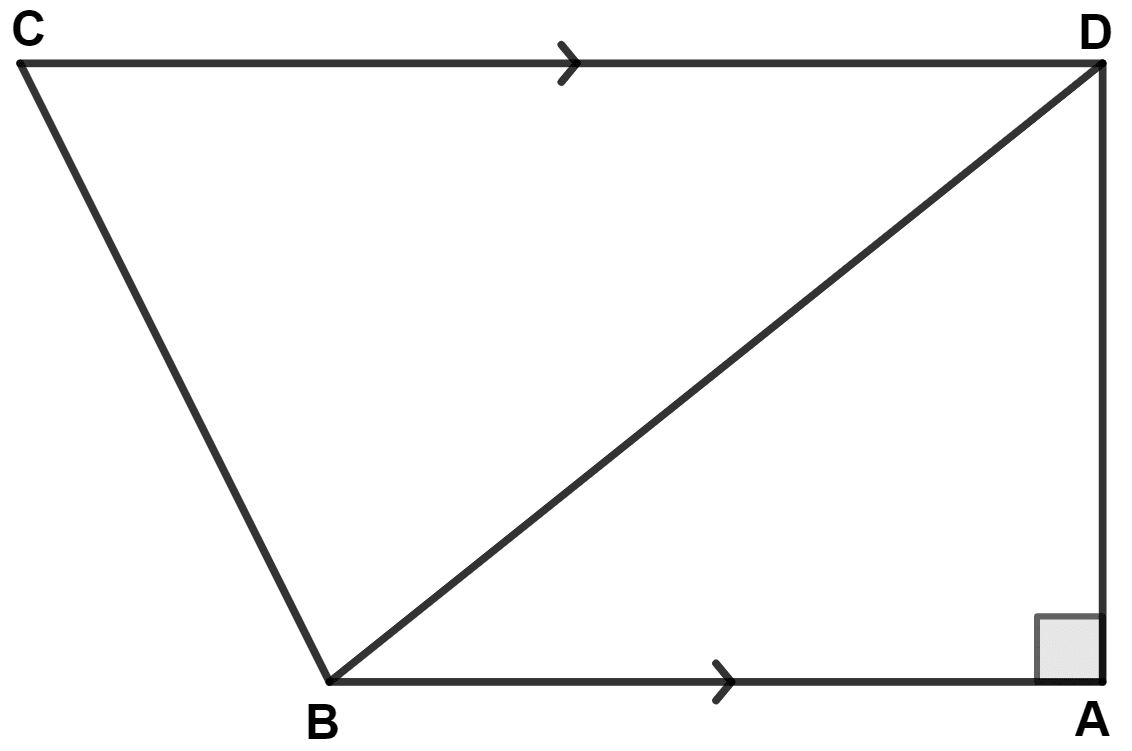
In the given figure, AB // CD, AB = 7 cm, BD = 25 cm and CD = 17 cm; find the length of side BC.
Answer
In right-angled triangle ABD,
By pythagoras theorem,
⇒ (Hypotenuse)2 = (Perpendicular)2 + Base2
⇒ BD2 = AD2 + AB2
⇒ 252 = AD2 + 72
⇒ 625 = AD2 + 49
⇒ AD2 = 625 - 49
⇒ AD2 = 576
⇒ AD = = 24 cm.
Draw BE perpendicular to CD.
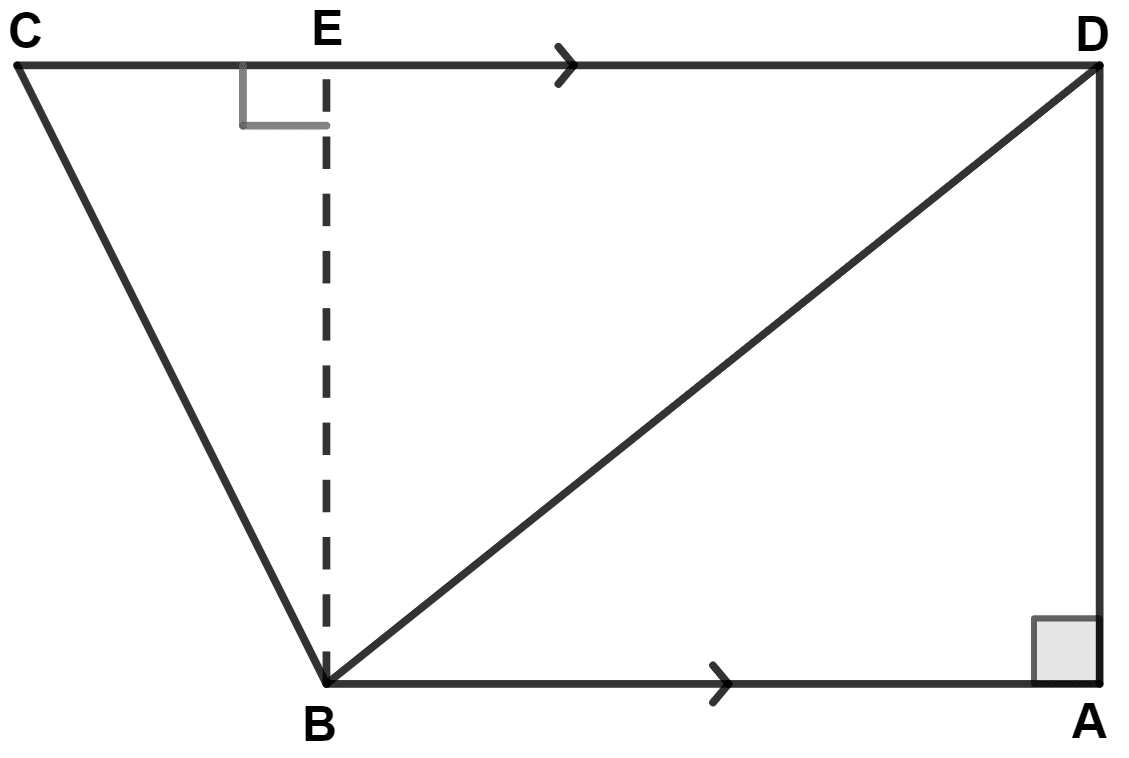
From figure,
ABED is a rectangle. Since, opposite sides of rectangle are equal.
∴ ED = AB = 7 cm and BE = AD = 24 cm.
⇒ CE = CD - ED = 17 - 7 = 10 cm.
In right-angled triangle BEC,
By pythagoras theorem,
⇒ (Hypotenuse)2 = (Perpendicular)2 + Base2
⇒ BC2 = BE2 + CE2
⇒ BC2 = 242 + 102
⇒ BC2 = 576 + 100
⇒ BC2 = 676
⇒ BC = = 26 cm.
Hence, BC = 26 cm.
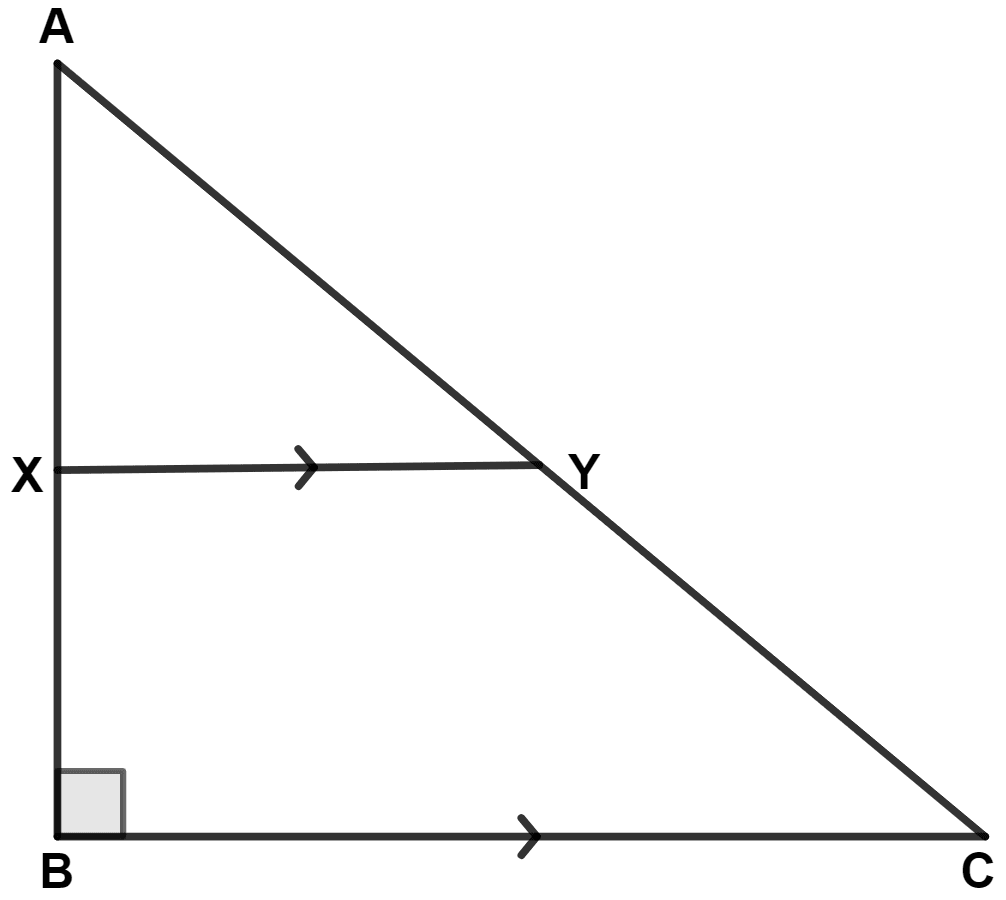
In the given figure, ∠B = 90°, XY // BC, AB = 12 cm, AY = 8 cm and AX : XB = 1 : 2 = AY : YC. Find the lengths of AC and BC.
Answer
Given,
AX : XB = 1 : 2
Let AX = x and XB = 2x.
From figure,
⇒ AX + XB = AB
⇒ x + 2x = 12
⇒ 3x = 12
⇒ x = = 4 cm.
⇒ AX = x = 4 cm and XB = 2x = 2(4) = 8 cm.
Given,
AY : YC = 1 : 2
From figure,
⇒ AC = AY + YC = 8 + 16 = 24 cm.
In right-angled triangle ABC,
By pythagoras theorem,
⇒ (Hypotenuse)2 = (Perpendicular)2 + Base2
⇒ AC2 = AB2 + BC2
⇒ 242 = 122 + BC2
⇒ 576 = 144 + BC2
⇒ BC2 = 576 - 144
⇒ BC2 = 432
⇒ BC = = 20.78 cm.
Hence, AC = 24 cm and BC = 20.78 cm.
In △ ABC, ∠B = 90°. Find the sides of the triangle, if :
(i) AB = (x - 3) cm, BC = (x + 4) cm and AC = (x + 6) cm
(ii) AB = x cm, BC = (4x + 4) cm and AC = (4x + 5) cm.
Answer
(i) In right-angled triangle ABC,
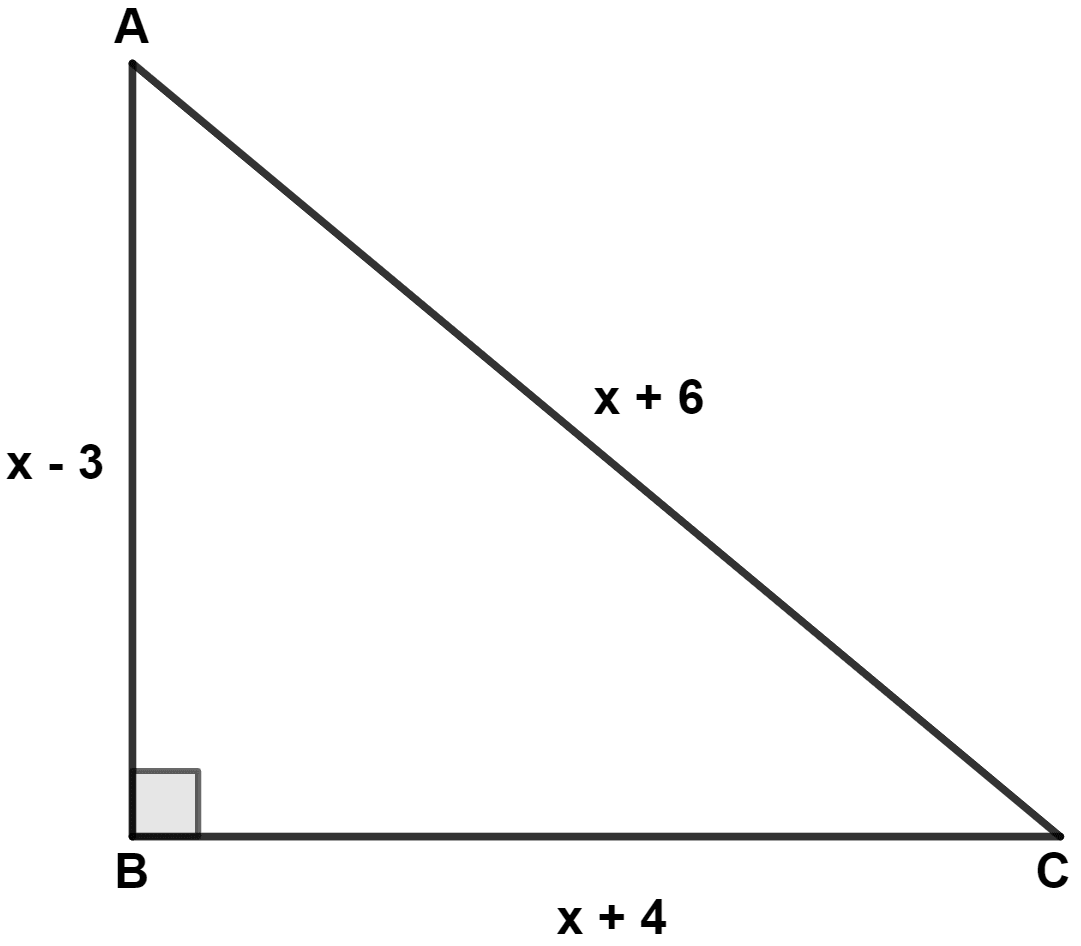
By pythagoras theorem,
⇒ (Hypotenuse)2 = (Perpendicular)2 + Base2
⇒ AC2 = AB2 + BC2
⇒ (x + 6)2 = (x - 3)2 + (x + 4)2
⇒ x2 + 62 + 12x = x2 + 9 - 6x + x2 + 16 + 8x
⇒ x2 + 36 + 12x = x2 + 9 - 6x + x2 + 16 + 8x
⇒ x2 + 36 + 12x = 2x2 + 25 + 2x
⇒ 2x2 - x2 + 2x - 12x + 25 - 36 = 0
⇒ x2 - 10x - 11 = 0
⇒ x2 - 11x + x - 11 = 0
⇒ x(x - 11) + 1(x - 11) = 0
⇒ (x + 1)(x - 11) = 0
⇒ x + 1 = 0 or x - 11 = 0
⇒ x = -1 or x = 11.
Since, side cannot be negative.
∴ x = 11.
AB = x - 3 = 11 - 3 = 8 cm,
BC = x + 4 = 11 + 4 = 15 cm,
AC = x + 6 = 11 + 6 = 17 cm.
Hence, AB = 8 cm, BC = 15 cm and AC = 17 cm.
(ii) In right-angled triangle ABC,
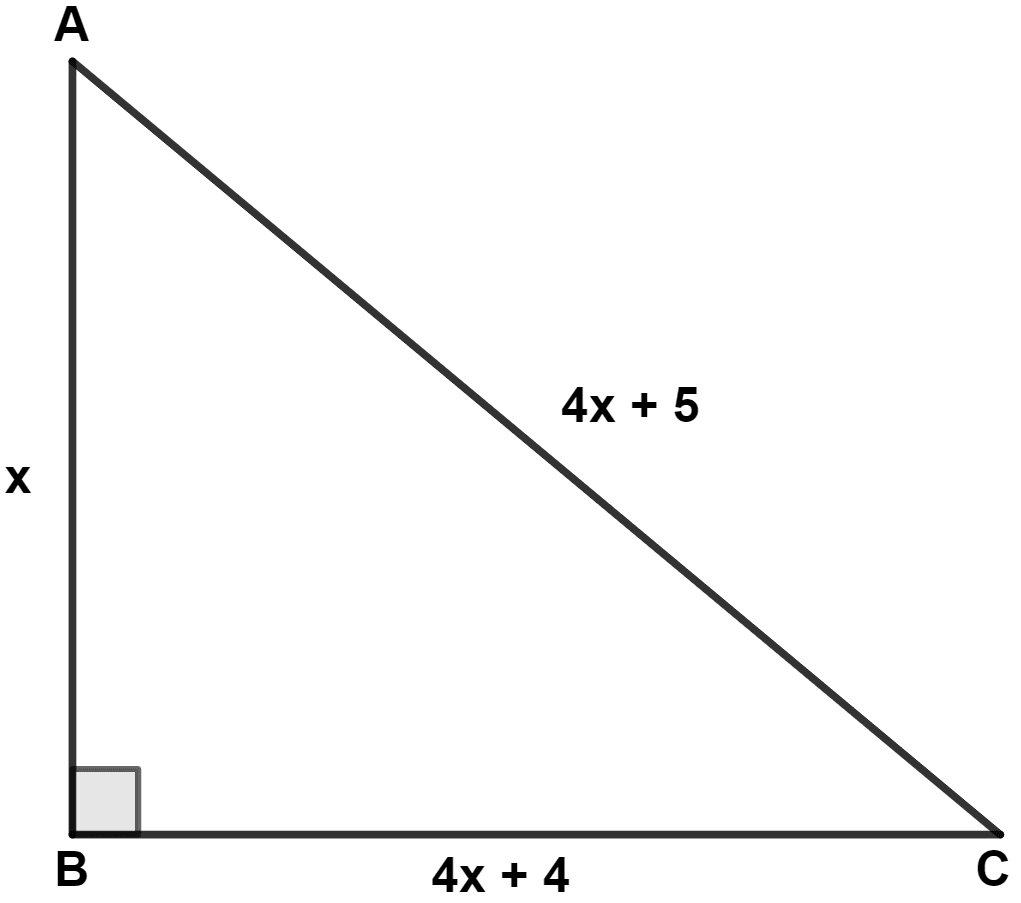
By pythagoras theorem,
⇒ (Hypotenuse)2 = (Perpendicular)2 + Base2
⇒ AC2 = AB2 + BC2
⇒ (4x + 5)2 = x2 + (4x + 4)2
⇒ (4x)2 + 52 + 2 × (4x) × 5 = x2 + (4x)2 + 42 + 2 × (4x) × 4
⇒ 16x2 + 25 + 40x = x2 + 16x2 + 16 + 32x
⇒ 16x2 + 25 + 40x = 17x2 + 16 + 32x
⇒ 17x2 - 16x2 + 16 - 25 + 32x - 40x = 0
⇒ x2 - 8x - 9 = 0
⇒ x2 - 9x + x - 9 = 0
⇒ x(x - 9) + 1(x - 9) = 0
⇒ (x + 1)(x - 9) = 0
⇒ x + 1 = 0 or x - 9 = 0
⇒ x = -1 or x = 9.
Since, side cannot be negative.
∴ x = 9.
AB = x = 9 cm,
BC = 4x + 4 = 4(9) + 4 = 36 + 4 = 40 cm,
AC = 4x + 5 = 4(9) + 5 = 35 + 5 = 41 cm.
Hence, AB = 9 cm, BC = 40 cm and AC = 41 cm.
If a side of a rhombus is 10 cm and one of the diagonals is 16 cm, find the other diagonal.
Answer
Let ABCD be the rhombus and the diagonals intersect at point O.
Let diagonal AC = 16 cm.
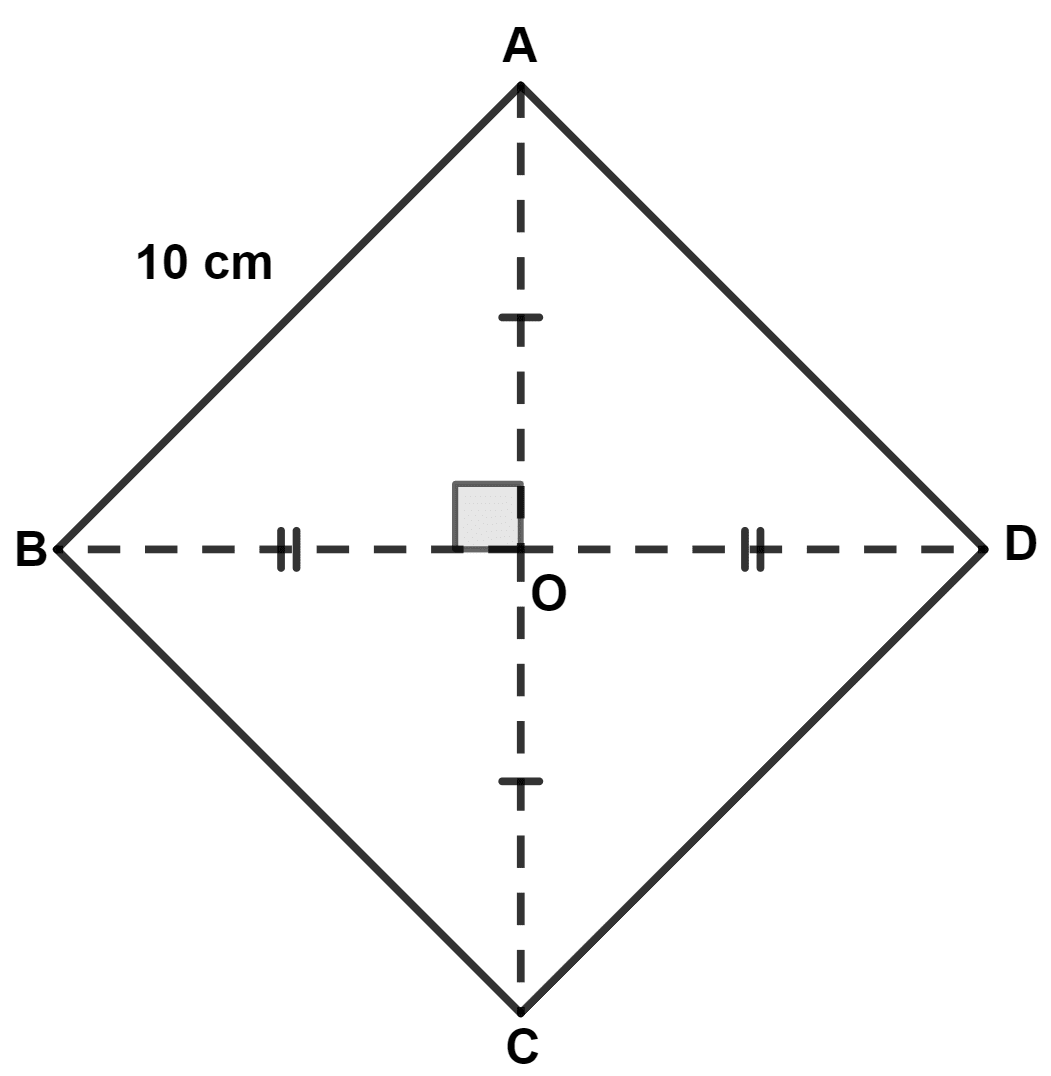
We know that,
Diagonals of rhombus bisect each other at right angles.
∴ AO = OC = = 8 cm and BO = OD = x cm (let).
In right angle triangle AOB,
By pythagoras theorem,
⇒ (Hypotenuse)2 = (Perpendicular)2 + Base2
⇒ AB2 = AO2 + OB2
⇒ 102 = 82 + x2
⇒ 100 = 64 + x2
⇒ x2 = 100 - 64
⇒ x2 = 36
⇒ x = = 6 cm.
From figure,
⇒ BD = BO + OD = 6 + 6 = 12 cm.
Hence, length of other diagonal = 12 cm.
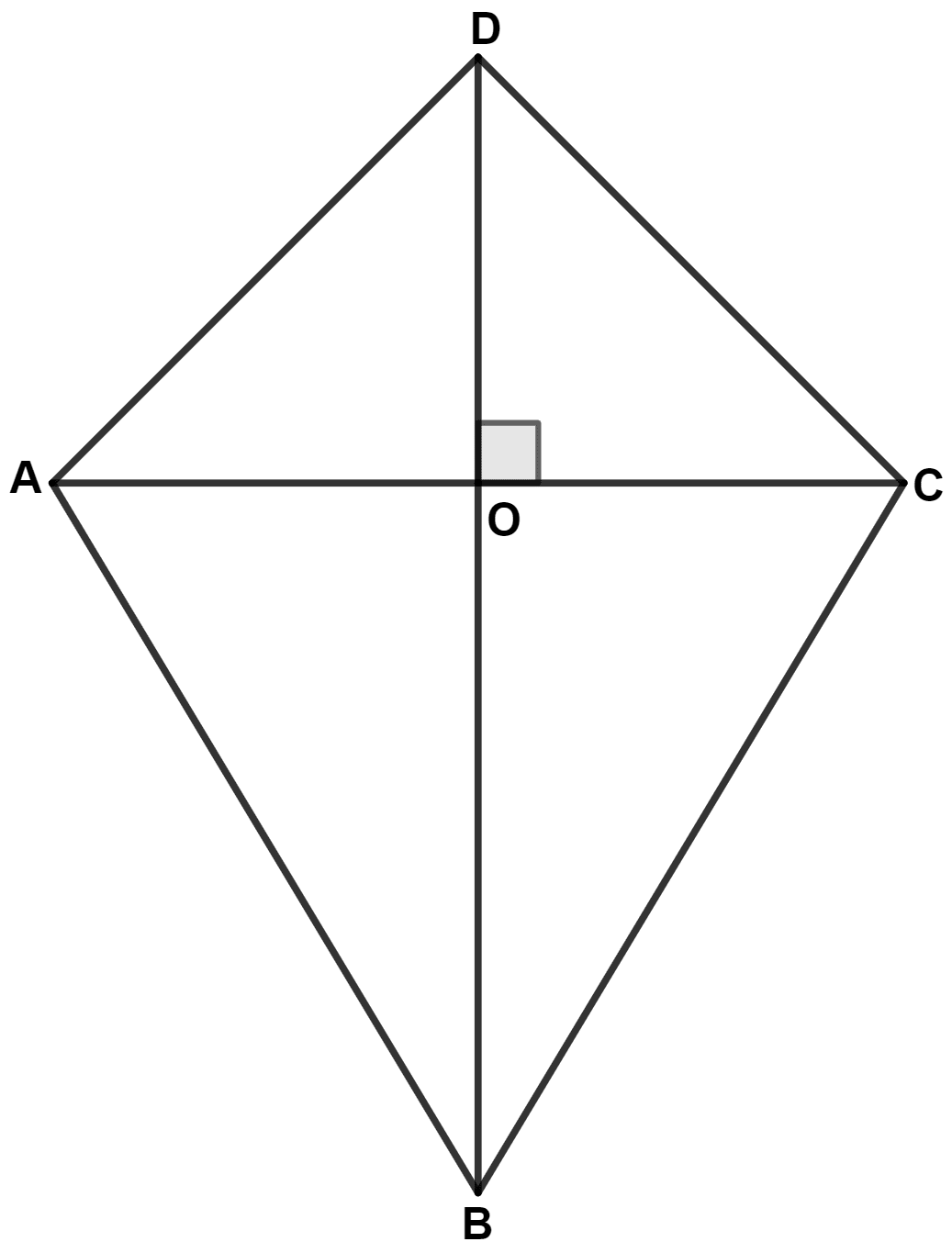
In the given figure, diagonals AC and BD intersect at right angle. Show that :
AB2 + CD2 = AD2 + BC2
Answer
By formula,
By pythagoras theorem,
⇒ (Hypotenuse)2 = (Perpendicular)2 + Base2
In right angle triangle AOB,
⇒ AB2 = OB2 + OA2 ..........(1)
In right angle triangle COD,
⇒ CD2 = OD2 + OC2 ..........(2)
In right angle triangle AOD,
⇒ AD2 = OD2 + OA2 ..........(3)
In right angle triangle BOC,
⇒ BC2 = OB2 + OC2 ..........(4)
Adding equations (1) and (2), we get :
⇒ AB2 + CD2 = OB2 + OA2 + OD2 + OC2
⇒ AB2 + CD2 = (OA2 + OD2) + (OC2 + OB2)
Substituting value from (3) and (4) in above equation, we get :
⇒ AB2 + CD2 = AD2 + BC2.
Hence, proved that AB2 + CD2 = AD2 + BC2.
Diagonals of rhombus ABCD intersect each other at point O. Prove that :
OA2 + OC2 = 2AD2 -
Answer
By formula,
By pythagoras theorem,
⇒ (Hypotenuse)2 = (Perpendicular)2 + Base2
In right angle triangle AOD,
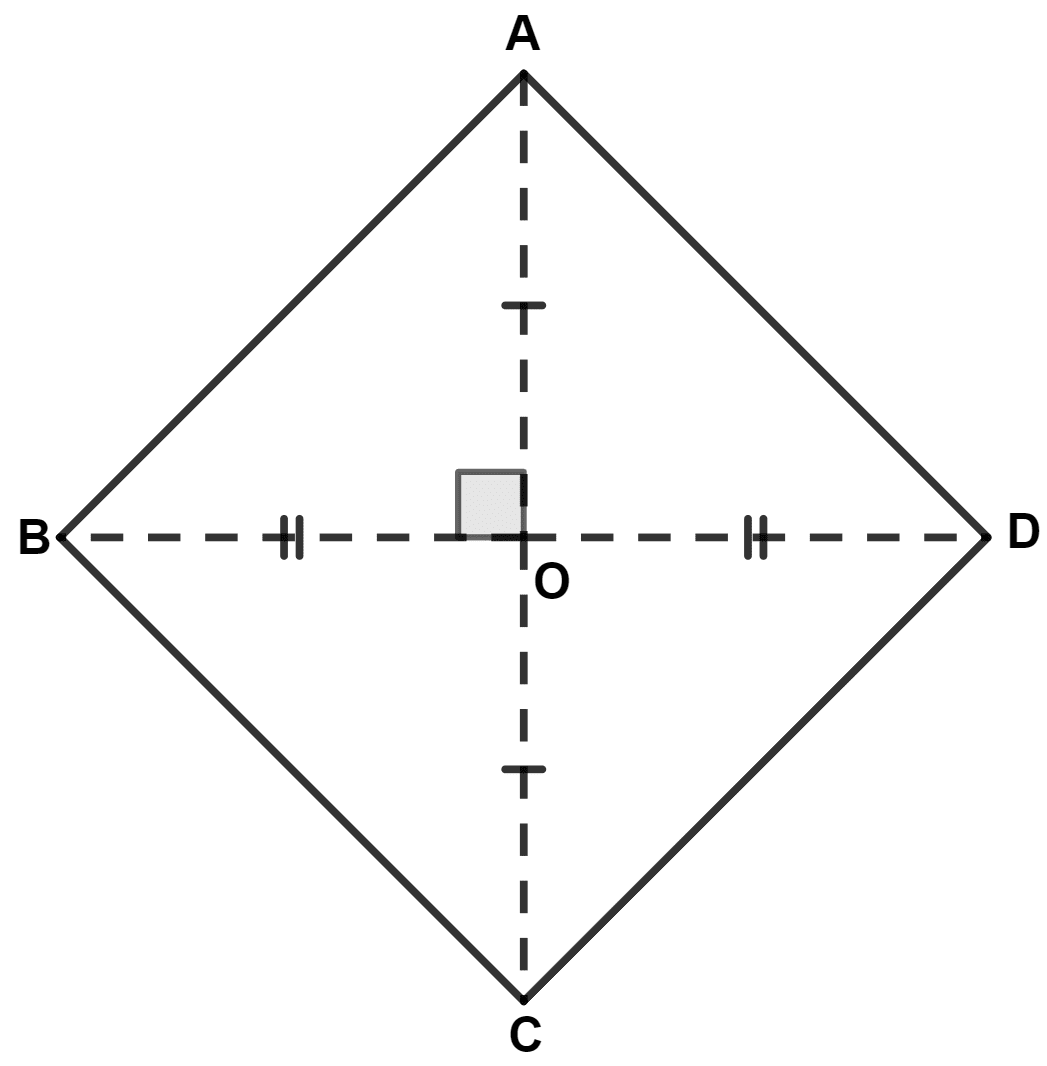
By pythagoras theorem,
⇒ AD2 = OA2 + OD2
⇒ OA2 = AD2 - OD2 ..........(1)
In right angle triangle COD,
By pythagoras theorem,
⇒ CD2 = OC2 + OD2
⇒ OC2 = CD2 - OD2 ..........(2)
To prove :
OA2 + OC2 = 2AD2 -
Solving L.H.S. of the above equation, we get :
⇒ OA2 + OC2 = AD2 - OD2 + CD2 - OD2
⇒ OA2 + OC2 = AD2 + CD2 - 2OD2 .........(3)
Since, all sides of a rhombus are equal and diagonals of rhombus bisect each other,
∴ CD = AD and OD =
Substituting value of CD and OD in equation (3), we get :
⇒ OA2 + OC2 = AD2 + AD2 -
⇒ OA2 + OC2 = 2AD2 -
⇒ OA2 + OC2 = 2AD2 - = R.H.S.
Hence, proved that OA2 + OC2 = 2AD2 - .
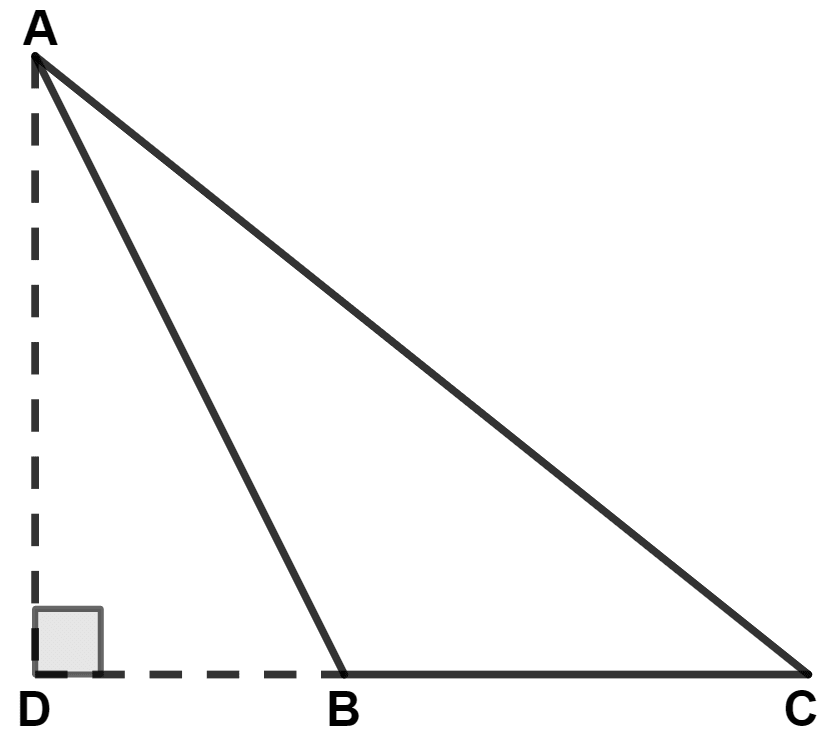
In the figure, AB = BC and AD is perpendicular to CD. Prove that :
AC2 = 2.BC.DC.
Answer
By formula,
By pythagoras theorem,
⇒ (Hypotenuse)2 = (Perpendicular)2 + Base2
In right angle triangle ABD,
By pythagoras theorem,
⇒ AB2 = AD2 + BD2
⇒ AD2 = AB2 - BD2 .........(1)
In right angle triangle ACD,
By pythagoras theorem,
⇒ AC2 = AD2 + DC2
= (AB2 - BD2) + (DB + BC)2 [From equation (1)]
= AB2 - BD2 + DB2 + BC2 + 2.DB.BC
= AB2 + BC2 + 2.DB.BC
= BC2 + BC2 + 2.DB.BC [As, AB = BC]
= 2BC2 + 2.DB.BC
= 2BC(BC + DB)
= 2BC.DC
Hence, proved that AC2 = 2BC.DC
In an isosceles triangle ABC; AB = AC and D is a point on BC produced. Prove that :
AD2 = AC2 + BD.CD
Answer
By formula,
By pythagoras theorem,
⇒ (Hypotenuse)2 = (Perpendicular)2 + Base2
Draw AE perpendicular to BC.
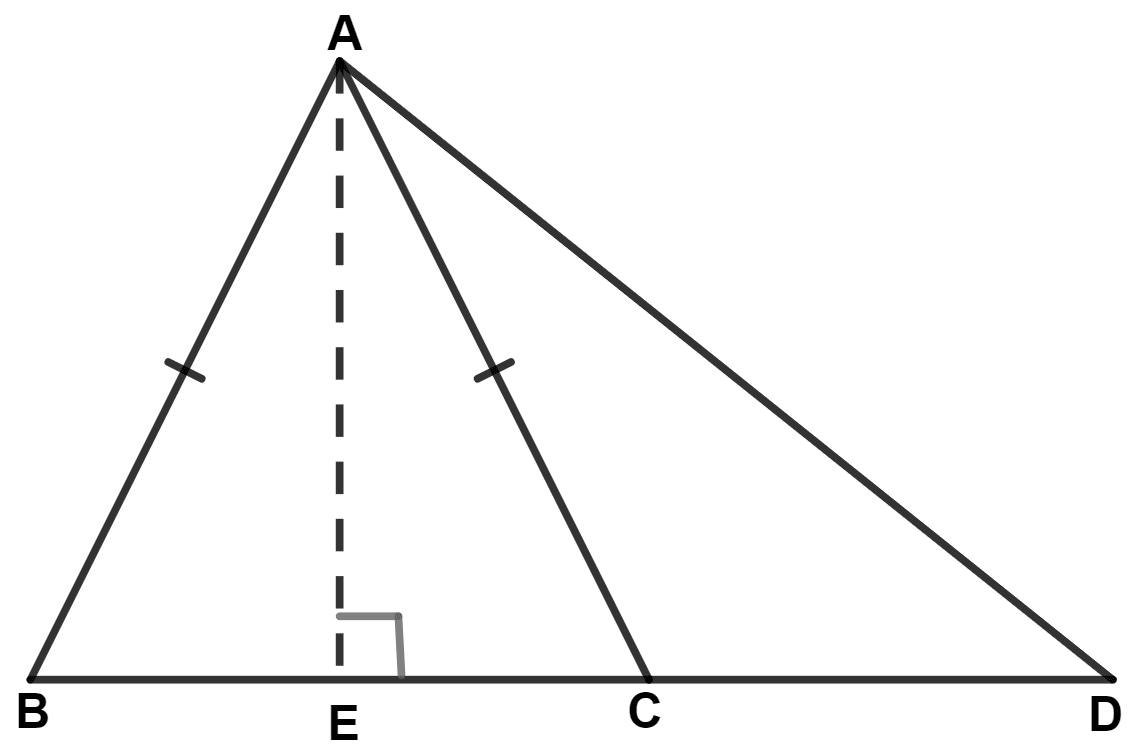
In right angle triangle AED,
By pythagoras theorem,
⇒ AD2 = AE2 + ED2
⇒ AD2 = AE2 + (EC + CD)2 .........(1)
In right angle triangle AEC,
By pythagoras theorem,
⇒ AC2 = AE2 + EC2
⇒ AE2 = AC2 - EC2 .........(2)
Substituting value of AE2 from equation (2) in (1), we get :
⇒ AD2 = AC2 - EC2 + (EC + CD)2
⇒ AD2 = AC2 - EC2 + EC2 + CD2 + 2.EC.CD
⇒ AD2 = AC2 + CD(CD + 2EC) ..........(3)
Since, ABC is an isosceles triangle.
We know that,
In an isosceles triangle altitude from the vertex bisects the base.
∴ E is the mid-point of BC.
⇒ EC = BC
⇒ BC = 2EC.
From figure,
⇒ BD = BC + CD
⇒ BD = 2EC + CD
Substituting above value in equation (3), we get :
⇒ AD2 = AC2 + CD.BD
Hence, proved that AD2 = AC2 + BD.CD
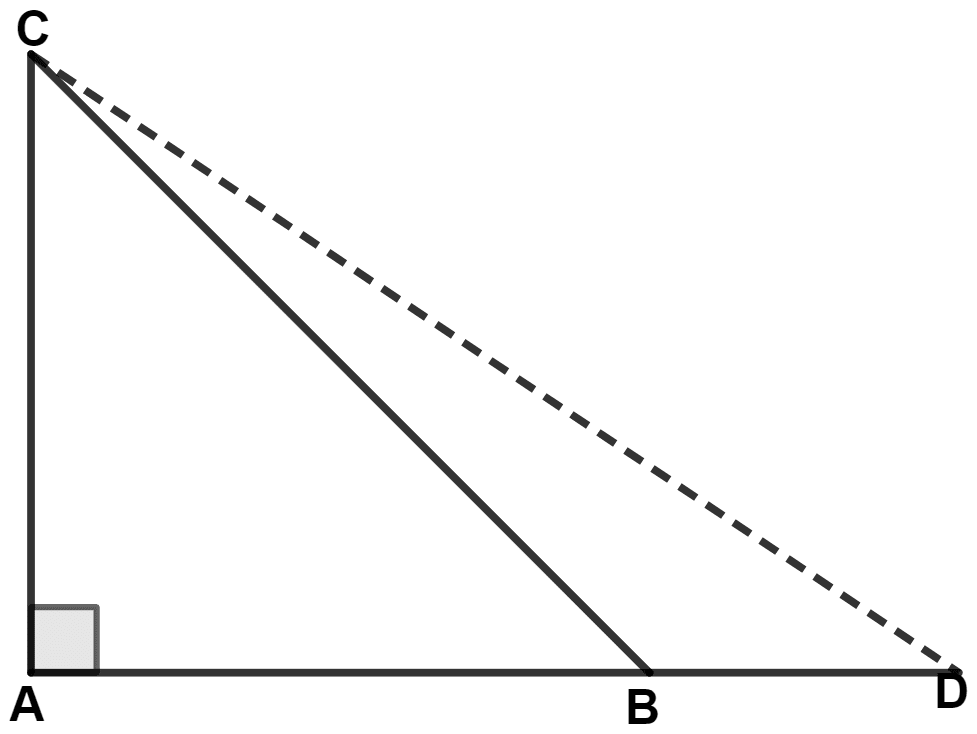
In triangle ABC, angle A = 90°, CA = AB and D is a point on AB produced. Prove that :
DC2 - BD2 = 2AB.AD.
Answer
By formula,
By pythagoras theorem,
⇒ (Hypotenuse)2 = (Perpendicular)2 + Base2
In right angle triangle ACD,
By pythagoras theorem,
⇒ CD2 = AC2 + AD2
⇒ CD2 = AC2 + (AB + BD)2
⇒ CD2 = AC2 + AB2 + BD2 + 2.AB.BD .........(1)
In right angle triangle ABC,
By pythagoras theorem,
⇒ BC2 = AC2 + AB2
⇒ BC2 = AB2 + AB2 (Since, CA = AB)
⇒ BC2 = 2AB2
⇒ AB2 = BC2 .........(2)
Substituting value of AB2 from equation (2) in (1), we get :
⇒ CD2 = AC2 + + BD2 + 2.AB.BD
⇒ CD2 - BD2 = AB2 + + 2.AB.BD [As, AC = AB]
⇒ CD2 - BD2 = AB2 + AB2 + 2.AB.(AD - AB) [From equation (2)]
⇒ CD2 - BD2 = 2AB2 + 2.AB.AD - 2.AB2
⇒ CD2 - BD2 = 2.AB.AD
Hence, proved that CD2 - BD2 = 2.AB.AD
In triangle ABC, AB = AC and BD is perpendicular to AC. Prove that :
BD2 - CD2 = 2CD × AD
Answer
By formula,
By pythagoras theorem,
⇒ (Hypotenuse)2 = (Perpendicular)2 + Base2
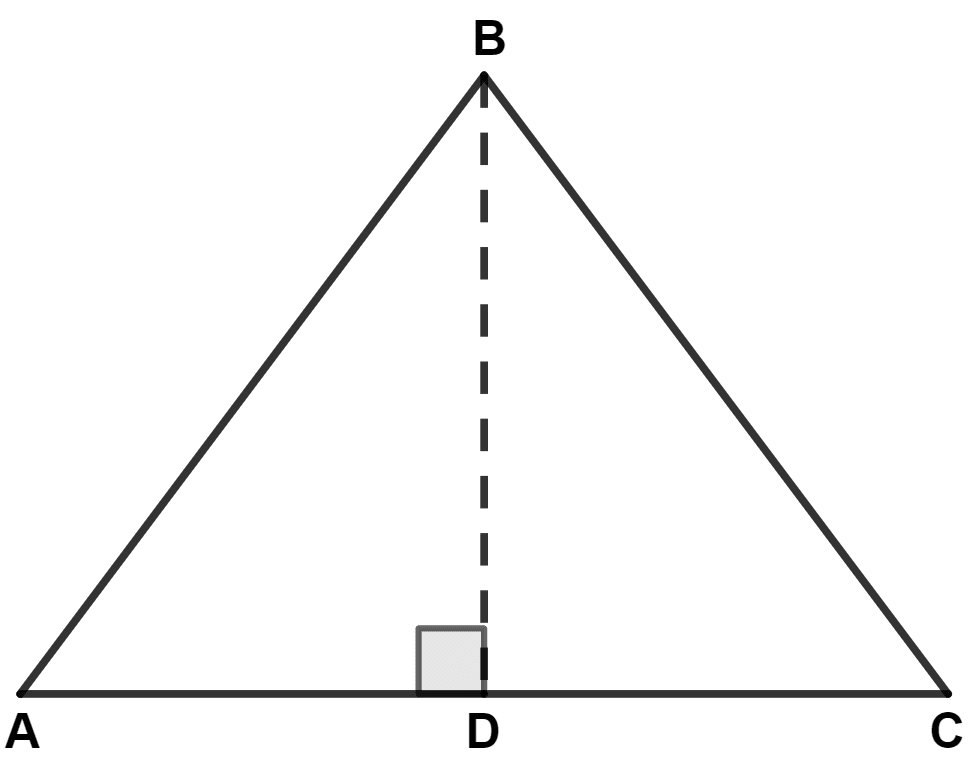
In right-angled triangle ABD,
By pythagoras theorem,
⇒ AB2 = AD2 + BD2
⇒ AD2 = AB2 - BD2 .......(1)
From figure,
⇒ AC = AD + DC
Squaring both sides, we get :
⇒ AC2 = (AD + DC)2
⇒ AC2 = AD2 + DC2 + 2AD.DC
⇒ AC2 = AB2 - BD2 + DC2 + 2AD.DC [From equation (1)]
Substituting AB = AC, in above equation :
⇒ AC2 = AC2 - BD2 + DC2 + 2AD.DC
⇒ AC2 - AC2 + BD2 - DC2 = 2AD.DC
⇒ BD2 - DC2 = 2CD × AD.
Hence, proved that BD2 - DC2 = 2CD × AD.
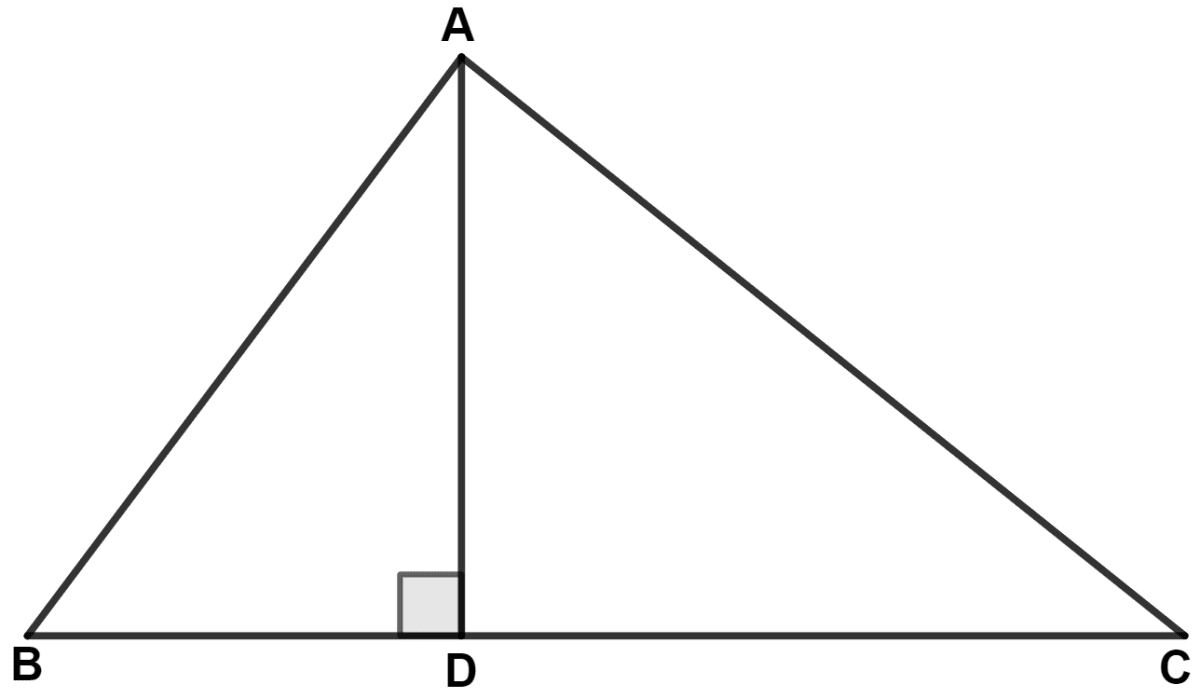
In the following figure, AD is perpendicular to BC and D divides BC in the ratio 1 : 3.
Prove that : 2AC2 = 2AB2 + BC2.
Answer
Given,
D divides BC in the ratio 1 : 3.
⇒ BD : DC = 1 : 3
Let BD = x and DC = 3x
From figure,
⇒ BC = BD + DC = x + 3x = 4x.
In right angle triangle ADC,
By pythagoras theorem,
⇒ AC2 = AD2 + CD2 ............(1)
In right angle triangle ABD,
By pythagoras theorem,
⇒ AB2 = AD2 + BD2 ............(2)
Subtracting equation (2) from (1), we get :
⇒ AC2 - AB2 = AD2 + CD2 - (AD2 + BD2)
⇒ AC2 - AB2 = CD2 - BD2
Substituting value of BD and CD in above equation, we get :
Hence, proved that 2AC2 = 2AB2 + BC2.
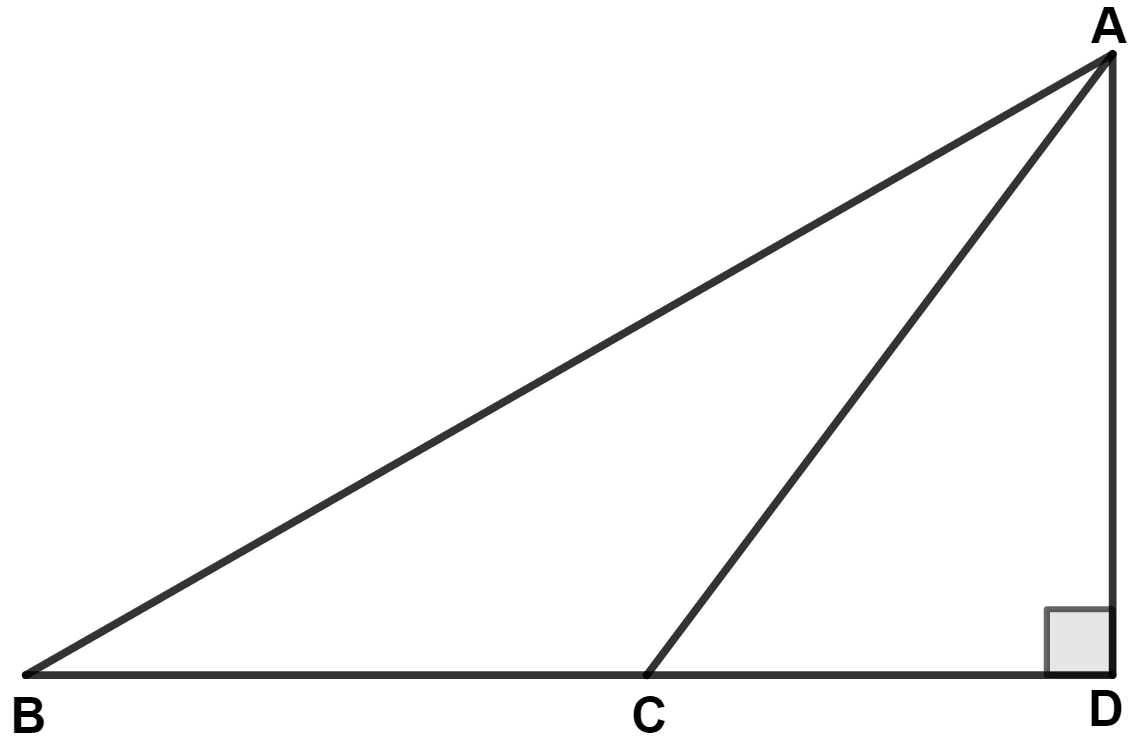
In the given figure, AB = 16 cm, BC = 12 cm and CA = 6 cm; find the length of CD.
Answer
By formula,
By pythagoras theorem,
⇒ (Hypotenuse)2 = (Perpendicular)2 + Base2
Let CD be x cm.
In right angle triangle ACD,
By pythagoras theorem,
⇒ AC2 = AD2 + CD2
⇒ 62 = AD2 + x2
⇒ 36 = AD2 + x2
⇒ AD2 = 36 - x2 ........(1)
In right angle triangle ABD,
By pythagoras theorem,
⇒ AB2 = AD2 + BD2
⇒ 162 = AD2 + (BC + CD)2
⇒ 256 = 36 - x2 + (12 + x)2 [From equation (1)]
⇒ 256 = 36 - x2 + 122 + x2 + 2(12)x
⇒ 256 = 36 + 144 + 24x
⇒ 256 = 180 + 24x
⇒ 24x = 256 - 180
⇒ 24x = 76
⇒ x = cm.
Hence, CD = cm.
In a quadrilateral ABCD, ∠A + ∠D = 90°, prove that : AC2 + BD2 = AD2 + BC2.
Answer
Produce AB and DC such that they meet at point E.
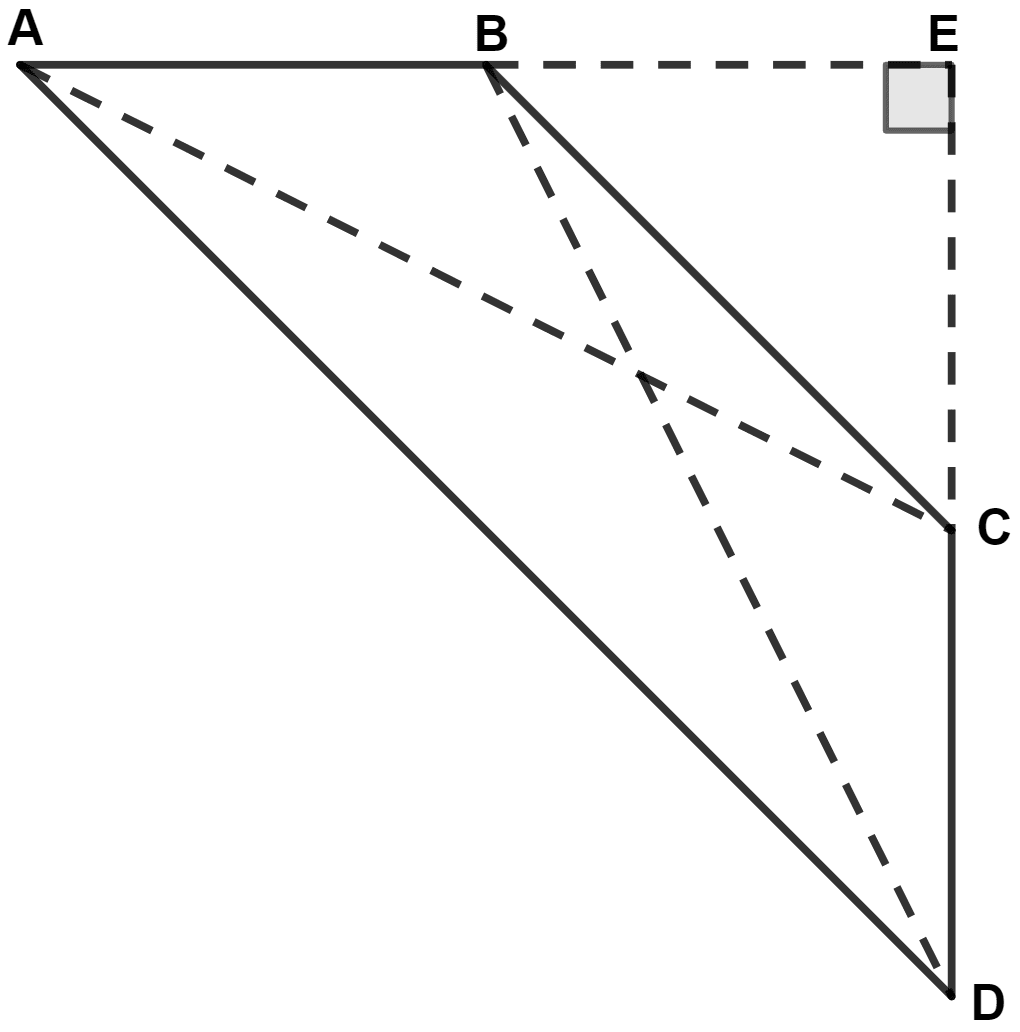
By formula,
By pythagoras theorem,
⇒ (Hypotenuse)2 = (Perpendicular)2 + Base2
In △ AED,
⇒ ∠A + ∠D + ∠E = 180°
⇒ 90° + ∠E = 180°
⇒ ∠E = 180° - 90° = 90°.
By pythagoras theorem,
⇒ AD2 = AE2 + DE2 .........(1)
In △ BEC,
By pythagoras theorem,
⇒ BC2 = BE2 + CE2 .........(2)
In △ AEC,
By pythagoras theorem,
⇒ AC2 = AE2 + CE2 .........(3)
In △ BED,
By pythagoras theorem,
⇒ BD2 = BE2 + DE2 .........(4)
Adding equations (1) and (2), we get :
⇒ AD2 + BC2 = AE2 + DE2 + BE2 + CE2
⇒ AD2 + BC2 = (AE2 + CE2) + (BE2 + DE2)
⇒ AD2 + BC2 = AC2 + BD2.
Hence, proved that AC2 + BD2 = AD2 + BC2.