
In △ ABC, ∠C = 90° and AC = BC, then AB2 is equal to :
AC2
2AC2
BC2
2BC2 - AC2
Answer
ABC is a right-angled triangle at C.
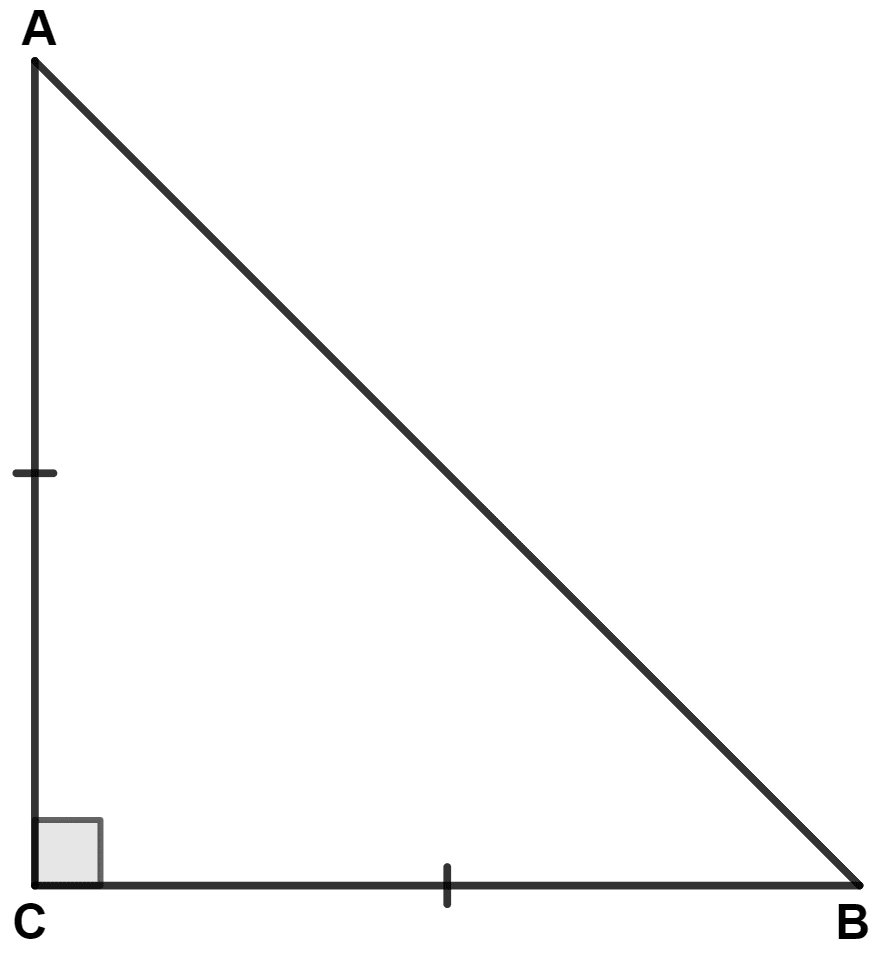
By pythagoras theorem,
⇒ (Hypotenuse)2 = (Perpendicular)2 + (Base)2
⇒ AB2 = AC2 + BC2
⇒ AB2 = AC2 + AC2 (Since, AC = BC)
⇒ AB2 = 2AC2.
Hence, Option 2 is the correct option.
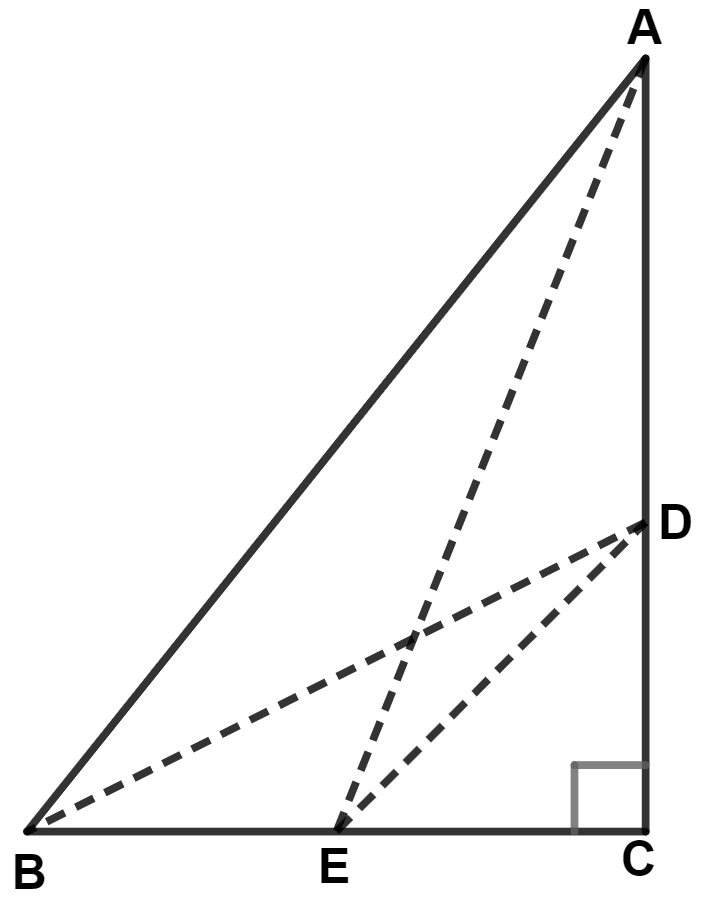
In the given diagram, AE2 + BD2 is equal to :
AB2 - DE2
DE2 - AB2
AB2 + DE2
DE × AB
Answer
By Formula,
By pythagoras theorem,
(Hypotenuse)2 = (Perpendicular)2 + (Base)2.
In right-angled triangle ABC,
⇒ AB2 = AC2 + BC2 ........(1)
In right-angled triangle DEC,
⇒ DE2 = CD2 + EC2 ........(2)
In right-angled triangle AEC,
⇒ AE2 = AC2 + EC2 ........(3)
In right-angled triangle BDC,
⇒ BD2 = CD2 + BC2 ........(4)
Adding equations (3) and (4), we get :
⇒ AE2 + BD2 = AC2 + EC2 + CD2 + BC2
= (AC2 + BC2) + (CD2 + EC2)
= AB2 + DE2 [From equations (1) and (2)].
Hence, Option 3 is the correct option.
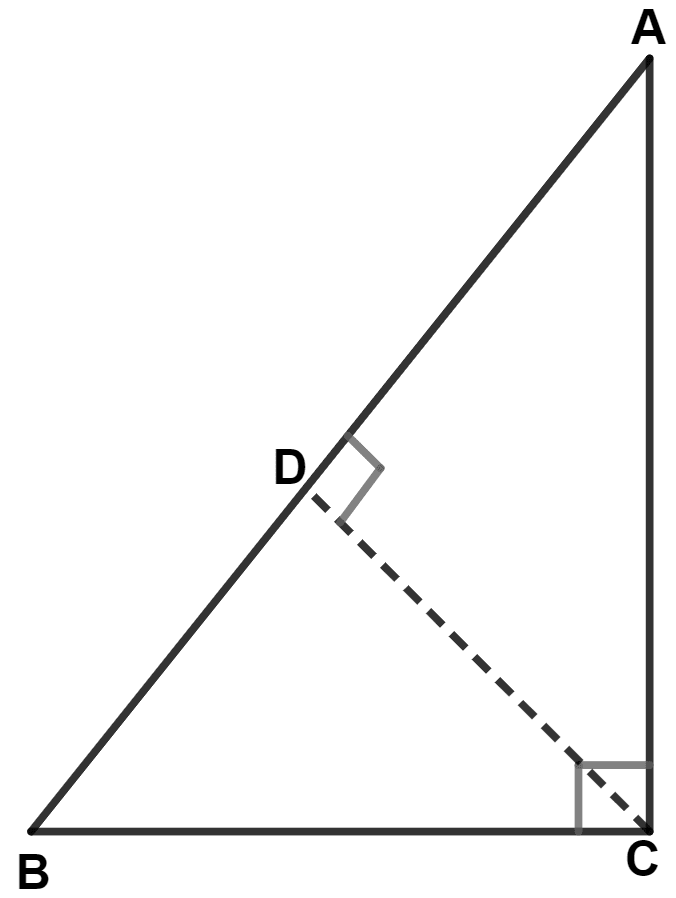
In the given figure, the value of AB × CD is :
AC × BC
AC × CD
AC × AB
AC2 + BC2
Answer
By formula,
⇒ Area of triangle = × base × height
From figure,
⇒ Area of △ ABC = × AB × CD .........(1)
⇒ Area of △ ABC = × BC × AC .........(2)
From equations (1) and (2), we get :
⇒ × AB × CD = × BC × AC
⇒ AB × CD = BC × AC.
Hence, Option 1 is the correct option.
ABC is an isosceles triangle right-angled at C. Then 2AC2 is equal to :
BC2
AC2
AC2 - BC2
AB2
Answer

Since, ABC is an isosceles triangle right-angled at C.
∴ ∠A = ∠B
∴ BC = AC [Sides opposite to equal angles are equal] ........(1)
In right-angled △ ABC,
By pythagoras theorem,
⇒ (Hypotenuse)2 = (Perpendicular)2 + (Base)2
⇒ AB2 = AC2 + BC2
⇒ AB2 = AC2 + AC2 [From equation (1)]
⇒ AB2 = 2AC2.
Hence, Option 4 is the correct option.
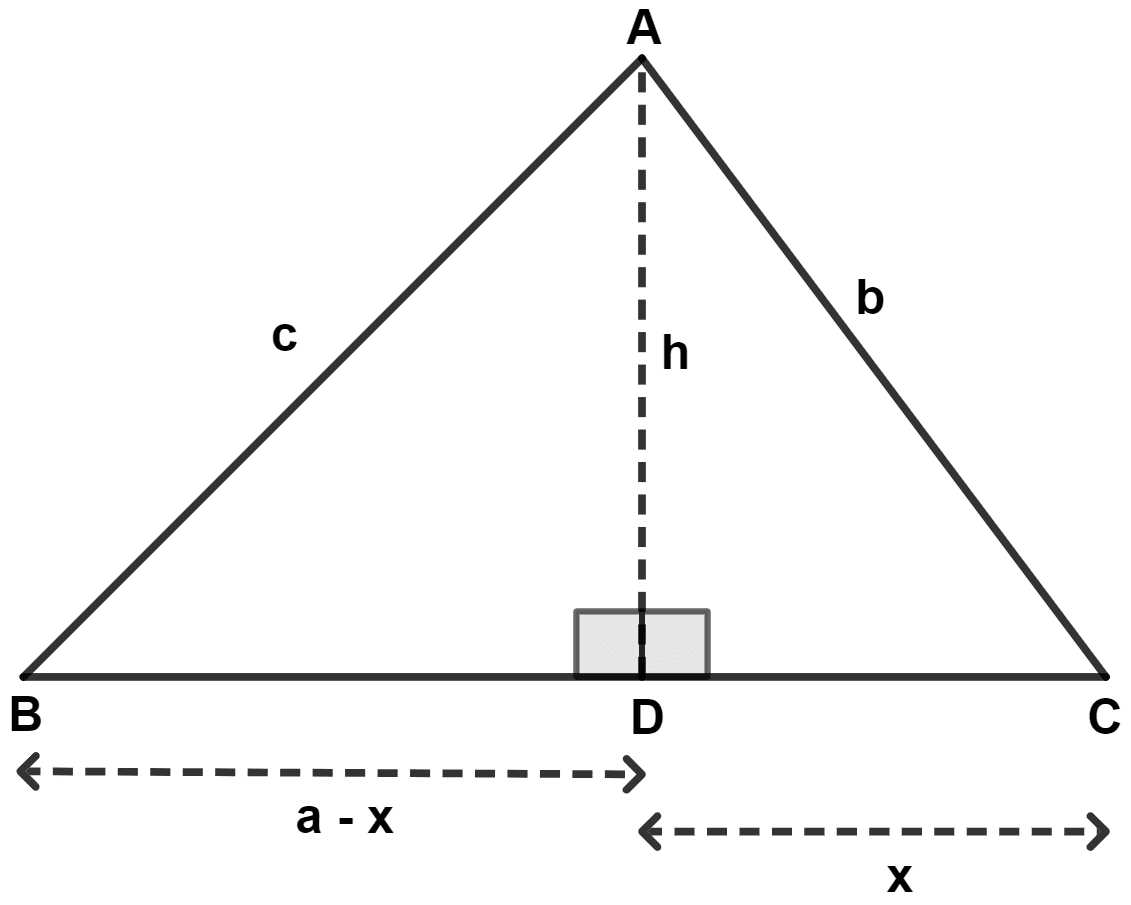
In the figure, given below, AD ⊥ BC. Prove that :
c2 = a2 + b2 - 2ax.
Answer
By formula,
By pythagoras theorem,
⇒ (Hypotenuse)2 = (Perpendicular)2 + (Base)2
In right-angled △ ABD,
⇒ AB2 = AD2 + BD2
⇒ c2 = h2 + (a - x)2 .............(1)
In right-angled △ ACD,
⇒ AC2 = AD2 + CD2
⇒ b2 = h2 + x2
⇒ h2 = b2 - x2 ..........(2)
Substituting value of h2 from equation (2) in (1), we get :
⇒ c2 = b2 - x2 + (a - x)2
⇒ c2 = b2 - x2 + a2 + x2 - 2ax
⇒ c2 = a2 + b2 - 2ax.
Hence, proved that c2 = a2 + b2 - 2ax.
In equilateral △ ABC, AD ⊥ BC and BC = x cm. Find, in terms of x, the length of AD.
Answer
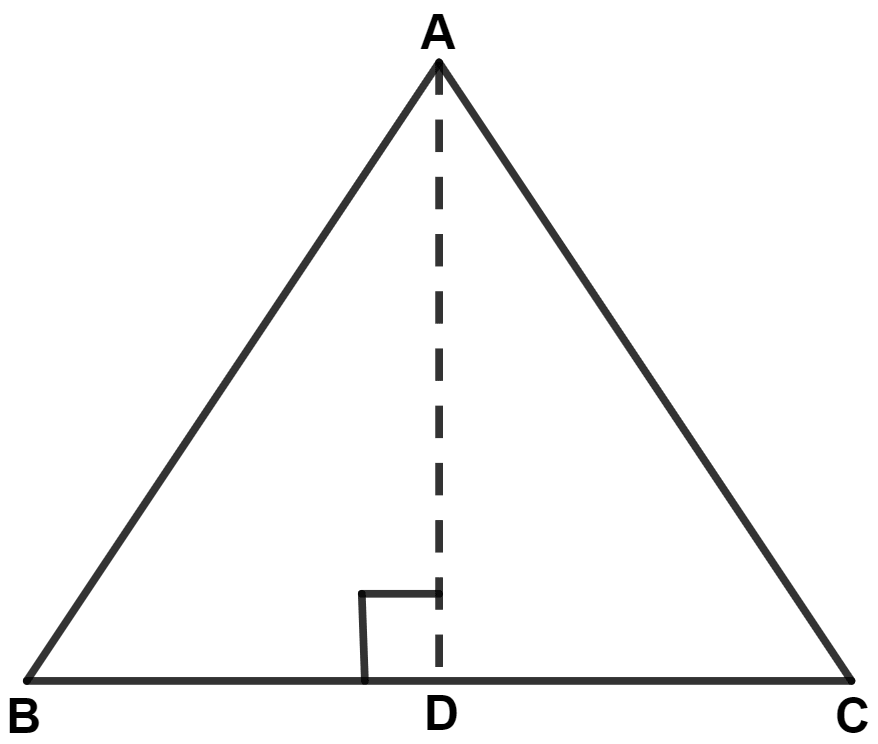
In △ ABD and △ ACD,
⇒ ∠ADB = ∠ADC (Both equal to 90°)
⇒ AD = AD (Common side)
⇒ AB = AC (Since, ABC is an equilateral triangle)
∴ △ ABD ≅ △ ACD (By S.A.S. axiom)
We know that,
Corresponding parts of congruent triangle are equal.
∴ BD = CD = cm.
In right-angled triangle ABD,
By pythagoras theorem,
⇒ (Hypotenuse)2 = (Perpendicular)2 + (Base)2
⇒ AB2 = AD2 + BD2
⇒ x2 = AD2 +
⇒ AD2 = x2 -
⇒ AD2 =
⇒ AD2 =
⇒ AD2 =
⇒ AD = cm.
Hence, AD = cm.
ABC is a triangle, right-angled at B. M is a point on BC. Prove that :
AM2 + BC2 = AC2 + BM2.
Answer
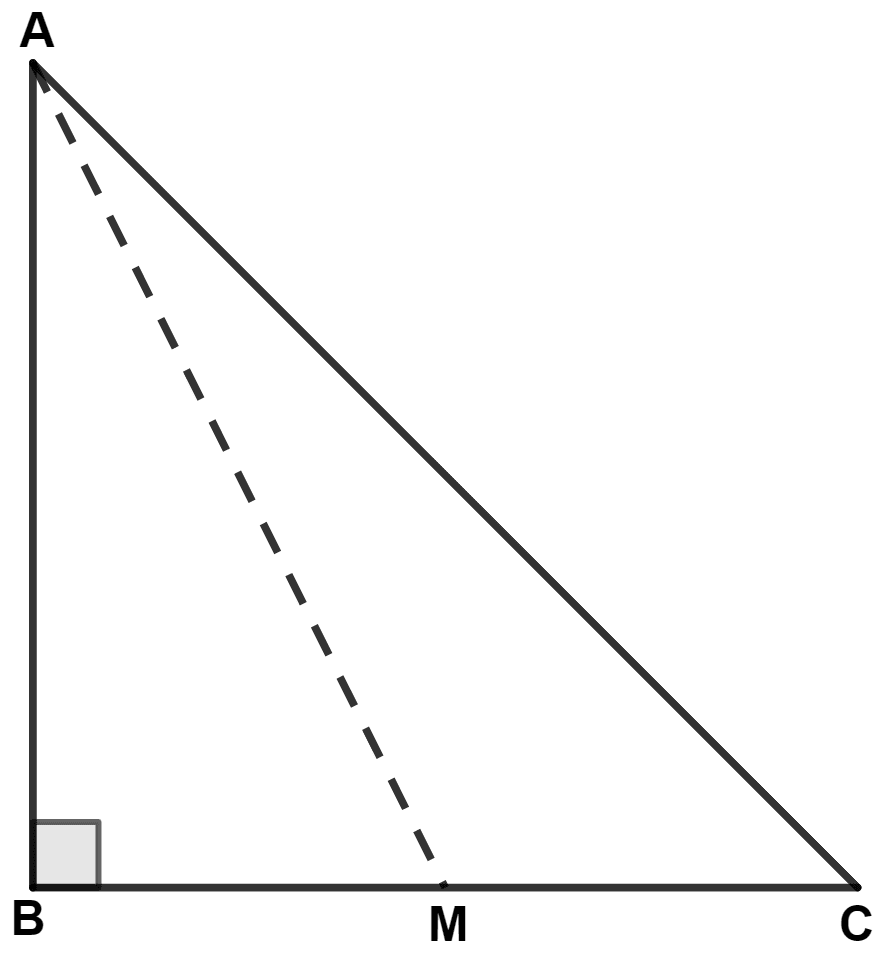
By formula,
By pythagoras theorem,
⇒ (Hypotenuse)2 = (Perpendicular)2 + (Base)2
In right-angled △ ABM,
⇒ AM2 = AB2 + BM2
⇒ AB2 = AM2 - BM2 ...........(1)
In right-angled △ ABC,
⇒ AC2 = AB2 + BC2
⇒ AB2 = AC2 - BC2 ...........(2)
From equations (1) and (2), we get :
⇒ AM2 - BM2 = AC2 - BC2
⇒ AM2 + BC2 = AC2 + BM2.
Hence, proved AM2 + BC2 = AC2 + BM2.
M and N are the mid-points of the sides QR and PQ respectively of a △ PQR, right-angled at Q. Prove that :
(i) PM2 + RN2 = 5 MN2
(ii) 4 PM2 = 4 PQ2 + QR2
(iii) 4 RN2 = PQ2 + 4 QR2
(iv) 4 (PM2 + RN2) = 5 PR2
Answer
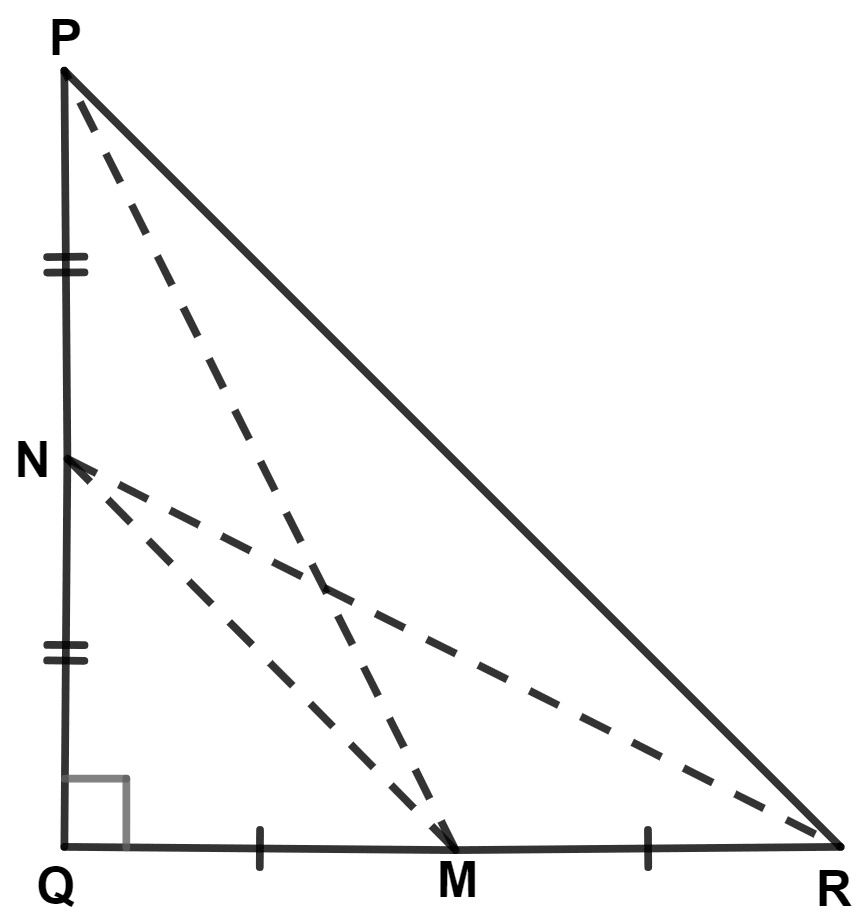
Since, M and N are the mid-points of the sides QR and PQ respectively.
PN = NQ and QM = RM
(i) In △ MNQ,
By pythagoras theorem,
⇒ MN2 = NQ2 + QM2 ..........(1)
In △ PQM,
By pythagoras theorem,
⇒ PM2 = PQ2 + QM2
⇒ PM2 = (PN + NQ)2 + QM2
⇒ PM2 = PN2 + NQ2 + 2.PN.NQ + QM2
⇒ PM2 = MN2 + PN2 + 2.PN.NQ [From equation (1)] ...........(2)
In △ RNQ,
By pythagoras theorem,
⇒ RN2 = NQ2 + RQ2
⇒ RN2 = NQ2 + (QM + RM)2
⇒ RN2 = NQ2 + QM2 + RM2 + 2.QM.RM
⇒ RN2 = MN2 + RM2 + 2.QM.RM [From equation (1)] ...........(3)
Adding equations (2) and (3), we get :
⇒ PM2 + RN2 = MN2 + PN2 + 2.PN.NQ + MN2 + RM2 + 2.QM.RM
⇒ PM2 + RN2 = 2MN2 + PN2 + RM2 + 2.PN.NQ + 2.QM.RM
Substituting PN = QN and RM = QM in above equation, we get :
⇒ PM2 + RN2 = 2MN2 + QN2 + QM2 + 2.NQ.NQ + 2.QM.QM
⇒ PM2 + RN2 = 2MN2 + QN2 + QM2 + 2 QN2 + 2 QM2
⇒ PM2 + RN2 = 2MN2 + (QN2 + QM2) + 2 (QN2 + QM2)
⇒ PM2 + RN2 = 2MN2 + MN2 + 2MN2 [From equation (1)]
⇒ PM2 + RN2 = 5MN2.
Hence, proved that PM2 + RN2 = 5MN2.
(ii) In △ PQM,
By pythagoras theorem,
⇒ PM2 = PQ2 + QM2
Multiplying both sides of the above equation by 4, we get :
⇒ 4PM2 = 4PQ2 + 4QM2
⇒ 4PM2 = 4PQ2 +
⇒ 4PM2 = 4PQ2 +
⇒ 4PM2 = 4PQ2 + QR2.
Hence, proved that 4PM2 = 4PQ2 + QR2.
(iii) In △ RQN,
By pythagoras theorem,
⇒ RN2 = NQ2 + QR2
Multiplying both sides of the above equation by 4, we get :
⇒ 4RN2 = 4NQ2 + 4QR2
⇒ 4RN2 = 4QR2 +
⇒ 4RN2 = 4QR2 +
⇒ 4RN2 = 4QR2 + PQ2.
Hence, proved that 4RN2 = PQ2 + 4QR2.
(iv) Proved in part (i), we get :
⇒ PM2 + RN2 = 5MN2
Multiplying both side of the above equation by 4, we get :
⇒ 4(PM2 + RN2) = 4 × 5 MN2
⇒ 4(PM2 + RN2) = 4 × 5 (NQ2 + MQ2)
⇒ 4(PM2 + RN2) = 4 × 5
⇒ 4(PM2 + RN2) = 4 × 5
⇒ 4(PM2 + RN2) = 4 × 5 (PQ2 + RQ2)
⇒ 4(PM2 + RN2) = 5 (PQ2 + RQ2) .....(4)
In right angled triangle PQR,
By pythagoras theorem,
⇒ PR2 = PQ2 + RQ2
Substituting above value of PR2 in equation (4), we get :
⇒ 4(PM2 + RN2) = 5 PR2.
Hence, proved that 4(PM2 + RN2) = 5 PR2.
In triangle ABC, ∠B = 90° and D is the mid-point of BC. Prove that : AC2 = AD2 + 3CD2.
Answer
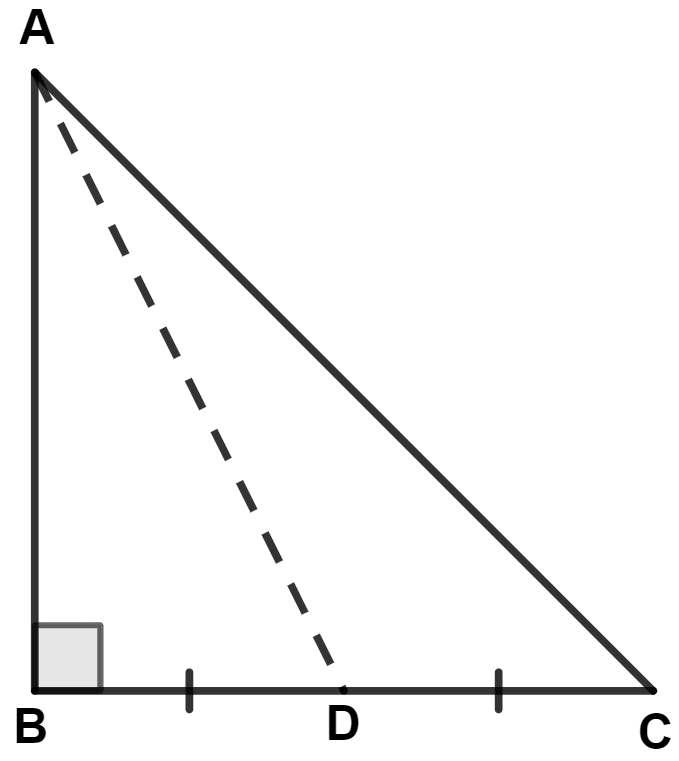
Given,
D is the mid-point of BC.
∴ CD = BD ........(1)
By formula,
By pythagoras theorem,
⇒ (Hypotenuse)2 = (Perpendicular)2 + (Base)2
In right-angled △ ABC,
⇒ AC2 = AB2 + BC2
⇒ AC2 = AB2 + (BD + CD)2
⇒ AC2 = AB2 + (CD + CD)2 ..........[From equation (1)]
⇒ AC2 = AB2 + (2CD)2
⇒ AC2 = AB2 + 4 CD2 ...........(2)
In right-angled △ ABD,
⇒ AD2 = AB2 + BD2
⇒ AD2 = AB2 + CD2 [From equation (1)] .......(3)
Subtracting equation (3) from (2), we get :
⇒ AC2 - AD2 = AB2 + 4 CD2 - (AB2 + CD2)
⇒ AC2 - AD2 = AB2 - AB2 + 4 CD2 - CD2
⇒ AC2 - AD2 = 3 CD2
⇒ AC2 = AD2 + 3 CD2.
Hence, proved that AC2 = AD2 + 3 CD2.
In a rectangle ABCD, prove that :
AC2 + BD2 = AB2 + BC2 + CD2 + DA2.
Answer
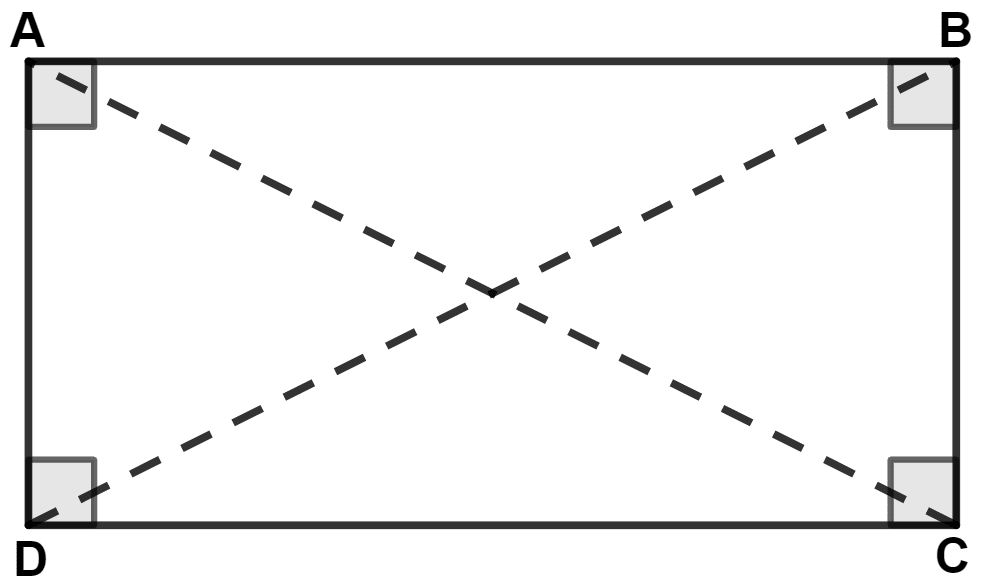
In rectangle the interior angles equal to 90° and opposite sides are equal.
∴ ∠A = ∠B = ∠C = ∠D = 90°, AB = DC and BC = AD.
By formula,
By pythagoras theorem,
⇒ (Hypotenuse)2 = (Perpendicular)2 + (Base)2
In right-angled △ ACD,
⇒ AC2 = AD2 + CD2 ........(1)
In right-angled △ BCD,
⇒ BD2 = BC2 + CD2
⇒ BD2 = BC2 + AB2 (As CD = AB) .........(2)
Adding equation (1) and (2), we get :
⇒ AC2 + BD2 = AD2 + CD2 + BC2 + AB2.
Hence, proved that AC2 + BD2 = AB2 + BC2 + CD2 + DA2.
In a quadrilateral ABCD, ∠B = 90° and ∠D = 90°. Prove that :
2AC2 - AB2 = BC2 + CD2 + DA2.
Answer
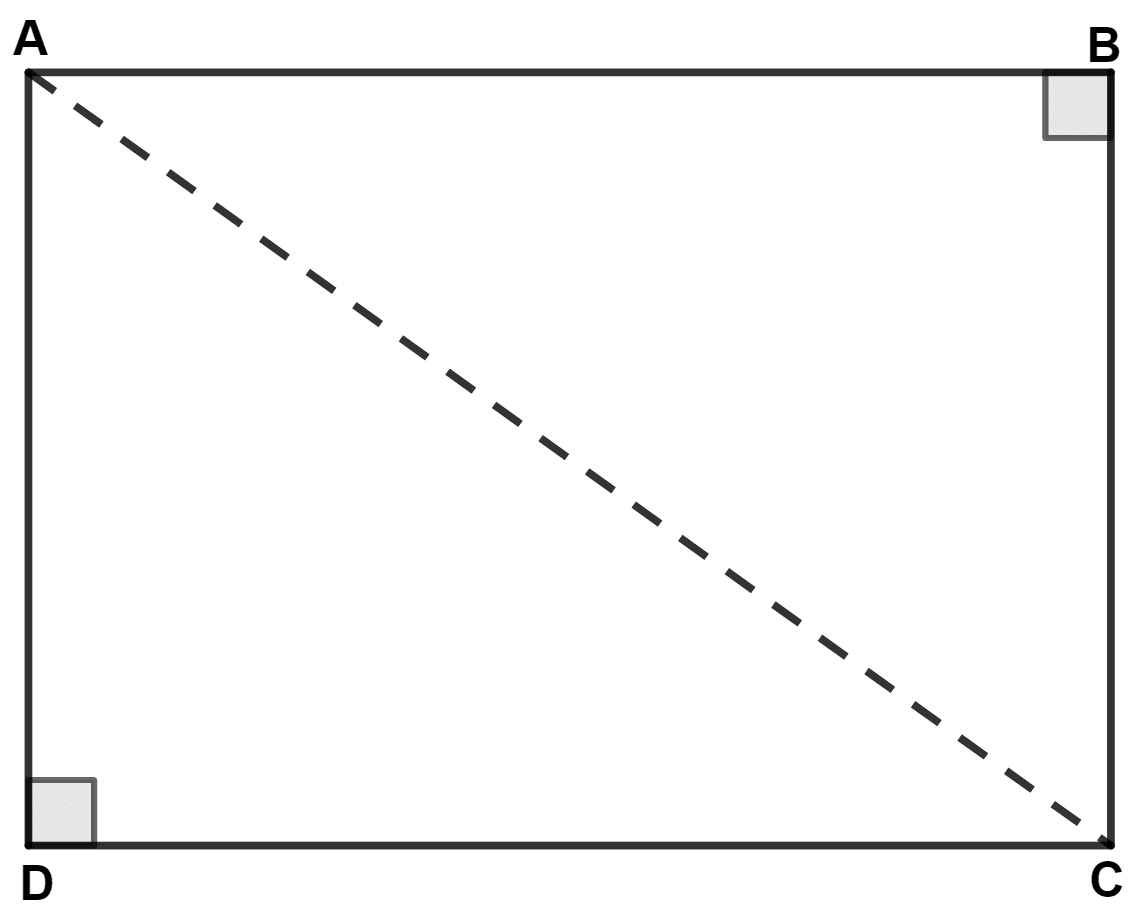
In right-angled triangle ABC,
By pythagoras theorem,
⇒ AC2 = AB2 + BC2
⇒ AB2 = AC2 - BC2 .........(1)
In right-angled triangle ADC,
By pythagoras theorem,
⇒ AC2 = AD2 + DC2 ........(2)
To prove :
2AC2 - AB2 = BC2 + CD2 + DA2.
Solving L.H.S. of the equation :
⇒ 2AC2 - AB2 = 2AC2 - (AC2 - BC2) [From equation (1)]
= 2AC2 - AC2 + BC2
= AC2 + BC2
= AD2 + DC2 + BC2 [From equation (2)]
= R.H.S.
Hence, proved that 2AC2 - AB2 = BC2 + CD2 + DA2.
O is any point inside a rectangle ABCD. Prove that :
OB2 + OD2 = OC2 + OA2.
Answer
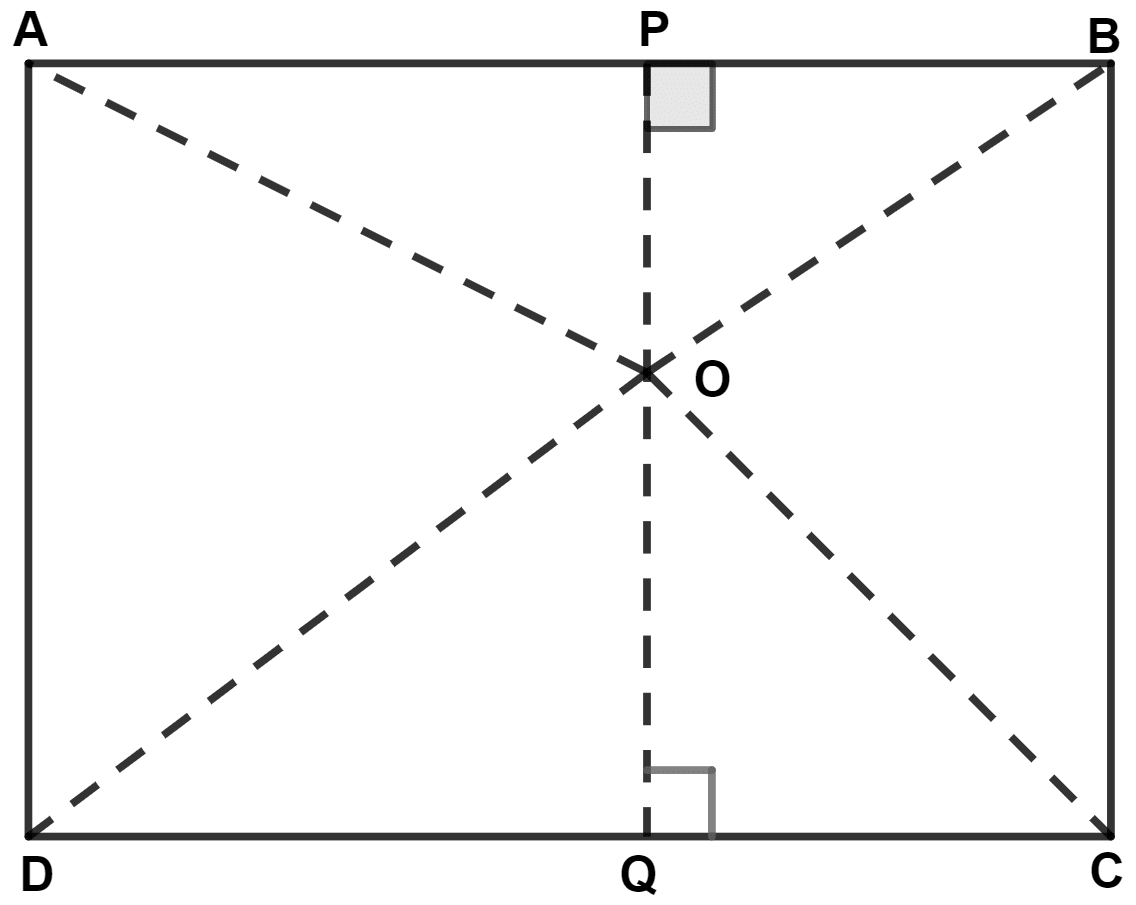
Through point O, draw PQ || BC so that P lies on AB and Q lies on DC.
Since, PQ || BC and AB ⊥ BC,
∴ AB ⊥ PQ and DC ⊥ PQ.
∴ BPQC and APQD are both rectangles.
In right-angled triangle OBP,
By pythagoras theorem,
⇒ OB2 = OP2 + BP2 ..........(1)
In right-angled triangle OQD,
By pythagoras theorem,
⇒ OD2 = OQ2 + DQ2 ..........(2)
In right-angled triangle OQC,
By pythagoras theorem,
⇒ OC2 = OQ2 + QC2 ..........(3)
In right-angled triangle OAP,
By pythagoras theorem,
⇒ OA2 = OP2 + AP2 ..........(4)
Adding equations (1) and (2), we get :
⇒ OB2 + OD2 = OP2 + BP2 + OQ2 + DQ2
= OP2 + CQ2 + OQ2 + AP2 (As, BP = CQ and DQ = AP)
= CQ2 + OQ2 + OP2 + AP2
= OC2 + OA2. [From equation (3) and (4)]
Hence, proved that OB2 + OD2 = OC2 + OA2.
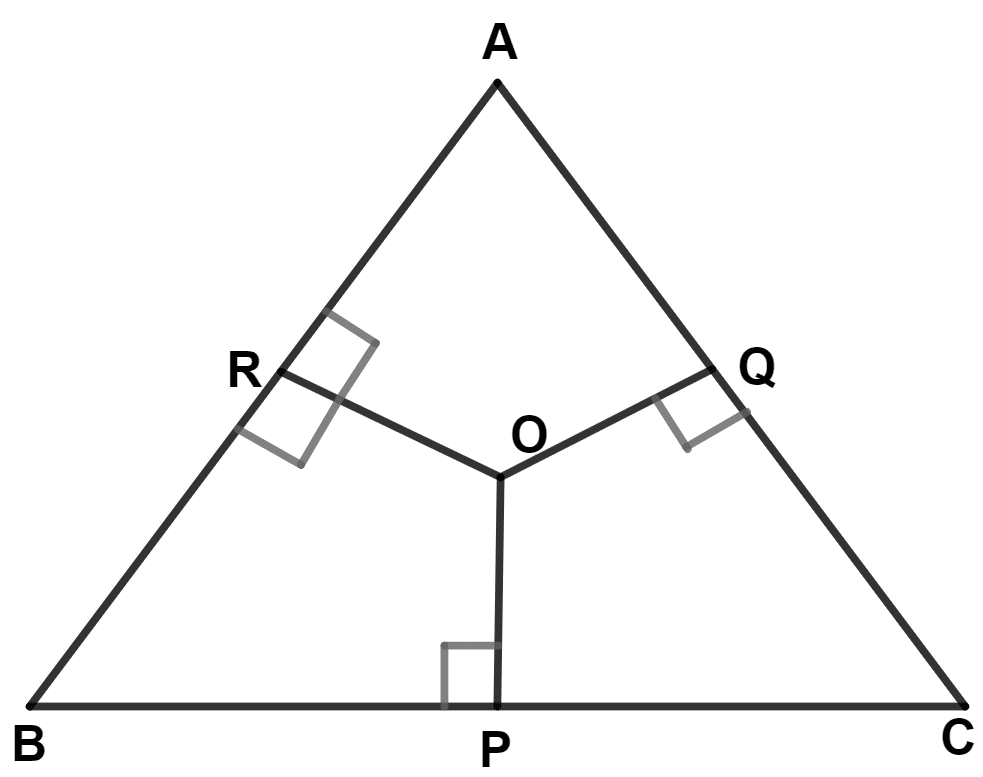
In the following figure, OP, OQ and OR are drawn perpendiculars to the sides BC, CA and AB respectively of triangle ABC. Prove that :
AR2 + BP2 + CQ2 = AQ2 + CP2 + BR2.
Answer
Join OA, OB and OC.
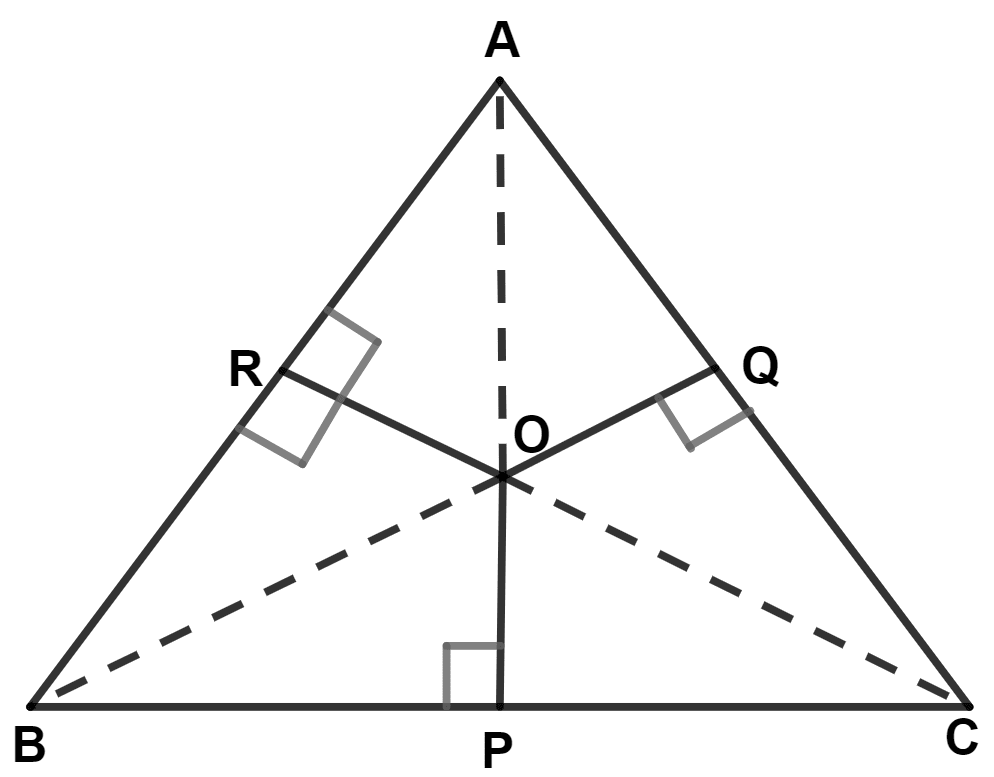
By formula,
By pythagoras theorem,
(Hypotenuse)2 = (Perpendicular)2 + (Base)2
In right-angled triangle AOR,
⇒ AO2 = AR2 + OR2
⇒ AR2 = AO2 - OR2 ..........(1)
In right-angled triangle BOP,
⇒ BO2 = BP2 + OP2
⇒ BP2 = BO2 - OP2 ..........(2)
In right-angled triangle COQ,
⇒ CO2 = CQ2 + OQ2
⇒ CQ2 = CO2 - OQ2 ..........(3)
In right-angled triangle AOQ,
⇒ AO2 = AQ2 + OQ2
⇒ AQ2 = AO2 - OQ2 ..........(4)
In right-angled triangle COP,
⇒ CO2 = CP2 + OP2
⇒ CP2 = CO2 - OP2 ..........(5)
In right-angled triangle BOR,
⇒ BO2 = BR2 + OR2
⇒ BR2 = BO2 - OR2 ..........(6)
Adding equations (1), (2) and (3), we get :
⇒ AR2 + BP2 + CQ2 = AO2 - OR2 + BO2 - OP2 + CO2 - OQ2 ..........(7)
Adding equations (4), (5) and (6), we get :
⇒ AQ2 + CP2 + BR2 = AO2 - OQ2 + CO2 - OP2 + BO2 - OR2
⇒ AQ2 + CP2 + BR2 = AO2 - OR2 + BO2 - OP2 + CO2 - OQ2 ...........(8)
From equations (7) and (8), we get :
⇒ AR2 + BP2 + CQ2 = AQ2 + CP2 + BR2.
Hence, proved that AR2 + BP2 + CQ2 = AQ2 + CP2 + BR2.