The negative of an irrational number is :
a rational number
an irrational number
a rational number and an irrational number
a whole number
Answer
Negative of an irrational number is also an irrational number.
Hence, Option 2 is the correct option.
8(8−1) is always :
rational
irrational
whole number
natural number
Answer
Given,
⇒8(8−1)⇒8−8⇒8−2.82...⇒5.17....
which is an irrational number.
Hence, Option 2 is the correct option.
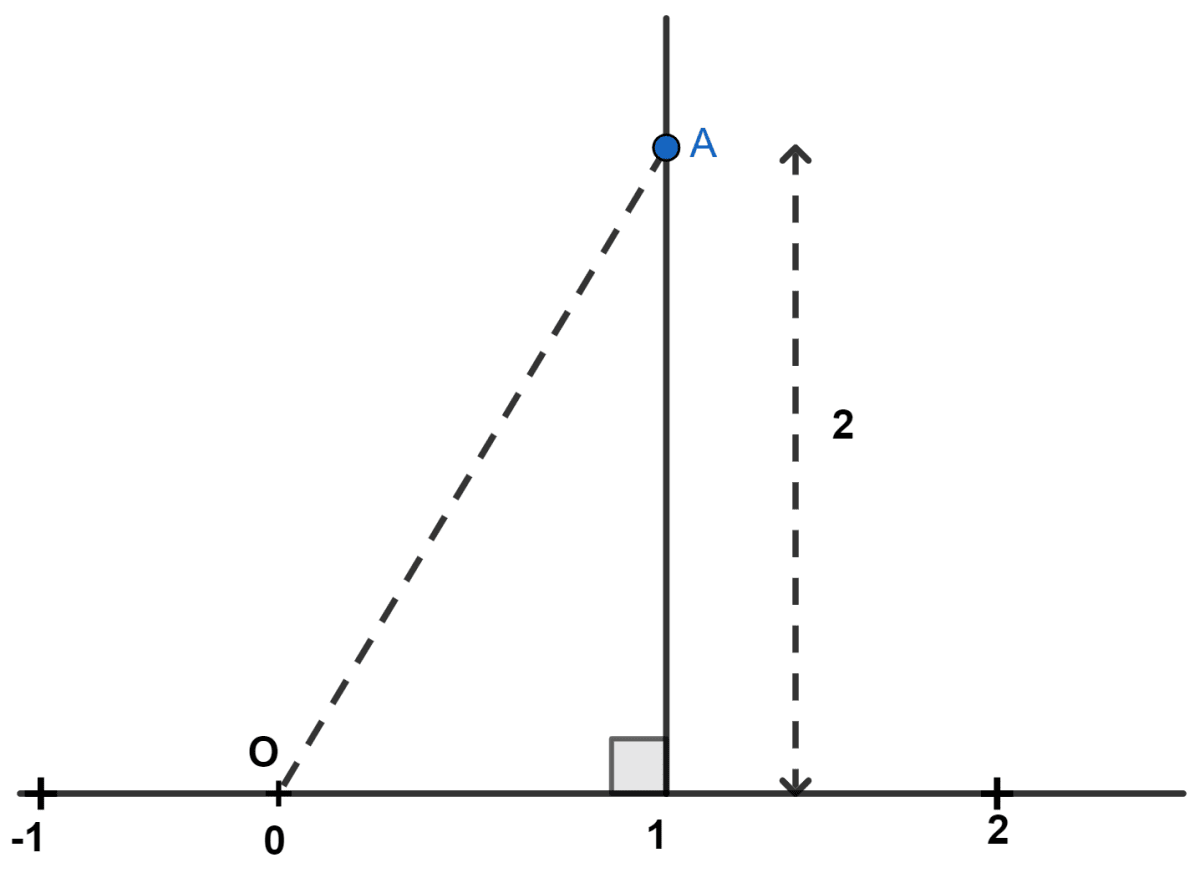
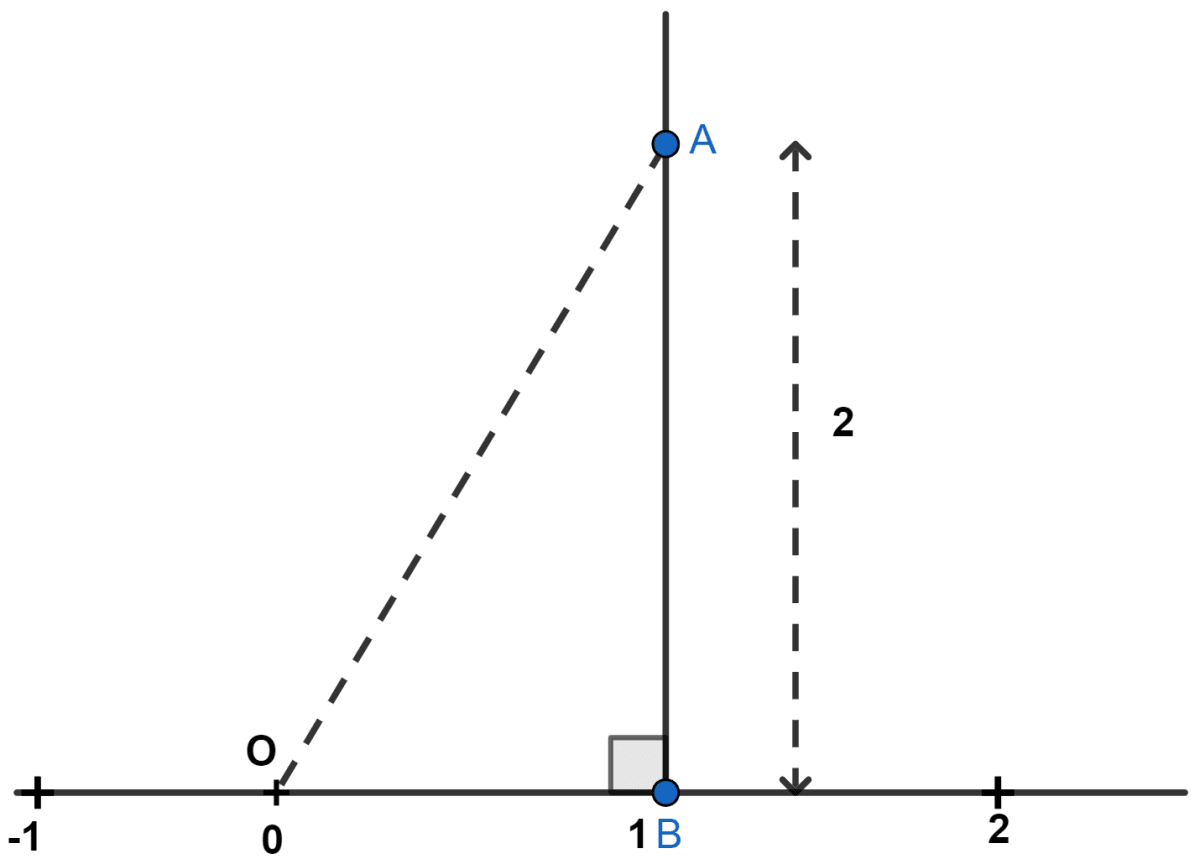
For the given figure length of OA is :
5
3
5 or 3
neither 5 nor 3
Answer
By pythagoras theorem,
Hypotenuse2 = Perpendicular2 + Base2
⇒ OA2 = AB2 + OB2
⇒ OA2 = 22 + 12
⇒ OA2 = 4 + 1
⇒ OA = 5
⇒ OA = 5.
Hence, Option 1 is the correct option.
23×38 is :
rational
irrational
neither rational nor irrational
12 ×5
Answer
Given,
⇒23×38⇒624⇒6×26⇒12×6⇒12×2.449.....⇒29.393.......
which is an irrational number.
Hence, Option 2 is the correct option.
Two irrational numbers between 8 and 11 are :
65 and 120
69 and 10.5
8.2 and 125
3 and 110
Answer
65 = 8.0622.... and 120 = 10.954......
Since, the above two nos. are non-terminating as well as non-recurring.
∴ They are irrational and in between 8 and 11.
Hence, Option 1 is the correct option.
State whether the following numbers are rational or not :
(i) (2+2)2
(ii) (3−3)2
(iii) (5+5)(5−5)
(iv) (3−2)2
Answer
(i) Given,
⇒(2+2)2⇒4+2+42⇒6+42⇒6+5.658....⇒11.658....
which is irrational.
Hence, (2+2)2 is not a rational number.
(ii) Given,
⇒(3−3)2⇒9+3−63⇒12−63⇒12−10.392.....⇒1.607......
which is irrational.
Hence, (3−3)2 is not a rational number.
(iii) Given,
⇒(5+5)(5−5)⇒25−55+55−5⇒20
which is rational.
Hence, (5+5)(5−5) is a rational number.
(iv) Given,
⇒(3−2)2⇒3+2−2×3×2⇒5−26⇒5−2×2.449...⇒5−4.898.....⇒0.101.....
which is irrational.
Hence, (3−2)2 is not a rational number.
Find the square of :
(i) 535
(ii) 3+2
(iii) 5−2
(iv) 3+25
Answer
(i) Squaring,
⇒(535)2⇒5×535×35⇒2545⇒59⇒154.
Hence, square of 535=154.
(ii) Squaring,
⇒(3+2)2⇒(3)2+(2)2+2×3×2⇒3+2+26⇒5+26.
Hence, square of 3+2=5+26.
(iii) Squaring,
⇒(5−2)2⇒(5)2+(2)2−2×5×2⇒5+4−45⇒9−45.
Hence, square of 5−2=9−45.
(iv) Squaring,
⇒(3+25)2⇒(3)2+(25)2+2×3×25⇒9+20+125⇒29+125.
Hence, square of 3+25=29+125.
State in each case, whether true or false :
(i) 2+3=5
(ii) 24+2=6
(iii) 37−27=7
(iv) 72 is an irrational number.
(v) 115 is a rational number.
(vi) All rational numbers are real numbers.
(vii) All real numbers are rational numbers.
(viii) Some real numbers are rational numbers.
Answer
(i) 2 = 1.41, 3 = 1.732 and 5 = 2.24
2+3 = 3.14, which is not equal to 2.24.
∴2+3=5
Hence, above statement is false.
(ii) Given,
24+2=6
Solving, L.H.S. :
⇒24+2⇒2×2+2⇒6.
Since, L.H.S. = R.H.S.
Hence, above statement is true.
(iii) Given,
37−27=7
Solving L.H.S. :
⇒37−27⇒7(3−2)⇒7×1⇒7.
Since, L.H.S. = R.H.S.
Hence, above statement is true.
(iv) Since, in 72 denominator is not equal to zero.
2 and 7 have no common factor.
∴ 72 is rational number.
Hence, above statement is false.
(v) Since, in 115 denominator is not equal to zero.
5 and 11 have no common factor.
∴ 115 is rational number.
Hence, above statement is true.
(vi) Both, rational and irrational numbers are real numbers.
Hence, above statement is true.
(vii) Real numbers are both rational as well as irrational number.
Hence, above statement is false.
(viii) Some rational numbers are also real numbers.
Hence, above statement is true.
Given universal set
= −6,−543,−4,−53,−83,0,54,1,132,8,3.01,π,8.47
From the given set, find :
(i) set of rational numbers
(ii) set of irrational numbers
(iii) set of integers
(iv) set of non-negative integers
Answer
(i) We need to find the set of rational numbers.
Rational numbers are :
Of form qp, where q ≠ 0.
Integers as well as terminating and recurring decimals are rational numbers.
From the universal set
Set of rational numbers
= −6,−543,−4,−53,−83,0,54,1,132,3.01,8.47
(ii) Since,
8=2.82.... and π=3.142....
Since, the above numbers are neither terminating nor recurring, hence they are irrational.
From the universal set
Set of irrational numbers = 8,π
(iii) From the universal set
Set of integers = −6,−4,0,1
(iv) From the universal set
Set of non-negative integers = {0, 1}.
Prove that each of the following numbers is irrational:
(i) 3+2
(ii) 3 - 2
Answer
(i) Let us assume 3+2 is a rational number.
Let 3+2 = x
Squaring both sides, we get;
⇒(3+2)2=x2⇒(3)2+(2)2+2×3×2=x2⇒3+2+26=x2⇒5+26=x2⇒26=x2−5⇒6=2x2−5
Here, x is rational,
∴ x2 is rational ..................(1)
⇒ x2 - 5 is rational
So, 2x2−5 is rational.
But 6 is irrational, as it is square root of non-perfect square.
⇒ 2x2−5 is irrational i.e. x2 - 5 is irrational and so x2 is irrational ....................(2)
From (1), x2 is rational, and
From (2), x2 is irrational
∴ We arrive at a contradiction.
So, our assumption that 3+2 is a rational number is wrong.
Hence, 3+2 is an irrational number.
(ii) Let us assume 3 - 2 is a rational number.
Let, 3 - 2 = x
Squaring both sides, we get;
⇒(3−2)2=x2⇒(3)2+(2)2−2×3×2=x2⇒9+2−62=x2⇒11−62=x2⇒62=11−x2⇒2=611−x2
Here, x is rational,
∴ x2 is rational ..................(1)
⇒ 11 - x2 is rational
So, 611−x2 is rational.
But 2 is irrational, as it is a square root of non-perfect square.
⇒ 611−x2 is irrational i.e. 11 - x2 is irrational and so x2 is irrational ....................(2)
From (1), x2 is rational, and
From (2), x2 is irrational
∴ We arrive at a contradiction.
So, our assumption that 3 - 2 is a rational number is wrong.
Hence, 3 - 2 is an irrational number.
Write a pair of irrational numbers whose sum is irrational.
Answer
Let 3+2 and 2−3 be two irrational numbers.
Sum of numbers
=3+2+2−3=3+2−1.
3+2−1 is an irrational number.
Hence, required pair = 3+2 and 2−3.
Write a pair of irrational numbers whose sum is rational.
Answer
Let 3+2 and 5−3 be two irrational numbers.
Sum of numbers
=3+2+5−3=7.
7 is a rational number.
Hence, required pair = 3+2 and 5−3.
Write a pair of irrational numbers whose difference is irrational.
Answer
Let 5+5 and 2+5 be two irrational numbers.
Difference of numbers
=5+5−(2+5)=5−2+5−5=5−2.
5−2 is an irrational number.
Hence, required pair = 5+5 and 2+5.
Write a pair of irrational numbers whose difference is rational.
Answer
Let 3+5 and 3+2 be two irrational numbers.
Difference of numbers
=3+5−(3+2)=3−3+5−2=3.
3 is a rational number.
Hence, required pair = 3+5 and 3+2.
Write a pair of irrational numbers whose product is irrational.
Answer
Let 2 and 3 be two irrational numbers.
Product of numbers
=2×3=6.
6 is an irrational number.
Hence, required pair = 2 and 3.
Write a pair of irrational numbers whose product is rational.
Answer
Let 5+2 and 5−2 be two irrational numbers.
Product of numbers
=(5+2)(5−2)=25−52+52−2=23.
23 is a rational number.
Hence, required pair = 5+2 and 5−2.