
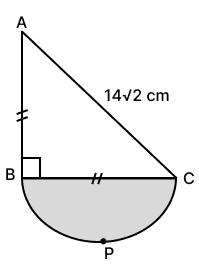
In the given figure, AB = BC, ∠ABC = 90°, AC = 14 cm and BPC (shaded portion) is semi-circle. If , the area of shaded portion is :
77 cm2
308 cm2
231 cm2
154 cm2
Answer
Let AB = BC = a cm and triangle ABC is a right triangle,
Using the Pythagoras theorem,
Base2 + Height2 = Hypotenuse2
⇒ BC2 + AB2 = AC2
⇒ a2 + a2 = ()2
⇒ 2a2 = 392
⇒ a2 =
⇒ a2 = 196
⇒ a =
⇒ a = 14 cm
Thus, AB = BC = 14 cm.
The diameter of the semicircle is BC = 14 cm, so the radius r is:
r = = = 7 cm
Area of semi-circle = πr2
Thus, the area of the shaded portion (the semicircle) is 77 cm2.
Hence, option 1 is the correct option.
The diameter of a circle is 14 cm. If it is doubled, the perimeter of the resulting circle will become:
four times
doubled
halved
three times
Answer
Given:
Diameter of the original circle = 14 cm
Radius of the original circle = r = = = 7 cm
Perimeter of the original circle = 2πr
When diameter is doubled, new diameter = 2 x 14 cm = 28 cm
New radius, r = = = 14 cm
New perimeter of circle:
Thus, the new perimeter is doubled compared to the original perimeter.
Hence, option 2 is the correct option.
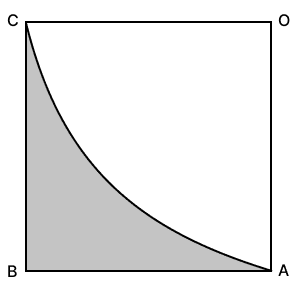
In the given figure, OABC is a square of side 14 cm. Taking , the area of the shaded portion is :
154 cm2
196 cm2
42 cm2
52 cm2
Answer
Side of the square = Radius of the circle = 14 cm
Area of shaded portion = Area of square - Area of quarter circle
The area of the shaded portion is 42 cm2.
Hence, option 3 is the correct option.
If the radius of a circle is doubled, then its area will become :
doubled
halved
four times
three times
Answer
Let r be the radius of circle.
Area of circle = πr2
When the radius is doubled, new radius = 2r
Area of new circle = π x (2r)2
= π x 4r2
= 4πr2
The new area is four times the area of the original circle.
Hence, option 3 is the correct option.
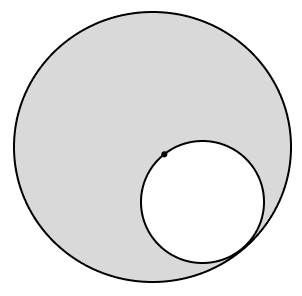
The radii of two circles are 14 cm and 28 cm. If the area of the shaded portion is :
1848 cm2
1644 cm2
486 cm2
702 cm2
Answer
Area of shaded portion = Area of bigger circle - Area of smaller circle
The area of shaded portion is 1848 cm2.
Hence, option 1 is the correct option.
The diameter of a circle is 28 cm. Find its :
(i) circumference
(ii) area
Answer
Given:
Diameter = d = 28 cm
Radius = r = = = 14 cm
(i) Circumference of a circle = 2πr
Hence, the circumference of a circle is 88 cm.
(ii) Area of a circle = πr2
Hence, the area of a circle is 616 cm2.
The circumference of a circular field is 308 m. Find its :
(i) radius
(ii) area.
Answer
(i) Let r be the radius of the circle.
The circumference of a circle = 308 m
As we know, the circumference of a circle = 2πr
Hence, the radius of a circle is 49 m.
(ii) Area of a circle = πr2
Hence, the area of a circle is 7,546 m2.
The sum of the circumference and diameter of a circle is 116 cm. Find its radius.
Answer
Given:
Circumference of a circle + Diameter of a circle = 116 cm
Hence, the radius of a circle is 14 cm.
The radii of two circles are 25 cm and 18 cm. Find the radius of the circle which has circumference equal to the sum of circumferences of these two circles.
Answer
Circumference of a circle = 2πr
For the first circle,
r1 = 25 cm
Circumference1 = 2 x π x 25 = 50π cm
For the second circle,
r2 = 18 cm
Circumference2 = 2 x π x 18 = 36π cm
Total circumference = Circumference1 + Circumference2
= 50π + 36π
= 86π cm
Let the radius of the new circle be R.
Circumference of the new circle = 2πR
86π = 2πR
86 = 2R
R =
R = 43 cm
Hence, the radius of the new circle is 43 cm.
The radii of two circles are 48 cm and 13 cm. Find the area of the circle which has its circumference equal to the difference of the circumferences of the given two circles.
Answer
Circumference of a circle = 2πr
For the first circle,
r1 = 48 cm
Circumference1 = 2 x π x 48 = 96π cm
For the second circle,
r2 = 13 cm
Circumference2 = 2 x π x 13 = 26π cm
Total circumference = Circumference1 - Circumference2
= 96π - 26π
= 70π cm
Let the radius of the new circle be R.
Circumference of the new circle = 2πR
70π = 2πR
70 = 2R
R =
R = 35 cm
And, area of the new circle = πr2
Hence, the area of new circle is 3,850 cm2.
The diameters of two circles are 32 cm and 24 cm. Find the radius of the circle having its area equal to sum of the areas of the two given circles.
Answer
For the first circle,
d1 = 32 cm
r1 = = = 16 cm
Area1 = π x 162 = 256π cm2
For the second circle,
d2 = 24 cm
r2 = = = 12 cm
Area2 = π x 122 = 144π cm2
Total area = Area1 + Area2
= 256π + 144π
= 400π cm
Let the radius of the new circle be R.
Area of the new circle = πR2
400π = πR2
400 = R2
R =
R = 20 cm
Hence, the radius of the new circle is 20 cm.
The radius of a circle is 5 m. Find the circumference of the circle whose area is 49 times the area of the given circle.
Answer
Given:
Radius of original circle = r = 5 m
Area of new circle = 49 times area of original circle.
Let R be the radius of new circle.
Circumference of new circle = 2πR
Hence, the circumference of new circle is 220 m.
A circle of largest area is cut from a rectangular piece of card-board with dimensions 55 cm and 42 cm. Find the ratio between the area of the circle cut and the area of the remaining card-board.
Answer
Given:
The dimensions of rectangular piece of card-board are:
Length = 55 cm
Width = 42 cm
The largest circle that can be cut from the rectangle will have a diameter equal to the shorter side of the rectangle.
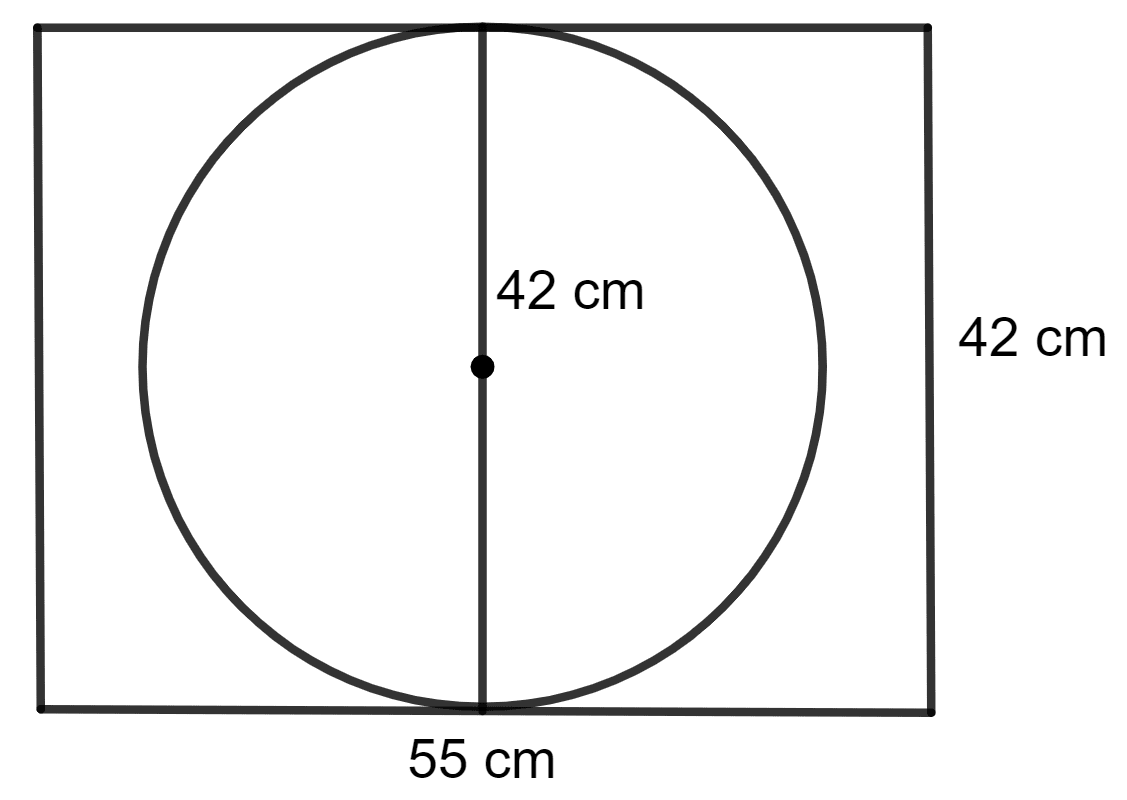
Diameter = Width = 42 cm
∵ Radius = r = = = 21 cm
Area of the circle = πr2
Area of the rectangular piece of cardboard = 55 x 42 cm2
= 2,310 cm2
Therefore, area of remaining cardboard = Area of rectangle - Area of circle
= (2,310 - 1,386) cm2
= 924 cm2
So, the ratio between the area of the circle cut and the area of the remaining card-board = 1,386 : 924
= 231 : 154
= 3 : 2
Hence, the ratio between the area of the circle cut and the area of the remaining cardboard is 3 : 2.
The following figure shows a square card-board ABCD of side 28 cm. Four identical circles of largest possible size are cut from this card as shown below.
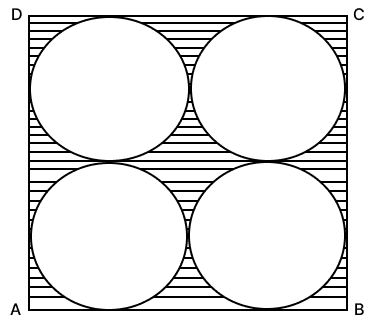
Find the area of the remaining card-board.
Answer
Given:
Side of square ABCD = 28 cm
Side of square = 2 x diameter of circle
Diameter of circle = = 14 cm
Radius of circle = = = 7 cm
Area of the remaining card-board = Area of square - 4 x Area of 1 circle
= side2 - 4 x πr2
Hence, the area of remaining cardboard is 168 cm2.
The radii of two circles are in the ratio 3 : 8. If the difference between their areas is 2695 π cm2, find the area of the smaller circle.
Answer
Let the two radii of two circles be 3a and 8a.
The difference between their areas = 2695 π cm2
⇒ π x (8a)2 - π x (3a)2 = 2695 π
⇒ π x 64a2 - π x 9a2 = 2695 π
⇒ π x (64a2 - 9a2) = 2695 π
⇒ x (64a2 - 9a2) = 2695
⇒ 64a2 - 9a2 = 2695
⇒ 55a2 = 2695
⇒ a2 =
⇒ a2 = 49
⇒ a =
⇒ a = 7 cm
The radii are 3a and 8a = 3 x 7 cm and 8 x 7 cm = 21 cm and 56 cm
Area of smaller circle = π x (21)2
Hence, the area of smaller circle is 1,386 cm2.
The diameters of three circles are in the ratio 3 : 5 : 6. If the sum of the circumferences of these circles be 308 cm; find the difference between the areas of the largest and the smallest of these circles.
Answer
Let the diameters of the three circles be 3a, 5a and 6a.
Radius of three circles = , and
Circumference of a circle = 2πr
For the first circle,
r1 = cm
Circumference1 = 2 x π x = 3aπ cm
For the second circle,
r2 = cm
Circumference2 = 2 x π x = 5aπ cm
For the third circle,
r2 = cm
Circumference2 = 2 x π x = 6aπ cm
Total circumference = Circumference1 + Circumference2 + Circumference3
⇒ 3aπ + 5aπ + 6aπ = 308
⇒ 14aπ = 308
⇒ 14 x a x = 308
⇒ 2 x a x 22 = 308
⇒ 44a = 308
⇒ a =
⇒ a = 7 cm
Radius of three circles = x 7 cm, x 7 cm and x 7 cm
= 10.5 cm, 17.5 cm and 21 cm
Difference between the area of the largest and the smallest circles = π(21)2 - π(10.5)2
= 441π - 110.25π cm2
= 330.75π cm2
= 330.75 x cm2
= 47.25 x 22 cm2
= 1039.5 cm2
Hence, the difference in the area = 1039.5 cm2.
Find the area of a ring shaped region enclosed between two concentric circles of radii 20 cm and 15 cm.
Answer
Given:
r1 = 20 cm
r2 = 15 cm
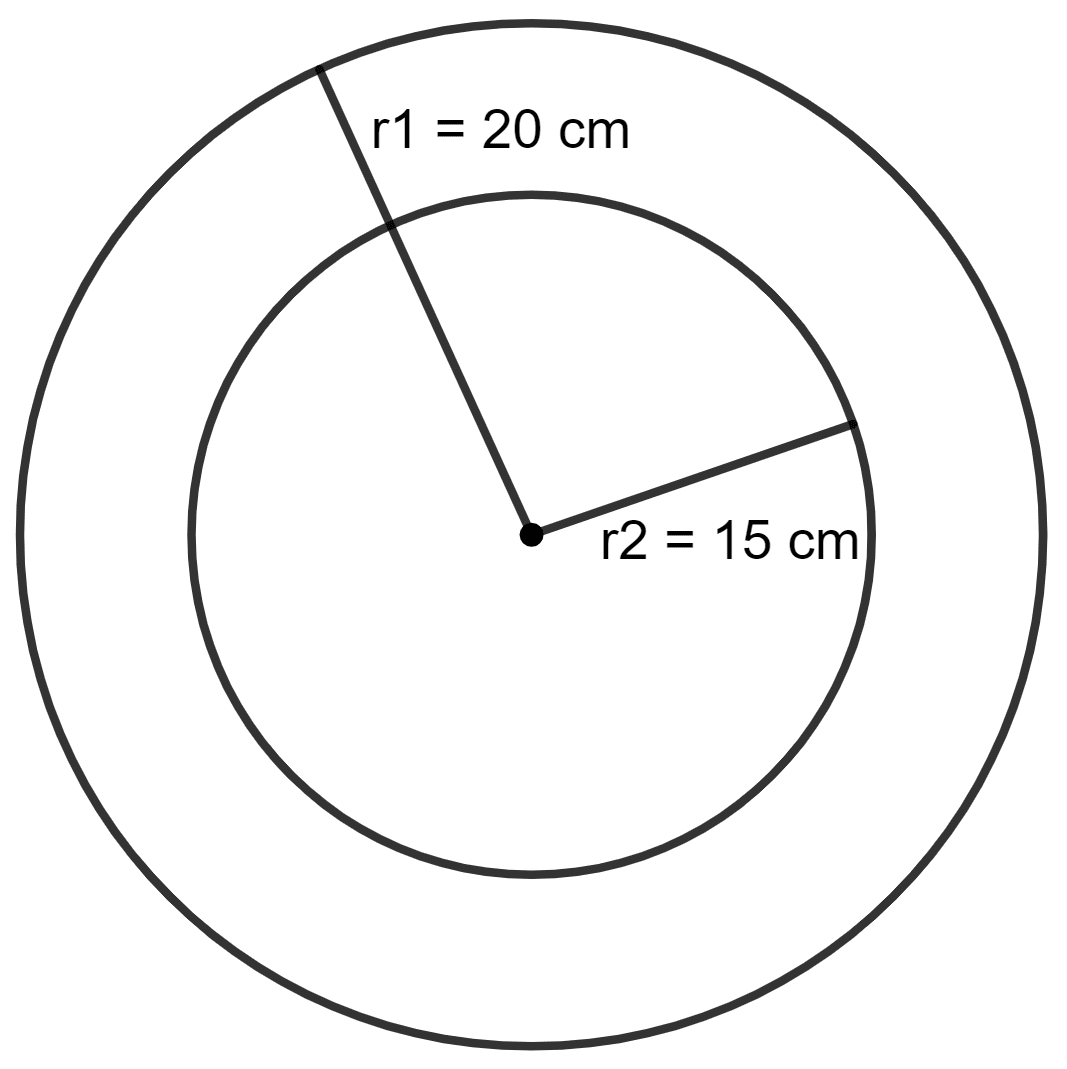
Area of ring shaped region = π(r12 - r22)
= π(202 - 152) cm2
= π(400 - 225) cm2
= π x 175 cm2
= x 175 cm2
= 22 x 25 cm2
= 550 cm2
Hence, the area of ring shaped region is 550 cm2.
The circumference of a given circular park is 55 m. It is surrounded by a path of uniform width 3.5 m. Find the area of the path.
Answer
Let r be the radius of the circular park.
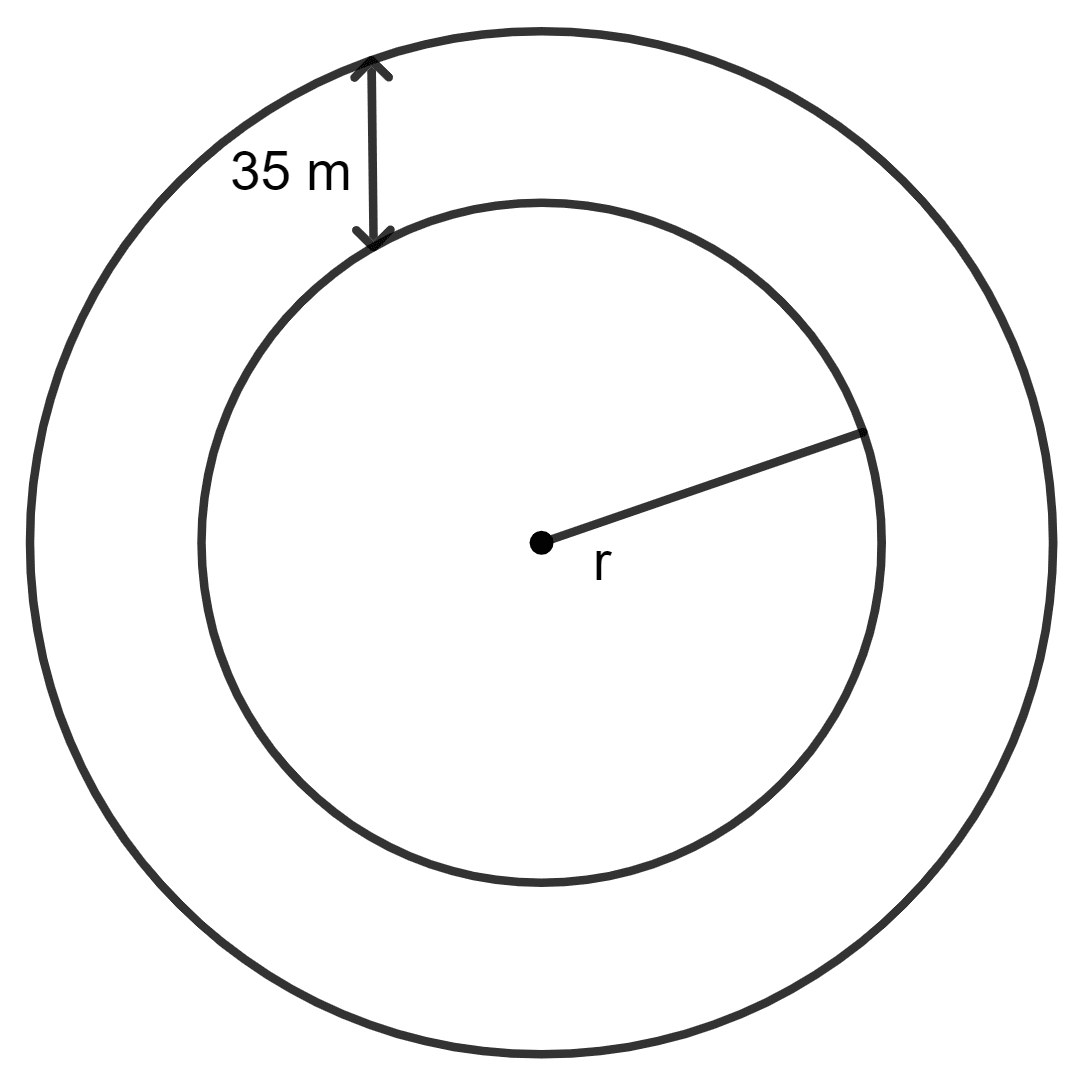
Circumference = 2πr
⇒ 2πr = 55
⇒ 2 x x r = 55
⇒ x r = 55
⇒ r =
⇒ r =
⇒ r =
⇒ r = 8.75 m
Radius of outer park = radius of park + width of the path
= 8.75 + 3.5 m
= 12.25 m
Area of the path = Area of outer park - Area of circular park
= π (12.25)2 - π (8.75)2 m2
= 150.0625π - 76.5625π m2
= 73.5 π m2
= 73.5 x m2
= 10.5 x 22 m2
= 231 m2
Hence, the area of the path is 231 m2.
There are two circular gardens A and B. The circumference of garden A is 1.760 km and the area of garden B is 25 times the area of garden A. Find the circumference of garden B.
Answer
Let r be the radius of the circular garden A.
Circumference of garden A = 2πr
⇒ 2πr = 1.760 km
⇒ 2πr = 1760 m
⇒ 2 x x r = 1760 m
⇒ x r = 1760 m
⇒ r = m
⇒ r = 7 x 40 m
⇒ r = 280 m
Area of garden A = πr2
= π x (280)2
= 78400π
Let R be the radius of garden B.
It is given that the area of garden B is 25 times the area of garden A.
⇒ πR2 = 25 x πr2
⇒ πR2 = 25 x 78400π
⇒ R2 = 25 x 78400
⇒ R2 = 25 x 78400
⇒ R2 = 1960000
⇒ R =
⇒ R = 1400 m
Circumference of garden B = 2πR
= 2 x x 1400 m
= 2 x 22 x 200 m
= 8800 m = 8.8 km
Hence, the circumference of garden B is 8.8 km.
A wheel has diameter 84 cm. Find how many complete revolutions must it make to cover 3.168 km.
Answer
Diameter of the wheel = 84 cm
Radius of the wheel = = = 42 cm
Circumference of the wheel = 2πr
Let the wheel make n revolutions.
Total distance traveled by the wheel = n x Circumference of the wheel
⇒ 3.168 km = n x 264 cm
⇒ 316,800 cm = n x 264 cm
⇒ n =
⇒ n = 1200
Hence, the wheel makes 1,200 revolutions.
Each wheel of a car is of diameter 80 cm. How many complete revolutions does each wheel make in 10 minutes when the car is travelling at a speed of 66 km per hour ?
Answer
Diameter of wheel = 80 cm
Radius of the wheel = = = 40 cm
Circumference of the wheel = 2πr
Let the wheel make n number of revolutions.
Speed of the car = 66 km per hour
Time = 10 min
Total distance = Speed x Time
= x 10 cm
= 11 x 100,000 cm
= 1,100,000
Total distance = Number of revolutions x Circumference of the wheel
⇒ 1,100,000 cm = n x cm
⇒ n =
⇒ n =
⇒ n = 4,375
Hence, the wheel makes 4,375 complete revolutions.
An express train is running between two stations with a uniform speed. If the diameter of each wheel of the train is 42 cm and each wheel makes 1200 revolutions per minute, find the speed of the train.
Answer
Diameter of wheel = 42 cm
Radius of wheel = = = 21 cm
Circumference of wheel = 2πr
Total distance covered by one wheel in 1 minute = Number of revolutions x Circumference of wheel
= 1,200 x 132 cm
= 158,400 cm
= 1.584 km
Speed of the train =
=
=
= 95.04 km/hr
Hence, the speed of the train is 95.04 km/hr.
The minute hand of a clock is 8 cm long. Find the area swept by the minute hand between 8.30 a.m. and 9.05 a.m.
Answer
Length of the minute hand (radius of the circle) = 8 cm
Time interval between 9.05 a.m. and 8.30 a.m. = 35 minutes
Area swept by the minute hand in 1 hr = πr2
Area of the circle in 60 minutes = cm2
Area of the circle in 1 minute = cm2
= cm2
Area of the circle in 35 minutes = cm2
= cm2
= cm2
Hence, the area swept by the minute hand between 8:30 a.m. and 9:05 a.m. is cm2.
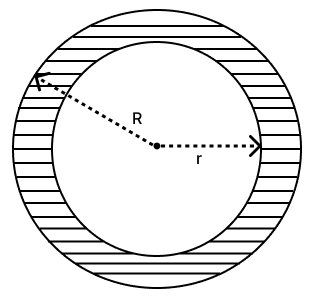
The shaded portion of the figure, given alongside, shows two concentric circles.
If the circumference of the two circles be 396 cm and 374 cm, find the area of the shaded portion.
Answer
Circumference of the circle = 2πr
For outer circle,
For inner circle,
Area of shaded portion = π(R2 - r2)
= π(632 - 59.52) cm2
= π(3,969 - 3,540.25) cm2
= π x 428.75 cm2
= x 428.75 cm2
= 22 x 61.25 cm2
= 1,347.5 cm2
Hence, the area of the shaded portion is 1,347.5 cm2.