
The area of the given figure is :
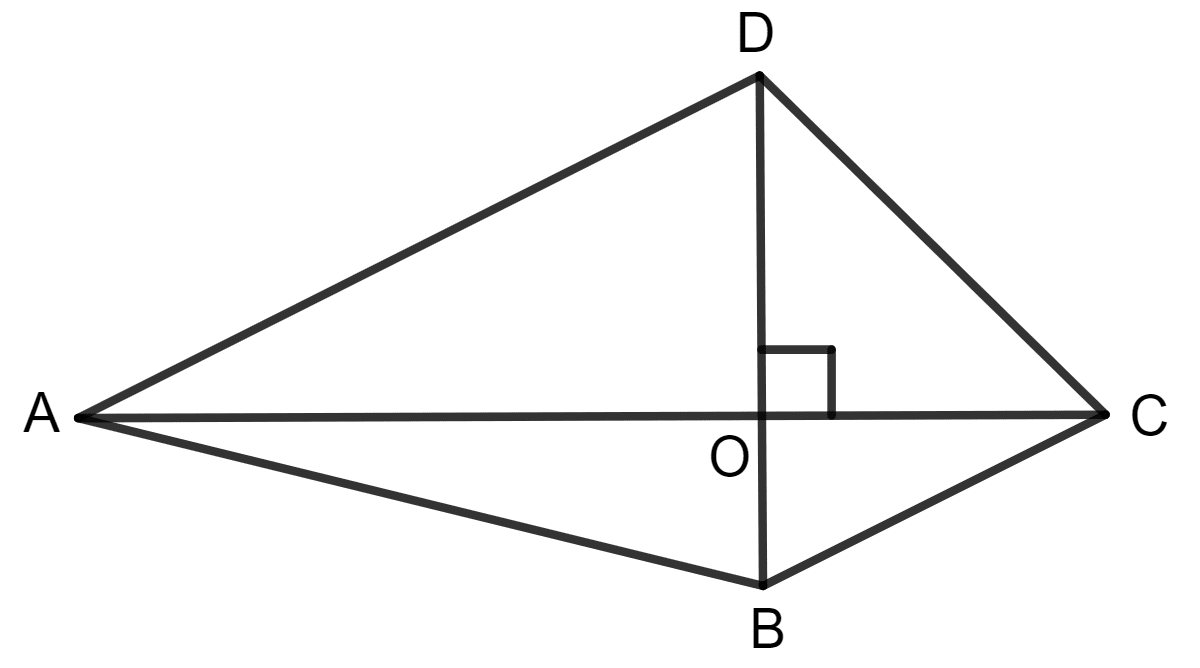
AC x BD
Answer
Area of triangle = x base x height
For Δ ABD,
Area = x BD x AO
For Δ CBD,
Area = x BD x CO
Area of quadrilateral ABCD = Area of Δ ABD + Area of Δ CBD
= x BD x AO + x BD x CO
= x BD x (AO + CO)
= x BD x AC
Hence, option 2 is the correct option.
If two adjacent sides and a diagonal of a rectangle are x, y and d respectively. The area of the rectangle is :
Answer
Given:
Adjacent sides of rectangle = x and y
Area of rectangle = base x height
=
Hence, option 1 is the correct option.
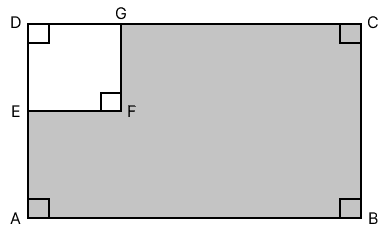
A square DEFG of side 8 cm is inscribed in a rectangle of adjacent sides 20 cm and 16 cm as shown in the figure.
The area of the shaded portion is :
64 cm2
128 cm2
256 cm2
320 cm2
Answer
Area of shaded portion = Area of rectangle ABCD - Area of square DEFG
Area of square = Side2
Area of rectangle = Base x Height
Area of shaded portion = 20 x 16 - 82 cm2
= 320 - 64 cm2
= 256 cm2
Hence, option 3 is the correct option.
The perimeter of a square is 72 cm, its area is :
324 cm2
356 cm2
Answer
Given:
Perimeter = 72 cm
Let s be the side of square.
Perimeter = 4 x side
⇒ 4 x s = 72
⇒ s =
⇒ s = 18 cm
Area = Side2
= 182 cm2
= 324 cm2
Hence, option 3 is the correct option.
Area of a rhombus is 360 cm2. If one diagonal of it is 20 cm; the other diagonal is :
24 cm
18 cm
40 cm
36 cm
Answer
Given:
Area = 360 cm2.
One diagonal = 20 cm
Let d be the other diagonal.
Area of rhombus = x product of diagonals
⇒ x 20 x d = 360
⇒ 10 x d = 360
⇒ d =
⇒ d = 36 cm
Hence, option 4 is the correct option.
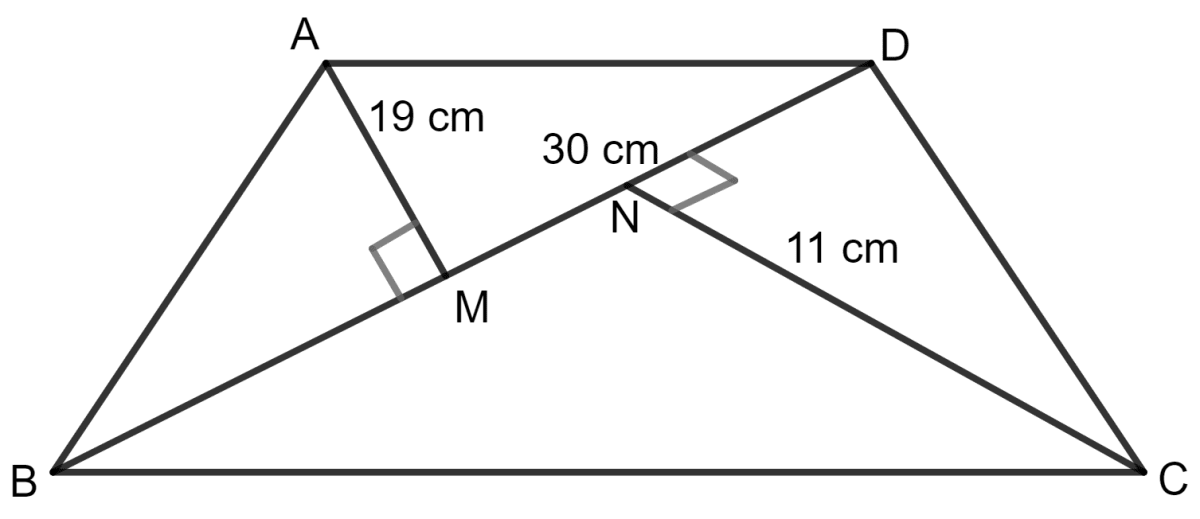
Find the area of a quadrilateral one of whose diagonals is 30 cm long and the perpendiculars from the other two vertices are 19 cm and 11 cm respectively.
Answer
The quadrilateral is shown in the figure below:
Area of triangle = x base x height
For Δ ABD,
Area = x BD x AM
= x 30 x 19 cm2
= 15 x 19 cm2
= 285 cm2
For Δ CBD,
Area = x BD x CN
= x 30 x 11 cm2
= 15 x 11 cm2
= 165 cm2
Area of quadrilateral ABCD = Area of Δ ABD + Area of Δ CBD
= 285 + 165 cm2
= 450 cm2
Hence, the area of quadrilateral is 450 cm2.
The diagonals of a quadrilateral are 16 cm and 13 cm. If they intersect each other at right angles; find the area of the quadrilateral.
Answer
Since the diagonals of the quadrilateral intersect at right angles, the area of the quadrilateral is given by:
Area = x Product of diagonals
= x 16 x 13 cm2
= 8 x 13 cm2
= 104 cm2
Hence, the area of the quadrilateral is 104 cm2.
Calculate the area of quadrilateral ABCD, in which ∠ABD = 90°, triangle BCD is an equilateral triangle of side 24 cm and AD = 26 cm.
Answer
For Δ ABD,
By using the Pythagoras theorem,
Base2 + Height2 = Hypotenuse2
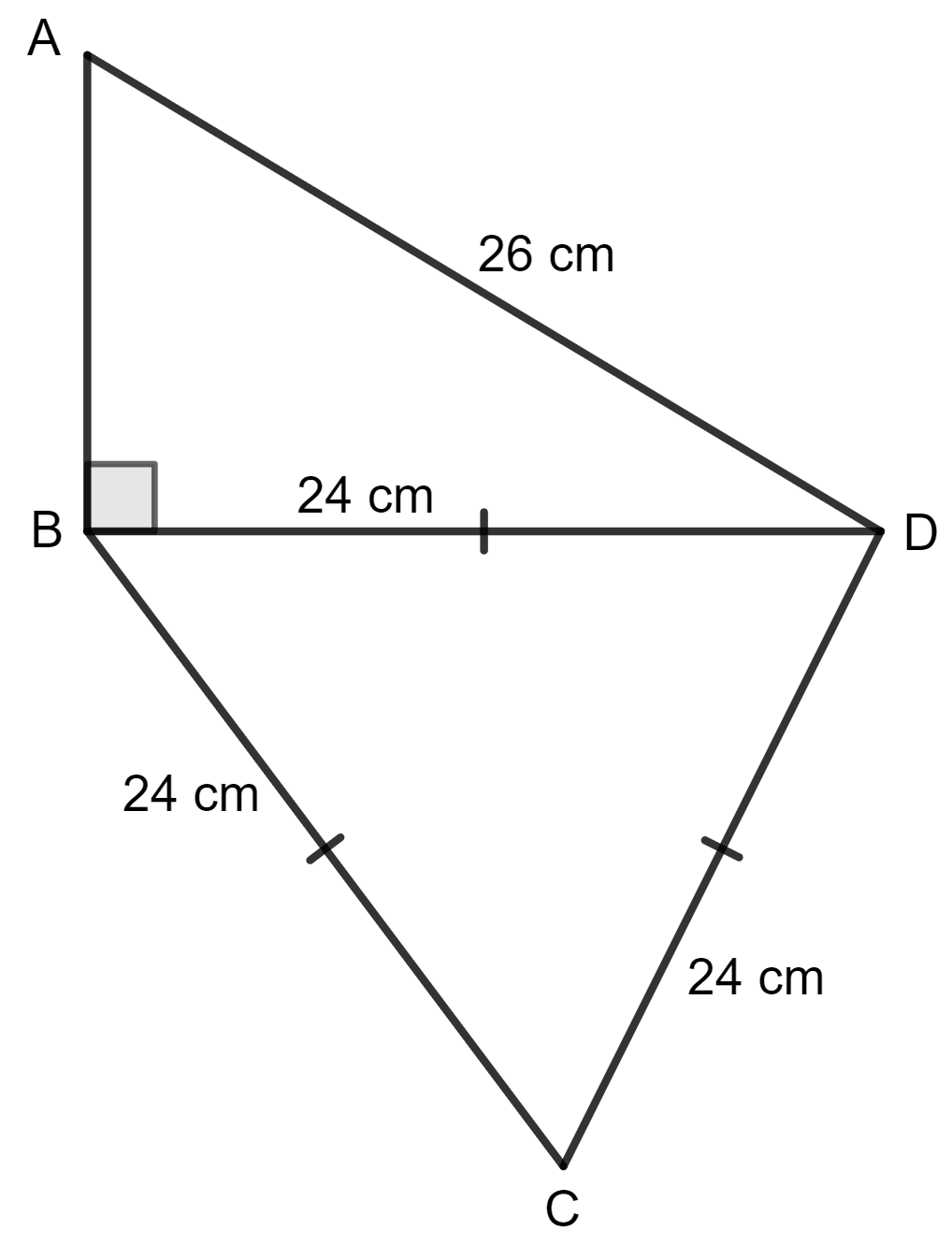
⇒ AB2 + BD2 = AD2
⇒ AB2 + (24)2 = (26)2
⇒ AB2 + 576 = 676
⇒ AB2 = 676 - 576
⇒ AB2 = 100
⇒ AB =
⇒ AB = 10 cm
Area of Δ ABD = x AB x BD
= x 10 x 24 cm2
= 5 x 24 cm2
= 120 cm2
Area of equilateral triangle BCD = x side2
= x 242
= x 576
= 144 cm2
= 249.41 cm2
Total area of quadrilateral ABCD = Δ ABD + Δ BCD
= 120 + 249.41 cm2
= 369.41 cm2
Hence, the area of quadrilateral ABCD is 369.41 cm2.
Calculate the area of quadrilateral ABCD in which AB = 32 cm, AD = 24 cm, ∠A = 90° and BC = CD = 52 cm.
Answer
Quadrilateral ABCD is shown in the figure below:
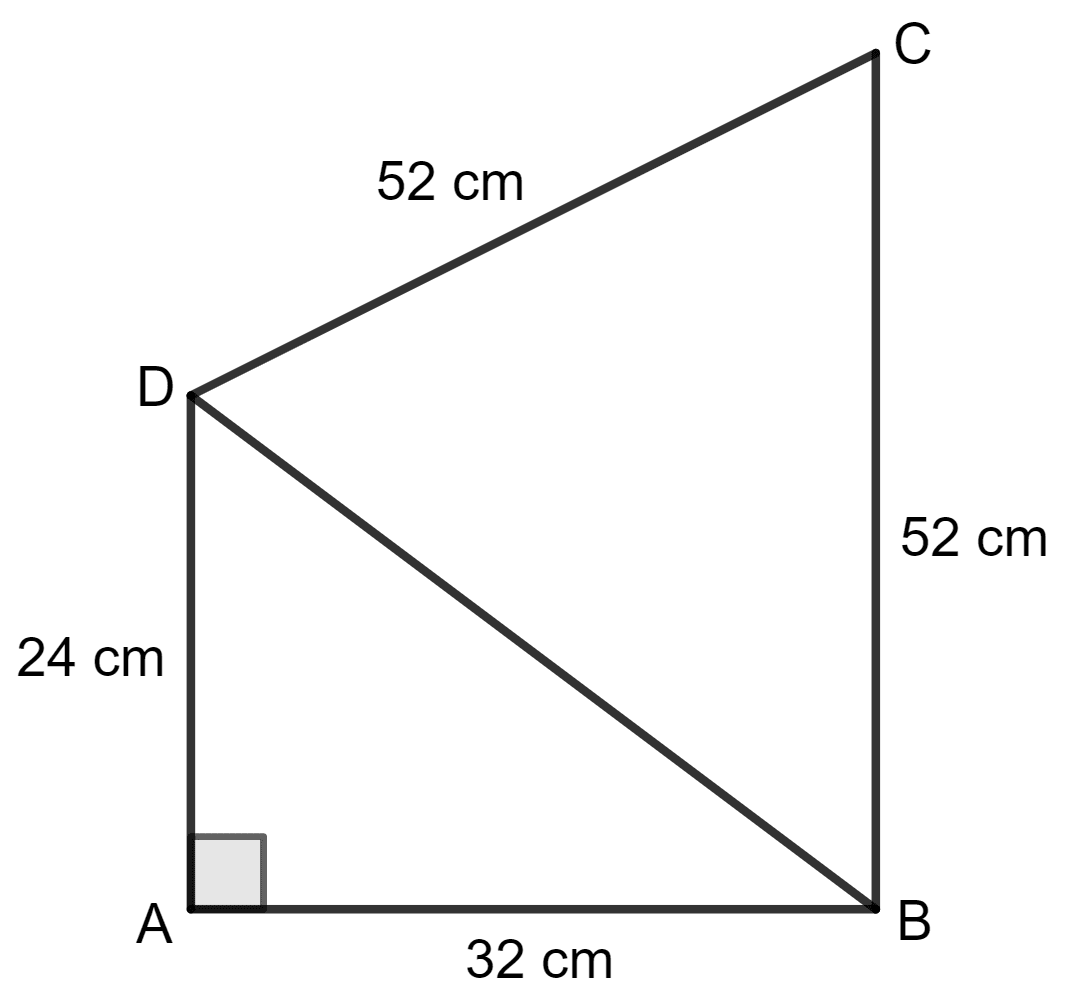
Area of Δ DAB = x base x height
= x DA x AB
= x 24 x 32 cm2
= 12 x 32 cm2
= 384 cm2
By using the Pythagoras theorem,
AD2 + AB2 = BD2
⇒ 242 + 322 = BD2
⇒ 576 + 1,024 = BD2
⇒ 1,600 = BD2
⇒ BD =
⇒ BD = 40 cm
In triangle BCD,
Let the sides of the triangle be:
a = 40 cm, b = 52 cm and c = 52 cm.
The semi-perimeter s:
∵ Area of Δ BCD =
= cm2
= cm2
= cm2
= 960 cm2
Therefore, area of quadrilateral ABCD = Area of Δ DAB + Area of triangle BCD
= 384 + 960 cm2
= 1344 cm2
Hence, the area of quadrilateral ABCD is 1344 cm2.
The perimeter of a rectangular field is km. If the length of the field is twice its width; find the area of the rectangle in sq. metres.
Answer
Given:
Perimeter = km.
Length of the field = Twice its width.
Let a be the width of the field.
So, the length = 2a
Perimeter of a rectangle = 2(length + width)
Thus, width = km
= m
= 100 m
Length = 2a = 2 x 100 m
= 200 m
Area = length x width
= 200 x 100 m2
= 20,000 m2
Hence, the area of the rectangle is 20,000 m2.
A rectangular plot 85 m long and 60 m broad is to be covered with grass leaving 5 m all around. Find the area to be laid with grass.
Answer
Given:
The length of the rectangular field is 85 m.
The breadth of the rectangular field is 60 m.
The width of the path to be covered with grass is 5 m.
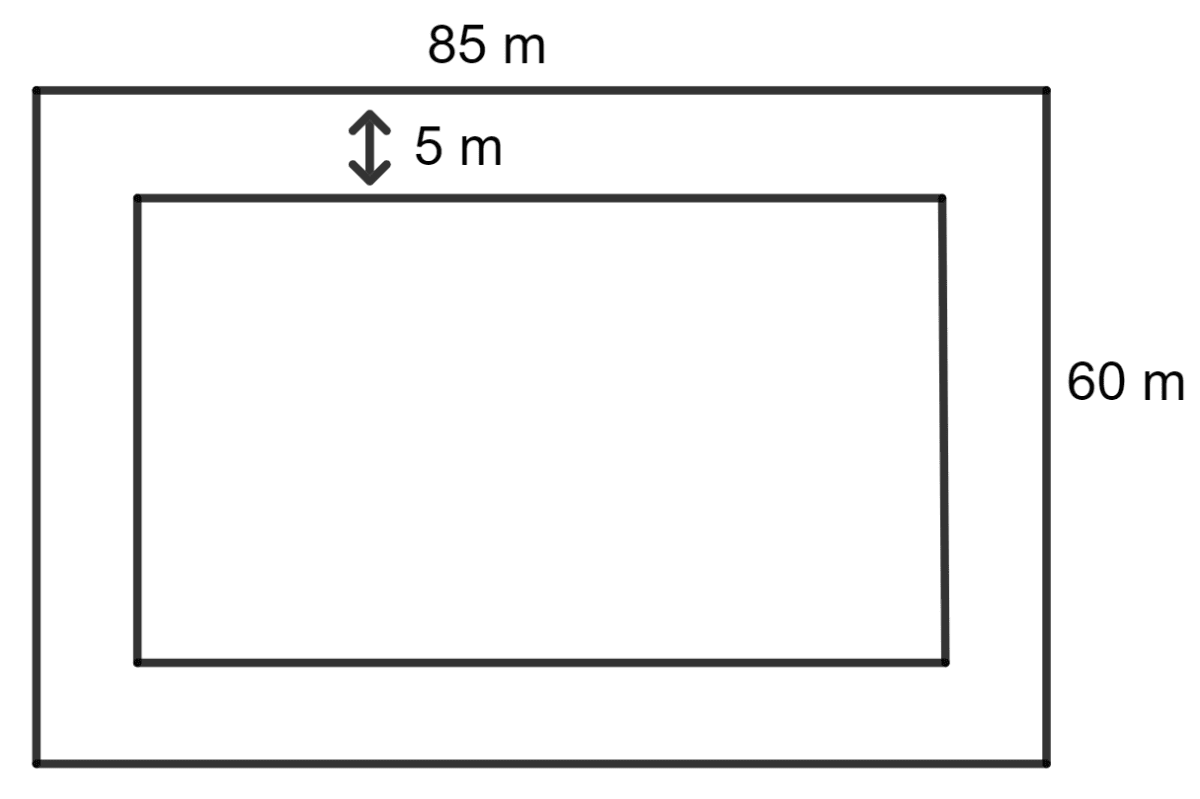
The length of the inner rectangular field = 85 m - 5 m - 5 m = 75 m
The breadth of the inner rectangular field = 60 m - 5 m - 5 m = 50 m
The area of a rectangle = length x breadth
⇒ Area of the inner field = 75 x 50 m2 = 3,750 m2
Hence, the area to be covered with grass is 3,750 m2.
The length and the breadth of a rectangle are 6 cm and 4 cm respectively. Find the height of a triangle whose base is 6 cm and area is 3 times that of the rectangle.
Answer
Given:
Length of the rectangle = 6 cm
Breadth of the rectangle = 4 cm
Area of the rectangle = length x breadth
= 6 x 4 cm2
= 24 cm2
Let h be the height of the triangle.
Base of the triangle = 6 cm
It is given that area of triangle is 3 times the area of the rectangle.
Area of triangle = x base x height
⇒ 3 x 24 = x 6 x h
⇒ 3 x 24 = 3 x h
⇒ x 24 = x h
⇒ h = 24 cm
Hence, the height of the triangle is 24 cm.
How many tiles, each of area 400 cm2, will be needed to pave a footpath which is 2 m wide and surrounds a grass plot 25 m long and 13 m wide ?
Answer
Given:
Dimensions of grass plot (ABCD) = 25 x 13 m
Width of footpath = 2 m
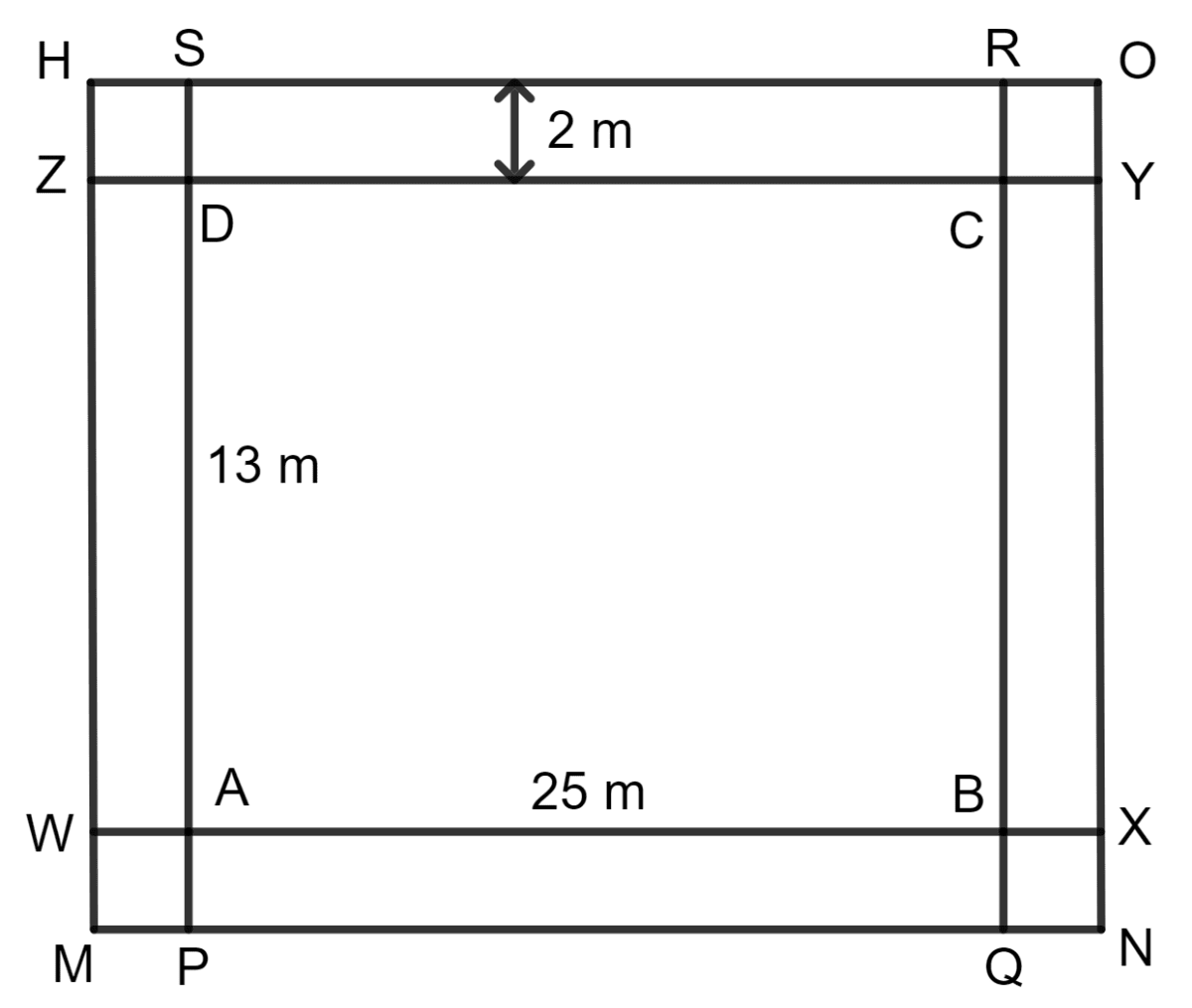
Area of footpath = Area of ABQP + Area of QNOR + Area of RCDS + Area of SHMP
= 2Area of ABQP + 2Area of QNOR
= 2(Area of ABQP + Area of QNOR)
Area of ABQP = l x b = AB x AP
= 25 x 2 m2
= 50 m2
Area of QNOR = l x b = DN x QN
= 17 x 2 m2
= 34 m2
Area of footpath = 2(50 + 34) m2
= 2 x 84 m2
= 168 m2
= 1680000 sq. cm
Total area = Number of tiles x Area covered by 1 tiles
⇒ 1680000 = Number of tiles x 400
⇒ Number of tiles =
= 4200
Hence, the number of tiles = 4200.
The cost of enclosing a rectangular garden with a fence all round, at the rate of 75 paise per metre, is ₹ 300. If the length of the garden is 120 metres, find the area of the field in square metres.
Answer
Given:
Length of the garden = 120 m
Cost of fencing = 75 paise per metre = ₹ 0.75 per m
Total cost = ₹ 300
Total cost of fencing = Perimeter x Cost per metre
⇒ ₹ 300 = Perimeter x ₹ 0.75
⇒ Perimeter = m
⇒ Perimeter = m
⇒ Perimeter = 400 m

Let b be the breadth of the garden.
Perimeter = 2(l + b)
⇒ 2(120 + b) = 400
⇒ 120 + b =
⇒ 120 + b = 200
⇒ b = 200 - 120
⇒ b = 80 m
Area of the rectangular garden = Length x Breadth
= 120 x 80 m2
= 9600 m2
Hence, the area of the garden is 9600 sq. m.
The width of a rectangular room is of its length, x, and its perimeter is y. Write an equation connecting x and y. Find the length of the room when the perimeter is 4400 cm.
Answer
Given:
Length = x
Width = of the length =
Perimeter =
Perimeter of a rectangle = 2(l + b)
The length when y = 4400 cm,
Hence, the equation connecting x and y is and the length of the room is 14 m.
The length of a rectangular verandah is 3 m more than its breadth. The numerical value of its area is equal to the numerical value of its perimeter.
(i) Taking x as the breadth of the verandah, write an equation in x that represents the above statement.
(ii) Solve the equation obtained in (i) above and hence find the dimensions of the verandah.
Answer
(i) Given:
Breadth of the verandah = x
Length of the verandah = x + 3
It is also given that the numerical value of the area is equal to the numerical value of the perimeter.
⇒ l x b = 2(l + b)
⇒ x(x + 3) = 2(x + x + 3)
⇒ x2 + 3x = 2(2x + 3)
⇒ x2 + 3x = 4x + 6
⇒ x2 + 3x - 4x - 6 = 0
⇒ x2 - x - 6 = 0
Hence, the equation is x2 - x - 6.
(ii) From (i),
⇒ x2 - x - 6 = 0
⇒ x2 - 3x + 2x - 6 = 0
⇒ x(x - 3) + 2(x - 3) = 0
⇒ (x - 3)(x + 2) = 0
⇒ x = 3 or - 2
Since breadth cannot be negative, x = 3 m.
Length = x + 3 = 3 + 3 m = 6 m
Hence, length = 6 m and breadth = 3 m.
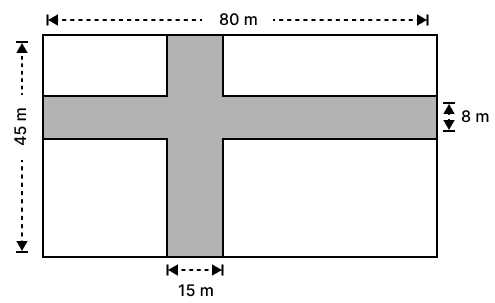
The diagram, given below, shows two paths drawn inside a rectangular field 80 m long and 45 m wide. The widths of the two paths are 8 m and 15 m as shown. Find the area of the shaded portion.
Answer
Given:
Length of the rectangular field = 80 m
Width of the rectangular field = 45 m
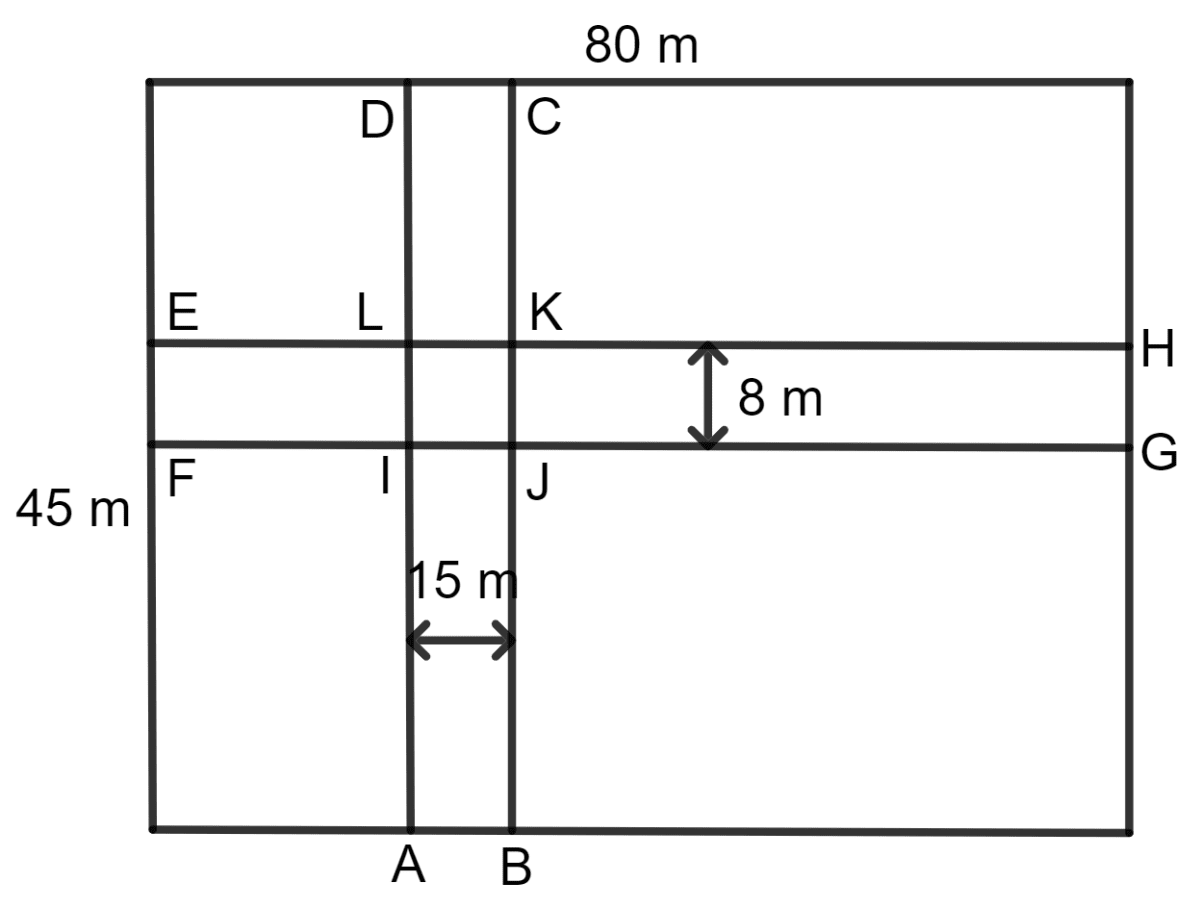
Area of shaded path = Area of path ABCD + Area of cross path EFGH - Area of path IJKL
Area of path ABCD = l x b = AB x BC
= 15 x 45 m2
= 675 m2
Area of path EFGH = l x b = EF x FG
= 8 x 80 m2
= 640 m2
Area of path IJKL = l x b = IJ x KL
= 15 x 8 m2
= 120 m2
Area of shaded path = 675 + 640 - 120 m2
= 1,195 m2
Hence, the area of shaded portion is 1,195 m2.
The rate for a 1.20 m wide carpet is ₹ 40 per metre; find the cost of covering a hall 45 m long and 32 m wide with this carpet. Also, find the cost of carpeting the same hall if the carpet, 80 cm wide, is at ₹ 25 per metre.
Answer
Given:
Dimensions of the hall = 45 m x 32 m
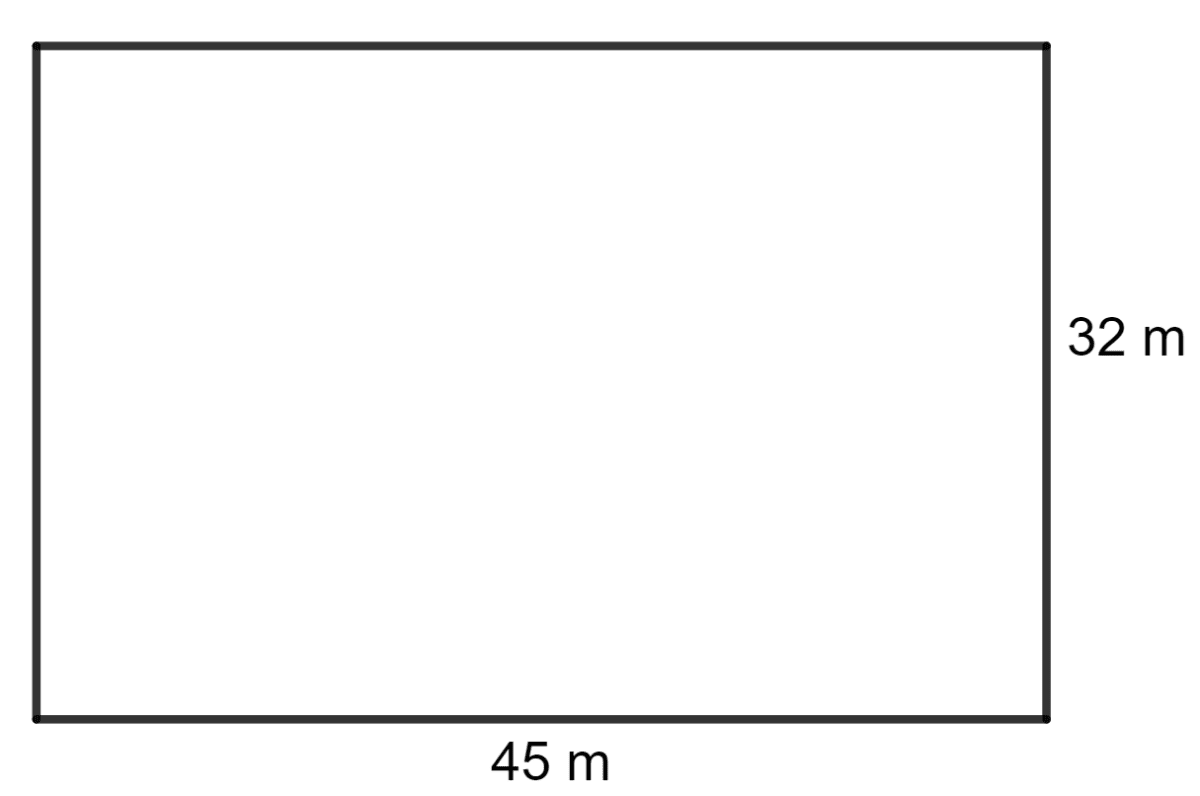
Area = l x b
= 45 x 32 m2
= 1,440 m2
Cost per metre of carpet = ₹40
Width of the carpet = 1.20 m
Cost per square metre = = = ₹ 33.33
Total cost = Cost per square metre x area of hall
= 33.33 x 1440
= ₹ 48,000
Width of the carpet in metres: 80 cm = 0.8 m
Cost per metre of carpet = ₹25
Cost per square metre = = = ₹ 31.25
Total cost = Cost per square metre x area of hall
= 31.25 x 1440
= ₹ 45,000
Hence, the cost of covering the hall with a 1.20 m wide carpet at ₹ 40 per metre is ₹ 48,000 and the cost of carpeting the hall with an 80 cm wide carpet at ₹ 25 per metre is ₹ 45,000.
Find the area and perimeter of a square plot of land, the length of whose diagonal is 15 metres. Give your answer correct to 2 places of decimals.
Answer
Given:
Diagonal of the square = 15 m
Let a be the length of side of the square.
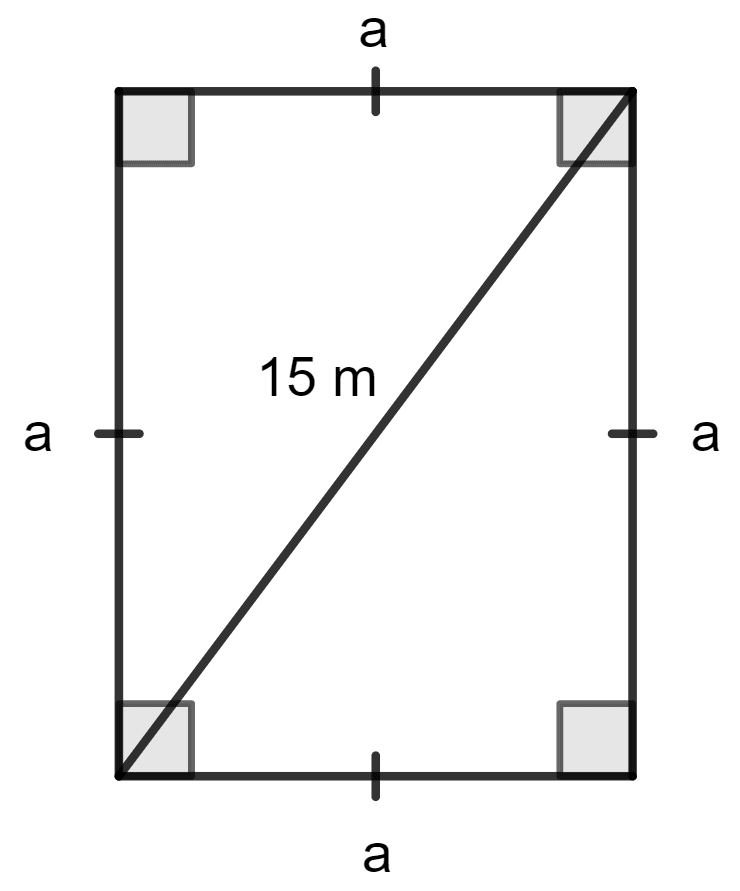
Using the Pythagoras theorem for a square,
⇒ Side2 + Side2 = Diagonal2
⇒ 2 x Side2 = Diagonal2
⇒ 2 x a2 = 152
⇒ 2a2 = 225
⇒ a2 =
⇒ a2 = 112.5
⇒ a =
⇒ a = 10.61 m
Area of square = side2
= 10.612 m2
= 112.5 m2
Perimeter of square = 4 x side
= 4 x 10.60 m
= 42.43 m
Hence, the area of the square plot is 112.5 m2 and the perimeter is 42.43 m.
The shaded region of the given diagram represents the lawn in the form of a house. On the three sides of the lawn there are flower-beds having a uniform width of 2 m.
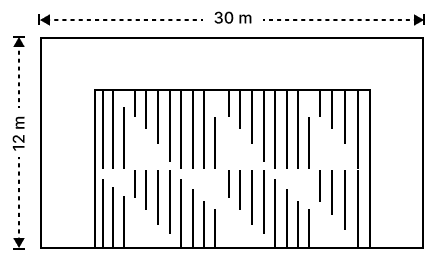
(i) Find the length and the breadth of the lawn.
(ii) Hence, or otherwise, find the area of the flower-beds.
Answer
Given:
Length of the lawn = 30 m
Breadth of the lawn = 12 m
Width of flowerbed = 2 m
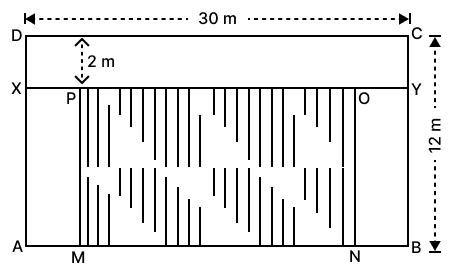
New length of lawn = 30 - 2 - 2 m = 30 - 4 m = 26 m
New breadth of lawn = 12 - 2 m = 10 m
Hence, the length of lawn = 26 m and the breadth of lawn = 10 m.
(ii) Area of flowerbed = Area of AMPX + Area of XDCY + Area of NBYO
Area of AMPX = l x b = AM x MP
= 10 x 2 m2
= 20 m2
Area of XDCY = l x b = XD x DC
= 30 x 2 m2
= 60 m2
Area of NBYO = l x b = NB x BY
= 10 x 2 m2
= 20 m2
Area of flowerbed = 20 + 60 + 20 m2
= 100 m2
Hence, the area of flowerbed is 100 m2.
A floor which measures 15 m x 8 m is to be laid with tiles measuring 50 cm x 25 cm. Find the number of tiles required.
Further, if a carpet is laid on the floor so that a space of 1 m exists between its edges and the edges of the floor, what fraction of the floor is left uncovered.
Answer
Given:
Dimensions of the floor = 15 m x 8 m
Dimensions of the tile = 50 cm x 25 cm = 0.5 m x 0.25 m
Area of floor = l x b
= 15 x 8 m2
= 120 m2
Area of tile = ltile x btile
= 0.5 x 0.25 m2
= 0.125 m2
Let n be the number of tiles.
Area of floor = Area of tile x Number of tiles
⇒ 120 = 0.125 x n
⇒ n =
⇒ n =
⇒ n = 960
Now, a carpet is laid on the floor, leaving a space of 1 m between its edges and the edges of the floor.
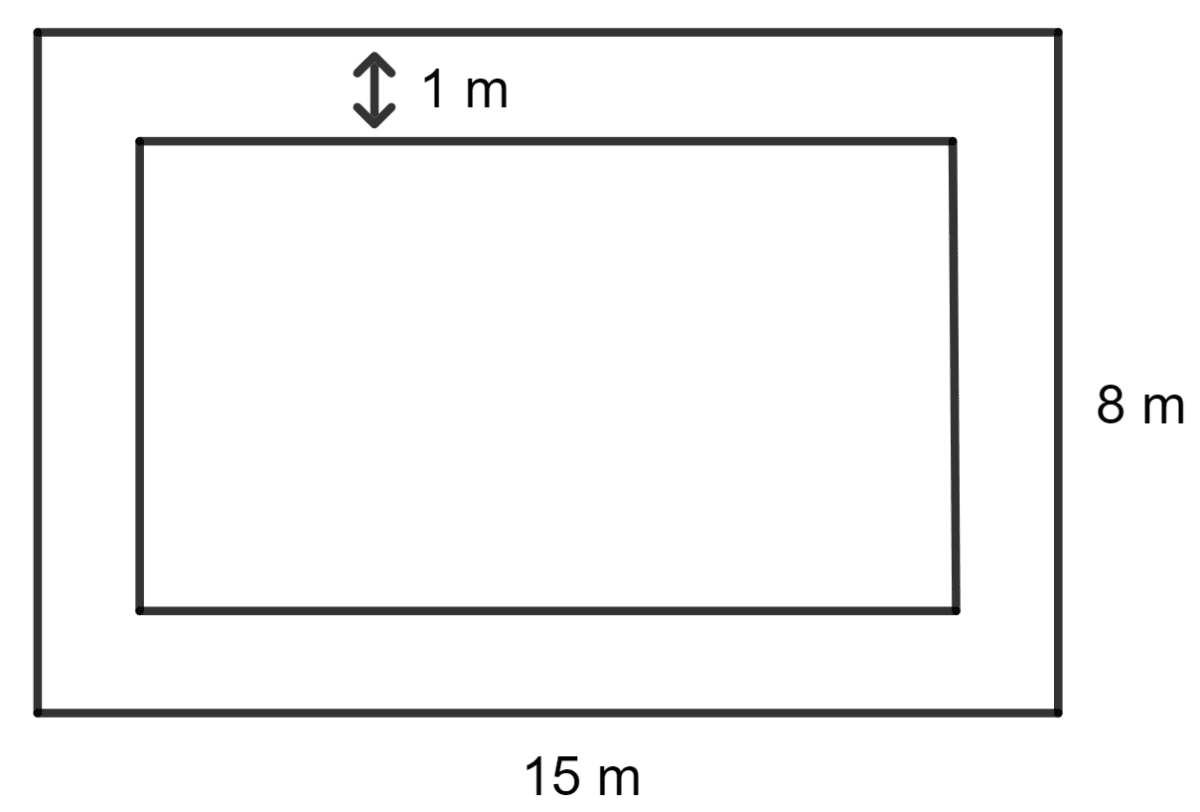
Length of the carpet = 15 - 1 - 1 m = 13 m
Breadth of the carpet = 8 - 1 - 1 m = 6 m
Area of uncovered floor = Area of floor - Area of carpet
= 15 x 8 - 13 x 6 m2
= 120 - 78 m2
= 42 m2
Fraction of floor left uncovered = =
Hence, the number of tiles needed is 960 and the fraction of the floor left uncovered is .
Two adjacent sides of parallelogram are 24 cm and 18 cm. If the distance between the longer sides is 12 cm; find the distance between the shorter sides.
Answer
Step 1 Finding the area of the parallelogram.
Length of one side of the parallelogram (longer side) = 24 cm
Length of the adjacent side (shorter side) = 18 cm
The distance between the longer sides = 12 cm
Area of parallelogram = base x height
= AB x DE
= 24 x 12 cm2
= 288 cm2
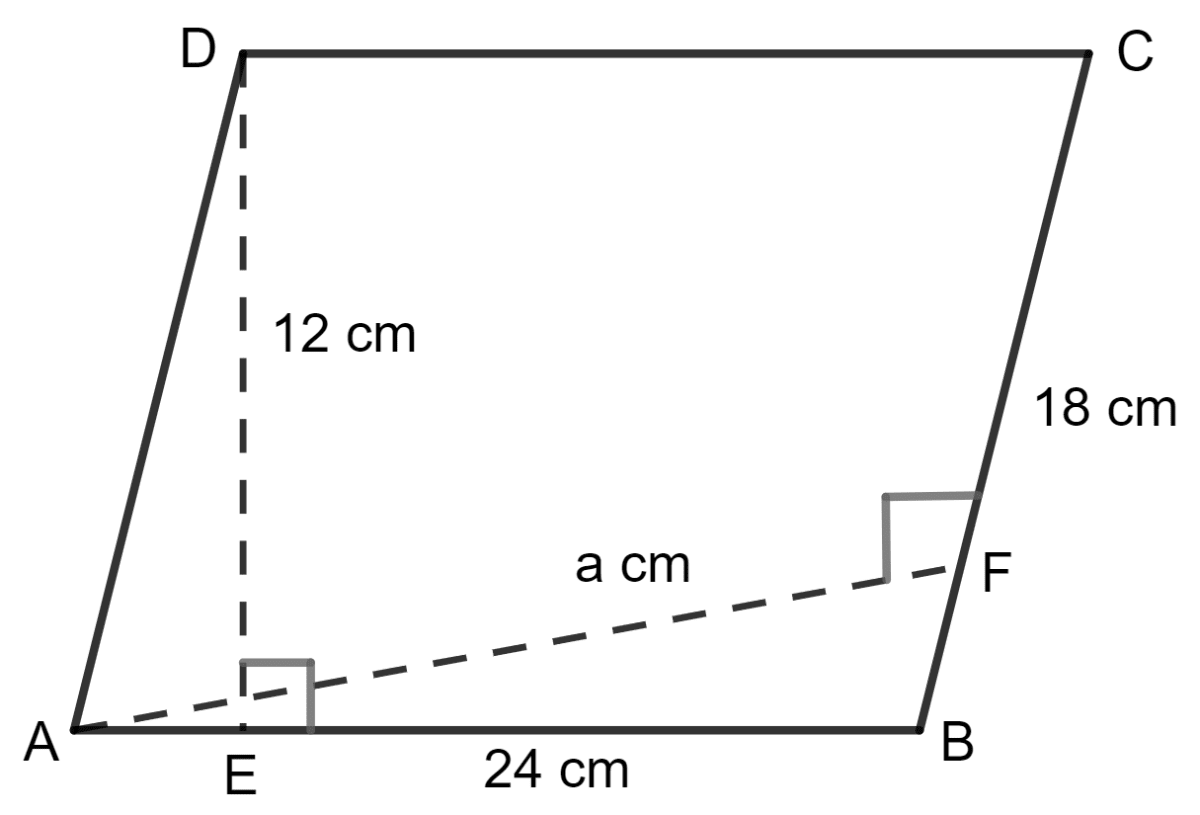
Step 2 Finding the sides of the parallelogram.
Let a be the distance between the shorter sides.
Area = base x height
= BC x AF
= 18 x a
Since area of the parallelogram will be same, if we consider AB as the base or BC as the base.
⇒ AB x DE = BC x AF
⇒ 288 = 18 x a
⇒ a =
⇒ a = 16 cm
Hence, the distance between the shorter sides of the parallelogram is 16 cm.
Two adjacent sides of a parallelogram are 28 cm and 26 cm. If one diagonal of it is 30 cm long; find the area of the parallelogram. Also, find the distance between its shorter sides.
Answer
By joining diagonal BD, the parallelogram is divided into two triangles. Let the sides of Δ ABD be:
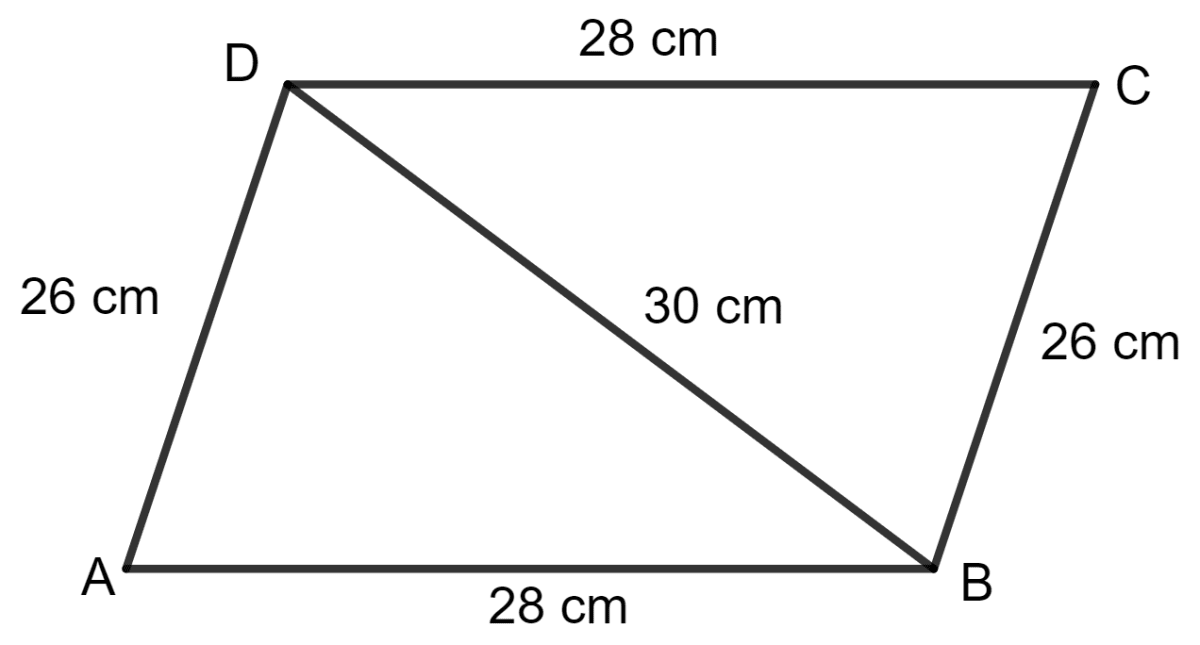
a = 28 cm, b = 26 cm and c = 30 cm.
The semi-perimeter s:
∵ Area of triangle =
= cm2
= cm2
= cm2
= 336 cm2
Area of parallelogram ABCD = 2 x area of Δ ABD
= 2 x 336 cm2
= 672 cm2
Let h be the distance between the shorter sides.
Area of the parallelogram = base x height
⇒ 26 x h = 672
⇒ h =
⇒ h = 25.84 cm
Hence, the area of the parallelogram is 672 cm2 and the distance between the shorter sides is 25.84 cm.
The area of a rhombus is 216 sq. cm. If its one diagonal is 24 cm; find :
(i) length of its other diagonal,
(ii) length of its side,
(iii) perimeter of the rhombus.
Answer
(i) Given:
Area of rhombus = 216 sq. cm
One diagonal = 24 cm
Let d be the other diagonal of rhombus.
Area = x product of diagonals
⇒ 216 = x 24 x d
⇒ 216 = 12 x d
⇒ d =
⇒ d = 18
Hence, the length of other diagonal is 18 cm.
(ii) The rhombus is shown in the figure below:
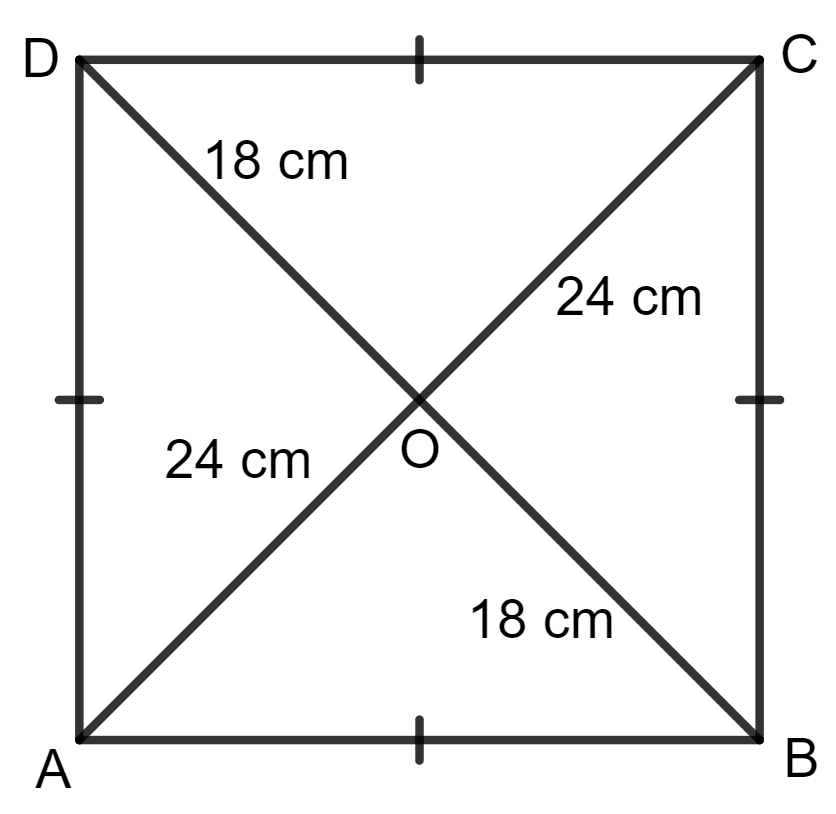
Diagonal AC = 24 cm
Then, OA = OC = = 12 cm
Diagonal BD = 18 cm
Then, OB = OD = = 9 cm
Since the diagonals of a rhombus bisect at 90°.
Applying pythagoras theorem in Δ AOB, we get:
AB2 = OA2 + OB2
⇒ AB2 = (12)2 + (9)2
⇒ AB2 = 144 + 81
⇒ AB2 = 225
⇒ AB =
⇒ AB = 15 cm
Hence, the length of each side of the rhombus is 15 cm.
(iii) Perimeter of the rhombus = 4 x side
= 4 x 15 cm
= 60 cm
Hence, the perimeter of the rhombus 60 cm.
The perimeter of a rhombus is 52 cm. If one diagonal is 24 cm; find :
(i) the length of its other diagonal,
(ii) its area.
Answer
(i) Given:
Perimeter of the rhombus = 52 cm
One diagonal BD = 24 cm
Let a be the length of a side of the rhombus.
Perimeter of a rhombus = 4 x Side
⇒ 4 x a = 52
⇒ a =
⇒ a = 13 cm
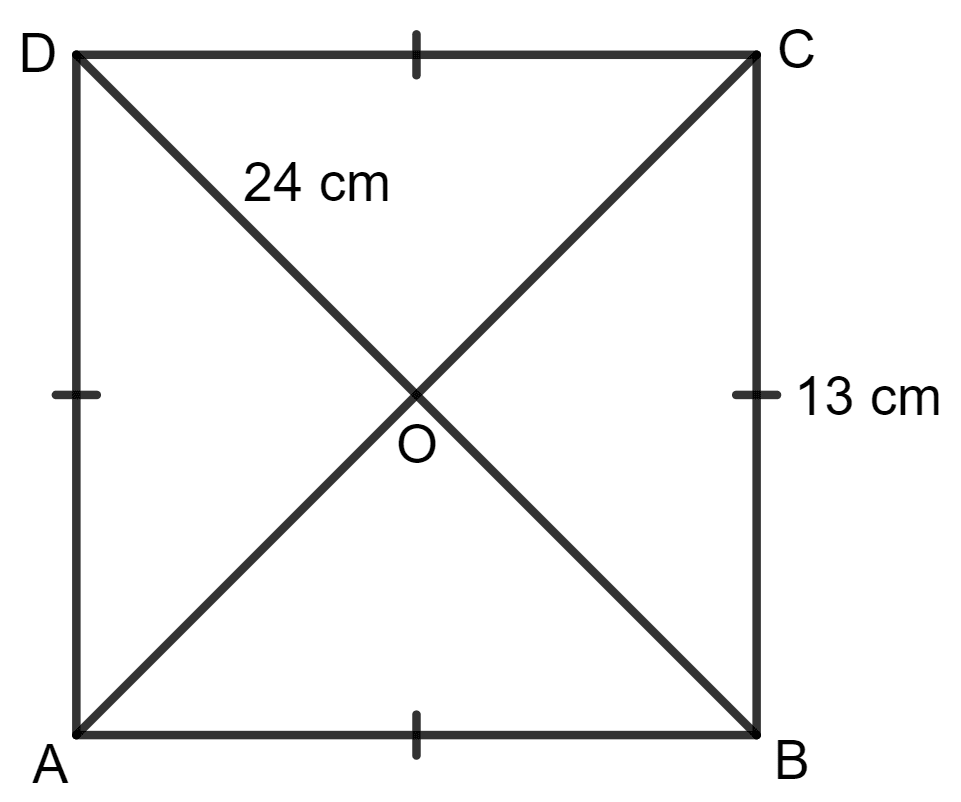
BD = 24 cm
Then, OB = OD = = 12 cm
Since the diagonals of a rhombus bisect at 90°.
Applying pythagoras theorem in triangle AOB, we get:
AB2 = OA2 + OB2
⇒ (13)2 = OA2 + (12)2
⇒ 169 = OA2 + 144
⇒ OA2 = 169 - 144
⇒ OA2 = 25
⇒ OA =
⇒ OA = 5 cm
AC = 2 x OA = 2 x 5 cm = 10 cm
Hence, the length of the other diagonal is 10 cm.
(ii) Area = x product of diagonals
= x 24 x 10 cm2
= 12 x 10 cm2
= 120 cm2
Hence, the area of the rhombus is 120 cm2.
The perimeter of a rhombus is 46 cm. If the height of the rhombus is 8 cm; find its area.
Answer
Given:
Perimeter of the rhombus = 46 cm
Height of the rhombus = 8 cm
Let a be the length of a side of the rhombus.
Perimeter = 4 x Side
⇒ 46 = 4 x a
⇒ a =
⇒ a = 11.5 cm
Area = base x height
= 11.5 x 8 cm2
= 92 cm2
Hence, the area of the rhombus is 92 cm2.
The given figure shows the cross-section of a concrete structure. Calculate the area of cross-section if AB = 1.8 m, CD = 0.6 m, DE = 0.8 m, EF = 0.3 m and AF = 1.2 m.
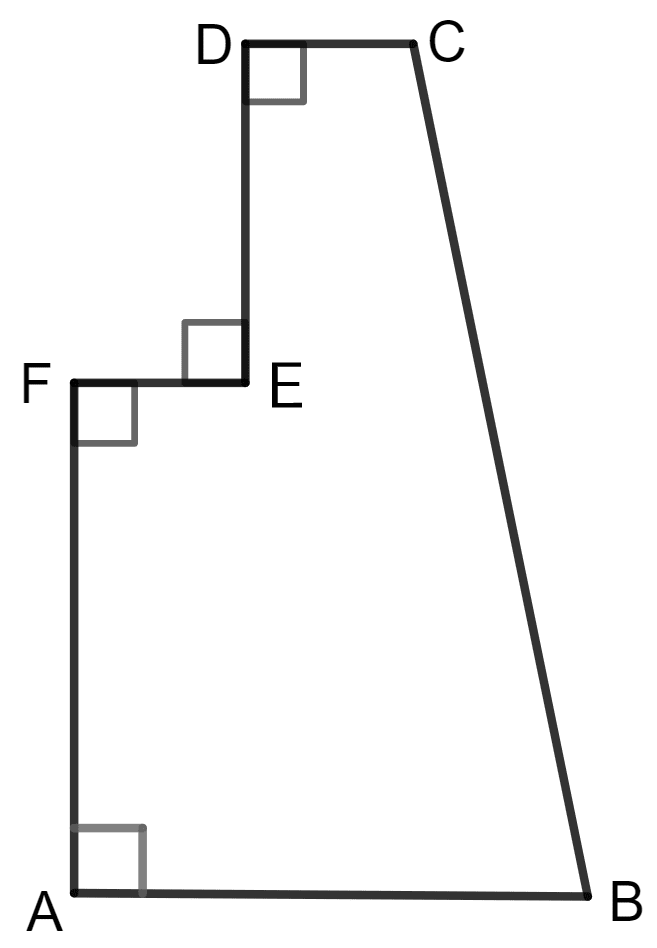
Answer
Given:
AB = 1.8 m, CD = 0.6 m, DE = 0.8 m, EF = 0.3 m and AF = 1.2 m
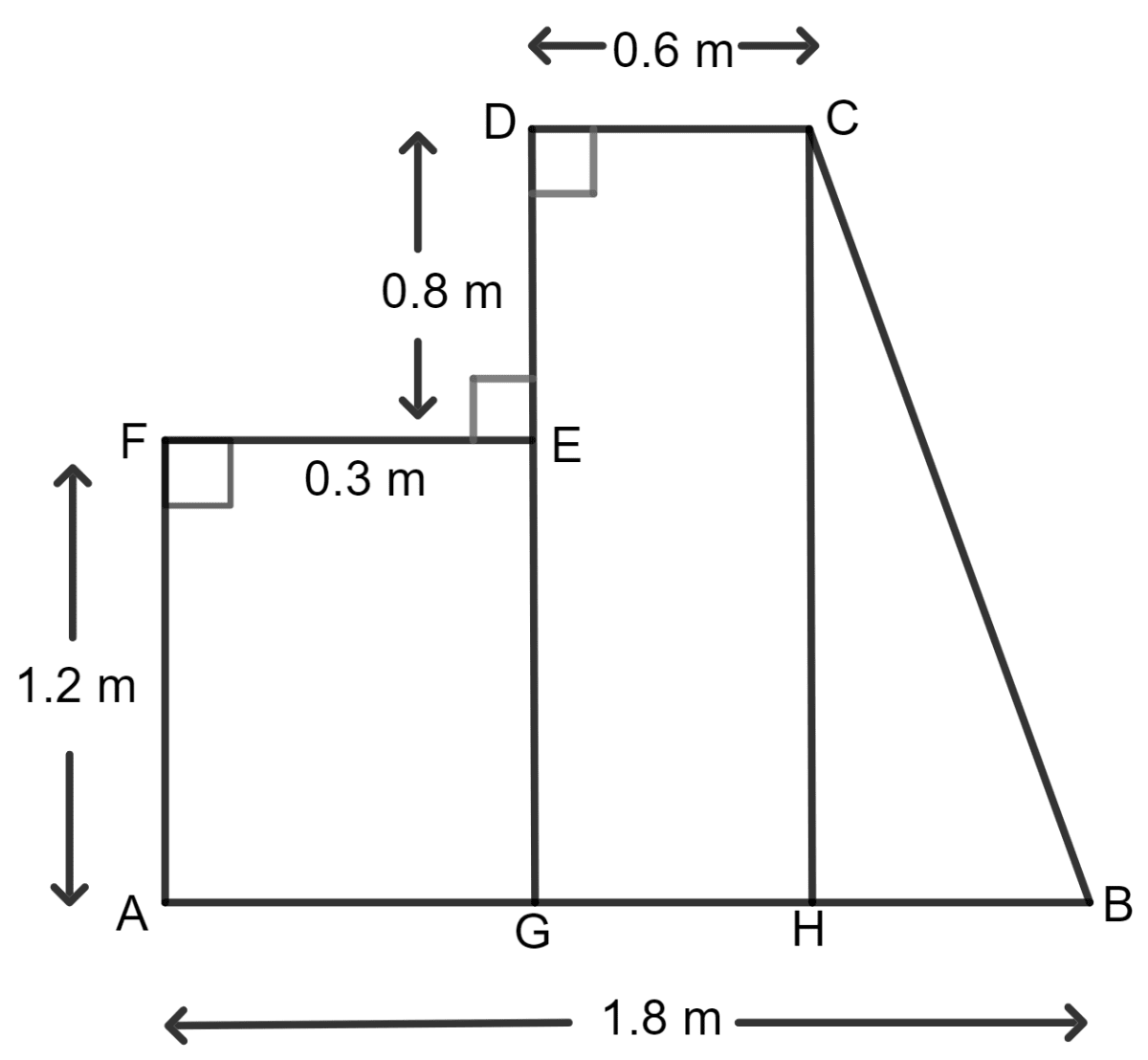
Area of ABCDEF = Area of rectangle AGEF + Area of rectangle GHCD + Area of triangle HBC.
Area of rectangle AGEF = l x b = AF x EF
= 1.2 x 0.3 m2
= 0.36 m2
Area of rectangle GHCD = l x b = GH x HC
= 0.6 x 2 m2 (HC = AF + ED = 1.2 + 0.8 = 2 cm)
= 1.2 m2
Area of triangle HBC = x b x h = x HB x HC
= x 0.9 x 2 m2 (HB = AB - AH = 1.8 - 0.9 = 0.9)
= 0.9 x 1 m2
= 0.9 m2
Now, area of ABCDEF = 0.36 m2 + 1.2 m2 + 0.9 m2
= 2.46 m2
Hence, the area of cross-section is 2.46 sq. m.
Calculate the area of the figure given below which is not drawn to scale.
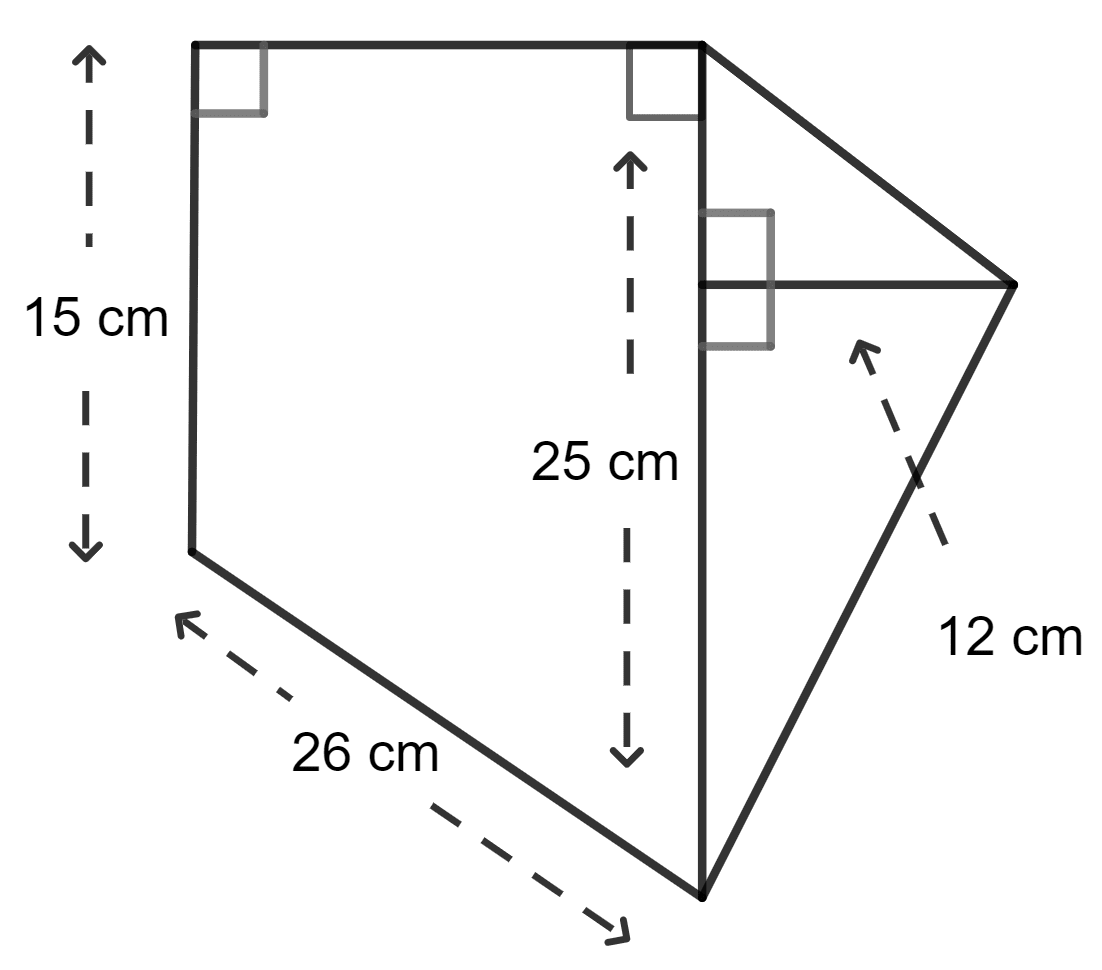
Answer
Area of figure ABCEF = Area of trapezium ABCF + Area of triangle CEF
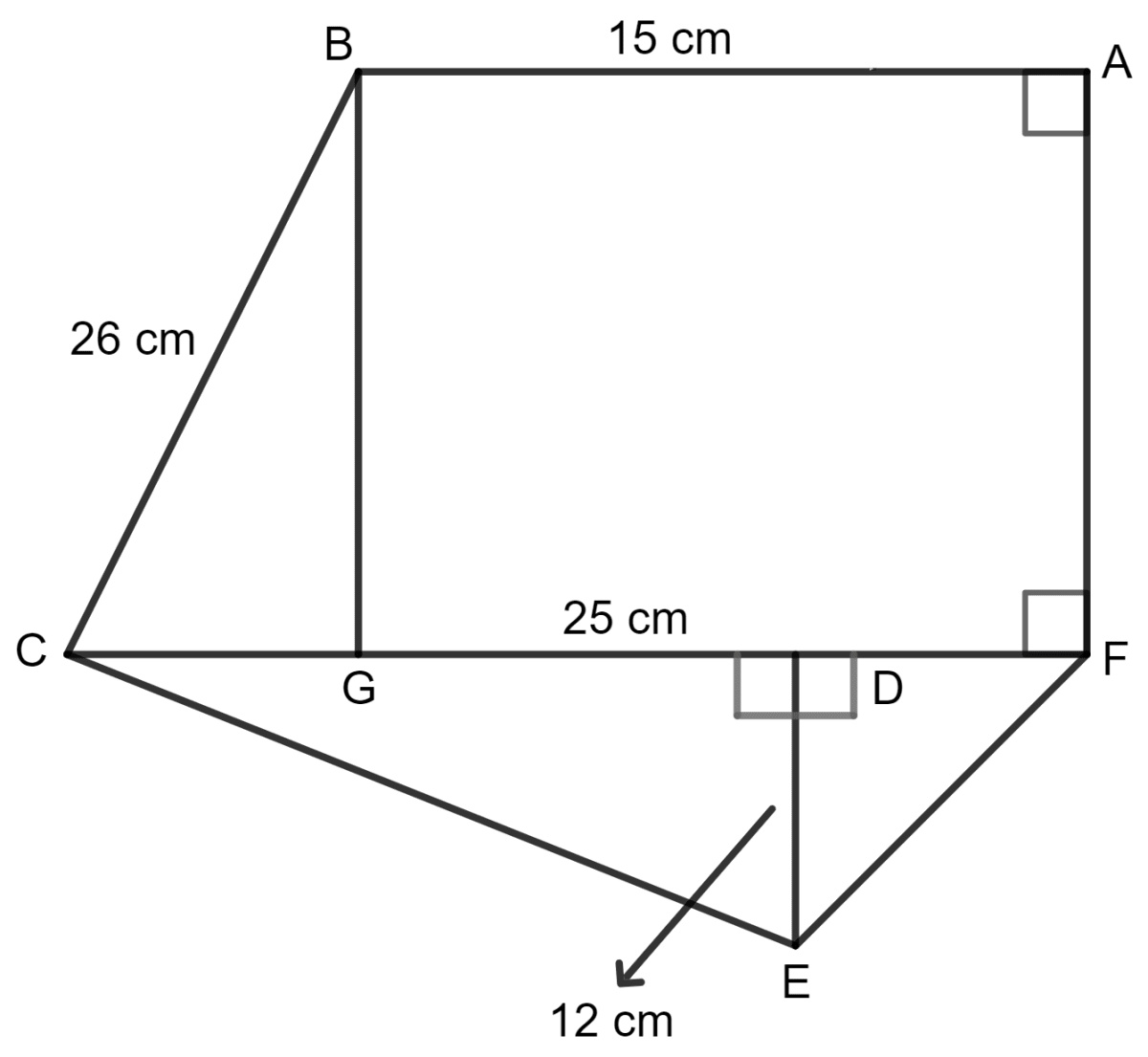
Area of triangle CEF = x b x h = x CF x DE
= x 25 x 12 m2
= 25 x 6 m2
= 150 m2
In triangle BGC,
Base2 + Height2 = Hypotenuse2
⇒ CG2 + BG2 = CB2
Let h be the length of BG.
⇒ 102 + h2 = 262 (∵CG = CF - GF = CF - BA = 25 - 15 = 10)
⇒ 100 + h2 = 676
⇒ h2 = 676 - 100
⇒ h2 = 576
⇒ h =
⇒ h = 24 cm
Area of trapezium = (sum of parallel sides) x distance between the parallel sides
= (AB + CF) x BG
= (15 + 25) x 24 m2
= x 40 x 24 m2
= 20 x 24 m2
= 480 m2
So, total area of figure ABCEF = 150 + 480 m2
= 630 m2
Hence, the area is 630 m2.
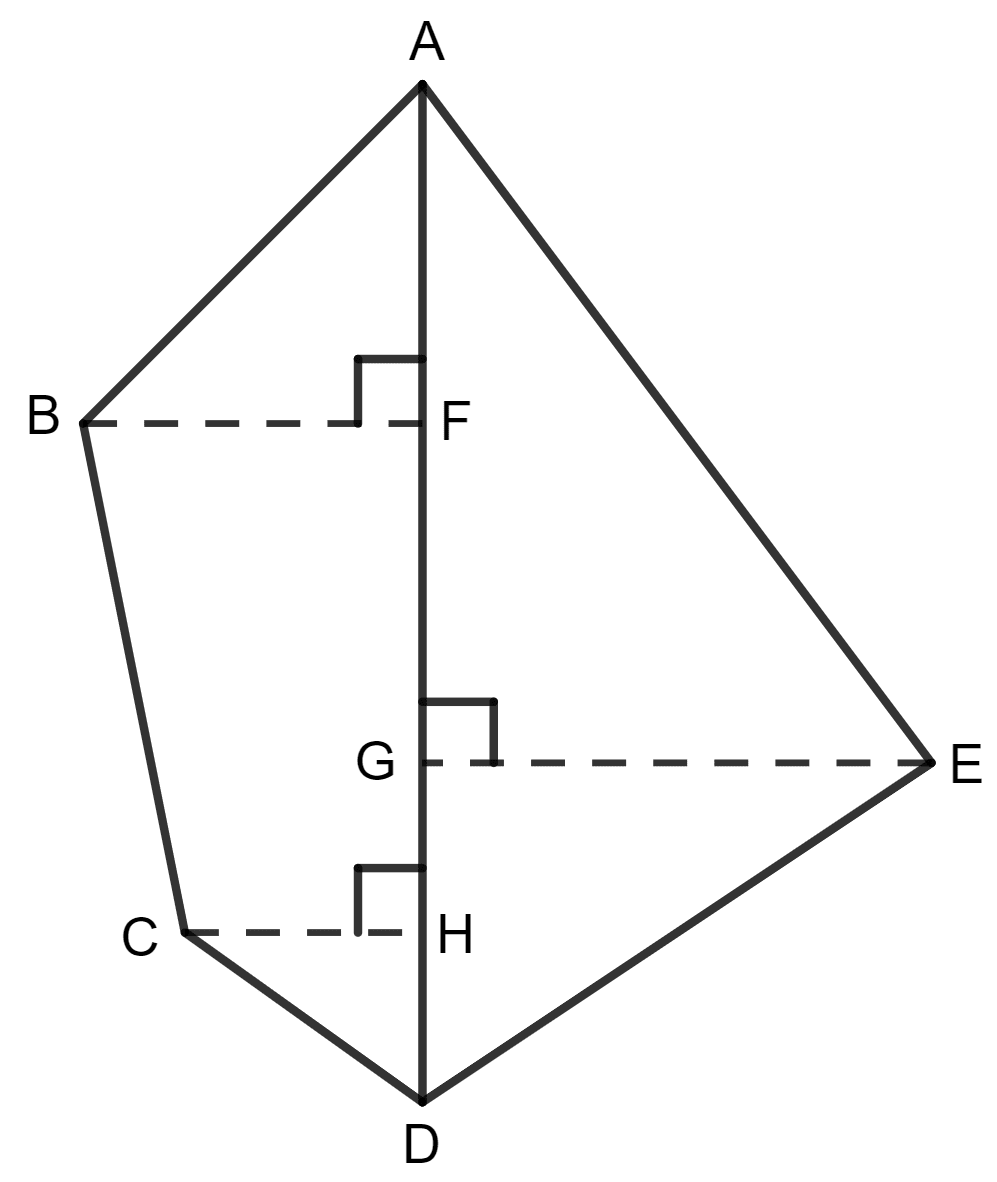
The following diagram shows a pentagonal field ABCDE in which the lengths of AF, FG, GH and HD are 50 m, 40 m, 15 m and 25 m respectively; and the lengths of perpendiculars BF, CH and EG are 50 m, 25 m and 60 m respectively. Determine the area of the field.
Answer
Area of figure ABCDE = Area of Δ ABF + Area of Δ AED + Area of Δ DHC + Area of trapezium BFHC
Area of Δ ABF = x b x h = x AF x BF
= x 50 x 50 m2
= 25 x 50 m2
= 1250 m2
Area of Δ AED = x b x h = x AD x GE
= x (AF + FG + GH + HD) x GE
= x (50 + 40 + 15 + 25) x 60 m2
= 130 x 30 m2
= 3900 m2
Area of Δ DHC = x b x h = x HD x CH
= x 25 x 25 m2
= 12.5 x 25 m2
= 312.5 m2
Area of trapezium BFHC = (sum of parallel sides) x distance between the parallel sides
= (BF + CH) x FH
= (BF + CH) x (FH + GH)
= (50 + 25) x (40 + 15) m2
= x 75 x 55 m2
= 37.5 x 55 m2
= 2062.5 m2
Thus, area of figure ABCDE = 1250 + 3900 + 312.5 + 2062.5 m2
= 7525 m2
Hence, the area is 7525 sq. m.