KnowledgeBoat Logo
|
OPEN IN APP

Chapter 19

Area and Perimeter of Plane Figures

Class - 9 Concise Mathematics Selina


Exercise 19(A)

Question 1(a)

Length of a side and corresponding altitude of a triangle is doubled. The area of triangle will become :

  1. double

  2. half

  3. four times

  4. one-fourth

Answer

The area of a triangle is given by:

Area = 12\dfrac{1}{2} x length x altitude

When the length of the side and the corresponding altitude of the triangle are doubled:

Area1 = 12\dfrac{1}{2} x 2 x length x 2 x altitude

= 4×(12×length×altitude)4 \times \Big( \dfrac{1}{2} \times \text{length} \times \text{altitude} \Big)

= 4 x Area

Area1 = 4 x Area

Thus, the new area of triangle becomes four times the original area.

Hence, option 3 is the correct option.

Question 1(b)

If each side of an equilateral triangle is halved, its area will be :

  1. halved

  2. four times

  3. unaltered

  4. one-fourth

Answer

Area of equilateral triangle = 34×side2\dfrac{\sqrt{3}}{4} \times side^2

If each side of the equilateral triangle is halved, then the new area will be:

New area = 34×(side2)2\dfrac{\sqrt{3}}{4} \times \Big(\dfrac{side}{2}\Big)^2

= 14(34×side2)\dfrac{1}{4}\Big(\dfrac{\sqrt{3}}{4} \times side^2\Big)

= 14\dfrac{1}{4} x Original area

Therefore, the new area of the equilateral triangle will be one-fourth of the original area.

Hence, option 4 is the correct option.

Question 1(c)

The area of a triangle is 37.5 cm2. If its base is 12.5 cm; the corresponding altitude is :

  1. 3 cm

  2. 25 cm

  3. 6 cm

  4. 12 cm

Answer

Given:

Area = 37.5 cm2

Base = 12.5 cm

Let h be the altitude of triangle.

Area of triangle = 12\dfrac{1}{2} x base x altitude

⇒ 37.5 = 12\dfrac{1}{2} x 12.5 x h

⇒ h = 37.5×212.5\dfrac{37.5 \times 2}{12.5}

⇒ h = 7512.5\dfrac{75}{12.5}

⇒ h = 6 cm

Hence, option 3 is the correct option.

Question 1(d)

ABC is a triangle with AB = AC = 12 cm and ∠A = 90°, the area of the triangle ABC is :

  1. 144 cm2

  2. 36 cm2

  3. 72 cm2

  4. 108 cm2

Answer

Given:

AB = AC = 12 cm

∠A = 90°
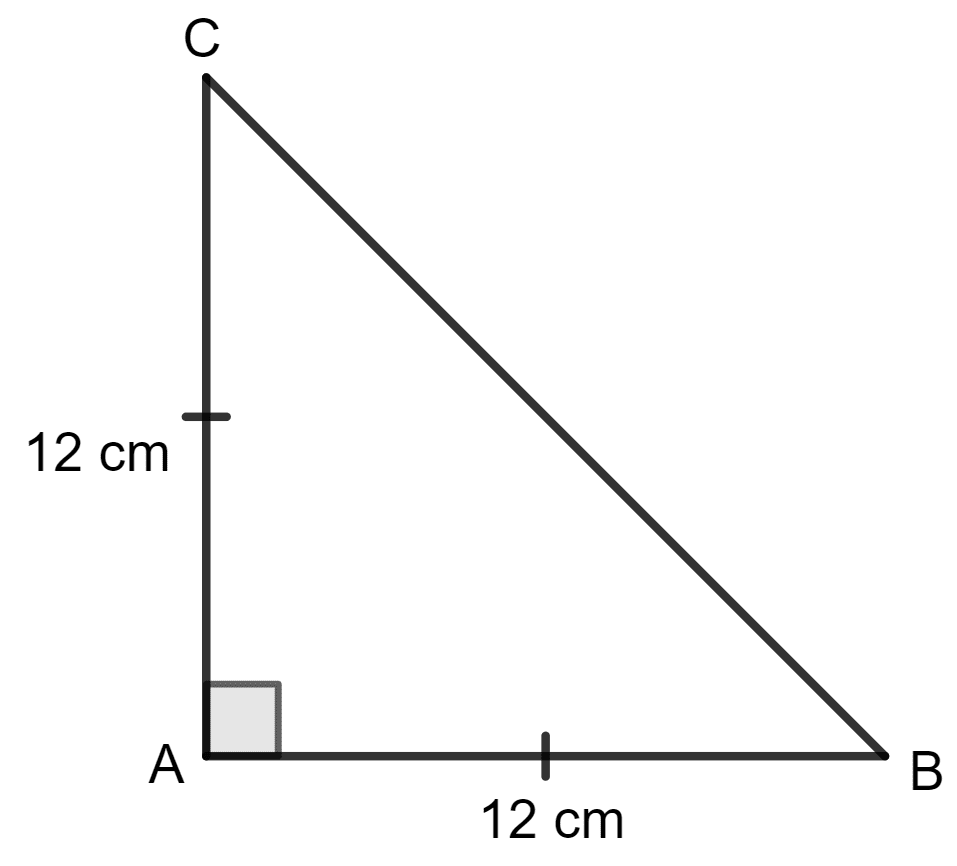
ABC is a triangle with AB = AC = 12 cm and ∠A = 90°, the area of the triangle ABC is : Area and Perimeter of Plane Figures, Concise Mathematics Solutions ICSE Class 9.

Area of triangle = 12\dfrac{1}{2} x base x altitude

= 12\dfrac{1}{2} x 12 x 12 cm2

= 12\dfrac{1}{2} x 144 cm2

= 72 cm2

Hence, option 3 is the correct option.

Question 1(e)

The sides of a triangle are 9 cm, 12 cm and 15 cm; the area of the triangle is :

  1. 54 cm2

  2. 96 cm2

  3. 108 cm2

  4. 135 cm2

Answer

Let the sides of the triangle be:

a = 9 cm, b = 12 cm and c = 15 cm.

The semi-perimeter s:

s=a+b+c2=9+12+152=362=18∵ s = \dfrac{a + b + c}{2}\\[1em] = \dfrac{9 + 12 + 15}{2}\\[1em] = \dfrac{36}{2}\\[1em] = 18

∵ Area of triangle = s(sa)(sb)(sc)\sqrt{s(s - a)(s - b)(s - c)}

= 18(189)(1812)(1815)\sqrt{18(18 - 9)(18 - 12)(18 - 15)} cm2

= 18×9×6×3\sqrt{18 \times 9 \times 6 \times 3} cm2

= 2,916\sqrt{2,916} cm2

= 54 cm2

Hence, option 1 is the correct option.

Question 2

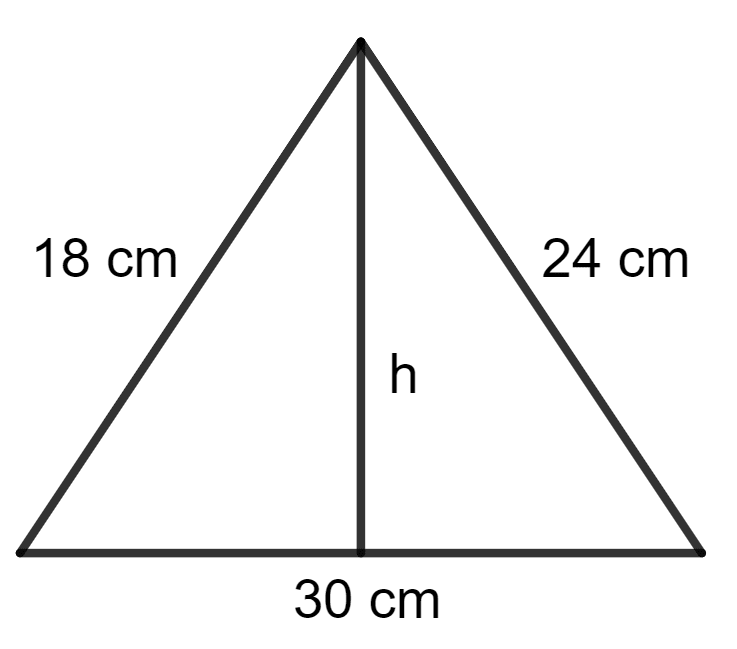
Find the area of a triangle whose sides are 18 cm, 24 cm and 30 cm.

Also, find the length of altitude corresponding to the largest side of the triangle.

Answer

Let the sides of the triangle be:

a = 18 cm, b = 24 cm and c = 30 cm.

The semi-perimeter s:

s=a+b+c2=18+24+302=722=36∵ s = \dfrac{a + b + c}{2}\\[1em] = \dfrac{18 + 24 + 30}{2}\\[1em] = \dfrac{72}{2}\\[1em] = 36

∵ Area of triangle = s(sa)(sb)(sc)\sqrt{s(s - a)(s - b)(s - c)}

= 36(3618)(3624)(3630)\sqrt{36(36 - 18)(36 - 24)(36 - 30)} cm2

= 36×18×12×6\sqrt{36 \times 18 \times 12 \times 6} cm2

= 46,656\sqrt{46,656} cm2

= 216 cm2

Find the area of a triangle whose sides are 18 cm, 24 cm and 30 cm. Area and Perimeter of Plane Figures, Concise Mathematics Solutions ICSE Class 9.

Using the area formula to find the altitude corresponding to the largest side (base = 30 cm):

Area = 12\dfrac{1}{2} x base x altitude

Let h be the altitude:

⇒ 216 = 12\dfrac{1}{2} x 30 x h

⇒ 216 = 15 x h

⇒ h = 21615\dfrac{216}{15}

⇒ h = 14.4 cm

Hence, the area of the triangle is 216 cm2 and the length of altitude corresponding to the largest side is 14.4 cm.

Question 3

The lengths of the sides of a triangle are in the ratio 3 : 4 : 5. Find the area of the triangle if its perimeter is 144 cm.

Answer

It is given that the lengths of the sides of a triangle are in the ratio 3 : 4 : 5.

Let the lengths of the sides be 3a, 4a and 5a.
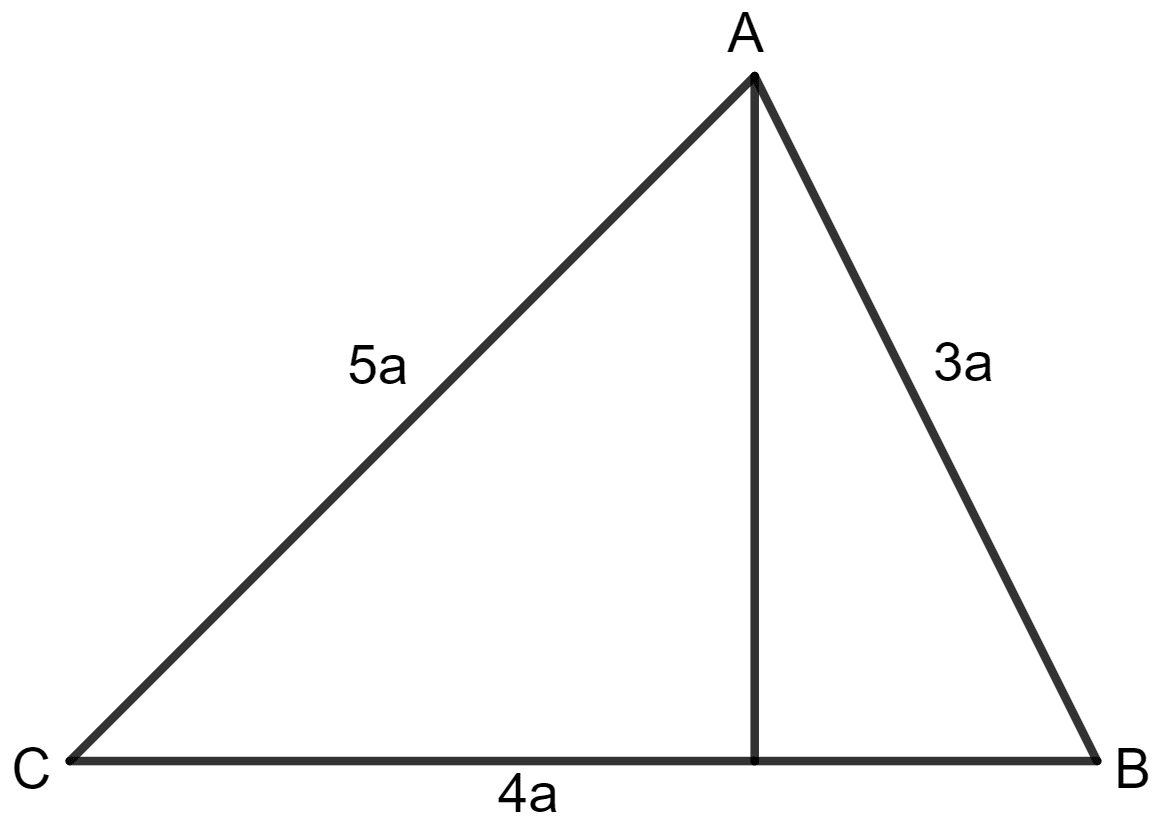
The lengths of the sides of a triangle are in the ratio 3 : 4 : 5. Find the area of the triangle if its perimeter is 144 cm. Area and Perimeter of Plane Figures, Concise Mathematics Solutions ICSE Class 9.

The perimeter of the triangle is 144 cm.

Perimeter = sum of all sides of triangle

⇒ 144 = 3a + 4a + 5a

⇒ 144 = 12a

⇒ a = 14412\dfrac{144}{12}

⇒ a = 12

So, the sides of triangle = 3a, 4a and 5a

= 3 x 12, 4 x 12 and 5 x 12

= 36, 48 and 60

Let a = 36 cm, b = 48 cm and c = 60 cm.

The semi-perimeter s:

s=a+b+c2=36+48+602=1442=72∵ s = \dfrac{a + b + c}{2}\\[1em] = \dfrac{36 + 48 + 60}{2}\\[1em] = \dfrac{144}{2}\\[1em] = 72

∵ Area of triangle = s(sa)(sb)(sc)\sqrt{s(s - a)(s - b)(s - c)}

= 72(7236)(7248)(7260)\sqrt{72(72 - 36)(72 - 48)(72 - 60)} cm2

= 72×36×24×12\sqrt{72 \times 36 \times 24 \times 12} cm2

= 746,496\sqrt{746,496} cm2

= 864 cm2

Hence, the area of the triangle is 864 cm2.

Question 4

ABC is a triangle in which AB = AC = 4 cm and ∠A = 90°. Calculate :

(i) the area of Δ ABC,

(ii) the length of perpendicular from A to BC.

Answer

(i) Given:

AB = AC = 4 cm

∠A = 90°
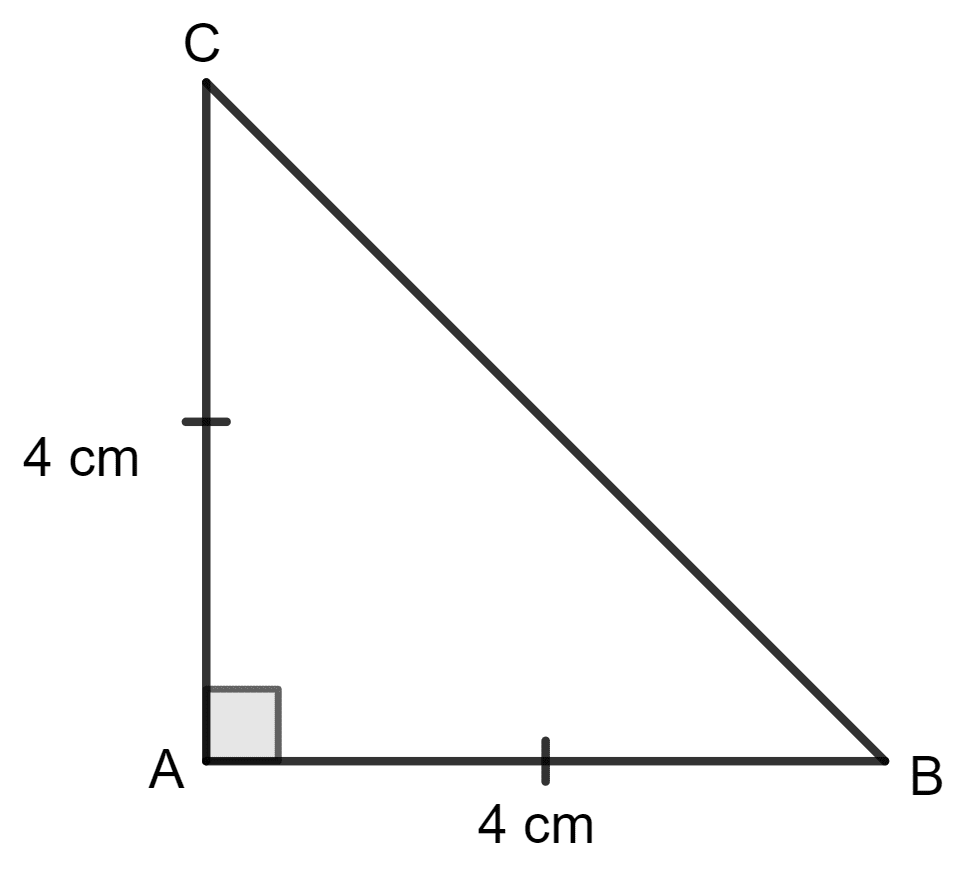
ABC is a triangle in which AB = AC = 4 cm and ∠A = 90°. Calculate : Area and Perimeter of Plane Figures, Concise Mathematics Solutions ICSE Class 9.

Area = 12\dfrac{1}{2} x base x height

= 12\dfrac{1}{2} x 4 x 4 cm2

= 12\dfrac{1}{2} x 16 cm2

= 8 cm2

(ii) By using the Pythagoras theorem,

AB2 + AC2 = BC2

⇒ (4)2 + (4)2 = BC2

⇒ 16 + 16 = BC2

⇒ BC2 = 32

⇒ BC = 32\sqrt{32}

⇒ BC = 4 2\sqrt{2} cm

Now considering BC as the base of the triangle, altitude AD will be its height.
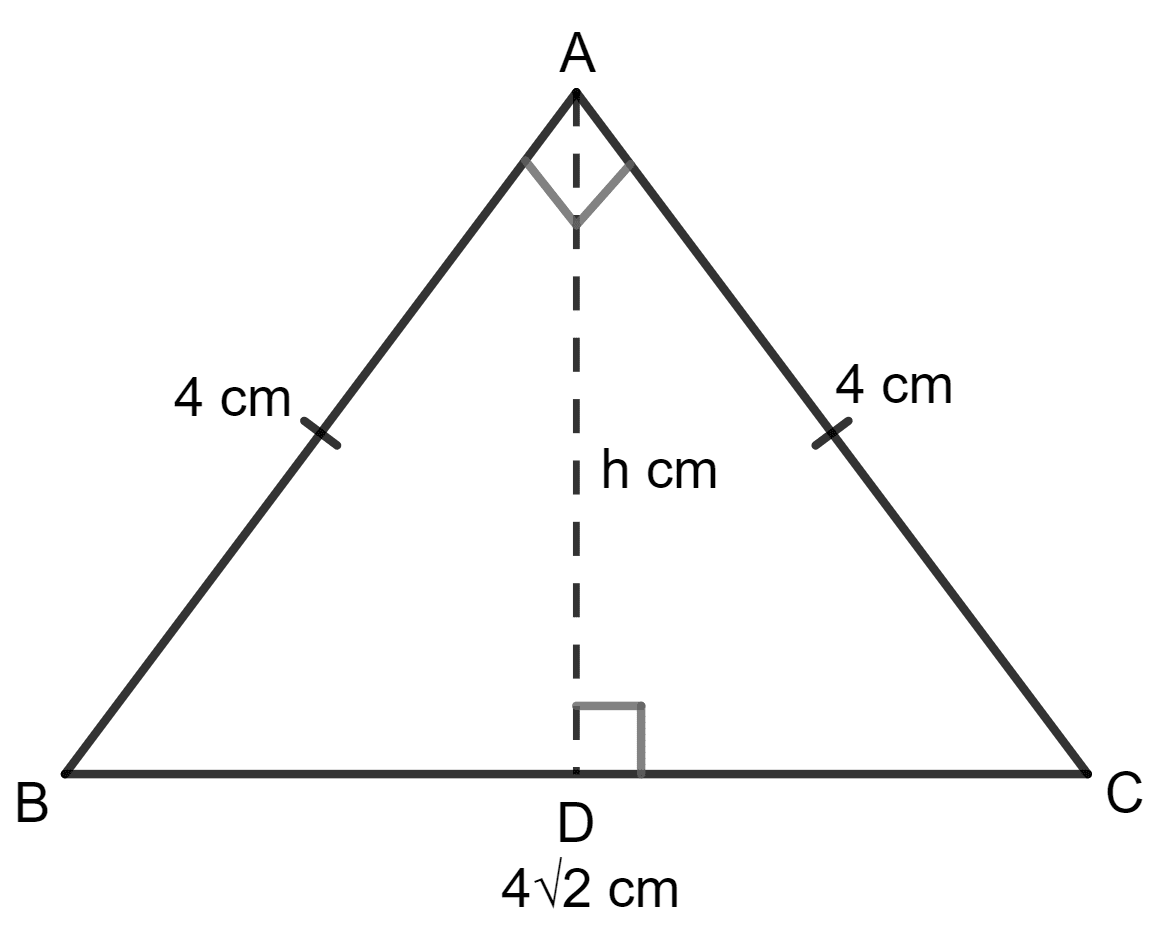
ABC is a triangle in which AB = AC = 4 cm and ∠A = 90°. Calculate : Area and Perimeter of Plane Figures, Concise Mathematics Solutions ICSE Class 9.

Area of the triangle will remain the same as before i.e., 8 cm2.

Let h be the altitude of triangle

Area = 12\dfrac{1}{2} x base x height

∴ 8 = 12\dfrac{1}{2} x BC x AD

⇒ 8 = 12\dfrac{1}{2} x 424 \sqrt{2} x h

⇒ 8 = 222 \sqrt{2} x h

⇒ h = 822\dfrac{8}{2 \sqrt{2}}

⇒ h = 42\dfrac{4}{\sqrt{2}}

⇒ h = 2.83 cm

Hence, the length of perpendicular from A to BC is 2.83 cm.

Question 5

The area of an equilateral triangle is 363 sq. cm36\sqrt{3}\text{ sq. cm}. Find its perimeter.

Answer

Given:

Area = 363 sq. cm36\sqrt{3}\text{ sq. cm}

Let s be the side of equilateral triangle.

Area of equilateral triangle = 34×side2\dfrac{\sqrt{3}}{4} \times \text{side}^2

363=34×s2363=34×s236=14×s2s2=36×4s2=144s=144s=12⇒ 36\sqrt{3} = \dfrac{\sqrt{3}}{4} \times s^2\\[1em] ⇒ 36\cancel{\sqrt{3}} = \dfrac{\cancel{\sqrt{3}}}{4} \times s^2\\[1em] ⇒ 36 = \dfrac{1}{4} \times s^2\\[1em] ⇒ s^2 = 36 \times 4\\[1em] ⇒ s^2 = 144\\[1em] ⇒ s = \sqrt{144}\\[1em] ⇒ s = 12

Perimeter = 3 x side

= 3 x 12 cm

= 36 cm

Hence, the perimeter is 36 cm.

Question 6

Find the area of an isosceles triangle with perimeter 36 cm and base 16 cm.

Answer

Given:

Perimeter = 36 cm

Base = 16 cm

Let a be the length of the equal sides of the triangle.

Perimeter = 2 x Equal side + Base

⇒ 36 = 2a + 16

⇒ 2a = 36 - 16

⇒ 2a = 20

⇒ a = 202\dfrac{20}{2}

⇒ a = 10 cm

Thus, the triangle has two equal sides, each 10 cm long, and a base of 16 cm.

a = 10 cm, b = 10 cm and c = 16 cm.

The semi-perimeter is:

s=a+b+c2=10+10+162=362=18∵ s = \dfrac{a + b + c}{2}\\[1em] = \dfrac{10 + 10 + 16}{2}\\[1em] = \dfrac{36}{2}\\[1em] = 18

∵ Area of triangle = s(sa)(sb)(sc)\sqrt{s(s - a)(s - b)(s - c)}

= 18(1810)(1810)(1816)\sqrt{18(18 - 10)(18 - 10)(18 - 16)} cm2

= 18×8×8×2\sqrt{18 \times 8 \times 8 \times 2} cm2

= 2,304\sqrt{2,304} cm2

= 48 cm2

Hence, the area is 48 cm2.

Question 7

The base of an isosceles triangle is 24 cm and its area is 192 sq. cm. Find its perimeter.

Answer

Given:

Base (b) = 24 cm

Area = 192 cm2

Let s be the length of the equal sides of the triangle.

Area of an isosceles triangle = 14×b×4s2b2\dfrac{1}{4} \times b \times \sqrt{4s^2 - b^2}

192=14×24×4s2242192=6×4s25764s2576=19264s2576=324s2576=10244s2=1024+5764s2=1600s2=16004s2=400s=400s=20⇒ 192 = \dfrac{1}{4} \times 24 \times \sqrt{4s^2 - 24^2}\\[1em] ⇒ 192 = 6 \times \sqrt{4s^2 - 576}\\[1em] ⇒ \sqrt{4s^2 - 576} = \dfrac{192}{6}\\[1em] ⇒ \sqrt{4s^2 - 576} = 32\\[1em] ⇒ 4s^2 - 576 = 1024\\[1em] ⇒ 4s^2 = 1024 + 576\\[1em] ⇒ 4s^2 = 1600\\[1em] ⇒ s^2 = \dfrac{1600}{4}\\[1em] ⇒ s^2 = 400\\[1em] ⇒ s = \sqrt{400}\\[1em] ⇒ s = 20

Perimeter = sum of all sides of triangle

= 20 + 20 + 24 cm

= 64 cm

Hence, the perimeter is 64 cm.

Question 8

The given figure shows a right-angled triangle ABC and an equilateral triangle BCD. Find the area of the shaded portion.
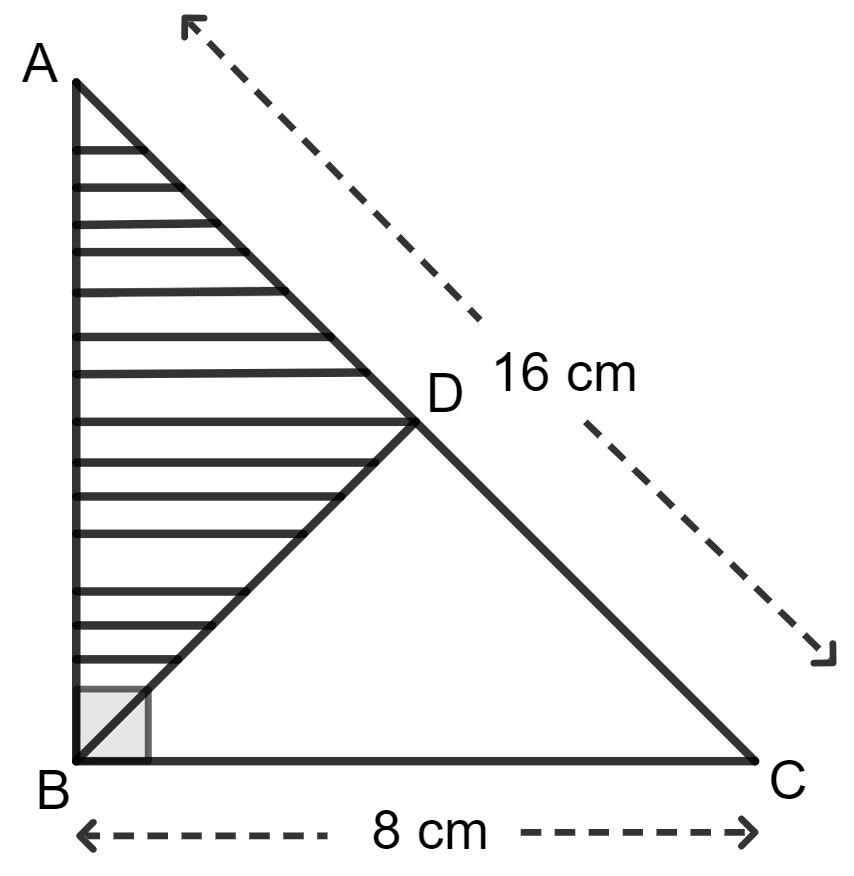
The given figure shows a right-angled triangle ABC and an equilateral triangle BCD. Find the area of the shaded portion. Area and Perimeter of Plane Figures, Concise Mathematics Solutions ICSE Class 9.

Answer

For triangle ABC (right-angled triangle),

Using the Pythagoras theorem,

Base2 + Height2 = Hypotenuse2

⇒ 82 + height2 = 162

⇒ 64 + height2 = 256

⇒ height2 = 256 - 64

⇒ height2 = 192

⇒ height = 192\sqrt{192}

⇒ height = 8 3\sqrt{3}

Area of triangle ABC = 12\dfrac{1}{2} x base x height

= 12×8×83\dfrac{1}{2} \times 8 \times 8 \sqrt{3}

= 4×834 \times 8 \sqrt{3}

= 32332 \sqrt{3} cm2

For triangle BCD,

Area of an equilateral triangle = 34\dfrac{\sqrt{3}}{4} x side2

= 34\dfrac{\sqrt{3}}{4} x 82

= 34\dfrac{\sqrt{3}}{4} x 64

= 16 3\sqrt{3} cm2

Area of Δ ABD (shaded portion) = Area of Δ ABC - Area of Δ BDC

= 32 3\sqrt{3} - 16 3\sqrt{3} cm2

= 16 3\sqrt{3} cm2

Hence, the area of the shaded portion is 163\sqrt{3} cm2 = 27.712 cm2.

Question 9

Find the area and the perimeter of quadrilateral ABCD, given below; if, AB = 8 cm, AD = 10 cm, BD = 12 cm, DC = 13 cm and ∠DBC = 90°.
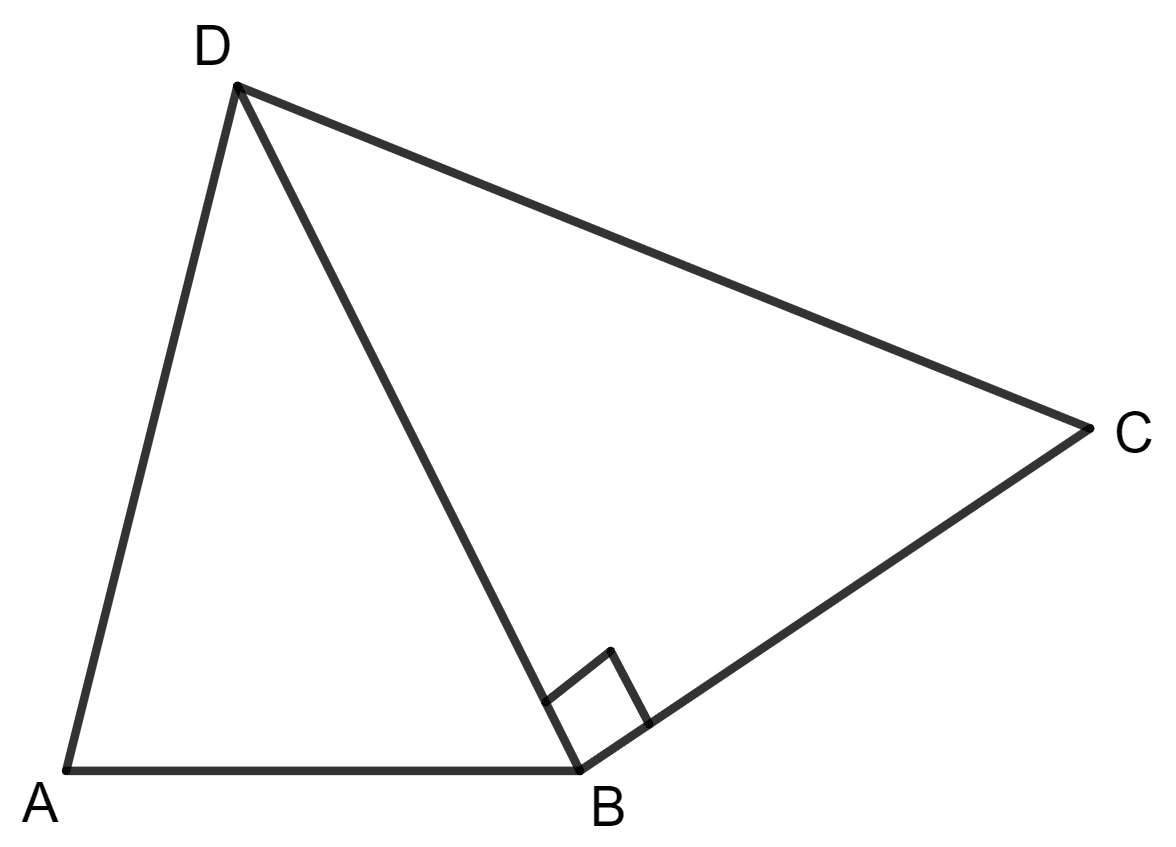
Find the area and the perimeter of quadrilateral ABCD, given below; if, AB = 8 cm, AD = 10 cm, BD = 12 cm, DC = 13 cm and ∠DBC = 90°. Area and Perimeter of Plane Figures, Concise Mathematics Solutions ICSE Class 9.

Answer

Given:

AB = 8 cm, AD = 10 cm, BD = 12 cm, DC = 13 cm and ∠DBC = 90°

In Δ BCD,

By using the Pythagoras theorem,

Base2 + Height2 = Hypotenuse2

⇒ BC2 + 122 = 132

⇒ BC2 + 144 = 169

⇒ BC2 = 169 - 144

⇒ BC2 = 25

⇒ BC = 25\sqrt{25}

⇒ BC = 5 cm

Area of Δ BCD = 12\dfrac{1}{2} x base x height

= 12\dfrac{1}{2} x 12 x 5 cm2

= 12\dfrac{1}{2} x 60 cm2

= 30 cm2

For Δ ABD,

Let AD = a = 10 cm, BD = b = 12 cm and AB = c = 8 cm.

s=a+b+c2=10+12+82=302=15∵ s = \dfrac{a + b + c}{2}\\[1em] = \dfrac{10 + 12 + 8}{2}\\[1em] = \dfrac{30}{2}\\[1em] = 15

∵ Area of triangle = s(sa)(sb)(sc)\sqrt{s(s - a)(s - b)(s - c)}

= 15(1510)(1512)(158)\sqrt{15(15 - 10)(15 - 12)(15 - 8)} cm2

= 15×5×3×7\sqrt{15 \times 5 \times 3 \times 7} cm2

= 1,575\sqrt{1,575} cm2

= 39.7 cm2

Area of quadrilateral ABCD = Area of Δ ABD + Area of Δ BCD

= 39.5 + 30 cm2

= 69.5 cm2

Perimeter of quadrilateral ABCD = Sum of all sides of quadrilateral

= AB + BC + CD + DA

= 8 + 10 + 13 + 5

= 36 cm

Hence, the area of quadrilateral is 69.7 cm2 and the perimeter is 36 cm.

Question 10

The base of a triangular field is three times its height. If the cost of cultivating the field at ₹ 36.72 per 100 m2 is ₹ 49,572; find its base and height.

Answer

Given:

Cost of cultivating the field = ₹ 36.72 per 100 m2

Total cost = ₹ 49,572

Total cost = Area x Cost of cultivating per 100 m2

Area = Total costCost of cultivating\dfrac{\text{Total cost}}{\text{Cost of cultivating}}

=49,572×10036.72=49,572×10,0003672=1,35,000 m2= \dfrac{49,572 \times 100}{36.72}\\[1em] = \dfrac{49,572 \times 10,000}{3672}\\[1em] = 1,35,000 \text{ m}^2

Let the height of the triangle be h.

Since the base of the field is three times its height, we have:

Base = 3h
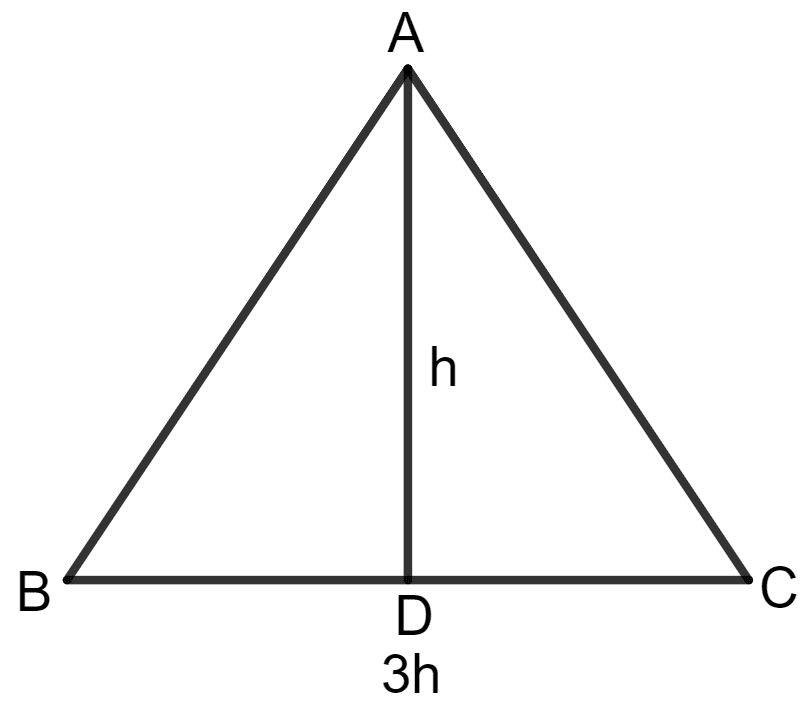
The base of a triangular field is three times its height. If the cost of cultivating the field at ₹ 36.72 per 100 m2 is ₹ 49,572; find its base and height. Area and Perimeter of Plane Figures, Concise Mathematics Solutions ICSE Class 9.

Area = 12\dfrac{1}{2} x base x height

1,35,000=12×3h×h1,35,000=32×h2h2=1,35,000×23h2=2,70,0003h2=90,000h=90,000h=300⇒ 1,35,000 = \dfrac{1}{2} \times 3h \times h\\[1em] ⇒ 1,35,000 = \dfrac{3}{2} \times h^2\\[1em] ⇒ h^2 = \dfrac{1,35,000 \times 2}{3}\\[1em] ⇒ h^2 = \dfrac{2,70,000}{3}\\[1em] ⇒ h^2 = 90,000\\[1em] ⇒ h = \sqrt{90,000}\\[1em] ⇒ h = 300

Thus, the height of the triangle is 300 m.

Base = 3 x height = 3 x 300 m = 900 m

Hence, the height is 300 m and the base is 900m.

Question 11

The sides of a triangular field are in the ratio 5 : 3 : 4 and its perimeter is 180 m. Find :

(i) its area.

(ii) altitude of the triangle corresponding to its largest side.

(iii) the cost of levelling the field at the rate of ₹ 10 per square metre.

Answer

(i) Given:

The sides of a triangular field are in the ratio 5 : 3 : 4.

Perimeter = 180 m

Let the sides of field be 5a, 3a and 4a.

Perimeter = Sum of all sides of triangular field

⇒ 180 = 5a + 3a + 4a

⇒ 180 = 12a

⇒ a = 18012\dfrac{180}{12}

⇒ a = 15

Thus, sides of field = 5a , 3a and 4a

= 5 x 15, 3 x 15 and 4 x 15

= 75 m, 45 m and 60 m

Let a = 75 m, b = 45 m and c = 60 m.

s=a+b+c2=75+45+602=1802=90∵ s = \dfrac{a + b + c}{2}\\[1em] = \dfrac{75 + 45 + 60}{2}\\[1em] = \dfrac{180}{2}\\[1em] = 90

∵ Area of triangle = s(sa)(sb)(sc)\sqrt{s(s - a)(s - b)(s - c)}

= 90(9075)(9045)(9060)\sqrt{90(90 - 75)(90 - 45)(90 - 60)} m2

= 90×15×45×30\sqrt{90 \times 15 \times 45 \times 30} m2

= 18,22,500\sqrt{18,22,500} m2

= 1,350 m2

Hence, the area is 1,350 m2.

(ii) Area = 12\dfrac{1}{2} x base x altitude

Base = 75 m

Let h be the altitude of triangle corresponding to the largest side 75 m,
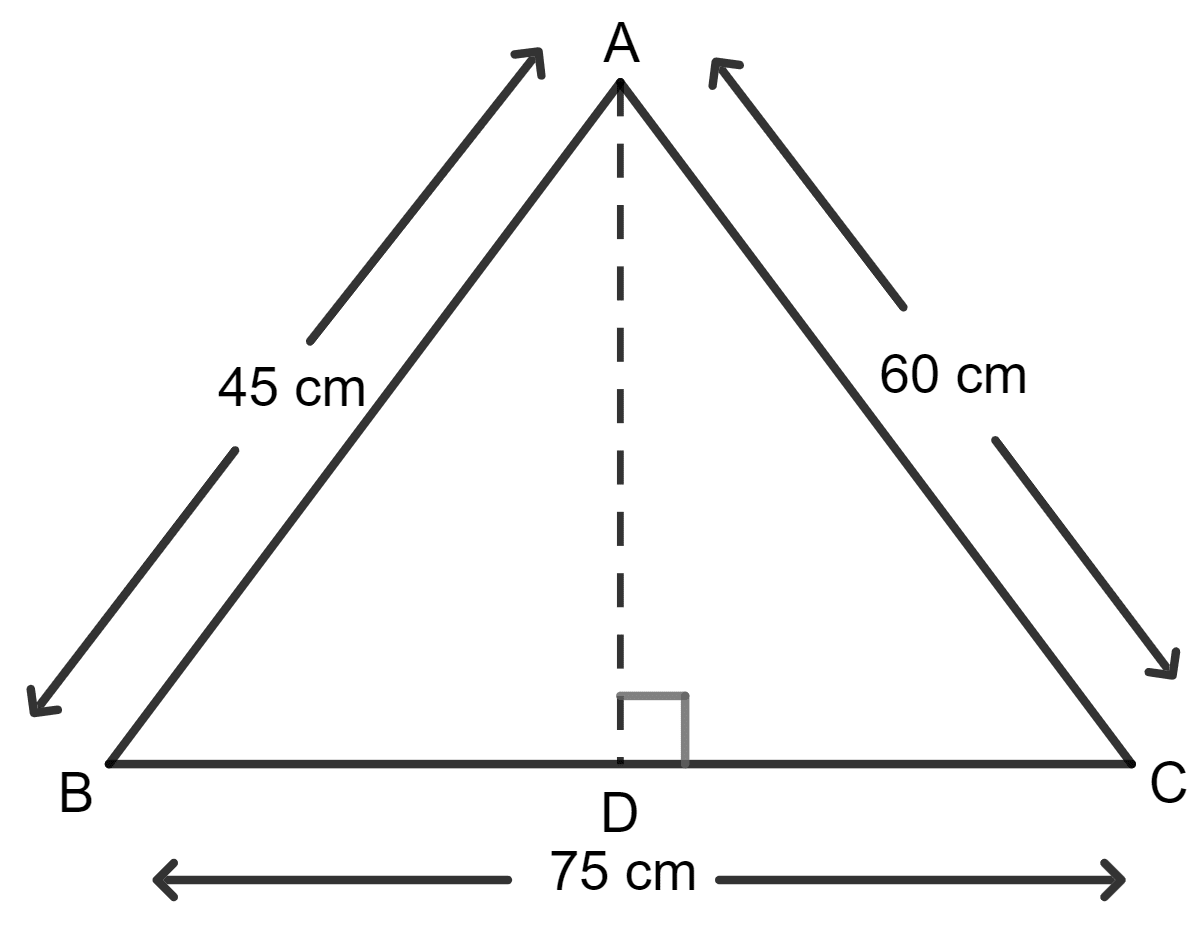
The sides of a triangular field are in the ratio 5 : 3 : 4 and its perimeter is 180 m. Find : Area and Perimeter of Plane Figures, Concise Mathematics Solutions ICSE Class 9.

⇒ 1350 = 12\dfrac{1}{2} x 75 x h

⇒ h = 1350×275\dfrac{1350 \times 2}{75}

⇒ h = 2,70075\dfrac{2,700}{75}

⇒ h = 36 m

Hence, the altitude of the triangle corresponding to its largest side is 36 m.

(iii) Cost of levelling = ₹ 10 per square metre

Total cost = Area x Cost of levelling

= ₹ 1,350 x 10

= ₹ 13,500

Hence, the total cost of levelling is ₹ 13,500.

Question 12

Each of equal sides of an isosceles triangle is 4 cm greater than its height. If the base of the triangle is 24 cm; calculate the perimeter and the area of the triangle.

Answer

Each of equal sides of an isosceles triangle is 4 cm greater than its height.
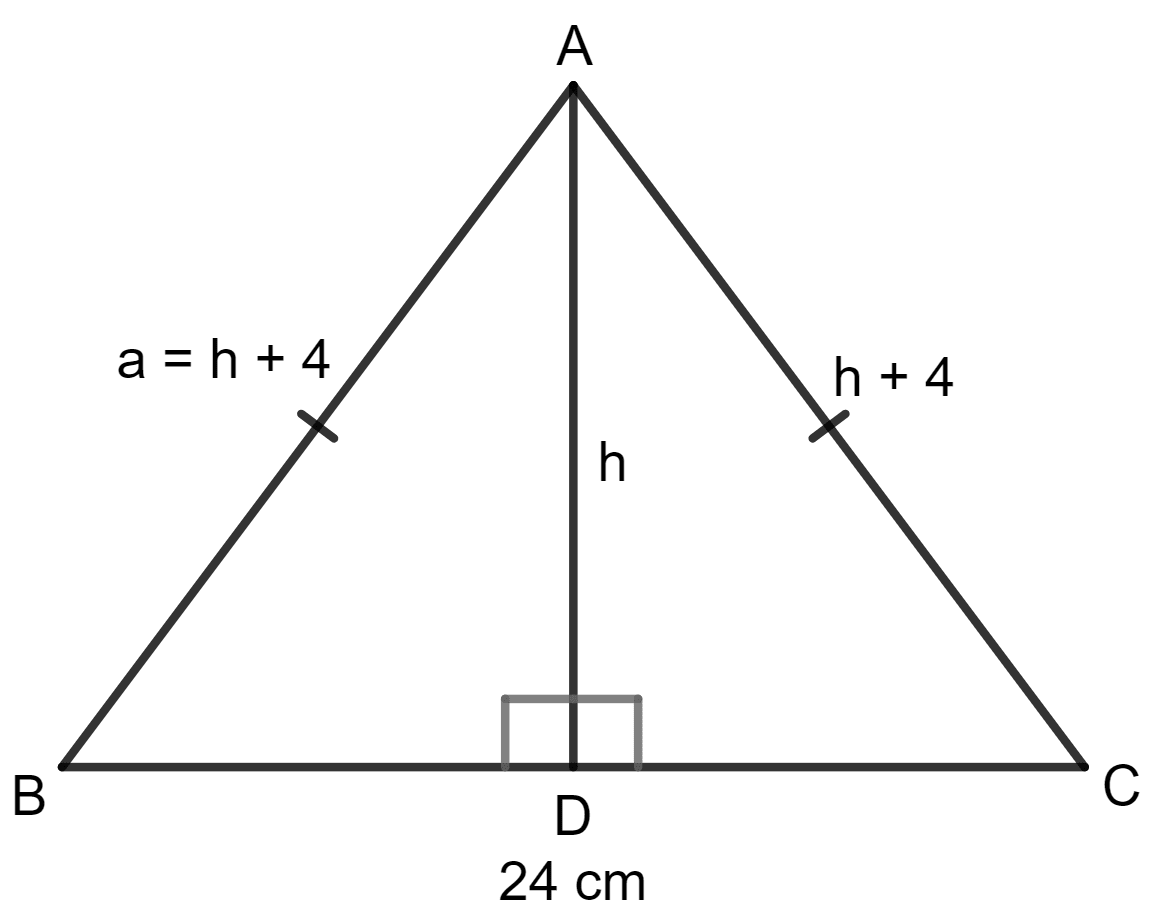
Each of equal sides of an isosceles triangle is 4 cm greater than its height. If the base of the triangle is 24 cm; calculate the perimeter and the area of the triangle. Area and Perimeter of Plane Figures, Concise Mathematics Solutions ICSE Class 9.

Let h be the height of the triangle.

Equal sides: AB = AC = h + 4

Base: BC = 24 cm

In Δ ABD and Δ ACD,

AD = AD [∵ Common Side]

∠ ADB = ∠ ADC [∵ Both are 90°]

AB = AC [∵ Δ ABC is isosceles]

∴ Δ ABD ≅ Δ ACD [RHS axiom]

∴ BD = CD [C.P.C.T]

∴ BD = CD = BC2\dfrac{\text{BC}}{2} = 242{\dfrac{24}{2}} = 12 cm

By using the Pythagoras theorem in Δ ABD,

BD2 + AD2 = AB2

⇒ 122 + h2 = (h + 4)2

⇒ 144 + h2 = h2 + 42 + 2 x h x 4

⇒ 144 + h2\cancel{h^2}= h2\cancel{h^2}+ 16 + 8h

⇒ 144 - 16 = 8h

⇒ 128 = 8h

⇒ h = 1288\dfrac{128}{8}

⇒ h = 16 cm

⇒ a = h + 4 = 16 + 4 = 20 cm

Perimeter of triangle = Sum of all sides

= AB + AC + BC

= (20 + 20 + 24) cm

= 64 cm

Area of triangle = 12\dfrac{1}{2} x base x height

= 12\dfrac{1}{2} x 24 x 16

= 12 x 16

= 192 cm2

Hence, the perimeter is 64 cm and the area is 192 cm2.

Question 13

Calculate the area and the height of an equilateral triangle whose perimeter is 60 cm.

Answer

Given:

Perimeter = 60 cm

Let a be the sides of equilateral triangle.

Perimeter = Sum of all sides

⇒ 60 = a + a + a

⇒ 60 = 3a

⇒ a = 603\dfrac{60}{3}

⇒ a = 20 cm

Area of equilateral triangle = 34×side2\dfrac{\sqrt{3}}{4} \times side^2

=34×202=34×400=1003=173.2cm2= \dfrac{\sqrt{3}}{4} \times 20^2\\[1em] = \dfrac{\sqrt{3}}{4} \times 400\\[1em] = 100 \sqrt{3} \\[1em] = 173.2 cm^2

Height of equilateral triangle = 32×side\dfrac{\sqrt{3}}{2} \times side

=32×20=103=17.32cm= \dfrac{\sqrt{3}}{2} \times 20\\[1em] = 10 \sqrt{3}\\[1em] = 17.32 cm

Hence, the area is 173.2 cm2 and the perimeter is 17.32 cm.

Question 14

In triangle ABC; angle A = 90°, side AB = x cm, AC = (x + 5) cm and area = 150 cm2. Find the sides of the triangle.

Answer

Δ ABC is shown in the figure below:
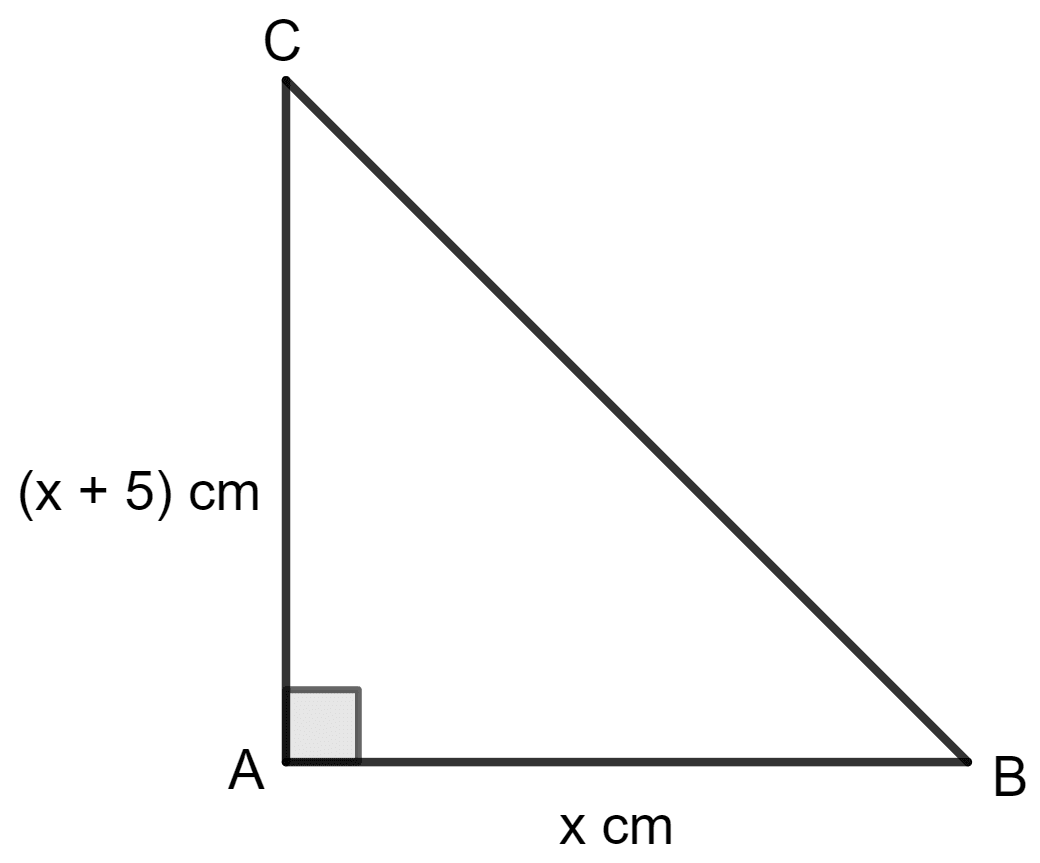
In triangle ABC; angle A = 90°, side AB = x cm, AC = (x + 5) cm and area = 150 cm<sup>2</sup>. Find the sides of the triangle. Area and Perimeter of Plane Figures, Concise Mathematics Solutions ICSE Class 9.

Given:

Area = 150 cm2

Area = 12×\dfrac{1}{2} \times base ×\times height

150=12×x×(x+5)150×2=x2+5x300=x2+5xx2+5x300=0x2+20x15x300=0x(x+20)15(x+20)=0(x+20)(x15)=0x=20 or 15⇒ 150 = \dfrac{1}{2} \times x \times (x + 5)\\[1em] ⇒ 150 \times 2 = x^2 + 5x\\[1em] ⇒ 300 = x^2 + 5x\\[1em] ⇒ x^2 + 5x - 300 = 0\\[1em] ⇒ x^2 + 20x - 15x - 300 = 0\\[1em] ⇒ x(x + 20) - 15(x + 20) = 0\\[1em] ⇒ (x + 20)(x - 15) = 0\\[1em] ⇒ x = -20 \text{ or } 15

Since length cannot be negative, AB = 15 cm.

Thus, AC = x + 5 = 15 + 5 cm = 20 cm

By using the Pythagoras theorem,

AB2 + AC2 = BC2

⇒ 152 + 202 = BC2

⇒ 225 + 400 = BC2

⇒ 625 = BC2

⇒ BC = 625\sqrt{625}

⇒ BC = 25

Hence, the sides of the triangle are 15 cm, 20 cm and 25 cm.

Question 15

If the difference between the sides of a right angled triangle is 3 cm and its area is 54 cm2; find its perimeter.

Answer

Given:

Area = 54 cm2

Let the two sides of the right-angled triangle be x cm and (x - 3) cm.
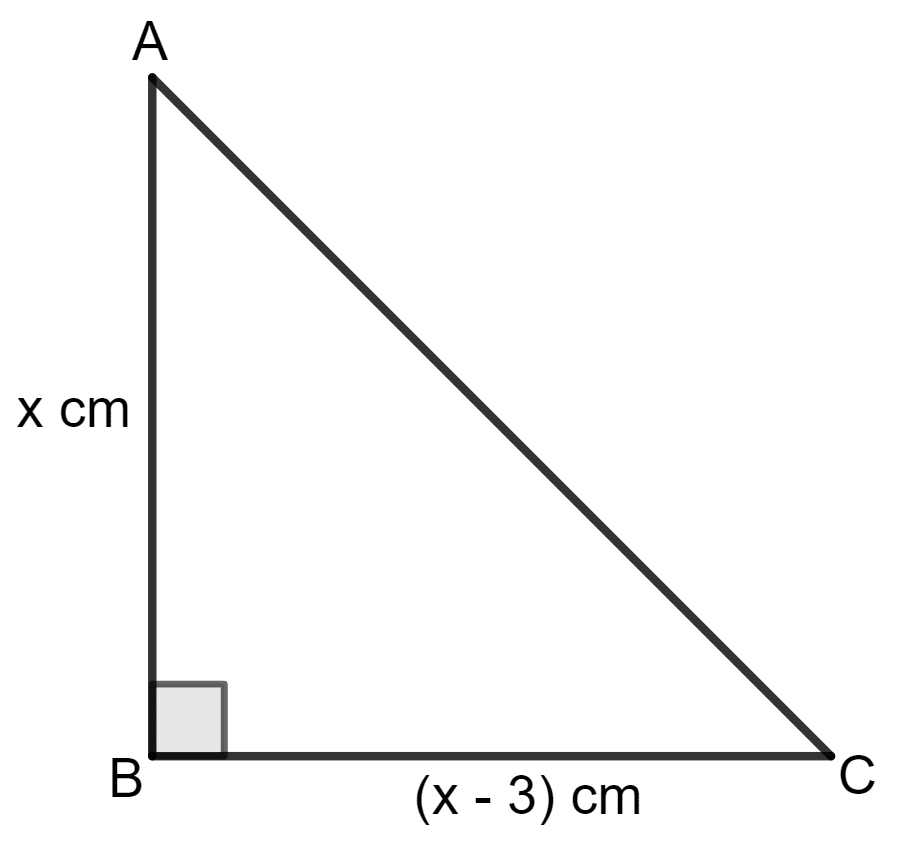
If the difference between the sides of a right angled triangle is 3 cm and its area is 54 cm2; find its perimeter. Area and Perimeter of Plane Figures, Concise Mathematics Solutions ICSE Class 9.

Area = 12\dfrac{1}{2} x base x height

⇒ 54 = 12\dfrac{1}{2} x BC x AB

⇒ 54 = 12×\dfrac{1}{2} \times (x - 3) ×\times x

⇒ 54 ×\times 2 = (x - 3) ×\times x

⇒ 108 = x2 - 3x

⇒ x2 - 3x - 108 = 0

⇒ x2 - 12x + 9x - 108 = 0

⇒ x(x - 12) + 9(x - 12) = 0

⇒ (x - 12)(x + 9) = 0

⇒ x = 12 or -9

Since length cannot be negative, AB is 12 cm.

BC = (x - 3) cm = 12 - 3 cm = 9 cm

By using the Pythagoras theorem,

AB2 + BC2 = AC2

⇒ 122 + 92 = AC2

⇒ 144 + 81 = AC2

⇒ 225 = AC2

⇒ AC = 225\sqrt{225}

⇒ AC = 15

Perimeter of right angled triangle = AB + BC + AC

= 12 + 9 + 15 cm

= 36 cm

Hence, the perimeter of the triangle is 36 cm.

Exercise 19(B)

Question 1(a)

The area of the given figure is :

The area of the given figure is : Area and Perimeter of Plane Figures, Concise Mathematics Solutions ICSE Class 9.
  1. AC x BD

  2. 12×AC×BD\dfrac{1}{2}\times AC \times BD

  3. 12×AB×BD\dfrac{1}{2}\times AB \times BD

  4. 12×(AD+BC)×BD\dfrac{1}{2}\times (AD + BC) \times BD

Answer

Area of triangle = 12\dfrac{1}{2} x base x height

For Δ ABD,

Area = 12\dfrac{1}{2} x BD x AO

For Δ CBD,

Area = 12\dfrac{1}{2} x BD x CO

Area of quadrilateral ABCD = Area of Δ ABD + Area of Δ CBD

= 12\dfrac{1}{2} x BD x AO + 12\dfrac{1}{2} x BD x CO

= 12\dfrac{1}{2} x BD x (AO + CO)

= 12\dfrac{1}{2} x BD x AC

Hence, option 2 is the correct option.

Question 1(b)

If two adjacent sides and a diagonal of a rectangle are x, y and d respectively. The area of the rectangle is :

  1. x×yx \times y

  2. 12× d2\dfrac{1}{2} \times\ d^2

  3. 12× x×d\dfrac{1}{2} \times\ x \times d

  4. 12× y×d\dfrac{1}{2} \times\ y \times d

Answer

Given:

Adjacent sides of rectangle = x and y

Area of rectangle = base x height

= x×yx \times y

Hence, option 1 is the correct option.

Question 1(c)

A square DEFG of side 8 cm is inscribed in a rectangle of adjacent sides 20 cm and 16 cm as shown in the figure.

The area of the shaded portion is :

  1. 64 cm2

  2. 128 cm2

  3. 256 cm2

  4. 320 cm2

A square DEFG of side 8 cm is inscribed in a rectangle of adjacent sides 20 cm and 16 cm as shown in the figure. Area and Perimeter of Plane Figures, Concise Mathematics Solutions ICSE Class 9.

Answer

Area of shaded portion = Area of rectangle ABCD - Area of square DEFG

Area of square = Side2

Area of rectangle = Base x Height

Area of shaded portion = 20 x 16 - 82 cm2

= 320 - 64 cm2

= 256 cm2

Hence, option 3 is the correct option.

Question 1(d)

The perimeter of a square is 72 cm, its area is :

  1. 9002 cm2900\sqrt{2} \text{ cm}^2

  2. 303 cm230\sqrt{3} \text{ cm}^2

  3. 324 cm2

  4. 356 cm2

Answer

Given:

Perimeter = 72 cm

Let s be the side of square.

Perimeter = 4 x side

⇒ 4 x s = 72

⇒ s = 724\dfrac{72}{4}

⇒ s = 18 cm

Area = Side2

= 182 cm2

= 324 cm2

Hence, option 3 is the correct option.

Question 1(e)

Area of a rhombus is 360 cm2. If one diagonal of it is 20 cm; the other diagonal is :

  1. 24 cm

  2. 18 cm

  3. 40 cm

  4. 36 cm

Answer

Given:

Area = 360 cm2.

One diagonal = 20 cm

Let d be the other diagonal.

Area of rhombus = 12\dfrac{1}{2} x product of diagonals

12\dfrac{1}{2} x 20 x d = 360

⇒ 10 x d = 360

⇒ d = 36010\dfrac{360}{10}

⇒ d = 36 cm

Hence, option 4 is the correct option.

Question 2

Find the area of a quadrilateral one of whose diagonals is 30 cm long and the perpendiculars from the other two vertices are 19 cm and 11 cm respectively.

Answer

The quadrilateral is shown in the figure below:

Find the area of a quadrilateral one of whose diagonals is 30 cm long and the perpendiculars from the other two vertices are 19 cm and 11 cm respectively. Area and Perimeter of Plane Figures, Concise Mathematics Solutions ICSE Class 9.

Area of triangle = 12\dfrac{1}{2} x base x height

For Δ ABD,

Area = 12\dfrac{1}{2} x BD x AM

= 12\dfrac{1}{2} x 30 x 19 cm2

= 15 x 19 cm2

= 285 cm2

For Δ CBD,

Area = 12\dfrac{1}{2} x BD x CN

= 12\dfrac{1}{2} x 30 x 11 cm2

= 15 x 11 cm2

= 165 cm2

Area of quadrilateral ABCD = Area of Δ ABD + Area of Δ CBD

= 285 + 165 cm2

= 450 cm2

Hence, the area of quadrilateral is 450 cm2.

Question 3

The diagonals of a quadrilateral are 16 cm and 13 cm. If they intersect each other at right angles; find the area of the quadrilateral.

Answer

Since the diagonals of the quadrilateral intersect at right angles, the area of the quadrilateral is given by:

Area = 12\dfrac{1}{2} x Product of diagonals

= 12\dfrac{1}{2} x 16 x 13 cm2

= 8 x 13 cm2

= 104 cm2

Hence, the area of the quadrilateral is 104 cm2.

Question 4

Calculate the area of quadrilateral ABCD, in which ∠ABD = 90°, triangle BCD is an equilateral triangle of side 24 cm and AD = 26 cm.

Answer

For Δ ABD,

By using the Pythagoras theorem,

Base2 + Height2 = Hypotenuse2

Calculate the area of quadrilateral ABCD, in which ∠ABD = 90°, triangle BCD is an equilateral triangle of side 24 cm and AD = 26 cm. Area and Perimeter of Plane Figures, Concise Mathematics Solutions ICSE Class 9.

⇒ AB2 + BD2 = AD2

⇒ AB2 + (24)2 = (26)2

⇒ AB2 + 576 = 676

⇒ AB2 = 676 - 576

⇒ AB2 = 100

⇒ AB = 100\sqrt{100}

⇒ AB = 10 cm

Area of Δ ABD = 12\dfrac{1}{2} x AB x BD

= 12\dfrac{1}{2} x 10 x 24 cm2

= 5 x 24 cm2

= 120 cm2

Area of equilateral triangle BCD = 34\dfrac{\sqrt{3}}{4} x side2

= 34\dfrac{\sqrt{3}}{4} x 242

= 34\dfrac{\sqrt{3}}{4} x 576

= 144 3{\sqrt{3}} cm2

= 249.41 cm2

Total area of quadrilateral ABCD = Δ ABD + Δ BCD

= 120 + 249.41 cm2

= 369.41 cm2

Hence, the area of quadrilateral ABCD is 369.41 cm2.

Question 5

Calculate the area of quadrilateral ABCD in which AB = 32 cm, AD = 24 cm, ∠A = 90° and BC = CD = 52 cm.

Answer

Quadrilateral ABCD is shown in the figure below:

Calculate the area of quadrilateral ABCD in which AB = 32 cm, AD = 24 cm, ∠A = 90° and BC = CD = 52 cm. Area and Perimeter of Plane Figures, Concise Mathematics Solutions ICSE Class 9.

Area of Δ DAB = 12\dfrac{1}{2} x base x height

= 12\dfrac{1}{2} x DA x AB

= 12\dfrac{1}{2} x 24 x 32 cm2

= 12 x 32 cm2

= 384 cm2

By using the Pythagoras theorem,

AD2 + AB2 = BD2

⇒ 242 + 322 = BD2

⇒ 576 + 1,024 = BD2

⇒ 1,600 = BD2

⇒ BD = 1,600\sqrt{1,600}

⇒ BD = 40 cm

In triangle BCD,

Let the sides of the triangle be:

a = 40 cm, b = 52 cm and c = 52 cm.

The semi-perimeter s:

s=a+b+c2=40+52+522=1442=72∵ s = \dfrac{a + b + c}{2}\\[1em] = \dfrac{40 + 52 + 52}{2}\\[1em] = \dfrac{144}{2}\\[1em] = 72

∵ Area of Δ BCD = s(sa)(sb)(sc)\sqrt{s(s - a)(s - b)(s - c)}

= 72(7240)(7252)(7252)\sqrt{72(72 - 40)(72 - 52)(72 - 52)} cm2

= 72×32×20×20\sqrt{72 \times 32 \times 20 \times 20} cm2

= 921,600\sqrt{921,600} cm2

= 960 cm2

Therefore, area of quadrilateral ABCD = Area of Δ DAB + Area of triangle BCD

= 384 + 960 cm2

= 1344 cm2

Hence, the area of quadrilateral ABCD is 1344 cm2.

Question 6

The perimeter of a rectangular field is 35\dfrac{3}{5} km. If the length of the field is twice its width; find the area of the rectangle in sq. metres.

Answer

Given:

Perimeter = 35\dfrac{3}{5} km.

Length of the field = Twice its width.

Let a be the width of the field.

So, the length = 2a

Perimeter of a rectangle = 2(length + width)

35=2(2a+a)35=2×3a35=6aa=35×6a=330a=110⇒ \dfrac{3}{5} = 2(2a + a)\\[1em] ⇒ \dfrac{3}{5} = 2 \times 3a\\[1em] ⇒ \dfrac{3}{5} = 6a\\[1em] ⇒ a = \dfrac{3}{5 \times 6}\\[1em] ⇒ a = \dfrac{3}{30}\\[1em] ⇒ a = \dfrac{1}{10}\\[1em]

Thus, width = 110\dfrac{1}{10} km

= 110×1,000\dfrac{1}{10} \times 1,000 m

= 100 m

Length = 2a = 2 x 100 m

= 200 m

Area = length x width

= 200 x 100 m2

= 20,000 m2

Hence, the area of the rectangle is 20,000 m2.

Question 7

A rectangular plot 85 m long and 60 m broad is to be covered with grass leaving 5 m all around. Find the area to be laid with grass.

Answer

Given:

The length of the rectangular field is 85 m.

The breadth of the rectangular field is 60 m.

The width of the path to be covered with grass is 5 m.

A rectangular plot 85 m long and 60 m broad is to be covered with grass leaving 5 m all around. Find the area to be laid with grass. Area and Perimeter of Plane Figures, Concise Mathematics Solutions ICSE Class 9.

The length of the inner rectangular field = 85 m - 5 m - 5 m = 75 m

The breadth of the inner rectangular field = 60 m - 5 m - 5 m = 50 m

The area of a rectangle = length x breadth

⇒ Area of the inner field = 75 x 50 m2 = 3,750 m2

Hence, the area to be covered with grass is 3,750 m2.

Question 8

The length and the breadth of a rectangle are 6 cm and 4 cm respectively. Find the height of a triangle whose base is 6 cm and area is 3 times that of the rectangle.

Answer

Given:

Length of the rectangle = 6 cm

Breadth of the rectangle = 4 cm

Area of the rectangle = length x breadth

= 6 x 4 cm2

= 24 cm2

Let h be the height of the triangle.

Base of the triangle = 6 cm

It is given that area of triangle is 3 times the area of the rectangle.

Area of triangle = 12\dfrac{1}{2} x base x height

⇒ 3 x 24 = 12\dfrac{1}{2} x 6 x h

⇒ 3 x 24 = 3 x h

3\cancel{3} x 24 = 3\cancel{3} x h

⇒ h = 24 cm

Hence, the height of the triangle is 24 cm.

Question 9

How many tiles, each of area 400 cm2, will be needed to pave a footpath which is 2 m wide and surrounds a grass plot 25 m long and 13 m wide ?

Answer

Given:

Dimensions of grass plot (ABCD) = 25 x 13 m

Width of footpath = 2 m

How many tiles, each of area 400 cm2, will be needed to pave a footpath which is 2 m wide and surrounds a grass plot 25 m long and 13 m wide ? Area and Perimeter of Plane Figures, Concise Mathematics Solutions ICSE Class 9.

Area of footpath = Area of ABQP + Area of QNOR + Area of RCDS + Area of SHMP

= 2Area of ABQP + 2Area of QNOR

= 2(Area of ABQP + Area of QNOR)

Area of ABQP = l x b = AB x AP

= 25 x 2 m2

= 50 m2

Area of QNOR = l x b = DN x QN

= 17 x 2 m2

= 34 m2

Area of footpath = 2(50 + 34) m2

= 2 x 84 m2

= 168 m2

= 1680000 sq. cm

Total area = Number of tiles x Area covered by 1 tiles

⇒ 1680000 = Number of tiles x 400

⇒ Number of tiles = 1680000400\dfrac{1680000}{400}

= 4200

Hence, the number of tiles = 4200.

Question 10

The cost of enclosing a rectangular garden with a fence all round, at the rate of 75 paise per metre, is ₹ 300. If the length of the garden is 120 metres, find the area of the field in square metres.

Answer

Given:

Length of the garden = 120 m

Cost of fencing = 75 paise per metre = ₹ 0.75 per m

Total cost = ₹ 300

Total cost of fencing = Perimeter x Cost per metre

⇒ ₹ 300 = Perimeter x ₹ 0.75

⇒ Perimeter = 3000.75\dfrac{300}{0.75} m

⇒ Perimeter = 3000075\dfrac{30000}{75} m

⇒ Perimeter = 400 m

The cost of enclosing a rectangular garden with a fence all round, at the rate of 75 paise per metre, is ₹ 300. If the length of the garden is 120 metres, find the area of the field in square metres. Area and Perimeter of Plane Figures, Concise Mathematics Solutions ICSE Class 9.

Let b be the breadth of the garden.

Perimeter = 2(l + b)

⇒ 2(120 + b) = 400

⇒ 120 + b = 4002\dfrac{400}{2}

⇒ 120 + b = 200

⇒ b = 200 - 120

⇒ b = 80 m

Area of the rectangular garden = Length x Breadth

= 120 x 80 m2

= 9600 m2

Hence, the area of the garden is 9600 sq. m.

Question 11

The width of a rectangular room is 47\dfrac{4}{7} of its length, x, and its perimeter is y. Write an equation connecting x and y. Find the length of the room when the perimeter is 4400 cm.

Answer

Given:

Length = x

Width = 47\dfrac{4}{7} of the length = 47×x\dfrac{4}{7} \times x

Perimeter = yy

Perimeter of a rectangle = 2(l + b)

2(x+47x)=y2(7+47x)=y2(117x)=y227x=y⇒ 2\Big(x + \dfrac{4}{7}x\Big) = y\\[1em] ⇒ 2\Big(\dfrac{7 + 4}{7}x\Big) = y\\[1em] ⇒ 2\Big(\dfrac{11}{7}x\Big) = y\\[1em] ⇒ \dfrac{22}{7}x = y\\[1em]

The length when y = 4400 cm,

227x=4400x=4400×722x=3080022x=1400cm=14m⇒ \dfrac{22}{7}x = 4400\\[1em] ⇒ x = \dfrac{4400 \times 7}{22}\\[1em] ⇒ x = \dfrac{30800}{22}\\[1em] ⇒ x = 1400 cm = 14 m

Hence, the equation connecting x and y is y=227xy = \dfrac{22}{7}x and the length of the room is 14 m.

Question 12

The length of a rectangular verandah is 3 m more than its breadth. The numerical value of its area is equal to the numerical value of its perimeter.

(i) Taking x as the breadth of the verandah, write an equation in x that represents the above statement.

(ii) Solve the equation obtained in (i) above and hence find the dimensions of the verandah.

Answer

(i) Given:

Breadth of the verandah = x

Length of the verandah = x + 3

It is also given that the numerical value of the area is equal to the numerical value of the perimeter.

⇒ l x b = 2(l + b)

⇒ x(x + 3) = 2(x + x + 3)

⇒ x2 + 3x = 2(2x + 3)

⇒ x2 + 3x = 4x + 6

⇒ x2 + 3x - 4x - 6 = 0

⇒ x2 - x - 6 = 0

Hence, the equation is x2 - x - 6.

(ii) From (i),

⇒ x2 - x - 6 = 0

⇒ x2 - 3x + 2x - 6 = 0

⇒ x(x - 3) + 2(x - 3) = 0

⇒ (x - 3)(x + 2) = 0

⇒ x = 3 or - 2

Since breadth cannot be negative, x = 3 m.

Length = x + 3 = 3 + 3 m = 6 m

Hence, length = 6 m and breadth = 3 m.

Question 13

The diagram, given below, shows two paths drawn inside a rectangular field 80 m long and 45 m wide. The widths of the two paths are 8 m and 15 m as shown. Find the area of the shaded portion.

The diagram, given below, shows two paths drawn inside a rectangular field 80 m long and 45 m wide. The widths of the two paths are 8 m and 15 m as shown. Find the area of the shaded portion. Area and Perimeter of Plane Figures, Concise Mathematics Solutions ICSE Class 9.

Answer

Given:

Length of the rectangular field = 80 m

Width of the rectangular field = 45 m

The diagram, given below, shows two paths drawn inside a rectangular field 80 m long and 45 m wide. The widths of the two paths are 8 m and 15 m as shown. Find the area of the shaded portion. Area and Perimeter of Plane Figures, Concise Mathematics Solutions ICSE Class 9.

Area of shaded path = Area of path ABCD + Area of cross path EFGH - Area of path IJKL

Area of path ABCD = l x b = AB x BC

= 15 x 45 m2

= 675 m2

Area of path EFGH = l x b = EF x FG

= 8 x 80 m2

= 640 m2

Area of path IJKL = l x b = IJ x KL

= 15 x 8 m2

= 120 m2

Area of shaded path = 675 + 640 - 120 m2

= 1,195 m2

Hence, the area of shaded portion is 1,195 m2.

Question 14

The rate for a 1.20 m wide carpet is ₹ 40 per metre; find the cost of covering a hall 45 m long and 32 m wide with this carpet. Also, find the cost of carpeting the same hall if the carpet, 80 cm wide, is at ₹ 25 per metre.

Answer

Given:

Dimensions of the hall = 45 m x 32 m

The rate for a 1.20 m wide carpet is ₹ 40 per metre; find the cost of covering a hall 45 m long and 32 m wide with this carpet. Also, find the cost of carpeting the same hall if the carpet, 80 cm wide, is at ₹ 25 per metre. Area and Perimeter of Plane Figures, Concise Mathematics Solutions ICSE Class 9.

Area = l x b

= 45 x 32 m2

= 1,440 m2

Cost per metre of carpet = ₹40

Width of the carpet = 1.20 m

Cost per square metre = 401.20\dfrac{40}{1.20} = 40012\dfrac{400}{12} = ₹ 33.33

Total cost = Cost per square metre x area of hall

= 33.33 x 1440

= ₹ 48,000

Width of the carpet in metres: 80 cm = 0.8 m

Cost per metre of carpet = ₹25

Cost per square metre = 250.8\dfrac{25}{0.8} = 2508\dfrac{250}{8} = ₹ 31.25

Total cost = Cost per square metre x area of hall

= 31.25 x 1440

= ₹ 45,000

Hence, the cost of covering the hall with a 1.20 m wide carpet at ₹ 40 per metre is ₹ 48,000 and the cost of carpeting the hall with an 80 cm wide carpet at ₹ 25 per metre is ₹ 45,000.

Question 15

Find the area and perimeter of a square plot of land, the length of whose diagonal is 15 metres. Give your answer correct to 2 places of decimals.

Answer

Given:

Diagonal of the square = 15 m

Let a be the length of side of the square.

Find the area and perimeter of a square plot of land, the length of whose diagonal is 15 metres. Give your answer correct to 2 places of decimals. Area and Perimeter of Plane Figures, Concise Mathematics Solutions ICSE Class 9.

Using the Pythagoras theorem for a square,

⇒ Side2 + Side2 = Diagonal2

⇒ 2 x Side2 = Diagonal2

⇒ 2 x a2 = 152

⇒ 2a2 = 225

⇒ a2 = 2252\dfrac{225}{2}

⇒ a2 = 112.5

⇒ a = 112.5\sqrt{112.5}

⇒ a = 10.61 m

Area of square = side2

= 10.612 m2

= 112.5 m2

Perimeter of square = 4 x side

= 4 x 10.60 m

= 42.43 m

Hence, the area of the square plot is 112.5 m2 and the perimeter is 42.43 m.

Question 16

The shaded region of the given diagram represents the lawn in the form of a house. On the three sides of the lawn there are flower-beds having a uniform width of 2 m.

The shaded region of the given diagram represents the lawn in the form of a house. On the three sides of the lawn there are flower-beds having a uniform width of 2 m. Area and Perimeter of Plane Figures, Concise Mathematics Solutions ICSE Class 9.

(i) Find the length and the breadth of the lawn.

(ii) Hence, or otherwise, find the area of the flower-beds.

Answer

Given:

Length of the lawn = 30 m

Breadth of the lawn = 12 m

Width of flowerbed = 2 m

The shaded region of the given diagram represents the lawn in the form of a house. On the three sides of the lawn there are flower-beds having a uniform width of 2 m. Area and Perimeter of Plane Figures, Concise Mathematics Solutions ICSE Class 9.

New length of lawn = 30 - 2 - 2 m = 30 - 4 m = 26 m

New breadth of lawn = 12 - 2 m = 10 m

Hence, the length of lawn = 26 m and the breadth of lawn = 10 m.

(ii) Area of flowerbed = Area of AMPX + Area of XDCY + Area of NBYO

Area of AMPX = l x b = AM x MP

= 10 x 2 m2

= 20 m2

Area of XDCY = l x b = XD x DC

= 30 x 2 m2

= 60 m2

Area of NBYO = l x b = NB x BY

= 10 x 2 m2

= 20 m2

Area of flowerbed = 20 + 60 + 20 m2

= 100 m2

Hence, the area of flowerbed is 100 m2.

Question 17

A floor which measures 15 m x 8 m is to be laid with tiles measuring 50 cm x 25 cm. Find the number of tiles required.

Further, if a carpet is laid on the floor so that a space of 1 m exists between its edges and the edges of the floor, what fraction of the floor is left uncovered.

Answer

Given:

Dimensions of the floor = 15 m x 8 m

Dimensions of the tile = 50 cm x 25 cm = 0.5 m x 0.25 m

Area of floor = l x b

= 15 x 8 m2

= 120 m2

Area of tile = ltile x btile

= 0.5 x 0.25 m2

= 0.125 m2

Let n be the number of tiles.

Area of floor = Area of tile x Number of tiles

⇒ 120 = 0.125 x n

⇒ n = 1200.125\dfrac{120}{0.125}

⇒ n = 120000125\dfrac{120000}{125}

⇒ n = 960

Now, a carpet is laid on the floor, leaving a space of 1 m between its edges and the edges of the floor.

A floor which measures 15 m x 8 m is to be laid with tiles measuring 50 cm x 25 cm. Find the number of tiles required. Area and Perimeter of Plane Figures, Concise Mathematics Solutions ICSE Class 9.

Length of the carpet = 15 - 1 - 1 m = 13 m

Breadth of the carpet = 8 - 1 - 1 m = 6 m

Area of uncovered floor = Area of floor - Area of carpet

= 15 x 8 - 13 x 6 m2

= 120 - 78 m2

= 42 m2

Fraction of floor left uncovered = 42120\dfrac{42}{120} = 720\dfrac{7}{20}

Hence, the number of tiles needed is 960 and the fraction of the floor left uncovered is 720\dfrac{7}{20}.

Question 18

Two adjacent sides of parallelogram are 24 cm and 18 cm. If the distance between the longer sides is 12 cm; find the distance between the shorter sides.

Answer

Step 1 Finding the area of the parallelogram.

Length of one side of the parallelogram (longer side) = 24 cm

Length of the adjacent side (shorter side) = 18 cm

The distance between the longer sides = 12 cm

Area of parallelogram = base x height

= AB x DE

= 24 x 12 cm2

= 288 cm2

Two adjacent sides of parallelogram are 24 cm and 18 cm. If the distance between the longer sides is 12 cm; find the distance between the shorter sides. Area and Perimeter of Plane Figures, Concise Mathematics Solutions ICSE Class 9.

Step 2 Finding the sides of the parallelogram.

Let a be the distance between the shorter sides.

Area = base x height

= BC x AF

= 18 x a

Since area of the parallelogram will be same, if we consider AB as the base or BC as the base.

⇒ AB x DE = BC x AF

⇒ 288 = 18 x a

⇒ a = 28818\dfrac{288}{18}

⇒ a = 16 cm

Hence, the distance between the shorter sides of the parallelogram is 16 cm.

Question 19

Two adjacent sides of a parallelogram are 28 cm and 26 cm. If one diagonal of it is 30 cm long; find the area of the parallelogram. Also, find the distance between its shorter sides.

Answer

By joining diagonal BD, the parallelogram is divided into two triangles. Let the sides of Δ ABD be:

Two adjacent sides of a parallelogram are 28 cm and 26 cm. If one diagonal of it is 30 cm long; find the area of the parallelogram. Also, find the distance between its shorter sides. Area and Perimeter of Plane Figures, Concise Mathematics Solutions ICSE Class 9.

a = 28 cm, b = 26 cm and c = 30 cm.

The semi-perimeter s:

s=a+b+c2=28+26+302=842=42∵ s = \dfrac{a + b + c}{2}\\[1em] = \dfrac{28 + 26 + 30}{2}\\[1em] = \dfrac{84}{2}\\[1em] = 42

∵ Area of triangle = s(sa)(sb)(sc)\sqrt{s(s - a)(s - b)(s - c)}

= 42(4228)(4226)(4230)\sqrt{42(42 - 28)(42 - 26)(42 - 30)} cm2

= 42×14×16×12\sqrt{42 \times 14 \times 16 \times 12} cm2

= 112,896\sqrt{112,896} cm2

= 336 cm2

Area of parallelogram ABCD = 2 x area of Δ ABD

= 2 x 336 cm2

= 672 cm2

Let h be the distance between the shorter sides.

Area of the parallelogram = base x height

⇒ 26 x h = 672

⇒ h = 67226\dfrac{672}{26}

⇒ h = 25.84 cm

Hence, the area of the parallelogram is 672 cm2 and the distance between the shorter sides is 25.84 cm.

Question 20

The area of a rhombus is 216 sq. cm. If its one diagonal is 24 cm; find :

(i) length of its other diagonal,

(ii) length of its side,

(iii) perimeter of the rhombus.

Answer

(i) Given:

Area of rhombus = 216 sq. cm

One diagonal = 24 cm

Let d be the other diagonal of rhombus.

Area = 12\dfrac{1}{2} x product of diagonals

⇒ 216 = 12\dfrac{1}{2} x 24 x d

⇒ 216 = 12 x d

⇒ d = 21612\dfrac{216}{12}

⇒ d = 18

Hence, the length of other diagonal is 18 cm.

(ii) The rhombus is shown in the figure below:

The area of a rhombus is 216 sq. cm. If its one diagonal is 24 cm; find : Area and Perimeter of Plane Figures, Concise Mathematics Solutions ICSE Class 9.

Diagonal AC = 24 cm

Then, OA = OC = 242\dfrac{24}{2} = 12 cm

Diagonal BD = 18 cm

Then, OB = OD = 182\dfrac{18}{2} = 9 cm

Since the diagonals of a rhombus bisect at 90°.

Applying pythagoras theorem in Δ AOB, we get:

AB2 = OA2 + OB2

⇒ AB2 = (12)2 + (9)2

⇒ AB2 = 144 + 81

⇒ AB2 = 225

⇒ AB = 225\sqrt{225}

⇒ AB = 15 cm

Hence, the length of each side of the rhombus is 15 cm.

(iii) Perimeter of the rhombus = 4 x side

= 4 x 15 cm

= 60 cm

Hence, the perimeter of the rhombus 60 cm.

Question 21

The perimeter of a rhombus is 52 cm. If one diagonal is 24 cm; find :

(i) the length of its other diagonal,

(ii) its area.

Answer

(i) Given:

Perimeter of the rhombus = 52 cm

One diagonal BD = 24 cm

Let a be the length of a side of the rhombus.

Perimeter of a rhombus = 4 x Side

⇒ 4 x a = 52

⇒ a = 524\dfrac{52}{4}

⇒ a = 13 cm

The perimeter of a rhombus is 52 cm. If one diagonal is 24 cm; find : Area and Perimeter of Plane Figures, Concise Mathematics Solutions ICSE Class 9.

BD = 24 cm

Then, OB = OD = 242\dfrac{24}{2} = 12 cm

Since the diagonals of a rhombus bisect at 90°.

Applying pythagoras theorem in triangle AOB, we get:

AB2 = OA2 + OB2

⇒ (13)2 = OA2 + (12)2

⇒ 169 = OA2 + 144

⇒ OA2 = 169 - 144

⇒ OA2 = 25

⇒ OA = 25\sqrt{25}

⇒ OA = 5 cm

AC = 2 x OA = 2 x 5 cm = 10 cm

Hence, the length of the other diagonal is 10 cm.

(ii) Area = 12\dfrac{1}{2} x product of diagonals

= 12\dfrac{1}{2} x 24 x 10 cm2

= 12 x 10 cm2

= 120 cm2

Hence, the area of the rhombus is 120 cm2.

Question 22

The perimeter of a rhombus is 46 cm. If the height of the rhombus is 8 cm; find its area.

Answer

Given:

Perimeter of the rhombus = 46 cm

Height of the rhombus = 8 cm

Let a be the length of a side of the rhombus.

Perimeter = 4 x Side

⇒ 46 = 4 x a

⇒ a = 464\dfrac{46}{4}

⇒ a = 11.5 cm

Area = base x height

= 11.5 x 8 cm2

= 92 cm2

Hence, the area of the rhombus is 92 cm2.

Question 23

The given figure shows the cross-section of a concrete structure. Calculate the area of cross-section if AB = 1.8 m, CD = 0.6 m, DE = 0.8 m, EF = 0.3 m and AF = 1.2 m.

The given figure shows the cross-section of a concrete structure. Calculate the area of cross-section if AB = 1.8 m, CD = 0.6 m, DE = 0.8 m, EF = 0.3 m and AF = 1.2 m. Area and Perimeter of Plane Figures, Concise Mathematics Solutions ICSE Class 9.

Answer

Given:

AB = 1.8 m, CD = 0.6 m, DE = 0.8 m, EF = 0.3 m and AF = 1.2 m

The given figure shows the cross-section of a concrete structure. Calculate the area of cross-section if AB = 1.8 m, CD = 0.6 m, DE = 0.8 m, EF = 0.3 m and AF = 1.2 m. Area and Perimeter of Plane Figures, Concise Mathematics Solutions ICSE Class 9.

Area of ABCDEF = Area of rectangle AGEF + Area of rectangle GHCD + Area of triangle HBC.

Area of rectangle AGEF = l x b = AF x EF

= 1.2 x 0.3 m2

= 0.36 m2

Area of rectangle GHCD = l x b = GH x HC

= 0.6 x 2 m2 (HC = AF + ED = 1.2 + 0.8 = 2 cm)

= 1.2 m2

Area of triangle HBC = 12\dfrac{1}{2} x b x h = 12\dfrac{1}{2} x HB x HC

= 12\dfrac{1}{2} x 0.9 x 2 m2 (HB = AB - AH = 1.8 - 0.9 = 0.9)

= 0.9 x 1 m2

= 0.9 m2

Now, area of ABCDEF = 0.36 m2 + 1.2 m2 + 0.9 m2

= 2.46 m2

Hence, the area of cross-section is 2.46 sq. m.

Question 24

Calculate the area of the figure given below which is not drawn to scale.

Calculate the area of the figure given below which is not drawn to scale. Area and Perimeter of Plane Figures, Concise Mathematics Solutions ICSE Class 9.

Answer

Area of figure ABCEF = Area of trapezium ABCF + Area of triangle CEF

Calculate the area of the figure given below which is not drawn to scale. Area and Perimeter of Plane Figures, Concise Mathematics Solutions ICSE Class 9.

Area of triangle CEF = 12\dfrac{1}{2} x b x h = 12\dfrac{1}{2} x CF x DE

= 12\dfrac{1}{2} x 25 x 12 m2

= 25 x 6 m2

= 150 m2

In triangle BGC,

Base2 + Height2 = Hypotenuse2

⇒ CG2 + BG2 = CB2

Let h be the length of BG.

⇒ 102 + h2 = 262 (∵CG = CF - GF = CF - BA = 25 - 15 = 10)

⇒ 100 + h2 = 676

⇒ h2 = 676 - 100

⇒ h2 = 576

⇒ h = 576\sqrt{576}

⇒ h = 24 cm

Area of trapezium = 12\dfrac{1}{2} (sum of parallel sides) x distance between the parallel sides

= 12\dfrac{1}{2} (AB + CF) x BG

= 12\dfrac{1}{2} (15 + 25) x 24 m2

= 12\dfrac{1}{2} x 40 x 24 m2

= 20 x 24 m2

= 480 m2

So, total area of figure ABCEF = 150 + 480 m2

= 630 m2

Hence, the area is 630 m2.

Question 25

The following diagram shows a pentagonal field ABCDE in which the lengths of AF, FG, GH and HD are 50 m, 40 m, 15 m and 25 m respectively; and the lengths of perpendiculars BF, CH and EG are 50 m, 25 m and 60 m respectively. Determine the area of the field.

The following diagram shows a pentagonal field ABCDE in which the lengths of AF, FG, GH and HD are 50 m, 40 m, 15 m and 25 m respectively; and the lengths of perpendiculars BF, CH and EG are 50 m, 25 m and 60 m respectively. Determine the area of the field. Area and Perimeter of Plane Figures, Concise Mathematics Solutions ICSE Class 9.

Answer

Area of figure ABCDE = Area of Δ ABF + Area of Δ AED + Area of Δ DHC + Area of trapezium BFHC

Area of Δ ABF = 12\dfrac{1}{2} x b x h = 12\dfrac{1}{2} x AF x BF

= 12\dfrac{1}{2} x 50 x 50 m2

= 25 x 50 m2

= 1250 m2

Area of Δ AED = 12\dfrac{1}{2} x b x h = 12\dfrac{1}{2} x AD x GE

= 12\dfrac{1}{2} x (AF + FG + GH + HD) x GE

= 12\dfrac{1}{2} x (50 + 40 + 15 + 25) x 60 m2

= 130 x 30 m2

= 3900 m2

Area of Δ DHC = 12\dfrac{1}{2} x b x h = 12\dfrac{1}{2} x HD x CH

= 12\dfrac{1}{2} x 25 x 25 m2

= 12.5 x 25 m2

= 312.5 m2

Area of trapezium BFHC = 12\dfrac{1}{2} (sum of parallel sides) x distance between the parallel sides

= 12\dfrac{1}{2} (BF + CH) x FH

= 12\dfrac{1}{2} (BF + CH) x (FH + GH)

= 12\dfrac{1}{2} (50 + 25) x (40 + 15) m2

= 12\dfrac{1}{2} x 75 x 55 m2

= 37.5 x 55 m2

= 2062.5 m2

Thus, area of figure ABCDE = 1250 + 3900 + 312.5 + 2062.5 m2

= 7525 m2

Hence, the area is 7525 sq. m.

Exercise 19(C)

Question 1(a)

In the given figure, AB = BC, ∠ABC = 90°, AC = 14 2{\sqrt2} cm and BPC (shaded portion) is semi-circle. If π=227π = \dfrac{22}{7}, the area of shaded portion is :

In the given figure, AB = BC, ∠ABC = 90°, AC = 14 √2 cm and BPC (shaded portion) is semi-circle. If π = 22/7, the area of shaded portion is : Area and Perimeter of Plane Figures, Concise Mathematics Solutions ICSE Class 9.
  1. 77 cm2

  2. 308 cm2

  3. 231 cm2

  4. 154 cm2

Answer

Let AB = BC = a cm and triangle ABC is a right triangle,

Using the Pythagoras theorem,

Base2 + Height2 = Hypotenuse2

⇒ BC2 + AB2 = AC2

⇒ a2 + a2 = (14214\sqrt{2})2

⇒ 2a2 = 392

⇒ a2 = 3922\dfrac{392}{2}

⇒ a2 = 196

⇒ a = 196\sqrt{196}

⇒ a = 14 cm

Thus, AB = BC = 14 cm.

The diameter of the semicircle is BC = 14 cm, so the radius r is:

r = d2\dfrac{d}{2} = 142\dfrac{14}{2} = 7 cm

Area of semi-circle = 12\dfrac{1}{2} πr2

=12×227×72=1×222×7×49=2214×49=1,07814=77cm2= \dfrac{1}{2} \times \dfrac{22}{7} \times 7^2\\[1em] = \dfrac{1 \times 22}{2 \times 7}\times 49\\[1em] = \dfrac{22}{14}\times 49\\[1em] = \dfrac{1,078}{14}\\[1em] = 77 \text{cm}^2

Thus, the area of the shaded portion (the semicircle) is 77 cm2.

Hence, option 1 is the correct option.

Question 1(b)

The diameter of a circle is 14 cm. If it is doubled, the perimeter of the resulting circle will become:

  1. four times

  2. doubled

  3. halved

  4. three times

Answer

Given:

Diameter of the original circle = 14 cm

Radius of the original circle = r = d2\dfrac{d}{2} = 142\dfrac{14}{2} = 7 cm

Perimeter of the original circle = 2πr

=2×227×7=447×7=447×7=44 cm= 2 \times \dfrac{22}{7} \times 7\\[1em] = \dfrac{44}{7} \times 7\\[1em] = \dfrac{44}{\cancel{7}} \times \cancel{7}\\[1em] = 44 \text{ cm}

When diameter is doubled, new diameter = 2 x 14 cm = 28 cm

New radius, r = d2\dfrac{d}{2} = 282\dfrac{28}{2} = 14 cm

New perimeter of circle:

=2×227×14=447×14=6167=88 cm= 2 \times \dfrac{22}{7} \times 14\\[1em] = \dfrac{44}{7} \times 14\\[1em] = \dfrac{616}{7}\\[1em] = 88 \text{ cm}\\[1em]

Thus, the new perimeter is doubled compared to the original perimeter.

Hence, option 2 is the correct option.

Question 1(c)

In the given figure, OABC is a square of side 14 cm. Taking π=227π = \dfrac{22}{7}, the area of the shaded portion is :

In the given figure, OABC is a square of side 14 cm. Taking π = 22/7, the area of the shaded portion is : Area and Perimeter of Plane Figures, Concise Mathematics Solutions ICSE Class 9.
  1. 154 cm2

  2. 196 cm2

  3. 42 cm2

  4. 52 cm2

Answer

Side of the square = Radius of the circle = 14 cm

Area of shaded portion = Area of square - 14\dfrac{1}{4} Area of quarter circle

=Side214πr2=14214×227×142=1962228×14×14=196222×14=1963082=196154=42cm2= Side^2 - \dfrac{1}{4} πr^2\\[1em] = 14^2 - \dfrac{1}{4} \times \dfrac{22}{7} \times 14^2\\[1em] = 196 - \dfrac{22}{28}\times 14 \times 14\\[1em] = 196 - \dfrac{22}{2} \times 14\\[1em] = 196 - \dfrac{308}{2} \\[1em] = 196 - 154\\[1em] = 42\text{cm}^2

The area of the shaded portion is 42 cm2.

Hence, option 3 is the correct option.

Question 1(d)

If the radius of a circle is doubled, then its area will become :

  1. doubled

  2. halved

  3. four times

  4. three times

Answer

Let r be the radius of circle.

Area of circle = πr2

When the radius is doubled, new radius = 2r

Area of new circle = π x (2r)2

= π x 4r2

= 4πr2

The new area is four times the area of the original circle.

Hence, option 3 is the correct option.

Question 1(e)

The radii of two circles are 14 cm and 28 cm. If π=227π = \dfrac{22}{7} the area of the shaded portion is :

The radii of two circles are 14 cm and 28 cm. If π = 22/7 the area of the shaded portion is : Area and Perimeter of Plane Figures, Concise Mathematics Solutions ICSE Class 9.
  1. 1848 cm2

  2. 1644 cm2

  3. 486 cm2

  4. 702 cm2

Answer

Area of shaded portion = Area of bigger circle - Area of smaller circle

=π×R2π×r2=227×282227×142=227×(282142)=227×(784196)=227×588=12,9367=1,848 cm2= π \times R^2 - π \times r^2\\[1em] = \dfrac{22}{7} \times 28^2 - \dfrac{22}{7} \times 14^2\\[1em] = \dfrac{22}{7} \times (28^2 - 14^2)\\[1em] = \dfrac{22}{7} \times (784 - 196)\\[1em] = \dfrac{22}{7} \times 588\\[1em] = \dfrac{12,936}{7}\\[1em] = 1,848 \text{ cm}^2

The area of shaded portion is 1848 cm2.

Hence, option 1 is the correct option.

Question 2

The diameter of a circle is 28 cm. Find its :

(i) circumference

(ii) area

Answer

Given:

Diameter = d = 28 cm

Radius = r = d2\dfrac{d}{2} = 282\dfrac{28}{2} = 14 cm

(i) Circumference of a circle = 2πr

=2×227×14=447×14=6167=88 cm= 2 \times \dfrac{22}{7} \times 14\\[1em] = \dfrac{44}{7} \times 14 \\[1em] = \dfrac{616}{7}\\[1em] = 88 \text{ cm}

Hence, the circumference of a circle is 88 cm.

(ii) Area of a circle = πr2

=227×142=227×196=4,3127=616 cm2= \dfrac{22}{7} \times 14^2\\[1em] = \dfrac{22}{7} \times 196\\[1em] = \dfrac{4,312}{7}\\[1em] = 616 \text{ cm}^2

Hence, the area of a circle is 616 cm2.

Question 3

The circumference of a circular field is 308 m. Find its :

(i) radius

(ii) area.

Answer

(i) Let r be the radius of the circle.

The circumference of a circle = 308 m

As we know, the circumference of a circle = 2πr

2×227×r=308447×r=308r=308×744r=2,15644r=49 m2⇒ 2 \times \dfrac{22}{7} \times r = 308\\[1em] ⇒ \dfrac{44}{7} \times r = 308\\[1em] ⇒ r = \dfrac{308 \times 7}{44}\\[1em] ⇒ r = \dfrac{2,156}{44}\\[1em] ⇒ r = 49 \text{ m}^2

Hence, the radius of a circle is 49 m.

(ii) Area of a circle = πr2

=227×492=227×2,401=52,8227=7,546 m2= \dfrac{22}{7} \times 49^2\\[1em] = \dfrac{22}{7} \times 2,401\\[1em] = \dfrac{52,822}{7}\\[1em] = 7,546 \text{ m}^2

Hence, the area of a circle is 7,546 m2.

Question 4

The sum of the circumference and diameter of a circle is 116 cm. Find its radius.

Answer

Given:

Circumference of a circle + Diameter of a circle = 116 cm

2πr+2r=1162r(π+1)=1162r(227+1)=1162r(22+77)=1162r(297)=116r(587)=116r=116×758r=81258r=14 cm⇒ 2πr + 2r = 116\\[1em] ⇒ 2r(π + 1) = 116\\[1em] ⇒ 2r\Big(\dfrac{22}{7} + 1\Big) = 116\\[1em] ⇒ 2r\Big(\dfrac{22 + 7}{7}\Big) = 116\\[1em] ⇒ 2r\Big(\dfrac{29}{7}\Big) = 116\\[1em] ⇒ r\Big(\dfrac{58}{7}\Big) = 116\\[1em] ⇒ r = \dfrac{116 \times 7}{58}\\[1em] ⇒ r = \dfrac{812}{58}\\[1em] ⇒ r = 14 \text{ cm}

Hence, the radius of a circle is 14 cm.

Question 5

The radii of two circles are 25 cm and 18 cm. Find the radius of the circle which has circumference equal to the sum of circumferences of these two circles.

Answer

Circumference of a circle = 2πr

For the first circle,

r1 = 25 cm

Circumference1 = 2 x π x 25 = 50π cm

For the second circle,

r2 = 18 cm

Circumference2 = 2 x π x 18 = 36π cm

Total circumference = Circumference1 + Circumference2

= 50π + 36π

= 86π cm

Let the radius of the new circle be R.

Circumference of the new circle = 2πR

86π = 2πR

86 = 2R

R = 862\dfrac{86}{2}

R = 43 cm

Hence, the radius of the new circle is 43 cm.

Question 6

The radii of two circles are 48 cm and 13 cm. Find the area of the circle which has its circumference equal to the difference of the circumferences of the given two circles.

Answer

Circumference of a circle = 2πr

For the first circle,

r1 = 48 cm

Circumference1 = 2 x π x 48 = 96π cm

For the second circle,

r2 = 13 cm

Circumference2 = 2 x π x 13 = 26π cm

Total circumference = Circumference1 - Circumference2

= 96π - 26π

= 70π cm

Let the radius of the new circle be R.

Circumference of the new circle = 2πR

70π = 2πR

70 = 2R

R = 702\dfrac{70}{2}

R = 35 cm

And, area of the new circle = πr2

=227×352=227×1,225=26,9507=3,850 cm2= \dfrac{22}{7} \times 35^2\\[1em] = \dfrac{22}{7} \times 1,225\\[1em] = \dfrac{26,950}{7}\\[1em] = 3,850 \text{ cm}^2

Hence, the area of new circle is 3,850 cm2.

Question 7

The diameters of two circles are 32 cm and 24 cm. Find the radius of the circle having its area equal to sum of the areas of the two given circles.

Answer

For the first circle,

d1 = 32 cm

r1 = d12\dfrac{d_1}{2} = 322\dfrac{32}{2} = 16 cm

Area1 = π x 162 = 256π cm2

For the second circle,

d2 = 24 cm

r2 = d22\dfrac{d_2}{2} = 242\dfrac{24}{2} = 12 cm

Area2 = π x 122 = 144π cm2

Total area = Area1 + Area2

= 256π + 144π

= 400π cm

Let the radius of the new circle be R.

Area of the new circle = πR2

400π = πR2

400 = R2

R = 400\sqrt{400}

R = 20 cm

Hence, the radius of the new circle is 20 cm.

Question 8

The radius of a circle is 5 m. Find the circumference of the circle whose area is 49 times the area of the given circle.

Answer

Given:

Radius of original circle = r = 5 m

Area of new circle = 49 times area of original circle.

Let R be the radius of new circle.

πR2=49×πr2227×R2=49×227×52227×R2=49×227×52R2=49×25R2=1,225R=1,225R=35 m2⇒ πR^2 = 49 \times πr^2\\[1em] ⇒ \dfrac{22}{7} \times R^2 = 49 \times \dfrac{22}{7} \times 5^2\\[1em] ⇒ \cancel{\dfrac{22}{7}} \times R^2 = 49 \times \cancel{\dfrac{22}{7}} \times 5^2\\[1em] ⇒ R^2 = 49 \times 25\\[1em] ⇒ R^2 = 1,225\\[1em] ⇒ R = \sqrt{1,225}\\[1em] ⇒ R = 35 \text{ m}^2

Circumference of new circle = 2πR

=2×227×35=447×35=1,5407=220 m2= 2 \times \dfrac{22}{7} \times 35\\[1em] = \dfrac{44}{7} \times 35\\[1em] = \dfrac{1,540}{7}\\[1em] = 220 \text{ m}^2

Hence, the circumference of new circle is 220 m.

Question 9

A circle of largest area is cut from a rectangular piece of card-board with dimensions 55 cm and 42 cm. Find the ratio between the area of the circle cut and the area of the remaining card-board.

Answer

Given:

The dimensions of rectangular piece of card-board are:

Length = 55 cm

Width = 42 cm

The largest circle that can be cut from the rectangle will have a diameter equal to the shorter side of the rectangle.

A circle of largest area is cut from a rectangular piece of card-board with dimensions 55 cm and 42 cm. Find the ratio between the area of the circle cut and the area of the remaining card-board. Area and Perimeter of Plane Figures, Concise Mathematics Solutions ICSE Class 9.

Diameter = Width = 42 cm

∵ Radius = r = d2\dfrac{d}{2} = 422\dfrac{42}{2} = 21 cm

Area of the circle = πr2

=227×212=227×441=9,7047=1,386 cm2= \dfrac{22}{7} \times 21^2\\[1em] = \dfrac{22}{7} \times 441\\[1em] = \dfrac{9,704}{7}\\[1em] = 1,386 \text{ cm}^2

Area of the rectangular piece of cardboard = 55 x 42 cm2

= 2,310 cm2

Therefore, area of remaining cardboard = Area of rectangle - Area of circle

= (2,310 - 1,386) cm2

= 924 cm2

So, the ratio between the area of the circle cut and the area of the remaining card-board = 1,386 : 924

= 231 : 154

= 3 : 2

Hence, the ratio between the area of the circle cut and the area of the remaining cardboard is 3 : 2.

Question 10

The following figure shows a square card-board ABCD of side 28 cm. Four identical circles of largest possible size are cut from this card as shown below.

The following figure shows a square card-board ABCD of side 28 cm. Four identical circles of largest possible size are cut from this card as shown below. Area and Perimeter of Plane Figures, Concise Mathematics Solutions ICSE Class 9.

Find the area of the remaining card-board.

Answer

Given:

Side of square ABCD = 28 cm

Side of square = 2 x diameter of circle

Diameter of circle = 282\dfrac{28}{2} = 14 cm

Radius of circle = d2\dfrac{d}{2} = 142\dfrac{14}{2} = 7 cm

Area of the remaining card-board = Area of square - 4 x Area of 1 circle

= side2 - 4 x πr2

=2824×227×72=2824×227×7×7=2824×227×7×7=2824×22×7=784616=168 cm2= 28^2 - 4 \times \dfrac{22}{7} \times 7^2\\[1em] = 28^2 - 4 \times \dfrac{22}{7} \times 7 \times 7\\[1em] = 28^2 - 4 \times \dfrac{22}{\cancel{7}} \times \cancel{7} \times 7\\[1em] = 28^2 - 4 \times 22 \times 7\\[1em] = 784 - 616\\[1em] = 168 \text{ cm}^2

Hence, the area of remaining cardboard is 168 cm2.

Question 11

The radii of two circles are in the ratio 3 : 8. If the difference between their areas is 2695 π cm2, find the area of the smaller circle.

Answer

Let the two radii of two circles be 3a and 8a.

The difference between their areas = 2695 π cm2

⇒ π x (8a)2 - π x (3a)2 = 2695 π

⇒ π x 64a2 - π x 9a2 = 2695 π

⇒ π x (64a2 - 9a2) = 2695 π

π\cancel{π} x (64a2 - 9a2) = 2695 π\cancel{π}

⇒ 64a2 - 9a2 = 2695

⇒ 55a2 = 2695

⇒ a2 = 269555\dfrac{2695}{55}

⇒ a2 = 49

⇒ a = 49\sqrt{49}

⇒ a = 7 cm

The radii are 3a and 8a = 3 x 7 cm and 8 x 7 cm = 21 cm and 56 cm

Area of smaller circle = π x (21)2

=227×441=9,7027=1,386 cm2= \dfrac{22}{7} \times 441\\[1em] = \dfrac{9,702}{7} \\[1em] = 1,386 \text{ cm}^2

Hence, the area of smaller circle is 1,386 cm2.

Question 12

The diameters of three circles are in the ratio 3 : 5 : 6. If the sum of the circumferences of these circles be 308 cm; find the difference between the areas of the largest and the smallest of these circles.

Answer

Let the diameters of the three circles be 3a, 5a and 6a.

Radius of three circles = 3a2\dfrac{3a}{2}, 5a2\dfrac{5a}{2} and 6a2\dfrac{6a}{2}

Circumference of a circle = 2πr

For the first circle,

r1 = 3a2\dfrac{3a}{2} cm

Circumference1 = 2 x π x 3a2\dfrac{3a}{2} = 3aπ cm

For the second circle,

r2 = 5a2\dfrac{5a}{2} cm

Circumference2 = 2 x π x 5a2\dfrac{5a}{2} = 5aπ cm

For the third circle,

r2 = 6a2\dfrac{6a}{2} cm

Circumference2 = 2 x π x 6a2\dfrac{6a}{2} = 6aπ cm

Total circumference = Circumference1 + Circumference2 + Circumference3

⇒ 3aπ + 5aπ + 6aπ = 308

⇒ 14aπ = 308

⇒ 14 x a x 227\dfrac{22}{7} = 308

⇒ 2 x a x 22 = 308

⇒ 44a = 308

⇒ a = 30844\dfrac{308}{44}

⇒ a = 7 cm

Radius of three circles = 32\dfrac{3}{2} x 7 cm, 52\dfrac{5}{2} x 7 cm and 62\dfrac{6}{2} x 7 cm

= 10.5 cm, 17.5 cm and 21 cm

Difference between the area of the largest and the smallest circles = π(21)2 - π(10.5)2

= 441π - 110.25π cm2

= 330.75π cm2

= 330.75 x 227\dfrac{22}{7} cm2

= 47.25 x 22 cm2

= 1039.5 cm2

Hence, the difference in the area = 1039.5 cm2.

Question 13

Find the area of a ring shaped region enclosed between two concentric circles of radii 20 cm and 15 cm.

Answer

Given:

r1 = 20 cm

r2 = 15 cm

Find the area of a ring shaped region enclosed between two concentric circles of radii 20 cm and 15 cm. Area and Perimeter of Plane Figures, Concise Mathematics Solutions ICSE Class 9.

Area of ring shaped region = π(r12 - r22)

= π(202 - 152) cm2

= π(400 - 225) cm2

= π x 175 cm2

= 227\dfrac{22}{7} x 175 cm2

= 22 x 25 cm2

= 550 cm2

Hence, the area of ring shaped region is 550 cm2.

Question 14

The circumference of a given circular park is 55 m. It is surrounded by a path of uniform width 3.5 m. Find the area of the path.

Answer

Let r be the radius of the circular park.

The circumference of a given circular park is 55 m. It is surrounded by a path of uniform width 3.5 m. Find the area of the path. Area and Perimeter of Plane Figures, Concise Mathematics Solutions ICSE Class 9.

Circumference = 2πr

⇒ 2πr = 55

⇒ 2 x 227\dfrac{22}{7} x r = 55

447\dfrac{44}{7} x r = 55

⇒ r = 7×5544\dfrac{7 \times 55}{44}

⇒ r = 7×54\dfrac{7 \times 5}{4}

⇒ r = 354\dfrac{35}{4}

⇒ r = 8.75 m

Radius of outer park = radius of park + width of the path

= 8.75 + 3.5 m

= 12.25 m

Area of the path = Area of outer park - Area of circular park

= π (12.25)2 - π (8.75)2 m2

= 150.0625π - 76.5625π m2

= 73.5 π m2

= 73.5 x 227\dfrac{22}{7} m2

= 10.5 x 22 m2

= 231 m2

Hence, the area of the path is 231 m2.

Question 15

There are two circular gardens A and B. The circumference of garden A is 1.760 km and the area of garden B is 25 times the area of garden A. Find the circumference of garden B.

Answer

Let r be the radius of the circular garden A.

Circumference of garden A = 2πr

⇒ 2πr = 1.760 km

⇒ 2πr = 1760 m

⇒ 2 x 227\dfrac{22}{7} x r = 1760 m

447\dfrac{44}{7} x r = 1760 m

⇒ r = 7×176044\dfrac{7 \times 1760}{44} m

⇒ r = 7 x 40 m

⇒ r = 280 m

Area of garden A = πr2

= π x (280)2

= 78400π

Let R be the radius of garden B.

It is given that the area of garden B is 25 times the area of garden A.

⇒ πR2 = 25 x πr2

⇒ πR2 = 25 x 78400π

π\cancel{π} R2 = 25 x 78400 π\cancel{π}

⇒ R2 = 25 x 78400

⇒ R2 = 1960000

⇒ R = 1960000\sqrt{1960000}

⇒ R = 1400 m

Circumference of garden B = 2πR

= 2 x 227\dfrac{22}{7} x 1400 m

= 2 x 22 x 200 m

= 8800 m = 8.8 km

Hence, the circumference of garden B is 8.8 km.

Question 16

A wheel has diameter 84 cm. Find how many complete revolutions must it make to cover 3.168 km.

Answer

Diameter of the wheel = 84 cm

Radius of the wheel = d2\dfrac{d}{2} = 842\dfrac{84}{2} = 42 cm

Circumference of the wheel = 2πr

=2×227×42=2×22×6=264 cm= 2 \times \dfrac{22}{7} \times 42\\[1em] = 2 \times 22 \times 6\\[1em] = 264 \text{ cm}

Let the wheel make n revolutions.

Total distance traveled by the wheel = n x Circumference of the wheel

⇒ 3.168 km = n x 264 cm

⇒ 316,800 cm = n x 264 cm

⇒ n = 316,800264\dfrac{316,800}{264}

⇒ n = 1200

Hence, the wheel makes 1,200 revolutions.

Question 17

Each wheel of a car is of diameter 80 cm. How many complete revolutions does each wheel make in 10 minutes when the car is travelling at a speed of 66 km per hour ?

Answer

Diameter of wheel = 80 cm

Radius of the wheel = d2\dfrac{d}{2} = 802\dfrac{80}{2} = 40 cm

Circumference of the wheel = 2πr

=2×227×40=1,7607 cm= 2 \times \dfrac{22}{7} \times 40\\[1em] = \dfrac{1,760}{7} \text{ cm}

Let the wheel make n number of revolutions.

Speed of the car = 66 km per hour

Time = 10 min

Total distance = Speed x Time

= 66×100,00060\dfrac{66 \times 100,000}{60} x 10 cm

= 11 x 100,000 cm

= 1,100,000

Total distance = Number of revolutions x Circumference of the wheel

⇒ 1,100,000 cm = n x 1,7607\dfrac{1,760}{7} cm

⇒ n = 1,100,000x71,760\dfrac{1,100,000 x 7}{1,760}

⇒ n = 7,700,0001,760\dfrac{7,700,000 }{1,760}

⇒ n = 4,375

Hence, the wheel makes 4,375 complete revolutions.

Question 18

An express train is running between two stations with a uniform speed. If the diameter of each wheel of the train is 42 cm and each wheel makes 1200 revolutions per minute, find the speed of the train.

Answer

Diameter of wheel = 42 cm

Radius of wheel = d2\dfrac{d}{2} = 422\dfrac{42}{2} = 21 cm

Circumference of wheel = 2πr

=2×227×21=2×22×3=132 cm= 2 \times \dfrac{22}{7} \times 21\\[1em] = 2 \times 22 \times 3\\[1em] = 132 \text{ cm}

Total distance covered by one wheel in 1 minute = Number of revolutions x Circumference of wheel

= 1,200 x 132 cm

= 158,400 cm

= 1.584 km

Speed of the train = DistanceTime\dfrac{\text{Distance}}{\text{Time}}

= 1.584160\dfrac{1.584}{\dfrac{1}{60}}

= 1.584×601\dfrac{1.584 \times 60}{1}

= 95.04 km/hr

Hence, the speed of the train is 95.04 km/hr.

Question 19

The minute hand of a clock is 8 cm long. Find the area swept by the minute hand between 8.30 a.m. and 9.05 a.m.

Answer

Length of the minute hand (radius of the circle) = 8 cm

Time interval between 9.05 a.m. and 8.30 a.m. = 35 minutes

Area swept by the minute hand in 1 hr = πr2

=227×82=227×64=1,4087 cm2= \dfrac{22}{7} \times 8^2\\[1em] = \dfrac{22}{7} \times 64\\[1em] = \dfrac{1,408}{7} \text{ cm}^2

Area of the circle in 60 minutes = 1,4087\dfrac{1,408}{7} cm2

Area of the circle in 1 minute = 1,4087×60\dfrac{1,408}{7 \times 60} cm2

= 352105\dfrac{352}{105} cm2

Area of the circle in 35 minutes = 352×35105\dfrac{352 \times 35}{105} cm2

= 3523\dfrac{352}{3} cm2

= 11713117\dfrac{1}{3} cm2

Hence, the area swept by the minute hand between 8:30 a.m. and 9:05 a.m. is 11713117\dfrac{1}{3} cm2.

Question 20

The shaded portion of the figure, given alongside, shows two concentric circles.

If the circumference of the two circles be 396 cm and 374 cm, find the area of the shaded portion.

The shaded portion of the figure, given alongside, shows two concentric circles. Area and Perimeter of Plane Figures, Concise Mathematics Solutions ICSE Class 9.

Answer

Circumference of the circle = 2πr

For outer circle,

2×227×R=396447×R=396R=396×744R=9×71R=63 cm⇒ 2 \times \dfrac{22}{7} \times R = 396\\[1em] ⇒ \dfrac{44}{7} \times R = 396\\[1em] ⇒ R = \dfrac{396 \times 7}{44}\\[1em] ⇒ R = \dfrac{9 \times 7}{1}\\[1em] ⇒ R = 63 \text{ cm}

For inner circle,

2×227×r=374447×r=374r=374×744r=17×72r=59.5 cm⇒ 2 \times \dfrac{22}{7} \times r = 374\\[1em] ⇒ \dfrac{44}{7} \times r = 374\\[1em] ⇒ r = \dfrac{374 \times 7}{44}\\[1em] ⇒ r = \dfrac{17 \times 7}{2}\\[1em] ⇒ r = 59.5 \text{ cm}

Area of shaded portion = π(R2 - r2)

= π(632 - 59.52) cm2

= π(3,969 - 3,540.25) cm2

= π x 428.75 cm2

= 227\dfrac{22}{7} x 428.75 cm2

= 22 x 61.25 cm2

= 1,347.5 cm2

Hence, the area of the shaded portion is 1,347.5 cm2.

Test Yourself

Question 1(a)

The base of a right triangle is 8 cm and its hypotenuse is 10 cm; the area of triangle is:

  1. 24 cm2

  2. 40 cm2

  3. 48 cm2

  4. 80 cm2

Answer

Given:

Base of the triangle = 8 cm

Hypotenuse of the triangle = 10 cm

Let h be the height of the triangle.

In a right-angled triangle, using the Pythagoras theorem,

⇒ Base2 + Height2 = Hypotenuse2

⇒ (8)2 + h2 = (10)2

⇒ 64 + h2 = 100

⇒ h2 = 100 - 64

⇒ h2 = 36

⇒ h = ​36\sqrt{36}

⇒ h = 6 cm.

By formula,

Area of the triangle = 12\dfrac{1}{2} x base x height

= 12\dfrac{1}{2} x 8 x 6 cm2

= 24 cm2.

Hence, option 1 is the correct option.

Question 1(b)

The area of an equilateral triangle is 434\sqrt{3} cm2, its perimeter is :

  1. 16 cm

  2. 4 cm

  3. 12 cm

  4. 8 cm

Answer

Given,

Area of equilateral triangle = 434\sqrt{3} cm2

By formula,

Area of the equilateral triangle = 34\dfrac{\sqrt{3}}{4} x side2

43=34×side2side2=4×433side2=4×4side2=16side=16side=4 cm.\Rightarrow 4\sqrt{3} = \dfrac{\sqrt{3}}{4} \times \text{side}^2\\[1em] \Rightarrow \text{side}^2 = \dfrac{4 \times 4\sqrt{3}}{\sqrt{3}}\\[1em] \Rightarrow \text{side}^2 = 4 \times 4\\[1em] \Rightarrow \text{side}^2 = 16\\[1em] \Rightarrow \text{side} = \sqrt{16}\\[1em] \Rightarrow \text{side} = 4\text{ cm}.

By formula,

Perimeter of equilateral triangle = 3 x side

= 3 x 4 cm

= 12 cm.

Hence, option 3 is the correct option.

Question 1(c)

If the perimeter of a square is 80 cm, its area is 80 cm2.

  1. true

  2. false

  3. none of these two

Answer

Given,

Perimeter of a square = 80 cm

⇒ 4 x side = 80

⇒ side = 804\dfrac{80}{4}

⇒ side = 20 cm

By formula,

Area of square = side2

= 202 cm2

= 400 cm2.

So, given area is false.

Hence, option 2 is the correct option.

Question 1(d)

If the area of a trapezium is 32 cm2 and distance between its parallel sides is 8 cm; the sum of length of its parallel side is :

  1. 4 cm

  2. 16 cm

  3. 8 cm

  4. 12 cm

Answer

Given, area of a trapezium = 32 cm2

Distance between its parallel sides = 8 cm

By formula,

Area of trapezium = 12\dfrac{1}{2} x (sum of parallel sides) x distance between the parallel sides

⇒ 32 = 12\dfrac{1}{2} x (Sum of parallel sides) x 8

⇒ 32 = Sum of parallel sides x 4

⇒ Sum of parallel sides = 324\dfrac{32}{4}

⇒ Sum of parallel sides = 8 cm.

Hence, option 3 is the correct option.

Question 1(e)

Statement 1: The side of a triangular board are 8 cm, 6 cm and 10 cm; the cost of painting it at the rate of ₹ 10 per square cm is 12\dfrac{1}{2} x 6 x 8 x ₹ 10.

Statement 2: 102 = 82 + 62

⇒ Sides of the triangle are 8 cm and 6 cm.

  1. Both the statements are true.

  2. Both the statements are false.

  3. Statement 1 is true, and statement 2 is false.

  4. Statement 1 is false, and statement 2 is true.

Answer

Given,

Sides of a triangular board are 8 cm, 6 cm and 10 cm.

⇒ 102 = 100, 82 = 64 and 62 = 36.

⇒ 100 = 64 + 36

⇒ 102 = 82 + 62

This confirms the triangle with sides 6 cm, 8 cm, and 10 cm is a right triangle, where 10 cm is the hypotenuse.

Thus, sides of the triangle are 8 cm and 6 cm.

So, statement 2 is true.

Area of triangle = 12\dfrac{1}{2} x base x height

= 12\dfrac{1}{2} x 8 x 6

Rate of painting = ₹ 10 per square cm

Cost of painting = Area x rate of painting

= 12\dfrac{1}{2} x 8 x 6 x ₹ 10

So, statement 1 is true.

∴ Both the statements are true.

Hence, option 1 is the correct option.

Question 1(f)

Statement 1: A rhombus shaped sheet with perimeter 40 cm has one diagonal 12 cm and the other diagonal is 16 cm.

Statement 2: If the other diagonal of this rhombus = x cm, x = 102 - 62.

  1. Both the statements are true.

  2. Both the statements are false.

  3. Statement 1 is true, and statement 2 is false.

  4. Statement 1 is false, and statement 2 is true.

Answer

Given,

The perimeter of a rhombus = 40 cm.

One diagonal = 12 cm.

As we know, the perimeter of the rhombus = 4 x side

⇒ 4 x side = 40 cm

⇒ side = 404\dfrac{40}{4} cm

⇒ side = 10 cm

A rhombus shaped sheet with perimeter 40 cm has one diagonal 12 cm and the other diagonal is 16 cm. Area and Perimeter of Plane, Concise Mathematics Solutions ICSE Class 9.

Let ABCD be a rhombus. From figure,

AB = 10 cm

Let diagonal AC = 12 cm

We know that,

Diagonals of rhombus bisect each other.

Then, OA = OC = 122\dfrac{12}{2} = 6 cm

Let OB be a cm.

Since the diagonal of a rhombus bisect at 90°.

Applying pythagoras theorem in triangle AOB, we get:

⇒ AB2 = OA2 + OB2

⇒ (10)2 = (6)2 + a2

⇒ a2 = (10)2 - (6)2

⇒ a2 = 100 - 36

⇒ a2 = 64

⇒ a = 64\sqrt{64}

⇒ a = 8

So, OB = 8 cm

BD = 2 x OB = 2 x 8 cm = 16 cm.

∴ Statement 1 is true.

As solved above,

If the other diagonal of this rhombus = x cm,

Then x2\dfrac{x}{2} will be equal to 102 - 62.

∴ Statement 2 is false.

∴ Statement 1 is true, and statement 2 is false.

Hence, option 3 is the correct option.

Question 1(g)

Assertion (A): The perimeter of the adjoining figure is (32 + x) cm.

The perimeter of the adjoining figure is (32 + x) cm. Area and Perimeter of Plane, Concise Mathematics Solutions ICSE Class 9.

Reason (R): x2 = 132 - 52 = 144 and x = 12 cm.

The perimeter of the adjoining figure is (32 + x) cm. Area and Perimeter of Plane, Concise Mathematics Solutions ICSE Class 9.

Perimeter = (32 + 12) cm

  1. A is true, but R is false.

  2. A is false, but R is true.

  3. Both A and R are true, and R is the correct reason for A.

  4. Both A and R are true, and R is the incorrect reason for A.

Answer

Perimeter of the figure = sum of all the sides

= 7 + 13 + 12 + x

= (32 + x) cm

So, assertion (A) is true.

From figure,

AB = AC - BC = 12 - 7 = 5 cm

Since, ABE is a right angled triangle. Using pythagoras theorem,

⇒ AE2 = AB2 + BE2

⇒ 132 = 52 + x2

⇒ 169 = 25 + x2

⇒ x2 = 169 - 25

⇒ x2 = 144

⇒ x = 144\sqrt{144}

⇒ x = 12 cm

Perimeter = (32 + x) = (32 + 12) cm.

∴ Both A and R are true, and R is the correct reason for A.

Hence, option 3 is the correct option.

Question 1(h)

Assertion (A): If BC = 14 cm, AB = 14 x 4 cm

If BC = 14 cm, AB = 14 x 4 cm. Area and Perimeter of Plane, Concise Mathematics Solutions ICSE Class 9.

Reason (R): AB = 4 x 2r = 4 x 14 cm

  1. A is true, but R is false.

  2. A is false, but R is true.

  3. Both A and R are true, and R is the correct reason for A.

  4. Both A and R are true, and R is the incorrect reason for A.

Answer

If BC = 14 cm, AB = 14 x 4 cm. Area and Perimeter of Plane, Concise Mathematics Solutions ICSE Class 9.

Given, BC = 14 cm

From figure,

Diameter (d) = 2r = 14 cm

AB has 4 circles (3 circles and 2 semi-circles).

AB = 4 x diameter of one circle = 4 x 2r = 4 x 14 cm = 56 cm.

∴ Both A and R are true, and R is the correct reason for A.

Hence, option 3 is the correct option.

Question 2

AD is altitude of an isosceles triangle ABC in which AB = AC = 30 cm and BC = 36 cm. A point O is marked on AD in such a way that ∠BOC = 90°. Find the area of quadrilateral ABOC.

Answer

ΔABC is shown in the figure below:

AD is altitude of an isosceles triangle ABC in which AB = AC = 30 cm and BC = 36 cm. A point O is marked on AD in such a way that ∠BOC = 90°. Find the area of quadrilateral ABOC. Area and Perimeter of Plane Figures, Concise Mathematics Solutions ICSE Class 9.

Area of isosceles triangle ABC =

=b44a2b2=3644×302362=94×302362=94×9001,296=936001,296=92,304=9×48=432 cm2= \dfrac{b}{4} \sqrt{4a^2 - b^2}\\[1em] = \dfrac{36}{4} \sqrt{4 \times 30^2 - 36^2}\\[1em] = 9 \sqrt{4 \times 30^2 - 36^2}\\[1em] = 9 \sqrt{4 \times 900 - 1,296}\\[1em] = 9 \sqrt{3600 - 1,296}\\[1em] = 9 \sqrt{2,304}\\[1em] = 9 \times 48 \\[1em] = 432 \text{ cm}^2

∠ BOC = ∠ COD = 45° (∵ AD divide ∠ BOC in 2 equal halves)

Let OB = OC = x.

In Δ BOC, by using the Pythagoras theorem,

OB2 + OC2 = BC2

⇒ x2 + x2 = (36)2

⇒ 2x2 = 1,296

⇒ x2 = 1,2962\dfrac{1,296}{2}

⇒ x2 = 648

⇒ x = 648\sqrt{648}

⇒ x = 18 2\sqrt{2}

Now the area of triangle BOC = 12\dfrac{1}{2} x base x height

=12×182×182=12×18×18×2=18×18=324 cm2= \dfrac{1}{2} \times 18 \sqrt{2} \times 18 \sqrt{2}\\[1em] = \dfrac{1}{2} \times 18 \times 18 \times 2\\[1em] = 18 \times 18\\[1em] = 324 \text{ cm}^2

Area of quadrilateral ABOC = Area of Δ ABC - Area of Δ BOC

= 432 - 324 cm2

= 108 cm2

Hence, the area of quadrilateral ABOC is 108 cm2.

Question 3

A footpath of uniform width runs all around the outside of a rectangular field 30 m long and 24 m wide. If the path occupies an area of 360 m2, find its width.

Answer

Given:

The length of the rectangular field = 30 m

The breadth of the rectangular field = 24 m

Area of path = 360 m2

Let the width of the path be x m.

A footpath of uniform width runs all around the outside of a rectangular field 30 m long and 24 m wide. If the path occupies an area of 360 m2, find its width. Area and Perimeter of Plane Figures, Concise Mathematics Solutions ICSE Class 9.

The length of the smaller rectangular field = 30 m - x m - x m

= 30 - 2x m

The breadth of the smaller rectangular field = 24 m - x m - x m

= 24 - 2x m

As we know, the area of a rectangle = length x breadth

⇒ Area of the larger rectangular field = 30 x 24 m2

= 720 m2

⇒ Area of the smaller rectangular field = (30 - 2x) x (24 - 2x) m2

= (720 - 108x - 4x2) m2

Area of the path = Area of larger rectangular field - Area of smaller rectangular field

⇒ 360 = 720 - (720 - 108x - 4x2)

⇒ 360 = 720 - 720 + 108x + 4x2

⇒ 4x2 + 108x - 360 = 0

⇒ x2 + 27x - 90 = 0

⇒ x2 + 30x - 3x - 90 = 0

⇒ x(x + 30) - 3(x + 30) = 0

⇒ (x + 30)(x - 3) = 0

⇒ x = - 30 or 3

Since the width of the path cannot be negative,

x = 3 m

Hence, the width of the path is 3 m.

Question 4

A wire when bent in the form of a square encloses an area of 484 m2. Find the largest area enclosed by the same wire when bent to form :

(i) an equilateral triangle.

(ii) a rectangle of breadth 16 m.

Answer

(i) Area of the square = 484 m2

Let a be the length of side of the square.

⇒ a2 = 484

⇒ a = 484\sqrt{484}

⇒ a = 22 m

Total length of the wire = Perimeter of the square = 4 x 22m = 88 m

Perimeter of the square = Perimeter of equilateral triangle.

⇒ 3 x side = 88 m

⇒ side = 883\dfrac{88}{3} m

⇒ side = 29.3 m

Area of equilateral triangle = 34\dfrac{\sqrt{3}}{4} x side2

= 34\dfrac{\sqrt{3}}{4} x (29.3)2 m2

= 34\dfrac{\sqrt{3}}{4} x 858.49 m2

= 372.57 m2

Hence, the area of the equilateral triangle is 372.57 sq. m.

(ii) Given:

Length of the rectangle = 16 m

Let b be the breadth of the rectangle.

Perimeter of the rectangle = Perimeter of the square

⇒ 2(l + b) = 88 m

⇒ 2(16 + b) = 88 m

⇒ 16 + b = 882\dfrac{88}{2} m

⇒ 16 + b = 44 m

⇒ b = 44 - 16 m

⇒ b = 28 m

Area of the rectangle = l x b

= 16 x 28 m2

= 448 m2

Hence, the area of the rectangle is 448 sq. m.

Question 5(i)

For the trapezium given below; find its area.

For the trapezium given below; find its area. Area and Perimeter of Plane Figures, Concise Mathematics Solutions ICSE Class 9.

Answer

Draw CE parallel to DA which meets AB at point E.

For the trapezium given below; find its area. Area and Perimeter of Plane Figures, Concise Mathematics Solutions ICSE Class 9.

DC = AE = 12 cm

AB = AE + EB

⇒ 20 = 12 + EB

⇒ EB = 20 - 12 = 8 cm

And, AD = CE = 10 cm

Area of isosceles triangle EBC =

=14×b×4s2b2=14×8×4×10282=2×4×10064=2×40064=2×394=2×19.85=39.7 cm2= \dfrac{1}{4} \times b \times \sqrt{4s^2 - b^2}\\[1em] = \dfrac{1}{4} \times 8 \times \sqrt{4 \times 10^2 - 8^2}\\[1em] = 2 \times \sqrt{4 \times 100 - 64}\\[1em] = 2 \times \sqrt{400 - 64}\\[1em] = 2 \times \sqrt{394}\\[1em] = 2 \times 19.85\\[1em] = 39.7 \text{ cm}^2

Also, area of triangle EBC = 12\dfrac{1}{2} x base x height

12×8×height=39.72×height=39.7height=39.72height=19.85 cm⇒ \dfrac{1}{2} \times 8 \times \text{height} = 39.7\\[1em] ⇒ 2 \times \text{height} = 39.7\\[1em] ⇒ \text{height} = \dfrac{39.7}{2}\\[1em] ⇒ \text{height} = 19.85 \text{ cm}

Area of trapezium ABCD = 12\dfrac{1}{2} x (sum of parallel sides) x height

= 12\dfrac{1}{2} x (12 + 20) x 9.15 sq. cm

= 12\dfrac{1}{2} x 32 x 9.15 sq. cm

= 16 x 9.15 sq. cm

= 146.64 sq. cm

Hence, the area of trapezium is 146.64 sq. cm.

Question 5(ii)

For the trapezium given below; find its area.

For the trapezium given below; find its area. Area and Perimeter of Plane Figures, Concise Mathematics Solutions ICSE Class 9.

Answer

Draw CO such that CO is perpendicular to AB.

For the trapezium given below; find its area. Area and Perimeter of Plane Figures, Concise Mathematics Solutions ICSE Class 9.

AO = DC = 8 cm

AB = AO + OB

⇒ 14 = 8 + OB

⇒ OB = 14 - 8 = 6 cm

Area of trapezium ABCD = 12\dfrac{1}{2} x (sum of parallel sides) x height

In triangle BCO, by using the Pythagoras theorem,

Base2 + Height2 = Hypotenuse2

⇒ (6)2 + Height2 = 102

⇒ 36 + Height2 = 100

⇒ Height2 = 100 - 36

⇒ Height2 = 64

⇒ Height = 64\sqrt{64}

⇒ Height = 8 cm

Area of trapezium ABCD = 12\dfrac{1}{2} x (8 + 14) x 8

= 12\dfrac{1}{2} x 22 x 8 sq. cm

= 11 x 8 sq. cm

= 88 sq. cm

Hence, the area of trapezium ABCD is 88 sq. cm.

Question 5(iii)

For the trapezium given below; find its area.

For the trapezium given below; find its area. Area and Perimeter of Plane Figures, Concise Mathematics Solutions ICSE Class 9.

Answer

Draw CE parallel to DA which meets AB at point E.

For the trapezium given below; find its area. Area and Perimeter of Plane Figures, Concise Mathematics Solutions ICSE Class 9.

AE = DC = 20 cm

AB = AE + EB

⇒ 32 = 20 + EB

⇒ EB = 32 - 20 = 12 cm

And, DA = CE = 10 cm

For the Δ EBC,

Let the sides of the triangle be:

a = 10 cm, b = 12 cm and c = 16 cm.

The semi-perimeter s:

s=a+b+c2=10+12+162=382=19∵ s = \dfrac{a + b + c}{2}\\[1em] = \dfrac{10 + 12 + 16}{2}\\[1em] = \dfrac{38}{2}\\[1em] = 19

∵ Area of triangle EBC = s(sa)(sb)(sc)\sqrt{s(s - a)(s - b)(s - c)}

= 19(1910)(1912)(1916)\sqrt{19(19 - 10)(19 - 12)(19 - 16)} cm2

= 19×9×7×3\sqrt{19 \times 9 \times 7 \times 3} cm2

= 3,591\sqrt{3,591} cm2

= 59.9 cm2

Let h be the height of Δ EBC,

Area of Δ EBC = 12\dfrac{1}{2} x base x height

12\dfrac{1}{2} x 12 x height = 59.9

⇒ 6 x height = 59.9

⇒ height = 59.96\dfrac{59.9}{6}

⇒ height = 9.98 cm

Area of trapezium ABCD = 12\dfrac{1}{2} x (sum of parallel sides) x height

= 12\dfrac{1}{2} x (20 + 32) x 9.98

= 12\dfrac{1}{2} x 52 x 9.98 sq. cm

= 26 x 9.98 sq. cm

= 259.65 sq. cm

Hence, the area of trapezium ABCD is 259.65 sq. cm.

Question 5(iv)

For the trapezium given below; find its area.

For the trapezium given below; find its area. Area and Perimeter of Plane Figures, Concise Mathematics Solutions ICSE Class 9.

Answer

Draw DE and CF perpendicular to AB.

For the trapezium given below; find its area. Area and Perimeter of Plane Figures, Concise Mathematics Solutions ICSE Class 9.

ABCD is an isosceles trapezium.

Let EF = FB = x cm

DC = EF = 18 cm

AB = AE + EF + FB

⇒ 30 = x + 18 + x

⇒ 30 = 2x + 18

⇒ 2x = 30 - 18

⇒ 2x = 12

⇒ x = 122\dfrac{12}{2}

⇒ x = 6 cm

As EDA is a right angled triangle, by using the Pythagoras theorem,

Base2 + Height2 = Hypotenuse2

⇒ (6)2 + height2 = 122

⇒ 36 + height2 = 144

⇒ height2 = 144 - 36

⇒ height2 = 108 cm

⇒ height = 108\sqrt{108} cm

⇒ height = 10.39 cm

Area of trapezium ABCD = 12\dfrac{1}{2} x (sum of parallel sides) x height

= 12\dfrac{1}{2} x (18 + 30) x 10.39

= 12\dfrac{1}{2} x 48 x 10.39 sq. cm

= 24 x 10.39 sq. cm

= 249.41 sq. cm

Hence, the area of trapezium ABCD is 249.41 sq. cm.

Question 6

The perimeter of a rectangular board is 70 cm. Taking its length as x cm, find its width in terms of x.

If the area of the rectangular board is 300 cm2; find its dimensions.

Answer

Given:

Perimeter of the rectangular board = 70 cm

Length = x cm

Let b be the width of the rectangular board.

Perimeter of a rectangle = 2(l + b)

⇒ 2(x + b) = 70

⇒ x + b = 702\dfrac{70}{2}

⇒ x + b = 35

⇒ b = 35 - x

Area = l x b

⇒ x ×\times (35 - x) = 300

⇒ 35x - x2 = 300

⇒ 35x - x2 - 300 = 0

⇒ x2 - 35x + 300 = 0

⇒ x2 - 20x - 15x + 300 = 0

⇒ x(x - 20) - 15(x - 20) = 0

⇒ (x - 20)(x - 15) = 0

⇒ x = 20 or 15

Therefore, b = (35 - x)

b = 15 or 20

Hence, the width of rectangular board is (35 - x) and the dimensions of the board are 20 cm and 15 cm.

Question 7

The area of a rectangle is 640 m2. Taking its length as x m; find, in terms of x, the width of the rectangle. If the perimeter of the rectangle is 104 m; find its dimensions.

Answer

Given:

Area of the rectangle = 640 m2

Length = x meters

Let b be the width of the rectangle.

Area of the rectangle = l x b

⇒ x × b = 640

⇒ b = 640x\dfrac{640}{x} m

By formula,

Perimeter of the rectangle = 2(l + b)

2(x+640x)2\Big(x + \dfrac{640}{x}\Big) = 104

(x+640x)=1042\Big(x + \dfrac{640}{x}\Big) = \dfrac{104}{2}

(x+640x)\Big(x + \dfrac{640}{x}\Big) = 52

⇒ x2 + 640 = 52x

⇒ x2 - 52x + 640 = 0

⇒ x2 - 32x - 20x + 640 = 0

⇒ x(x - 32) - 20(x - 32) = 0

⇒ (x - 20)(x - 32) = 0

⇒ x - 20 = 0 or x - 32 = 0

⇒ x = 20 m or x = 32 m.

Now,

⇒ b = 640x\dfrac{640}{x}

Case 1 : x = 20 m

⇒ b = 64020\dfrac{640}{20} = 32 m.

Case 2 : x = 32 m

⇒ b = 64032\dfrac{640}{32} = 20 m.

Hence, the width of rectangle is 640x\dfrac{640}{x} and the dimensions of the rectangle are 20 m and 32 m.

Question 8

The length of a rectangle is twice the side of a square and its width is 6 cm greater than the side of the square. If area of the rectangle is three times the area of the square; find the dimensions of each.

Answer

Given:

Let s be the side of the square.

Length of the rectangle = 2 x Side of the square

⇒ l = 2s

Width of the rectangle = Side of the square + 6

⇒ w = s + 6

Area of the rectangle = 3 x area of the square

⇒ l x w = 3s2

⇒ 2s x (s + 6) = 3s2

⇒ 2s2 + 12s = 3s2

⇒ 2s2 + 12s - 3s2 = 0

⇒ - s2 + 12s = 0

⇒ s2 - 12s = 0

⇒ s(s - 12) = 0

⇒ s = 0 or 12

Since the side cannot be zero, s = 12 cm.

The dimensions of the rectangle:

l = 2 x s = 2 x 12 cm = 24 cm

w = s + 6 = 12 + 6 = 18 cm

Hence, the length and width of the rectangle are 24 cm and 18 cm, and the side of the square is 12 cm.

Question 9

ABCD is a square with each side 12 cm. P is a point on BC such that area of Δ ABP : area of trapezium APCD = 1 : 5. Find the length of CP.

Answer

Square ABCD is shown in the figure below:

ABCD is a square with each side 12 cm. P is a point on BC such that area of Δ ABP : area of trapezium APCD = 1 : 5. Find the length of CP. Area and Perimeter of Plane Figures, Concise Mathematics Solutions ICSE Class 9.

Given:

Area of Δ ABPArea of trapezium APCD=15\dfrac{\text{Area of Δ ABP}}{\text{Area of trapezium APCD}} = \dfrac{1}{5}

Area of Δ ABP = 12\dfrac{1}{2} x base x height

= 12\dfrac{1}{2} x 12 x (12 - CP)

Area of trapezium APCD = 12\dfrac{1}{2} x (sum of parallel sides) x height

= 12\dfrac{1}{2} x (12 + CP) x 12

12×12×(12CP)12×(12+CP)×12=1512×12×(12CP)12×(12+CP)×12=1512×(12CP)(12+CP)×12=15(12CP)(12+CP)=155×(12CP)=1×(12+CP)605CP=12+CP6012=5CP+CP48=6CPCP=486CP=8 cm⇒ \dfrac{\dfrac{1}{2} \times 12 \times (12 - CP)}{\dfrac{1}{2} \times (12 + CP) \times 12} = \dfrac{1}{5}\\[1em] ⇒ \dfrac{\cancel{\dfrac{1}{2}} \times 12 \times (12 - CP)}{\cancel{\dfrac{1}{2}} \times (12 + CP) \times 12} = \dfrac{1}{5}\\[1em] ⇒ \dfrac{\cancel{12} \times (12 - CP)}{ (12 + CP) \times \cancel{12}} = \dfrac{1}{5}\\[1em] ⇒ \dfrac{(12 - CP)}{ (12 + CP)} = \dfrac{1}{5}\\[1em] ⇒ 5 \times (12 - CP) = 1 \times (12 + CP)\\[1em] ⇒ 60 - 5CP = 12 + CP\\[1em] ⇒ 60 - 12 = 5CP + CP\\[1em] ⇒ 48 = 6CP\\[1em] ⇒ CP = \dfrac{48}{6}\\[1em] ⇒ CP = 8 \text { cm}

Hence, the length of CP is 8 cm.

Question 10

A rectangular plot of land measures 45 m x 30 m. A boundary wall of height 2.4 m is built all around the plot at a distance of 1 m from the plot. Find the area of the inner surface of the boundary wall.

Answer

Given:

The boundary wall is built all around the rectangular plot at a distance of 1 meter, which means the wall forms a larger rectangle around the plot as shown in the figure below:

A rectangular plot of land measures 45 m x 30 m. A boundary wall of height 2.4 m is built all around the plot at a distance of 1 m from the plot. Find the area of the inner surface of the boundary wall. Area and Perimeter of Plane Figures, Concise Mathematics Solutions ICSE Class 9.

Dimensions of the outer rectangle (including the boundary wall):

Length of the outer rectangle = (45 + 1 + 1) m = 47 m

Width of the outer rectangle = (30 + 1 + 1) m = 32 m

Perimeter of the outer rectangle = 2(length + breadth)

= 2(47 + 32)

= 2 x 79 = 158 m

Area of the inner surface of the boundary wall is the perimeter of the outer rectangle multiplied by the height of the wall.

Inner surface area of boundary wall = Perimeter of outer rectangle x height of wall

= 158 m x 2.4 m

= 379.2 m2

Hence, the area of the inner surface of the boundary wall is 379.2 m2.

Question 11

A wire when bent in the form of a square encloses an area = 576 cm2. Find the largest area enclosed by the same wire when bent to form:

(i) an equilateral triangle.

(ii) a rectangle whose adjacent sides differ by 4 cm.

Answer

(i) Area of the square = 576 cm2

Let a be the length of side of the square.

⇒ a2 = 576

⇒ a = 576\sqrt{576}

⇒ a = 24 cm

Total length of the wire = Perimeter of the square = 4 x 24 cm = 96 cm

Perimeter of the square = Perimeter of equilateral triangle.

⇒ 3 x side = 96 cm

⇒ side = 963\dfrac{96}{3} cm

⇒ side = 32 cm

Area of equilateral triangle = 34\dfrac{\sqrt{3}}{4} x side2

= 34\dfrac{\sqrt{3}}{4} x (32)2 cm2

= 34\dfrac{\sqrt{3}}{4} x 1,024 cm2

= 256 3\sqrt{3} cm2

Hence, the area of equilateral triangle is 256 3\sqrt{3} cm2.

(ii) Given:

Let l be the length and b be the breadth of the rectangle.

l - b = 4 ...............(1)

Perimeter of rectangle = Perimeter of square

⇒ 2(l + b) = 96 cm

⇒ 2(l + b) = 96 cm

⇒ l + b = 962\dfrac{96}{2} cm

⇒ l + b = 48 cm ...............(2)

Add equation (1) and (2), we get

⇒ (l - b) + (l + b) = 4 + 48

⇒ l - b + l + b = 52

⇒ 2l = 52

⇒ l = 522\dfrac{52}{2}

⇒ l = 26 cm

So, b = l - 4 = 26 - 4 = 22 cm

Area of rectangle = l x b

= 26 x 22 cm2

= 572 cm2

Hence, the area of rectangle is 572 cm2.

Question 12

The area of a parallelogram is y cm2 and its height is h cm. The base of another parallelogram is x cm more than the base of the first parallelogram and its area is twice the area of the first. Find, in terms of y, h and x, the expression for the height of the second parallelogram.

Answer

Given:

Area of the first parallelogram = y cm2

Height of the first parallelogram = h cm

Area of the first parallelogram = base x height

⇒ y = base x h

⇒ base of the first parallelogram = yh\dfrac{y}{h} cm

The base of the second parallelogram = (yh+x)\Big(\dfrac{y}{h} + x\Big) cm

Area of the second parallelogram = base x height

2y=(yh+x)2y = \Big(\dfrac{y}{h} + x\Big) x height

⇒ height = 2hyy+hx\dfrac{2hy}{y + hx}

Hence, the height of the second parallelogram is 2hyy+hx\dfrac{2hy}{y + hx}.

Question 13

The distance between parallel sides of a trapezium is 15 cm and the length of the line segment joining the mid-points of its non-parallel sides is 26 cm. Find the area of the trapezium.

Answer

Given:

Let the given trapezium be as shown in the figure below:

The distance between parallel sides of a trapezium is 15 cm and the length of the line segment joining the mid-points of its non-parallel sides is 26 cm. Find the area of the trapezium. Area and Perimeter of Plane Figures, Concise Mathematics Solutions ICSE Class 9.

The distance between parallel sides of a trapezium, (i.e., height) = 15 cm

The length of the line segment joining the mid-points of its non-parallel sides, EF = 26 cm

Since EF is half of the sum of the lengths of the parallel sides.

EF = 12\dfrac{1}{2} x (AD + BC)

12\dfrac{1}{2} x (AD + BC) = 26

⇒ AD + BC = 26 x 2 cm = 52 cm

Area of trapezium = 12\dfrac{1}{2} x (Sum of parallel sides) x height

= 12\dfrac{1}{2} x (AD + BC) x height

= 12\dfrac{1}{2} x 52 x 15

= 26 x 15

= 390 cm2

Hence, the area of the trapezium is 390 cm2.

Question 14

The diagonal of a rectangular plot is 34 m and its perimeter is 92 m. Find its area.

Answer

Given:

Diagonal of the rectangular plot = 34 m

Perimeter of the rectangular plot = 92 m

Let l be the length and b be the breadth of the rectangular plot.

The diagonal of a rectangular plot is 34 m and its perimeter is 92 m. Find its area. Area and Perimeter of Plane Figures, Concise Mathematics Solutions ICSE Class 9.

Perimeter = 2(l + b)

⇒ 2(l + b) = 92

⇒ l + b = 922\dfrac{92}{2}

⇒ l + b = 46

Squaring both side,

⇒ (l + b)2 = 462

⇒ l2 + b2 + 2lb = 2,116 ...............(1)

As all the angles of rectangle are 90°, we can use the Pythagoras theorem,

Base2 + Height2 = Hypotenuse2

⇒ l2 + b2 = 342

⇒ l2 + b2 = 1,156

Using equation (1), we get

⇒ 2,116 - 2lb = 1,156

⇒ 2,116 - 1,156 = 2lb

⇒ 960 = 2lb

⇒ lb = 9602\dfrac{960}{2}

⇒ lb = 480

Hence, the area of the rectangular plot is 480 m2.

Question 15

The cost of fencing a circular field at the rate of ₹ 240 per metre is ₹ 52,800. The field is to be ploughed at the rate of ₹ 12.50 per m2. Find the cost of ploughing the field.

Answer

Given:

Rate of fencing = ₹ 240 per metre

Total cost = ₹ 52,800

Let r be the radius of the field.

Total cost = Circumference of field x Rate of fencing

52,800=2πr×2402πr=52,8002402πr=2202×227×r=220447×r=220r=220×744r=5×71r=35 m⇒ 52,800 = 2πr \times 240\\[1em] ⇒ 2πr = \dfrac{52,800}{240}\\[1em] ⇒ 2πr = 220\\[1em] ⇒ 2 \times \dfrac{22}{7} \times r = 220\\[1em] ⇒ \dfrac{44}{7} \times r = 220\\[1em] ⇒ r = \dfrac{220 \times 7}{44}\\[1em] ⇒ r = \dfrac{5 \times 7}{1}\\[1em] ⇒ r = 35 \text{ m}

Area of the field = πr2

=227×352=227×1225=22×175=3,850 m2= \dfrac{22}{7} \times 35^2\\[1em] = \dfrac{22}{7} \times 1225\\[1em] = 22 \times 175\\[1em] = 3,850 \text{ m}^2

Rate of ploughing = ₹ 12.50 per m2

Total cost of ploughing = Area of the field x Rate of ploughing

= 3,850 x 12.50

= ₹ 48,125

Hence, the total cost of ploughing is ₹ 48,125.

Question 16

Two circles touch each other externally. The sum of their areas is 58π cm2 and the distance between their centres is 10 cm. Find the radii of the two circles.

Answer

Let r1 and r2 be the radii of the two circles.

Two circles touch each other externally. The sum of their areas is 58π cm<sup>2</sup> and the distance between their centres is 10 cm. Find the radii of the two circles. Area and Perimeter of Plane Figures, Concise Mathematics Solutions ICSE Class 9.

Sum of the areas = 58π

⇒ A1 + A2 = 58π

⇒ πr12 + πr22 = 58π

⇒ π(r12 + r22) = 58π

π\cancel{π} (r12 + r22) = 58 π\cancel{π}

⇒ r12 + r22 = 58 ...............(1)

Also, since the circles touch externally, the sum of their radii equals the distance between their centers.

r1 + r2 = 10

⇒ r1 = 10 - r2

Substituting the value of r1 in equation (1),

⇒ (10 - r2)2 + r22 = 58

⇒ 102 + r22 - 2 x 10 x r2 + r22 = 58

⇒ 100 + 2r22 - 20r2 = 58

⇒ 100 + 2r22 - 20r2 - 58 = 0

⇒ 2r22 - 20r2 - 42 = 0

⇒ r22 - 10r2 - 21 = 0

⇒ r22 - 3r2 - 7r2 - 21 = 0

⇒ r2(r2 - 3) - 7(r2 - 3) = 0

⇒ (r2 - 3)(r2 - 7) = 0

⇒ r2 = 3 cm or 7 cm

Using equation (1), we find r1:

If r2 = 3, then r1 = 10 - 3 = 7 cm

If r2 = 7, then r1 = 10 - 7 = 3 cm

Hence, the radii of the two circles are 7 cm and 3 cm.

Question 17

The given figure shows a rectangle ABCD inscribed in a circle as shown alongside.

The given figure shows a rectangle ABCD inscribed in a circle as shown alongside. Area and Perimeter of Plane Figures, Concise Mathematics Solutions ICSE Class 9.

If AB = 28 cm and BC = 21 cm, find the area of the shaded portion of the given figure.

Answer

ABCD is a rectangle. So, ∠ABC = 90°.

By using the Pythagoras theorem,

Let h be the diagonal of the rectangle.

The given figure shows a rectangle ABCD inscribed in a circle as shown alongside. Area and Perimeter of Plane Figures, Concise Mathematics Solutions ICSE Class 9.

Base2 + Height2 = Diagonal2

⇒ 282 + 212 = h2

⇒ 784 + 441 = h2

⇒ 1,225 = h2

⇒ h = 1,225\sqrt{1,225}

⇒ h = 35 cm

Diagonal of rectangle = Diameter of circle.

Radius = d2\dfrac{d}{2} = 352\dfrac{35}{2} = 17.5 cm

Area of shaded portion = Area of circle - Area of rectangle

= πr2 - lb cm2

= 227\dfrac{22}{7} x 17.52 - 28 x 21 cm2

= 227\dfrac{22}{7} x 306.25 - 28 x 21 cm2

= 22 x 43.75 - 588 cm2

= 962.5 - 588 cm2

= 374.5 cm2

Hence, area of the shaded portion = 374.5 cm2.

Question 18

A square is inscribed in a circle of radius 7 cm. Find the area of the square.

Answer

Diagonal of the square = Diameter of the circle.

Radius of circle = 7 cm

Diameter of circle = 2 x 7 cm = 14 cm

Diagonal of square = 14 cm

Let s be the side of square.

A square is inscribed in a circle of radius 7 cm. Find the area of the square. Area and Perimeter of Plane Figures, Concise Mathematics Solutions ICSE Class 9.

By using the Pythagoras theorem,

Base2 + Height2 = Hypotenuse2

⇒ s2 + s2 = 142

⇒ 2s2 = 196

⇒ s2 = 1962\dfrac{196}{2}

⇒ s2 = 98 cm

⇒ s = 98\sqrt{98} cm

Area of square = Side2

= (98)2(\sqrt{98})^2 cm2

= 98 cm2

Hence, the area of the square is 98 cm2.

Question 19

A metal wire, when bent in the form of an equilateral triangle of largest area, encloses an area of 4843 cm2484{\sqrt3} \text{ cm}^2. If the same wire is bent into the form of a circle of largest area, find the area of this circle.

Answer

Given:

Area of the equivalent triangle = 4843 cm2484{\sqrt3} \text{ cm}^2

Let a be the length of the equivalent triangle.

Area of equivalent triangle = 34×a2\dfrac{\sqrt{3}}{4} \times a^2

34×a2=4843 cm234×a2=4843 cm214×a2=484 cm2a2=484×4 cm2a2=1,936 cm2a=1,936 cm2a=44 cm⇒ \dfrac{\sqrt{3}}{4} \times a^2 = 484{\sqrt3} \text{ cm}^2\\[1em] ⇒ \dfrac{\cancel{\sqrt{3}}}{4} \times a^2 = 484 \cancel{\sqrt{3}} \text{ cm}^2\\[1em] ⇒ \dfrac{1}{4} \times a^2 = 484 \text{ cm}^2\\[1em] ⇒ a^2 = 484 \times 4 \text{ cm}^2\\[1em] ⇒ a^2 = 1,936 \text{ cm}^2\\[1em] ⇒ a = \sqrt{1,936} \text{ cm}^2\\[1em] ⇒ a = 44 \text{ cm}

Perimeter of the triangle = 3 x side

= 3 x 44 cm = 132 cm

Perimeter of triangle = Circumference of circle

2πr=1322×227×r=132447×r=132r=7×13244r=7×31r=21⇒ 2πr = 132\\[1em] ⇒ 2 \times \dfrac{22}{7} \times r = 132\\[1em] ⇒ \dfrac{44}{7} \times r = 132\\[1em] ⇒ r = \dfrac{7 \times 132}{44}\\[1em] ⇒ r = \dfrac{7 \times 3}{1}\\[1em] ⇒ r = 21

Area of circle = πr2

=227×212=227×441=22×63=1,386 cm2= \dfrac{22}{7} \times 21^2\\[1em] = \dfrac{22}{7} \times 441\\[1em] = 22 \times 63\\[1em] = 1,386 \text{ cm}^2

Hence, the area of the circle is 1,386 cm2.

Question 20

The perimeter of a triangle is 450 m and its sides are in the ratio 12 : 5 : 13. Find the area of the triangle.

Answer

Given:

Perimeter of the triangle = 450 m

Ratio of the sides = 12 : 5 : 13.

Let the sides of triangle be 12a, 5a and 13a.

Perimeter of the triangle = Sum of sides of the triangle

⇒ 12a + 5a + 13a = 450

⇒ 30a = 450

⇒ a = 45030\dfrac{450}{30}

⇒ a = 15

Thus, sides are 12 x 15, 5 x 15 and 13 x 15 m

= 180 m, 75 m and 195 m

The sides of the triangle are:

a = 180 m, b = 75 m and c = 195 m.

The semi-perimeter s:

s=a+b+c2=180+75+1952=4502=225∵ s = \dfrac{a + b + c}{2}\\[1em] = \dfrac{180 + 75 + 195}{2}\\[1em] = \dfrac{450}{2}\\[1em] = 225

∵ Area of triangle = s(sa)(sb)(sc)\sqrt{s(s - a)(s - b)(s - c)}

= 225(225180)(22575)(225195)\sqrt{225(225 - 180)(225 - 75)(225 - 195)} m2

= 225×45×150×30\sqrt{225 \times 45 \times 150 \times 30} m2

= 45,562,500\sqrt{45,562,500} m2

= 6,750 m2

Hence, the area of the triangle is 6,750 m2.

Question 21

A triangle and a parallelogram have the same base and the same area. If the sides of the triangle are 26 cm, 28 cm and 30 cm and the parallelogram stands on the base 28 cm, find the height of the parallelogram.

Answer

Let the sides of the triangle be:

a = 26 cm, b = 28 cm and c = 30 cm.

The semi-perimeter s of the triangle is:

s=a+b+c2=26+28+302=842=42∵ s = \dfrac{a + b + c}{2}\\[1em] = \dfrac{26 + 28 + 30}{2}\\[1em] = \dfrac{84}{2}\\[1em] = 42

∵ Area of triangle = s(sa)(sb)(sc)\sqrt{s(s - a)(s - b)(s - c)}

= 42(4226)(4228)(4230)\sqrt{42(42 - 26)(42 - 28)(42 - 30)} cm2

= 42×16×14×12\sqrt{42 \times 16 \times 14 \times 12} cm2

= 112,896\sqrt{112,896} cm2

= 336 cm2

Area of triangle = Area of parallelogram

(∵ Area of parallelogram = base x height)

Let h be the height of parallelogram.

⇒ 336 = 28 x h

⇒ h = 33628\dfrac{336}{28}

⇒ h = 12 cm

Hence, the height of the parallelogram is 12 cm.

Question 22

Using the information in the following figure, find the area of the trapezium.

Using the information in the following figure, find the area of the trapezium. Area and Perimeter of Plane Figures, Concise Mathematics Solutions ICSE Class 9.

Answer

Draw a perpendicular line CP on AB, such that CP = 9 m and AP = 23 m.

Let PB = a m

Using the information in the following figure, find the area of the trapezium. Area and Perimeter of Plane Figures, Concise Mathematics Solutions ICSE Class 9.

In Δ CPB, by using the Pythagoras theorem,

Base2 + Height2 = Hypotenuse2

⇒ a2 + (9)2 = (15)2

⇒ a2 + 81 = 225

⇒ a2 = 225 - 81

⇒ a2 = 144

⇒ a2 = 144

⇒ a = 144\sqrt{144}

⇒ a = 12 m

So, AB = AP + PB = 23 + 12 = 35 m

Area of trapezium = 12\dfrac{1}{2} (sum of parallel sides) x height

= 12\dfrac{1}{2} (23 + 35) x 9

= 12\dfrac{1}{2} x 58 x 9

= 29 x 9

= 261 m2

Hence, the area of the trapezium is 261 m2.

Question 23

Sum of the areas of two squares is 400 cm2. If the difference of their perimeters is 16 cm, find the sides of the two squares.

Answer

Given:

Sum of the areas of two squares = 400 cm2.

The difference of their perimeters = 16 cm

Let a and b be the sides of 2 square.

Sum of Areas,

⇒ a2 + b2 = 400 ...............(1)

Difference of Perimeters,

⇒ 4a - 4b = 16

⇒ 4(a - b) = 16

⇒ a - b = 164\dfrac{16}{4}

⇒ a - b = 4

⇒ a = 4 + b

Substituting the value of a in equation (1), we get

⇒ (4 + b)2 + b2 = 400

⇒ 42 + b2 + 2 x 4 x b + b2 = 400

⇒ 16 + b2 + 8b + b2 = 400

⇒ 16 + 2b2 + 8b - 400 = 0

⇒ 2b2 + 8b - 384 = 0

⇒ b2 + 4b - 192 = 0

⇒ b2 + 16b - 12b - 192 = 0

⇒ b(b + 16) - 12(b + 16) = 0

⇒ (b + 16)(b - 12) = 0

⇒ b = - 16 or 12

Since the side of a square cannot be negative, b = 12 cm.

So, a = 4 + b = 16 cm

Hence, the sides of the squares are 16 cm and 12 cm.

Question 24

Find the area and the perimeter of a square with diagonal 24 cm.

[Take 2\sqrt{2} = 1.41].

Answer

Diagonal of the square = 24 cm

Let a be the side of square.

Find the area and the perimeter of a square with diagonal 24 cm. Area and Perimeter of Plane Figures, Concise Mathematics Solutions ICSE Class 9.

By using the Pythagoras theorem,

AB2 + BC2 = AC2

⇒ a2 + a2 = (24)2

⇒ 2a2 = 576

⇒ a2 = 5762\dfrac{576}{2}

⇒ a2 = 288

⇒ a = 288\sqrt{288}

⇒ a = 12 2\sqrt{2}

⇒ a = 12 x 1.41 = 16.92 cm

Area of the square = side2

= (288\sqrt{288})2 cm2

= 288 cm2

Perimeter of the square = 4 x side

= 4 x 16.92 cm

= 67.68 cm

Hence, the area of the square is 288 cm2 and the perimeter is 67.68 cm.

Question 25

A steel wire, when bent in the form of a square, encloses an area of 121 cm2. The same wire is bent in the form of a circle. Find area of the circle.

Answer

Given:

Area of the square = 121 cm2

Let s be the side of the square.

As we know, the area of the square = side2

⇒ s2 = 121

⇒ s = 121\sqrt{121}

⇒ s = 11

Total length of the wire = Perimeter of the square

As we know, the perimeter of the square = 4 x side

= 4 x 11

= 44 cm

Perimeter of the square = Circumference of the circle

Let r be the radius of the circle.

⇒ 2πr = 44

2×227×r=44447×r=44r=7×4444r=30844r=7⇒ 2 \times \dfrac{22}{7} \times r = 44\\[1em] ⇒ \dfrac{44}{7} \times r = 44\\[1em] ⇒ r = \dfrac{7 \times 44}{44}\\[1em] ⇒ r = \dfrac{308}{44}\\[1em] ⇒ r = 7

Area of the circle = πr2

=227×72=227×49=1,0787=154= \dfrac{22}{7} \times 7^2\\[1em] = \dfrac{22}{7} \times 49\\[1em] = \dfrac{1,078}{7}\\[1em] = 154

Hence, the area of the circle is 154 cm2.

Question 26

The perimeter of a semicircular plate is 108 cm, find its area.

Answer

Given:

Perimeter of the semicircular plate = 108 cm

Let r be the radius of the plate.

The perimeter of the semicircular plate includes the curved part (half the circumference of a circle) and the diameter. So,

⇒ πr + 2r = Perimeter

⇒ πr + 2r = 108

⇒ r(π + 2) = 108

⇒ r (227+2)\Big(\dfrac{22}{7} + 2\Big) = 108

⇒ r (227+147)\Big(\dfrac{22}{7} + \dfrac{14}{7}\Big) = 108

⇒ r (22+147)\Big(\dfrac{22 + 14}{7} \Big) = 108

⇒ r (367)\Big(\dfrac{36}{7}\Big) = 108

⇒ r = (7×10836)\Big(\dfrac{7 \times 108}{36}\Big)

⇒ r = 7 x 3 = 21 cm

Area of semicircular plate = 12\dfrac{1}{2} πr2

=12×227×212=2214×441=9,70214=693 cm2= \dfrac{1}{2} \times \dfrac{22}{7} \times 21^2\\[1em] = \dfrac{22}{14} \times 441\\[1em] = \dfrac{9,702}{14} \\[1em] = 693 \text{ cm}^2

Hence, the area of the semicircular plate is 693 cm2.

Question 27

Two circles touch externally. The sum of their areas is 130π sq. cm and the distance between their centres is 14 cm. Find the radii of the circles.

Answer

Given:

Sum of areas of two circles = 130π cm2

The distance between their centres = 14 cm

Let r1r_1 and r2r_2 be the radii of 2 circles.

Two circles touch externally. The sum of their areas is 130π sq. cm and the distance between their centres is 14 cm. Find the radii of the circles. Area and Perimeter of Plane Figures, Concise Mathematics Solutions ICSE Class 9.

Area of the first circle + Area of the second circle = 130π

⇒ A1 + A2 = 130π

⇒ πr12 + πr22 = 130π

⇒ π(r12 + r22) = 130π

π\cancel{π} (r12 + r22) = 130 π\cancel{π}

⇒ r12 + r22 = 130 ...............(1)

Also, since the circles touch externally, the sum of their radii equals the distance between their centers.

r1 + r2 = 14

⇒ r1 = 14 - r2

Putting the value of r1 in equation (1),

⇒ (14 - r2)2 + r22 = 130

⇒ 142 + r22 - 2 x 14 x r2 + r22 = 130

⇒ 196 + 2r22 - 28r2 = 130

⇒ 196 + 2r22 - 28r2 - 130 = 0

⇒ 2r22 - 28r2 + 66 = 0

⇒ r22 - 14r2 + 33 = 0

⇒ r22 - 11r2 - 3r2 + 33 = 0

⇒ r2(r2 - 11) - 3(r2 - 11) = 0

⇒ (r2 - 11)(r2 - 3) = 0

⇒ r2 = 11 cm or 3 cm

Using equation (1), we find r1:

If r2 = 11, then r1 = 14 - 11 = 3cm

If r2 = 3, then r1 = 14 - 3 = 11cm

Hence, the radii of the two circles are 11 cm and 3 cm.

Question 28

The diameters of the front and the rear wheels of a tractor are 63 cm and 1.54 m respectively. The rear wheel is rotating at 2461124\dfrac{6}{11} revolutions per minute. Find :

(i) the revolutions per minute made by the front wheel.

(ii) the distance travelled by the tractor in 40 minutes.

Answer

(i) Given:

Diameter of the rear wheel = 1.54 m

Diameter of the front wheel = 0.63 m

Radius of the rear wheel = d2\dfrac{d}{2} = 1.542\dfrac{1.54}{2} = 0.77 m

Radius of the front wheel = d2\dfrac{d}{2} = 0.632\dfrac{0.63}{2} = 0.315 m

Distance travelled by the tractor in 1 revolution of the rear wheel = Circumference of the rear wheel

= 2πr

=2×227×0.77=447×0.77=44×0.11=4.84 m= 2 \times \dfrac{22}{7} \times 0.77\\[1em] = \dfrac{44}{7} \times 0.77\\[1em] = 44 \times 0.11\\[1em] = 4.84 \text{ m}

The number of revolutions per minute for the rear wheel is = 2461124\dfrac{6}{11} = 27011\dfrac{270}{11}

So, the distance traveled by the rear wheel in one minute is = 4.84 x 27011\dfrac{270}{11}

= 0.44 x 270

= 118.8 m

Let x be the number of revolutions made by the front wheel.

The total distance travelled by tractor in 1 min = Number of revolutions made by the front wheel in 1 min x Circumference of wheel

x×2×227×0.315=118.8x×44×0.045=118.8x×1.98=118.8x=118.81.98x=60⇒ x \times 2 \times \dfrac{22}{7} \times 0.315 = 118.8\\[1em] ⇒ x \times 44 \times 0.045 = 118.8\\[1em] ⇒ x \times 1.98 = 118.8\\[1em] ⇒ x = \dfrac{118.8}{1.98}\\[1em] ⇒ x = 60

Hence, the number of revolutions made by the front wheel is 60.

(ii) Distance travelled by the tractor in 40 minutes = Number of revolutions made by the rear wheel in 40 min x Circumference of the rear wheel

=27011×40×4.84=270×40×0.44=4,752 m= \dfrac{270}{11} \times 40 \times 4.84 \\[1em] = 270 \times 40 \times 0.44 \\[1em] = 4,752 \text{ m}

Hence, the distance travelled by the tractor in 40 minutes is 4,752 m = 4.752 km.

Question 29

Two circles touch each other externally. The sum of their areas is 74π cm2 and the distance between their centres is 12 cm. Find the diameters of the circle.

Answer

Given:

Sum of area = 740π cm2

The distance between their centres = 12 cm

Let <code>r1</code><code>r_1</code> and <code>r2</code><code>r_2</code> be the radius of 2 circles.

Two circles touch each other externally. The sum of their areas is 74π cm2 and the distance between their centres is 12 cm. Find the diameters of the circle. Area and Perimeter of Plane Figures, Concise Mathematics Solutions ICSE Class 9.

⇒ A1 + A2 = 74π

⇒ πr12 + πr22 = 74π

⇒ π(r12 + r22) = 74π

π\cancel{π} (r12 + r22) = 74 π\cancel{π}

⇒ r12 + r22 = 74 ...............(1)

And, r1 + r2 = 12

⇒ r1 = 12 - r2

Putting the value of r1 in equation (1),

⇒ (12 - r2)2 + r22 = 74

⇒ 122 + r22 - 2 x 12 x r2 + r22 = 74

⇒ 144 + 2r22 - 24r2 = 74

⇒ 144 + 2r22 - 24r2 - 74 = 0

⇒ 2r22 - 24r2 + 70 = 0

⇒ r22 - 12r2 + 35 = 0

⇒ r22 - 7r2 - 5r2 + 35 = 0

⇒ r2(r2 - 7) - 5(r2 - 7) = 0

⇒ (r2 - 7)(r2 - 5) = 0

⇒ r2 = 7 cm or 5 cm

⇒ r1 = 12 - r2 = 12 - 7 or 12 - 5 = 5 cm or 7 cm

Hence, the radius of 2 circles = 7 cm and 5 cm.

Question 30

If a square is inscribed in a circle, find the ratio of the areas of the circle and the square.

Answer

Let a be the side of the square.

If a square is inscribed in a circle, find the ratio of the areas of the circle and the square. Area and Perimeter of Plane Figures, Concise Mathematics Solutions ICSE Class 9.

By using the Pythagoras theorem,

AB2 + BC2 = AC2

⇒ a2 + a2 = AC2

⇒ AC2 = 2a2

⇒ AC = a 2\sqrt{2}

Diagonal of the square = Diameter of the circle

d = a 2\sqrt{2}

Radius, r = d2\dfrac{d}{2} = a22\dfrac{a \sqrt{2}}{2}

Now, the ratio of the area of the circle to the area of the square is:

=Area of circleArea of square=πr2side2=π×(a22)2a2=π×a2×24a2=π×a22a2=π2=2214=117= \dfrac{\text{Area of circle}}{\text{Area of square}}\\[1em] = \dfrac{πr^2}{\text{side}^2}\\[1em] = \dfrac{π \times \Big(\dfrac{a \sqrt{2}}{2}\Big)^2}{a^2}\\[1em] = \dfrac{π \times a^2 \times 2}{4a^2}\\[1em] = \dfrac{π \times a^2}{2a^2}\\[1em] = \dfrac{π}{2}\\[1em] = \dfrac{22}{14}\\[1em] = \dfrac{11}{7}\\[1em]

Hence, the ratio of the area of the circle to the area of the square is 11 : 7.

PrevNext