2 tan 30° 1 + tan 2 30° \dfrac{\text{2 tan 30°}}{1 + \text{tan}^2 \text{ 30°}} 1 + tan 2 30° 2 tan 30°
sin 60°
cos 60°
sec 60°
cosec 60°
Answer
2 tan 30° 1 + tan 2 30° = 2 × 1 3 1 + ( 1 3 ) 2 = 2 3 1 + 1 3 = 2 3 3 + 1 3 = 2 × 3 4 × 3 = 6 4 3 = 3 2 3 = 3 2 = sin 60 ° \dfrac{\text{2 tan 30°}}{1 + \text{tan}^2 \text{ 30°}} = \dfrac{2 \times \dfrac{1}{\sqrt{3}}}{1 + \Big(\dfrac{1}{\sqrt{3}}\Big)^2}\\[1em] = \dfrac{\dfrac{2}{\sqrt{3}}}{1 + \dfrac{1}{3}}\\[1em] = \dfrac{\dfrac{2}{\sqrt{3}}}{\dfrac{3 + 1}{3}}\\[1em] = \dfrac{2 \times 3}{4 \times {\sqrt{3}}}\\[1em] = \dfrac{6}{4{\sqrt{3}}}\\[1em] = \dfrac{3}{2{\sqrt{3}}}\\[1em] = \dfrac{{\sqrt{3}}}{2}\\[1em] = \text{sin} 60° 1 + tan 2 30° 2 tan 30° = 1 + ( 3 1 ) 2 2 × 3 1 = 1 + 3 1 3 2 = 3 3 + 1 3 2 = 4 × 3 2 × 3 = 4 3 6 = 2 3 3 = 2 3 = sin 60°
Hence, option 1 is the correct option.
If tan 3A - 3 {\sqrt3} 3
15°
20°
30°
10°
Answer
tan 3A - 3 {\sqrt3} 3
tan 3A = 3 {\sqrt3} 3
tan 3A = tan 60°
So, 3A = 60°
A = 60 ° 3 \dfrac{60°}{3} 3 60°
A = 20°
Hence, option 2 is the correct option.
If cot A = tan A and 0 ≤ A ≤ 90°, the measure of angle A is :
30°
60°
45°
90°
Answer
cot A = tan A
⇒ 1 tan A \dfrac{1}{\text{tan A}} tan A 1
⇒ tan2 A = 1
⇒ tan A = 1
⇒ tan A = tan 45°
Hence, A = 45°
Hence, option 3 is the correct option.
The value of :
cos2 60° - 2 sin3 30° + 3 cot4 45° is :
1
-2
3
2
Answer
cos 2 60 ° − 2 sin 3 30 ° + 3 cot 4 45 ° = ( 1 2 ) 2 − 2 × ( 1 2 ) 3 + 3 × ( 1 ) 2 = 1 4 − 2 × 1 8 + 3 = 1 4 − 1 4 + 3 = 3 \text{cos}^2 60° - 2 \text{sin}^3 30° + 3 \text{cot}^4 45° = \Big(\dfrac{1}{2}\Big)^2 - 2 \times \Big(\dfrac{1}{2}\Big)^3 + 3 \times (1)^2\\[1em] = \dfrac{1}{4} - 2 \times \dfrac{1}{8} + 3\\[1em] = \dfrac{1}{4} - \dfrac{1}{4} + 3\\[1em] = 3 cos 2 60° − 2 sin 3 30° + 3 cot 4 45° = ( 2 1 ) 2 − 2 × ( 2 1 ) 3 + 3 × ( 1 ) 2 = 4 1 − 2 × 8 1 + 3 = 4 1 − 4 1 + 3 = 3
Hence, option 3 is the correct option.
The value of cos 60° - cos 0° + 2 sin 90° cot 60° × cot 30° \dfrac{\text{cos 60° - cos 0°} + \text{2 sin 90°}}{\text{ cot 60°}\times \text{ cot 30°}} cot 60° × cot 30° cos 60° - cos 0° + 2 sin 90°
1 1 2 1\dfrac{1}{2} 1 2 1
2 3 \dfrac{2}{3} 3 2
-2
1
Answer
cos 60° - cos 0° + 2 sin 90° cot 60° × cot 30° = 1 2 − 1 + 2 × 1 1 3 × 3 = 1 2 − 1 + 2 1 = 1 2 + 1 = 1 + 2 2 = 3 2 = 1 1 2 \dfrac{\text{cos 60° - cos 0°} + \text{2 sin 90°}}{\text{ cot 60°}\times \text{ cot 30°}} = \dfrac{\dfrac{1}{2} - 1 + 2 \times 1}{\dfrac{1}{\sqrt3}\times \sqrt3}\\[1em] = \dfrac{\dfrac{1}{2} - 1 + 2}{1}\\[1em] = \dfrac{1}{2} + 1\\[1em] = \dfrac{1 + 2}{2}\\[1em] = \dfrac{3}{2}\\[1em] = 1\dfrac{1}{2} cot 60° × cot 30° cos 60° - cos 0° + 2 sin 90° = 3 1 × 3 2 1 − 1 + 2 × 1 = 1 2 1 − 1 + 2 = 2 1 + 1 = 2 1 + 2 = 2 3 = 1 2 1
Hence, option 1 is the correct option.
Find the value of:
sin 30° cos 30°
Answer
sin 30° cos 30° = 1 2 × 3 2 = 3 4 \text{sin 30° cos 30°} = \dfrac{1}{2} \times \dfrac{\sqrt3}{2}\\[1em] = \dfrac{\sqrt3}{4}\\[1em] sin 30° cos 30° = 2 1 × 2 3 = 4 3
Hence, sin 30° cos 30° = 3 4 \dfrac{\sqrt3}{4} 4 3
Find the value of:
tan 30° tan 60°
Answer
tan 30° tan 60° = 1 3 × 3 = 1 3 × 3 = 1 \text{tan 30° tan 60°} = \dfrac{1}{\sqrt3} \times \sqrt3\\[1em] = \dfrac{1}{\cancel{\sqrt3}} \times \cancel{\sqrt3}\\[1em] = 1 tan 30° tan 60° = 3 1 × 3 = 3 1 × 3 = 1
Hence, tan 30° tan 60° = 1.
Find the value of:
cos2 60° + sin2 30°
Answer
cos 2 60 ° + sin 2 30 ° = ( 1 2 ) 2 + ( 1 2 ) 2 = 1 4 + 1 4 = 1 + 1 4 = 2 4 = 1 2 \text{cos}^2 60° + \text{sin}^2 30° = \Big(\dfrac{1}{2}\Big)^2 + \Big(\dfrac{1}{2}\Big)^2\\[1em] = \dfrac{1}{4} + \dfrac{1}{4}\\[1em] = \dfrac{1 + 1}{4}\\[1em] = \dfrac{2}{4}\\[1em] = \dfrac{1}{2} cos 2 60° + sin 2 30° = ( 2 1 ) 2 + ( 2 1 ) 2 = 4 1 + 4 1 = 4 1 + 1 = 4 2 = 2 1
Hence, cos2 60° + sin2 30° = 1 2 \dfrac{1}{2} 2 1
Find the value of:
cosec2 60° - tan2 30°
Answer
cosec 2 60 ° − tan 2 30 ° = ( 2 3 ) 2 − ( 1 3 ) 2 = 4 3 − 1 3 = 4 − 1 3 = 3 3 = 1 \text{cosec}^2 60° - \text{tan}^2 30° = \Big(\dfrac{2}{\sqrt3}\Big)^2 - \Big(\dfrac{1}{\sqrt3}\Big)^2\\[1em] = \dfrac{4}{3} - \dfrac{1}{3}\\[1em] = \dfrac{4 - 1}{3}\\[1em] = \dfrac{3}{3}\\[1em] = 1 cosec 2 60° − tan 2 30° = ( 3 2 ) 2 − ( 3 1 ) 2 = 3 4 − 3 1 = 3 4 − 1 = 3 3 = 1
Hence, cosec2 60° - tan2 30° = 1.
Find the value of:
sin2 30° + cos2 30° + cot2 45°
Answer
sin 2 30 ° + cos 2 30 ° + cot 2 45 ° = ( 1 2 ) 2 + ( 3 2 ) 2 + ( 1 ) 2 = 1 4 + 3 4 + 1 = 1 + 3 4 + 1 = 4 4 + 1 = 1 + 1 = 2 \text{sin}^2 30° + \text{cos}^2 30° + \text{cot}^2 45° = \Big(\dfrac{1}{2}\Big)^2 + \Big(\dfrac{\sqrt3}{2}\Big)^2 + (1)^2\\[1em] = \dfrac{1}{4} + \dfrac{3}{4} + 1\\[1em] = \dfrac{1 + 3}{4} + 1\\[1em] = \dfrac{4}{4} + 1\\[1em] = 1 + 1\\[1em] = 2 sin 2 30° + cos 2 30° + cot 2 45° = ( 2 1 ) 2 + ( 2 3 ) 2 + ( 1 ) 2 = 4 1 + 4 3 + 1 = 4 1 + 3 + 1 = 4 4 + 1 = 1 + 1 = 2
Hence, sin2 30° + cos2 30° + cot2 45° = 2.
Find the value of:
cos2 60° + sec2 30° + tan2 45°
Answer
cos 2 60 ° + sec 2 30 ° + tan 2 45 ° = ( 1 2 ) 2 + ( 2 3 ) 2 + ( 1 ) 2 = 1 4 + 4 3 + 1 = 1 × 3 4 × 3 + 4 × 4 3 × 4 + 1 × 12 12 = 3 12 + 16 12 + 12 12 = 3 + 16 + 12 12 = 31 12 = 2 7 12 \text{cos}^2 60° + \text{sec}^2 30° + \text{tan}^2 45° = \Big(\dfrac{1}{2}\Big)^2 + \Big(\dfrac{2}{\sqrt3}\Big)^2 + (1)^2\\[1em] = \dfrac{1}{4} + \dfrac{4}{3} + 1\\[1em] = \dfrac{1 \times 3}{4 \times 3} + \dfrac{4 \times 4}{3 \times 4} + \dfrac{1 \times 12}{12}\\[1em] = \dfrac{3}{12} + \dfrac{16}{12} + \dfrac{12}{12}\\[1em] = \dfrac{3 + 16 + 12}{12}\\[1em] = \dfrac{31}{12}\\[1em] = 2\dfrac{7}{12} cos 2 60° + sec 2 30° + tan 2 45° = ( 2 1 ) 2 + ( 3 2 ) 2 + ( 1 ) 2 = 4 1 + 3 4 + 1 = 4 × 3 1 × 3 + 3 × 4 4 × 4 + 12 1 × 12 = 12 3 + 12 16 + 12 12 = 12 3 + 16 + 12 = 12 31 = 2 12 7
Hence, cos2 60° + sec2 30° + tan2 45° = 2 7 12 2\dfrac{7}{12} 2 12 7
Find the value of :
tan2 30° + tan2 45° + tan2 60°
Answer
tan2 30° + tan2 45° + tan2 60°
= ( 1 3 ) 2 + ( 1 ) 2 + ( 3 ) 2 = 1 3 + 1 + 3 = 1 3 + 1 × 3 3 + 3 × 3 3 = 1 3 + 3 3 + 9 3 = 1 + 3 + 9 3 = 13 3 = 4 1 3 = \Big(\dfrac{1}{\sqrt3}\Big)^2 + (1)^2 + (\sqrt3)^2\\[1em] = \dfrac{1}{3} + 1 + 3\\[1em] = \dfrac{1}{3} + \dfrac{1 \times 3}{3} + \dfrac{3 \times 3}{3}\\[1em] = \dfrac{1}{3} + \dfrac{3}{3} + \dfrac{9}{3}\\[1em] = \dfrac{1 + 3 + 9}{3}\\[1em] = \dfrac{13}{3}\\[1em] = 4\dfrac{1}{3} = ( 3 1 ) 2 + ( 1 ) 2 + ( 3 ) 2 = 3 1 + 1 + 3 = 3 1 + 3 1 × 3 + 3 3 × 3 = 3 1 + 3 3 + 3 9 = 3 1 + 3 + 9 = 3 13 = 4 3 1
Hence, tan2 30° + tan2 45° + tan2 60° = 4 1 3 4\dfrac{1}{3} 4 3 1
Find the value of :
tan 45° cosec 30° + sec 60° cot 45° − 5 sin 90° 2 cos 0° \dfrac{\text{tan 45°}}{\text{cosec 30°}} + \dfrac{\text{sec 60°}}{\text{cot 45°}} - \dfrac{\text{5 sin 90°}}{\text{2 cos 0°}} cosec 30° tan 45° + cot 45° sec 60° − 2 cos 0° 5 sin 90°
Answer
tan 45° cosec 30° + sec 60° cot 45° − 5 sin 90° 2 cos 0° \dfrac{\text{tan 45°}}{\text{cosec 30°}} + \dfrac{\text{sec 60°}}{\text{cot 45°}} - \dfrac{\text{5 sin 90°}}{\text{2 cos 0°}} cosec 30° tan 45° + cot 45° sec 60° − 2 cos 0° 5 sin 90°
= 1 2 + 2 1 − 5 × 1 2 × 1 = 1 2 + 2 × 2 1 × 2 − 5 2 = 1 2 + 4 2 − 5 2 = 1 + 4 − 5 2 = 0 = \dfrac{1}{2} + \dfrac{2}{1} - \dfrac{5 \times 1}{2 \times 1}\\[1em] = \dfrac{1}{2} + \dfrac{2 \times 2}{1 \times 2} - \dfrac{5}{2}\\[1em] = \dfrac{1}{2} + \dfrac{4}{2} - \dfrac{5}{2}\\[1em] = \dfrac{1 + 4 - 5}{2}\\[1em] = 0 = 2 1 + 1 2 − 2 × 1 5 × 1 = 2 1 + 1 × 2 2 × 2 − 2 5 = 2 1 + 2 4 − 2 5 = 2 1 + 4 − 5 = 0
Hence, tan 45° cosec 30° + sec 60° cot 45° − 5 sin 90° 2 cos 0° = 0 \dfrac{\text{tan 45°}}{\text{cosec 30°}} + \dfrac{\text{sec 60°}}{\text{cot 45°}} - \dfrac{\text{5 sin 90°}}{\text{2 cos 0°}} = 0 cosec 30° tan 45° + cot 45° sec 60° − 2 cos 0° 5 sin 90° = 0
Find the value of :
3 sin2 30° + 2 tan2 60° - 5 cos2 45°
Answer
3 sin2 30° + 2 tan2 60° - 5 cos2 45°
= 3 × ( 1 2 ) 2 + 2 × ( 3 ) 2 − 5 × ( 1 2 ) 2 = 3 × 1 4 + 2 × 3 − 5 × 1 2 = 3 4 + 6 − 5 2 = 3 4 + 6 × 4 4 − 5 × 2 2 × 2 = 3 4 + 24 4 − 10 4 = 3 + 24 − 10 4 = 17 4 = 4 1 4 = 3 \times \Big(\dfrac{1}{2}\Big)^2 + 2 \times (\sqrt3)^2 - 5 \times \Big(\dfrac{1}{\sqrt2}\Big)^2\\[1em] = 3 \times \dfrac{1}{4} + 2 \times 3 - 5 \times \dfrac{1}{2}\\[1em] = \dfrac{3}{4} + 6 - \dfrac{5}{2}\\[1em] = \dfrac{3}{4} + \dfrac{6 \times 4}{4} - \dfrac{5 \times 2}{2 \times 2}\\[1em] = \dfrac{3}{4} + \dfrac{24}{4} - \dfrac{10}{4}\\[1em] = \dfrac{3 + 24 - 10}{4}\\[1em] = \dfrac{17}{4}\\[1em] = 4\dfrac{1}{4} = 3 × ( 2 1 ) 2 + 2 × ( 3 ) 2 − 5 × ( 2 1 ) 2 = 3 × 4 1 + 2 × 3 − 5 × 2 1 = 4 3 + 6 − 2 5 = 4 3 + 4 6 × 4 − 2 × 2 5 × 2 = 4 3 + 4 24 − 4 10 = 4 3 + 24 − 10 = 4 17 = 4 4 1
Hence, 3 sin2 30° + 2 tan2 60° - 5 cos2 45° = 4 1 4 4\dfrac{1}{4} 4 4 1
Prove that :
sin 60° cos 30° + cos 60°. sin 30° = 1
Answer
sin 60° cos 30° + cos 60°. sin 30° = 1
L.H.S = sin 60° cos 30° + cos 60°. sin 30°
= 3 2 × 3 2 + 1 2 × 1 2 = 3 4 + 1 4 = 3 + 1 4 = 4 4 = 1 = \dfrac{\sqrt3}{2} \times \dfrac{\sqrt3}{2} + \dfrac{1}{2} \times \dfrac{1}{2} \\[1em] = \dfrac{3}{4} + \dfrac{1}{4}\\[1em] = \dfrac{3 + 1}{4}\\[1em] = \dfrac{4}{4}\\[1em] = 1 = 2 3 × 2 3 + 2 1 × 2 1 = 4 3 + 4 1 = 4 3 + 1 = 4 4 = 1
R.H.S = 1
∴ L.H.S = R.H.S
Hence proved, sin 60° cos 30° + cos 60°. sin 30° = 1.
Prove that :
cos 30°. cos 60° - sin 30°. sin 60° = 0
Answer
cos 30°. cos 60° - sin 30°. sin 60° = 0
L.H.S. = cos 30°. cos 60° - sin 30°. sin 60°
= 3 2 × 1 2 − 1 2 × 3 2 = 3 4 − 3 4 = 0 = \dfrac{\sqrt3}{2} \times \dfrac{1}{2} - \dfrac{1}{2} \times \dfrac{\sqrt3}{2} \\[1em] = \dfrac{\sqrt3}{4} - \dfrac{\sqrt3}{4}\\[1em] = 0 = 2 3 × 2 1 − 2 1 × 2 3 = 4 3 − 4 3 = 0
R.H.S. = 0
∴ L.H.S. = R.H.S.
Hence proved, cos 30°. cos 60° - sin 30°. sin 60° = 0.
Prove that :
cosec2 45° - cot2 45° = 1
Answer
cosec2 45° - cot2 45° = 1
L.H.S. = cosec2 45° - cot2 45°
= ( 2 ) 2 − ( 1 ) 2 = 2 − 1 = 1 = (\sqrt2)^2 - (1)^2 \\[1em] = 2 - 1\\[1em] = 1 = ( 2 ) 2 − ( 1 ) 2 = 2 − 1 = 1
R.H.S. = 1
∴ L.H.S. = R.H.S.
Hence proved, cosec2 45° - cot2 45° = 1.
Prove that :
cos2 30° - sin2 30° = cos 60°
Answer
cos2 30° - sin2 30° = cos 60°
L.H.S. = cos2 30° - sin2 30°
= ( 3 4 ) 2 − ( 1 4 ) 2 = 3 4 − 1 4 = 3 − 1 4 = 2 4 = 1 2 = \Big(\dfrac{\sqrt3}{4}\Big)^2 - \Big(\dfrac{1}{4}\Big)^2 \\[1em] = \dfrac{3}{4} - \dfrac{1}{4}\\[1em] = \dfrac{3 - 1}{4}\\[1em] = \dfrac{2}{4}\\[1em] = \dfrac{1}{2} = ( 4 3 ) 2 − ( 4 1 ) 2 = 4 3 − 4 1 = 4 3 − 1 = 4 2 = 2 1
R.H.S.. = cos 60° = 1 2 \dfrac{1}{2} 2 1
∴ L.H.S. = R.H.S.
Hence proved, cos2 30° - sin2 30° = cos 60°.
Prove that :
( tan 60° + 1 tan 60° - 1 ) 2 = 1 + cos 30° 1 - cos 30° \Big(\dfrac{\text{tan 60° + 1}}{\text{tan 60° - 1}}\Big)^2 = \dfrac{\text{1 + cos 30°}}{\text{1 - cos 30°}} ( tan 60° - 1 tan 60° + 1 ) 2 = 1 - cos 30° 1 + cos 30°
Answer
( tan 60° + 1 tan 60° - 1 ) 2 = 1 + cos 30° 1 - cos 30° \Big(\dfrac{\text{tan 60° + 1}}{\text{tan 60° - 1}}\Big)^2 = \dfrac{\text{1 + cos 30°}}{\text{1 - cos 30°}} ( tan 60° - 1 tan 60° + 1 ) 2 = 1 - cos 30° 1 + cos 30°
L.H.S. = ( tan 60° + 1 tan 60° - 1 ) 2 = ( 3 + 1 3 − 1 ) 2 = ( ( 3 + 1 ) × ( 3 + 1 ) ( 3 − 1 ) × ( 3 + 1 ) ) 2 = ( ( 3 + 1 ) 2 ( 3 ) 2 − ( 1 ) 2 ) 2 = ( 3 + 1 + 2 × 1 × 3 3 − 1 ) 2 = ( 4 + 2 3 2 ) 2 = ( 2 + 3 ) 2 = 4 + 3 + 2 × 2 × 3 = 7 + 4 3 \text{L.H.S.} = \Big(\dfrac{\text{tan 60° + 1}}{\text{tan 60° - 1}}\Big)^2\\[1em] = \Big(\dfrac{\sqrt3 + 1}{\sqrt3 - 1}\Big)^2\\[1em] = \Big(\dfrac{(\sqrt3 + 1) \times (\sqrt3 + 1)}{(\sqrt3 - 1) \times (\sqrt3 + 1)}\Big)^2\\[1em] = \Big(\dfrac{(\sqrt3 + 1)^2}{(\sqrt3)^2 - (1)^2}\Big)^2\\[1em] = \Big(\dfrac{3 + 1 + 2 \times 1 \times \sqrt3}{3 - 1}\Big)^2\\[1em] = \Big(\dfrac{4 + 2\sqrt3}{2}\Big)^2\\[1em] = (2 + \sqrt3)^2\\[1em] = 4 + 3 + 2 \times 2 \times \sqrt3\\[1em] = 7 + 4\sqrt3 L.H.S. = ( tan 60° - 1 tan 60° + 1 ) 2 = ( 3 − 1 3 + 1 ) 2 = ( ( 3 − 1 ) × ( 3 + 1 ) ( 3 + 1 ) × ( 3 + 1 ) ) 2 = ( ( 3 ) 2 − ( 1 ) 2 ( 3 + 1 ) 2 ) 2 = ( 3 − 1 3 + 1 + 2 × 1 × 3 ) 2 = ( 2 4 + 2 3 ) 2 = ( 2 + 3 ) 2 = 4 + 3 + 2 × 2 × 3 = 7 + 4 3
R.H.S. = 1 + cos 30° 1 - cos 30° = 1 + 3 2 1 − 3 2 = 2 + 3 2 2 − 3 2 = 2 + 3 2 2 − 3 2 = 2 + 3 2 − 3 = ( 2 + 3 ) × ( 2 + 3 ) ( 2 − 3 ) × ( 2 + 3 ) = ( 2 + 3 ) 2 ( 2 ) 2 − ( 3 ) 2 = 4 + 3 + 2 × 2 × 3 4 − 3 = 7 + 4 3 \text{R.H.S.} = \dfrac{\text{1 + cos 30°}}{\text{1 - cos 30°}}\\[1em] = \dfrac{1 + \dfrac{\sqrt3}{2}}{1 - \dfrac{\sqrt3}{2}}\\[1em] = \dfrac{\dfrac{2 + \sqrt3}{2}}{\dfrac{2 - \sqrt3}{2}}\\[1em] = \dfrac{\dfrac{2 + \sqrt3}{\cancel{2}}}{\dfrac{2 - \sqrt3}{\cancel{2}}}\\[1em] = \dfrac{2 + \sqrt3}{2 - \sqrt3}\\[1em] = \dfrac{(2 + \sqrt3) \times (2 + \sqrt3)}{(2 - \sqrt3) \times (2 + \sqrt3)}\\[1em] = \dfrac{(2 + \sqrt3)^2}{(2)^2 - (\sqrt3)^2}\\[1em] = \dfrac{4 + 3 + 2 \times 2 \times \sqrt3}{4 - 3}\\[1em] = 7 + 4\sqrt3\\[1em] R.H.S. = 1 - cos 30° 1 + cos 30° = 1 − 2 3 1 + 2 3 = 2 2 − 3 2 2 + 3 = 2 2 − 3 2 2 + 3 = 2 − 3 2 + 3 = ( 2 − 3 ) × ( 2 + 3 ) ( 2 + 3 ) × ( 2 + 3 ) = ( 2 ) 2 − ( 3 ) 2 ( 2 + 3 ) 2 = 4 − 3 4 + 3 + 2 × 2 × 3 = 7 + 4 3
∴ L.H.S. = R.H.S.
Hence, ( tan 60° + 1 tan 60° - 1 ) 2 = 1 + cos 30° 1 - cos 30° \Big(\dfrac{\text{tan 60° + 1}}{\text{tan 60° - 1}}\Big)^2 = \dfrac{\text{1 + cos 30°}}{\text{1 - cos 30°}} ( tan 60° - 1 tan 60° + 1 ) 2 = 1 - cos 30° 1 + cos 30°
Prove that :
3 cosec2 60° - 2 cot2 30° + sec2 45° = 0.
Answer
3 cosec2 60° - 2 cot2 30° + sec2 45° = 0.
L.H.S. = 3 cosec2 60° - 2 cot2 30° + sec2 45°
= 3 × ( 2 3 ) 2 − 2 × ( 3 ) 2 + ( 2 ) 2 = 3 × ( 4 3 ) − 2 × 3 + 2 = 4 − 6 + 2 = 0 = 3 \times \Big(\dfrac{2}{\sqrt3}\Big)^2 - 2 \times ({\sqrt3})^2 + ({\sqrt2})^2\\[1em] = 3 \times \Big(\dfrac{4}{3}\Big) - 2 \times 3 + 2\\[1em] = 4 - 6 + 2\\[1em] = 0 = 3 × ( 3 2 ) 2 − 2 × ( 3 ) 2 + ( 2 ) 2 = 3 × ( 3 4 ) − 2 × 3 + 2 = 4 − 6 + 2 = 0
R.H.S. = 0
∴ L.H.S. = R.H.S.
Hence, 3 cosec2 60° - 2 cot2 30° + sec2 45° = 0.
Prove that :
sin ( 2 × 30 ° ) = 2 tan 30° 1 + tan 2 30° \text{sin }(2 \times 30°) = \dfrac{2 \text{ tan 30°}}{1 + \text{tan}^2 \text{ 30°}} sin ( 2 × 30° ) = 1 + tan 2 30° 2 tan 30°
Answer
sin ( 2 × 30 ° ) = 2 tan 30° 1 + tan 2 30° \text{sin }(2 \times 30°) = \dfrac{2 \text{ tan 30°}}{1 + \text{tan}^2 \text{ 30°}} sin ( 2 × 30° ) = 1 + tan 2 30° 2 tan 30°
L.H.S. = sin (2 x 30°) = sin 60° = 3 2 \dfrac{\sqrt3}{2} 2 3
R.H.S.
= 2 tan 30° 1 + tan 2 30° = 2 × 1 3 1 + ( 1 3 ) 2 = 2 3 1 + 1 3 = 2 3 3 + 1 3 = 2 3 4 3 = 2 × 3 4 × 3 = 3 2 = \dfrac{2 \text{ tan 30°}}{1 + \text{tan}^2 \text{ 30°}}\\[1em] = \dfrac{2 \times \dfrac{1}{\sqrt3}}{1 + \Big(\dfrac{1}{\sqrt3}\Big)^2}\\[1em] = \dfrac{\dfrac{2}{\sqrt3}}{1 + \dfrac{1}{3}}\\[1em] = \dfrac{\dfrac{2}{\sqrt3}}{\dfrac{3 + 1}{3}}\\[1em] = \dfrac{\dfrac{2}{\sqrt3}}{\dfrac{4}{3}}\\[1em] = \dfrac{2 \times 3}{4 \times \sqrt3}\\[1em] = \dfrac{\sqrt3}{2}\\[1em] = 1 + tan 2 30° 2 tan 30° = 1 + ( 3 1 ) 2 2 × 3 1 = 1 + 3 1 3 2 = 3 3 + 1 3 2 = 3 4 3 2 = 4 × 3 2 × 3 = 2 3
∴ L.H.S. = R.H.S.
Hence, sin ( 2 × 30 ° ) = 2 tan 30° 1 + tan 2 30° \text{sin }(2 \times 30°) = \dfrac{2 \text{ tan 30°}}{1 + \text{tan}^2 \text{ 30°}} sin ( 2 × 30° ) = 1 + tan 2 30° 2 tan 30°
Prove that :
cos ( 2 × 30 ° ) = 1 − tan 2 30° 1 + tan 2 30° \text{cos }(2 \times 30°) = \dfrac{1 - \text{tan}^2 \text{ 30°}}{1 + \text{tan}^2 \text{ 30°}} cos ( 2 × 30° ) = 1 + tan 2 30° 1 − tan 2 30°
Answer
cos ( 2 × 30 ° ) = 1 − tan 2 30° 1 + tan 2 30° \text{cos }(2 \times 30°) = \dfrac{1 - \text{tan}^2 \text{ 30°}}{1 + \text{tan}^2 \text{ 30°}} cos ( 2 × 30° ) = 1 + tan 2 30° 1 − tan 2 30°
L.H.S. = cos (2 x 30°) = cos 60° = 1 2 \dfrac{1}{2} 2 1
R.H.S.
= 1 − tan 2 30° 1 + tan 2 30° = 1 − ( 1 3 ) 2 1 + ( 1 3 ) 2 = 1 − 1 3 1 + 1 3 = 3 3 − 1 3 3 3 + 1 3 = 3 − 1 3 3 + 1 3 = 2 3 4 3 = 2 3 4 3 = 2 4 = 1 2 = \dfrac{1 - \text{tan}^2 \text{ 30°}}{1 + \text{tan}^2 \text{ 30°}}\\[1em] = \dfrac{1 - \Big(\dfrac{1}{\sqrt3}\Big)^2}{1 + \Big(\dfrac{1}{\sqrt3}\Big)^2}\\[1em] = \dfrac{1 - \dfrac{1}{3}}{1 + \dfrac{1}{3}}\\[1em] = \dfrac{\dfrac{3}{3} - \dfrac{1}{3}}{\dfrac{3}{3} + \dfrac{1}{3}}\\[1em] = \dfrac{\dfrac{3 - 1}{3}}{\dfrac{3 + 1}{3}}\\[1em] = \dfrac{\dfrac{2}{3}}{\dfrac{4}{3}}\\[1em] = \dfrac{\dfrac{2}{\cancel{3}}}{\dfrac{4}{\cancel{3}}}\\[1em] = \dfrac{2}{4}\\[1em] = \dfrac{1}{2} = 1 + tan 2 30° 1 − tan 2 30° = 1 + ( 3 1 ) 2 1 − ( 3 1 ) 2 = 1 + 3 1 1 − 3 1 = 3 3 + 3 1 3 3 − 3 1 = 3 3 + 1 3 3 − 1 = 3 4 3 2 = 3 4 3 2 = 4 2 = 2 1
∴ L.H.S. = R.H.S.
Hence, cos ( 2 × 30 ° ) = 1 − tan 2 30° 1 + tan 2 30° \text{cos }(2 \times 30°) = \dfrac{1 - \text{tan}^2 \text{ 30°}}{1 + \text{tan}^2 \text{ 30°}} cos ( 2 × 30° ) = 1 + tan 2 30° 1 − tan 2 30°
Prove that :
tan ( 2 × 30 ° ) = 2 tan 30° 1 − tan 2 30° \text{tan} (2 \times 30°) = \dfrac{\text{2 tan 30°}}{1 - \text{tan}^2 \text{ 30°}} tan ( 2 × 30° ) = 1 − tan 2 30° 2 tan 30°
Answer
tan ( 2 × 30 ° ) = 2 tan 30° 1 − tan 2 30° \text{tan} (2 \times 30°) = \dfrac{\text{2 tan 30°}}{1 - \text{tan}^2 \text{ 30°}} tan ( 2 × 30° ) = 1 − tan 2 30° 2 tan 30°
L.H.S. = tan 2 x 30° = tan 60° = 3 \sqrt3 3
R.H.S.
= 2 tan 30° 1 − tan 2 30° = 2 × 1 3 1 − ( 1 3 ) 2 = 2 3 1 − 1 3 = 2 3 3 3 − 1 3 = 2 3 3 − 1 3 = 2 3 2 3 = 2 × 3 2 × 3 = 3 = \dfrac{\text{2 tan 30°}}{1 - \text{tan}^2 \text{ 30°}}\\[1em] = \dfrac{2 \times \dfrac{1}{\sqrt3}}{1 - \Big(\dfrac{1}{\sqrt3}\Big)^2}\\[1em] = \dfrac{\dfrac{2}{\sqrt3}}{1 - \dfrac{1}{3}}\\[1em] = \dfrac{\dfrac{2}{\sqrt3}}{\dfrac{3}{3} - \dfrac{1}{3}}\\[1em] = \dfrac{\dfrac{2}{\sqrt3}}{\dfrac{3 - 1}{3}}\\[1em] = \dfrac{\dfrac{2}{\sqrt3}}{\dfrac{2}{3}}\\[1em] = \dfrac{2 \times 3}{2 \times \sqrt3}\\[1em] = \sqrt3 = 1 − tan 2 30° 2 tan 30° = 1 − ( 3 1 ) 2 2 × 3 1 = 1 − 3 1 3 2 = 3 3 − 3 1 3 2 = 3 3 − 1 3 2 = 3 2 3 2 = 2 × 3 2 × 3 = 3
∴ L.H.S. = R.H.S.
Hence, tan ( 2 × 30 ° ) = 2 tan 30° 1 − tan 2 30° \text{tan} (2 \times 30°) = \dfrac{\text{2 tan 30°}}{1 - \text{tan}^2 \text{ 30°}} tan ( 2 × 30° ) = 1 − tan 2 30° 2 tan 30°
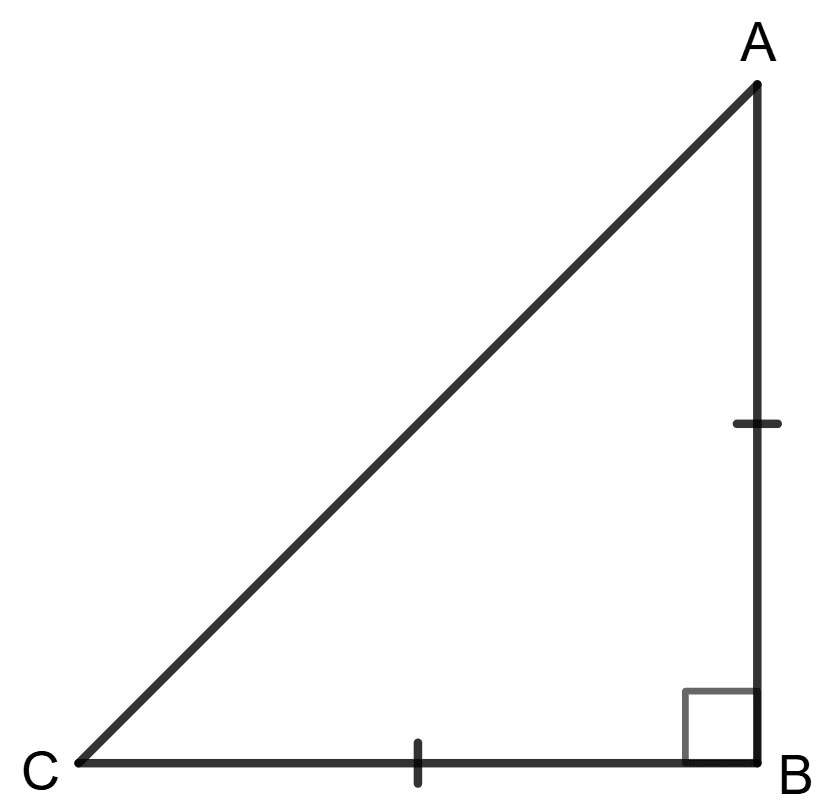
ABC is an isosceles right-angled triangle. Assuming AB = BC = x, find the value of each of the following trigonometric ratios :
(i) sin 45°
(ii) cos 45°
(iii) tan 45°
Answer
In Δ ABC,
⇒ AC2 = BC2 + AB2 (∴ AC is hypotenuse)
⇒ AC2 = x2 + x2
⇒ AC2 = 2x2
⇒ AC = 2 x 2 \sqrt{2\text{x}^2} 2 x 2
⇒ AC = 2 \sqrt{2} 2
As Δ ABC is isosceles right angled triangle, ∠BAC = ∠BCA = 90 ° 2 \dfrac{90°}{2} 2 90°
(i) sin 45°
sin 45° = sin A = sin C
sin A = P e r p e n d i c u l a r H y p o t e n u s e \dfrac{Perpendicular}{Hypotenuse} Hy p o t e n u se P er p e n d i c u l a r
= B C A C = x 2 x = 1 2 \dfrac{BC}{AC} = \dfrac{x}{\sqrt2x} = \dfrac{1}{\sqrt2} A C BC = 2 x x = 2 1
Hence, sin 45° = 1 2 \dfrac{1}{\sqrt2} 2 1
(ii) cos 45°
cos 45° = cos A = cos C
cos A = B a s e H y p o t e n u s e \dfrac{Base}{Hypotenuse} Hy p o t e n u se B a se
= A B A C = x 2 x = 1 2 \dfrac{AB}{AC} = \dfrac{x}{\sqrt2x} = \dfrac{1}{\sqrt2} A C A B = 2 x x = 2 1
Hence, cos 45° = 1 2 \dfrac{1}{\sqrt2} 2 1
(iii) tan 45°
tan 45° = tan A = tan C
tan A = P e r p e n d i c u l a r B a s e \dfrac{Perpendicular}{Base} B a se P er p e n d i c u l a r
= B C A B = x x \dfrac{BC}{AB} = \dfrac{x}{x} A B BC = x x
Hence, tan 45° = 1 .
Prove that :
sin 60° = 2 sin 30° cos 30°.
Answer
sin 60° = 2 sin 30° cos 30°.
L.H.S. = sin 60° = 3 2 \dfrac{\sqrt3}{2} 2 3
R.H.S.= 2 sin 30° cos 30°
= 2 × 1 2 × 3 2 = 2 × 1 2 × 3 2 = 3 2 = 2 \times \dfrac{1}{2} \times \dfrac{\sqrt3}{2}\\[1em] = \cancel{2} \times \dfrac{1}{\cancel{2}} \times \dfrac{\sqrt3}{2}\\[1em] = \dfrac{\sqrt3}{2} = 2 × 2 1 × 2 3 = 2 × 2 1 × 2 3 = 2 3
∴ L.H.S. = R.H.S.
Hence proved, sin 60° = 2 sin 30° cos 30°.
Prove that :
4 (sin4 30° + cos4 60°) - 3 (cos2 45° - sin2 90°) = 2
Answer
4 (sin4 30° + cos4 60°) - 3 (cos2 45° - sin2 90°) = 2
L.H.S. = 4 (sin4 30° + cos4 60°) - 3 (cos2 45° - sin2 90°)
= 4 × ( ( 1 2 ) 4 + ( 1 2 ) 4 ) − 3 × ( ( 1 2 ) 2 − ( 1 ) 2 ) = 4 × ( 1 16 + 1 16 ) − 3 × ( 1 2 − 1 ) = 4 × ( 1 + 1 16 ) − 3 × ( 1 2 − 2 2 ) = 4 × ( 2 16 ) − 3 × ( 1 − 2 2 ) = 4 × ( 1 8 ) − 3 × ( − 1 2 ) = 1 2 + 3 2 = 1 + 3 2 = 4 2 = 2 = 4 \times \Big(\Big(\dfrac{1}{2}\Big)^4 + \Big(\dfrac{1}{2}\Big)^4\Big) - 3 \times \Big(\Big(\dfrac{1}{\sqrt2}\Big)^2 - (1)^2\Big)\\[1em] = 4 \times \Big(\dfrac{1}{16} + \dfrac{1}{16}\Big) - 3 \times \Big(\dfrac{1}{2} - 1\Big)\\[1em] = 4 \times \Big(\dfrac{1 + 1}{16}\Big) - 3 \times \Big(\dfrac{1}{2} - \dfrac{2}{2}\Big)\\[1em] = 4 \times \Big(\dfrac{2}{16}\Big) - 3 \times \Big(\dfrac{1 - 2}{2}\Big)\\[1em] = 4 \times \Big(\dfrac{1}{8}\Big) - 3 \times \Big(\dfrac{-1}{2}\Big)\\[1em] = \dfrac{1}{2} + \dfrac{3}{2}\\[1em] = \dfrac{1 + 3}{2}\\[1em] = \dfrac{ 4}{2}\\[1em] = 2 = 4 × ( ( 2 1 ) 4 + ( 2 1 ) 4 ) − 3 × ( ( 2 1 ) 2 − ( 1 ) 2 ) = 4 × ( 16 1 + 16 1 ) − 3 × ( 2 1 − 1 ) = 4 × ( 16 1 + 1 ) − 3 × ( 2 1 − 2 2 ) = 4 × ( 16 2 ) − 3 × ( 2 1 − 2 ) = 4 × ( 8 1 ) − 3 × ( 2 − 1 ) = 2 1 + 2 3 = 2 1 + 3 = 2 4 = 2
R.H.S. = 2
∴ L.H.S. = R.H.S.
Hence, 4 (sin4 30° + cos4 60°) - 3 (cos2 45° - sin2 90°) = 2.
If sin x = cos x and x is acute, state the value of x.
Answer
sin x = cos x
As we know that sin2 x + cos2 x = 1
⇒ sin2 x + sin2 x = 1
⇒ 2sin2 x = 1
⇒ sin2 x = 1 2 \dfrac{1}{2} 2 1
⇒ sin x = 1 2 \dfrac{1}{\sqrt2} 2 1
⇒ sin x = sin 45°
⇒ x = 45°
Hence, the value of x = 45°.
If sec A = cosec A and 0° ≤ A ≤ 90°, state the value of A.
Answer
sec A = cosec A
1 cos A = 1 sin A \dfrac{1}{\text{cos A}} = \dfrac{1}{\text{sin A}} cos A 1 = sin A 1
sin A = cos A
As we know that sin2 A + cos2 A = 1
⇒ sin2 A + sin2 A = 1
⇒ 2sin2 A = 1
⇒ sin2 A = 1 2 \dfrac{1}{2} 2 1
⇒ sin A = 1 2 \dfrac{1}{\sqrt2} 2 1
⇒ sin A = sin 45°
⇒ A = 45°
Hence, the value of A = 45°.
If tan θ = cot θ and 0° ≤ θ ≤ 90°, state the value of θ.
Answer
tan θ = cot θ
sin θ cos θ = cos θ sin θ \dfrac{\text{sin θ}}{\text{cos θ}} = \dfrac{\text{cos θ}}{\text{sin θ}} cos θ sin θ = sin θ cos θ
sin 2 θ = cos 2 θ \text{sin}^2 \text{θ} = \text{cos}^2 \text{θ} sin 2 θ = cos 2 θ
As we know that sin2 θ + cos2 θ = 1
⇒ sin2 θ + sin2 θ = 1
⇒ 2sin2 θ = 1
⇒ sin2 θ = 1 2 \dfrac{1}{2} 2 1
⇒ sin θ = 1 2 \dfrac{1}{\sqrt2} 2 1
⇒ sin θ = sin 45°
⇒ θ = 45°
Hence, the value of θ = 45°.
If sin x = cos y; write the relation between x and y, if both the angles x and y are acute.
Answer
sin x = cos y
cos y = sin (90° - y)
So, sin x = sin (90° - y)
⇒ x = 90° - y
⇒ x + y = 90°
Hence, the relation between x and y is x + y = 90°.
If sin x = cos y, then x + y = 45°; write true or false.
Answer
False
Reason:
sin x = cos y
It is only possible only when x = y = 45°.
sin 45° = cos 45° = 1
sec θ. cot θ = cosec θ write true or false.
Answer
True
Reason:
sec θ. cot θ = cosec θ
L.H.S. = sec θ. cot θ
= 1 cos θ × cos θ sin θ = 1 cos θ × cos θ sin θ = 1 sin θ = cosec θ = \dfrac{1}{\text{cos θ}} \times \dfrac{\text{cos θ}}{\text{sin θ}}\\[1em] = \dfrac{1}{\cancel{\text{cos θ}}} \times \dfrac{\cancel{\text{cos θ}}}{\text{sin θ}}\\[1em] = \dfrac{1}{\text{sin θ}}\\[1em] = \text{cosec θ} = cos θ 1 × sin θ cos θ = cos θ 1 × sin θ cos θ = sin θ 1 = cosec θ
R.H.S. = cosec θ
∴ L.H.S. = R.H.S.
For any angle θ, state the value of :
sin2 θ + cos2 θ.
Answer
1
Reason:
sin2 θ + cos2 θ = 1
Let take θ = 30°
sin2 30° = ( 1 2 ) 2 = 1 4 \Big(\dfrac{1}{2}\Big)^2 = \dfrac{1}{4} ( 2 1 ) 2 = 4 1
cos2 30° = ( 3 2 ) 2 = 3 4 \Big(\dfrac{\sqrt3}{2}\Big)^2 = \dfrac{3}{4} ( 2 3 ) 2 = 4 3
Now, sin2 30° + cos2 30°
= 1 4 + 3 4 = 1 + 3 4 = 4 4 = 1 = \dfrac{1}{4} + \dfrac{3}{4}\\[1em] = \dfrac{1 + 3}{4}\\[1em] = \dfrac{4}{4}\\[1em] = 1 = 4 1 + 4 3 = 4 1 + 3 = 4 4 = 1
State for any acute angle θ whether :
sin θ increases or decreases as θ increases.
Answer
sin θ increases as θ increases
Reason — As we know,
sin 0° = 0
sin 30° = 1 2 \dfrac{1}{2} 2 1
sin 45° = 1 2 \dfrac{1}{\sqrt2} 2 1
sin 60° = 3 2 \dfrac{\sqrt3}{2} 2 3
sin 90° = 1
State for any acute angle θ whether :
cos θ increases or decreases as θ increases.
Answer
cos θ decreases as θ increases
Reason — As we know,
cos 0° = 1
cos 30° = 3 2 \dfrac{\sqrt3}{2} 2 3
cos 45° = 1 2 \dfrac{1}{\sqrt2} 2 1
cos 60° = 1 2 \dfrac{1}{2} 2 1
cos 90° = 0
State for any acute angle θ whether :
tan θ increases or decreases as θ decreases.
Answer
tan θ decreases as θ decreases.
Reason — As we know,
tan 90° = not defined
tan 60° = 3 \sqrt3 3
tan 45° = 1
tan 30° = 1 3 \dfrac{1}{\sqrt3} 3 1
tan 0° = 0