KnowledgeBoat Logo
|
OPEN IN APP

Chapter 21

Trigonometrical Ratios — Exercise 21(B)

Class - 9 Concise Mathematics Selina


Exercise 21(B)

Question 1(a)

If cos A=12\text{cos A} = \dfrac{1}{\sqrt2} and sin B=32\text{sin B} = \dfrac{\sqrt3}{2}, the value of tan Btan A1+tan A tan B\dfrac{\text{tan B} - \text{tan A}}{1 + \text{tan A tan B}} is :

  1. 232 - {\sqrt3}
  2. 2+32 + {\sqrt3}
  3. 32{\sqrt3} - 2
  4. 3+2{\sqrt3} + 2

Answer

Given:

cos A=12A = \dfrac{1}{\sqrt2}

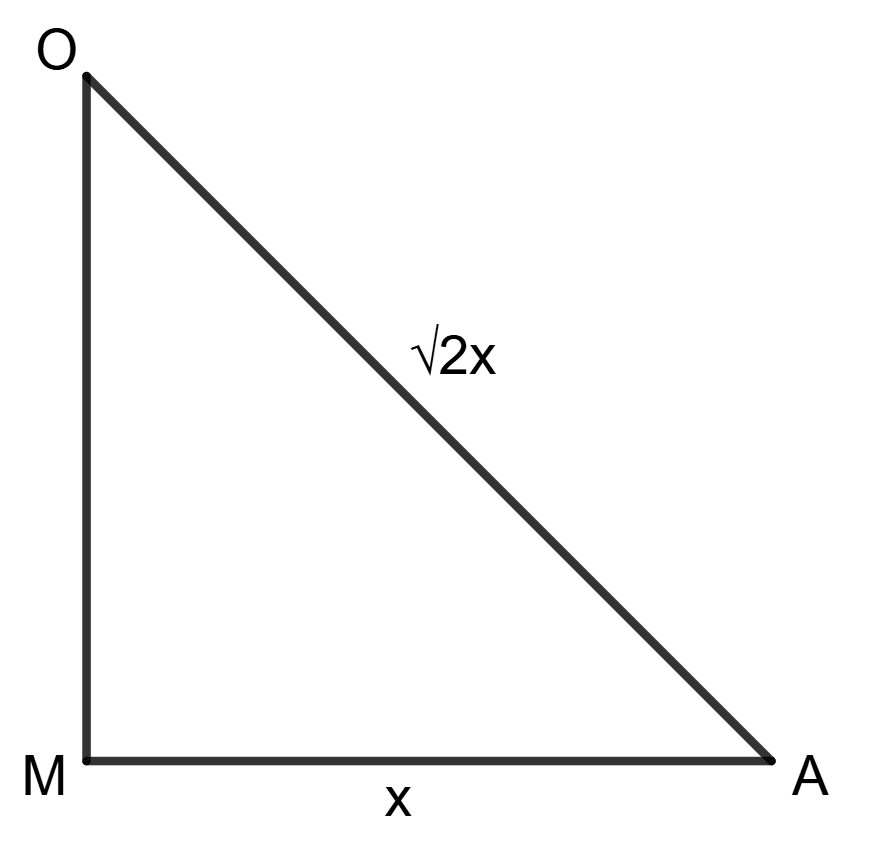
i.e., BaseHypotenuse=12\dfrac{\text{Base}}{\text{Hypotenuse}} = \dfrac{1}{\sqrt2}

∴ If length of AM = x unit, length of AO = x 2\sqrt{2} unit.

If cos A = 1/2 and sin B = 3/2, the value of tan B - tan A1 + tan A tan B is : Trigonometrical Ratios, Concise Mathematics Solutions ICSE Class 9.

In Δ AMO,

⇒ AO2 = AM2 + MO2 (∵ AC is hypotenuse)

⇒ (2\sqrt{2}x)2 = (x)2 + MO2

⇒ 2x2 = x2 + MO2

⇒ MO2 = 2x2 - x2

⇒ MO2 = x2

⇒ MO = x2\sqrt{\text{x}^2}

⇒ MO = x

tan A=PerpendicularBaseA = \dfrac{Perpendicular}{Base}

=OMMA=xx=1= \dfrac{OM}{MA} = \dfrac{x}{x} = 1

And,

sin B=32B = \dfrac{\sqrt3}{2}

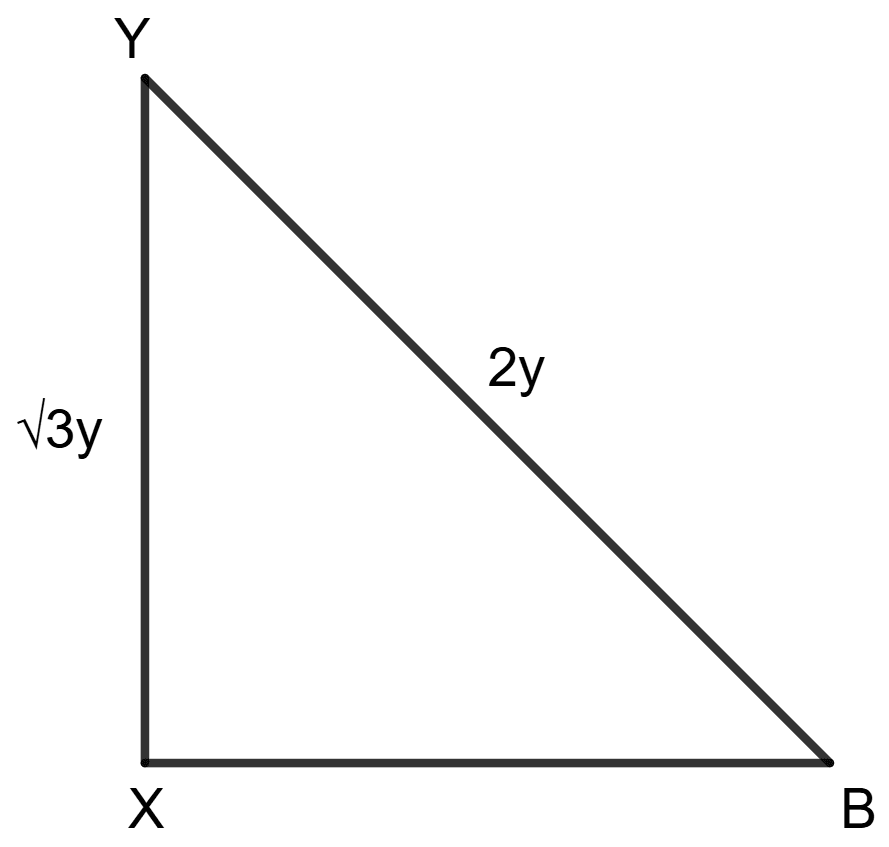
i.e. PerpendicularHypotenuse=32\dfrac{\text{Perpendicular}}{\text{Hypotenuse}} = \dfrac{\sqrt3}{2}

∴ If length of XY = 3\sqrt{3} y unit, length of YB = 2y unit.

If cos A = 1/2 and sin B = 3/2, the value of tan B - tan A1 + tan A tan B is : Trigonometrical Ratios, Concise Mathematics Solutions ICSE Class 9.

In Δ BXY,

⇒ YB2 = YX2 + BX2 (∵ AC is hypotenuse)

⇒ (2y)2 = (3\sqrt{3}y)2 + BX2

⇒ 4y2 = 3y2 + BX2

⇒ BX2 = 4y2 - 3y2

⇒ BX2 = y2

⇒ BX = y2\sqrt{\text{y}^2}

⇒ BX = y

tan B=PerpendicularBaseB = \dfrac{Perpendicular}{Base}

=XYBX=3yy=31= \dfrac{XY}{BX} = \dfrac{\sqrt{3}y}{y} = \dfrac{\sqrt{3}}{1}

Now,

tan Btan A1+tan A tan B=3111+31×1=311+3=(31)×(13)(1+3)×(13)=(331+3)1232=23413=2(32)2=2(32)2=3+2=23\dfrac{\text{tan B} - \text{tan A}}{1 + \text{tan A } \text{tan B}}\\[1em] = \dfrac{\dfrac{\sqrt{3}}{1} - 1}{1 + \dfrac{\sqrt{3}}{1} \times 1}\\[1em] = \dfrac{\sqrt{3} - 1}{1 + \sqrt{3}}\\[1em] = \dfrac{(\sqrt{3} - 1) \times (1 - \sqrt{3})}{(1 + \sqrt{3}) \times (1 - \sqrt{3})}\\[1em] = \dfrac{(\sqrt{3} - 3 - 1 + \sqrt{3})}{1^2 - \sqrt{3}^2}\\[1em] = \dfrac{2 \sqrt{3} - 4}{1 - 3}\\[1em] = \dfrac{2 (\sqrt{3} - 2)}{-2}\\[1em] = \dfrac{\cancel{2} (\sqrt{3} - 2)}{-\cancel{2}}\\[1em] = -\sqrt{3} + 2\\[1em] = 2 - \sqrt{3}

Hence, option 1 is the correct option.

Question 1(b)

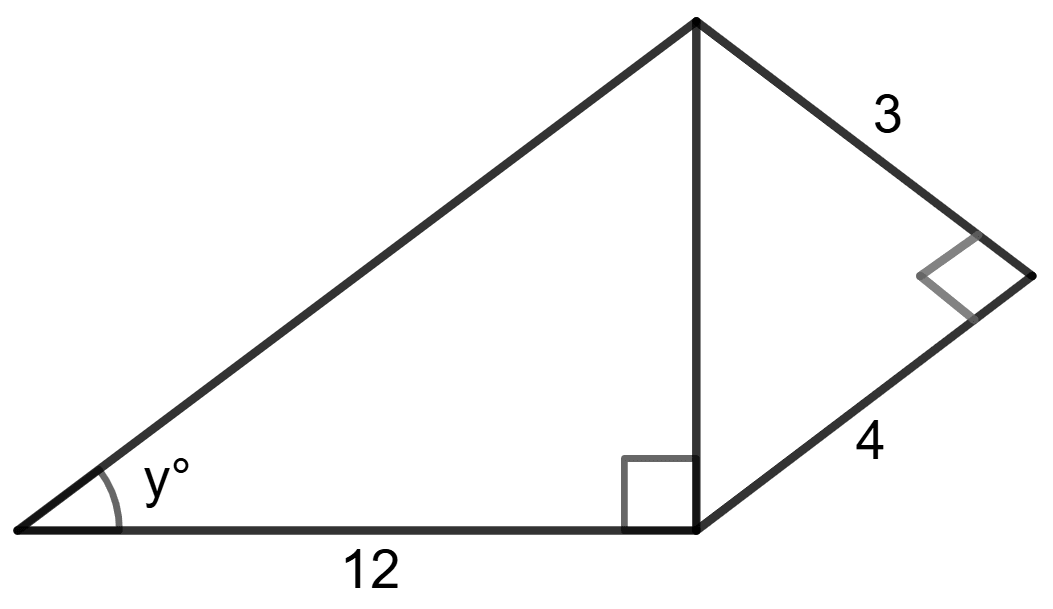
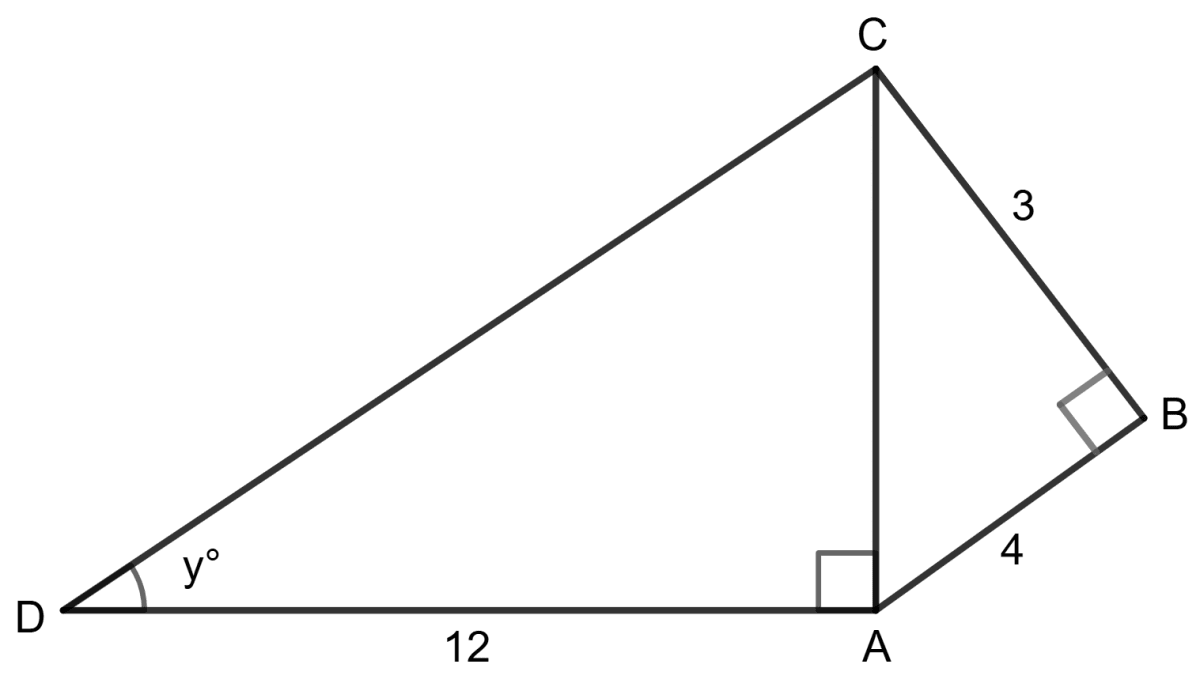
From the given figure, the value of cos y is :

  1. 13\dfrac{1}{3}
  2. 14\dfrac{1}{4}
  3. 1213\dfrac{12}{13}
  4. 11121\dfrac{1}{12}
From the given figure, the value of cos y is : Trigonometrical Ratios, Concise Mathematics Solutions ICSE Class 9.

Answer

In Δ ABC,

From the given figure, the value of cos y is : Trigonometrical Ratios, Concise Mathematics Solutions ICSE Class 9.

⇒ AC2 = AB2 + BC2 (∵ AC is hypotenuse)

⇒ AC2 = 42 + 32

⇒ AC2 = 16 + 9

⇒ AC2 = 25

⇒ AC = 25\sqrt{25}

⇒ AC = 5

In Δ ADC,

⇒ DC2 = AC2 + DA2 (∵ DC is hypotenuse)

⇒ DC2 = 52 + 122

⇒ DC2 = 25 + 144

⇒ DC2 = 169

⇒ DC = 169\sqrt{169}

⇒ DC = 13

cos y = BaseHypotenuse\dfrac{Base}{Hypotenuse}

=DADC=1213= \dfrac{DA}{DC}\\[1em] = \dfrac{12}{13}

Hence, option 3 is the correct option.

Question 1(c)

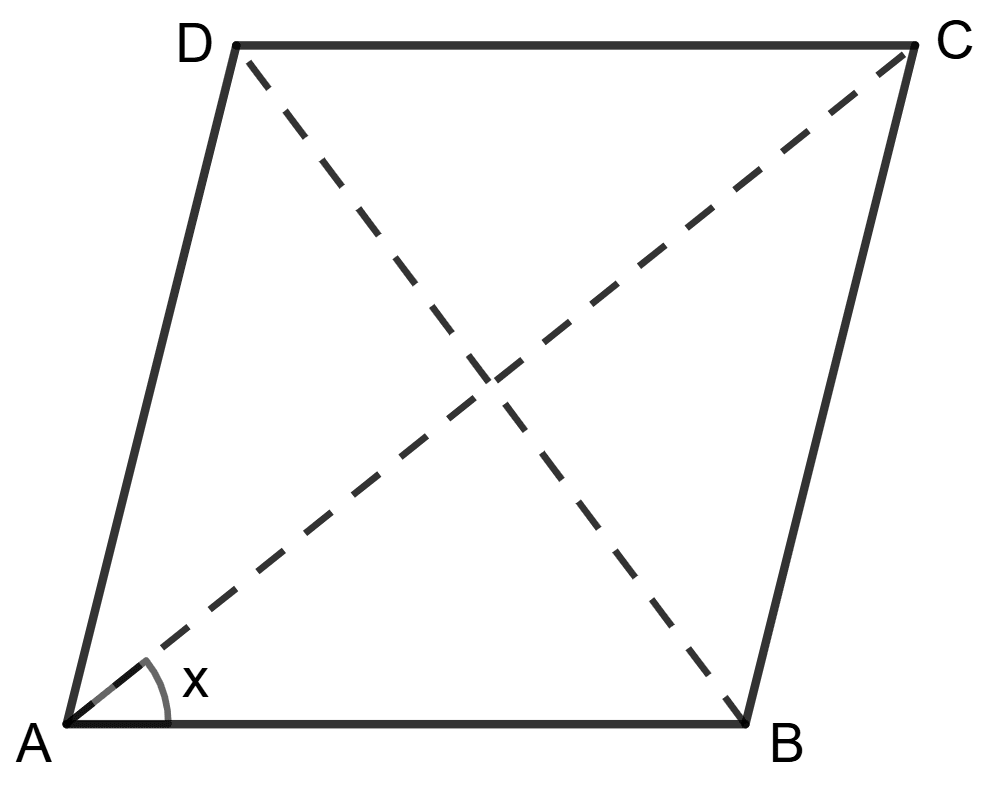
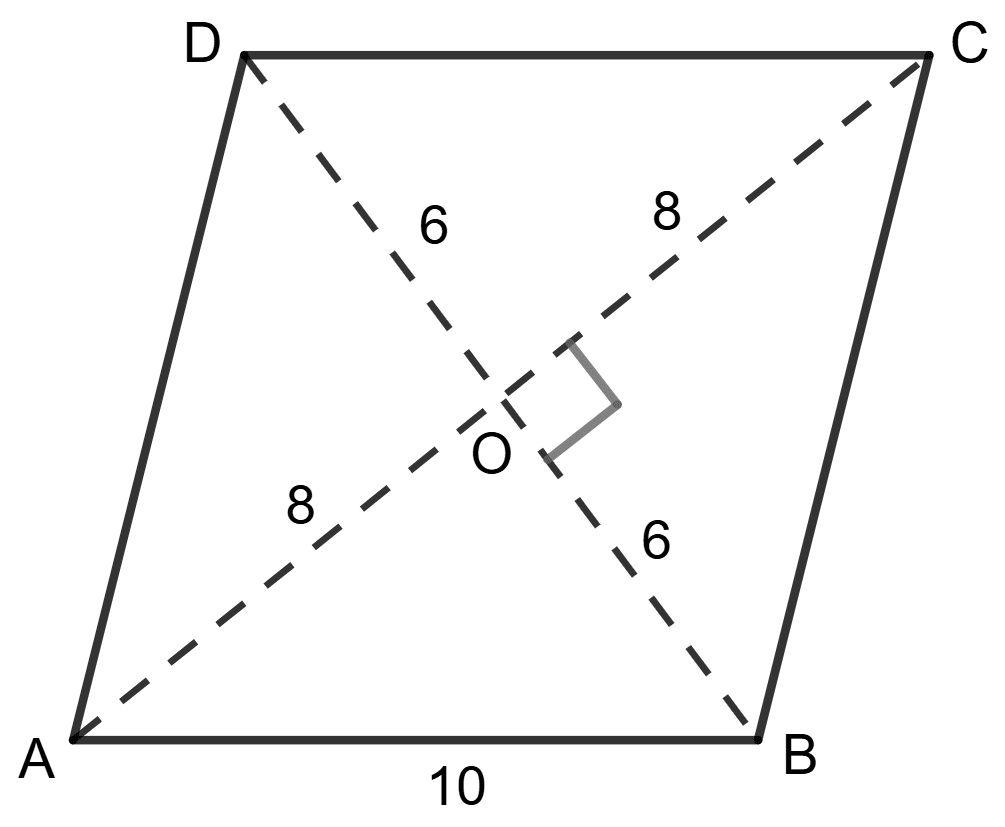
ABCD is a rhombus with diagonals BD and AC equal to 12 cm and 16 cm respectively. The value of cosec x is :

  1. 1231\dfrac{2}{3}
  2. 3133\dfrac{1}{3}
  3. 12\dfrac{1}{2}
  4. 1131\dfrac{1}{3}
ABCD is a rhombus with diagonals BD and AC equal to 12 cm and 16 cm respectively. The value of cosec x is : Trigonometrical Ratios, Concise Mathematics Solutions ICSE Class 9.

Answer

The diagonals of a rhombus bisect each other at right angles.

ABCD is a rhombus with diagonals BD and AC equal to 12 cm and 16 cm respectively. The value of cosec x is : Trigonometrical Ratios, Concise Mathematics Solutions ICSE Class 9.

∴ ∠AOB = 90°

In Δ AOB,

⇒ AB2 = BO2 + OA2 (∵ AB is hypotenuse)

⇒ AB2 = 62 + 82

⇒ AB2 = 36 + 64

⇒ AB2 = 100

⇒ AB = 100\sqrt{100}

⇒ AB = 10 cm

cosec x=HypotenusePerpendicularx = \dfrac{Hypotenuse}{Perpendicular}

=ABOB=106=53=123= \dfrac{AB}{OB}\\[1em] = \dfrac{10}{6}\\[1em] = \dfrac{5}{3}\\[1em] = 1\dfrac{2}{3}

Hence, option 1 is the correct option.

Question 1(d)

If sin A - cosec A = 2, the value of sin2 A + cosec2 A is :

  1. 2
  2. 0
  3. 4
  4. 6

Answer

Given:

sin A - cosec A = 2

Squaring both sides,

⇒ (sin A - cosec A)2 = (2)2

⇒ (sin A)2 + (cosec A)2 - 2 x sin A x cosec A = 4

⇒ sin2 A + cosec2 A - 2 x sin A\text{sin A} x 1sin A\dfrac{1}{\text{sin A}} = 4

⇒ sin2 A + cosec2 A - 2 x sin A\cancel{\text{sin A}}x 1sin A\dfrac{1}{\cancel{\text{sin A}}} = 4

⇒ sin2 A + cosec2 A - 2 = 4

⇒ sin2 A + cosec2 A = 4 + 2

⇒ sin2 A + cosec2 A = 6

Hence, option 4 is the correct option.

Question 1(e)

If cot A=5\text{cot A} = {\sqrt5}, the value of cosec2 A - sec2 A is :

  1. 524\dfrac{5}{24}
  2. 4454\dfrac{4}{5}
  3. 5
  4. 24

Answer

Given:

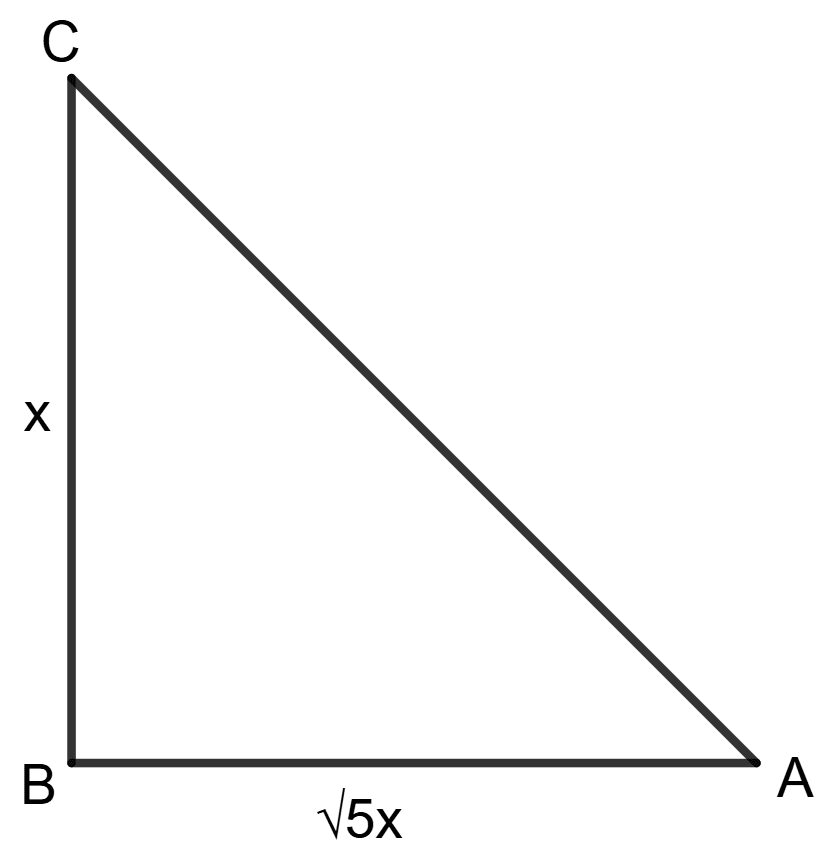
cot A=5cot A=BasePerpendicular=51\text{cot A} = {\sqrt5}\\[1em] \text{cot A} = \dfrac{\text{Base}}{\text{Perpendicular}} = \dfrac{\sqrt5}{1}\\[1em]

∴ If length of AB = 5\sqrt{5} x unit, length of BC = x unit.

If cot A = 5, the value of cosec2 A - sec2 A is : Trigonometrical Ratios, Concise Mathematics Solutions ICSE Class 9.

In Δ ABC,

⇒ AC2 = AB2 + BC2 (∵ AC is hypotenuse)

⇒ AC2 = (5(\sqrt{5} x)2 + (x)2

⇒ AC2 = 5x2 + x2

⇒ AC2 = 6x2

⇒ AC = 6x2\sqrt{6\text{x}^2}

⇒ AC = 6\sqrt{6} x

cosec A=HypotenusePerpendicularA = \dfrac{Hypotenuse}{Perpendicular}

=ACBC=6xx=61= \dfrac{AC}{BC} = \dfrac{\sqrt{6}\text{x}}{\text{x}} = \dfrac{\sqrt{6}}{1}

sec A=HypotenuseBaseA = \dfrac{Hypotenuse}{Base}

=ACAB=6x5x=65= \dfrac{AC}{AB} = \dfrac{\sqrt{6}\text{x}}{\sqrt{5}\text{x}} = \dfrac{\sqrt{6}}{\sqrt{5}}

Now, cosec2 A - sec2 A

=(61)2(65)2=6165=6×51×56×15×1=30565=3065=245=445= \Big(\dfrac{\sqrt{6}}{1}\Big)^2 - \Big(\dfrac{\sqrt{6}}{\sqrt{5}}\Big)^2\\[1em] = \dfrac{6}{1} - \dfrac{6}{5}\\[1em] = \dfrac{6 \times 5}{1 \times 5} - \dfrac{6 \times 1}{5 \times 1}\\[1em] = \dfrac{30}{5} - \dfrac{6}{5}\\[1em] = \dfrac{30 - 6}{5}\\[1em] = \dfrac{24}{5}\\[1em] = 4\dfrac{4}{5}

Hence, option 2 is the correct option.

Question 2

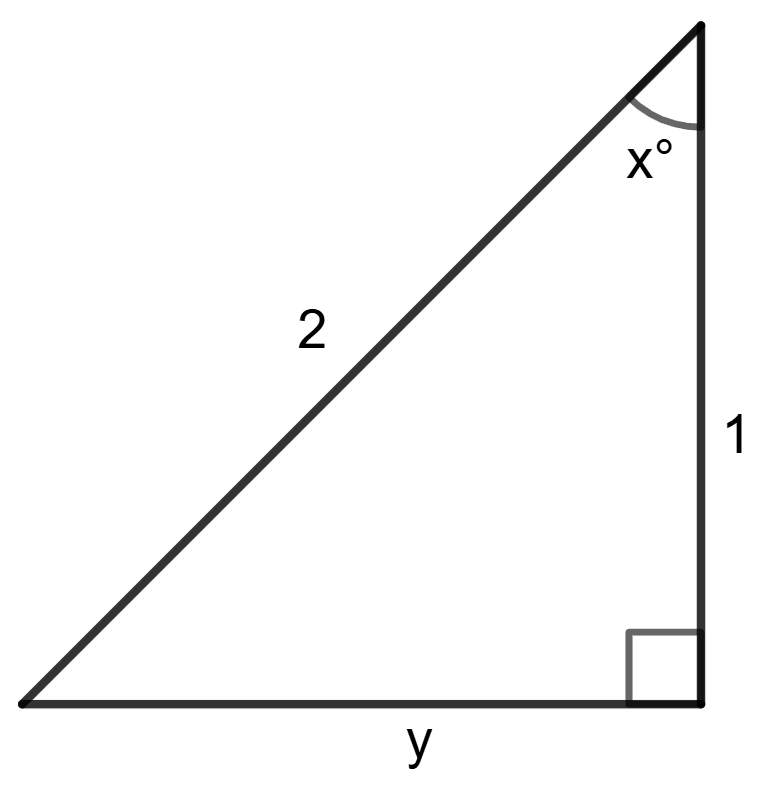
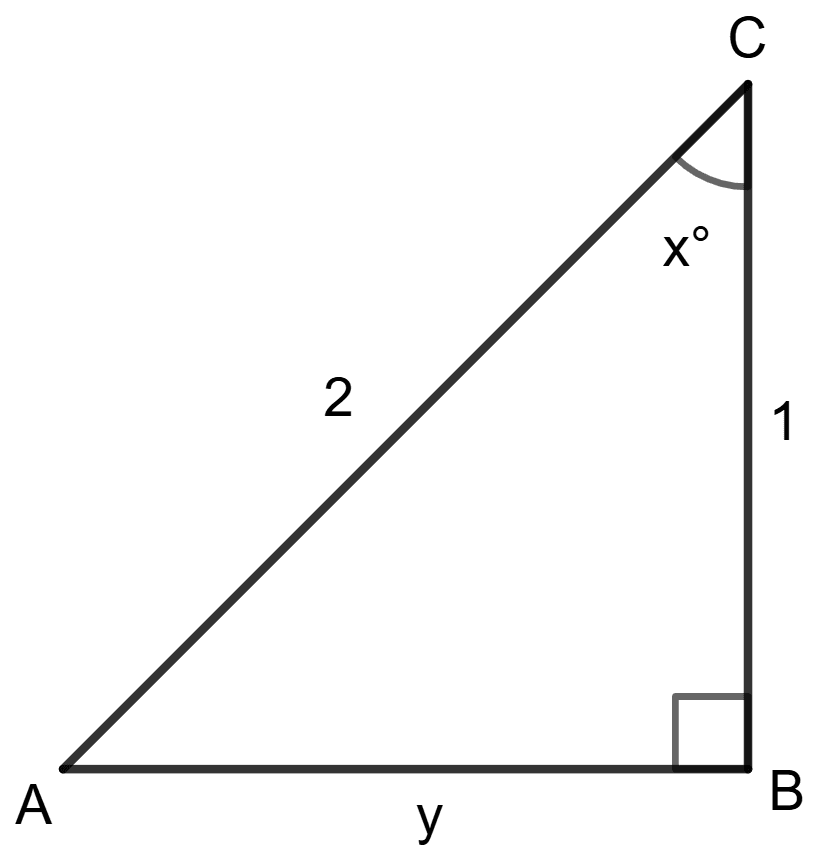
From the following figure, find :

From the following figure, find : Trigonometrical Ratios, Concise Mathematics Solutions ICSE Class 9.

(i) y

(ii) sin x°

(iii) (sec x° - tan x°)(sec x° + tan x°)

Answer

(i) In Δ ABC,

From the following figure, find : Trigonometrical Ratios, Concise Mathematics Solutions ICSE Class 9.

⇒ AC2 = AB2 + BC2 (∵ AC is hypotenuse)

⇒ 22 = y2 + 12

⇒ 4 = y2 + 1

⇒ y2 = 4 - 1

⇒ y2 = 3

⇒ y = 3\sqrt{3}

Hence, the value of y = 3\sqrt{3}.

(ii) sin x°=PerpendicularHypotenusex° = \dfrac{Perpendicular}{Hypotenuse}

=ABAC=32= \dfrac{AB}{AC}\\[1em] = \dfrac{\sqrt{3}}{2}

Hence, sin x°=32x° = \dfrac{\sqrt{3}}{2}.

(iii) (sec x° - tan x°)(sec x° + tan x°)

sec x°=HypotenuseBasex° = \dfrac{Hypotenuse}{Base}

=ACCB=21=2= \dfrac{AC}{CB}\\[1em] = \dfrac{2}{1} = 2

tan x°=PerpendicularBasex° = \dfrac{Perpendicular}{Base}

=ABCB=31=3= \dfrac{AB}{CB}\\[1em] = \dfrac{\sqrt{3}}{1} = 3

Now, (sec x° - tan x°)(sec x° + tan x°)

=(23)(2+3)=(2)2(3)2=43=1= (2 - \sqrt{3})(2 + \sqrt{3}) \\[1em] = (2)^2 - (\sqrt{3})^2 \\[1em] = 4 - 3 \\[1em] = 1

Hence, (sec x° - tan x°)(sec x° + tan x°) = 1.

Question 3

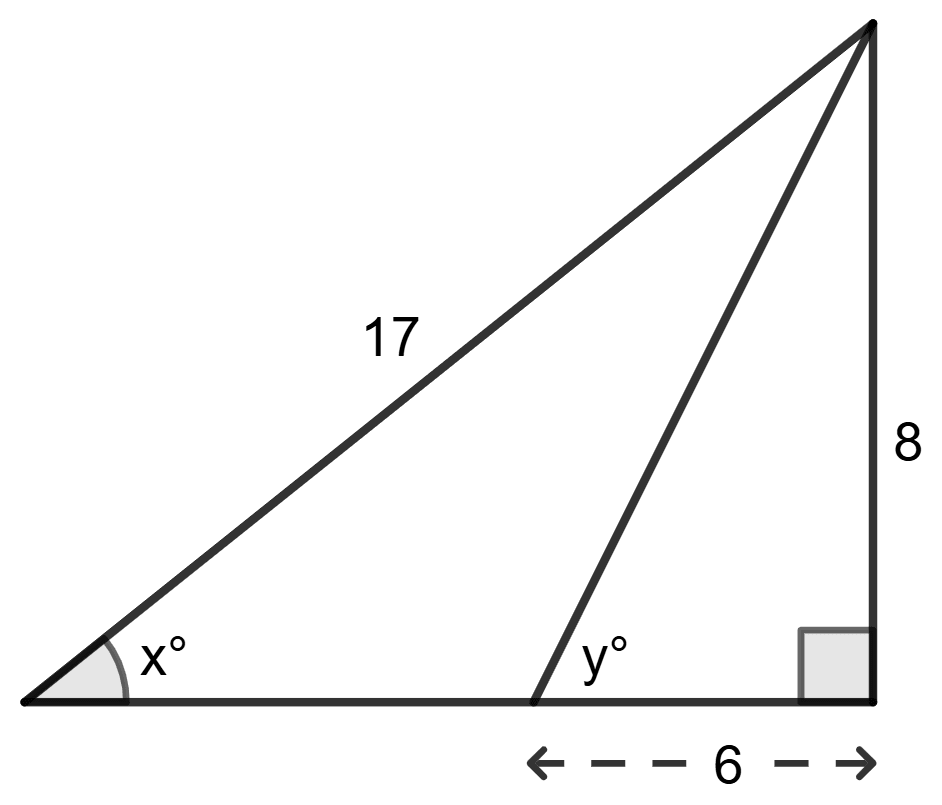
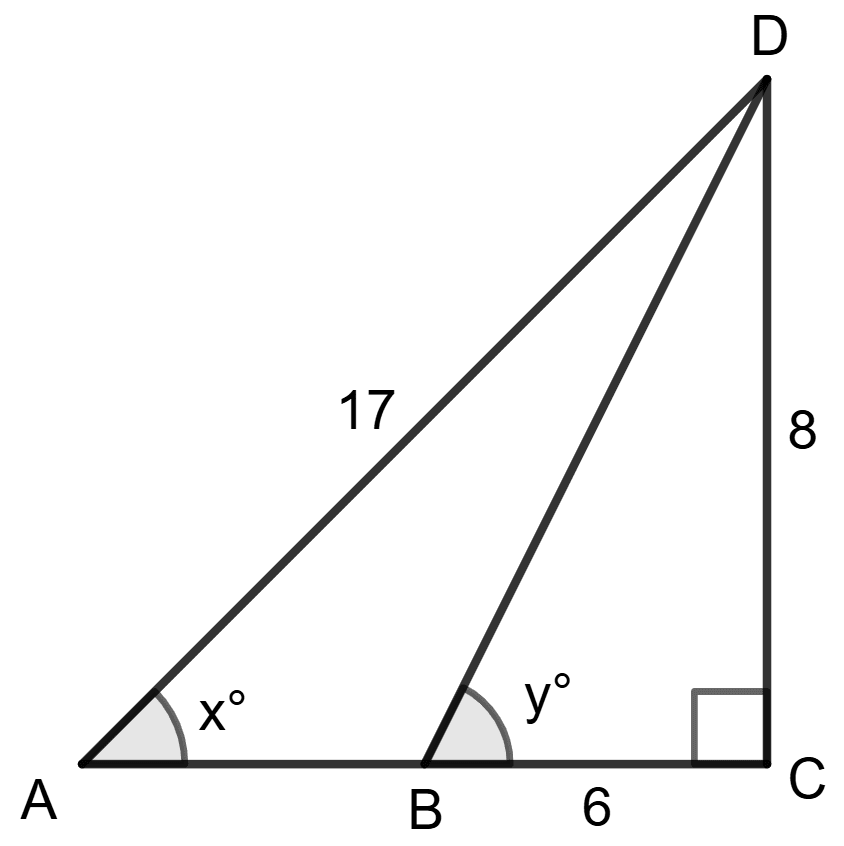
Use the given figure to find :

Use the given figure to find : Trigonometrical Ratios, Concise Mathematics Solutions ICSE Class 9.

(i) sin x°

(ii) cos y°

(iii) 3 tan x° - 2 sin y° + 4 cos y°

Answer

In Δ BCD,

Use the given figure to find : Trigonometrical Ratios, Concise Mathematics Solutions ICSE Class 9.

⇒ BD2 = BC2 + CD2 (∵ BD is hypotenuse)

⇒ BD2 = 62 + 82

⇒ BD2 = 36 + 64

⇒ BD2 = 100

⇒ BD = 100\sqrt{100}

⇒ BD = 10

In Δ ACD,

⇒ AD2 = AC2 + CD2 (∵ AD is hypotenuse)

⇒ 172 = AC2 + 82

⇒ 289 = AC2 + 64

⇒ AC2 = 289 - 64

⇒ AC2 = 225

⇒ AC = 225\sqrt{225}

⇒ AC = 15

(i) sin x°=PerpendicularHypotenusex° = \dfrac{Perpendicular}{Hypotenuse}

=DCAD=817= \dfrac{DC}{AD}\\[1em] = \dfrac{8}{17}

Hence, sin x°=817x° = \dfrac{8}{17}.

(ii) cos y°=BaseHypotenusey° = \dfrac{Base}{Hypotenuse}

=BCBD=610=35= \dfrac{BC}{BD}\\[1em] = \dfrac{6}{10}\\[1em] = \dfrac{3}{5}

Hence, cos y°=35y° = \dfrac{3}{5}.

(iii) 3 tan x° - 2 sin y° + 4 cos y°

tan x°=PerpendicularBasex° = \dfrac{Perpendicular}{Base}

=DCAC=815= \dfrac{DC}{AC}\\[1em] = \dfrac{8}{15}

sin y°=PerpendicularHypotenusey° = \dfrac{Perpendicular}{Hypotenuse}

=CDBD=810=45= \dfrac{CD}{BD}\\[1em] = \dfrac{8}{10}\\[1em] = \dfrac{4}{5}

cos y°=BaseHypotenusey° = \dfrac{Base}{Hypotenuse}

=BCBD=610=35= \dfrac{BC}{BD}\\[1em] = \dfrac{6}{10}\\[1em] = \dfrac{3}{5}

Now, 3 tan x° - 2 sin y° + 4 cos y°

=3×8152×45+4×35=241585+125=2415+8+125=2415+45=2415+4×35×3=2415+1215=24+1215=3615=125=225= 3 \times \dfrac{8}{15} - 2 \times \dfrac{4}{5} + 4 \times \dfrac{3}{5}\\[1em] = \dfrac{24}{15} - \dfrac{8}{5} + \dfrac{12}{5}\\[1em] = \dfrac{24}{15} + \dfrac{- 8 + 12}{5}\\[1em] = \dfrac{24}{15} + \dfrac{4}{5}\\[1em] = \dfrac{24}{15} + \dfrac{4 \times 3}{5 \times 3}\\[1em] = \dfrac{24}{15} + \dfrac{12}{15}\\[1em] = \dfrac{24 + 12}{15}\\[1em] = \dfrac{36}{15}\\[1em] = \dfrac{12}{5}\\[1em] = 2\dfrac{2}{5}

Hence, 3 tan x° - 2 sin y° + 4 cos y° = 2252\dfrac{2}{5}.

Question 4

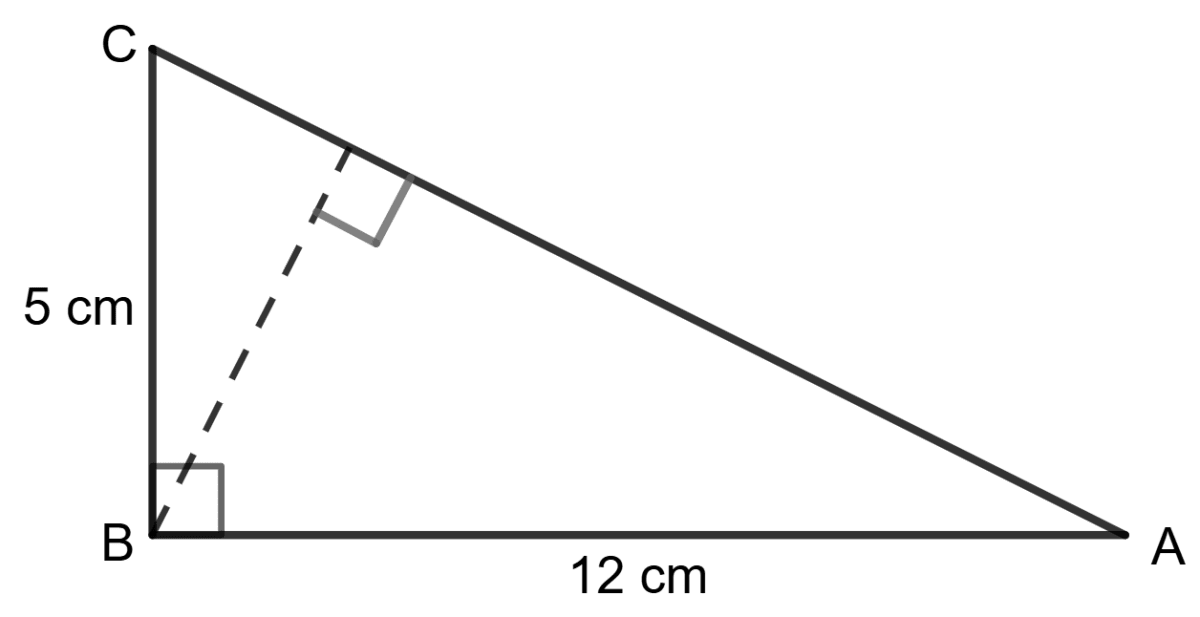
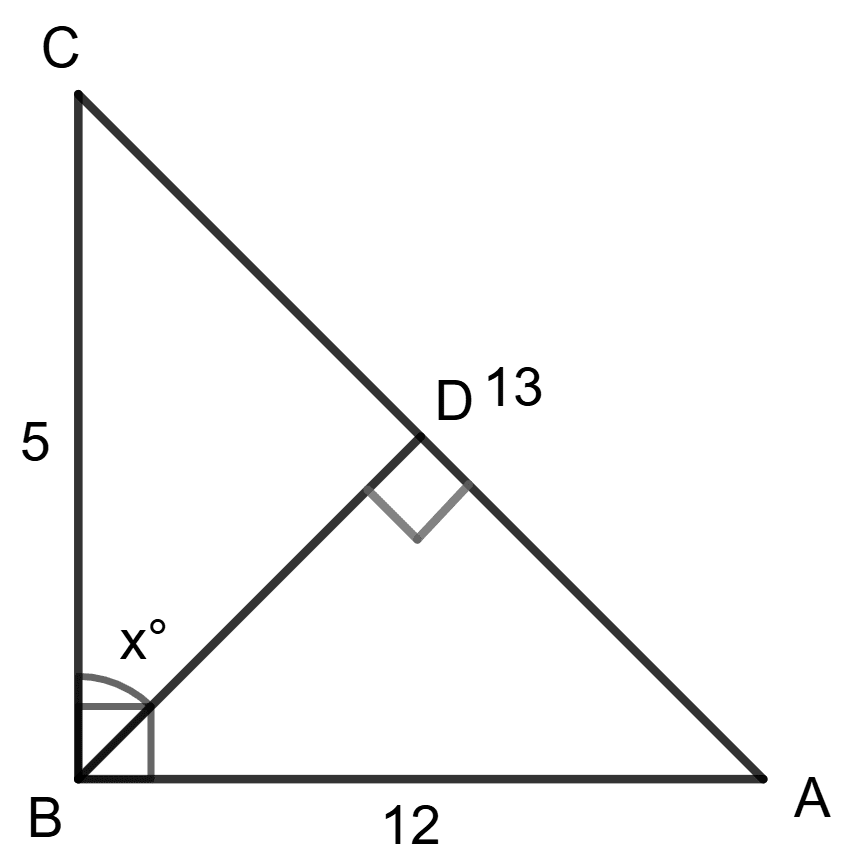
In the diagram, given below, triangle ABC is right-angled at B and BD is perpendicular to AC. Find :

(i) cos ∠DBC

(ii) cot ∠DBA

In the diagram, given below, triangle ABC is right-angled at B and BD is perpendicular to AC. Find : Trigonometrical Ratios, Concise Mathematics Solutions ICSE Class 9.

Answer

In Δ ABC,

⇒ AC2 = AB2 + BC2 (∵ AC is hypotenuse)

⇒ AC2 = 122 + 52

⇒ AC2 = 144 + 25

⇒ AC2 = 169

⇒ AC = 169\sqrt{169}

⇒ AC = 13

In the diagram, given below, triangle ABC is right-angled at B and BD is perpendicular to AC. Find : Trigonometrical Ratios, Concise Mathematics Solutions ICSE Class 9.

Let ∠CBD be .

So, ∠DBA = 90° - x°.

In Δ DAB, according to angle sum property

⇒ ∠ DAB + ∠ADB + ∠DBA = 180°

⇒ ∠ DAB + 90° + (90° - x°) = 180°

⇒ ∠ DAB + 180° - x° = 180°

⇒ ∠ DAB - x° = 0

⇒ ∠ DAB = x°

From figure,

∠ DAB = ∠ CAB = x°

∴ ∠ CBD = ∠ CAB = x°

(i) cos ∠DBC = cos ∠CAB = BaseHypotenuse\dfrac{Base}{Hypotenuse}

=ABAC=1213= \dfrac{AB}{AC}\\[1em] = \dfrac{12}{13}

Hence, cos ∠DBC = 1213\dfrac{12}{13}.

(ii) In Δ BCD, according to angle sum property

⇒ ∠ DBC + ∠DCB + ∠CDB = 180°

⇒ ∠ DCB + x° + 90° = 180°

⇒ ∠ DCB = 180° - 90° - x°

⇒ ∠ DCB = 90° - x°

From figure,

∠ DCB = ∠ ACB = 90° - x°

∴ ∠ DBA = ∠ ACB = 90° - x°

cot ∠DBA = cot ∠ACB = BasePerpendicular\dfrac{Base}{Perpendicular}

=BCAB=512= \dfrac{BC}{AB}\\[1em] = \dfrac{5}{12}

Hence, cot ∠DBA = 512\dfrac{5}{12}.

Question 5

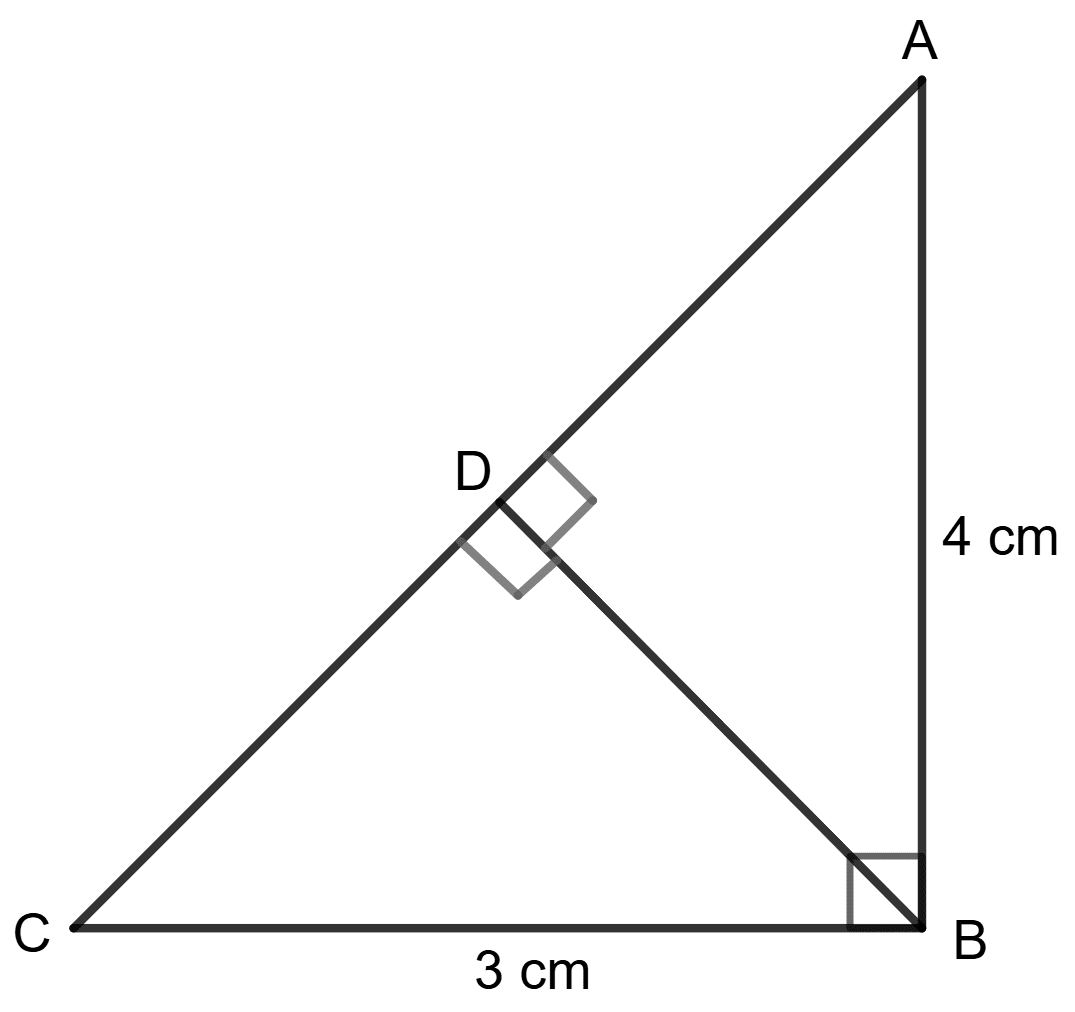
In the given figure, triangle ABC is right-angled at B. D is the foot of the perpendicular from B to AC. Given that BC = 3 cm and AB = 4 cm. Find :

(i) tan ∠DBC

(ii) sin ∠DBA

In the given figure, triangle ABC is right-angled at B. D is the foot of the perpendicular from B to AC. Given that BC = 3 cm and AB = 4 cm. Find : Trigonometrical Ratios, Concise Mathematics Solutions ICSE Class 9.

Answer

In Δ ABC,

⇒ AC2 = AB2 + BC2 (∵ AC is hypotenuse)

⇒ AC2 = 42 + 32

⇒ AC2 = 16 + 9

⇒ AC2 = 25

⇒ AC = 25\sqrt{25}

⇒ AC = 5

Let CD = y and BD = x

In Δ BCD,

⇒ BC2 = CD2 + BD2 (∵ BC is hypotenuse)

⇒ 32 = y2 + x2

⇒ 9 = y2 + x2 ................(1)

In Δ ABD,

⇒ AB2 = AD2 + BD2 (∵ BC is hypotenuse)

⇒ 42 = (5 - y)2 + x2

⇒ 16 = 25 + y2 - 10y + x2 ................(2)

Subtracting (1) from (2), we get

⇒ 16 - 9 = (25 + y2 - 10y + x2) - (y2 + x2)

⇒ 7 = 25 + y2 - 10y + x2 - y2 - x2

⇒ 7 = 25 - 10y

⇒ 7 - 25 = -10y

⇒ -10y = -18

⇒ y = 1810\dfrac{18}{10} = 1.8

AD = 5 - 1.8 = 3.2

Using equation (1),

⇒ 9 = (1.8)2 + x2

⇒ x2 = 9 - 3.24

⇒ x2 = 5.76

⇒ x = 5.76\sqrt{5.76}

⇒ x = 2.4

(i) cos ∠DBC = PerpendicularBase\dfrac{Perpendicular}{Base}

=CDBD=1.82.4=34= \dfrac{CD}{BD}\\[1em] = \dfrac{1.8}{2.4}\\[1em] = \dfrac{3}{4}

Hence, tan ∠DBC = 34\dfrac{3}{4}.

(ii) sin ∠DBA = PerpendicularHypotenuse\dfrac{Perpendicular}{Hypotenuse}

=ADAB=3.24=45= \dfrac{AD}{AB}\\[1em] = \dfrac{3.2}{4}\\[1em] = \dfrac{4}{5}

Hence, sin ∠DBA = 45\dfrac{4}{5}.

Question 6

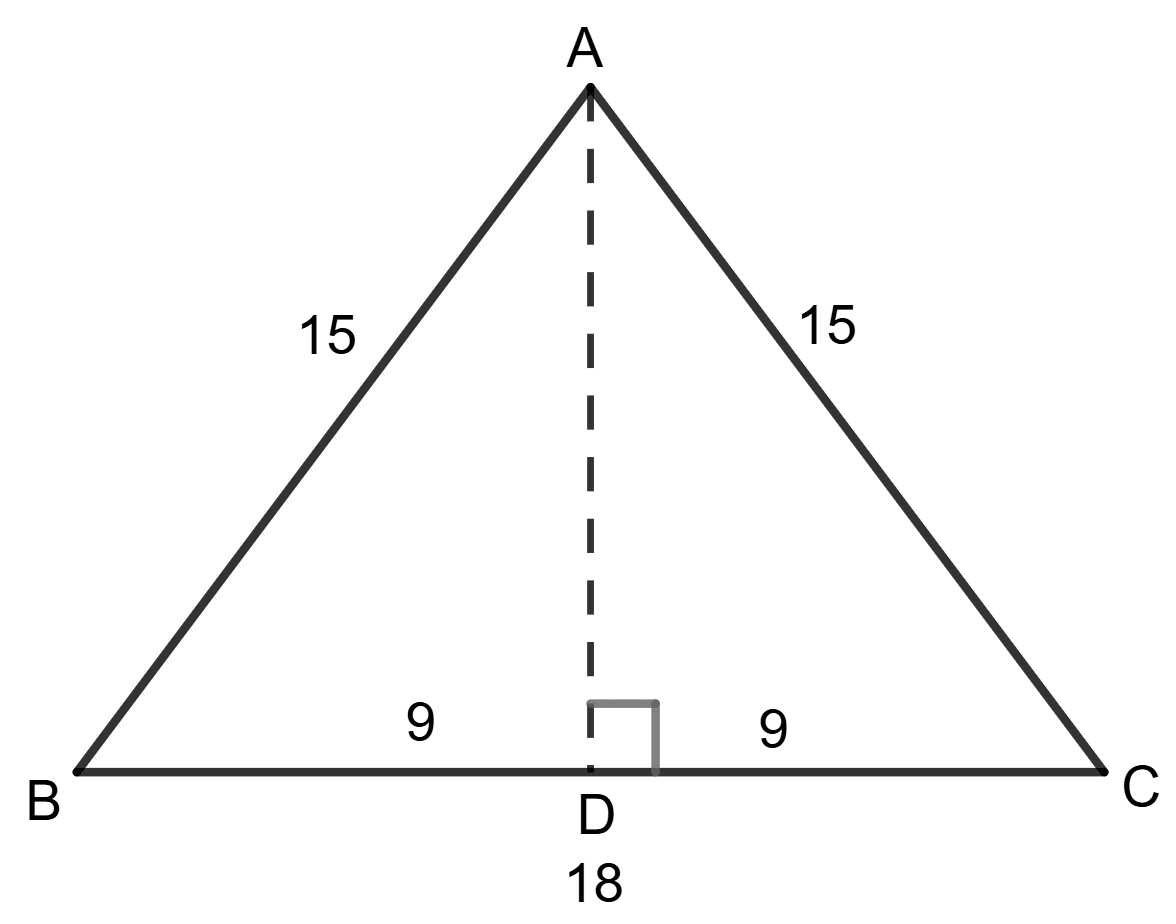
In triangle ABC, AB = AC = 15 cm and BC = 18 cm, find cos ∠ABC.

Answer

In isosceles triangle ABC, the perpendicular drawn from angle A to the side BC divides BC into 2 equal parts.

In triangle ABC, AB = AC = 15 cm and BC = 18 cm, find cos ∠ABC. Trigonometrical Ratios, Concise Mathematics Solutions ICSE Class 9.

BD = DC = 182\dfrac{18}{2} = 9

cos ∠ABC = BaseHypotenuse\dfrac{Base}{Hypotenuse}

=BDAB=915=35= \dfrac{BD}{AB}\\[1em] = \dfrac{9}{15}\\[1em] = \dfrac{3}{5}

Hence, cos ∠ABC = 35\dfrac{3}{5}.

Question 7

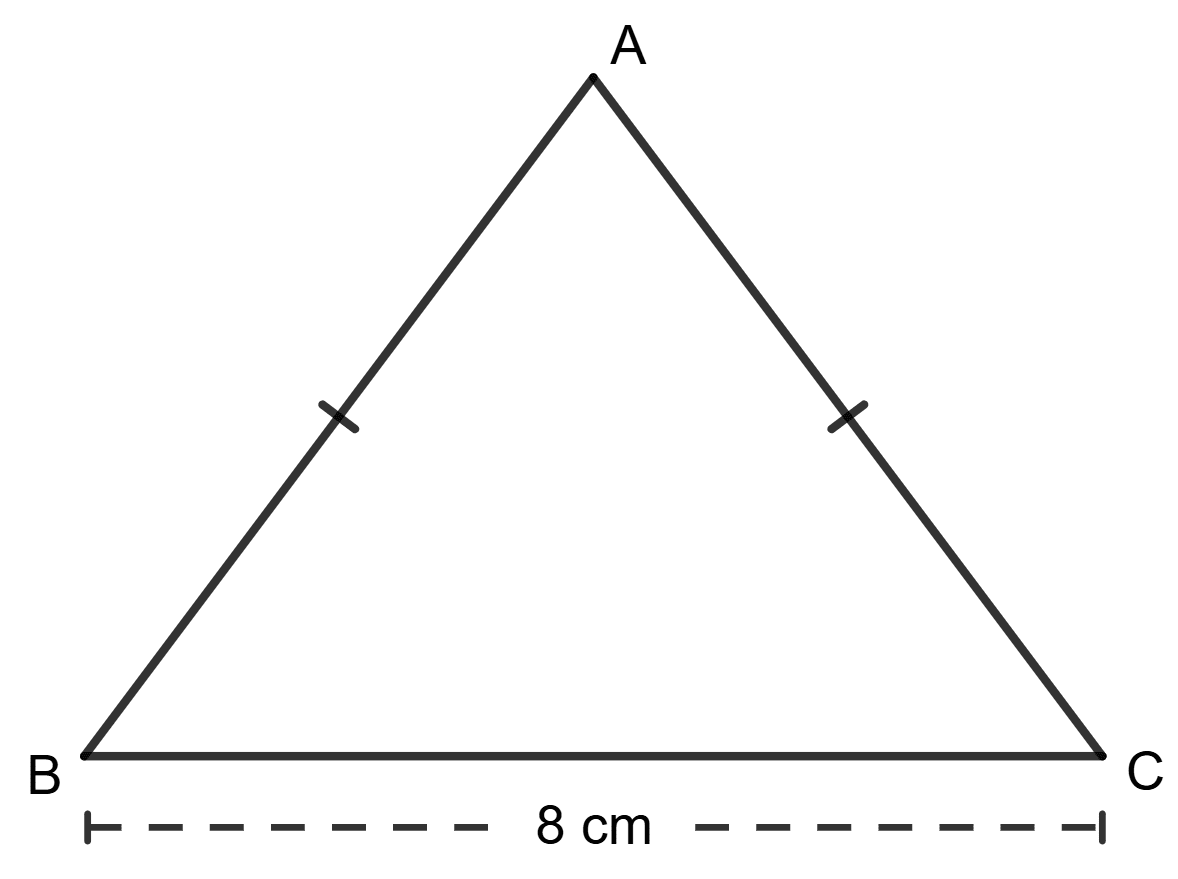
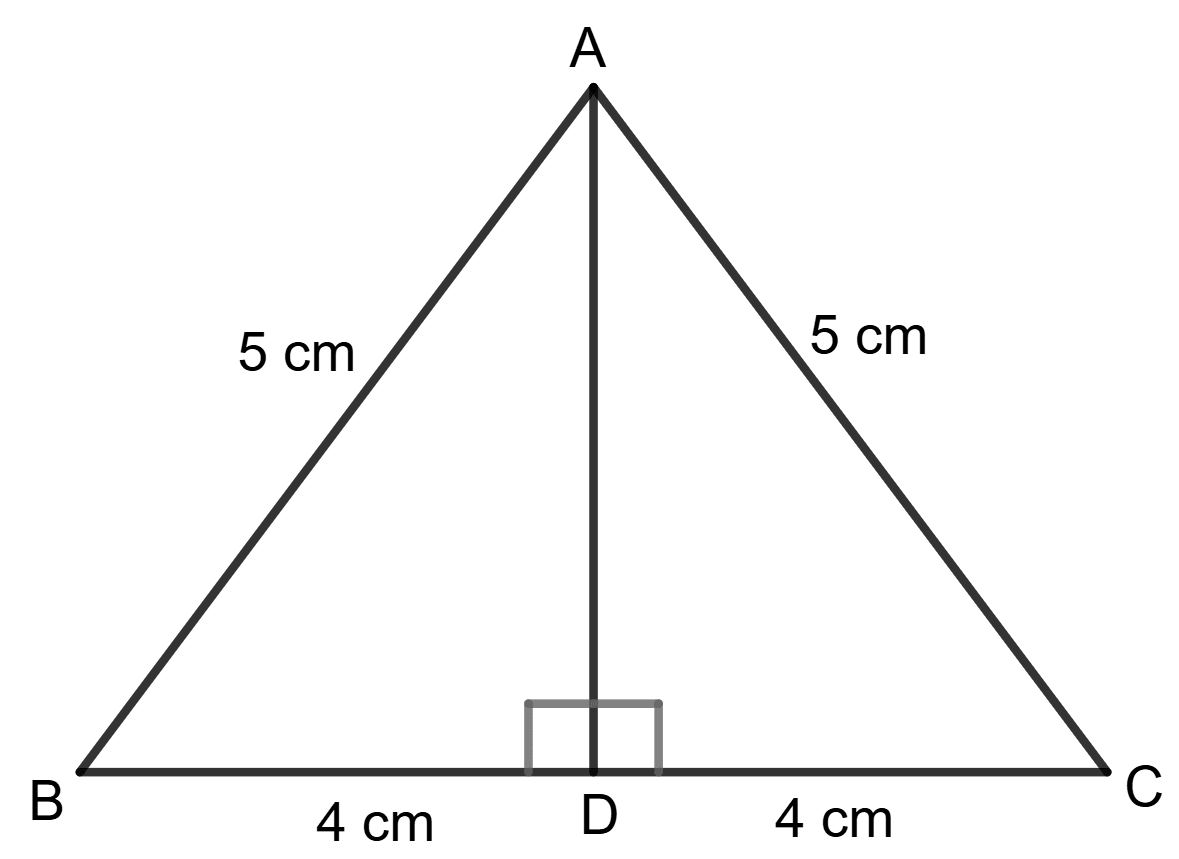
In the figure, given below, ABC is an isosceles triangle with BC = 8 cm and AB = AC = 5 cm. Find :

(i) sin B

(ii) tan C.

(iii) sin2 B + cos2 B

(iv) tan C - cot B

In the figure, given below, ABC is an isosceles triangle with BC = 8 cm and AB = AC = 5 cm. Find : Trigonometrical Ratios, Concise Mathematics Solutions ICSE Class 9.

Answer

In isosceles Δ ABC, the perpendicular drawn from angle A to the side BC divides BC into 2 equal parts.

BD = DC = 82\dfrac{8}{2} = 4

In the figure, given below, ABC is an isosceles triangle with BC = 8 cm and AB = AC = 5 cm. Find : Trigonometrical Ratios, Concise Mathematics Solutions ICSE Class 9.

In Δ ABD,

⇒ AB2 = BD2 + AD2 (∵ AB is hypotenuse)

⇒ 52 = 42 + AD2

⇒ 25 = 16 + AD2

⇒ AD2 = 25 - 16

⇒ AD2 = 9

⇒ AD = 9\sqrt{9}

⇒ AD = 3

(i) sin B = PerpendicularHypotenuse\dfrac{Perpendicular}{Hypotenuse}

ADAB=35\dfrac{AD}{AB} = \dfrac{3}{5}

Hence, sin B = 35\dfrac{3}{5}

(ii) tan C = PerpendicularBase\dfrac{Perpendicular}{Base}

ADDC=34\dfrac{AD}{DC} = \dfrac{3}{4}

Hence, tan C = 34\dfrac{3}{4}

(iii) sin2 B + cos2 B

sin B = PerpendicularHypotenuse\dfrac{Perpendicular}{Hypotenuse}

ADAB=35\dfrac{AD}{AB} = \dfrac{3}{5}

cos B = BaseHypotenuse\dfrac{Base}{Hypotenuse}

BDAB=45\dfrac{BD}{AB} = \dfrac{4}{5}

Now, sin2 B + cos2 B

=(35)2+(45)2=925+1625=9+1625=2525=1= \Big(\dfrac{3}{5}\Big)^2 + \Big(\dfrac{4}{5}\Big)^2\\[1em] = \dfrac{9}{25} + \dfrac{16}{25}\\[1em] = \dfrac{9 + 16}{25}\\[1em] = \dfrac{25}{25}\\[1em] = 1

Hence, sin2 B + cos2 B = 1.

(iv) tan C - cot B

tan C = PerpendicularBase\dfrac{Perpendicular}{Base}

=ADDC=34= \dfrac{AD}{DC} = \dfrac{3}{4}

cot B = BasePerpendicular\dfrac{Base}{Perpendicular}

=BDAD=43= \dfrac{BD}{AD} = \dfrac{4}{3}

Now, tan C - cot B

=3443=3×34×34×43×4=9121612=91612=712= \dfrac{3}{4} - \dfrac{4}{3}\\[1em] = \dfrac{3 \times 3}{4 \times 3}- \dfrac{4 \times 4}{3 \times 4}\\[1em] = \dfrac{9}{12} - \dfrac{16}{12}\\[1em] = \dfrac{9 - 16}{12}\\[1em] = \dfrac{-7}{12}

Hence, tan C - cot B = 712\dfrac{-7}{12}.

Question 8

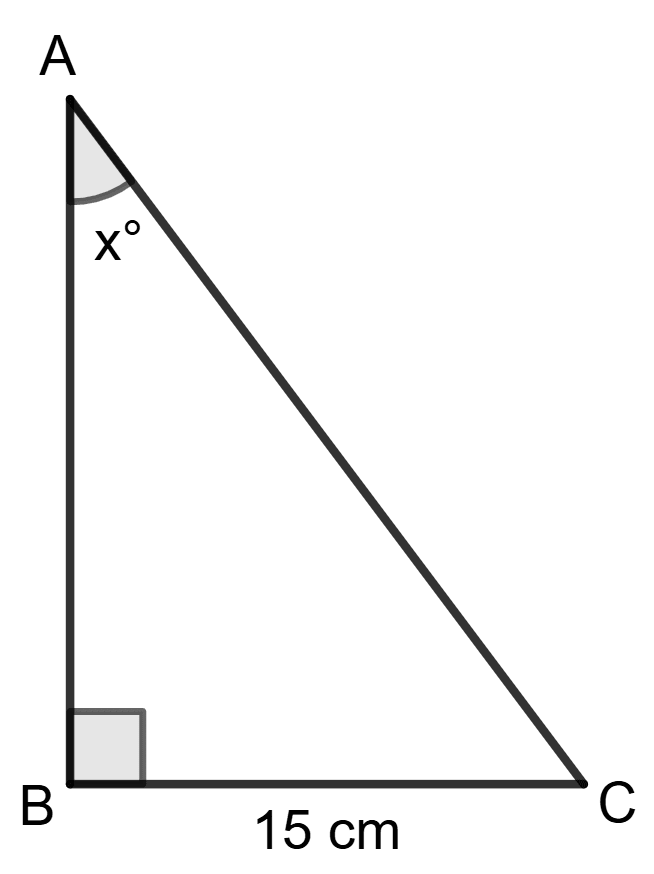
In triangle ABC; ∠ABC = 90°, ∠CAB = x°, tan x°=34\text{tan x°} = \dfrac{3}{4} and BC = 15 cm. Find the measures of AB and AC.

Answer

Given:

tan x°=34tan x°=PerpendicularBase=34BCAB=34\text{tan x°} = \dfrac{3}{4}\\[1em] \text{tan x°} = \dfrac{Perpendicular}{Base} = \dfrac{3}{4} \\[1em] \Rightarrow \dfrac{BC}{AB} = \dfrac{3}{4}

In triangle ABC; ∠ABC = 90°, ∠CAB = x°, tan x° = 3/4 and BC = 15 cm. Find the measures of AB and AC. Trigonometrical Ratios, Concise Mathematics Solutions ICSE Class 9.

∴ If length of AB = 4x unit, length of BC = 3x unit.

BC = 15 cm (∵ Given)

∴ 3x = 15

⇒ x = 153\dfrac{15}{3} = 5 cm

∴ AB = 4x = 4 x 5 = 20 cm

In Δ ABC,

⇒ AC2 = BC2 + AB2 (∵ AB is hypotenuse)

⇒ AC2 = (15)2 + (20)2

⇒ AC2 = 225 + 400

⇒ AC2 = 625

⇒ AC = 625\sqrt{625}

⇒ AC = 25 cm

Hence, AB = 20 cm and AC = 25 cm.

Question 9

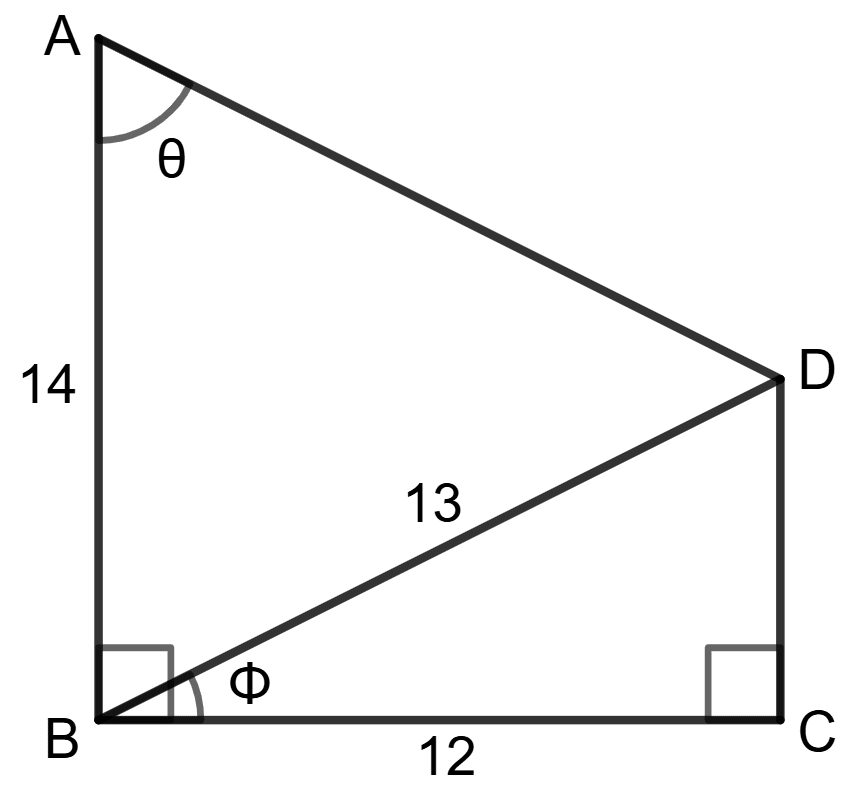
Using the measurements given in the following figure :

(i) Find the value of sin Φ and tan θ.

(ii) Write an expression for AD in terms of θ.

Using the measurements given in the following figure : Trigonometrical Ratios, Concise Mathematics Solutions ICSE Class 9.

Answer

(i) In Δ BCD,

⇒ BD2 = BC2 + CD2 (∵ BD is hypotenuse)

⇒ 132 = 122 + CD2

⇒ 169 = 144 + CD2

⇒ CD2 = 169 - 144

⇒ CD2 = 25

⇒ CD = 25\sqrt{25}

⇒ CD = 5

sin Φ = PerpendicularHypotenuse\dfrac{Perpendicular}{Hypotenuse}

=CDBD=513= \dfrac{CD}{BD} = \dfrac{5}{13}

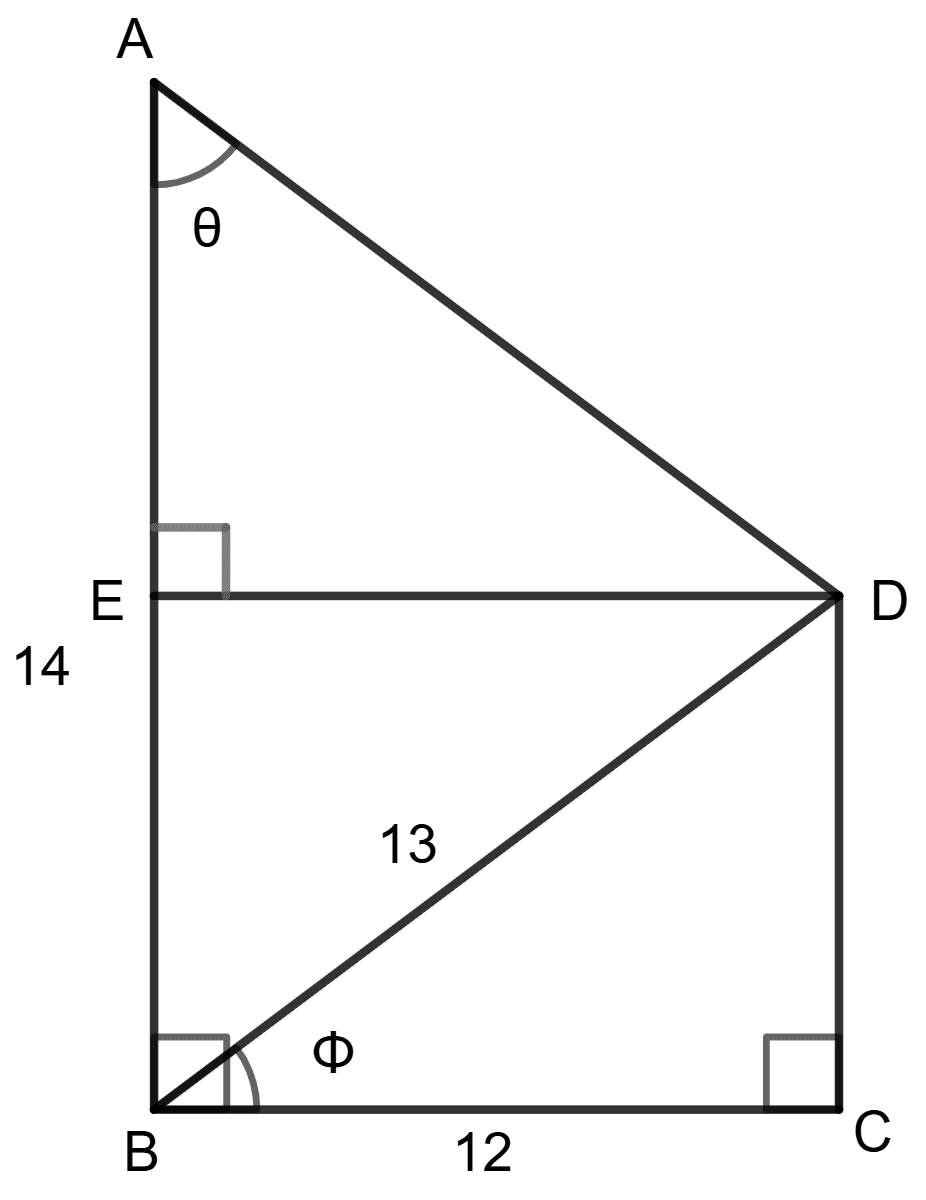
Draw a line parallel to BC from point D such that it meets AB at point E. This line DE will be ⊥ to AB.

Using the measurements given in the following figure : Trigonometrical Ratios, Concise Mathematics Solutions ICSE Class 9.

From figure,

DE = BC = 12

In Δ BED,

⇒ BD2 = BE2 + DE2 (∵ BD is hypotenuse)

⇒ 132 = BE2 + 122

⇒ 169 = BE2 + 144

⇒ BE2 = 169 - 144

⇒ BE2 = 25

⇒ BE = 25\sqrt{25}

⇒ BE = 5

And, AE = AB - BE = 14 - 5 = 9

tan θ = BasePerpendicular\dfrac{Base}{Perpendicular}

=DEAE=129=43= \dfrac{DE}{AE} = \dfrac{12}{9} = \dfrac{4}{3}

Hence, sin Φ = 513\dfrac{5}{13} and tan θ = 43\dfrac{4}{3}

(ii) sin θ = PerpendicularHypotenuse\dfrac{Perpendicular}{Hypotenuse}

sin θ = DEAD=12AD\dfrac{DE}{AD} = \dfrac{12}{AD}

AD = 12sin θ\dfrac{12}{\text{sin θ}} = 12 cosec θ

cos θ = BaseHypotenuse\dfrac{Base}{Hypotenuse}

cos θ = AEAD=9AD\dfrac{AE}{AD} = \dfrac{9}{AD}

AD = 9cos θ\dfrac{9}{\text{cos θ}} = 9 sec θ

Hence, AD = 12 cosec θ or 9 sec θ.

Question 10

In the given figure; BC = 15 cm and sin B=45\text{sin B} = \dfrac{4}{5}.

(i) Calculate the measures of AB and AC.

(ii) Now, if tan ∠ADC = 1; calculate the measures of CD and AD.

In the given figure; BC = 15 cm and sin B = 4/5. Trigonometrical Ratios, Concise Mathematics Solutions ICSE Class 9.

Answer

(i) Given:

sin B=45sin B=PerpendicularHypotenuse=45\text{sin B} = \dfrac{4}{5}\\[1em] \text{sin B} = \dfrac{Perpendicular}{Hypotenuse} = \dfrac{4}{5}

∴ If length of AC = 4x cm, length of AB = 5x cm.

In Δ ABC,

⇒ AB2= BC2 + AC2 (∵ AB is hypotenuse)

⇒ (5x)2 = BC2 + (4x)2

⇒ 25x2 = BC2 + 16x2

⇒ BC2 = 25x2 - 16x2

⇒ BC2 = 9x2

⇒ BC = 9x2\sqrt{9\text{x}^2}

⇒ BC = 3x

It is given that BC = 15 cm

3x = 15

x = 153\dfrac{15}{3}

x = 5 cm

AB = 5x = 5 x 5 cm = 25 cm

AC = 4x = 4 x 5 cm = 20 cm

Hence, AB = 25 cm and AC = 20 cm.

(ii) tan ∠ADC = 1

tan ∠ADC=PerpendicularBase=1\text{tan ∠ADC} = \dfrac{Perpendicular}{Base} = 1

∴ If length of AC = x unit, length of CD = x unit.

From (i), we know AC = 20 cm

∴ x = 20 cm

So, AC = CD = 20 cm

In Δ ACD,

⇒ AD2 = AC2 + CD2 (∵ AD is hypotenuse)

⇒ AD2 = 202 + 202

⇒ AD2 = 400 + 400

⇒ AD2 = 800

⇒ AD = 800\sqrt{800}

⇒ AD = 20220\sqrt{2}

Hence, CD = 20 cm and AD = 20 2\sqrt{2} cm.

Question 11

If sin A + cosec A = 2; find the value of sin2 A + cosec2 A.

Answer

sin A + cosec A = 2

Squaring both sides,

(sin A + cosec A)2 = 22

⇒ sin2 A + cosec2 A + 2 x sin A x cosec A = 4

⇒ sin2 A + cosec2 A + 2 x sin A x 1sin A\dfrac{1}{\text{sin A}} = 4

⇒ sin2 A + cosec2 A + 2 x sin A{\cancel{\text{sin A}}}x 1sin A\dfrac{1}{\cancel{\text{sin A}}} = 4

⇒ sin2 A + cosec2 A + 2 = 4

⇒ sin2 A + cosec2 A = 4 - 2

⇒ sin2 A + cosec2 A = 2

Hence, sin2 A + cosec2 A = 2.

Question 12

If tan A + cot A = 5; find the value of tan2 A + cot2 A.

Answer

tan A + cot A = 5

Squaring both sides,

(tan A + cot A)2 = 52

⇒ tan2 A + cot2 A + 2 x tan A x cot A = 25

⇒ tan2 A + cot2 A + 2 x tan A x 1tan A\dfrac{1}{\text{tan A}} = 25

⇒ tan2 A + cot2 A + 2 x tan A{\cancel{\text{tan A}}}x 1tan A\dfrac{1}{\cancel{\text{tan A}}} = 25

⇒ tan2 A + cot2 A + 2 = 25

⇒ tan2 A + cot2 A = 25 - 2

⇒ tan2 A + cot2 A = 23

Hence, tan2 A + cot2 A = 23.

Question 13

Given : 4 sin θ = 3 cos θ; find the value of :

(i) sin θ

(ii) cos θ

(iii) cot2 θ - cosec2 θ

(iv) 4 cos2 θ - 3 sin2 θ + 2

Answer

Given:

4 sin θ = 3 cos θ

sin θcos θ=34tan θ=34tan θ=PerpendicularBasePerpendicularBase=34⇒ \dfrac{\text{sin θ}}{\text{cos θ}} = \dfrac{3}{4}\\[1em] ⇒ \text{tan θ} = \dfrac{3}{4}\\[1em] ⇒ \text{tan θ} = \dfrac{\text{Perpendicular}}{\text{Base}}\\[1em] ⇒ \dfrac{\text{Perpendicular}}{\text{Base}} = \dfrac{3}{4}\\[1em]

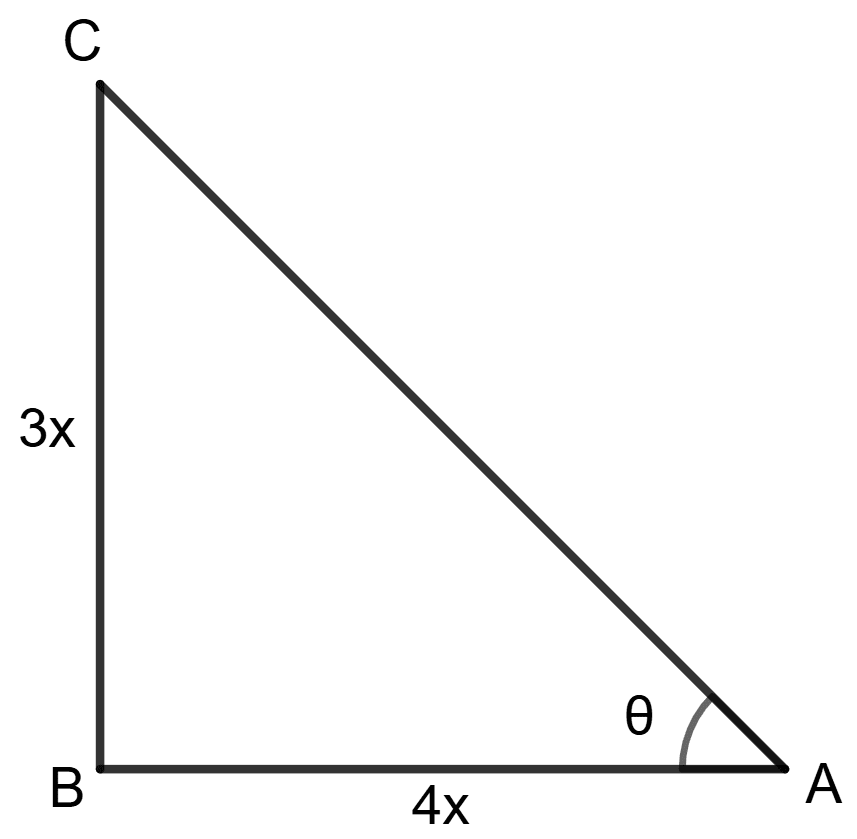
∴ If length of BC = 3x unit, length of AB = 4x unit.

Given : 4 sin θ = 3 cos θ; find the value of : Trigonometrical Ratios, Concise Mathematics Solutions ICSE Class 9.

In Δ ABC,

⇒ AC2 = BC2 + AB2 (∵ AC is hypotenuse)

⇒ AC2 = (3x)2 + (4x)2

⇒ AC2 = 9x2 + 16x2

⇒ AC2 = 25x2

⇒ AC = 25x2\sqrt{25 \text{x}^2}

⇒ AC = 5x

(i) sin θ = PerpendicularHypotenuse\dfrac{Perpendicular}{Hypotenuse}

CBAC=3x5x=35\dfrac{CB}{AC} = \dfrac{3x}{5x} = \dfrac{3}{5}

Hence, sin θ = 35\dfrac{3}{5}.

(ii) cos θ = BaseHypotenuse\dfrac{Base}{Hypotenuse}

ABAC=4x5x=45\dfrac{AB}{AC} = \dfrac{4x}{5x} = \dfrac{4}{5}

Hence, cos θ = 45\dfrac{4}{5}.

(iii) cot2 θ - cosec2 θ + 2

cot θ = BasePerpendicular\dfrac{Base}{Perpendicular}

ABBC=4x3x=43\dfrac{AB}{BC} = \dfrac{4x}{3x} = \dfrac{4}{3}

cosec θ = HypotenusePerpendicular\dfrac{Hypotenuse}{Perpendicular}

ACCB=5x3x=53\dfrac{AC}{CB} = \dfrac{5x}{3x} = \dfrac{5}{3}

Now, cot2 θ - cosec2 θ

=(43)2(53)2=169259=16259=99=1= \Big(\dfrac{4}{3}\Big)^2 - \Big(\dfrac{5}{3}\Big)^2 \\[1em] = \dfrac{16}{9} - \dfrac{25}{9} \\[1em] = \dfrac{16 - 25}{9} \\[1em] = \dfrac{- 9}{9} \\[1em] = -1

Hence, cot2 θ - cosec2 θ + 2 = -1.

(iv) 4 cos2 θ - 3 sin2 θ + 2

cos θ = BaseHypotenuse\dfrac{Base}{Hypotenuse}

ABAC=4x5x=45\dfrac{AB}{AC} = \dfrac{4x}{5x} = \dfrac{4}{5}

sin θ = PerpendicularHypotenuse\dfrac{Perpendicular}{Hypotenuse}

CBAC=3x5x=35\dfrac{CB}{AC} = \dfrac{3x}{5x} = \dfrac{3}{5}

Now, 4 cos2 θ - 3 sin2 θ + 2

=4×(45)23×(35)2+2=4×16253×925+2=64252725+2=642725+2=3725+2=3725+2×2525=3725+5025=37+5025=8725=31225= 4 \times \Big(\dfrac{4}{5}\Big)^2 - 3 \times \Big(\dfrac{3}{5}\Big)^2 + 2\\[1em] = 4 \times \dfrac{16}{25} - 3 \times \dfrac{9}{25} + 2\\[1em] = \dfrac{64}{25} - \dfrac{27}{25} + 2\\[1em] = \dfrac{64 - 27}{25} + 2\\[1em] = \dfrac{37}{25} + 2\\[1em] = \dfrac{37}{25} + \dfrac{2 \times 25}{25}\\[1em] = \dfrac{37}{25} + \dfrac{50}{25}\\[1em] = \dfrac{37 + 50}{25}\\[1em] = \dfrac{87}{25}\\[1em] = 3\dfrac{12}{25}

Hence, 4 cos2 θ - 3 sin2 θ + 2 =312253\dfrac{12}{25}.

Question 14

Given : 17 cos θ = 15; find the value of tan θ + 2 sec θ.

Answer

Given:

17 cos θ = 15

cos θ = 1517\dfrac{15}{17}

cos θ=BaseHypotenuse=1517\Rightarrow \text{cos θ} = \dfrac{Base}{Hypotenuse} = \dfrac{15}{17}\\[1em]

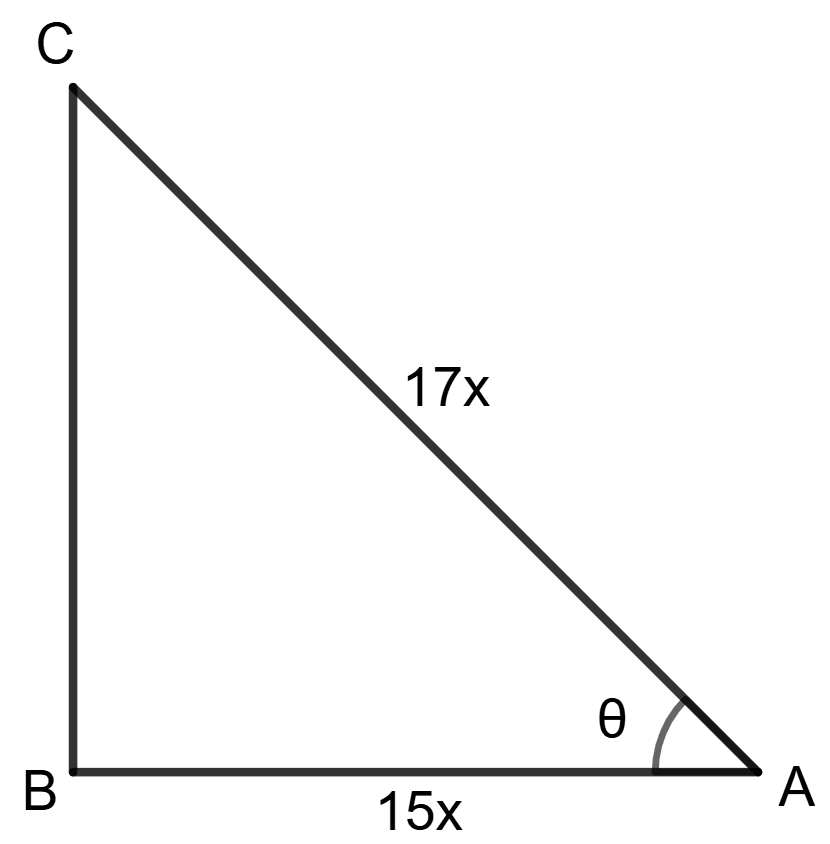
Given : 17 cos θ = 15; find the value of tan θ + 2 sec θ. Trigonometrical Ratios, Concise Mathematics Solutions ICSE Class 9.

∴ If length of AC = 17x unit, length of AB = 15x unit.

In Δ ABC,

⇒ AC2 = BC2 + AB2 (∵ AC is hypotenuse)

⇒ (17x)2 = BC2 + (15x)2

⇒ 289x2 = BC2 + 225x2

⇒ BC2 = 289x2 - 225x2

⇒ BC = 64x2\sqrt{64 \text{x}^2}

⇒ BC = 8x

tan θ = PerpendicularBase\dfrac{Perpendicular}{Base}

=CBAB=8x15x=815= \dfrac{CB}{AB} = \dfrac{8x}{15x} = \dfrac{8}{15}

sec θ = HypotenuseBase\dfrac{Hypotenuse}{Base}

=ACAB=17x15x=1715= \dfrac{AC}{AB} = \dfrac{17x}{15x} = \dfrac{17}{15}

Now, tan θ + 2 sec θ

=815+2×1715=815+3415=8+3415=4215=145=245= \dfrac{8}{15} + 2 \times \dfrac{17}{15}\\[1em] = \dfrac{8}{15} + \dfrac{34}{15}\\[1em] = \dfrac{8 + 34}{15}\\[1em] = \dfrac{42}{15}\\[1em] = \dfrac{14}{5}\\[1em] = 2\dfrac{4}{5}

Hence, tan θ + 2 sec θ = 2452\dfrac{4}{5}.

Question 15

Given: 5 cos A - 12 sin A = 0; evaluate :

sin A+cos A 2 cos A sin A\dfrac{\text{sin A} + \text{cos A }}{2\text{ cos A } - \text{sin A}}

Answer

Given:

5 cos A - 12 sin A = 0

⇒ 5 cos A = 12 sin A

sin Acos A=512\dfrac{\text{sin A}}{\text{cos A}} = \dfrac{5}{12}

tan A=512\text{tan A} = \dfrac{5}{12}

tan A=PerpendicularBase=512⇒ \text{tan A} = \dfrac{Perpendicular}{Base} = \dfrac{5}{12} \\[1em]

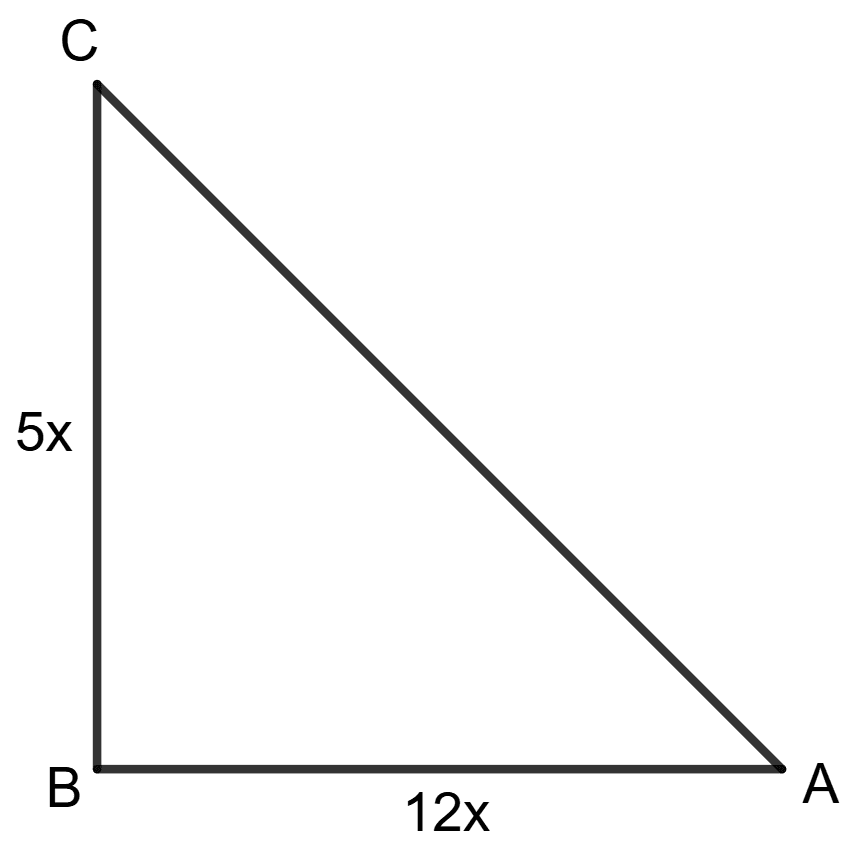
Given: 5 cos A - 12 sin A = 0; evaluate : Trigonometrical Ratios, Concise Mathematics Solutions ICSE Class 9.

∴ If length of BC = 5x unit, length of AB = 12x unit.

In Δ ABC,

⇒ AC2 = BC2 + AB2 (∵ AC is hypotenuse)

⇒ AC2 = (5x)2 + (12x)2

⇒ AC2 = 25x2 + 144x2

⇒ AC2 = 169x2

⇒ AC = 169x2\sqrt{169 \text{x}^2}

⇒ AC = 13x

sin A = PerpendicularHypotenuse\dfrac{Perpendicular}{Hypotenuse}

CBAC=5x13x=513\dfrac{CB}{AC} = \dfrac{5x}{13x} = \dfrac{5}{13}

cos A = BaseHypotenuse\dfrac{Base}{Hypotenuse}

ABAC=12x13x=1213\dfrac{AB}{AC} = \dfrac{12x}{13x} = \dfrac{12}{13}

Now,

sin A+cos A 2 cos A sin A=513+12132×1213513=5+12132413513=171324513=17131913=17131913=1719\dfrac{\text{sin A} + \text{cos A }}{2\text{ cos A } - \text{sin A}}\\[1em] = \dfrac{\dfrac{5}{13} + \dfrac{12}{13}}{2 \times \dfrac{12}{13} - \dfrac{5}{13}}\\[1em] = \dfrac{\dfrac{5 + 12}{13}}{\dfrac{24}{13} - \dfrac{5}{13}}\\[1em] = \dfrac{\dfrac{17}{13}}{\dfrac{24 - 5}{13}}\\[1em] = \dfrac{\dfrac{17}{13}}{\dfrac{19}{13}}\\[1em] = \dfrac{\dfrac{17}{\cancel{13}}}{\dfrac{19}{\cancel{13}}}\\[1em] = \dfrac{17}{19}

Hence, sin A+cos A 2 cos A sin A=1719\dfrac{\text{sin A} + \text{cos A }}{2\text{ cos A } - \text{sin A}} = \dfrac{17}{19}.

PrevNext