
In double decomposition reactions between two compounds — base & acid to give salt & water, there is an interchange of:
- atoms
- ions
- radicals
- molecules
Answer
Radicals
Reason — In a double decomposition reaction, two compounds exchange their positive and negative radicals to form new compounds. Atoms are not exchanged individually; whole molecules also do not swap places.
The salt which is efflorescent and the residue after exposure is an anhydrate.
- washing soda
- calcium chloride
- magnesium chloride
- iron [III] chloride
Answer
Washing soda
Reason — Washing soda is an efflorescent hydrated salt. On exposure to air, it loses water of crystallisation and changes into a powdery residue. Calcium chloride, magnesium chloride and iron [III] chloride absorb moisture from air; hence they are not efflorescent.
The salt whose solubility in water decreases with rise in temperature.
- calcium sulphate
- sodium nitrate
- potassium nitrate
- ammonium chloride
Answer
Calcium sulphate
Reason — Calcium sulphate is one of the salts whose solubility in water decreases with rise in temperature. Sodium nitrate, potassium nitrate and ammonium chloride show an increase in solubility with rise in temperature.
The anhydrous salt which changes colour on reaction with water vapour.
- calcium sulphate
- sodium sulphate
- cobalt chloride
- calcium chloride
Answer
Cobalt chloride
Reason — Anhydrous cobalt chloride is blue. When it absorbs water vapour, it forms hydrated cobalt chloride, which is pink. Because of this colour change, it is used to test for moisture/water vapour.
Anhydrous calcium sulphate is white. It absorbs water to form hydrated calcium sulphate (gypsum), but there is no noticeable colour change. Anhydrous sodium sulphate is white. On absorbing water, it forms hydrated crystals (washing soda type hydrates), but again no colour change occurs. Anhydrous calcium chloride is white and highly hygroscopic. It absorbs water vapour and may even dissolve in the absorbed water (deliquescent), but its colour does not change.
The main gas which is responsible for global warming.
- nitric oxide
- nitrogen dioxide
- nitrous oxide
- ammonia
Answer
Nitrous oxide
Reason — Nitrous oxide (N₂O) is a greenhouse gas. It absorbs heat radiated from the Earth's surface and prevents some of it from escaping into space. This causes the Earth's atmosphere to warm, contributing to global warming.
Nitric oxide is mainly involved in formation of air pollutants and acid rain. It is not a major greenhouse gas responsible for global warming. Nitrogen dioxide causes air pollution, smog, and acid rain. Though harmful, it is not considered a principal greenhouse gas. Ammonia is not a greenhouse gas responsible for global warming. It mainly causes irritation and environmental pollution in water/soil.
The maximum number of electrons which can be present in the L-shell of an atom of argon.
- two
- thirty two
- eight
- eighteen
Answer
Eight
Reason — Electronic configuration of argon is 2, 8, 8. K-shell has 2 electrons, L-shell has 8 electrons, M-shell has 8 electrons. Therefore, eight is correct maximum capacity of the L-shell.
A gas which changes the colour of colourless alkaline pyrogallol solution but shows no change with moist blue litmus paper.
- hydrogen
- oxygen
- carbon dioxide
- sulphur dioxide
Answer
Oxygen
Reason — Alkaline pyrogallol solution absorbs oxygen and turns brown. Moist blue litmus paper changes colour only in presence of acidic gases. Oxygen is a neutral gas, so it does not affect moist blue litmus paper.
Hydrogen does not react with alkaline pyrogallol solution and not change blue litmus paper. Carbon dioxide is acidic gas and turns moist blue litmus red. Sulphur dioxide is acidic gas and turns moist blue litmus red and may bleach colours.
The formation of hydrogen & oxygen from acidified water is an example of a/an:
- photochemical reaction
- electrochemical reaction
- endothermic reaction
- thermal dissociation reaction
Answer
Electrochemical reaction
Reason — Acidified water is decomposed into hydrogen and oxygen by passing an electric current through it. The chemical change is produced by electrical energy, so the reaction is called an electrochemical reaction (electrolysis). Electrolysis of acidified water is a standard example.
Photochemical reaction is a reaction caused by light. Endothermic reaction is reaction absorbing heat energy. Thermal dissociation reaction is decomposition caused by heat.
A chemical reaction which proceeds with evolution of heat energy under prevalent conditions, is a reaction between:
- nitrogen & oxygen
- carbon & steam
- ammonia & oxygen
- thermal decomposition of limestone
Answer
Ammonia & oxygen
Reason — A reaction that evolves heat energy is called an exothermic reaction. Oxidation of ammonia releases heat.
Nitrogen & oxygen requires very high temperature and absorbs heat energy. Carbon & steam requires heat. Thermal decomposition of limestone needs continuous heating.
The number of valence electrons of an element in period 3, which burns in air producing a gas which turns lime water milky, is:
- 5
- 7
- 4
- 6
Answer
6
Reason — The period 3 element which burns in air to give a gas that turns lime water milky is sulphur. Sulphur has electronic configuration 2, 8, 6; hence it has 6 valence electrons.
S + O2 ⟶ SO2
Ca(OH)2 + SO2 ⟶ CaSO3↓ + H2O
Ozone in presence of U.V. light gives:
- one atom of nascent oxygen
- molecular oxygen + one atom of nascent oxygen
- molecular oxygen + two atoms of nascent oxygen
- two atoms of nascent oxygen
Answer
Molecular oxygen + one atom of nascent oxygen
Reason — It is correct representation of ozone decomposition. Under ultraviolet (U.V.) light, ozone decomposes as:
O3 O2 + O
One atom of nascent oxygen is incomplete because molecular oxygen is also formed. Molecular oxygen + two atoms of nascent oxygen would mean total four oxygen atoms, which is impossible from O3. Two atoms of nascent oxygen does not represent the actual decomposition reaction.
A covalent molecule of oxygen [168O] contains ................ electrons in the outer shell of each of the oxygen atoms, which are not involved in sharing.
- one
- two
- three
- four
Answer
four
Reason — Each oxygen atom shares 2 electrons to form a double covalent bond. Therefore, out of 6 valence electrons: 2 are involved in sharing, 4 remain unshared. So, each oxygen atom has 4 electrons not involved in sharing.
Molecular weight of oxygen is 32 g, i.e. 1 molecule of oxygen is ............... times as heavy as th the mass of carbon atom [C12].
- 8
- 64
- 16
- 32
Answer
32
Reason — molecular mass of oxygen gas
16 × 2 = 32
1 atomic mass unit = of the mass of carbon atom.
32 unit = 32 × of the mass of carbon atom.
Mass of one O2 molecule = 32 × of the mass of carbon atom.
one molecule of oxygen is 32 times as heavy as th mass of a carbon-12 atom.
Assertion (A): Acid rains have an adverse effect on the environment — including soil chemistry.
Reason (R): When falling on the earth, it increases the acidity of the soil.
- Both A & R are true and R is the correct explanation of A.
- Both A & R are true but R is not the correct explanation of A.
- A is true but R is false.
- A is false but R is true.
Answer
Both A & R are true and R is the correct explanation of A.
Reason — A is true as acid rain harms plants, aquatic life, buildings, and also affects the chemical nature of soil.
R is true as acid rain lowers the pH of soil, making it more acidic. This affects soil nutrients and microorganisms.
Therefore, Both A & R are true and R is the correct explanation of A is the correct option.
Assertion (A): Temporary hardness in water is mainly due to presence of calcium & magnesium bicarbonates in water.
Reason (R): The hardness in temporary hard water can be removed by boiling.
- Both A & R are true and R is the correct explanation of A.
- Both A & R are true but R is not the correct explanation of A.
- A is true but R is false.
- A is false but R is true.
Answer
Both A & R are true but R is not the correct explanation of A.
Reason — A is true as temporary hardness is caused by soluble bicarbonates such as Calcium bicarbonate and Magnesium bicarbonate.
R is true on boiling, bicarbonates decompose into insoluble precipitates.
Therefore, Both A & R are true but R is not the correct explanation of A is the correct option.
The setup shown below is that of the apparatus used to obtain hydrogen gas in the laboratory.
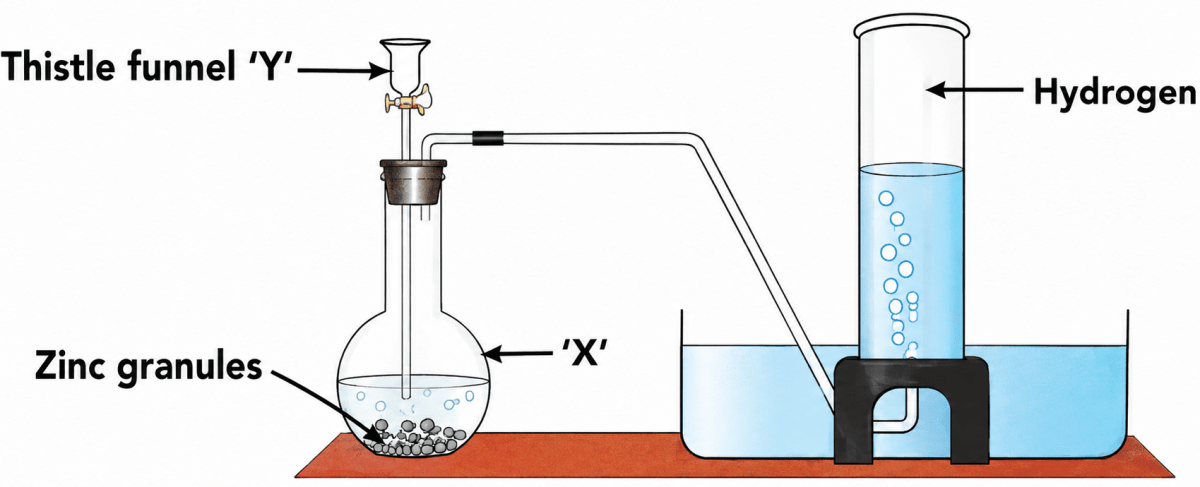
(a) Select the correct answer. The reactant added in the flask 'X' is:
- conc. NaOH solution
- conc. KOH solution
- conc. H2SO4
- dil. HCl
(b) Give a reason why gaseous impurities are produced during the laboratory preparation of hydrogen gas.
(c) Which impurities produced above can be removed by passage through lead nitrate solution, in the above preparation of hydrogen?
(d) Give a reason for the statement — 'Only after all the air in the apparatus is allowed to escape, is the hydrogen gas collected.'
(e) Hydrogen gas is not collected by downward displacement of air, even though it is lighter than air. Give a reason for the same.
Answer
(a) The reactant added in the flask 'X' is dil. HCl.
Zn + 2HCl ⟶ ZnCl2 + H2
(b) Gaseous impurities are produced during the laboratory preparation of hydrogen gas because commercial zinc used in the laboratory contains impurities such as sulphides, phosphides, arsenides, etc. These impurities react with dilute acid to produce gases like hydrogen sulphide, phosphine, arsine.
(c) Impurity removed by passage through lead nitrate solution is hydrogen sulphide.
(d) Hydrogen gas is collected only after all the air in the apparatus is allowed to escape because a mixture of hydrogen and air is explosive.
(e) Hydrogen gas is not collected by downward displacement of air, even though it is lighter than air because it forms an explosive mixture with air.
Match the following — Column A with Column B [names of compounds with their correct formulas].
| Column A | Column B |
|---|---|
| (a) Iron [III] chloride | 1. FeCl2 |
| (b) Iron [III] oxide | 2. Fe3O4 |
| (c) Iron [II] chloride | 3. Fe2O3 |
| (d) Iron [III] sulphate | 4. FeCl3 |
| (e) Iron [III] sulphide | 5. FeO |
| 6. FeS | |
| 7. FeSO4 | |
| 8. Fe2S3 | |
| 9. FeCl | |
| 10. FeS2 | |
| 11. Fe2(SO4)3 |
Answer
| Column A | Column B |
|---|---|
| (a) Iron [III] chloride | 4. FeCl3 |
| (b) Iron [III] oxide | 3. Fe2O3 |
| (c) Iron [II] chloride | 1. FeCl2 |
| (d) Iron [III] sulphate | 11. Fe2(SO4)3 |
| (e) Iron [III] sulphide | 8. Fe2S3 |
Complete the following by choosing the correct answer from the bracket.
(a) Ammonium sulphate is an example of a/an ............... [hydrous / anhydrous] salt.
(b) The relative atomic mass of an element expressed in grams is known as ............... [a.m.u. / gram atom / gram molecular mass].
(c) The law which relates between the pressure of a gas and the volume occupied by it is ............... [Charles' law / Boyle's law / Avogadro's law].
(d) A covalent molecule containing two single covalent bonds is ............... [ammonia / water / methane].
(e) 'The volume of a gas A will double, if the temperature of the gas A increased from 100°C to 200°C.' This statement is ............... [true / false].
Answer
(a) Ammonium sulphate is an example of a/an anhydrous salt.
(b) The relative atomic mass of an element expressed in grams is known as gram atom.
(c) The law which relates between the pressure of a gas and the volume occupied by it is Boyle's law.
(d) A covalent molecule containing two single covalent bonds is water.
(e) 'The volume of a gas A will double, if the temperature of the gas A increased from 100°C to 200°C.' This statement is false.
Identify the following types of chemical reactions (a) to (e) by matching them with the correct type of reaction 1 to 5.
| Column A | Column B |
|---|---|
| (a) 4AgBr ⟶ 2Ag2Br + Br2 | 1. Displacement reaction |
| (b) Mg + 2HCl [dil.] ⟶ MgCl2 + H2 | 2. Thermal dissociation |
| (c) Cu(OH)2 + H2SO4 [dil.] ⟶ CuSO4 + 2H2O | 3. Reduction reaction |
| (d) NH4Cl ⇌ NH3 + HCl | 4. Double decomposition reaction |
| (e) 2FeCl3 + H2S ⟶ 2FeCl2 + 2HCl + S | 5. Photochemical reaction |
Answer
| Column A | Column B |
|---|---|
| (a) 4AgBr ⟶ 2Ag2Br + Br2 | 5. Photochemical reaction |
| (b) Mg + 2HCl [dil.] ⟶ MgCl2 + H2 | 1. Displacement reaction |
| (c) Cu(OH)2 + H2SO4 [dil.] ⟶ CuSO4 + 2H2O | 4. Double decomposition reaction |
| (d) NH4Cl ⇌ NH3 + HCl | 2. Thermal dissociation |
| (e) 2FeCl3 + H2S ⟶ 2FeCl2 + 2HCl + S | 3. Reduction reaction |
'Column A' gives the details of properties of certain elements in the different groups of the Periodic Table. 'Column B' gives the names of the elements of the Periodic Table.
Copy & complete the table below to match the properties in 'Column A' with the elements in 'Column B'.
| Column A | Column B |
|---|---|
| (a) Is the gaseous element in group 15 [VA] | 1. Fluorine |
| (b) Is the liquid non-metallic element of group 17 [VIIA] | 2. Sulphur |
| (c) Is the most electronegative element of group 17 [VIIA] | 3. Carbon |
| (d) Is an element of group 16 [VIA] which exists in allotropic forms | 4. Nitrogen |
| (e) Has 4 electrons in its valence shell & is in group 14 [IVA] | 5. Bromine |
| Property | (a) | (b) | (c) | (d) | (e) |
|---|---|---|---|---|---|
| Element |
Answer
| Column A | Column B |
|---|---|
| (a) Is the gaseous element in group 15 [VA] | 4. Nitrogen |
| (b) Is the liquid non-metallic element of group 17 [VIIA] | 5. Bromine |
| (c) Is the most electronegative element of group 17 [VIIA] | 1. Fluorine |
| (d) Is an element of group 16 [VIA] which exists in allotropic forms | 2. Sulphur |
| (e) Has 4 electrons in its valence shell & is in group 14 [IVA] | 3. Carbon |
Give balanced equations for the following conversions.
(a) Zinc to sodium zincate.
(b) Ozone to two molecules of oxygen gas.
(c) Hydrogen to ammonia.
(d) Sulphur trioxide to sulphuric acid — a component of acid rain.
(e) Iron to iron [III] chloride.
Answer
(a) Zn + 2NaOH ⟶ Na2ZnO2 + H2
(b) 2O3 ⟶ 3O2
(c) N2 + 3H2 ⟶ 2NH3
(d) SO3 + H2O ⟶ H2SO4
(e) 2Fe + 3Cl2 ⟶ 2FeCl3
Give reasons for the following.
(a) For calculating the percentage composition of compound, its molecular weight must be known.
(b) The physical properties of the isotopes of chlorine are different.
(c) The Modern Periodic Law was more acceptable than Mendeleev's Periodic Law.
(d) A saturated solution can be converted to an unsaturated solution by heating the saturated solution slowly.
(e) Both precipitation & neutralization reactions are considered as double decomposition reactions.
Answer
(a) The molecular weight of a compound must be known because percentage composition is calculated using:
Percentage of an element =
(b) The physical properties of isotopes of chlorine are different because isotopes have different mass numbers due to different numbers of neutrons. Since many physical properties depend on mass, the isotopes show slight differences in their physical properties.
(c) The Modern Periodic Law was more acceptable because elements are arranged according to their atomic numbers and not atomic masses. This removed the anomalies present in Dmitri Mendeleev periodic table and explained the position of isotopes correctly.
(d) On heating, the solubility of most solids in water increases. Therefore, the solvent can dissolve more solute, making the saturated solution unsaturated.
(e) Both precipitation and neutralization reactions are considered double decomposition reactions because in both reactions there is an exchange of positive and negative radicals between two compounds, forming two new compounds.
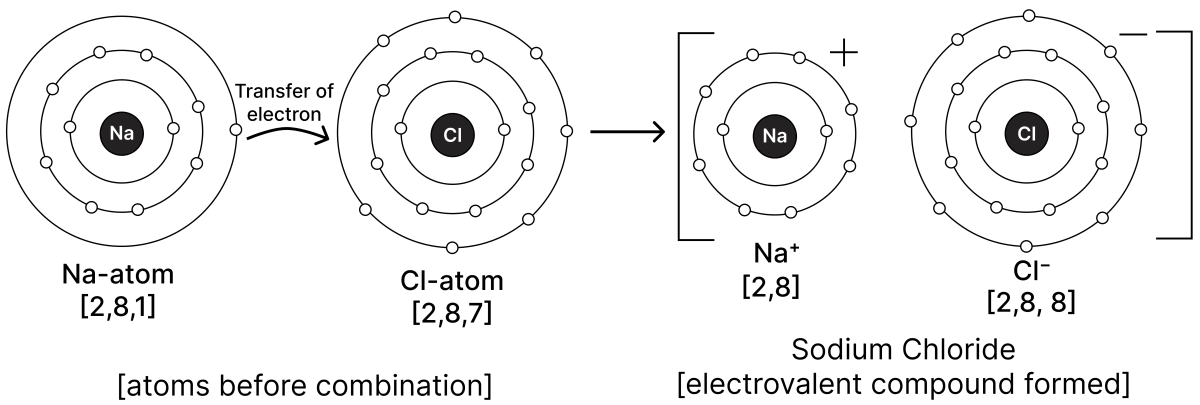
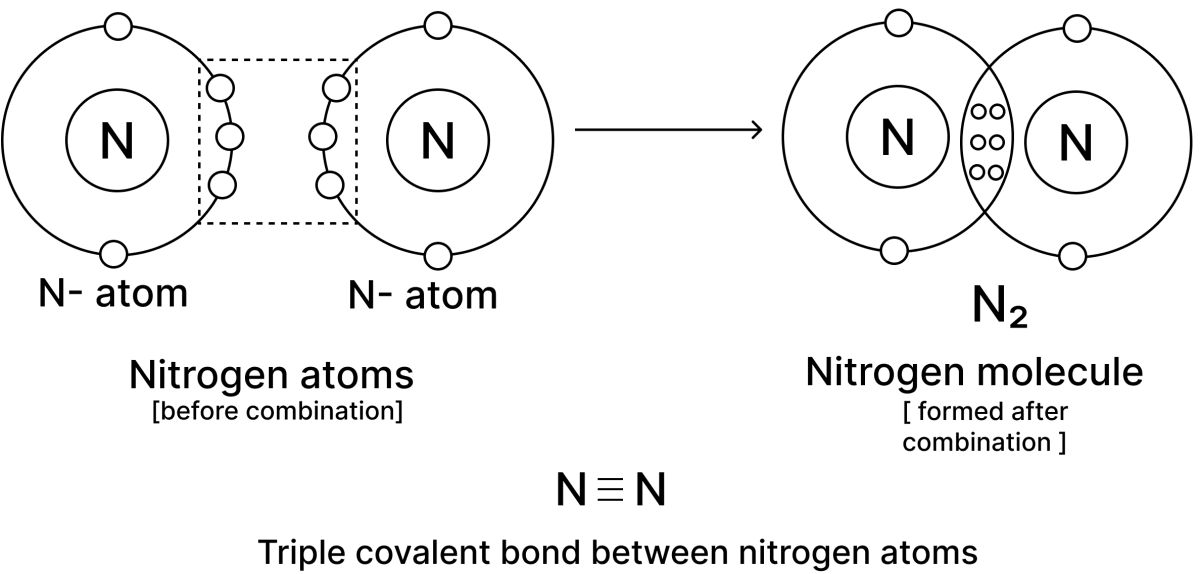
Draw the atomic orbit structure of formation of:
(a) Electrovalent compound — sodium chloride [Na = 11, Cl = 17]
(b) Covalent molecule — nitrogen [N = 7]
Answer
(a)
(b)
Name a gaseous covalent molecule formed from two different elements, having four single covalent bonds.
Answer
A gaseous covalent molecule formed from two different elements, having four single covalent bonds is methane (CH4).
Differentiate between:
(a) Shared pair and lone pair of electrons and duplet rule & octet rule.
(b) Filtration & defluoridation — in purification of water.
Answer
Differences between Shared pair and lone pair of electrons:
| Shared Pair | Lone Pair |
|---|---|
| A shared pair of electrons is a pair of valence electrons shared by two atoms to form a covalent bond. | A lone pair of electrons is a pair of valence electrons not shared with another atom. It is also called an unshared pair or non-bonding pair. |
| Example: Water has two shared pairs of electrons. | Example: Ammonia has one lone pair of electrons. |
Differences between duplet and octet rule:
| Duplet Rule | Octet Rule |
|---|---|
| An atom is stable when its outermost shell has 2 electrons. | An atom is stable when its outermost shell has 8 electrons. |
Differences between Filtration and defluoridation (purification of water):
| Filtration | Defluoridation |
|---|---|
| It is the process of removing suspended insoluble impurities from water. | It is the process of removing excess fluoride ions from water. |
| It is done by passing water through sand and gravel. | It is done by using activated carbon to remove excess fluoride ions. |
The basis of classification of elements was to put together elements which showed maximum resemblance. Complete the statements given below by filling in the correct word/s.
(a) An example of Dobereiner's Law of Triads is of elements — oxygen, carbon & nitrogen in which the atomic weight of the middle element, i.e. ............... , was the average of the atomic weights of the other two elements.
(b) As per Newland's Law of Octaves, elements when arranged in increasing order of their atomic weights, showed resemblance in properties between the eighth element, example 'chlorine' and the first element, i.e. ............... .
(c) A non-metal with electronic configuration 2, 8, 6 belongs to period ............... and group ............... .
(d) From the elements, carbon — group 14 [IVA], nitrogen — group 15 [VA], oxygen — group 16 [VIA] & sulphur — group 16 [VIA], the element/s which shows allotropy are ............... .
(e) The defects in Mendeleev's Periodic Table disappear if the basis of classification of elements is changed from atomic ............... to atomic ............... .
Answer
(a) An example of Dobereiner's Law of Triads is of elements — oxygen, carbon & nitrogen in which the atomic weight of the middle element, i.e. nitrogen , was the average of the atomic weights of the other two elements.
(b) As per Newland's Law of Octaves, elements when arranged in increasing order of their atomic weights, showed resemblance in properties between the eighth element, example 'chlorine' and the first element, i.e. fluorine .
(c) A non-metal with electronic configuration 2, 8, 6 belongs to period 3 and group 16 (VIA) .
(d) From the elements, carbon — group 14 [IVA], nitrogen — group 15 [VA], oxygen — group 16 [VIA] & sulphur — group 16 [VIA], the element/s which shows allotropy are carbon and sulphur .
(e) The defects in Mendeleev's Periodic Table disappear if the basis of classification of elements is changed from atomic mass to atomic number .
Select the correct word from the words in bracket to complete each statement.
(a) The element which shows variable valency is ............... [nickel / chromium / tin].
(b) If boiled water after filtering, lathers with soap, it is said to be a sample of ............... [permanent / temporary] hard water.
(c) The absolute scale of temperature has its zero at ............... [273°C / -273°C / 0°C].
(d) The formula of the phosphate radical is ............... [PO33- / PO43- / PO42-].
(e) Components in a compound ............... [retain / do not retain] their original properties.
Answer
(a) The element which shows variable valency is tin.
(b) If boiled water after filtering, lathers with soap, it is said to be a sample of temporary hard water.
(c) The absolute scale of temperature has its zero at -273°C.
(d) The formula of the phosphate radical is PO43-.
(e) Components in a compound do not retain their original properties.
An atom of magnesium has an atomic number 12 & mass number 24.
(a) State its electronic configuration and valency.
(b) Give a reason why it is considered a metal.
(c) Give a reason why chlorine [at. no. 17] is considered a non-metal.
(d) State the number of nucleons in the nucleus of the atom of magnesium.
(e) Give a reason why the 'L shell' of magnesium has 8 electrons, and not 10.
Answer
(a) Electronic configuration of magnesium :
2, 8, 2
The valency will be +2 because element needs to donate 2 electrons to attain stability.
(b) Magnesium is considered a metal because it loses electrons easily and forms positive ions (Mg2+).
(c) Chlorine (atomic number 17) is considered a non-metal because it gains one electron easily to complete its octet and forms a negative ion (Cl-).
(d) Number of nucleons in the nucleus of magnesium = 24
(e) The L-shell of magnesium has 8 electrons and not 10 because the maximum number of electrons in a shell is given by 2n2. For the L-shell, n = 2; therefore, maximum electrons = 2 × 22 = 8.
Give balanced equations for the following direct combination reactions between:
(a) An acidic oxide of phosphorus & water.
(b) A basic oxide of sodium & water.
(c) A trivalent metal & a greenish yellow gas.
Answer
(a) P2O5 + 3H2O ⟶ 2H3PO4
(b) Na2O + H2O ⟶ 2NaOH
(c) 2Al + 3Cl2 ⟶ 2AlCl3
Underline the reduced product in each of the following reactions.
(a) Cl2 + 2H2O + SO2 ⟶ 2HCl + H2SO4
(b) Br2 + H2S ⟶ S + 2HBr
Answer
(a) Cl2 + 2H2O + SO2 ⟶ 2HCl + H2SO4
(b) Br2 + H2S ⟶ S + 2HBr
State two major atmospheric pollutants in each case responsible for:
(a) Acid rain.
(b) Global warming.
(c) Ozone depletion.
Answer
(a) Two major atmospheric pollutants in each case responsible for acid rain are sulphur dioxide and nitrogen dioxide.
(b) Two major atmospheric pollutants in each case responsible for global warming are carbon dioxide and methane.
(c) Two major atmospheric pollutants in each case responsible for ozone depletion are chlorofluorocarbons and carbon tetrachloride.
Calculate the following.
(a) Which of the following ammonium sulphate or calcium nitrate has lower percentage of nitrogen? [Ca = 40, O = 16, S = 32, N = 14]
(b) The relative molecular mass [molecular weight] of K2Cr2O7. [K = 39, Cr = 52, O = 16]
Answer
(a) Molecular mass of ammonium sulphate (NH4)2SO4
= 2(14) + 8(1) + 32 + 4(16)
= 28 + 8 + 32 + 64
= 132
Mass of nitrogen = 28
% of nitrogen in ammonium sulphate =
= 21.21%
Molecular mass of calcium nitrate Ca(NO3)2
= 40 + 2(14) + 6(16)
= 40 + 28 + 96
= 164
Mass of nitrogen = 28
% of nitrogen in calcium nitrate =
= 17.07%
So, calcium nitrate has the lower percentage of nitrogen.
(b) The relative molecular mass of K2Cr2O7 = 2(39) + 2(52) + 7(16)
= 78 + 104 + 112
= 294
Copper [II] nitrate is heated in a hard glass test tube.
(a) State the colour change in the crystals on heating.
(b) The coloured acidic gas evolved on heating turns KI paper brown. Give the equation for the reaction.
(c) The colourless gas evolved on heating turns a colourless solution brown, when absorbed in it. Name the colourless solution.
Answer
(a) On heating, blue crystals of copper(II) nitrate turn into a black residue of copper(II) oxide.
(b) The coloured acidic gas evolved on heating is nitrogen dioxide. It turns potassium iodide paper brown due to liberation of iodine.
2KI + 2NO2 ⟶ 2KNO2 + I2
(c) The colourless solution is alkaline pyrogallol solution. Oxygen is absorbed by alkaline pyrogallol solution and turns it brown.
Select the correct answer from words in bracket in each statement given below.
(a) The nitrate which on thermal decomposition, leaves a residue which fuses with the glass. [copper nitrate / zinc nitrate / lead nitrate]
(b) A salt which reacts with dilute sulphuric acid, liberating a gas which turns lead acetate paper silvery black. [sodium sulphite / sodium sulphate / sodium sulphide]
(c) A substance which reacts with dilute hydrochloric acid liberating a gas which burns quietly in air with a pale blue flame. [copper / magnesium / silver]
Answer
(a) The nitrate which on thermal decomposition, leaves a residue which fuses with the glass is lead nitrate.
(b) A salt which reacts with dilute sulphuric acid, liberating a gas which turns lead acetate paper silvery black is sodium sulphide.
(c) A substance which reacts with dilute hydrochloric acid liberating a gas which burns quietly in air with a pale blue flame is magnesium.
Give balanced equations for the following:
(a) A direct combination reaction involving phosphorus and a neutral gas.
(b) A direct combination reaction involving pressure as one of the conditions of the reaction.
(c) A reaction of conversion of calcium sulphate in permanent hard water to calcium carbonate using washing soda.
(d) Conversion of zinc nitrate to zinc carbonate by a double decomposition reaction.
Answer
(a) P4 + 5O2 ⟶ P4O10
(b) N2 + 3H2 2NH3
(c) CaSO4 + Na2CO3 ⟶ CaCO3↓ + Na2SO4
(d) Zn(NO3)2 + Na2CO3 ⟶ ZnCO3↓ + 2NaNO3
Given below is the atomic orbit structure of a molecule of ammonia.
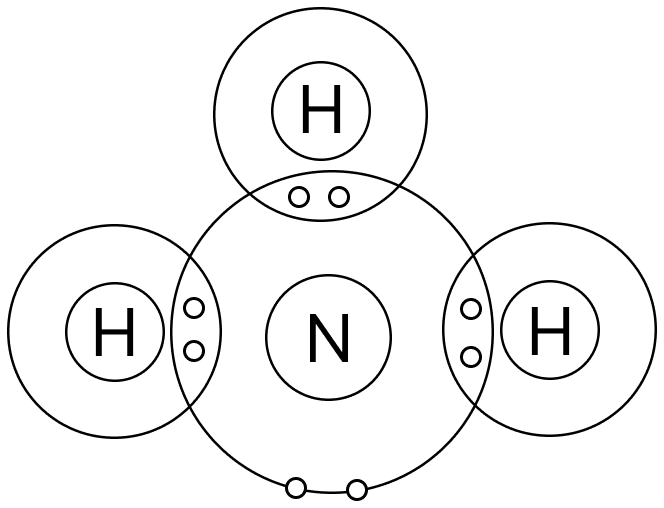
Answer the Following
State how the molecule differs from a water molecule with respect to:
(a) lone pair of electrons
(b) covalent bonds
(c) shared pair of electrons
Answer
(a) The molecule of ammonia differs from a water molecule with respect to lone pair of electrons as ammonia has one lone pair of electrons whereas water has two lone pairs of electrons.
(b) The molecule of ammonia differs from a water molecule with respect to covalent bonds as ammonia has three covalent bonds whereas water has two covalent bonds.
(c) The molecule of ammonia differs from a water molecule with respect to shared pair of electrons as ammonia has three shared pairs of electrons whereas water has two shared pairs of electrons.
Give balanced equations for the following conversions.
(a) Methane to an acidic gas which has no effect on acidified KMnO4 or K2Cr2O7 solution.
(b) Ammonium hydroxide to ammonium chloride.
Answer
(a) The acidic gas having no effect on acidified KMnO4 or K2Cr2O7 is carbon dioxide.
CH4 + 2O2 ⟶ CO2 + 2H2O
(b) Conversion of ammonium hydroxide to ammonium chloride:
NH4OH + HCl ⟶ NH4Cl + H2O
Select the correct answer from the words in brackets.
(a) The salt which has water of crystallisation in its molecule. [potassium sulphate, sodium nitrate, magnesium sulphate, lead chloride]
(b) The formation of hydrogen and oxygen from acidified water is an example of a/an — [photochemical reaction, electrochemical reaction, endothermic reaction].
(c) A reaction in which mercury [II] oxide breaks up on heating to give mercury and oxygen is an example of — [thermal dissociation, thermal decomposition, displacement reaction].
(d) A neutralization reaction between lead hydroxide and nitric acid results in formation of a/an — [soluble salt, insoluble salt].
(e) The soluble compound formed when excess sulphur dioxide gas is passed through lime water — [calcium sulphate, calcium bisulphite, calcium sulphite].
Answer
(a) Magnesium sulphate
(b) Electrochemical reaction
(c) Thermal decomposition
(d) Soluble salt
(e) Calcium bisulphite